

- Industry Size (2026)
- USD 301.6 Mn
- Forecast (2036)
- USD 550.4 Mn
- CAGR (2026 to 2036)
- 6.2%
Phospholipase Enzyme Market Size, Market Forecast and Outlook By FMI
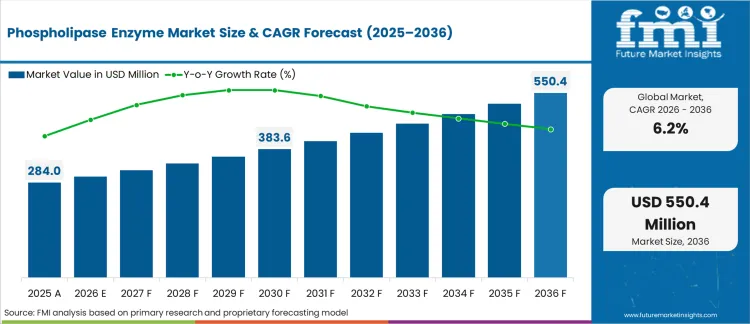
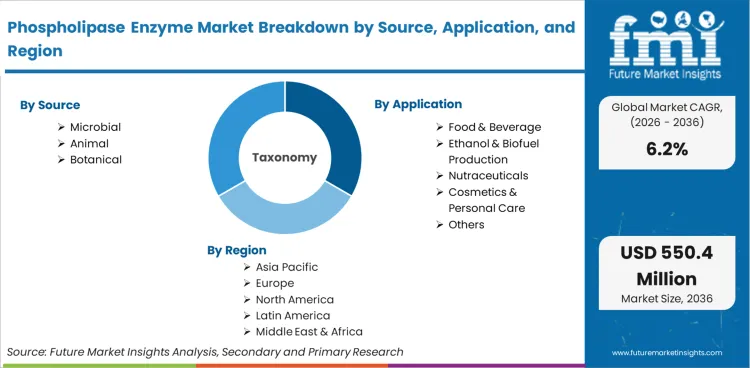
In 2025, the phospholipase enzyme market was valued at USD 284.0 million. Based on Future Market Insights’ analysis, demand for phospholipase enzyme is estimated to grow to USD 301.6 million in 2026 and USD 550.4 million by 2036. FMI projects a CAGR of 6.2% during the forecast period. As per FMI, absolute dollar growth of USD 248.8 million over the decade reflects steady expansion driven by regulatory, sustainability, and reformulation dynamics shaping procurement across major consuming economies.
As Ester Baiget, CEO of Novonesis, stated regarding Novonesis enzyme portfolio expansion, 'In 2025, we continued to deliver strong organic sales growth... 33 new product launches in 2025.' [1] In October 2025, BASF and IFF announced a strategic collaboration to accelerate the development of IFF's Designed Enzymatic Biomaterials (DEB) technology platform, focusing on next-generation enzyme technologies for fabric, dish, personal care, and industrial cleaning applications by combining BASF's chemical expertise with IFF's biotechnology and protein engineering. [2]
Summary of Phospholipase Enzyme Market
- Phospholipase Enzyme Market Definition
- The phospholipase enzyme market covers the global production, trade, and consumption of phospholipase enzymes (PLA1, PLA2, PLC, PLD) derived from microbial, animal, and botanical sources. These enzyme...
- Demand Drivers in the Market
- FMI analysts observe that regulatory and sustainability mandates are expanding the addressable market for certified and traceable phospholipase enzyme products across major consuming regions.
- Technology advancement and reformulation requirements are creating specification-grade demand segments that command pricing premiums above commodity alternatives.
- Regional compliance divergence is multiplying procurement complexity, forcing multinational buyers to maintain parallel sourcing and certification capabilities.
- Key Segments Analyzed in the FMI Report
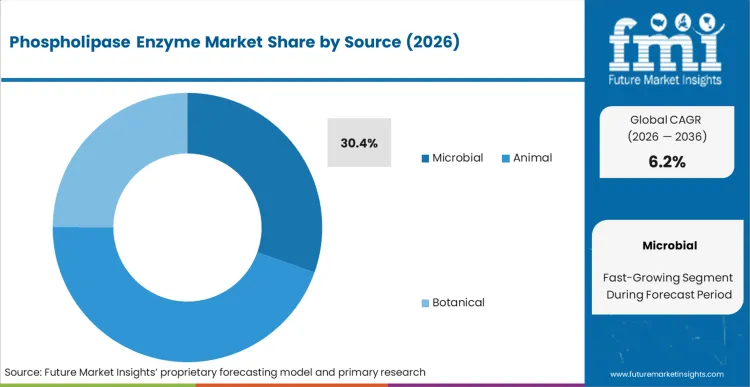
- As per FMI, microbial source holds 30.4% of market value in 2026.
- Microbial source holds 30.4% of market value in 2026, and food and beverage accounts for 30.1% of application demand.
- Analyst Opinion at FMI
- Nandini Roy Choudhury, Principal Consultant for Food & Beverage Industry at Future Market Insights, opines, 'In the updated version of the Phospholipase Enzyme Market Report for 2026 to 2036, CXOs will find that microbial phospholipase engineering is enabling substrate-specific enzyme variants that command 30 to 50% pricing premiums over crude preparations in vegetable oil degumming and biofuel applications. My findings also indicate that BASF's divestiture of its feed enzyme portfolio is creating supply chain uncertainty for customers dependent on BASF-sourced phospholipases, while Novonesis and DSM N.V. are consolidating enzyme platform ownership that concentrates R&D capability among fewer suppliers.'
- Strategic Implications / Executive Takeaways
- Invest in certification and traceability infrastructure to capture premiums in regulated markets.
- Diversify sourcing across at least two geographic regions to mitigate supply concentration and regulatory compliance risk.
- Build specification-grade capability rather than competing on commodity pricing as technology and regulatory shifts create value segmentation.
- Methodology
- Validated through first-hand interviews with producers, formulators, and procurement managers across 10+ countries.
- Zero reliance on speculative third-party market research reports.
- Based on verifiable trade data, production statistics, and plant-level capacity verification from primary disclosures.
China (7.7% CAGR) India (7.5% CAGR) The USA (5.8% CAGR) Brazil (5.1% CAGR) Japan (4.9% CAGR) are the key growth markets. Based on FMI’s report, Microbial source holds 30.4% of market value in 2026, and food and beverage accounts for 30.1% of application demand.
Phospholipase Enzyme Market Definition
The phospholipase enzyme market covers the global production, trade, and consumption of phospholipase enzymes (PLA1, PLA2, PLC, PLD) derived from microbial, animal, and botanical sources. These enzymes catalyze the hydrolysis of phospholipids and are used in food processing (oil degumming, egg yolk modification, dairy emulsification), ethanol and biofuel production, nutraceutical manufacturing, and cosmetics formulation.
Phospholipase Enzyme Market Inclusions
The report covers global and regional market sizes by volume and value with a 10-year forecast from 2026 to 2036. Segmental breakdowns include source (microbial, animal, botanical), application (food and beverage, ethanol and biofuel production, nutraceuticals, cosmetics and personal care), and geographic analysis across major producing and consuming regions.
Phospholipase Enzyme Market Exclusions
The scope excludes general-purpose lipase enzymes that do not specifically target phospholipid substrates. Pharmaceutical-grade phospholipase preparations used in clinical diagnostics or therapeutic applications are not included unless produced from the same microbial fermentation platforms serving industrial applications.
Phospholipase Enzyme Market Research Methodology
- Primary Research: Interviews were conducted with producers, distributors, formulators, and procurement managers across major regions.
- Desk Research: Production and trade data from national agencies, FAO, UN Comtrade, and industry associations supported volume benchmarking.
- Market-Sizing and Forecasting: A hybrid top-down and bottom-up model was developed, validated against plant-level capacities and trade flows.
- Data Validation and Update Cycle: Outputs undergo anomaly screening, variance checks, and structured peer review prior to release.
Key Industry Highlights
Increasing Demand for High-quality Bakery Products is anticipated to Fuel the Phospholipase Enzyme Market.
Consumers are becoming more concerned with health and well-being, seeking bakery products that are low in fat, free of artificial ingredients, and high in nutrients. Phospholipase enzymes allow producers to minimize or eliminate synthetic emulsifiers in their formulations, resulting in cleaner-label products that appeal to health-conscious consumers.
Furthermore, these enzymes aid in the development of low-fat bread products by enhancing dough texture without a demand for added fats.
As people's lives become busier, the demand for quick and easy ready-to-eat bakery products such as packaged bread, muffins, and croissants has increased. Phospholipase enzymes increase the shelf life of these products by delaying staling and preserving freshness, making them more desirable for modern consumers.
Furthermore, Novozymes A/S (a subsidiary of Novonesis) operates with local clients and collaborators in various regions across Africa, such as dough improvers, baking consumers, flour mills, and partnered food manufacturers, to enhance its flour with specific enzymes and provide opportunities to meet the increasing demand from consumers and the baking industry.
Rising Demand for Cheese is expected to boost the Sales of Phospholipase Enzyme.
The increasing demand for cheese is being driven by changing dietary patterns, growing urbanization, and the expanding popularity of Western cuisines is creating a significant need for phospholipase enzymes globally. Phospholipase enzyme plays an essential role in cheese production and holds several advantages, including increased production speed, texture, taste, and cost-effectiveness.
The utilization of phospholipase enzymes is developing as cheese remains a key component of processed foods and numerous cooking cultures. This provides manufacturers with a competitive advantage in terms of quality, sustainability, and profitability.
The increasing per capita consumption of cheese makes it necessary for the manufacturers to increase the yield and quality of cheese to fulfill the requirements of the consumers. Thus, the demand for phospholipase is estimated to increase as it helps in the hydrolysis of phospholipids and improves the yield of cheese. It also aids in reducing the environmental impact that occurs due to cheese production.
Advancements in Enzyme Engineering and Biotechnology: Catalyzing Growth in the Phospholipase Enzyme Market
The market for phospholipase enzymes has been transformed by developments in enzyme engineering and biotechnology. Hydrolyzed phospholipids enzyme usage is driving innovation and increasing usage of this type of enzyme in industries such as pharmaceuticals, food & beverage, biofuels, and industrial.
The development of more efficient, stable, and affordable enzymes for various applications is now promising owing to advancements in enzyme engineering and biotechnological techniques. The enhancements not only boost the efficiency of phospholipase enzyme but also facilitate sustainable and adaptable production, opening up new market opportunities.
2021 to 2025 Global Phospholipase Enzyme Sales Analysis Compared to Demand Forecasts for 2026 to 2036
Global sales increased at a CAGR of 5.7% from 2021 to 2025. For the next ten years (2026 to 2036), projections are that expenditure on such products will rise at 6.2% CAGR.
Between 2021 to 2025 key industries, notably food processing, demonstrated high demand for phospholipase enzymes owing to their role in enhancing emulsification, increasing dairy and bread product quality, and optimizing fat utilization in cheese manufacturing.
Europe and North America led the market due to their advanced food-processing industries and strong regulatory frameworks that support the use of enzyme-based products. Meanwhile, developing economies in Latin America and the Asia Pacific had great economic potential owing to growing industrialization and expanded consumer markets.
From the year 2026 to 2036, the growing global emphasis on sustainability and green technology is predicted to increase the adoption of enzymatic solutions, such as phospholipase enzymes, as the industry prioritizes waste reduction and efficiency.
In the food and beverage industry, the continued trend toward plant-based and functional food items, along with advancements in enzyme engineering, will open up new market prospects. Furthermore, the biofuel sector, which has expressed an increased interest in enzymatic solutions for biodiesel generation, is projected to be a substantial driver of demand.
Market Concentration
Tier 1 Companies are referred to as the major players of the industry as they are fully established worldwide with majority shares of the business ecosystem. Industry leaders always lead the level of creativity, research, and development and most of the time are the trendsetters.
The companies are concentrating their research & development (R&D) efforts on the development of innovations in molecular biology, and enzyme engineering. As a result, numerous organic strategies have been implemented in the market, such as new product developments and capacity expansions.
Tier 2 Companies are the regional players with adequate market coverage and are known for offering niche products. They are typically more localized and address specific issues of more general ones.
Tier 3 Companies are smaller players who are usually limited to the local or regional areas. They tend to service localized areas and do not possess the same level of R&D as bigger companies but are nonetheless helpful in satisfying local needs.
These companies are smaller in size but remain strong in their target industries owing to their deep-rooted innovations and customer service.
Regional Analysis
Based on the regional analysis, the phospholipase enzyme market is segmented across 30+ countries. The full report also offers market attractiveness analysis based on regional trends.
.webp "Top Country Growth Comparison Phospholipase Enzyme Market Cagr (2026 2036)")
| Country | CAGR (2026 to 2036) |
|---|---|
| China | 7.7% |
| India | 7.5% |
| The USA | 5.8% |
| Brazil | 5.1% |
| Japan | 4.9% |
Source: Future Market Insights (FMI) analysis, based on proprietary forecasting model and primary research
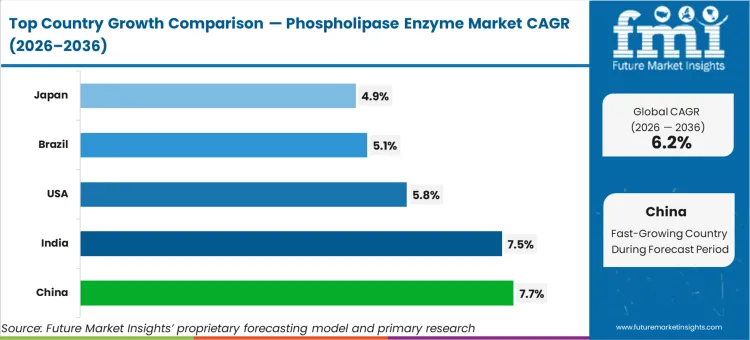
China
Demand for phospholipase enzymes in China is projected to rise at 7.7% CAGR through 2036. China's vegetable oil refining industry, the world's largest, is the primary demand driver for phospholipase used in enzymatic degumming of soybean, rapeseed, and palm oils. Sunson Industry Group, based in Cangzhou, Hebei, holds approximately 16% global market share and operates the largest microbial enzyme fermentation facility dedicated to phospholipase production in Asia. The Ministry of Science and Technology's 14th Five-Year Plan includes enzyme technology as a priority area for bio-manufacturing, supporting domestic R&D investment in engineered phospholipase variants with improved substrate specificity for food and biofuel applications.
India
Demand for phospholipase enzymes in India is projected to rise at 7.5% CAGR through 2036. India's expanding edible oil refining capacity, particularly soybean and mustard oil processing in Madhya Pradesh, Rajasthan, and Gujarat, is driving adoption of enzymatic degumming to reduce phospholipid content and improve refined oil yields. Advanced Enzyme Technologies, headquartered in Thane, Maharashtra, produces phospholipase preparations for food, feed, and nutraceutical applications through its microbial fermentation platforms. FSSAI's food processing modernization initiatives encourage enzyme-based processing technologies that reduce chemical reagent use in oil refining.
The USA
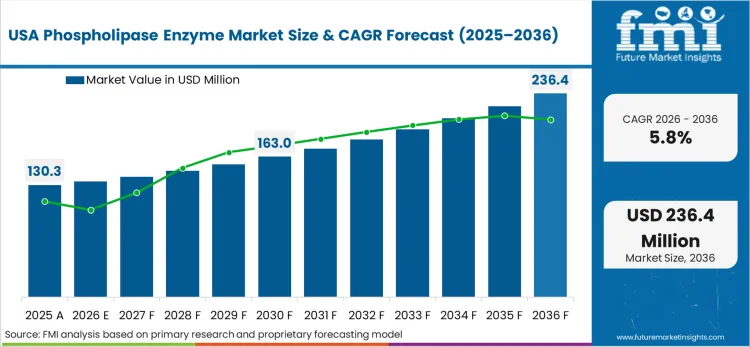
Demand for phospholipase enzymes in the USA is projected to rise at 5.8% CAGR through 2036. The US biofuel industry, supported by Renewable Fuel Standard (RFS) mandates, uses phospholipase in corn ethanol and biodiesel production to improve process yields and reduce phospholipid fouling in distillation equipment. DuPont de Nemours (now IFF Nutrition and Biosciences) and Kerry Group supply phospholipase preparations for food processing and biofuel applications from US production facilities. The FDA's GRAS framework covers microbial phospholipase preparations used in food processing, supporting broad adoption in oil refining, egg yolk modification, and dairy applications.
Japan
Demand for phospholipase enzymes in Japan is projected to grow at 4.9% CAGR through 2036. Japan's specialty food processing industry uses phospholipase for lecithin modification in chocolate, bakery, and dairy applications where precise emulsification properties are required. Amano Enzyme Inc., headquartered in Nagoya, is a leading global supplier of specialty phospholipase preparations with engineered substrate specificity for food and pharmaceutical applications. Sanyo Fine Co. supplies phospholipase for cosmetics and personal care formulations where phospholipid modification improves skin absorption and product stability.
Brazil
Demand for phospholipase enzymes in Brazil is projected to grow at 5.1% CAGR through 2036. Brazil's soybean crushing industry, the world's second-largest, is increasingly adopting enzymatic degumming to improve refined soybean oil yields and reduce water degumming waste. Novonesis (formerly Novozymes) supplies phospholipase preparations to Brazilian oil refiners through its Latin American distribution network. Brazil's ethanol industry, the world's second-largest, is evaluating phospholipase application in corn ethanol production facilities expanding in Mato Grosso and Goias states.
FMI’s analysis of the phospholipase enzyme market consists of country-wise assessment across all major economies. Readers can find regional trends, regulations, pricing dynamics, and demand drivers.
Category-Wise Insights
Innovation in the Food & Beverage Sector Pushing the Application Segment for Higher Sales
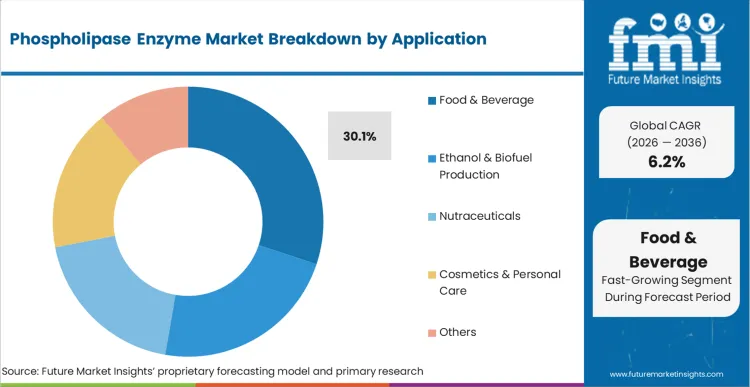
| Segment | Bakery & Confectionery (By Application) |
|---|---|
| Value Share (2026) | 30.1% |
This expansion is fueled by increased consumer demand for high-quality, functional, and clean-label food items. In the baking business, phospholipase enzymes increase dough stability and shelf life, whereas in dairy, they improve cheese output and texture.
The growing popularity of plant-based diets drives demand for these enzymes, which aid in emulsification and fat breakdown in dairy and meat replacements. Furthermore, the move toward more sustainable manufacturing techniques, such as enzymatic degumming in edible oil refining, is driving expansion in this market.
Adoption of Microbial Phospholipase Enzymes Augmented the Source Sales
| Segment | Microbial (By Source) |
|---|---|
| Value Share (2026) | 30.4% |
The microbial segment is expected to dominate the Phospholipase Enzyme market during the forecast period, owing to its extensive application across industries, and environmental sustainability. Microbial phospholipase is important in the bread industry as it improves dough stability and crumb structure, and prolongs the shelf life of baked products.
Its organic appearance is consistent with the rising demand for clean-label and less processed products, making it an appealing option for both industrial bakers and artisanal manufacturers. Furthermore, the enzyme reduces the need for synthetic emulsifiers, which aids manufacturers' attempts to develop healthier and more sustainable products.
Competitive Aligners for Market Players
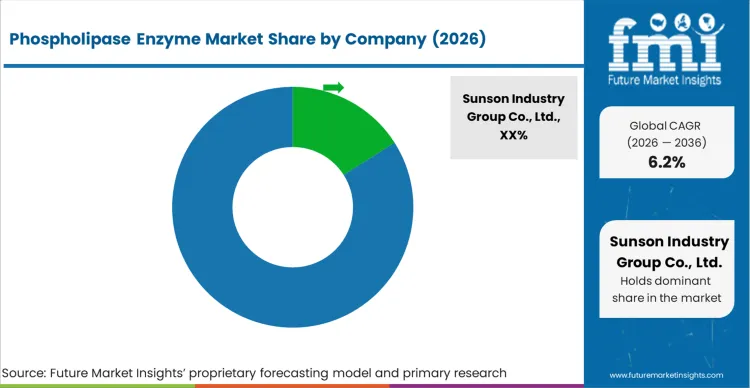
Sunson Industry Group holds approximately 16% market share, leveraging integrated operations across sourcing, processing, and distribution. Competition is defined by certification capability, supply chain traceability, and formulation service differentiation.
Buyer leverage varies by end-use segment. Large manufacturers negotiate volume contracts with formula-based pricing, while specification-grade buyers pay fixed premiums for certified or specialty grades. Contract structures increasingly tie pricing to commodity indices.
Recent Developments
The report includes full coverage of recent trends from competitive benchmarking. Some of the recent developments covered in the reports:
- In October 2025, BASF and IFF announced a strategic collaboration to accelerate the development of IFF's Designed Enzymatic Biomaterials (DEB) technology platform, focusing on next-generation enzyme technologies for fabric, dish, personal care, and industrial cleaning applications by combining BASF's chemical expertise with IFF's biotechnology and protein engineering. [2]
- In July 2025, BASF expanded its liquid enzyme portfolio with the launch of Lavergy L Pace, a high-performance liquid lipase designed for the detergent industry to provide superior fat and oil stain removal at low wash temperatures, as part of BASF's strategy to provide a comprehensive range of liquid enzymes for sustainable laundry formulations. [3]
Key Players in Phospholipase Enzyme Market
- Sunson Industry Group Co. Ltd
- EUCODIS Bioscience GmbH
- BASF SE
- Kerry Group
- Kemin Industries
- Amano Enzyme Inc.
- Advanced Enzyme Technologies
- Bioseutica B.V.
- Sanyo Fine Co. Ltd
- DSM N.V.
- DuPont de Nemours Inc.
- AB Enzymes GmbH
- Aumgene Biosciences
- Merck KGaA
- Novonesis
Scope of the Report
| Metric | Value |
|---|---|
| Quantitative Units | USD 301.6 million (2026) to USD 550.4 million (2036), at a CAGR of 6.2% |
| Forecast Period | 2026 to 2036 |
| Approach | Hybrid top-down and bottom-up market modeling validated through primary interviews, supported by trade data benchmarking and capacity verification |
Phospholipase Enzyme Market Analysis by Segments
By Source:
Microbial, Animal, and Botanical
By Application:
Food and Beverage, Ethanol and Biofuel Production, Nutraceuticals, Cosmetics and Personal Care, and Others
Bibliography
- [1] Novonesis. (2025). Annual results and 33 new product launches in 2025. Corporate Investor Communication.
- [2] BASF. (2025). BASF and IFF announce strategic collaboration on Designed Enzymatic Biomaterials. Corporate Press Release, October 2025.
- [3] BASF. (2025). BASF launches Lavergy L Pace liquid lipase for detergent industry. Corporate Press Release, July 2025.
This Report Addresses
- Market intelligence to enable structured strategic decision making across mature and emerging phospholipase enzyme economies
- Market size estimation and 10-year revenue forecasts from 2026 to 2036
- Growth opportunity mapping across key segments
- Segment and regional revenue forecasts
- Competition strategy assessment
- Regulatory impact analysis
- Market report delivery in PDF, Excel, PPT, and interactive dashboard formats
Frequently Asked Questions
How large is the demand for phospholipase enzyme in the global market in 2026?
Demand for phospholipase enzyme in the global market is estimated to be valued at USD 301.6 million in 2026.
What will be the market size of phospholipase enzyme by 2036?
Market size for phospholipase enzyme is projected to reach USD 550.4 million by 2036.
What is the expected CAGR for phospholipase enzyme between 2026 and 2036?
Demand is expected to grow at a CAGR of 6.2% between 2026 and 2036.
Which segment leads the phospholipase enzyme market in 2026?
Microbial Source is expected to lead, capturing approximately 30.4% of global market share in 2026.
What is the growth outlook for China in the phospholipase enzyme market?
China is projected to grow at a CAGR of 7.7% during 2026 to 2036.
What is the growth outlook for India in the phospholipase enzyme market?
India is projected to grow at a CAGR of 7.5% during 2026 to 2036.
What is the growth outlook for The USA in the phospholipase enzyme market?
The USA is projected to grow at a CAGR of 5.8% during 2026 to 2036.
What is the growth outlook for Brazil in the phospholipase enzyme market?
Brazil is projected to grow at a CAGR of 5.1% during 2026 to 2036.
What is phospholipase enzyme market in this report?
The phospholipase enzyme market covers the global production, trade, and consumption of phospholipase enzymes (PLA1, PLA2, PLC, PLD) derived from microbial, animal, and botanical sources. These enzyme.
How does FMI build and validate the forecast?
Forecast is developed using hybrid top-down and bottom-up modeling validated through trade data, production statistics, and structured industry review.
Preview the report firsthand - request a free sample
Get SampleGet the brochure for pricing and purchase details.
Get PDFTable of Content
- Executive Summary
- Global Market Outlook
- Demand-side Trends
- Supply-side Trends
- Technology Roadmap Analysis
- Analysis and Recommendations
- Market Overview
- Market Coverage / Taxonomy
- Market Definition / Scope / Limitations
- Research Methodology
- Chapter Orientation
- Analytical Lens and Working Hypotheses
- Market Structure, Signals, and Trend Drivers
- Benchmarking and Cross-market Comparability
- Market Sizing, Forecasting, and Opportunity Mapping
- Research Design and Evidence Framework
- Desk Research Programme (Secondary Evidence)
- Company Annual and Sustainability Reports
- Peer-reviewed Journals and Academic Literature
- Corporate Websites, Product Literature, and Technical Notes
- Earnings Decks and Investor Briefings
- Statutory Filings and Regulatory Disclosures
- Technical White Papers and Standards Notes
- Trade Journals, Industry Magazines, and Analyst Briefs
- Conference Proceedings, Webinars, and Seminar Materials
- Government Statistics Portals and Public Data Releases
- Press Releases and Reputable Media Coverage
- Specialist Newsletters and Curated Briefings
- Sector Databases and Reference Repositories
- FMI Internal Proprietary Databases and Historical Market Datasets
- Subscription Datasets and Paid Sources
- Social Channels, Communities, and Digital Listening Inputs
- Additional Desk Sources
- Expert Input and Fieldwork (Primary Evidence)
- Primary Modes
- Qualitative Interviews and Expert Elicitation
- Quantitative Surveys and Structured Data Capture
- Blended Approach
- Why Primary Evidence is Used
- Field Techniques
- Interviews
- Surveys
- Focus Groups
- Observational and In-context Research
- Social and Community Interactions
- Stakeholder Universe Engaged
- C-suite Leaders
- Board Members
- Presidents and Vice Presidents
- R&D and Innovation Heads
- Technical Specialists
- Domain Subject-matter Experts
- Scientists
- Physicians and Other Healthcare Professionals
- Governance, Ethics, and Data Stewardship
- Research Ethics
- Data Integrity and Handling
- Primary Modes
- Tooling, Models, and Reference Databases
- Desk Research Programme (Secondary Evidence)
- Data Engineering and Model Build
- Data Acquisition and Ingestion
- Cleaning, Normalisation, and Verification
- Synthesis, Triangulation, and Analysis
- Quality Assurance and Audit Trail
- Market Background
- Market Dynamics
- Drivers
- Restraints
- Opportunity
- Trends
- Scenario Forecast
- Demand in Optimistic Scenario
- Demand in Likely Scenario
- Demand in Conservative Scenario
- Opportunity Map Analysis
- Product Life Cycle Analysis
- Supply Chain Analysis
- Investment Feasibility Matrix
- Value Chain Analysis
- PESTLE and Porter’s Analysis
- Regulatory Landscape
- Regional Parent Market Outlook
- Production and Consumption Statistics
- Import and Export Statistics
- Market Dynamics
- Global Market Analysis 2021 to 2025 and Forecast, 2026 to 2036
- Historical Market Size Value (USD Million) Analysis, 2021 to 2025
- Current and Future Market Size Value (USD Million) Projections, 2026 to 2036
- Y-o-Y Growth Trend Analysis
- Absolute $ Opportunity Analysis
- Global Market Pricing Analysis 2021 to 2025 and Forecast 2026 to 2036
- Global Market Analysis 2021 to 2025 and Forecast 2026 to 2036, By Source
- Introduction / Key Findings
- Historical Market Size Value (USD Million) Analysis By Source , 2021 to 2025
- Current and Future Market Size Value (USD Million) Analysis and Forecast By Source , 2026 to 2036
- Microbial
- Animal
- Botanical
- Microbial
- Y-o-Y Growth Trend Analysis By Source , 2021 to 2025
- Absolute $ Opportunity Analysis By Source , 2026 to 2036
- Global Market Analysis 2021 to 2025 and Forecast 2026 to 2036, By Application
- Introduction / Key Findings
- Historical Market Size Value (USD Million) Analysis By Application, 2021 to 2025
- Current and Future Market Size Value (USD Million) Analysis and Forecast By Application, 2026 to 2036
- Food & Beverage
- Ethanol & Biofuel Production
- Nutraceuticals
- Cosmetics & Personal Care
- Others
- Food & Beverage
- Y-o-Y Growth Trend Analysis By Application, 2021 to 2025
- Absolute $ Opportunity Analysis By Application, 2026 to 2036
- Global Market Analysis 2021 to 2025 and Forecast 2026 to 2036, By Region
- Introduction
- Historical Market Size Value (USD Million) Analysis By Region, 2021 to 2025
- Current Market Size Value (USD Million) Analysis and Forecast By Region, 2026 to 2036
- North America
- Latin America
- Western Europe
- Eastern Europe
- East Asia
- South Asia and Pacific
- Middle East & Africa
- Market Attractiveness Analysis By Region
- North America Market Analysis 2021 to 2025 and Forecast 2026 to 2036, By Country
- Historical Market Size Value (USD Million) Trend Analysis By Market Taxonomy, 2021 to 2025
- Market Size Value (USD Million) Forecast By Market Taxonomy, 2026 to 2036
- By Country
- USA
- Canada
- Mexico
- By Source
- By Application
- By Country
- Market Attractiveness Analysis
- By Country
- By Source
- By Application
- Key Takeaways
- Latin America Market Analysis 2021 to 2025 and Forecast 2026 to 2036, By Country
- Historical Market Size Value (USD Million) Trend Analysis By Market Taxonomy, 2021 to 2025
- Market Size Value (USD Million) Forecast By Market Taxonomy, 2026 to 2036
- By Country
- Brazil
- Chile
- Rest of Latin America
- By Source
- By Application
- By Country
- Market Attractiveness Analysis
- By Country
- By Source
- By Application
- Key Takeaways
- Western Europe Market Analysis 2021 to 2025 and Forecast 2026 to 2036, By Country
- Historical Market Size Value (USD Million) Trend Analysis By Market Taxonomy, 2021 to 2025
- Market Size Value (USD Million) Forecast By Market Taxonomy, 2026 to 2036
- By Country
- Germany
- UK
- Italy
- Spain
- France
- Nordic
- BENELUX
- Rest of Western Europe
- By Source
- By Application
- By Country
- Market Attractiveness Analysis
- By Country
- By Source
- By Application
- Key Takeaways
- Eastern Europe Market Analysis 2021 to 2025 and Forecast 2026 to 2036, By Country
- Historical Market Size Value (USD Million) Trend Analysis By Market Taxonomy, 2021 to 2025
- Market Size Value (USD Million) Forecast By Market Taxonomy, 2026 to 2036
- By Country
- Russia
- Poland
- Hungary
- Balkan & Baltic
- Rest of Eastern Europe
- By Source
- By Application
- By Country
- Market Attractiveness Analysis
- By Country
- By Source
- By Application
- Key Takeaways
- East Asia Market Analysis 2021 to 2025 and Forecast 2026 to 2036, By Country
- Historical Market Size Value (USD Million) Trend Analysis By Market Taxonomy, 2021 to 2025
- Market Size Value (USD Million) Forecast By Market Taxonomy, 2026 to 2036
- By Country
- China
- Japan
- South Korea
- By Source
- By Application
- By Country
- Market Attractiveness Analysis
- By Country
- By Source
- By Application
- Key Takeaways
- South Asia and Pacific Market Analysis 2021 to 2025 and Forecast 2026 to 2036, By Country
- Historical Market Size Value (USD Million) Trend Analysis By Market Taxonomy, 2021 to 2025
- Market Size Value (USD Million) Forecast By Market Taxonomy, 2026 to 2036
- By Country
- India
- ASEAN
- Australia & New Zealand
- Rest of South Asia and Pacific
- By Source
- By Application
- By Country
- Market Attractiveness Analysis
- By Country
- By Source
- By Application
- Key Takeaways
- Middle East & Africa Market Analysis 2021 to 2025 and Forecast 2026 to 2036, By Country
- Historical Market Size Value (USD Million) Trend Analysis By Market Taxonomy, 2021 to 2025
- Market Size Value (USD Million) Forecast By Market Taxonomy, 2026 to 2036
- By Country
- Kingdom of Saudi Arabia
- Other GCC Countries
- Turkiye
- South Africa
- Other African Union
- Rest of Middle East & Africa
- By Source
- By Application
- By Country
- Market Attractiveness Analysis
- By Country
- By Source
- By Application
- Key Takeaways
- Key Countries Market Analysis
- USA
- Pricing Analysis
- Market Share Analysis, 2025
- By Source
- By Application
- Canada
- Pricing Analysis
- Market Share Analysis, 2025
- By Source
- By Application
- Mexico
- Pricing Analysis
- Market Share Analysis, 2025
- By Source
- By Application
- Brazil
- Pricing Analysis
- Market Share Analysis, 2025
- By Source
- By Application
- Chile
- Pricing Analysis
- Market Share Analysis, 2025
- By Source
- By Application
- Germany
- Pricing Analysis
- Market Share Analysis, 2025
- By Source
- By Application
- UK
- Pricing Analysis
- Market Share Analysis, 2025
- By Source
- By Application
- Italy
- Pricing Analysis
- Market Share Analysis, 2025
- By Source
- By Application
- Spain
- Pricing Analysis
- Market Share Analysis, 2025
- By Source
- By Application
- France
- Pricing Analysis
- Market Share Analysis, 2025
- By Source
- By Application
- India
- Pricing Analysis
- Market Share Analysis, 2025
- By Source
- By Application
- ASEAN
- Pricing Analysis
- Market Share Analysis, 2025
- By Source
- By Application
- Australia & New Zealand
- Pricing Analysis
- Market Share Analysis, 2025
- By Source
- By Application
- China
- Pricing Analysis
- Market Share Analysis, 2025
- By Source
- By Application
- Japan
- Pricing Analysis
- Market Share Analysis, 2025
- By Source
- By Application
- South Korea
- Pricing Analysis
- Market Share Analysis, 2025
- By Source
- By Application
- Russia
- Pricing Analysis
- Market Share Analysis, 2025
- By Source
- By Application
- Poland
- Pricing Analysis
- Market Share Analysis, 2025
- By Source
- By Application
- Hungary
- Pricing Analysis
- Market Share Analysis, 2025
- By Source
- By Application
- Kingdom of Saudi Arabia
- Pricing Analysis
- Market Share Analysis, 2025
- By Source
- By Application
- Turkiye
- Pricing Analysis
- Market Share Analysis, 2025
- By Source
- By Application
- South Africa
- Pricing Analysis
- Market Share Analysis, 2025
- By Source
- By Application
- USA
- Market Structure Analysis
- Competition Dashboard
- Competition Benchmarking
- Market Share Analysis of Top Players
- By Regional
- By Source
- By Application
- Competition Analysis
- Competition Deep Dive
- Sunson Industry Group Co., Ltd.
- Overview
- Product Portfolio
- Profitability by Market Segments (Product/Age /Sales Channel/Region)
- Sales Footprint
- Strategy Overview
- Marketing Strategy
- Product Strategy
- Channel Strategy
- EUCODIS Bioscience GmbH
- BASF SE
- Kerry Group
- Kemin Industries
- Amano Enzyme Inc.
- Advanced Enzyme Technologies
- Bioseutica B.V.
- Sanyo Fine Co., Ltd.
- DSM N.V.
- DuPont de Nemours, Inc.
- AB Enzymes GmbH
- Aumgene Biosciences
- Merck KGaA
- Novonesis
- Others
- Sunson Industry Group Co., Ltd.
- Competition Deep Dive
- Assumptions & Acronyms Used


