

- Industry Size (2026)
- USD 1.6 Bn
- Forecast (2036)
- USD 5.2 Bn
- CAGR (2026 to 2036)
- 12.5%
Enzyme Cloud Creams Market Forecast and Outlook 2026 to 2036
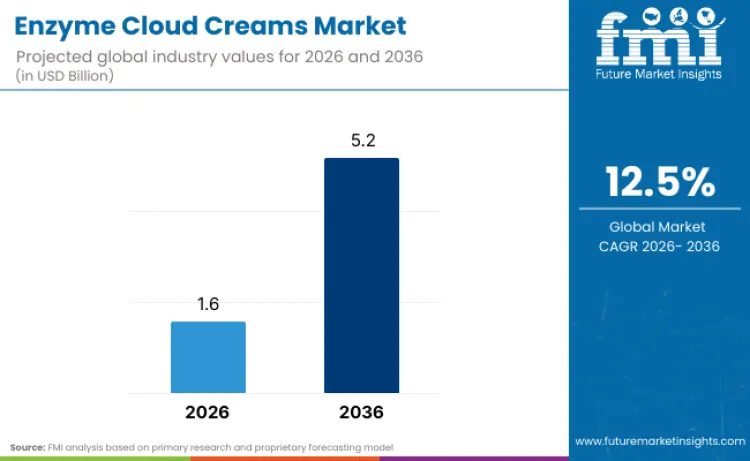
The global enzyme cloud creams sector is on track to achieve a valuation of USD 5.2 billion by 2036, accelerating from USD 1.6 billion in 2026 at a CAGR of 12.5%. As per Future Market Insights, expansion is structurally underpinned by consumer demand for gentle exfoliation alternatives that address skin sensitivity concerns associated with glycolic acid and retinoid treatments which frequently cause irritation and compromise skin barrier integrity. DECIEM, the parent company of The Ordinary skincare brand, noted in public statements that enzyme-based formulations represent a category experiencing substantial consumer interest, with the company highlighting that enzymatic exfoliants offer effective surface renewal without the inflammation response typical of high-concentration AHA formulations, though specific enzyme product revenue was not disclosed separately within the broader functional skincare portfolio.
This consumer preference for gentle biochemical exfoliation compels manufacturers to invest in enzyme sourcing from fermentation biotechnology rather than plant extraction, as microbially-produced proteases and lipases deliver consistent activity levels and purity specifications that natural fruit enzyme extracts cannot match due to seasonal variability and contamination risks. Simultaneously the formulation landscape is shifting from rinse-off enzyme masks applied weekly to leave-on enzyme creams used daily, creating technical challenges where formulators must balance sufficient enzyme concentration for visible results against activity levels that avoid over-exfoliation from cumulative exposure.
The operational reality for cosmetics manufacturers is defined by the need to stabilize enzyme proteins within cream bases where pH levels, preservative systems, and emulsifier choices can denature biological activity and render products ineffective despite enzyme inclusion on ingredient labels. European Union cosmetics regulations under Regulation (EC) No 1223/2009 require functional ingredient substantiation, creating compliance pressure to demonstrate that enzyme formulations deliver claimed exfoliation benefits through clinical efficacy testing rather than relying solely on ingredient presence. This regulatory environment is accelerating R&D investment in enzyme encapsulation technologies including liposomal delivery and microencapsulation that protect proteins from degradation while controlling release rates that prevent excessive keratolytic activity.
Summary of the Enzyme Cloud Creams Market
What Is Growth Outlook for Enzyme Cloud Creams Market as per Future Market Insights Projection?
Future Market Insights projects the enzyme cloud creams market to expand at a CAGR of 12.5% from 2026 to 2036, increasing from USD 1.6 Billion in 2026 to USD 5.2 Billion by 2036.
FMI Research Approach: FMI proprietary forecasting model based on enzymatic skincare adoption trajectories, gentle exfoliation category growth analysis, and biotechnology enzyme production cost curves that enable commercial formulation viability.
How Do FMI Analysts Perceive Enzyme Cloud Creams Market to Evolve?
FMI analysts perceive the market evolving toward multi-enzyme formulations, where combinations of protease, lipase, and amylase provide broader exfoliation by targeting protein, lipid, and polysaccharide bonds, moving beyond single-function actives.
FMI Research Approach: Skincare ingredient innovation tracking and biotechnology application analysis in cosmetic formulations, examining enzyme specificity and synergistic combination effects.
Which Country Holds Largest Share in Global Enzyme Cloud Creams Market?
China holds a significant share of the global enzyme cloud creams market by value, supported by strong cultural alignment with gentle exfoliation using rice enzyme and fruit ferment formulations.
FMI Research Approach: FMI country-level revenue modeling by enzymatic skincare penetration rates, K-beauty and J-beauty influence on Chinese cosmetics trends, and domestic enzyme ingredient production capacity.
How Large Will Enzyme Cloud Creams Market Be by 2036?
The global enzyme cloud creams market is projected to reach USD 5.2 Billion by 2036.
FMI Research Approach: FMI long-term revenue forecast derived from sensitive skin population growth, retinoid intolerance rates, enzyme production biotechnology cost reduction projections, and clean beauty movement momentum favoring biological actives.
What Is Definition of Enzyme Cloud Creams Market?
The enzyme cloud creams market comprises lightweight facial moisturizers formulated with proteolytic, lipolytic, or amylolytic enzymes that gently exfoliate dead skin cells by breaking down intercellular adhesion molecules, without mechanical or chemical irritation.
FMI Research Approach: FMI market taxonomy and inclusion-exclusion framework aligned with functional skincare classification and enzyme cosmetics industry standards distinguishing leave-on enzyme creams from rinse-off enzyme masks and cleansers.
What Are Globally Unique Trends Shaping Enzyme Cloud Creams Market?
Globally unique trends include temperature-stable enzymes via directed evolution, microbiome-derived exfoliating actives, and pH-triggered encapsulation that activates on skin contact to localize enzymatic activity and extend shelf life.
FMI Research Approach: Biotechnology enzyme engineering trend analysis and cosmetic ingredient technology monitoring examining next-generation enzyme stabilization and controlled-release formulation advances.
Enzyme Cloud Creams Market Key Takeaways
| Metric | Details |
|---|---|
| Industry Size (2026) | USD 1.6 Billion |
| Industry Value (2036) | USD 5.2 Billion |
| CAGR (2026-2036) | 12.5% |
Source: Future Market Insights (FMI) analysis, based on proprietary forecasting model and primary research
Which Factors Propel Adoption of Enzyme Cloud Creams?
Retinoid intolerance among sensitive skin consumers serves as the primary catalyst for enzyme cloud cream adoption, as dermatological research published in the Journal of Clinical and Aesthetic Dermatology documents that 30-40% of retinoid users discontinue treatment due to irritation, dryness, and peeling side effects that compromise quality of life despite anti-aging efficacy. This substantial treatment abandonment creates addressable markets for alternative exfoliation approaches that deliver visible skin texture improvement without inflammation. Enzyme formulations targeting this population position themselves as gentle efficacy solutions where protease enzymes selectively digest desmosomal proteins linking corneocytes without penetrating viable epidermis or triggering inflammatory cascades associated with retinoid receptor activation.
Clean beauty movement momentum is accelerating enzyme cream adoption as consumer preference shifts from synthetic alpha hydroxy acids and beta hydroxy acids toward plant-derived and biotechnology-produced ingredients perceived as natural alternatives. The term enzyme carries biological associations that align with clean beauty positioning, despite most commercial cosmetic enzymes being produced through industrial fermentation identical to pharmaceutical protein manufacturing. Marketing narratives emphasizing papaya enzyme, pumpkin enzyme, and rice ferment create botanical associations that obscure biotechnology origins while meeting consumer demand for recognizable ingredient names. This perception gap is enabling brands to command premium pricing for enzyme products positioned as natural alternatives to chemical exfoliants, despite comparable manufacturing complexity and production costs.
Dermatologist recommendations are amplifying enzyme cream adoption among rosacea and eczema patients requiring exfoliation to address texture concerns but unable to tolerate conventional treatments that exacerbate underlying inflammatory conditions. Clinical experience demonstrates that properly formulated enzyme creams deliver stratum corneum renewal without triggering vasodilation, pruritus, or barrier disruption that characterize adverse responses to glycolic acid and salicylic acid in compromised skin. This professional endorsement is legitimizing enzyme exfoliation beyond cosmetic efficacy into therapeutic skincare where dermatology practices recommend specific enzyme products as medical-grade alternatives. Paula's Choice, a clinically-focused skincare brand, developed enzyme formulations specifically for sensitive skin populations unable to use traditional exfoliants, demonstrating industry recognition of this unmet clinical need.
How is the Enzyme Cloud Creams Market Segmented?
The enzyme cloud creams market is segmented by product type, enzyme type, skin type, distribution channel, end user, and region to reflect the convergence of dermatology science and mass-premium skincare adoption. By product type, the market includes moisturizing enzyme creams, brightening enzyme creams, anti-aging enzyme creams, and repair and recovery enzyme creams, which address hydration, exfoliation, renewal, and post-stress skin repair needs. By enzyme type, formulations are categorized into protease-based, lipase-based, amylase-based, and multi-enzyme systems, highlighting the growing role of enzymatic specificity in gentle exfoliation and barrier-friendly skin renewal.
By skin type, demand spans sensitive, dry, oily, and combination skin, reflecting the positioning of enzyme creams as low-irritation alternatives to acid-based actives. By distribution channel, adoption is led by online retail, followed by specialty beauty stores, pharmacies and drug stores, and mass retail formats, underscoring the importance of education-led digital commerce alongside professional credibility. By end user, women account for the largest share, while men and unisex consumers represent expanding segments. FMI analysis indicates that while innovation in enzyme systems is accelerating, market structure remains anchored in trusted skincare routines, creating a balance between science-led differentiation and everyday usability.
Why Do Moisturizing Enzyme Creams Hold a Dominant Share?
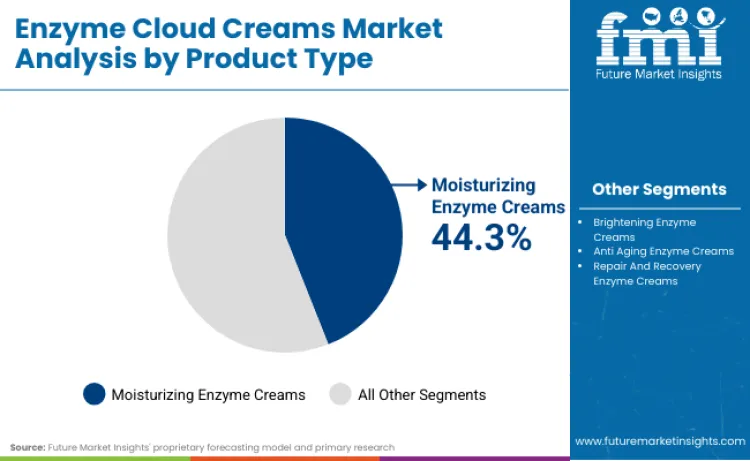
Moisturizing enzyme creams command a dominant 44.3% share because they embed enzymatic activity directly into daily hydration routines, eliminating the friction associated with separate exfoliation steps. Protease-based enzymes reinforce this positioning, as they are widely recognized as the most precise and effective enzyme class, constituting the largest segment in the global industrial enzyme market due to their ability to catalyze highly specific proteolytic reactions. By selectively acting on surface-level protein debris without disrupting healthy tissue, proteases enable controlled, leave-on exfoliation that aligns naturally with moisturizing formats.
This biological precision underpins why moisturizing enzyme creams are perceived as primary skincare products rather than optional treatments. Proteases function as molecular “scissors,” regulating the fate and activity of proteins in a highly targeted manner, which supports smoother texture and improved barrier function without irritation. This allows brands to justify premium pricing through daily-use value rather than episodic treatment claims. The leave-on cream format further reinforces dominance by removing time and compliance barriers associated with rinse-off enzyme masks, ensuring consistent use and sustained results within everyday skincare routines.
Why Are Protease-Based Enzymes the Preferred Enzyme Type?
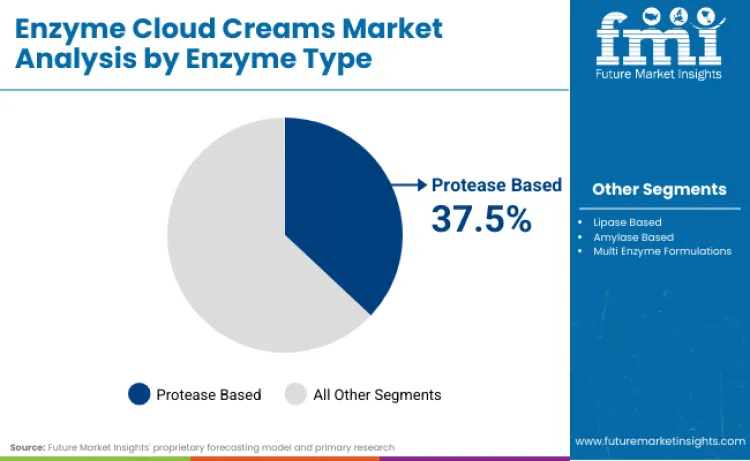
Protease-based formulations maintain a dominant 37.5% share because they align directly with the skin’s natural biological renewal mechanisms rather than forcing artificial exfoliation. In healthy skin, specific serine proteases such as KLK5 and KLK7 are essential for the orderly desquamation of corneocytes, where they regulate skin turnover by breaking down corneodesmosome proteins like desmoglein-1 and desmocollin-1. This intrinsic role allows protease-based enzyme creams to deliver controlled, biomimetic exfoliation that improves texture and radiance without disrupting barrier integrity, making them particularly suitable for leave-on daily formulations.
The industry’s growing preference for recombinant proteases further reinforces this dominance. As articulated across cosmetic science discourse, “recombinant refers to proteins or peptides manufactured in host cells, as opposed to those extracted from animal sources,” enabling the production of human-identical or animal-free enzymes with superior batch-to-batch consistency and vegan compliance. This combination of biological relevance, precision activity, and modern manufacturing reliability protects protease-based enzymes from displacement by broader, less selective enzyme classes, positioning them as the gold-standard catalytic system for next-generation enzyme skincare formulations.
Why Does Online Retail Dominate the Distribution Mix?
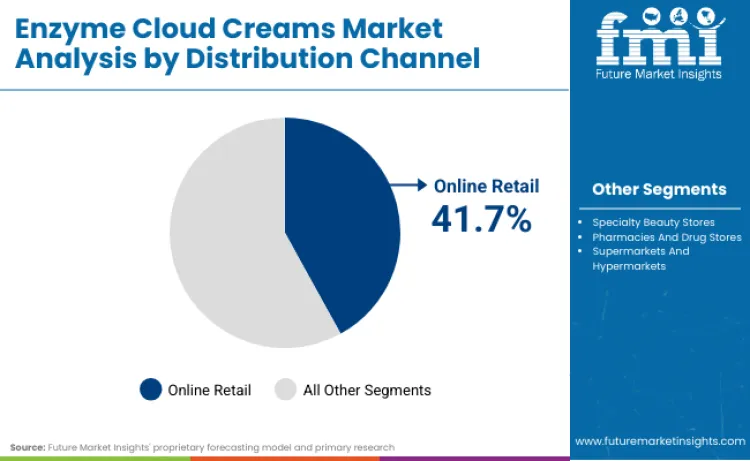
Online retail holds 41.7% distribution share as direct-to-consumer brands including The Ordinary, Paula's Choice, and Glow Recipe built enzyme product offerings specifically for e-commerce channels where detailed ingredient education through website content guides purchasing decisions without requiring in-store consultation. The complexity of enzyme formulations and skin type matching favors digital channels where brands provide comprehensive usage instructions, ingredient explanations, and customer reviews that inform selection better than traditional retail shelf browsing. Subscription models emerging through online channels create recurring revenue streams where consumers receive monthly enzyme cream shipments, increasing lifetime value beyond one-time purchases typical of brick-and-mortar retail. E-commerce platforms also enable brands to offer enzyme concentrations and formulations tailored to different skin sensitivities through product variation that physical retail shelf space constraints prohibit.
Why Is Consumer Demand for Immediate Results Reshaping Enzyme Cream Formulation?
Consumer psychology has shifted sharply toward expecting visible skincare results within days rather than weeks, largely shaped by social media-driven beauty narratives. This impatience is pushing enzyme cream formulations toward higher activity levels and multi-enzyme combinations designed to accelerate exfoliation and skin renewal. As a result, brands are carefully testing the boundary between rapid efficacy and over-exfoliation risk. To manage this tension, manufacturers are introducing graduated enzyme systems, where consumers begin with low-intensity formulations and progress toward more concentrated options as tolerance builds. This staged approach supports faster visible outcomes while protecting skin barrier integrity, and it simultaneously creates structured product ladders that increase lifetime customer value through planned regimen escalation.
How Is Ingredient Exclusivity Redefining Competitive Differentiation?
Competition is intensifying around access to proprietary enzyme sources that move formulations beyond widely available papain and bromelain. Japanese fermentation technology firms are developing novel enzymes derived from traditional sake brewing microorganisms, combining biotechnology advancement with cultural heritage narratives. In parallel, Korean ingredient suppliers are commercializing enzymes sourced from kimchi fermentation bacteria, aligning exfoliation efficacy with probiotic skincare positioning. These exclusive enzyme systems allow brands to escape commodity pricing pressure by differentiating on uniqueness, origin, and intellectual property rather than competing solely on enzyme concentration metrics. Ingredient storytelling has become as critical as performance, enabling premium positioning through scarcity and innovation.
What Role Do Advanced Delivery and Stability Systems Play in Market Evolution?
The formulation frontier is increasingly focused on pH-responsive enzyme systems that remain dormant within cream formulations but activate upon contact with skin. By maintaining stability at formulation pH and triggering activity at skin pH, brands are maximizing shelf life while concentrating biological action where it matters most. Microencapsulation and liposomal delivery technologies further enable controlled enzyme release, extending activity duration on the skin surface while preventing premature degradation during storage. Companies that achieve multi-year shelf stability without refrigeration gain a significant competitive advantage, as they can access mass retail channels that were previously inaccessible to enzyme products requiring cold-chain distribution.
How Will Enzyme Cloud Creams Market Expansion Unfold Across Key Global Regions?
The enzyme cloud creams market is poised for significant expansion across key global regions, with varying growth rates projected from 2026 to 2036. China leads the way with a CAGR of 16.9%, driven by K-beauty and J-beauty influence promoting enzyme fermentation skincare and expanding middle-class demand for premium functional products. India follows at 15.6%, benefiting from traditional papaya and turmeric enzyme usage heritage and growing cosmetic consciousness among urban millennials. Germany records 14.4% growth, reflecting European clean beauty leadership and consumer preference for biotechnology-derived natural actives. Brazil is anticipated to grow at 13.1%, driven by tropical fruit enzyme biodiversity and domestic ingredient pride supporting local papaya and pineapple enzyme formulations. The United States, with a CAGR of 11.9%, maintains substantial market scale through sensitive skin population seeking retinoid alternatives and direct-to-consumer brand innovation. The United Kingdom at 10.6% presents steady growth opportunities, fueled by dermatology-focused skincare education and professional beauty retail consultation.
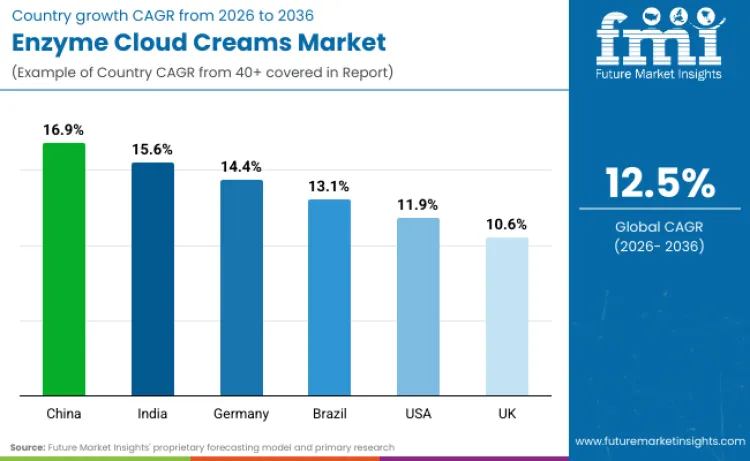
| Country | CAGR (2026-2036) |
|---|---|
| China | 16.9% |
| India | 15.6% |
| Germany | 14.4% |
| Brazil | 13.1% |
| United States | 11.9% |
| United Kingdom | 10.6% |
Source: Future Market Insights (FMI) analysis, based on proprietary forecasting model and primary research
Why is China integrating bio-fermentation into high-performance skincare?
China is expanding at a rapid 16.9% CAGR, driven by a structural shift from price-led consumption toward proof-based, biotech-validated skincare. As of 2026, enzyme cloud creams are increasingly evaluated on measurable efficacy, sensory performance, and trust rather than promotional pricing alone. This transition mirrors the influence of J-beauty and K-beauty philosophies, where minimalism is paired with high biological precision. Consumer decision-making is evolving toward quantifiable “experience,” where texture transformation, visible renewal, and tolerability act as conversion triggers. The integration of bio-fermentation technologies enables brands to deliver this proof through refined enzyme activity and consistent performance. FMI analysis indicates that China’s leadership is rooted in its ability to industrialize fermentation science at scale while aligning it with digitally educated consumers who actively compare claims, results, and ingredient origins. This convergence is positioning China as the fastest-advancing market for enzyme cloud creams globally.
Why is India formalizing gentle, botanical-led enzyme skincare?
India is growing at a strong 15.6% CAGR, propelled by regulatory formalization of herbal and enzyme-based cosmetics alongside rising urban demand for low-irritation products. National enforcement of certified herbal standards under existing cosmetics regulation frameworks is elevating consumer confidence in enzyme formulations. Urban professionals, increasingly informed by dermatologists and digital education, are consciously avoiding harsh actives that exacerbate sensitivity, accelerating adoption of “gentle by design” skincare. Enzyme cloud creams align closely with this preference by offering gradual exfoliation and renewal without aggressive resurfacing. FMI analysis suggests that India’s growth is less about rapid trend cycles and more about trust building through compliance, labeling clarity, and botanical familiarity. As certified enzymes and plant-derived actives gain legitimacy, enzyme cloud creams are transitioning from niche solutions to everyday moisturizers within India’s expanding premium-mass skincare segment.
Why is Germany anchoring growth in validated clean biotechnology?
Germany is expanding at a 14.4% CAGR, supported by a mature consumer base that prioritizes safety, validation, and environmental responsibility. Market growth reflects increasing preference for bio-fermented and clinically credible natural actives as regulatory updates tighten ingredient scrutiny across the EU. Enzyme cloud creams benefit from this environment because their positioning combines biological functionality with clean formulation narratives. Regulatory reinforcement around safety and sustainability is accelerating the shift away from synthetic exfoliants toward enzyme systems that demonstrate controlled activity and skin compatibility. FMI analysis indicates that Germany’s market evolution is driven by validation rather than novelty, with consumers rewarding brands that demonstrate compliance, transparency, and performance consistency. As a result, enzyme cloud creams are gaining traction as everyday treatment moisturizers that satisfy both dermatological expectations and clean beauty principles.
Why is Brazil leveraging biodiversity through its bioeconomy strategy?
Brazil is growing at a 13.1% CAGR, anchored in national efforts to valorize biodiversity through a formal bioeconomy framework. Enzyme cloud creams are benefiting from renewed focus on native biological resources, particularly proteolytic enzymes such as papain and bromelain derived from tropical ecosystems. These enzymes are increasingly positioned as both effective and culturally resonant actives, linking exfoliation performance with biodiversity stewardship. FMI analysis suggests that Brazil’s growth is reinforced by consumer familiarity with botanical ingredients and strong acceptance of nature-based efficacy narratives. As bioeconomy initiatives expand, enzyme cloud creams are moving beyond imported concepts toward locally relevant formulations that combine functional skincare benefits with environmental identity. This alignment is strengthening domestic demand while enhancing Brazil’s relevance as a sourcing and innovation hub for enzyme-based cosmetics.
Why is the United States shifting from aggressive actives to skin longevity?
The United States is expanding at a steady 11.9% CAGR, characterized by a consumer-led pivot away from harsh resurfacing agents toward enzyme-driven molecular defense. Growing awareness of over-exfoliation risks is reshaping routines toward barrier protection, resilience, and long-term skin vitality. Enzyme cloud creams fit this shift by offering controlled renewal that supports skin longevity rather than short-term intensity. Regulatory stability following recent federal clarifications has allowed brands and laboratories to refocus on ingredient performance validation rather than compliance uncertainty. FMI analysis indicates that USA growth is driven by education-led demand, where consumers seek bio-intelligent products that align with simplified yet effective routines. Enzyme cloud creams are increasingly positioned as foundational treatments that protect, renew, and maintain skin health over time.
Why is the United Kingdom advancing through pharmacy-led metabolic beauty?
The United Kingdom is growing at a 10.6% CAGR, driven by a pharmacy-centric model where skincare education is closely linked to health and wellness. Enzyme cloud creams are gaining traction as part of a broader “metabolic beauty” movement that emphasizes skin renewal through biological optimization rather than cosmetic camouflage. Pharmacies and medical aesthetic clinics act as trusted gatekeepers, guiding consumers toward enzyme-based solutions that support natural turnover and resilience. FMI analysis suggests that the UK market values credibility and holistic positioning over trend velocity. As beauty and health increasingly converge, enzyme cloud creams are benefiting from their alignment with metabolism-focused narratives that resonate with consumers seeking long-term skin balance rather than rapid but disruptive results.
How is the Competition in the Enzyme Cloud Creams Market?
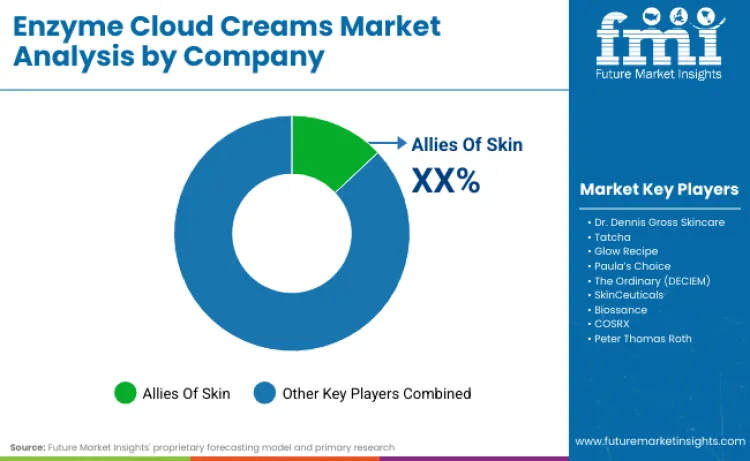
Competition in the enzyme cloud creams market is defined by established premium skincare leaders defending their positions through proprietary biotechnology and deep integration with professional dermatology ecosystems. Brands such as Tatcha and SkinCeuticals maintain loyalty by embedding fermentation science and enzyme stabilization into clinically positioned formulations that are perceived as medical-grade rather than cosmetic. Their competitive advantage lies not only in ingredient selection but in owning differentiated fermentation processes that are difficult to replicate at scale. Tatcha articulated this origin-led differentiation by stating: “Every formula starts in the fields and seas of Japan, where we harvest nutrient-dense green tea, rice bran, and algae, our scientists use a natural process of double fermentation to release their bioavailable actives.” This emphasis on provenance and process reinforces consumer trust and premium positioning.
At the same time, competition is intensifying through industrial biotechnology players that bring pharmaceutical-style precision into cosmetic manufacturing. Amyris exemplifies this shift by applying automated fermentation and molecule-level control to enzyme and bioactive production. As the company noted: “Our Barra Bonita Plant exemplifies the cutting-edge of industrial automation. Each molecule produced is governed by a unique recipe, allowing precise control over process parameters.” This convergence of professional dermatology endorsement and industrial biotech precision is raising entry barriers, pushing competition beyond branding into ownership of fermentation infrastructure, process control, and long-term ingredient exclusivity.
Recent Developments:
- In February 2024, Dr. Dennis Gross Skincare launched an advanced enzyme treatment featuring triple-enzyme blend combining protease, lipase, and amylase for comprehensive exfoliation across protein, lipid, and polysaccharide targets.
- In October 2024, Glow Recipe expanded its enzyme line with a watermelon enzyme moisturizer incorporating encapsulated enzymes for controlled-release exfoliation throughout the day.
Key Players in Enzyme Cloud Creams Market
- Allies of Skin
- Dr. Dennis Gross Skincare LLC
- Tatcha LLC
- Glow Recipe
- Paula's Choice
- The Ordinary (DECIEM Beauty Group Inc.)
- SkinCeuticals (L'Oreal Group)
- Biossance (Amyris Inc.)
- COSRX
- Peter Thomas Roth Labs LLC
Market Definition
The enzyme cloud creams market represents revenue generated from lightweight facial moisturizing products formulated with proteolytic, lipolytic, or amylolytic enzymes that provide biochemical exfoliation through degradation of intercellular adhesion proteins, surface lipids, and polysaccharide complexes binding dead keratinocytes to viable epidermis. The market measures sales value of enzyme-containing creams, lotions, and gel-creams sold through retail and online channels to consumers seeking gentle exfoliation alternatives to chemical acids and physical scrubs, excluding rinse-off enzyme masks, cleansers, and professional treatment products.
Market Inclusion
Inclusions cover moisturizing enzyme creams combining hydration and exfoliation in daily-use formats, brightening enzyme creams targeting hyperpigmentation through accelerated cell turnover, anti-aging enzyme creams addressing texture and fine lines, and repair and recovery enzyme creams for compromised skin barriers. It encompasses protease-based formulations utilizing papain, bromelain, or microbial proteases for protein target exfoliation, lipase-based products addressing sebum and lipid components, amylase-based formulations targeting polysaccharide bonds, and multi-enzyme systems combining multiple enzyme classes for comprehensive renewal.
Market Exclusion
Exclusions include rinse-off enzyme masks and treatments requiring removal after timed application. Enzyme cleansers and face wash products are excluded as separate categories. Professional spa and dermatology office enzyme peels fall outside scope. Enzyme dietary supplements and ingestible beauty products are not included. Body enzyme products targeting areas other than face are excluded. Products containing enzymes as minor inactive ingredients rather than functional actives are outside market definition when exfoliation is not a primary claimed benefit.
Scope of Report
| Items | Values |
|---|---|
| Quantitative Units | USD billion |
| Product Type | Moisturizing Enzyme Creams; Brightening Enzyme Creams; Anti-Aging Enzyme Creams; Repair & Recovery Enzyme Creams |
| Enzyme Type | Protease-Based; Lipase-Based; Amylase-Based; Multi-Enzyme Formulations |
| Skin Type | Sensitive Skin; Dry Skin; Oily Skin; Combination Skin |
| Distribution Channel | Online Retail; Specialty Beauty Stores; Pharmacies & Drug Stores; Supermarkets & Hypermarkets |
| End User | Women; Men; Unisex |
| Formulation & Technology Focus | Enzyme Stabilization Systems; pH-Triggered Activation Platforms; Microencapsulation & Liposomal Enzyme Delivery; Recombinant Enzyme Fermentation Technologies; Controlled-Release Exfoliation Systems |
| Regions Covered | North America; Europe; East Asia; South Asia; Latin America; Middle East & Africa |
| Countries Covered | China; India; Germany; Brazil; United States; United Kingdom; Japan; South Korea; France; and 40+ additional countries |
| Key Companies Profiled | Allies of Skin; Dr. Dennis Gross Skincare; Tatcha; Glow Recipe; Paula’s Choice; The Ordinary (DECIEM); SkinCeuticals (L’Oréal Group); Biossance; COSRX; Peter Thomas Roth |
| Additional Attributes | Dollar sales by product type, enzyme class, skin type, channel, and end user; efficacy benchmarking across exfoliation gentleness, barrier integrity, enzyme activity retention, and clinical tolerability; adoption trends for daily leave-on enzymatic renewal; regulatory impact on functional ingredient substantiation; biotechnology fermentation supply chain dynamics; premiumization and dermatologist endorsement influence |
Enzyme Cloud Creams Market by Segments
By Product Type:
- Moisturizing Enzyme Creams
- Brightening Enzyme Creams
- Anti-Aging Enzyme Creams
- Repair And Recovery Enzyme Creams
By Enzyme Type:
- Protease Based
- Lipase Based
- Amylase Based
- Multi Enzyme Formulations
By Skin Type:
- Sensitive Skin
- Dry Skin
- Oily Skin
- Combination Skin
By Distribution Channel:
- Online Retail
- Specialty Beauty Stores
- Pharmacies And Drug Stores
- Supermarkets And Hypermarkets
By End User:
- Women
- Men
- Unisex
By Region:
- North America (United States, Canada, Mexico)
- Europe (Germany, United Kingdom, France, Italy, Spain, BENELUX, Nordics)
- East Asia (China, Japan, South Korea)
- South Asia (India, Australia & New Zealand, Southeast Asia)
- Latin America (Brazil, Argentina, Chile, Colombia)
- Middle East & Africa
Bibliography
- Cosmetics Europe (2023). Cosmetics Europe Annual Report 2023: Empowering the Future of the Cosmetics Industry.
- National Medical Products Administration (NMPA) (2023). Annual Report on the Safety and Supervision of Cosmetics in China (2023).
- National Eczema Association (2023). NEA Research Report: The Burden of Disease and Treatment Adherence in Atopic Dermatitis Patients. [Online] San Francisco.
Frequently Asked Questions
What is the current global market size for Enzyme Cloud Creams?
The global market is valued at USD 1.6 billion in 2026, driven by rising demand for gentle enzymatic exfoliation as an alternative to irritating chemical actives.
What is the projected CAGR for the Enzyme Cloud Creams market?
Sales are projected to increase at a 12.5% CAGR from 2026 to 2036, reflecting strong momentum for biotechnology-stabilized enzyme skincare.
Which segment currently dominates the industry?
Moisturizing enzyme creams hold the leading share of 44.3%, while protease-based formulations account for 37.5% of the enzyme type segment.
What are the primary drivers for adoption in emerging markets?
K-beauty fermentation influence in China, botanical enzyme familiarity in India, and rising clean biotechnology acceptance are the primary growth engines in developing regions.
Who are the leading players in the Enzyme Cloud Creams space?
Allies of Skin, Dr. Dennis Gross Skincare, Tatcha, Glow Recipe, Paula's Choice, The Ordinary, and SkinCeuticals are leading the competitive landscape.
Preview the report firsthand - request a free sample
Get SampleGet the brochure for pricing and purchase details.
Get PDFTable of Content
- Executive Summary
- Global Market Outlook
- Demand Side Trends
- Supply Side Trends
- Technology Roadmap Analysis
- Analysis and Recommendations
- Market Overview
- Market Coverage / Taxonomy
- Market Definition / Scope / Limitations
- Research Methodology
- Chapter Orientation
- Analytical Lens and Working Hypotheses
- Market Structure, Signals, and Trend Drivers
- Benchmarking and Cross-market Comparability
- Market Sizing, Forecasting, and Opportunity Mapping
- Research Design and Evidence Framework
- Desk Research Programme (Secondary Evidence)
- Company Annual and Sustainability Reports
- Peer-reviewed Journals and Academic Literature
- Corporate Websites, Product Literature, and Technical Notes
- Earnings Decks and Investor Briefings
- Statutory Filings and Regulatory Disclosures
- Technical White Papers and Standards Notes
- Trade Journals, Industry Magazines, and Analyst Briefs
- Conference Proceedings, Webinars, and Seminar Materials
- Government Statistics Portals and Public Data Releases
- Press Releases and Reputable Media Coverage
- Specialist Newsletters and Curated Briefings
- Sector Databases and Reference Repositories
- FMI Internal Knowledge Base and Historical Datasets
- Subscription Datasets and Paid Sources
- Social Channels, Communities, and Digital Listening Inputs
- Additional Desk Sources
- Expert Input and Fieldwork (Primary Evidence)
- Primary Modes
- Qualitative Interviews and Expert Elicitation
- Quantitative Surveys and Structured Data Capture
- Blended Approach
- Why Primary Evidence is Used
- Field Techniques
- Interviews
- Surveys
- Focus Groups
- Observational and In-context Research
- Social and Community Interactions
- Stakeholder Universe Engaged
- C-suite Leaders
- Board Members
- Presidents and Vice Presidents
- R&D and Innovation Heads
- Technical Specialists
- Domain Subject-matter Experts
- Scientists
- Physicians and Other Healthcare Professionals
- Governance, Ethics, and Data Stewardship
- Research Ethics
- Data Integrity and Handling
- Primary Modes
- Tooling, Models, and Reference Databases
- Desk Research Programme (Secondary Evidence)
- Data Engineering and Model Build
- Data Acquisition and Ingestion
- Cleaning, Normalisation, and Verification
- Synthesis, Triangulation, and Analysis
- Quality Assurance and Audit Trail
- Market Background
- Market Dynamics
- Drivers
- Restraints
- Opportunity
- Trends
- Scenario Forecast
- Demand in Optimistic Scenario
- Demand in Likely Scenario
- Demand in Conservative Scenario
- Opportunity Map Analysis
- Product Life Cycle Analysis
- Supply Chain Analysis
- Investment Feasibility Matrix
- Value Chain Analysis
- PESTLE and Porter's Analysis
- Regulatory Landscape
- Regional Parent Market Outlook
- Production and Consumption Statistics
- Import and Export Statistics
- Market Dynamics
- Global Market Analysis 2021 to 2025 and Forecast, 2026 to 2036
- Historical Market Size Value (USD Million) Analysis, 2021 to 2025
- Current and Future Market Size Value (USD Million) Projections, 2026 to 2036
- Y-o-Y Growth Trend Analysis
- Absolute $ Opportunity Analysis
- Global Market Pricing Analysis 2021 to 2025 and Forecast 2026 to 2036
- Y-o-Y Growth Trend Analysis 2021 to 2025
- Absolute $ Opportunity Analysis 2026 to 2036
- Global Market Analysis 2021 to 2025 and Forecast 2026 to 2036, By Product Type
- Introduction / Key Findings
- Historical Market Size Value (USD Million) Analysis By Product Type, 2021 to 2025
- Current and Future Market Size Value (USD Million) Analysis and Forecast By Product Type, 2026 to 2036
- Moisturizing Enzyme Creams
- Brightening Enzyme Creams
- Anti-Aging Enzyme Creams
- Repair & Recovery Enzyme Creams
- Y-o-Y Growth Trend Analysis By Product Type, 2021 to 2025
- Absolute $ Opportunity Analysis By Product Type, 2026 to 2036
- Global Market Analysis 2021 to 2025 and Forecast 2026 to 2036, By Enzyme Type
- Introduction / Key Findings
- Historical Market Size Value (USD Million) Analysis By Enzyme Type, 2021 to 2025
- Current and Future Market Size Value (USD Million) Analysis and Forecast By Enzyme Type, 2026 to 2036
- Protease-Based
- Lipase-Based
- Amylase-Based
- Multi-Enzyme Formulations
- Y-o-Y Growth Trend Analysis By Enzyme Type, 2021 to 2025
- Absolute $ Opportunity Analysis By Enzyme Type, 2026 to 2036
- Global Market Analysis 2021 to 2025 and Forecast 2026 to 2036, By Skin Type
- Introduction / Key Findings
- Historical Market Size Value (USD Million) Analysis By Skin Type, 2021 to 2025
- Current and Future Market Size Value (USD Million) Analysis and Forecast By Skin Type, 2026 to 2036
- Sensitive Skin
- Dry Skin
- Oily Skin
- Combination Skin
- Y-o-Y Growth Trend Analysis By Skin Type, 2021 to 2025
- Absolute $ Opportunity Analysis By Skin Type, 2026 to 2036
- Global Market Analysis 2021 to 2025 and Forecast 2026 to 2036, By Distribution Channel
- Introduction / Key Findings
- Historical Market Size Value (USD Million) Analysis By Distribution Channel, 2021 to 2025
- Current and Future Market Size Value (USD Million) Analysis and Forecast By Distribution Channel, 2026 to 2036
- Online Retail
- Specialty Beauty Stores
- Pharmacies & Drug Stores
- Supermarkets & Hypermarkets
- Y-o-Y Growth Trend Analysis By Distribution Channel, 2021 to 2025
- Absolute $ Opportunity Analysis By Distribution Channel, 2026 to 2036
- Global Market Analysis 2021 to 2025 and Forecast 2026 to 2036, By End User
- Introduction / Key Findings
- Historical Market Size Value (USD Million) Analysis By End User, 2021 to 2025
- Current and Future Market Size Value (USD Million) Analysis and Forecast By End User, 2026 to 2036
- Women
- Men
- Unisex
- Y-o-Y Growth Trend Analysis By End User, 2021 to 2025
- Absolute $ Opportunity Analysis By End User, 2026 to 2036
- Global Market Analysis 2021 to 2025 and Forecast 2026 to 2036, By Region
- Introduction
- Historical Market Size Value (USD Million) Analysis By Region, 2021 to 2025
- Current Market Size Value (USD Million) Analysis and Forecast By Region, 2026 to 2036
- North America
- Latin America
- Western Europe
- Eastern Europe
- East Asia
- South Asia and Pacific
- Middle East & Africa
- Market Attractiveness Analysis By Region
- North America Market Analysis 2021 to 2025 and Forecast 2026 to 2036, By Country
- Historical Market Size Value (USD Million) Trend Analysis By Market Taxonomy, 2021 to 2025
- Market Size Value (USD Million) Forecast By Market Taxonomy, 2026 to 2036
- By Country
- USA
- Canada
- Mexico
- By Product Type
- By Enzyme Type
- By Skin Type
- By Distribution Channel
- By End User
- By Country
- Market Attractiveness Analysis
- By Country
- By Product Type
- By Enzyme Type
- By Skin Type
- By Distribution Channel
- By End User
- Key Takeaways
- Latin America Market Analysis 2021 to 2025 and Forecast 2026 to 2036, By Country
- Historical Market Size Value (USD Million) Trend Analysis By Market Taxonomy, 2021 to 2025
- Market Size Value (USD Million) Forecast By Market Taxonomy, 2026 to 2036
- By Country
- Brazil
- Argentina
- Chile
- Colombia
- Rest of Latin America
- By Product Type
- By Enzyme Type
- By Skin Type
- By Distribution Channel
- By End User
- By Country
- Market Attractiveness Analysis
- By Country
- By Product Type
- By Enzyme Type
- By Skin Type
- By Distribution Channel
- By End User
- Key Takeaways
- Western Europe Market Analysis 2021 to 2025 and Forecast 2026 to 2036, By Country
- Historical Market Size Value (USD Million) Trend Analysis By Market Taxonomy, 2021 to 2025
- Market Size Value (USD Million) Forecast By Market Taxonomy, 2026 to 2036
- By Country
- Germany
- UK
- France
- Italy
- Spain
- BENELUX
- Nordics
- Rest of Western Europe
- By Product Type
- By Enzyme Type
- By Skin Type
- By Distribution Channel
- By End User
- By Country
- Market Attractiveness Analysis
- By Country
- By Product Type
- By Enzyme Type
- By Skin Type
- By Distribution Channel
- By End User
- Key Takeaways
- Eastern Europe Market Analysis 2021 to 2025 and Forecast 2026 to 2036, By Country
- Historical Market Size Value (USD Million) Trend Analysis By Market Taxonomy, 2021 to 2025
- Market Size Value (USD Million) Forecast By Market Taxonomy, 2026 to 2036
- By Country
- Russia
- Poland
- Hungary
- Balkan & Baltic
- Rest of Eastern Europe
- By Product Type
- By Enzyme Type
- By Skin Type
- By Distribution Channel
- By End User
- By Country
- Market Attractiveness Analysis
- By Country
- By Product Type
- By Enzyme Type
- By Skin Type
- By Distribution Channel
- By End User
- Key Takeaways
- East Asia Market Analysis 2021 to 2025 and Forecast 2026 to 2036, By Country
- Historical Market Size Value (USD Million) Trend Analysis By Market Taxonomy, 2021 to 2025
- Market Size Value (USD Million) Forecast By Market Taxonomy, 2026 to 2036
- By Country
- China
- Japan
- South Korea
- By Product Type
- By Enzyme Type
- By Skin Type
- By Distribution Channel
- By End User
- By Country
- Market Attractiveness Analysis
- By Country
- By Product Type
- By Enzyme Type
- By Skin Type
- By Distribution Channel
- By End User
- Key Takeaways
- South Asia and Pacific Market Analysis 2021 to 2025 and Forecast 2026 to 2036, By Country
- Historical Market Size Value (USD Million) Trend Analysis By Market Taxonomy, 2021 to 2025
- Market Size Value (USD Million) Forecast By Market Taxonomy, 2026 to 2036
- By Country
- India
- Australia & New Zealand
- Southeast Asia
- Rest of South Asia and Pacific
- By Product Type
- By Enzyme Type
- By Skin Type
- By Distribution Channel
- By End User
- By Country
- Market Attractiveness Analysis
- By Country
- By Product Type
- By Enzyme Type
- By Skin Type
- By Distribution Channel
- By End User
- Key Takeaways
- Middle East & Africa Market Analysis 2021 to 2025 and Forecast 2026 to 2036, By Country
- Historical Market Size Value (USD Million) Trend Analysis By Market Taxonomy, 2021 to 2025
- Market Size Value (USD Million) Forecast By Market Taxonomy, 2026 to 2036
- By Country
- Kingdom of Saudi Arabia
- Other GCC Countries
- South Africa
- Other African Union
- Rest of Middle East & Africa
- By Product Type
- By Enzyme Type
- By Skin Type
- By Distribution Channel
- By End User
- By Country
- Market Attractiveness Analysis
- By Country
- By Product Type
- By Enzyme Type
- By Skin Type
- By Distribution Channel
- By End User
- Key Takeaways
- Key Countries Market Analysis
- USA
- Pricing Analysis
- Market Share Analysis, 2025
- By Product Type
- By Enzyme Type
- By Skin Type
- By Distribution Channel
- By End User
- Canada
- Pricing Analysis
- Market Share Analysis, 2025
- By Product Type
- By Enzyme Type
- By Skin Type
- By Distribution Channel
- By End User
- Mexico
- Pricing Analysis
- Market Share Analysis, 2025
- By Product Type
- By Enzyme Type
- By Skin Type
- By Distribution Channel
- By End User
- Brazil
- Pricing Analysis
- Market Share Analysis, 2025
- By Product Type
- By Enzyme Type
- By Skin Type
- By Distribution Channel
- By End User
- Argentina
- Pricing Analysis
- Market Share Analysis, 2025
- By Product Type
- By Enzyme Type
- By Skin Type
- By Distribution Channel
- By End User
- Germany
- Pricing Analysis
- Market Share Analysis, 2025
- By Product Type
- By Enzyme Type
- By Skin Type
- By Distribution Channel
- By End User
- UK
- Pricing Analysis
- Market Share Analysis, 2025
- By Product Type
- By Enzyme Type
- By Skin Type
- By Distribution Channel
- By End User
- France
- Pricing Analysis
- Market Share Analysis, 2025
- By Product Type
- By Enzyme Type
- By Skin Type
- By Distribution Channel
- By End User
- Italy
- Pricing Analysis
- Market Share Analysis, 2025
- By Product Type
- By Enzyme Type
- By Skin Type
- By Distribution Channel
- By End User
- Spain
- Pricing Analysis
- Market Share Analysis, 2025
- By Product Type
- By Enzyme Type
- By Skin Type
- By Distribution Channel
- By End User
- China
- Pricing Analysis
- Market Share Analysis, 2025
- By Product Type
- By Enzyme Type
- By Skin Type
- By Distribution Channel
- By End User
- Japan
- Pricing Analysis
- Market Share Analysis, 2025
- By Product Type
- By Enzyme Type
- By Skin Type
- By Distribution Channel
- By End User
- South Korea
- Pricing Analysis
- Market Share Analysis, 2025
- By Product Type
- By Enzyme Type
- By Skin Type
- By Distribution Channel
- By End User
- India
- Pricing Analysis
- Market Share Analysis, 2025
- By Product Type
- By Enzyme Type
- By Skin Type
- By Distribution Channel
- By End User
- Australia & New Zealand
- Pricing Analysis
- Market Share Analysis, 2025
- By Product Type
- By Enzyme Type
- By Skin Type
- By Distribution Channel
- By End User
- Russia
- Pricing Analysis
- Market Share Analysis, 2025
- By Product Type
- By Enzyme Type
- By Skin Type
- By Distribution Channel
- By End User
- Poland
- Pricing Analysis
- Market Share Analysis, 2025
- By Product Type
- By Enzyme Type
- By Skin Type
- By Distribution Channel
- By End User
- Kingdom of Saudi Arabia
- Pricing Analysis
- Market Share Analysis, 2025
- By Product Type
- By Enzyme Type
- By Skin Type
- By Distribution Channel
- By End User
- South Africa
- Pricing Analysis
- Market Share Analysis, 2025
- By Product Type
- By Enzyme Type
- By Skin Type
- By Distribution Channel
- By End User
- USA
- Market Structure Analysis
- Competition Dashboard
- Competition Benchmarking
- Market Share Analysis of Top Players
- By Regional
- By Product Type
- By Enzyme Type
- By Skin Type
- By Distribution Channel
- By End User
- Competition Analysis
- Competition Deep Dive
- Allies of Skin
- Dr. Dennis Gross Skincare LLC
- Tatcha LLC
- Glow Recipe
- Paula's Choice
- The Ordinary (DECIEM Beauty Group Inc.)
- SkinCeuticals (L'Oreal Group)
- Biossance (Amyris Inc.)
- COSRX
- Peter Thomas Roth Labs LLC
- Competition Deep Dive
- Assumptions & Acronyms Used


