

- Industry Size (2026)
- USD 520.0 Mn
- Forecast (2036)
- USD 1335.0 Mn
- CAGR (2026 to 2036)
- 9.7%
Potato Protein Isolate Market Size, Market Forecast and Outlook By FMI
In 2025, the potato protein isolate market crossed a valuation of USD 480.0 million. Based on Future Market Insights’ analysis, demand is estimated to grow to USD 520.0 million in 2026 and USD 1,335.0 million by 2036. FMI projects a CAGR of 9.7% during the forecast period. Formulation architects rapidly specify these non-animal fractions to replace synthetic stabilizers and volatile egg albumen in commercial extrusion lines. Purchasing directors prioritize functional binders capable of withstanding ultra-high-temperature processing without compromising end-product texture.
Extraction viability hinges on agricultural proximity and vertical integration within cooperative models. In 2024, United States potato production reached 421 million cwt [1]. Procurement managers lock in long-term off-take agreements with processors who control root crop supply chains, ensuring continuous ingredient availability during seasonal harvest fluctuations. Predictable yields allow manufacturers to scale plant based protein extraction without incurring excessive spot-market premiums.
“This partnership is truly a perfect match for us”, says Gerritsen when asked about the overall added value of the partnership for IQI. “Avebe is a strong and innovative Dutch company with renowned expertise in the development of potato-based ingredients, a demonstrated commitment to sustainability, and more than a century of experience in the food industry. Joining forces with them allows us to combine their technical expertise on potato proteins with our focus on the pet food market. It’s a great example of how we like doing business.” [2]
Summary of Potato Protein Isolate
-
Potato Protein Isolate Market Definition
- Industry covers concentrated potato-derived proteins utilized as functional ingredients in commercial food manufacturing.
- Demand Drivers in the Market
- Rising adoption of plant-based dietary regimens fuels alternative protein procurement.
- Functional requirements in allergen-free formulations drive substitution away from soy and wheat.
- Vertical integration among starch processors improves ingredient yield and cost viability.
- Key Segments Analyzed in the FMI Report
- Form: Isolate Powder dominates (62%) over liquid concentrate and textured variants due to shelf stability and dry-blend compatibility.
- Application: Food & Beverages lead (44% of total volume) driven by clean-label binding and egg-replacement demand.
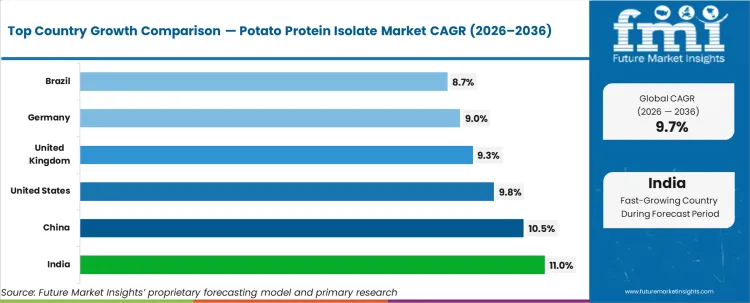
- Geography: High-growth Asia-Pacific (India 11.0%, China 10.5%) outpaces mature North America and Europe.
- Analyst Opinion at FMI
- Nandini Roy Choudhury, Principal Consultant for Food & Beverage at Future Market Insights, opines, “In the updated Potato Protein Isolate Market report for 2026 to 2036, my team and I have examined how starch industry by-product valorization is reshaping protein economics. Potato protein, once treated as a secondary stream, is now being strategically refined into high-value isolates. As manufacturers pursue zero-waste processing models, integrated starch-protein extraction facilities will define competitive cost leadership.”
- Strategic Implications/Executive Takeaways
- Transition ingredient sourcing toward vertically integrated agricultural cooperatives.
- Prioritize powder formats to mitigate shelf-life risks during global shipping.
- Lock in supply agreements before peak harvest periods to stabilize formulation costs.
- Methodology
- Validated through first-hand corporate production and capacity data.
- Zero reliance on speculative third-party market research reports.
- Based on verifiable industrial benchmarks and verified sources.
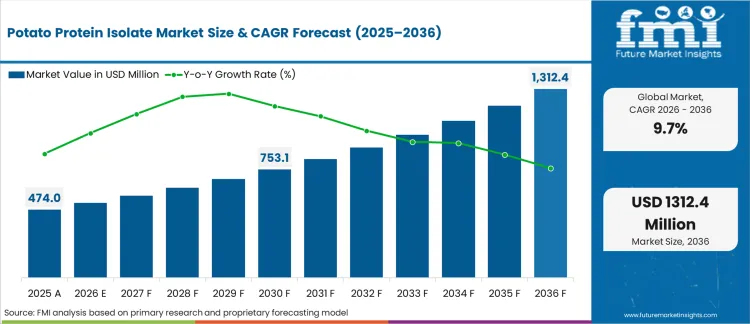
Across India (11.0%), China (10.5%), United States (9.8%), United Kingdom (9.3%), Germany (9.0%), and Brazil (8.7%), expansion concentrates where localized agricultural output intersects with high-density food manufacturing. Procurement clusters around vertically integrated starch facilities, favoring incumbents capable of executing continuous extraction runs. Buyers secure volume commitments ahead of harvest cycles to neutralize global logistics bottlenecks.
Potato Protein Isolate Market Key Takeaways
| Metric | Details |
|---|---|
| Industry Size (2026) | USD 520.0 million |
| Industry Value (2036) | USD 1,335.0 million |
| CAGR (2026-2036) | 9.7% |
Potato Protein Isolate Market Definition
Potato protein isolate represents a highly concentrated non-animal fraction extracted during agricultural starch manufacturing, serving as a functional additive in commercial food processing. Buyers utilize extracted proteins for gelling, foaming, and structural binding properties in meat analogs and clean-label bakery goods. Industrial processors recover target amino acids from starch effluent, creating premium ingredients that replace conventional dairy or egg derivatives.
Potato Protein Isolate Market Inclusions
The Potato Protein Isolate category includes powdered isolates exceeding 80% protein concentration, produced through advanced extraction and purification processes. It covers texturized protein formats engineered for meat analogue structures and specialized functional fractions incorporated into premium pet nutrition formulations, supplied primarily at the ingredient level for industrial food and feed applications.
Potato Protein Isolate Market Exclusions
The scope excludes native potato starches, unmodified flours, and other carbohydrate-dominant derivatives. It does not include crude potato meal used for basic livestock feed. Low-concentration potato protein concentrates falling below the 80% purity threshold are also excluded from this classification.
Potato Protein Isolate Market Research Methodology
- Primary Research: Interviews captured data from starch processors and plant-based formulators to map isolate yield constraints.
- Desk Research: Analysts assessed official agricultural output data and harvest reports to model feedstock availability.
- Market-Sizing and Forecasting: Models reconciled global root crop tonnage against commercial extraction rates to validate total addressable volume.
- Data Validation and Update Cycle: Outputs underwent variance checks against regional trade codes and public capacity disclosures prior to release.
Segmental Analysis
Potato Protein Isolate Market Analysis by Product Form
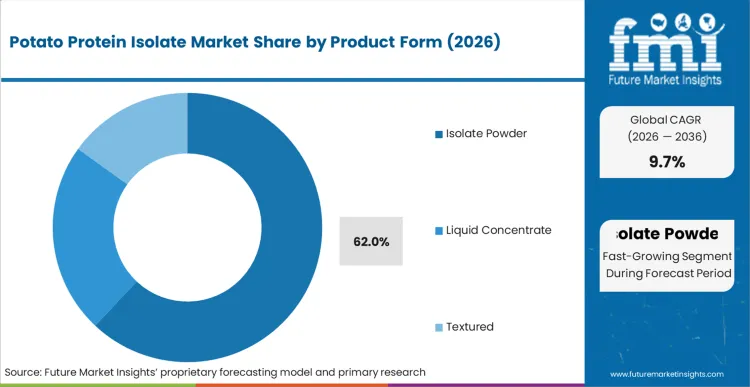
Isolate Powder commands 62% share in 2026. Formulation scientists select powdered formats due to superior shelf stability and exact dosing control in large-scale blending operations. Dry powders integrate efficiently into existing manufacturing lines without requiring specialized liquid handling infrastructure. As per FMI's projection, procurement tilts toward powders to minimize transportation weight and associated freight costs. Processors extract proteins from starch wastewater, dehydrating fractions into fine powders that retain high solubility. Demand aligns with continuous expansion in vegan protein powder portfolios. Buyers prioritize formulations that prevent clumping and maintain consistent hydration rates during thermal processing. Global extraction capacity heavily dictates supply, forcing brands to optimize inventory cycles. KMC amba reported DKK 800 million in major capacity projects during 2025 and 2026 to expand granule and derivate lines [3]. Steady production upgrades support continuous powder manufacturing runs.
- Format utility: Powder variants dominate formulation strategies because dry ingredients eliminate microbial spoilage risks during extended transit. Procurement teams consolidate orders into bulk shipments, reducing unit costs and ensuring supply continuity.
- Yield optimization: Processors upgrade dehydration equipment to maximize powder recovery from starch effluent. High coagulation temperatures allow extracted fractions to withstand aggressive commercial sterilization protocols without structural collapse.
- Application efficiency: Dry isolates blend seamlessly with other functional flours, lowering overall mixing times in industrial settings. Operations managers mandate powder usage to accelerate throughput and decrease energy-intensive liquid handling routines.
Potato Protein Isolate Market Analysis by Application
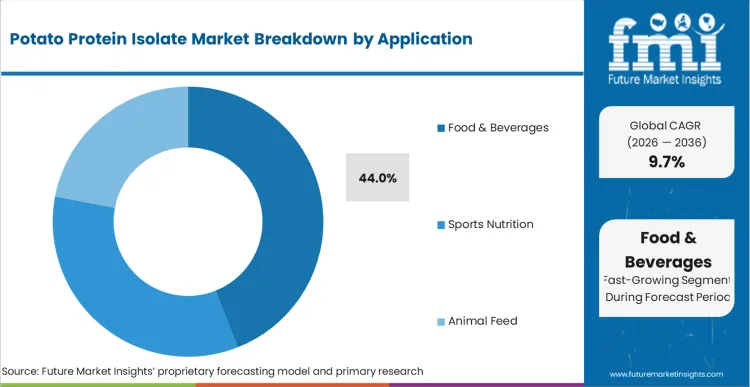
Industrial kitchens and large-scale formulators are increasingly using potato protein isolates to replace egg albumen, delivering the aeration and gelation required in baked goods and confectionery applications. Their non-allergenic profile supports clean-label positioning, particularly for products targeting sensitive consumer groups. FMI estimates that developers are also incorporating extracted potato proteins into plant-based nuggets to replicate meat-like texture and improve moisture retention. The ingredient’s heat stability enhances extrusion performance, preventing structural breakdown during high-temperature processing, while customized blends are being tailored for beverage emulsion stability. With USA plant-based retail sales reaching USD 8.1 billion in 2024 [4], manufacturers are accelerating integration efforts across portfolios, resulting in food and beverages accounting for 44% of total market share in 2026.
- Binding performance: Formulators utilize extracted fractions to replace synthetic stabilizers, achieving superior water-holding capacity in extruded applications. Commercial adoption accelerates as developers recognize the exact textural equivalence provided by specialized isolates.
- Allergen substitution: Clean-label initiatives force replacement of soy and wheat binders across legacy food brands. Widespread retail turnover sustains upstream B2B ingredient demand, validating continuous procurement cycles.
- Process tolerance: High gelation thresholds allow proteins to withstand aggressive sterilization protocols during beverage bottling. Production managers specify exact isolate grades to reduce batch failures during ultra-high-temperature processing runs.
Potato Protein Isolate Market Drivers, Restraints, and Opportunities
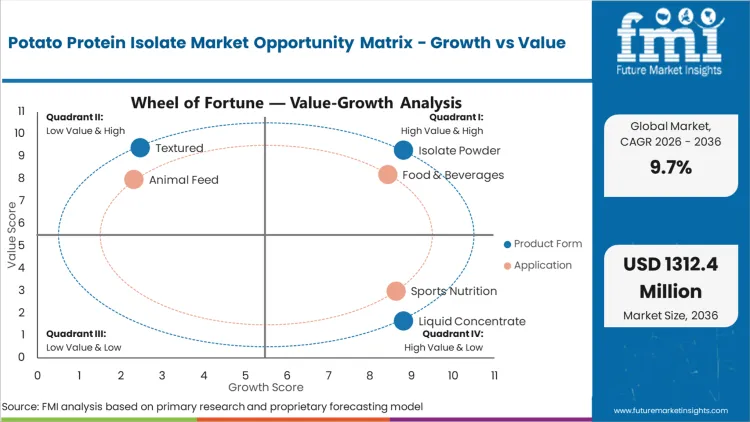
Clean-label substitution across commercial food manufacturing accelerates isolate adoption. Formulation teams replace soy and wheat allergens with hypoallergenic potato extracts to capture broader consumer pools while maintaining product texture. Extracted proteins deliver superior binding and foaming characteristics essential for commercial baking and meat analog production. Procurement cycles align with expanding vegan product portfolios, forcing ingredient distributors to stockpile high-quality isolates. The Good Food Institute reported that 81% of households purchasing plant-based foods in the United States exhibited repeat buying behaviors in 2023 [5]. Strong retail turnover sustains upstream B2B ingredient demand and justifies capacity expansion investments.
Upstream agricultural yields and weather volatility limit raw material availability, capping absolute protein extraction volumes. Procurement teams mitigate supply shocks by securing long-term contracts with cooperative-owned processors capable of managing harvest risks. Unpredictable weather patterns disrupt harvest schedules, creating localized shortages of starch-rich cultivars necessary for efficient protein recovery. Average United States potato yields stood at 454 cwt per acre in 2024, dictating the ultimate ceiling for extractable volumes [6]. Fluctuating crop yields force formulators to build buffer inventories, tying up working capital and exposing buyers to seasonal price spikes.
- Pet nutrition premiumization: Companion animal food brands seek high-digestibility plant proteins for grain-free kibble. IQI Trusted Petfood Ingredients signed an exclusive partnership with Royal Avebe in August 2024 to distribute ProtaSTAR premium potato protein [7].
- Manufacturing automation: Starch processors invest heavily in automated extraction technology to improve protein yield per ton of root crop. KMC amba opened a new automated logistics center in February 2025 to meet rising global ingredient demand [8].
- Application diversification: Formulators integrate functional isolates into mainstream bakery items to replace volatile commercial egg supplies. Royal Avebe launched PerfectaSOL in November 2023, providing next-generation solutions tailored for dairy-free cheese and confectionery [9].
Regional Analysis
.webp "Top Country Growth Comparison Potato Protein Isolate Market Cagr (2026 2036)")
Based on regional analysis, the Potato Protein Isolate market is segmented into North America, Latin America, Europe, East Asia, South Asia, Oceania and Middle East & Africa across 40+ countries. The full report also offers market attractiveness analysis based on regional trends.
| Country | CAGR (2026 to 2036) |
|---|---|
| India | 11.0% |
| China | 10.5% |
| United States | 9.8% |
| United Kingdom | 9.3% |
| Germany | 9.0% |
| Brazil | 8.7% |
Source: Future Market Insights (FMI) analysis, based on proprietary forecasting model and primary research
Asia Pacific Potato Protein Isolate Market Analysis
Asia Pacific region leads growth through massive industrial food manufacturing expansion and rising domestic fortification targets. Food processors across Asian markets adopt neutral-taste functional binders to improve texture in noodles, bakery goods, and localized plant-based meat formats. High domestic agricultural output provides a structural advantage for regional ingredient extraction. Asia's share of world potato production reached 54% in May 2025, cementing regional dominance in feedstock availability [10]. Major ingredient conglomerates aggressively acquire local nutrition brands to capture fast-growing retail segments. Formulators replace expensive imported proteins with locally extracted alternatives to improve final product margins.
- India: In India, expanding protein fortification initiatives and large urban populations seeking affordable plant-based nutrition are strengthening long-term demand visibility. As policy intent increasingly converts into structured procurement cycles and wider product deployment, isolate powder demand is projected to grow at an 11.0% CAGR through 2036.
- China: Isolate sales in China are projected to rise at 10.5% CAGR from 2026 to 2036 as industrial food manufacturing targets texture improvement, creating a clearer pathway from policy intent to purchase orders. Domestic processors scale operations to meet internal formulation requirements.
FMI's report includes detailed supply chain mapping and regulatory assessments for Asia Pacific markets. Japan and South Korea demonstrate rapid adoption of specialized nutritional ingredients. Procurement teams monitor regional potato processing capacity to secure stable supply lines.
North America Potato Protein Isolate Market Analysis
In North America, adoption is accelerating as plant-based liquid and powder formulations gain traction among clean-label consumers. Beverage and sports nutrition brands are replacing dairy proteins with hypoallergenic potato isolates to attract vegan buyers. With USA harvested potato area reaching 927,000 acres in 2024 [11], domestic supply remains strong. Distributors are strengthening regional networks and forming alliances to localize production, reducing exposure to shipping delays, currency swings, and freight volatility while supporting agricultural cooperatives.
- United States: United States is expected to record 9.8% CAGR in ingredient demand over 2026 to 2036 as formulation scientists shift specifications toward clean-label binders, tightening links between operational constraints and adoption-led investment. Consistent agricultural output supports domestic extraction viability.
FMI's report includes comprehensive volume modeling and end-use application breakdowns for North American markets. Canada and Mexico present emerging opportunities for agricultural processing integration. Formulators explore pea protein and potato blends to optimize amino acid profiles in functional foods.
Europe Potato Protein Isolate Market Analysis
Europe serves as global epicenter for advanced agricultural extraction technology. Vertically integrated cooperatives dominate ingredient supply, leveraging decades of processing expertise to produce highly purified isolates. Strict environmental regulations push manufacturers to extract maximum value from agricultural side-streams, advancing protein recovery techniques. Emsland Group announced a mid double-digit million investment in a new potato flake factory in January 2024 [12]. Massive root crop processing sustains protein output and drives technological innovation. Strategic partnerships expand ingredient distribution networks across the continent, lowering friction for regional food formulators seeking specialized binders.
- United Kingdom: Expanding distribution partnerships across the United Kingdom are improving ingredient availability and prompting capacity upgrades among processors. As supply chains become more integrated, mid-sized manufacturers are able to shorten commercialization timelines and scale new product launches more efficiently. Within this strengthening ecosystem, isolate revenues in the country are projected to grow at a 9.3% CAGR between 2026 and 2036.
- Germany: In Germany, specialized protein demand is supported by engineering-led efficiency improvements that elevate reliability and consistency in procurement decisions. Growth across the segment is estimated at a 9.0% CAGR through 2036, as proximity to major processing hubs ensures stable ingredient access and reinforces buyer confidence in long-term supply security.
FMI's report includes rigorous assessment of cooperative processing capacities and trade flows across European markets. France and Netherlands harbor massive centralized extraction facilities. Production managers evaluate potato flake by-products as supplementary protein extraction sources.
Latin America Potato Protein Isolate Market Analysis
Growth across Latin America is increasingly tied to cost-efficient formulation strategies and stronger local co-manufacturing networks. Bakeries and beverage producers are testing alternative binders to reduce dependence on imported egg and dairy inputs. Mexico’s potato production reached 46.8 million cwt in 2024, up 7% year over year [13], creating a solid feedstock base for future protein extraction. As multinational brands standardize recipes across regional subsidiaries, demand for consistent functional performance continues to rise.
- Brazil: Outlook for functional binders in Brazil indicates 8.7% CAGR from 2026 to 2036 as co-manufacturing expands, strengthening demand from both public programs and private operators. Scaling domestic agriculture signals rising processing potential across the broader region.
FMI's report includes detailed analysis of import dependencies and localized processing potential in Latin America. Argentina and Chile exhibit strong agricultural fundamentals for future processing investments. Distributors supply soy protein isolate alongside potato variants to satisfy diverse industrial requirements.
Competitive Aligners for Market Players
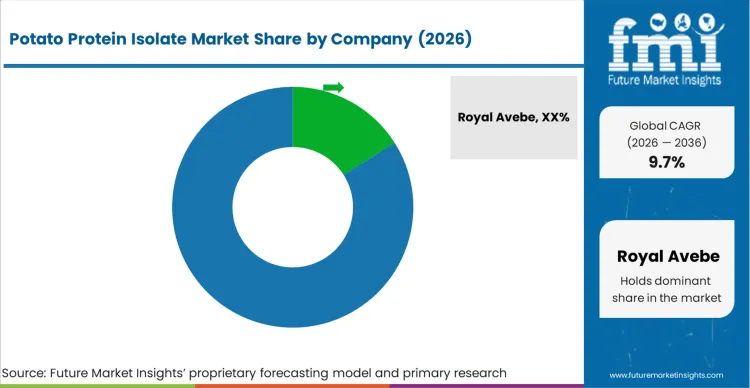
Raw material supply chain integration dictates competitive survival during periods of agricultural volatility. Incumbent manufacturers operating cooperative models leverage guaranteed root crop deliveries to maintain uninterrupted extraction. Suppliers lacking direct agricultural integration face severe margin compression during poor harvest seasons when spot-market crop prices spike. Burcon NutraScience formed an alliance intending to acquire and operate a commercial protein production facility in November 2024 [14]. Capital-light acquisitions allow emerging players to bypass initial construction hurdles and rapidly secure output capabilities.
Application-specific product development separates premium ingredient suppliers from commoditized starch vendors. Innovative manufacturers engineer unique protein fractions optimized for distinct end-uses, ranging from foaming agents in confectionery to structural binders in pet foods. Summa Equity acquired a majority stake in Nutris in September 2024 to innovate sustainable plant-based nutrition [15]. Private equity investment accelerates formulation research, enabling nimble producers to capture market share from legacy dairy ingredient providers.
Logistics and distribution footprint determine global market penetration for extracted powders. Leading manufacturers invest heavily in automated warehousing and regional distribution partnerships to guarantee rapid fulfillment for multinational food brands. Extended shelf life of powder formats enables centralized mega-factory production paired with decentralized global storage. Lyckeby Group formalized an organizational change, renaming itself Lyckeby Group Economic Association in June 2025 to consolidate its ingredient platform [16]. Unified corporate structures streamline international export processes and improve buyer confidence in long-term supply viability.
Recent Developments
The report includes full coverage of key trends from competitive benchmarking. Some of the recent developments covered in the reports:
- In August 2025, Royal Avebe announced the start of its 2025 potato campaign, processing delivered potatoes into starch and protein six days a week [17].
- In May 2025, KMC amba partnered with Daymer Ingredients Ltd to expand potato-based solutions to United Kingdom manufacturers [18].
Key Players in Potato Protein Isolate
- Royal Avebe
- KMC amba
- IQI Trusted Petfood Ingredients
- Burcon NutraScience
- Summa Equity
- Marico Limited
- Emsland Group
- Lyckeby Group
- Roquette
- Tereos
- Ingredion
Scope of the Report
| Metric | Value |
|---|---|
| Quantitative Units | USD 520.0 million (2026) to USD 1,335.0 million (2036), at a CAGR of 9.7% |
| Market Definition | Potato protein isolate represents a highly concentrated non-animal fraction extracted during agricultural starch manufacturing, serving as a functional additive in commercial food processing. |
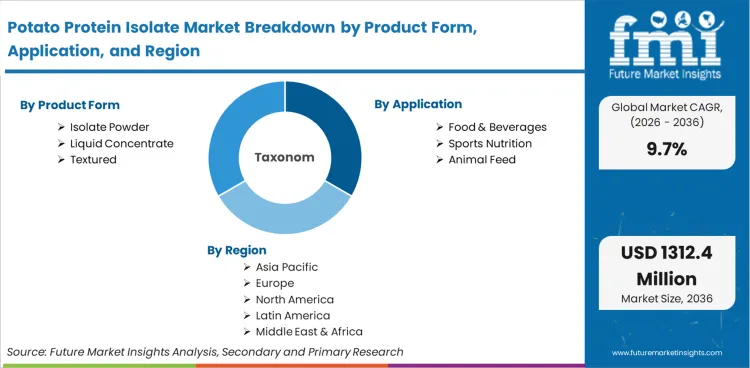
| Product Form Segmentation | Isolate Powder, Liquid Concentrate, Textured |
| Application Segmentation | Food & Beverages, Sports Nutrition, Animal Feed |
| Distribution Channel Segmentation | Supermarkets / Grocery Retail, Online Retail, Specialty Stores |
| End-User Group Segmentation | Adults, Geriatric, Pediatric |
| Regions Covered | North America, Latin America, Europe, East Asia, South Asia, Oceania, Middle East and Africa |
| Countries Covered | United States, Canada, Mexico, Brazil, Argentina, Germany, France, United Kingdom, Italy, Spain, China, India, Japan, South Korea, Indonesia, Australia and 40 plus countries |
| Key Companies Profiled | Royal Avebe, KMC amba, IQI Trusted Petfood Ingredients, Burcon NutraScience, Summa Equity, Marico Limited, Emsland Group, Lyckeby Group, Roquette, Tereos, Ingredion |
| Forecast Period | 2026 to 2036 |
| Approach | Hybrid top down and bottom up market modeling validated through primary interviews with resin producers and panel manufacturers, supported by trade data benchmarking and plant level capacity verification |
Potato Protein Isolate Market Analysis by Segments
Product Form
- Isolate Powder
- Liquid Concentrate
- Textured
Application
- Food & Beverages
- Sports Nutrition
- Animal Feed
Distribution Channel
- Supermarkets / Grocery Retail
- Online Retail
- Specialty Stores
End-User Group
- Adults
- Geriatric
- Pediatric
Region
- Asia Pacific
- India
- China
- Japan
- South Korea
- Indonesia
- Australia & New Zealand
- ASEAN
- Rest of Asia Pacific
- Europe
- Germany
- Italy
- France
- United Kingdom
- Spain
- Benelux
- Nordics
- Central & Eastern Europe
- Rest of Europe
- North America
- United States
- Canada
- Mexico
- Latin America
- Brazil
- Argentina
- Chile
- Rest of Latin America
- Middle East & Africa
- Kingdom of Saudi Arabia
- United Arab Emirates
- South Africa
- Turkey
- Rest of Middle East & Africa
Bibliography
- [1] USDA NASS, USA 2024 potato production: 421 million cwt, 26-Sep-2025
- [2] IQI Petfood. (2024). Avebe partnership – Protastar.
- [3] KMC amba, Reported DKK 800M in major projects, 2025/26
- [4] Plant Based Foods Association, Dollar sales of plant-based foods (USA, 2024): $8.1B, 2024
- [5] The Good Food Institute, Repeat purchasing (plant-based foods, USA, 2023), 15-Apr-2024
- [6] USDA NASS, USA 2024 average yield: 454 cwt/acre, 26-Sep-2025
- [7] IQI Trusted Petfood Ingredients, Signed long-term exclusive partnership, 19-Aug-2024
- [8] KMC amba, Opened a new automated logistics center, 25-Feb-2025
- [9] Royal Avebe, Launched PerfectaSOL next generation potato protein, 27-Nov-2023
- [10] FAO, Asia share of world potato production: 54%, 14-May-2025
- [11] USDA NASS, USA 2024 harvested area: 927,000 acres, 26-Sep-2025
- [12] Emsland Group, Announced investment in a new potato flake factory, 30-Jan-2024
- [13] USDA ESMIS, Mexico 2024 potato production: 46.8 million cwt, 19-Dec-2025
- [14] Burcon NutraScience, Formed alliance intending to acquire protein production facility, 20-Nov-2024
- [15] Summa Equity, Acquired majority stake in Nutris, 03-Sep-2024
- [16] Lyckeby Group, Formalized organizational change: renamed association, 03-Jun-2025
- [17] Royal Avebe, Announced start of 2025 potato campaign, 21-Aug-2025
- [18] KMC amba, Partnered with Daymer Ingredients Ltd, May 2025
This bibliography is provided for reader reference and is not exhaustive. The full report contains the complete reference list and detailed citations.
This Report Addresses
- Market intelligence to enable structured strategic decision making across mature and emerging protein economies.
- Market size estimation and 10 year revenue forecasts from 2026 to 2036, supported by validated capacity and trade benchmarks.
- Growth opportunity mapping across powder, liquid, and textured forms with emphasis on functional extraction grade transitions.
- Segment and regional revenue forecasts covering food, beverage, sports nutrition, and animal feed applications.
- Competition strategy assessment including agricultural integration models, cost survivability positioning, and formulation support capability benchmarking.
- Product reformulation tracking including clean-label, allergen-free, and vegan-aligned grades.
- Regulatory impact analysis covering novel food mandates, agricultural side-stream utilization policies, and export driven specification upgrades.
- Market report delivery in PDF, Excel, PPT, and interactive dashboard formats for executive and operational use.
Frequently Asked Questions
How large is the demand for Potato Protein Isolate in the global market in 2026?
Demand for Potato Protein Isolate in the global market is estimated to be valued at USD 520.0 million in 2026.
What will be the market size of Potato Protein Isolate in the global market by 2036?
Market size for Potato Protein Isolate is projected to reach USD 1,335.0 million by 2036.
What is the expected demand growth for Potato Protein Isolate in the global market between 2026 and 2036?
Demand for Potato Protein Isolate in the global market is expected to grow at a CAGR of 9.7% between 2026 and 2036.
Which Product Form is poised to lead global sales by 2026?
Isolate Powder is expected to be the dominant form, capturing approximately 62% of global market share in 2026 due to logistics efficiency and extended shelf stability.
How significant is the role of Food & Beverages in driving Potato Protein Isolate adoption in 2026?
Food & Beverages represents a critical segment, projected to hold a substantial 44% share of total volumes in 2026 as formulators prioritize clean-label structural binders.
What is driving demand in India?
Protein fortification mandates and strategic corporate acquisitions accelerate domestic adoption of plant-based functional ingredients.
What compliance standards or regulations are referenced for India?
FAO nutritional guidelines regarding protein security and alternative ingredient utilization are referenced as key compliance benchmarks.
What is the India growth outlook in this report?
India is projected to grow at a CAGR of 11.0% during 2026 to 2036.
Why is North America described as a priority region in this report?
Growth is sustained by massive consumer retail uptake of formulated plant-based foods and localized processing capacity investments.
What type of demand dominates in North America?
Replacement-driven demand for clean-label, hypoallergenic functional binders dominates regional consumption.
What is the China growth outlook in this report?
China is projected to expand at a CAGR of 10.5% during 2026 to 2036.
Does the report cover United States in its regional analysis?
United States is included within North America under the regional scope of analysis.
What are the sources referred to for analyzing United States?
Official agricultural statistics published by USDA NASS covering root crop production, storage, and harvested acreage are cited as primary reference sources.
What is the main demand theme linked to United States in North America coverage?
North American demand aligns with aggressive retail expansion of plant-based liquid and powder formulations targeting allergen-conscious demographics.
Does the report cover United Kingdom in its regional analysis?
United Kingdom is included within Europe under the regional coverage framework.
What is the main United Kingdom related demand theme in Europe coverage?
Expanding distribution partnerships lower procurement friction for mid-sized commercial food producers.
Which product formats or configurations are strategically important for Europe supply chains?
Powder isolates remain prioritized due to lower spoilage risk and reduced freight weight across intra-continental distribution channels.
What is Potato Protein Isolate and what is it mainly used for?
Potato protein isolate constitutes a highly purified non-animal functional ingredient utilized for gelling, foaming, and binding in commercial food and beverage processing.
What does Potato Protein Isolate mean in this report?
Potato protein isolate refers to global agricultural extraction, trade, and industrial consumption of functional potato-derived proteins exceeding 80% purity.
What is included in the scope of this Potato Protein Isolate report?
Scope covers extracted isolates by form, key applications such as sports nutrition, and distribution channels including supermarket retail.
What is excluded from the scope of this report?
Native starches, crude potato meal, low-concentration concentrates, and unprocessed agricultural flour are excluded unless part of specialized hybrid blends.
What does market forecast mean on this page?
Market forecast represents a model-based projection built on defined agricultural and industrial assumptions for strategic planning purposes.
How does FMI build and validate the Potato Protein Isolate forecast?
Forecast is developed using hybrid top-down and bottom-up modeling validated through USDA/FAO trade data, capacity checks, and processing industry review.
What does zero reliance on speculative third party market research mean here?
Primary interviews and verifiable public datasets from agricultural bodies are utilized instead of unverified syndicated estimates.
Preview the report firsthand - request a free sample
Get SampleGet the brochure for pricing and purchase details.
Get PDFTable of Content
- Executive Summary
- Global Market Outlook
- Demand-side Trends
- Supply-side Trends
- Technology Roadmap Analysis
- Analysis and Recommendations
- Market Overview
- Market Coverage / Taxonomy
- Market Definition / Scope / Limitations
- Research Methodology
- Chapter Orientation
- Analytical Lens and Working Hypotheses
- Market Structure, Signals, and Trend Drivers
- Benchmarking and Cross-market Comparability
- Market Sizing, Forecasting, and Opportunity Mapping
- Research Design and Evidence Framework
- Desk Research Programme (Secondary Evidence)
- Company Annual and Sustainability Reports
- Peer-reviewed Journals and Academic Literature
- Corporate Websites, Product Literature, and Technical Notes
- Earnings Decks and Investor Briefings
- Statutory Filings and Regulatory Disclosures
- Technical White Papers and Standards Notes
- Trade Journals, Industry Magazines, and Analyst Briefs
- Conference Proceedings, Webinars, and Seminar Materials
- Government Statistics Portals and Public Data Releases
- Press Releases and Reputable Media Coverage
- Specialist Newsletters and Curated Briefings
- Sector Databases and Reference Repositories
- FMI Internal Proprietary Databases and Historical Market Datasets
- Subscription Datasets and Paid Sources
- Social Channels, Communities, and Digital Listening Inputs
- Additional Desk Sources
- Expert Input and Fieldwork (Primary Evidence)
- Primary Modes
- Qualitative Interviews and Expert Elicitation
- Quantitative Surveys and Structured Data Capture
- Blended Approach
- Why Primary Evidence is Used
- Field Techniques
- Interviews
- Surveys
- Focus Groups
- Observational and In-context Research
- Social and Community Interactions
- Stakeholder Universe Engaged
- C-suite Leaders
- Board Members
- Presidents and Vice Presidents
- R&D and Innovation Heads
- Technical Specialists
- Domain Subject-matter Experts
- Scientists
- Physicians and Other Healthcare Professionals
- Governance, Ethics, and Data Stewardship
- Research Ethics
- Data Integrity and Handling
- Primary Modes
- Tooling, Models, and Reference Databases
- Desk Research Programme (Secondary Evidence)
- Data Engineering and Model Build
- Data Acquisition and Ingestion
- Cleaning, Normalisation, and Verification
- Synthesis, Triangulation, and Analysis
- Quality Assurance and Audit Trail
- Market Background
- Market Dynamics
- Drivers
- Restraints
- Opportunity
- Trends
- Scenario Forecast
- Demand in Optimistic Scenario
- Demand in Likely Scenario
- Demand in Conservative Scenario
- Opportunity Map Analysis
- Product Life Cycle Analysis
- Supply Chain Analysis
- Investment Feasibility Matrix
- Value Chain Analysis
- PESTLE and Porter’s Analysis
- Regulatory Landscape
- Regional Parent Market Outlook
- Production and Consumption Statistics
- Import and Export Statistics
- Market Dynamics
- Global Market Analysis 2021 to 2025 and Forecast, 2026 to 2036
- Historical Market Size Value (USD Million) Analysis, 2021 to 2025
- Current and Future Market Size Value (USD Million) Projections, 2026 to 2036
- Y-o-Y Growth Trend Analysis
- Absolute $ Opportunity Analysis
- Global Market Pricing Analysis 2021 to 2025 and Forecast 2026 to 2036
- Global Market Analysis 2021 to 2025 and Forecast 2026 to 2036, By Product Form
- Introduction / Key Findings
- Historical Market Size Value (USD Million) Analysis By Product Form , 2021 to 2025
- Current and Future Market Size Value (USD Million) Analysis and Forecast By Product Form , 2026 to 2036
- Isolate Powder
- Liquid Concentrate
- Textured
- Isolate Powder
- Y-o-Y Growth Trend Analysis By Product Form , 2021 to 2025
- Absolute $ Opportunity Analysis By Product Form , 2026 to 2036
- Global Market Analysis 2021 to 2025 and Forecast 2026 to 2036, By Application
- Introduction / Key Findings
- Historical Market Size Value (USD Million) Analysis By Application, 2021 to 2025
- Current and Future Market Size Value (USD Million) Analysis and Forecast By Application, 2026 to 2036
- Food & Beverages
- Sports Nutrition
- Animal Feed
- Food & Beverages
- Y-o-Y Growth Trend Analysis By Application, 2021 to 2025
- Absolute $ Opportunity Analysis By Application, 2026 to 2036
- Global Market Analysis 2021 to 2025 and Forecast 2026 to 2036, By Region
- Introduction
- Historical Market Size Value (USD Million) Analysis By Region, 2021 to 2025
- Current Market Size Value (USD Million) Analysis and Forecast By Region, 2026 to 2036
- North America
- Latin America
- Western Europe
- Eastern Europe
- East Asia
- South Asia and Pacific
- Middle East & Africa
- Market Attractiveness Analysis By Region
- North America Market Analysis 2021 to 2025 and Forecast 2026 to 2036, By Country
- Historical Market Size Value (USD Million) Trend Analysis By Market Taxonomy, 2021 to 2025
- Market Size Value (USD Million) Forecast By Market Taxonomy, 2026 to 2036
- By Country
- USA
- Canada
- Mexico
- By Product Form
- By Application
- By Country
- Market Attractiveness Analysis
- By Country
- By Product Form
- By Application
- Key Takeaways
- Latin America Market Analysis 2021 to 2025 and Forecast 2026 to 2036, By Country
- Historical Market Size Value (USD Million) Trend Analysis By Market Taxonomy, 2021 to 2025
- Market Size Value (USD Million) Forecast By Market Taxonomy, 2026 to 2036
- By Country
- Brazil
- Chile
- Rest of Latin America
- By Product Form
- By Application
- By Country
- Market Attractiveness Analysis
- By Country
- By Product Form
- By Application
- Key Takeaways
- Western Europe Market Analysis 2021 to 2025 and Forecast 2026 to 2036, By Country
- Historical Market Size Value (USD Million) Trend Analysis By Market Taxonomy, 2021 to 2025
- Market Size Value (USD Million) Forecast By Market Taxonomy, 2026 to 2036
- By Country
- Germany
- UK
- Italy
- Spain
- France
- Nordic
- BENELUX
- Rest of Western Europe
- By Product Form
- By Application
- By Country
- Market Attractiveness Analysis
- By Country
- By Product Form
- By Application
- Key Takeaways
- Eastern Europe Market Analysis 2021 to 2025 and Forecast 2026 to 2036, By Country
- Historical Market Size Value (USD Million) Trend Analysis By Market Taxonomy, 2021 to 2025
- Market Size Value (USD Million) Forecast By Market Taxonomy, 2026 to 2036
- By Country
- Russia
- Poland
- Hungary
- Balkan & Baltic
- Rest of Eastern Europe
- By Product Form
- By Application
- By Country
- Market Attractiveness Analysis
- By Country
- By Product Form
- By Application
- Key Takeaways
- East Asia Market Analysis 2021 to 2025 and Forecast 2026 to 2036, By Country
- Historical Market Size Value (USD Million) Trend Analysis By Market Taxonomy, 2021 to 2025
- Market Size Value (USD Million) Forecast By Market Taxonomy, 2026 to 2036
- By Country
- China
- Japan
- South Korea
- By Product Form
- By Application
- By Country
- Market Attractiveness Analysis
- By Country
- By Product Form
- By Application
- Key Takeaways
- South Asia and Pacific Market Analysis 2021 to 2025 and Forecast 2026 to 2036, By Country
- Historical Market Size Value (USD Million) Trend Analysis By Market Taxonomy, 2021 to 2025
- Market Size Value (USD Million) Forecast By Market Taxonomy, 2026 to 2036
- By Country
- India
- ASEAN
- Australia & New Zealand
- Rest of South Asia and Pacific
- By Product Form
- By Application
- By Country
- Market Attractiveness Analysis
- By Country
- By Product Form
- By Application
- Key Takeaways
- Middle East & Africa Market Analysis 2021 to 2025 and Forecast 2026 to 2036, By Country
- Historical Market Size Value (USD Million) Trend Analysis By Market Taxonomy, 2021 to 2025
- Market Size Value (USD Million) Forecast By Market Taxonomy, 2026 to 2036
- By Country
- Kingdom of Saudi Arabia
- Other GCC Countries
- Turkiye
- South Africa
- Other African Union
- Rest of Middle East & Africa
- By Product Form
- By Application
- By Country
- Market Attractiveness Analysis
- By Country
- By Product Form
- By Application
- Key Takeaways
- Key Countries Market Analysis
- USA
- Pricing Analysis
- Market Share Analysis, 2025
- By Product Form
- By Application
- Canada
- Pricing Analysis
- Market Share Analysis, 2025
- By Product Form
- By Application
- Mexico
- Pricing Analysis
- Market Share Analysis, 2025
- By Product Form
- By Application
- Brazil
- Pricing Analysis
- Market Share Analysis, 2025
- By Product Form
- By Application
- Chile
- Pricing Analysis
- Market Share Analysis, 2025
- By Product Form
- By Application
- Germany
- Pricing Analysis
- Market Share Analysis, 2025
- By Product Form
- By Application
- UK
- Pricing Analysis
- Market Share Analysis, 2025
- By Product Form
- By Application
- Italy
- Pricing Analysis
- Market Share Analysis, 2025
- By Product Form
- By Application
- Spain
- Pricing Analysis
- Market Share Analysis, 2025
- By Product Form
- By Application
- France
- Pricing Analysis
- Market Share Analysis, 2025
- By Product Form
- By Application
- India
- Pricing Analysis
- Market Share Analysis, 2025
- By Product Form
- By Application
- ASEAN
- Pricing Analysis
- Market Share Analysis, 2025
- By Product Form
- By Application
- Australia & New Zealand
- Pricing Analysis
- Market Share Analysis, 2025
- By Product Form
- By Application
- China
- Pricing Analysis
- Market Share Analysis, 2025
- By Product Form
- By Application
- Japan
- Pricing Analysis
- Market Share Analysis, 2025
- By Product Form
- By Application
- South Korea
- Pricing Analysis
- Market Share Analysis, 2025
- By Product Form
- By Application
- Russia
- Pricing Analysis
- Market Share Analysis, 2025
- By Product Form
- By Application
- Poland
- Pricing Analysis
- Market Share Analysis, 2025
- By Product Form
- By Application
- Hungary
- Pricing Analysis
- Market Share Analysis, 2025
- By Product Form
- By Application
- Kingdom of Saudi Arabia
- Pricing Analysis
- Market Share Analysis, 2025
- By Product Form
- By Application
- Turkiye
- Pricing Analysis
- Market Share Analysis, 2025
- By Product Form
- By Application
- South Africa
- Pricing Analysis
- Market Share Analysis, 2025
- By Product Form
- By Application
- USA
- Market Structure Analysis
- Competition Dashboard
- Competition Benchmarking
- Market Share Analysis of Top Players
- By Regional
- By Product Form
- By Application
- Competition Analysis
- Competition Deep Dive
- Royal Avebe
- Overview
- Product Portfolio
- Profitability by Market Segments (Product/Age /Sales Channel/Region)
- Sales Footprint
- Strategy Overview
- Marketing Strategy
- Product Strategy
- Channel Strategy
- KMC amba
- IQI Trusted Petfood Ingredients
- Burcon NutraScience
- Summa Equity
- Marico Limited
- Emsland Group
- Royal Avebe
- Competition Deep Dive
- Assumptions & Acronyms Used


