

- Industry Size (2026)
- USD 430.0 Mn
- Forecast (2036)
- USD 1.5 Bn
- CAGR (2026 to 2036)
- 13.5%
Returnless Refund Fraud Detection Market Size, Market Forecast and Outlook By FMI
The returnless refund fraud detection market crossed a valuation of USD 380.0 million in 2025 and is projected to exceed USD 430.0 million in 2026, sustaining a 13.5% CAGR across the forecast period. The next decade is defined by a significant expansion in analytical and sophistication, continued investment in carrier‑rate API integration, behavioral identity modelling, and real‑time recovery‑cost estimation pushes the market to USD 1.5 billion by 2036. As retailers increasingly connect logistics economics with consumer‑level behavioral signals, refund decisioning shifts from a rules‑based compliance function to a dynamic loss‑prevention engine capable of optimizing item‑recovery outcomes and minimizing avoidable capital leakage.
E‑commerce loss‑prevention leaders operate under mounting pressure driven by sustained increases in fulfillment and reverse‑logistics costs. For many low value SKUs, the expense of shipping items back to distribution centers now surpasses the cost of producing replacements, prompting retailers to issue automatic return waivers to avoid unnecessary transit fees. This practice, while operationally efficient, creates substantial vulnerability. Organized fraud networks exploit these gaps through automated, coordinated non delivery claims at scale. Embedding fraud‑detection protocols directly into policy engines enables retailers to systematically distinguish genuine carrier failures from patterned abuse. As a result, capital leakage is prevented far earlier, often before analysts would traditionally identify anomalous behaviors.
Summary of Returnless Refund Fraud Detection Market
- Market Snapshot
- The market’s trajectory signals a shift as retailers prioritize real‑time refund decisioning to balance customer‑experience speed with escalating abuse risk. Valuation rises from USD 380.0 million in 2025 to USD 1,530.0 million by 2036, reflecting a sustained 13.5% CAGR (2026-2036).
- Category scope includes software and decision engines that approve, delay, redirect, or deny returnless refunds, instant refunds, and refund claims based on shopper‑level risk profiles.
- Market performance is increasingly shaped by the tension between fast‑refund expectations for trusted customers and the need for stricter controls as return fraud and policy abuse expand across omnichannel retail environments.
- Demand and Growth Drivers
- Growth is underpinned by persistently high returns volume, with NRF estimating USD 849.9 billion in 2025 returns and ~9% classified as fraudulent, creating a clear need for automated refund‑risk segmentation.
- A second driver is the expansion of preventable shrink: Appriss Retail projects USD 100 billion in 2025 refund fraud and abuse and USD 706 billion in total returns, intensifying the need for verification and policy‑orchestration tools.
- Adoption is accelerated by retailers switching from manual adjudication to AI‑driven policy orchestration, supported by launches such as Narvar Shield and expansions like Signifyd’s Intelligent Returns Suite.
- Leading growth markets include India (16.8% CAGR), followed by Australia (14.4%), United Kingdom (14.1%), United States (13.2%), France (13.0%), Germany (12.6%), and Japan (12.1%).
- Growth is tempered by merchant caution around false positives, as overly restrictive decisioning can suppress repeat purchase behavior and degrade customer experience.
- Product and Segment View
- The category comprises risk engines, rules‑orchestration systems, claims‑verification modules, return scoring, identity intelligence, and refund workflow APIs, delivered predominantly through cloud‑based solutions.
- These capabilities are deployed across apparel, electronics, beauty, home goods, and specialty retail, with the strongest demand from sectors experiencing high return rates and recurring abuse patterns.
- Risk scoring holds a 31% share, driven by retailer preference for clear approve/deny/review signals before investing in broader returns analytics.
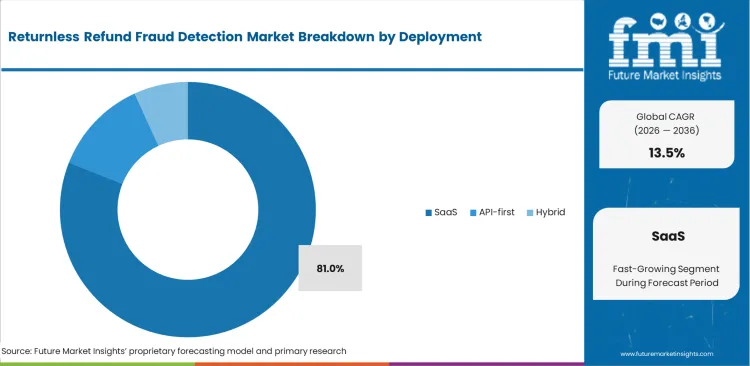
- SaaS models represent 81% of deployments, reflecting retailer preference for rapid integration, centralized updates, and lower operational overhead.
- Enterprise retailers account for 58% of adoption, given their higher exposure to abuse, complex omni‑channel workflows, and larger stakes.
- Apparel leads with 29% share, supported by chronic return behaviors such as bracketing and wardrobing.
- Instant refunds command 41% share within refund workflows, as merchants increasingly rely on real‑time trust signals to unlock faster refunds without elevating abuse risk.
- Scope includes refund‑abuse scoring, returnless‑refund decisioning, policy‑abuse screening, and claims verification, while excluding general payment‑fraud platforms that do not explicitly evaluate refund or return‑related abuse.
- Geography and Competitive Outlook
- India, Australia, and the United Kingdom represent the fastest‑growth markets, while the United States remains the most mature and revenue‑dense.
- Competitive dynamics are moving toward platform‑based expansion, with vendors integrating returns management, identity intelligence, and fraud‑decisioning into unified ecosystems rather than offering standalone tools.
- Key competitors include Appriss Retail, Riskified, Narvar, Signifyd, Forter, Sift, and SEON.
- Market concentration remains moderate, with Appriss Retail holding dominant share, supported by its long‑standing specialization in returns and claims fraud for large enterprise retailers.
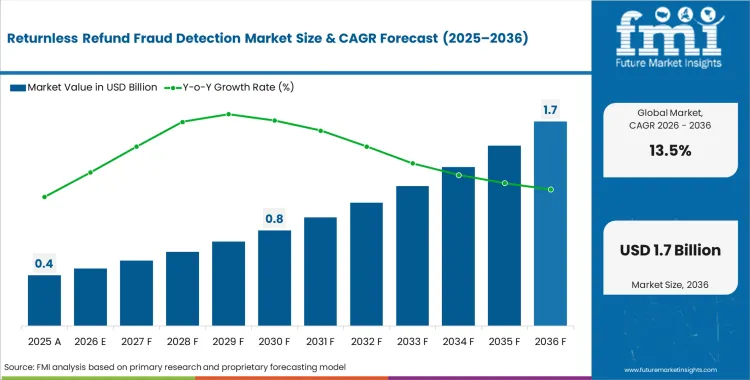
When loss‑prevention teams integrate real‑time carrier cost APIs with identity‑velocity tracking, refund concessions evolve from static value thresholds to dynamic, risk‑adjusted decisioning. This architecture activates advanced returns‑abuse detection capabilities that immediately block serial offenders while automatically waiving returns for trusted customers whose behavioral profiles indicate legitimate issues. The outcome is a materially stronger defensive posture: organized fraud attempts are intercepted at inception, and friction is reduced for genuine shoppers.
India is expected to lead this market, with demand rising at a CAGR of 16.8% through 2036 as government-backed digitization widens seller networks and increases the need for automated policy abuse controls. Australia follows at 14.4%, supported by high e-commerce penetration and strong consumer expectations around return convenience. The United Kingdom is projected to record 14.1% CAGR during the forecast period, while the United States is likely to grow at 13.2%, driven by the measurable scale of enterprise abuse across digital commerce channels. France is anticipated to expand at 13.0%, and Germany is set to post 12.6% as online retail systems continue to mature. Japan is forecast to witness 12.1% CAGR through 2036, reflecting a steadier pace of digital commerce growth. Differences across these countries are shaped by how far automated claim orchestration has developed within each market.
Segmental Analysis
Returnless Refund Fraud Detection Market Analysis by Detection Type
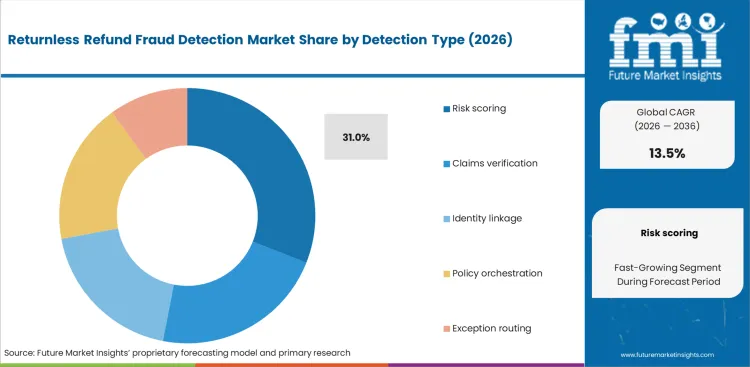
Loss prevention managers must balance frictionless customer experiences against rising concession abuse. Robust ecommerce refund risk scoring is estimated hold 31.0% share in 2026 because automated algorithms evaluate hundreds of data points instantly before authorizing payouts. Systems map device IDs, shipping addresses, and historical dispute rates to identify coordinated theft. Relying purely on velocity metrics fails when organized crime rings use distributed residential proxies to mask coordinated attacks.
FMI analysts note that scoring algorithms consistently misclassify legitimate shoppers ordering multiple sizes of a single garment as high-risk abusers, a false-positive reality that procurement directors rarely factor into unit-cost comparisons. This classification error limits autonomous decision confidence. Failing to fine-tune score thresholds forces retailers to route excessive claims to manual review teams, destroying intended savings. Implementing AI in fraud management layers refines risk thresholds dynamically, effectively neutralizing automated return approval fraud.
- Velocity evaluation: Algorithms track claim frequency across linked IP addresses over specific timeframes to flag coordinated behavior. Loss prevention analysts identify syndicated attacks early, preventing huge inventory drain before automated concession rules authorize unauthorized payouts.
- Anomaly flagging: Systems isolate unusual request patterns deviating from established consumer baseline behavior across multiple product categories. Operations directors block automated bots attempting mass refund exploitation during peak holiday seasons.
- Identity resolution: Software connects disparate email addresses sharing identical physical drop locations across extended periods. Fraud investigators unravel complex abuse networks, stopping coordinated financial extraction campaigns targeting specific high-value electronic items.
Returnless Refund Fraud Detection Market Analysis by Deployment
On‑premises software struggles to keep pace with rapidly evolving policy‑exploitation tactics emerging across underground forums. As retailers face increasingly sophisticated abuse patterns, e‑commerce technology directors have accelerated their movement toward subscription‑based cloud platforms that leverage centralized learning pools to anonymize and aggregate attack data across hundreds of merchants.
In 2026, cloud‑hosted returnless refund solutions account for 81.0% of deployments, reflecting the sector’s reliance on scalable infrastructure capable of delivering continuous algorithm updates against emerging threat vectors. According to FMI’s assessment, these cloud environments enable the consolidation of signals from disparate retailers, allowing the identification of professional refunders operating simultaneously across multiple brands. Technical evaluators often overlook that pure multi‑tenant cloud architectures restrict merchants from implementing highly customized risk rules tailored to unique internal supply‑chain nuances, introducing friction during enterprise onboarding.
- Infrastructure overhead: Cloud platforms eliminate internal server maintenance requirements entirely. IT procurement managers reduce total cost of ownership while gaining access to specialized threat intelligence databases maintained by dedicated vendor security teams.
- Integration complexity: Standardized APIs connect cloud fraud engines directly to existing shopping cart platforms seamlessly. Technical project managers deploy protection systems within weeks rather than enduring months of complex legacy database mapping.
- Update latency: Centralized cloud architecture pushes threat signature updates universally across all client instances immediately. Risk directors protect revenue streams against zero-day policy exploitation methods discovered on dark web channels.
Returnless Refund Fraud Detection Market Analysis by Merchant Size
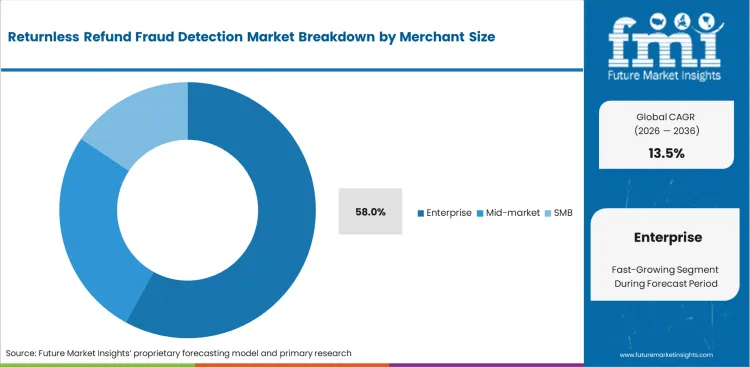
Enterprise operations face considerable transaction volumes that render manual claim review mathematically unfeasible. To manage this scale, multinational retailers increasingly rely on algorithmic decision engines capable of processing thousands of concurrent refund requests. FMI notes that high‑volume merchants frequently deploy customized machine learning models trained on their own historical abuse patterns, enabling more accurate and context‑specific decisioning. This operational scale also empowers large retailers to negotiate complex performance‑based pricing structures with software vendors. The enterprise segment commands 58.0% share in 2026, reflecting its heavy dependence on sophisticated automation capabilities.
What smaller competitors often overlook is that such enormous transaction volumes generate significant statistical noise, enabling patient fraud syndicates to siphon millions through micro‑claims that evade automated alert thresholds. This inherent volume blindness necessitates specialized omnichannel returns fraud detection routines. Delaying upgrades to enterprise‑grade payment processing solutions exposes retailers to increasingly advanced scraping bots engineered to probe and exploit refund policy limits across multichannel order management frameworks.
- Volume processing: Distributed computing architecture analyzes concurrent claim requests without introducing checkout friction. Operations vice presidents scale refund automation safely during significant promotional events without requiring temporary call center staffing surges.
- Rule complexity: Advanced platforms support hundreds of intersecting policy condition rules simultaneously. Risk strategy directors construct highly nuanced approval paths separating premium loyalist customers from opportunistic first-time abusers.
- Vendor negotiation: Substantial transaction volume provides high leverage during software contract discussions. Procurement heads secure performance guarantees ensuring vendor compensation aligns directly with actual prevented financial losses rather than mere API calls.
Returnless Refund Fraud Detection Market Analysis by Retail Vertical
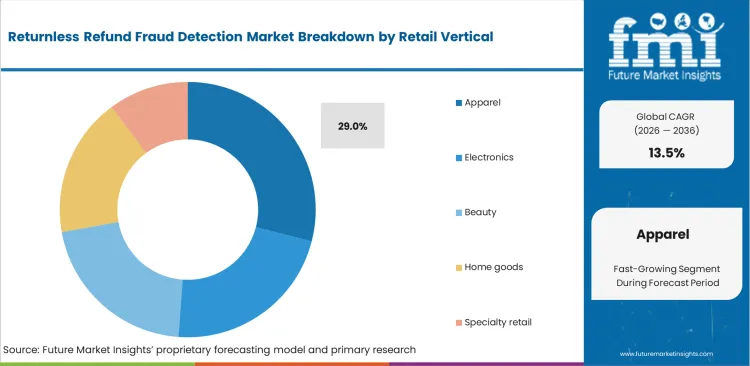
Apparel brands struggle constantly with shoppers ordering multiple sizes only to claim packages never arrived. Sophisticated apparel refund fraud detection accounts for 29.0% share in 2026 because clothing maintains incredibly high baseline return frequencies that naturally mask deliberate policy abuse. Loss prevention directors deploy advanced identity clustering to differentiate genuine sizing issues from organized wardrobing rings. According to FMI's estimates, clothing merchants endure unique vulnerabilities because fast-fashion items lack serial numbers, making returned item verification notoriously difficult. What category managers fail to realize is that implementing strict algorithmic barriers frequently punishes high-value loyalists whose legitimate sizing experiments create blunt fraud filters. This loyalty destruction costs brands far more than occasional missing inventory.
- Baseline masking: High natural return frequencies hide coordinated financial extraction attempts effectively. Fraud analysts deploy statistical deviation algorithms to identify subtle behavioral anomalies buried within millions of legitimate sizing complaints.
- Item verification: Clothing lacks unique digital identifiers tracking specific units through reverse supply chains. Operations managers rely on post-purchase behavioral scoring rather than physical product authentication to determine concession legitimacy.
- Loyalist punishment: Blunt policy enforcement rules routinely block premium buyers exhibiting high purchase frequencies. Customer experience directors intervene manually to rescue valuable relationships damaged by overly aggressive algorithmic fraud assumptions.
Returnless Refund Fraud Detection Market Analysis by Refund Workflow
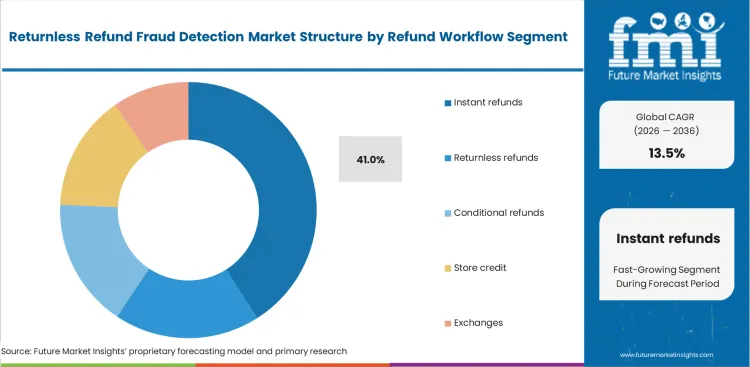
Merchants are under growing pressure to issue refunds immediately, often before the underlying claim is fully verified, as customer expectations continue to shift toward faster reimbursement. Treasury teams rely on predictive scoring models that can assess customer trust signals within milliseconds, allowing refund decisions to align with the pace of digital fulfilment. FMI’s assessment suggests that this shift toward immediate concession approval removes much of the manual review layer and places risk evaluation almost entirely on automated decisioning engines.
The challenge is that faster payouts can weaken verification discipline and create repeat abuse when shoppers learn how automated approvals behave. Instant refunds are estimated to account for 41.0% share in 2026 within refund workflows. That level reflects how deeply frictionless reimbursement models are being embedded into merchant operations. Financial exposure rises when instant payments are deployed without strong risk-intelligence support, since inaccurate approvals can lead to avoidable capital leakage. Effective instant refund fraud prevention has therefore become critical for merchants trying to preserve payout speed without undermining control.
- Processing latency: Algorithms calculate risk scores within milliseconds using cached behavioral profiles. E-commerce directors deliver frictionless customer experiences while blocking known syndicates attempting immediate automated cash extraction.
- Decision permanence: Instant payout execution leaves merchants with zero recovery options once funds transfer completes. Treasury managers demand highly accurate predictive models to prevent irrecoverable financial losses driven by automated bot networks.
- Behavioral conditioning: Frictionless automated approvals train consumers to fabricate delivery issues repeatedly. Risk analysts implement dynamic friction protocols requiring photographic evidence specifically from accounts exhibiting sudden claim frequency spikes.
Returnless Refund Fraud Detection Market Drivers, Restraints, and Opportunities
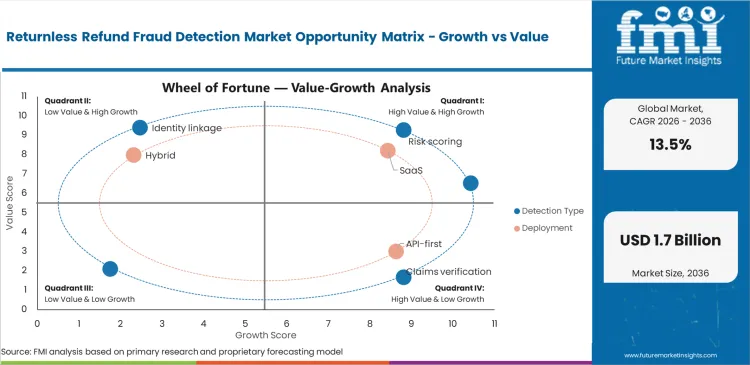
Rising transportation costs compel logistics directors to abandon physical item recovery for low-margin goods entirely. Shipping cheap items back to regional warehouses via reverse logistics channels frequently destroys all remaining profit margin. Retailers respond by issuing automatic financial waivers to save transit fees, inadvertently creating considerable vulnerabilities. Organized syndicates exploit this mathematical reality using coordinated bot networks to claim non-delivery on thousands of orders simultaneously. Delaying algorithmic intervention causes huge capital drain because automated approval systems process malicious claims endlessly before human analysts recognize attack patterns, pushing urgent adoption of comprehensive return policy optimization software.
Data privacy regulations restrict merchant ability to share known abuser profiles across disparate retail networks. Operations directors struggle to identify professional refunders who continuously rotate synthetic identities and fresh email addresses. While vendors attempt to build anonymized consortium networks, strict compliance teams block sharing detailed personal identifiable information. This fragmented visibility enables criminal rings to extract capital from multiple brands using identical tactics without activating any centralized detection mechanisms.
Opportunities in the Returnless Refund Fraud Detection Market
- Carrier integration: Direct API connections with shipping companies allow risk scoring algorithms to verify precise package delivery coordinates instantly. Logistics managers deny false non-delivery claims automatically using exact geolocation data.
- Consortium networks: Anonymized threat intelligence sharing enables competing merchants to pool specific policy abuse tactics safely. Fraud directors block known malicious device fingerprints before perpetrators execute their first transaction on new platforms.
- Dynamic routing: Algorithms push suspicious claims toward hyperlocal returns pickup centers for physical verification while instantly approving trusted buyer requests. Operations managers reduce total review costs while maintaining high security against organized syndicates.
Regional Analysis
Based on regional analysis, returnless refund fraud detection market is segmented into North America, Europe, Asia Pacific, and other regions across 40 plus countries.
.webp "Top Country Growth Comparison Returnless Refund Fraud Detection Market Cagr (2026 2036)")
| Country | CAGR (2026 to 2036) |
|---|---|
| India | 16.8% |
| Australia | 14.4% |
| United Kingdom | 14.1% |
| United States | 13.2% |
| France | 13.0% |
| Germany | 12.6% |
| Japan | 12.1% |
Source: Future Market Insights (FMI) analysis, based on proprietary forecasting model and primary research
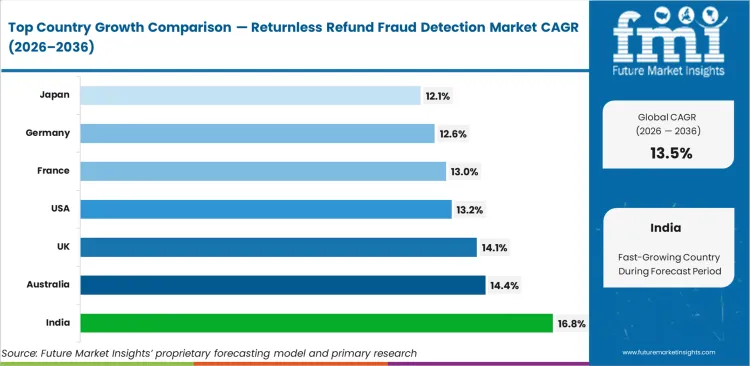
Asia Pacific Returnless Refund Fraud Detection Market Analysis
Government-backed digitization initiatives force newly onboarded regional sellers to confront sophisticated abuse vectors previously reserved for multinational enterprises. ONDC seller expansion brings millions of vulnerable merchants online without traditional loss prevention infrastructure. Fraud directors scramble to deploy localized identity resolution models capable of handling unique regional address formatting and shared residential proxies. FMI's analysis indicates rapid middle-class e-commerce adoption pushes transaction volumes far beyond manual review capacity, making algorithmic intervention mandatory. Differing maturity levels across Asian logistics networks complicate verification efforts, pushing software vendors to develop localized carrier integrations.
- India: The expansion of the ONDC network introduces vast pools of previously unprotected merchants to sophisticated policy abuse vulnerabilities. Demand for returnless refund fraud detection in India is anticipated to record a 16.8% CAGR through 2036. Digital transformation directors urgently require scalable software to protect newly established online revenue streams, preventing organized syndicates from draining working capital from smaller vendors lacking sophisticated retail analytics teams.
- Australia: High online retail penetration embeds convenience into shopper expectations, forcing managers to balance instant approvals against rising organized exploitation. Procuring advanced identity linkage tools provides domestic brands significant margin advantages over competitors utilizing manual claim review processes. Driven by this tension, the Australian industry is poised to rise at a 14.4% CAGR during the assessment, ultimately allowing operations teams to achieve an optimal security balance.
- Japan: The Japanese returnless refund fraud detection sector is set to garner a 12.1% CAGR between 2026 and 2036, dictated heavily by conservative corporate buying cycles ensuring steadier digital commerce expansion. Enterprise IT directors prioritize extensive software testing before trusting autonomous algorithms with sensitive customer relationship decisions. Implementing localized delivery management software integrations allows retailers to maintain legendary service standards while effectively blocking subtle abuse patterns.
FMI's report includes China, South Korea, and Southeast Asian nations. Regional payment preference fragmentation requires vendors to support vast arrays of localized digital wallets beyond standard credit architecture.
Europe Returnless Refund Fraud Detection Market Analysis
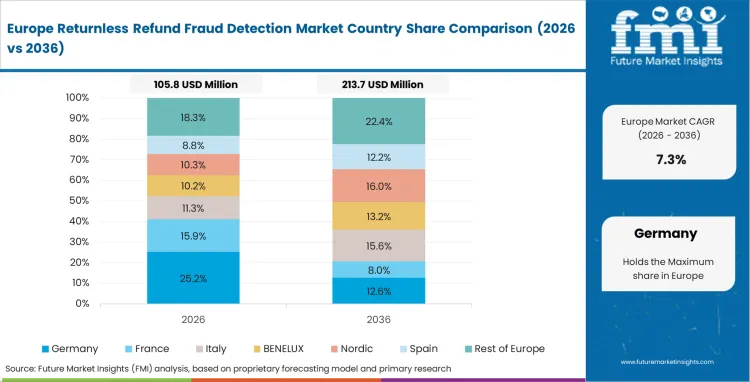
Strict consumer protection mandates prevent merchants from imposing rigid return barriers, forcing retailers to rely entirely on invisible post-purchase behavioral algorithms. European privacy frameworks severely restrict cross-merchant identity sharing, complicating consortium-based threat detection efforts. Risk strategy leaders construct highly customized rules engines to identify subtle abuse patterns without violating stringent data handling regulations. FMI analysts note that cross-border fulfillment complexities amplify non-delivery claim frequencies, requiring algorithms to differentiate between genuine customs delays and deliberate policy manipulation. Differing logistics infrastructure across member states demands flexible software parameters.
- United Kingdom: Mature digital shopping habits create sophisticated consumer exploitation strategies, forcing retail loss prevention heads to deploy advanced device fingerprinting against professional refund rings advertising on encrypted platforms. By adopting comprehensive brand protection tools, merchants stop synchronized attacks targeting high-value electronics during seasonal promotions. The United Kingdom market is anticipated to capture a 14.1% CAGR through 2036, effectively securing retailer profit margins against organized digital theft.
- France: Deliberate enterprise software procurement cycles require clear return-on-investment metrics before financial controllers authorize widespread autonomous decision engine installations. Within this highly cautious environment, French sales of returnless refund fraud detection systems are set to record a 13.0% CAGR during the forecast period. Integrating sophisticated inventory management software connections provides the necessary data points to justify expensive algorithmic upgrades, ultimately securing robust supply chain visibility.
- Germany: Demand for fraud detection solutions in Germany is anticipated to rise at a 12.6% CAGR by 2036, as a deeply entrenched high-baseline return culture creates significant statistical noise masking deliberate abuse. Operations directors implement complex deviation models to identify serial abusers hiding within acceptable behavioral parameters. Connecting retail logistics platforms directly with risk engines ensures merchants maintain profitability despite notoriously high consumer return expectations.
FMI's report includes Italy, Spain, and Nordic countries. Evolving cross-border tax regulations create additional verification layers for automated concession engines to navigate.
North America Returnless Refund Fraud Detection Market Analysis
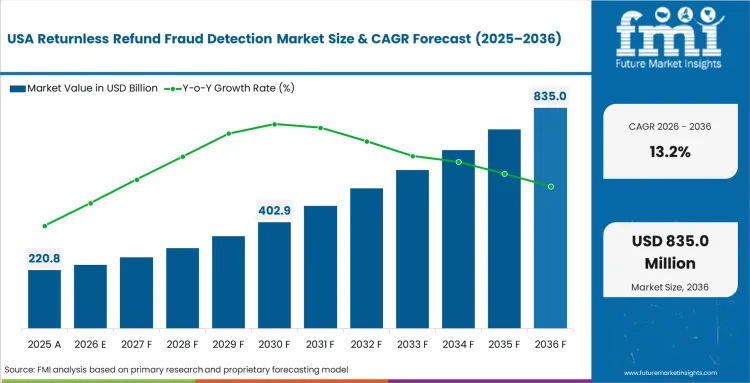
Significant enterprise scale means incremental algorithmic improvements generate tens of millions in recovered revenue annually. Regional loss prevention teams possess sophisticated threat intelligence capabilities, pushing software vendors to deliver highly customizable machine learning environments rather than rigid black-box solutions. According to FMI's estimates, market competition forces retailers to offer incredibly lenient concession policies, effectively weaponizing customer service against merchant profitability. Advanced technical teams build proprietary data lakes combining vendor risk scores with internal customer lifetime value metrics.
- United States: Deep e-commerce foundations support high enterprise abuse scale as criminal syndicates alter extraction tactics. The United States returnless refund fraud detection segment is poised to capture a 13.2% CAGR during the assessment. Loss prevention leaders move budgets toward post-purchase policy enforcement, deploying payment analytics software to isolate fraud rings across distributed IP addresses, redefining benchmarks as buyers evaluate the best refund fraud detection software.
FMI's report includes Canada and Mexico. Expanding cross-border fulfillment operations require sophisticated last mile reverse logistics integrations to combat localized transit theft rings.
Competitive Aligners for Market Players
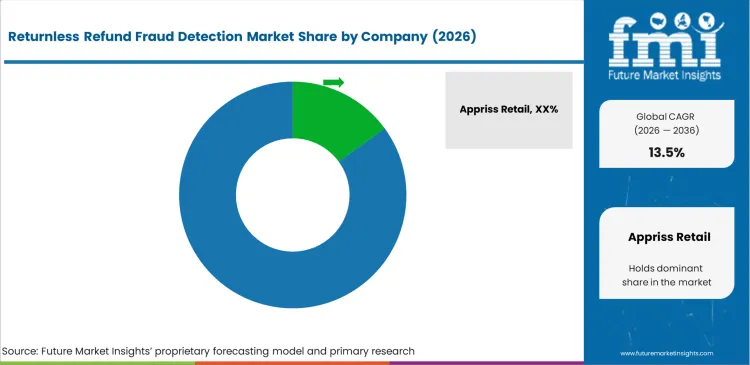
Incumbents built initial success by analyzing credit card chargebacks at checkout, but modern returnless abuse requires entirely different architectural approaches. Companies like Appriss Retail and Riskified leverage vast historical data lakes spanning billions of transactions to identify cross-merchant behavioral anomalies. These huge data repositories allow established vendors to train superior predictive models that recognize new syndicated attack vectors faster than isolated internal retail teams ever could. This consortium data advantage serves as a barrier against new software entrants attempting to build accurate risk models from scratch, pushing buyers toward established returns management software with fraud prevention capabilities.
Challengers entering this space must develop specialized identity resolution techniques focusing exclusively on post-purchase actions rather than payment authentication. Emerging platforms differentiate themselves by offering seamless mobile payment security integration alongside specific carrier API connections that verify precise delivery coordinates. To capture share from established giants, newer vendors construct highly flexible microservices that allow merchant data science teams to insert proprietary artificial intelligence in retail models directly into vendor decision flows.
Large retail enterprises actively resist vendor lock-in by utilizing multiple fraud engines simultaneously, routing different transaction types to specialized algorithms based on specific product categories. Procurement directors force platform providers to accept performance-based pricing models where software costs tie directly to actual recovered revenue rather than mere processing volume. Changing software architectures empower merchants to experiment with diverse decision engines, constantly evaluating incumbent model accuracy against agile return fraud software vendors handling secondhand apparel or niche retail streams.
Key Players in Returnless Refund Fraud Detection Market
- Appriss Retail
- Riskified
- Narvar
- Signifyd
- Forter
- Sift
- SEON
Scope of the Report
| Metric | Value |
|---|---|
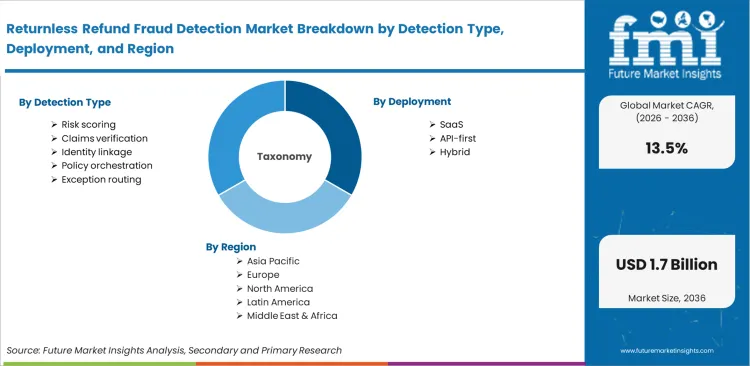
| Quantitative Units | USD 430.0 million to USD 1,530.0 million, at a CAGR of 13.5% |
| Market Definition | Returnless refund fraud detection involves software algorithms determining if buyers requesting reimbursement without returning items are executing legitimate service claims or orchestrating policy abuse. These platforms analyze identity signals, claim velocity, and device intelligence. |
| Segmentation | Detection type, Deployment, Merchant size, Retail vertical, and Refund workflow |
| Regions Covered | North America, Latin America, Europe, Asia Pacific, and Middle East and Africa |
| Countries Covered | United States, Canada, Germany, United Kingdom, France, Italy, Spain, Russia, China, Japan, South Korea, India, ASEAN, ANZ, Brazil, Mexico, GCC, South Africa |
| Key Companies Profiled | Appriss Retail, Riskified, Narvar, Signifyd, Forter, Sift, SEON |
| Forecast Period | 2026 to 2036 |
| Approach | Retail transaction volumes combined with reported concession dispute rates and vendor platform gross merchandise value processed cross-referenced against published earnings |
Source: Future Market Insights (FMI) analysis, based on proprietary forecasting model and primary research
Returnless Refund Fraud Detection Market Analysis by Segments
Detection type
- Risk scoring
- Claims verification
- Identity linkage
- Policy orchestration
- Exception routing
Deployment
- SaaS
- API-first
- Hybrid
Merchant size
- Enterprise
- Mid-market
- SMB
Retail vertical
- Apparel
- Electronics
- Beauty
- Home goods
- Specialty retail
Refund workflow
- Instant refunds
- Returnless refunds
- Conditional refunds
- Store credit
- Exchanges
Region:
- North America
- United States
- Canada
- Europe
- Germany
- United Kingdom
- France
- Italy
- Spain
- Asia Pacific
- China
- Japan
- South Korea
- Taiwan
- Singapore
- Latin America
- Brazil
- Mexico
- Argentina
- Middle East & Africa
- GCC Countries
- South Africa
Bibliography
- Federal Trade Commission. (2025). New Report Shows FTC Returned $337.3 Million to Consumers in 2024. Federal Trade Commission.
- Merchant Risk Council. (2025). 2025 Global Payments and Fraud Report. Merchant Risk Council.
- National Retail Federation, & Happy Returns. (2024). 2024 Consumer Returns in the Retail Industry. National Retail Federation.
- Kumar, P. R., Rajasekaran, R., & Ravichandran, N. (2025). On Detecting Frauds in Retail Transactions for Enhanced E-Commerce Security Using Deep Learning Techniques. Procedia Computer Science, 252, 2417-2424.
- Mishra, A., Singh, R. K., & Kumar, A. (2024). Return management in e-commerce firms: A machine learning framework. Journal of Cleaner Production, 479, 143824.
This bibliography is provided for reader reference. The full FMI report contains the complete reference list with primary source documentation.
This Report Addresses
- E-commerce transportation cost pressures forcing operations directors to abandon physical item recovery frameworks.
- Algorithmic evaluation techniques required to instantly analyze post-purchase buyer behavior across diverse product categories.
- Identity resolution strategies empowering fraud investigators to unravel coordinated refund-as-a-service extraction networks.
- SaaS platform adoption metrics tracking enterprise shifts toward centralized threat intelligence consortium databases.
- Regional digitized seller expansion introducing vulnerable merchant pools to sophisticated global policy abuse vectors.
- Machine learning deployment challenges separating genuine apparel sizing issues from deliberate wardrobing exploitation.
- Carrier API integration methods allowing logistics managers to automatically reject false non-delivery concession claims.
Performance-based software procurement models aligning vendor compensation directly with actual prevented merchant financial losses.
Frequently Asked Questions
What is returnless refund fraud?
Returnless refund fraud occurs when customers successfully claim financial reimbursement from digital merchants without sending the physical item back. Criminal syndicates exploit automated leniency policies using coordinated bots to claim items were damaged or never arrived, converting unprotected retail inventory directly into cash.
How big is the returnless refund fraud detection market?
Industry valuation crossed USD 430.0 million in 2026 and heads toward USD 1,530.0 million by 2036. Revenue scales at a 13.5% CAGR as multinational retailers aggressively implement sophisticated identity resolution algorithms to protect thin profit margins against highly organized refund-as-a-service underground networks.
Explain the returnless refund fraud detection market trajectory?
Rising reverse logistics costs force retailers to grant automatic financial waivers for low-margin goods. Criminal organizations weaponize these automatic waivers, compelling enterprise operations managers to deploy advanced policy orchestration engines capable of differentiating genuine customer fulfillment complaints from systemic capital extraction attempts.
Why are merchants adopting returnless refund fraud tools?
Data privacy regulations restrict merchant ability to share known abuser profiles across disparate retail networks. Strict compliance teams block sharing detailed personal identifiable information, creating fragmented visibility that allows criminal rings to extract capital from multiple brands without being detected by any centralized oversight systems.
Which retail sectors need refund abuse detection most?
Apparel maintains incredibly high baseline return frequencies masking deliberate policy abuse. Loss prevention directors deploy sophisticated identity clustering to differentiate genuine sizing issues from organized wardrobing rings exploiting missing serial numbers and manipulating lenient trial policies.
Why are instant refunds increasing fraud exposure?
Prioritizing speed over accuracy conditions consumers to exploit automated approvals continuously. Financial controllers realize this behavioral conditioning transforms honest shoppers into opportunistic abusers once they discover instant approval loopholes, forcing treasury managers to demand highly accurate predictive models.
How do merchants detect item-not-received fraud?
Direct API connections with shipping companies allow risk scoring algorithms to verify precise package delivery coordinates instantly. Logistics managers deny false non-delivery claims automatically using exact geolocation data, eliminating manual tracking number verification overhead entirely.
What is the difference between return fraud vs chargeback fraud?
Chargeback models look for stolen credentials and mismatched billing addresses during the initial checkout phase. Returnless refund fraud involves legitimate customers using valid payment methods to steal inventory post-purchase. Catching these actors requires analyzing post-purchase behavior and claim velocity rather than point-of-sale risk.
Who are the key vendors in returnless refund fraud detection?
Established vendors like Appriss Retail and Riskified leverage vast historical data lakes spanning billions of transactions to identify cross-merchant behavioral anomalies. These repositories allow incumbents to train superior predictive models that recognize new syndicated attack vectors faster than isolated internal retail teams.
How to reduce return fraud without hurting CX?
Algorithms calculate risk scores within milliseconds using cached behavioral profiles. E-commerce directors deliver frictionless customer experiences while blocking known syndicates attempting immediate automated cash extraction, ensuring premium loyalist shoppers never encounter frustrating manual review friction during valid dispute processes.
What data signals are used in ecommerce refund risk scoring?
Systems map device IDs, shipping addresses, and historical dispute rates to identify coordinated theft without introducing manual review friction. Fraud investigators require sophisticated identity linkage software to connect completely different email addresses sharing identical physical drop locations.
How do professional refund networks defeat simple velocity filters?
Organized crime rings use distributed residential proxies to mask coordinated attacks, generating disparate IP addresses that bypass simple velocity thresholds. Advanced deployments redefine national retail security benchmarks by identifying subtle behavioral anomalies buried within millions of legitimate complaints.
What operational consequence occurs when risk thresholds remain uncalibrated?
Failing to fine-tune score thresholds forces retailers to route excessive claims to manual review teams, destroying intended operational savings. Blunt algorithmic barriers frequently punish high-value loyalists whose legitimate sizing experiments trigger fraud filters, causing severe brand damage.
Why is apparel a leading segment for apparel refund fraud detection?
Clothing lacks unique digital identifiers tracking specific units through reverse supply chains. Operations managers rely on post-purchase behavioral scoring rather than physical product authentication to determine concession legitimacy when customers claim delivered packages contained incorrect items.
How does cross-border fulfillment complicate European detection efforts?
Differing logistics infrastructure across member states demands flexible software parameters. Cross-border complexities amplify genuine non-delivery claim frequencies, requiring algorithms to differentiate between authentic customs delays and deliberate policy manipulation engineered by sophisticated underground consumer forums.
Why do merchants increasingly utilize SaaS platforms?
SaaS holds 81.0% share in 2026 as cloud infrastructure guarantees continuous algorithm updates against emerging threat vectors. E-commerce technology directors favor subscription platforms because centralized learning pools anonymize attack data across hundreds of merchants simultaneously.
How do advanced platforms handle high-volume promotional events?
Distributed computing architecture analyzes concurrent claim requests without introducing checkout friction. Operations vice presidents scale refund automation safely during significant seasonal events without requiring temporary call center staffing surges to manage the inevitable concession dispute spikes.
Why is API-first deployment gaining traction among technical teams?
Emerging platforms offer API-first microservices allowing merchant data science teams to insert proprietary artificial intelligence models directly into vendor decision flows. This architectural flexibility prevents vendor lock-in and allows continuous evaluation against alternative niche detection engines.
What metrics do procurement heads use to evaluate software effectiveness?
Procurement heads secure performance guarantees ensuring vendor compensation aligns directly with actual prevented financial losses rather than mere API calls. Advanced platforms must prove their automated rejections accurately isolate fraud without damaging long-term premium customer lifetime value.
What tension exists within multi-tenant cloud models?
Pure multi-tenant cloud models restrict merchants from applying highly customized risk rules specific to unique internal supply chain quirks. This standardization tension creates friction during enterprise onboarding, pushing technical project managers to seek hybrid integration capabilities.
How do Japanese corporate procurement cycles affect regional growth?
Conservative corporate buying cycles dictate steadier digital commerce expansion, resulting in 12.1% growth. Enterprise IT directors prioritize extensive software testing before trusting autonomous algorithms with customer relationship decisions, demanding localized logistics integrations prior to full deployment.
What role do anomaly flagging algorithms play during holiday peaks?
Systems isolate unusual request patterns deviating from established consumer baseline behavior across multiple product categories. Operations directors block automated bots attempting mass refund exploitation precisely when manual review teams are overwhelmed by legitimate seasonal return volume.
Why do mid-market retailers struggle to deploy adequate protections?
Significant enterprise transaction volume creates leverage during software contract discussions that smaller competitors lack. Mid-market vendors struggle to access sophisticated micro-fraud detection routines, leaving their balance sheets vulnerable to scraping bots testing refund policy limits.
How do differing regional regulations shape software architectures?
Strict European consumer protection mandates prevent merchants from imposing rigid physical return barriers, forcing reliance on invisible post-purchase behavioral algorithms. Software vendors must develop localized compliance modules adapting to shifting cross-border tax regulations and variable privacy standards.
Preview the report firsthand - request a free sample
Get SampleGet the brochure for pricing and purchase details.
Get PDFTable of Content
- Executive Summary
- Global Market Outlook
- Demand-side Trends
- Supply-side Trends
- Technology Roadmap Analysis
- Analysis and Recommendations
- Market Overview
- Market Coverage / Taxonomy
- Market Definition / Scope / Limitations
- Research Methodology
- Chapter Orientation
- Analytical Lens and Working Hypotheses
- Market Structure, Signals, and Trend Drivers
- Benchmarking and Cross-market Comparability
- Market Sizing, Forecasting, and Opportunity Mapping
- Research Design and Evidence Framework
- Desk Research Programme (Secondary Evidence)
- Company Annual and Sustainability Reports
- Peer-reviewed Journals and Academic Literature
- Corporate Websites, Product Literature, and Technical Notes
- Earnings Decks and Investor Briefings
- Statutory Filings and Regulatory Disclosures
- Technical White Papers and Standards Notes
- Trade Journals, Industry Magazines, and Analyst Briefs
- Conference Proceedings, Webinars, and Seminar Materials
- Government Statistics Portals and Public Data Releases
- Press Releases and Reputable Media Coverage
- Specialist Newsletters and Curated Briefings
- Sector Databases and Reference Repositories
- FMI Internal Proprietary Databases and Historical Market Datasets
- Subscription Datasets and Paid Sources
- Social Channels, Communities, and Digital Listening Inputs
- Additional Desk Sources
- Expert Input and Fieldwork (Primary Evidence)
- Primary Modes
- Qualitative Interviews and Expert Elicitation
- Quantitative Surveys and Structured Data Capture
- Blended Approach
- Why Primary Evidence is Used
- Field Techniques
- Interviews
- Surveys
- Focus Groups
- Observational and In-context Research
- Social and Community Interactions
- Stakeholder Universe Engaged
- C-suite Leaders
- Board Members
- Presidents and Vice Presidents
- R&D and Innovation Heads
- Technical Specialists
- Domain Subject-matter Experts
- Scientists
- Physicians and Other Healthcare Professionals
- Governance, Ethics, and Data Stewardship
- Research Ethics
- Data Integrity and Handling
- Primary Modes
- Tooling, Models, and Reference Databases
- Desk Research Programme (Secondary Evidence)
- Data Engineering and Model Build
- Data Acquisition and Ingestion
- Cleaning, Normalisation, and Verification
- Synthesis, Triangulation, and Analysis
- Quality Assurance and Audit Trail
- Market Background
- Market Dynamics
- Drivers
- Restraints
- Opportunity
- Trends
- Scenario Forecast
- Demand in Optimistic Scenario
- Demand in Likely Scenario
- Demand in Conservative Scenario
- Opportunity Map Analysis
- Product Life Cycle Analysis
- Supply Chain Analysis
- Investment Feasibility Matrix
- Value Chain Analysis
- PESTLE and Porter’s Analysis
- Regulatory Landscape
- Regional Parent Market Outlook
- Production and Consumption Statistics
- Import and Export Statistics
- Market Dynamics
- Global Market Analysis 2021 to 2025 and Forecast, 2026 to 2036
- Historical Market Size Value (USD Million) Analysis, 2021 to 2025
- Current and Future Market Size Value (USD Million) Projections, 2026 to 2036
- Y-o-Y Growth Trend Analysis
- Absolute $ Opportunity Analysis
- Global Market Pricing Analysis 2021 to 2025 and Forecast 2026 to 2036
- Global Market Analysis 2021 to 2025 and Forecast 2026 to 2036, By Detection Type
- Introduction / Key Findings
- Historical Market Size Value (USD Million) Analysis By Detection Type , 2021 to 2025
- Current and Future Market Size Value (USD Million) Analysis and Forecast By Detection Type , 2026 to 2036
- Risk scoring
- Claims verification
- Identity linkage
- Policy orchestration
- Exception routing
- Risk scoring
- Y-o-Y Growth Trend Analysis By Detection Type , 2021 to 2025
- Absolute $ Opportunity Analysis By Detection Type , 2026 to 2036
- Global Market Analysis 2021 to 2025 and Forecast 2026 to 2036, By Deployment
- Introduction / Key Findings
- Historical Market Size Value (USD Million) Analysis By Deployment, 2021 to 2025
- Current and Future Market Size Value (USD Million) Analysis and Forecast By Deployment, 2026 to 2036
- SaaS
- API-first
- Hybrid
- SaaS
- Y-o-Y Growth Trend Analysis By Deployment, 2021 to 2025
- Absolute $ Opportunity Analysis By Deployment, 2026 to 2036
- Global Market Analysis 2021 to 2025 and Forecast 2026 to 2036, By Merchant Size
- Introduction / Key Findings
- Historical Market Size Value (USD Million) Analysis By Merchant Size, 2021 to 2025
- Current and Future Market Size Value (USD Million) Analysis and Forecast By Merchant Size, 2026 to 2036
- Enterprise
- Mid-market
- SMB
- Enterprise
- Y-o-Y Growth Trend Analysis By Merchant Size, 2021 to 2025
- Absolute $ Opportunity Analysis By Merchant Size, 2026 to 2036
- Global Market Analysis 2021 to 2025 and Forecast 2026 to 2036, By Retail Vertical
- Introduction / Key Findings
- Historical Market Size Value (USD Million) Analysis By Retail Vertical, 2021 to 2025
- Current and Future Market Size Value (USD Million) Analysis and Forecast By Retail Vertical, 2026 to 2036
- Apparel
- Electronics
- Beauty
- Home goods
- Specialty retail
- Apparel
- Y-o-Y Growth Trend Analysis By Retail Vertical, 2021 to 2025
- Absolute $ Opportunity Analysis By Retail Vertical, 2026 to 2036
- Global Market Analysis 2021 to 2025 and Forecast 2026 to 2036, By Refund Workflow
- Introduction / Key Findings
- Historical Market Size Value (USD Million) Analysis By Refund Workflow, 2021 to 2025
- Current and Future Market Size Value (USD Million) Analysis and Forecast By Refund Workflow, 2026 to 2036
- Instant refunds
- Returnless refunds
- Conditional refunds
- Store credit
- Exchanges
- Instant refunds
- Y-o-Y Growth Trend Analysis By Refund Workflow, 2021 to 2025
- Absolute $ Opportunity Analysis By Refund Workflow, 2026 to 2036
- Global Market Analysis 2021 to 2025 and Forecast 2026 to 2036, By Region
- Introduction
- Historical Market Size Value (USD Million) Analysis By Region, 2021 to 2025
- Current Market Size Value (USD Million) Analysis and Forecast By Region, 2026 to 2036
- North America
- Latin America
- Western Europe
- Eastern Europe
- East Asia
- South Asia and Pacific
- Middle East & Africa
- Market Attractiveness Analysis By Region
- North America Market Analysis 2021 to 2025 and Forecast 2026 to 2036, By Country
- Historical Market Size Value (USD Million) Trend Analysis By Market Taxonomy, 2021 to 2025
- Market Size Value (USD Million) Forecast By Market Taxonomy, 2026 to 2036
- By Country
- USA
- Canada
- Mexico
- By Detection Type
- By Deployment
- By Merchant Size
- By Retail Vertical
- By Refund Workflow
- By Country
- Market Attractiveness Analysis
- By Country
- By Detection Type
- By Deployment
- By Merchant Size
- By Retail Vertical
- By Refund Workflow
- Key Takeaways
- Latin America Market Analysis 2021 to 2025 and Forecast 2026 to 2036, By Country
- Historical Market Size Value (USD Million) Trend Analysis By Market Taxonomy, 2021 to 2025
- Market Size Value (USD Million) Forecast By Market Taxonomy, 2026 to 2036
- By Country
- Brazil
- Chile
- Rest of Latin America
- By Detection Type
- By Deployment
- By Merchant Size
- By Retail Vertical
- By Refund Workflow
- By Country
- Market Attractiveness Analysis
- By Country
- By Detection Type
- By Deployment
- By Merchant Size
- By Retail Vertical
- By Refund Workflow
- Key Takeaways
- Western Europe Market Analysis 2021 to 2025 and Forecast 2026 to 2036, By Country
- Historical Market Size Value (USD Million) Trend Analysis By Market Taxonomy, 2021 to 2025
- Market Size Value (USD Million) Forecast By Market Taxonomy, 2026 to 2036
- By Country
- Germany
- UK
- Italy
- Spain
- France
- Nordic
- BENELUX
- Rest of Western Europe
- By Detection Type
- By Deployment
- By Merchant Size
- By Retail Vertical
- By Refund Workflow
- By Country
- Market Attractiveness Analysis
- By Country
- By Detection Type
- By Deployment
- By Merchant Size
- By Retail Vertical
- By Refund Workflow
- Key Takeaways
- Eastern Europe Market Analysis 2021 to 2025 and Forecast 2026 to 2036, By Country
- Historical Market Size Value (USD Million) Trend Analysis By Market Taxonomy, 2021 to 2025
- Market Size Value (USD Million) Forecast By Market Taxonomy, 2026 to 2036
- By Country
- Russia
- Poland
- Hungary
- Balkan & Baltic
- Rest of Eastern Europe
- By Detection Type
- By Deployment
- By Merchant Size
- By Retail Vertical
- By Refund Workflow
- By Country
- Market Attractiveness Analysis
- By Country
- By Detection Type
- By Deployment
- By Merchant Size
- By Retail Vertical
- By Refund Workflow
- Key Takeaways
- East Asia Market Analysis 2021 to 2025 and Forecast 2026 to 2036, By Country
- Historical Market Size Value (USD Million) Trend Analysis By Market Taxonomy, 2021 to 2025
- Market Size Value (USD Million) Forecast By Market Taxonomy, 2026 to 2036
- By Country
- China
- Japan
- South Korea
- By Detection Type
- By Deployment
- By Merchant Size
- By Retail Vertical
- By Refund Workflow
- By Country
- Market Attractiveness Analysis
- By Country
- By Detection Type
- By Deployment
- By Merchant Size
- By Retail Vertical
- By Refund Workflow
- Key Takeaways
- South Asia and Pacific Market Analysis 2021 to 2025 and Forecast 2026 to 2036, By Country
- Historical Market Size Value (USD Million) Trend Analysis By Market Taxonomy, 2021 to 2025
- Market Size Value (USD Million) Forecast By Market Taxonomy, 2026 to 2036
- By Country
- India
- ASEAN
- Australia & New Zealand
- Rest of South Asia and Pacific
- By Detection Type
- By Deployment
- By Merchant Size
- By Retail Vertical
- By Refund Workflow
- By Country
- Market Attractiveness Analysis
- By Country
- By Detection Type
- By Deployment
- By Merchant Size
- By Retail Vertical
- By Refund Workflow
- Key Takeaways
- Middle East & Africa Market Analysis 2021 to 2025 and Forecast 2026 to 2036, By Country
- Historical Market Size Value (USD Million) Trend Analysis By Market Taxonomy, 2021 to 2025
- Market Size Value (USD Million) Forecast By Market Taxonomy, 2026 to 2036
- By Country
- Kingdom of Saudi Arabia
- Other GCC Countries
- Turkiye
- South Africa
- Other African Union
- Rest of Middle East & Africa
- By Detection Type
- By Deployment
- By Merchant Size
- By Retail Vertical
- By Refund Workflow
- By Country
- Market Attractiveness Analysis
- By Country
- By Detection Type
- By Deployment
- By Merchant Size
- By Retail Vertical
- By Refund Workflow
- Key Takeaways
- Key Countries Market Analysis
- USA
- Pricing Analysis
- Market Share Analysis, 2025
- By Detection Type
- By Deployment
- By Merchant Size
- By Retail Vertical
- By Refund Workflow
- Canada
- Pricing Analysis
- Market Share Analysis, 2025
- By Detection Type
- By Deployment
- By Merchant Size
- By Retail Vertical
- By Refund Workflow
- Mexico
- Pricing Analysis
- Market Share Analysis, 2025
- By Detection Type
- By Deployment
- By Merchant Size
- By Retail Vertical
- By Refund Workflow
- Brazil
- Pricing Analysis
- Market Share Analysis, 2025
- By Detection Type
- By Deployment
- By Merchant Size
- By Retail Vertical
- By Refund Workflow
- Chile
- Pricing Analysis
- Market Share Analysis, 2025
- By Detection Type
- By Deployment
- By Merchant Size
- By Retail Vertical
- By Refund Workflow
- Germany
- Pricing Analysis
- Market Share Analysis, 2025
- By Detection Type
- By Deployment
- By Merchant Size
- By Retail Vertical
- By Refund Workflow
- UK
- Pricing Analysis
- Market Share Analysis, 2025
- By Detection Type
- By Deployment
- By Merchant Size
- By Retail Vertical
- By Refund Workflow
- Italy
- Pricing Analysis
- Market Share Analysis, 2025
- By Detection Type
- By Deployment
- By Merchant Size
- By Retail Vertical
- By Refund Workflow
- Spain
- Pricing Analysis
- Market Share Analysis, 2025
- By Detection Type
- By Deployment
- By Merchant Size
- By Retail Vertical
- By Refund Workflow
- France
- Pricing Analysis
- Market Share Analysis, 2025
- By Detection Type
- By Deployment
- By Merchant Size
- By Retail Vertical
- By Refund Workflow
- India
- Pricing Analysis
- Market Share Analysis, 2025
- By Detection Type
- By Deployment
- By Merchant Size
- By Retail Vertical
- By Refund Workflow
- ASEAN
- Pricing Analysis
- Market Share Analysis, 2025
- By Detection Type
- By Deployment
- By Merchant Size
- By Retail Vertical
- By Refund Workflow
- Australia & New Zealand
- Pricing Analysis
- Market Share Analysis, 2025
- By Detection Type
- By Deployment
- By Merchant Size
- By Retail Vertical
- By Refund Workflow
- China
- Pricing Analysis
- Market Share Analysis, 2025
- By Detection Type
- By Deployment
- By Merchant Size
- By Retail Vertical
- By Refund Workflow
- Japan
- Pricing Analysis
- Market Share Analysis, 2025
- By Detection Type
- By Deployment
- By Merchant Size
- By Retail Vertical
- By Refund Workflow
- South Korea
- Pricing Analysis
- Market Share Analysis, 2025
- By Detection Type
- By Deployment
- By Merchant Size
- By Retail Vertical
- By Refund Workflow
- Russia
- Pricing Analysis
- Market Share Analysis, 2025
- By Detection Type
- By Deployment
- By Merchant Size
- By Retail Vertical
- By Refund Workflow
- Poland
- Pricing Analysis
- Market Share Analysis, 2025
- By Detection Type
- By Deployment
- By Merchant Size
- By Retail Vertical
- By Refund Workflow
- Hungary
- Pricing Analysis
- Market Share Analysis, 2025
- By Detection Type
- By Deployment
- By Merchant Size
- By Retail Vertical
- By Refund Workflow
- Kingdom of Saudi Arabia
- Pricing Analysis
- Market Share Analysis, 2025
- By Detection Type
- By Deployment
- By Merchant Size
- By Retail Vertical
- By Refund Workflow
- Turkiye
- Pricing Analysis
- Market Share Analysis, 2025
- By Detection Type
- By Deployment
- By Merchant Size
- By Retail Vertical
- By Refund Workflow
- South Africa
- Pricing Analysis
- Market Share Analysis, 2025
- By Detection Type
- By Deployment
- By Merchant Size
- By Retail Vertical
- By Refund Workflow
- USA
- Market Structure Analysis
- Competition Dashboard
- Competition Benchmarking
- Market Share Analysis of Top Players
- By Regional
- By Detection Type
- By Deployment
- By Merchant Size
- By Retail Vertical
- By Refund Workflow
- Competition Analysis
- Competition Deep Dive
- Appriss Retail
- Overview
- Product Portfolio
- Profitability by Market Segments (Product/Age /Sales Channel/Region)
- Sales Footprint
- Strategy Overview
- Marketing Strategy
- Product Strategy
- Channel Strategy
- Riskified
- Narvar
- Signifyd
- Forter
- Sift
- SEON
- Appriss Retail
- Competition Deep Dive
- Assumptions & Acronyms Used


