

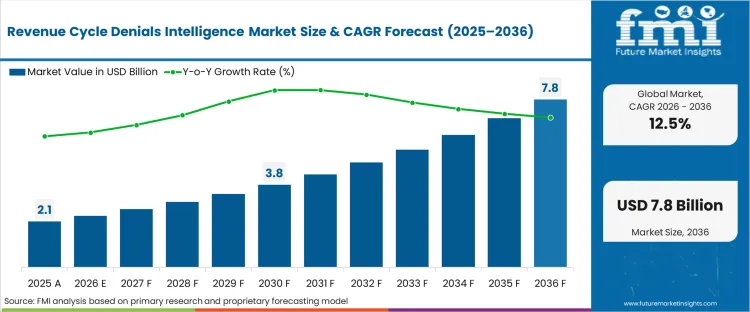
- Industry Size (2026)
- USD 2.4 Bn
- Forecast (2036)
- USD 7.8 Bn
- CAGR (2026 to 2036)
- 12.50%
Revenue Cycle Denials Intelligence Market Size, Market Forecast and Outlook By FMI
The revenue cycle denials intelligence market was valued at USD 2.1 billion in 2025 and is projected to reach USD 2.4 billion in 2026, reflecting a CAGR of 12.5%. Continued investment is expected to drive market expansion to USD 7.8 billion by 2036, as healthcare providers adopt advanced intelligence solutions to counter increasingly automated payer claim denials and preserve collection performance.
Revenue cycle directors are currently forced to decide between bolting third-party intelligence modules onto legacy electronic health records or migrating entire financial operations to unified platforms. The stakes of delaying this architectural choice materialize as deteriorating days in accounts receivable, as legacy human-in-the-loop triage fails against automated payer adjudication. While standard metrics track recovery rates, predictive billing workflows reveal that the actual financial leakage occurs in the hidden administrative cost of the appeal process itself.
Growth becomes self-reinforcing only when real-time clinical natural language processing fully integrates with 835/837 EDI feeds. Health system Chief Information Officers trigger this inflection by abandoning batch-file claims processing in favor of pre-submission algorithmic clearance. Once this architectural gate is crossed, health systems shift from retrospective recovery to proactive margin defense.
Summary of Revenue Cycle Denials Intelligence Market
- Revenue Cycle Denials Intelligence Market Definition
- The analytical layer within healthcare finance that uses machine learning to intercept, analyze, and correct claim anomalies. It isolates the specific variables that trigger payer rejections, shifting provider operations from retrospective recovery to predictive financial clearance.
- Demand Drivers in the Market
- Commercial payer deployment of automated adjudication algorithms forces revenue cycle directors to counter with equivalent predictive intelligence.
- Thinning operating margins in high-volume diagnostic networks compel Chief Financial Officers to eliminate the administrative cost of manual appeals.
- Complex coding transitions require clinical documentation specialists to adopt real-time translation tools to prevent baseline rejection spikes.
- Key Segments Analyzed in the FMI Report
- Software: Software is projected to hold 68.4% share in 2026, as human-in-the-loop triage cannot mathematically scale against the volume of automated payer denials.
- Hospitals: Hospitals are anticipated to grab 54.2% share in 2026, driven by their concentration of complex, high-acuity claims that attract the highest rate of payer scrutiny.
- Cloud-based: Cloud-based is estimated to record 81.5% share in 2026, reflecting the necessity of continuous algorithm updates to match shifting payer rules.
- Denial Analysis: Denial Analysis is poised to account for 42.1% share in 2026, providing the foundational root-cause visibility required before predictive models can be trained.
- India: 15.5% compound growth, driven by the expansion of outsourced capability centers scaling algorithmic processing for global health networks.
- Analyst Opinion at FMI
- Sabyasachi Ghosh, Principal Analyst, Healthcare, at FMI, opines, "The general consensus is that deploying artificial intelligence will systematically reduce the total volume of healthcare denials. The reality inside major billing centers is entirely different. AI doesn't solve the denial problem; it simply escalates the speed of the arms race. As providers deploy better predictive clearance, commercial payers immediately adjust their own adjudication algorithms to detect deeper clinical-coding discrepancies, forcing providers back into an endless cycle of continuous model retraining."
- Strategic Implications / Executive Takeaways
- Health system Chief Information Officers must architect their data lakes to fuse clinical and financial feeds simultaneously, while implementing rigorous clinical AI model governance frameworks to monitor and correct algorithmic drift.
- Revenue cycle vendors should acquire niche specialty-specific algorithms to avoid competing purely on generalized platform features.
- Diagnostic network operators face shrinking appeal windows that require fully automated pre-authorization validation before patient encounters.
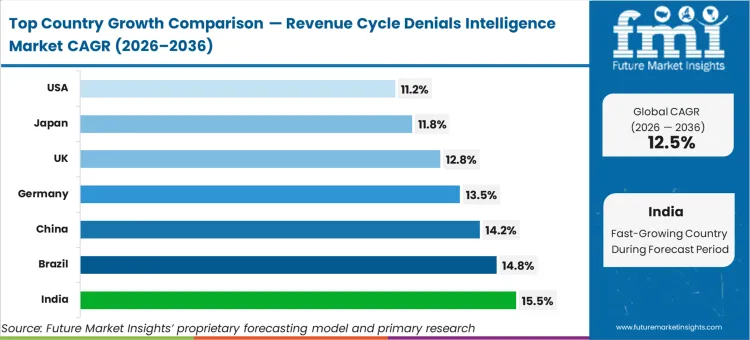
India is estimated to advance at 15.5%, leading the geographic expansion as outsourced Global Capability Centers handling Western claims deploy advanced toolsets to manage rising transaction volumes. Brazil tracks at 14.8%, followed by China expanding at 14.2% as large urban hospital networks transition from manual ledger systems directly to automated claim tracking. Germany follows at 13.5% and the UK at 12.8%, where centralized procurement frameworks push regional health trusts toward standardized financial clearance protocols. Japan expands at 11.8%, while the USA registers 11.2% growth. The divergence across this range reflects a strict separation between markets optimizing outsourced labor productivity and those defending against aggressive commercial payer algorithms.
Revenue Cycle Denials Intelligence Market Key Takeaways
| Metric | Details |
|---|---|
| Industry Size (2026) | USD 2.4 billion |
| Industry Value (2036) | USD 7.8 billion |
| CAGR (2026-2036) | 12.50% |
Revenue Cycle Denials Intelligence Market Definition
Revenue Cycle Denials Intelligence encompasses the software algorithms and analytical frameworks deployed by healthcare providers to predict, identify, and resolve rejected or unpaid medical claims. It is functionally distinct from standard medical billing software because it does not merely route claims; it applies machine learning to historical adjudication data to identify root-cause failure patterns and simulate payer responses before submission.
Revenue Cycle Denials Intelligence Market Inclusions
The scope includes predictive denial modeling software, automated claim tracking applications, retrospective denial analysis platforms, and specialized consulting services directly tied to algorithm implementation. The inclusion of healthcare payer interoperability components is restricted to modules specifically functioning to translate payer remittance advice into actionable provider workflows.
Revenue Cycle Denials Intelligence Market Exclusions
Basic electronic health record systems without predictive financial capabilities are explicitly outside the scope. Standard debt collection software and patient-facing payment portals are excluded because their functional boundary addresses patient-responsibility revenue rather than commercial or government payer adjudication friction.
Revenue Cycle Denials Intelligence Market Research Methodology
- Primary Research: Chief Financial Officers, Revenue Cycle Directors, and Healthcare CIOs across tiered hospital networks and specialized diagnostic facilities.
- Desk Research: CMS adjudication transparency reports, commercial payer algorithm deployment filings, and healthcare IT vendor certification registries.
- Market-Sizing and Forecasting: Baseline anchors directly to the measurable volume of electronic EDI 835/837 transaction clearinghouse data and historical denial rates.
- Data Validation and Update Cycle: Forecasts are cross-validated against the quarterly capital expenditure reports of publicly traded health IT integrators.
Segmental Analysis
Revenue Cycle Denials Intelligence Market Analysis by Component
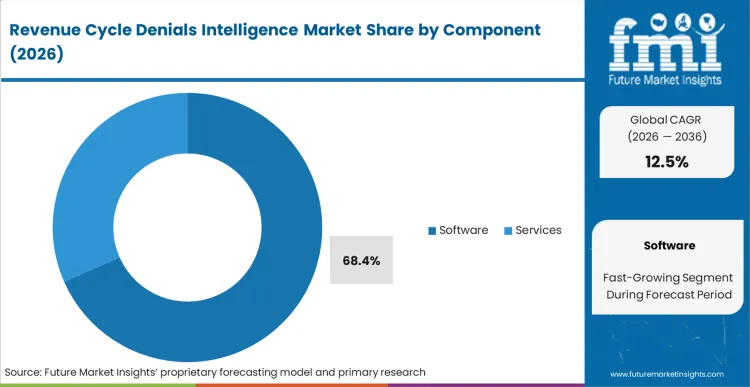
Manual ledger review and basic rules engines failed to keep pace as commercial payers transitioned to algorithmic adjudication. Software holds 68.4% of the industry because human-in-the-loop triage is mathematically unscalable against the volume of automated 835/837 EDI denials generated by modern payer systems.
According to FMI's estimates, Chief Financial Officers now prioritize software that autonomously maps denial codes back to the originating clinical documentation. This intelligence layer shifts the billing department's function from individual claim correction to systemic workflow redesign. Facilities relying on legacy manual appeals face insurmountable administrative costs that rapidly consume the margins of recovered claims. A medical billing infrastructure that lacks this predictive software component operates at a permanent structural disadvantage.
- Procurement trigger: Sinking clean-claim rates prompt finance directors to seek software that identifies specific payer logic shifts.
- Qualification standard: Vendors are evaluated on their ability to ingest disparate EDI feeds without requiring custom API builds for every payer.
- Renewal imperative: Hospitals expand software footprints only when the platform proves it can adapt to unannounced mid-year commercial payer algorithm changes.
Revenue Cycle Denials Intelligence Market Analysis by End User
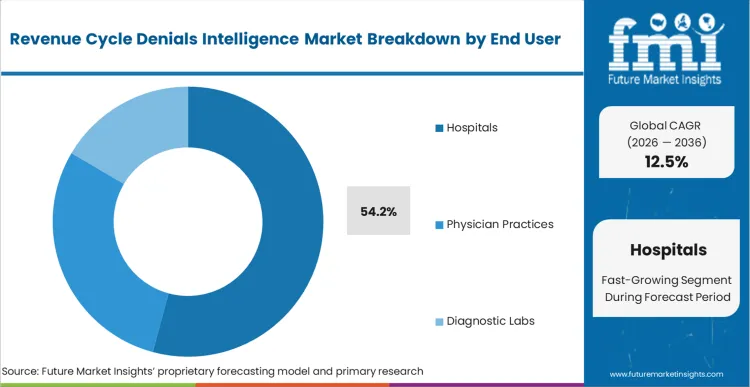
High-acuity medical facilities face the immediate operational choice between scaling their administrative headcount or automating their clearance protocols. Hospitals dominate this dimension with 54.2% share, driven entirely by their concentration of complex, multi-day inpatient claims that attract the highest rate of payer scrutiny.
In FMI's view, the sheer density of clinical data generated during a hospital stay creates an exponentially higher probability of coding discrepancies compared to outpatient encounters. Revenue cycle directors at these institutions use intelligence tools to simulate payer audits before the claim ever leaves the facility. Failure to intercept these discrepancies pre-submission results in cash-flow bottlenecks that can threaten a hospital's daily operational liquidity.
- Clinical documentation gaps: Incomplete physician notes trigger automated payer denials. Revenue cycle software intercepts these gaps, forcing documentation addendums before billing.
- Contractual misalignment: Payer-specific contractual nuances are frequently missed by human billers. Algorithmic intelligence prevents these specific margin leaks.
- Process integration: To capture full financial benefit, hospitals must push denial intelligence upstream, integrating alerts directly into the physician's electronic health record interface.
Revenue Cycle Denials Intelligence Market Analysis by Deployment
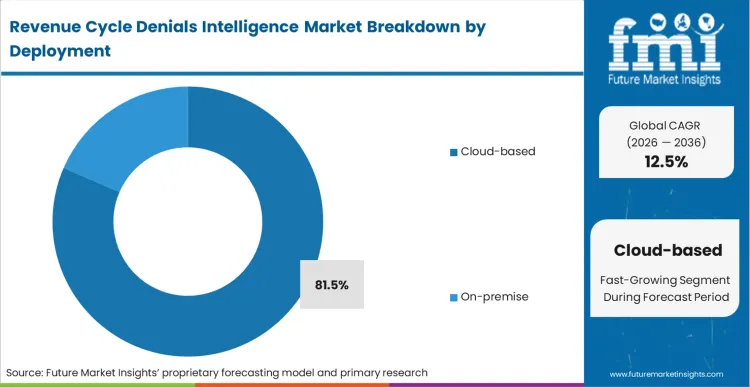
The commercial consequence of hardcoded, on-premise rules engines is their inability to update when external payers alter their adjudication logic. Cloud-based deployment captures 81.5% share because continuous algorithm updates are structurally mandatory to match shifting payer rules. Revenue cycle directors mandate cloud architectures to ensure their predictive models learn from denial patterns aggregated across thousands of cloud computing healthcare networks, rather than just their own isolated facility data. As per FMI's projection, this shared intelligence creates a network effect where a denial code generated in one state instantly trains the clearance algorithm for a hospital in another. Facilities trapped on legacy on-premise servers bear the entire cost of discovering new payer denial tactics through lost revenue.
- Implementation expenditure: Cloud architectures eliminate the capital expenditure of localized servers, shifting procurement into operational expense budgets.
- Maintenance burden: On-premise systems hide continuous IT maintenance costs. Cloud deployment transfers this burden entirely to the vendor.
- Lifecycle parity: Total cost of ownership comparisons overwhelmingly favor cloud systems when factoring in the required frequency of predictive model retraining.
Revenue Cycle Denials Intelligence Market Analysis by Application
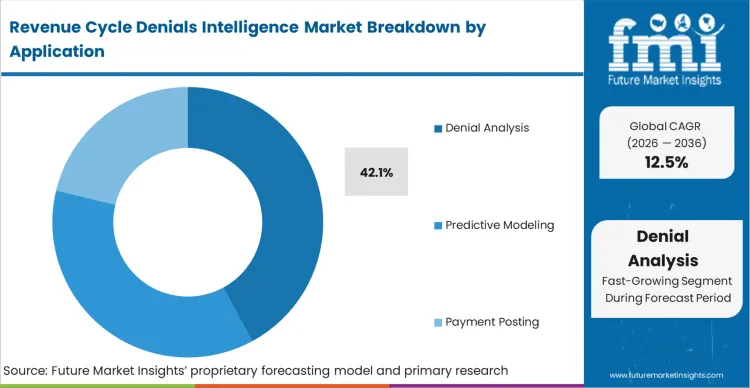
By 2036, the practice of waiting for a claim to reject before analyzing it will be viewed as an architectural failure. Denial Analysis currently leads with 42.1% share, providing the foundational root-cause visibility required before advanced predictive models can be trained. FMI analysts opine that health networks must first understand their historical failure modes before they can trust algorithms to clear claims autonomously. This application isolates exactly which physicians, codes, and payer combinations cause the most financial friction. Operations heads who ignore this analytical baseline and attempt to jump straight to automated posting end up scaling their existing errors rather than eliminating them.
- Early adopters: Massive academic medical centers deploy denial analysis first to untangle highly specialized billing rejections.
- Subsequent integration: Regional health systems follow, applying the insights to standardize their centralized billing offices.
- Final conversion: Small independent physician groups convert last, driven by the unsustainability of outsourcing appeals to third-party collection agencies.
Revenue Cycle Denials Intelligence Market Drivers, Restraints, and Opportunities
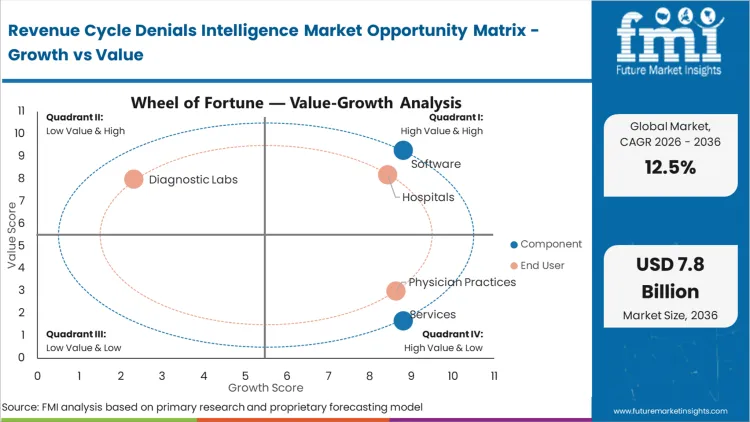
The structural shift from retrospective recovery to proactive margin defense requires revenue cycle directors to eliminate the administrative cost of the appeal process itself. As commercial payers increasingly deploy unannounced machine learning algorithms to auto-deny claims, human billing staff cannot process the volume of rejection codes quickly enough to prevent days in accounts receivable from ballooning. This forces Chief Financial Officers to procure intelligence layers that simulate payer adjudication pre-submission, shifting the operational focus from recovering lost money to ensuring the claim never fails the initial algorithmic check.
The primary friction slowing adoption is the existence of deeply siloed clinical and financial data lakes within legacy provider networks. Finance departments frequently purchase predictive algorithms that lack the structural access to read the clinical physician notes required to validate a complex claim. This architectural disconnect means the algorithm can flag a potential denial but cannot automatically append the missing clinical context. While clinical documentation improvements exist, their integration requires massive IT governance overhauls that paralyze procurement cycles.
Opportunities in the Revenue Cycle Denials Intelligence Market
- Real-time clinical NLP integration: The inability of legacy systems to read unstructured physician notes enables vendors to deploy natural language processing modules. Health IT integrators who bridge this clinical-financial gap capture premium enterprise contracts.
- Payer-specific behavior modeling: Unannounced changes to commercial payer algorithms create blind spots. Third-party developers capture market share by offering localized models trained specifically on regional payer adjudication histories.
- Pre-authorization automation: Shrinking appeal windows demand immediate clearance. Platform vendors who shift intelligence to the pre-encounter scheduling phase eliminate the downstream denial entirely.
Regional Analysis
Based on the regional analysis, the Revenue Cycle Denials Intelligence market is segmented into North America, Europe, Asia Pacific, and other regions across 40 plus countries.
.webp "Top Country Growth Comparison Revenue Cycle Denials Intelligence Market Cagr (2026 2036)")
| Country | CAGR (2026 to 2036) |
|---|---|
| India | 15.5% |
| Brazil | 14.8% |
| China | 14.2% |
| Germany | 13.5% |
| UK | 12.8% |
| Japan | 11.8% |
| USA | 11.2% |
North America Revenue Cycle Denials Intelligence Market Analysis
Cost structures, operating margins, and the aggressive posture of commercial insurance carriers dictate the architectural choices of healthcare networks in this region. The extreme fragmentation of payer rules forces facilities to invest heavily in predictive clearance just to maintain baseline solvency. Based on FMI's assessment, networks that rely on manual ledger review are rapidly absorbed by larger, tech-enabled health systems due to insurmountable administrative overhead. Fraud analytics frameworks overlap heavily with denial intelligence here, creating a high barrier to entry for generalized software vendors.
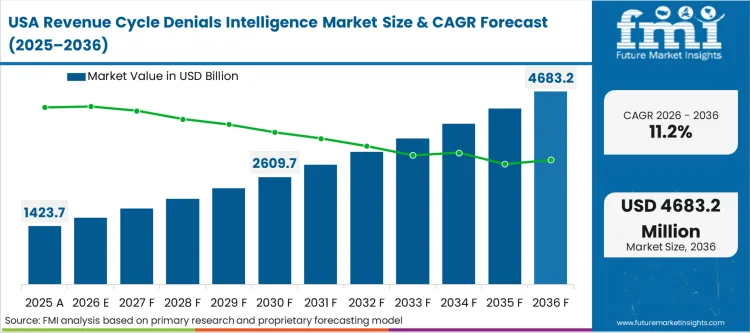
- USA: The USA market is forecast to register a CAGR of 11.2%. The aggressive deployment of auto-adjudication algorithms by commercial insurers requires hospital CFOs to deploy equal or superior machine learning countermeasures. Revenue cycle managers must constantly retrain their pre-submission clearance models to anticipate unannounced logic shifts from major payers. American health systems that establish the most robust predictive data lakes create a structural competitive advantage, allowing them to acquire smaller, financially strained regional hospitals that lack the IT infrastructure to survive modern payer scrutiny.
FMI's report includes Canada and Mexico. The cross-border expansion of managed care models from the USA forces these adjacent networks to begin establishing basic electronic tracking infrastructures.
Europe Revenue Cycle Denials Intelligence Market Analysis
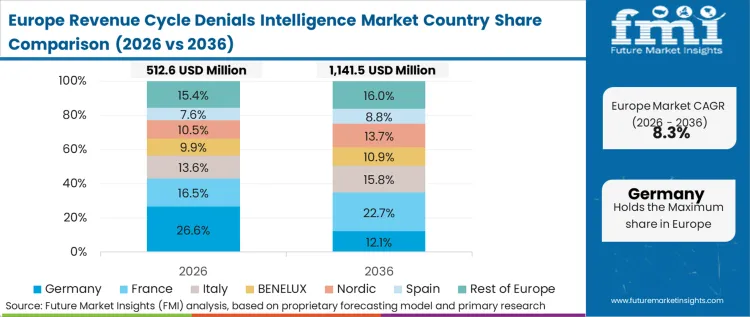
The regulatory environment and centralized procurement frameworks shape how intelligence platforms are deployed across these single-payer and hybrid systems. Unlike regions fighting commercial payer algorithms, European adoption is driven by strict government mandates demanding transparency in hospital resource allocation. In FMI's view, software is implemented primarily to ensure compliance with clinical coding standards rather than to maximize competitive revenue recovery.
- Germany: Germany's updated hospital financing legislation penalizes facilities that fail to accurately document complex care episodes, making precise coding an economic necessity rather than an administrative preference. FMI estimates the Revenue Cycle Denials Intelligence market in Germany to expand at an annual growth rate of 13.5%. Operations heads deploy denial analysis to align physician documentation exactly with strict federal reimbursement criteria. Vendors that localize their algorithms to interpret German specific DRG (Diagnosis Related Group) frameworks capture lucrative, long-term regional state contracts.
- UK: Over the forecast period, Revenue Cycle Denials Intelligence in the UK is set for a CAGR of 12.8%. Centralized procurement directives obligate National Health Service (NHS) trusts to eliminate the administrative waste associated with rejected internal funding requests. Trust administrators must deploy standardized tracking software to identify bottlenecks in the patient pathway coding. Integrating these intelligence layers allows regional trusts to automatically clear funding allocations without manual auditing, freeing up vital administrative headcount for frontline patient operations.
FMI's report includes France, Italy, and Spain. Across these heavily regulated networks, procurement cycles prioritize vendors offering native interoperability with existing national health databases over proprietary standalone predictive capabilities.
Asia Pacific Revenue Cycle Denials Intelligence Market Analysis
The digital infrastructure condition of this region heavily skews its adoption pattern, sharply dividing highly scaled outsourcing hubs from rapidly modernizing domestic hospital networks. Large-scale healthcare BPO operations dominate the software consumption, utilizing advanced algorithms to process massive volumes of Western claims. As per FMI's projection, domestic facilities are leapfrogging legacy on-premise servers entirely, adopting cloud-based intelligence from day one.
- India: India's dense concentration of Global Capability Centers (GCCs) servicing US and UK health networks necessitates the deployment of highly scalable, volume-driven AI triage tools. Operations managers in these centers must process millions of disparate 835/837 EDI feeds daily, a task mathematically impossible without machine learning. Demand for Revenue Cycle Denials Intelligence in India is estimated to expand at a CAGR of 15.5%. By mastering these predictive algorithms for foreign clients, Indian IT integrators position themselves to dominate the global export of specialized healthcare revenue cycle capabilities.
- China: The sheer scale of urban hospital consolidation in China forces facility directors to abandon manual ledger systems in favour of automated claim tracking. China market for revenue cycle denials intelligence is likely to post a CAGR of 14.2%. Administrators must unify the financial data of newly acquired regional clinics into a single, visible cloud platform. As these networks establish baseline digital infrastructure, their trajectory shifts rapidly toward deploying native predictive analytics to manage domestic state-insurance claim volumes.
- Japan: Japan's Revenue Cycle Denials Intelligence industry is projected to witness growth at a CAGR of 11.8%. The rapidly ageing patient demographic and subsequent high-frequency clinic utilisation stress the capacity of traditional billing departments. Clinic managers operate under intense pressure to clear high volumes of low-acuity claims without expanding administrative payrolls. The growth pace obscures the reality that Japanese adoption is driven heavily by workflow automation in elder-care facilities, rather than aggressive disputes with commercial insurers.
FMI's report includes South Korea and Australia. These markets demonstrate a high readiness for automated pre-authorization modules, driven by government initiatives to digitize the entire patient financial journey.
Competitive Aligners for Market Players
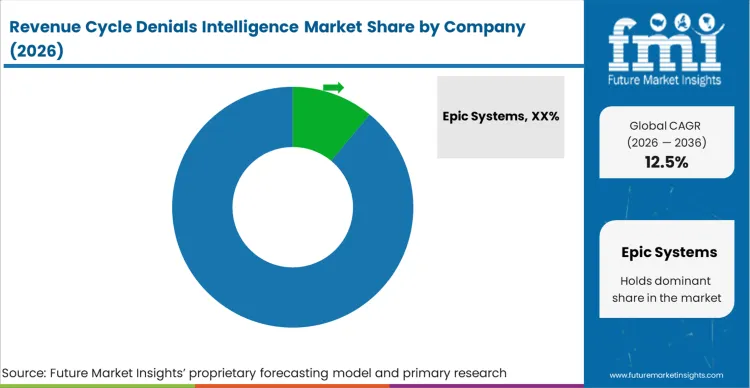
The architectural requirement to integrate directly with core electronic health records drives the concentrated nature of this market at the platform level. Buyers distinguish qualified from unqualified vendors entirely on their ability to ingest and normalize data from legacy systems and Epic Systems without requiring custom API engineering for every hospital wing. A vendor offering a theoretically superior predictive algorithm will be disqualified immediately if it requires the hospital's internal IT department to manually route the daily EDI feeds.
Incumbents such as Experian Health maintain their structural advantage through the sheer volume of historical adjudication data they process daily. This massive data lake allows their machine learning models to identify subtle shifts in payer algorithms weeks before a smaller competitor's model would even trigger an alert. To replicate this, a challenger must build proprietary data-sharing consortiums among mid-tier hospitals to aggregate enough baseline training data to make their predictive revenue integrity software viable.
Large hospital networks resist vendor lock-in by demanding modularity, purchasing base platforms from dominant EHR providers while sourcing specialized, high-performance denial algorithms from niche developers. This structural tension between the hospital's desire for best-of-breed analytics and the incumbent's incentive to bundle closed-ecosystem tools will define the competitive trajectory through 2036. The market remains concentrated at the data-routing layer but highly fragmented in the deployment of specialty-specific predictive models.
Key Players in Revenue Cycle Denials Intelligence Market
- Epic Systems
- Experian Health
- Waystar
- R1 RCM
- AGS Health
- Conifer Health Solutions
Scope of the Report
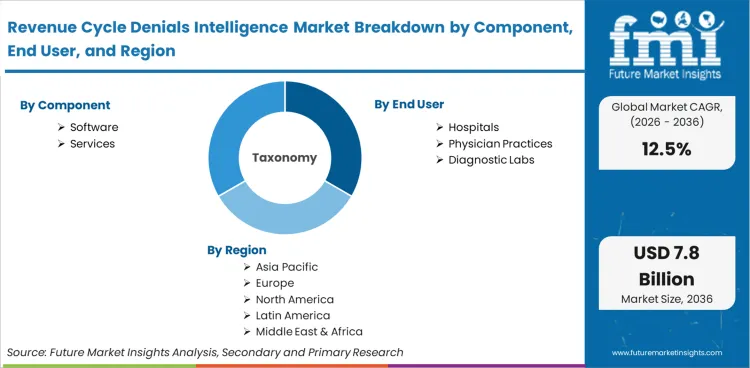
| Metric | Value |
|---|---|
| Quantitative Units | USD 2.4 billion to USD 7.8 billion, at a CAGR of 12.50% |
| Market Definition | The software algorithms and analytical frameworks deployed by healthcare providers to predict, identify, and resolve rejected or unpaid medical claims by simulating payer adjudication logic. |
| Component Segmentation | Software, Services |
| End User Segmentation | Hospitals, Physician Practices, Diagnostic Labs |
| Deployment Segmentation | Cloud-based, On-premise |
| Application Segmentation | Claim Tracking, Denial Analysis, Predictive Modeling, Payment Posting |
| Regions Covered | North America, Europe, Asia Pacific, Latin America, Middle East & Africa |
| Countries Covered | India, Brazil, China, Germany, UK, Japan, USA, and 40 plus countries |
| Key Companies Profiled | Epic Systems, Experian Health, Waystar, R1 RCM, AGS Health, Conifer Health Solutions |
| Forecast Period | 2026 to 2036 |
| Approach | Interviews with hospital CFOs and revenue cycle directors. Baseline models anchored to verifiable clearinghouse electronic transaction volumes. Forecasts validated against publicly reported IT capital expenditure of major health networks. |
Revenue Cycle Denials Intelligence Market Analysis by Segments
-
Component:
- Software
- Services
-
End User:
- Hospitals
- Physician Practices
- Diagnostic Labs
-
Deployment:
- Cloud-based
- On-premise
-
Application:
- Claim Tracking
- Denial Analysis
- Predictive Modeling
- Payment Posting
-
Region:
- North America
- Europe
- Asia-Pacific
- Rest of the World
- Latin America
- Middle East, and Africa
Bibliography
- American Hospital Association. (2024, September). Skyrocketing hospital administrative costs, burdensome commercial insurer policies are impacting patient care.
- American Medical Association. (2025). 2024 AMA prior authorization physician survey.
- CAQH. (2024). 2023 CAQH index report: A new normal: How trends from the pandemic are impacting the future of healthcare administration.
- Centers for Medicare & Medicaid Services. (2024, January 17). CMS interoperability and prior authorization final rule (CMS-0057-F).
- Medicare Payment Advisory Commission. (2024, June). Provider networks and prior authorization in Medicare Advantage. In Report to the Congress: Medicare and the health care delivery system (Chapter 2).
- National Committee on Vital and Health Statistics. (2024, July 10). 2024 report to Congress on the implementation of the Administrative Simplification provisions of the Health Insurance Portability and Accountability Act (HIPAA) of 1996.
- Office of the Assistant Secretary for Technology Policy & Office of the National Coordinator for Health Information Technology. (2024, September). 2024 report to Congress: ASTP report to Congress on Cures Act progress.
- U.S. Government Accountability Office. (2024, March 14). Medicaid managed care: Additional federal action needed to fully leverage new appeals and grievances data (GAO-24-106627).
This bibliography is provided for reader reference. The full FMI report contains the complete reference list with primary source documentation.
This Report Addresses
- Market intelligence to support strategic decision making across predictive denial modeling software and claim tracking applications
- Market size estimation and 10-year revenue forecasts from 2026 to 2036, supported by clearinghouse transaction volume metrics
- Growth opportunity mapping across Component and End User dimensions with emphasis on real-time clinical NLP integration with 835/837 EDI feeds
- Segment and regional revenue forecasts covering cloud-based deployments across aggressive commercial insurance carrier environments
- Competition strategy assessment including platform EHR integration capabilities and proprietary data-sharing consortiums
- Technology development tracking including automated pre-authorization modules, NLP tools, and specialized DRG frameworks
- Market access analysis covering National Health Service procurement directives and CMS electronic data interchange standards
- Market report delivery in PDF, Excel, PPT, and interactive dashboard formats for executive strategy, hospital IT procurement, and operational benchmarking use
Frequently Asked Questions
How large is the Revenue Cycle Denials Intelligence in 2026?
The valuation hits USD 2.4 billion. This figure represents the immediate capital deployed by health networks to defend against the rising volume of unannounced commercial payer algorithm updates.
What will it be valued at by 2036?
The sector reaches USD 7.8 billion. This trajectory signals a total operational shift from managing manual appeals to sustaining continuous, pre-submission algorithmic clearance architectures.
What CAGR is projected?
The 12.50% CAGR reflects the speed of the algorithmic arms race. It is constrained only by the ability of legacy hospital IT departments to modernize their deeply siloed clinical and financial data lakes.
Which Component segment leads?
Software holds 68.4% share. Human billing staff physically cannot review and map the daily volume of automated 835/837 EDI rejection codes without a predictive machine learning layer.
Which End User segment leads?
Hospitals dominate with 54.2% share. Their concentration of complex, multi-day inpatient care episodes generates the highest density of clinical variables, attracting maximum payer scrutiny.
Which Deployment segment leads?
Cloud-based systems command 81.5% share. Revenue cycle directors mandate cloud architectures to ensure their predictive models are continuously retrained by denial patterns aggregated across thousands of external facilities.
What drives rapid growth?
Growth is driven by commercial payers deploying machine learning to auto-deny claims. This forces Chief Financial Officers to procure opposing intelligence layers to prevent cash-flow bottlenecks and maintain baseline collection rates.
What is the primary restraint?
The structural disconnect between clinical and financial data lakes. Predictive algorithms frequently flag potential coding anomalies but lack the architectural access to automatically read unstructured physician notes to correct them.
Which country grows fastest?
India advances at 15.5%, followed by Brazil at 14.8%. India's acceleration is driven by outsourced Global Capability Centers deploying high-volume AI tools, whereas Brazil relies on modernizing deeply fragmented domestic billing networks.
How do government procurement directives shape European adoption?
In markets like the UK, centralized NHS mandates obligate regional trusts to adopt standardized tracking software. The goal is to eliminate internal administrative waste associated with internal funding requests, rather than fighting commercial insurers.
Why is real-time NLP integration critical for hospitals?
Legacy platforms wait for a claim to reject before analyzing it. Natural language processing intercepts incomplete physician notes during the patient encounter, forcing clinical addendums before the billing department ever processes the file.
How do niche developers compete against major EHR providers?
Massive EHR incumbents dominate the data-routing platform layer. Challengers bypass this by offering highly specialized, specialty-specific predictive models trained on localized regional payer adjudication histories that general platforms miss.
What specific operational bottleneck does Denial Analysis solve?
Denial Analysis isolates exactly which provider, code, and payer combination causes routine friction. Operations heads use this baseline visibility to restructure the workflow before they deploy automated models, preventing the scaling of existing errors.
Why do manual ledger systems fail in the current environment?
Manual systems rely on retrospective recovery. When commercial payers deploy auto-adjudication, the administrative cost of human staff appealing individual claims quickly exceeds the margin of the recovered revenue.
How do Global Capability Centers impact software consumption?
GCCs handling outsourced Western claims operate on razor-thin margins and massive volumes. They consume advanced software to ensure their labor force only interacts with claims that strictly require complex human intervention.
Why are cloud systems favored in total cost of ownership comparisons?
On-premise servers hide the massive continuous IT costs of model retraining. Cloud systems shift the burden of algorithmic updates entirely to the vendor, ensuring hospitals always run logic matching the latest payer shifts.
What forces physician practices to adopt predictive tracking?
Smaller practices face shrinking appeal windows and lack the cash reserves to absorb delayed payments. They adopt automated tracking because outsourcing their rising denial volume to third-party collection agencies becomes financially unsustainable.
How does predictive modeling change the procurement timeline?
Procurement shifts from buying periodic software updates to subscribing to continuous intelligence feeds. Hospitals demand proof that a vendor's algorithm can adapt to mid-year commercial payer logic changes without requiring manual IT intervention.
What happens to facilities that delay integration?
They suffer deteriorating days in accounts receivable. As their manual appeals fail against automated payer checks, they forfeit access to preferred procurement networks that demand strict electronic financial clearance.
How do updated EHR and regional compliance standards affect billing?
Strict federal reimbursement criteria, such as Germany's hospital financing legislation, penalize poor documentation. This forces facilities to use denial intelligence to align exactly with state regulations to secure their operational funding.
Why are value-based care payments driving intelligence adoption?
Value-based contracts require precise tracking of patient outcomes against cost. Algorithms ensure that complex episodes of care are coded correctly the first time, preventing funding clawbacks from managed care organizations.
What makes the USA market structurally unique?
The USA features extreme payer fragmentation. Hospital CFOs must continuously retrain models to anticipate unannounced logic shifts from dozens of different major commercial insurers simultaneously, driving intense continuous software investment.
Preview the report firsthand - request a free sample
Get SampleGet the brochure for pricing and purchase details.
Get PDFTable of Content
- Executive Summary
- Global Market Outlook
- Demand-side Trends
- Supply-side Trends
- Technology Roadmap Analysis
- Analysis and Recommendations
- Market Overview
- Market Coverage / Taxonomy
- Market Definition / Scope / Limitations
- Research Methodology
- Chapter Orientation
- Analytical Lens and Working Hypotheses
- Market Structure, Signals, and Trend Drivers
- Benchmarking and Cross-market Comparability
- Market Sizing, Forecasting, and Opportunity Mapping
- Research Design and Evidence Framework
- Desk Research Programme (Secondary Evidence)
- Company Annual and Sustainability Reports
- Peer-reviewed Journals and Academic Literature
- Corporate Websites, Product Literature, and Technical Notes
- Earnings Decks and Investor Briefings
- Statutory Filings and Regulatory Disclosures
- Technical White Papers and Standards Notes
- Trade Journals, Industry Magazines, and Analyst Briefs
- Conference Proceedings, Webinars, and Seminar Materials
- Government Statistics Portals and Public Data Releases
- Press Releases and Reputable Media Coverage
- Specialist Newsletters and Curated Briefings
- Sector Databases and Reference Repositories
- FMI Internal Proprietary Databases and Historical Market Datasets
- Subscription Datasets and Paid Sources
- Social Channels, Communities, and Digital Listening Inputs
- Additional Desk Sources
- Expert Input and Fieldwork (Primary Evidence)
- Primary Modes
- Qualitative Interviews and Expert Elicitation
- Quantitative Surveys and Structured Data Capture
- Blended Approach
- Why Primary Evidence is Used
- Field Techniques
- Interviews
- Surveys
- Focus Groups
- Observational and In-context Research
- Social and Community Interactions
- Stakeholder Universe Engaged
- C-suite Leaders
- Board Members
- Presidents and Vice Presidents
- R&D and Innovation Heads
- Technical Specialists
- Domain Subject-matter Experts
- Scientists
- Physicians and Other Healthcare Professionals
- Governance, Ethics, and Data Stewardship
- Research Ethics
- Data Integrity and Handling
- Primary Modes
- Tooling, Models, and Reference Databases
- Desk Research Programme (Secondary Evidence)
- Data Engineering and Model Build
- Data Acquisition and Ingestion
- Cleaning, Normalisation, and Verification
- Synthesis, Triangulation, and Analysis
- Quality Assurance and Audit Trail
- Market Background
- Market Dynamics
- Drivers
- Restraints
- Opportunity
- Trends
- Scenario Forecast
- Demand in Optimistic Scenario
- Demand in Likely Scenario
- Demand in Conservative Scenario
- Opportunity Map Analysis
- Product Life Cycle Analysis
- Supply Chain Analysis
- Investment Feasibility Matrix
- Value Chain Analysis
- PESTLE and Porter’s Analysis
- Regulatory Landscape
- Regional Parent Market Outlook
- Production and Consumption Statistics
- Import and Export Statistics
- Market Dynamics
- Global Market Analysis 2021 to 2025 and Forecast, 2026 to 2036
- Historical Market Size Value (USD Million) Analysis, 2021 to 2025
- Current and Future Market Size Value (USD Million) Projections, 2026 to 2036
- Y-o-Y Growth Trend Analysis
- Absolute $ Opportunity Analysis
- Global Market Pricing Analysis 2021 to 2025 and Forecast 2026 to 2036
- Global Market Analysis 2021 to 2025 and Forecast 2026 to 2036, By Component
- Introduction / Key Findings
- Historical Market Size Value (USD Million) Analysis By Component , 2021 to 2025
- Current and Future Market Size Value (USD Million) Analysis and Forecast By Component , 2026 to 2036
- Software
- Services
- Software
- Y-o-Y Growth Trend Analysis By Component , 2021 to 2025
- Absolute $ Opportunity Analysis By Component , 2026 to 2036
- Global Market Analysis 2021 to 2025 and Forecast 2026 to 2036, By End User
- Introduction / Key Findings
- Historical Market Size Value (USD Million) Analysis By End User, 2021 to 2025
- Current and Future Market Size Value (USD Million) Analysis and Forecast By End User, 2026 to 2036
- Hospitals
- Physician Practices
- Diagnostic Labs
- Hospitals
- Y-o-Y Growth Trend Analysis By End User, 2021 to 2025
- Absolute $ Opportunity Analysis By End User, 2026 to 2036
- Global Market Analysis 2021 to 2025 and Forecast 2026 to 2036, By Deployment
- Introduction / Key Findings
- Historical Market Size Value (USD Million) Analysis By Deployment, 2021 to 2025
- Current and Future Market Size Value (USD Million) Analysis and Forecast By Deployment, 2026 to 2036
- Cloud-based
- On-premise
- Cloud-based
- Y-o-Y Growth Trend Analysis By Deployment, 2021 to 2025
- Absolute $ Opportunity Analysis By Deployment, 2026 to 2036
- Global Market Analysis 2021 to 2025 and Forecast 2026 to 2036, By Application
- Introduction / Key Findings
- Historical Market Size Value (USD Million) Analysis By Application, 2021 to 2025
- Current and Future Market Size Value (USD Million) Analysis and Forecast By Application, 2026 to 2036
- Denial Analysis
- Predictive Modeling
- Payment Posting
- Denial Analysis
- Y-o-Y Growth Trend Analysis By Application, 2021 to 2025
- Absolute $ Opportunity Analysis By Application, 2026 to 2036
- Global Market Analysis 2021 to 2025 and Forecast 2026 to 2036, By Region
- Introduction
- Historical Market Size Value (USD Million) Analysis By Region, 2021 to 2025
- Current Market Size Value (USD Million) Analysis and Forecast By Region, 2026 to 2036
- North America
- Latin America
- Western Europe
- Eastern Europe
- East Asia
- South Asia and Pacific
- Middle East & Africa
- Market Attractiveness Analysis By Region
- North America Market Analysis 2021 to 2025 and Forecast 2026 to 2036, By Country
- Historical Market Size Value (USD Million) Trend Analysis By Market Taxonomy, 2021 to 2025
- Market Size Value (USD Million) Forecast By Market Taxonomy, 2026 to 2036
- By Country
- USA
- Canada
- Mexico
- By Component
- By End User
- By Deployment
- By Application
- By Country
- Market Attractiveness Analysis
- By Country
- By Component
- By End User
- By Deployment
- By Application
- Key Takeaways
- Latin America Market Analysis 2021 to 2025 and Forecast 2026 to 2036, By Country
- Historical Market Size Value (USD Million) Trend Analysis By Market Taxonomy, 2021 to 2025
- Market Size Value (USD Million) Forecast By Market Taxonomy, 2026 to 2036
- By Country
- Brazil
- Chile
- Rest of Latin America
- By Component
- By End User
- By Deployment
- By Application
- By Country
- Market Attractiveness Analysis
- By Country
- By Component
- By End User
- By Deployment
- By Application
- Key Takeaways
- Western Europe Market Analysis 2021 to 2025 and Forecast 2026 to 2036, By Country
- Historical Market Size Value (USD Million) Trend Analysis By Market Taxonomy, 2021 to 2025
- Market Size Value (USD Million) Forecast By Market Taxonomy, 2026 to 2036
- By Country
- Germany
- UK
- Italy
- Spain
- France
- Nordic
- BENELUX
- Rest of Western Europe
- By Component
- By End User
- By Deployment
- By Application
- By Country
- Market Attractiveness Analysis
- By Country
- By Component
- By End User
- By Deployment
- By Application
- Key Takeaways
- Eastern Europe Market Analysis 2021 to 2025 and Forecast 2026 to 2036, By Country
- Historical Market Size Value (USD Million) Trend Analysis By Market Taxonomy, 2021 to 2025
- Market Size Value (USD Million) Forecast By Market Taxonomy, 2026 to 2036
- By Country
- Russia
- Poland
- Hungary
- Balkan & Baltic
- Rest of Eastern Europe
- By Component
- By End User
- By Deployment
- By Application
- By Country
- Market Attractiveness Analysis
- By Country
- By Component
- By End User
- By Deployment
- By Application
- Key Takeaways
- East Asia Market Analysis 2021 to 2025 and Forecast 2026 to 2036, By Country
- Historical Market Size Value (USD Million) Trend Analysis By Market Taxonomy, 2021 to 2025
- Market Size Value (USD Million) Forecast By Market Taxonomy, 2026 to 2036
- By Country
- China
- Japan
- South Korea
- By Component
- By End User
- By Deployment
- By Application
- By Country
- Market Attractiveness Analysis
- By Country
- By Component
- By End User
- By Deployment
- By Application
- Key Takeaways
- South Asia and Pacific Market Analysis 2021 to 2025 and Forecast 2026 to 2036, By Country
- Historical Market Size Value (USD Million) Trend Analysis By Market Taxonomy, 2021 to 2025
- Market Size Value (USD Million) Forecast By Market Taxonomy, 2026 to 2036
- By Country
- India
- ASEAN
- Australia & New Zealand
- Rest of South Asia and Pacific
- By Component
- By End User
- By Deployment
- By Application
- By Country
- Market Attractiveness Analysis
- By Country
- By Component
- By End User
- By Deployment
- By Application
- Key Takeaways
- Middle East & Africa Market Analysis 2021 to 2025 and Forecast 2026 to 2036, By Country
- Historical Market Size Value (USD Million) Trend Analysis By Market Taxonomy, 2021 to 2025
- Market Size Value (USD Million) Forecast By Market Taxonomy, 2026 to 2036
- By Country
- Kingdom of Saudi Arabia
- Other GCC Countries
- Turkiye
- South Africa
- Other African Union
- Rest of Middle East & Africa
- By Component
- By End User
- By Deployment
- By Application
- By Country
- Market Attractiveness Analysis
- By Country
- By Component
- By End User
- By Deployment
- By Application
- Key Takeaways
- Key Countries Market Analysis
- USA
- Pricing Analysis
- Market Share Analysis, 2025
- By Component
- By End User
- By Deployment
- By Application
- Canada
- Pricing Analysis
- Market Share Analysis, 2025
- By Component
- By End User
- By Deployment
- By Application
- Mexico
- Pricing Analysis
- Market Share Analysis, 2025
- By Component
- By End User
- By Deployment
- By Application
- Brazil
- Pricing Analysis
- Market Share Analysis, 2025
- By Component
- By End User
- By Deployment
- By Application
- Chile
- Pricing Analysis
- Market Share Analysis, 2025
- By Component
- By End User
- By Deployment
- By Application
- Germany
- Pricing Analysis
- Market Share Analysis, 2025
- By Component
- By End User
- By Deployment
- By Application
- UK
- Pricing Analysis
- Market Share Analysis, 2025
- By Component
- By End User
- By Deployment
- By Application
- Italy
- Pricing Analysis
- Market Share Analysis, 2025
- By Component
- By End User
- By Deployment
- By Application
- Spain
- Pricing Analysis
- Market Share Analysis, 2025
- By Component
- By End User
- By Deployment
- By Application
- France
- Pricing Analysis
- Market Share Analysis, 2025
- By Component
- By End User
- By Deployment
- By Application
- India
- Pricing Analysis
- Market Share Analysis, 2025
- By Component
- By End User
- By Deployment
- By Application
- ASEAN
- Pricing Analysis
- Market Share Analysis, 2025
- By Component
- By End User
- By Deployment
- By Application
- Australia & New Zealand
- Pricing Analysis
- Market Share Analysis, 2025
- By Component
- By End User
- By Deployment
- By Application
- China
- Pricing Analysis
- Market Share Analysis, 2025
- By Component
- By End User
- By Deployment
- By Application
- Japan
- Pricing Analysis
- Market Share Analysis, 2025
- By Component
- By End User
- By Deployment
- By Application
- South Korea
- Pricing Analysis
- Market Share Analysis, 2025
- By Component
- By End User
- By Deployment
- By Application
- Russia
- Pricing Analysis
- Market Share Analysis, 2025
- By Component
- By End User
- By Deployment
- By Application
- Poland
- Pricing Analysis
- Market Share Analysis, 2025
- By Component
- By End User
- By Deployment
- By Application
- Hungary
- Pricing Analysis
- Market Share Analysis, 2025
- By Component
- By End User
- By Deployment
- By Application
- Kingdom of Saudi Arabia
- Pricing Analysis
- Market Share Analysis, 2025
- By Component
- By End User
- By Deployment
- By Application
- Turkiye
- Pricing Analysis
- Market Share Analysis, 2025
- By Component
- By End User
- By Deployment
- By Application
- South Africa
- Pricing Analysis
- Market Share Analysis, 2025
- By Component
- By End User
- By Deployment
- By Application
- USA
- Market Structure Analysis
- Competition Dashboard
- Competition Benchmarking
- Market Share Analysis of Top Players
- By Regional
- By Component
- By End User
- By Deployment
- By Application
- Competition Analysis
- Competition Deep Dive
- Epic Systems
- Overview
- Product Portfolio
- Profitability by Market Segments (Product/Age /Sales Channel/Region)
- Sales Footprint
- Strategy Overview
- Marketing Strategy
- Product Strategy
- Channel Strategy
- Experian Health
- Waystar
- R1 RCM
- AGS Health
- Conifer Health Solutions
- Epic Systems
- Competition Deep Dive
- Assumptions & Acronyms Used


