

- Industry Size (2026)
- USD 3.89 Bn
- Forecast (2036)
- USD 6.33 Bn
- CAGR (2026 to 2036)
- 5.00%
Bicycle Rim Market Size, Market Forecast and Outlook By FMI
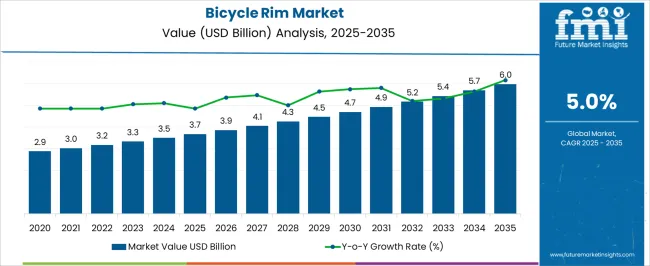
The bicycle rim market was valued at USD 3.70 billion in 2025, projected to reach USD 3.89 billion in 2026, and is forecast to expand to USD 6.33 billion by 2036 at a 5.00% CAGR. Structural shifts in end-use procurement cycles and tightening performance specifications across downstream sectors are accelerating capital allocation toward bicycle rim categories. Procurement teams operating across global supply chains now require standardized compliance certifications, compressing qualification timelines and elevating minimum specification thresholds for approved supplier lists.
Capital expenditure planning cycles across verticals consuming bicycle rim products have shifted from discretionary upgrades to mandated replacements. Regulatory frameworks governing material performance, safety testing, and environmental compliance are tightening across all major consumption regions. Buyers evaluating supplier contracts increasingly weight lifecycle cost models over upfront unit pricing, favoring suppliers with vertically integrated operations and certified testing capabilities.
Summary of Bicycle Rim Market
- Market Snapshot
- The bicycle rim market is valued at USD 3.70 billion in 2025 and is projected to reach USD 6.33 billion by 2036.
- The industry is expected to grow at a 5.00% CAGR from 2026 to 2036, creating an incremental opportunity of USD 2.44 billion.
- The market operates as a specification-driven procurement category where compliance certifications, material performance standards, and supply chain integration define competitive positioning.
- Demand and Growth Drivers
- Demand is rising as downstream industries face tightening performance specifications and mandatory compliance requirements across procurement cycles.
- Technology upgrades and process automation are accelerating adoption of higher-specification bicycle rim products across manufacturing operations.
- Infrastructure expansion programs in emerging economies are creating greenfield demand that bypasses legacy supplier constraints.
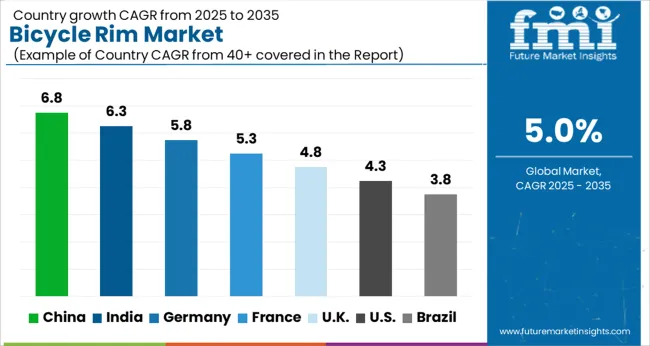
- Among key countries, China leads at 6.80% CAGR, followed by India at 6.30%, Germany at 5.80%, France at 5.30%, UK at 4.80%, USA at 4.30%, and Brazil at 3.80%.
- Product and Segment View
- The market includes bicycle rim products segmented across material type, size, sales channel, bicycle type categories serving diverse industrial and commercial applications.
- Aluminum leads by material type with 47.6% share in 2026.
- Above 20 inch leads by size with 52.8% share in 2026.
- The scope covers Aluminum, Steel, Carbon, Copper configurations among other formats, while excluding unrelated commodity categories and non-specialized alternatives.
- Geography and Competitive Outlook
- China and India are the fastest-growing markets due to infrastructure expansion and rising industrial demand, while North America and Europe remain high-value mature demand bases.
- Competition is shaped by vertical integration capabilities, specification compliance certifications, and established procurement channel relationships, with key players including Shimano Inc., SRAM LLC, Campagnolo S.r.l., DT Swiss AG, ENVE Composites LLC, HED Cycling Products, Rolf Prima.
- Market consolidation trends are evident as leading suppliers acquire complementary capabilities to meet broadening customer specification requirements.
- Analyst Opinion at FMI
- Nikhil Kaitwade, Principal Consultant, opines: 'As per FMI analysis, the bicycle rim market is transitioning from a volume-driven procurement model to a specification-led qualification framework. Buyers who delay integration of higher-performance bicycle rim solutions into their supply chains face material cost escalation as compliance timelines compress. FMI analysts observe that suppliers lacking certified production capabilities will find themselves excluded from approved vendor lists as downstream operators enforce tighter material specifications.'
- Strategic Implications / Executive Takeaways
- Procurement directors must transition vendor qualification processes to prioritize lifecycle cost models and specification compliance certifications over lowest unit price evaluations.
- Capital project teams should mandate compatibility with next-generation performance standards in all new equipment procurement specifications entering the 2027 tender cycle.
- Supply chain architects must develop multi-source qualification programs to mitigate concentration risk across critical bicycle rim supply categories.
Bicycle Rim Market Key Takeaways
| Metric | Details |
|---|---|
| Industry Size (2026) | USD 3.89 billion |
| Industry Value (2036) | USD 6.33 billion |
| CAGR (2026-2036) | 5.00% |
Source: Future Market Insights, 2026
Regional deployment parameters reflect differentiated adoption velocities. China sets the pace with a 6.80% CAGR, followed by India at 6.30% as infrastructure expansion programs bypass legacy procurement constraints. Germany operations advance at a 5.80% rate, supported by regulatory compliance mandates. France tracks at 5.30%. UK networks maintain a 4.80% expansion trajectory. USA registers a 4.30% pace. Brazil expands at a 3.80% trajectory.
Bicycle Rim Market Definition
Bicycle Rim constitutes the material, product, or technology category defined by its primary industrial function within downstream manufacturing and end-use sectors. The scope encompasses standardized and specialty configurations compliant with global performance and safety specifications. Core inclusions govern products meeting defined procurement parameters across industrial, commercial, and institutional buyer categories.
Bicycle Rim Market Inclusions
Market scope includes Aluminum, Steel, Carbon, Copper, Above 20 inch configurations and related product variants. Global and regional market sizes, forecast period 2026 to 2036, and segment breakdowns by material type, size, sales channel, bicycle type are fully incorporated within the analytical boundary.
Bicycle Rim Market Exclusions
Standard commodity alternatives lacking specialized performance certifications are excluded. Downstream finished goods, standalone accessory components, and non-standardized custom fabrications fall outside the analytical parameters. Legacy product formats without current industry specification compliance are explicitly omitted from the valuation.
Bicycle Rim Market Research Methodology
- Primary Research: Analysts engaged with procurement specification leads, technical managers, and supply chain directors across key consumption sectors to map decision gates triggering product upgrades and supplier requalification.
- Desk Research: Data collection phases aggregated regulatory compliance frameworks, industry standards ratification schedules, and published procurement guidelines from major institutional buyers.
- Market-Sizing and Forecasting: Baseline values derive from a bottom-up aggregation of product volumes and contract values, applying region-specific adoption curves to project future demand velocity.
- Data Validation and Update Cycle: Projections are tested against publicly reported expenditure guidance from leading industrial consumers and trade association production statistics.
Why is the Bicycle Rim Market Growing?
The Bicycle Rim market is experiencing steady growth due to the increasing adoption of high-performance bicycles across both urban and recreational segments. The current market scenario is being shaped by a rising preference for lightweight and durable rims, growing consumer awareness of cycling as a sustainable mode of transportation, and the expansion of cycling infrastructure in various regions. Technological advancements in rim manufacturing, including precision alloy casting and machining, have improved the overall performance and safety of bicycles, supporting broader market acceptance.
Rising demand in both professional sports and leisure cycling is creating opportunities for premium and customized rim solutions. Additionally, partnerships between bicycle manufacturers and component suppliers are enabling the integration of advanced rims into new models, facilitating innovation in aerodynamics and weight reduction.
The market is anticipated to benefit from increasing investments in e-bikes and high-end bicycles, which require robust and lightweight rim materials Overall, the future outlook is driven by enhanced performance demands, consumer preference for high-quality cycling products, and evolving lifestyle trends favoring active and sustainable transportation.
Segmental Analysis
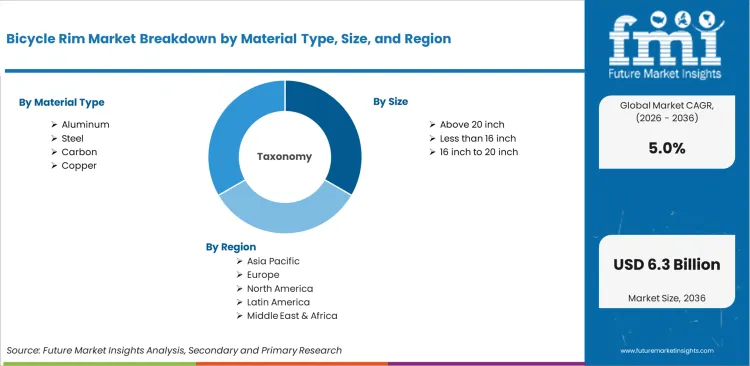
The bicycle rim market is segmented by material type, size, sales channel, bicycle type, and geographic regions. By material type, bicycle rim market is divided into Aluminum, Steel, Carbon, and Copper. In terms of size, bicycle rim market is classified into Above 20 inch, Less than 16 inch, and 16 inch to 20 inch. Based on sales channel, bicycle rim market is segmented into OEM (Original Equipment Manufacturer) and Aftermarket. By bicycle type, bicycle rim market is segmented into Mountain, Sports, Road, and Hybrid. Regionally, the bicycle rim industry is classified into North America, Latin America, Western Europe, Eastern Europe, Balkan & Baltic Countries, Russia & Belarus, Central Asia, East Asia, South Asia & Pacific, and the Middle East & Africa.
Insights into the Aluminum Material Type Segment
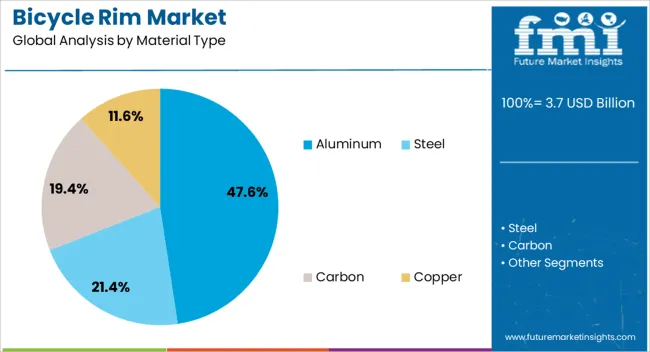
The aluminum material type is projected to hold 47.60% of the Bicycle Rim market revenue share in 2026, making it the leading material segment. This dominance is being attributed to aluminum’s inherent advantages of low weight, corrosion resistance, and high strength, which improve both ride quality and durability. Adoption has been accelerated in high-performance bicycles, including road and racing bicycles, where efficient power transfer and handling are critical.
The availability of advanced aluminum alloys allows manufacturers to produce rims with optimized aerodynamics and strength-to-weight ratios, further reinforcing their market position. Additionally, aluminum rims offer cost-effectiveness compared to other premium materials, making them attractive to both OEMs and aftermarket customers.
The segment has been supported by the growing emphasis on sustainability and recyclability, as aluminum can be reused without significant performance loss As cycling popularity increases in urban mobility and leisure activities, the aluminum segment is expected to maintain leadership due to its balance of performance, durability, and affordability, coupled with proven manufacturing scalability.
Insights into the Above 20 Inch Size Segment
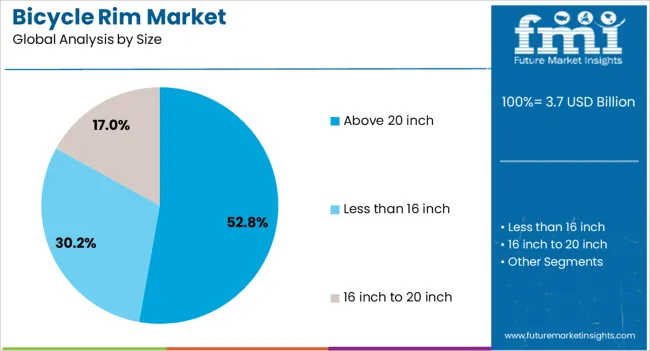
The above 20 inch rim size segment is anticipated to hold 52.80% of the Bicycle Rim market revenue share in 2026, emerging as the leading size category. This growth has been driven by the increasing preference for larger wheel diameters in mountain bikes, road bikes, and e-bikes, which provide enhanced stability, better handling, and improved shock absorption.
Larger rims are being favored in performance and endurance bicycles as they reduce rolling resistance and enhance overall ride efficiency. The adoption has been further accelerated by advancements in lightweight materials and precision manufacturing, allowing larger rims to be strong without adding excessive weight.
Additionally, consumer demand for comfort and improved cycling dynamics in both recreational and professional cycling segments has supported growth in this category As urban and trail cycling continue to gain popularity, the above 20 inch rim segment is expected to maintain leadership, driven by its ability to deliver performance benefits while accommodating emerging cycling trends and evolving rider expectations.
Insights into the OEM Sales Channel Segment
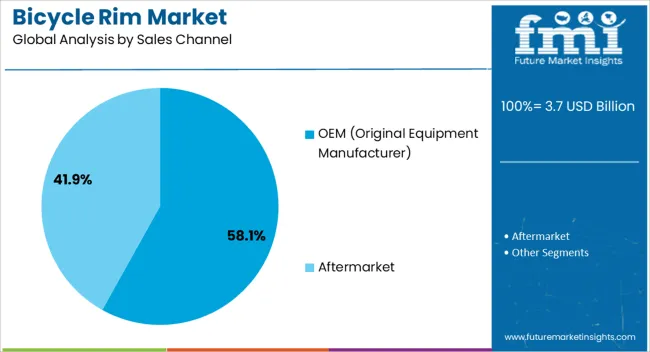
The OEM (Original Equipment Manufacturer) sales channel is projected to account for 58.10% of the Bicycle Rim market revenue share in 2026, making it the dominant distribution segment. This leadership is being influenced by the growing trend of integrating high-quality rims directly into new bicycles during production, ensuring product reliability and performance consistency.
OEM distribution allows for better alignment between bicycle design and rim specifications, facilitating optimized aerodynamics, weight distribution, and compatibility with braking and drivetrain systems. The channel has been reinforced by partnerships between rim manufacturers and bicycle producers, enabling large-scale production while maintaining stringent quality standards.
Additionally, OEM adoption is being driven by the increasing demand for complete and ready-to-use bicycles from professional and recreational cyclists, reducing the need for aftermarket customization As consumer preference for fully equipped, high-performance bicycles rises, the OEM sales channel is expected to continue its dominance, supported by streamlined supply chains, strong manufacturer relationships, and the value placed on factory-installed quality components.
Market Overview
Bicycle Rim Market: Introduction
A bicycle is a human-powered, pedal-driven, two-wheeled steerable machine, widely used for transportation, recreation and sports activities. One of the components of a bicycle is the rim, which is the outer edge of the wheel, holding the tire. Owing to continuous expansion of bicycle fleet, growing bicycle sporting culture and rising demand for sports and mountain bicycles, ensuring rider safety has become extremely important. Different types of bicycle rims are available in the market. Based on material, these rims can be of steel, carbon, aluminum and copper. Among these, the aluminum segment is estimated to gain traction over the forecast period owing to its non-corrosive properties & light weight.
Bicycle Rim Market: Market Dynamics
Bicycle Rim Market: Drivers
Busy and modern lifestyle force people to exclude exercising from their schedule and survive on junk food. This often leads to a person being overweight or obese. Thus, rising health consciousness among consumers is anticipated to upsurge the demand for bicycles, which will further increase the demand for bicycle rims over the forecast period. Moreover, the expanding tourism industry across the globe will also give traction to the growth of the bicycle rim market in the coming years. That apart, the ever-growing bicycle industry, both in developed and emerging economies, will further drive the growth of the bicycle rim market over the forecast period.
Bicycle Rim Market: Restraints
Commutation by bicycles is suitable and ideal for smaller distances as the human capacity to cycle is limited. This is anticipated to reduce the demand for bicycles and act as a restraining factor for the growth of the concerned market over the forecast period. Moreover, the lack of dedicated cycling tracks in emerging economies will further hamper the growth of the bicycle rim market in the coming years.
Bicycle Rim Market: Trends
Rapid industrialization and the introduction of new materials, which are incredibly light but very strong, have transformed the bicycle industry. This is anticipated to act as a major trend in the global bicycle rim market over the forecast period. Moreover, the manufacturers are focused on expanding their presence to escalate competition in the global bicycle rim market.
Bicycle Rim Market: Regional Outlook
The regional demand dynamics of bicycle rims is directly correlated with the overall production and fleet of the bicycles. China is projected to dominate in terms of sales and is estimated to remain dominant in terms of demand for bicycle rims owing to increasing sales of bicycles.
North America is expected to grow at significant CAGR during the forecast period in the bicycle rim market owing to increasing government regulations to support green transportation in the region. The European region is expected to witness high penetration rate due to rising bicycle fleet in the region. The Middle East & Africa (MEA) region is anticipated to grow at a substantial pace in the coming years owing to high demand for bicycle rims from bicycle manufacturers.
Bicycle Rim Market: Market Participants
Example of some of the key players identified across the value chain of the global bicycle rim market are Araya Industrial Co. Ltd., Ambrosio Srl, Fit Werx, Hed Cycling Products Inc., Ravi Enterprises, Ryde, Ursus S.p.a. Xiamen YISHUN Carbon Composite Technology Co., Ltd., among others.
The research report presents a comprehensive assessment of the market and contains thoughtful insights, facts, historical data, and statistically supported and industry-validated market data. It also contains projections using a suitable set of assumptions and methodologies. The research report provides analysis and information according to market segments such as geography, application, sales channel, and end user.
The bicycle rim report covers exhaustive analysis on
- Market Segments
- Market Dynamics
- Market Size
- Supply & Demand
- Current Trends/Issues/Challenges
- Competition & Companies Involved
- Technology
- Value Chain
Regional analysis includes
- North America (USA, Canada)
- Latin America (Mexico, Brazil)
- Western Europe (Germany, Italy, France, UK, Spain)
- Eastern Europe (Poland, Russia)
- Asia Pacific (China, India, ASEAN, Australia & New Zealand)
- Japan
- Middle East and Africa (GCC Countries, S. Africa, Northern Africa)
The bicycle rim report is a compilation of first-hand information, qualitative and quantitative assessment by industry analysts, and inputs from industry experts and industry participants across the value chain. The report provides in-depth analysis of parent market trends, macro-economic indicators, and governing factors, along with market attractiveness as per segment. The report also maps the qualitative impact of various market factors on market segments and geographies.
Analysis of Bicycle Rim Market By Key Countries
.webp "Top Country Growth Comparison Bicycle Rim Market Cagr (2026 2036)")
| Countries | CAGR |
|---|---|
| China | 6.8% |
| India | 6.3% |
| Germany | 5.8% |
| France | 5.3% |
| UK | 4.8% |
| USA | 4.3% |
| Brazil | 3.8% |
Source: FMI analysis based on primary research and proprietary forecasting model
Country-wise Analysis
The Bicycle Rim Market is expected to register a CAGR of 5.0% during the forecast period, exhibiting varied country level momentum. China leads with the highest CAGR of 6.8%, followed by India at 6.3%. Developed markets such as Germany, France, and the UK continue to expand steadily, while the USA is likely to grow at consistent rates. Brazil posts the lowest CAGR at 3.8%, yet still underscores a broadly positive trajectory for the global Bicycle Rim Market.
In 2026, Germany held a dominant revenue in the Western Europe market and is expected to grow with a CAGR of 5.8%. The USA Bicycle Rim Market is estimated to be valued at USD 1.4 billion in 2026 and is anticipated to reach a valuation of USD 2.1 billion by 2036. Sales are projected to rise at a CAGR of 4.3% over the forecast period between 2026 and 2036. While Japan and South Korea markets are estimated to be valued at USD 181.4 million and USD 117.9 million respectively in 2026.
Key Players in the Bicycle Rim Market
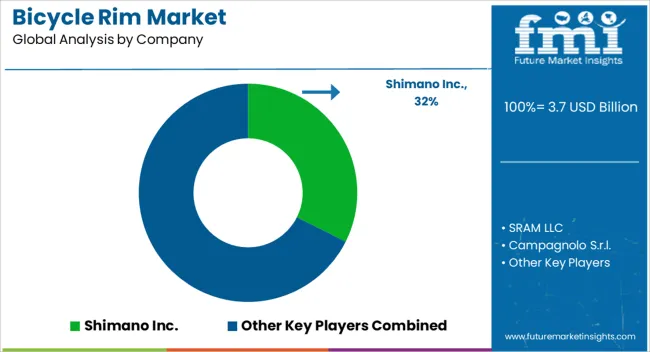
- Shimano Inc.
- SRAM LLC
- Campagnolo S.r.l.
- DT Swiss AG
- ENVE Composites LLC
- HED Cycling Products
- Rolf Prima
- Easton Cycling
- Fulcrum Wheels S.r.l.
- Boyd Cycling
- Industry Nine
- Reynolds Cycling LLC
- Zipp Speed Weaponry
- Vision Tech USA
- Prime Components
Scope of the Report
| Metric | Value |
|---|---|
| Quantitative Units | USD 3.89 billion to USD 6.33 billion, at a CAGR of 5.00% |
| Market Definition | Bicycle Rim encompasses the material, product, or technology category serving downstream industrial, commercial, and institutional end-use sectors under defined performance and safety specifications. |
| Material Type Segmentation | Aluminum, Steel, Carbon, Copper |
| Size Segmentation | Above 20 inch, Less than 16 inch, 16 inch to 20 inch |
| Sales Channel Segmentation | OEM, Aftermarket |
| Bicycle Type Segmentation | Mountain, Sports, Road, Hybrid |
| Regions Covered | North America, Latin America, Europe, East Asia, South Asia, Oceania, Middle East & Africa |
| Countries Covered | China, India, Germany, France, UK, USA, Brazil, and 40 plus countries |
| Key Companies Profiled | Shimano Inc., SRAM LLC, Campagnolo S.r.l., DT Swiss AG, ENVE Composites LLC, HED Cycling Products, Rolf Prima, Easton Cycling, Fulcrum Wheels S.r.l., Boyd Cycling |
| Forecast Period | 2026 to 2036 |
| Approach | Forecasting models apply a bottom-up methodology starting with global installed base metrics and projecting conversion rates to higher-specification product categories. |
Bicycle Rim Market by Segments
Material Type:
- Aluminum
- Steel
- Carbon
- Copper
Size:
- Above 20 inch
- Less than 16 inch
- 16 inch to 20 inch
Sales Channel:
- OEM (Original Equipment Manufacturer)
- Aftermarket
Bicycle Type:
- Mountain
- Sports
- Road
- Hybrid
Region:
- North America
- USA
- Canada
- Mexico
- Latin America
- Brazil
- Chile
- Rest of Latin America
- Western Europe
- Germany
- UK
- Italy
- Spain
- France
- Nordic
- BENELUX
- Rest of Western Europe
- Eastern Europe
- Russia
- Poland
- Hungary
- Balkan & Baltic
- Rest of Eastern Europe
- East Asia
- China
- Japan
- South Korea
- South Asia and Pacific
- India
- ASEAN
- Australia & New Zealand
- Rest of South Asia and Pacific
- Middle East & Africa
- Kingdom of Saudi Arabia
- Other GCC Countries
- Turkiye
- South Africa
- Other African Union
- Rest of Middle East & Africa
Bibliography
- 1. Organisation for Economic Co-operation and Development. (2025, June). Industrial performance and competitiveness indicators. OECD.
- 2. World Bank Group. (2025). Global economic prospects: Industrial supply chains and trade facilitation. World Bank.
- 3. United Nations Industrial Development Organization. (2025). Industrial development report: Manufacturing and global value chains. UNIDO.
- 4. International Organization for Standardization. (2025). ISO standards catalogue: Materials testing and quality management. ISO.
- 5. European Commission, Directorate-General for Internal Market, Industry, Entrepreneurship and SMEs. (2025). Single market for goods: Industrial product compliance. European Commission.
- 6. USA Bureau of Labor Statistics. (2025). Producer price indexes for intermediate demand. USA Department of Labor.
This bibliography is provided for reader reference. The full Future Market Insights report contains the complete reference list with primary research documentation.
Frequently Asked Questions
How large is the demand for Bicycle Rim in the global market in 2026?
Demand for Bicycle Rim in the global market is estimated to be valued at USD 3.89 billion in 2026.
What will be the market size of Bicycle Rim in the global market by 2036?
Market size for Bicycle Rim is projected to reach USD 6.33 billion by 2036.
What is the expected demand growth for Bicycle Rim in the global market between 2026 and 2036?
Demand for Bicycle Rim is expected to grow at a CAGR of 5.00% between 2026 and 2036.
Which Material Type is poised to lead global sales by 2026?
Aluminum accounts for 47.6% in 2026, driven by established procurement specifications and downstream integration requirements.
What is driving demand in China?
China leads with a 6.80% CAGR as greenfield industrial facilities deploying modern procurement frameworks create scaled demand for specification-compliant bicycle rim products.
What is the India growth outlook in this report?
India is projected to grow at a CAGR of 6.30% during 2026 to 2036.
What is Bicycle Rim and what is it mainly used for?
Bicycle Rim constitutes the specialized material, product, or technology category designed for defined industrial, commercial, and institutional applications. End-use sectors primarily deploy it to meet performance, safety, and regulatory compliance requirements.
How does FMI build and validate the Bicycle Rim forecast?
Forecasting models apply a bottom-up methodology starting with global installed base metrics and cross-validate projections against quarterly industry production and trade volumes.
Preview the report firsthand - request a free sample
Get SampleGet the brochure for pricing and purchase details.
Get PDFTable of Content
- Executive Summary
- Global Market Outlook
- Demand-side Trends
- Supply-side Trends
- Technology Roadmap Analysis
- Analysis and Recommendations
- Market Overview
- Market Coverage / Taxonomy
- Market Definition / Scope / Limitations
- Research Methodology
- Chapter Orientation
- Analytical Lens and Working Hypotheses
- Market Structure, Signals, and Trend Drivers
- Benchmarking and Cross-market Comparability
- Market Sizing, Forecasting, and Opportunity Mapping
- Research Design and Evidence Framework
- Desk Research Programme (Secondary Evidence)
- Company Annual and Sustainability Reports
- Peer-reviewed Journals and Academic Literature
- Corporate Websites, Product Literature, and Technical Notes
- Earnings Decks and Investor Briefings
- Statutory Filings and Regulatory Disclosures
- Technical White Papers and Standards Notes
- Trade Journals, Industry Magazines, and Analyst Briefs
- Conference Proceedings, Webinars, and Seminar Materials
- Government Statistics Portals and Public Data Releases
- Press Releases and Reputable Media Coverage
- Specialist Newsletters and Curated Briefings
- Sector Databases and Reference Repositories
- FMI Internal Proprietary Databases and Historical Market Datasets
- Subscription Datasets and Paid Sources
- Social Channels, Communities, and Digital Listening Inputs
- Additional Desk Sources
- Expert Input and Fieldwork (Primary Evidence)
- Primary Modes
- Qualitative Interviews and Expert Elicitation
- Quantitative Surveys and Structured Data Capture
- Blended Approach
- Why Primary Evidence is Used
- Field Techniques
- Interviews
- Surveys
- Focus Groups
- Observational and In-context Research
- Social and Community Interactions
- Stakeholder Universe Engaged
- C-suite Leaders
- Board Members
- Presidents and Vice Presidents
- R&D and Innovation Heads
- Technical Specialists
- Domain Subject-matter Experts
- Scientists
- Physicians and Other Healthcare Professionals
- Governance, Ethics, and Data Stewardship
- Research Ethics
- Data Integrity and Handling
- Primary Modes
- Tooling, Models, and Reference Databases
- Desk Research Programme (Secondary Evidence)
- Data Engineering and Model Build
- Data Acquisition and Ingestion
- Cleaning, Normalisation, and Verification
- Synthesis, Triangulation, and Analysis
- Quality Assurance and Audit Trail
- Market Background
- Market Dynamics
- Drivers
- Restraints
- Opportunity
- Trends
- Scenario Forecast
- Demand in Optimistic Scenario
- Demand in Likely Scenario
- Demand in Conservative Scenario
- Opportunity Map Analysis
- Product Life Cycle Analysis
- Supply Chain Analysis
- Investment Feasibility Matrix
- Value Chain Analysis
- PESTLE and Porter’s Analysis
- Regulatory Landscape
- Regional Parent Market Outlook
- Production and Consumption Statistics
- Import and Export Statistics
- Market Dynamics
- Global Market Analysis 2021 to 2025 and Forecast, 2026 to 2036
- Historical Market Size Value (USD Million) Analysis, 2021 to 2025
- Current and Future Market Size Value (USD Million) Projections, 2026 to 2036
- Y-o-Y Growth Trend Analysis
- Absolute $ Opportunity Analysis
- Global Market Pricing Analysis 2021 to 2025 and Forecast 2026 to 2036
- Global Market Analysis 2021 to 2025 and Forecast 2026 to 2036, By Material Type
- Introduction / Key Findings
- Historical Market Size Value (USD Million) Analysis By Material Type , 2021 to 2025
- Current and Future Market Size Value (USD Million) Analysis and Forecast By Material Type , 2026 to 2036
- Aluminum
- Steel
- Carbon
- Copper
- Aluminum
- Y-o-Y Growth Trend Analysis By Material Type , 2021 to 2025
- Absolute $ Opportunity Analysis By Material Type , 2026 to 2036
- Global Market Analysis 2021 to 2025 and Forecast 2026 to 2036, By Size
- Introduction / Key Findings
- Historical Market Size Value (USD Million) Analysis By Size, 2021 to 2025
- Current and Future Market Size Value (USD Million) Analysis and Forecast By Size, 2026 to 2036
- Above 20 inch
- Less than 16 inch
- 16 inch to 20 inch
- Above 20 inch
- Y-o-Y Growth Trend Analysis By Size, 2021 to 2025
- Absolute $ Opportunity Analysis By Size, 2026 to 2036
- Global Market Analysis 2021 to 2025 and Forecast 2026 to 2036, By Sales Channel
- Introduction / Key Findings
- Historical Market Size Value (USD Million) Analysis By Sales Channel, 2021 to 2025
- Current and Future Market Size Value (USD Million) Analysis and Forecast By Sales Channel, 2026 to 2036
- OEM
- Aftermarket
- OEM
- Y-o-Y Growth Trend Analysis By Sales Channel, 2021 to 2025
- Absolute $ Opportunity Analysis By Sales Channel, 2026 to 2036
- Global Market Analysis 2021 to 2025 and Forecast 2026 to 2036, By Bicycle Type
- Introduction / Key Findings
- Historical Market Size Value (USD Million) Analysis By Bicycle Type, 2021 to 2025
- Current and Future Market Size Value (USD Million) Analysis and Forecast By Bicycle Type, 2026 to 2036
- Mountain
- Sports
- Road
- Hybrid
- Mountain
- Y-o-Y Growth Trend Analysis By Bicycle Type, 2021 to 2025
- Absolute $ Opportunity Analysis By Bicycle Type, 2026 to 2036
- Global Market Analysis 2021 to 2025 and Forecast 2026 to 2036, By Region
- Introduction
- Historical Market Size Value (USD Million) Analysis By Region, 2021 to 2025
- Current Market Size Value (USD Million) Analysis and Forecast By Region, 2026 to 2036
- North America
- Latin America
- Western Europe
- Eastern Europe
- East Asia
- South Asia and Pacific
- Middle East & Africa
- Market Attractiveness Analysis By Region
- North America Market Analysis 2021 to 2025 and Forecast 2026 to 2036, By Country
- Historical Market Size Value (USD Million) Trend Analysis By Market Taxonomy, 2021 to 2025
- Market Size Value (USD Million) Forecast By Market Taxonomy, 2026 to 2036
- By Country
- USA
- Canada
- Mexico
- By Material Type
- By Size
- By Sales Channel
- By Bicycle Type
- By Country
- Market Attractiveness Analysis
- By Country
- By Material Type
- By Size
- By Sales Channel
- By Bicycle Type
- Key Takeaways
- Latin America Market Analysis 2021 to 2025 and Forecast 2026 to 2036, By Country
- Historical Market Size Value (USD Million) Trend Analysis By Market Taxonomy, 2021 to 2025
- Market Size Value (USD Million) Forecast By Market Taxonomy, 2026 to 2036
- By Country
- Brazil
- Chile
- Rest of Latin America
- By Material Type
- By Size
- By Sales Channel
- By Bicycle Type
- By Country
- Market Attractiveness Analysis
- By Country
- By Material Type
- By Size
- By Sales Channel
- By Bicycle Type
- Key Takeaways
- Western Europe Market Analysis 2021 to 2025 and Forecast 2026 to 2036, By Country
- Historical Market Size Value (USD Million) Trend Analysis By Market Taxonomy, 2021 to 2025
- Market Size Value (USD Million) Forecast By Market Taxonomy, 2026 to 2036
- By Country
- Germany
- UK
- Italy
- Spain
- France
- Nordic
- BENELUX
- Rest of Western Europe
- By Material Type
- By Size
- By Sales Channel
- By Bicycle Type
- By Country
- Market Attractiveness Analysis
- By Country
- By Material Type
- By Size
- By Sales Channel
- By Bicycle Type
- Key Takeaways
- Eastern Europe Market Analysis 2021 to 2025 and Forecast 2026 to 2036, By Country
- Historical Market Size Value (USD Million) Trend Analysis By Market Taxonomy, 2021 to 2025
- Market Size Value (USD Million) Forecast By Market Taxonomy, 2026 to 2036
- By Country
- Russia
- Poland
- Hungary
- Balkan & Baltic
- Rest of Eastern Europe
- By Material Type
- By Size
- By Sales Channel
- By Bicycle Type
- By Country
- Market Attractiveness Analysis
- By Country
- By Material Type
- By Size
- By Sales Channel
- By Bicycle Type
- Key Takeaways
- East Asia Market Analysis 2021 to 2025 and Forecast 2026 to 2036, By Country
- Historical Market Size Value (USD Million) Trend Analysis By Market Taxonomy, 2021 to 2025
- Market Size Value (USD Million) Forecast By Market Taxonomy, 2026 to 2036
- By Country
- China
- Japan
- South Korea
- By Material Type
- By Size
- By Sales Channel
- By Bicycle Type
- By Country
- Market Attractiveness Analysis
- By Country
- By Material Type
- By Size
- By Sales Channel
- By Bicycle Type
- Key Takeaways
- South Asia and Pacific Market Analysis 2021 to 2025 and Forecast 2026 to 2036, By Country
- Historical Market Size Value (USD Million) Trend Analysis By Market Taxonomy, 2021 to 2025
- Market Size Value (USD Million) Forecast By Market Taxonomy, 2026 to 2036
- By Country
- India
- ASEAN
- Australia & New Zealand
- Rest of South Asia and Pacific
- By Material Type
- By Size
- By Sales Channel
- By Bicycle Type
- By Country
- Market Attractiveness Analysis
- By Country
- By Material Type
- By Size
- By Sales Channel
- By Bicycle Type
- Key Takeaways
- Middle East & Africa Market Analysis 2021 to 2025 and Forecast 2026 to 2036, By Country
- Historical Market Size Value (USD Million) Trend Analysis By Market Taxonomy, 2021 to 2025
- Market Size Value (USD Million) Forecast By Market Taxonomy, 2026 to 2036
- By Country
- Kingdom of Saudi Arabia
- Other GCC Countries
- Turkiye
- South Africa
- Other African Union
- Rest of Middle East & Africa
- By Material Type
- By Size
- By Sales Channel
- By Bicycle Type
- By Country
- Market Attractiveness Analysis
- By Country
- By Material Type
- By Size
- By Sales Channel
- By Bicycle Type
- Key Takeaways
- Key Countries Market Analysis
- USA
- Pricing Analysis
- Market Share Analysis, 2025
- By Material Type
- By Size
- By Sales Channel
- By Bicycle Type
- Canada
- Pricing Analysis
- Market Share Analysis, 2025
- By Material Type
- By Size
- By Sales Channel
- By Bicycle Type
- Mexico
- Pricing Analysis
- Market Share Analysis, 2025
- By Material Type
- By Size
- By Sales Channel
- By Bicycle Type
- Brazil
- Pricing Analysis
- Market Share Analysis, 2025
- By Material Type
- By Size
- By Sales Channel
- By Bicycle Type
- Chile
- Pricing Analysis
- Market Share Analysis, 2025
- By Material Type
- By Size
- By Sales Channel
- By Bicycle Type
- Germany
- Pricing Analysis
- Market Share Analysis, 2025
- By Material Type
- By Size
- By Sales Channel
- By Bicycle Type
- UK
- Pricing Analysis
- Market Share Analysis, 2025
- By Material Type
- By Size
- By Sales Channel
- By Bicycle Type
- Italy
- Pricing Analysis
- Market Share Analysis, 2025
- By Material Type
- By Size
- By Sales Channel
- By Bicycle Type
- Spain
- Pricing Analysis
- Market Share Analysis, 2025
- By Material Type
- By Size
- By Sales Channel
- By Bicycle Type
- France
- Pricing Analysis
- Market Share Analysis, 2025
- By Material Type
- By Size
- By Sales Channel
- By Bicycle Type
- India
- Pricing Analysis
- Market Share Analysis, 2025
- By Material Type
- By Size
- By Sales Channel
- By Bicycle Type
- ASEAN
- Pricing Analysis
- Market Share Analysis, 2025
- By Material Type
- By Size
- By Sales Channel
- By Bicycle Type
- Australia & New Zealand
- Pricing Analysis
- Market Share Analysis, 2025
- By Material Type
- By Size
- By Sales Channel
- By Bicycle Type
- China
- Pricing Analysis
- Market Share Analysis, 2025
- By Material Type
- By Size
- By Sales Channel
- By Bicycle Type
- Japan
- Pricing Analysis
- Market Share Analysis, 2025
- By Material Type
- By Size
- By Sales Channel
- By Bicycle Type
- South Korea
- Pricing Analysis
- Market Share Analysis, 2025
- By Material Type
- By Size
- By Sales Channel
- By Bicycle Type
- Russia
- Pricing Analysis
- Market Share Analysis, 2025
- By Material Type
- By Size
- By Sales Channel
- By Bicycle Type
- Poland
- Pricing Analysis
- Market Share Analysis, 2025
- By Material Type
- By Size
- By Sales Channel
- By Bicycle Type
- Hungary
- Pricing Analysis
- Market Share Analysis, 2025
- By Material Type
- By Size
- By Sales Channel
- By Bicycle Type
- Kingdom of Saudi Arabia
- Pricing Analysis
- Market Share Analysis, 2025
- By Material Type
- By Size
- By Sales Channel
- By Bicycle Type
- Turkiye
- Pricing Analysis
- Market Share Analysis, 2025
- By Material Type
- By Size
- By Sales Channel
- By Bicycle Type
- South Africa
- Pricing Analysis
- Market Share Analysis, 2025
- By Material Type
- By Size
- By Sales Channel
- By Bicycle Type
- USA
- Market Structure Analysis
- Competition Dashboard
- Competition Benchmarking
- Market Share Analysis of Top Players
- By Region
- By Material Type
- By Size
- By Sales Channel
- By Bicycle Type
- Competition Analysis
- Competition Deep Dive
- Shimano Inc.
- Overview
- Product Portfolio
- Profitability by Market Segments (Product/Age /Sales Channel/Region)
- Sales Footprint
- Strategy Overview
- Marketing Strategy
- Product Strategy
- Channel Strategy
- SRAM LLC
- Campagnolo S.r.l.
- DT Swiss AG
- ENVE Composites LLC
- HED Cycling Products
- Rolf Prima
- Easton Cycling
- Fulcrum Wheels S.r.l.
- Boyd Cycling
- Industry Nine
- Reynolds Cycling LLC
- Zipp Speed Weaponry
- Vision Tech USA
- Prime Components
- Shimano Inc.
- Competition Deep Dive
- Assumptions & Acronyms Used


