

- Industry Size (2026)
- USD 1.5 Bn
- Forecast (2036)
- USD 3.1 Bn
- CAGR (2026 to 2036)
- 7.5%
Sardine and Anchovy Umami Concentrate Systems Market Size, Market Forecast and Outlook By FMI
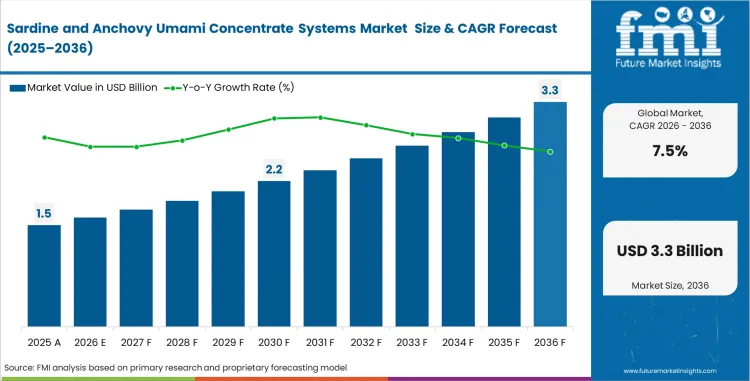
Sardine and Anchovy Umami Concentrate Systems Market was valued at USD 1.4 billion in 2025. Demand is expected to reach USD 1.5 billion in 2026 at a CAGR of 7.5% during the forecast period. Continued use of concentrated marine umami ingredients in industrial savory formulation lifts total valuation to USD 3.1 billion through 2036 as processors move away from simple condiment use toward controlled ingredient systems that fit dry blending, thermal processing, and repeat batch execution.
Summary of Sardine and Anchovy Umami Concentrate Systems Market
- Sardine and Anchovy Umami Concentrate Systems Market Snapshot
- Sardine and Anchovy Umami Concentrate Systems Market is valued at USD 1.4 billion in 2025 and is projected to reach USD 3.1 billion by 2036.
- Industry outlook points to 7.5% CAGR from 2026 to 2036, creating an incremental opportunity of USD 1.5 billion over the period.
- Category includes sardine- and anchovy-derived fermented extracts, hydrolysates, pastes, powders, and blended savory bases supplied for B2B food formulation rather than the broader retail condiment trade.
- Performance in this sector depends more on fermentation consistency, odor handling, powder stability, and formulation fit than on raw fish volume alone.
- Sardine and Anchovy Umami Concentrate Systems Market Demand and Growth Drivers
- Processors are adopting these systems when they need deeper savory character across sauces, soups, snacks, and ready meals without relying only on narrower, less rounded taste-enhancement tools.
- Fermented fish concentrates remain commercially relevant because they deliver broader savory depth, better flavor maturity, and easier integration into compound seasoning systems than narrower single-note inputs.
- Side-stream utilization also supports category expansion, as more fish raw material is being redirected into human-food ingredient systems instead of lower-value outlets.
- Adoption still faces practical limits because odor control, raw-material variation, and salt management can delay internal qualification, especially when buyers must distinguish industrial concentrate systems from broader extract or condiment categories.
- Sardine and Anchovy Umami Concentrate Systems Market Product and Segment View
- Product scope includes fermented extracts, hydrolysates, anchovy pastes, fish sauce powders, and blended savory bases used in industrial savory formulation.
- Food manufacturers, seasoning houses, and formulators use these systems across seasonings, soups, sauces, snacks, and ready meals when marine umami is required in compact, process-stable formats.
- Supported by its established role across fish sauce, paste, and extract applications, Anchovy is expected to account for 62.0% share of the Source Species segment in 2026.
- Fermented Extract is projected to secure 34.0% share of the Product Type segment in 2026, reflecting its fit across sauces, powders, and seasoning premixes.
- In the Format segment, Powder is likely to represent 39.0% of market share in 2026 because it offers lower transport burden, easier blending, and cleaner industrial dosing.
- Seasonings are anticipated to emerge with 29.0% share of the Application segment in 2026, as concentrate systems are most often used to strengthen broader savory blends.
- Since large processors generate the highest repeat demand through customized B2B formulations, Food Manufacturers are forecast to represent 45.0% of the End Use segment in 2026.
- Scope includes food-grade sardine and anchovy concentrate systems used for savory formulation, while excluding canned whole fish, finished retail fish sauce packs, fishmeal, feed-grade hydrolysates, and marine nutraceutical proteins outside umami ingredient use.
- Sardine and Anchovy Umami Concentrate Systems Market Geography and Competitive Outlook
- Vietnam, Thailand, and China remain the fastest-growing production-linked countries, while Japan, Spain, and the United States continue to anchor stable higher-value demand shaped by culinary familiarity or imported formulation use.
- Suppliers compete more on powder-conversion capability, extract standardization, formulation support, and ability to deliver process-friendly sensory performance than on scale alone.
- Competitive landscape remains fragmented, reflecting a specialty ingredient category shaped by regional processing know-how, custom supply requirements, and application-specific buyer qualification rather than broad global concentration.
Key Takeaways, Market Size, and Forecast
- Sardine and Anchovy Umami Concentrate Systems Market is projected to grow from USD 1.5 billion in 2026 to USD 3.1 billion by 2036, at a CAGR of 7.5%.
- The sardine and anchovy umami concentrate systems market was valued at USD 1.4 billion in 2025.
- By 2036, the Sardine and Anchovy Umami Concentrate Systems Market is expected to be worth USD 3.1 billion.
- From 2026 to 2036, the market is projected to expand at a CAGR of 7.5%.
- The market is projected to create an incremental opportunity of USD 1.5 billion between 2026 and 2036.
- In 2026, Anchovy is expected to account for 62.0% of the source species segment.
- Vietnam (8.3%) and Thailand (8.0%) are two of the fastest growing markets.
Sardine and Anchovy Umami Concentrate Systems Market Key Takeaways
| Metric | Details |
|---|---|
| Industry Size (2026) | USD 1.5 billion |
| Industry Value (2036) | USD 3.1 billion |
| CAGR (2026-2036) | 7.5% |
Source: Future Market Insights (FMI) analysis, based on proprietary forecasting model and primary research
Sourcing heads are no longer buying marine umami mainly for taste intensity; they are buying for specification stability, dosing control, and repeat performance across industrial production. Earlier, anchovy paste, fish sauce, or a basic extract could be treated as a culinary input and adjusted later at the blending stage. Commercial requirements are now tighter because concentrate systems must clear formulation, operations, and quality teams before they become repeat-purchase inputs. Savory programs built around powders, premixes, and multi-plant production need stable taste delivery, controlled odor, and consistent ingredient behavior. This becomes more important when marine umami is used inside broader seasoning systems. Getting enough marine intensity is usually not the main issue. Greater difficulty comes from keeping aroma, salt load, and inclusion behavior stable through drying, blending, storage, and scale-up. Controlling how that intensity behaves after drying, storage, blending, and scale-up is usually the harder part. Once that level of control becomes part of the brief, concentrate systems move from occasional flavor additions into regular industrial inputs.
This category becomes easier to adopt only when the same sensory note can be delivered in a production-ready format that reduces plant disruption rather than adding correction work. Sensory strength from fish sauce may be accepted early, but repeat purchasing improves once odor profile, salt load, and dosing behavior are steady enough to work inside wider product systems. Once performance becomes consistent, buyers can move faster through qualification and cut down on reformulation during larger production runs.
Vietnam is projected to post 8.3% CAGR in this market through 2036, followed by Thailand at 8.0%, China at 7.6%, South Korea at 7.4%, the United States at 6.8%, Japan at 6.6%, and Spain at 6.3%. Faster growth in Asian markets comes from closer links between raw-material handling, fermentation, and downstream savory manufacturing. Japan and Spain remain important, though demand there depends more on application quality and specification depth than on scale. Import-led application demand keeps expansion steady in the United States, but growth there depends more on proving plant compatibility and labeling practicality than on domestic production depth.
Segmental Analysis
Sardine and Anchovy Umami Concentrate Systems Market Analysis by Source Species
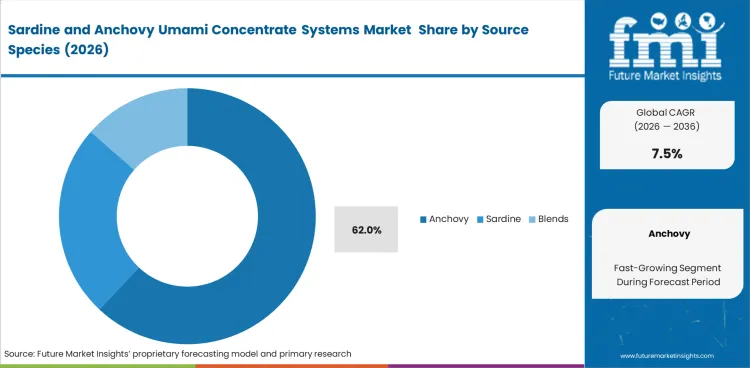
Buyers looking for dependable marine umami usually start from supply familiarity and sensory predictability before they think about novelty. Anchovy benefits on both counts. It sits close to long-standing fish sauce, paste, and extract traditions, which makes commercial qualification easier when manufacturers want a known taste direction with less explanation at the development stage. Market estimates place Anchovy at 62.0% share in 2026, and that lead reflects more than culinary legacy. Anchovy-derived systems give formulators a cleaner route into concentrated savory profiles that can be shifted across powders, liquids, and semi-solid bases without forcing the buyer into a new usage language. Sardine remains relevant where cost, species access, or regional product design changes the brief, yet anchovy keeps its edge because buyers already understand how to build around it. Delaying source-species clarity often leaves product teams correcting aroma behavior late in development, when reformulation becomes slower and costlier. Frozen sardine flows matter to supply planning, but industrial concentrate demand still leans more heavily on anchovy-centered formulation logic.
- Fermentation heritage: Long use in extract and sauce systems gives anchovy a shorter qualification path for buyers building familiar savory notes.
- Species confidence: Product teams can predict profile direction more easily when the raw-material base aligns with established industrial taste references.
- Adjustment burden: Switching species late in the brief can change aroma balance and create avoidable reformulation work for seasoning developers.
Sardine and Anchovy Umami Concentrate Systems Market Analysis by Product Type
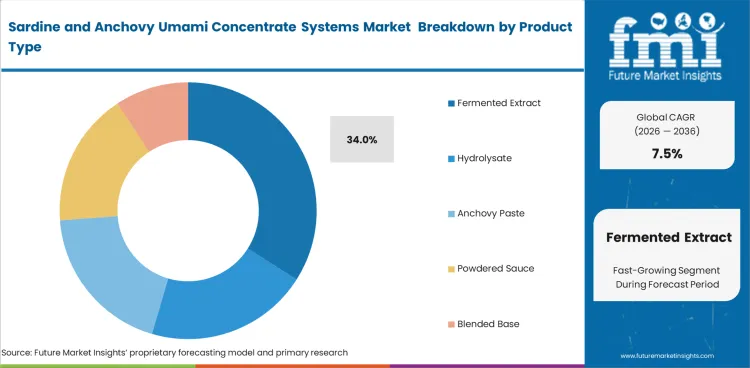
Plain marine intensity does not solve an industrial brief if it arrives in a form that is hard to standardize. Fermented Extract is expected to account for 34.0% share in 2026 because buyers are purchasing maturity of taste, not just concentration of source material. Fermentation helps build rounded savory depth that moves more naturally into sauces, premixes, and dry blends than a narrower raw input would. Savory formulation teams also value the way fermented systems can be framed and dosed within existing savory development language, which reduces trial-and-error during application work. Large users prefer ingredient formats that already carry a developed sensory profile, since that shortens the number of supporting inputs needed downstream. Hydrolysates, pastes, and blended bases all remain commercially active, but fermented extracts stay ahead where buyers want concentrated taste with fewer correction steps once a brief moves toward scale. Broader demand for seafood flavors supports that position.
- Standardization depth: Fermented extracts fit buyers that need a defined savory note before final seasoning architecture is built.
- Aroma retention: More developed flavor character reduces the amount of corrective work required after drying or blending.
- Batch discipline: Processors relying on narrower or less integrated inputs can face more sensory balancing work at scale.
Sardine and Anchovy Umami Concentrate Systems Market Analysis by Format
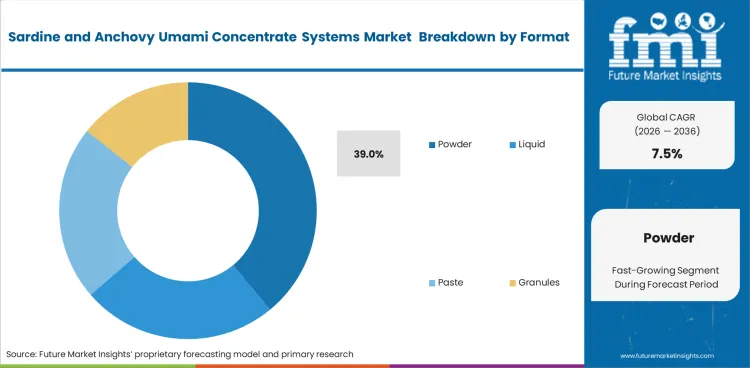
Freight cost, storage control, and dosing behavior often decide format choice before any buyer reaches a final taste decision. Powder leads for that reason. Powder will represent 39.0% of the market in 2026, supported by how easily it moves through dry blending, premix handling, and warehouse storage compared with liquid-heavy alternatives. Food manufacturers do not buy format for convenience alone. They buy it because transport efficiency, lower spill risk, and cleaner meter-in behavior reduce avoidable production drag. Paste and liquid formats still matter where profile authenticity or immediate solubility is central to the brief, but powder keeps widening its industrial role because it fits more manufacturing environments without forcing special handling. Granules retain a narrower position where controlled dispersion or texture-related use cases matter. Demand linked to savory flavor blends further supports powder formats, especially when buyers need marine umami to sit inside broader compound systems rather than travel as a standalone ingredient.
- Dosing control: Powder gives line operators tighter inclusion management across large seasoning and premix runs.
- Freight efficiency: Lower transport burden improves economics when ingredients move across plants or export routes.
- Storage stability: Buyers can plan inventory more comfortably when the format carries less leakage and handling exposure than liquid alternatives.
Sardine and Anchovy Umami Concentrate Systems Market Analysis by Application
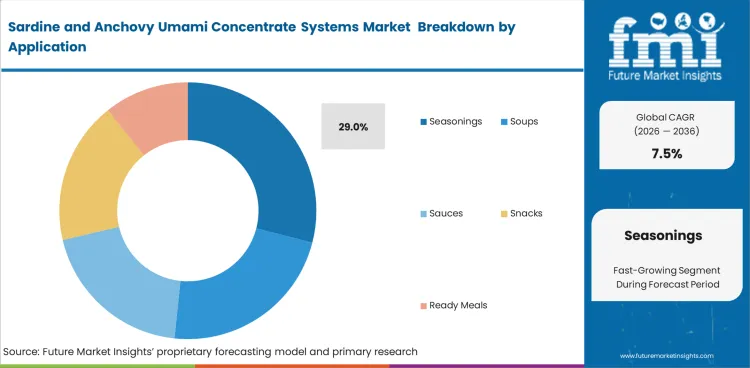
Seasonings matter because they are where concentrated umami can be multiplied across the widest number of finished foods. A seasoning house or food manufacturer can use one marine concentrate system across snack coatings, soup premixes, sauce bases, and meal enhancers once the profile is properly built. That wider carry-through keeps Seasonings in the lead. By 2026, Seasonings are projected to contribute 29.0% of total market share, reflecting the category’s role as a formulation hub rather than a single finished end use. This segment wins when buyers want marine depth to operate as one layer inside a broader savory form instead of appearing as an exposed seafood note. Soups, sauces, snacks, and ready meals remain important outlets, but seasoning systems absorb the most flexible demand because they let processors stretch one concentrated input across multiple SKUs. That is also why marine umami keeps showing up in adjacent savory seasoning development work.
- Inclusion range: Seasoning systems let one marine input travel across several finished product categories with fewer changes.
- Line fit: Buyers can integrate concentrates more smoothly when the ingredient sits inside an existing seasoning architecture.
- Reformulation utility: Product teams gain room to rebalance salt, savoriness, and profile weight without rebuilding the finished food from scratch.
Sardine and Anchovy Umami Concentrate Systems Market Analysis by End Use
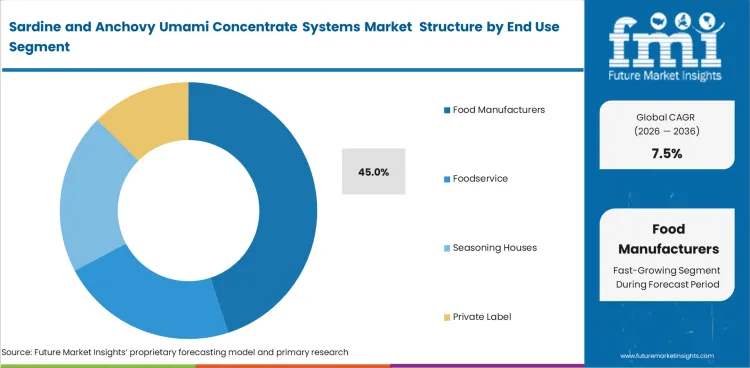
Repeat industrial volume usually settles where specification discipline is strongest, and that is why Food Manufacturers stay ahead of the channel mix. A 45.0% share is expected for Food Manufacturers in 2026 because large processors buy concentrate systems not only for taste but for continuity across multiple plants, product families, and production cycles. Foodservice remains commercially relevant, especially where concentrated marine depth supports kitchen efficiency or back-of-house consistency. Seasoning Houses also matter because they translate raw ingredient behavior into application-ready blends. Still, manufacturers hold the lead because they carry the heaviest recurring purchase burden and the greatest need for customized briefs tied to process stability. It reflects operating exposure more than channel prestige. Buyers producing at industrial scale cannot tolerate large swings in odor, dosing, or blend performance. Demand linked to the broader seasoning business reinforces that pattern, since concentrate systems are increasingly being selected for repeat formulation use rather than occasional niche deployment.
- Volume continuity: Large manufacturers place repeat orders because ingredient reliability matters across ongoing production schedules.
- Custom briefs: Industrial buyers often need tighter sensory and handling specifications than smaller or less standardized channels.
- Repeat ordering: A supplier that fits one production system well has a better chance of staying in the brief through later product extensions.
Sardine and Anchovy Umami Concentrate Systems Market Drivers, Restraints, and Opportunities
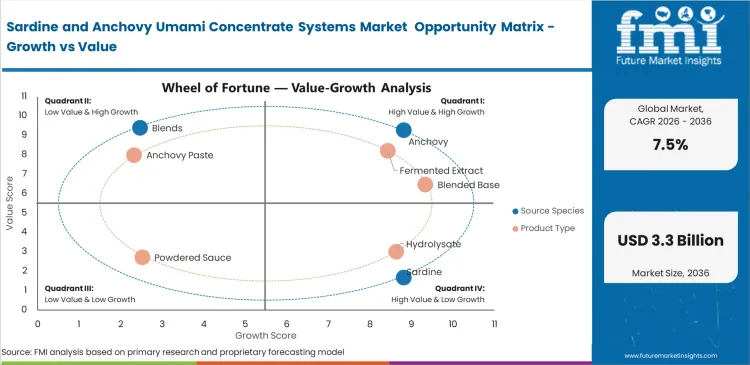
Buyers are being pushed toward more disciplined marine umami sourcing because finished products now need deeper savory character without creating avoidable production complications. Product developers want concentrated taste that can sit inside dry blends, premixes, sauces, and prepared meals with less adjustment after the first commercial trial. Product developers and sourcing heads also prefer formats that can be written into a broader brief instead of behaving like an isolated seafood note. Product selection shows this pattern clearly, as marine concentrates are assessed against other taste-building tools, including flavor modulator systems, and still choose sardine- or anchovy-derived inputs when they need recognizable depth and a more natural savory character inside formulation work.
Qualification delays remain a real restraint. A buyer may like the sensory result and still slow the purchase because odor control, salt behavior, and line compatibility need sign-off from several teams before adoption becomes routine. R&D, quality, supply, and operations do not always move at the same speed, and that creates a compositional drag that is harder to remove than a simple pricing issue. Future Market Insights analysis suggests that hydrolysate development improves some of this burden by giving buyers more controlled ingredient options, yet fish protein hydrolysate approaches do not erase the need for application testing. When specification matching is weak, even a promising concentrate can get stuck in trial mode.
Opportunities in the Sardine and Anchovy Umami Concentrate Systems Market
- Side-stream conversion: Processors turning more fish streams into food-grade taste ingredients can widen supply options for buyers that need cost-disciplined marine inputs. Work around protein hydrolysate applications also supports that direction when manufacturers want more controlled functional behavior.
- Custom powdering: Ingredient suppliers that can move liquid or paste sensory profiles into stable powdered form are better placed with large-volume manufacturers that care about freight, dosing, and warehouse handling.
- Cross-category formulation: Suppliers able to design one concentrate system for seasonings, sauces, snacks, and meal bases can win more repeat business from buyers trying to simplify multi-SKU development.
Regional Analysis
Based on the regional analysis, the sardine and anchovy umami concentrate systems market is segmented into Asia Pacific, North America, and Europe across 40 plus countries.
.webp "Top Country Growth Comparison Sardine And Anchovy Umami Concentrate Systems Market Cagr (2026 2036)")
| Country | CAGR (2026 to 2036) |
|---|---|
| Vietnam | 8.3% |
| Thailand | 8.0% |
| China | 7.6% |
| South Korea | 7.4% |
| United States | 6.8% |
| Japan | 6.6% |
| Spain | 6.3% |
Source: Future Market Insights (FMI) analysis, based on proprietary forecasting model and primary research
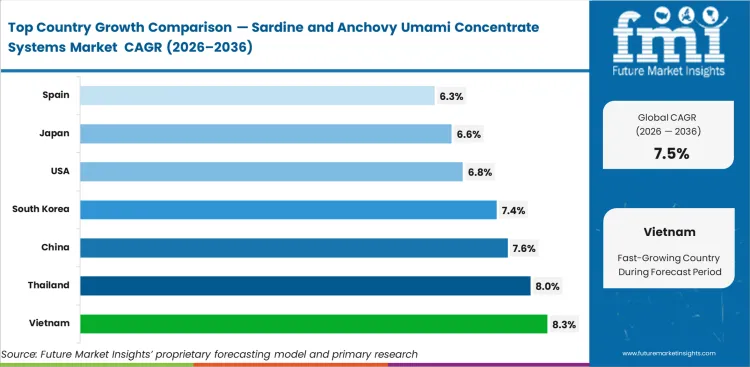
Asia Pacific Sardine and Anchovy Umami Concentrate Systems Market Analysis
Asia Pacific starts from a stronger commercial base because anchovy- and sardine-derived taste systems are already familiar to ingredient users across the region. Commercial discussion usually begins further down the chain, around format control, export suitability, and how a concentrate performs in seasoning and sauce production. Vietnam and Thailand matter for their fermentation base and outward ingredient trade, while China adds processing depth and a broader manufacturing platform. South Korea and Japan contribute steady demand with tighter specification expectations. Raw-material handling, processing know-how, and end-use familiarity sit closer together here than in other regions, but execution risk still matters. Odor control, standardization, and batch repeatability continue to separate stronger suppliers from weaker ones once concentrates move into larger production programs.
- Vietnam: Vietnam stays at the front of this regional group because export discipline, fermentation capability, and ingredient-trade readiness are already well established. Industry outlook in Vietnam points to 8.3% CAGR through 2036, reflecting a market where sardine and anchovy concentrate systems are supported by a more mature processing base and stronger outward commercial movement. Product teams in the country usually work from an existing application language, which reduces early-stage qualification effort. Faster acceptance here comes less from discovery and more from execution consistency in industrial savory use.
- Thailand: Thailand stays close behind because its seafood-processing base already supports conversion of marine raw material into higher-value savory ingredients. Commercial use benefits from familiarity at both the processing and application stage, which makes the category easier to place in seasoning and sauce programs. Suppliers that can maintain profile consistency and dependable use performance are in a stronger position to secure repeat demand. Country-level demand analysis indicates 8.0% CAGR from 2026 to 2036. That pace reflects a market where processing know-how and ingredient application are already linked in practical commercial use.
- China: China draws strength from processing depth as much as from manufacturing scale. Ingredient production, application work, and downstream food manufacturing sit closer together here, which improves supply continuity and makes technical coordination easier for large-volume users. China is forecast to register 7.6% CAGR through 2036 as extract-oriented capability supports broader use of sardine and anchovy concentrate systems across savory manufacturing. Product teams benefit when ingredient availability and application support can be handled within one domestic base. Suppliers with cleaner sensory control are likely to hold the stronger commercial position.
- South Korea: South Korea remains commercially meaningful because savory food demand is already well developed and marine taste notes fit naturally into the local product environment. Category awareness is not the main hurdle here. Greater pressure falls on profile control, specification accuracy, and consistency across repeated industrial use. Market outlook in South Korea indicates 7.4% CAGR during the forecast period, placing it below the top three countries but still in a solid position. Suppliers entering this market need tighter execution, since formulation teams are less willing to tolerate variation once an ingredient is approved.
- Japan: Industry outlook in Japan points to 6.6% CAGR through 2036. Japan reflects maturity more than speed in this category. Product teams are usually not searching for novelty, and greater attention goes to whether a concentrate performs cleanly inside a defined sensory brief and remains stable through processing. Deep culinary familiarity keeps the category relevant, though a more established usage base moderates the pace. Suppliers with disciplined aroma control, stronger format stability, and tighter specification matching are better placed to retain business in a market where performance expectations are already high.
FMI analysts view Asia Pacific as the region where commercial advantage comes from execution discipline rather than from basic category awareness. Suppliers that can pair sensory depth with plant-ready consistency are better positioned than sellers that rely only on heritage or raw-material access.
North America Sardine and Anchovy Umami Concentrate Systems Market Analysis
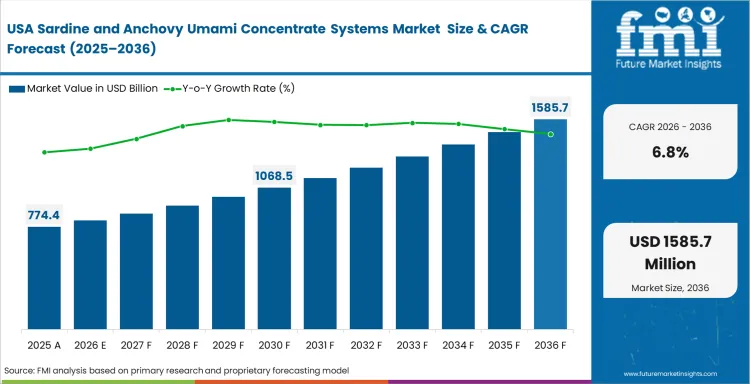
Import-led application demand shapes North America more than direct production depth. Sardine and anchovy concentrates are often assessed here as targeted formulation tools rather than pantry-linked ingredients moving straight into manufacturing. Commercial discussions therefore center on functionality, format behavior, and repeatability across snacks, sauces, and prepared foods. United States demand remains steady, which fits a category advancing through wider processed-food use and controlled product trials. Familiarity with umami is already present in the region. Wider adoption depends on whether marine concentrates can fit mainstream production without creating odor, labeling, or handling issues that outweigh the taste benefit.
- United States: United States remains relevant because marine concentrates are finding broader use across seasoning systems, snack profiles, sauces, and prepared food development. Commercial acceptance depends heavily on proving that these ingredients can fit mainstream manufacturing without creating extra handling, labeling, or odor complications. Product developers tend to move once format suitability is clear and the ingredient can be used without adding unnecessary process burden. United States is expected to record 6.8% CAGR from 2026 to 2036. Suppliers that make industrial use easier are more likely to secure repeat business.
FMI notes that North America rewards suppliers that can translate marine concentrates into a clear industrial use case with minimal production disruption. Technical selling matters more here because repeat business depends on how easily an ingredient fits plant operations after the first successful trial.
Europe Sardine and Anchovy Umami Concentrate Systems Market Analysis
Culinary familiarity gives Europe a stable base in parts of the region, but industrial use still depends on disciplined conversion of that familiarity into specification-ready ingredients. Product developers are usually less concerned with discovery and more concerned with whether a sardine- or anchovy-derived concentrate behaves cleanly in seasoning, sauce, and prepared-food applications. Commercial progress is therefore tied to profile control, batch consistency, and ease of use inside professional formulation work. Europe can appear slower on headline pace, yet mature demand bases often expose supplier weaknesses faster because expectation levels are already well formed.
- Spain: Spain benefits from strong culinary familiarity, but industrial use still depends on whether suppliers can turn that familiarity into a specification-ready ingredient for commercial formulation. Product teams already know how anchovy- and sardine-derived notes should behave, so weak execution is identified quickly and rejected early. Commercial conditions are tighter for that reason, especially where consistency is uneven. Spain is likely to post 6.3% CAGR in the sector by 2036. Suppliers that maintain cleaner profile control and steadier processing performance are more likely to convert existing demand into stable repeat orders.
FMI notes that Europe is better understood through demand quality than through pace alone. Mature use environments can be demanding, and that raises the value of suppliers that deliver reliable sensory behavior without creating extra correction work during formulation or scale-up.
Competitive Aligners for Market Players
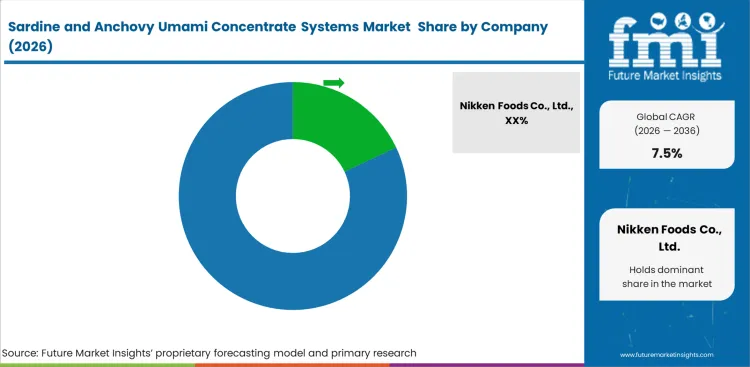
Competition in this market is shaped less by headline scale and more by who can convert marine raw material into a reliable industrial brief. Buyers compare suppliers on specification control, odor management, format flexibility, and whether the ingredient behaves predictably in a real production environment. A supplier with strong sensory power can still lose if the product creates dosing problems or forces repeated correction work inside formulation. Future Market Insights analysis suggests that adjacency to broader flavors capabilities can help, especially when buyers want marine umami folded into wider savory design rather than purchased as a standalone note.
Incumbents are stronger where they already understand the language of industrial savory formulation and can offer application support instead of only a raw ingredient. That support matters in powders, fermented extracts, and blended systems, where the purchase decision often depends on how fast a buyer can move from lab fit to production fit. Smaller or regional challengers can still win when they offer tighter sensory specificity, faster sample response, or a better match to a niche brief. Product lines that sit close to fish hydrolysate development also benefit when buyers want both taste and functional handling discipline from one supplier conversation.
Fragmentation stays high because the category draws suppliers from seafood processing, flavor systems, and customized application work. Nikken Foods Co., Ltd., Sokol & Company, Del-Val Food Ingredients, Inc., Shanghai Hensin Industry Co., Ltd., Dalian YSK Bio-Technology Co., Ltd., and DOBE IND. CO., LTD. all operate in a space where contract fit matters as much as broad presence. Buyers choosing between marine concentrate suppliers often benchmark service reliability, custom brief response, and whether the supplier can stretch from concentrated seafood notes into adjacent canned seafood or alternative savory directions such as vegan fish sauce where portfolio overlap changes sourcing logic.
Key Players in Sardine and Anchovy Umami Concentrate Systems Market
- Nikken Foods Co., Ltd.
- Sokol & Company
- Del-Val Food Ingredients, Inc.
- Shanghai Hensin Industry Co., Ltd.
- Dalian YSK Bio-Technology Co., Ltd.
- DOBE IND. CO., LTD.
Scope of the Report
| Metric | Value |
|---|---|
| Quantitative Units | USD 1.5 billion in 2026, and USD 3.1 billion by 2036, at a CAGR of 7.5% |
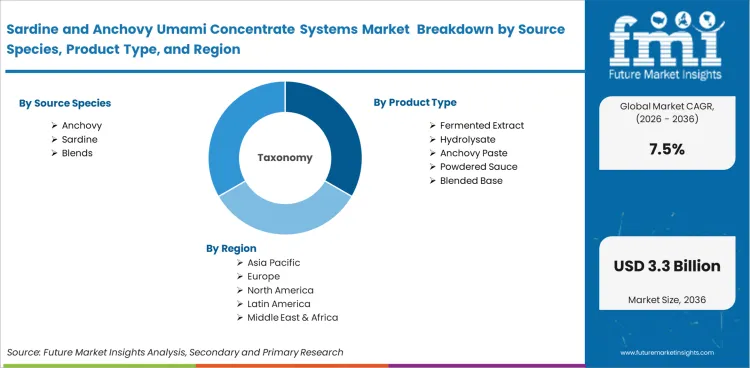
| Market Definition | Food-grade sardine- and anchovy-based umami concentrate systems developed for industrial savory formulation, including fermented extracts, hydrolysates, pastes, powders, and blended bases designed to improve taste depth, handling consistency, and process suitability across seasonings, sauces, soups, snacks, and ready meals. |
| Segmentation | By Source Species, Product Type, Format, Application, End Use, and Region |
| Regions Covered | Asia Pacific, North America, Europe |
| Countries Covered | Vietnam, Thailand, China, South Korea, United States, Japan, Spain |
| Key Companies Profiled | Nikken Foods Co., Ltd., Sokol & Company, Del-Val Food Ingredients, Inc., Shanghai Hensin Industry Co., Ltd., Dalian YSK Bio-Technology Co., Ltd., DOBE IND. CO., LTD. |
| Forecast Period | 2026 to 2036 |
| Approach | Bottom-up value sizing built from seafood extract trade movement, fish-based savory ingredient conversion, active supplier participation, format-specific application demand, and use-case-adjusted industrial selling values. |
Sardine and Anchovy Umami Concentrate Systems Market Analysis by Segments
By Source Species:
- Anchovy
- Sardine
- Blends
By Product Type:
- Fermented Extract
- Hydrolysate
- Anchovy Paste
- Powdered Sauce
- Blended Base
By Format:
- Powder
- Liquid
- Paste
- Granules
By Application:
- Seasonings
- Soups
- Sauces
- Snacks
- Ready Meals
By End Use:
- Food Manufacturers
- Foodservice
- Seasoning Houses
- Private Label
By Region:
- Asia Pacific
- Vietnam
- Thailand
- China
- South Korea
- Japan
- North America
- United States
- Europe
- Spain
Bibliography
- Food and Agriculture Organization of the United Nations. (2024). The State of World Fisheries and Aquaculture 2024: Blue transformation in action.
- Honrado, A., Miguel, M., Ardila, P., Beltrán, J. A., & Calanche, J. B. (2024). From Waste to Value: Fish Protein Hydrolysates as a Technological and Functional Ingredient in Human Nutrition. Foods, 13(19), 3120.
- Ono, M., & Mouritsen, O. G. (2025). Umami-rich seasonings and condiments in Western food cultures for umamification in a plant-forward cuisine. International Journal of Gastronomy and Food Science, 42, 101305.
- Rooper, C. N., Boldt, J. L., Uriarte, A., Hansen, C., Ward, T., & Gaichas, S. (2024). Small pelagic fish: new frontiers in science and sustainable management. Canadian Journal of Fisheries and Aquatic Sciences, 81(8), 984-989.
This bibliography is provided for reader reference. The full FMI report contains the complete reference list with primary source documentation.
This Report Addresses
- Market sizing and forecast for sardine and anchovy umami concentrate systems from 2026 to 2036.
- Commercial logic behind anchovy leadership in source-species demand.
- Product-type positioning across fermented extract, hydrolysate, paste, powdered sauce, and blended base formats.
- Format-level buying logic across powder, liquid, paste, and granule offerings.
- Application mapping across seasonings, soups, sauces, snacks, and ready meals.
- End-use behavior across food manufacturers, foodservice, seasoning houses, and private-label channels.
- Country demand outlook for Vietnam, Thailand, China, South Korea, United States, Japan, and Spain.
- Competitive alignment across suppliers operating in industrial marine umami ingredients.
Frequently Asked Questions
How large is the Sardine and Anchovy Umami Concentrate Systems Market in 2026?
Industry size is projected at USD 1.5 billion in 2026. That figure reflects B2B demand for sardine- and anchovy-derived concentrate systems used in industrial savory formulation rather than the full retail seafood condiment trade.
What will the Sardine and Anchovy Umami Concentrate Systems Market be valued at by 2036?
FMI projects the market to reach USD 3.1 billion by 2036. Expansion is tied to broader use of concentrated marine umami ingredients in seasonings, sauces, snacks, soups, and ready meals.
What CAGR is projected for the Sardine and Anchovy Umami Concentrate Systems Market?
FMI estimates a CAGR of 7.5% from 2026 to 2036. That rate suits a specialty ingredient category where adoption depends on formulation fit, specification control, and repeat industrial use.
Which Source Species segment leads in the Sardine and Anchovy Umami Concentrate Systems Market?
Anchovy leads the Source Species segment. FMI expects it to account for 62.0% share in 2026 because buyers already understand how anchovy-derived notes behave in fish sauce, paste, and extract-based systems.
Which Product Type segment leads in the Sardine and Anchovy Umami Concentrate Systems Market?
Fermented Extract leads Product Type. A 34.0% share is expected in 2026, reflecting buyer preference for concentrated savory depth that enters formulation with fewer corrective steps.
Which Format segment leads in the Sardine and Anchovy Umami Concentrate Systems Market?
Powder leads by Format with an expected 39.0% share in 2026. Buyers prefer it because it is easier to transport, store, and dose inside industrial seasoning and premix systems.
What is driving rapid growth in the Sardine and Anchovy Umami Concentrate Systems Market?
Industrial food manufacturers want marine umami in forms that work cleanly inside large-scale production. Demand rises when concentrates can deliver taste depth without creating extra burden in blending, storage, or batch control.
What is the primary restraint in the Sardine and Anchovy Umami Concentrate Systems Market?
Qualification remains the main restraint. Buyers may accept the sensory result early, but scale adoption slows when odor control, salt behavior, and application fit need approval across several internal teams.
Which country is projected to grow fastest in the Sardine and Anchovy Umami Concentrate Systems Market?
Vietnam leads the country outlook at 8.3% CAGR through 2036. Its advantage comes from stronger fermentation heritage, export linkage, and closer alignment between raw-material handling and concentrated savory ingredient production.
How does structural category scope shape the Sardine and Anchovy Umami Concentrate Systems Market?
Scope is defined by ingredient function, not by all seafood-derived products. FMI includes food-grade concentrate systems used in savory formulation and excludes canned fish, feed hydrolysates, marine oils, and finished retail packs.
What product shift matters most in the Sardine and Anchovy Umami Concentrate Systems Market?
Buyers are moving away from treating marine umami as a simple culinary add-on. More commercial weight now sits on standardized powders, fermented extracts, and blended bases that behave reliably in production.
What competitive pattern defines the Sardine and Anchovy Umami Concentrate Systems Market?
Competition is fragmented and practical. Buyers usually compare suppliers on specification control, format suitability, response speed, and whether the ingredient performs cleanly in real manufacturing conditions.
Why does Vietnam stay ahead of Thailand in the Sardine and Anchovy Umami Concentrate Systems Market?
Vietnam and Thailand are close, but Vietnam holds a small edge in projected pace. Export-facing concentration systems and stronger commercial linkage between fermentation and outward ingredient trade help keep Vietnam in front.
What keeps China relevant in the Sardine and Anchovy Umami Concentrate Systems Market?
China matters because of processing depth and manufacturing scale. A 7.6% CAGR suggests buyers continue to value a supply base that can support ingredient production and broader savory application work together.
How should South Korea be read in the Sardine and Anchovy Umami Concentrate Systems Market?
South Korea is not the fastest market, yet it stays commercially important at 7.4% CAGR. Savory demand is already well developed, so supplier success depends more on specification quality than on creating first-time awareness.
Why does Japan remain relevant even at a lower CAGR in the Sardine and Anchovy Umami Concentrate Systems Market?
Japan’s 6.6% CAGR reflects maturity rather than weakness. Buyers there often know the category well, which raises expectations for sensory precision and format discipline instead of rewarding loose supply expansion.
What does the United States represent in the Sardine and Anchovy Umami Concentrate Systems Market?
United States demand is largely application-led and import-linked. A 6.8% CAGR shows steady acceptance in processed foods, but suppliers usually need to prove format fit and production practicality before volume scales.
Why does Spain matter in the Sardine and Anchovy Umami Concentrate Systems Market?
Spain stays relevant because culinary familiarity reduces basic acceptance risk. Its 6.3% CAGR points to steady industrial use where buyers still expect disciplined ingredient behavior rather than loose seafood positioning.
Why do Seasonings lead the Application split in the Sardine and Anchovy Umami Concentrate Systems Market?
Seasonings lead with 29.0% share in 2026 because one concentrate system can support multiple finished food categories from a single formulation platform. That flexibility makes seasonings the widest commercial outlet for marine umami ingredients.
Why do Food Manufacturers lead the End Use split in the Sardine and Anchovy Umami Concentrate Systems Market?
Food Manufacturers are projected to account for 45.0% share in 2026. Large processors place repeat orders and need customized inputs that can hold up across several production lines and product families.
How does FMI research the Sardine and Anchovy Umami Concentrate Systems Market?
FMI combines primary interviews with savory formulators, supply managers, and product developers with desk research on trade movement, supplier portfolios, and ingredient format coverage. Forecasts are then checked against country demand direction and downstream application logic.
What is excluded from the Sardine and Anchovy Umami Concentrate Systems Market that buyers often confuse with it?
Retail fish sauce, canned seafood, feed-grade hydrolysates, marine oils, and nutraceutical proteins are outside scope. Buyers often confuse them with this market because they share raw-material roots, but they do not serve the same formulation function.
What is the less obvious commercial insight in the Sardine and Anchovy Umami Concentrate Systems Market?
Taste intensity alone does not decide supplier success here. Buyers often struggle more with odor behavior, dosing control, and batch repeatability than with finding enough marine savory strength in the first place.
Preview the report firsthand - request a free sample
Get SampleGet the brochure for pricing and purchase details.
Get PDFTable of Content
- Executive Summary
- Global Market Outlook
- Demand-side Trends
- Supply-side Trends
- Technology Roadmap Analysis
- Analysis and Recommendations
- Market Overview
- Market Coverage / Taxonomy
- Market Definition / Scope / Limitations
- Research Methodology
- Chapter Orientation
- Analytical Lens and Working Hypotheses
- Market Structure, Signals, and Trend Drivers
- Benchmarking and Cross-market Comparability
- Market Sizing, Forecasting, and Opportunity Mapping
- Research Design and Evidence Framework
- Desk Research Programme (Secondary Evidence)
- Company Annual and Sustainability Reports
- Peer-reviewed Journals and Academic Literature
- Corporate Websites, Product Literature, and Technical Notes
- Earnings Decks and Investor Briefings
- Statutory Filings and Regulatory Disclosures
- Technical White Papers and Standards Notes
- Trade Journals, Industry Magazines, and Analyst Briefs
- Conference Proceedings, Webinars, and Seminar Materials
- Government Statistics Portals and Public Data Releases
- Press Releases and Reputable Media Coverage
- Specialist Newsletters and Curated Briefings
- Sector Databases and Reference Repositories
- FMI Internal Proprietary Databases and Historical Market Datasets
- Subscription Datasets and Paid Sources
- Social Channels, Communities, and Digital Listening Inputs
- Additional Desk Sources
- Expert Input and Fieldwork (Primary Evidence)
- Primary Modes
- Qualitative Interviews and Expert Elicitation
- Quantitative Surveys and Structured Data Capture
- Blended Approach
- Why Primary Evidence is Used
- Field Techniques
- Interviews
- Surveys
- Focus Groups
- Observational and In-context Research
- Social and Community Interactions
- Stakeholder Universe Engaged
- C-suite Leaders
- Board Members
- Presidents and Vice Presidents
- R&D and Innovation Heads
- Technical Specialists
- Domain Subject-matter Experts
- Scientists
- Physicians and Other Healthcare Professionals
- Governance, Ethics, and Data Stewardship
- Research Ethics
- Data Integrity and Handling
- Primary Modes
- Tooling, Models, and Reference Databases
- Desk Research Programme (Secondary Evidence)
- Data Engineering and Model Build
- Data Acquisition and Ingestion
- Cleaning, Normalisation, and Verification
- Synthesis, Triangulation, and Analysis
- Quality Assurance and Audit Trail
- Market Background
- Market Dynamics
- Drivers
- Restraints
- Opportunity
- Trends
- Scenario Forecast
- Demand in Optimistic Scenario
- Demand in Likely Scenario
- Demand in Conservative Scenario
- Opportunity Map Analysis
- Product Life Cycle Analysis
- Supply Chain Analysis
- Investment Feasibility Matrix
- Value Chain Analysis
- PESTLE and Porter’s Analysis
- Regulatory Landscape
- Regional Parent Market Outlook
- Production and Consumption Statistics
- Import and Export Statistics
- Market Dynamics
- Global Market Analysis 2021 to 2025 and Forecast, 2026 to 2036
- Historical Market Size Value (USD Million) Analysis, 2021 to 2025
- Current and Future Market Size Value (USD Million) Projections, 2026 to 2036
- Y-o-Y Growth Trend Analysis
- Absolute $ Opportunity Analysis
- Global Market Pricing Analysis 2021 to 2025 and Forecast 2026 to 2036
- Global Market Analysis 2021 to 2025 and Forecast 2026 to 2036, By Source Species
- Introduction / Key Findings
- Historical Market Size Value (USD Million) Analysis By Source Species , 2021 to 2025
- Current and Future Market Size Value (USD Million) Analysis and Forecast By Source Species , 2026 to 2036
- Anchovy
- Sardine
- Blends
- Anchovy
- Y-o-Y Growth Trend Analysis By Source Species , 2021 to 2025
- Absolute $ Opportunity Analysis By Source Species , 2026 to 2036
- Global Market Analysis 2021 to 2025 and Forecast 2026 to 2036, By Product Type
- Introduction / Key Findings
- Historical Market Size Value (USD Million) Analysis By Product Type, 2021 to 2025
- Current and Future Market Size Value (USD Million) Analysis and Forecast By Product Type, 2026 to 2036
- Fermented Extract
- Hydrolysate
- Anchovy Paste
- Powdered Sauce
- Blended Base
- Fermented Extract
- Y-o-Y Growth Trend Analysis By Product Type, 2021 to 2025
- Absolute $ Opportunity Analysis By Product Type, 2026 to 2036
- Global Market Analysis 2021 to 2025 and Forecast 2026 to 2036, By Format
- Introduction / Key Findings
- Historical Market Size Value (USD Million) Analysis By Format, 2021 to 2025
- Current and Future Market Size Value (USD Million) Analysis and Forecast By Format, 2026 to 2036
- Powder
- Liquid
- Paste
- Granules
- Powder
- Y-o-Y Growth Trend Analysis By Format, 2021 to 2025
- Absolute $ Opportunity Analysis By Format, 2026 to 2036
- Global Market Analysis 2021 to 2025 and Forecast 2026 to 2036, By Application
- Introduction / Key Findings
- Historical Market Size Value (USD Million) Analysis By Application, 2021 to 2025
- Current and Future Market Size Value (USD Million) Analysis and Forecast By Application, 2026 to 2036
- Seasonings
- Soups
- Sauces
- Snacks
- Ready Meals
- Seasonings
- Y-o-Y Growth Trend Analysis By Application, 2021 to 2025
- Absolute $ Opportunity Analysis By Application, 2026 to 2036
- Global Market Analysis 2021 to 2025 and Forecast 2026 to 2036, By End Use
- Introduction / Key Findings
- Historical Market Size Value (USD Million) Analysis By End Use, 2021 to 2025
- Current and Future Market Size Value (USD Million) Analysis and Forecast By End Use, 2026 to 2036
- Food Manufacturers
- Foodservice
- Seasoning Houses
- Private Label
- Food Manufacturers
- Y-o-Y Growth Trend Analysis By End Use, 2021 to 2025
- Absolute $ Opportunity Analysis By End Use, 2026 to 2036
- Global Market Analysis 2021 to 2025 and Forecast 2026 to 2036, By Region
- Introduction
- Historical Market Size Value (USD Million) Analysis By Region, 2021 to 2025
- Current Market Size Value (USD Million) Analysis and Forecast By Region, 2026 to 2036
- North America
- Latin America
- Western Europe
- Eastern Europe
- East Asia
- South Asia and Pacific
- Middle East & Africa
- Market Attractiveness Analysis By Region
- North America Market Analysis 2021 to 2025 and Forecast 2026 to 2036, By Country
- Historical Market Size Value (USD Million) Trend Analysis By Market Taxonomy, 2021 to 2025
- Market Size Value (USD Million) Forecast By Market Taxonomy, 2026 to 2036
- By Country
- USA
- Canada
- Mexico
- By Source Species
- By Product Type
- By Format
- By Application
- By End Use
- By Country
- Market Attractiveness Analysis
- By Country
- By Source Species
- By Product Type
- By Format
- By Application
- By End Use
- Key Takeaways
- Latin America Market Analysis 2021 to 2025 and Forecast 2026 to 2036, By Country
- Historical Market Size Value (USD Million) Trend Analysis By Market Taxonomy, 2021 to 2025
- Market Size Value (USD Million) Forecast By Market Taxonomy, 2026 to 2036
- By Country
- Brazil
- Chile
- Rest of Latin America
- By Source Species
- By Product Type
- By Format
- By Application
- By End Use
- By Country
- Market Attractiveness Analysis
- By Country
- By Source Species
- By Product Type
- By Format
- By Application
- By End Use
- Key Takeaways
- Western Europe Market Analysis 2021 to 2025 and Forecast 2026 to 2036, By Country
- Historical Market Size Value (USD Million) Trend Analysis By Market Taxonomy, 2021 to 2025
- Market Size Value (USD Million) Forecast By Market Taxonomy, 2026 to 2036
- By Country
- Germany
- UK
- Italy
- Spain
- France
- Nordic
- BENELUX
- Rest of Western Europe
- By Source Species
- By Product Type
- By Format
- By Application
- By End Use
- By Country
- Market Attractiveness Analysis
- By Country
- By Source Species
- By Product Type
- By Format
- By Application
- By End Use
- Key Takeaways
- Eastern Europe Market Analysis 2021 to 2025 and Forecast 2026 to 2036, By Country
- Historical Market Size Value (USD Million) Trend Analysis By Market Taxonomy, 2021 to 2025
- Market Size Value (USD Million) Forecast By Market Taxonomy, 2026 to 2036
- By Country
- Russia
- Poland
- Hungary
- Balkan & Baltic
- Rest of Eastern Europe
- By Source Species
- By Product Type
- By Format
- By Application
- By End Use
- By Country
- Market Attractiveness Analysis
- By Country
- By Source Species
- By Product Type
- By Format
- By Application
- By End Use
- Key Takeaways
- East Asia Market Analysis 2021 to 2025 and Forecast 2026 to 2036, By Country
- Historical Market Size Value (USD Million) Trend Analysis By Market Taxonomy, 2021 to 2025
- Market Size Value (USD Million) Forecast By Market Taxonomy, 2026 to 2036
- By Country
- China
- Japan
- South Korea
- By Source Species
- By Product Type
- By Format
- By Application
- By End Use
- By Country
- Market Attractiveness Analysis
- By Country
- By Source Species
- By Product Type
- By Format
- By Application
- By End Use
- Key Takeaways
- South Asia and Pacific Market Analysis 2021 to 2025 and Forecast 2026 to 2036, By Country
- Historical Market Size Value (USD Million) Trend Analysis By Market Taxonomy, 2021 to 2025
- Market Size Value (USD Million) Forecast By Market Taxonomy, 2026 to 2036
- By Country
- India
- ASEAN
- Australia & New Zealand
- Rest of South Asia and Pacific
- By Source Species
- By Product Type
- By Format
- By Application
- By End Use
- By Country
- Market Attractiveness Analysis
- By Country
- By Source Species
- By Product Type
- By Format
- By Application
- By End Use
- Key Takeaways
- Middle East & Africa Market Analysis 2021 to 2025 and Forecast 2026 to 2036, By Country
- Historical Market Size Value (USD Million) Trend Analysis By Market Taxonomy, 2021 to 2025
- Market Size Value (USD Million) Forecast By Market Taxonomy, 2026 to 2036
- By Country
- Kingdom of Saudi Arabia
- Other GCC Countries
- Turkiye
- South Africa
- Other African Union
- Rest of Middle East & Africa
- By Source Species
- By Product Type
- By Format
- By Application
- By End Use
- By Country
- Market Attractiveness Analysis
- By Country
- By Source Species
- By Product Type
- By Format
- By Application
- By End Use
- Key Takeaways
- Key Countries Market Analysis
- USA
- Pricing Analysis
- Market Share Analysis, 2025
- By Source Species
- By Product Type
- By Format
- By Application
- By End Use
- Canada
- Pricing Analysis
- Market Share Analysis, 2025
- By Source Species
- By Product Type
- By Format
- By Application
- By End Use
- Mexico
- Pricing Analysis
- Market Share Analysis, 2025
- By Source Species
- By Product Type
- By Format
- By Application
- By End Use
- Brazil
- Pricing Analysis
- Market Share Analysis, 2025
- By Source Species
- By Product Type
- By Format
- By Application
- By End Use
- Chile
- Pricing Analysis
- Market Share Analysis, 2025
- By Source Species
- By Product Type
- By Format
- By Application
- By End Use
- Germany
- Pricing Analysis
- Market Share Analysis, 2025
- By Source Species
- By Product Type
- By Format
- By Application
- By End Use
- UK
- Pricing Analysis
- Market Share Analysis, 2025
- By Source Species
- By Product Type
- By Format
- By Application
- By End Use
- Italy
- Pricing Analysis
- Market Share Analysis, 2025
- By Source Species
- By Product Type
- By Format
- By Application
- By End Use
- Spain
- Pricing Analysis
- Market Share Analysis, 2025
- By Source Species
- By Product Type
- By Format
- By Application
- By End Use
- France
- Pricing Analysis
- Market Share Analysis, 2025
- By Source Species
- By Product Type
- By Format
- By Application
- By End Use
- India
- Pricing Analysis
- Market Share Analysis, 2025
- By Source Species
- By Product Type
- By Format
- By Application
- By End Use
- ASEAN
- Pricing Analysis
- Market Share Analysis, 2025
- By Source Species
- By Product Type
- By Format
- By Application
- By End Use
- Australia & New Zealand
- Pricing Analysis
- Market Share Analysis, 2025
- By Source Species
- By Product Type
- By Format
- By Application
- By End Use
- China
- Pricing Analysis
- Market Share Analysis, 2025
- By Source Species
- By Product Type
- By Format
- By Application
- By End Use
- Japan
- Pricing Analysis
- Market Share Analysis, 2025
- By Source Species
- By Product Type
- By Format
- By Application
- By End Use
- South Korea
- Pricing Analysis
- Market Share Analysis, 2025
- By Source Species
- By Product Type
- By Format
- By Application
- By End Use
- Russia
- Pricing Analysis
- Market Share Analysis, 2025
- By Source Species
- By Product Type
- By Format
- By Application
- By End Use
- Poland
- Pricing Analysis
- Market Share Analysis, 2025
- By Source Species
- By Product Type
- By Format
- By Application
- By End Use
- Hungary
- Pricing Analysis
- Market Share Analysis, 2025
- By Source Species
- By Product Type
- By Format
- By Application
- By End Use
- Kingdom of Saudi Arabia
- Pricing Analysis
- Market Share Analysis, 2025
- By Source Species
- By Product Type
- By Format
- By Application
- By End Use
- Turkiye
- Pricing Analysis
- Market Share Analysis, 2025
- By Source Species
- By Product Type
- By Format
- By Application
- By End Use
- South Africa
- Pricing Analysis
- Market Share Analysis, 2025
- By Source Species
- By Product Type
- By Format
- By Application
- By End Use
- USA
- Market Structure Analysis
- Competition Dashboard
- Competition Benchmarking
- Market Share Analysis of Top Players
- By Regional
- By Source Species
- By Product Type
- By Format
- By Application
- By End Use
- Competition Analysis
- Competition Deep Dive
- Nikken Foods Co., Ltd.
- Overview
- Product Portfolio
- Profitability by Market Segments (Product/Age /Sales Channel/Region)
- Sales Footprint
- Strategy Overview
- Marketing Strategy
- Product Strategy
- Channel Strategy
- Sokol & Company
- Del-Val Food Ingredients, Inc.
- Shanghai Hensin Industry Co., Ltd.
- Dalian YSK Bio-Technology Co., Ltd.
- DOBE IND. CO., LTD.
- Nikken Foods Co., Ltd.
- Competition Deep Dive
- Assumptions & Acronyms Used


