

- Industry Size (2026)
- USD 2460 Mn
- Forecast (2036)
- USD 7988.4 Mn
- CAGR (2026 to 2036)
- 12.5%
Smart Reverse-Vending Machines Market Forecast and Outlook 2026 to 2036
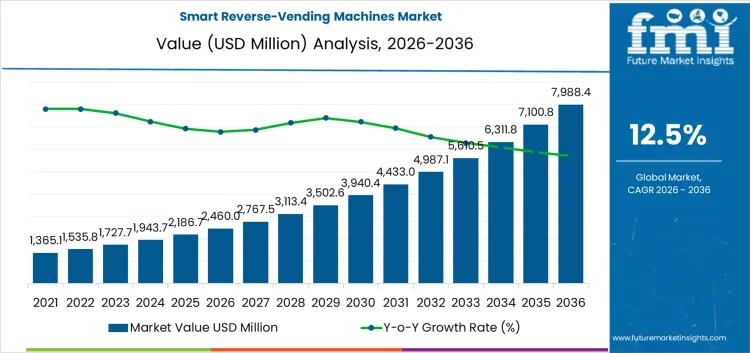
The smart reverse-vending machines market is forecast to advance at a 12.5% CAGR, rising from USD 2,460 million in 2026 to USD 7,988.4 million by 2036. Procurement behavior in this space is being shaped by institutional risk management rather than short-term cost optimization. Purchasing decisions are increasingly anchored to proven compliance with deposit-return regulations, system accuracy, and long-term service reliability. Preference is being given to suppliers with established deployment records, as operational failure carries regulatory and reputational exposure for retailers and municipalities.
Vendor lock-in is reinforced through proprietary software platforms, backend clearing integrations, and data continuity requirements that raise switching costs after installation. Evaluation cycles are therefore extended, with emphasis placed on lifecycle economics, upgrade pathways, and service-level guarantees. Capital allocation is commonly approved only after technical validation and reference benchmarking across comparable jurisdictions. Over the forecast period, value capture is expected to concentrate among suppliers able to reduce buyer uncertainty through standardized platforms, predictable maintenance models, and contractual stability that aligns with multi-year recycling infrastructure programs.
Quick Stats for Smart Reverse-Vending Machines Market
- Smart Reverse-Vending Machines Market Value (2026): USD 2,460 Million
- Smart Reverse-Vending Machines Market Forecast Value (2036): USD 7,988.4 Million
- Smart Reverse-Vending Machines Market Forecast CAGR 2026 to 2036: 12.5%
- Leading Machine Type in Smart Reverse-Vending Machines Market: AI-Enabled RVMs (48% share)
- Key Growth Regions in Smart Reverse-Vending Machines Market: Europe, Asia Pacific, North America, Latin America, Middle East & Africa
- Top Key Players in Smart Reverse-Vending Machines Market: TOMRA Systems ASA, Envipco Holding N.V., Recycling Robotics, Inc., Incom Recycle Co., Ltd., Suzhou Huilong Electric Co., Ltd., Panasonic Holdings Corporation, Fuji Electric Co., Ltd.
Smart Reverse-Vending Machines Market Key Takeaways
| Metric | Value |
|---|---|
| Smart Reverse-Vending Machines Market Value (2026) | USD 2,460 Million |
| Smart Reverse-Vending Machines Market Forecast Value (2036) | USD 7,988.4 Million |
| Smart Reverse-Vending Machines Market Forecast CAGR 2026 to 2036 | 12.5% |
How are Deposit-Return Systems and Digital Waste Infrastructure Driving the Smart Reverse-Vending Machines Market?
Growth in the smart reverse-vending machines market is being driven by the expansion and modernization of deposit-return systems across developed and emerging economies. Governments and municipalities are tightening collection targets for beverage containers, creating demand for automated solutions that improve return rates while reducing manual handling costs. For RVM manufacturers, this is translating into large, multi-year procurement programs where system reliability, throughput capacity, and fraud prevention capabilities are critical evaluation criteria.
Technology differentiation is becoming central to supplier competitiveness. Retailers and recycling operators increasingly favor smart RVMs equipped with AI-based material recognition, real-time data connectivity, and cloud-enabled reporting. These features support accurate material sorting, enable dynamic incentive management, and integrate machines into broader waste-management and recycling analytics platforms. Suppliers offering modular designs that support upgrades, multiple container types, and remote monitoring are gaining stronger adoption across retail and public-space deployments.
Commercial viability is also being shaped by operating cost efficiency and service models. Buyers are assessing machines based on maintenance requirements, uptime performance, and total cost of ownership rather than upfront price alone. As deployment scales in supermarkets, transit hubs, and urban centers, service contracts, software subscriptions, and data services are emerging as recurring revenue streams for suppliers. For manufacturers and ecosystem partners, long-term success in the smart reverse-vending machines market increasingly depends on system scalability, digital integration, and the ability to support evolving regulatory and recycling infrastructure requirements.
How Is the Smart Reverse-Vending Machines Market Structured Across Key Segments?
The smart reverse-vending machines market is segmented by end use and machine type, reflecting how collection intensity, automation needs, and deployment scale shape equipment demand. By end use, deposit-return schemes represent the leading segment, driven by structured collection frameworks that require reliable, high-throughput return infrastructure. Other end uses include retail collection points, urban collection programs, high-efficiency collection hubs, pilot DRS projects, and retail pilot installations that support phased rollouts. By machine type, AI-enabled RVMs form the dominant category, while retail-integrated RVMs, smart kiosks, and compact RVMs address space constraints, user engagement, and location-specific deployment requirements.
Why Do Deposit-Return Schemes Lead End-Use Demand in the Smart Reverse-Vending Machines Market?
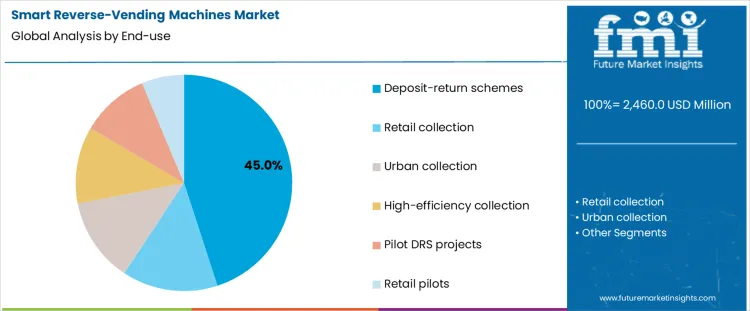
Deposit-return schemes account for 45% share of the smart reverse-vending machines market because they rely on automated, traceable return systems to manage high container volumes. These schemes require machines capable of accurate item recognition, fraud prevention, and rapid transaction processing. Centralized programs favor standardized RVM deployments to ensure consistent user experience across regions. High return rates increase machine utilization, supporting demand for durable systems with minimal downtime. Operators prioritize equipment that integrates with backend clearing and reporting platforms. For manufacturers and solution providers, deposit-return schemes offer large-scale rollouts, repeat orders, and long service contracts, reinforcing their position as the largest end-use segment.
Why Do AI-Enabled RVMs Dominate The Smart Reverse-Vending Machines Market By Machine Type?

AI-enabled RVMs hold 48% share of the smart reverse-vending machines market because advanced recognition and data processing capabilities improve accuracy and operational efficiency. These machines use computer vision and machine learning to identify containers, detect contamination, and reduce manual intervention. Retailers and program operators prefer AI-enabled systems to handle mixed input streams and variable packaging formats. Faster processing speeds support higher throughput in busy locations. Embedded analytics provide insights into usage patterns and maintenance needs. For suppliers, AI-enabled RVMs enable software upgrades, remote diagnostics, and recurring revenue models, explaining their dominance among machine configurations.
What Are The Key Dynamics Of The Smart Reverse-Vending Machines Market?
The smart reverse-vending machines (RVM) market is driven by increasing deployment of automated collection systems that accept used bottles, cans, and containers in return for incentives, credits, or loyalty points. Retailers, waste managers, and municipalities are procuring RVMs to streamline recycling streams, improve material recovery rates, and reduce manual handling costs. For OEMs and systems integrators, ease of integration with POS/loyalty systems, accuracy of material identification, durability in high-throughput environments, and remote fleet monitoring capabilities are critical factors that influence buyer decisions and aftermarket service agreements.
How Are Technology And Connectivity Trends Shaping This Market?
Technology and connectivity trends are shaping the smart reverse-vending machines market through integration of AI-powered recognition, IoT connectivity, and real-time data analytics. Advanced sensors and image recognition engines enable automated sorting by material type, shape, and size, increasing accuracy and reducing false accepts/rejects. IoT modules transmit machine health, fill-level, and user interaction data to cloud dashboards for remote monitoring, predictive maintenance, and route optimization. Integration with mobile apps and digital wallets allows consumers to redeem incentives instantly, enhancing user engagement. For suppliers, offering robust APIs and software support services increases stickiness with retail chains and recycling partners.
Why Do Operational, Regulatory, And Cost Barriers Restrain Market Adoption?
Operational, regulatory, and cost barriers restrain the smart reverse-vending machines market by increasing complexity for buyers and operators. High upfront cost of automated RVM hardware, installation, and commissioning can deter small retailers or community programs with limited budgets. Regulatory variability across regions such as differing container deposit return schemes (DRS) and material acceptance rules requires machine configuration customization and ongoing software updates, raising support costs. Operational challenges such as vandalism protection, space allocation in high-traffic areas, and maintenance logistics can impact uptime and user satisfaction. These constraints require suppliers to offer flexible financing, robust service networks, and clear compliance roadmaps.
What Is the Country-Wise Outlook for the Smart Reverse-Vending Machines Market?
The smart reverse-vending machines (RVMs) market is shaped by deposit-return schemes, extended producer responsibility mandates, and the digitization of waste collection. Adoption varies by country based on regulatory enforcement, consumer participation models, and integration with retail and municipal systems. Mature markets emphasize upgrades, analytics, and fraud prevention, while emerging economies prioritize rapid network expansion and incentive-led collection. Growth is supported by AI-based material recognition, cashless rewards, and cloud connectivity. Suppliers combining reliable hardware, intelligent software, and scalable service models are best positioned across countries.
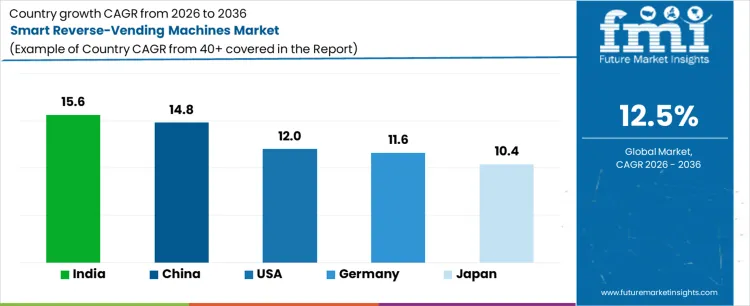
| Country | CAGR (%) |
|---|---|
| India | 15.6% |
| China | 14.8% |
| United States | 12.0% |
| Germany | 11.6% |
| Japan | 10.4% |
How is Germany Optimizing Smart Reverse-Vending Machines within a Mature Deposit System?
The smart reverse-vending machines market in Germany, growing at a CAGR of 11.6% during 2026-2036, is shaped by one of the world’s most established deposit-return frameworks. Adoption is primarily upgrade-led, as retailers replace legacy RVMs with smart systems offering higher recognition accuracy, faster throughput, and advanced fraud prevention. Operators prioritize uptime, compact footprints, and seamless integration with national clearing and refund platforms. Buyers emphasize AI-based material recognition, predictive maintenance, and real-time data reporting to reduce store congestion and operating costs. Procurement processes are highly specification-driven, favoring suppliers with proven compliance, strong service networks, and long lifecycle support. Volumes are stable, but value per installation remains high due to software depth and service requirements. Germany rewards suppliers that combine hardware reliability with analytics, remote diagnostics, and energy efficiency
What is Driving Accelerated Deployment of Smart RVMs across the United States?
Demand for smart reverse-vending machines market in the United States, expanding at a CAGR of 12.0% during 2026-2036, is driven by expanding state-level deposit programs and retailer-led sustainability initiatives. Adoption spans supermarkets, convenience stores, public venues, and campuses. Buyers prioritize flexibility to handle multiple container types, cashless incentives, and integration with retailer loyalty and mobile payment platforms. Unlike Europe, deployment models vary widely by state, making modularity and configurability critical procurement criteria. Operators emphasize scalability, rapid installation, and analytics that improve collection efficiency and reduce shrinkage. Software features such as cloud connectivity, reporting dashboards, and fraud detection increasingly influence purchasing decisions. Volumes are growing steadily as more states adopt or expand deposit legislation. The US represents a value-driven market where ROI, software functionality, and nationwide service coverage matter more than lowest hardware cost.
Why Is China Emerging as a Major Volume-Led Growth Engine for Smart RVMs?
Sale of smart reverse-vending machines market in China, growing at a CAGR of 14.8% during 2026-2036, reflects rapid urban deployment and government-backed recycling pilots. Municipalities, property developers, and brands deploy RVMs in transit hubs, residential communities, campuses, and shopping centers. Buyers focus on high throughput, cost efficiency, and localized software capable of supporting QR-code rewards and digital wallets. Domestic suppliers dominate volume segments through aggressive pricing and fast rollout capability. Advanced AI recognition and data integration are increasingly required in high-traffic locations. Procurement decisions are influenced by capital cost, deployment speed, and local service availability. Adoption is largely Greenfield, with networks expanding quickly across major cities. China represents a scale-driven market where supplier success depends on manufacturing capacity, localization, and ability to support rapid deployment.
How Does Japan Apply Precision and Reliability Standards to Smart RVM Adoption?
The smart reverse-vending machines market in Japan, expanding at a CAGR of 10.4% during the forecast period, is shaped by a precision-first adoption philosophy. Operators emphasize compact design, low noise, energy efficiency, and exceptionally high recognition accuracy. Deployment is incremental, with long validation cycles and strong preference for proven reliability. Buyers prioritize system stability, long equipment lifecycles, and minimal maintenance disruption in dense retail environments. Procurement favors suppliers with strong documentation, local service teams, and established track records. Volumes remain moderate, but specification rigor supports premium pricing. Japan rewards technology providers that align with operational discipline, consistency, and continuous improvement rather than rapid expansion. The market suits suppliers focused on engineering excellence, software stability, and long-term operational performance.
Why Is India the Fastest-Growing Market for Smart Reverse-Vending Machines?
Demand for smart reverse-vending machines market in India, growing at a CAGR of 15.6% during 2026-2036, is driven by rapid urbanization, smart city initiatives, and incentive-based recycling pilots. Deployments are largely GREENFIELD across malls, metro stations, airports, educational campuses, and corporate parks. Buyers emphasize affordability, modularity, and ease of maintenance. Adoption often begins with PET bottles and cans, with scope expanding as programs mature. Procurement decisions are cost-sensitive but increasingly influenced by service support, uptime, and data reporting. Financing models, revenue-sharing, and public-private partnerships play a significant role. India represents a high-growth, early-stage market where suppliers offering adaptable platforms, local manufacturing, and on-ground service can secure long-term positioning as deposit and incentive systems scale nationally.
How are Companies Competing in the Smart Reverse-Vending Machines Market?
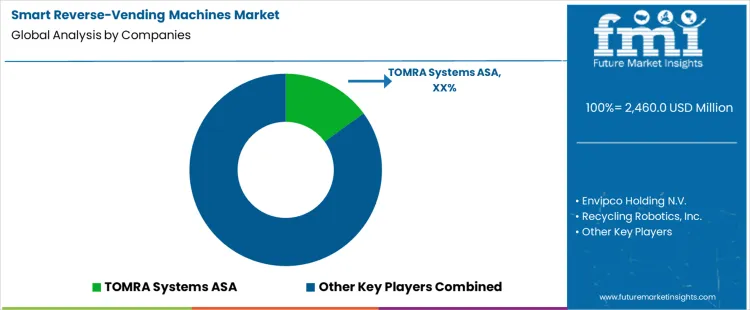
Competition in the smart reverse-vending machines (RVMs) market is defined by system intelligence, compliance with container deposit schemes, and documented performance in automation and user experience as presented in official product materials. TOMRA Systems ASA positions its RVM portfolio around advanced sensor technology and high-throughput acceptance. Brochures emphasize machine accuracy for diverse container types, cloud-based analytics, and seamless integration with deposit return systems (DRS). Its product documentation highlights robust build quality and scalable fleet management tools for retailers and municipalities.
Envipco Holding N.V. competes through modular smart RVM solutions with official literature focusing on ease of serviceability and adaptability to varied return locations from supermarkets to transit hubs. Product sheets underline ergonomic deposit interfaces and flexible payment options backed by compliance with global recycling regulations. Recycling Robotics, Inc. differentiates via automated robotic sorting integration, with brochures highlighting AI-enabled recognition and handling of containers that reduce manual intervention.
Regional and volume producers strengthen competitive breadth. Incom Recycle Co., Ltd. and Suzhou Huilong Electric Co., Ltd. offer cost-effective RVM units documented for reliable acceptance rates and simplified maintenance, supported by product guides tailored to local recycling infrastructures. Panasonic Holdings Corporation and Fuji Electric Co., Ltd. leverage established electronics platforms with brochures emphasizing energy-efficient drives, intuitive user displays, and integration with loyalty or digital wallet systems. Across all suppliers, differentiation is driven by verified container recognition accuracy, intelligent transaction handling, and documented integration with recycling ecosystems rather than unit price alone.
Key Players in Smart Reverse-Vending Machines Market
- TOMRA Systems ASA
- Envipco Holding N.V.
- Recycling Robotics, Inc.
- Incom Recycle Co., Ltd.
- Suzhou Huilong Electric Co., Ltd.
- Panasonic Holdings Corporation
- Fuji Electric Co., Ltd.
Scope of Report
| Attribute | Description |
|---|---|
| Quantitative Unit | USD Million |
| End-use | Deposit-Return Schemes, Retail Collection, Urban Collection, High-Efficiency Collection, Pilot DRS Projects, Retail Pilots |
| Machine Type | AI-Enabled RVMs, Retail-Integrated RVMs, Smart Kiosks, Compact RVMs |
| Countries Covered | China, Japan, South Korea, India, Australia & New Zealand, ASEAN, Rest of Asia Pacific, Germany, United Kingdom, France, Italy, Spain, Nordic, BENELUX, Rest of Europe, United States, Canada, Mexico, Brazil, Chile, Rest of Latin America, Kingdom of Saudi Arabia, Other GCC Countries, Turkey, South Africa, Other African Union, Rest of Middle East & Africa |
| Regions Covered | Asia Pacific, Europe, North America, Latin America, Middle East & Africa |
| Key Companies Profiled | TOMRA Systems ASA, Envipco Holding N.V., Recycling Robotics, Inc., Incom Recycle Co., Ltd., Suzhou Huilong Electric Co., Ltd., Panasonic Holdings Corporation, Fuji Electric Co., Ltd. |
| Additional Attributes | Dollar sales by end-use and machine type are evaluated across automated recycling and deposit-return infrastructure. The report includes country-level demand assessment, growth projections for 2026-2036, analysis of AI recognition accuracy and throughput efficiency, evaluation of retail integration and smart payment features, competitive benchmarking of manufacturers, and assessment of policy-driven adoption trends across urban waste management systems. |
Smart Reverse-Vending Machines Market by Key Segments
End-use
- Deposit-return schemes
- Retail collection
- Urban collection
- High-efficiency collection
- Pilot DRS projects
- Retail pilots
Machine Type
- AI-enabled RVMs
- Retail-integrated RVMs
- Smart kiosks
- Compact RVMs
Region:
- Asia Pacific
- China
- Japan
- South Korea
- India
- Australia & New Zealand
- ASEAN
- Rest of Asia Pacific
- Europe
- Germany
- United Kingdom
- France
- Italy
- Spain
- Nordic
- BENELUX
- Rest of Europe
- North America
- United States
- Canada
- Mexico
- Latin America
- Brazil
- Chile
- Rest of Latin America
- Middle East & Africa
- Kingdom of Saudi Arabia
- Other GCC Countries
- Turkey
- South Africa
- Other African Union
- Rest of Middle East & Africa
Bibliography
- United Nations Environment Programme. (2024). Global Waste Management Outlook: Circularity and Reverse Logistics Systems.
- International Energy Agency. (2024). Digital Technologies and AI in Waste Sorting and Recycling Infrastructure.
- European Commission. (2024). Deposit Return Systems in the EU: Implementation Status and Policy Guidance.
Frequently Asked Questions
How big is the smart reverse-vending machines market in 2026?
The global smart reverse-vending machines market is estimated to be valued at USD 2,460.0 million in 2026.
What will be the size of smart reverse-vending machines market in 2036?
The market size for the smart reverse-vending machines market is projected to reach USD 7,988.4 million by 2036.
How much will be the smart reverse-vending machines market growth between 2026 and 2036?
The smart reverse-vending machines market is expected to grow at a 12.5% CAGR between 2026 and 2036.
What are the key product types in the smart reverse-vending machines market?
The key product types in smart reverse-vending machines market are deposit-return schemes, retail collection, urban collection, high-efficiency collection, pilot drs projects and retail pilots.
Which machine type segment to contribute significant share in the smart reverse-vending machines market in 2026?
In terms of machine type, ai-enabled rvms segment to command 48.0% share in the smart reverse-vending machines market in 2026.
Preview the report firsthand - request a free sample
Get SampleGet the brochure for pricing and purchase details.
Get PDFTable of Content
- Executive Summary
- Global Market Outlook
- Demand-side Trends
- Supply-side Trends
- Technology Roadmap Analysis
- Analysis and Recommendations
- Market Overview
- Market Coverage / Taxonomy
- Market Definition / Scope / Limitations
- Market Background
- Market Dynamics
- Drivers
- Restraints
- Opportunity
- Trends
- Scenario Forecast
- Demand in Optimistic Scenario
- Demand in Likely Scenario
- Demand in Conservative Scenario
- Opportunity Map Analysis
- Product Life Cycle Analysis
- Supply Chain Analysis
- Investment Feasibility Matrix
- Value Chain Analysis
- PESTLE and Porter’s Analysis
- Regulatory Landscape
- Regional Parent Market Outlook
- Production and Consumption Statistics
- Import and Export Statistics
- Market Dynamics
- Global Market Analysis 2021 to 2025 and Forecast, 2026 to 2036
- Historical Market Size Value (USD Million) Analysis, 2021 to 2025
- Current and Future Market Size Value (USD Million) Projections, 2026 to 2036
- Y-o-Y Growth Trend Analysis
- Absolute $ Opportunity Analysis
- Global Market Pricing Analysis 2021 to 2025 and Forecast 2026 to 2036
- Global Market Analysis 2021 to 2025 and Forecast 2026 to 2036, By End-use
- Introduction / Key Findings
- Historical Market Size Value (USD Million) Analysis By End-use , 2021 to 2025
- Current and Future Market Size Value (USD Million) Analysis and Forecast By End-use , 2026 to 2036
- Deposit-return schemes
- Retail collection
- Urban collection
- High-efficiency collection
- Pilot DRS projects
- Retail pilots
- Deposit-return schemes
- Y-o-Y Growth Trend Analysis By End-use , 2021 to 2025
- Absolute $ Opportunity Analysis By End-use , 2026 to 2036
- Global Market Analysis 2021 to 2025 and Forecast 2026 to 2036, By Machine Type
- Introduction / Key Findings
- Historical Market Size Value (USD Million) Analysis By Machine Type, 2021 to 2025
- Current and Future Market Size Value (USD Million) Analysis and Forecast By Machine Type, 2026 to 2036
- AI-enabled RVMs
- Retail-integrated RVMs
- Smart kiosks
- Compact RVMs
- AI-enabled RVMs
- Y-o-Y Growth Trend Analysis By Machine Type, 2021 to 2025
- Absolute $ Opportunity Analysis By Machine Type, 2026 to 2036
- Global Market Analysis 2021 to 2025 and Forecast 2026 to 2036, By Region
- Introduction
- Historical Market Size Value (USD Million) Analysis By Region, 2021 to 2025
- Current Market Size Value (USD Million) Analysis and Forecast By Region, 2026 to 2036
- North America
- Latin America
- Western Europe
- Eastern Europe
- East Asia
- South Asia and Pacific
- Middle East & Africa
- Market Attractiveness Analysis By Region
- North America Market Analysis 2021 to 2025 and Forecast 2026 to 2036, By Country
- Historical Market Size Value (USD Million) Trend Analysis By Market Taxonomy, 2021 to 2025
- Market Size Value (USD Million) Forecast By Market Taxonomy, 2026 to 2036
- By Country
- USA
- Canada
- Mexico
- By End-use
- By Machine Type
- By Country
- Market Attractiveness Analysis
- By Country
- By End-use
- By Machine Type
- Key Takeaways
- Latin America Market Analysis 2021 to 2025 and Forecast 2026 to 2036, By Country
- Historical Market Size Value (USD Million) Trend Analysis By Market Taxonomy, 2021 to 2025
- Market Size Value (USD Million) Forecast By Market Taxonomy, 2026 to 2036
- By Country
- Brazil
- Chile
- Rest of Latin America
- By End-use
- By Machine Type
- By Country
- Market Attractiveness Analysis
- By Country
- By End-use
- By Machine Type
- Key Takeaways
- Western Europe Market Analysis 2021 to 2025 and Forecast 2026 to 2036, By Country
- Historical Market Size Value (USD Million) Trend Analysis By Market Taxonomy, 2021 to 2025
- Market Size Value (USD Million) Forecast By Market Taxonomy, 2026 to 2036
- By Country
- Germany
- UK
- Italy
- Spain
- France
- Nordic
- BENELUX
- Rest of Western Europe
- By End-use
- By Machine Type
- By Country
- Market Attractiveness Analysis
- By Country
- By End-use
- By Machine Type
- Key Takeaways
- Eastern Europe Market Analysis 2021 to 2025 and Forecast 2026 to 2036, By Country
- Historical Market Size Value (USD Million) Trend Analysis By Market Taxonomy, 2021 to 2025
- Market Size Value (USD Million) Forecast By Market Taxonomy, 2026 to 2036
- By Country
- Russia
- Poland
- Hungary
- Balkan & Baltic
- Rest of Eastern Europe
- By End-use
- By Machine Type
- By Country
- Market Attractiveness Analysis
- By Country
- By End-use
- By Machine Type
- Key Takeaways
- East Asia Market Analysis 2021 to 2025 and Forecast 2026 to 2036, By Country
- Historical Market Size Value (USD Million) Trend Analysis By Market Taxonomy, 2021 to 2025
- Market Size Value (USD Million) Forecast By Market Taxonomy, 2026 to 2036
- By Country
- China
- Japan
- South Korea
- By End-use
- By Machine Type
- By Country
- Market Attractiveness Analysis
- By Country
- By End-use
- By Machine Type
- Key Takeaways
- South Asia and Pacific Market Analysis 2021 to 2025 and Forecast 2026 to 2036, By Country
- Historical Market Size Value (USD Million) Trend Analysis By Market Taxonomy, 2021 to 2025
- Market Size Value (USD Million) Forecast By Market Taxonomy, 2026 to 2036
- By Country
- India
- ASEAN
- Australia & New Zealand
- Rest of South Asia and Pacific
- By End-use
- By Machine Type
- By Country
- Market Attractiveness Analysis
- By Country
- By End-use
- By Machine Type
- Key Takeaways
- Middle East & Africa Market Analysis 2021 to 2025 and Forecast 2026 to 2036, By Country
- Historical Market Size Value (USD Million) Trend Analysis By Market Taxonomy, 2021 to 2025
- Market Size Value (USD Million) Forecast By Market Taxonomy, 2026 to 2036
- By Country
- Kingdom of Saudi Arabia
- Other GCC Countries
- Turkiye
- South Africa
- Other African Union
- Rest of Middle East & Africa
- By End-use
- By Machine Type
- By Country
- Market Attractiveness Analysis
- By Country
- By End-use
- By Machine Type
- Key Takeaways
- Key Countries Market Analysis
- USA
- Pricing Analysis
- Market Share Analysis, 2025
- By End-use
- By Machine Type
- Canada
- Pricing Analysis
- Market Share Analysis, 2025
- By End-use
- By Machine Type
- Mexico
- Pricing Analysis
- Market Share Analysis, 2025
- By End-use
- By Machine Type
- Brazil
- Pricing Analysis
- Market Share Analysis, 2025
- By End-use
- By Machine Type
- Chile
- Pricing Analysis
- Market Share Analysis, 2025
- By End-use
- By Machine Type
- Germany
- Pricing Analysis
- Market Share Analysis, 2025
- By End-use
- By Machine Type
- UK
- Pricing Analysis
- Market Share Analysis, 2025
- By End-use
- By Machine Type
- Italy
- Pricing Analysis
- Market Share Analysis, 2025
- By End-use
- By Machine Type
- Spain
- Pricing Analysis
- Market Share Analysis, 2025
- By End-use
- By Machine Type
- France
- Pricing Analysis
- Market Share Analysis, 2025
- By End-use
- By Machine Type
- India
- Pricing Analysis
- Market Share Analysis, 2025
- By End-use
- By Machine Type
- ASEAN
- Pricing Analysis
- Market Share Analysis, 2025
- By End-use
- By Machine Type
- Australia & New Zealand
- Pricing Analysis
- Market Share Analysis, 2025
- By End-use
- By Machine Type
- China
- Pricing Analysis
- Market Share Analysis, 2025
- By End-use
- By Machine Type
- Japan
- Pricing Analysis
- Market Share Analysis, 2025
- By End-use
- By Machine Type
- South Korea
- Pricing Analysis
- Market Share Analysis, 2025
- By End-use
- By Machine Type
- Russia
- Pricing Analysis
- Market Share Analysis, 2025
- By End-use
- By Machine Type
- Poland
- Pricing Analysis
- Market Share Analysis, 2025
- By End-use
- By Machine Type
- Hungary
- Pricing Analysis
- Market Share Analysis, 2025
- By End-use
- By Machine Type
- Kingdom of Saudi Arabia
- Pricing Analysis
- Market Share Analysis, 2025
- By End-use
- By Machine Type
- Turkiye
- Pricing Analysis
- Market Share Analysis, 2025
- By End-use
- By Machine Type
- South Africa
- Pricing Analysis
- Market Share Analysis, 2025
- By End-use
- By Machine Type
- USA
- Market Structure Analysis
- Competition Dashboard
- Competition Benchmarking
- Market Share Analysis of Top Players
- By Regional
- By End-use
- By Machine Type
- Competition Analysis
- Competition Deep Dive
- TOMRA Systems ASA
- Overview
- Product Portfolio
- Profitability by Market Segments (Product/Age /Sales Channel/Region)
- Sales Footprint
- Strategy Overview
- Marketing Strategy
- Product Strategy
- Channel Strategy
- Envipco Holding N.V.
- Recycling Robotics, Inc.
- Incom Recycle Co., Ltd.
- Suzhou Huilong Electric Co., Ltd.
- Panasonic Holdings Corporation
- Fuji Electric Co., Ltd.
- TOMRA Systems ASA
- Competition Deep Dive
- Assumptions & Acronyms Used
- Research Methodology


