

- Industry Size (2022)
- USD 61.8 Bn
- Forecast (2032)
- USD 130.5 Bn
- CAGR (2022 to 2032)
- 7.7%
Specialty Generics Market Outlook (2022-2032)
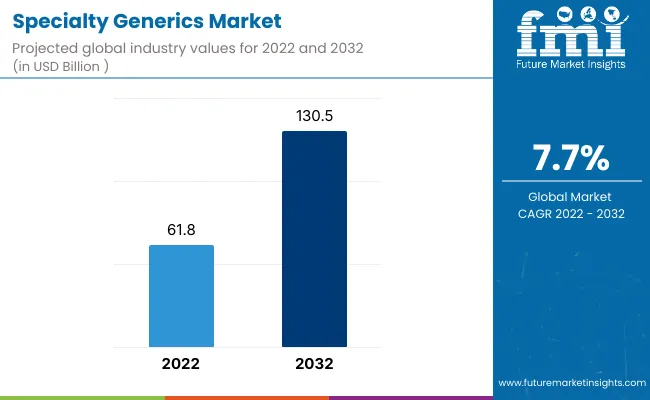
[250 Pages Report] The global specialty generics market is expected to enjoy a valuation of US$ 61.8 Bn by the end of 2022, and further expand at a CAGR rate of 7.7% to reach a valuation of ~US$ 130.5 Bn in 2032. According to a recent study, the injectable route of administration led the market with a share of about 48.4% in the year 2021, globally.
Specialty generics can be small compounds generated using conventional pharmaceutical production techniques or large, injectable, protein-based molecules produced by a biotechnology process. Specialty generics are widely used in treatments for diseases such as multiple sclerosis, cancer, pulmonary hypertension, haemophilia, and hepatitis C treating complex disorders.
With rising cancer cases across the globe, the need for specialty generics oral and injectable is expected to surge rapidly over the forecast period (2022-2032). According to the American Cancer Society, by 2040, the global burden of cancer is expected to grow nearly double, reaching 27.5 million new cancer cases from 17 million in 2018. To curb the global burden of such diseases, key players are introducing a variety of specialty generics.
For instance, in April 2022, a leading healthcare professional, Dr. Reddy’s Laboratories announced the launch of a methylprednisolone sodium succinate injection for the pateints with blood disorders, certain type of cancers, and arthritis in the U.S.
| Attributes | Key Insights |
| Specialty Generics Market Market Value 2021 | US$ 57.4 Bn |
| Market Value 2022 | US$ 61.8 Bn |
| Market Value 2032 | US$ 130.5 Bn |
| CAGR 2022-2032 | 7.7% |
| Market Share of Top 5 Countries | 61.7% |
Sales Analysis of Specialty Generics from 2017 to 2021 Vs Market Outlook for 2022 to 2032
As per Future Market Insights (FMI), the market value for specialty generics was approximately 14.2% of the overall ~US$ 404.7 Bn of global generics market in 2021. Sales of specialty generics surged at a CAGR of 7.3% from 2017 to 2021, owing to the rising prevalence of chronic and infectious diseases.
The demand for specialty generic medications is predicted to grow profitably as the number of off-patent specialty drugs rises. Preference for specialty generics is expected to surge as these drugs act on cancer treatment and central nervous system, and other therapeutic areas. Hence, biopharma businesses are switching their focus to complex generic drugs, which deliver more value by attending to new unmet needs. Further, the market is predicted to expand due to rise in incidence of neurological disorders, epilepsy, etc.
According to American Action Forum 2020, about 6 percent of children in the U.S. have more than one chronic ailment. While, about 27% of children in the country suffer from at least one chronic condition. Adults, on the other hand, experience at least one chronic ailment in 60% of cases, and multiple chronic conditions in 42% of cases.
Thus, owing to the aforementioned factors, the global specialty generics market is expected to grow at a CAGR rate value of 7.7% during the forecast period from 2022 to 2032. As per FMI, sales in the market are expected to increase by 2.1x, reaching US$ 130.5 Bn by 2032.
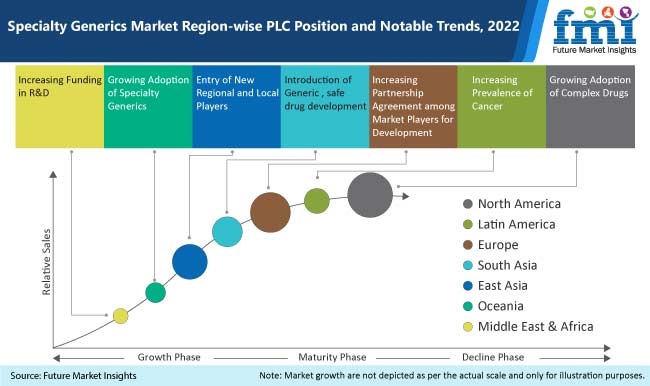
What are the Key Trends Propelling the Sales in the Market?
Asia Pacific to be a Hotspot for Sepcialty Generics Companies through 2022 & beyond
With development in healthcare infrastructure in India, China, and Japan, key players are eyeing the Asia Pacific specialty generics market to generate lucrative revenues. Growing patient pool, and affordable development and manufacturing, will draw international biopharmaceuticals to Asia with the emphasis on strengthening the R&D landscape, particularly for biologics.
In addition to the oversupply of simple generic products on the market, biopharma companies are focusing on developing complex generic medications that address additional unmet needs and provide greater value to patients.
As per the United Nations, in 2019, there were 703 million people worldwide who were 65 or older. In 2050, it is expected that there will be 1.5 billion people falling under the elderly age group. In the entire world, the percentage of people 65 and older rose from 6% in 1990 to 9% in 2019. By 2050, that percentage is expected to increase to 16%, meaning that one in six persons worldwide would be 65 or older. This is expected to provide lucrative opportunities for growth in the overall specialty generics market.
What are the Factors Restraining the Demand for Specialty Generics?
Regulatory requirements play a significant role in limiting the growth as the FDA Office of Generic Drugs (OGD) typically guides the endpoints and data necessary for the U.S. approval of simple generics as part of their clear development roadmap.
Set regulatory guidelines are not available for the process flow for the production of such differentiated generic formulations. This will increase uncertainty and risk in the planning and design process. In addition to this, according to the Global Health Journal, 2019, specialty medications are excessively expensive in the U.S.
Patients are at risk of not being able to pay for crucial and life-saving medications for complicated illnesses throughout a range of therapeutic classes, such as multiple sclerosis, cancer, inflammatory conditions, and Hepatitis C, due to high cost.
Even though only 2% of American prescriptions are for specialty medications, they accounted for roughly 45% of all drugs purchased in the country in 2018, and this is steadily increasing. The expected increase in U.S. pharmaceutical spending from US$ 485 billion in 2018 to around US$ 655 billion in 2023 due to rising expenditures for high-cost specialty and biologics.
Country-wise Insights
What Makes China a Highly Lucrative Market for Specialty Generics?
Development in China Pharmaceutical Industry to Push Demand in the Market
China held approximately 33.3% share in the East Asia market in 2021 and is projected to display growth at a CAGR of 4.5% during the forecast period. China is one of the largest pharmaceutical marketplaces in the world, this is expected to boost the market over the forecast period.
Owing to the rising prevalence of chronic illnesses and presence of regulatory approvals in the country, the demand for oral and injectable specialty generics. As per FMI, China is expected to spearhead the growth in East Asia market over the upcoming decade.
Why is the Demand for Specialty Generics Increasing in the U.S.?
Availability of Programs in Therapeutic Areas to Augment the Growth in the Market
The U.S. dominated the North America specialty generics market with a share of about 92.0% in 2021. Growth in the market is expected to continue to witness same growth over the forecast period. The U.S. is considered to be one of the largest pharmaceutical sectors, which is fueling the growth in specialty generics market.
Also, rising incidence of fatal diseases, including cancer and HIV, is driving the specialty generics market in the U.S. Additionally, increasing research and development in therapeutic areas will boost specialty generics market.
Furthermore, the U.S. Food and Drug Administration (FDA) successful programmes, such as Breakthrough Therapy, which attempts to increase and streamline patients' access to these medications, is one of the key industry trends driving the growth of the specialty generics market.
What is the Demand Outlook for Germany Specialty Generics Market?
Rising Prevalence of Chronic Illnessses to Increase the Sales in Germany Market
Germany is set to exhibit a CAGR growth at 5.6% CAGR in the Europe specialty generics market during the forecast period. Emergence of new therapeutic alternatives is raising patient survival rates for numerous chronic illnesses, including cancer, multiple sclerosis, rheumatoid arthritis, and HIV/AIDS.
This is pushing for pharmaceutical patent amendments to prevent expiry, improving the demand in the market. Due to these advances in the medical industry, demand for specialty generics market is increasing, boosting the market in Germany.
Category-wise Insights
Which is the Most Preferred Route of Administration in Specialty Generics Market?
Nearly 2/5th of Sales are Concentrated in Oncology Segment through 2022 & beyond
The injectable route of administration is expected to present high growth at a CAGR of 8.2% during the forecast period, with a share of about 48.4% in 2021. This is owing to its property of instant dosage distribution in the body, prolonged effect, and rapid absorption.
In terms of application, the oncology segment held a revenue share of around 38.4% in 2021. Sales in the oncology segment are expected to surge at a CAGR of 8.0% over the assessment period. According to the National Cancer Institute, 2020, cancer is the leading cause of death worldwide. By 2040, the rate of cancer cases will project to 29.5 million with cases of mortality up to 16.4 million.
Which is the Leading Distribution Channel in the Specialty Generics Market?
Hospital Pharmacies to Account for Half of the Sales in the Market
Hospital pharmacies held the highest market share value for specialty generics, holding around 48.2% share in 2021. Growing prevalence of chronic and infectious diseases, as well as the increasing treatment rate and dispensing of prescription medicines, have driven the demand in the segment, propelling sales in specialty generics market.
Competitive Landscape
With the presence of established players in the specialty generics market, the overall market is highly consolidated. To meet the growing demand and expand their customer base, these companies are implementing methods such as mergers and acquisitions, partnerships and collaborations, and new product launches.
Instances of key developmental strategies by the industry players in the specialty generics market are given below:
- In October 2020, Teva introduced ATRIPLA (efavirenz 600 mg/emtricitabine 200 mg/tenofovir disoproxil fumarate 300 mg) and Emtricitabine 200 mg/tenofovir disoproxil fumarate 300 mg tablets, the first generic versions of these HIV-1 treatments in the U.S.
- In May 2019, Mallinckrodt revised its plans for spinning off its Specialty Generics/Active Pharmaceutical Ingredients (Specialty Generics) division as a new company to shareholders of Mallinckrodt plc. One company will be focused on cutting-edge specialty branded pharmaceuticals, while the other will be primarily focused on manufacturing specialty generic products and APIs.
Report Scope as per Specialty Generics Industry Analysis
|
Attribute |
Details |
|
Market Value 2022 |
US$ 61.8 Bn |
|
Market Value 2032 |
US$ 130.5 Bn |
|
CAGR 2022-2032 |
7.7% |
|
Forecast Period |
2017-2021 |
|
Historical Data Available for |
2022-2032 |
|
Market Analysis |
US$ Mn for Value |
|
Key Regions Covered |
North America, Latin America, Europe, South Asia, East Asia, Oceania, and Middle East & Africa |
|
Key Countries Covered |
U.S., Canada, Brazil, Mexico, Argentina, U.K., Germany, Italy, Russia, Spain, France, BENELUX, Rest of Europe, India, Thailand, Indonesia, Malaysia, Japan, China, South Korea, Australia, New Zealand, Turkey, GCC, North Africa, and South Africa |
|
Key Market Segments Covered |
Route of Administration, Application, Distribution Channel, and Region |
|
Key Companies Profiled |
|
Key Market Segments Covered in Specialty Generics Industry Research
By Route of Administration:
- Injectable
- Oral
- Others
By Application:
- Oncology
- Autoimmune Diseases
- Infectious Diseases
- Others
By Distribution Channel:
- Hospital Pharmacies
- Retail Pharmacies
- Online Pharmacies
By Region:
- North America
- Latin America
- Europe
- South Asia
- East Asia
- Oceania
- Middle East and Africa (MEA)
Frequently Asked Questions
How much is the specialty generics market currently worth?
The global specialty generics market was worth US$ 57.4 Bn in 2021 and is set to expand 2.1X over the next ten years.
What is the sales forecast for specialty generics through 2032?
The specialty generics market is expected to reach US$ 130.5 Bn by end of 2032 at a CAGR of 7.7%.
What are the trends driving the demand outlook of the global specialty generics market?
The growing burden of chronic and infectious disease, rising awareness regarding high-level therapeutics and sustainable production methods, and the adoption of complex generics, are some of the key trends in this market.
Which region has the highest market share in the global specialty generics market?
North America has the highest market share of about 36.7% by value in 2021 in the global specialty generics market.
How likely is the specialty generics market to grow in India?
India accounts for about 45.8% of the market share in 2021 in the South Asia specialty generics market and is projected to grow with a CAGR of 4.9% in the forecast period.
Which are the top five countries driving demand for the specialty generics market?
India, the U.S., China, the U.K, and Germany are the top five countries, which are expected to drive demand in the specialty generics market.
Who are the key manufacturers in the specialty generics market?
Teva Pharmaceuticals Industries, Akorn, Inc., Mylan N.V., Mallinckrodt, Sandoz International GmbH, Pfizer, Inc., Sun Pharmaceutical Industries Ltd., Valeant Pharmaceuticals, Apotex Corp., Endo International plc are some of the key players in the specialty generics industry.
What is the demand outlook for China specialty generics market?
China accounted for 33.3% market share by value in 2021 within the region of East Asia. The specialty generics market in China is expected to grow at a 4.5% CAGR value during the forecast period.
What is the outlook of Japan in the specialty generics market?
Japan displays a share of around 43.0% in 2021 within East Asia and is set to present a lucrative CAGR growth rate of 5.8% during the forecast period.
Preview the report firsthand - request a free sample
Get SampleGet the brochure for pricing and purchase details.
Get PDFTable of Content
1. Executive Summary
1.1. Global Market Outlook
1.2. Demand-Side Trends
1.3. Supply-Side Trends
1.4. Analysis and Recommendations
2. Market Overview
2.1. Market Coverage / Taxonomy
2.2. Market Definition / Scope / Limitations
2.3. Inclusions and Exclusions
3. Key Market Trends
3.1. Key Trends Impacting the Market
3.2. Product Innovation / Development Trends
4. Key Success Factors
4.1. Disease Epidemiology, Key Diseases
4.2. Product Adoption / Usage Analysis
4.3. Key Strategies Adopted by Manufacturers
4.4. PESTLE Analysis
4.5. Porter’s Analysis
4.6. Regulatory Scenario
5. Market Background
5.1. Macro-Economic Factors
5.1.1. Global GDP Growth Outlook
5.1.2. Global Healthcare GDP Growth Overview
5.1.3. Global Generics Market Overview
5.2. Forecast Factors - Relevance & Impact
5.2.1. New/Improved Product Launches
5.2.2. Prevalence of Chronic diseases
5.2.3. Adoption Rate Among Patients
5.2.4. Product Penetration across Regions
5.2.5. Advancement in Technology
5.2.6. Cost of products
5.3. Market Dynamics
5.3.1. Drivers
5.3.2. Restraints
5.3.3. Opportunity Analysis
6. COVID-19 Crisis – Impact Assessment
6.1. Current COVID-19 Statistics and Probable Future Impact
6.1.1. by Route of Administration
6.1.2. by Application
6.1.3. by Distribution Channel
6.1.4. by Region
6.2. 2021 Market Scenario
7. Global Specialty Generics Market Demand (in Value or Size in US$ Bn) Analysis 2017-2021 and Forecast, 2022–2032
7.1. Historical Market Value (US$ Bn) Analysis, 2017-2021
7.2. Current and Future Market Value (US$ Bn) Projections, 2022–2032
7.2.1. Y-o-Y Growth Trend Analysis
7.2.2. Absolute $ Opportunity Analysis
8. Global Specialty Generics Market Analysis 2017-2021 and Forecast 2022–2032, by Route of Administration
8.1. Introduction / Key Findings
8.2. Historical Market Size (US$ Bn) Analysis by Route of Administration, 2017-2021
8.3. Current and Future Market Size (US$ Bn) Analysis and Forecast by Route of Administration, 2022–2032
8.3.1. Injectable
8.3.2. Oral
8.3.3. Others
8.4. Market Attractiveness Analysis by Route of Administration
9. Global Specialty Generics Market Analysis 2017-2021 and Forecast 2022–2032, by Application
9.1. Introduction / Key Findings
9.2. Historical Market Size (US$ Bn) by Application, 2017-2021
9.3. Current and Future Market Size (US$ Bn) Forecast by Application, 2022–2032
9.3.1. Oncology
9.3.2. Autoimmune Diseases
9.3.3. Infectious Diseases
9.3.4. Others
9.4. Market Attractiveness Analysis by Application
10. Global Specialty Generics Market Analysis 2017-2021 and Forecast 2022–2032, by Distribution Channel
10.1. Introduction / Key Findings
10.2. Historical Market Size (US$ Bn) by Distribution Channel, 2017-2021
10.3. Current and Future Market Size (US$ Bn) Forecast by Distribution Channel, 2022–2032
10.3.1. Hospital Pharmacies
10.3.2. Retail Pharmacies
10.3.3. Online Pharmacies
10.4. Market Attractiveness Analysis by Distribution Channel
11. Global Specialty Generics Market Analysis 2017-2021 and Forecast 2022–2032, by Region
11.1. Introduction
11.2. Historical Market Size (US$ Bn) Analysis by Region, 2017-2021
11.3. Current and Future Market Size (US$ Bn) Analysis and Forecast by Region, 2022–2032
11.3.1. North America
11.3.2. Latin America
11.3.3. Europe
11.3.4. East Asia
11.3.5. South Asia
11.3.6. Oceania
11.3.7. Middle East and Africa (MEA)
11.4. Market Attractiveness Analysis by Region
12. North America Global Specialty Generics Market Analysis 2017-2021 and Forecast 2022–2032
12.1. Introduction
12.2. Market Trends
12.3. Historical Market Size (US$ Bn) Trend Analysis by Market Taxonomy, 2017-2021
12.4. Current and Future Market Size (US$ Bn) Forecast by Market Taxonomy, 2022–2032
12.4.1. by Country
12.4.1.1. U.S.
12.4.1.2. Canada
12.4.2. by Route of Administration
12.4.3. by Application
12.4.4. by Distribution Channel
12.5. Market Attractiveness Analysis
12.5.1. by Country
12.5.2. by Route of Administration
12.5.3. by Application
12.5.4. by Distribution Channel
12.6. Key Market Participants - Intensity Mapping
12.7. Drivers and Restraints - Impact Analysis
12.8. Country Level Analysis & Forecast
12.8.1. U.S. Global Specialty Generics Market Analysis
12.8.1.1. Introduction
12.8.1.2. Market Analysis and Forecast by Market Taxonomy
12.8.1.2.1. by Route of Administration
12.8.1.2.2. by Application
12.8.1.2.3. by Distribution Channel
12.8.2. Canada Global Specialty Generics Market Analysis
12.8.2.1. Introduction
12.8.2.2. Market Analysis and Forecast by Market Taxonomy
12.8.2.2.1. by Route of Administration
12.8.2.2.2. by Application
12.8.2.2.3. by Distribution Channel
13. Latin America Global Specialty Generics Market Analysis 2017-2021 and Forecast 2022–2032
13.1. Introduction
13.2. Market Trends
13.3. Historical Market Size (US$ Bn) Trend Analysis by Market Taxonomy, 2017-2021
13.4. Current and Future Market Size (US$ Bn) Forecast by Market Taxonomy, 2022–2032
13.4.1. by Country
13.4.1.1. Mexico
13.4.1.2. Brazil
13.4.1.3. Argentina
13.4.1.4. Rest of Latin America
13.4.2. by Route of Administration
13.4.3. by Application
13.4.4. by Distribution Channel
13.5. Market Attractiveness Analysis
13.5.1. by Country
13.5.2. by Route of Administration
13.5.3. by Application
13.5.4. by Distribution Channel
13.6. Key Market Participants - Intensity Mapping
13.7. Drivers and Restraints - Impact Analysis
13.8. Country Level Analysis & Forecast
13.8.1. Mexico Global Specialty Generics Market Analysis
13.8.1.1. Introduction
13.8.1.2. Market Analysis and Forecast by Market Taxonomy
13.8.1.2.1. by Route of Administration
13.8.1.2.2. by Application
13.8.1.2.3. by Distribution Channel
13.8.2. Brazil Global Specialty Generics Market Analysis
13.8.2.1. Introduction
13.8.2.2. Market Analysis and Forecast by Market Taxonomy
13.8.2.2.1. by Route of Administration
13.8.2.2.2. by Application
13.8.2.2.3. by Distribution Channel
13.8.3. Argentina Global Specialty Generics Market Analysis
13.8.3.1. Introduction
13.8.3.2. Market Analysis and Forecast by Market Taxonomy
13.8.3.2.1. by Route of Administration
13.8.3.2.2. by Application
13.8.3.2.3. by Distribution Channel
14. Europe Global Specialty Generics Market Analysis 2017-2021 and Forecast 2022–2032
14.1. Introduction
14.2. Market Trends
14.3. Historical Market Size (US$ Bn) Trend Analysis by Market Taxonomy, 2017-2021
14.4. Current and Future Market Size (US$ Bn) Forecast by Market Taxonomy, 2022–2032
14.4.1. by Country
14.4.1.1. Germany
14.4.1.2. Italy
14.4.1.3. France
14.4.1.4. U.K.
14.4.1.5. Spain
14.4.1.6. BENELUX
14.4.1.7. Russia
14.4.1.8. Rest of Europe
14.4.2. by Route of Administration
14.4.3. by Application
14.4.4. by Distribution Channel
14.5. Market Attractiveness Analysis
14.5.1. by Country
14.5.2. by Route of Administration
14.5.3. by Application
14.5.4. by Distribution Channel
14.6. Key Market Participants - Intensity Mapping
14.7. Drivers and Restraints - Impact Analysis
14.8. Country Level Analysis & Forecast
14.8.1. Germany Global Specialty Generics Market Analysis
14.8.1.1. Introduction
14.8.1.2. Market Analysis and Forecast by Market Taxonomy
14.8.1.2.1. by Route of Administration
14.8.1.2.2. by Application
14.8.1.2.3. by Distribution Channel
14.8.2. Italy Global Specialty Generics Market Analysis
14.8.2.1. Introduction
14.8.2.2. Market Analysis and Forecast by Market Taxonomy
14.8.2.2.1. by Route of Administration
14.8.2.2.2. by Application
14.8.2.2.3. by Distribution Channel
14.8.3. France Global Specialty Generics Market Analysis
14.8.3.1. Introduction
14.8.3.2. Market Analysis and Forecast by Market Taxonomy
14.8.3.2.1. by Route of Administration
14.8.3.2.2. by Application
14.8.3.2.3. by Distribution Channel
14.8.4. U.K. Global Specialty Generics Market Analysis
14.8.4.1. Introduction
14.8.4.2. Market Analysis and Forecast by Market Taxonomy
14.8.4.2.1. by Route of Administration
14.8.4.2.2. by Application
14.8.4.2.3. by Distribution Channel
14.8.5. Spain Global Specialty Generics Market Analysis
14.8.5.1. Introduction
14.8.5.2. Market Analysis and Forecast by Market Taxonomy
14.8.5.2.1. by Route of Administration
14.8.5.2.2. by Application
14.8.5.2.3. by Distribution Channel
14.8.6. BENELUX Global Specialty Generics Market Analysis
14.8.6.1. Introduction
14.8.6.2. Market Analysis and Forecast by Market Taxonomy
14.8.6.2.1. by Route of Administration
14.8.6.2.2. by Application
14.8.6.2.3. by Distribution Channel
14.8.7. Russia Global Specialty Generics Market Analysis
14.8.7.1. Introduction
14.8.7.2. Market Analysis and Forecast by Market Taxonomy
14.8.7.2.1. by Route of Administration
14.8.7.2.2. by Application
14.8.7.2.3. by Distribution Channel
15. East Asia Global Specialty Generics Market Analysis 2017-2021 and Forecast 2022–2032
15.1. Introduction
15.2. Market Trends
15.3. Historical Market Size (US$ Bn) Trend Analysis by Market Taxonomy, 2017-2021
15.4. Current and Future Market Size (US$ Bn) Forecast by Market Taxonomy, 2022–2032
15.4.1. by Country
15.4.1.1. China
15.4.1.2. Japan
15.4.1.3. South Korea
15.4.2. by Route of Administration
15.4.3. by Application
15.4.4. by Distribution Channel
15.5. Market Attractiveness Analysis
15.5.1. by Country
15.5.2. by Route of Administration
15.5.3. by Application
15.5.4. by Distribution Channel
15.6. Key Market Participants - Intensity Mapping
15.7. Drivers and Restraints - Impact Analysis
15.8. Country Level Analysis & Forecast
15.8.1. China Global Specialty Generics Market Analysis
15.8.1.1. Introduction
15.8.1.2. Market Analysis and Forecast by Market Taxonomy
15.8.1.2.1. by Route of Administration
15.8.1.2.2. by Application
15.8.1.2.3. by Distribution Channel
15.8.2. Japan Global Specialty Generics Market Analysis
15.8.2.1. Introduction
15.8.2.2. Market Analysis and Forecast by Market Taxonomy
15.8.2.2.1. by Route of Administration
15.8.2.2.2. by Application
15.8.2.2.3. by Distribution Channel
15.8.3. South Korea Global Specialty Generics Market Analysis
15.8.3.1. Introduction
15.8.3.2. Market Analysis and Forecast by Market Taxonomy
15.8.3.2.1. by Route of Administration
15.8.3.2.2. by Application
15.8.3.2.3. by Distribution Channel
16. South Asia Global Specialty Generics Market Analysis 2017-2021 and Forecast 2022–2032
16.1. Introduction
16.2. Market Trends
16.3. Historical Market Size (US$ Bn) Trend Analysis by Market Taxonomy, 2017-2021
16.4. Current and Future Market Size (US$ Bn) Forecast by Market Taxonomy, 2022–2032 Taxonomy, 2022–2032
16.4.1. by Country
16.4.1.1. India
16.4.1.2. Indonesia
16.4.1.3. Malaysia
16.4.1.4. Thailand
16.4.1.5. Rest of South Asia
16.4.2. by Route of Administration
16.4.3. by Application
16.4.4. by Distribution Channel
16.5. Market Attractiveness Analysis
16.5.1. by Country
16.5.2. by Route of Administration
16.5.3. by Application
16.5.4. by Distribution Channel
16.6. Key Market Participants - Intensity Mapping
16.7. Drivers and Restraints - Impact Analysis
16.8. Country Level Analysis & Forecast
16.8.1. India Global Specialty Generics Market Analysis
16.8.1.1. Introduction
16.8.1.2. Market Analysis and Forecast by Market Taxonomy
16.8.1.2.1. by Route of Administration
16.8.1.2.2. by Application
16.8.1.2.3. by Distribution Channel
16.8.2. Indonesia Global Specialty Generics Market Analysis
16.8.2.1. Introduction
16.8.2.2. Market Analysis and Forecast by Market Taxonomy
16.8.2.2.1. by Route of Administration
16.8.2.2.2. by Application
16.8.2.2.3. by Distribution Channel
16.8.3. Malaysia Global Specialty Generics Market Analysis
16.8.3.1. Introduction
16.8.3.2. Market Analysis and Forecast by Market Taxonomy
16.8.3.2.1. by Route of Administration
16.8.3.2.2. by Application
16.8.3.2.3. by Distribution Channel
16.8.4. Thailand Global Specialty Generics Market Analysis
16.8.4.1. Introduction
16.8.4.2. Market Analysis and Forecast by Market Taxonomy
16.8.4.2.1. by Route of Administration
16.8.4.2.2. by Application
16.8.4.2.3. by Distribution Channel
17. Oceania Global Specialty Generics Market 2017-2021 and Forecast 2022-2032
17.1. Introduction
17.2. Market Trends
17.3. Historical Market Size (US$ Bn) Trend Analysis by Market Taxonomy, 2017-2021
17.4. Current & Future Market Size (US$ Bn) Forecast by Market Taxonomy, 2022–2032
17.4.1. by Country
17.4.1.1. Australia
17.4.1.2. New Zealand
17.4.2. by Route of Administration
17.4.3. by Application
17.4.4. by Distribution Channel
17.5. Market Attractiveness Analysis
17.5.1. by Country
17.5.2. by Route of Administration
17.5.3. by Application
17.5.4. by Distribution Channel
17.6. Key Market Participants - Intensity Mapping
17.7. Drivers and Restraints - Impact Analysis
17.8. Country Level Analysis & Forecast
17.8.1. Australia Global Specialty Generics Market Analysis
17.8.1.1. Introduction
17.8.1.2. Market Analysis and Forecast by Market Taxonomy
17.8.1.2.1. by Route of Administration
17.8.1.2.2. by Application
17.8.1.2.3. by Distribution Channel
17.8.2. New Zealand Global Specialty Generics Market Analysis
17.8.2.1. Introduction
17.8.2.2. Market Analysis and Forecast by Market Taxonomy
17.8.2.2.1. by Route of Administration
17.8.2.2.2. by Application
17.8.2.2.3. by Distribution Channel
18. Middle East and Africa (MEA) Global Specialty Generics Market Analysis 2017-2021 and Forecast 2022–2032
18.1. Introduction
18.2. Market Trends
18.3. Historical Market Size (US$ Bn) Trend Analysis by Market Taxonomy, 2017-2021
18.4. Current and Future Market Size (US$ Bn) Forecast by Market Taxonomy, 2022–2032
18.4.1. by Country
18.4.1.1. GCC Countries
18.4.1.2. Turkey
18.4.1.3. South Africa
18.4.1.4. North Africa
18.4.1.5. Rest of Middle East and Africa
18.4.2. by Route of Administration
18.4.3. by Application
18.4.4. by Distribution Channel
18.5. Market Attractiveness Analysis
18.5.1. by Country
18.5.2. by Route of Administration
18.5.3. by Application
18.5.4. by Distribution Channel
18.6. Key Market Participants - Intensity Mapping
18.7. Drivers and Restraints - Impact Analysis
18.8. Country Level Analysis & Forecast
18.8.1. GCC Countries Global Specialty Generics Market Analysis
18.8.1.1. Introduction
18.8.1.2. Market Analysis and Forecast by Market Taxonomy
18.8.1.2.1. by Route of Administration
18.8.1.2.2. by Application
18.8.1.2.3. by Distribution Channel
18.8.2. Turkey Global Specialty Generics Market Analysis
18.8.2.1. Introduction
18.8.2.2. Market Analysis and Forecast by Market Taxonomy
18.8.2.2.1. by Route of Administration
18.8.2.2.2. by Application
18.8.2.2.3. by Distribution Channel
18.8.3. South Africa Global Specialty Generics Market Analysis
18.8.3.1. Introduction
18.8.3.2. Market Analysis and Forecast by Market Taxonomy
18.8.3.2.1. by Route of Administration
18.8.3.2.2. by Application
18.8.3.2.3. by Distribution Channel
18.8.4. North Africa Global Specialty Generics Market Analysis
18.8.4.1. Introduction
18.8.4.2. Market Analysis and Forecast by Market Taxonomy
18.8.4.2.1. by Route of Administration
18.8.4.2.2. by Application
18.8.4.2.3. by Distribution Channel
19. Market Structure Analysis
19.1. Market Analysis by Tier of Companies
19.2. Market Share Analysis (%) of Top Players
19.3. Market Presence Analysis
20. Competition Analysis
20.1. Competition Dashboard
20.2. Competition Benchmarking
20.3. Competition Deep Dive
20.3.1. Teva Pharmaceuticals Industries
20.3.1.1. Overview
20.3.1.2. Product Portfolio
20.3.1.3. Key Financials
20.3.1.4. Sales Footprint
20.3.1.5. SWOT Analysis
20.3.1.6. Strategy Overview
20.3.1.7. Key Developments
20.3.2. Akorn, Inc.
20.3.2.1. Overview
20.3.2.2. Product Portfolio
20.3.2.3. Key Financials
20.3.2.4. Sales Footprint
20.3.2.5. SWOT Analysis
20.3.2.6. Strategy Overview
20.3.2.7. Key Developments
20.3.3. Mylan N.V.
20.3.3.1. Overview
20.3.3.2. Product Portfolio
20.3.3.3. Key Financials
20.3.3.4. Sales Footprint
20.3.3.5. SWOT Analysis
20.3.3.6. Strategy Overview
20.3.3.7. Key Developments
20.3.4. Mallinckrodt
20.3.4.1. Overview
20.3.4.2. Product Portfolio
20.3.4.3. Key Financials
20.3.4.4. Sales Footprint
20.3.4.5. SWOT Analysis
20.3.4.6. Strategy Overview
20.3.4.7. Key Developments
20.3.5. Pfizer, Inc.
20.3.5.1. Overview
20.3.5.2. Product Portfolio
20.3.5.3. Key Financials
20.3.5.4. Sales Footprint
20.3.5.5. SWOT Analysis
20.3.5.6. Strategy Overview
20.3.5.7. Key Developments
20.3.6. Sun Pharmaceutical Industries Ltd.
20.3.6.1. Overview
20.3.6.2. Product Portfolio
20.3.6.3. Key Financials
20.3.6.4. Sales Footprint
20.3.6.5. SWOT Analysis
20.3.6.6. Strategy Overview
20.3.6.7. Key Developments
20.3.7. Valeant Pharmaceuticals
20.3.7.1. Overview
20.3.7.2. Product Portfolio
20.3.7.3. Key Financials
20.3.7.4. Sales Footprint
20.3.7.5. SWOT Analysis
20.3.7.6. Strategy Overview
20.3.7.7. Key Developments
20.3.8. Apotex Corp.
20.3.8.1. Overview
20.3.8.2. Product Portfolio
20.3.8.3. Key Financials
20.3.8.4. Sales Footprint
20.3.8.5. SWOT Analysis
20.3.8.6. Strategy Overview
20.3.8.7. Key Developments
20.3.9. Endo International plc.
20.3.9.1. Overview
20.3.9.2. Product Portfolio
20.3.9.3. Key Financials
20.3.9.4. Sales Footprint
20.3.9.5. SWOT Analysis
20.3.9.6. Strategy Overview
20.3.9.7. Key Developments
21. Assumptions and Acronyms Used
22. Research Methodology


