

- Industry Size (2026)
- USD 1.4 Bn
- Forecast (2036)
- USD 2.7 Bn
- CAGR (2026 to 2036)
- 6.8%
Synbiotic Blend Market Size, Market Forecast and Outlook By FMI
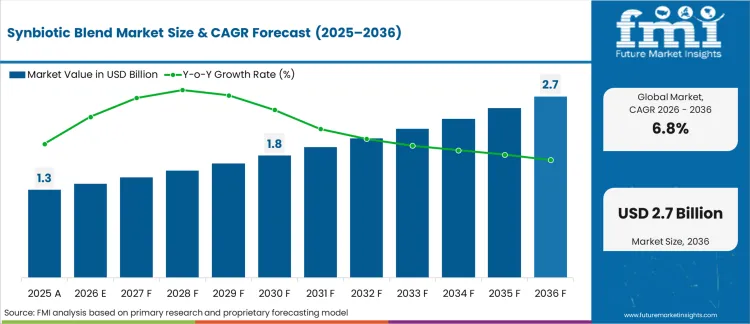
In 2025, the Synbiotic Blend market crossed a valuation of USD 1.3 billion and is projected to reach USD 1.4 billion in 2026 and USD 2.7 billion by 2036, reflecting a CAGR of 6.8%, with momentum tied to clinical substantiation gates. Procurement teams require documented strain survivability and targeted microbiome modulation before authorizing retail listings. Product formulators must specify colony forming units and targeted prebiotic fibers to clear health claim reviews.
Raised compliance thresholds reset minimum capability requirements, forcing manufacturers to invest in strict efficacy trials. A 2025 meta-analysis of 29 randomized controlled trials involving 1,633 older adults confirms that while prebiotics significantly drive Bifidobacterium (SMD: 1.09), synbiotic interventions excel at precision modulation, significantly increasing specific strains like B. longum and B. breve, and boosting beneficial short-chain fatty acids like acetic acid [6]. Manufacturers prioritizing these gut microbiota metrics clear retail review committees faster than those with generic formulations. Adoption of evidence-backed blends reduces consumer skepticism and justifies the premium pricing models essential for maintaining high-margin manufacturing operations.
Summary of Synbiotic Blend Market
- Synbiotic Blend Market Definition
- The industry encompasses the development, formulation, and commercialization of combined prebiotic and probiotic products designed to synergistically support gut microbiota balance, enhance digestive function, and improve overall immune and metabolic health across dietary supplements, functional foods, and clinical nutrition applications.
- Demand Drivers in the Market
- Expanding clinical evidence linking gut health to immunity and cognitive function.
- Preventive healthcare spending targeting metabolic and digestive disorders.
- Manufacturing advancements improving strain survivability in diverse formats.
- Key Segments Analyzed in the FMI Report
- Product Form: Capsules & Tablets (46% share in 2026) versus Powder Sachets & Stick Packs, Functional Foods & Beverages, and Liquid Suspensions.
- Application: Digestive Health (52% share in 2026) versus Immunity Support, Infant & Pediatric Nutrition, and Women’s Health & Others.
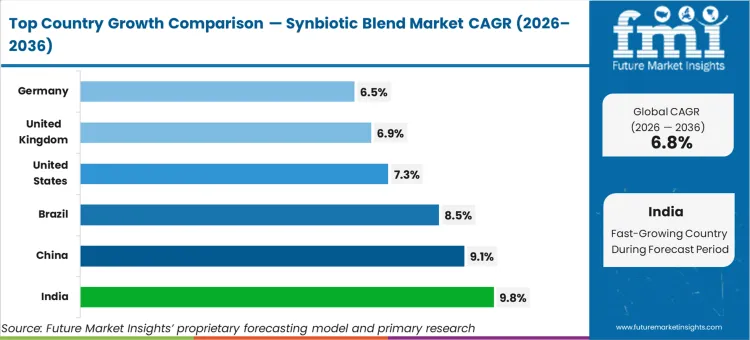
- Geography: High-growth Asia Pacific (India 9.8%, China 9.1%) versus regulatory-intensive mature markets including the United States (7.3%), United Kingdom (6.9%), and Germany (6.5%).
- Analyst Opinion at FMI
- Nandini Roy Choudhury, Consultant for Food & Beverage at Future Market Insights, opines, “The next decade will reward synbiotic blend manufacturers that prioritize scientific substantiation over marketing-driven claims. I observe that regulatory bodies across North America and Europe are tightening oversight on probiotic labeling and health benefit communication. This shift places pressure on food brands to partner with suppliers offering documented strain efficacy, survivability data, and clear dosage benchmarks. Synbiotic systems that demonstrate synergistic gut microbiome modulation will command premium positioning, while undifferentiated blends risk commoditization in a maturing functional ingredient landscape.”
- Strategic Implications/Executive Takeaways
- Pivot to clinically validated strain and fiber combinations to clear retail buyer scrutiny.
- Secure contract manufacturing capacity for specialized powder and liquid suspensions.
- Target specific therapeutic adjacencies like pediatric immunity or metabolic health.
- Methodology
- Validated through first-hand corporate production and capacity data.
- Zero reliance on speculative third-party market research reports.
- Based on verifiable industrial benchmarks and verified sources.
As stated by Loula Merkel, CEO of COMET, "Prebiotics continue to gain undeniable traction, expanding well beyond supplements and into nearly every aisle of the grocery store." "We developed this annual report to help our customers stay ahead of what's next. I am confident that these findings will help inform their business strategies and lead to the next generation of innovative products." [5]
Country dispersion mirrors health claim exposure, with India, China, Brazil, the United States, the United Kingdom, and Germany posting higher conversion where rising disposable income accelerates preventive health spending. According to FMI's estimates, procurement clears faster for products exhibiting proven synbiotic efficacy for specific conditions. Suppliers align strain sourcing with these regional buying triggers to maximize shelf velocity and limit regulatory pushback.
Synbiotic Blend Market Key Takeaways
| Metric | Details |
|---|---|
| Industry Size (2026) | USD 1.4 billion |
| Industry Value (2036) | USD 2.7 billion |
| CAGR (2026-2036) | 6.8% |
Synbiotic Blend Market Definition
The Synbiotic Blend market represents the global commercialization of finished dietary and functional products that combine live probiotic microorganisms with complementary prebiotic substrates in a single formulation. It measures revenues generated from integrated synbiotic products intended to support probiotic viability and function, with products commonly positioned for digestive and gut-health benefits. Market valuation captures sales across supplement, pediatric nutrition, adult wellness, and fortified food categories distributed through pharmacy, specialty retail, mass-market, and e-commerce channels.
Synbiotic Blend Market Inclusions
The scope includes co-formulated capsules and tablets containing clinically validated probiotic strains paired with specific prebiotic fibers. Powder sachets, stick packs, and liquid suspensions positioned for digestive and immune support are included. Functional foods and beverages fortified with defined synbiotic combinations, where both components are declared and quantified, form part of the measured revenue base.
Synbiotic Blend Market Exclusions
Standalone probiotic supplements without a prebiotic substrate and isolated prebiotic fibers without live cultures are excluded. Postbiotic preparations, heat-killed bacterial lysates, and non-viable formulations are not considered. Traditional fermented foods lacking standardized strain identification and quantified synbiotic composition fall outside the defined market scope.
Synbiotic Blend Market Research Methodology
- Primary Research: Interviews with nutraceutical formulators and retail category managers verified strain procurement trends and volume metrics.
- Desk Research: Analysis of clinical trial data from national health institutes validated efficacy claims and adoption rates.
- Market-Sizing and Forecasting: Top-down assessment of regional consumption benchmarks calibrated baseline models across major geographies.
- Data Validation and Update Cycle: Synthesis of production capacity expansions and retail rollout data confirmed near-term supply projections.
Segmental Analysis
Synbiotic Blend Market Analysis by Product Form
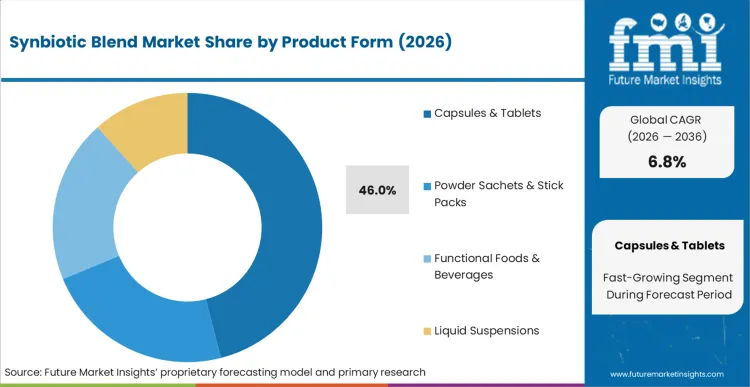
Capsules & Tablets command 46% of the volume in 2026, driven by stability requirements that dictate formulation preferences. Manufacturers gravitate toward encapsulated formats to protect live cultures from harsh gastric acid during transit. Liquid and powder variations serve pediatric and functional beverage segments but face strict shelf-life constraints. According to FMI's estimates, formulators balance survivability with consumer pill fatigue by adapting encapsulation techniques to house specialized pre- and probiotic combinations safely.
- Procurement dynamics: Increasing focus on product quality and compliance standards is influencing ingredient sourcing decisions across the dietary supplement category. Manufacturers are prioritizing standardized inputs, transparent documentation, and consistent formulation parameters to meet retailer and consumer expectations, particularly in capsule-based formats.
- Technology advancement: Continuous improvements in formulation and processing technologies are enhancing product stability and shelf life. Companies are investing in upgraded manufacturing capabilities to improve production efficiency, maintain ingredient integrity, and optimize cost structures while ensuring consistent product performance.
- Buyer priority: Product effectiveness and formulation quality strongly influence purchasing decisions among health-conscious consumers. Demand is shifting toward advanced synbiotic blends that combine complementary probiotic strains and prebiotic fibers to support digestive balance, metabolic health, and overall gut microbiome functionality.
Synbiotic Blend Market Analysis by Application
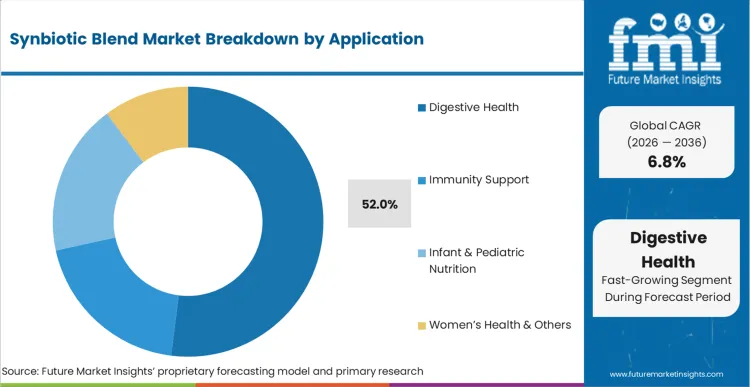
Digestive Health accounts for 52% of the sector in 2026, supported by high incidence rates of chronic gastrointestinal distress. Growing awareness of microbiome balance funnels consumer spending into targeted therapeutic blends rather than generic vitamins. FMI analysts opine that emerging applications in cognitive support and metabolic health broaden the addressable base. Brands link specific microbial strains to measurable health outcomes, moving the category from general wellness to symptom-specific intervention.
- Clinical focus: Growing scientific interest in microbiome health is encouraging continued research into the functional benefits of synbiotic formulations. Expanding clinical exploration is supporting product innovation and guiding the development of targeted formulations addressing digestive health, immunity support, and overall wellness.
- Demographic driver: Aging populations face heightened metabolic risks and declining microbiome diversity. Type II diabetes (T2DM) is a global health concern which is estimated to affect close to 750 million individuals by the year 2045 [1].
- Formulation considerations: Product development in the synbiotic blend segment increasingly focuses on scientifically balanced combinations of probiotics and prebiotics. Manufacturers are investing in research, formulation optimization, and product testing to support digestive health, immune support, and overall microbiome balance while maintaining product stability and quality.
Synbiotic Blend Market Drivers, Restraints, and Opportunities
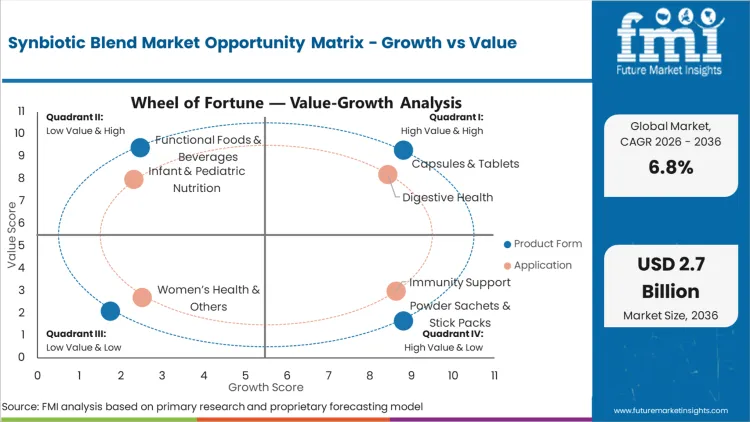
Clinical validation mandates act as the primary catalyst for category expansion across mature health markets. Regulatory bodies and major retail chains demand rigorous scientific backing for functional health claims, pushing formulators away from generic blends toward proprietary, evidence-based synbiotic products. This shift forces heavy investment in human clinical trials to demonstrate specific microbiome modulation effects. The focus on therapeutic efficacy accelerates consumer adoption and justifies premium pricing models.
Strain survivability and manufacturing constraints limit rapid scaling for emerging independent brands. Combining live bacterial cultures with prebiotic substrates introduces complex moisture and stability challenges during production and storage. Poor formulation leads to rapid CFU degradation, resulting in product recalls and damaged brand equity. Companies without specialized infrastructure face high contract manufacturing costs, squeezing margins and delaying product launches. Consistent viability remains the critical hurdle for mass-market expansion as brands fight for premium placement.
- Skincare Integration: Topical applications present an untapped revenue stream for microbiome modulation. Manufacturers target dermatology sectors by formulating specialized bacterial blends, evidenced by partnerships launching probiotic-based microbiome skincare for acne-prone skin in Poland [2].
- Early-stage Innovation: Specialized biotechnology firms develop novel microbiome solutions to address systemic health issues. New entrants secure funding to build computing platforms testing prebiotic effects on microbial communities, advancing formulation science.
- Retail Channel Expansion: Omnichannel strategies stabilize revenue streams for high-margin formulations. Growing gut health companies expand physical footprints with nationwide launches at major farmers market stores, demonstrating immense cross-category potential.
Regional Analysis
Based on the regional analysis, the Synbiotic Blend market is segmented into North America, Latin America, Europe, East Asia, South Asia, Oceania and Middle East & Africa across 40+ countries. The full report also offers market attractiveness analysis based on regional trends.
.webp "Top Country Growth Comparison Synbiotic Blend Market Cagr (2026 2036)")
| Country | CAGR (2026 to 2036) |
|---|---|
| India | 9.8% |
| China | 9.1% |
| Brazil | 8.5% |
| United States | 7.3% |
| United Kingdom | 6.9% |
| Germany | 6.5% |
Source: Future Market Insights (FMI) analysis, based on proprietary forecasting model and primary research
Asia Pacific Synbiotic Blend Market Analysis
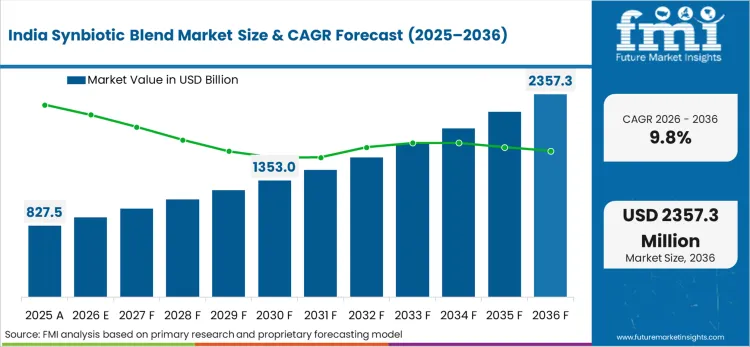
Asia Pacific exhibits rapid adoption fueled by rising disposable income and a cultural affinity for digestive wellness. Formulators adapt products to local dietary habits, developing powder and liquid formats suited for varied climates. Regulatory frameworks evolve to establish clearer guidelines for functional claims, filtering out low-quality entrants from retail shelves. According to FMI's estimates, regional manufacturers scale production rapidly to meet surging demand for immunity-boosting supplements.
- India: Demand for synbiotic blends in India is set to grow at 9.8% CAGR through 2036, supported by an expanding middle class prioritizing preventive digestive care before procurement and budgeting cycles translate into higher deployment volumes. Market penetration aligns closely with rising chronic disease awareness and domestic manufacturing upgrades to stabilize supply chains.
- China: Sales of synbiotic blends in China are projected to rise at 9.1% CAGR from 2026 to 2036 as domestic formulators integrate traditional wellness concepts with clinical microbiome science, creating a clearer pathway from policy or spending intent to purchase orders.
FMI’s report includes an extensive evaluation of the Asia Pacific landscape and its emerging regulatory frameworks. Japan and South Korea represent critical markets for advanced functional foods and geriatric nutrition. Buyers monitor evolving health claim regulations in these nations to dictate future formulation strategies regarding heat-stable probiotics and specialized delivery mechanisms.
North America Synbiotic Blend Market Analysis
North America features a mature, highly competitive landscape driven by clinical validation and premium retail expansion. The region commands a massive share of global biotic sales, with consumers demanding transparency in strain selection and CFU counts. Companies invest heavily in retail partnerships and direct-to-consumer platforms to capture market share. Formulation advancements push the category beyond traditional capsules into functional foods.
- United States: The United States synbiotic blend sector is projected to grow at a 7.3% CAGR from 2026 to 2036, driven by strong retail category management practices that prioritize clinically validated formulations. This emphasis on evidence-based products supports higher adoption and encourages continuous product innovation.
FMI’s report includes detailed tracking of North American channel dynamics and consumer purchasing behaviors. Canada and Mexico offer secondary expansion targets through pharmacy and specialized retail networks. Suppliers must navigate stringent labeling standards across these borders to place multistrain probiotics successfully and maintain cross-border compliance.
Latin America Synbiotic Blend Market Analysis
Latin America represents an emerging frontier characterized by growing awareness of metabolic health. Economic factors push consumers toward cost-effective preventive nutrition rather than expensive pharmaceutical interventions. Brands navigate varied import regulations to establish local distribution networks and secure early market share. Formulators prioritize shelf-stable powders to overcome regional cold-chain logistics challenges.
- Brazil: Brazil is expected to rise 8.5% CAGR in synbiotic blend demand over 2026 to 2036 as rising obesity rates drive interest in metabolic interventions, tightening the link between operational constraints and adoption-led investment. Regional clinical data on overweight populations shapes local marketing efforts, prompting companies to establish local distribution frameworks.
FMI’s report includes an analysis of Latin American market entry barriers and distribution bottlenecks. Argentina and Chile present opportunities for affordable powder formulations tailored to public health initiatives. Manufacturers observe regional clinical trials to align product claims with local infant gut health priorities and secure institutional purchasing contracts.
Europe Synbiotic Blend Market Analysis
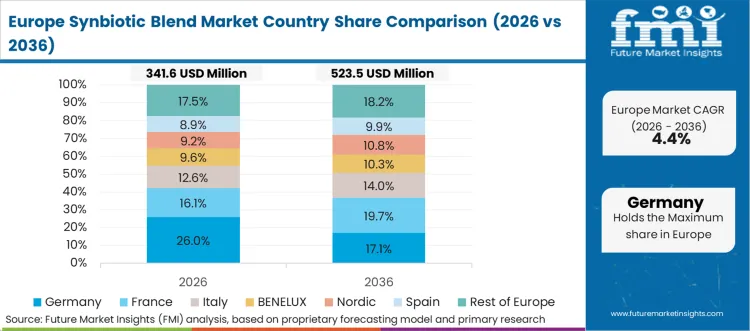
Europe operates under strict health claim regulations, demanding robust clinical evidence for synbiotic products. Established pharmaceutical and nutraceutical companies dominate the landscape, utilizing extensive pharmacy distribution networks. Strategic partnerships accelerate cross-border expansion and product innovation in a highly fragmented regulatory environment. Regional authorities heavily scrutinize functional claims before allowing market entry.
- United Kingdom: In the United Kingdom, the synbiotic blend market is forecast to advance at 6.9% CAGR through 2036, with growth anchored in high consumer education regarding microbiome science that converts into measurable budget allocation. Retailers prioritize brands with clear strain transparency and verifiable clinical backing.
- Germany: Demand for symbiotic blend in Germany is anticipated to rise at 6.5% CAGR over the forecast period as strict regulatory standards filter out unsubstantiated products, helping suppliers align positioning with local buying triggers. Strategic distribution agreements accelerate growth across this strict compliance landscape.
FMI’s report includes comprehensive mapping of European regulatory environments and pharmacy distribution structures. France and Italy remain pivotal for digestive health supplements driven by aging demographics. Companies track European Food Safety Authority guidelines to ensure formulation compliance for microbiome therapeutics and avoid costly product recalls.
Competitive Aligners for Market Players
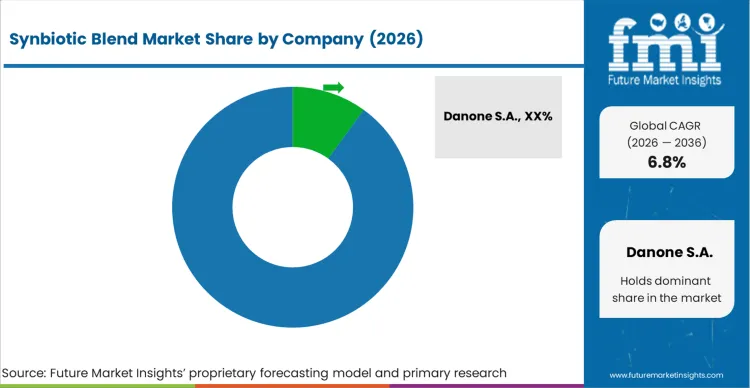
Strategic acquisitions consolidate proprietary technology and expand clinical portfolios across the nutritional landscape. Large corporations absorb specialized biotechnology firms to acquire validated strains and advanced delivery mechanisms. This consolidation pressures mid-tier brands to differentiate through niche applications or specialized formats, forcing them to secure exclusive licensing agreements to remain viable.
Manufacturing control determines margin viability and product quality for biotic formulators. Contract manufacturing bottlenecks force leading brands to internalize production or forge long-term partnerships with dedicated facilities. Internalized production limits exposure to supply chain volatility and ensures consistent CFU viability, allowing brands to scale operations without compromising the delicate microbial balance required for health claims.
Retail channel dominance dictates brand survival in a saturated wellness sector. Companies secure national listings by demonstrating clinical efficacy and strong unit economics to category managers. Securing premium shelf space in mass-market retail requires substantial marketing investment and proven consumer retention, pushing brands to adopt omnichannel strategies that combine physical grocery presence with recurring digital subscriptions.
Recent Developments
The report includes full coverage of key trends from competitive benchmarking. Some of the recent developments covered in the reports:
- In March 2026, OutPost Bio secured EUR 2.9 million in pre-Seed funding to make human microbiology computable and test prebiotic effects, advancing formulation science. [4]
- In June 2025, Seed Health expanded its retail footprint with a nationwide launch at 450 Sprouts Farmers Market stores, pushing clinical blends into mainstream channels. [3]
Key Players in Synbiotic Blend Market
- Danone S.A.
- Yakult Honsha Co., Ltd.
- DSM-Firmenich
- Lallemand Inc.
- Probi AB
- Nestlé S.A.
- Sabinsa Corporation
Scope of the Report
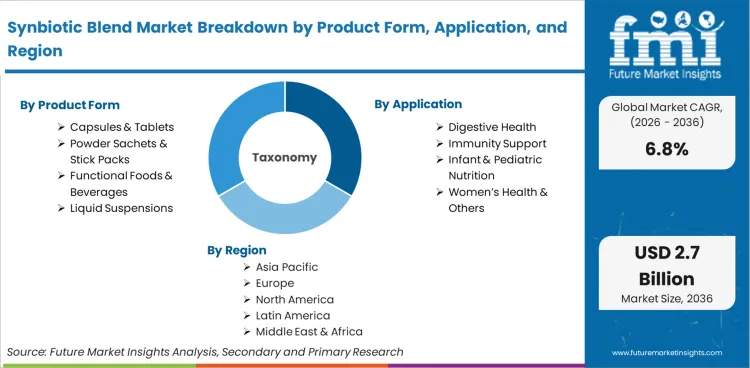
| Metric | Value |
|---|---|
| Quantitative Units | USD 1.4 billion (2026) to USD 2.7 billion (2036), at a CAGR of 6.8% |
| Market Definition | The synbiotic blend sector comprises the commercialization of dietary products containing both live microorganisms and selective substrates utilized by host microorganisms conferring a health benefit. |
| Product Form Segmentation | Capsules & Tablets, Powder Sachets & Stick Packs, Functional Foods & Beverages, Liquid Suspensions |
| Application Segmentation | Digestive Health, Immunity Support, Infant & Pediatric Nutrition, Women’s Health & Others |
| Regions Covered | North America, Latin America, Europe, East Asia, South Asia, Oceania, Middle East and Africa |
| Countries Covered | United States, United Kingdom, Germany, India, China, Brazil and 40 plus countries |
| Key Companies Profiled | Danone S.A., Yakult Honsha Co., Ltd., DSM-Firmenich, Lallemand Inc., Probi AB, Nestlé S.A., Sabinsa Corporation |
| Forecast Period | 2026 to 2036 |
| Approach | Hybrid top-down and bottom-up modeling validated through primary interviews with synbiotic blend manufacturers, probiotic strain developers, contract formulators, and dietary supplement brands, supported by retail sales benchmarking, trade flow analysis, and production capacity verification across encapsulation and powder blending facilities |
Synbiotic Blend Market Analysis by Segments
Product Form:
- Capsules & Tablets
- Powder Sachets & Stick Packs
- Functional Foods & Beverages
- Liquid Suspensions
Application:
- Digestive Health
- Immunity Support
- Infant & Pediatric Nutrition
- Women’s Health & Others
Region:
- Asia Pacific
- India
- China
- Japan
- South Korea
- Indonesia
- Australia & New Zealand
- ASEAN
- Rest of Asia Pacific
- Europe
- Germany
- Italy
- France
- United Kingdom
- Spain
- Benelux
- Nordics
- Central & Eastern Europe
- Rest of Europe
- North America
- United States
- Canada
- Mexico
- Latin America
- Brazil
- Argentina
- Chile
- Rest of Latin America
- Middle East & Africa
- Kingdom of Saudi Arabia
- United Arab Emirates
- South Africa
- Turkey
- Rest of Middle East & Africa
Bibliography
- [1] Global Prebiotic Association. (2025, May). What’s the latest in prebiotic research? - May 2025 edition.
- [2] Bausch Health. (2025). Partnership to launch probiotic-based microbiome skincare for acne-prone skin in Poland.
- [3] PR Newswire. (2025). Leading gut health company Seed expands retail footprint with nationwide launch at Sprouts.
- [4] EU Startups. (2026). Female-led biotech startup OutPost Bio raises EUR 2.9 million.
- [5] PR Newswire. (2025). COMET predicts prebiotic blends and mood support will be top trends for 2026.
- [6] PMC. (2025). Meta-analysis of effects of probiotics, prebiotics, and synbiotics on gut microbiota in older adults.
This bibliography is provided for reader reference and is not exhaustive. The full report contains the complete reference list and detailed citations.
This Report Addresses
- Market intelligence to enable structured strategic decision making across mature and emerging nutraceutical economies
- Market size estimation and 10 year revenue forecasts from 2026 to 2036, supported by validated capacity and trade benchmarks
- Growth opportunity mapping across capsules, powders, and liquid forms with emphasis on clinical substantiation
- Segment and regional revenue forecasts covering digestive health, immunity support, and pediatric applications
- Competition strategy assessment including integration models, cost survivability positioning, and compliance capability benchmarking
- Product reformulation and efficacy compliance tracking including targeted CFUs and fiber inclusion metrics
- Regulatory impact analysis covering health claims mandates and export driven specification upgrades
- Market report delivery in PDF, Excel, PPT, and interactive dashboard formats for executive and operational use
Frequently Asked Questions
How large is the demand for Synbiotic Blend in the global market in 2026?
Demand for Synbiotic Blend in the global market is estimated to be valued at USD 1.4 billion in 2026.
What will be the market size of Synbiotic Blend in the global market by 2036?
Market size for Synbiotic Blend is projected to reach USD 2.7 billion by 2036.
What is the expected demand growth for Synbiotic Blend in the global market between 2026 and 2036?
Demand for Synbiotic Blend in the global market is expected to grow at a CAGR of 6.8% between 2026 and 2036.
Which Product Form is poised to lead global sales by 2026?
Capsules & Tablets format commands 46% share, given its ability to protect live cultures from gastric degradation.
How significant is the role of Digestive Health in driving Synbiotic Blend adoption in 2026?
Digestive Health captures 52% share as chronic gastrointestinal distress funnels consumer spending into targeted therapeutic blends.
What is driving demand in India?
Growing awareness of preventive digestive care among an expanding middle class drives adoption and retail velocity.
What compliance standards or regulations are referenced for India?
National health survey associations provide baseline tracking for biotic consumption trends.
What is the India growth outlook in this report?
India is projected to grow at a CAGR of 9.8% during 2026 to 2036.
Why is North America described as a priority region in this report?
High consumer awareness and massive retail penetration for premium, clinically validated formulations anchor long-term demand.
What type of demand dominates in North America?
Clinically substantiated product replacement demand drives value over generic supplement formats.
What is China growth outlook in this report?
China is projected to expand at a CAGR of 9.1% during 2026 to 2036.
Does the report cover Brazil in its regional analysis?
Yes, Brazil is included within Latin America under the regional scope of analysis.
What are the sources referred to for analyzing Brazil?
Analysis relies on clinical studies tracking gut microbiota profiles in local overweight populations.
What is the main demand theme linked to Brazil in its region coverage?
Obesity rates and metabolic intervention interest steer targeted product development and regional marketing.
Does the report cover the United States in its regional analysis?
Yes, the United States is included within North America under the regional coverage framework.
What is the main United States related demand theme in its region coverage?
Stringent retail category management demands clinically backed formulations for mass-market placement.
Which product formats or configurations are strategically important for Asia Pacific supply chains?
Powder sachets and liquid suspensions hold importance for climate adaptability and localized consumer preferences.
What is Synbiotic Blend and what is it mainly used for?
Synbiotic blends combine live probiotic microorganisms with selective prebiotic substrates to enhance gastrointestinal health and immunity.
What does Synbiotic Blend mean in this report?
The market tracks commercial dietary products formulating targeted bacterial strains with compatible prebiotic fibers.
What is included in the scope of this Synbiotic Blend report?
Co-formulated capsules, tablets, powder stick packs, liquid suspensions, and fortified functional foods are included.
What is excluded from the scope of this report?
Standalone probiotics, isolated prebiotic fibers, and general fermented foods lacking quantified strains are excluded.
What does market forecast mean on this page?
Market forecast represents a model-based projection built on defined assumptions for strategic planning purposes.
How does FMI build and validate the Synbiotic Blend forecast?
Forecasts use hybrid top-down and bottom-up modeling validated against corporate capacity data and clinical trial benchmarks.
What does zero reliance on speculative third party market research mean here?
Primary interviews and verifiable public clinical datasets are used instead of unverified syndicated market estimates.
Preview the report firsthand - request a free sample
Get SampleGet the brochure for pricing and purchase details.
Get PDFTable of Content
- Demand-side Trends
- Supply-side Trends
- Technology Roadmap Analysis
- Market Coverage / Taxonomy
- Market Definition / Scope / Limitations
- Research Methodology
- Chapter Orientation
- Analytical Lens and Working Hypotheses
- Market Structure, Signals, and Trend Drivers
- Benchmarking and Cross-market Comparability
- Market Sizing, Forecasting, and Opportunity Mapping
- Research Design and Evidence Framework
- Desk Research Programme (Secondary Evidence)
- Company Annual and Sustainability Reports
- Peer-reviewed Journals and Academic Literature
- Corporate Websites, Product Literature, and Technical Notes
- Earnings Decks and Investor Briefings
- Statutory Filings and Regulatory Disclosures
- Technical White Papers and Standards Notes
- Sector Databases and Reference Repositories
- FMI Internal Proprietary Databases and Historical Market Datasets
- Subscription Datasets and Paid Sources
- Social Channels, Communities, and Digital Listening Inputs
- Additional Desk Sources
- Expert Input and Fieldwork (Primary Evidence)
- Primary Modes
- Qualitative Interviews and Expert Elicitation
- Quantitative Surveys and Structured Data Capture
- Blended Approach
- Why Primary Evidence is Used
- Field Techniques
- Interviews
- Surveys
- Focus Groups
- Observational and In-context Research
- Social and Community Interactions
- Stakeholder Universe Engaged
- C-suite Leaders
- Board Members
- Presidents and Vice Presidents
- R&D and Innovation Heads
- Technical Specialists
- Domain Subject-matter Experts
- Scientists
- Physicians and Other Healthcare Professionals
- Governance, Ethics, and Data Stewardship
- Research Ethics
- Data Integrity and Handling
- Primary Modes
- Tooling, Models, and Reference Databases
- Desk Research Programme (Secondary Evidence)
- Data Engineering and Model Build
- Data Acquisition and Ingestion
- Cleaning, Normalisation, and Verification
- Synthesis, Triangulation, and Analysis
- Quality Assurance and Audit Trail
- Market Background
- Market Dynamics
- Drivers
- Restraints
- Opportunity
- Trends
- Scenario Forecast
- Demand in Optimistic Scenario
- Demand in Likely Scenario
- Demand in Conservative Scenario
- Opportunity Map Analysis
- Product Life Cycle Analysis
- Supply Chain Analysis
- Investment Feasibility Matrix
- Value Chain Analysis
- PESTLE and Porter’s Analysis
- Regulatory Landscape
- Regional Parent Market Outlook
- Production and Consumption Statistics
- Import and Export Statistics
- Market Dynamics
- Global Market Analysis 2021 to 2025 and Forecast, 2026 to 2036
- Historical Market Size Value (USD Million) Analysis, 2021 to 2025
- Current and Future Market Size Value (USD Million) Projections, 2026 to 2036
- Y-o-Y Growth Trend Analysis
- Absolute $ Opportunity Analysis
- Global Market Pricing Analysis 2021 to 2025 and Forecast 2026 to 2036
- Global Market Analysis 2021 to 2025 and Forecast 2026 to 2036, By Product Form
- Introduction / Key Findings
- Historical Market Size Value (USD Million) Analysis By Product Form , 2021 to 2025
- Current and Future Market Size Value (USD Million) Analysis and Forecast By Product Form , 2026 to 2036
- Capsules & Tablets
- Powder Sachets & Stick Packs
- Functional Foods & Beverages
- Liquid Suspensions
- Capsules & Tablets
- Y-o-Y Growth Trend Analysis By Product Form , 2021 to 2025
- Absolute $ Opportunity Analysis By Product Form , 2026 to 2036
- Global Market Analysis 2021 to 2025 and Forecast 2026 to 2036, By Application
- Introduction / Key Findings
- Historical Market Size Value (USD Million) Analysis By Application, 2021 to 2025
- Current and Future Market Size Value (USD Million) Analysis and Forecast By Application, 2026 to 2036
- Digestive Health
- Immunity Support
- Infant & Pediatric Nutrition
- Women’s Health & Others
- Digestive Health
- Y-o-Y Growth Trend Analysis By Application, 2021 to 2025
- Absolute $ Opportunity Analysis By Application, 2026 to 2036
- Global Market Analysis 2021 to 2025 and Forecast 2026 to 2036, By Region
- Introduction
- Historical Market Size Value (USD Million) Analysis By Region, 2021 to 2025
- Current Market Size Value (USD Million) Analysis and Forecast By Region, 2026 to 2036
- North America
- Latin America
- Western Europe
- Eastern Europe
- East Asia
- South Asia and Pacific
- Middle East & Africa
- Market Attractiveness Analysis By Region
- North America Market Analysis 2021 to 2025 and Forecast 2026 to 2036, By Country
- Historical Market Size Value (USD Million) Trend Analysis By Market Taxonomy, 2021 to 2025
- Market Size Value (USD Million) Forecast By Market Taxonomy, 2026 to 2036
- By Country
- USA
- Canada
- Mexico
- By Product Form
- By Application
- By Country
- Market Attractiveness Analysis
- By Country
- By Product Form
- By Application
- Key Takeaways
- Latin America Market Analysis 2021 to 2025 and Forecast 2026 to 2036, By Country
- Historical Market Size Value (USD Million) Trend Analysis By Market Taxonomy, 2021 to 2025
- Market Size Value (USD Million) Forecast By Market Taxonomy, 2026 to 2036
- By Country
- Brazil
- Chile
- Rest of Latin America
- By Product Form
- By Application
- By Country
- Market Attractiveness Analysis
- By Country
- By Product Form
- By Application
- Key Takeaways
- Western Europe Market Analysis 2021 to 2025 and Forecast 2026 to 2036, By Country
- Historical Market Size Value (USD Million) Trend Analysis By Market Taxonomy, 2021 to 2025
- Market Size Value (USD Million) Forecast By Market Taxonomy, 2026 to 2036
- By Country
- Germany
- UK
- Italy
- Spain
- France
- Nordic
- BENELUX
- Rest of Western Europe
- By Product Form
- By Application
- By Country
- Market Attractiveness Analysis
- By Country
- By Product Form
- By Application
- Key Takeaways
- Eastern Europe Market Analysis 2021 to 2025 and Forecast 2026 to 2036, By Country
- Historical Market Size Value (USD Million) Trend Analysis By Market Taxonomy, 2021 to 2025
- Market Size Value (USD Million) Forecast By Market Taxonomy, 2026 to 2036
- By Country
- Russia
- Poland
- Hungary
- Balkan & Baltic
- Rest of Eastern Europe
- By Product Form
- By Application
- By Country
- Market Attractiveness Analysis
- By Country
- By Product Form
- By Application
- Key Takeaways
- East Asia Market Analysis 2021 to 2025 and Forecast 2026 to 2036, By Country
- Historical Market Size Value (USD Million) Trend Analysis By Market Taxonomy, 2021 to 2025
- Market Size Value (USD Million) Forecast By Market Taxonomy, 2026 to 2036
- By Country
- China
- Japan
- South Korea
- By Product Form
- By Application
- By Country
- Market Attractiveness Analysis
- By Country
- By Product Form
- By Application
- Key Takeaways
- South Asia and Pacific Market Analysis 2021 to 2025 and Forecast 2026 to 2036, By Country
- Historical Market Size Value (USD Million) Trend Analysis By Market Taxonomy, 2021 to 2025
- Market Size Value (USD Million) Forecast By Market Taxonomy, 2026 to 2036
- By Country
- India
- ASEAN
- Australia & New Zealand
- Rest of South Asia and Pacific
- By Product Form
- By Application
- By Country
- Market Attractiveness Analysis
- By Country
- By Product Form
- By Application
- Key Takeaways
- Middle East & Africa Market Analysis 2021 to 2025 and Forecast 2026 to 2036, By Country
- Historical Market Size Value (USD Million) Trend Analysis By Market Taxonomy, 2021 to 2025
- Market Size Value (USD Million) Forecast By Market Taxonomy, 2026 to 2036
- By Country
- Kingdom of Saudi Arabia
- Other GCC Countries
- Turkiye
- South Africa
- Other African Union
- Rest of Middle East & Africa
- By Product Form
- By Application
- By Country
- Market Attractiveness Analysis
- By Country
- By Product Form
- By Application
- Key Takeaways
- Key Countries Market Analysis
- USA
- Pricing Analysis
- Market Share Analysis, 2025
- By Product Form
- By Application
- Canada
- Pricing Analysis
- Market Share Analysis, 2025
- By Product Form
- By Application
- Mexico
- Pricing Analysis
- Market Share Analysis, 2025
- By Product Form
- By Application
- Brazil
- Pricing Analysis
- Market Share Analysis, 2025
- By Product Form
- By Application
- Chile
- Pricing Analysis
- Market Share Analysis, 2025
- By Product Form
- By Application
- Germany
- Pricing Analysis
- Market Share Analysis, 2025
- By Product Form
- By Application
- UK
- Pricing Analysis
- Market Share Analysis, 2025
- By Product Form
- By Application
- Italy
- Pricing Analysis
- Market Share Analysis, 2025
- By Product Form
- By Application
- Spain
- Pricing Analysis
- Market Share Analysis, 2025
- By Product Form
- By Application
- France
- Pricing Analysis
- Market Share Analysis, 2025
- By Product Form
- By Application
- India
- Pricing Analysis
- Market Share Analysis, 2025
- By Product Form
- By Application
- ASEAN
- Pricing Analysis
- Market Share Analysis, 2025
- By Product Form
- By Application
- Australia & New Zealand
- Pricing Analysis
- Market Share Analysis, 2025
- By Product Form
- By Application
- China
- Pricing Analysis
- Market Share Analysis, 2025
- By Product Form
- By Application
- Japan
- Pricing Analysis
- Market Share Analysis, 2025
- By Product Form
- By Application
- South Korea
- Pricing Analysis
- Market Share Analysis, 2025
- By Product Form
- By Application
- Russia
- Pricing Analysis
- Market Share Analysis, 2025
- By Product Form
- By Application
- Poland
- Pricing Analysis
- Market Share Analysis, 2025
- By Product Form
- By Application
- Hungary
- Pricing Analysis
- Market Share Analysis, 2025
- By Product Form
- By Application
- Kingdom of Saudi Arabia
- Pricing Analysis
- Market Share Analysis, 2025
- By Product Form
- By Application
- Turkiye
- Pricing Analysis
- Market Share Analysis, 2025
- By Product Form
- By Application
- South Africa
- Pricing Analysis
- Market Share Analysis, 2025
- By Product Form
- By Application
- USA
- Market Structure Analysis
- Competition Dashboard
- Competition Benchmarking
- Market Share Analysis of Top Players
- By Regional
- By Product Form
- By Application
- Competition Analysis
- Competition Deep Dive
- Danone S.A.
- Overview
- Product Portfolio
- Profitability by Market Segments (Product/Age /Sales Channel/Region)
- Sales Footprint
- Strategy Overview
- Marketing Strategy
- Product Strategy
- Channel Strategy
- Yakult Honsha Co., Ltd.
- DSM-Firmenich
- Lallemand Inc.
- Probi AB
- Nestlé S.A.
- Sabinsa Corporation
- Danone S.A.
- Competition Deep Dive
- Assumptions & Acronyms Used


