

- Industry Size (2026)
- USD 848.0 Mn
- Forecast (2036)
- USD 1953.0 Mn
- CAGR (2026 to 2036)
- 8.7%
Tryptic Protein Digestion Kits Market Forecast and Outlook 2026 to 2036
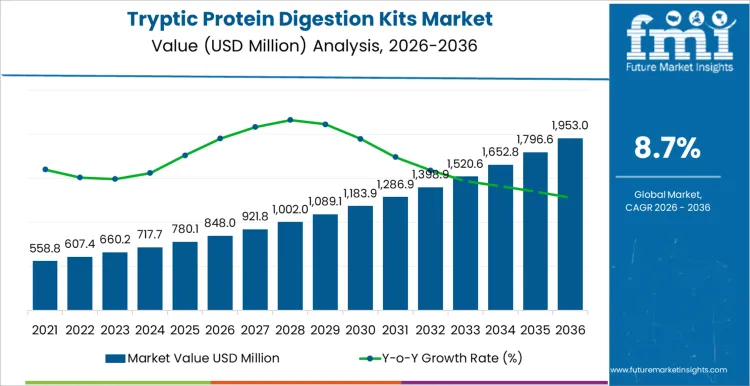
The tryptic protein digestion kits market is projected to reach USD 848.0 million in 2026 and expand to USD 1,953.0 million by 2036, at a CAGR of 8.7%. Value expansion is driven by standardized proteomics sample preparation requirements across academic research, biopharmaceutical development, and clinical proteomics workflows. Adoption intensity remains closely linked to mass spectrometry utilization growth, reproducibility mandates, and increasing reliance on kit-based digestion to reduce inter-operator and inter-laboratory variability. Spending concentration favors sequencing-grade and automation-compatible kits that support high-throughput peptide generation with predictable digestion efficiency and minimal autolysis risk.
Demand progression is governed by proteomics standardization, biologics characterization needs, and integration with automated LC-MS pipelines. Kit adoption expands where regulated bioanalytical testing, biosimilar comparability studies, and large cohort biomarker research require consistent peptide maps and validated workflows. Cost sensitivity, enzyme stability constraints, and limited protocol flexibility moderate unrestricted uptake in smaller laboratories. Market behavior remains anchored to repeat consumable demand, laboratory modernization cycles, and method harmonization requirements rather than exploratory proteomics alone. These factors support sustained, structurally stable growth across global life science research environments.
Quick Stats for Tryptic Protein Digestion Kits Market
- Tryptic Protein Digestion Kits Market Value (2026): USD 848.0 million
- Tryptic Protein Digestion Kits Market Forecast Value (2036): USD 1,953.0 million
- Tryptic Protein Digestion Kits Market Forecast CAGR 2026 to 2036: 8.7%
- Leading Kit Type by Demand Share: Sequencing-grade trypsin reagents
- Fastest-Growing Countries: India, Brazil, China, USA, Germany
- Top Players in Global Demand: Thermo Fisher Scientific, Promega, Merck KGaA, Waters, Agilent Technologies
Tryptic Protein Digestion Kits Market Key Takeaways
| Metric | Value |
|---|---|
| Market Value (2026) | USD 848.0 million |
| Market Forecast Value (2036) | USD 1,953.0 million |
| Forecast CAGR 2026 to 2036 | 8.7% |
Why is the Demand for Tryptic Protein Digestion Kits Growing?
Demand for tryptic protein digestion kits is increasing as life science researchers and proteomics laboratories require reliable, streamlined solutions for preparing complex biological samples prior to mass spectrometry and tandem mass tag analysis. Trypsin-catalyzed digestion of proteins into peptides remains a core step in shotgun proteomics workflows because it generates predictable peptide fragments that improve identification confidence and quantitative reproducibility. Researchers specify kits formulated with optimized trypsin quality, stabilizers, and buffer systems that minimize autolysis and maximize digestion efficiency across varied sample types, including serum, tissue lysates, and cell cultures. Procurement teams evaluate kit performance metrics such as digestion completeness, reproducibility, and ease of workflow integration because consistent peptide generation influences downstream identification, quantitation, and bioinformatics interpretation in high-throughput studies.
Growth in applications such as biomarker discovery, systems biology, and biologic therapeutic characterization reinforces adoption of tryptic digestion kits that support standardized sample preparation across multi-user laboratories. As large-scale proteomic studies expand, laboratories prioritize solutions that reduce sample-to-sample variability and shorten preparation time without sacrificing data quality. Vendor support for protocol optimization, documentation, and troubleshooting enhances confidence among technical staff, particularly when integrating digestion kits with automated liquid handling systems. Advances in formulation stability extend shelf life and support reproducible performance under varied storage conditions, which is especially valuable in decentralized research facilities and contract research settings. These application-specific performance and operational readiness drivers are contributing to sustained demand growth in the tryptic protein digestion kits market.
How Is the Tryptic Protein Digestion Kits Industry Segmented by Kit Type, Application, and End User?
Demand for tryptic protein digestion kits is driven by reproducibility requirements, increasing sample throughput, and standardization across proteomics workflows. Laboratories prioritize consistent peptide generation, minimized variability, and compatibility with high-resolution mass spectrometry. Adoption reflects wider use of automation, expansion of regulated bioanalytical testing, and growth in large-cohort studies. Selection decisions focus on digestion efficiency, workflow integration, and data comparability across runs. Segmentation clarifies how kit configuration, analytical purpose, and organizational setting influence utilization patterns across discovery, development, and quality environments.
Which Testing Kit Category Holds the Largest Share in Tryptic Protein Digestion Workflows?
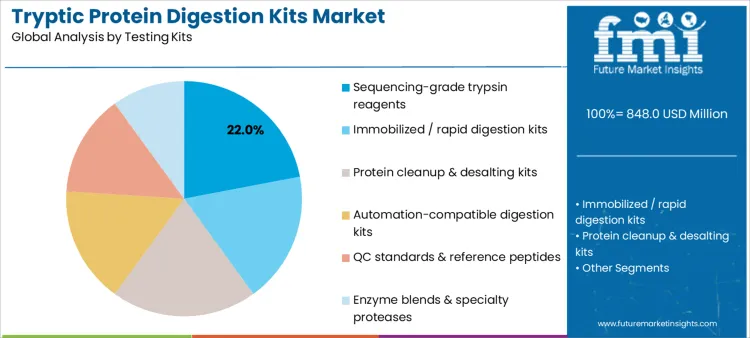
Sequencing-grade trypsin reagents hold 22.0%, reflecting their central role in achieving specific and reproducible protein cleavage. These reagents support consistent peptide maps required for comparative analysis across experiments. Protein cleanup and desalting kits account for 20.0%, addressing matrix interference and improving downstream signal quality. Immobilized or rapid digestion kits at 18.0% shorten processing timelines while maintaining digestion control. Automation-compatible digestion kits represent 16.0%, supporting standardized high-throughput operations. QC standards and reference peptides at 14.0% enable method verification, while enzyme blends at 10.0% serve specialized proteolysis needs. Kit-type distribution reflects emphasis on digestion fidelity and operational efficiency.
Key Points
- Sequencing-grade trypsin underpins reproducible digestion.
- Cleanup kits improve analytical signal consistency.
- Automation-ready formats support scalable workflows.
How Do Application Areas Influence Demand for Tryptic Protein Digestion Kits?
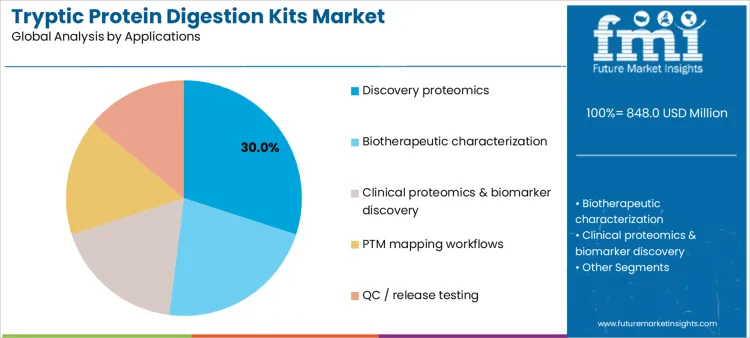
Discovery proteomics represents 30.0%, driven by exploratory studies requiring broad protein coverage and reliable digestion across diverse samples. Biotherapeutic characterization at 22.0% relies on precise peptide mapping to assess structure, purity, and degradation pathways. Clinical proteomics and biomarker discovery at 18.0% emphasize consistency across large patient cohorts. PTM mapping workflows at 16.0% require controlled digestion to preserve modification information. QC and release testing at 14.0% depend on validated, repeatable protocols supporting compliance. Application segmentation highlights stronger utilization where data reliability, comparability, and regulatory confidence are critical.
Key Points
- Discovery studies require broad and consistent digestion.
- Biotherapeutic analysis depends on precise peptide mapping.
- QC workflows demand validated and repeatable performance.
Which End User Groups Drive Adoption of Tryptic Protein Digestion Kits?
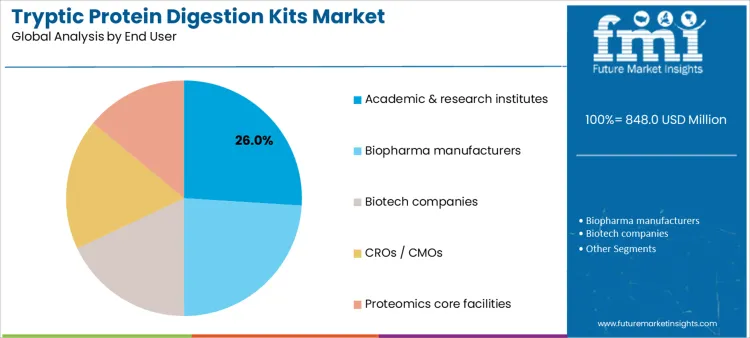
Academic and research institutes account for 26.0%, reflecting extensive use in method development and hypothesis-driven proteomics. Biopharma manufacturers at 24.0% integrate digestion kits into development and quality programs supporting biologics pipelines. Biotech companies at 18.0% apply kits in translational research and early-stage characterization. CROs and CMOs at 18.0% require standardized kits adaptable to multiple client protocols. Proteomics core facilities at 14.0% support shared instrumentation and varied project needs. End-user segmentation indicates concentration where analytical depth, throughput, and protocol standardization guide kit selection.
Key Points
- Academia drives exploratory and method-focused usage.
- Biopharma integrates kits into regulated workflows.
- Service organizations require standardized, flexible solutions.
What are the Key Dynamics in the Tryptic Protein Digestion Kits Market?
Demand for tryptic protein digestion kits reflects standardized sample preparation requirements in proteomics, biopharmaceutical analysis, and clinical research. Adoption concentrates in academic research laboratories, contract research organizations, biopharmaceutical manufacturers, and proteomics core facilities. Global scope aligns with growth in mass spectrometry-based protein analysis. Usage centers on ready-to-use kits containing sequencing-grade trypsin and buffers optimized for reproducible enzymatic digestion prior to peptide-based analysis.
How do analytical reproducibility need and workflow efficiency shape adoption?
Proteomic workflows rely on consistent and complete protein digestion to generate reliable peptide maps. Demand increases where variability in in-house digestion protocols affects mass spectrometry data quality and comparability. Tryptic digestion kits provide controlled enzyme activity, defined reaction conditions, and reduced preparation steps, supporting inter-laboratory consistency. Biopharmaceutical development uses these kits for protein characterization, impurity profiling, and comparability studies under regulated environments. High-throughput research settings value reduced hands-on time and predictable digestion kinetics. Compatibility with automation platforms and downstream LC-MS workflows enhances utility. Adoption reflects analytical priority for reproducibility, time efficiency, and data integrity in complex protein analysis pipelines.
How do enzyme stability limits, cost exposure, and method flexibility influence market scalability?
Trypsin activity is sensitive to storage conditions, autolysis, and contamination, affecting shelf life and performance reliability. Demand sensitivity rises where cold chain handling increases logistical complexity. Kit cost exceeds bulk enzyme procurement, influencing adoption in cost-constrained academic laboratories. Fixed protocols limit flexibility for atypical proteins requiring alternative digestion conditions. Batch-to-batch enzyme variability necessitates quality control oversight. Regulatory environments require extensive validation when switching suppliers or formats. Dependence on animal-derived or recombinant enzyme sourcing affects supply stability. Scalability remains constrained by enzyme stability considerations, budget sensitivity, and need for method adaptability across diverse proteomic applications.
How Is Demand for Tryptic Protein Digestion Kits Evolving Globally?
Demand for tryptic protein digestion kits is expanding globally as proteomics workflows become integral to biopharmaceutical development, clinical research, and academic life sciences. Standardized sample preparation supports reproducibility across mass spectrometry platforms. Growth in biologics characterization, biomarker discovery, and quality control increases routine kit usage. Automation compatibility and reduced preparation variability influence purchasing decisions. Growth rates in India at 11.2%, Brazil at 10.7%, China at 10.2%, the USA at 7.2%, and Germany at 7.1% indicate sustained expansion driven by proteomics adoption, laboratory throughput requirements, and method standardization rather than exploratory research alone.

| Country | CAGR (%) |
|---|---|
| India | 11.2% |
| Brazil | 10.7% |
| China | 10.2% |
| USA | 7.2% |
| Germany | 7.1% |
What Is Driving Accelerated Growth of Tryptic Protein Digestion Demand in India?
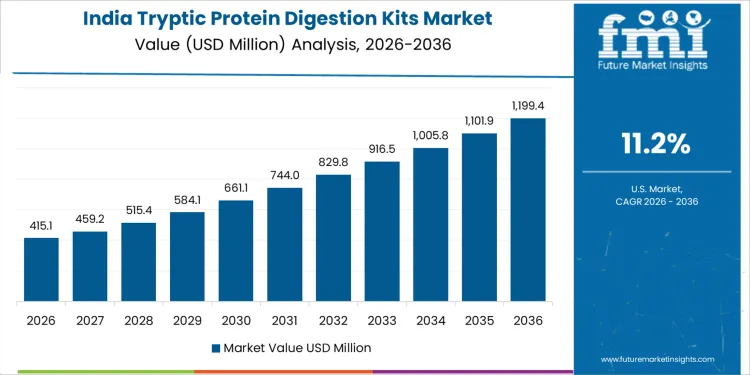
Demand for tryptic protein digestion kits in India is growing at a CAGR of 11.2%, supported by expansion of proteomics research within pharmaceutical and academic laboratories. Contract research organizations increase digestion throughput to support biologics characterization and biosimilar comparability studies. Universities and research institutes adopt standardized kits to improve reproducibility in mass spectrometry workflows. Growing availability of LC-MS platforms increases routine sample preparation volumes. Local distributors improve kit availability and technical support. Growth reflects laboratory modernization, research funding expansion, and standardization needs rather than niche exploratory proteomics activity.
- Expansion of biosimilar and biologics research
- Increased CRO proteomics service activity
- Wider adoption of LC-MS platforms
- Improved domestic distribution and support
Why Is Brazil Experiencing Strong Uptake of Tryptic Protein Digestion Kits?
Tryptic protein digestion demand in Brazil is expanding at a CAGR of 10.7%, driven by growth in academic proteomics and public research initiatives. Universities and national research centers increase use of standardized digestion protocols for biomarker and disease research. Biopharmaceutical laboratories apply digestion kits for formulation and stability studies. Government-funded projects support instrumentation and consumables procurement. Regional core facilities provide shared proteomics services. Growth reflects institutional research investment and method harmonization rather than high-volume commercial testing.
- Expansion of academic proteomics programs
- Public funding for life science research
- Biopharmaceutical formulation analysis needs
- Use of centralized proteomics core facilities
How Is China Sustaining Momentum in Tryptic Protein Digestion Kit Utilization?
Demand for tryptic protein digestion kits in China is growing at a CAGR of 10.2%, aligned with large-scale proteomics research and biopharmaceutical development. Domestic biologics developers integrate standardized digestion within quality and characterization workflows. National research programs support proteome mapping and disease biomarker studies. High-throughput laboratories favor ready-to-use kits to reduce variability. Domestic and international suppliers ensure broad availability. Growth reflects scale-driven adoption and research prioritization rather than small-lab experimentation.
- Integration in biologics quality workflows
- National proteomics research initiatives
- High-throughput laboratory standardization needs
- Broad supplier availability at scale
What Factors Are Supporting Tryptic Protein Digestion Demand in United States?
Tryptic protein digestion demand in the United States is expanding at a CAGR of 7.2%, supported by mature proteomics infrastructure and standardized workflows. Pharmaceutical and biotech companies use digestion kits for routine characterization and comparability studies. Clinical research laboratories apply kits within translational proteomics programs. Automation and reproducibility requirements favor kit-based preparation. Replacement demand arises from steady research activity rather than rapid lab expansion. Growth reflects workflow optimization and consistency requirements rather than increased proteomics adoption rates.
- Routine use in biopharmaceutical characterization
- Translational proteomics research activity
- Automation-compatible sample preparation
- Stable replacement-driven consumables demand
Why Is Germany Showing Steady Expansion in Tryptic Protein Digestion Kits?
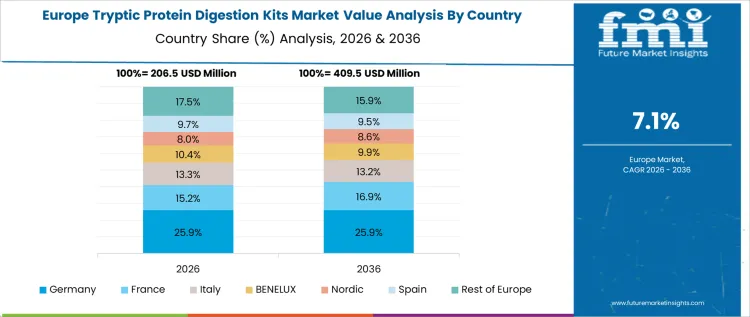
Tryptic protein digestion demand in Germany is growing at a CAGR of 7.1%, shaped by strong academic research and industrial biotechnology presence. Research institutes emphasize method validation and reproducibility in proteomics experiments. Pharmaceutical laboratories use digestion kits to support analytical consistency. Funding stability supports continuous consumables procurement. Emphasis on quality standards moderates rapid volume increases. Growth remains steady, reflecting disciplined research activity and standardized laboratory practices rather than aggressive scale-up.
- Emphasis on reproducible proteomics methods
- Pharmaceutical analytical consistency needs
- Stable public research funding environment
- Strong laboratory quality standards
What is the competitive landscape of demand for the tryptic protein digestion kits market globally?
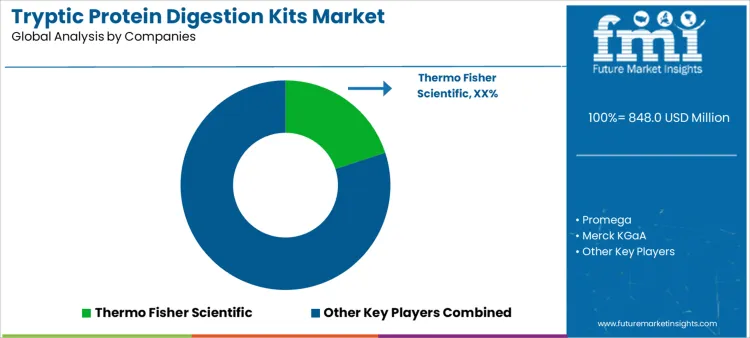
Demand for tryptic protein digestion kits is shaped by proteomics standardization, biomarker validation workflows, and regulated bioanalytical testing requirements. Laboratories assess digestion reproducibility, enzyme specificity, autolysis suppression, batch consistency, and compatibility with mass spectrometry platforms. Buyer evaluation includes protocol simplicity, sample throughput suitability, storage stability, and robustness across complex biological matrices. Procurement behavior emphasizes lot traceability, validated performance documentation, and supplier capability to support method transfer across sites. Trend in the tryptic protein digestion kits market reflects increasing use in clinical proteomics, translational research, and high-throughput discovery pipelines requiring reliable digestion performance.
Thermo Fisher Scientific leads competitive positioning through high-purity trypsin kits integrated within comprehensive proteomics and mass spectrometry ecosystems. Promega competes by supplying sequencing-grade digestion kits valued for consistency, ease of use, and adoption in regulated laboratories. Merck KGaA supports demand through branded proteomics reagents aligned with quality management systems and global distribution reach. Waters maintains relevance by positioning digestion kits alongside chromatography and mass spectrometry workflows used in analytical laboratories. Competitive differentiation centers on enzyme activity consistency, documentation quality, workflow compatibility, and dependable supply supporting reproducible proteomic analysis.
Key Players in the Tryptic Protein Digestion Kits Market
- Thermo Fisher Scientific
- Promega
- Merck KGaA
- Waters
- Agilent Technologies
- Others
Scope of the Report
| Items | Values |
|---|---|
| Quantitative Units | USD million |
| Testing Kits | Sequencing-grade trypsin reagents; Immobilized / rapid digestion kits; Protein cleanup & desalting kits; Automation-compatible digestion kits; QC standards & reference peptides; Enzyme blends & specialty proteases |
| Applications | Discovery proteomics; Biotherapeutic characterization; Clinical proteomics & biomarker discovery; PTM mapping workflows; QC / release testing |
| End User | Academic & research institutes; Biopharma manufacturers; Biotech companies; CROs / CMOs; Proteomics core facilities |
| Regions Covered | Asia Pacific, Europe, North America, Latin America, Middle East & Africa |
| Countries Covered | India, Brazil, China, USA, Germany, and 40+ countries |
| Key Companies Profiled | Thermo Fisher Scientific; Promega; Merck KGaA; Waters; Agilent Technologies; Others |
| Additional Attributes | Dollar sales by testing kit type, application, and end user; digestion efficiency, specificity, and reproducibility across sequencing-grade and immobilized trypsin systems; compatibility with automated and high-throughput proteomics workflows; impact on peptide coverage, PTM preservation, and data quality; quality control requirements for regulated biopharma analysis; procurement patterns driven by research funding cycles, biologics development pipelines, and centralized proteomics facilities. |
Tryptic Protein Digestion Kits Market by Segment
Testing Kits:
- Sequencing-grade trypsin reagents
- Immobilized / rapid digestion kits
- Protein cleanup & desalting kits
- Automation-compatible digestion kits
- QC standards & reference peptides
- Enzyme blends & specialty proteases
Applications:
- Discovery proteomics
- Biotherapeutic characterization
- Clinical proteomics & biomarker discovery
- PTM mapping workflows
- QC / release testing
End User:
- Academic & research institutes
- Biopharma manufacturers
- Biotech companies
- CROs / CMOs
- Proteomics core facilities
Region:
- Asia Pacific
- China
- Japan
- South Korea
- India
- Australia & New Zealand
- ASEAN
- Rest of Asia Pacific
- Europe
- Germany
- United Kingdom
- France
- Italy
- Spain
- Nordic
- BENELUX
- Rest of Europe
- North America
- United States
- Canada
- Mexico
- Latin America
- Brazil
- Chile
- Rest of Latin America
- Middle East & Africa
- Kingdom of Saudi Arabia
- Other GCC Countries
- Turkey
- South Africa
- Other African Union
- Rest of Middle East & Africa
Bibliography
- International Organization for Standardization. (2023). ISO 17294-2: Biotechnology – Analytical methods for protein characterization using mass spectrometry. ISO.
- United States Food and Drug Administration. (2023). Bioanalytical method validation: Guidance for industry. U.S. Department of Health and Human Services.
- European Medicines Agency. (2024). Guideline on bioanalytical method validation for protein and peptide analysis. EMA.
- United States Pharmacopeia. (2024). General chapter <1058> and related guidance on analytical procedure lifecycle for protein characterization. United States Pharmacopeia.
Frequently Asked Questions
How big is the tryptic protein digestion kits market in 2026?
The global tryptic protein digestion kits market is estimated to be valued at USD 848.0 million in 2026.
What will be the size of tryptic protein digestion kits market in 2036?
The market size for the tryptic protein digestion kits market is projected to reach USD 1,953.0 million by 2036.
How much will be the tryptic protein digestion kits market growth between 2026 and 2036?
The tryptic protein digestion kits market is expected to grow at a 8.7% CAGR between 2026 and 2036.
What are the key product types in the tryptic protein digestion kits market?
The key product types in tryptic protein digestion kits market are sequencing-grade trypsin reagents, immobilized / rapid digestion kits, protein cleanup & desalting kits, automation-compatible digestion kits, qc standards & reference peptides and enzyme blends & specialty proteases.
Which applications segment to contribute significant share in the tryptic protein digestion kits market in 2026?
In terms of applications, discovery proteomics segment to command 30.0% share in the tryptic protein digestion kits market in 2026.
Preview the report firsthand - request a free sample
Get SampleGet the brochure for pricing and purchase details.
Get PDFTable of Content
- Executive Summary
- Global Market Outlook
- Demand-side Trends
- Supply-side Trends
- Technology Roadmap Analysis
- Analysis and Recommendations
- Market Overview
- Market Coverage / Taxonomy
- Market Definition / Scope / Limitations
- Market Background
- Market Dynamics
- Drivers
- Restraints
- Opportunity
- Trends
- Scenario Forecast
- Demand in Optimistic Scenario
- Demand in Likely Scenario
- Demand in Conservative Scenario
- Opportunity Map Analysis
- Product Life Cycle Analysis
- Supply Chain Analysis
- Investment Feasibility Matrix
- Value Chain Analysis
- PESTLE and Porter’s Analysis
- Regulatory Landscape
- Regional Parent Market Outlook
- Production and Consumption Statistics
- Import and Export Statistics
- Market Dynamics
- Global Market Analysis 2021 to 2025 and Forecast, 2026 to 2036
- Historical Market Size Value (USD Million) Analysis, 2021 to 2025
- Current and Future Market Size Value (USD Million) Projections, 2026 to 2036
- Y-o-Y Growth Trend Analysis
- Absolute $ Opportunity Analysis
- Global Market Pricing Analysis 2021 to 2025 and Forecast 2026 to 2036
- Global Market Analysis 2021 to 2025 and Forecast 2026 to 2036, By Testing Kits
- Introduction / Key Findings
- Historical Market Size Value (USD Million) Analysis By Testing Kits , 2021 to 2025
- Current and Future Market Size Value (USD Million) Analysis and Forecast By Testing Kits , 2026 to 2036
- Sequencing-grade trypsin reagents
- Immobilized / rapid digestion kits
- Protein cleanup & desalting kits
- Automation-compatible digestion kits
- QC standards & reference peptides
- Enzyme blends & specialty proteases
- Sequencing-grade trypsin reagents
- Y-o-Y Growth Trend Analysis By Testing Kits , 2021 to 2025
- Absolute $ Opportunity Analysis By Testing Kits , 2026 to 2036
- Global Market Analysis 2021 to 2025 and Forecast 2026 to 2036, By Applications
- Introduction / Key Findings
- Historical Market Size Value (USD Million) Analysis By Applications, 2021 to 2025
- Current and Future Market Size Value (USD Million) Analysis and Forecast By Applications, 2026 to 2036
- Discovery proteomics
- Biotherapeutic characterization
- Clinical proteomics & biomarker discovery
- PTM mapping workflows
- QC / release testing
- Discovery proteomics
- Y-o-Y Growth Trend Analysis By Applications, 2021 to 2025
- Absolute $ Opportunity Analysis By Applications, 2026 to 2036
- Global Market Analysis 2021 to 2025 and Forecast 2026 to 2036, By End User
- Introduction / Key Findings
- Historical Market Size Value (USD Million) Analysis By End User, 2021 to 2025
- Current and Future Market Size Value (USD Million) Analysis and Forecast By End User, 2026 to 2036
- Academic & research institutes
- Biopharma manufacturers
- Biotech companies
- CROs / CMOs
- Proteomics core facilities
- Academic & research institutes
- Y-o-Y Growth Trend Analysis By End User, 2021 to 2025
- Absolute $ Opportunity Analysis By End User, 2026 to 2036
- Global Market Analysis 2021 to 2025 and Forecast 2026 to 2036, By Region
- Introduction
- Historical Market Size Value (USD Million) Analysis By Region, 2021 to 2025
- Current Market Size Value (USD Million) Analysis and Forecast By Region, 2026 to 2036
- North America
- Latin America
- Western Europe
- Eastern Europe
- East Asia
- South Asia and Pacific
- Middle East & Africa
- Market Attractiveness Analysis By Region
- North America Market Analysis 2021 to 2025 and Forecast 2026 to 2036, By Country
- Historical Market Size Value (USD Million) Trend Analysis By Market Taxonomy, 2021 to 2025
- Market Size Value (USD Million) Forecast By Market Taxonomy, 2026 to 2036
- By Country
- USA
- Canada
- Mexico
- By Testing Kits
- By Applications
- By End User
- By Country
- Market Attractiveness Analysis
- By Country
- By Testing Kits
- By Applications
- By End User
- Key Takeaways
- Latin America Market Analysis 2021 to 2025 and Forecast 2026 to 2036, By Country
- Historical Market Size Value (USD Million) Trend Analysis By Market Taxonomy, 2021 to 2025
- Market Size Value (USD Million) Forecast By Market Taxonomy, 2026 to 2036
- By Country
- Brazil
- Chile
- Rest of Latin America
- By Testing Kits
- By Applications
- By End User
- By Country
- Market Attractiveness Analysis
- By Country
- By Testing Kits
- By Applications
- By End User
- Key Takeaways
- Western Europe Market Analysis 2021 to 2025 and Forecast 2026 to 2036, By Country
- Historical Market Size Value (USD Million) Trend Analysis By Market Taxonomy, 2021 to 2025
- Market Size Value (USD Million) Forecast By Market Taxonomy, 2026 to 2036
- By Country
- Germany
- UK
- Italy
- Spain
- France
- Nordic
- BENELUX
- Rest of Western Europe
- By Testing Kits
- By Applications
- By End User
- By Country
- Market Attractiveness Analysis
- By Country
- By Testing Kits
- By Applications
- By End User
- Key Takeaways
- Eastern Europe Market Analysis 2021 to 2025 and Forecast 2026 to 2036, By Country
- Historical Market Size Value (USD Million) Trend Analysis By Market Taxonomy, 2021 to 2025
- Market Size Value (USD Million) Forecast By Market Taxonomy, 2026 to 2036
- By Country
- Russia
- Poland
- Hungary
- Balkan & Baltic
- Rest of Eastern Europe
- By Testing Kits
- By Applications
- By End User
- By Country
- Market Attractiveness Analysis
- By Country
- By Testing Kits
- By Applications
- By End User
- Key Takeaways
- East Asia Market Analysis 2021 to 2025 and Forecast 2026 to 2036, By Country
- Historical Market Size Value (USD Million) Trend Analysis By Market Taxonomy, 2021 to 2025
- Market Size Value (USD Million) Forecast By Market Taxonomy, 2026 to 2036
- By Country
- China
- Japan
- South Korea
- By Testing Kits
- By Applications
- By End User
- By Country
- Market Attractiveness Analysis
- By Country
- By Testing Kits
- By Applications
- By End User
- Key Takeaways
- South Asia and Pacific Market Analysis 2021 to 2025 and Forecast 2026 to 2036, By Country
- Historical Market Size Value (USD Million) Trend Analysis By Market Taxonomy, 2021 to 2025
- Market Size Value (USD Million) Forecast By Market Taxonomy, 2026 to 2036
- By Country
- India
- ASEAN
- Australia & New Zealand
- Rest of South Asia and Pacific
- By Testing Kits
- By Applications
- By End User
- By Country
- Market Attractiveness Analysis
- By Country
- By Testing Kits
- By Applications
- By End User
- Key Takeaways
- Middle East & Africa Market Analysis 2021 to 2025 and Forecast 2026 to 2036, By Country
- Historical Market Size Value (USD Million) Trend Analysis By Market Taxonomy, 2021 to 2025
- Market Size Value (USD Million) Forecast By Market Taxonomy, 2026 to 2036
- By Country
- Kingdom of Saudi Arabia
- Other GCC Countries
- Turkiye
- South Africa
- Other African Union
- Rest of Middle East & Africa
- By Testing Kits
- By Applications
- By End User
- By Country
- Market Attractiveness Analysis
- By Country
- By Testing Kits
- By Applications
- By End User
- Key Takeaways
- Key Countries Market Analysis
- USA
- Pricing Analysis
- Market Share Analysis, 2025
- By Testing Kits
- By Applications
- By End User
- Canada
- Pricing Analysis
- Market Share Analysis, 2025
- By Testing Kits
- By Applications
- By End User
- Mexico
- Pricing Analysis
- Market Share Analysis, 2025
- By Testing Kits
- By Applications
- By End User
- Brazil
- Pricing Analysis
- Market Share Analysis, 2025
- By Testing Kits
- By Applications
- By End User
- Chile
- Pricing Analysis
- Market Share Analysis, 2025
- By Testing Kits
- By Applications
- By End User
- Germany
- Pricing Analysis
- Market Share Analysis, 2025
- By Testing Kits
- By Applications
- By End User
- UK
- Pricing Analysis
- Market Share Analysis, 2025
- By Testing Kits
- By Applications
- By End User
- Italy
- Pricing Analysis
- Market Share Analysis, 2025
- By Testing Kits
- By Applications
- By End User
- Spain
- Pricing Analysis
- Market Share Analysis, 2025
- By Testing Kits
- By Applications
- By End User
- France
- Pricing Analysis
- Market Share Analysis, 2025
- By Testing Kits
- By Applications
- By End User
- India
- Pricing Analysis
- Market Share Analysis, 2025
- By Testing Kits
- By Applications
- By End User
- ASEAN
- Pricing Analysis
- Market Share Analysis, 2025
- By Testing Kits
- By Applications
- By End User
- Australia & New Zealand
- Pricing Analysis
- Market Share Analysis, 2025
- By Testing Kits
- By Applications
- By End User
- China
- Pricing Analysis
- Market Share Analysis, 2025
- By Testing Kits
- By Applications
- By End User
- Japan
- Pricing Analysis
- Market Share Analysis, 2025
- By Testing Kits
- By Applications
- By End User
- South Korea
- Pricing Analysis
- Market Share Analysis, 2025
- By Testing Kits
- By Applications
- By End User
- Russia
- Pricing Analysis
- Market Share Analysis, 2025
- By Testing Kits
- By Applications
- By End User
- Poland
- Pricing Analysis
- Market Share Analysis, 2025
- By Testing Kits
- By Applications
- By End User
- Hungary
- Pricing Analysis
- Market Share Analysis, 2025
- By Testing Kits
- By Applications
- By End User
- Kingdom of Saudi Arabia
- Pricing Analysis
- Market Share Analysis, 2025
- By Testing Kits
- By Applications
- By End User
- Turkiye
- Pricing Analysis
- Market Share Analysis, 2025
- By Testing Kits
- By Applications
- By End User
- South Africa
- Pricing Analysis
- Market Share Analysis, 2025
- By Testing Kits
- By Applications
- By End User
- USA
- Market Structure Analysis
- Competition Dashboard
- Competition Benchmarking
- Market Share Analysis of Top Players
- By Regional
- By Testing Kits
- By Applications
- By End User
- Competition Analysis
- Competition Deep Dive
- Thermo Fisher Scientific
- Overview
- Product Portfolio
- Profitability by Market Segments (Product/Age /Sales Channel/Region)
- Sales Footprint
- Strategy Overview
- Marketing Strategy
- Product Strategy
- Channel Strategy
- Promega
- Merck KGaA
- Waters
- Agilent Technologies
- Others
- Thermo Fisher Scientific
- Competition Deep Dive
- Assumptions & Acronyms Used
- Research Methodology


