

- Industry Size (2026)
- USD 1928.3 Mn
- Forecast (2036)
- USD 2713.2 Mn
- CAGR (2026 to 2036)
- 3.5%
Demand for Functional Flavour in the UK 2026 to 2036
Demand for functional flavour in the UK is likely to be valued at USD 1,928.3 million in 2026 and is projected to reach USD 2,713.2 million by 2036, reflecting a 3.5% CAGR. This demand is rooted in how flavour systems now carry responsibility beyond taste delivery, serving as a structural component in foods and beverages positioned around wellness, performance, and nutritional intent.
Functional flavour adoption in the UK is shaped by formulation challenges linked to vitamins, botanicals, proteins, and mineral systems. Product developers rely on these flavour solutions to correct bitterness, manage aftertaste, and preserve sensory balance across shelf life and processing conditions. Reliability of flavour expression, stability under heat and pH stress, and consistency across production runs guide purchasing decisions more than novelty profiles.
Usage patterns reflect integration into daily consumption categories rather than limited experimentation. Beverages, fortified snacks, and nutrition-oriented foods depend on flavour systems that maintain familiarity while supporting functional positioning. Development teams prioritize solutions that align with regulatory boundaries, ingredient cost control, and scalable manufacturing. Demand strength is sustained by the role functional flavour plays in protecting repeat purchase behavior, supporting product credibility, and enabling functional formulations to meet everyday taste expectations without compromising performance.
Quick Stats for Functional Flavour Industry in the UK
- Functional Flavour Industry Value (2026): USD 1,928.3 million
- Functional Flavour Industry Forecast Value (2036): USD 2,713.2 million
- Functional Flavour Industry Forecast CAGR (2026–2036): 3.5%
- Leading Application by Demand Share: Functional beverages
- Fastest-Growing Regions: England, Scotland, Wales, Northern Ireland
- Key Industry Participants: Symrise AG, Frutarom Industries Ltd, Wild Flavors and Specialty Ingredients, Takasago International Corporation, Excellentia International Firmenich SA
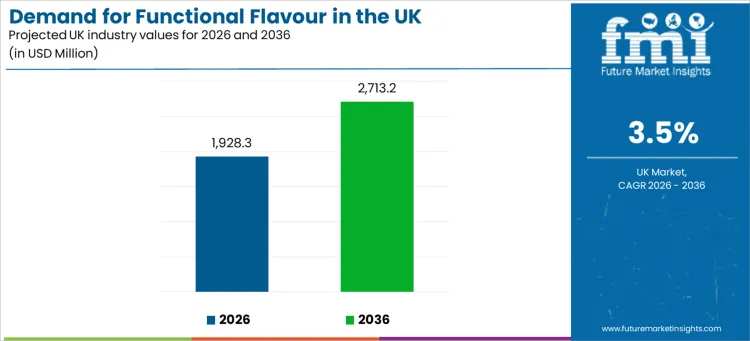
Functional Flavour Industry in the UK Key Takeaways
| Metric | Value |
|---|---|
| Industry Value (2026) | USD 1,928.3 million |
| Industry Forecast Value (2036) | USD 2,713.2 million |
| Forecast CAGR (2026 to 2036) | 3.5% |
Why is the UK Building Steady Demand for Functional Flavour?
Consumer preferences in the UK are shifting toward foods and beverages that deliver sensory satisfaction and perceived wellness benefits. Shoppers increasingly seek products that combine bold, memorable tastes with functional attributes such as digestive comfort, energy support, or immune encouragement. Functional flavour meets this need by blending taste innovation with ingredient profiles that suggest added benefit, making every day eating feel purposeful rather than ordinary.
Product developers in the UK respond with creative flavour formulations that reflect both trending and enduring cultural influences. Ingredients like turmeric, ginger, botanical extracts, and fermented notes feature in drinks, snacks, and meal accompaniments because they convey taste complexity alongside associations with wellbeing. Retailers and food service operators spot rising uptake in these products and adjust offerings, particularly in premium and health-oriented lines, to match evolving consumer expectations.
Purchase behaviour in the UK also reflects greater openness to experimenting within familiar categories. When consumers encounter functional flavour profiles that deliver satisfying taste and offer a narrative of benefit, they tend to repurchase and recommend to peers. Brands that articulate clear, credible functional benefits without overcomplicating the eating experience gain traction, reinforcing demand as UK diets evolve toward more purposeful flavour experiences.
How is Functional Flavour Demand Segmented by Application and Type in the UK?
Demand for functional flavour in the UK reflects how product developers balance sensory delivery with performance expectations tied to health positioning, stability, and repeat consumption. Segmentation follows formulation practicality, processing tolerance, and the need to maintain flavour impact under functional ingredient loads.
Why do functional beverages lead application-level demand?
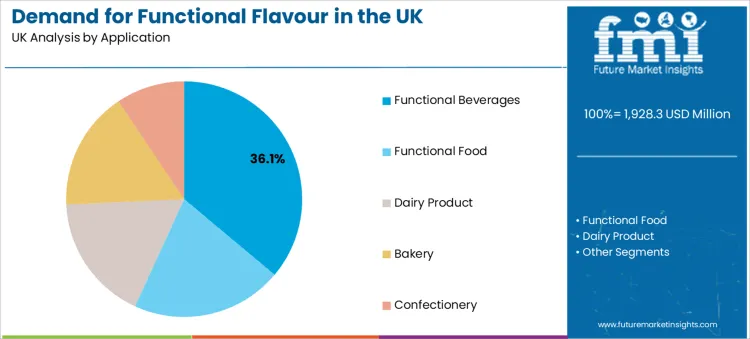
Functional beverages hold a 36.1% share, placing them as the primary application area. Beverage formats require immediate flavour perception to offset bitterness, astringency, or metallic notes introduced by vitamins, minerals, botanicals, and protein systems. Liquid formats place flavour under constant stress from pH variation, thermal treatment, and shelf-life exposure, which increases reliance on robust flavour systems.
Developers favour beverages because flavour adjustments can be tuned rapidly during product optimization without altering texture or structure. This flexibility supports faster reformulation cycles when nutrition targets shift or regulatory thresholds change. Consumption frequency also strengthens demand, since beverages form part of daily routines rather than occasional intake occasions.
What keeps synthetic flavours dominant across functional formulations?
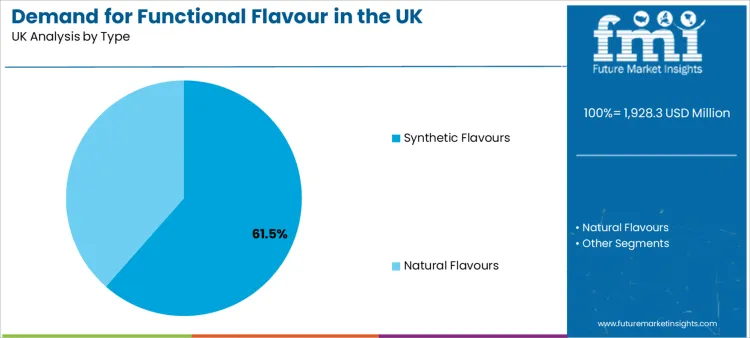
Synthetic flavours account for a 61.5% share, reflecting their consistency, cost discipline, and processing resilience. These flavours deliver repeatable sensory output across high-shear mixing, heat exposure, and extended storage, which suits functional recipes carrying complex ingredient matrices. Predictable flavour strength reduces reformulation risk and simplifies scale-up from pilot to commercial production.
Product teams also value the precision offered by synthetic systems, where flavour intensity and release timing can be controlled tightly. This supports uniform taste delivery across batches and production sites, limiting variability that could undermine consumer trust in functional products positioned around efficacy and reliability.
What shapes demand for functional flavour in the UK?
Demand for functional flavour in the UK reflects consumer preference for taste profiles that deliver specific sensory and health-related expectations in food and beverage products. Functional flavours are used to mask bitter or off-notes from botanicals, vitamins, proteins and botanical extracts and to enhance perceived freshness, fruit intensity or savory complexity. Growth is linked to expanded product development in sports nutrition, adult health drinks, fortified snacks and botanical soft drinks where taste quality directly influences repeat purchase behavior.
How do consumer expectations and category expansion drive uptake of functional flavour solutions?
In the UK industry, consumer interest in better-for-you products that still deliver enjoyable taste experiences strongly influences demand for functional flavour systems. Brands reformulating products to include probiotics, plant proteins and fibre concentrates often encounter sensory challenges that can reduce palatability; functional flavour solutions help align flavour perception with category norms. Sports and active lifestyle drinks use tailored flavour systems to support citrus, berry or exotic notes that persist through cold storage without bitterness.
Adult nutrition formats such as fortified waters and botanical beverages rely on compounds that balance herbal or functional ingredients with familiar, pleasing taste profiles. Retailers in mainstream and health food channels increasingly request formulations that meet specific sensory performance criteria in target segments.
What constraints related to ingredient cost and regulatory compliance influence industry growth?
Growth of functional flavour demand in the UK is influenced by cost considerations and regulatory interpretation of flavour and health claim guidelines. Formulators often face higher ingredient costs for specialised flavour modulators that deliver targeted sensory outcomes, which can limit use in value-oriented segments. Complex supply chains for botanical extracts and high-performance flavour systems can expose cost volatility and sourcing risk when crop yields vary seasonally or geopolitically.
Regulatory frameworks on labelling and permitted use of certain flavour compounds affect where specific solutions can be marketed with health or functional messaging without additional compliance documentation. Flavour systems must also demonstrate stability under UK processing regimes, including pasteurisation and cold fill bottling, requiring iterative development and sensory validation. Ingredient interaction with sweeteners, acids and texturants common in fortified foods adds further complexity for developers seeking robust flavour performance in diverse matrices.
How is Functional Flavour Demand Evolving across Key Regions in the UK?
Demand for functional flavour across the UK progresses as manufacturers pursue taste optimization alongside health positioning and formulation efficiency. Regional variation reflects product development intensity, co-manufacturing scale, technical capability in flavour systems, and how quickly teams align sensory outcomes with functional performance targets.
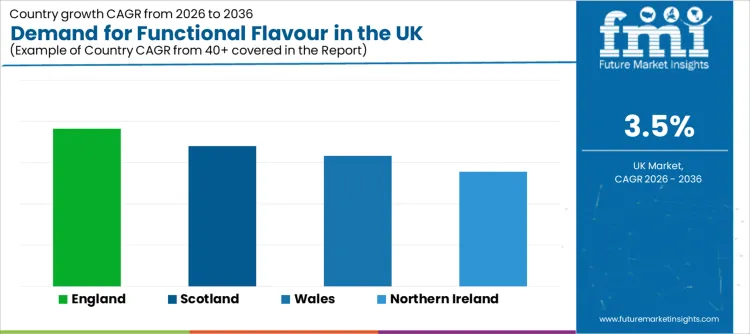
| Region | CAGR (2026-2036) |
|---|---|
| England | 3.8% |
| Scotland | 3.4% |
| Wales | 3.2% |
| Northern Ireland | 2.8% |
Why is England leading expansion through formulation scale and innovation intensity?
England grows at 3.8%, supported by a dense base of food and beverage developers running frequent reformulation cycles. Demand strengthens where flavour systems deliver taste masking, mouthfeel support, and stability within complex recipes. Buyers prioritize partners that integrate smoothly into rapid development pipelines, enabling consistent sensory outcomes across high-volume production and diversified product portfolios.
How is Scotland progressing through focused adoption in performance-led food categories?
Scotland expands at 3.4%, shaped by selective uptake within categories that link flavour performance to functional claims. Manufacturers favour solutions that maintain taste integrity while supporting protein fortification, sugar reduction, or nutrient delivery. Demand rises where flavour houses provide dependable technical support and ensure repeatable sensory profiles across smaller yet quality-driven production runs.
What is shaping Wales as manufacturers balance functionality with formulation simplicity?
Wales advances at 3.2%, driven by practical adoption among producers seeking functional benefits without adding formulation complexity. Demand builds when flavours support sweetness modulation, bitterness control, or aroma lift using streamlined ingredient systems. Purchasing decisions focus on ease of integration, predictable performance, and compatibility with existing processing conditions and validation frameworks.
Why is Northern Ireland showing measured growth tied to targeted application use?
Northern Ireland records 2.8% growth, reflecting targeted use within specific food and beverage applications rather than broad portfolio rollout. Adoption expands where functional flavours demonstrate clear sensory value in nutritionally positioned products. Demand improves when suppliers deliver stable performance, consistent supply, and clear technical guidance suited to narrower production scopes.
What Defines the Competitive Landscape for Functional Flavour in the UK?
Demand for functional flavour in the UK is influenced by growth in fortified foods, sports nutrition, functional beverages, and wellness-oriented confectionery. Buyers focus on flavour systems that can mask bitterness from vitamins, minerals, botanicals, and plant proteins while maintaining clean taste delivery. Evaluation criteria include stability under heat and pH variation, compatibility with reduced sugar or salt formulations, and compliance with UK and EU flavour regulations. Procurement behavior favors suppliers offering application-specific flavour modulation, rapid reformulation support, and sensory validation aligned with local consumer preferences. Trend in the UK industry reflects increasing use of functional flavours to support health claims without compromising taste acceptance.
Symrise AG holds strong positioning in the UK through advanced flavour modulation technologies supporting functional nutrition and beverage applications. Wild Flavors and Specialty Ingredients competes by integrating functional flavours with natural extracts and colour systems suited for clean-label products. Frutarom Industries maintains relevance through customised flavour solutions targeting fortified dairy, bakery, and savoury categories. Takasago International Corporation supports demand with precision flavour systems emphasizing balance in complex functional matrices. Ungerer Limited and Excellentia International Firmenich SA participate through specialised aroma and flavour offerings tailored to niche functional and wellness segments. Competitive differentiation centers on sensory performance, formulation adaptability, regulatory assurance, and depth of application expertise.
Key Industry Participants
- Ungerer Limited
- Frutarom Industries Ltd
- Wild Flavors and Specialty Ingredients
- Excellentia International Firmenich SA
- Symrise AG
- Takasago International Corporation
Scope of Report
| Items | Values |
|---|---|
| Quantitative Units | USD million |
| Application | Functional Beverages; Functional Food; Dairy Product; Bakery; Confectionery |
| Type | Synthetic Flavours; Natural Flavours |
| Regions Covered | England; Scotland; Wales; Northern Ireland |
| Key Companies Profiled | Ungerer Limited; Frutarom Industries Ltd; Wild Flavors and Specialty Ingredients; Excellentia International Firmenich SA; Symrise AG; Takasago International Corporation |
Functional Flavour Demand in the UK by Segments
Application:
- Functional Beverages
- Functional Food
- Dairy Product
- Bakery
- Confectionery
Type:
- Synthetic Flavours
- Natural Flavours
By Region:
- England
- Scotland
- Wales
- Northern Ireland
Bibliography
- Food Standards Agency. (2023). Flavourings and food ingredients with flavouring properties: UK regulatory guidance. UK Government.
- Food Standards Agency. (2024). Guidance on the use of flavourings in foods and beverages. UK Government.
- Department for Environment, Food & Rural Affairs. (2023). UK food supply, formulation practices, and ingredient usage trends. UK Government.
- Department for Environment, Food & Rural Affairs. (2024). Food and drink manufacturing inputs and reformulation activity in the UK. UK Government.
- British Nutrition Foundation. (2023). Functional ingredients, sensory perception, and consumer acceptance in foods. British Nutrition Foundation.
- McMahon, D. J., Oberg, C. J., & Broadbent, J. R. (2023). Flavour masking and modulation strategies in fortified and functional foods. Journal of Food Science, 88(6), 2451–2464.
Preview the report firsthand - request a free sample
Get SampleGet the brochure for pricing and purchase details.
Get PDFTable of Content
- Executive Summary
- UK Market Outlook
- Demand-side Trends
- Supply-side Trends
- Technology Roadmap Analysis
- Analysis and Recommendations
- Market Overview
- Market Coverage / Taxonomy
- Market Definition / Scope / Limitations
- Market Background
- Market Dynamics
- Drivers
- Restraints
- Opportunity
- Trends
- Scenario Forecast
- Demand in Optimistic Scenario
- Demand in Likely Scenario
- Demand in Conservative Scenario
- Opportunity Map Analysis
- Product Life Cycle Analysis
- Supply Chain Analysis
- Investment Feasibility Matrix
- Value Chain Analysis
- PESTLE and Porter’s Analysis
- Regulatory Landscape
- Regional Parent Market Outlook
- Production and Consumption Statistics
- Import and Export Statistics
- Market Dynamics
- UK Market Analysis 2021 to 2025 and Forecast, 2026 to 2036
- Historical Market Size Value (USD Million) Analysis, 2021 to 2025
- Current and Future Market Size Value (USD Million) Projections, 2026 to 2036
- Y-o-Y Growth Trend Analysis
- Absolute $ Opportunity Analysis
- UK Market Pricing Analysis 2021 to 2025 and Forecast 2026 to 2036
- UK Market Analysis 2021 to 2025 and Forecast 2026 to 2036, By Application
- Introduction / Key Findings
- Historical Market Size Value (USD Million) Analysis By Application , 2021 to 2025
- Current and Future Market Size Value (USD Million) Analysis and Forecast By Application , 2026 to 2036
- Functional Beverages
- Functional Food
- Dairy Product
- Bakery
- Confectionery
- Functional Beverages
- Y-o-Y Growth Trend Analysis By Application , 2021 to 2025
- Absolute $ Opportunity Analysis By Application , 2026 to 2036
- UK Market Analysis 2021 to 2025 and Forecast 2026 to 2036, By Type
- Introduction / Key Findings
- Historical Market Size Value (USD Million) Analysis By Type, 2021 to 2025
- Current and Future Market Size Value (USD Million) Analysis and Forecast By Type, 2026 to 2036
- Synthetic Flavours
- Natural Flavours
- Synthetic Flavours
- Y-o-Y Growth Trend Analysis By Type, 2021 to 2025
- Absolute $ Opportunity Analysis By Type, 2026 to 2036
- Market Structure Analysis
- Competition Dashboard
- Competition Benchmarking
- Market Share Analysis of Top Players
- By Regional
- By Application
- By Type
- Competition Analysis
- Competition Deep Dive
- Ungerer Limited
- Overview
- Product Portfolio
- Profitability by Market Segments (Product/Age /Sales Channel/Region)
- Sales Footprint
- Strategy Overview
- Marketing Strategy
- Product Strategy
- Channel Strategy
- Frutarom Industries Ltd
- Wild Flavors and Specialty Ingredients
- Excellentia International Firmenich SA
- Symrise AG
- Takasago International Corporation
- Ungerer Limited
- Competition Deep Dive
- Assumptions & Acronyms Used
- Research Methodology


