

- Industry Size (2025)
- USD 4.7 Bn
- Forecast (2035)
- USD 11.1 Bn
- CAGR (2025 to 2035)
- 8.90%
Demand for Alopecia Treatment in USA Forecast and Outlook 2025 to 2035
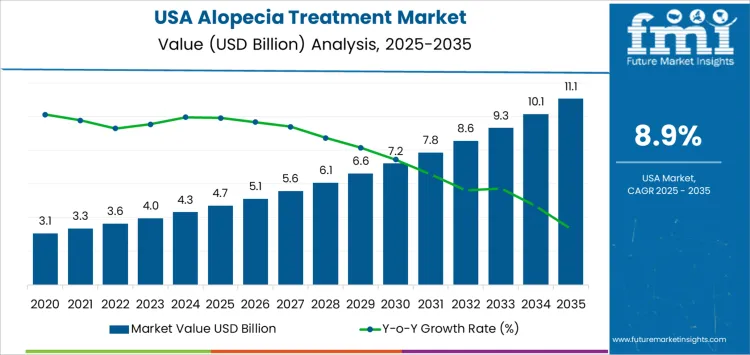
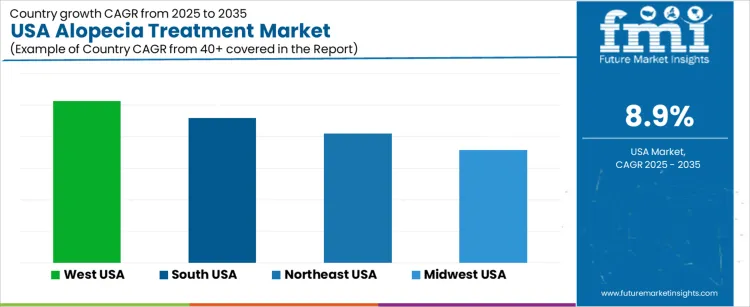
Demand for alopecia treatment in the USA is expected to grow from USD 4.7 billion in 2025 to USD 11.1 billion in 2035, with a forecast CAGR of 8.90%. Demand is increasing across all regions, with West USA leading with a 10.3% CAGR, driven by its advanced healthcare infrastructure and high awareness of aesthetic procedures. In the South USA, demand is rising at a 9.2% CAGR, driven by growing interest in hair restoration and hair-loss treatments. Northeast USA follows with an 8.2% CAGR, driven by its well-established healthcare system and the growing adoption of medical and cosmetic solutions for hair loss. Midwest USA shows a more gradual growth at a 7.1% CAGR, with demand steadily increasing due to rising awareness and access to effective alopecia treatments.
Quick Stats of the Demand for Alopecia Treatment in USA
- Demand for Alopecia Treatment in USA Value (2025): USD 4.7 billion
- Demand for Alopecia Treatment in USA Forecast Value (2035): USD 11.1 billion
- Demand for Alopecia Treatment in USA Forecast CAGR (2025-2035): 8.90%
- Demand for Alopecia Treatment in USA Leading Dosage Form: Hair Transplant Services
- Demand for Alopecia Treatment in USA Key Growth Regions: West USA, South USA, Northeast USA, Midwest USA
- Demand for Alopecia Treatment in USA Top Players: Pfizer Inc., Teva Pharmaceuticals USA, Inc., Sun Pharmaceuticals, Sandoz, Abbott
In West USA, high consumer awareness and access to advanced treatment options, including hair transplants, contribute to the region’s leading demand. Demand in South USA is driven by increasing healthcare investments and access to clinics offering non-invasive and medical treatments for alopecia. Northeast USA’s robust healthcare network supports steady growth, particularly in urban areas with easy access to diverse treatment options. In Midwest USA, demand is expanding as more people become aware of available treatments, with cities like Chicago seeing increased adoption of both medical and cosmetic therapies. Despite slower growth in the Rest of USA, the ongoing expansion of healthcare infrastructure and telemedicine services is contributing to a steady rise in demand. With the prevalence of alopecia increasing across the country, these trends are expected to persist throughout the forecast period.
Demand for Alopecia Treatment in USA Key Takeaways
| Metric | Value |
|---|---|
| Demand for Alopecia Treatment in USA Value (2025) | USD 4.7 billion |
| Demand for Alopecia Treatment in USA Forecast Value (2035) | USD 11.1 billion |
| Demand for Alopecia Treatment in USA Forecast CAGR (2025-2035) | 8.90% |
Why is the Demand for Alopecia Treatment in USA Growing?
The demand for alopecia treatment in the USA is growing due to the increasing prevalence of hair loss, particularly among both men and women. Alopecia, which includes conditions like androgenic alopecia and alopecia areata, affects millions of people, leading to a surge in the demand for treatments that can address this condition. With the rising awareness about the impact of hair loss on self-esteem and mental health, more individuals are seeking effective solutions, contributing to the growing demand for treatments. This includes the use of oral medications, topical treatments, and emerging therapies like hair transplants and laser therapies.
Advancements in medical treatments for alopecia are another key driver. Innovations in prescription medications such as finasteride and minoxidil, along with the introduction of new biologics and platelet-rich plasma (PRP) therapies, are providing more effective options for managing hair loss. As these treatments gain popularity, their widespread use is increasing, particularly among patients seeking non-invasive or minimally invasive solutions. The growing acceptance of aesthetic treatments has encouraged more people to seek out these solutions as a means of restoring their hair.
The rising demand for cosmetic procedures also plays a significant role in the growth of the alopecia treatment industry. As the cosmetic and wellness industries continue to expand, more treatment options are becoming available. challenges such as the high cost of advanced treatments and the variability in treatment effectiveness for different individuals may present barriers. The ongoing advancements in treatment technologies and growing awareness are expected to drive significant growth in the demand for alopecia treatments in the USA.
What is the Segment-Wise Analysis of Demand for Alopecia Treatment in USA?
Demand for alopecia treatment in the USA is segmented by dosage form, sales channel, indication, and region. By dosage form, hair transplant services lead at 23%, followed by topical drugs, oral drugs, injectables, drug therapy, and low-level laser therapy. In terms of sales channel, hospitals dominate with 38%, followed by hair care clinics, dermatology clinics, retail pharmacy chains, and online sales channels. The key indications for alopecia treatment include alopecia areata, alopecia totalis, alopecia universalis, alopecia barbae, chemotherapy-induced alopecia, and other types of hair loss. Regionally, demand spans across West USA, South USA, Northeast USA, and Midwest USA.
How Do Hair Transplant Services Lead the Demand for Alopecia Treatment in USA?
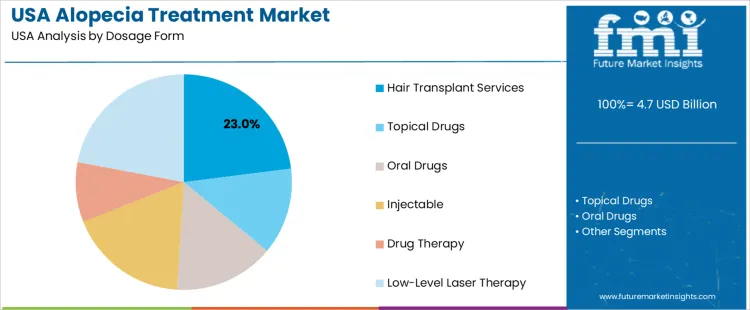
Hair transplant services account for 23% of the demand for alopecia treatment in the USA, driven by their effectiveness in providing permanent hair restoration. Hair transplant procedures, such as follicular unit extraction (FUE) and follicular unit transplantation (FUT), are widely sought after by individuals with severe hair loss, particularly those with androgenetic alopecia or other forms of permanent hair thinning. The demand for hair transplant services is particularly strong in regions like West USA and South USA, where cosmetic procedures are widely popular. Growing awareness of advanced hair restoration techniques spreads, more people are turning to hair transplants as a reliable and lasting solution for hair loss. The high success rate of these procedures, combined with increasing acceptance of cosmetic treatments, ensures that hair transplant services remain a leading choice for alopecia treatment in the USA.
Why Do Hospitals Lead the Demand for Alopecia Treatment in USA?
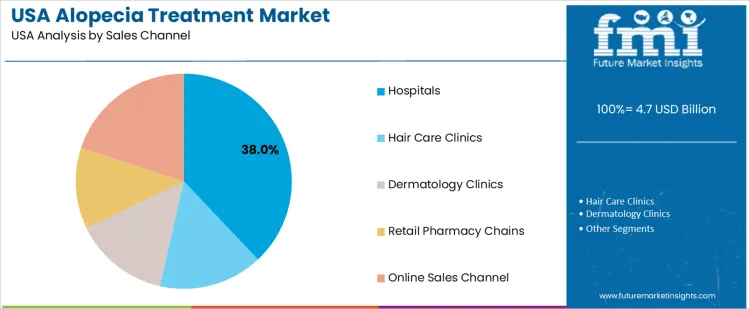
Hospitals account for 38% of the demand for alopecia treatment in the USA, reflecting their role as a primary setting for medical interventions in severe hair loss cases. Hospitals are crucial for providing specialized treatments, such as drug therapies, injectable treatments, and even hair transplant services for patients with significant hair loss. The high volume of patients seeking medical treatments for alopecia, including those with chemotherapy-induced alopecia or other medical conditions, contributes to the strong demand in hospital settings. Hospitals also offer a wider range of treatment options, including advanced diagnostic tools and specialist consultations. In regions like the Northeast and Midwest USA, where healthcare infrastructure is robust, hospitals play a leading role in offering comprehensive alopecia treatments. Individuals seek professional care for hair loss, hospitals continue to be the primary sales channel for alopecia treatment in the USA.
What are the Key Trends, Drivers, and Restraints in Demand for Alopecia Treatment in USA?
Demand for alopecia treatments in the USA is steadily increasing due to a combination of factors. The prevalence of hair loss, particularly androgenetic alopecia and autoimmune-related conditions, is widespread, affecting both men and women. There is a growing acceptance of seeking medical treatments for hair loss, driven by increased awareness and the availability of various treatment options. Technological advances in medical research have introduced more effective therapies, including FDA-approved drugs, laser treatments, and regenerative medicine approaches. Despite these advancements, some restraints limit adoption. Existing treatments may take months to show results and are not universally effective, leading to patient dissatisfaction. Side effects and the long-term nature of treatment regimens may also deter individuals.
Why is Demand for Alopecia Treatment Growing in the USA?
The demand for alopecia treatment in the USA is growing due to several key factors. The high incidence of hair loss, particularly with an aging population, drives individuals to seek treatments for thinning or balding hair. Hair loss affects not only physical appearance but also self-esteem, making it a significant concern for many people. As a result, there is increased interest in available therapies. Societal attitudes toward personal appearance has evolved, with more people being proactive about addressing concerns such as hair loss. Advancements in treatment options, such as FDA-approved topical medications and hair regrowth treatments, have made it easier for individuals to manage their condition. Awareness campaigns and media discussions have reduced the stigma surrounding alopecia, encouraging people to seek professional help and try new treatments.
How are Technological & Industry Innovations Driving Alopecia Treatment Demand in the USA?
Innovations in drug development, such as topical medications and oral treatments, have expanded the range of available solutions for patients. Advancements in hair restoration techniques, such as laser therapy and follicle regeneration, offer non-invasive options that show promising results. Stem-cell therapies and platelet-rich plasma (PRP) treatments are emerging as potential solutions for restoring hair growth. These technological innovations not only enhance the effectiveness of treatments but also provide patients with a variety of options tailored to their specific needs. As research continues, new and more efficient methods of treating alopecia are expected to emerge, further driving demand. The continuous evolution of these treatments has improved patient outcomes, and as they become more affordable and accessible, the adoption of these solutions is expected to rise, further fueling the demand for alopecia treatments.
What are the Key Challenges and Risks That Could Limit Alopecia Treatment Demand in the USA?
One key challenge is the variability in treatment outcomes. Many therapies do not work for all patients, and the results can take several months to become visible. This uncertainty can lead to frustration and reduced satisfaction with the treatments. Some treatments may cause side effects, which could discourage continued use. Another obstacle is the cost of more advanced treatments, such as hair transplants or prescription medications, which may not be covered by insurance, limiting access for individuals without comprehensive healthcare plans. There is also the issue of societal attitudes; although there is growing acceptance of seeking treatment for alopecia, some individuals may still feel self-conscious about pursuing solutions, particularly in more conservative or less open communities.
What is the Demand Outlook for Alopecia Treatment in USA?
| Region | CAGR (%) |
|---|---|
| West USA | 10.3% |
| South USA | 9.2% |
| Northeast USA | 8.2% |
| Midwest USA | 7.1% |
Demand for alopecia treatment in the USA is growing across all regions, with West USA leading at a 10.3% CAGR, driven by high awareness and access to advanced treatment options. South USA follows closely with a 9.2% CAGR, supported by increasing consumer interest in aesthetic and hair loss treatments. Northeast USA shows an 8.2% CAGR, with a well-established healthcare network and rising demand for both medical and cosmetic solutions. Midwest USA experiences a 7.1% CAGR, as increasing awareness and availability of treatment options contribute to steady growth. As the prevalence of alopecia rises and more treatment options become accessible, the demand for alopecia treatment is expected to continue growing across all regions in the USA.
How is Demand for Alopecia Treatment Growing in West USA?
West USA leads the demand for alopecia treatment, growing at a 10.3% CAGR. The region’s strong focus on wellness and advanced cosmetic procedures contributes significantly to this growth. States like California are known for offering a wide variety of aesthetic services, including hair transplants and oral medications for alopecia. High consumer awareness and access to innovative treatments drive demand, especially among younger consumers seeking solutions for hair loss. The region’s healthcare system also supports a variety of treatment options tailored to different stages of alopecia. West USA's emphasis on self-care and beauty fuels the growing interest in non-invasive and medical treatments. As demand for personalized care increases, the adoption of alopecia treatment technologies is expected to remain high in the region.
Why is Demand for Alopecia Treatment Rising in South USA?
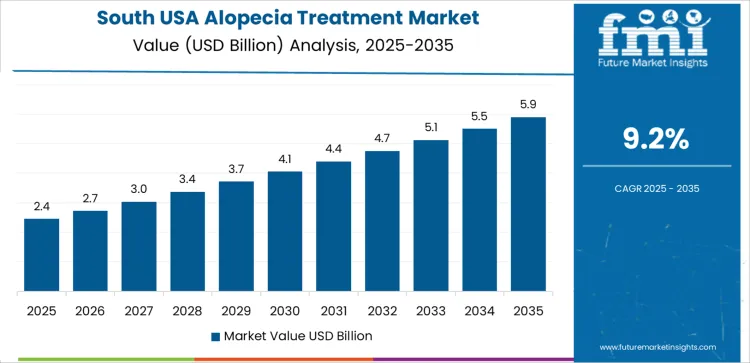
In South USA, demand for alopecia treatment is rising at a 9.2% CAGR. The region’s growing consumer interest in aesthetic treatments is contributing to this trend, especially in states like Texas and Florida. As awareness of hair loss solutions grows, people are increasingly turning to treatments such as hair restoration, medications, and topical solutions. The region's warm climate and increasing number of specialized clinics are making alopecia treatments more accessible. The evolving perception of beauty and appearance, coupled with an increasing number of individuals seeking both medical and non-medical solutions for alopecia, is also driving demand. South USA’s healthcare providers are offering a broader range of advanced treatments, meeting the region’s growing need for effective hair loss solutions. This trend will continue as awareness and demand for effective treatments rise.
How is Demand for Alopecia Treatment Expanding in Northeast USA?
Northeast USA shows steady demand for alopecia treatment, growing at an 8.2% CAGR. The region's established healthcare network, especially in cities like New York and Boston, has led to widespread adoption of hair loss treatments. As awareness of alopecia increases, both medical and cosmetic solutions are gaining popularity among consumers. The availability of a wide range of treatment options, from topical treatments to hair transplants, supports steady growth. The region’s focus on healthcare innovation and the demand for personalized treatment plans has fueled the adoption of advanced alopecia solutions. With a strong healthcare infrastructure and rising consumer demand for aesthetic procedures, the need for alopecia treatments is expected to continue expanding in the Northeast, meeting the growing demand for effective hair restoration solutions.
Why is Demand for Alopecia Treatment Growing in Midwest USA?
Midwest USA is experiencing steady demand for alopecia treatment, growing at a 7.1% CAGR. The region's growing awareness of hair loss treatments, combined with increasing access to innovative solutions, is driving this demand. Cities like Chicago are seeing an uptick in both medical and cosmetic treatments for alopecia, including hair restoration and topical solutions. As more healthcare providers incorporate these treatments into their services, more patients are turning to effective methods for managing hair loss. The region’s increasing focus on aesthetic procedures and the adoption of advanced healthcare solutions further support the steady growth in alopecia treatment demand. With greater awareness and evolving consumer preferences for non-invasive solutions, the demand for alopecia treatment is expected to continue rising steadily in the Midwest, reflecting the region’s growing interest in personalized, effective care.
What is Driving the Demand for Treatments for Alopecia in USA and Who Are the Key Suppliers?
The demand for treatments for alopecia in the USA is growing as more individual’s experience hair‑loss conditions such as androgenetic alopecia and Alopecia Areata. These conditions, which affect a significant portion of the population, can arise from genetic factors, hormonal imbalances, stress, or autoimmune responses. Hair loss, particularly when it is noticeable or progressive, can lead to significant psychological and social impacts, contributing to a heightened desire for effective treatments. The growing awareness of available options, coupled with advancements in medical research, is driving the demand for both cosmetic and medical solutions to address hair loss.
Key suppliers of alopecia treatments in the USA include Pfizer Inc., Teva Pharmaceuticals USA, Inc., Sun Pharmaceuticals, Sandoz, and Abbott Laboratories. Pfizer, which holds around 30.0% of the industry share, is a major player in providing systemic therapies and topical treatments. These companies offer a range of treatment options to manage different types and severities of alopecia. These include well‑known treatments such as minoxidil and finasteride, as well as emerging therapies that target the underlying causes of hair loss, offering more tailored approaches.
Newer approaches such as platelet-rich plasma (PRP) injections, low‑level laser therapy (LLLT), and stem cell therapies are gaining traction. These methods are seen as promising alternatives to more conventional treatments, and they are growing in popularity among individuals seeking non-invasive and advanced solutions for hair restoration. With ongoing advancements in biotechnology and dermatology, more treatments are expected to become available, further enhancing the options for people dealing with hair loss.
Key Players in USA Alopecia Treatment Demand
- Pfizer Inc.
- Teva Pharmaceuticals USA, Inc.
- Sun Pharmaceuticals
- Sandoz
- Abbott
Scope of Report
| Items | Values |
|---|---|
| Quantitative Units (2025) | USD billion |
| Dosage Form | Hair Transplant Services, Topical Drugs, Oral Drugs, Injectable, Drug Therapy, Low-Level Laser Therapy |
| Indication | Alopecia Areata, Alopecia Totalis, Alopecia Universalis, Alopecia Barbae, Chemotherapy Induced Alopecia, Others |
| Sales Channel | Hospitals, Hair Care Clinics, Dermatology Clinics, Retail Pharmacy Chains, Online Sales Channel |
| Region | West USA, South USA, Northeast USA, Midwest USA |
| Countries Covered | USA |
| Key Companies Profiled | Pfizer Inc., Teva Pharmaceuticals USA, Inc., Sun Pharmaceuticals, Sandoz, Abbott |
| Additional Attributes | Dollar sales by dosage form and indication; regional CAGR and growth outlook; increasing use of hair transplant services and laser therapy; innovations in alopecia drug therapies |
USA Alopecia Treatment Demand by Key Segments
Dosage Form
- Hair Transplant Services
- Topical Drugs
- Oral Drugs
- Injectable
- Drug Therapy
- Low-Level Laser Therapy
Indication
- Alopecia Areata
- Alopecia Totalis
- Alopecia Universalis
- Alopecia Barbae
- Chemotherapy Induced Alopecia
- Others
Sales Channel
- Hospitals
- Hair Care Clinics
- Dermatology Clinics
- Retail Pharmacy Chains
- Online Sales Channel
Region
- West USA
- South USA
- Northeast USA
- Midwest USA
Frequently Asked Questions
How big is the demand for alopecia treatment in USA in 2025?
The demand for alopecia treatment in USA is estimated to be valued at USD 4.7 billion in 2025.
What will be the size of alopecia treatment in USA in 2035?
The market size for the alopecia treatment in USA is projected to reach USD 11.1 billion by 2035.
How much will be the demand for alopecia treatment in USA growth between 2025 and 2035?
The demand for alopecia treatment in USA is expected to grow at a 8.9% CAGR between 2025 and 2035.
What are the key product types in the alopecia treatment in USA?
The key product types in alopecia treatment in USA are hair transplant services, topical drugs, oral drugs, injectable, drug therapy and low-level laser therapy.
Which indication segment is expected to contribute significant share in the alopecia treatment in USA in 2025?
In terms of indication, alopecia areata segment is expected to command 24.0% share in the alopecia treatment in USA in 2025.
Preview the report firsthand - request a free sample
Get SampleGet the brochure for pricing and purchase details.
Get PDFTable of Content
- Executive Summary
- USA Market Outlook
- Demand-side Trends
- Supply-side Trends
- Technology Roadmap Analysis
- Analysis and Recommendations
- Market Overview
- Market Coverage / Taxonomy
- Market Definition / Scope / Limitations
- Market Background
- Market Dynamics
- Drivers
- Restraints
- Opportunity
- Trends
- Scenario Forecast
- Demand in Optimistic Scenario
- Demand in Likely Scenario
- Demand in Conservative Scenario
- Opportunity Map Analysis
- Product Life Cycle Analysis
- Supply Chain Analysis
- Investment Feasibility Matrix
- Value Chain Analysis
- PESTLE and Porter’s Analysis
- Regulatory Landscape
- Regional Parent Market Outlook
- Production and Consumption Statistics
- Import and Export Statistics
- Market Dynamics
- USA Market Analysis 2020 to 2024 and Forecast, 2025 to 2035
- Historical Market Size Value (USD Million) Analysis, 2020 to 2024
- Current and Future Market Size Value (USD Million) Projections, 2025 to 2035
- Y-o-Y Growth Trend Analysis
- Absolute $ Opportunity Analysis
- USA Market Pricing Analysis 2020 to 2024 and Forecast 2025 to 2035
- USA Market Analysis 2020 to 2024 and Forecast 2025 to 2035, By Dosage Form
- Introduction / Key Findings
- Historical Market Size Value (USD Million) Analysis By Dosage Form , 2020 to 2024
- Current and Future Market Size Value (USD Million) Analysis and Forecast By Dosage Form , 2025 to 2035
- Hair Transplant Services
- Topical Drugs
- Oral Drugs
- Injectable
- Drug Therapy
- Low-Level Laser Therapy
- Y-o-Y Growth Trend Analysis By Dosage Form , 2020 to 2024
- Absolute $ Opportunity Analysis By Dosage Form , 2025 to 2035
- USA Market Analysis 2020 to 2024 and Forecast 2025 to 2035, By Indication
- Introduction / Key Findings
- Historical Market Size Value (USD Million) Analysis By Indication, 2020 to 2024
- Current and Future Market Size Value (USD Million) Analysis and Forecast By Indication, 2025 to 2035
- Alopecia Areata
- Alopecia Totalis
- Alopecia Universalis
- Alopecia Barbae
- Chemotherapy Induced Alopecia
- Others
- Y-o-Y Growth Trend Analysis By Indication, 2020 to 2024
- Absolute $ Opportunity Analysis By Indication, 2025 to 2035
- USA Market Analysis 2020 to 2024 and Forecast 2025 to 2035, By Sales Channel
- Introduction / Key Findings
- Historical Market Size Value (USD Million) Analysis By Sales Channel, 2020 to 2024
- Current and Future Market Size Value (USD Million) Analysis and Forecast By Sales Channel, 2025 to 2035
- Hospitals
- Hair Care Clinics
- Dermatology Clinics
- Retail Pharmacy Chains
- Online Sales Channel
- Y-o-Y Growth Trend Analysis By Sales Channel, 2020 to 2024
- Absolute $ Opportunity Analysis By Sales Channel, 2025 to 2035
- Market Structure Analysis
- Competition Dashboard
- Competition Benchmarking
- Market Share Analysis of Top Players
- By Regional
- By Dosage Form
- By Indication
- By Sales Channel
- Competition Analysis
- Competition Deep Dive
- Teva Pharmaceuticals USA, Inc.
- Overview
- Product Portfolio
- Profitability by Market Segments (Product/Age /Sales Channel/Region)
- Sales Footprint
- Strategy Overview
- Marketing Strategy
- Product Strategy
- Channel Strategy
- Sun Pharmaceuticals
- Sandoz
- Abbott
- Teva Pharmaceuticals USA, Inc.
- Competition Deep Dive
- Assumptions & Acronyms Used
- Research Methodology


