

- Industry Size (2025)
- USD 0.5 Bn
- Forecast (2035)
- USD 0.9 Bn
- CAGR (2025 to 2035)
- 7.1%
Demand for Burns Treatment in USA 2025 to 2035
The USA burns treatment demand is valued at USD 0.5 billion in 2025 and is forecasted to reach USD 0.9 billion by 2035, reflecting a CAGR of 7.1%. Demand is influenced by the persistent incidence of thermal, chemical, and electrical burns across residential, industrial, and outdoor environments. Increased utilization of advanced wound-management products in emergency departments, specialized burn centers, and outpatient care contributes to steady expansion. Broader awareness of infection prevention, moisture balance, and tissue-regeneration requirements also shapes treatment preferences.
Wound care dressings lead the treatment landscape. These dressings are selected for their ability to maintain optimal healing conditions, support autolytic debridement, and provide antimicrobial protection. Hydrogels, hydrofibers, silicone dressings, and silver-based products are widely adopted for superficial and partial-thickness burns. Improvements in conformability, exudate management, and atraumatic removal support greater clinical acceptance across acute and long-term care.
Quick Stats for USA Burns Treatment Demand
- USA Burns Treatment Sales Value (2025): USD 0.5 billion
- USA Burns Treatment Forecast Value (2035): USD 0.9 billion
- USA Burns Treatment Forecast CAGR (2025 to 2035): 7.1%
- Leading Treatment Type in USA Burns Treatment Demand: Wound Care Dressings
- Key Growth Regions in USA Burns Treatment Demand: West USA, South USA, Northeast USA
- Top Players in USA Burns Treatment Demand: Smith & Nephew plc, Mölnlycke Health Care AB, 3M Healthcare, Coloplast A/S, Convatec Group Plc
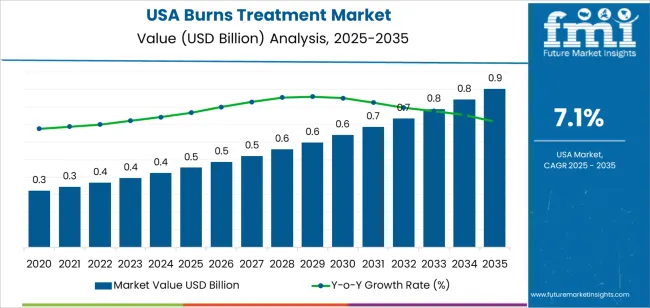
What is the Growth Forecast for Burns Treatment Industry in USA through 2035?
West USA, South USA, and Northeast USA represent the highest utilization regions due to the presence of major trauma hospitals, burn units, and rehabilitation facilities. These regions also demonstrate strong procurement capacity for advanced dressing systems and infection-control products. Key suppliers include Smith & Nephew plc, Mölnlycke Health Care AB, 3M Healthcare, Coloplast A/S, and Convatec Group Plc. These companies provide advanced wound dressings, fluid-management materials, and skin-regeneration solutions used in acute burn care and post-treatment recovery.
Growth momentum in the USA burns-treatment segment remains steady across the forecast horizon. Early-period momentum is anchored in broader adoption of advanced wound-care materials, including bioengineered skin substitutes and improved grafting products. Hospitals expand standardized burn-care pathways, which increases treatment intensity and supports consistent year-to-year gains. Clinical practice improvements, such as enhanced debridement techniques and infection-control solutions, also help maintain an upward trajectory during the initial years.
Mid-period momentum follows a similar pattern as more facilities integrate modern burn-care protocols and expand access to specialist services. Utilization rises as trauma centers align with updated guidelines, strengthening demand for supportive products and procedural treatments. In the later period, momentum stabilizes as adoption across major systems reaches maturity. Growth continues through replacement cycles, incremental therapy upgrades, and expanded access to specialized burn units, but annual changes become more uniform. The momentum profile reflects a consistent expansion phase with limited volatility, shaped by clinical need, procedural standardization, and gradual advances in burn-care technologies.
USA Burns Treatment Key Takeaways
| Metric | Value |
|---|---|
| USA Burns Treatment Sales Value (2025) | USD 0.5 billion |
| USA Burns Treatment Forecast Value (2035) | USD 0.9 billion |
| USA Burns Treatment Forecast CAGR (2025-2035) | 7.1% |
Why is the Demand for Burns Treatment in the USA Growing?
Demand for burns treatment in the USA is increasing as the incidence of burn injuries and the need for advanced wound-care management continue to rise. The ageing population and greater prevalence of comorbidities such as diabetes and vascular disease raise the risk of burn complications and slow healing. The demand for treatments that focus on long-term outcomes, such as skin grafts, biologic skin substitutes and advanced dressings, supports growth in specialized burn-care services.
Hospitals and dedicated burn-centers require more advanced technologies to reduce healing time, control infection risk and improve cosmetic and functional outcomes. Constraints include high cost of advanced burn-care products and procedures, lengthy rehabilitation periods, and limited reimbursement clarity for newer therapies. Some smaller health-care facilities may still rely on standard dressings or surgical options rather than costlier biologic or regenerative solutions.
Which Treatment Types and Burn-Degree Categories Lead Demand for Burns Treatment in the USA?
Demand for burns treatment in the United States reflects the range of clinical interventions required across outpatient clinics, emergency departments, and specialised burn centres. Treatment-type selection depends on burn severity, wound depth, infection-prevention needs, and healing timelines. Burn-degree distribution demonstrates how patients present across first-, second-, and third-degree injuries, each requiring varying levels of medical attention and resource utilization.
By Treatment Type, Wound Care Dressings Account for the Largest Share of Demand
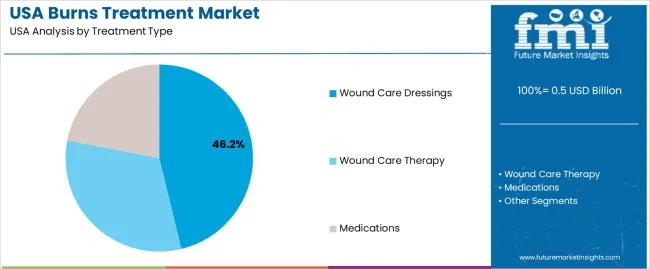
Wound care dressings hold 46.2% of national demand and represent the leading treatment category. Dressings support moisture control, bacterial-barrier protection, and consistent wound-healing conditions for superficial and partial-thickness burns. Wound care therapy accounts for 31.8%, including debridement methods, negative-pressure systems, and advanced modalities used for deeper wounds or slow-healing tissue. Medications represent 22.0%, covering topical antimicrobials, systemic analgesics, and anti-inflammatory agents prescribed for symptom control and infection management. Treatment-type distribution reflects clinical triage routines, wound depth, and healing goals across USA care settings treating mild to complex burn injuries.
Key drivers and attributes:
- Dressings support moisture balance and infection control.
- Therapies assist with debridement and advanced wound management.
- Medications address pain, inflammation, and infection risk.
- Treatment choice reflects wound depth and healing trajectory.
By Degree of Burn, Second-Degree Burns Account for the Largest Share of Demand
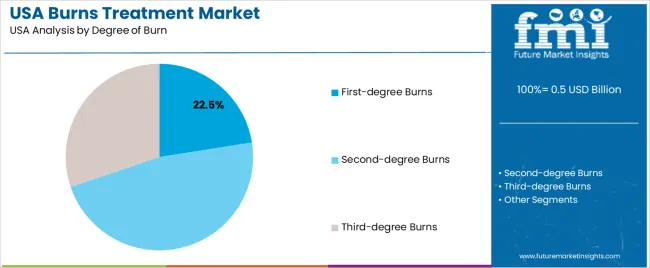
Second-degree burns hold 47.3% of national demand and represent the most treated burn category. These injuries involve partial-thickness skin damage, requiring structured wound care, fluid management, and infection monitoring. First-degree burns account for 22.5%, covering superficial injuries generally treated with moisturising agents, basic dressings, and short clinic visits. Third-degree burns represent 30.2%, requiring specialised intervention such as excision, grafting, and intensive rehabilitation. Degree-of-burn distribution reflects patient exposure patterns, severity incidence, and clinical load across USA hospitals and burn units treating thermal, chemical, and electrical injuries.
Key drivers and attributes:
- Second-degree burns require structured and prolonged care.
- First-degree cases need basic wound protection.
- Third-degree burns demand surgical and advanced interventions.
- Burn severity influences treatment intensity and resource use.
What are the Drivers, Restraints, and Key Trends of the Demand for Burns Treatment in the USA?
Rising incidence of fire- and chemical-related burns, expansion of outpatient burn-care centers and higher survival rates from severe burns are driving demand.
In the United States, the number of people treated for burn injuries remains significant due to residential fire incidents, industrial accidents and increasing use of cosmetic/medical procedures that carry risk of thermal damage. Dedicated burn centers in states such as Texas, California and Florida are expanding, enabling treatment of more moderate and severe burns outside intensive hospital settings. Advances in emergency response, trauma-care protocols and reconstructive-surgery capabilities are resulting in higher survival, more follow-up treatments and thus greater demand for advanced dressings, skin-substitutes and rehabilitation services.
High treatment cost, limited trained specialists in rural industries and differences in reimbursement pathways restrain growth.
Burn-treatment episodes often involve prolonged hospital stays, multidisciplinary care teams, costly grafting or biological dressings and intensive rehabilitation, which increases cost burden for hospitals, payers and patients. In many rural or underserved regions of the USA, access to dedicated burn-units or specialist surgeons is limited, which may delay treatment or lead to referral out of region, reducing volume in local industries. Variability in coverage from Medicare, Medicaid and private insurers for newer biologic dressings or outpatient treatment centers may slow uptake of the latest therapies, even when clinical benefit is recognized.
Growth of regenerative skin-substitutes, increased use of tele-burn care and rising focus on scar-minimization and cosmetic-outcome treatments define key trends.
Manufacturers are introducing bioengineered skin-substitute products, stem-cell seeded scaffolds and dressings with integrated antimicrobial agents specifically for the USA industry where consumer expectations for cosmetic recovery are high. Telemedicine platforms and remote wound-care monitoring services are being adopted by burn centers to support post-discharge care, reduce readmissions and extend reach into suburban industries. Attention to aesthetic outcomes and scar management is increasing demand for treatments that shorten hospital stay, improve functional recovery and address quality-of-life for burn survivors, which expands the scope of burn-treatment solutions beyond immediate acute care.
Analysis of the Demand for Burns Treatment in the USA by Region
Demand for burns treatment in the USA is rising through 2035 as hospitals, trauma centers, outpatient wound-care clinics, and emergency departments expand services for thermal, chemical, electrical, and friction-related burn injuries. Growth is supported by wider adoption of advanced wound-care dressings, biologic grafts, and infection-control therapies. Burn centers integrate hydrogel systems, antimicrobial films, collagen matrices, and regenerative-tissue products to support faster healing and lower complication risks.
Occupational injuries, household accidents, and wildfire-related burn incidents contribute to regional variation. Insurance coverage for advanced wound care and broader access to specialized burn facilities also influence demand patterns. West USA leads at 8.2%, followed by South USA (7.3%), Northeast USA (6.6%), and Midwest USA (5.7%).
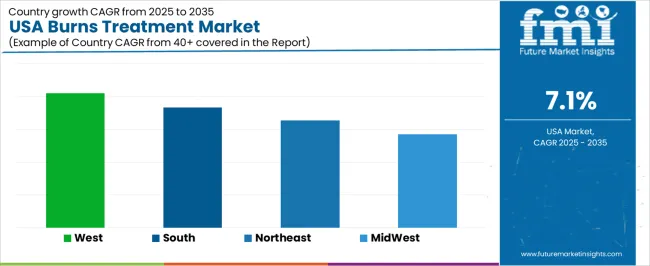
| Region | CAGR (2025-2035) |
|---|---|
| West USA | 8.2% |
| South USA | 7.3% |
| Northeast USA | 6.6% |
| Midwest USA | 5.7% |
How is the West USA region driving demand for burns treatment?
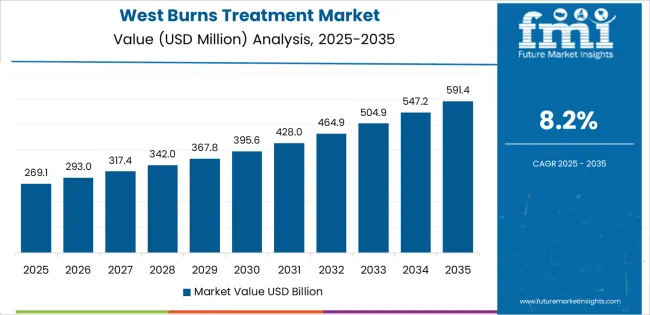
West USA grows at 8.2% CAGR, supported by wildfire-related burn injuries, high urban density, and broad access to specialized burn centers across California, Washington, Oregon, Colorado, Utah, and Arizona. Regional hospitals treat a steady volume of acute thermal burns linked to household accidents, industrial exposures, and outdoor hazards. Wildfire events in California and the Pacific Northwest increase demand for advanced wound dressings, antimicrobial therapies, and biologic skin substitutes. Burn centers integrate bioengineered grafts and hydrogel systems to manage partial- and full-thickness burns. Emergency departments across the West adopt rapid-assessment tools and standardized burn-care protocols. Research hospitals participate in clinical evaluations of regenerative-tissue treatments.
- Burn centers adopting advanced biologic and hydrogel dressings
- Wildfire-related injuries driving demand for specialized care
- Emergency departments expanding standardized burn-treatment protocols
- Research networks testing regenerative-tissue therapies
How is the South USA region shaping demand for burns treatment?
South USA grows at 7.3% CAGR, driven by high rates of occupational burn injuries, strong presence of trauma-care facilities, and regional population growth across Texas, Florida, Georgia, North Carolina, Tennessee, and Alabama. Industrial sectors such as manufacturing, oil and gas, construction, and food processing contribute to a steady volume of thermal and chemical burns requiring specialized treatment. Hospitals expand wound-care units to manage partial-thickness burns and chronic complications from delayed healing. Clinics adopt antimicrobial films, foam dressings, and collagen-based wound products to support outpatient treatment. Burn centers in major Southern cities increase capacity for severe cases requiring grafting.
- Occupational injuries increasing demand for burn treatment
- Hospitals expanding wound-care and burn-management units
- Outpatient clinics using antimicrobial and collagen dressings
- Regional burn centers treating severe trauma-related burns
How is the Northeast USA region influencing demand for burns treatment?
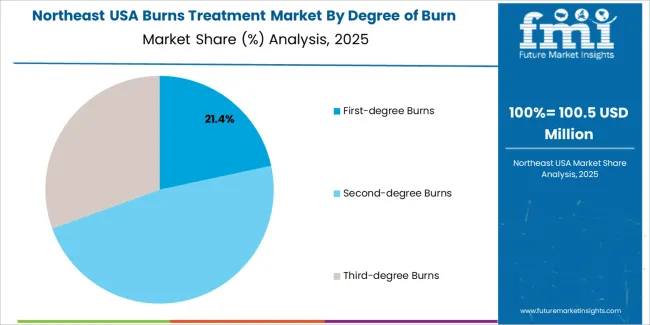
Northeast USA grows at 6.6% CAGR, shaped by dense urban populations, strong hospital networks, and established burn-treatment programs across New York, Massachusetts, Pennsylvania, New Jersey, and Connecticut. Regional hospitals treat burn injuries linked to residential heating systems, kitchen accidents, chemical exposures, and industrial incidents. Academic medical centers implement advanced therapies, including bioengineered skin substitutes and regenerative-tissue dressings for deep dermal burns. Outpatient wound-care clinics use hydrocolloid and hydrogel dressings to support controlled healing. Burn units coordinate with regional emergency services for rapid triage.
- Academic hospitals advancing biologic and regenerative burn therapies
- Wound-care clinics expanding hydrogel and hydrocolloid use
- Urban emergency services increasing burn-injury triage capacity
- Industrial and residential accidents maintaining treatment demand
How is the Midwest USA region contributing to demand for burns treatment?
Midwest USA grows at 5.7% CAGR, supported by broad hospital networks, strong industrial sectors, and steady need for outpatient wound management across Illinois, Ohio, Michigan, Minnesota, Wisconsin, and Iowa. Manufacturing and agricultural operations contribute to ongoing burn-treatment demand, particularly for thermal, chemical, and electrical injuries. Hospitals use advanced wound dressings, antimicrobial systems, and synthetic grafts to manage acute burns and prevent infection. Community clinics integrate foam, film, and alginate dressings for follow-up care. Burn centers in Midwestern states treat severe cases requiring surgical intervention.
- Hospitals adopting advanced wound-care and grafting materials
- Industrial and agricultural sectors contributing to treatment volumes
- Clinics using foam and alginate dressings for ongoing management
- Specialized burn centers supporting severe-trauma care
What is the competitive landscape of the demand for burns treatment in the USA?
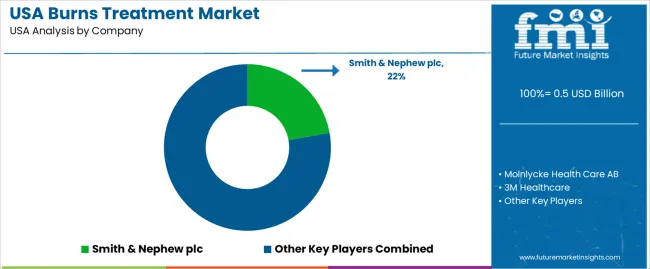
Demand for burns treatment in the USA is shaped by a concentrated group of wound-care and medical-device suppliers supporting hospitals, burn centres, emergency departments, and home-care networks. Smith & Nephew plc holds the leading position with an estimated 22.2% share, supported by controlled production of silver-based dressings, bioactive wound coverings, and negative-pressure systems used widely in partial- and full-thickness burn management. Its position is reinforced by consistent clinical performance, reliable moisture-balance control, and strong integration with USA hospital formularies.
Mölnlycke Health Care AB follows as a major participant, providing silicone-based dressings and absorbent foams designed for atraumatic removal and stable exudate management. These products are commonly used in USA burn units seeking predictable healing environments and reduced dressing-change trauma. 3M Healthcare maintains significant adoption through antimicrobial dressings, skin-substitute technologies, and advanced wound-care platforms with documented performance across acute burn care and graft-support protocols.
Coloplast A/S contributes products used for moist-wound management and long-duration wear, emphasizing controlled adhesion and stable handling characteristics suited to sensitive burn tissue. Convatec Group Plc adds further capability with hydrofiber and antimicrobial dressings used in both inpatient and outpatient burn-care pathways.
Competition across this segment centres on exudate control, antimicrobial effectiveness, dressing-change comfort, graft-support compatibility, and supply reliability. Demand remains steady as USA burn centres and emergency departments prioritise advanced wound-care materials that support consistent healing progression, reduce infection risk, and provide stable coverage across diverse burn-severity categories.
Key Players in USA Burns Treatment Demand
- Smith & Nephew plc
- Molnlycke Health Care AB
- 3M Healthcare
- Coloplast A/S
- Convatec Group Plc
Scope of the Report
| Items | Values |
|---|---|
| Quantitative Units | USD billion |
| Treatment Type | Wound Care Dressings, Wound Care Therapy, Medications |
| Degree of Burn | First-degree Burns, Second-degree Burns, Third-degree Burns |
| Regions Covered | West USA, South USA, Northeast USA, Midwest USA |
| Key Companies Profiled | Smith & Nephew plc, Mölnlycke Health Care AB, 3M Healthcare, Coloplast A/S, Convatec Group Plc |
| Additional Attributes | Dollar sales by treatment type and burn degree; regional adoption across West USA, South USA, Northeast USA, and Midwest USA; adoption of advanced hydrocolloids, antimicrobial dressings, biologics, and negative pressure therapy; competitive landscape of wound care and burn management suppliers; integration with hospitals, burn centers, emergency care, trauma units, and outpatient wound clinics. |
USA Burns Treatment Demand by Segments
Treatment Type:
- Wound Care Dressings
- Wound Care Therapy
- Medications
Degree of Burn:
- First-degree Burns
- Second-degree Burns
- Third-degree Burns
Region:
- West USA
- South USA
- Northeast USA
- Midwest USA
Frequently Asked Questions
How big is the demand for burns treatment in usa in 2025?
The demand for burns treatment in usa is estimated to be valued at USD 0.5 billion in 2025.
What will be the size of burns treatment in usa in 2035?
The market size for the burns treatment in usa is projected to reach USD 0.9 billion by 2035.
How much will be the demand for burns treatment in usa growth between 2025 and 2035?
The demand for burns treatment in usa is expected to grow at a 7.1% CAGR between 2025 and 2035.
What are the key product types in the burns treatment in usa?
The key product types in burns treatment in usa are wound care dressings, wound care therapy and medications.
Which degree of burn segment is expected to contribute significant share in the burns treatment in usa in 2025?
In terms of degree of burn, first-degree burns segment is expected to command 22.5% share in the burns treatment in usa in 2025.
Preview the report firsthand - request a free sample
Get SampleGet the brochure for pricing and purchase details.
Get PDFTable of Content
- Executive Summary
- USA Market Outlook
- Demand-side Trends
- Supply-side Trends
- Technology Roadmap Analysis
- Analysis and Recommendations
- Market Overview
- Market Coverage / Taxonomy
- Market Definition / Scope / Limitations
- Market Background
- Market Dynamics
- Drivers
- Restraints
- Opportunity
- Trends
- Scenario Forecast
- Demand in Optimistic Scenario
- Demand in Likely Scenario
- Demand in Conservative Scenario
- Opportunity Map Analysis
- Product Life Cycle Analysis
- Supply Chain Analysis
- Investment Feasibility Matrix
- Value Chain Analysis
- PESTLE and Porter’s Analysis
- Regulatory Landscape
- Regional Parent Market Outlook
- Production and Consumption Statistics
- Import and Export Statistics
- Market Dynamics
- USA Market Analysis 2020 to 2024 and Forecast, 2025 to 2035
- Historical Market Size Value (USD Million) Analysis, 2020 to 2024
- Current and Future Market Size Value (USD Million) Projections, 2025 to 2035
- Y-o-Y Growth Trend Analysis
- Absolute $ Opportunity Analysis
- USA Market Pricing Analysis 2020 to 2024 and Forecast 2025 to 2035
- USA Market Analysis 2020 to 2024 and Forecast 2025 to 2035, By Treatment Type
- Introduction / Key Findings
- Historical Market Size Value (USD Million) Analysis By Treatment Type , 2020 to 2024
- Current and Future Market Size Value (USD Million) Analysis and Forecast By Treatment Type , 2025 to 2035
- Wound Care Dressings
- Wound Care Therapy
- Medications
- Y-o-Y Growth Trend Analysis By Treatment Type , 2020 to 2024
- Absolute $ Opportunity Analysis By Treatment Type , 2025 to 2035
- USA Market Analysis 2020 to 2024 and Forecast 2025 to 2035, By Degree of Burn
- Introduction / Key Findings
- Historical Market Size Value (USD Million) Analysis By Degree of Burn, 2020 to 2024
- Current and Future Market Size Value (USD Million) Analysis and Forecast By Degree of Burn, 2025 to 2035
- First-degree Burns
- Second-degree Burns
- Third-degree Burns
- Y-o-Y Growth Trend Analysis By Degree of Burn, 2020 to 2024
- Absolute $ Opportunity Analysis By Degree of Burn, 2025 to 2035
- Market Structure Analysis
- Competition Dashboard
- Competition Benchmarking
- Market Share Analysis of Top Players
- By Regional
- By Treatment Type
- By Degree of Burn
- Competition Analysis
- Competition Deep Dive
- Smith & Nephew plc
- Overview
- Product Portfolio
- Profitability by Market Segments (Product/Age /Sales Channel/Region)
- Sales Footprint
- Strategy Overview
- Marketing Strategy
- Product Strategy
- Channel Strategy
- Molnlycke Health Care AB
- 3M Healthcare
- Coloplast A/S
- Convatec Group Plc
- Smith & Nephew plc
- Competition Deep Dive
- Assumptions & Acronyms Used
- Research Methodology


