

- Industry Size (2025)
- USD 0.6 Bn
- Forecast (2035)
- USD 1.0 Bn
- CAGR (2025 to 2035)
- 4.8%
Demand for Sound Sensor in USA 2025 to 2035
The USA sound sensor demand is valued at USD 0.6 billion in 2025 and is anticipated to reach USD 1.0 billion by 2035, reflecting a CAGR of 4.8%. Growth is supported by expanding use in consumer electronics, smart home devices, and automotive safety systems that rely on accurate acoustic detection. Security alarms, noise monitoring, and voice-enabled controls contribute to continuous integration into connected product ecosystems.
Surface acoustic wave (SAW) sensors represent the leading type due to high sensitivity, stable frequency response, and compact design that aligns with miniaturized electronics. Their durability and low power usage support deployment in portable devices and industrial machinery where precise noise measurement improves automation and operational safety. Continued innovation in MEMS-based sound sensing strengthens performance across multiple noise environments.
Quick Stats for USA Sound Sensor Demand
- USA Sound Sensor Sales Value (2025): USD 0.6 billion
- USA Sound Sensor Forecast Value (2035): USD 1.0 billion
- USA Sound Sensor Forecast CAGR (2025 to 2035): 4.8%
- Leading Type in USA Sound Sensor Demand: Surface Acoustic Wave (SAW) Sensor
- Key Growth Regions in USA Sound Sensor Demand: West USA, South USA, Northeast USA
- Top Players in USA Sound Sensor Demand: Knowles Corporation, STMicroelectronics, Infineon Technologies, Analog Devices Inc., Robert Bosch GmbH
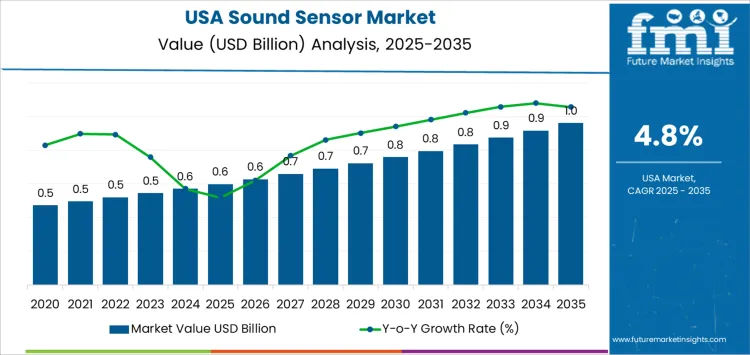
What is the Growth Forecast for Sound Sensor Industry in USA through 2035?
The West, South, and Northeast regions reflect strong technology adoption driven by dense consumer electronics manufacturing clusters and widespread implementation of smart infrastructure. Key suppliers include Knowles Corporation, STMicroelectronics, Infineon Technologies, Analog Devices Inc., and Robert Bosch GmbH. Strategic priorities focus on advanced signal processing, integration with AI-enabled systems, and product lines tailored for automotive and smart device applications requiring reliable acoustic accuracy.
Demand for sound sensors in the United States shows a stronger forward trajectory over the coming decade compared with the previous ten-year period. Earlier growth tied closely to basic voice activation in smartphones, household electronics, and security alarms. Adoption expanded steadily but within a limited cluster of applications. Hardware was often optimized for cost efficiency instead of performance enhancement, which kept year-to-year acceleration contained.
Future growth is broader in scope. Smart homes incorporate sound recognition for environmental awareness, acoustic analytics, and noise monitoring. Automotive platforms integrate sensors into advanced driver assistance and cabin comfort systems. Industrial facilities apply sound-based diagnostics to detect equipment anomalies. Medical devices rely on precise acoustic measurements for respiratory and cardiovascular monitoring. These sectors introduce more technically demanding use cases, creating higher value per unit.
Artificial intelligence improves localization accuracy, power efficiency, and background noise differentiation. Integration into multifunctional sensor modules supports scaling. This shift signals a transition from supplementary components to core enablers of connected environments. The next decade delivers more consistent and elevated gains relative to the prior period as adoption spreads across consumer, commercial, and infrastructure settings with a larger contribution from innovation-driven replacement cycles.
USA Sound Sensor Key Takeaways
| Metric | Value |
|---|---|
| USA Sound Sensor Sales Value (2025) | USD 0.6 billion |
| USA Sound Sensor Forecast Value (2035) | USD 1.0 billion |
| USA Sound Sensor Forecast CAGR (2025-2035) | 4.8% |
Why is the Demand for Sound Sensors in the USA Growing?
Demand for sound sensors in the USA is increasing because industries and consumers rely on audio-based detection for safety, automation and convenience applications. Smart home devices use sound sensors to detect door knocks, glass breaks or unusual noises, triggering alerts for homeowners. Security system providers integrate sensors into building alarms and intrusion detection applications where audio clues complement motion or video detection. Industrial and manufacturing facilities adopt sound sensors for machine monitoring and predictive maintenance. Sensors detect unusual acoustic patterns or vibrations that indicate mechanical faults such as bearing wear or leaks. Early detection helps prevent costly downtime and supports maintenance scheduling in automotive plants, warehouses and production lines.
Healthcare and elder care services use sound-responsive devices to monitor patient environments or alert caregivers when calls for help or cries occur. Educational facilities and public buildings use acoustic sensors to manage noise levels, building automation and environmental comfort in shared spaces. Constraints include privacy concerns when audio monitoring is used in residential or public environments and interference from ambient noise that can reduce detection accuracy. Calibration and sensitivity tuning are required for reliable performance. Some use cases require integration with other sensors for robust detection, which can increase system complexity and cost.
Which Types and Industry Technologies Lead Demand for Sound Sensors in the United States?
Demand for sound sensors in the United States grows through acoustic monitoring in vehicles, home automation, industrial safety, and medical diagnostics. Smart devices integrate microphones and vibration sensors for voice control and noise analysis. Advancements in miniature design support wearable electronics and automation in security systems. Regulations for occupational health and improved precision in robotics influence continuous technology deployment across consumer and commercial sectors.
By Type, SAW Sensors Hold the Largest Share
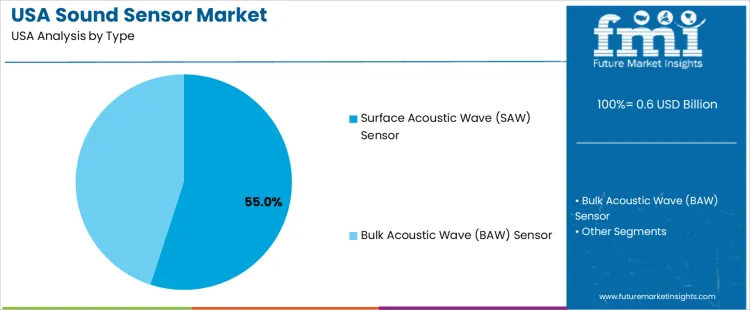
Surface Acoustic Wave (SAW) sensors hold 55.0%. These devices deliver stability, broad temperature tolerance, and selective frequency response, which supports applications in automotive noise tracking and consumer voice-enabled equipment. SAW sensors maintain consistent output in harsh environments including vibration-intensive facilities. Bulk Acoustic Wave (BAW) sensors hold 45.0%, serving communication equipment, compact consumer products, and medical tools requiring strong frequency selectivity in small sizes. BAW formats contribute to integrated chip layouts in next-generation electronics signal filtering. Type demand connects with signal clarity, durability, and system size limits in high-volume USA manufacturing sectors.
Key Points:
- SAW supports rugged, high-stability sound measurement
- BAW integrates with compact electronics and medical tools
- Architecture selection aligns with noise precision and spatial footprint
By Industry Technology, Automotive Leads Consumption
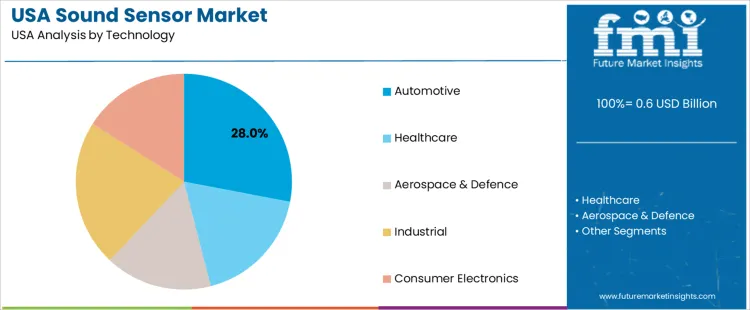
Automotive applications account for 28.0%. Use relates to cabin acoustics, driver-assistance microphones, and electric engine sound design. Industrial deployment holds 22.0%, including machine health monitoring and automated equipment response. Healthcare represents 18.0%, where sensors assist in diagnostic auscultation and respiratory sound evaluation. Consumer electronics accounts for 16.0%, aligned with microphones for smartphones and smart home control. Aerospace and defense also hold 16.0%, supporting pilot communication accuracy and structural acoustic assessment. Industry demand concentrates where real-time sound detection supports operational safety and automation reliability.
Key Points:
- Automotive leads through monitoring and interface enhancements
- Industrial systems rely on acoustic sensing for equipment reliability
- Healthcare and defense incorporate sensors to support human and system protection
What are the Key Dynamics in the Sound Sensor Industry?
Growth of smart home devices, expansion of industrial monitoring systems and increased integration in consumer electronics drive demand.
In the United States, sound sensors support intelligent home ecosystems that automate lighting, alarms and voice-activated controls across residential environments. Manufacturers of smart speakers, security systems and noise-aware appliances incorporate sound detection to improve user interaction and safety responsiveness. Industrial facilities adopt acoustic monitoring to detect machinery anomalies and reduce downtime through predictive maintenance. Automakers use sound sensing in advanced driver assistance systems to support siren recognition and cabin noise management. Municipal infrastructure planners evaluate street noise levels to improve urban design in high-density regions. These applications maintain recurring procurement through electronics supply chains serving high-volume consumer and commercial markets.
Price sensitivity in high-volume products, limited accuracy in complex acoustic environments and cybersecurity concerns restrain demand.
Procurement teams in consumer electronics evaluate each component cost very carefully, which restricts adoption of premium sensing modules where margins are narrow. Background noise in factories, crowded streets or entertainment venues challenges microphone-based measurements, leading to performance variation across real-world settings. Some users hesitate to adopt sound-enabled devices due to privacy expectations regarding unwanted audio collection. Standardization in certification and testing requires additional effort for suppliers targeting regulated industries such as healthcare. These operational and perception-related factors reduce uniform deployment in all USA market segments.
Shift toward miniaturized MEMS technologies, increased demand in voice-enabled interfaces and rising interest in environmental noise analytics define key trends.
Manufacturers develop microelectromechanical sound sensors that fit into compact wearables and smart appliances without affecting design constraints. Software platforms combine sound inputs with machine learning to identify events such as glass breakage or distress calls in residential and commercial safety systems. Healthcare and senior care environments adopt acoustic monitoring for patient fall alerts and nighttime supervision that reduces staff workload.
Retail and transportation hubs implement noise analytics to manage comfort and worker exposure limits. Domestic suppliers expand packaging and calibration services to strengthen supply resilience for large USA electronics producers. These shifts indicate continued, technology-centered demand for sound sensors across the United States supported by automation, safety priorities and consumer interaction features.
Analysis of the Demand for Sound Sensors in the USA by Region
Demand for sound sensors in the United States increases due to their use in smart buildings, consumer electronics, industrial automation, and healthcare monitoring. Devices detect acoustic patterns for noise-level management, voice-activated systems, and safety alerts in public spaces. Commercial facilities implement sound-based triggers for lighting and access control. Home adoption increases through smart speakers and connected appliances. Healthcare networks apply sensors for patient monitoring and assistive communication devices. West USA leads with 5.6% CAGR, followed by South USA at 5.0%, Northeast USA at 4.5%, and Midwest USA at 3.9%. Growth aligns with production footprints, infrastructure digitalization, and smart-device purchasing behaviors across each region.
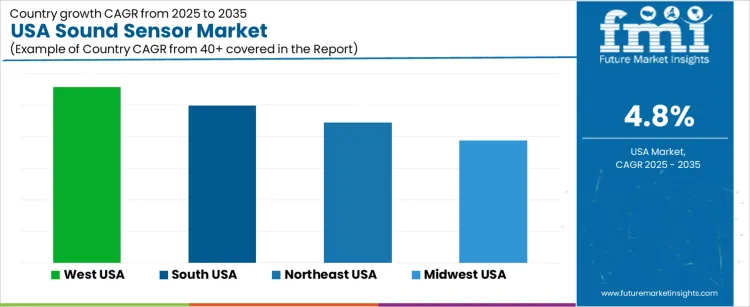
| Region | CAGR (2025-2035) |
|---|---|
| West USA | 5.6% |
| South USA | 5.0% |
| Northeast USA | 4.5% |
| Midwest USA | 3.9% |
How is the West USA driving demand for sound sensors?
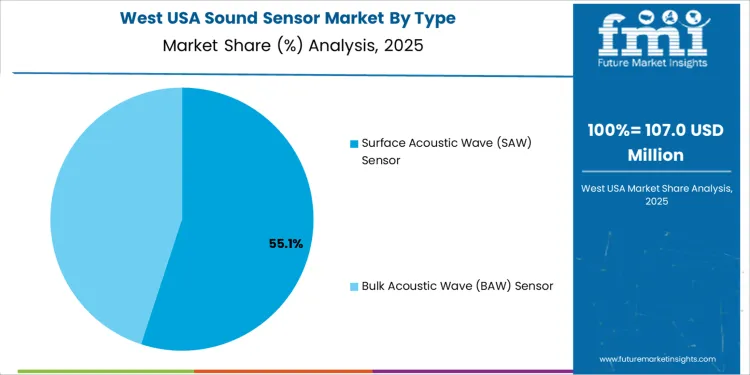
West USA records 5.6% CAGR, reflecting strong integration of sound-based interfaces in California and Washington technology ecosystems. Smart-home penetration drives adoption of voice-activated systems for lighting, locks, and media controls. Urban noise-management programs use distributed acoustic sensors to monitor environmental disturbances. Consumer manufacturers prioritize microphones and sensors that enhance entertainment devices and gaming platforms. Automotive suppliers employ sound sensors to refine cabin alerts and driver-assistance features. Facility managers deploy acoustics sensing for occupancy analytics in commercial buildings. Procurement priorities include compact form factors, signal accuracy, and integration with artificial intelligence for detection consistency.
- Smart-home adoption strengthening voice interface usage
- Noise monitoring supporting municipal compliance systems
- Consumer device upgrades requiring sensitive acoustic components
- Adoption in advanced automotive alert systems
How is the South USA shaping sensor utilization?

South USA grows at 5.0% CAGR, influenced by smart-city projects and industrial expansions across Texas and Florida. Warehouses and manufacturing units adopt sound sensors for preventive maintenance tasks that detect mechanical irregularities. Residential construction increases installation of voice-enabled appliances desired by suburban buyers. Stadiums and entertainment venues use acoustic sensors to manage event safety and crowd-noise monitoring. Security contractors incorporate sound detection to reinforce perimeter alert functions within commercial sites. Procurement decisions emphasize durability under high-humidity environments common in Gulf regions.
- Industrial safety tasks using acoustic irregularity detection
- Residential development expanding voice-enabled installations
- Sports and entertainment areas adopting sound intelligence
- Security integrations improving incident response systems
How is the Northeast USA influencing demand?
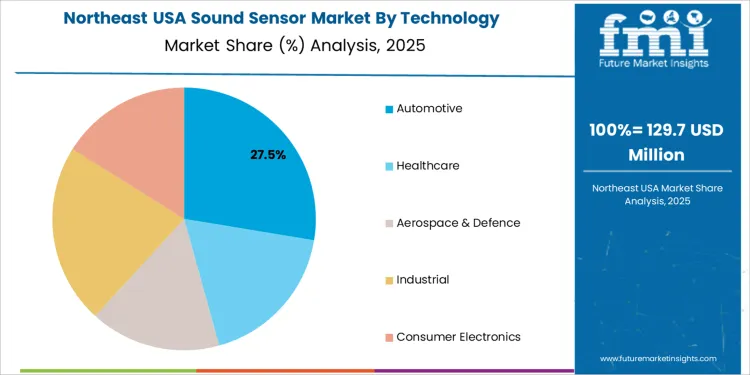
Northeast USA reaches 4.5% CAGR, helped by public transit innovation and dense urban living conditions in New York and Massachusetts. Transit operators install sound sensors to communicate updates and monitor emergency signals in busy terminals. Smart offices adopt acoustic analytics for productivity and meeting-room availability detection. Research institutions support ongoing improvements in speech recognition and audio-signal processing. Hospitals explore patient-monitoring applications that include sound-activated alert systems for assisted-living units. Buyers emphasize precise voice-trigger capabilities and high signal-to-noise performance needed in crowded acoustical environments.
- Transit communication upgrades relying on acoustic signaling
- Smart workspace integration improving environmental awareness
- Healthcare facilities using audio-based safety cues
- Research communities advancing algorithmic enhancements
How is the Midwest USA contributing to adoption?
Midwest USA posts 3.9% CAGR, influenced by manufacturing automation and agricultural technology adoption across Illinois, Michigan, and Ohio. Production floors integrate sound sensors into equipment monitoring routines that support predictive maintenance. Universities and colleges incorporate audio-based learning technologies within digital classrooms. Retail security systems in shopping districts employ acoustic-triggered alerts aimed at preventing property loss. Home buyers show interest in practical smart devices that provide hands-free interaction without premium pricing. Procurement teams review product options seeking steady accuracy, low-maintenance designs, and versatile system compatibility across legacy infrastructure.
- Predictive maintenance use in industrial facilities
- Educational smart-classroom adoption sustaining demand
- Retail security alarms incorporating sensor-trigger logic
- Cost-focused consumer purchasing supporting steady uptake
What is the competitive landscape of the demand for sound sensors in the United States?
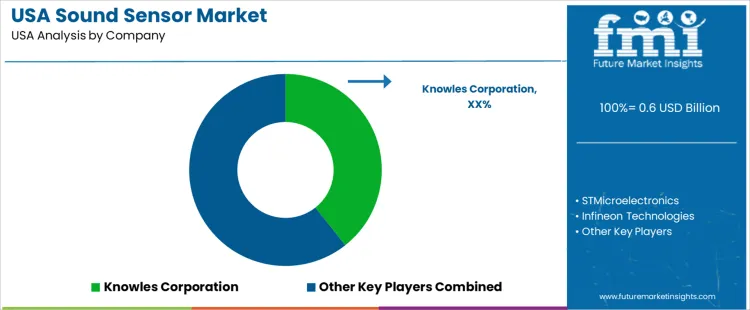
Demand for sound sensors in the United States supports consumer electronics, automotive audio control, security systems, and smart-home devices that rely on precise acoustic detection. Procurement teams prioritize signal clarity, low-power architecture, and size compatibility for compact hardware designs. Technical documentation and domestic application-engineering support influence supplier selection during product qualification.
Knowles Corporation holds an estimated 39.3% share. Its specialization in micro-electromechanical microphones aligns with USA device makers focused on high-fidelity voice capture in wearables, earbuds, and voice-activated systems. STMicroelectronics participates with sensor solutions integrated into multifunction chipsets used in connected appliances and surveillance equipment requiring consistent audio recognition.
Infineon Technologies supplies advanced MEMS devices tuned for noise filtering in automotive and industrial applications. Analog Devices Inc. supports professional audio and healthcare segments requiring stable measurement accuracy and signal-processing alignment. Robert Bosch GmbH contributes with acoustic components used in mobility platforms and smart-building technologies that require reliable sound-triggered control. Competitive position depends on noise-to-signal performance, integration flexibility with USA electronics supply chains, firmware development support, and documented lifecycle quality. Companies delivering compact sensor formats, stable manufacturing output, and accessible engineering resources retain advantages across USA demand for sound-sensing components.
Key Players in USA Sound Sensor Demand
- Knowles Corporation
- STMicroelectronics
- Infineon Technologies
- Analog Devices Inc.
- Robert Bosch GmbH
Scope of the Report
| Items | Values |
|---|---|
| Quantitative Units | USD billion |
| Type | Surface Acoustic Wave (SAW) Sensor, Bulk Acoustic Wave (BAW) Sensor |
| Technology | Automotive, Healthcare, Aerospace & Defence, Industrial, Consumer Electronics |
| Specification | Low Frequency Detection, High Frequency Detection |
| Regions Covered | West USA, South USA, Northeast USA, Midwest USA |
| Key Companies Profiled | Knowles Corporation, STMicroelectronics, Infineon Technologies, Analog Devices Inc., Robert Bosch GmbH |
| Additional Attributes | Dollar sales by type, technology segments, and detection specifications; adoption across automotive safety systems, smart consumer electronics, and industrial monitoring applications; regional expansion tied to electronics manufacturing clusters and EV technology integration; competitive differentiation through miniaturization, MEMS-based audio sensing, and improvements in signal-to-noise ratio; role of AI-enabled audio analytics, IoT devices, and healthcare diagnostics using acoustic sensing. |
USA Sound Sensor Demand by Segments
Type:
- Surface Acoustic Wave (SAW) Sensor
- Bulk Acoustic Wave (BAW) Sensor
Technology:
- Automotive
- Healthcare
- Aerospace & Defence
- Industrial
- Consumer Electronics
Specification:
- Low Frequency Detection
- High Frequency Detection
Region:
- West USA
- South USA
- Northeast USA
- Midwest USA
Frequently Asked Questions
How big is the demand for sound sensor in USA in 2025?
The demand for sound sensor in USA is estimated to be valued at USD 0.6 billion in 2025.
What will be the size of sound sensor in USA in 2035?
The market size for the sound sensor in USA is projected to reach USD 1.0 billion by 2035.
How much will be the demand for sound sensor in USA growth between 2025 and 2035?
The demand for sound sensor in USA is expected to grow at a 4.8% CAGR between 2025 and 2035.
What are the key product types in the sound sensor in USA?
The key product types in sound sensor in USA are surface acoustic wave (saw) sensor and bulk acoustic wave (baw) sensor.
Which technology segment is expected to contribute significant share in the sound sensor in USA in 2025?
In terms of technology, automotive segment is expected to command 28.0% share in the sound sensor in USA in 2025.
Preview the report firsthand - request a free sample
Get SampleGet the brochure for pricing and purchase details.
Get PDFTable of Content
- Executive Summary
- USA Market Outlook
- Demand-side Trends
- Supply-side Trends
- Technology Roadmap Analysis
- Analysis and Recommendations
- Market Overview
- Market Coverage / Taxonomy
- Market Definition / Scope / Limitations
- Market Background
- Market Dynamics
- Drivers
- Restraints
- Opportunity
- Trends
- Scenario Forecast
- Demand in Optimistic Scenario
- Demand in Likely Scenario
- Demand in Conservative Scenario
- Opportunity Map Analysis
- Product Life Cycle Analysis
- Supply Chain Analysis
- Investment Feasibility Matrix
- Value Chain Analysis
- PESTLE and Porter’s Analysis
- Regulatory Landscape
- Regional Parent Market Outlook
- Production and Consumption Statistics
- Import and Export Statistics
- Market Dynamics
- USA Market Analysis 2020 to 2024 and Forecast, 2025 to 2035
- Historical Market Size Value (USD Million) Analysis, 2020 to 2024
- Current and Future Market Size Value (USD Million) Projections, 2025 to 2035
- Y-o-Y Growth Trend Analysis
- Absolute $ Opportunity Analysis
- USA Market Pricing Analysis 2020 to 2024 and Forecast 2025 to 2035
- USA Market Analysis 2020 to 2024 and Forecast 2025 to 2035, By Type
- Introduction / Key Findings
- Historical Market Size Value (USD Million) Analysis By Type , 2020 to 2024
- Current and Future Market Size Value (USD Million) Analysis and Forecast By Type , 2025 to 2035
- Surface Acoustic Wave (SAW) Sensor
- Bulk Acoustic Wave (BAW) Sensor
- Y-o-Y Growth Trend Analysis By Type , 2020 to 2024
- Absolute $ Opportunity Analysis By Type , 2025 to 2035
- USA Market Analysis 2020 to 2024 and Forecast 2025 to 2035, By Technology
- Introduction / Key Findings
- Historical Market Size Value (USD Million) Analysis By Technology, 2020 to 2024
- Current and Future Market Size Value (USD Million) Analysis and Forecast By Technology, 2025 to 2035
- Automotive
- Healthcare
- Aerospace & Defence
- Industrial
- Consumer Electronics
- Y-o-Y Growth Trend Analysis By Technology, 2020 to 2024
- Absolute $ Opportunity Analysis By Technology, 2025 to 2035
- USA Market Analysis 2020 to 2024 and Forecast 2025 to 2035, By Specification
- Introduction / Key Findings
- Historical Market Size Value (USD Million) Analysis By Specification, 2020 to 2024
- Current and Future Market Size Value (USD Million) Analysis and Forecast By Specification, 2025 to 2035
- Low Frequency Detection
- High Frequency Detection
- Y-o-Y Growth Trend Analysis By Specification, 2020 to 2024
- Absolute $ Opportunity Analysis By Specification, 2025 to 2035
- Market Structure Analysis
- Competition Dashboard
- Competition Benchmarking
- Market Share Analysis of Top Players
- By Regional
- By Type
- By Technology
- By Specification
- Competition Analysis
- Competition Deep Dive
- Knowles Corporation
- Overview
- Product Portfolio
- Profitability by Market Segments (Product/Age /Sales Channel/Region)
- Sales Footprint
- Strategy Overview
- Marketing Strategy
- Product Strategy
- Channel Strategy
- STMicroelectronics
- Infineon Technologies
- Analog Devices Inc.
- Robert Bosch GmbH
- Knowles Corporation
- Competition Deep Dive
- Assumptions & Acronyms Used
- Research Methodology


