

- Industry Size (2025)
- USD 17.1 Bn
- Forecast (2035)
- USD 62.2 Bn
- CAGR (2025 to 2035)
- 13.8%
Demand for Tablet in USA 2025 to 2035
The USA tablet demand is valued at USD 17.1 billion in 2025 and is projected to reach USD 62.2 billion by 2035, reflecting a CAGR of 13.8%. Growth is driven by rising remote work and digital learning adoption, along with expanding use of portable devices for streaming, gaming, and productivity tasks. Continuous advances in display quality, battery life, and portable processing performance sustain strong upgrade cycles in consumer and enterprise environments.
Slate tablets lead demand due to their lightweight designs, intuitive interfaces, and broad application across education, entertainment, and field-based professional workflows. Buyers focus on multi-purpose functionality supported by enhanced storage, faster connectivity, and improved accessory ecosystems. Increased penetration of 5G-enabled models strengthens usage in mobile-first scenarios.
Quick Stats for USA Tablet Demand
- USA Tablet Sales Value (2025): USD 17.1 billion
- USA Tablet Forecast Value (2035): USD 62.2 billion
- USA Tablet Forecast CAGR (2025 to 2035): 13.8%
- Leading Product Type in USA Tablet Demand: Slate Tablet
- Key Growth Regions in USA Tablet Demand: West USA, South USA, Northeast USA
- Top Players in USA Tablet Demand: Apple (iPad), Samsung, Amazon (Fire Tablets), Lenovo, Microsoft (Surface)

What is the Growth Forecast for Tablet Industry in USA through 2035?
The West, South, and Northeast regions show accelerated uptake supported by high digital device penetration and strong institutional procurement for education and business continuity. Key suppliers include Apple (iPad), Samsung, Amazon (Fire Tablets), Lenovo, and Microsoft (Surface). Their strategies emphasize software-hardware integration, display innovations, and product segmentation that targets premium, mid-range, and student-focused users to support long-term adoption.
Demand for tablets in the United States expands throughout the next decade with changing intensity between the initial and later years of the forecast period. Early growth from 2025 to the end of the decade benefits from remote and hybrid work settings, device upgrades in education systems, improved processing power, and competitive pricing in mid-range models. Consumer adoption remains active as households add multiple screens for entertainment, learning, and communication. Enterprise interest in tablets for field operations, digital workflows, and point-of-care usage adds steady volume during these years.
Later growth toward 2035 remains positive although more measured. Household penetration reaches a strong base, leading to slower rates as demand relies on replacement cycles rather than new adoption. Rival products such as convertible laptops and large smartphones draw part of the technology budget. Product differentiation shifts toward durability, private-network compatibility, and productivity accessories to retain relevance in professional environments. Across ten years, the comparison indicates stronger momentum in the early phase and controlled expansion in the latter phase, reflecting a transition from rising adoption to a stable but moderate upgrade-driven profile.
USA Tablet Key Takeaways
| Metric | Value |
|---|---|
| USA Tablet Sales Value (2025) | USD 17.1 billion |
| USA Tablet Forecast Value (2035) | USD 62.2 billion |
| USA Tablet Forecast CAGR (2025-2035) | 13.8% |
Why is the Demand for Tablets in the USA Growing?
Demand for tablets in the USA is rising because consumers seek flexible computing devices that balance portability and functionality. Tablets allow users to browse the internet, stream media, read e-books, handle email, and run apps while avoiding bulk that comes with traditional laptops. Many households own at least one tablet, which supports high usage in education, entertainment, remote work, and everyday tasks. Schools and educational institutions increase tablet adoption for remote learning. Students use tablets for reading, note-taking, virtual classes, and interactive learning tools. Tablets also find use among older adults seeking simple devices for communication, video calls and managing daily tasks without the complexity of full computers.
Business users adopt tablets for presentations, mobile work, inventory management and point-of-sale systems. The convenience of touch screens, long battery life, and lightweight design supports deployment across field service operations and retail environments. Constraints include competition from smartphones that offer overlapping functions and from laptops offering more powerful performance. Some users avoid tablets when they require heavy computing tasks, graphics-intensive applications or extensive multitasking.
Which Product Types and End-Use Segments Lead Demand for Tablets in the United States?
Demand for tablets in the United States reflects widespread device ownership among students, households, and remote workers. Buyers prioritize screen quality, battery life, lightweight design, and app ecosystem flexibility. Growth aligns with learning adoption, streaming access, and mobile productivity. Commercial deployments contribute steady demand in healthcare, education, and retail workflows requiring secure mobility and reliable device management. Replacement cycles depend on OS updates, chipset efficiency, and connectivity upgrades.
By Product Type, Slate Tablets Hold the Largest Share
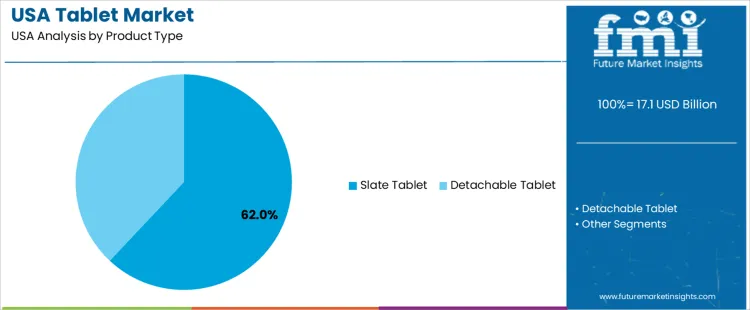
Slate tablets represent 62.0%. Their dominance reflects use in entertainment, education, travel, and general household computing. The form factor supports extended battery capacity and optimized display sizes in the USA streaming and e-learning environment. Detachable tablets hold 38.0%. Productivity users value keyboard-enabled input, multitasking, and enterprise-grade software support. These devices fit hybrid office setups and frontline worker use cases where portability matters. Demand patterns across both categories respond to budget segmentation, ease of carrying, touchscreen-first interfaces, and long application support. USA buyers expect stable performance for media consumption, lightweight productivity, and digital learning.
Key Points:
- Slate tablets lead due to versatile lifestyle and learning usage
- Detachable formats support mobile productivity requirements
- Purchase decisions reflect display needs and daily usage intensity
By End-Use, Consumer Adoption Drives the Largest Share
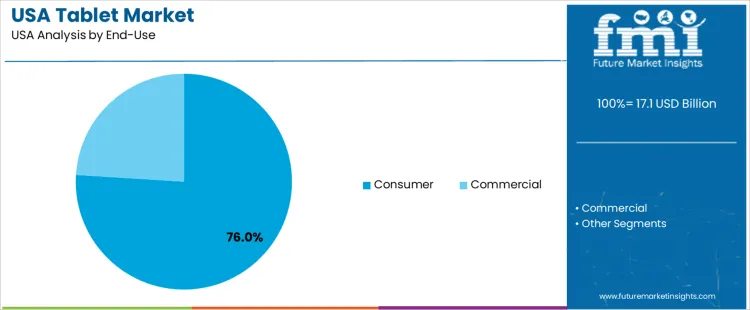
Consumer users account for 76.0%. Households rely on tablets for entertainment, gaming, social content, and communication. Device adoption aligns with children’s learning, family streaming habits, and digital reading trends. Commercial use represents 24.0%. Enterprises integrate tablets in fieldwork, patient engagement, hospitality ordering, and point-of-service support. These deployments benefit from wireless connectivity, security compliance, and rugged accessories. End-use dynamics demonstrate that broad lifestyle integration continues to outperform enterprise hardware cycles in overall share.
Key Points:
- Households generate steady recurring device upgrades
- Commercial environments prioritize mobility with secure deployment
- Usage intensity influences refresh cycles and premium feature adoption
What are the Key Dynamics in the Tablet Industry?
Growth of hybrid work arrangements, expanded digital learning adoption and continuous household device refresh cycles drive demand.
In the United States, many workers divide time between corporate offices and home environments, which increases use of portable devices that support video meetings and productivity apps. School districts maintain one-to-one learning programs that supply tablets to students for digital coursework and remote instruction continuity. Households purchase tablets as shared screens for media streaming, e-reading and casual computing due to portability and touchscreen interfaces. Retailers promote seasonal upgrades tied to entertainment ecosystems that link tablets with smart TVs, wireless audio and cloud gaming services. Healthcare systems introduce tablet-based patient engagement tools that support teleconsultation and survey intake in clinics. These varied use cases sustain regular procurement across consumer, education and enterprise markets in the United States.
Price sensitivity in mass-market segments, durability concerns in heavy-use environments and extended lifespan of recent devices restrain faster expansion.
Mid-range and premium tablets compete with budget laptops and large smartphones for discretionary spending in households. Schools and businesses evaluate replacement schedules carefully due to cost of accessories, device management and protective cases. Battery improvements and processor efficiency extend the useful life of newer models, which lengthens upgrade intervals outside premium enthusiast groups. Certain professional tasks still require full keyboards and advanced software that favor laptops, affecting tablet selection in specialized fields. Repair availability and accidental damage concerns influence purchase hesitation among families with younger children. These conditions moderate rapid growth in segments where value and longevity guide buying decisions.
Shift toward detachable keyboards, increased enterprise-grade security features and rising demand for large displays define key trends.
Producers add keyboard options that support document creation and multitasking for workers and students. Security enhancements such as biometric authentication and encrypted storage align with corporate IT policies governing mobile access to sensitive data. Large-format models expand adoption for design, presentation and point-of-sale applications. E-commerce channels broaden access for refurbished devices that attract cost-conscious buyers while reducing electronic waste. Accessories such as styluses gain traction in note-taking and creative workflows. These developments indicate stable and diversified demand for tablets across the United States supported by mobile productivity needs, digital content consumption and education technology programs.
Analysis of the Demand for Tablets in the USA by Region
Demand for tablets in the United States grows as consumers, enterprises, and educational institutions integrate portable computing into daily workflows. Product selection emphasizes versatility in streaming, productivity, and digital learning. Retailers expand availability of mid-range and premium devices featuring advanced displays, high-efficiency chipsets, and longer battery life. 5G connectivity improves mobility for hybrid workers and commuters. Device-management platforms support corporate and classroom security requirements. West USA leads with 15.8% CAGR, followed by South USA at 14.2%, Northeast USA at 12.7%, and Midwest USA at 11.0%. Growth aligns with broadband access, remote-usage patterns, and household device penetration across each region.
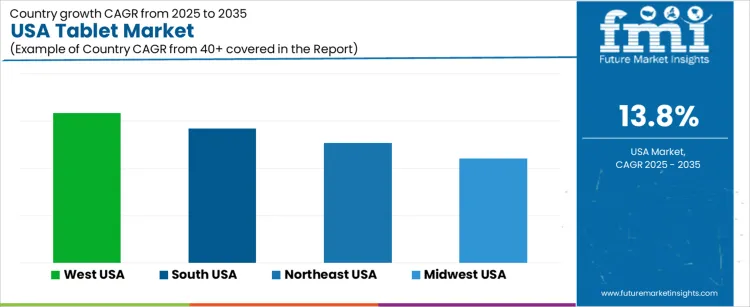
| Region | CAGR (2025-2035) |
|---|---|
| West USA | 15.8% |
| South USA | 14.2% |
| Northeast USA | 12.7% |
| Midwest USA | 11.0% |
How is the West USA driving demand for tablets?
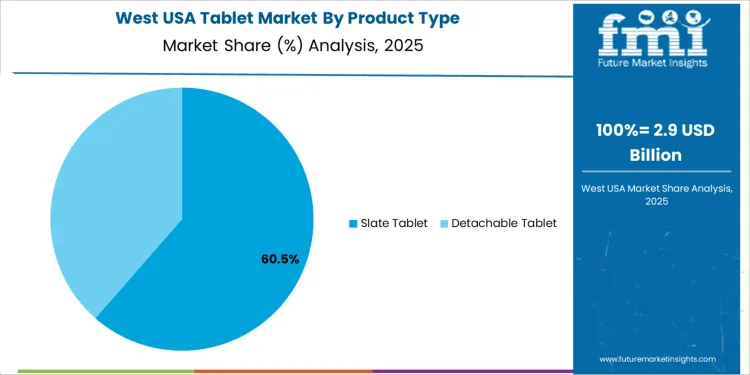
West USA records 15.8% CAGR, supported by high digital-device adoption in California, Washington, and Oregon. Households invest in multi-device ecosystems for remote work, smart-home control, and streaming entertainment. Schools expand tablet deployment for curriculum access, standardized test preparation, and accessibility accommodations. Technology startups and media-production sectors use tablets for design tasks, content previews, and field-based collaboration.
E-commerce networks enable frequent model upgrades driven by new chip releases and camera enhancements. Healthcare providers rely on tablet interfaces during tele-consultations and outpatient care documentation. Retailers highlight device durability and versatility during promotional cycles. Procurement decisions consider chipset efficiency, storage scalability, and accessory compatibility supporting keyboards and styluses.
- Education usage increasing device circulation
- Media and tech sectors driving premium model demand
- Telehealth workflows supporting tablet-based interactions
- E-commerce accelerating product-refresh behavior
How is the South USA shaping demand?

South USA posts 14.2% CAGR, linked to rising hybrid-work models across Texas, Florida, Georgia, and North Carolina. Broadband expansion in suburban and secondary cities encourages tablet-based streaming and home-office productivity. Manufacturing and field-service organizations equip employees with ruggedized devices for mobility-driven tasks. Households with children adopt tablets for gaming and digital-learning support. Regional healthcare networks apply touchscreen platforms in patient-check-in systems and bedside engagement. Sales remain strong in value-driven device tiers as large retailers and warehouse clubs supply bundled offerings. Buying teams examine battery-longevity improvements and wireless-access performance under frequent mobility conditions.
- Hybrid-work reliance sustaining steady upgrades
- Family entertainment and gaming supporting household adoption
- Ruggedized devices serving field-operations needs
- Healthcare applications reinforcing business purchases
How is the Northeast USA influencing usage trends?

Northeast USA expands at 12.7% CAGR, supported by dense business districts and university networks in New York, New Jersey, Pennsylvania, and Massachusetts. Professionals integrate tablets into mobility-focused workflows requiring secure remote access to enterprise software. Students adopt models optimized for note-taking, digital textbooks, and virtual-campus engagement. Public transport commuters choose lightweight designs for productivity during travel. Procurement teams evaluate encryption, biometric authentication, and device-management controls. Healthcare and finance institutions require compliance-oriented security configurations. Model-selection priorities emphasize premium displays suited to design reviews and data analysis.
- Enterprise usage strengthening device replacement frequency
- University demand reinforcing consistent procurement cycles
- Commuter mobility encouraging screen-optimized form factors
- Security requirements guiding product evaluation
How is the Midwest USA contributing to adoption growth?
Midwest USA shows 11.0% CAGR, influenced by steady use in education, healthcare, and industrial manufacturing hubs across Illinois, Michigan, Ohio, and Wisconsin. School districts employ tablets to increase digital literacy and reduce textbook distribution costs. Hospitals adopt touch-enabled workflows for patient monitoring and bedside service applications. Small businesses invest in tablets for point-of-sale systems and customer-engagement activities. Budget planning favors durable devices with long support life. Broadband development across rural zones increases access for tele-learning and virtual services. Buyers weigh warranty programs and repair-service routing to maintain device uptime.
- Classroom technology expanding long-term usage
- Healthcare operations integrating digital-record access
- Small-business purchasing for retail and service tasks
- Warranty stability guiding cost-focused procurement
What is the competitive landscape of demand for tablets in the United States?
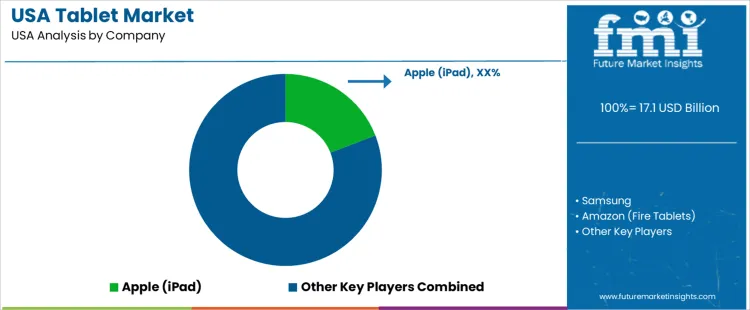
Demand for tablets in the United States centers on device ecosystems, application compatibility, battery endurance, and pricing breadth. Consumer electronics retailers report consistent turnover from refresh cycles in education, entertainment, and mobile productivity. Households integrate tablets for content streaming and casual computing. Enterprises deploy units for field workflows and retail point-of-service tasks. Providers supplying chipset efficiency, accessory ecosystems, and strong OS support retain purchasing preference.
iPad models deliver performance tiers suited to students, creative users, and business deployments. Integration with proprietary services and enterprise device management enhances retention among existing iPhone and Mac owners. Samsung remains a prominent option within Android deployments. Display quality, stylus compatibility, and 5G connectivity attract buyers seeking multipurpose mobility. Amazon Fire Tablets serve entry-level requirements through aggressive pricing, parental control features, and simplified retail access tied to subscription services.
Lenovo maintains visibility among education and enterprise buyers valuing durability and configurable specifications. Microsoft Surface devices target productivity-driven users who require Windows applications in a portable form. Competition reflects design versatility, operating system alignment with user habits, secure interoperability across personal devices, and distribution reach across both online and physical channels. Continuous feature updates sustain replacement momentum within consumer and professional environments.
Key Players in USA Tablet Demand
- Apple (iPad)
- Samsung
- Amazon (Fire Tablets)
- Lenovo
- Microsoft (Surface)
Scope of the Report
| Items | Values |
|---|---|
| Quantitative Units | USD billion |
| Product Type | Slate Tablet, Detachable Tablet |
| End-Use | Consumer, Commercial |
| Operating System | Android, iOS, Windows |
| Regions Covered | West USA, South USA, Northeast USA, Midwest USA |
| Key Companies Profiled | Apple (iPad), Samsung, Amazon (Fire Tablets), Lenovo, Microsoft (Surface) |
| Additional Attributes | Dollar sales by product type, operating system, and end-use segments; regional sales differences driven by consumer electronics adoption trends and commercial mobility deployments; competitive landscape among premium, mid-range, and budget tablet brands; demand supported by hybrid work, digital learning, and entertainment usage; procurement through retail, online channels, and IT enterprise purchasing. |
USA Tablet Demand by Segments
Product Type:
- Slate Tablet
- Detachable Tablet
End-Use:
- Consumer
- Commercial
Operating System:
- Android
- iOS
- Windows
Region:
- West USA
- South USA
- Northeast USA
- Midwest USA
Frequently Asked Questions
How big is the demand for tablet in USA in 2025?
The demand for tablet in USA is estimated to be valued at USD 17.1 billion in 2025.
What will be the size of tablet in USA in 2035?
The market size for the tablet in USA is projected to reach USD 62.2 billion by 2035.
How much will be the demand for tablet in USA growth between 2025 and 2035?
The demand for tablet in USA is expected to grow at a 13.8% CAGR between 2025 and 2035.
What are the key product types in the tablet in USA?
The key product types in tablet in USA are slate tablet and detachable tablet.
Which end-use segment is expected to contribute significant share in the tablet in USA in 2025?
In terms of end-use, consumer segment is expected to command 76.0% share in the tablet in USA in 2025.
Preview the report firsthand - request a free sample
Get SampleGet the brochure for pricing and purchase details.
Get PDFTable of Content
- Executive Summary
- USA Market Outlook
- Demand-side Trends
- Supply-side Trends
- Technology Roadmap Analysis
- Analysis and Recommendations
- Market Overview
- Market Coverage / Taxonomy
- Market Definition / Scope / Limitations
- Market Background
- Market Dynamics
- Drivers
- Restraints
- Opportunity
- Trends
- Scenario Forecast
- Demand in Optimistic Scenario
- Demand in Likely Scenario
- Demand in Conservative Scenario
- Opportunity Map Analysis
- Product Life Cycle Analysis
- Supply Chain Analysis
- Investment Feasibility Matrix
- Value Chain Analysis
- PESTLE and Porter’s Analysis
- Regulatory Landscape
- Regional Parent Market Outlook
- Production and Consumption Statistics
- Import and Export Statistics
- Market Dynamics
- USA Market Analysis 2020 to 2024 and Forecast, 2025 to 2035
- Historical Market Size Value (USD Million) Analysis, 2020 to 2024
- Current and Future Market Size Value (USD Million) Projections, 2025 to 2035
- Y-o-Y Growth Trend Analysis
- Absolute $ Opportunity Analysis
- USA Market Pricing Analysis 2020 to 2024 and Forecast 2025 to 2035
- USA Market Analysis 2020 to 2024 and Forecast 2025 to 2035, By Product Type
- Introduction / Key Findings
- Historical Market Size Value (USD Million) Analysis By Product Type , 2020 to 2024
- Current and Future Market Size Value (USD Million) Analysis and Forecast By Product Type , 2025 to 2035
- Slate Tablet
- Detachable Tablet
- Y-o-Y Growth Trend Analysis By Product Type , 2020 to 2024
- Absolute $ Opportunity Analysis By Product Type , 2025 to 2035
- USA Market Analysis 2020 to 2024 and Forecast 2025 to 2035, By End-Use
- Introduction / Key Findings
- Historical Market Size Value (USD Million) Analysis By End-Use, 2020 to 2024
- Current and Future Market Size Value (USD Million) Analysis and Forecast By End-Use, 2025 to 2035
- Consumer
- Commercial
- Y-o-Y Growth Trend Analysis By End-Use, 2020 to 2024
- Absolute $ Opportunity Analysis By End-Use, 2025 to 2035
- USA Market Analysis 2020 to 2024 and Forecast 2025 to 2035, By Operating System
- Introduction / Key Findings
- Historical Market Size Value (USD Million) Analysis By Operating System, 2020 to 2024
- Current and Future Market Size Value (USD Million) Analysis and Forecast By Operating System, 2025 to 2035
- Android
- iOS
- Windows
- Y-o-Y Growth Trend Analysis By Operating System, 2020 to 2024
- Absolute $ Opportunity Analysis By Operating System, 2025 to 2035
- Market Structure Analysis
- Competition Dashboard
- Competition Benchmarking
- Market Share Analysis of Top Players
- By Regional
- By Product Type
- By End-Use
- By Operating System
- Competition Analysis
- Competition Deep Dive
- Apple (iPad)
- Overview
- Product Portfolio
- Profitability by Market Segments (Product/Age /Sales Channel/Region)
- Sales Footprint
- Strategy Overview
- Marketing Strategy
- Product Strategy
- Channel Strategy
- Samsung
- Amazon (Fire Tablets)
- Lenovo
- Microsoft (Surface)
- Apple (iPad)
- Competition Deep Dive
- Assumptions & Acronyms Used
- Research Methodology


