

- Industry Size (2026)
- USD 5.1 Bn
- Forecast (2036)
- USD 12.0 Bn
- CAGR (2026 to 2036)
- 8.9%
Zero Emission Building Insulations Market Forecast and Outlook 2026 to 2036
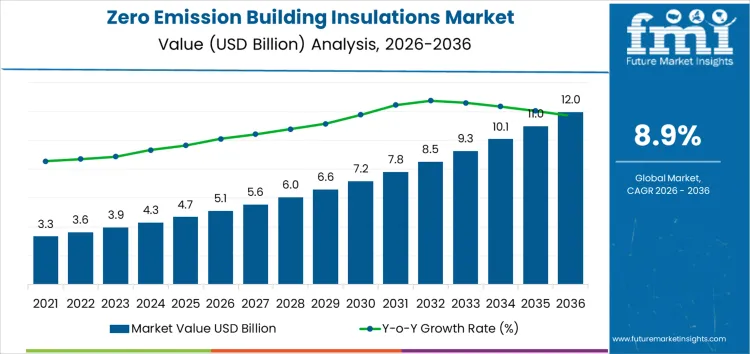
The Zero Emission Building Insulations Market is valued at USD 5.1 billion in 2026 and is projected to reach USD 12.0 billion by 2036, reflecting a CAGR of 8.9%. Market outcomes are shaped by concentration in high-performance residential and commercial construction programs and the reliance of building projects on certified low-carbon materials. End-use dependency drives procurement planning and material selection. Volume stability is influenced by regulatory compliance, project timelines, and regional construction activity. Suppliers delivering validated, energy-efficient insulation solutions capture predictable revenue streams, while smaller operators face variability and limited leverage.
Revenue concentration is determined by alignment with multi-building programs and adherence to energy efficiency standards. Adoption varies across residential, commercial, industrial, and institutional structures. Margins favor operators offering certified mineral wool, cellulose-based, bio-foam, and aerogel insulations with application expertise and technical support. Fragmentation persists in regional and niche suppliers, whereas established companies such as Saint-Gobain, Rockwool Group, Owens Corning, Knauf Insulation, and Kingspan Group capture concentrated value through portfolio breadth, multi-application performance, and compliance verification rather than output volume alone.
Quick Stats of the Zero Emission Building Insulations Market
- Zero Emission Building Insulations Market Value (2026): USD 5.1 billion
- Zero-Emission Building Insulations Forecast Value (2036): USD 12.0 billion
- Zero-Emission Building Insulations Forecast CAGR 2026 to 2036: 8.9%
- Zero-Emission Building Insulations Leading Material Type: Mineral Wool (Rock & Glass)
- Zero-Emission Building Insulations Leading Building Type: Residential Buildings
- Zero-Emission Building Insulations Key Growth Regions: China, Germany, France, USA, Japan
- Zero-Emission Building Insulations Top Players: Saint-Gobain, Rockwool Group, Owens Corning, Knauf Insulation, Kingspan Group
What is the Growth Forecast for Zero Emission Building Insulations Market through 2036?
Between 2026 and 2031, the Zero Emission Building Insulations Market is projected to grow from USD 5.1 billion to USD 7.2 billion, generating an absolute increase of USD 2.1 billion. The rolling CAGR for this period is approximately 7.1%. Growth is driven by adoption of eco-friendly insulation materials, regulatory mandates for energy efficiency, and increasing construction of green buildings. Volume contributes around 68% of growth due to higher installations in residential and commercial projects. Price growth accounts for 32%, supported by premium materials, innovative insulation technologies, and compliance with zero-emission building standards.
From 2031 to 2036, the market is expected to expand from USD 7.2 billion to USD 12.0 billion, adding USD 4.7 billion. The rolling CAGR for this period is approximately 10.7%, reflecting accelerated adoption driven by stricter energy codes and green building incentives. Volume remains the dominant driver, contributing roughly 66% of growth due to expanded construction activity and retrofit projects. Price growth represents 34%, supported by high-performance materials, differentiated thermal efficiency, and sustainability-focused formulations. Competitive advantage favors suppliers with validated products, regulatory compliance, and scalable production capabilities.
Zero Emission Building Insulations Key Takeaways
| Metric | Value |
|---|---|
| Market Value (2026) | USD 5.1 billion |
| Forecast Value (2036) | USD 12.0 billion |
| Forecast CAGR 2026 to 2036 | 8.90% |
What Is Driving Demand for Zero-Emission Building Insulations?
Zero-emission building insulations are increasingly adopted to improve energy efficiency, reduce carbon footprints, and comply with green building standards. Historically, conventional insulation materials relied on fossil-based components, resulting in embedded carbon emissions and limited environmental sustainability. Modern insulations utilize bio-based, recycled, or advanced mineral materials that provide thermal performance while eliminating embodied emissions. Architects, construction companies, and facility managers prioritize thermal conductivity, fire resistance, moisture control, and regulatory compliance. Early adoption focused on sustainable or certified projects, while current demand spans residential, commercial, and industrial buildings driven by energy codes, climate policies, and corporate sustainability initiatives. Material performance, installation methods, and lifecycle assessment influence procurement and selection decisions.
Increasing building energy standards, carbon neutrality goals, and consumer demand for environmentally responsible construction are shaping market growth. Compared with conventional insulation, contemporary zero-emission products emphasize low thermal conductivity, long-term durability, and compatibility with modern building envelopes. Cost structures depend on raw material sourcing, manufacturing processes, and installation requirements, concentrating margins among suppliers capable of delivering consistent, certified products. Developers and facility owners adopt zero-emission insulations to reduce operational energy consumption, meet sustainability certifications, and enhance indoor comfort. By 2036, these materials are expected to become a standard in new construction and retrofitting projects, supporting energy efficiency, climate compliance, and sustainable building practices globally.
What Factors Are Shaping the Demand for Zero-Emission Building Insulations in Terms of Material Type and Building Type?
The demand for zero-emission building insulations is segmented by material type and building type. Material types include mineral wool (rock and glass), cellulose-based insulation, bio-based foams, aerogels, and other advanced materials. Building types include residential, commercial, industrial, and institutional structures. Adoption is influenced by thermal efficiency, environmental compliance, and fire resistance. Uptake is driven by energy savings, sustainability goals, and regulatory requirements. Material and building type selection depends on insulation performance, building design, and climate conditions, ensuring reduced carbon footprint, long-term durability, and operational energy efficiency in new and retrofitted construction projects.
Why Is Mineral Wool (Rock and Glass) Leading the Material Type Segment in Zero-Emission Insulations?
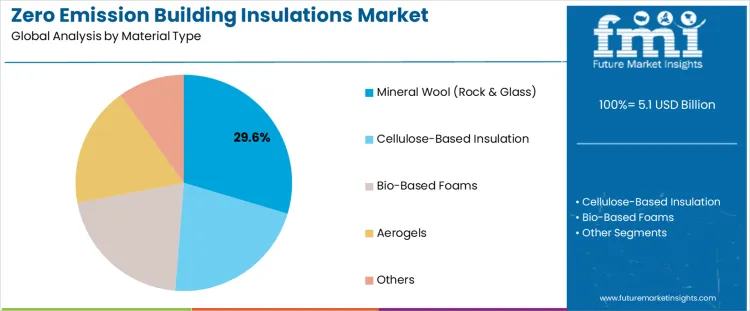
Mineral wool, including rock and glass wool, accounts for 29.6% of total material type demand, making it the leading category. These materials provide high thermal and acoustic insulation, fire resistance, and durability. Adoption is reinforced by compatibility with multiple building structures, ease of installation, and proven performance in energy-efficient construction. Contractors use mineral wool in walls, roofs, and floors to reduce heat transfer, improve comfort, and meet sustainability requirements. Maintenance is minimal due to material stability and resistance to moisture and pests. The segment leads because mineral wool delivers operational efficiency, durability, and regulatory compliance in zero-emission building applications.
Operational considerations further support adoption. Mineral wool must maintain thermal performance under variable temperatures, humidity, and load-bearing conditions. It integrates with vapor barriers, fireproofing, and structural components without compromising building integrity. The segment leads because mineral wool balances insulation effectiveness, long-term reliability, and sustainability for residential, commercial, and industrial construction projects.
Why Are Residential Buildings Representing the Largest Building Type Segment in Zero-Emission Insulations?
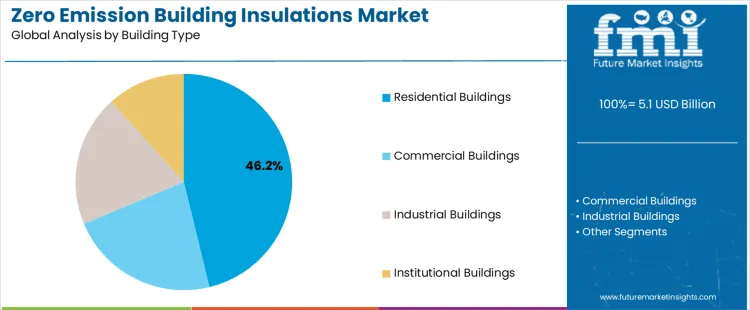
Residential buildings account for 46.2% of total building type demand, making them the largest segment. Adoption is driven by homeowner priorities for energy efficiency, comfort, and reduced utility costs. Insulation systems in residential structures are selected to balance thermal performance, environmental compliance, and installation ease. Contractors install mineral wool, cellulose, and foam insulations in walls, roofs, and floors to enhance energy efficiency and maintain indoor comfort. The segment benefits from government incentives, sustainability certifications, and urban building regulations encouraging low-carbon construction materials.
Operational and design factors influence adoption. Insulations must tolerate temperature fluctuations, moisture, and settlement without compromising performance. Proper installation ensures uniform coverage, thermal efficiency, and reduced energy consumption. Residential buildings lead because they represent the largest global construction segment adopting zero-emission insulation solutions, providing measurable energy savings, carbon reduction, and long-term operational efficiency.
How Are Zero-Emission Insulations Enhancing Energy Efficiency and Sustainability?
Zero-emission building insulations are increasingly adopted in residential, commercial, and industrial construction to reduce energy consumption and carbon footprint. Adoption is strongest in regions with strict building codes, sustainability incentives, and high urbanization. Insulation materials are selected for thermal performance, fire resistance, and environmental impact. Growth is driven by regulatory compliance, energy efficiency targets, and demand for eco-friendly construction. Investment focuses on material quality, durability, and compatibility with building systems. Contractors and developers prioritize insulations that improve indoor comfort, reduce heating and cooling costs, and support regional environmental and energy regulations.
Why Are Regional Energy Policies and Green Building Standards Driving Adoption?
Demand is influenced by local building codes, energy efficiency requirements, and sustainability programs promoting low-carbon construction. Developers adopt zero-emission insulation to comply with performance standards and obtain green certifications. Materials offering consistent thermal resistance, long-term durability, and minimal environmental impact gain preference. Adoption is concentrated in regions with government incentives and stringent environmental regulations. Operational efficiency and regulatory compliance drive procurement rather than cost. Suppliers delivering certified, high-performance insulation solutions gain advantage in both residential and commercial construction sectors.
What Factors Limit Broader Implementation of Zero-Emission Insulations?
High material costs, specialized installation techniques, and performance variability limit widespread adoption. Compatibility with diverse building designs, fire safety regulations, and acoustic requirements adds complexity. Regulatory approval processes and material certification timelines can extend deployment. Smaller developers or regions with limited green building initiatives may face slower adoption. These factors concentrate early use among large-scale construction projects, sustainable building programs, and regions with supportive energy and environmental policies.
How Are Innovation and Industry Collaboration Shaping Market Growth?
Developments include bio-based foams, recycled fiber insulations, and advanced mineral-based materials with low embodied carbon. Collaboration between material manufacturers, construction companies, and regulatory bodies ensures performance validation, code compliance, and sustainability certification. Pilot projects assess thermal performance, durability, and installation efficiency before large-scale deployment. Quality monitoring and certification systems maintain reliability and regulatory alignment. Focus is on energy efficiency, environmental impact reduction, and building performance rather than cost or volume. Collaborative initiatives enable broader adoption of zero-emission insulations in regions prioritizing sustainable and energy-efficient construction.
What is the Demand for Zero-Emission Building Insulations by Country?
| Country | CAGR (%) |
|---|---|
| USA | 8.1 |
| Germany | 9.4 |
| China | 9.8 |
| France | 8.6 |
| Japan | 7.5 |
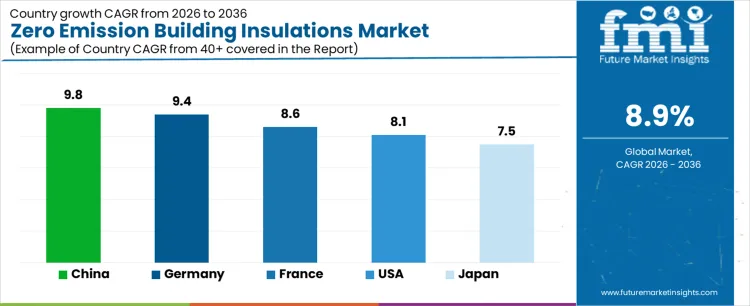
Demand for zero-emission building insulations is rising as governments and construction companies focus on reducing carbon footprints, improving energy efficiency, and meeting green building regulations. China leads with a 9.8% CAGR, driven by rapid urbanization, large-scale construction projects, and government policies promoting sustainable building materials. Germany follows at 9.4%, supported by strict energy efficiency standards and widespread adoption of eco-friendly insulation solutions. France records 8.6% growth, shaped by green building initiatives and retrofitting programs. The USA grows at 8.1%, driven by renewable energy integration and sustainable construction practices. Japan shows 7.5% CAGR, reflecting moderate adoption of zero-emission insulation solutions and compliance with national energy efficiency policies.
How Is the United States Experiencing Growth in the Zero Emission Building Insulations Market?
United States is experiencing growth at a CAGR of 8.1%, supported by increasing adoption of zero-emission insulation materials in residential, commercial, and industrial construction. Developers and manufacturers are implementing insulation solutions designed to reduce energy consumption, improve thermal efficiency, and minimize carbon footprint. Demand is concentrated in urban centers, commercial real estate projects, and green building initiatives. Investments focus on material performance, regulatory compliance, and ease of installation rather than large-scale market expansion. Growth reflects rising awareness of energy efficiency, stricter building codes, and incentives for low-carbon construction technologies to support sustainability and operational cost reduction.
- Zero-emission materials drive adoption.
- Applications include residential, commercial, and industrial buildings.
- Urban centers and construction projects concentrate demand.
- Material performance and regulatory compliance guide investment.
How Is Germany Witnessing Expansion With Sustainable Construction Initiatives?
Germany is witnessing growth at a CAGR of 9.4%, supported by adoption of zero-emission building insulations to meet strict energy efficiency and carbon reduction targets. Manufacturers and developers are implementing insulation materials designed for thermal performance, environmental compliance, and long-term durability. Demand is concentrated in urban housing developments, commercial construction, and green building projects. Investments prioritize material quality, installation efficiency, and regulatory adherence rather than broad expansion. Growth reflects government policies promoting low-carbon buildings, energy efficiency programs, and industrial adoption of sustainable construction materials across residential and commercial sectors.
- Sustainable construction drives adoption.
- Insulation materials enhance thermal efficiency and reduce emissions.
- Urban housing and commercial projects concentrate demand.
- Material quality and installation efficiency guide investment.
How Is China Experiencing Rapid Growth With Green Building Initiatives?
China is experiencing rapid growth at a CAGR of 9.8%, fueled by adoption of zero-emission building insulations in residential, commercial, and industrial projects to improve energy efficiency and reduce carbon emissions. Developers and manufacturers are deploying materials optimized for thermal performance, environmental sustainability, and durability under local climate conditions. Demand is concentrated in urban centers, high-rise developments, and industrial construction projects. Investments focus on material performance, regulatory compliance, and installation precision rather than rapid expansion. Growth reflects government support for green buildings, rising construction activity, and industrial adoption of energy-efficient, low-carbon insulation technologies.
- Green building initiatives drive adoption.
- Materials optimize thermal efficiency and minimize emissions.
- Urban centers and industrial projects concentrate demand.
- Material performance and regulatory compliance guide investment.
How Is France Witnessing Growth With Energy Efficiency Regulations?
France is witnessing growth at a CAGR of 8.6%, supported by adoption of zero-emission building insulations to meet energy efficiency standards and reduce operational carbon footprint. Manufacturers and developers are applying insulation materials designed for thermal performance, regulatory compliance, and long-term durability in residential and commercial construction. Demand is concentrated in urban housing developments, commercial buildings, and industrial facilities. Investments prioritize material quality, installation efficiency, and regulatory adherence rather than large-scale expansion. Growth reflects government incentives, energy efficiency programs, and adoption of low-carbon construction materials across the building sector.
- Energy efficiency regulations drive adoption.
- Insulation materials improve thermal performance and reduce emissions.
- Urban housing and industrial projects concentrate demand.
- Material quality and installation efficiency guide investment.
How Is Japan Experiencing Moderate Growth With Sustainable Building Materials?
Japan is experiencing growth at a CAGR of 7.5%, fueled by adoption of zero-emission insulation materials in residential, commercial, and industrial buildings to reduce energy consumption and carbon emissions. Developers and manufacturers are implementing insulation solutions optimized for thermal efficiency, environmental compliance, and durability under local climate conditions. Demand is concentrated in urban construction projects, industrial facilities, and commercial buildings. Investments focus on material performance, regulatory compliance, and installation precision rather than market-wide expansion. Growth reflects government incentives for energy-efficient construction, rising adoption of low-carbon materials, and industrial emphasis on sustainable building practices.
- Sustainable materials drive adoption.
- Insulation applications include residential and commercial buildings.
- Urban and industrial projects concentrate demand.
- Material performance and regulatory compliance guide investment.
Who Competes in the Zero Emission Building Insulations Market and How Do They Differ?
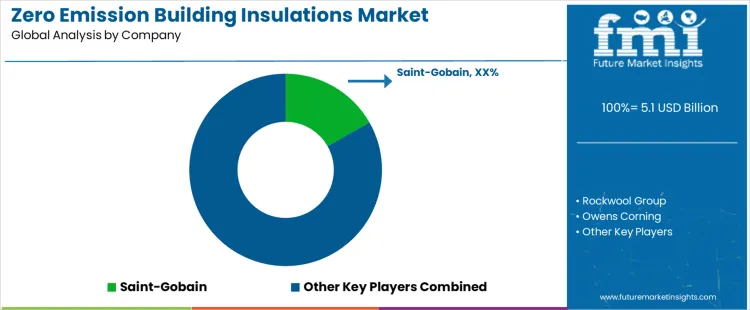
Competition in the Zero Emission Building Insulations Market is defined by material performance, embodied carbon reduction, thermal efficiency, and compatibility with sustainable construction standards. Saint Gobain supplies insulation solutions engineered for low thermal conductivity and reduced lifecycle environmental impact, with emphasis on integration into energy efficient building envelopes. Rockwool Group focuses on mineral wool products that deliver thermal performance while supporting fire resistance and moisture management in low emission design.Owens Corning offers expanded polystyrene and fibreglass systems optimised to meet stringent carbon reduction targets and energy code requirements.
Knauf Insulation competes with glass mineral wool and bio based blends engineered for thermal continuity and reduced production emissions. Kingspan Group delivers high performance rigid insulation boards that emphasise low embodied energy and high R values per unit thickness. Other market participants include regional manufacturers and specialty providers that supply cellulose, sheep wool, hemp, or other bio based insulation media tailored to sustainable building specifications. Competitive differences arise from material thermal resistance, embodied carbon footprint, moisture and fire performance, and alignment with green building certifications. Firms that offer documented low emission solutions coupled with supply continuity and compliance with evolving sustainability codes are positioned to support the growing demand for climate aligned building insulation systems.
Key Players in the Zero Emission Building Insulations Market
- Saint-Gobain
- Rockwool Group
- Owens Corning
- Knauf Insulation
- Kingspan Group
- Others
Scope of the Report
| Items | Values |
|---|---|
| Quantitative Units (2026) | USD billion |
| Material Type | Mineral Wool (Rock & Glass), Cellulose-Based Insulation, Bio-Based Foams, Aerogels, Others |
| Building Type | Residential Buildings, Commercial Buildings, Industrial Buildings, Institutional Buildings |
| Application Area | Walls & Facades, Roofs & Ceilings, Floors & Basements, HVAC & Duct Insulation |
| Region | Asia Pacific, Europe, North America, Latin America, Middle East & Africa |
| Key Countries Covered | China, Japan, South Korea, India, Australia & New Zealand, Germany, United Kingdom, France, Italy, Spain, Nordic, BENELUX, United States, Canada, Mexico, Brazil, Chile, Kingdom of Saudi Arabia, Other GCC Countries, Turkey, South Africa, Other African Union |
| Key Companies Profiled | Saint-Gobain, Rockwool Group, Owens Corning, Knauf Insulation, Kingspan Group, Others |
| Additional Attributes | Dollar sales by material type and building type; regional CAGR, volume and value growth projections; adoption by residential, commercial, industrial, and institutional projects; regulatory compliance and energy efficiency standards; installation expertise |
Zero Emission Building Insulations Market Segmentation
Material Type:
- Mineral Wool (Rock & Glass)
- Cellulose-Based Insulation
- Bio-Based Foams
- Aerogels
- Others
Building Type:
- Residential Buildings
- Commercial Buildings
- Industrial Buildings
- Institutional Buildings
Application Area:
- Walls & Facades
- Roofs & Ceilings
- Floors & Basements
- HVAC & Duct Insulation
Region:
- Asia Pacific
- China
- Japan
- South Korea
- India
- Australia & New Zealand
- ASEAN
- Rest of Asia Pacific
- Europe
- Germany
- United Kingdom
- France
- Italy
- Spain
- Nordic
- BENELUX
- Rest of Europe
- North America
- United States
- Canada
- Mexico
- Latin America
- Brazil
- Chile
- Rest of Latin America
- Middle East & Africa
- Kingdom of Saudi Arabia
- Other GCC Countries
- Turkey
- South Africa
- Other African Union
- Rest of Middle East & Africa
Bibliography
- International Energy Agency (IEA). (2024). Building energy efficiency and low‑carbon insulation materials in net‑zero pathways. IEA Energy Efficiency Reports.
- Intergovernmental Panel on Climate Change (IPCC). (2023). AR6 Synthesis Report: Mitigation of climate change in buildings and construction. IPCC Working Group III.
- European Commission – Joint Research Centre (JRC). (2024). Low‑emission construction materials and insulation performance for climate‑neutral buildings. Publications Office of the European Union.
- U.S. Department of Energy (DOE). (2024). Advanced insulation materials for zero‑emission residential and commercial buildings. Building Technologies Office Reports.
- International Organization for Standardization (ISO). (2023). ISO 14067: Carbon footprint of construction materials and insulation systems. ISO Technical Standards.
Frequently Asked Questions
How big is the zero emission building insulations market in 2026?
The global zero emission building insulations market is estimated to be valued at USD 5.1 billion in 2026.
What will be the size of zero emission building insulations market in 2036?
The market size for the zero emission building insulations market is projected to reach USD 12.0 billion by 2036.
How much will be the zero emission building insulations market growth between 2026 and 2036?
The zero emission building insulations market is expected to grow at a 8.9% CAGR between 2026 and 2036.
What are the key product types in the zero emission building insulations market?
The key product types in zero emission building insulations market are mineral wool (rock & glass), cellulose-based insulation, bio-based foams, aerogels and others.
Which building type segment to contribute significant share in the zero emission building insulations market in 2026?
In terms of building type, residential buildings segment to command 46.2% share in the zero emission building insulations market in 2026.
Preview the report firsthand - request a free sample
Get SampleGet the brochure for pricing and purchase details.
Get PDFTable of Content
- Executive Summary
- Global Market Outlook
- Demand-side Trends
- Supply-side Trends
- Technology Roadmap Analysis
- Analysis and Recommendations
- Market Overview
- Market Coverage / Taxonomy
- Market Definition / Scope / Limitations
- Market Background
- Market Dynamics
- Drivers
- Restraints
- Opportunity
- Trends
- Scenario Forecast
- Demand in Optimistic Scenario
- Demand in Likely Scenario
- Demand in Conservative Scenario
- Opportunity Map Analysis
- Product Life Cycle Analysis
- Supply Chain Analysis
- Investment Feasibility Matrix
- Value Chain Analysis
- PESTLE and Porter’s Analysis
- Regulatory Landscape
- Regional Parent Market Outlook
- Production and Consumption Statistics
- Import and Export Statistics
- Market Dynamics
- Global Market Analysis 2021 to 2025 and Forecast, 2026 to 2036
- Historical Market Size Value (USD Million) Analysis, 2021 to 2025
- Current and Future Market Size Value (USD Million) Projections, 2026 to 2036
- Y-o-Y Growth Trend Analysis
- Absolute $ Opportunity Analysis
- Global Market Pricing Analysis 2021 to 2025 and Forecast 2026 to 2036
- Global Market Analysis 2021 to 2025 and Forecast 2026 to 2036, By Material Type
- Introduction / Key Findings
- Historical Market Size Value (USD Million) Analysis By Material Type , 2021 to 2025
- Current and Future Market Size Value (USD Million) Analysis and Forecast By Material Type , 2026 to 2036
- Mineral Wool (Rock & Glass)
- Cellulose-Based Insulation
- Bio-Based Foams
- Aerogels
- Others
- Mineral Wool (Rock & Glass)
- Y-o-Y Growth Trend Analysis By Material Type , 2021 to 2025
- Absolute $ Opportunity Analysis By Material Type , 2026 to 2036
- Global Market Analysis 2021 to 2025 and Forecast 2026 to 2036, By Building Type
- Introduction / Key Findings
- Historical Market Size Value (USD Million) Analysis By Building Type, 2021 to 2025
- Current and Future Market Size Value (USD Million) Analysis and Forecast By Building Type, 2026 to 2036
- Residential Buildings
- Commercial Buildings
- Industrial Buildings
- Institutional Buildings
- Residential Buildings
- Y-o-Y Growth Trend Analysis By Building Type, 2021 to 2025
- Absolute $ Opportunity Analysis By Building Type, 2026 to 2036
- Global Market Analysis 2021 to 2025 and Forecast 2026 to 2036, By Application Area
- Introduction / Key Findings
- Historical Market Size Value (USD Million) Analysis By Application Area, 2021 to 2025
- Current and Future Market Size Value (USD Million) Analysis and Forecast By Application Area, 2026 to 2036
- Walls & Facades
- Roofs & Ceilings
- Floors & Basements
- HVAC & Duct Insulation
- Walls & Facades
- Y-o-Y Growth Trend Analysis By Application Area, 2021 to 2025
- Absolute $ Opportunity Analysis By Application Area, 2026 to 2036
- Global Market Analysis 2021 to 2025 and Forecast 2026 to 2036, By Region
- Introduction
- Historical Market Size Value (USD Million) Analysis By Region, 2021 to 2025
- Current Market Size Value (USD Million) Analysis and Forecast By Region, 2026 to 2036
- North America
- Latin America
- Western Europe
- Eastern Europe
- East Asia
- South Asia and Pacific
- Middle East & Africa
- Market Attractiveness Analysis By Region
- North America Market Analysis 2021 to 2025 and Forecast 2026 to 2036, By Country
- Historical Market Size Value (USD Million) Trend Analysis By Market Taxonomy, 2021 to 2025
- Market Size Value (USD Million) Forecast By Market Taxonomy, 2026 to 2036
- By Country
- USA
- Canada
- Mexico
- By Material Type
- By Building Type
- By Application Area
- By Country
- Market Attractiveness Analysis
- By Country
- By Material Type
- By Building Type
- By Application Area
- Key Takeaways
- Latin America Market Analysis 2021 to 2025 and Forecast 2026 to 2036, By Country
- Historical Market Size Value (USD Million) Trend Analysis By Market Taxonomy, 2021 to 2025
- Market Size Value (USD Million) Forecast By Market Taxonomy, 2026 to 2036
- By Country
- Brazil
- Chile
- Rest of Latin America
- By Material Type
- By Building Type
- By Application Area
- By Country
- Market Attractiveness Analysis
- By Country
- By Material Type
- By Building Type
- By Application Area
- Key Takeaways
- Western Europe Market Analysis 2021 to 2025 and Forecast 2026 to 2036, By Country
- Historical Market Size Value (USD Million) Trend Analysis By Market Taxonomy, 2021 to 2025
- Market Size Value (USD Million) Forecast By Market Taxonomy, 2026 to 2036
- By Country
- Germany
- UK
- Italy
- Spain
- France
- Nordic
- BENELUX
- Rest of Western Europe
- By Material Type
- By Building Type
- By Application Area
- By Country
- Market Attractiveness Analysis
- By Country
- By Material Type
- By Building Type
- By Application Area
- Key Takeaways
- Eastern Europe Market Analysis 2021 to 2025 and Forecast 2026 to 2036, By Country
- Historical Market Size Value (USD Million) Trend Analysis By Market Taxonomy, 2021 to 2025
- Market Size Value (USD Million) Forecast By Market Taxonomy, 2026 to 2036
- By Country
- Russia
- Poland
- Hungary
- Balkan & Baltic
- Rest of Eastern Europe
- By Material Type
- By Building Type
- By Application Area
- By Country
- Market Attractiveness Analysis
- By Country
- By Material Type
- By Building Type
- By Application Area
- Key Takeaways
- East Asia Market Analysis 2021 to 2025 and Forecast 2026 to 2036, By Country
- Historical Market Size Value (USD Million) Trend Analysis By Market Taxonomy, 2021 to 2025
- Market Size Value (USD Million) Forecast By Market Taxonomy, 2026 to 2036
- By Country
- China
- Japan
- South Korea
- By Material Type
- By Building Type
- By Application Area
- By Country
- Market Attractiveness Analysis
- By Country
- By Material Type
- By Building Type
- By Application Area
- Key Takeaways
- South Asia and Pacific Market Analysis 2021 to 2025 and Forecast 2026 to 2036, By Country
- Historical Market Size Value (USD Million) Trend Analysis By Market Taxonomy, 2021 to 2025
- Market Size Value (USD Million) Forecast By Market Taxonomy, 2026 to 2036
- By Country
- India
- ASEAN
- Australia & New Zealand
- Rest of South Asia and Pacific
- By Material Type
- By Building Type
- By Application Area
- By Country
- Market Attractiveness Analysis
- By Country
- By Material Type
- By Building Type
- By Application Area
- Key Takeaways
- Middle East & Africa Market Analysis 2021 to 2025 and Forecast 2026 to 2036, By Country
- Historical Market Size Value (USD Million) Trend Analysis By Market Taxonomy, 2021 to 2025
- Market Size Value (USD Million) Forecast By Market Taxonomy, 2026 to 2036
- By Country
- Kingdom of Saudi Arabia
- Other GCC Countries
- Turkiye
- South Africa
- Other African Union
- Rest of Middle East & Africa
- By Material Type
- By Building Type
- By Application Area
- By Country
- Market Attractiveness Analysis
- By Country
- By Material Type
- By Building Type
- By Application Area
- Key Takeaways
- Key Countries Market Analysis
- USA
- Pricing Analysis
- Market Share Analysis, 2025
- By Material Type
- By Building Type
- By Application Area
- Canada
- Pricing Analysis
- Market Share Analysis, 2025
- By Material Type
- By Building Type
- By Application Area
- Mexico
- Pricing Analysis
- Market Share Analysis, 2025
- By Material Type
- By Building Type
- By Application Area
- Brazil
- Pricing Analysis
- Market Share Analysis, 2025
- By Material Type
- By Building Type
- By Application Area
- Chile
- Pricing Analysis
- Market Share Analysis, 2025
- By Material Type
- By Building Type
- By Application Area
- Germany
- Pricing Analysis
- Market Share Analysis, 2025
- By Material Type
- By Building Type
- By Application Area
- UK
- Pricing Analysis
- Market Share Analysis, 2025
- By Material Type
- By Building Type
- By Application Area
- Italy
- Pricing Analysis
- Market Share Analysis, 2025
- By Material Type
- By Building Type
- By Application Area
- Spain
- Pricing Analysis
- Market Share Analysis, 2025
- By Material Type
- By Building Type
- By Application Area
- France
- Pricing Analysis
- Market Share Analysis, 2025
- By Material Type
- By Building Type
- By Application Area
- India
- Pricing Analysis
- Market Share Analysis, 2025
- By Material Type
- By Building Type
- By Application Area
- ASEAN
- Pricing Analysis
- Market Share Analysis, 2025
- By Material Type
- By Building Type
- By Application Area
- Australia & New Zealand
- Pricing Analysis
- Market Share Analysis, 2025
- By Material Type
- By Building Type
- By Application Area
- China
- Pricing Analysis
- Market Share Analysis, 2025
- By Material Type
- By Building Type
- By Application Area
- Japan
- Pricing Analysis
- Market Share Analysis, 2025
- By Material Type
- By Building Type
- By Application Area
- South Korea
- Pricing Analysis
- Market Share Analysis, 2025
- By Material Type
- By Building Type
- By Application Area
- Russia
- Pricing Analysis
- Market Share Analysis, 2025
- By Material Type
- By Building Type
- By Application Area
- Poland
- Pricing Analysis
- Market Share Analysis, 2025
- By Material Type
- By Building Type
- By Application Area
- Hungary
- Pricing Analysis
- Market Share Analysis, 2025
- By Material Type
- By Building Type
- By Application Area
- Kingdom of Saudi Arabia
- Pricing Analysis
- Market Share Analysis, 2025
- By Material Type
- By Building Type
- By Application Area
- Turkiye
- Pricing Analysis
- Market Share Analysis, 2025
- By Material Type
- By Building Type
- By Application Area
- South Africa
- Pricing Analysis
- Market Share Analysis, 2025
- By Material Type
- By Building Type
- By Application Area
- USA
- Market Structure Analysis
- Competition Dashboard
- Competition Benchmarking
- Market Share Analysis of Top Players
- By Regional
- By Material Type
- By Building Type
- By Application Area
- Competition Analysis
- Competition Deep Dive
- Saint-Gobain
- Overview
- Product Portfolio
- Profitability by Market Segments (Product/Age /Sales Channel/Region)
- Sales Footprint
- Strategy Overview
- Marketing Strategy
- Product Strategy
- Channel Strategy
- Rockwool Group
- Owens Corning
- Knauf Insulation
- Kingspan Group
- Others
- Saint-Gobain
- Competition Deep Dive
- Assumptions & Acronyms Used
- Research Methodology


