

- Market Size (2026)
- USD 18.8 Bn
- Forecast (2036)
- USD 37.9 Bn
- CAGR (2026 to 2036)
- 7.3%
How Big is the Animal Feed Additives Market in 2026?
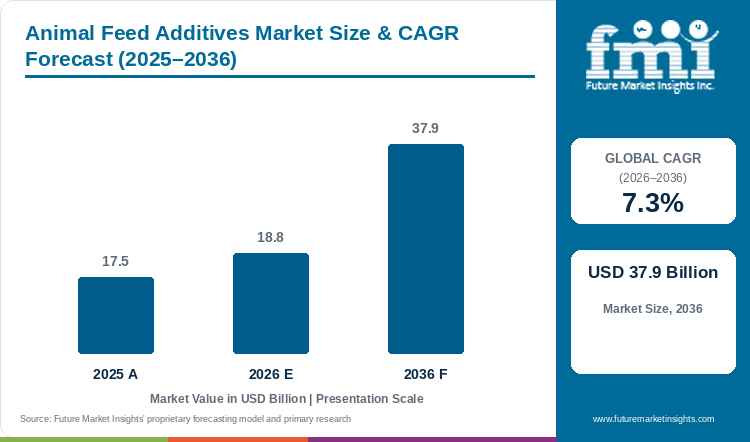
Sales of animal feed additives were USD 17.5 Billion in 2025 and will rise to USD 18.8 Billion in 2026. At a 7.3% CAGR over 2026 to 2036, animal feed additives market will reach USD 37.9 Billion by 2036.
A recently updated report on the animal feed additives market by FMI shows a 7.3% CAGR between 2026 and 2036. Sales of animal feed additives will reach USD 37.9 Billion by 2036, roughly double the 2026 value.
Demand for animal feed additives will rise with feed protein use and with the push by livestock producers to get more meat, milk and eggs from each tonne of feed. In June 2026, OECD and FAO projected that global feed protein consumption will increase 13.5% over the next decade as livestock and aquaculture systems intensify [1]. Nutritionists at compound-feed plants will keep adding amino acids, enzymes and plant extracts that lift digestibility, and additive spending will move in step with the poultry feed market and the feed enzymes market.
Our analysts at FMI analyze opportunities in adjacent market, classified under the umbrella of animal feed market. Adjacent ingredient markets will grow slower, with feed enzymes at 6.0%, phytogenic feed additives at 6.0%, feed amino acids at 5.7% and pet food additives at 5.5%. Analysts at FMI see feed mills buying several functions together in one additive program. FMI predicts high ROI for suppliers that combine enzymes, botanicals and amino acids into one formula during the forecast period.
Key Takeaways of Animal Feed Additives Market
- Plant-derived sources will hold 93.5% of source revenue in 2026.
- Poultry will take 40.6% of livestock market share in 2026. Demand will be driven as small feed-conversion gains add up across very large flocks.
- Key companies operating in the animal feed additives market include dsm-firmenich, Evonik, Adisseo, Cargill, Kemin Industries, EW Nutrition, Novonesis, and Lallemand Animal Nutrition, among many players in the full report.
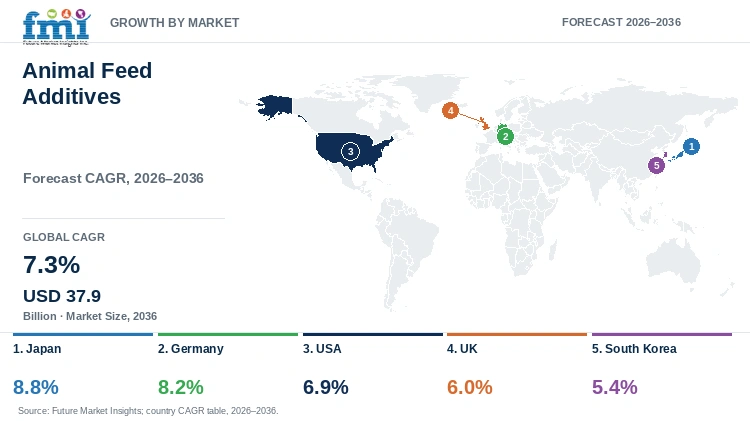
- Japan (8.8%) and Germany (8.2%) will lead country growth through 2036. South Korea will grow slowest at 5.4% during the forecast period.
Analyst Perspective
“High ROI will be with suppliers holding local regulatory teams and field nutritionists, and smaller brands with thin trial data will struggle to keep accounts.”
- Nandini Roy Choudhury, Principal Consultant, Future Market Insights
How is the Animal Feed Additives Market Segmented?
Animal feed additives market is segmented across source, form, livestock and region.
Source covers plant, animal, and microorganism.
Form covers powder, granules, and liquid.
Livestock covers poultry, ruminant, swine, pet animal, and aquaculture.
Why Do Plant-derived Additives Lead the Animal Feed Additives Market by Source?
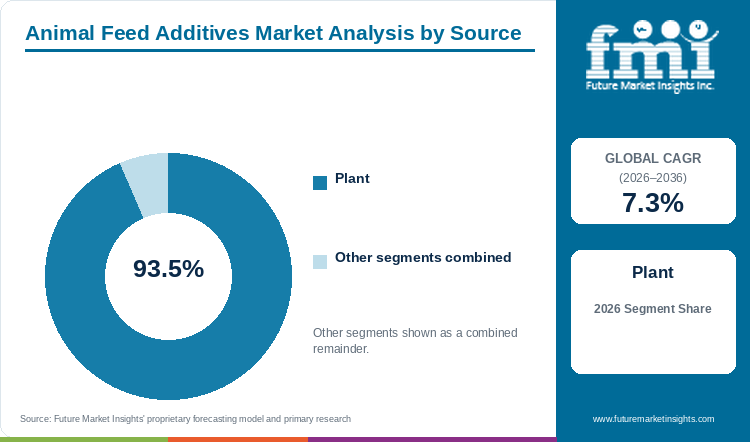
Plant-derived additives will capture 93.5% of source revenue in 2026.
Sales of plant-derived animal feed additives will stay high during the forecast period. Key challenges in the plant source segment include variation in active compounds from one harvest or extraction batch to the next. As a result, feed buyers pay more for standardized specifications.
- As per FMI's report, plant sources will account for 93.5% of 2026 source revenue, backed by the wide range of botanical actives open to formulators.
- In November 2025, Cargill raised capacity at the Engerwitzdorf, Austria micronutrition plant by 50.0% to 30,000 metric tons a year 2].
Why is Powder the Leading Form of Animal Feed Additives?
In 2026, powder will account for 58.8% of form market share.
Powder will remain the leading form of animal feed additives through 2036. FMI's analysis finds that the feed premix market is proportional to demand for powder owing to its stability and ease of transport. Key challenges in powder handling include dust, operator exposure and segregation in the mixer. Demand for granules comes from mills seeking lower dust and better flow. Adoption of liquid additives will rise among pellet mills that spray heat-sensitive enzymes and probiotics onto feed after the pellet press.
- By form, powder will account for 58.8% of market share in 2026.
- In April 2026, Novonesis said Bovacillus withstands temperatures up to 95°C and works in pellets, liquid feed, TMR, mineral blocks and mash [3].
Why Does Poultry Account for the Largest Share of Animal Feed Additives Demand?
Based on livestock, poultry will lead with 40.6% of 2026.
Poultry producers remain the largest buyers of feed additives, owing to rapid flock turnover that lets integrators measure the effect of each ration change on feed conversion within a single cycle. Ruminant diets will add further demand, with methane control opening a new product line tracked in the methane-reducing feed additive market. Swine and pet animal diets make up further shares of livestock revenue. Aquaculture feed makers form another buyer group, covered by FMI in the aquafeed additives market study.
- Poultry will reach 40.6% of livestock market share in 2026.
- In April 2026, USDA NASS reported that the USA produced 9.40 billion broilers in 2025, with total live weight of 62.2 billion pounds [4].
Market Dynamics
What are the Drivers, Restraints, and Opportunities in the Animal Feed Additives Market?
Demand will follow intensive livestock production and the value of feed efficiency. Authorization rules will slow new launches, and validated gut-health and environmental additives will open fresh revenue as farms cut antibiotic use.
- Driver: Demand will remain high from larger and more intensive poultry. Pig and fish operations will pay premium price for additives during the forecast period.
- Restraint: Authorization, safety and efficacy files delay commercial launch, as each regulator asks for a separate dossier.
- Opportunity: Plant-based, microbial and methane-reducing additives with authorized claims will replace part of the antibiotic toolkit and help farms meet environmental targets.
Key trend analysis points that intensive livestock production will keep raising the value of each point of feed efficiency. Authorization rules will slow new launches in every profiled country. Validated gut-health and environmental additives will open fresh revenue as farms cut antibiotic use.
Which Country CAGRs are Profiled in the Animal Feed Additives Market?
| Country | CAGR, 2026 to 2036 |
|---|---|
| Japan | 8.8% |
| Germany | 8.2% |
| USA | 6.9% |
| UK | 6.0% |
| South Korea | 5.4% |
How do Country-level CAGRs Compare in the Animal Feed Additives Market?
According to FMI's report, country CAGRs will spread 3.4 percentage points between 2026 and 2036, from Japan at 8.8% down to South Korea at 5.4%. Japan and Germany sit above 8.0%. The USA follows at 6.9%, ahead of the UK at 6.0%. Authorization speed, livestock mix and feed-mill structure account for most of the gap.
- Japan runs 0.6 points ahead of Germany. Buyers in both markets favor suppliers with local designation or EU authorization before the first mill trial.
- A large poultry and pig slaughter base under EU rules keeps Germany 1.3 points above the USA.
- Broiler scale drives US growth, with 9.40 billion birds produced in 2025.
- The UK holds a 0.6-point lead over South Korea.
FMI's full report extends country-level CAGR analysis to over 30 countries across North America, Latin America, Western Europe, Eastern Europe, East Asia, South Asia and Pacific, and the Middle East and Africa.
Country Outlook
- Our analysts at FMI suggest that suppliers with an accepted Japanese dossier will hold an edge with local feed makers, as designation in Japan requires proof of need, effect and safety. In August 2026, MAFF updated feed additive guidance after an August 3 revision to the treatment of certain antimicrobial preparations [5]. Sales of animal feed additives in Japan will grow at an 8.8% CAGR from 2026 to 2036
- Germany's large industrial livestock sector will carry animal feed additive growth at an 8.2% CAGR till 2036. Destatis reported in August 2025 that commercial slaughter included 346.1 million poultry in the first half of 2025 [6]. German feed buyers run mature, cost-focused operations. Additive suppliers need EU authorization plus trial data proving value under local pelleting conditions.
- Broiler volume anchors US demand for animal feed additives, which will expand at a 6.9% CAGR through 2036. USDA NASS reported in April 2026 that the country produced 9.40 billion broilers in 2025, with a live weight of 62.2 billion pounds [4]. Large integrators centralize nutrition decisions, so one approved product moves across many poultry complexes at once. Regulatory status will be the main friction after the FDA proposed stricter GRAS oversight in August 2026 [7].
- UK farmers will look for nutrition tools that hold flock and herd performance with fewer antibiotics, after the Veterinary Medicines Directorate reported in November 2025 that livestock antibiotic sales fell 57.0% over the prior decade [8]. The Food Standards Agency reported in September 2026 that 49 feed additives had been authorized for the GB market, with 163 applications still awaiting authorization and the GB Register of Feed Additives serving as the official record [9]. Suppliers track register status and conditions of use product by product. Growth of animal feed additives in the UK will hold at a 6.0% CAGR over the forecast period.
- Key challenges in the South Korean animal feed additives market include component registration, owing to which growth will be the slowest of the five profiled countries at a 5.4% CAGR till 2036. MAFRA reported in April 2026 that 98.9% of 645 monitored feed samples met hazardous-substance limits in the 2025 surveillance program [10]. Suppliers need consistent specifications and batch records that distributors can show during quality checks.
Who are the Notable Companies in the Animal Feed Additives Market?
Key companies profiled by FMI include dsm-firmenich, Evonik, Adisseo, Cargill, Kemin Industries, EW Nutrition, Novonesis and Lallemand Animal Nutrition.
Animal feed additives market share among suppliers follows authorization records, species coverage and the trial evidence behind each active ingredient, as per FMI. The report places the profiled companies in three strategy cohorts. dsm-firmenich is profiled through the Animal Nutrition & Health business, which the company agreed in February 2026 to sell to CVC Capital Partners, with closing expected by the end of 2026. Delacon, Provimi and Diamond V appear under Cargill, the parent company, to avoid double counting. Feed mills compare suppliers on trial data, regulatory status and technical service before approving a product for the premix.
- Integrated Amino Acid and Vitamin Producers: dsm-firmenich, Evonik, and Adisseo make high-volume nutritional additives such as vitamins and methionine at world-scale plants and sell specialty products alongside.
- Phytogenic and Feed-Quality Formulators: Cargill, Kemin Industries, and EW Nutrition supply plant extracts, pathogen control products and gut-health blends to feed mills.
- Enzyme and Microbial Biosolution Specialists: Novonesis and Lallemand Animal Nutrition concentrate on enzymes, bacteria and yeast strains holding EU authorizations across several species.
Competitive Benchmarking
| Company | Authorization Record | Multi-Species Evidence | Plant or Microbial Actives | Geographic Reach |
|---|---|---|---|---|
| dsm-firmenich (Animal Nutrition & Health) | High | High | Medium | Global, managed from Kaiseraugst, Switzerland |
| Evonik | High | High | Medium | Europe, Asia and the Americas, with methionine plants in Antwerp, Singapore and Mobile |
| Adisseo | High | High | Medium | Global sales, with methionine production in Spain and China (Nanjing), and a new powder methionine plant under construction in Fujian Province, China |
| Cargill | Medium | High | High | Global, with an expanded micronutrition plant in Austria |
| Kemin Industries | Medium | High | High | More than 120 countries, with 11 manufacturing sites |
| EW Nutrition | Low | Medium | High | Americas, Europe, Asia-Pacific, and the Middle East and Africa |
| Novonesis | High | High | High | Global |
| Lallemand Animal Nutrition | High | High | High | Europe, North America and international markets |
Scoring basis: Authorization Record tracks public evidence of feed additive authorizations, registrations or regulatory filings held for company products. Multi-Species Evidence tracks documented product use across poultry, swine, ruminant, aquaculture and pet animal diets. Plant or Microbial Actives tracks documented plant-derived, probiotic, yeast or enzyme products in the portfolio. High marks broad, clearly documented capability. Medium marks credible but narrower documented capability. Low marks limited public documentation for that criterion. Geographic Reach reflects evidenced sales, distribution or production activity. Scores draw on public company documentation reviewed by FMI in September 2026.
Key Developments
- In February 2026, dsm-firmenich agreed to sell the Animal Nutrition & Health business to CVC Capital Partners at an enterprise value of EUR 2.2 billion [11]. dsm-firmenich will keep Bovaer, Veramaris and a 20.0% stake in the two new companies.
- In April 2026, Novonesis launched Bovacillus, the first Bacillus probiotic authorized for lactating dairy cows in Europe, with a cited 3.7% gain in feed efficiency [3].
Key Players
Integrated Amino Acid and Vitamin Producers
- dsm-firmenich
- Evonik
- Adisseo
Phytogenic and Feed-Quality Formulators
- Cargill
- Kemin Industries
- EW Nutrition
Enzyme and Microbial Biosolution Specialists
- Novonesis
- Lallemand Animal Nutrition
Report Scope and Methodology
| Coverage field | Report scope |
|---|---|
| Market breakdown | 4 categories: Source (Plant, Animal, Microorganism), Form (Powder, Granules, Liquid), Livestock (Poultry, Ruminant, Swine, Pet Animal, Aquaculture), and Region |
| Quantitative units | USD Billion |
| Market definition | Revenue from additive products sold for intentional incorporation into animal feed or drinking-water delivery within the Source, Form and Livestock segmentation. The definition excludes complete feed, finished pet food or aquafeed, veterinary pharmaceuticals, downstream animal products and adjacent substitute revenue. |
| Regions covered | North America, Latin America, Western Europe, Eastern Europe, East Asia, South Asia and Pacific, Middle East and Africa |
| Countries covered | 30+ countries, including the USA, UK, Germany, Japan, and South Korea |
| Key companies profiled | A few of the notable companies out of many players covered by FMI include dsm-firmenich, Evonik, Adisseo, Cargill, Kemin Industries, EW Nutrition, Novonesis, and Lallemand Animal Nutrition |
| Forecast period | 2026 to 2036 |
| Approach | FMI applies a hybrid bottom-up and top-down sizing framework that reconciles supplier additive revenue with compound-feed output, livestock production and species-mix indicators, and removes finished-feed and veterinary-drug revenue. |
Research Methodology
| Method | Approach |
|---|---|
| Primary research | FMI's primary research engages additive manufacturers, premix producers, compound-feed mills, integrators, distributors and animal nutritionists to test purchase criteria, dosing practice, cost-in-use, regulatory timelines and repeat-order behavior. |
| Desk research | The analysis reviews agricultural outlooks, livestock and slaughter statistics, regulator publications from EFSA, FDA, MAFF, MAFRA and the Food Standards Agency, antimicrobial-use reports and first-party company information, keeping sources that define demand, supply roles or market access. |
| Market sizing and forecasting | The sizing framework links additive inclusion rates to compound-feed volume by species, product mix, form, pricing and supplier participation. Forecasts consider livestock intensification, antibiotic reduction, authorization timelines and substitution among plant, animal and microbial actives. |
| Data validation | Supplier evidence is triangulated with feed-production and livestock indicators, and segment logic is checked against the revenue boundary. Complete feed, veterinary pharmaceuticals, finished pet food and duplicate channel revenue are removed before final reconciliation. |
Animal Feed Additives Market by Segments
Animal Feed Additives Market Segmented by Source
- Plant
- Animal
- Microorganism
Animal Feed Additives Market Segmented by Form
- Powder
- Granules
- Liquid
Animal Feed Additives Market Segmented by Livestock
- Poultry
- Ruminant
- Swine
- Pet Animal
- Aquaculture
Animal Feed Additives Market Segmented by Region
- North America
- United States
- Canada
- Latin America
- Brazil
- Mexico
- Argentina
- Chile
- Western Europe
- Germany
- France
- United Kingdom
- Italy
- Spain
- Benelux
- Nordics
- Eastern Europe
- Poland
- Czech Republic
- Romania
- Hungary
- East Asia
- China
- Japan
- South Korea
- South Asia and Pacific
- India
- ASEAN
- Australia and New Zealand
- Middle East and Africa
- GCC Countries
- South Africa
- Türkiye
- Israel
Research Sources and Bibliography
- [1] OECD and Food and Agriculture Organization of the United Nations (2026, June 29). OECD-FAO Agricultural Outlook 2026-2035.
- [2] Cargill (2025, November 4). Cargill Animal Nutrition & Health Increases Micronutrition Production Capacity to Meet Growing Customer Demand.
- [3] Novonesis (2026, April 29). Novonesis launches Europe's first Bacillus probiotic for dairy cows.
- [4] U.S. Department of Agriculture, National Agricultural Statistics Service (2026, April 30). Poultry - Production and Value 2025 Summary.
- [5] Ministry of Agriculture, Forestry and Fisheries of Japan (2026, August 18). Feed Additives.
- [6] Statistisches Bundesamt (2025, August 7). Fleischproduktion im 1. Halbjahr 2025: mehr Schweinefleisch und weniger Rindfleisch.
- [7] U.S. Food and Drug Administration (2026, August 10). Generally Recognized as Safe (GRAS) Notification Program.
- [8] Veterinary Medicines Directorate (2025, November 18). Veterinary Antimicrobial Resistance and Sales Surveillance 2024.
- [9] Food Standards Agency (2026, September 14). Animal feed report: FSA Business Committee.
- [10] Ministry of Agriculture, Food and Rural Affairs of the Republic of Korea (2026, April 28). Monitoring of hazardous substances in distributed feed found 98.9% of samples compliant.
- [11] dsm-firmenich (2026, February 9). dsm-firmenich announces agreement to divest Animal Nutrition & Health to CVC Capital Partners.
- [12] European Food Safety Authority (2026, August 18). Feed additives.
- [13] Feed Strategy (2026, July 17). Evonik completes backward integration of its global MetAMINO production network.
- [14] Adisseo (2026, March 7). FY2025: double-digit revenue growth and solid profit margin in a highly competitive environment.
- [15] EW Nutrition (2026, February 3). EW Nutrition and GRASP Strengthen Strategic Partnership.
- [16] Kemin Industries (2025, May 12). Kemin Industries Expands Innovation in Intestinal Health with Strategic Acquisition.
- [17] Lallemand Animal Nutrition (n.d.; accessed September 30, 2026). BACTOCELL.
This bibliography is provided for reader reference and is not exhaustive. The full FMI report contains the complete reference list and detailed citations.
This Report Answers
- How big will the Animal Feed Additives Market be in 2026, and what value will FMI forecast for 2036?
- Which livestock and feed-efficiency pressures will support demand for animal feed additives through 2036?
- Why will plant-derived additives hold the leading position within the Source category in 2026?
- How will the powder form fit premix and compound-feed handling at feed mills?
- Why will poultry hold the largest share within the Livestock category?
- How will growth rates differ across Japan, Germany, the USA, the UK, and South Korea till 2036?
- What will the authorization records and product scope of the profiled companies show feed buyers?
- How will authorization and efficacy requirements slow the launch of new feed additives?
- What will feed mill nutritionists and procurement teams check before approving a feed additive for the premix?
Frequently Asked Questions
How big is the animal feed additives market expected to be in 2026?
Animal feed additives market size is USD 18.8 billion in 2026, as per FMI, compared with USD 17.5 billion in 2025. Sales will reach USD 37.9 billion by 2036.
What is the CAGR of the animal feed additives market from 2026 to 2036?
Growth of the animal feed additives market will reach a 7.3% CAGR from 2026 to 2036. Rising feed protein use and farm programs aimed at lower antibiotic use will keep additive spending climbing.
Which source holds the largest share of the animal feed additives market?
Plant-derived additives will lead with 93.5% of source revenue in 2026. Herbs, spices and essential-oil fractions give formulators a wide range of antioxidant and gut-health functions.
Which livestock segment buys the most feed additives?
Poultry will account for 40.6% of livestock revenue in 2026. Short flock cycles let integrators measure feed conversion quickly, so proven additives get reordered across large bird volumes.
Which country will grow fastest?
Japan will post the highest CAGR among the five profiled countries at 8.8% till 2036, ahead of Germany at 8.2%. South Korea will grow slowest at 5.4%.
What notable restraint affects the animal feed additives market?
Key challenges in the animal feed additives market include authorization, owing to which a new additive reaches buyers one country at a time. EFSA, the FDA, MAFF and the UK register each ask for evidence on identity, safety and efficacy [12].
Which are the key companies in the animal feed additives market?
dsm-firmenich, Evonik, Adisseo, Cargill, Kemin Industries, EW Nutrition, Novonesis, and Lallemand Animal Nutrition rank among the notable companies. The full FMI report covers many more players.
Preview the report firsthand - request a free sample
Get SampleGet the brochure for pricing and purchase details.
Get PDFTable of Content
- Key Takeaways
- Market Size and CAGR
- Top Growth Driver
- Fastest Growing Segment
- Leading Region
- Key Companies
- Emerging Opportunities
- Executive Summary
- Global Market Outlook
- Demand-side Trends
- Supply-side Trends
- Technology Roadmap Analysis
- Analysis and Recommendations
- Analyst Perspective (What is happening? Why now? What should investors know?)
- Key Questions Answered
- How large is the market?
- What is the CAGR?
- What are key trends?
- Which region dominates?
- Who are the leaders?
- Market Overview
- Market Coverage / Taxonomy
- Market Definition / Scope / Limitations
- Research Methodology
- Chapter Orientation
- Analytical Lens and Working Hypotheses
- Market Structure, Signals, and Trend Drivers
- Benchmarking and Cross-market Comparability
- Market Sizing, Forecasting, and Opportunity Mapping
- Research Design and Evidence Framework
- Desk Research Programme (Secondary Evidence)
- Expert Input and Fieldwork (Primary Evidence)
- Tooling, Models, and Reference Databases
- Data Engineering and Model Build
- Quality Assurance and Audit Trail
- Market Background
- Market Dynamics (Drivers, Restraints, Opportunity, Trends)
- Scenario Forecast (Optimistic, Likely, Conservative)
- Impact Analysis
- AI Impact
- Sustainability Impact
- Regulatory Impact
- Technology Impact
- Consumer / Buyer Analysis
- Purchase Drivers
- Adoption Barriers
- Buyer Journey
- Opportunity Map Analysis
- Product Life Cycle Analysis
- Supply Chain Analysis
- Investment Feasibility Matrix
- Value Chain Analysis
- PESTLE and Porter's Analysis
- Regulatory Landscape
- Regional Parent Market Outlook
- Production and Consumption Statistics
- Import and Export Statistics
- Global Market Analysis and Forecast, 2021 to 2036
- Historical Market Size Value (USD Billion) Analysis, 2021 to 2025
- Current and Future Market Size Value (USD Billion) Projections, 2026 to 2036
- Y-o-Y Growth Trend Analysis
- Absolute $ Opportunity Analysis
- Global Market Pricing Analysis, 2021 to 2036
- Global Market Analysis and Forecast, By Source, 2021 to 2036
- Introduction / Key Findings
- Historical Market Size Value (USD Billion) Analysis By Source, 2021 to 2025
- Current and Future Market Size Value (USD Billion) Analysis and Forecast By Source, 2026 to 2036
- Plant
- Animal
- Microorganism
- Y-o-Y Growth Trend Analysis By Source, 2021 to 2025
- Absolute $ Opportunity Analysis By Source, 2026 to 2036
- Global Market Analysis and Forecast, By Form, 2021 to 2036
- Introduction / Key Findings
- Historical Market Size Value (USD Billion) Analysis By Form, 2021 to 2025
- Current and Future Market Size Value (USD Billion) Analysis and Forecast By Form, 2026 to 2036
- Powder
- Granules
- Liquid
- Y-o-Y Growth Trend Analysis By Form, 2021 to 2025
- Absolute $ Opportunity Analysis By Form, 2026 to 2036
- Global Market Analysis and Forecast, By Livestock, 2021 to 2036
- Introduction / Key Findings
- Historical Market Size Value (USD Billion) Analysis By Livestock, 2021 to 2025
- Current and Future Market Size Value (USD Billion) Analysis and Forecast By Livestock, 2026 to 2036
- Poultry
- Ruminant
- Swine
- Pet Animal
- Aquaculture
- Y-o-Y Growth Trend Analysis By Livestock, 2021 to 2025
- Absolute $ Opportunity Analysis By Livestock, 2026 to 2036
- Global Market Analysis and Forecast, By Region, 2021 to 2036
- Introduction
- Historical Market Size Value (USD Billion) Analysis By Region, 2021 to 2025
- Current Market Size Value (USD Billion) Analysis and Forecast By Region, 2026 to 2036
- North America
- Latin America
- Western Europe
- Eastern Europe
- East Asia
- South Asia and Pacific
- Middle East and Africa
- Market Attractiveness Analysis By Region
- North America Market Analysis and Forecast, By Country, 2021 to 2036
- Historical Market Size Value (USD Billion) Trend Analysis By Market Taxonomy, 2021 to 2025
- Market Size Value (USD Billion) Forecast By Market Taxonomy, 2026 to 2036
- By Country
- United States
- Canada
- By Source
- By Form
- By Livestock
- By Country
- Market Attractiveness Analysis
- By Country
- By Source
- By Form
- By Livestock
- Key Takeaways
- Latin America Market Analysis and Forecast, By Country
- Historical Market Size Value (USD Billion) Trend Analysis By Market Taxonomy, 2021 to 2025
- Market Size Value (USD Billion) Forecast By Market Taxonomy, 2026 to 2036
- By Country
- Brazil
- Mexico
- Argentina
- Chile
- By Source
- By Form
- By Livestock
- By Country
- Market Attractiveness Analysis
- By Country
- By Source
- By Form
- By Livestock
- Key Takeaways
- Western Europe Market Analysis and Forecast, By Country
- Historical Market Size Value (USD Billion) Trend Analysis By Market Taxonomy, 2021 to 2025
- Market Size Value (USD Billion) Forecast By Market Taxonomy, 2026 to 2036
- By Country
- Germany
- France
- United Kingdom
- Italy
- Spain
- Benelux
- Nordics
- By Source
- By Form
- By Livestock
- By Country
- Market Attractiveness Analysis
- By Country
- By Source
- By Form
- By Livestock
- Key Takeaways
- Eastern Europe Market Analysis and Forecast, By Country
- Historical Market Size Value (USD Billion) Trend Analysis By Market Taxonomy, 2021 to 2025
- Market Size Value (USD Billion) Forecast By Market Taxonomy, 2026 to 2036
- By Country
- Poland
- Czech Republic
- Romania
- Hungary
- By Source
- By Form
- By Livestock
- By Country
- Market Attractiveness Analysis
- By Country
- By Source
- By Form
- By Livestock
- Key Takeaways
- East Asia Market Analysis and Forecast, By Country
- Historical Market Size Value (USD Billion) Trend Analysis By Market Taxonomy, 2021 to 2025
- Market Size Value (USD Billion) Forecast By Market Taxonomy, 2026 to 2036
- By Country
- China
- Japan
- South Korea
- By Source
- By Form
- By Livestock
- By Country
- Market Attractiveness Analysis
- By Country
- By Source
- By Form
- By Livestock
- Key Takeaways
- South Asia and Pacific Market Analysis and Forecast, By Country
- Historical Market Size Value (USD Billion) Trend Analysis By Market Taxonomy, 2021 to 2025
- Market Size Value (USD Billion) Forecast By Market Taxonomy, 2026 to 2036
- By Country
- India
- ASEAN
- Australia and New Zealand
- By Source
- By Form
- By Livestock
- By Country
- Market Attractiveness Analysis
- By Country
- By Source
- By Form
- By Livestock
- Key Takeaways
- Middle East and Africa Market Analysis and Forecast, By Country
- Historical Market Size Value (USD Billion) Trend Analysis By Market Taxonomy, 2021 to 2025
- Market Size Value (USD Billion) Forecast By Market Taxonomy, 2026 to 2036
- By Country
- GCC Countries
- South Africa
- Türkiye
- Israel
- By Source
- By Form
- By Livestock
- By Country
- Market Attractiveness Analysis
- By Country
- By Source
- By Form
- By Livestock
- Key Takeaways
- Key Countries Market Analysis
- United States
- Pricing Analysis
- Market Share Analysis, 2025
- By Source
- By Form
- By Livestock
- Canada
- Pricing Analysis
- Market Share Analysis, 2025
- By Source
- By Form
- By Livestock
- Mexico
- Pricing Analysis
- Market Share Analysis, 2025
- By Source
- By Form
- By Livestock
- Brazil
- Pricing Analysis
- Market Share Analysis, 2025
- By Source
- By Form
- By Livestock
- Chile
- Pricing Analysis
- Market Share Analysis, 2025
- By Source
- By Form
- By Livestock
- Germany
- Pricing Analysis
- Market Share Analysis, 2025
- By Source
- By Form
- By Livestock
- United Kingdom
- Pricing Analysis
- Market Share Analysis, 2025
- By Source
- By Form
- By Livestock
- Italy
- Pricing Analysis
- Market Share Analysis, 2025
- By Source
- By Form
- By Livestock
- Spain
- Pricing Analysis
- Market Share Analysis, 2025
- By Source
- By Form
- By Livestock
- France
- Pricing Analysis
- Market Share Analysis, 2025
- By Source
- By Form
- By Livestock
- India
- Pricing Analysis
- Market Share Analysis, 2025
- By Source
- By Form
- By Livestock
- ASEAN
- Pricing Analysis
- Market Share Analysis, 2025
- By Source
- By Form
- By Livestock
- Australia and New Zealand
- Pricing Analysis
- Market Share Analysis, 2025
- By Source
- By Form
- By Livestock
- China
- Pricing Analysis
- Market Share Analysis, 2025
- By Source
- By Form
- By Livestock
- Japan
- Pricing Analysis
- Market Share Analysis, 2025
- By Source
- By Form
- By Livestock
- South Korea
- Pricing Analysis
- Market Share Analysis, 2025
- By Source
- By Form
- By Livestock
- Poland
- Pricing Analysis
- Market Share Analysis, 2025
- By Source
- By Form
- By Livestock
- Hungary
- Pricing Analysis
- Market Share Analysis, 2025
- By Source
- By Form
- By Livestock
- Türkiye
- Pricing Analysis
- Market Share Analysis, 2025
- By Source
- By Form
- By Livestock
- South Africa
- Pricing Analysis
- Market Share Analysis, 2025
- By Source
- By Form
- By Livestock
- United States
- Market Structure Analysis
- Competition Dashboard
- Competition Benchmarking
- Market Share Analysis of Top Players
- By Regional
- By Source
- By Form
- By Livestock
- Emerging Startups
- Innovation Benchmarking
- Competition Analysis
- Competition Deep Dive
- dsm-firmenich (Animal Nutrition & Health)
- Overview
- Product Portfolio
- Profitability by Market Segments
- Sales Footprint
- Strategy Overview
- Marketing Strategy
- Product Strategy
- Channel Strategy
- Evonik
- Adisseo
- Cargill
- Kemin Industries
- EW Nutrition
- Novonesis
- Lallemand Animal Nutrition
- dsm-firmenich
- dsm-firmenich (Animal Nutrition & Health)
- Case Studies
- Success Stories
- Recent Developments
- Competition Deep Dive
- Assumptions & Acronyms Used


