

- Industry Size (2026)
- USD 33.8 Bn
- Forecast (2036)
- USD 75.0 Bn
- CAGR (2026 to 2036)
- 8.3%
ASEAN Automotive Aftermarket Size, Market Forecast and Outlook By FMI
The ASEAN automotive aftermarket market was valued at USD 31.2 billion in 2025. Industry revenue is projected to cross USD 33.8 billion in 2026 and reach USD 75.0 billion by 2036 at an 8.3% CAGR. Offline traditional distribution is predicted to hold 72.0% share in 2026. DIFM is set to be dominant service type with an expected 68.0% share in 2026.
Summary of the ASEAN Automotive Aftermarket
- Demand and Growth Drivers
- ASEAN vehicle parc expansion is raising parts replacement activity as passenger cars remain the largest aftermarket base through 2036.
- Engine components lead product demand due to high-use vehicles in Indonesia and Thailand require repeated maintenance. Vietnam is also witnessing similar replacement demand across older fleets.
- Online parts access and service booking tools are supporting aftermarket demand since consumers compare replacement options before workshop visits.
- Product and Segment View
- Passenger cars lead vehicle type demand with an expected 66.0% share in 2026 as private car use creates repeat service visits.
- DIFM leads service type with an estimated 68.0% share in 2026 since owners prefer mechanic-led repairs for safety items.
- Individual owners represent an estimated 57.0% of customer type demand in 2026 led by household vehicles requiring regular parts and service.
- Geography and Competitive Outlook
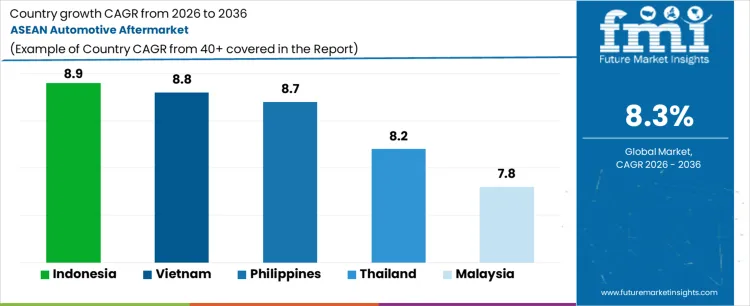
- Vietnam and the Philippines are garnering steady expansion with 8.8% CAGR and 8.7% CAGR by 2036 due to expanding vehicle ownership.
- Thailand is forecast at 8.2% CAGR through 2036 as its repair base benefits from large pickup and passenger car fleets.
- Companies such as Bosch Mobility Aftermarket and DENSO are focusing on parts depth.
- Analyst Opinion
- Nikhil Kaitwade, Principal Analyst for Automotive at FMI, reports, "ASEAN aftermarket demand is being driven by rising everyday ownership costs and workshop access. Drivers in Indonesia and Vietnam require affordable parts as car use expands. Also, Thailand and Malaysia depend on reliable supply for older passenger cars and pickups. Suppliers should focus on parts availability and mechanic confidence before pushing online-only channels. Quality proof is important since low priced parts can create repeat repair costs for owners."
- ASEAN Automotive Aftermarket Value Analysis
- Passenger cars is estimated to garner a 66.0% share as private cars create regular service events across ASEAN cities.
- Engine components is anticipated to hold around 25.0% share led by heat and heavy traffic raising wear on powertrain parts.
- Offline traditional distribution remains the main sales route as workshops and parts counters manage urgent repair purchases.
- DIFM service demand stays ahead of DIY work since brake and engine repairs require tools and mechanic skill.
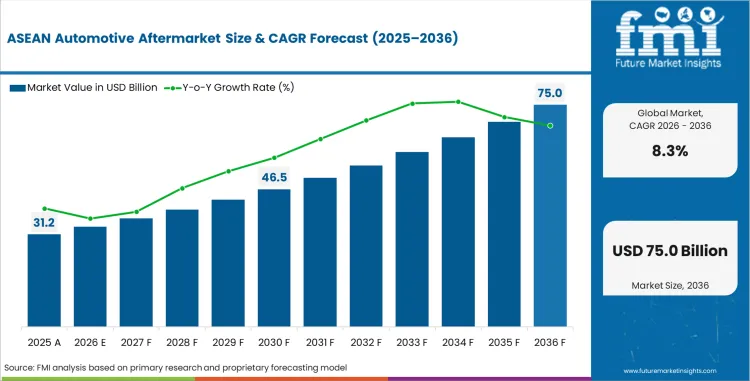
Key Takeaways
| Metric | Value |
|---|---|
| Market Size (2025) | USD 31.2 Billion |
| Market Size (2036) | USD 75.0 Billion |
| CAGR (2026-2036) | 8.3% |
| Incremental Opportunity (2026-2036) | USD 38.1 Billion |
| Leading Distribution Channel (2026) | Offline Traditional Distribution |
| Offline Traditional Distribution Share (2026) | 72.0% |
| Fastest-Growing Country | Indonesia |
| Indonesia CAGR | 8.9% |
| 2nd Fastest-Growing Country | Vietnam |
| Vietnam CAGR | 8.8% |
ASEAN Automotive Aftermarket Definition
The ASEAN automotive aftermarket covers replacement parts and service activity after vehicle sale. Scope includes engine components, tires and brake systems. It also includes automotive repair and maintenance services for passenger cars and commercial vehicles. The study excludes new vehicle sales and factory fitted original equipment.
ASEAN Automotive Aftermarket Inclusions
The study includes vehicle type, product type and service location across ASEAN aftermarket demand. It also includes branded parts, independent parts and workshop-led replacement activity.
ASEAN Automotive Aftermarket Exclusions
The study excludes new vehicle sales, factory original equipment supply and insurance settlement values outside repair spending. The study also excludes fuel retailing, parking fees and vehicle finance charges.
ASEAN Automotive Aftermarket Research Methodology
- Primary Research: FMI analysts reviewed inputs from parts distributors, workshops, service chains, and regional automotive specialists active across ASEAN.
- Desk Research: The study combined FMI sizing inputs with vehicle sales data from ASEAN Automotive Federation and JAMA regional automotive references.
- Market Sizing and Forecasting: Baseline values were aligned with vehicle type, mix product demand, channel use, and country outlook.
- Data Validation and Update Cycle: Forecasts were checked against segment shares, company activity, vehicle sales, and country fleet signals.
Why is the ASEAN Automotive Aftermarket Growing?
- Older cars and daily commuting create repeat need for filters, brake parts and engine components.
- Workshop-led repairs remain common since many owners prefer mechanic advice before buying safety related parts.
- Online commerce improves price checking but local delivery and fitment decide frequent repair purchases.
Rising vehicle ownership across ASEAN continues to drive consistent aftermarket demand as vehicles move beyond warranty coverage. AAF recorded more than 10 million motorcycle and scooter sales across ASEAN markets in 2024, reinforcing the importance of two‑wheeler servicing and parts replacement in overall aftermarket activity. Passenger car owners further contribute higher‑value repair demand through sensors and other safety‑critical components.
Across the region, supplier choice is shaped by a balance of quality assurance and price discipline. Branded suppliers protect their position through catalog accuracy and mechanic training, while broader APEJ automotive sector growth highlights how Asia‑Pacific aftermarket demand remains closely aligned with fleet expansion and parts availability.
Market Segmentation Analysis
- Passenger cars are expected to account for 66.0% share in 2026 since private vehicles require frequent repeat maintenance visits.
- Engine components are projected to contribute 25.0% share in 2026 due to heat stress and traffic.
- Offline traditional distribution is anticipated to represent 72.0% share in 2026 led by urgent parts being purchased through workshops.
- DIFM is likely to secure 68.0% share in 2026 as most owners use mechanics for safety and powertrain work.
The ASEAN automotive aftermarket is segmented by vehicle type into passenger cars, commercial vehicles and two wheelers. Passenger cars lead since private owners require routine servicing and accident repair. Product type includes engine components, tires and automotive exhaust systems. Engine components retain the largest product position due to powertrain wear across traffic and heat conditions. Distribution covers offline traditional and online commerce. Offline traditional channels stay ahead as mechanics need immediate parts access and delivery certainty. Service type includes DIFM and DIY, with DIFM leading due to technician-led repairs. Customer type includes individual owners, fleet operators and insurers. Service location includes independent workshops, franchise centers, dealer service, and mobile service.
ASEAN Automotive Aftermarket Analysis by Vehicle Type
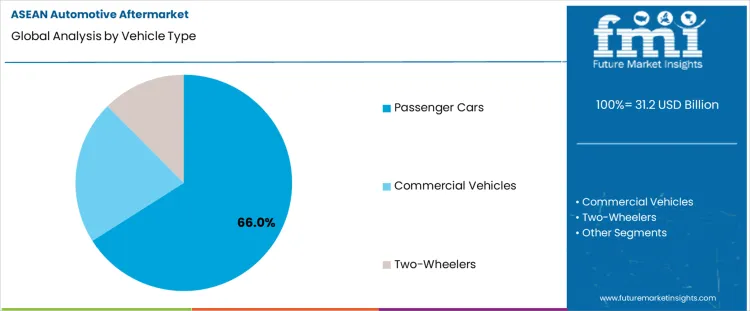
- Passenger cars are expected to account for 66.0% share in 2026 since private owners create the largest base of repair visits.
- Passenger car servicing attracts demand for automotive coolant and brake parts since urban traffic raises heat and wear.
Insights into the Commercial Vehicles Segment
- Commercial vehicles require scheduled maintenance as downtime affects route income and fleet availability.
- Truck and van owners often choose durable wheel bearing aftermarket parts due to load stress and rough road use.
ASEAN Automotive Aftermarket Analysis by Product Type
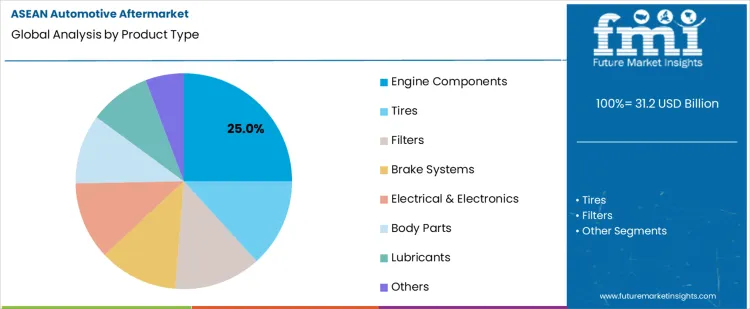
- Engine components are anticipated to represent 25.0% share in 2026 due to high engine load creating frequent replacement need.
- Sensors and ignition systems drive ECU service demand as modern vehicles use more control modules.
Insights into the Tire Segment
- Tires require frequent replacement as heat and rough roads shorten tread life.
- Performance buyers use automotive performance parts for braking and handling upgrades in urban car communities.
ASEAN Automotive Aftermarket Analysis by Distribution Channel
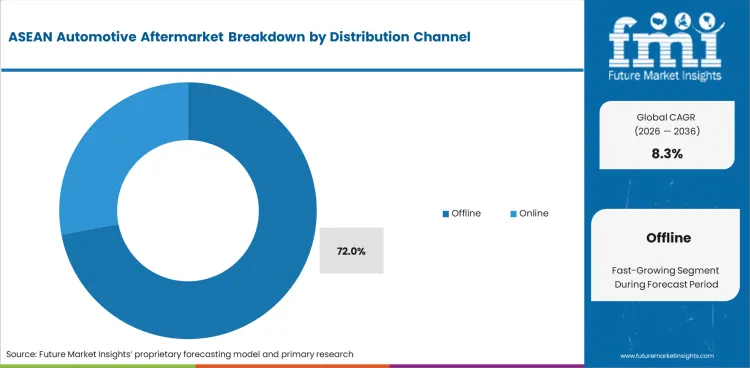
- Offline distribution is set to lead with a 72.0% share in 2026 as workshops buy parts during active repair jobs.
- Parts counters remain important to avoid wrong-part returns that delay same-day repairs.
Insights into the Online Commerce Segment
- Online commerce helps owners compare prices and identify part numbers before a workshop visit.
- Digital channels gain more use for car accessories since buyers can select style parts without urgent fitment checks.
ASEAN Automotive Aftermarket Analysis by Service Type
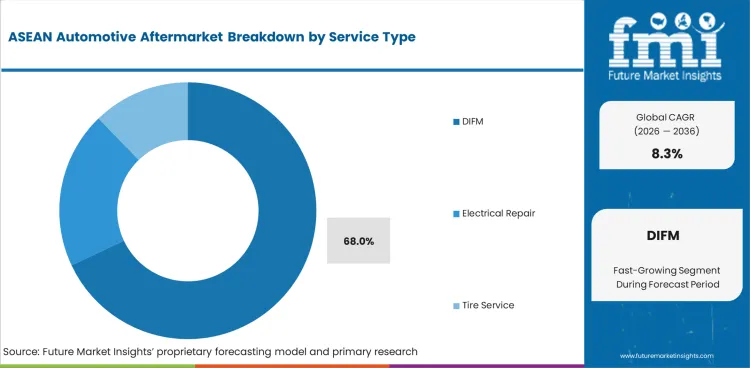
- DIFM is forecast to hold 68.0% of service type demand in 2026 since owners rely on mechanics for engine and brake repairs.
- Workshop-led jobs require dependable automotive actuator availability since electronic parts become more common in vehicle repair.
Insights into the DIY Segment
-
DIY activity stays concentrated in basic cleaning items and simple consumables.
- Home users often prefer automotive part cleaners and degreasers for light upkeep before choosing mechanic-led replacement work.
ASEAN Automotive Aftermarket Analysis by Customer Type
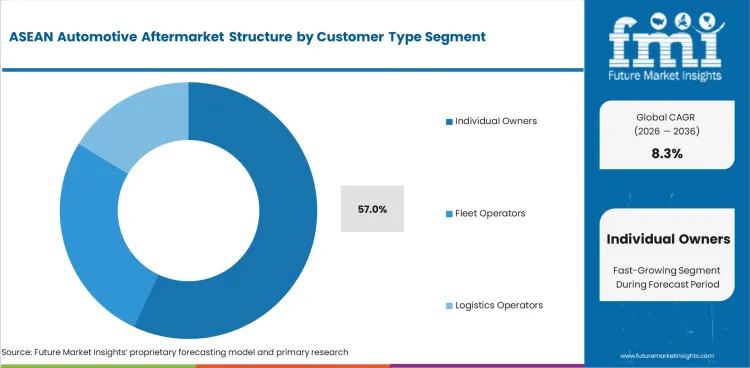
- Individual owners are projected to account for 57.0% share in 2026 due to household car servicing and part replacement demand growth.
- Owner spending connects with automotive performance accessories as drivers add lighting, body and handling upgrades.
Insights into the Fleet Operators Segment
- Fleet operators purchase parts through scheduled service cycles to keep pickups and cars available.
- Fleet maintenance can favor automotive bearing and clutch components since load use can shorten replacement intervals.
ASEAN Automotive Aftermarket Analysis by Service Location
- Independent workshops are expected to represent 48.0% share in 2026 as they offer local reach and lower labor charges.
- Independent repair outlets require extensive inventory across ASEAN automotive bearings led by older vehicles requiring varied part references.
Insights into the Dealer Service Segment
- Dealer service remains important for warranty-linked repairs and premium vehicle maintenance.
- Body shops and dealer outlets use automotive refinish coatings after collision work or exterior repairs.
ASEAN Automotive Aftermarket Drivers Restraints and Opportunities
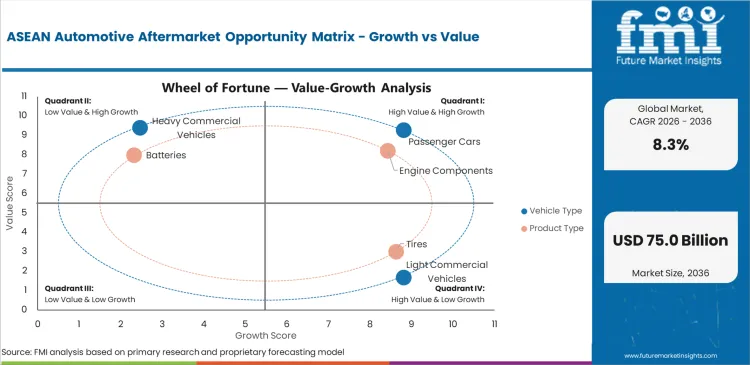
- Vehicle parc expansion will sustain replacement demand across passenger cars alongside light commercial vehicles and two-wheelers through 2036.
- Informal repair outlets and counterfeit parts raise margin pressure for organized parts distributors.
- Digital service networks and EV repair capability will create service revenue for suppliers with verified parts catalogues.
Parts quality pressure is likely to limit margins for formal distributors across ASEAN aftermarket channels. Independent workshops often compete on price first. Certified components become harder to defend during repair decisions. B-Quik’s 2024 store base showed 223 outlets in Thailand, 26 in Indonesia and 3 in Cambodia. The footprint shows organized service chains already have scale in tire replacement and routine maintenance.
Equipment Price Benchmarking Analysis
ASEAN automotive aftermarket equipment pricing should be benchmarked by installed capability. Automated service systems and ADAS calibration equipment will form the premium band as they depend on software with sensors and technician training. Control equipment will remain mid-priced since workshops usually buy diagnostic tools and inspection systems in stages. Robotics and motion systems are likely to remain limited to larger remanufacturing centers or parts warehouses since payback needs steady service volume. Industrial machinery such as lifts, tire changers and wheel alignment systems will form the base price band due to larger workshop use. IFR reported in September 2025 that 542,000 industrial robots were installed globally in 2024. Asia accounted for 74% of new deployments, supporting higher regional availability of robotics and automation suppliers for ASEAN aftermarket equipment buyers.
Installed Base and Replacement Cycle Analysis
ASEAN aftermarket equipment is expected to shift from tire changers or engine testers toward diagnostic tools and software-linked workshop equipment. Older independent workshops are likely to replace equipment in stages since full workshop conversion requires technician training and higher tool investment. Bosch Indonesia’s February 2025 launch of Bosch Car Service in Indonesia supports this upgrade cycle, with a target of 20 outlets in 2025 and 120 outlets within five years. Bosch also stated its global Bosch Car Service network covered 13,000 workshops across 150 countries, giving the Indonesia expansion a proven service model for maintenance equipment with diagnostics and EV repair support. The first Indonesian flagship workshop offers conventional and electric vehicle servicing, and Bosch reported it was authorized by CATL as a high-voltage EV battery repair center. This development shows replacement cycles will be shaped by workshop modernization. Verified spare parts use and battery repair capability will influence upgrade decisions.
Regional Analysis
.webp "Top Country Growth Comparison Asean Automotive Aftermarket Cagr (2026 2036)")
| Country | CAGR 2026 to 2036 |
|---|---|
| Indonesia | 8.9% |
| Vietnam | 8.8% |
| Philippines | 8.7% |
| Thailand | 8.2% |
| Malaysia | 7.8% |
Source: Future Market Insights analysis based on ASEAN country demand narratives and public source checks in 2026.
Analysis of ASEAN Automotive Aftermarket by Key Countries
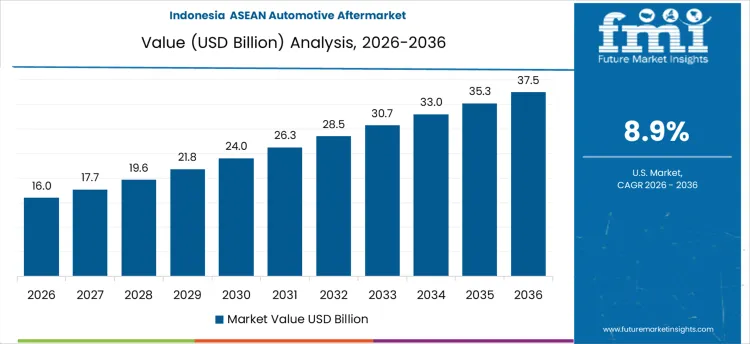
- Indonesia is likely to post the fastest pace at 8.9% CAGR through 2036 because its large vehicle base creates repeat demand for tires, batteries and filters.
- Vietnam is expected to follow at 8.8% CAGR through 2036 as rising vehicle ownership expands repair activity across urban service networks.
- The Philippines is projected at 8.7% CAGR through 2036 because city vehicle use supports steady maintenance demand across workshops.
- Thailand is expected to rise at 8.2% CAGR through 2036 as its established automotive base keeps replacement parts consumption steady.
- Malaysia is projected at 7.8% CAGR through 2036 because its mature service network supports stable parts demand from private vehicles.
Country expansion differs with vehicle ownership levels and workshop network depth. Indonesia leads since its large population and expanding vehicle fleet increase recurring replacement activity. Vietnam follows as car ownership is rising from a lower base. The Philippines benefits from urban vehicle use and replacement service needs. Thailand and Malaysia expand at steadier rates due to more mature automotive systems and organized service channels.
Demand Outlook for ASEAN Automotive Aftermarket in Indonesia
Demand for ASEAN automotive aftermarket in Indonesia is projected to record 8.9% CAGR through 2036 led by a larger vehicle fleet increasing recurring demand for tires, batteries and filters. Private vehicle use supports repair activity across city workshops. Online parts access improves availability for consumers seeking faster service options. Indonesia leads the country forecast due to its larger vehicle base and expanding middle-income customer group.
- Passenger vehicle ownership supports recurring parts replacement across routine maintenance channels.
- Tire and battery replacement remains a steady outlet as road use and climate conditions shorten service life.
- Online parts platforms can improve price visibility and product access for urban consumers.
Sales Analysis of ASEAN Automotive Aftermarket in Vietnam
Industry sales in Vietnam are expected to expand at 8.8% CAGR through 2036 as vehicle ownership increases and workshop networks add repair capacity. Consumers are spending more on scheduled maintenance as personal mobility expands. Spare parts demand is influenced by filters, lubricants and electrical components. Vietnam stays aligned to Indonesia due to faster vehicle parc addition from a smaller base.
- New vehicle ownership increases the future base for repair and replacement demand.
- Urban service centers support routine maintenance for filters along with oils and brake parts.
- Digital parts access helps workshops source components faster across large cities.
Opportunity Analysis of ASEAN Automotive Aftermarket in the Philippines
ASEAN automotive aftermarket demand in the Philippines is projected to rise at 8.7% CAGR through 2036 due to urban vehicle use increasing maintenance frequency. Service activity is supported by repair shops serving private cars and light commercial vehicles. The Philippines remains above the regional average due to expanding vehicle ownership in key urban areas.
- Urban commuting creates steady wear on brakes, tires and engine service items.
- Replacement parts demand benefits from a growing base of privately owned vehicles.
- Online parts channels can support consumers seeking faster product comparison before repairs.
Demand Outlook for ASEAN Automotive Aftermarket in Thailand
Demand for ASEAN automotive aftermarket in Thailand is projected at 8.2% CAGR through 2036 as a well-developed automotive base sustains consistent replacement demand. The country expands at a moderate pace since its automotive system is already more developed.
- Established repair networks support regular maintenance across passenger cars and light commercial vehicles.
- Tire and engine component replacement benefits from high road use across urban and intercity routes.
- Organized service chains can defend branded parts demand through warranty support and service records.
Sales Analysis of ASEAN Automotive Aftermarket in Malaysia
Malaysia’s sector is expected to grow at 7.8% CAGR through 2036 since its mature vehicle ownership base supports stable parts replacement. Service demand is led by passenger vehicles requiring scheduled repair and replacement items. Parts suppliers focus on product traceability and digital ordering support.
- Mature vehicle ownership supports repeat replacement of filters, batteries and lubricants.
- Organized workshops help improve consumer trust in branded aftermarket components.
- Digital ordering systems can reduce parts search time for repair shops and consumers.
Competitive Structure and Strategic Positioning
- ASEAN aftermarket competition remains fragmented with brands and local distributors serving different repair channels.
- Large suppliers compete through catalog depth and mechanic trust with delivery speed shaping workshop preference.
- Regional distributors acquire orders through local inventory and credit support for independent repair outlets.
- Entry barriers rise as repair shops expect accurate fitment data and fast replacement for wrong part cases.
Competition in ASEAN aftermarket supply is shaped by parts availability at workshop level. Bosch Mobility Aftermarket introduced eight new products for Malaysia in 2025, including wipers, battery chargers and spark plugs. This product release supports a routine-service parts strategy across wear items and basic maintenance components. Distributors require fast counter support since repair jobs lose value once mechanics wait for part confirmation.
DENSO supports regional aftermarket product sales through its Asia headquarters in Singapore. FORVIA HELLA adds spare parts, workshop equipment and diagnostic tools through its Lifecycle Solutions business. These sources reflect how large suppliers compete through catalog depth and parts availability.
Key Companies in the ASEAN Automotive Aftermarket
- Competition spans global parts suppliers, workshop service operators and lifecycle solution providers with different strengths.
- Global parts suppliers: Bosch, DENSO and FORVIA HELLA compete through replacement parts and workshop support. Bosch Mobility Aftermarket introduced eight Malaysia products in 2025 across wipers, battery chargers and spark plugs. DENSO supports aftermarket product sales through its Asia headquarters in Singapore.
- Workshop service operators: B-Quik and Bosch Car Service compete through service access and maintenance reach. Marubeni’s 2024 report listed B-Quik at 223 stores in Thailand, 26 in Indonesia and 3 in Cambodia. Bosch Indonesia targeted 20 Bosch Car Service outlets in 2025 and 120 outlets within five years.
- Lifecycle solution providers: FORVIA HELLA and Bosch compete through diagnostics, spare parts and service tools for independent workshops. FORVIA HELLA states its Lifecycle Solutions business offers around 38,000 spare parts and workshop equipment with diagnostics.
Key Developments in the ASEAN Automotive Aftermarket
- In October 2024, FORVIA HELLA started sales of brake products under the HELLA brand and reported over 90% brake pad coverage and more than 85% brake disc coverage for electric and hybrid models.
- In March 2025, Toyota Motor Philippines began development of the Toyota Clarin Service Center in Misamis Occidental with a planned 2,620 square meter building for periodic maintenance, general repair and body paint services.
- In April 2025, Mitsubishi Motors Malaysia opened a new 3S Centre for sales, service and spare parts in Kajang and raised its Klang Valley network to 19 3S centres.
Competitive Benchmarking: ASEAN Automotive Aftermarket
| Company | Product Breadth | Channel Reach | Service Support | Footprint |
|---|---|---|---|---|
| Robert Bosch GmbH | High | Large | Large | ASEAN and Global |
| DENSO Corporation | High | Large | Large | Asia |
| FORVIA HELLA | High | Moderate | Large | Global |
| ZF Friedrichshafen AG | High | Moderate | Large | Southeast Asia and Global |
| B-Quik Co., Ltd. | Moderate | Large | Large | ASEAN |
| Mitsubishi Motors Malaysia | Moderate | Large | Large | Malaysia |
| Toyota Motor Philippines | Moderate | Large | Large | Philippines |
Source: Future Market Insights competitive analysis based on official company updates and ASEAN service footprint checks in 2026.
Key Players in the ASEAN Automotive Aftermarket
Major Global Players
- Robert Bosch GmbH
- DENSO Corporation
- FORVIA HELLA
- ZF Friedrichshafen AG
Regional Participants
- B-Quik Co., Ltd.
- PT Astra Otoparts Tbk
- YHI International Limited
Report Scope and Coverage
| Item | Value |
|---|---|
| Market Definition | Replacement parts and post-sale service activity for vehicles operating in ASEAN. |
| Vehicle Type | Passenger cars, Commercial vehicles, and Two wheelers |
| Product Type | Engine components, Tires, Filters, Brake systems, Electrical electronics, Body parts, Lubricants, and Others |
| Distribution Channel | Offline Traditional and Online Commerce |
| Service Type | DIFM and DIY |
| Customer Type | Individual owners, Fleet operators, Workshops, and Insurers |
| Service Location | Independent workshops, Franchise centers, Dealer service, and Mobile service |
| Countries Covered | Indonesia, Vietnam, Philippines, Cambodia, Thailand, Malaysia, and Singapore |
| Companies Profiled | Bosch Mobility Aftermarket, DENSO, Continental, AISIN, DRiV, FORVIA HELLA, Niterra, Bridgestone, Michelin, and ACDelco |
| Forecast Period | 2026 to 2036 |
| Approach | Hybrid bottom-up and top-down method using FMI values with vehicle sales and service channel checks. |
Source: Future Market Insights analysis, 2026.
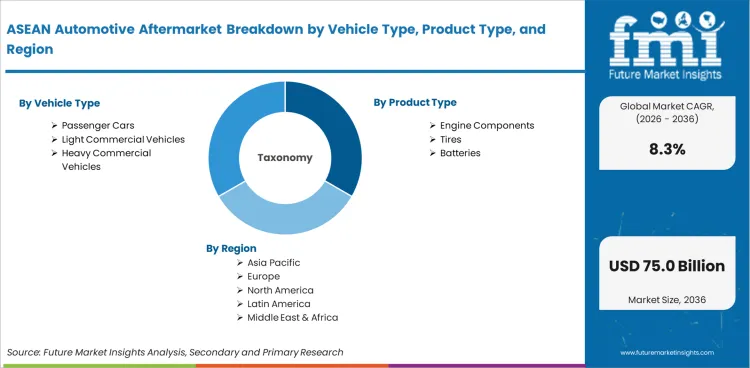
ASEAN Automotive Aftermarket Breakdown by Vehicle Type, Product Type, Service Type, Sales Channel, Customer Type, Workshop Type, and Country
ASEAN Automotive Aftermarket Segmented by Vehicle Type:
- Passenger Cars
- Light Commercial Vehicles
- Heavy Commercial Vehicles
- Two Wheelers
ASEAN Automotive Aftermarket Segmented by Product Type:
- Engine Components
- Tires
- Batteries
- Brake Parts
- Filters
- Lubricants
- Electrical Parts
- Suspension Parts
- Lighting Parts
- Cooling Parts
ASEAN Automotive Aftermarket Segmented by Service Type:
- Routine Maintenance
- Mechanical Repair
- Electrical Repair
- Tire Service
- Battery Service
- Body Repair
- Diagnostic Service
- EV Service
ASEAN Automotive Aftermarket Segmented by Sales Channel:
- Authorized Dealers
- Independent Workshops
- Parts Retailers
- Online Platforms
- Fleet Service Centers
- Service Chains
ASEAN Automotive Aftermarket Segmented by Customer Type:
- Individual Owners
- Fleet Operators
- Ride Hailing Fleets
- Logistics Operators
- Repair Workshops
- Used Car Dealers
ASEAN Automotive Aftermarket Segmented by Workshop Type:
- Independent Garages
- Authorized Workshops
- Multi Brand Chains
- Tire Centers
- Battery Centers
- Quick Service Centers
ASEAN Automotive Aftermarket by Country:
- Indonesia
- Thailand
- Malaysia
- Vietnam
- Philippines
- Singapore
- Cambodia
- Laos
- Myanmar
- Brunei
Research Sources and Bibliography
- HELLA GmbH & Co. KGaA. (2024, October 1). Sales launch with new name: Brake products available under the HELLA brand from October.
- Mitsubishi Motors Malaysia. (2025, April 28). Mitsubishi Motors has opened its 19th 3S outlet in Klang Valley, located in Kajang.
- Toyota Motor Philippines. (2025, March 28). Toyota Clarin, Misamis Occidental Service Center Breaks Ground.
- ASEAN Automotive Federation. (2025, January). Dec 2024.xlsx.
- International Federation of Robotics. (2025, September 25). World Robotics 2025 report – INDUSTRIAL ROBOTS – released by IFR: Global robot demand in factories doubles over 10 years.
- Bosch Indonesia. (2025, February 18). Bosch Car Service brings high-quality vehicle maintenance solutions to Indonesia.
- Bosch Malaysia. (2025). A Glimpse Into 2025: Bosch Mobility Aftermarket introduces eight new innovative products for Malaysia.
- DENSO International Asia Pte. Ltd. (2025, September). Aftermarket News (Sep’25).
- HELLA GmbH & Co. KGaA. (2025, March 7). Annual report 2024.
- Japan Automobile Manufacturers Association. (2025, November 24). Driving Growth Towards the Future 2025.
- PT Astra Otoparts Tbk. (2025, March 27). Annual Report 2024.
- YHI International Limited. (2025, April 3). Moving Forward with Fortitude.
The bibliography is provided for reader reference and direct source checking.
This Report Addresses
- What is the ASEAN automotive aftermarket value in 2026 and how far can it rise by 2036?
- Which vehicle type leads ASEAN automotive aftermarket demand and why does it retain the largest share?
- Which product type holds the largest 2026 position in ASEAN automotive aftermarket sales?
- Why do offline traditional channels remain ahead of online commerce in ASEAN automotive aftermarket distribution?
- Which countries are forecast to rise fastest in the ASEAN automotive aftermarket through 2036?
- Which companies compete across ASEAN automotive aftermarket parts and service support?
- How does FMI size and forecast ASEAN automotive aftermarket value across segments and countries?
Frequently Asked Questions
How large is the ASEAN automotive aftermarket in 2026?
The ASEAN automotive aftermarket is expected to reach USD 33.8 billion in 2026 due to vehicle ownership creating recurring service activity.
What will the ASEAN Automotive Aftermarket be worth by 2036?
The ASEAN automotive aftermarket is forecast to reach USD 75.0 billion by 2036 as replacement cycles expand with vehicle use.
What CAGR is expected for the ASEAN Automotive Aftermarket from 2026 to 2036?
The ASEAN automotive aftermarket is expected to advance at 8.3% CAGR during 2026 to 2036.
Which segment leads the ASEAN automotive aftermarket in 2026?
Offline traditional distribution leads with an expected 72.0% share in 2026 since workshops control urgent repair purchase decisions.
Which product type leads the ASEAN automotive aftermarket in 2026?
Engine components lead with an estimated 25.0% share in 2026 due to heat stress and stop-start traffic.
Which country grows fastest in the ASEAN automotive aftermarket through 2036?
Indonesia leads the country set at a projected 8.9% CAGR through 2036 as its large vehicle base needs recurring parts replacement.
What does the ASEAN automotive aftermarket include?
The ASEAN automotive aftermarket includes replacement parts and repair services after vehicle sales across passenger cars and commercial vehicles.
How was the ASEAN automotive aftermarket forecast prepared?
FMI used supplied market values with segment shares and checked the forecast against vehicle sales and country service signals.
Preview the report firsthand - request a free sample
Get SampleGet the brochure for pricing and purchase details.
Get PDFTable of Content
- Key Takeaways
- Market Size and CAGR
- Top Growth Driver
- Fastest Growing Segment
- Leading Region
- Key Companies
- Emerging Opportunities
- Executive Summary
- ASEAN Market Outlook
- Demand-side Trends
- Supply-side Trends
- Technology Roadmap Analysis
- Analysis and Recommendations
- Analyst Perspective (What is happening? Why now? What should investors know?)
- Key Questions Answered
- How large is the market?
- What is the CAGR?
- What are key trends?
- Which region dominates?
- Who are the leaders?
- Market Overview
- Market Coverage / Taxonomy
- Market Definition / Scope / Limitations
- Research Methodology
- Chapter Orientation
- Analytical Lens and Working Hypotheses
- Market Structure, Signals, and Trend Drivers
- Benchmarking and Cross-market Comparability
- Market Sizing, Forecasting, and Opportunity Mapping
- Research Design and Evidence Framework
- Desk Research Programme (Secondary Evidence)
- Expert Input and Fieldwork (Primary Evidence)
- Tooling, Models, and Reference Databases
- Data Engineering and Model Build
- Quality Assurance and Audit Trail
- Market Background
- Market Dynamics (Drivers, Restraints, Opportunity, Trends)
- Scenario Forecast (Optimistic, Likely, Conservative)
- Impact Analysis
- AI Impact
- Sustainability Impact
- Regulatory Impact
- Technology Impact
- Consumer / Buyer Analysis
- Purchase Drivers
- Adoption Barriers
- Buyer Journey
- Opportunity Map Analysis
- Product Life Cycle Analysis
- Supply Chain Analysis
- Investment Feasibility Matrix
- Value Chain Analysis
- PESTLE and Porter's Analysis
- Regulatory Landscape
- Regional Parent Market Outlook
- Vehicle Parc and Aftermarket Parts Consumption Statistics
- Import and Export Statistics
- ASEAN Market Analysis and Forecast, 2021 to 2036
- Historical Market Size Value (USD Billion) Analysis, 2021 to 2025
- Current and Future Market Size Value (USD Billion) Projections, 2026 to 2036
- Y-o-Y Growth Trend Analysis
- Absolute $ Opportunity Analysis
- ASEAN Market Pricing Analysis, 2021 to 2036
- ASEAN Market Analysis and Forecast, By Vehicle Type, 2021 to 2036
- Introduction / Key Findings
- Historical Market Size Value (USD Billion) Analysis By Vehicle Type, 2021 to 2025
- Current and Future Market Size Value (USD Billion) Analysis and Forecast By Vehicle Type, 2026 to 2036
- Passenger Cars
- Light Commercial Vehicles
- Heavy Commercial Vehicles
- Two Wheelers
- Y-o-Y Growth Trend Analysis By Vehicle Type, 2021 to 2025
- Absolute $ Opportunity Analysis By Vehicle Type, 2026 to 2036
- ASEAN Market Analysis and Forecast, By Product Type, 2021 to 2036
- Introduction / Key Findings
- Historical Market Size Value (USD Billion) Analysis By Product Type, 2021 to 2025
- Current and Future Market Size Value (USD Billion) Analysis and Forecast By Product Type, 2026 to 2036
- Engine Components
- Tires
- Batteries
- Brake Parts
- Filters
- Lubricants
- Electrical Parts
- Suspension Parts
- Lighting Parts
- Cooling Parts
- Y-o-Y Growth Trend Analysis By Product Type, 2021 to 2025
- Absolute $ Opportunity Analysis By Product Type, 2026 to 2036
- ASEAN Market Analysis and Forecast, By Distribution Channel, 2021 to 2036
- Introduction / Key Findings
- Historical Market Size Value (USD Billion) Analysis By Distribution Channel, 2021 to 2025
- Current and Future Market Size Value (USD Billion) Analysis and Forecast By Distribution Channel, 2026 to 2036
- Offline Traditional
- Online Commerce
- Y-o-Y Growth Trend Analysis By Distribution Channel, 2021 to 2025
- Absolute $ Opportunity Analysis By Distribution Channel, 2026 to 2036
- ASEAN Market Analysis and Forecast, By Service Type, 2021 to 2036
- Introduction / Key Findings
- Historical Market Size Value (USD Billion) Analysis By Service Type, 2021 to 2025
- Current and Future Market Size Value (USD Billion) Analysis and Forecast By Service Type, 2026 to 2036
- Routine Maintenance
- Mechanical Repair
- Electrical Repair
- Tire Service
- Battery Service
- Body Repair
- Diagnostic Service
- EV Service
- Y-o-Y Growth Trend Analysis By Service Type, 2021 to 2025
- Absolute $ Opportunity Analysis By Service Type, 2026 to 2036
- ASEAN Market Analysis and Forecast, By Customer Type, 2021 to 2036
- Introduction / Key Findings
- Historical Market Size Value (USD Billion) Analysis By Customer Type, 2021 to 2025
- Current and Future Market Size Value (USD Billion) Analysis and Forecast By Customer Type, 2026 to 2036
- Individual Owners
- Fleet Operators
- Ride Hailing Fleets
- Logistics Operators
- Repair Workshops
- Used Car Dealers
- Y-o-Y Growth Trend Analysis By Customer Type, 2021 to 2025
- Absolute $ Opportunity Analysis By Customer Type, 2026 to 2036
- ASEAN Market Analysis and Forecast, By Workshop Type
- Introduction / Key Findings
- Historical Market Size Value (USD Billion) Analysis By Workshop Type, 2021 to 2025
- Current and Future Market Size Value (USD Billion) Analysis and Forecast By Workshop Type, 2026 to 2036
- Independent Garages
- Authorized Workshops
- Multi Brand Chains
- Tire Centers
- Battery Centers
- Quick Service Centers
- Y-o-Y Growth Trend Analysis By Workshop Type, 2021 to 2025
- Absolute $ Opportunity Analysis By Workshop Type, 2026 to 2036
- ASEAN Market Analysis and Forecast, By Country, 2021 to 2036
- Introduction
- Historical Market Size Value (USD Billion) Analysis By Country, 2021 to 2025
- Current Market Size Value (USD Billion) Analysis and Forecast By Country, 2026 to 2036
- ASEAN
- Market Attractiveness Analysis By Country
- ASEAN Market Analysis and Forecast, By Country, 2021 to 2036
- Historical Market Size Value (USD Billion) Trend Analysis By Market Taxonomy, 2021 to 2025
- Market Size Value (USD Billion) Forecast By Market Taxonomy, 2026 to 2036
- By Country
- Indonesia
- Vietnam
- Philippines
- Cambodia
- Thailand
- Malaysia
- Singapore
- By Vehicle Type
- By Product Type
- By Distribution Channel
- By Service Type
- By Customer Type
- By Workshop Type
- By Country
- Market Attractiveness Analysis
- By Country
- By Vehicle Type
- By Product Type
- By Distribution Channel
- By Service Type
- By Customer Type
- By Workshop Type
- Key Takeaways
- Key Countries Market Analysis
- Indonesia
- Pricing Analysis
- Market Share Analysis, 2025
- By Vehicle Type
- By Product Type
- By Distribution Channel
- By Service Type
- By Customer Type
- By Workshop Type
- Vietnam
- Pricing Analysis
- Market Share Analysis, 2025
- By Vehicle Type
- By Product Type
- By Distribution Channel
- By Service Type
- By Customer Type
- By Workshop Type
- Philippines
- Pricing Analysis
- Market Share Analysis, 2025
- By Vehicle Type
- By Product Type
- By Distribution Channel
- By Service Type
- By Customer Type
- By Workshop Type
- Cambodia
- Pricing Analysis
- Market Share Analysis, 2025
- By Vehicle Type
- By Product Type
- By Distribution Channel
- By Service Type
- By Customer Type
- By Workshop Type
- Thailand
- Pricing Analysis
- Market Share Analysis, 2025
- By Vehicle Type
- By Product Type
- By Distribution Channel
- By Service Type
- By Customer Type
- By Workshop Type
- Malaysia
- Pricing Analysis
- Market Share Analysis, 2025
- By Vehicle Type
- By Product Type
- By Distribution Channel
- By Service Type
- By Customer Type
- By Workshop Type
- Singapore
- Pricing Analysis
- Market Share Analysis, 2025
- By Vehicle Type
- By Product Type
- By Distribution Channel
- By Service Type
- By Customer Type
- By Workshop Type
- Indonesia
- Market Structure Analysis
- Competition Dashboard
- Competition Benchmarking
- Market Share Analysis of Top Players
- By Countryal
- By Vehicle Type
- By Product Type
- By Distribution Channel
- By Service Type
- By Customer Type
- By Workshop Type
- Emerging Startups
- Innovation Benchmarking
- Case Studies
- Success Stories
- Recent Developments
- Competition Analysis
- Competition Deep Dive
- Bosch Mobility Aftermarket
- Overview
- Product Portfolio
- Profitability by Market Segments
- Sales Footprint
- Strategy Overview
- Marketing Strategy
- Product Strategy
- Channel Strategy
- DENSO
- Continental
- AISIN
- DRiV
- FORVIA HELLA
- Niterra
- Bridgestone
- Michelin
- ACDelco
- Bosch Mobility Aftermarket
- Competition Deep Dive
- Assumptions & Acronyms Used


