

- Industry Size (2026)
- USD 14.9 Bn
- Forecast (2036)
- USD 38.4 Bn
- CAGR (2026 to 2036)
- 9.9%
Electric Wheelchair Market Size, Market Forecast and Outlook By FMI
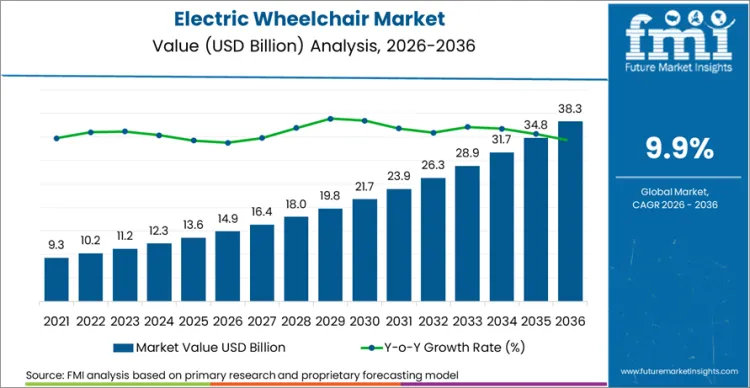
The electric wheelchair market is expected to expand from USD 14.9 billion in 2026 to USD 38.4 billion by 2036. The market is anticipated to register a 9.9% CAGR during the forecast period. Front wheel drive models are likely to gain stronger adoption as users look for compact indoor control and safer home mobility. Hospitals and clinics are expected to increase use of powered wheelchairs for rehabilitation programs and patient movement across care settings.
Summary of the Electric Wheelchair Market
- Demand and Growth Drivers
- Aging populations are expected to increase demand for powered mobility devices across hospitals and residential care settings.
- Rising mobility impairment levels are likely to increase adoption of electric wheelchairs among long-term care users.
- Demand for lightweight foldable designs is anticipated to increase as users seek easier travel and storage.
- Product and Segment View
- Front wheel drive electric wheelchairs are expected to gain preference for better indoor turning and compact movement.
- Rear wheel drive models are likely to attract users needing stronger outdoor performance and longer travel distance.
- Standing electric wheelchairs are anticipated to serve users needing posture assistance and improved daily independence.
- Geography and Competitive Outlook
- The United States is expected to record steady adoption through reimbursement access and strong supplier presence.
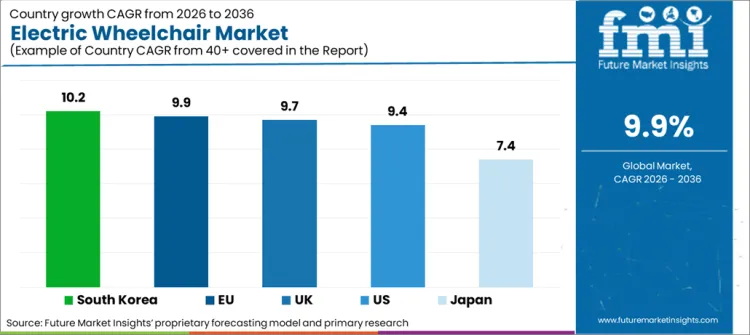
- South Korea is likely to record the fastest country-level expansion at 10.2% CAGR through 2036.
- Companies with lighter frames and smart control systems are anticipated to strengthen buyer interest in premium models.
- Analyst Opinion
- Anurag Sharma, serves as Principal consultant for Healthcare at FMI with coverage across therapeutic device markets. He suggests, “The electric wheelchair market is anticipated to favor manufacturers able to combine clinical reliability with lighter travel-oriented designs. Premium folding systems and smart controls are likely to guide purchasing as buyers seek safer mobility with daily-use convenience.”
- Electric Wheelchair Market Value Analysis
- The electric wheelchair market is moving from basic clinical mobility equipment into a higher-value assistive device space.
- Demand is likely to rise as aging populations and mobility impairment cases increase across major healthcare systems.
- Adoption is expected to improve through lighter product designs and smarter controls for daily user convenience.
- Spending is anticipated to be backed by rehabilitation use and home-care demand across developed healthcare markets.
Key Takeaways, Market Size, and Forecast
- The electric wheelchair market is expected to reach USD 14.9 billion in 2026 across medical and consumer channels.
- By 2036, the electric wheelchair market is projected to reach USD 38.4 billion across global demand pockets.
- From 2026 to 2036, the market is anticipated to expand at a 9.9% CAGR.
- Front wheel drive electric wheelchairs are likely to see steady demand from users needing compact indoor movement.
- Hospitals and clinics are expected to adopt electric wheelchairs for rehabilitation use and safer assisted mobility.
- South Korea is projected to record the fastest country-level expansion at 10.2% CAGR through 2036.
Summary of Electric Wheelchair Market
Segmentation Outlook - Global Electric Wheelchair Market
Front Wheel Drive and Rear Wheel Drive Electric Wheelchairs Drive Market Growth as Mobility Solutions Advance
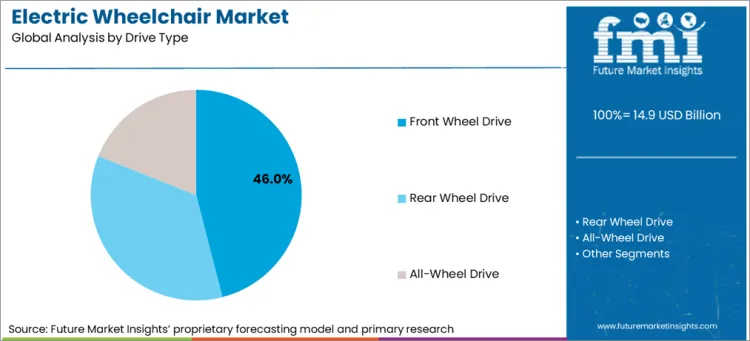
Global electric wheelchair market is divided into front wheel drive, rear wheel drive, and a newly launched all-wheel-drive electric wheelchairs, which account for a large part of the market. Wheelchairs are vital for supporting disabled persons, elderly patients, and patients undergoing recovery from an injury, as they facilitate greater movement, an improved quality of life, and greater participation in social and occupational activities.
Growing needs for indoor mobility drive Front Wheel Drive Electric Wheelchairs to lead the market demand
Nevertheless, users are increasingly turning towards a new model, a front wheel drive electric wheelchair, in search of significant indoor manoeuvrability and obstacle negotiation, thus offering better turn radius around small spaces and increased traction control alongside improved stability over landscaped surfaces. Front wheel drive wheelchairs come with a front drive wheel enabling people to move into tighter areas, around corners and confined spaces easier than rear wheel drive wheelchairs.
Conclusion: The rising demand for home-based mobility solutions has resulted in the adoption of front wheel drive electric wheelchairs, with many people suffering from disabilities, spinal cord injuries, and neuromuscular disorders looking for compact, user-friendly mobility devices to facilitate independent movement in their homes. (Such as smaller turning radii, improved curb climbing ability, and ability to better navigate hallways, doorways, and indoors)
Furthermore, improvements in technology have led to the production of more efficient electric wheelchairs with advanced features that are safe for the elderly. These wheelchairs aim to reduce the need for caregiver assistance, promote patient autonomy, and improve accessibility in hospital wards, rehabilitation centers and nursing homes.
Lightweight, foldable front wheel drive electric wheelchairs are designed for people with disabilities; they have made travel easier for wheelchair users, allowing them to be more portable, easily transportable in a vehicle and more accessible. High-end variants incorporate tipping-prevention mechanisms with intelligent navigation controls and better seating systems for safety, comfort and user experience.
The only downside to indoor mobility offered by front wheel drive electric wheelchairs is their ability to navigate the outdoor terrain and speed limitations, not to mention not being that stable when tackling steep inclines. Nevertheless, superior suspension technology, multi-terrain drive modes, and artificial intelligence-based navigation systems are enhancing device capability, durability, and user adaptability, consequently extending the market growth prospects for front wheel drive electric wheelchairs.
Market Opportunities for Rear Wheel Drive Electric Wheelchairs as Outdoor Mobility Solutions Expand
Rear wheel drive electric wheelchairs have seen solid market penetration, especially for outdoor mobility, long-distance travel, and high-speed movement, as people with mobility disabilities demand high power, terrain-adaptive wheelchair solutions. In contrast to front wheel drive models, rear wheel drive wheelchairs place the drive wheels in the back, allowing for faster acceleration, increased directional control and overall better performance on uneven surfaces.
Portable wheelchair adoption in rear wheel drive systems is caused by an increasing number of elderly people or people with mobility impairments who need long-term mobility assistance due to the benefits that come with rear wheel drive systems which provide more weight distribution, better ground clearance, and speed, therefore, increasing independence and outdoor accessibility.
The growing trend toward recreational and sports use is driving high-performance rear wheel drive electric wheelchairs featuring innovative all-terrain tires, shock-absorbing suspension and adjustable seating positions, allowing users to roll through parks, rough terrains and public spaces more efficiently.
However, the rear wheel drive wheelchair functionality has been improved with the addition of smart wheelchair technology, AI-based navigation, and remote control systems, paving the way for no hand wheelchair operation, path automation, and GPS-based tracking for outdoor operations. These innovations are aimed at severely disabled wheelchair users, allowing for more independence and less reliance on caregivers.
It is also validated with many hospitals and rehabilitation centers adopting rear wheel drive electric wheelchairs to assist their patients in recovery from stroke, spinal cord injury, and muscular dystrophy, who are reported to engage in outdoor therapeutic, social reintegration, and physical activity at the highest frequencies when powered mobility is available.
Nevertheless, the only real downside is outdoor performance features slower, less agile indoor operation because rear wheel drive electric wheelchairs inexorably have a greater turning radius and are less adept at wheeling through cramped doorways or crowded areas. Technological developments such as joystick-controlled movement, multi-mode drive systems and smart braking technologies are enhancing user control, adaptability and long-term efficiency of the device, further fuelling the demand for rear wheel drive electric wheelchairs.
Hospitals & Clinics and Home Care Drive Market Growth as Mobility Assistance Expands in Healthcare and Residential Settings
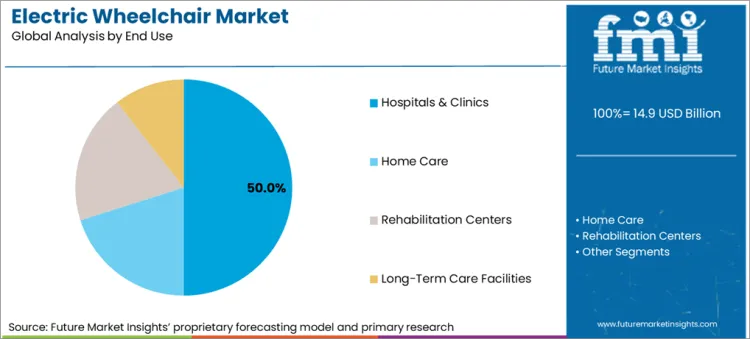
Segments like home care and hospitals & clinics are poised to drive the market as healthcare providers, clinics and rehabilitation specialists are making electric wheelchairs their first choice to aid patients in recovery, to support mobility needs of the elderly and to manage long-term disabilities.
Electric Wheelchairs Provide Patients Better Mobility, Leading to High Demand for Hospitals & Clinics Market Segmentation: Electric Wheelchairs Market Segmentation are as follows: Electric Wheelchairs Market Segmentation by Type: Market segmentation of Electric Wheelchairs by type includes: Electric Powered Electric Powered
Hospitals and clinics are the biggest consumers as healthcare facilities need electric wheelchairs for post-operative patients and people with neuromuscular disorders, as well as patients recovering from injuries or a surgery. For instance, electric-powered mobility aids offer patients more independence than manual wheelchairs, allowing medical staff and caregivers to focus on other tasks.
These telemetry-based hospital electric wheelchair solutions have emerged to meet the increasing demand from the joint replacement, spinal cord injury recovery, and stroke recovery patient pool, which translates into enhanced patient mobility, accelerated rehabilitation, and reduced patient stay duration. Electric wheelchairs are more and more frequently incorporated into physical therapy programs by healthcare providers to build muscle strength, recover motor function, and eventually move a patient toward self-sufficient movement.
AI-powered electric wheelchairs increasingly used in hospitals help expand further rehabilitation and mobility therapy opportunities, tracking real-time patients' movement patterns, adjusting the wheelchair settings automatically, and remote tracking of rehabilitation progress. Such technology provides higher accuracy in mobility support and custom-made therapy routines for people with different levels of mobility.
Moreover, the rising adoption of electric wheelchairs in specialized practice settings-like neurology centers, geriatric care units, and orthopaedic rehabilitation facilities-has further spur market growth, as these practice settings are aimed at enhancing mobility assistance features, reducing physical load on the patients, and improving accessibility across medical settings.
Although electric wheelchairs are portable and assist with mobility within the hospital, they come with challenges such as high acquisition costs, low supply in underfunded health systems, and maintenance demands. Nevertheless, innovations in wheelchair design for hospital usage, AI-assisted tracking of patient mobility, and government-backed assistive technology initiatives are improving device availability, affordability and provisioning in long-term hospital care settings to future-proof device accessibility and ensure the continued growth of the hospital-use electric wheelchair market.
Division of Home Care Grows with Increasing Demand for Independent Living and Personalized Mobility Solutions
Families and caregivers are increasingly seeking assistive solutions that facilitate independent living and enhance overall well-being, driving strong market adoption for home care, especially among the elderly, disabled individuals, and patients requiring long-term, mobility-based assistance. Home-based electric wheelchair use enables patients to remain autonomous, engage in daily life, and move around the home environment more easily than institutionalized care.
Rising home-centric elderly care settings and telehealth have surged the demand for disability-based patient-use e-wheels customized for in-home usage, which offers small footprints, smart navigational controls, and a body-fit seating mechanism to facilitate indoor mobility.
Advancements in electric wheelchairs have led to the development of foldable and lightweight solutions, which allow for easy transport, storage and multi-environment adaptability as home-based mobility solutions. Users can choose their own speed, have an intuitive joystick for controls, and receive help via AI-powered navigation assistance - fundamentally geared toward retaining users' independence in home environments.
Furthermore, voice-activated and smart home-compatible electric wheelchairs have also been steadily integrated into the actuators of the wheelchair promoting the growth of the market. It offers the ability to integrate and sync mobility aids with automation systems in the homes, provides the user with the comfort of controlling movement through speech and, in the end, offers the user the ability to recalculate the way, based on pre-programmed paths.
The increasing use of electric wheelchairs in home care is unnecessary due to the high cost of the device, the lack of insurance coverage for home-based mobility devices, and limited awareness of the smart wheelchair technology.
Though the home care electric wheelchair market may have been slowing for quite some time, a number of new innovations ranging from AI-driven wheelchair automation, government-backed home mobility assistance programs to budget-friendly personal mobility solutions. Bestow an improved accessibility, affordability and home-based mobility efficiency on the niche, securing continued demand for home care electric wheelchair solutions.
Regional Market Trends
North America
North America is dominating the electric wheelchair market because of advanced healthcare infrastructure, high disposable income, and a large geriatric population. Moving computer-based design analysis in North America is driven by the growing adoption of electric wheelchairs in the USA and Canada on account of incentivized reimbursement policies and focus on developing mobility solutions for people with disabilities. Technological advancements and the presence of major market players also reinforce the market in the region.
Europe
A significant share of the market will be occupied by Europe due to the growing elderly population and government policies encouraging mobility assistance across the region. Germany, France, and the UK are among the countries with the highest adoption figures thanks to strong healthcare systems and increased awareness of assistive technologies. The growth of the market is due to the regions focusing on improving accessibility and inclusiveness.
Asia-Pacific
Over the forecast period, the speediest growth in the electric wheelchair market is expected to see in the Asia-Pacific region. This growth is propelled by swift urbanization, rising medical spending and an older population in nations like China, Japan and India. Increased awareness of mobility-grade solutions and growing disposable income are also contributing factors to the growth of the market in this region.
Challenges and Opportunities
Challenges
The Cost of Electric Wheelchairs
The high cost of electric wheelchairs can be a barrier for most people, especially in low- and middle-income countries. To compound the problem, insurers do not reimburse the services, making it difficult to bring them into general practice.
Infrastructure Limitations
Lack of wheelchair accessible infrastructure and transportation, makes it impractical as well as unappealing for the end users in some regions.
Opportunities
Technological Advancements
With several breakthroughs including the incorporation of AI, IoT, and more sophisticated battery capabilities, electric wheelchairs can be made even more functional, efficient, and easily operable, more affordable to produce and marketing to a much wider consumer base.
Increasing Awareness and Acceptance
The market's expansion is facilitated by high societal awareness and acceptance of mobility aids, combined with encouraging government programmes and laws. Growing awareness through educational campaigns and advocacy for inclusivity is contributing to increasing demand for electric wheelchairs.
Shifts in the Global Electric Wheelchair Market from 2021 to 2025 and Future Trends 2026 to 2036
The Global Electric Wheelchair Market held a market value of USD 2881.2 Million in the year 2021 and is projected to grow at a CAGR of 10.2% over the forecast period. The rising presence of neuromuscular disorders, spinal cord injuries, multiple sclerosis (MS), and mobility impairments have held the growth of demand for high-performance, lightweight, and customizable electric wheelchairs. Supporting market growth include the increased demand for rehabilitative care, government-sponsored mobility assistance schemes, and enhanced healthcare infrastructure.
New safety measures for electric wheelchair stability, battery efficacy, and sophisticated control systems were implemented by regulatory agencies like the FDA, EMA, and ISO, resulting in improved performance, safety, and comfort of users. Better mobility in the latter category was provided with the help of subsidies and funding programs from governments and non-profit organizations that aimed to improve accessibility to disabled individuals, geriatric patients and those recovering from lower limb surgeries.
From smart electric wheelchairs to AI-powered navigation and even brain-computer interface (BCI) controls, the world of personal mobility solutions saw transformative technology. Researchers created voice-controlled electric wheelchairs, joystick-free autonomous mobility devices and AI-based obstacle detection devices to facilitate independence of movement for users with severe disabilities.
Implemented IoT-enabled remote monitoring platforms which facilitated caregivers to monitor wheelchair performance, battery life, and user movement patterns, thus helping to carry out preventative maintenance and avoid accidents. Moreover, ultra-lightweight carbon fiber frames, folding functions, and ultra-long-range battery electric wheelchairs have high mobility and convenience, increasing market coverage.
Despite that, market penetration is still hindered due to challenges including costs of the devices are high, insurance reimbursement is limited, and infrastructural barriers in a developing country. As a result, advanced power mobility devices were often unaffordable for wheelchair users living in low-income areas, and without sufficient, wheelchair-specific distribution networks or the local infrastructure to support their use.
Charging concerns, along with the expected maintenance and durability issues, have hindered large-scale adoption of electric wheelchairs for many years. Yet, as companies developed AI-enhanced self-driving wheelchairs, affordability mobility solutions, and green power sources, electric wheelchairs became rapidly more accessible and advanced.
The global electric wheelchairs market will witness paradigmatic shifts, powered by AI-enabled mobility, automatic wheelchair navigation and sustainability trends between 2025 to 2035. 3-wheelchair transportation the development of autonomous electric wheelchairs, brain-controlled mobility assistive devices, and solar-powered wheelchair charging stations will change the way disabled people experience personalized assistive mobility, rehabilitation support, and independence.
AI-Powered Autonomous Electric Wheelchairs Go a single step further towards enhancement and technology-powered life through attire-based steering, a technique that operates with no fingers and can remedy part of typical clashes faced by disabled and elderly individuals when entering and exiting places.
Powered by AI-driven vision systems, the technology will be able to identify obstacles and avoid collisions, even while creating real-time maps of the environment, enabling users to traverse through complex surroundings without manual control. Quantum computing will ease routing, travel aware mobility, and dynamic terrain adaptation under the collaboration of AI algorithms making electric wheelchairs more intelligent and sensible.
The use of brain-computer interface (BCI) electric wheelchairs will revolutionise mobility aids for those suffering from severe motor impairments, including quadriplegia and ALS (amyotrophic lateral sclerosis). This BCI technology integrated into a wheelchair will translate users' brainwave activity into wheel movement commands, allowing a hands-free mobility experience.
Integration of haptic systems and sensory augmentation will refine the user experience, with increasingly sophisticated posture monitoring and adjustment algorithms, facilitating ergonomic comfort and immediate assistance.
This will further enhance the solar-powered and self-charging electric wheelchair for the masses, which has empowered them to have a battery range and no dependency on any other conventional source to be charged.
They get wireless inductive charging stations, and energy-harvesting wheelchair wheels, which can be charged continuously without having to be taken out and replaced frequently. Artificial Intelligence (AI) will enhance energy management in wheelchairs powered by batteries, optimizing usage according to terrain, speed and users' activity patterns, increasing operational time and reducing carbon footprint.
Bjoern Matieko: sustainability and cost efficiency will significantly influence future electric wheelchair innovations. Using 3D-printed wheelchair frames, biodegradable power cells, and lightweight modular designs will mitigate production costs and enhance environmental sustainability.
AI-powered predictive maintenance platforms will facilitate automatic wheelchair servicing and self-diagnosing error detection, as well as real-time repair assistance, all of which will lower downtime and operating costs.
Market Shifts: A Comparative Analysis (2021 to 2025 vs. 2026 to 2036)
| Category | 2021 to 2025 |
|---|---|
| Regulatory Landscape | Advanced stability control and better joystick designs and lightweight electric wheelchairs were approved by governments and regulatory agencies. |
| Technological Advancements | There was even electric wheelchairs that featured AI-powered obstacle detection, IoT-powered remote tracking, and lightweight battery-based designs. |
| Industry Applications | Well-known Mobility, Rehabilitation, & Disability Aid: Electric wheelchairs were widespread for elderly mobility assistance. |
| Adoption of Smart Equipment | Hospitals, rehabilitation centres, and home care providers started using smart, remote-monitored, and ergonomically enhanced electric wheelchairs. |
| Data Analytics & Predictive Modelling | Real-time wheelchair tracking powered by AI, predictive movement analytics, and fall detection systems significantly improved safety. |
| Production & Supply Chain Dynamics | The market encountered supply chain issues, increased production costs, and varying access to electric wheelchairs by country or region. |
| Market Growth Drivers | Increased disability rates, soaring demand for AI-based wheelchairs, and government investments in mobility solutions drove growth. |
| Category | 2026 to 2036 |
|---|---|
| Regulatory Landscape | Policies for assistive mobility will encompass regulations for AI-powered autonomous wheelchairs, compliance for brain-controlled mobility devices, and infrastructure policies for wireless charging. |
| Technological Advancements | Mobility solutions are poised for transformation through brain-computer interface (BCI) mobility, AI-driven self-navigating wheelchairs, and sustainable power integration. |
| Industry Applications | Smart urban accessibility solutions, AI-powered assistive robotics, and fully autonomous personal mobility aids will cause disruption. |
| Adoption of Smart Equipment | User experience will evolve due to wireless energy-charging self-driving wheelchairs, AI-assisted caregiver monitoring, and haptic-feedback-controlled mobility aids. |
| Data Analytics & Predictive Modelling | They enable quantum-enhanced mobility simulations, AI-powered user adaptation, and predictive wheelchair maintenance alerts that can further optimize accessibility and longevity. |
| Production & Supply Chain Dynamics | AI-optimized wheelchair manufacturing, decentralized printing of assistive devices, and blockchain-secured supply chain logistics will improve access across geographies. |
| Market Growth Drivers | Future market growth will be driven by the emergence of autonomous assistive mobility, the integration of smart urban wheelchairs, and AI-enabled personal mobility assistants. |
Country-wise Insights
United States
The USA Electric Wheelchair Market is seeing solid growth owing to the aging population, a higher prevalence of disability, technological innovations in mobility devices, and increasing insurance coverage for powered wheel chairs. As per USA Census Bureau, more than 61 million adults in the USA are disabled, and mobility impairments are the most common disability, which creates the demand for advanced electric wheelchair solutions.
The expansion of Medicare/type insurance coverage for electric wheelchairs is driving the market for electric wheelchairs, making them more accessible to people with limited mobility due to multiple sclerosis (MS), spinal cord injuries, and muscular dystrophy.
In addition, lAI Engine-driven and intelligent electric wheelchair also comply to the market. IO enhanced smart wheelchairs from manufacturers including Pride Mobility, Invacare, and Permobil are also taking the place of traditional counterparts, allowing for autonomous navigation and voice control, which promotes personal independence.
Furthermore, growing demand for light-weight, and folding electric wheelchairs is supporting the development of portable mobility solutions for patient mobility preferences in travel-friendly and outdoor categories.
| Country | CAGR (2026 to 2036) |
|---|---|
| USA | 9.4% |
United Kingdom
The UK Electric Wheelchair Market is influenced by factors including increasing number of elderly population, NHS funded disability support for long-term, and joyful mobility solutions.
Electric Wheelchair Holds Greater Significance The United Kingdom has a practice of patient care, with more than 12 million individuals aged 65 and above, requiring the use of electric wheelchair to be able to function independently.
The National Health Service (NHS) will fund and grant wheelchair users allowing existing mobility aid users to have designs they can afford through the Wheelchair Service program.
The use of smart electric wheelchairs with artificial intelligence-based navigation and safety systems is expanding, enhancing autonomous mobility solutions for those with significant physical restrictions.
In addition, rising demand for travel-friendly and all-terrain electric wheelchair models that can function both indoors and outdoors is a significant business factor with the growing use of lightweight, compact, and foldable electric wheelchairs.
| Country | CAGR (2026 to 2036) |
|---|---|
| UK | 9.7% |
European Union
The Electric Wheelchair Market in Europe is driven by robust Government funding for disability assistance along with greater requirement for advanced mobility solutions in addition to increasing innovations in description powered electric wheelchairs.
With USD 4 billion of EU’s Disability Strategy 2021 to 2030 being allocated for mobility and accessibility programs, adoption in electric wheelchairs among elderly population as well as disabled populaion is growing.
Germany, France, and Italy have emerged as the forerunners in this market, bolstered by partnerships between the public and private sectors to promote mobility solutions and access to healthcare. Robotic-assisted wheelchair control systems and autonomous navigation technologies are being integrated to provide independent mobility options for individuals with severe disabilities.
Furthermore, the increasing need for high-performance electric wheelchairs capable of all-terrain performance is leading to advancements in battery efficiency, durability, and ergonomic design.
| Country | CAGR (2026 to 2036) |
|---|---|
| European Union (EU) | 9.9% |
Japan
Japan's Electric Wheelchair Market is growing due to its rapidly ageing population, dominant robotics industry, and government-sponsored healthcare initiatives for mobility assistance. Japan's population is among the most geriatric in the world, with over 28 percent of its citizens being 65 and above, characterized by the widespread use of electric wheelchairs in the elderly care and rehabilitation center.
Loosening purse strings in October 2023, the government will set up USD 300 billion (USD 2.2 billion) to fund assistive technology and elderly mobility solutions, speeding the development of robotic-powered and AI-integrated wheelchairs.
Firmly grasping to gilded crutches, the elderly gentleman in a black suit fights against the all-encroaching steal guts of the electric wheelchair, which has not been upgraded; the duel degenerating into knee-gritting tension, as WHILL recently unveiled its latest self-driving electric wheelchairs, equipped with additional automated obstacle detection and smart navigation features, making independent mobility more accessible for people with serious disabilities, and Japan's Panasonic and other leading robotics manufacturers followed up to launch their own products as well.
Moreover, the advent of lightweight, compact, and foldable electric wheelchairs is fulfilling travel-friendly and home-use mobility needs of Japan’s urban citizenry.
| Country | CAGR (2026 to 2036) |
|---|---|
| Japan | 7.4% |
South Korea
South Korea Electric Wheelchair Market is growing at a significant rate owing to increasing disability rate, growing government support towards mobility assistance and increasing adoption of smart and connected wheelchairs. South Korea’s Ministry of Health and Welfare will spend 1.5 trillion (USD 1.2 billion) on disability-support programs, which offer increased access to electric wheelchairs and rehabilitation technologies.
Increasing numbers of elderly people suffering from mobility issues, along with high rates of urbanization, are leading to demand for small and foldable electric wheelchair models designed for use on public transport and indoors. AI Voice Controlled Smart Wheelchair with Obstacle Detection System is also on its way increasing the adoption of autonomous mobility solutions for patients with severe physical disabilities.
Moreover, South Korea's substantial investment in smart technology and IoT connectivity has prompted the development of cloud-connected electric wheelchairs, enabling real-time monitoring and remote assistance.
Additionally, South Korea’s strong presence in smart technology and IoT connectivity is leading to the development of cloud-connected electric wheelchairs, allowing real-time monitoring and remote assistance.
| Country | CAGR (2026 to 2036) |
|---|---|
| South Korea | 10.2% |
Competitive Outlook
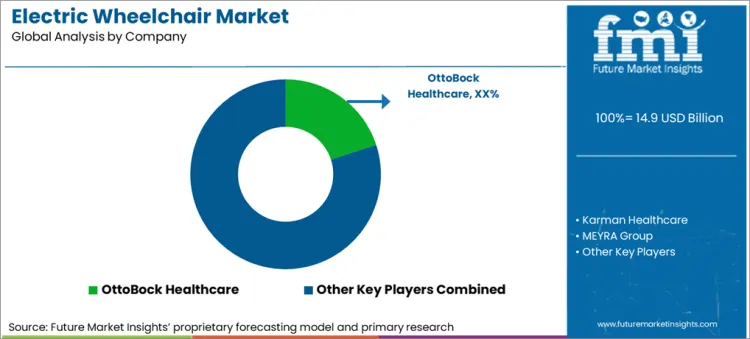
High adoption of electric wheelchairs with AI-powered navigation, growing demand for mobility assistance devices, and advancements in battery-powered wheelchairs are primary factors driving the growth of open market for global electric wheelchair market. Companies plan to work on lightweight foldable designs, IoT-enabled remote control, and terrain adaptability to ensure user independence, comfort, and accessibility.
The market unwinds engine-powered lift manufacturers, rehabilitation gadgets, car mechanics and hardware producers, and brilliant supportive gadget suppliers. The starkest global pioneers and versatility individual suppliers framed the perfect stage that is propelling power-based versatility, recovery designing, and gadget utilization in the market.
Recent Developments
- In December 2025, Sunrise Medical acquired Ergoflix, a German premium foldable power wheelchair leader, to strengthen its lifestyle mobility portfolio.
- In December 2025, Pride Mobility launched three carbon fiber travel power wheelchairs: Jazzy Carbon 27, 27x (vertical folding), and HD (400 lbs capacity).
- In November 2024, Invacare Holdings sold its North American operations to MIGA Holdings LLC in a landmark industry restructuring.
Key Company Offerings and Activities
| Company Name | Key Offerings/Activities |
|---|---|
| Invacare Corporation | Designs power wheelchairs, electric reclining chairs, and all-terrain mobility devices that utilize long-range lithium battery systems. |
| Permobil AB | Focuses on smart electric wheelchairs with AI-guided navigation, robotic exoskeleton integration, and customized seating solutions. |
| Pride Mobility Products Corp. | We have been producing innovative mobility solutions since 2011 and are known for our compact, foldable electric wheelchairs and high-performance bariatric devices for indoor and outdoor use. |
| Sunrise Medical LLC | Provides high-performance power wheelchairs with customizable controls, voice command integration, and pressure-relief seating technology. |
| Drive DeVilbiss Healthcare | Offers affordable, easy-to-transport electric wheelchairs that are comfortable and can handle rugged terrain. |
Key Company Insights
Invacare Corporation (12-17%)
Invacare is the leader in electric wheelchairs, offering long-distance and lightweight values for changes in mobility designed for rehabilitation, homecare and going outdoors. The company also offers sophisticated battery technology and customizable ergonomic features.
Permobil AB (10-14%)
These include intelligent electric wheelchairs by Swedish company Permobil that are utilizing AI-powered eye-tracking technology, alternative joystick input, and robotic joint assistance to enhance user independence and personalised mobility.
Pride Mobility Products Corp. (9-13%)
They specialize in small and collapsible electric wheelchairs, putting great effort into maneuverability, minimizing weight, and transportability with assembly times suitable for urban and indoor usage.
Sunrise Medical LLC (7-11%)
Sunrise Medical also manufactures high-performance power wheelchairs with adaptive seating, smart posture correction and cloud-connected health tracking for long-term users looking to improve their mobility and comfort.
Drive DeVilbiss Healthcare (5-9%)
Driven by the needs of outdoor lifestyles, Drive DeVilbiss produces affordable, hard-wearing electric wheelchairs, with enhanced suspension and all-terrain capabilities.
Additional Players of Importance (40-50% Combined)
Next-generation electric wheelchair innovation, smart assistive technologies, and enhanced accessibility solutions come from several manufacturers. These include:
- OttoBock Healthcare
- Karman Healthcare
- MEYRA Group
- Hoveround Corporation
- Golden Technologies
Market Definition
The electric wheelchair market represents revenue from battery-powered mobility chairs designed for individuals with mobility impairments, sold through medical, rehabilitation, and consumer channels.
Inclusions cover center-wheel, rear-wheel, and front-wheel drive power wheelchairs, foldable travel power wheelchairs, standing power wheelchairs, and pediatric power wheelchairs. Batteries, controllers, and smart accessories are included.
Exclusions include manual wheelchairs, mobility scooters, stairlifts, and powered exoskeletons. Wheelchair-accessible vehicle modifications are outside scope.
Scope of Report
| Items | Values |
|---|---|
| Quantitative Units (2026) | USD 14.9 Billion |
| Product Type | Center-Wheel Drive, Rear-Wheel Drive, Front-Wheel Drive, Foldable Travel, Standing |
| Distribution | Medical/Rehabilitation, Direct-to-Consumer, Online, Government Procurement |
| Regions Covered | North America, Europe, Asia Pacific, Latin America, Middle East and Africa |
| Key Companies Profiled | Sunrise Medical, Pride Mobility, Permobil, Invacare/MIGA, Ottobock |
Key Segmentation
By Product Type:
- Front Wheel Drive
- Rear Wheel Drive
- Standing Electric Wheelchairs
By End Users:
- Hospitals & Clinics
- Home Care
- Sports Conditioning
By Region:
- North America
- Latin America
- Western Europe
- Eastern Europe
- East Asia
- South Asia Pacific
- Middle East and Africa
Bibliography
- Sunrise Medical GmbH. (2025, December). Ergoflix acquisition announcement. Sunrise Medical Press.
- Pride Mobility Products Corp. (2025, December). Jazzy Carbon travel wheelchair launch. Pride Mobility Press Releases.
- World Health Organization. (2024). Global report on assistive technology demand. WHO.
Frequently Asked Questions
What is the current global market size for Electric Wheelchair?
The global market is valued at USD 14.9 Billion in 2026, driven by the aging global population, rising mobility impairment prevalence, and the transformation of power wheelchair design from institutional equipment to lifestyle-oriented consumer products.
What is the projected Compound Annual Growth Rate (CAGR) for the market over the next 10 years?
The market is projected to grow at a CAGR of 9.9% from 2026 to 2036.
Which regions are experiencing the fastest expansion?
North America leads driven by Medicare power wheelchair reimbursement and the direct-to-consumer premium segment, followed by Europe where Sunrise Medical's Ergoflix acquisition is scaling foldable technologies across distribution networks.
What are the primary market drivers?
The shift from institutional medical equipment to lifestyle mobility products with carbon fiber construction and smart app-connected features, combined with industry consolidation through premium brand acquisitions, are the primary growth catalysts.
Who are the leading suppliers in the industry?
Sunrise Medical, Pride Mobility, Permobil, Invacare/MIGA, and Ottobock are key players, differentiating through carbon fiber travel designs, premium foldable technology acquisitions, and smart drive mode customization platforms.
Preview the report firsthand - request a free sample
Get SampleGet the brochure for pricing and purchase details.
Get PDFTable of Content
- Executive Summary
- Global Market Outlook
- Demand-side Trends
- Supply-side Trends
- Technology Roadmap Analysis
- Analysis and Recommendations
- Market Overview
- Market Coverage / Taxonomy
- Market Definition / Scope / Limitations
- Research Methodology
- Chapter Orientation
- Analytical Lens and Working Hypotheses
- Market Structure, Signals, and Trend Drivers
- Benchmarking and Cross-market Comparability
- Market Sizing, Forecasting, and Opportunity Mapping
- Research Design and Evidence Framework
- Desk Research Programme (Secondary Evidence)
- Company Annual and Sustainability Reports
- Peer-reviewed Journals and Academic Literature
- Corporate Websites, Product Literature, and Technical Notes
- Earnings Decks and Investor Briefings
- Government Statistics Portals and Public Data Releases
- Press Releases and Reputable Media Coverage
- Specialist Newsletters and Curated Briefings
- Sector Databases and Reference Repositories
- FMI Internal Proprietary Databases and Historical Market Datasets
- Subscription Datasets and Paid Sources
- Social Channels, Communities, and Digital Listening Inputs
- Additional Desk Sources
- Expert Input and Fieldwork (Primary Evidence)
- Primary Modes
- Qualitative Interviews and Expert Elicitation
- Quantitative Surveys and Structured Data Capture
- Blended Approach
- Why Primary Evidence is Used
- Field Techniques
- Interviews
- Surveys
- Focus Groups
- Observational and In-context Research
- Social and Community Interactions
- Stakeholder Universe Engaged
- C-suite Leaders
- Board Members
- Presidents and Vice Presidents
- R&D and Innovation Heads
- Technical Specialists
- Domain Subject-matter Experts
- Scientists
- Physicians and Other Healthcare Professionals
- Governance, Ethics, and Data Stewardship
- Research Ethics
- Data Integrity and Handling
- Primary Modes
- Tooling, Models, and Reference Databases
- Desk Research Programme (Secondary Evidence)
- Data Engineering and Model Build
- Data Acquisition and Ingestion
- Cleaning, Normalisation, and Verification
- Synthesis, Triangulation, and Analysis
- Quality Assurance and Audit Trail
- Market Background
- Market Dynamics
- Drivers
- Restraints
- Opportunity
- Trends
- Scenario Forecast
- Demand in Optimistic Scenario
- Demand in Likely Scenario
- Demand in Conservative Scenario
- Opportunity Map Analysis
- Product Life Cycle Analysis
- Supply Chain Analysis
- Investment Feasibility Matrix
- Value Chain Analysis
- PESTLE and Porter’s Analysis
- Regulatory Landscape
- Regional Parent Market Outlook
- Production and Consumption Statistics
- Import and Export Statistics
- Market Dynamics
- Global Market Analysis 2021 to 2025 and Forecast, 2026 to 2036
- Historical Market Size Value (USD Billion) Analysis, 2021 to 2025
- Current and Future Market Size Value (USD Billion) Projections, 2026 to 2036
- Y-o-Y Growth Trend Analysis
- Absolute $ Opportunity Analysis
- Global Market Pricing Analysis 2021 to 2025 and Forecast 2026 to 2036
- Global Market Analysis 2021 to 2025 and Forecast 2026 to 2036, By Drive Type
- Introduction / Key Findings
- Historical Market Size Value (USD Billion) Analysis By Drive Type , 2021 to 2025
- Current and Future Market Size Value (USD Billion) Analysis and Forecast By Drive Type , 2026 to 2036
- Front Wheel Drive
- Rear Wheel Drive
- All-Wheel Drive
- Front Wheel Drive
- Y-o-Y Growth Trend Analysis By Drive Type , 2021 to 2025
- Absolute $ Opportunity Analysis By Drive Type , 2026 to 2036
- Global Market Analysis 2021 to 2025 and Forecast 2026 to 2036, By End Use
- Introduction / Key Findings
- Historical Market Size Value (USD Billion) Analysis By End Use, 2021 to 2025
- Current and Future Market Size Value (USD Billion) Analysis and Forecast By End Use, 2026 to 2036
- Hospitals & Clinics
- Home Care
- Rehabilitation Centers
- Long-Term Care Facilities
- Hospitals & Clinics
- Y-o-Y Growth Trend Analysis By End Use, 2021 to 2025
- Absolute $ Opportunity Analysis By End Use, 2026 to 2036
- Global Market Analysis 2021 to 2025 and Forecast 2026 to 2036, By Region
- Introduction
- Historical Market Size Value (USD Billion) Analysis By Region, 2021 to 2025
- Current Market Size Value (USD Billion) Analysis and Forecast By Region, 2026 to 2036
- North America
- Latin America
- Western Europe
- Eastern Europe
- East Asia
- South Asia and Pacific
- Middle East & Africa
- Market Attractiveness Analysis By Region
- North America Market Analysis 2021 to 2025 and Forecast 2026 to 2036, By Country
- Historical Market Size Value (USD Billion) Trend Analysis By Market Taxonomy, 2021 to 2025
- Market Size Value (USD Billion) Forecast By Market Taxonomy, 2026 to 2036
- By Country
- USA
- Canada
- Mexico
- By Drive Type
- By End Use
- By Country
- Market Attractiveness Analysis
- By Country
- By Drive Type
- By End Use
- Key Takeaways
- Latin America Market Analysis 2021 to 2025 and Forecast 2026 to 2036, By Country
- Historical Market Size Value (USD Billion) Trend Analysis By Market Taxonomy, 2021 to 2025
- Market Size Value (USD Billion) Forecast By Market Taxonomy, 2026 to 2036
- By Country
- Brazil
- Chile
- Rest of Latin America
- By Drive Type
- By End Use
- By Country
- Market Attractiveness Analysis
- By Country
- By Drive Type
- By End Use
- Key Takeaways
- Western Europe Market Analysis 2021 to 2025 and Forecast 2026 to 2036, By Country
- Historical Market Size Value (USD Billion) Trend Analysis By Market Taxonomy, 2021 to 2025
- Market Size Value (USD Billion) Forecast By Market Taxonomy, 2026 to 2036
- By Country
- Germany
- UK
- Italy
- Spain
- France
- Nordic
- BENELUX
- Rest of Western Europe
- By Drive Type
- By End Use
- By Country
- Market Attractiveness Analysis
- By Country
- By Drive Type
- By End Use
- Key Takeaways
- Eastern Europe Market Analysis 2021 to 2025 and Forecast 2026 to 2036, By Country
- Historical Market Size Value (USD Billion) Trend Analysis By Market Taxonomy, 2021 to 2025
- Market Size Value (USD Billion) Forecast By Market Taxonomy, 2026 to 2036
- By Country
- Russia
- Poland
- Hungary
- Balkan & Baltic
- Rest of Eastern Europe
- By Drive Type
- By End Use
- By Country
- Market Attractiveness Analysis
- By Country
- By Drive Type
- By End Use
- Key Takeaways
- East Asia Market Analysis 2021 to 2025 and Forecast 2026 to 2036, By Country
- Historical Market Size Value (USD Billion) Trend Analysis By Market Taxonomy, 2021 to 2025
- Market Size Value (USD Billion) Forecast By Market Taxonomy, 2026 to 2036
- By Country
- China
- Japan
- South Korea
- By Drive Type
- By End Use
- By Country
- Market Attractiveness Analysis
- By Country
- By Drive Type
- By End Use
- Key Takeaways
- South Asia and Pacific Market Analysis 2021 to 2025 and Forecast 2026 to 2036, By Country
- Historical Market Size Value (USD Billion) Trend Analysis By Market Taxonomy, 2021 to 2025
- Market Size Value (USD Billion) Forecast By Market Taxonomy, 2026 to 2036
- By Country
- India
- ASEAN
- Australia & New Zealand
- Rest of South Asia and Pacific
- By Drive Type
- By End Use
- By Country
- Market Attractiveness Analysis
- By Country
- By Drive Type
- By End Use
- Key Takeaways
- Middle East & Africa Market Analysis 2021 to 2025 and Forecast 2026 to 2036, By Country
- Historical Market Size Value (USD Billion) Trend Analysis By Market Taxonomy, 2021 to 2025
- Market Size Value (USD Billion) Forecast By Market Taxonomy, 2026 to 2036
- By Country
- Kingdom of Saudi Arabia
- Other GCC Countries
- Turkiye
- South Africa
- Other African Union
- Rest of Middle East & Africa
- By Drive Type
- By End Use
- By Country
- Market Attractiveness Analysis
- By Country
- By Drive Type
- By End Use
- Key Takeaways
- Key Countries Market Analysis
- USA
- Pricing Analysis
- Market Share Analysis, 2025
- By Drive Type
- By End Use
- Canada
- Pricing Analysis
- Market Share Analysis, 2025
- By Drive Type
- By End Use
- Mexico
- Pricing Analysis
- Market Share Analysis, 2025
- By Drive Type
- By End Use
- Brazil
- Pricing Analysis
- Market Share Analysis, 2025
- By Drive Type
- By End Use
- Chile
- Pricing Analysis
- Market Share Analysis, 2025
- By Drive Type
- By End Use
- Germany
- Pricing Analysis
- Market Share Analysis, 2025
- By Drive Type
- By End Use
- UK
- Pricing Analysis
- Market Share Analysis, 2025
- By Drive Type
- By End Use
- Italy
- Pricing Analysis
- Market Share Analysis, 2025
- By Drive Type
- By End Use
- Spain
- Pricing Analysis
- Market Share Analysis, 2025
- By Drive Type
- By End Use
- France
- Pricing Analysis
- Market Share Analysis, 2025
- By Drive Type
- By End Use
- India
- Pricing Analysis
- Market Share Analysis, 2025
- By Drive Type
- By End Use
- ASEAN
- Pricing Analysis
- Market Share Analysis, 2025
- By Drive Type
- By End Use
- Australia & New Zealand
- Pricing Analysis
- Market Share Analysis, 2025
- By Drive Type
- By End Use
- China
- Pricing Analysis
- Market Share Analysis, 2025
- By Drive Type
- By End Use
- Japan
- Pricing Analysis
- Market Share Analysis, 2025
- By Drive Type
- By End Use
- South Korea
- Pricing Analysis
- Market Share Analysis, 2025
- By Drive Type
- By End Use
- Russia
- Pricing Analysis
- Market Share Analysis, 2025
- By Drive Type
- By End Use
- Poland
- Pricing Analysis
- Market Share Analysis, 2025
- By Drive Type
- By End Use
- Hungary
- Pricing Analysis
- Market Share Analysis, 2025
- By Drive Type
- By End Use
- Kingdom of Saudi Arabia
- Pricing Analysis
- Market Share Analysis, 2025
- By Drive Type
- By End Use
- Turkiye
- Pricing Analysis
- Market Share Analysis, 2025
- By Drive Type
- By End Use
- South Africa
- Pricing Analysis
- Market Share Analysis, 2025
- By Drive Type
- By End Use
- USA
- Market Structure Analysis
- Competition Dashboard
- Competition Benchmarking
- Market Share Analysis of Top Players
- By Regional
- By Drive Type
- By End Use
- Competition Analysis
- Competition Deep Dive
- OttoBock Healthcare
- Overview
- Product Portfolio
- Profitability by Market Segments (Product/Age /Sales Channel/Region)
- Sales Footprint
- Strategy Overview
- Marketing Strategy
- Product Strategy
- Channel Strategy
- Karman Healthcare
- MEYRA Group
- Hoveround Corporation
- Golden Technologies
- OttoBock Healthcare
- Competition Deep Dive
- Assumptions & Acronyms Used


