


Salesforce Services Market
The Salesforce services market is segmented by Service Type (Planning & Advisory Services; Implementation Services; Integration & Customization; Data Migration; Managed Services), Application (Sales Cloud; Service Cloud; Marketing Cloud; Commerce Cloud; Analytics; Industry Clouds), Vertical (BFSI; Healthcare & Life Sciences; Retail & CPG; Media & Telecom; Manufacturing; Government; Energy & Utilities), and Region. Forecast for 2026 to 2036.
Historical Data Covered: 2016 to 2024 | Base Year: 2025 | Estimated Year: 2026 | Forecast Period: 2027 to 2036
Salesforce Services Market Size, Market Forecast and Outlook By FMI
The Salesforce services market is forecast to advance from USD 23.0 billion in 2026 to USD 99.0 billion by 2036. FMI projects the market to expand at 15.6% CAGR during 2026 to 2036. Implementation services remain the largest service type, while Sales Cloud forms the main application base for enterprise CRM programs.
Summary of the Salesforce Services Market
- Demand and Growth Drivers
- Enterprise CRM modernization is increasing demand for Salesforce consulting and implementation support.
- Cloud migration programs are widening the need for certified Salesforce service partners.
- Legacy system integration is creating steady demand for customization and data migration.
- Workflow automation is raising spending across sales and service operations.
- Product and Segment View
- Implementation services lead because Salesforce rollouts need configuration and system integration.
- Sales Cloud holds the main application share due to its role in revenue workflows.
- BFSI leads vertical demand as banks and insurers need unified customer data.
- Managed services gain importance as enterprises extend Salesforce across functions.
- Geography and Competitive Outlook
- Australia & New Zealand show the fastest growth due to rapid cloud modernization.
- Japan records strong expansion as enterprises replace older CRM systems.
- China gains from localized CRM deployments across large business groups.
- Global integrators win through industry depth and long-term Salesforce partnerships.
- Analyst Opinion
- Sudip Saha, Principal Consultant at FMI, suggests, “Salesforce services are moving from implementation support into long-term enterprise operating models. Companies need partners that can manage CRM, data, automation, and user adoption together. Service providers with strong Salesforce practices and reusable industry templates are likely to gain stronger account depth through the forecast period.”
- Salesforce Services Market Value Analysis
- Salesforce services are shifting from one-time CRM projects into continuous transformation programs.
- Implementation work creates the first value layer through configuration and integration.
- Managed services extend revenue as enterprises keep improving Salesforce environments.
- BFSI demand remains strong because customer data and compliance needs are complex.
- Partner capability will decide value capture as multi-cloud Salesforce use expands.
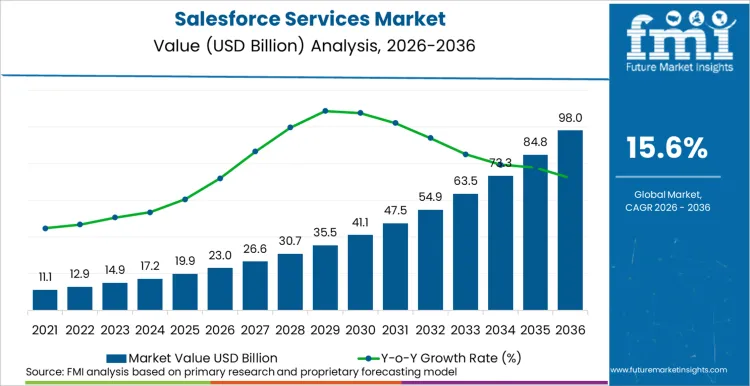
Salesforce Services Market Key Takeaways
| Metric | Details |
|---|---|
| Industry Size (2026) | USD 23.0 Billion |
| Industry Value (2036) | USD 99.0 Billion |
| CAGR (2026-2036) | 15.6% |
Source: Future Market Insights (FMI) analysis, based on proprietary forecasting model and primary research.
What Is Driving Rising Adoption of Salesforce Services Across Enterprises?
Expectations around CRM deployment and digital transformation are evolving as Salesforce services move beyond one-time implementation projects into ongoing enterprise capability-building programs. According to Future Market Insights, enterprises are placing increasing value on rapid deployment cycles, seamless integration with legacy systems, and continuous optimization of sales, service, and marketing workflows. Earlier Salesforce engagements were often treated as standalone CRM rollouts, which limited long-term value realization and slowed platform adoption across business units. That approach is changing as organizations embed Salesforce more deeply into core customer engagement and analytics architectures.
Service delivery strategies illustrate this shift. Accenture integrates Salesforce implementation, cloud migration, and managed services within broader digital transformation programs rather than positioning CRM projects as isolated IT upgrades. These engagements focus on aligning Salesforce with business processes, data strategies, and AI-enabled automation layers, supporting sustained platform utilization rather than one-off go-live milestones. FMI notes that enterprises adopting long-term Salesforce service partnerships, with continuous enhancement and optimization cycles, are more likely to scale platform usage across functions and regions as CRM adoption matures.
How Is the Salesforce Services Market Segmented?
The Salesforce services market is segmented by type of service, application, and vertical, reflecting how enterprises structure CRM adoption and expansion programs. By type of service, demand spans planning services such as advisory and change management, management services including monitoring, upgrades, governance, helpdesk, training, and BPO, and implementation services covering integrated deployments, custom application development, modernization, data migration, and testing. Implementation services form the largest share as enterprises prioritize end-to-end rollout and system integration programs. By application, the market includes Sales Cloud, Service Cloud, Marketing Cloud, App Cloud, Commerce Cloud, and Analytics, with Sales Cloud leading initial adoption. By vertical, BFSI, healthcare and life sciences, media and telecom, retail and CPG, government, manufacturing, and energy and utilities represent core demand pools, with BFSI holding the largest share.
Why Do Implementation Services Represent the Largest Share?
Implementation services account for 41.7% of Salesforce services demand, reflecting their role as the primary entry point for CRM transformation programs. Enterprises rely on implementation partners to configure Salesforce environments, integrate CRM with ERP and marketing automation systems, and migrate large volumes of legacy customer data. These projects typically span multiple clouds and require custom application development to align workflows with industry-specific processes. Large implementation programs also establish the technical foundation for subsequent management and optimization services, creating long-term service relationships. Accenture’s Salesforce practice illustrates this dynamic, supporting global BFSI and retail clients with multi-cloud implementations that embed Salesforce into front-office operations. FMI observes that as enterprises expand CRM footprints across regions and business units, implementation services continue to drive by service spending and drive sustained demand.
Why Does Sales Cloud Lead Demand by Application?
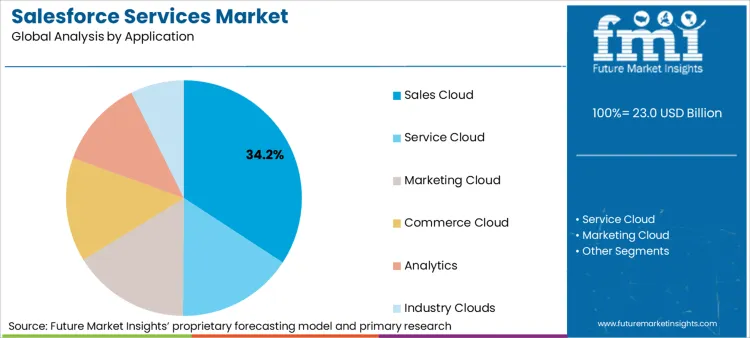
Sales Cloud represents 34.2% of application-level demand, driven by its role as the core system of record for revenue operations. Organizations typically deploy Sales Cloud as the first step in CRM modernization to standardize lead management, opportunity tracking, and pipeline analytics. Sales leaders prioritize visibility into customer interactions and sales performance, which positions Sales Cloud as the foundation for broader Salesforce adoption. Once Sales Cloud is embedded, enterprises expand into Service Cloud, Marketing Cloud, and Analytics to build integrated customer engagement platforms. This phased adoption pattern reinforces Sales Cloud’s foundational role within the application mix. FMI notes that Sales Cloud’s centrality to revenue workflows ensures sustained investment across upgrades, customization, and integration projects, driven by its core position within Salesforce services demand.
Why Does BFSI Dominate Salesforce Services Adoption by Vertical?
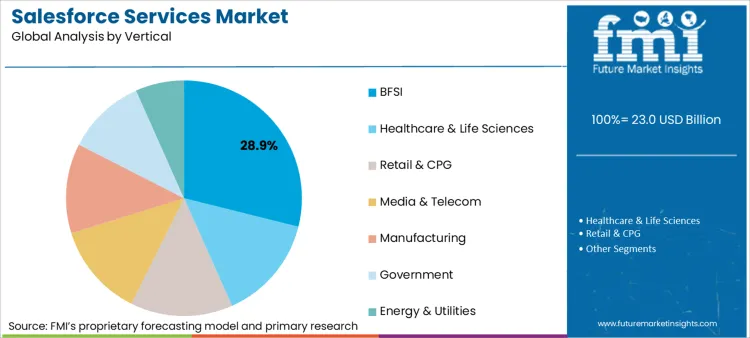
BFSI accounts for 28.9% of Salesforce services demand, reflecting the sector’s high reliance on CRM-driven customer engagement and relationship management. Banks and insurers operate across complex omnichannel environments that require unified customer data, personalized communication, and regulatory-compliant workflows. Salesforce deployments in BFSI involve extensive customization to support onboarding, service case management, and relationship advisory processes across digital and branch networks. High data security and compliance requirements also increase service intensity across implementation, governance, and monitoring phases. FMI highlights that BFSI organizations continue to invest in CRM modernization to support cross-sell, retention, and digital service models, sustaining strong demand for Salesforce services relative to other verticals.
What Trends Are Driving Structural Change in the Salesforce Services Ecosystem?
Salesforce services are gaining strategic importance as enterprises prioritize continuous CRM optimization, faster cloud deployment cycles, and tighter integration across sales, service, marketing, and data platforms. Service providers now focus on building repeatable delivery frameworks that support rapid configuration, iterative releases, and ongoing performance tuning rather than one-time system go-lives. Clients expect shorter implementation timelines, standardized accelerators, and industry-specific templates that reduce deployment risk and improve time to value. As per Future Market Insights, Salesforce services are increasingly positioned as long-term digital enablement partnerships, supporting continuous platform evolution as organizations expand use of AI-driven analytics, workflow automation, and multi-cloud orchestration across customer engagement functions.
How Is Service Portfolio Expansion Strengthening Enterprise CRM Platforms?
Service portfolio expansion is reinforcing competitive positioning as providers bundle implementation, integration, data migration, and managed services into unified Salesforce delivery platforms. Global system integrators are building industry-aligned Salesforce practices that address sector-specific workflows, compliance requirements, and data architectures. Deloitte’s Salesforce practice integrates CRM deployment with cloud modernization, data engineering, and industry-specific process frameworks, enabling enterprises to scale Salesforce adoption across regions and business units. This platform-oriented delivery model improves consistency in solution design, accelerates multi-country rollouts, and supports long-term optimization programs. FMI observes that broad service portfolios strengthen provider stickiness, extend contract duration, and align Salesforce deployments with wider enterprise transformation roadmaps.
Why Is Delivery Model Refinement Driving Innovation in Salesforce Services?
Cost discipline and rising performance expectations are pushing service providers to refine delivery models while maintaining implementation quality and post-go-live support. Enterprises demand predictable timelines, outcome-based pricing structures, and measurable ROI from CRM investments. Service teams are standardizing deployment playbooks, reusable components, and automation scripts to improve delivery efficiency and reduce customization overhead. Minor variations in data models or integration architecture can significantly affect system performance and user adoption at scale. FMI notes that increasing competition is placing greater emphasis on delivery rigor, governance frameworks, and continuous optimization capabilities, positioning Salesforce services as long-term operational enablers rather than short-term IT projects.
What Is the Country-wise Outlook for the Salesforce Services Market?
Country-level growth for Salesforce services varies based on cloud adoption maturity, digital transformation intensity, partner ecosystem depth, and regulatory environments. Australia and New Zealand lead with a 19.1% CAGR, reflecting aggressive enterprise cloud modernization and strong uptake of multi-cloud CRM programs. Japan follows at 16.8%, supported by modernization of legacy front-office systems and rising demand for service automation. China records 16.1%, driven by enterprise digitization across large corporates and platform localization needs. Germany posts 15.1%, reflecting structured CRM modernization across industrial and export-oriented enterprises. The United States shows a 12.5% CAGR, indicating steady expansion within a highly penetrated CRM market. Growth across these markets is driven by implementation-heavy deployments, platform integration, and expansion into service, marketing, and analytics clouds.
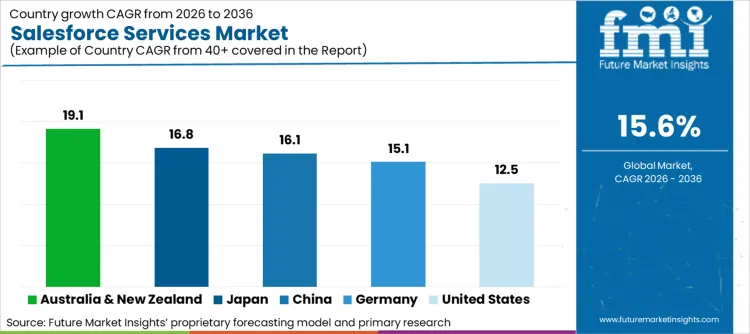
| Country | CAGR (%) |
|---|---|
| Australia & New Zealand | 19.1% |
| Japan | 16.8% |
| China | 16.1% |
| Germany | 15.1% |
| United States | 12.5% |
Source: FMI historical analysis and forecast data.
Why Do Australia and New Zealand Show the Fastest Growth in Salesforce Services?
Australia and New Zealand record a 19.1% CAGR, supported by rapid cloud migration across mid-sized and large enterprises and strong reliance on partner-led CRM transformation programs. Organizations in these markets prioritize integrated customer data platforms to unify sales, service, and marketing workflows across distributed teams. Salesforce services adoption is driven by multi-cloud implementations that replace fragmented CRM environments and support omnichannel engagement. Public sector digital transformation and utilities modernization programs further contribute to sustained demand for implementation and management services. Growth reflects platform standardization across industries such as BFSI, telecom, and retail, where CRM modernization underpins customer experience strategies. This environment supports recurring demand for upgrades, governance, and analytics enablement as deployments mature.
What Is Driving Salesforce Services Expansion in Japan?
Japan posts a 16.8% CAGR, reflecting steady replacement of legacy CRM systems and growing enterprise focus on service automation and customer experience consistency. Organizations emphasize reliability, data governance, and integration with existing ERP environments, driving demand for complex implementation and modernization services. Salesforce deployments in Japan often involve phased rollouts across Sales Cloud and Service Cloud, followed by analytics enablement to improve service quality and response times. Adoption is shaped by structured transformation programs rather than rapid experimentation, resulting in sustained multi-year service engagements. The need to harmonize customer data across physical and digital touchpoints further supports demand for integration, testing, and governance services, reinforcing Japan’s strong growth trajectory within the Salesforce services market.
Why Is China Emerging as a High-Growth Market for Salesforce Services?
China records a 16.1% CAGR, supported by enterprise digitization programs across large corporates and growing demand for localized CRM architectures. Organizations increasingly require tailored Salesforce implementations that integrate with domestic platforms and comply with data governance requirements, driving service intensity across implementation and customization layers. Alibaba Cloud’s enterprise partnerships illustrate how CRM modernization projects in China are embedded within broader cloud transformation programs, creating demand for system integration and application modernization services. Salesforce services adoption is shaped by the need to localize workflows, analytics, and integrations across regional business units. Growth reflects structured enterprise modernization rather than greenfield adoption, sustaining strong demand for certified partners capable of managing complex, localized CRM deployments.
What Supports Germany’s Salesforce Services Growth Trajectory?
Germany posts a 15.1% CAGR, driven by CRM modernization across industrial, manufacturing, and export-oriented enterprises. Organizations prioritize standardized customer data platforms to support B2B sales processes, partner management, and after-sales service workflows. Salesforce services are deployed to integrate CRM with ERP and field service systems, supporting end-to-end customer lifecycle management. Adoption is shaped by compliance considerations, structured implementation planning, and emphasis on process consistency across business units. The growth profile reflects disciplined enterprise modernization programs that favor long-term service partnerships for upgrades, governance, and performance optimization rather than one-off implementation projects.
Why Is Growth More Moderate in the United States Salesforce Services Market?
The United States records a 12.5% CAGR, reflecting expansion within a mature CRM ecosystem with high Salesforce penetration. Demand is driven primarily by multi-cloud expansion, modernization of earlier Salesforce implementations, and migration toward advanced analytics and automation layers. Organizations invest in upgrades, integration, and governance services to extend CRM capabilities across marketing, commerce, and service functions. Growth is shaped more by expansion of existing deployments than by first-time CRM adoption. The depth of the partner ecosystem supports sustained service demand, though baseline penetration tempers growth rates relative to emerging markets.
What Is the Competitive Outlook for the Salesforce Services Market?
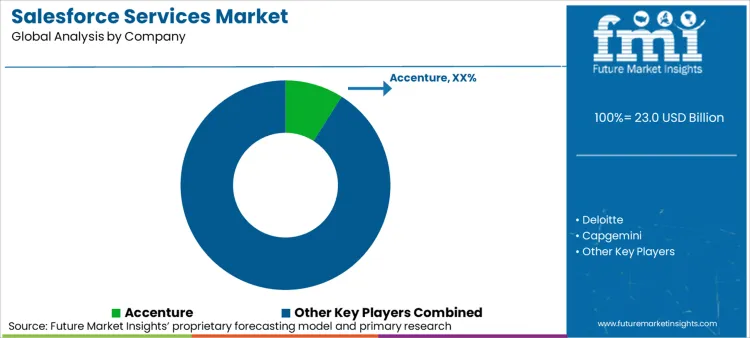
The competitive landscape for enterprise CRM and digital experience services is led by global technology vendors and large IT services firms that extend beyond core software platforms to maintain ecosystem relevance and service-led growth. Players such as Microsoft Corporation, SAP SE, Oracle Corporation, Salesforce.com Inc., and Adobe Inc. benefit from platform ownership, deep enterprise penetration, and broad partner networks, enabling them to drive long-term transformation programs. Services and systems integration leaders including IBM Corporation, Accenture PLC, Tata Consultancy Services Limited, Tech Mahindra Limited, Wipro, and DXC Technology leverage scale, global delivery, and industry-aligned practices to capture downstream implementation and managed services demand. Competitive positioning in this market is shaped less by short-term project wins and more by the ability to sustain multi-year enterprise transformation partnerships across CRM, ERP, data, and experience platforms
Market analysis indicates that competition is increasingly centered on depth of industry specialization, cloud-native delivery models, and integration capability across CRM, data, and experience layers rather than aggressive price-led expansion. Companies such as Accenture and IBM emphasize end-to-end transformation programs spanning strategy, implementation, and long-term operations, while Tata Consultancy Services, Wipro, and Tech Mahindra strengthen positioning through scalable offshore delivery, domain-specific accelerators, and outcome-oriented service frameworks. Long-term competitive advantage will likely depend on how effectively service providers embed CRM and experience platforms into core enterprise workflows, positioning these solutions as operational infrastructure rather than standalone IT deployments.
Recent Developments:
- In August 2025, Accenture agreed to acquire NeuraFlash to strengthen Salesforce gen AI capabilities and expand mid-market consulting services globally.
- In October 2025, IBM and Salesforce expanded collaboration to integrate IBM Z mainframe data into Salesforce Agentforce using Zero Copy architecture, enabling real-time insights, analytics, and agentic enterprise applications.
Key Players in Salesforce Services Market
- Accenture
- Deloitte
- Capgemini
- IBM Consulting
- Cognizant
- Tata Consultancy Services Limited
- Wipro
- Tech Mahindra Limited
- DXC Technology
Market Definition
The Salesforce services market captures revenue from professional services delivered to design, implement, integrate, customize, and manage Salesforce platforms across enterprise and mid-market organizations. In this assessment, the market covers commercially contracted Salesforce-related services positioned to support CRM deployment, digital customer engagement, workflow automation, data integration, and platform optimization. Market sizing reflects the value of service contracts delivered through consulting engagements, implementation projects, and managed services arrangements, analyzed by service type, enterprise size, end-use industry, and region, and reported in USD billion.
The scope includes Salesforce implementation services, system integration, data migration, application development, customization, testing, training, and ongoing managed services supporting Sales Cloud, Service Cloud, Marketing Cloud, Commerce Cloud, Data Cloud, and industry-specific Salesforce solutions. Service engagements delivered through global system integrators, IT consulting firms, and certified Salesforce partners are included. Geographic coverage spans North America, Europe, Asia Pacific, Latin America, and the Middle East & Africa.
The market excludes Salesforce software subscription revenues, standalone CRM license fees, non-Salesforce CRM consulting services, and generic IT services not directly tied to Salesforce platform deployment or optimization. Revenues from hardware procurement, cloud infrastructure resale, third-party software licensing unrelated to Salesforce implementations, and internal in-house IT teams delivering Salesforce support without external commercial contracts are excluded.
Scope of Report
| Items | Values |
|---|---|
| Quantitative Units (2026) | USD 23.0 Billion |
| Service Type | Planning & Advisory Services; Implementation Services; Integration & Customization; Data Migration; Managed Services |
| Application | Sales Cloud; Service Cloud; Marketing Cloud; Commerce Cloud; Analytics; Industry Clouds |
| Vertical | BFSI; Healthcare & Life Sciences; Retail & CPG; Media & Telecom; Manufacturing; Government; Energy & Utilities |
| Regions Covered | North America, Europe, Asia Pacific, Latin America, Middle East & Africa |
| Countries Covered | United States, Germany, United Kingdom, India, China, Japan, Australia & New Zealand, and 40+ countries |
| Key Companies Profiled | Accenture; Deloitte; Capgemini; IBM Consulting; Cognizant; Tata Consultancy Services Limited; Wipro; Tech Mahindra Limited; DXC Technology |
| Additional Attributes | Dollar sales by service type and application; country-wise growth analysis; Salesforce Cloud adoption patterns by vertical; implementation versus managed services mix; partner ecosystem maturity and delivery model evolution |
Source: FMI historical analysis and forecast data
Salesforce Services Market by Segments
By Service Type:
- Planning & Advisory Services
- Implementation Services
- Integration & Customization
- Data Migration
- Managed Services
By Application:
- Sales Cloud
- Service Cloud
- Marketing Cloud
- Commerce Cloud
- Analytics
- Industry Clouds
By Vertical:
- BFSI
- Healthcare & Life Sciences
- Retail & CPG
- Media & Telecom
- Manufacturing
- Government
- Energy & Utilities
By Region:
- North America
- Europe
- Asia Pacific
- Latin America
- Middle East & Africa
Bibliography
- Accenture. (2025, August). Accenture to Acquire NeuraFlash to Accelerate Gen AI Capabilities in Salesforce Services.
- Salesforce, Inc. (2025). Fiscal Year 2025 Annual Report (Form 10-K). USA Securities and Exchange Commission.
- IBM Corporation. (2025, October). IBM and Salesforce Expand Collaboration to Integrate IBM Z Data into Agentforce.
- International Trade Administration. (2025). Cloud Computing and Digital Transformation: Top Markets Report 2025. USA Department of Commerce.
- Tata Consultancy Services. (2025). Global Cloud Study: The Era of AI-Driven Enterprise Modernization. TCS Thought Leadership.
Frequently Asked Questions
How big is the global Salesforce services market?
The Salesforce services market is valued at USD 23.0 billion in 2026 and is projected to reach USD 99.0 billion by 2036.
What is the growth outlook for the Salesforce services market over the next 10 years?
The market is expected to grow at a 15.6% CAGR from 2026 to 2036, driven by enterprise-wide CRM modernization, multi-cloud integration, and AI-enabled workflow automation initiatives.
Which product segments or formats drive demand in this market?
Implementation services lead with 41.7% share, Sales Cloud drives 34.2% of application demand, and BFSI dominates vertical adoption with 28.9% share.
How does consumer behavior differ by region?
Australia & New Zealand and Japan show faster growth due to aggressive cloud modernization and legacy replacement cycles, while the United States grows more moderately within a mature, high-penetration CRM environment.
What are the main risks and constraints affecting this market?
Key constraints include high implementation complexity, integration challenges with legacy systems, cost discipline pressures, talent shortages in certified Salesforce expertise, and increasing competition among global system integrators.
Table of Content
- Executive Summary
- Global Market Outlook
- Demand to side Trends
- Supply to side Trends
- Technology Roadmap Analysis
- Analysis and Recommendations
- Market Overview
- Market Coverage / Taxonomy
- Market Definition / Scope / Limitations
- Research Methodology
- Chapter Orientation
- Analytical Lens and Working Hypotheses
- Market Structure, Signals, and Trend Drivers
- Benchmarking and Cross-market Comparability
- Market Sizing, Forecasting, and Opportunity Mapping
- Research Design and Evidence Framework
- Desk Research Programme (Secondary Evidence)
- Company Annual and Sustainability Reports
- Peer-reviewed Journals and Academic Literature
- Corporate Websites, Product Literature, and Technical Notes
- Earnings Decks and Investor Briefings
- Statutory Filings and Regulatory Disclosures
- Technical White Papers and Standards Notes
- Trade Journals, Industry Magazines, and Analyst Briefs
- Conference Proceedings, Webinars, and Seminar Materials
- Government Statistics Portals and Public Data Releases
- Press Releases and Reputable Media Coverage
- Specialist Newsletters and Curated Briefings
- Sector Databases and Reference Repositories
- FMI Internal Proprietary Databases and Historical Market Datasets
- Subscription Datasets and Paid Sources
- Social Channels, Communities, and Digital Listening Inputs
- Additional Desk Sources
- Expert Input and Fieldwork (Primary Evidence)
- Primary Modes
- Qualitative Interviews and Expert Elicitation
- Quantitative Surveys and Structured Data Capture
- Blended Approach
- Why Primary Evidence is Used
- Field Techniques
- Interviews
- Surveys
- Focus Groups
- Observational and In-context Research
- Social and Community Interactions
- Stakeholder Universe Engaged
- C-suite Leaders
- Board Members
- Presidents and Vice Presidents
- R&D and Innovation Heads
- Technical Specialists
- Domain Subject-matter Experts
- Scientists
- Physicians and Other Healthcare Professionals
- Governance, Ethics, and Data Stewardship
- Research Ethics
- Data Integrity and Handling
- Primary Modes
- Tooling, Models, and Reference Databases
- Desk Research Programme (Secondary Evidence)
- Data Engineering and Model Build
- Data Acquisition and Ingestion
- Cleaning, Normalisation, and Verification
- Synthesis, Triangulation, and Analysis
- Quality Assurance and Audit Trail
- Market Background
- Market Dynamics
- Drivers
- Restraints
- Opportunity
- Trends
- Scenario Forecast
- Demand in Optimistic Scenario
- Demand in Likely Scenario
- Demand in Conservative Scenario
- Opportunity Map Analysis
- Product Life Cycle Analysis
- Supply Chain Analysis
- Investment Feasibility Matrix
- Value Chain Analysis
- PESTLE and Porter’s Analysis
- Regulatory Landscape
- Regional Parent Market Outlook
- Production and Consumption Statistics
- Import and Export Statistics
- Market Dynamics
- Global Market Analysis 2021 to 2025 and Forecast, 2026 to 2036
- Historical Market Size Value (USD Million) Analysis, 2021 to 2025
- Current and Future Market Size Value (USD Million) Projections, 2026 to 2036
- Y to o to Y Growth Trend Analysis
- Absolute $ Opportunity Analysis
- Global Market Pricing Analysis 2021 to 2025 and Forecast 2026 to 2036
- Global Market Analysis 2021 to 2025 and Forecast 2026 to 2036, By Service Type
- Introduction / Key Findings
- Historical Market Size Value (USD Million) Analysis By Service Type , 2021 to 2025
- Current and Future Market Size Value (USD Million) Analysis and Forecast By Service Type , 2026 to 2036
- Planning & Advisory Services
- Implementation Services
- Integration & Customization
- Data Migration
- Managed Services
- Planning & Advisory Services
- Y to o to Y Growth Trend Analysis By Service Type , 2021 to 2025
- Absolute $ Opportunity Analysis By Service Type , 2026 to 2036
- Global Market Analysis 2021 to 2025 and Forecast 2026 to 2036, By Application
- Introduction / Key Findings
- Historical Market Size Value (USD Million) Analysis By Application, 2021 to 2025
- Current and Future Market Size Value (USD Million) Analysis and Forecast By Application, 2026 to 2036
- Sales Cloud
- Service Cloud
- Marketing Cloud
- Commerce Cloud
- Analytics
- Industry Clouds
- Sales Cloud
- Y to o to Y Growth Trend Analysis By Application, 2021 to 2025
- Absolute $ Opportunity Analysis By Application, 2026 to 2036
- Global Market Analysis 2021 to 2025 and Forecast 2026 to 2036, By Vertical
- Introduction / Key Findings
- Historical Market Size Value (USD Million) Analysis By Vertical, 2021 to 2025
- Current and Future Market Size Value (USD Million) Analysis and Forecast By Vertical, 2026 to 2036
- BFSI
- Healthcare & Life Sciences
- Retail & CPG
- Media & Telecom
- Manufacturing
- Government
- Energy & Utilities
- BFSI
- Y to o to Y Growth Trend Analysis By Vertical, 2021 to 2025
- Absolute $ Opportunity Analysis By Vertical, 2026 to 2036
- Global Market Analysis 2021 to 2025 and Forecast 2026 to 2036, By Region
- Introduction
- Historical Market Size Value (USD Million) Analysis By Region, 2021 to 2025
- Current Market Size Value (USD Million) Analysis and Forecast By Region, 2026 to 2036
- North America
- Latin America
- Western Europe
- Eastern Europe
- East Asia
- South Asia and Pacific
- Middle East & Africa
- Market Attractiveness Analysis By Region
- North America Market Analysis 2021 to 2025 and Forecast 2026 to 2036, By Country
- Historical Market Size Value (USD Million) Trend Analysis By Market Taxonomy, 2021 to 2025
- Market Size Value (USD Million) Forecast By Market Taxonomy, 2026 to 2036
- By Country
- USA
- Canada
- Mexico
- By Service Type
- By Application
- By Vertical
- By Country
- Market Attractiveness Analysis
- By Country
- By Service Type
- By Application
- By Vertical
- Key Takeaways
- Latin America Market Analysis 2021 to 2025 and Forecast 2026 to 2036, By Country
- Historical Market Size Value (USD Million) Trend Analysis By Market Taxonomy, 2021 to 2025
- Market Size Value (USD Million) Forecast By Market Taxonomy, 2026 to 2036
- By Country
- Brazil
- Chile
- Rest of Latin America
- By Service Type
- By Application
- By Vertical
- By Country
- Market Attractiveness Analysis
- By Country
- By Service Type
- By Application
- By Vertical
- Key Takeaways
- Western Europe Market Analysis 2021 to 2025 and Forecast 2026 to 2036, By Country
- Historical Market Size Value (USD Million) Trend Analysis By Market Taxonomy, 2021 to 2025
- Market Size Value (USD Million) Forecast By Market Taxonomy, 2026 to 2036
- By Country
- Germany
- UK
- Italy
- Spain
- France
- Nordic
- BENELUX
- Rest of Western Europe
- By Service Type
- By Application
- By Vertical
- By Country
- Market Attractiveness Analysis
- By Country
- By Service Type
- By Application
- By Vertical
- Key Takeaways
- Eastern Europe Market Analysis 2021 to 2025 and Forecast 2026 to 2036, By Country
- Historical Market Size Value (USD Million) Trend Analysis By Market Taxonomy, 2021 to 2025
- Market Size Value (USD Million) Forecast By Market Taxonomy, 2026 to 2036
- By Country
- Russia
- Poland
- Hungary
- Balkan & Baltic
- Rest of Eastern Europe
- By Service Type
- By Application
- By Vertical
- By Country
- Market Attractiveness Analysis
- By Country
- By Service Type
- By Application
- By Vertical
- Key Takeaways
- East Asia Market Analysis 2021 to 2025 and Forecast 2026 to 2036, By Country
- Historical Market Size Value (USD Million) Trend Analysis By Market Taxonomy, 2021 to 2025
- Market Size Value (USD Million) Forecast By Market Taxonomy, 2026 to 2036
- By Country
- China
- Japan
- South Korea
- By Service Type
- By Application
- By Vertical
- By Country
- Market Attractiveness Analysis
- By Country
- By Service Type
- By Application
- By Vertical
- Key Takeaways
- South Asia and Pacific Market Analysis 2021 to 2025 and Forecast 2026 to 2036, By Country
- Historical Market Size Value (USD Million) Trend Analysis By Market Taxonomy, 2021 to 2025
- Market Size Value (USD Million) Forecast By Market Taxonomy, 2026 to 2036
- By Country
- India
- ASEAN
- Australia & New Zealand
- Rest of South Asia and Pacific
- By Service Type
- By Application
- By Vertical
- By Country
- Market Attractiveness Analysis
- By Country
- By Service Type
- By Application
- By Vertical
- Key Takeaways
- Middle East & Africa Market Analysis 2021 to 2025 and Forecast 2026 to 2036, By Country
- Historical Market Size Value (USD Million) Trend Analysis By Market Taxonomy, 2021 to 2025
- Market Size Value (USD Million) Forecast By Market Taxonomy, 2026 to 2036
- By Country
- Kingdom of Saudi Arabia
- Other GCC Countries
- Turkiye
- South Africa
- Other African Union
- Rest of Middle East & Africa
- By Service Type
- By Application
- By Vertical
- By Country
- Market Attractiveness Analysis
- By Country
- By Service Type
- By Application
- By Vertical
- Key Takeaways
- Key Countries Market Analysis
- USA
- Pricing Analysis
- Market Share Analysis, 2025
- By Service Type
- By Application
- By Vertical
- Canada
- Pricing Analysis
- Market Share Analysis, 2025
- By Service Type
- By Application
- By Vertical
- Mexico
- Pricing Analysis
- Market Share Analysis, 2025
- By Service Type
- By Application
- By Vertical
- Brazil
- Pricing Analysis
- Market Share Analysis, 2025
- By Service Type
- By Application
- By Vertical
- Chile
- Pricing Analysis
- Market Share Analysis, 2025
- By Service Type
- By Application
- By Vertical
- Germany
- Pricing Analysis
- Market Share Analysis, 2025
- By Service Type
- By Application
- By Vertical
- UK
- Pricing Analysis
- Market Share Analysis, 2025
- By Service Type
- By Application
- By Vertical
- Italy
- Pricing Analysis
- Market Share Analysis, 2025
- By Service Type
- By Application
- By Vertical
- Spain
- Pricing Analysis
- Market Share Analysis, 2025
- By Service Type
- By Application
- By Vertical
- France
- Pricing Analysis
- Market Share Analysis, 2025
- By Service Type
- By Application
- By Vertical
- India
- Pricing Analysis
- Market Share Analysis, 2025
- By Service Type
- By Application
- By Vertical
- ASEAN
- Pricing Analysis
- Market Share Analysis, 2025
- By Service Type
- By Application
- By Vertical
- Australia & New Zealand
- Pricing Analysis
- Market Share Analysis, 2025
- By Service Type
- By Application
- By Vertical
- China
- Pricing Analysis
- Market Share Analysis, 2025
- By Service Type
- By Application
- By Vertical
- Japan
- Pricing Analysis
- Market Share Analysis, 2025
- By Service Type
- By Application
- By Vertical
- South Korea
- Pricing Analysis
- Market Share Analysis, 2025
- By Service Type
- By Application
- By Vertical
- Russia
- Pricing Analysis
- Market Share Analysis, 2025
- By Service Type
- By Application
- By Vertical
- Poland
- Pricing Analysis
- Market Share Analysis, 2025
- By Service Type
- By Application
- By Vertical
- Hungary
- Pricing Analysis
- Market Share Analysis, 2025
- By Service Type
- By Application
- By Vertical
- Kingdom of Saudi Arabia
- Pricing Analysis
- Market Share Analysis, 2025
- By Service Type
- By Application
- By Vertical
- Turkiye
- Pricing Analysis
- Market Share Analysis, 2025
- By Service Type
- By Application
- By Vertical
- South Africa
- Pricing Analysis
- Market Share Analysis, 2025
- By Service Type
- By Application
- By Vertical
- USA
- Market Structure Analysis
- Competition Dashboard
- Competition Benchmarking
- Market Share Analysis of Top Players
- By Regional
- By Service Type
- By Application
- By Vertical
- Competition Analysis
- Competition Deep Dive
- Accenture
- Overview
- Product Portfolio
- Profitability by Market Segments (Product/Age /Sales Channel/Region)
- Sales Footprint
- Strategy Overview
- Marketing Strategy
- Product Strategy
- Channel Strategy
- Deloitte
- Capgemini
- IBM Consulting
- Cognizant
- Tata Consultancy Services Limited
- Wipro
- Tech Mahindra Limited
- DXC Technology
- Accenture
- Competition Deep Dive
- Assumptions & Acronyms Used
List of Tables
- Table 1: Global Market Value (USD Million) Forecast by Region, 2021 to 2036
- Table 2: Global Market Value (USD Million) Forecast by Service Type , 2021 to 2036
- Table 3: Global Market Value (USD Million) Forecast by Application, 2021 to 2036
- Table 4: Global Market Value (USD Million) Forecast by Vertical, 2021 to 2036
- Table 5: North America Market Value (USD Million) Forecast by Country, 2021 to 2036
- Table 6: North America Market Value (USD Million) Forecast by Service Type , 2021 to 2036
- Table 7: North America Market Value (USD Million) Forecast by Application, 2021 to 2036
- Table 8: North America Market Value (USD Million) Forecast by Vertical, 2021 to 2036
- Table 9: Latin America Market Value (USD Million) Forecast by Country, 2021 to 2036
- Table 10: Latin America Market Value (USD Million) Forecast by Service Type , 2021 to 2036
- Table 11: Latin America Market Value (USD Million) Forecast by Application, 2021 to 2036
- Table 12: Latin America Market Value (USD Million) Forecast by Vertical, 2021 to 2036
- Table 13: Western Europe Market Value (USD Million) Forecast by Country, 2021 to 2036
- Table 14: Western Europe Market Value (USD Million) Forecast by Service Type , 2021 to 2036
- Table 15: Western Europe Market Value (USD Million) Forecast by Application, 2021 to 2036
- Table 16: Western Europe Market Value (USD Million) Forecast by Vertical, 2021 to 2036
- Table 17: Eastern Europe Market Value (USD Million) Forecast by Country, 2021 to 2036
- Table 18: Eastern Europe Market Value (USD Million) Forecast by Service Type , 2021 to 2036
- Table 19: Eastern Europe Market Value (USD Million) Forecast by Application, 2021 to 2036
- Table 20: Eastern Europe Market Value (USD Million) Forecast by Vertical, 2021 to 2036
- Table 21: East Asia Market Value (USD Million) Forecast by Country, 2021 to 2036
- Table 22: East Asia Market Value (USD Million) Forecast by Service Type , 2021 to 2036
- Table 23: East Asia Market Value (USD Million) Forecast by Application, 2021 to 2036
- Table 24: East Asia Market Value (USD Million) Forecast by Vertical, 2021 to 2036
- Table 25: South Asia and Pacific Market Value (USD Million) Forecast by Country, 2021 to 2036
- Table 26: South Asia and Pacific Market Value (USD Million) Forecast by Service Type , 2021 to 2036
- Table 27: South Asia and Pacific Market Value (USD Million) Forecast by Application, 2021 to 2036
- Table 28: South Asia and Pacific Market Value (USD Million) Forecast by Vertical, 2021 to 2036
- Table 29: Middle East & Africa Market Value (USD Million) Forecast by Country, 2021 to 2036
- Table 30: Middle East & Africa Market Value (USD Million) Forecast by Service Type , 2021 to 2036
- Table 31: Middle East & Africa Market Value (USD Million) Forecast by Application, 2021 to 2036
- Table 32: Middle East & Africa Market Value (USD Million) Forecast by Vertical, 2021 to 2036
List of Figures
- Figure 1: Global Market Pricing Analysis
- Figure 2: Global Market Value (USD Million) Forecast 2021-2036
- Figure 3: Global Market Value Share and BPS Analysis by Service Type , 2026 and 2036
- Figure 4: Global Market Y-o-Y Growth Comparison by Service Type , 2026-2036
- Figure 5: Global Market Attractiveness Analysis by Service Type
- Figure 6: Global Market Value Share and BPS Analysis by Application, 2026 and 2036
- Figure 7: Global Market Y-o-Y Growth Comparison by Application, 2026-2036
- Figure 8: Global Market Attractiveness Analysis by Application
- Figure 9: Global Market Value Share and BPS Analysis by Vertical, 2026 and 2036
- Figure 10: Global Market Y-o-Y Growth Comparison by Vertical, 2026-2036
- Figure 11: Global Market Attractiveness Analysis by Vertical
- Figure 12: Global Market Value (USD Million) Share and BPS Analysis by Region, 2026 and 2036
- Figure 13: Global Market Y-o-Y Growth Comparison by Region, 2026-2036
- Figure 14: Global Market Attractiveness Analysis by Region
- Figure 15: North America Market Incremental Dollar Opportunity, 2026-2036
- Figure 16: Latin America Market Incremental Dollar Opportunity, 2026-2036
- Figure 17: Western Europe Market Incremental Dollar Opportunity, 2026-2036
- Figure 18: Eastern Europe Market Incremental Dollar Opportunity, 2026-2036
- Figure 19: East Asia Market Incremental Dollar Opportunity, 2026-2036
- Figure 20: South Asia and Pacific Market Incremental Dollar Opportunity, 2026-2036
- Figure 21: Middle East & Africa Market Incremental Dollar Opportunity, 2026-2036
- Figure 22: North America Market Value Share and BPS Analysis by Country, 2026 and 2036
- Figure 23: North America Market Value Share and BPS Analysis by Service Type , 2026 and 2036
- Figure 24: North America Market Y-o-Y Growth Comparison by Service Type , 2026-2036
- Figure 25: North America Market Attractiveness Analysis by Service Type
- Figure 26: North America Market Value Share and BPS Analysis by Application, 2026 and 2036
- Figure 27: North America Market Y-o-Y Growth Comparison by Application, 2026-2036
- Figure 28: North America Market Attractiveness Analysis by Application
- Figure 29: North America Market Value Share and BPS Analysis by Vertical, 2026 and 2036
- Figure 30: North America Market Y-o-Y Growth Comparison by Vertical, 2026-2036
- Figure 31: North America Market Attractiveness Analysis by Vertical
- Figure 32: Latin America Market Value Share and BPS Analysis by Country, 2026 and 2036
- Figure 33: Latin America Market Value Share and BPS Analysis by Service Type , 2026 and 2036
- Figure 34: Latin America Market Y-o-Y Growth Comparison by Service Type , 2026-2036
- Figure 35: Latin America Market Attractiveness Analysis by Service Type
- Figure 36: Latin America Market Value Share and BPS Analysis by Application, 2026 and 2036
- Figure 37: Latin America Market Y-o-Y Growth Comparison by Application, 2026-2036
- Figure 38: Latin America Market Attractiveness Analysis by Application
- Figure 39: Latin America Market Value Share and BPS Analysis by Vertical, 2026 and 2036
- Figure 40: Latin America Market Y-o-Y Growth Comparison by Vertical, 2026-2036
- Figure 41: Latin America Market Attractiveness Analysis by Vertical
- Figure 42: Western Europe Market Value Share and BPS Analysis by Country, 2026 and 2036
- Figure 43: Western Europe Market Value Share and BPS Analysis by Service Type , 2026 and 2036
- Figure 44: Western Europe Market Y-o-Y Growth Comparison by Service Type , 2026-2036
- Figure 45: Western Europe Market Attractiveness Analysis by Service Type
- Figure 46: Western Europe Market Value Share and BPS Analysis by Application, 2026 and 2036
- Figure 47: Western Europe Market Y-o-Y Growth Comparison by Application, 2026-2036
- Figure 48: Western Europe Market Attractiveness Analysis by Application
- Figure 49: Western Europe Market Value Share and BPS Analysis by Vertical, 2026 and 2036
- Figure 50: Western Europe Market Y-o-Y Growth Comparison by Vertical, 2026-2036
- Figure 51: Western Europe Market Attractiveness Analysis by Vertical
- Figure 52: Eastern Europe Market Value Share and BPS Analysis by Country, 2026 and 2036
- Figure 53: Eastern Europe Market Value Share and BPS Analysis by Service Type , 2026 and 2036
- Figure 54: Eastern Europe Market Y-o-Y Growth Comparison by Service Type , 2026-2036
- Figure 55: Eastern Europe Market Attractiveness Analysis by Service Type
- Figure 56: Eastern Europe Market Value Share and BPS Analysis by Application, 2026 and 2036
- Figure 57: Eastern Europe Market Y-o-Y Growth Comparison by Application, 2026-2036
- Figure 58: Eastern Europe Market Attractiveness Analysis by Application
- Figure 59: Eastern Europe Market Value Share and BPS Analysis by Vertical, 2026 and 2036
- Figure 60: Eastern Europe Market Y-o-Y Growth Comparison by Vertical, 2026-2036
- Figure 61: Eastern Europe Market Attractiveness Analysis by Vertical
- Figure 62: East Asia Market Value Share and BPS Analysis by Country, 2026 and 2036
- Figure 63: East Asia Market Value Share and BPS Analysis by Service Type , 2026 and 2036
- Figure 64: East Asia Market Y-o-Y Growth Comparison by Service Type , 2026-2036
- Figure 65: East Asia Market Attractiveness Analysis by Service Type
- Figure 66: East Asia Market Value Share and BPS Analysis by Application, 2026 and 2036
- Figure 67: East Asia Market Y-o-Y Growth Comparison by Application, 2026-2036
- Figure 68: East Asia Market Attractiveness Analysis by Application
- Figure 69: East Asia Market Value Share and BPS Analysis by Vertical, 2026 and 2036
- Figure 70: East Asia Market Y-o-Y Growth Comparison by Vertical, 2026-2036
- Figure 71: East Asia Market Attractiveness Analysis by Vertical
- Figure 72: South Asia and Pacific Market Value Share and BPS Analysis by Country, 2026 and 2036
- Figure 73: South Asia and Pacific Market Value Share and BPS Analysis by Service Type , 2026 and 2036
- Figure 74: South Asia and Pacific Market Y-o-Y Growth Comparison by Service Type , 2026-2036
- Figure 75: South Asia and Pacific Market Attractiveness Analysis by Service Type
- Figure 76: South Asia and Pacific Market Value Share and BPS Analysis by Application, 2026 and 2036
- Figure 77: South Asia and Pacific Market Y-o-Y Growth Comparison by Application, 2026-2036
- Figure 78: South Asia and Pacific Market Attractiveness Analysis by Application
- Figure 79: South Asia and Pacific Market Value Share and BPS Analysis by Vertical, 2026 and 2036
- Figure 80: South Asia and Pacific Market Y-o-Y Growth Comparison by Vertical, 2026-2036
- Figure 81: South Asia and Pacific Market Attractiveness Analysis by Vertical
- Figure 82: Middle East & Africa Market Value Share and BPS Analysis by Country, 2026 and 2036
- Figure 83: Middle East & Africa Market Value Share and BPS Analysis by Service Type , 2026 and 2036
- Figure 84: Middle East & Africa Market Y-o-Y Growth Comparison by Service Type , 2026-2036
- Figure 85: Middle East & Africa Market Attractiveness Analysis by Service Type
- Figure 86: Middle East & Africa Market Value Share and BPS Analysis by Application, 2026 and 2036
- Figure 87: Middle East & Africa Market Y-o-Y Growth Comparison by Application, 2026-2036
- Figure 88: Middle East & Africa Market Attractiveness Analysis by Application
- Figure 89: Middle East & Africa Market Value Share and BPS Analysis by Vertical, 2026 and 2036
- Figure 90: Middle East & Africa Market Y-o-Y Growth Comparison by Vertical, 2026-2036
- Figure 91: Middle East & Africa Market Attractiveness Analysis by Vertical
- Figure 92: Global Market - Tier Structure Analysis
- Figure 93: Global Market - Company Share Analysis
Full Research Suite comprises of:

Market outlook & trends analysis
Interviews & case studies
Strategic recommendations
Vendor profiles & capabilities analysis
5-year forecasts
8 regions and 60+ country-level data splits
Market segment data splits
12 months of continuous data updates
DELIVERED AS:
PDF EXCEL ONLINE


