

- Market Size (2026)
- USD 261.1 Bn
- Forecast (2036)
- USD 429.3 Bn
- CAGR (2026 to 2036)
- 5.1%
Caffeinated Beverage Market Size, Market Forecast and Outlook By FMI
Summary of the Caffeinated Beverage Market
- Demand and Growth Drivers
- Demand is being reshaped by sustained energy drink category expansion among younger consumers, which drives structural volume growth.
- Clean-label and natural caffeine reformulation—utilizing sources like green coffee bean, green tea, and guarana—is pulling premium SKUs into scaled distribution and commanding pricing premiums of 15% to 30%.
- RTD coffee and functional tea proliferation serves as both a growth catalyst and a margin expansion lever, with these categories commanding 20% to 35% higher margins than commodity carbonated soft drinks.
- Product and Segment View
- Carbonated soft drinks dominate the product landscape with a 42.7% share in 2026, supported by established infrastructure and category dominance across global retail.
- Synthetic flavors command a 69.3% share of the flavor segment, reflecting the continued dominance of conventional beverage manufacturing processes.
- Grocery stores lead the sales channel segment at 38.0%, reflecting established retail distribution networks.
- Geography and Competitive Outlook
- North America and Western Europe lead absolute category volumes, while Asia-Pacific delivers the highest growth through emerging-market consumer expansion.
- Competitive differentiation is increasingly based on reformulation capability, capacity expansion, and successful partnerships with retailers to meet clean-label and regulatory standards.
- Key market participants utilize scaled convenience retail infrastructure and premium SKU development to defend against margin compression and drive category adjacency.
- Analyst Opinion
- Nandini Roy Choudhury, at FMI says, “The market is transitioning toward a specification-premium model, where the convergence of clean-label reformulation, functional tea and coffee proliferation, and targeted demographic engagement determines long-term competitive viability.”
- Market evolution is defined by a shift from broad commodity volume reliance to high-specification, functional, and premium-positioned beverage strategies.
- Key adoption is driven by the need for manufacturers to lessen the effects of sugar-reduction rules and health trends by creating new zero-sugar and natural-caffeine products.
- Product innovation is moving toward sourcing ingredients that can withstand climate change and cold-chain distribution solutions that help the higher-margin RTD coffee and functional tea sub-segments.
- To win over younger customers and protect against the growth of private-label brands, strategic growth is becoming more and more dependent on investments in reformulation and brand storytelling.
Key Takeaways, Market Size, and Forecast
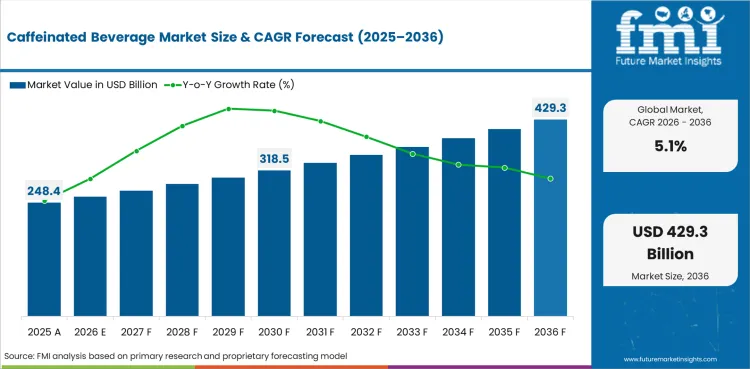
- The caffeinated beverage market was valued at USD 248.4 billion in 2025.
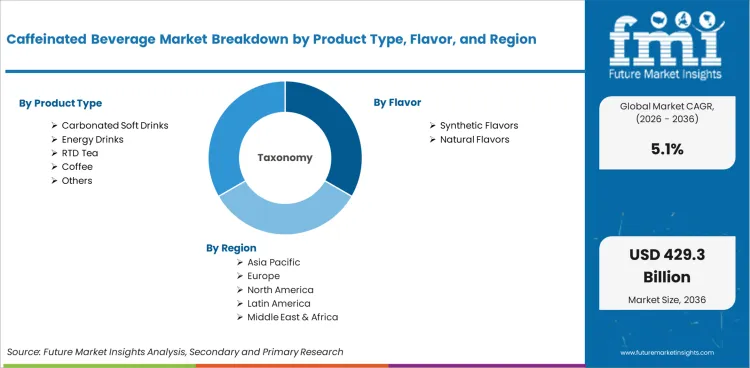
- The market is projected to reach USD 261.1 billion in 2026 and USD 429.3 billion by 2036, growing at a CAGR of 5.1%.
- From 2026 to 2036, the market is expected to expand at a CAGR of 5.1%.
- Carbonated soft drinks dominate the product type segment, accounting for 42.7% of market share in 2026.
- Synthetic flavors lead the flavor segment with a 69.3% share.
- Grocery stores serve as the dominant sales channel, capturing 38.0% of market distribution.
- The market is projected to create strong growth driven by energy drink expansion, clean-label reformulation, and rising demand for RTD coffee and functional tea.
- India (17.01%) and Germany (15.65%) are among the fastest-growing markets globally.
Caffeinated Beverage Market Definition
The caffeinated beverage market encompasses commercially produced ready-to-drink beverages containing caffeine as a functional ingredient, including carbonated soft drinks, energy drinks, ready-to-drink tea, ready-to-drink coffee, and specialty functional beverages supplied through grocery, convenience, modern trade, specialty, and online retail channels.
Caffeinated Beverage Market Inclusions
Market scope includes all commercially traded caffeinated beverage products segmented by product type (carbonated soft drinks, energy drinks, RTD tea, coffee, others), flavor profile (synthetic flavors, natural flavors), and sales channel (grocery stores, convenience stores, modern trade, specialty stores, online stores, other retail stores). Revenue sizing spans the 2026 to 2036 forecast period.
Caffeinated Beverage Market Exclusions
The scope excludes fresh-brewed hot coffee and tea beverages sold through foodservice, caffeine supplements and capsules classified under dietary supplements, and caffeinated confectionery products such as caffeine mints and energy gummies covered in separate ingredient categories.
Caffeinated Beverage Market Research Methodology
- Primary Research: FMI analysts conducted interviews with beverage manufacturer procurement and marketing leaders, category buyers at major retailers, distribution partners across convenience channels, and functional ingredient formulators across North America, Europe, and Asia-Pacific.
- Desk Research: Data collection aggregated beverage association trade statistics, retail scan data publications, company annual reports, and FDA and EFSA caffeine regulatory filings to establish verifiable baseline parameters.
- Market Sizing and Forecasting: Baseline values derive from a bottom-up aggregation of caffeinated beverage transaction volumes, applying region-specific energy drink and RTD coffee category growth rates to project demand through 2036.
- Data validation and update cycle: Projections are tested against beverage manufacturer financial disclosures, retail category scan reports, and regulatory caffeine content filings on a quarterly refresh schedule.
Why is the Caffeinated Beverage Market Growing?
- Sustained energy drink category expansion among younger consumers drives structural volume growth.
- Natural caffeine and clean-label reformulation pulls premium SKUs into scaled distribution at pricing premiums.
- RTD coffee and functional tea category proliferation commands 20 to 35 percent margin advantages.
The caffeinated beverage market is expanding steadily, shaped by energy drink category growth, clean-label reformulation, and RTD coffee and functional tea proliferation. Energy drinks driven by Red Bull, Monster Energy, and Rockstar have sustained double-digit growth across the North American and Asia-Pacific convenience channels for over a decade, supported by expanding consumer segments and occasion-based consumption patterns.
Clean-label reformulation is adding a specification layer that favours scaled brands. Natural caffeine from green coffee bean, green tea, and guarana sources is replacing synthetic caffeine in premium SKUs, with retailer clean-label standards at Target, Whole Foods, Tesco, and Sainsbury's driving reformulation investment. These reformulated SKUs command 15 to 30 percent pricing premiums and support higher-margin category positioning.
RTD coffee and functional tea represent both a growth catalyst and a margin expansion lever. Starbucks, Monster Java, Dunkin, and emerging functional tea brands are capturing share from traditional carbonated soft drinks with 20 to 35 percent higher margins, supporting manufacturer investment in premium SKU launches, cold-chain distribution, and category adjacency extension across breakfast and afternoon consumption occasions.
Segmental Analysis
- Carbonated soft drinks will make up 42.7 percent of the product type segment in 2026, thanks to Coca-Cola and PepsiCo's strong presence in global retail and convenience distribution.
- Synthetic flavors make up 69.3% of the flavor segment, and grocery stores make up 38.0% of the sales channel. This shows how traditional beverage manufacturing and large-scale retail distribution are still in charge.
- Energy drinks, ready-to-drink tea, and ready-to-drink coffee are smaller parts of the market, but they grow faster and make more money than regular carbonated soft drinks.
There are different types of caffeinated drinks, flavors, sales channels, and geographic regions in the market. The segment shares for 2026 show the most common use cases, format preferences, and channel structures that define the category in both mature and new markets.
Insights into the Carbonated Soft Drinks Segment
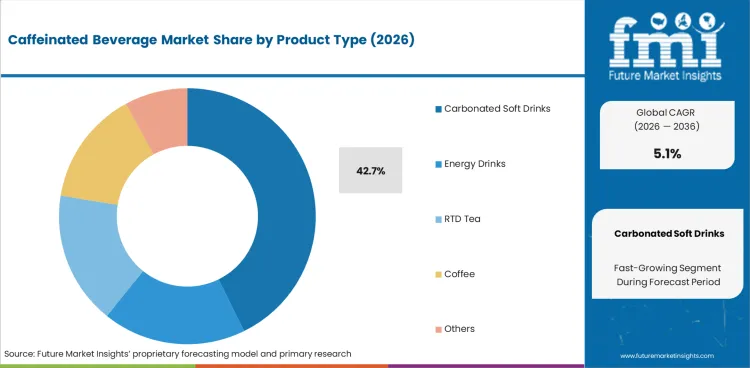
Carbonated Soft Drinks is projected to lead the product type segment with a 42.7% share in 2026. This leadership reflects established manufacturing and supply infrastructure, competitive unit economics, and functional superiority in meeting core customer requirements across the dominant application channels.
Within this category, adjacent sub-segments are gaining share as customers respond to reformulation, regulatory, and consumer preference shifts. Converters and suppliers with format breadth and regional capacity are best positioned to capture this subsegment rotation.
Insights into the Synthetic Flavors Segment
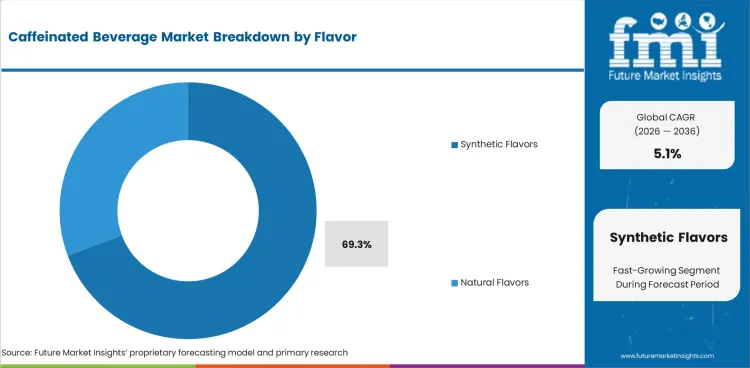
Synthetic Flavors is projected to lead the flavor segment with a 69.3% share in 2026. This leadership reflects established manufacturing and supply infrastructure, competitive unit economics, and functional superiority in meeting core customer requirements across the dominant application channels.
Insights into the Grocery Stores Segment
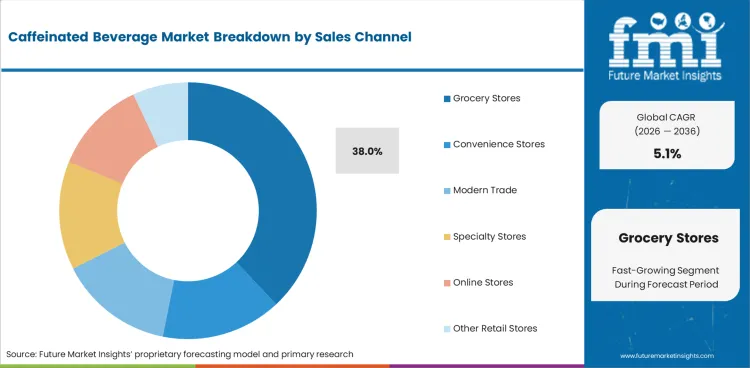
Grocery Stores is projected to lead the sales channel segment with a 38.0% share in 2026. This leadership reflects established manufacturing and supply infrastructure, competitive unit economics, and functional superiority in meeting core customer requirements across the dominant application channels.
Caffeinated Beverage Market Drivers, Restraints, and Opportunities
- Energy drink category expansion among younger consumers drives structural volume growth at scale.
- Clean-label and natural caffeine reformulation commands 15 to 30 percent pricing premiums.
- RTD coffee and functional tea proliferation captures margin advantages over commodity soft drinks.
The caffeinated beverage market is shaped by three concurrent dynamics: category expansion pulling baseline demand, regulatory and reformulation pressure reshaping specification, and advanced method or format innovation expanding premium pricing bands. Manufacturers and suppliers are responding by investing in reformulation, capacity expansion, and retailer or regulatory certification partnerships.
Energy Drink Category Expansion
Demand is shaped by energy drink category expansion across younger demographic segments in North American, European, and Asia-Pacific convenience channels. Red Bull, Monster Energy, and Rockstar dominate scaled volume, while performance-positioned brands including 5-hour ENERGY capture premium-pricing occasion-based consumption. Sports and gaming-positioned SKU launches drive incremental category entry among younger consumers.
Clean-Label Reformulation
Growth reflects clean-label reformulation pulling natural caffeine sources including green coffee bean, green tea, guarana, and yerba mate into premium SKU formulations. Retailer clean-label standards at Target, Whole Foods, Tesco, and Sainsbury's drive reformulation investment, with reformulated SKUs commanding 15 to 30 percent pricing premiums over synthetic-caffeine baselines.
RTD Coffee and Functional Tea Proliferation
Adoption is expanding through RTD coffee and functional tea proliferation capturing share from traditional carbonated soft drinks. Starbucks RTD, Monster Java, Dunkin cold brew, and emerging kombucha and functional tea brands deliver 20 to 35 percent higher margins than commodity soft drinks, supporting manufacturer investment in cold-chain distribution and premium SKU development.
Sugar-Reduction and Zero-Sugar Reformulation
Substantial opportunity exists in sugar-reduction and zero-sugar reformulation responding to global sugar-tax implementation and consumer metabolic health concerns. Zero-sugar and low-sugar energy drinks, stevia-sweetened RTD tea, and sugar-reduced soft drinks are capturing incremental category share while supporting manufacturer revenue stability across regulatory-driven reformulation cycles.
Analysis of Caffeinated Beverage Market By Key Countries
.webp "Top Country Growth Comparison Caffeinated Beverage Market Cagr (2026 2036)")
| Country | CAGR |
|---|---|
| India | 17.01% |
| Germany | 15.65% |
| Brazil | 14.29% |
| United States | 12.93% |
| United Kingdom | 11.56% |
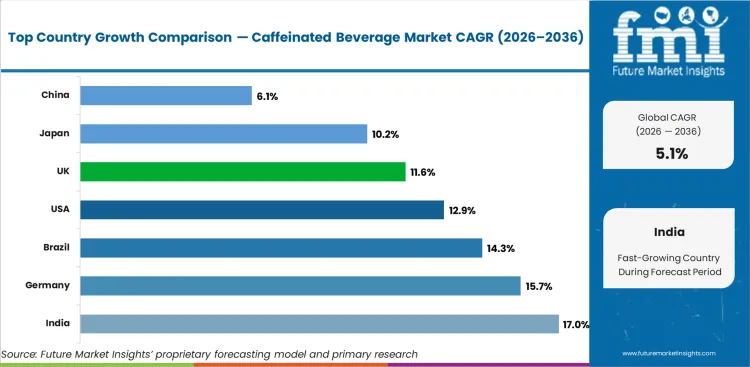
- North America and Western Europe have the most absolute category volumes because of their large convenience store networks. Asia-Pacific has the fastest growth because of the rise of consumers in emerging markets.
- India is in the lead with a CAGR of 17.01 percent. This is due to rising consumption among the urban middle class, the growth of convenience stores, and the entry of energy drinks into younger consumer groups.
- In Germany and Europe, growth continues thanks to premiumization, clean-label reformulation, and more people drinking ready-to-drink coffee.
- China at 6.10 percent shows that the market is mature and that the dynamics of tea culture replacing coffee culture are holding back the growth rates of caffeinated soft drinks.
The caffeinated beverage market is projected to grow globally at a CAGR of 5.1% from 2026 to 2036. Among the top markets, India leads at 17.01%, followed by Germany at 15.65%, while Brazil posts 14.29%, United States records 12.93%, and United Kingdom stands at 11.56%. The analysis spans over 30 countries, with the leading markets detailed below.
Demand Outlook for Caffeinated Beverage Market in United States
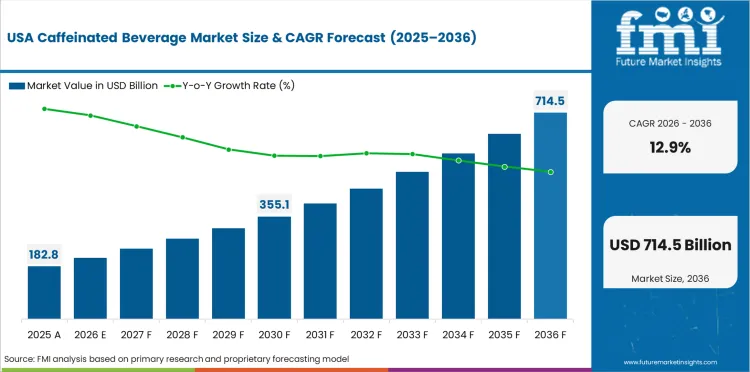
The United States is projected to grow at a 12.93 percent CAGR through 2036, shaped by sustained energy drink category expansion, clean-label reformulation across premium SKU ranges, and rising RTD coffee category proliferation. The Coca-Cola Company, PepsiCo, Red Bull, Monster Energy Company, and 5-hour ENERGY anchor domestic category competition with scaled retail and convenience distribution.
- Sustained energy drink category expansion drives structural volume growth.
- Clean-label reformulation expands premium SKU pricing positioning.
- RTD coffee proliferation captures margin advantages over soft drinks.
Future Outlook for Caffeinated Beverage Market in United Kingdom
The United Kingdom is projected to grow at an 11.56 percent CAGR through 2036, with demand supported by energy drink category depth, soft drink sugar levy-driven reformulation, and rising RTD coffee and functional tea adoption. UK retailers maintain deep clean-label standards across caffeinated beverage SKU ranges at Tesco, Sainsbury's, and Waitrose.
- Soft drink sugar levy drives reformulation investment at scale.
- Retailer clean-label standards consolidate premium SKU positioning.
- RTD coffee and functional tea adoption expands category margins.
Opportunity Analysis for Caffeinated Beverage Market in Germany
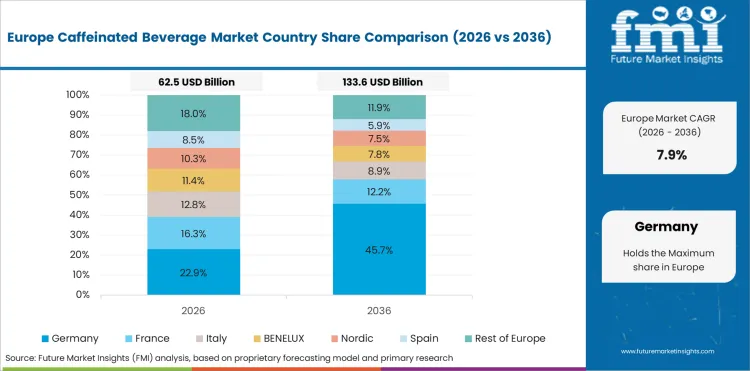
Germany demonstrates steady growth through 2036 as the country's scaled beverage manufacturing industry, strong discount retailer private-label programmes, and premium specialty retail channels support consistent caffeinated beverage demand. German manufacturers and distributors anchor European category competition with both value-tier and premium positioning.
- Discount retailer private-label programmes drive value-tier volume.
- Premium specialty retail anchors clean-label and RTD coffee positioning.
- Scaled beverage manufacturing supports European category competition.
In-depth Analysis for Caffeinated Beverage Market in Japan
Japan is projected to grow at a 10.20 percent CAGR through 2036, reflecting mature convenience store category depth, Taisho Pharmaceutical energy drink heritage under the Lipovitan brand, and rising RTD coffee dominance across Seven-Eleven, FamilyMart, and Lawson stores. Japanese distributors favour high-specification caffeinated beverages with functional positioning.
- Convenience store category depth drives scaled distribution volume.
- Taisho Pharmaceutical energy drink heritage anchors premium positioning.
- RTD coffee dominance captures structural category margin leadership.
Sales Analysis for Caffeinated Beverage Market in China
China at 6.10 percent CAGR reflects the market's scale maturity and tea-culture substitution dynamics constraining incremental caffeinated soft drink growth rates. Chinese domestic brands and international entrants compete across energy drinks, RTD tea, and bottled coffee categories with Red Bull China, Eastroc Super Drink, and Nongfu Spring leading category positioning.
- Scale maturity and tea-culture substitution constrain growth rates.
- Eastroc Super Drink and Red Bull China dominate energy drink category.
- Bottled coffee and RTD tea proliferation captures premium positioning.
In-depth Analysis for Caffeinated Beverage Market in India
India demonstrates strong growth through 2036, supported by rising urban middle-class consumption, convenience retail expansion, and energy drink category entry across younger consumer segments. Domestic brands and international entrants compete across energy drinks, RTD coffee, and functional beverage segments with Red Bull, PepsiCo, and emerging local brand category activity.
- Urban middle-class consumption expansion drives category entry.
- Convenience retail expansion scales distribution infrastructure.
- Energy drink category entry among younger consumers accelerates growth.
Competitive Landscape and Strategic Positioning
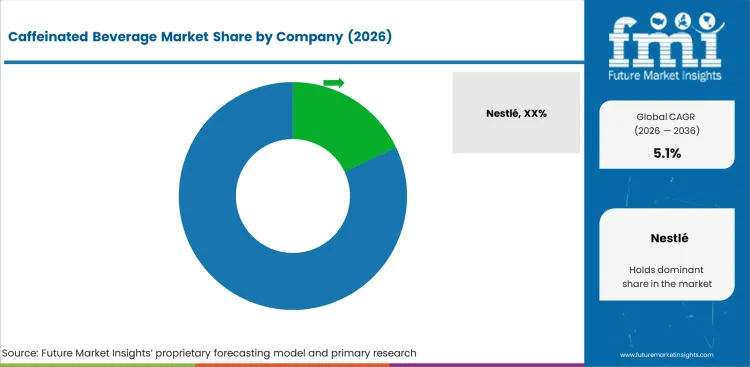
- The top converters collectively hold material share, with competitive differentiation shifting from unit cost to reformulation capability, certification depth, and customer-relationship tenure.
- Regional specialists are gaining share where local regulatory mandates and customer preference favour certified or specialised product and service offerings.
- Start-ups and SMEs are carving niche positions in climate, clean-label, and digital-channel categories targeting premium customer segments.
The caffeinated beverage market is shaped by scaled global beverage manufacturers, specialist energy drink brands, and emerging functional beverage entrants. The Coca-Cola Company and PepsiCo lead the scaled global carbonated soft drink category with integrated bottling networks, distribution partnerships, and broad portfolio coverage across caffeinated SKU ranges.
Red Bull and Monster Energy Company anchor the global energy drink category with dominant convenience channel positioning, motorsports and gaming sponsorship reach, and specialized energy drink brand equity. Rockstar Inc. operates in the scaled energy drink segment with PepsiCo-aligned distribution and retail category partnership.
Dr Pepper Snapple Group, AriZona Beverages USA, and 5-hour ENERGY represent the mid-tier and niche-positioned specialist beverage segment. Nestlé operates across RTD coffee and tea categories with scaled global manufacturing and distribution, while Taisho Pharmaceutical Holdings anchors Japanese energy drink category leadership under the Lipovitan brand.
Barriers to entry include bottling and distribution network access, retailer category management relationships, brand equity investment across long category-development cycles, regulatory caffeine content compliance under FDA, EFSA, and equivalent frameworks, and the multi-year category entry qualification cycles typical of scaled retail chains. Strategic priorities across leading brands include clean-label reformulation, RTD coffee and functional tea expansion, zero-sugar SKU development, and emerging-market distribution partnership investment.
Major Industry Players
Key global companies leading the caffeinated beverage market include:
- The Coca-Cola Company (USA), PepsiCo (USA), Red Bull (Austria), and Monster Energy Company (USA) were identified as leading players in the caffeinated beverage market, given their scaled global distribution, dominant retail category positioning, and established brand equity across caffeinated SKU ranges.
- Nestlé (Switzerland), Dr Pepper Snapple Group (USA), Taisho Pharmaceutical Holdings Co. Ltd. (Japan), and Rockstar Inc. (USA) operate as scaled global and regional beverage manufacturer players with broad portfolio coverage across RTD coffee, energy drinks, and functional beverage categories.
- AriZona Beverages USA (USA) and 5-hour ENERGY (Living Essentials LLC) (USA) have established strong positions in specialized category segments including RTD tea and occasion-based energy shots with focused brand positioning and retail distribution.
Competitive Benchmarking: Caffeinated Beverage Market
| Company | Category Breadth | Distribution Reach | Clean-Label Positioning | Geographic Footprint |
|---|---|---|---|---|
| The Coca-Cola Company | High | High | Medium | Global |
| PepsiCo | High | High | Medium | Global |
| Red Bull | Medium | High | Medium | Global |
| Monster Energy Company | Medium | High | Low | Global |
| Nestlé | High | High | High | Global |
| Dr Pepper Snapple Group | Medium | High | Low | North America |
| Rockstar, Inc. | Low | High | Low | North America |
| Taisho Pharmaceutical Holdings Co., Ltd. | Low | Medium | Medium | Asia-Pacific |
| AriZona Beverages USA | Medium | Medium | Low | North America |
| 5-hour ENERGY (Living Essentials LLC) | Low | Medium | Low | North America |
Source: Future Market Insights competitive analysis, 2026..
Key Developments in Caffeinated Beverage Market
- The global caffeinated beverage market is valued at about USD 248.4 billion in 2025 and is projected to reach roughly USD 375 billion by 2035, growing at a CAGR of 5.1% over that decade.
- Health oriented reforms are shaping the market, with increasing demand for reduced sugar, natural caffeine, and functional formats (e.g., nootropics, wellness positioned products) across North America, Europe, and fast growing markets like India.
Key Players in the Caffeinated Beverage Market
Major Global Players
- Nestlé
- PepsiCo
- Red Bull
- Monster Energy Company
- Rockstar, Inc.
- Dr Pepper Snapple Group
- Taisho Pharmaceutical Holdings Co., Ltd.
Emerging Players/Startups
- The Coca-Cola Company
- AriZona Beverages USA
- 5-hour ENERGY (Living Essentials LLC)
Scope of the report
| Metric | Value |
|---|---|
| Quantitative Units | USD 261.07 billion to USD 429.32 billion, at a CAGR of 5.1% |
| Market Definition | The caffeinated beverage market encompasses commercially produced ready-to-drink beverages containing caffeine as a functional ingredient, including carbonated soft drinks, energy drinks, ready-to-drink tea, ready-to-drink coffee, and specialty functional beverages supplied through grocery, convenience, modern trade, specialty, and online retail channels. |
| Regions Covered | North America, Latin America, Europe, East Asia, South Asia and Pacific, Middle East and Africa |
| Countries Covered | India, China, USA, UK, Germany, Japan, South Korea, Brazil, 30 plus countries |
| Key Companies Profiled | Nestlé, PepsiCo, Red Bull, Monster Energy Company, Rockstar, Inc., Dr Pepper Snapple Group, Taisho Pharmaceutical Holdings Co., Ltd., The Coca-Cola Company, AriZona Beverages USA, 5-hour ENERGY (Living Essentials LLC) |
| Forecast Period | 2026 to 2036 |
| Approach | Hybrid bottom-up and top-down methodology starting with verified caffeinated beverage market transaction data, projecting adoption velocity across segments and regions. |
Market Segmentation Analysis
Caffeinated Beverage Market Market Segmented by Product Type:
- Carbonated Soft Drinks
- Energy Drinks
- RTD Tea
- Coffee
- Others
Caffeinated Beverage Market Market Segmented by Flavor:
- Synthetic Flavors
- Natural Flavors
Caffeinated Beverage Market Market Segmented by Sales Channel:
- Grocery Stores
- Convenience Stores
- Modern Trade
- Specialty Stores
- Online Stores
- Other Retail Stores
Caffeinated Beverage Market Market by Region:
- North America
- USA
- Canada
- Mexico
- Latin America
- Brazil
- Chile
- Rest of Latin America
- Western Europe
- Germany
- UK
- Italy
- Spain
- France
- Nordic
- BENELUX
- Rest of Western Europe
- Eastern Europe
- Russia
- Poland
- Hungary
- Balkan & Baltic
- Rest of Eastern Europe
- East Asia
- China
- Japan
- South Korea
- South Asia and Pacific
- India
- ASEAN
- Australia & New Zealand
- Rest of South Asia and Pacific
- Middle East & Africa
- Kingdom of Saudi Arabia
- Other GCC Countries
- Turkiye
- South Africa
- Other African Union
- Rest of Middle East & Africa
Bibliography
- 1. USA Food and Drug Administration. (2024). Caffeine in Food and Dietary Supplements Regulation. FDA.
- 2. European Food Safety Authority. (2024). Scientific Opinion on the Safety of Caffeine. EFSA.
- 3. National Restaurant Association. (2025). State of the Restaurant Industry Beverage Report. NRA.
- 4. Codex Alimentarius Commission. (2024). General Standard for Food Additives. FAO/WHO.
- 5. World Health Organization. (2024). Guidelines on Sugar and Caffeine Consumption. WHO.
This bibliography is provided for reader reference.
This Report Addresses
- Market sizing and revenue forecasting for caffeinated beverage market from 2026 to 2036.
- Segmentation analysis across the primary axes and regional geographies.
- Regional and country-level insights covering over 30 markets with comparative growth analysis.
- Regulatory and compliance analysis covering key multilateral, national, and industry frameworks.
- Competitive landscape assessment covering market structure, vendor positioning, and recent developments.
- Investment opportunity mapping across growth verticals and geographic regions.
- Supply chain tracking from input sourcing to finished product distribution.
- Data delivery in PDF and Excel formats with quarterly refresh access.
Frequently Asked Questions
How large is the demand for Caffeinated Beverage Market in the global market in 2026?
Demand for caffeinated beverage market in the global market is estimated to be valued at USD 261.07 billion in 2026.
What will be the market size of Caffeinated Beverage Market by 2036?
Market size for caffeinated beverage market is projected to reach USD 429.32 billion by 2036.
What is the expected demand growth for Caffeinated Beverage Market between 2026 and 2036?
Demand for caffeinated beverage market is expected to grow at a CAGR of 5.1% between 2026 and 2036.
Which Product Type is poised to lead global sales by 2026?
Carbonated Soft Drinks accounts for 42.7% in 2026, reflecting established manufacturing infrastructure and functional performance advantages.
How is the Grocery Stores segment driving Caffeinated Beverage Market adoption?
Grocery Stores represents 38.0% of the sales channel demand as leading operators drive procurement volumes.
What does Caffeinated Beverage Market definition mean in this report?
The caffeinated beverage market encompasses commercially produced ready-to-drink beverages containing caffeine as a functional ingredient, including carbonated soft drinks, energy drinks, ready-to-drink tea, ready-to-drink coffee, and specialty functional beverages supplied through grocery, convenience, modern trade, specialty, and online retail channels.
How does FMI build and validate the Caffeinated Beverage Market forecast?
Forecasting models apply a hybrid bottom-up methodology starting with verified transaction data, cross-validated against industry sales statistics and manufacturer financial disclosures.
Preview the report firsthand - request a free sample
Get SampleGet the brochure for pricing and purchase details.
Get PDFTable of Content
- Demand-side Trends
- Supply-side Trends
- Technology Roadmap Analysis
- Analysis and Recommendations
- Market Overview
- Market Coverage / Taxonomy
- Market Definition / Scope / Limitations
- Research Methodology
- Chapter Orientation
- Analytical Lens and Working Hypotheses
- Market Structure, Signals, and Trend Drivers
- Benchmarking and Cross-market Comparability
- Market Sizing, Forecasting, and Opportunity Mapping
- Research Design and Evidence Framework
- Desk Research Programme (Secondary Evidence)
- Company Annual and Sustainability Reports
- Peer-reviewed Journals and Academic Literature
- Corporate Websites, Product Literature, and Technical Notes
- Earnings Decks and Investor Briefings
- Statutory Filings and Regulatory Disclosures
- Technical White Papers and Standards Notes
- Trade Journals, Industry Magazines, and Analyst Briefs
- Conference Proceedings, Webinars, and Seminar Materials
- Government Statistics Portals and Public Data Releases
- Sector Databases and Reference Repositories
- FMI Internal Proprietary Databases and Historical Market Datasets
- Subscription Datasets and Paid Sources
- Social Channels, Communities, and Digital Listening Inputs
- Additional Desk Sources
- Expert Input and Fieldwork (Primary Evidence)
- Primary Modes
- Qualitative Interviews and Expert Elicitation
- Quantitative Surveys and Structured Data Capture
- Blended Approach
- Why Primary Evidence is Used
- Field Techniques
- Interviews
- Surveys
- Focus Groups
- Observational and In-context Research
- Social and Community Interactions
- Stakeholder Universe Engaged
- C-suite Leaders
- Board Members
- Presidents and Vice Presidents
- R&D and Innovation Heads
- Technical Specialists
- Domain Subject-matter Experts
- Scientists
- Physicians and Other Healthcare Professionals
- Governance, Ethics, and Data Stewardship
- Research Ethics
- Data Integrity and Handling
- Primary Modes
- Tooling, Models, and Reference Databases
- Desk Research Programme (Secondary Evidence)
- Data Engineering and Model Build
- Data Acquisition and Ingestion
- Cleaning, Normalisation, and Verification
- Synthesis, Triangulation, and Analysis
- Quality Assurance and Audit Trail
- Market Background
- Market Dynamics
- Drivers
- Restraints
- Opportunity
- Trends
- Scenario Forecast
- Demand in Optimistic Scenario
- Demand in Likely Scenario
- Demand in Conservative Scenario
- Opportunity Map Analysis
- Product Life Cycle Analysis
- Supply Chain Analysis
- Investment Feasibility Matrix
- Value Chain Analysis
- PESTLE and Porter’s Analysis
- Regulatory Landscape
- Regional Parent Market Outlook
- Production and Consumption Statistics
- Import and Export Statistics
- Market Dynamics
- Global Market Analysis 2021 to 2025 and Forecast, 2026 to 2036
- Historical Market Size Value (USD Million) Analysis, 2021 to 2025
- Current and Future Market Size Value (USD Million) Projections, 2026 to 2036
- Y-o-Y Growth Trend Analysis
- Absolute $ Opportunity Analysis
- Global Market Pricing Analysis 2021 to 2025 and Forecast 2026 to 2036
- Global Market Analysis 2021 to 2025 and Forecast 2026 to 2036, By Product Type
- Introduction / Key Findings
- Historical Market Size Value (USD Million) Analysis By Product Type , 2021 to 2025
- Current and Future Market Size Value (USD Million) Analysis and Forecast By Product Type , 2026 to 2036
- Carbonated Soft Drinks
- Energy Drinks
- RTD Tea
- Coffee
- Others
- Carbonated Soft Drinks
- Y-o-Y Growth Trend Analysis By Product Type , 2021 to 2025
- Absolute $ Opportunity Analysis By Product Type , 2026 to 2036
- Global Market Analysis 2021 to 2025 and Forecast 2026 to 2036, By Flavor
- Introduction / Key Findings
- Historical Market Size Value (USD Million) Analysis By Flavor, 2021 to 2025
- Current and Future Market Size Value (USD Million) Analysis and Forecast By Flavor, 2026 to 2036
- Synthetic Flavors
- Natural Flavors
- Synthetic Flavors
- Y-o-Y Growth Trend Analysis By Flavor, 2021 to 2025
- Absolute $ Opportunity Analysis By Flavor, 2026 to 2036
- Global Market Analysis 2021 to 2025 and Forecast 2026 to 2036, By Sales Channel
- Introduction / Key Findings
- Historical Market Size Value (USD Million) Analysis By Sales Channel, 2021 to 2025
- Current and Future Market Size Value (USD Million) Analysis and Forecast By Sales Channel, 2026 to 2036
- Grocery Stores
- Convenience Stores
- Modern Trade
- Specialty Stores
- Online Stores
- Other Retail Stores
- Grocery Stores
- Y-o-Y Growth Trend Analysis By Sales Channel, 2021 to 2025
- Absolute $ Opportunity Analysis By Sales Channel, 2026 to 2036
- Global Market Analysis 2021 to 2025 and Forecast 2026 to 2036, By Region
- Introduction
- Historical Market Size Value (USD Million) Analysis By Region, 2021 to 2025
- Current Market Size Value (USD Million) Analysis and Forecast By Region, 2026 to 2036
- North America
- Latin America
- Western Europe
- Eastern Europe
- East Asia
- South Asia and Pacific
- Middle East & Africa
- Market Attractiveness Analysis By Region
- North America Market Analysis 2021 to 2025 and Forecast 2026 to 2036, By Country
- Historical Market Size Value (USD Million) Trend Analysis By Market Taxonomy, 2021 to 2025
- Market Size Value (USD Million) Forecast By Market Taxonomy, 2026 to 2036
- By Country
- USA
- Canada
- Mexico
- By Product Type
- By Flavor
- By Sales Channel
- By Country
- Market Attractiveness Analysis
- By Country
- By Product Type
- By Flavor
- By Sales Channel
- Key Takeaways
- Latin America Market Analysis 2021 to 2025 and Forecast 2026 to 2036, By Country
- Historical Market Size Value (USD Million) Trend Analysis By Market Taxonomy, 2021 to 2025
- Market Size Value (USD Million) Forecast By Market Taxonomy, 2026 to 2036
- By Country
- Brazil
- Chile
- Rest of Latin America
- By Product Type
- By Flavor
- By Sales Channel
- By Country
- Market Attractiveness Analysis
- By Country
- By Product Type
- By Flavor
- By Sales Channel
- Key Takeaways
- Western Europe Market Analysis 2021 to 2025 and Forecast 2026 to 2036, By Country
- Historical Market Size Value (USD Million) Trend Analysis By Market Taxonomy, 2021 to 2025
- Market Size Value (USD Million) Forecast By Market Taxonomy, 2026 to 2036
- By Country
- Germany
- UK
- Italy
- Spain
- France
- Nordic
- BENELUX
- Rest of Western Europe
- By Product Type
- By Flavor
- By Sales Channel
- By Country
- Market Attractiveness Analysis
- By Country
- By Product Type
- By Flavor
- By Sales Channel
- Key Takeaways
- Eastern Europe Market Analysis 2021 to 2025 and Forecast 2026 to 2036, By Country
- Historical Market Size Value (USD Million) Trend Analysis By Market Taxonomy, 2021 to 2025
- Market Size Value (USD Million) Forecast By Market Taxonomy, 2026 to 2036
- By Country
- Russia
- Poland
- Hungary
- Balkan & Baltic
- Rest of Eastern Europe
- By Product Type
- By Flavor
- By Sales Channel
- By Country
- Market Attractiveness Analysis
- By Country
- By Product Type
- By Flavor
- By Sales Channel
- Key Takeaways
- East Asia Market Analysis 2021 to 2025 and Forecast 2026 to 2036, By Country
- Historical Market Size Value (USD Million) Trend Analysis By Market Taxonomy, 2021 to 2025
- Market Size Value (USD Million) Forecast By Market Taxonomy, 2026 to 2036
- By Country
- China
- Japan
- South Korea
- By Product Type
- By Flavor
- By Sales Channel
- By Country
- Market Attractiveness Analysis
- By Country
- By Product Type
- By Flavor
- By Sales Channel
- Key Takeaways
- South Asia and Pacific Market Analysis 2021 to 2025 and Forecast 2026 to 2036, By Country
- Historical Market Size Value (USD Million) Trend Analysis By Market Taxonomy, 2021 to 2025
- Market Size Value (USD Million) Forecast By Market Taxonomy, 2026 to 2036
- By Country
- India
- ASEAN
- Australia & New Zealand
- Rest of South Asia and Pacific
- By Product Type
- By Flavor
- By Sales Channel
- By Country
- Market Attractiveness Analysis
- By Country
- By Product Type
- By Flavor
- By Sales Channel
- Key Takeaways
- Middle East & Africa Market Analysis 2021 to 2025 and Forecast 2026 to 2036, By Country
- Historical Market Size Value (USD Million) Trend Analysis By Market Taxonomy, 2021 to 2025
- Market Size Value (USD Million) Forecast By Market Taxonomy, 2026 to 2036
- By Country
- Kingdom of Saudi Arabia
- Other GCC Countries
- Turkiye
- South Africa
- Other African Union
- Rest of Middle East & Africa
- By Product Type
- By Flavor
- By Sales Channel
- By Country
- Market Attractiveness Analysis
- By Country
- By Product Type
- By Flavor
- By Sales Channel
- Key Takeaways
- Key Countries Market Analysis
- USA
- Pricing Analysis
- Market Share Analysis, 2025
- By Product Type
- By Flavor
- By Sales Channel
- Canada
- Pricing Analysis
- Market Share Analysis, 2025
- By Product Type
- By Flavor
- By Sales Channel
- Mexico
- Pricing Analysis
- Market Share Analysis, 2025
- By Product Type
- By Flavor
- By Sales Channel
- Brazil
- Pricing Analysis
- Market Share Analysis, 2025
- By Product Type
- By Flavor
- By Sales Channel
- Chile
- Pricing Analysis
- Market Share Analysis, 2025
- By Product Type
- By Flavor
- By Sales Channel
- Germany
- Pricing Analysis
- Market Share Analysis, 2025
- By Product Type
- By Flavor
- By Sales Channel
- UK
- Pricing Analysis
- Market Share Analysis, 2025
- By Product Type
- By Flavor
- By Sales Channel
- Italy
- Pricing Analysis
- Market Share Analysis, 2025
- By Product Type
- By Flavor
- By Sales Channel
- Spain
- Pricing Analysis
- Market Share Analysis, 2025
- By Product Type
- By Flavor
- By Sales Channel
- France
- Pricing Analysis
- Market Share Analysis, 2025
- By Product Type
- By Flavor
- By Sales Channel
- India
- Pricing Analysis
- Market Share Analysis, 2025
- By Product Type
- By Flavor
- By Sales Channel
- ASEAN
- Pricing Analysis
- Market Share Analysis, 2025
- By Product Type
- By Flavor
- By Sales Channel
- Australia & New Zealand
- Pricing Analysis
- Market Share Analysis, 2025
- By Product Type
- By Flavor
- By Sales Channel
- China
- Pricing Analysis
- Market Share Analysis, 2025
- By Product Type
- By Flavor
- By Sales Channel
- Japan
- Pricing Analysis
- Market Share Analysis, 2025
- By Product Type
- By Flavor
- By Sales Channel
- South Korea
- Pricing Analysis
- Market Share Analysis, 2025
- By Product Type
- By Flavor
- By Sales Channel
- Russia
- Pricing Analysis
- Market Share Analysis, 2025
- By Product Type
- By Flavor
- By Sales Channel
- Poland
- Pricing Analysis
- Market Share Analysis, 2025
- By Product Type
- By Flavor
- By Sales Channel
- Hungary
- Pricing Analysis
- Market Share Analysis, 2025
- By Product Type
- By Flavor
- By Sales Channel
- Kingdom of Saudi Arabia
- Pricing Analysis
- Market Share Analysis, 2025
- By Product Type
- By Flavor
- By Sales Channel
- Turkiye
- Pricing Analysis
- Market Share Analysis, 2025
- By Product Type
- By Flavor
- By Sales Channel
- South Africa
- Pricing Analysis
- Market Share Analysis, 2025
- By Product Type
- By Flavor
- By Sales Channel
- USA
- Market Structure Analysis
- Competition Dashboard
- Competition Benchmarking
- Market Share Analysis of Top Players
- By Regional
- By Product Type
- By Flavor
- By Sales Channel
- Competition Analysis
- Competition Deep Dive
- Nestlé
- Overview
- Product Portfolio
- Profitability by Market Segments (Product/Age /Sales Channel/Region)
- Sales Footprint
- Strategy Overview
- Marketing Strategy
- Product Strategy
- Channel Strategy
- PepsiCo
- Red Bull
- Monster Energy Company
- Rockstar, Inc.
- Dr Pepper Snapple Group
- Taisho Pharmaceutical Holdings Co., Ltd.
- The Coca-Cola Company
- AriZona Beverages USA
- 5-hour ENERGY (Living Essentials LLC)
- Nestlé
- Competition Deep Dive
- Assumptions & Acronyms Used


