

- Industry Size (2026)
- USD 0.31 Bn
- Forecast (2036)
- USD 0.47 Bn
- CAGR (2026 to 2036)
- 4.2%
Chill Block Market Size, Forecast and Outlook By FMI
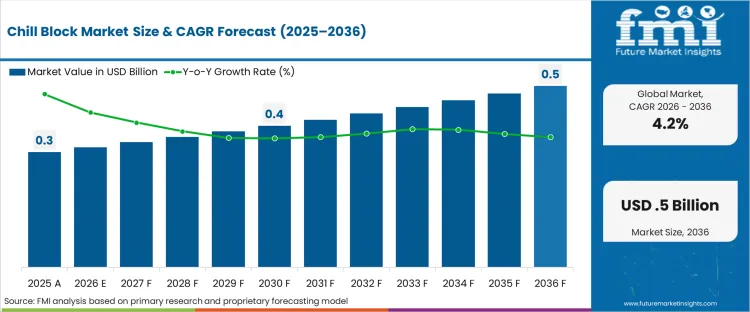
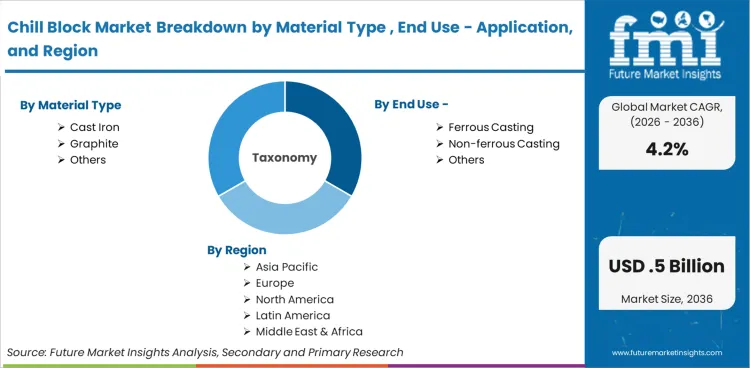
The chill block market is estimated at USD 0.30 billion in 2025, reaches USD 0.31 billion in 2026, and is projected to grow to USD 0.47 billion by 2036 at a CAGR of 4.2%. Cast iron chill blocks continue to hold the largest share in 2026 because of familiarity, cost efficiency, and broad foundry compatibility. Ferrous casting remains the leading application, though non-ferrous and die-casting applications are increasingly relevant where directional solidification and defect reduction carry high value. Market demand is supported by foundry quality control, scrap reduction efforts, and the need to shape local solidification behavior in more complex cast geometries.
Summary of Chill Block Market
- Key Drivers
- Chill blocks are used because uncontrolled solidification creates porosity, shrinkage, and weak sections that immediately erode foundry economics.
- As customers ask for tighter dimensional and metallurgical outcomes, foundries need more deliberate control of local cooling rates.
- The third driver is process discipline in die-casting and non-ferrous operations, where surface quality and solidification sequence materially affect downstream machining and reject levels.
- Key Segments Analyzed in the Report
- Material type: cast iron, graphite, copper alloy, silicon carbide and specialty materials
- Application: ferrous casting, non-ferrous casting, high-pressure die casting, foundry tooling, others
- End use: automotive castings, industrial machinery castings, aerospace components, general foundries
- Region: North America, Latin America, Western Europe, Eastern Europe, East Asia, South Asia & Pacific, and Middle East & Africa
- Analyst Opinion
- Nikhil Kaitwade, Principal Consultant at Future Market Insights says, “Chill blocks are a specialist foundry-control market that sits close to the economics of casting yield rather than the glamour end of capital equipment. Their commercial value does not come from visible complexity. It comes from their ability to alter local solidification behavior, reduce shrinkage-related defects, and prevent rework or scrap in castings where downstream quality failures are far more expensive than the cooling insert itself. Suppliers that combine materials knowledge with defect-solving support usually capture more durable value than vendors competing on metal stock alone.”
Chill Block Market Definition
The chill block market includes metallic or high-conductivity inserts and blocks used in casting and mold systems to accelerate localized heat extraction, promote directional solidification, and improve metallurgical integrity. It covers foundry chills, die-casting chill inserts, chill vents, and related localized cooling components selected according to thermal behavior, casting geometry, and alloy requirements. These products serve ferrous and non-ferrous foundries, die casters, and casting operations where shrinkage control, surface soundness, dimensional stability, and yield improvement matter directly to production economics.
Chill Block Market Inclusions
- Revenue from chill blocks, chills, inserts, and chill vents sold into foundry, sand-casting, permanent-mold, and die-casting applications.
- Material-specific cooling solutions supplied to control local solidification, reduce porosity, and improve casting soundness.
- Application-support revenue linked to chill selection, placement, and defect-reduction in casting operations.
Chill Block Market Exclusions
- General mold materials, coatings, and tooling components that do not perform a discrete chill or localized cooling function.
- Full casting machines, molding lines, or foundry systems sold without separable chill-block scope.
- Thermal-management hardware used outside metal casting or foundry operations.
Chill Block Market Research Methodology
This study evaluates the market across key segments and regions for the base year 2025 and the forecast period 2026 to 2036. All market values are presented in USD billion. The analysis is built on a review of regulatory references, company disclosures, product and technology developments, trade literature, and industry documentation relevant to the value chain. Market estimates are derived through triangulation of demand-side trends, supply-side positioning, pricing dynamics, application intensity, and regional adoption patterns to establish current market size and forecast potential.
Key Drivers, Restraints, and Trends in Chill Block Market
Drivers
Demand is supported by the economics of scrap prevention in casting operations. When foundries face porosity, shrinkage, and localized solidification defects, the use of chills increases because they extract heat faster and improve directional solidification. This matters more in ferrous casting environments, which still represent the larger share of the foundry base, and in iron-casting applications where quality losses can quickly outweigh the cost of localized cooling components. Adoption is also reinforced by the broader need to maintain yield and casting soundness without resorting immediately to full tooling redesign.
Restraints
The market remains constrained by customization intensity and low standalone visibility in procurement. Chills are often selected case by case, which limits standardization and keeps the category tied to foundry know-how rather than broad catalog sales. In some programs, defect reduction can also be pursued through gating changes, riser redesign, or alternative tooling modifications, which means chill blocks compete with process engineering, not only with rival materials. The category is therefore commercially important but often hidden inside a wider casting-optimization budget.
Trends
The market is moving away from rule-of-thumb chill usage toward more engineered placement and material selection. Foundry suppliers increasingly position themselves around technical support, process optimization, and defect-solving rather than simple consumables supply. In die-casting and non-ferrous applications, specialized cooling inserts and chill vents are gaining importance where cycle control, venting, and casting surface quality are tightly linked. This shifts competitive advantage toward suppliers that can connect thermal behavior with practical foundry productivity.
Segmental Analysis
Chill Block Market Analysis by Primary Segment
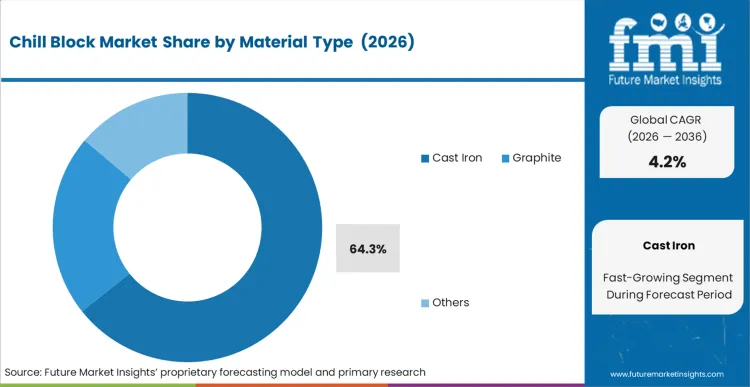
Cast iron is projected to hold the leading share of 64.3% in 2026. This estimate is grounded in the still-dominant role of ferrous castings in foundry activity and the continuing weight of gray-iron-heavy casting ecosystems in adjacent market datasets. Cast iron remains commercially attractive for chill applications because it offers a workable balance of thermal behavior, cost efficiency, machinability, and familiarity across established foundry practice. Higher-conductivity materials such as copper and certain specialty alloys remain relevant in targeted use cases, but cast iron continues to anchor the mainstream installed base.
Chill Block Market Analysis by End Use or Application
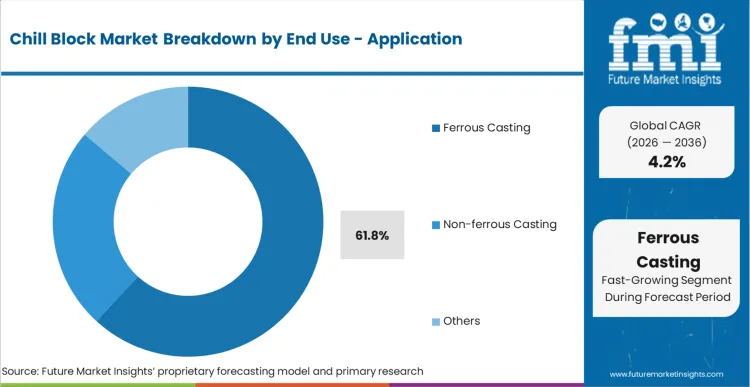
Ferrous casting is expected to account for 61.8% of the chill block market in 2026. The segment leads because ferrous foundries still represent the larger production base in broader foundry markets, and technical literature describes chills as especially common in steel and other quality-sensitive ferrous casting applications. Non-ferrous and die-casting use cases are becoming more important in engineered components, but the largest recurring demand pool still comes from iron and steel foundries where defect control, feeding behavior, and solidification management remain central operating concerns.
Competitive Aligners for Market Players
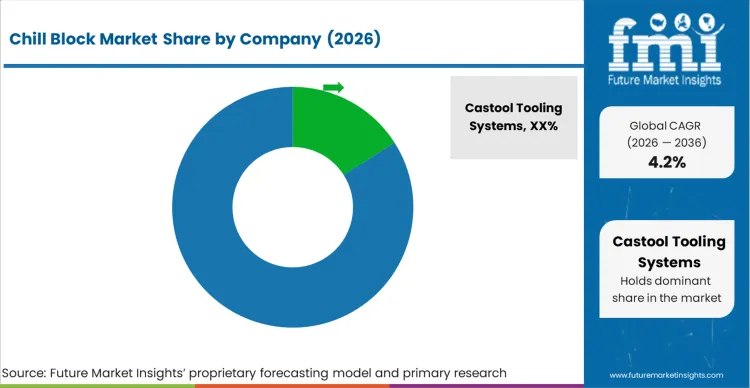
Competition in the chill block market is shaped less by headline brand visibility and more by material behavior, foundry know-how, and the ability to convert a defect pattern into a workable localized cooling solution. Suppliers with stronger application support, metallurgical understanding, and integration into broader foundry workflows usually outperform simple stock-material vendors. The market therefore rewards companies that can pair dependable supply with engineering support on placement, wear profile, thermal response, and casting-yield improvement.
Key Players in Chill Block Market
- Castool Tooling Systems
- ASK Chemicals
- HA Group
- Imerys Foundry Minerals
- RMC Foundry Group
- Sinto Group
- Inductotherm Group
- Foseco
- Hüttenes-Albertus
- Suzhou Mingzhi Technology
Strategic Outlook by FMI on Chill Block Market
The chill block market should remain niche but stable through 2036. Growth will be tied to higher-quality casting demand, foundry modernization, and a greater willingness to use engineered thermal-control measures to reduce scrap and improve consistency.
Scope of the Report
| Metric | Value |
|---|---|
| Market Value | USD 0.30 billion in 2025 to USD 0.47 billion by 2036 |
| CAGR | 4.2% from 2026 to 2036 |
| Base Year | 2025 |
| Forecast Period | 2026 to 2036 |
| Material Type Segmentation | Cast Iron, Graphite, Copper Alloy, Silicon Carbide and Specialty Materials |
| Application Segmentation | Ferrous Casting, Non-ferrous Casting, High-pressure Die Casting, Foundry Tooling, Others |
| End Use Segmentation | Automotive Castings, Industrial Machinery Castings, Aerospace Components, General Foundries |
| Regions Covered | North America, Latin America, Western Europe, Eastern Europe, East Asia, South Asia & Pacific, and Middle East & Africa |
Bibliography
- Castool Tooling Systems. 2021. Chill Block.
- Foundry Gate. Current. Chills.
- The IET Digital Library. 1974. Application of Chills to the Production of Sound Castings.
- ScienceDirect. 2020. An Investigation of Direct-Chill Cast 2024 Aluminum Alloy
Frequently Asked Questions
What is driving growth in the chill block market?
Growth is being driven by foundry efforts to reduce porosity, improve directional solidification, and lower scrap.
Which material segment leads the chill block market?
Cast iron leads because it offers a practical balance of thermal performance and cost across foundry operations.
Why are ferrous castings important in the chill block market?
Ferrous foundries represent a large installed base where local cooling control continues to affect yield and quality.
What restrains the chill block market?
Customization, limited procurement visibility, and competition from broader mold-design changes all restrain growth.
Which regions matter in the chill block market?
All major foundry regions matter, with East Asia especially important because of casting output and die-casting activity.
What is the outlook for the chill block market through 2036?
The outlook is steady, supported by casting-quality requirements and more engineered thermal-control practices.
Preview the report firsthand - request a free sample
Get SampleGet the brochure for pricing and purchase details.
Get PDFTable of Content
- Executive Summary
- Global Market Outlook
- Demand-side Trends
- Supply-side Trends
- Technology Roadmap Analysis
- Analysis and Recommendations
- Market Overview
- Market Coverage / Taxonomy
- Market Definition / Scope / Limitations
- Research Methodology
- Chapter Orientation
- Analytical Lens and Working Hypotheses
- Market Structure, Signals, and Trend Drivers
- Benchmarking and Cross-market Comparability
- Market Sizing, Forecasting, and Opportunity Mapping
- Research Design and Evidence Framework
- Desk Research Programme (Secondary Evidence)
- Company Annual and Sustainability Reports
- Peer-reviewed Journals and Academic Literature
- Corporate Websites, Product Literature, and Technical Notes
- Earnings Decks and Investor Briefings
- Statutory Filings and Regulatory Disclosures
- Technical White Papers and Standards Notes
- Trade Journals, Industry Magazines, and Analyst Briefs
- Conference Proceedings, Webinars, and Seminar Materials
- Government Statistics Portals and Public Data Releases
- Press Releases and Reputable Media Coverage
- Specialist Newsletters and Curated Briefings
- Sector Databases and Reference Repositories
- FMI Internal Proprietary Databases and Historical Market Datasets
- Subscription Datasets and Paid Sources
- Social Channels, Communities, and Digital Listening Inputs
- Additional Desk Sources
- Expert Input and Fieldwork (Primary Evidence)
- Primary Modes
- Qualitative Interviews and Expert Elicitation
- Quantitative Surveys and Structured Data Capture
- Blended Approach
- Why Primary Evidence is Used
- Field Techniques
- Interviews
- Surveys
- Focus Groups
- Observational and In-context Research
- Social and Community Interactions
- Stakeholder Universe Engaged
- C-suite Leaders
- Board Members
- Presidents and Vice Presidents
- R&D and Innovation Heads
- Technical Specialists
- Domain Subject-matter Experts
- Scientists
- Physicians and Other Healthcare Professionals
- Governance, Ethics, and Data Stewardship
- Research Ethics
- Data Integrity and Handling
- Primary Modes
- Tooling, Models, and Reference Databases
- Desk Research Programme (Secondary Evidence)
- Data Engineering and Model Build
- Data Acquisition and Ingestion
- Cleaning, Normalisation, and Verification
- Synthesis, Triangulation, and Analysis
- Quality Assurance and Audit Trail
- Market Background
- Market Dynamics
- Drivers
- Restraints
- Opportunity
- Trends
- Scenario Forecast
- Demand in Optimistic Scenario
- Demand in Likely Scenario
- Demand in Conservative Scenario
- Opportunity Map Analysis
- Product Life Cycle Analysis
- Supply Chain Analysis
- Investment Feasibility Matrix
- Value Chain Analysis
- PESTLE and Porter’s Analysis
- Regulatory Landscape
- Regional Parent Market Outlook
- Production and Consumption Statistics
- Import and Export Statistics
- Market Dynamics
- Global Market Analysis 2021 to 2025 and Forecast, 2026 to 2036
- Historical Market Size Value (USD Million) Analysis, 2021 to 2025
- Current and Future Market Size Value (USD Million) Projections, 2026 to 2036
- Y-o-Y Growth Trend Analysis
- Absolute $ Opportunity Analysis
- Global Market Pricing Analysis 2021 to 2025 and Forecast 2026 to 2036
- Global Market Analysis 2021 to 2025 and Forecast 2026 to 2036, By Material Type
- Introduction / Key Findings
- Historical Market Size Value (USD Million) Analysis By Material Type , 2021 to 2025
- Current and Future Market Size Value (USD Million) Analysis and Forecast By Material Type , 2026 to 2036
- Cast Iron
- Graphite
- Others
- Cast Iron
- Y-o-Y Growth Trend Analysis By Material Type , 2021 to 2025
- Absolute $ Opportunity Analysis By Material Type , 2026 to 2036
- Global Market Analysis 2021 to 2025 and Forecast 2026 to 2036, By End Use - Application
- Introduction / Key Findings
- Historical Market Size Value (USD Million) Analysis By End Use - Application, 2021 to 2025
- Current and Future Market Size Value (USD Million) Analysis and Forecast By End Use - Application, 2026 to 2036
- Ferrous Casting
- Non-ferrous Casting
- Others
- Ferrous Casting
- Y-o-Y Growth Trend Analysis By End Use - Application, 2021 to 2025
- Absolute $ Opportunity Analysis By End Use - Application, 2026 to 2036
- Global Market Analysis 2021 to 2025 and Forecast 2026 to 2036, By Region
- Introduction
- Historical Market Size Value (USD Million) Analysis By Region, 2021 to 2025
- Current Market Size Value (USD Million) Analysis and Forecast By Region, 2026 to 2036
- North America
- Latin America
- Western Europe
- Eastern Europe
- East Asia
- South Asia and Pacific
- Middle East & Africa
- Market Attractiveness Analysis By Region
- North America Market Analysis 2021 to 2025 and Forecast 2026 to 2036, By Country
- Historical Market Size Value (USD Million) Trend Analysis By Market Taxonomy, 2021 to 2025
- Market Size Value (USD Million) Forecast By Market Taxonomy, 2026 to 2036
- By Country
- USA
- Canada
- Mexico
- By Material Type
- By End Use - Application
- By Country
- Market Attractiveness Analysis
- By Country
- By Material Type
- By End Use - Application
- Key Takeaways
- Latin America Market Analysis 2021 to 2025 and Forecast 2026 to 2036, By Country
- Historical Market Size Value (USD Million) Trend Analysis By Market Taxonomy, 2021 to 2025
- Market Size Value (USD Million) Forecast By Market Taxonomy, 2026 to 2036
- By Country
- Brazil
- Chile
- Rest of Latin America
- By Material Type
- By End Use - Application
- By Country
- Market Attractiveness Analysis
- By Country
- By Material Type
- By End Use - Application
- Key Takeaways
- Western Europe Market Analysis 2021 to 2025 and Forecast 2026 to 2036, By Country
- Historical Market Size Value (USD Million) Trend Analysis By Market Taxonomy, 2021 to 2025
- Market Size Value (USD Million) Forecast By Market Taxonomy, 2026 to 2036
- By Country
- Germany
- UK
- Italy
- Spain
- France
- Nordic
- BENELUX
- Rest of Western Europe
- By Material Type
- By End Use - Application
- By Country
- Market Attractiveness Analysis
- By Country
- By Material Type
- By End Use - Application
- Key Takeaways
- Eastern Europe Market Analysis 2021 to 2025 and Forecast 2026 to 2036, By Country
- Historical Market Size Value (USD Million) Trend Analysis By Market Taxonomy, 2021 to 2025
- Market Size Value (USD Million) Forecast By Market Taxonomy, 2026 to 2036
- By Country
- Russia
- Poland
- Hungary
- Balkan & Baltic
- Rest of Eastern Europe
- By Material Type
- By End Use - Application
- By Country
- Market Attractiveness Analysis
- By Country
- By Material Type
- By End Use - Application
- Key Takeaways
- East Asia Market Analysis 2021 to 2025 and Forecast 2026 to 2036, By Country
- Historical Market Size Value (USD Million) Trend Analysis By Market Taxonomy, 2021 to 2025
- Market Size Value (USD Million) Forecast By Market Taxonomy, 2026 to 2036
- By Country
- China
- Japan
- South Korea
- By Material Type
- By End Use - Application
- By Country
- Market Attractiveness Analysis
- By Country
- By Material Type
- By End Use - Application
- Key Takeaways
- South Asia and Pacific Market Analysis 2021 to 2025 and Forecast 2026 to 2036, By Country
- Historical Market Size Value (USD Million) Trend Analysis By Market Taxonomy, 2021 to 2025
- Market Size Value (USD Million) Forecast By Market Taxonomy, 2026 to 2036
- By Country
- India
- ASEAN
- Australia & New Zealand
- Rest of South Asia and Pacific
- By Material Type
- By End Use - Application
- By Country
- Market Attractiveness Analysis
- By Country
- By Material Type
- By End Use - Application
- Key Takeaways
- Middle East & Africa Market Analysis 2021 to 2025 and Forecast 2026 to 2036, By Country
- Historical Market Size Value (USD Million) Trend Analysis By Market Taxonomy, 2021 to 2025
- Market Size Value (USD Million) Forecast By Market Taxonomy, 2026 to 2036
- By Country
- Kingdom of Saudi Arabia
- Other GCC Countries
- Turkiye
- South Africa
- Other African Union
- Rest of Middle East & Africa
- By Material Type
- By End Use - Application
- By Country
- Market Attractiveness Analysis
- By Country
- By Material Type
- By End Use - Application
- Key Takeaways
- Key Countries Market Analysis
- USA
- Pricing Analysis
- Market Share Analysis, 2025
- By Material Type
- By End Use - Application
- Canada
- Pricing Analysis
- Market Share Analysis, 2025
- By Material Type
- By End Use - Application
- Mexico
- Pricing Analysis
- Market Share Analysis, 2025
- By Material Type
- By End Use - Application
- Brazil
- Pricing Analysis
- Market Share Analysis, 2025
- By Material Type
- By End Use - Application
- Chile
- Pricing Analysis
- Market Share Analysis, 2025
- By Material Type
- By End Use - Application
- Germany
- Pricing Analysis
- Market Share Analysis, 2025
- By Material Type
- By End Use - Application
- UK
- Pricing Analysis
- Market Share Analysis, 2025
- By Material Type
- By End Use - Application
- Italy
- Pricing Analysis
- Market Share Analysis, 2025
- By Material Type
- By End Use - Application
- Spain
- Pricing Analysis
- Market Share Analysis, 2025
- By Material Type
- By End Use - Application
- France
- Pricing Analysis
- Market Share Analysis, 2025
- By Material Type
- By End Use - Application
- India
- Pricing Analysis
- Market Share Analysis, 2025
- By Material Type
- By End Use - Application
- ASEAN
- Pricing Analysis
- Market Share Analysis, 2025
- By Material Type
- By End Use - Application
- Australia & New Zealand
- Pricing Analysis
- Market Share Analysis, 2025
- By Material Type
- By End Use - Application
- China
- Pricing Analysis
- Market Share Analysis, 2025
- By Material Type
- By End Use - Application
- Japan
- Pricing Analysis
- Market Share Analysis, 2025
- By Material Type
- By End Use - Application
- South Korea
- Pricing Analysis
- Market Share Analysis, 2025
- By Material Type
- By End Use - Application
- Russia
- Pricing Analysis
- Market Share Analysis, 2025
- By Material Type
- By End Use - Application
- Poland
- Pricing Analysis
- Market Share Analysis, 2025
- By Material Type
- By End Use - Application
- Hungary
- Pricing Analysis
- Market Share Analysis, 2025
- By Material Type
- By End Use - Application
- Kingdom of Saudi Arabia
- Pricing Analysis
- Market Share Analysis, 2025
- By Material Type
- By End Use - Application
- Turkiye
- Pricing Analysis
- Market Share Analysis, 2025
- By Material Type
- By End Use - Application
- South Africa
- Pricing Analysis
- Market Share Analysis, 2025
- By Material Type
- By End Use - Application
- USA
- Market Structure Analysis
- Competition Dashboard
- Competition Benchmarking
- Market Share Analysis of Top Players
- By Regional
- By Material Type
- By End Use - Application
- Competition Analysis
- Competition Deep Dive
- Castool Tooling Systems
- Overview
- Product Portfolio
- Profitability by Market Segments (Product/Age /Sales Channel/Region)
- Sales Footprint
- Strategy Overview
- Marketing Strategy
- Product Strategy
- Channel Strategy
- ASK Chemicals
- HA Group
- Imerys Foundry Minerals
- RMC Foundry Group
- Sinto Group
- Castool Tooling Systems
- Competition Deep Dive
- Assumptions & Acronyms Used


