- Market Size (2026)
- USD 3.0 Bn
- Forecast (2036)
- USD 4.9 Bn
- CAGR (2026 to 2036)
- 5.0%
How Big Is the Grain Storage Silos Market in 2026?
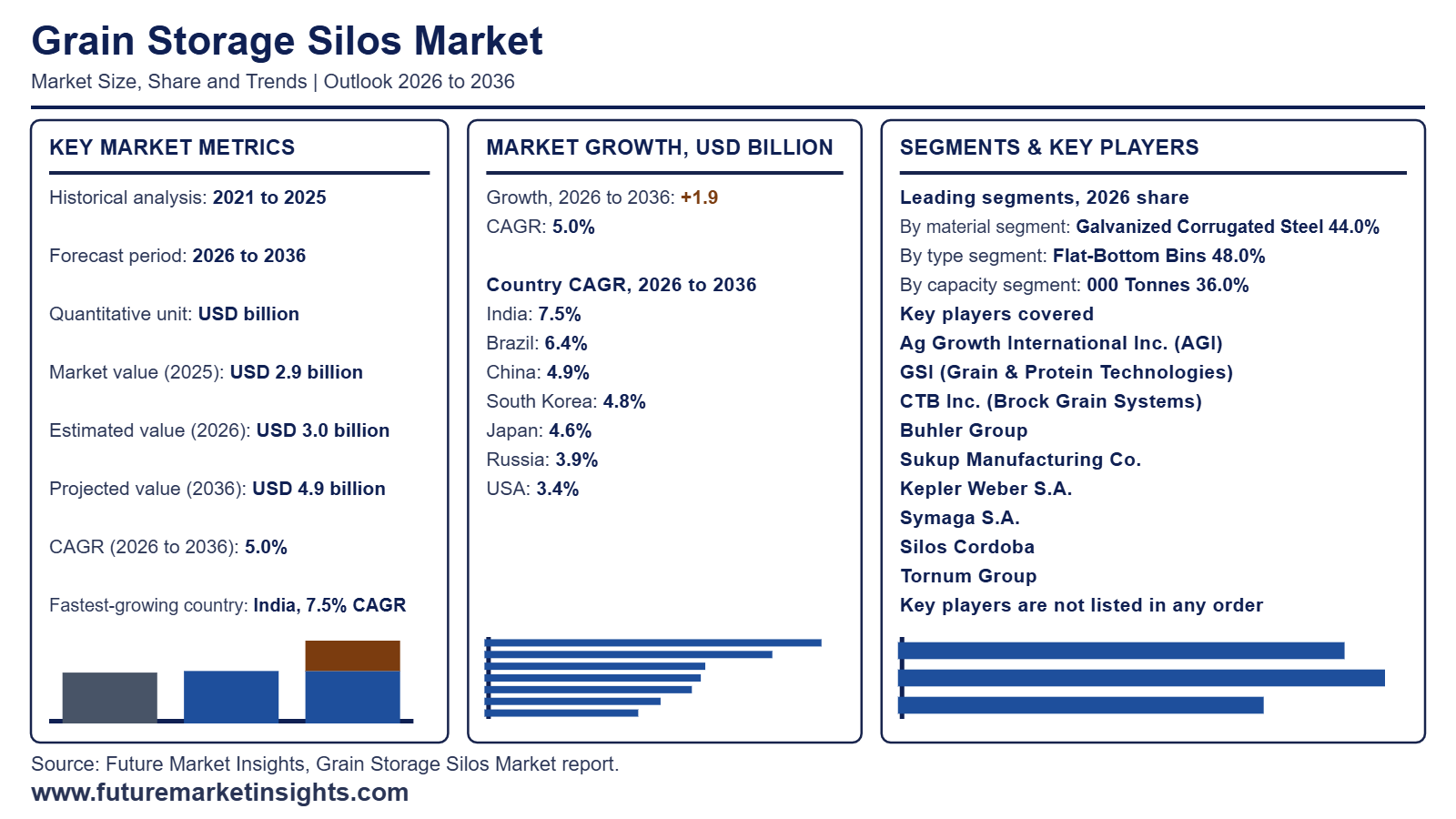
At a historical valuation of USD 2.9 billion in 2025 and progressing to USD 3.0 billion in 2026, grain storage silos market size is on course to reach USD 4.9 billion by 2036, aided by a forecast-period CAGR of 5.0%. FMI survey reflects that on-farm harvest buffering and mechanized national food-reserve hubs will generate an incremental opportunity of USD 1.9 billion over the decade.
Table 1: Global Grain Storage Silos Market Size, Share, and Forecast Summary (2025 to 2036)
| Market Metric | Valuation / Share / Forecast Benchmark |
|---|---|
| 2025 Market Size (Historical) | USD 2.9 billion |
| 2026 Market Size (Estimated) | USD 3.0 billion |
| 2036 Market Size (Projected) | USD 4.9 billion |
| Compound Annual Growth Rate (2026 to 2036) | 5.0% CAGR |
| Incremental Dollar Opportunity (2026 to 2036) | USD 1.9 billion |
| Dominant Material Segment (2026 Share) | Galvanized Corrugated Steel (44.0% share in 2026) | Other Segment Combined (56.0%) |
| Leading Type Segment (2026 Share) | Flat-Bottom Bins (48.0% share in 2026) | Other Segment Combined (52.0%) |
| Leading Capacity Segment (2026 Share) | 500 to 5,000 Tonnes (36.0% share in 2026) | Other Segment Combined (64.0%) |
| Leading End User Segment (2026 Share) | Farms (38.0% share in 2026) | Other Segment Combined (62.0%) |
| Fastest-Growing Country Markets (2026 to 2036) | India (7.5% CAGR), Brazil (6.4% CAGR), China (4.9% CAGR) |
| Leading Tier-1 Companies | Ag Growth International Inc. (AGI), GSI (Grain & Protein Technologies), CTB Inc. (Brock Grain Systems), Buhler Group, Sukup Manufacturing Co., Kepler Weber S.A., Symaga S.A., Silos Cordoba, Tornum Group, CST Industries Inc. |
Source: Future Market Insights analysis of the grain storage silos market, 2026.
Executive Market Overview
Adoption of fixed metal grain storage vessels across commercial elevators, bioethanol processors, and row-crop farms is rising because high-speed combine harvesting overwhelms rural truck and rail dispatch capacity during peak autumn weeks. When growers harvest huge volumes of corn and soybeans within narrow weather windows, lack of on-site bin capacity forces immediate distressed sales, which explains why agricultural machinery investment in aerated steel bins is expanding; stock figures published by the National Agricultural Statistics Service, United States Department of Agriculture (September 2026) confirm that United States corn stocks in all positions reached 2.1 billion bushels on September 1, 2026, up 35.0% year-over-year, including 1.3 billion bushels at off-farm commercial facilities beside silos and hermetic food grain storage. FMI's market research tracks wide country-wise growth differences across the global grain industry. India is projected to post the fastest expansion at a 7.5% CAGR and Brazil follows at a 6.4% CAGR as federal food-reserve concessions and double-crop corn-ethanol complexes close structural storage deficits, whereas China (4.9% CAGR) and mature replacement markets such as the USA (3.4% CAGR) focus primarily on upgrading existing bin networks.
Buyer preference in both farm and commercial tenders is shifting toward high-tensile corrugated steel bins equipped with automated temperature cables, carbon-dioxide spoilage sensors, and zero-entry sweep augers. However, FMI believes that elevated reinforced-concrete ring-foundation costs, high agricultural borrowing rates, and strict combustible-dust safety rules remain major factors expected to hinder market growth moving forward when crop prices dip. Strategic investments by leading silo fabricators are directly addressing structural and freight costs, as seen when Symaga S.A. (July 2026) upgraded its silo production to S450GD structural steel with 450 N/mm2 yield strength and Ag Growth International Inc. (June 2026) invested in 4-inch corrugated farm-bin roll-forming lines in Kansas. FMI projects ai grain harvest s7 combine logistics to expand at a 7.3% CAGR and storage tank equipment to grow at a 5.1% CAGR, whereas silo bags advance at a slower 4.0% CAGR compared with 5.0% CAGR for grain storage silos because permanent steel vessels eliminate single-season plastic waste and rodent losses. Market scope covers new silo and bin structures, excluding temporary plastic bags, standalone grain dryers, and stored grain commodity value.
This Report Answers
- How large the grain storage silos market is in 2026 and what valuation it reaches by 2036
- Which material, type, capacity, and end user segments lead in 2026
- What harvest arrival pressures push buyer adoption and what restrains civil approvals
- Which seven countries are expected to grow fastest between 2026 and 2036
- How Ag Growth International Inc., Kepler Weber S.A., Sukup Manufacturing Co., and Symaga S.A. compete
- How the grain storage silos market is defined, segmented, and measured
Analyst Perspective
"Grain storage silo manufacturers will expand project margins by selling pre-engineered high-tensile corrugated steel vessels pre-wired with automated temperature, moisture, and carbon-dioxide aeration controls rather than competing on bare sheet tonnage. Primary commercial restraint comes from civil foundation and receiving-pit construction cost, which often equals the price of the steel bin itself."
- Nikhil Kaitwade, Principal Consultant, Future Market Insights.
Key Market Trends & Insights
- High-Tensile Galvanized Steel Grades Reduce Wall Weight and Erection Time: European and South American silo fabricators are switching to higher-yield structural galvanized steel coils to support taller flat-bottom and hopper vessels without excessive wall plate thickness. Lower shipping weight per cubic meter of storage cuts inland freight bills while resisting wind and seismic loads, which FMI finds is driving strong product preference among export terminal buyers. Technical disclosures from Symaga S.A. (July 2026) confirm the July 13, 2026 rollout of S450GD structural steel raising yield strength from 350 N/mm2 to 450 N/mm2 in parallel with new 3.8-meter diameter silos, while Symaga S.A. (October 2025) invested EUR 3.0 million annually to install two robotic welding cells for roof collars and doors beside fluidized bed dryer conditioning lines.
- Automated Headspace Aeration and Telemetry Sensors Prevent Mycotoxin Spoilage: Commercial millers and on-farm bin owners are specifying digital temperature cables and automated roof exhaust fans to stop moisture migration without manual bin entry. Manual entry inside a filled grain vessel to check crusted corn or wheat creates severe engulfment hazards, so FMI analysts note that remote conditioning telemetry is accelerating buyer adoption across farm and elevator upgrades. Project records from Silos Cordoba (May 2026) detailing a 3,100-tonne flat-bottom wheat silo installation at a German flour mill equipped with automated roof ventilation and continuous temperature telemetry, paired with Sukup Manufacturing Co. (March 2025) launching its SYNK smart bin monitoring platform, reinforce automated preservation in parallel with post-harvest treatment.
- Bioethanol and Oilseed Crushing Plants Anchor Turnkey Mega-Silo Contracts: Agro-industrial processors in Brazil and the United States Midwest are ordering multi-vessel flat-bottom complexes directly connected to high-capacity rail receiving pits to secure year-round corn and soybean crush feedstock. Reliance on third-party country elevators exposes ethanol plants to harvest freight spikes, and FMI suggests processor-owned buffer complexes are now a primary engine of industrial sales growth. Contract filings from Kepler Weber S.A. (November 2025) documenting a 240,000-tonne grain handling and storage complex in Goias, Brazil for Sao Martinho's corn-processing expansion illustrate how processors drive turnkey orders connected with cereal and grain fortification ingredients.
What Are the Main Drivers, Restraints, and Opportunities?
Peak harvest arrival surges and public food-reserve modernization drive steel bin orders, whereas civil foundation expenses and engulfment safety compliance restrain farm capex, leaving rail-linked PPP terminals as the top opportunity.
Driver: Concentrated Harvest Arrivals and Carryover Stock Preservation
Commercial grain elevators and port terminals are purchasing corrugated galvanized steel silos because mechanized grain handling and aeration floors prevent mycotoxin formation and moisture spoilage across high-volume wheat, corn, and soybean crops. Storing grain in engineered steel bins allows grain handlers to hold grain safely until export shipping windows open or seasonal price spreads widen. Statistics from the Food and Agriculture Organization (November 2025) forecast world cereal production at 2,849 million tonnes for 2024/25, confirming the heavy volume of harvested grain that requires weather-tight containment. FMI trend analysis indicates that agricultural cooperatives and commercial port logistics operators will maintain steady procurement of high-capacity flat-bottom silos to modernize bulk grain storage infrastructure through 2036.
Restraint: Civil Foundation Costs, Interest Rates, and Grain-Handling Safety Mandates
Commercial and farm storage projects are frequently postponed when reinforced-concrete ring-wall foundations, three-phase electrical upgrades, and high borrowing costs stretch payback horizons beyond five crop seasons. Elevator operators must also engineer compliant catwalks, zero-entry sweep augers, and dust-collection systems to pass occupational safety inspections, which In FMI's view acts as a concrete restraint on capital approval. Federal enforcement standards maintained by the Occupational Safety and Health Administration, United States Department of Labor (January 2025) under 29 CFR 1910.272 mandate strict engulfment lockout-tagout and combustible grain-dust controls, while Food and Agriculture Organization of the United Nations (March 2026) reports highlight how high financing rates in Eastern Europe and Russia push cash-constrained growers toward temporary bags in parallel with feeder containers.
Opportunity: Public-Private Food Reserve Modernization and Green-Storage Retrofits
Prospects expected to come over the forecast decade center on Asian and Middle Eastern governments replacing bag-warehouses with mechanized, temperature-controlled steel silos linked to dedicated rail sidings. Bulk steel silos cut post-harvest spoilage and fumigation chemical use across national wheat and rice reserves, opening a multi-year tender pipeline that FMI expects turnkey suppliers to capture. Policy announcements from the Press Information Bureau, Government of India (September 2026) reviewing a storage roadmap for 13.1 million metric tons (131 lakh tonnes) of new food-grain capacity and directives from the State Council Information Office of China (September 2026) expanding high-standard, low-temperature grain warehouses for 2026 to 2030 create substantial contract opportunities in parallel with flour fortification premix and wheat protein milling hubs.
How Is the Grain Storage Silos Market Segmented?
Grain Storage Silos Market is segmented by Material, Type, Capacity, End User, and Region. Forecast period from 2026 to 2036.
| Segmentation Axis | Sub-Segments Covered | 2026 Leading Segment & Share | Other Segment Combined & Total |
|---|---|---|---|
| Material | Galvanized Corrugated Steel, Concrete, Bolted Steel Tanks, Welded Stainless Steel | Galvanized Corrugated Steel (44.0% share in 2026) | Other Segment Combined (56.0%) | Total (100.0%) |
| Type | Flat-Bottom Bins, Hopper-Bottom Silos, Concrete Elevator Silos, Portable and Small Farm Bins | Flat-Bottom Bins (48.0% share in 2026) | Other Segment Combined (52.0%) | Total (100.0%) |
| Capacity | 500 to 5,000 Tonnes, Below 500 Tonnes, 5,000 to 20,000 Tonnes, Above 20,000 Tonnes | 500 to 5,000 Tonnes (36.0% share in 2026) | Other Segment Combined (64.0%) | Total (100.0%) |
| End User | Farms, Commercial Elevators and Traders, Ports and Terminals, Food and Feed Processors, Government Reserves | Farms (38.0% share in 2026) | Other Segment Combined (62.0%) | Total (100.0%) |
| Region | North America, Latin America, Western Europe, Eastern Europe, East Asia, South Asia and Pacific, Middle East and Africa | North America & South Asia (led by India at 7.5% CAGR) | Global Coverage Across 7 Core Countries (100.0%) |
Source: Future Market Insights analysis of the grain storage silos market, 2026.
Why Does Galvanized Corrugated Steel Hold 44.0% of Material Demand in 2026?
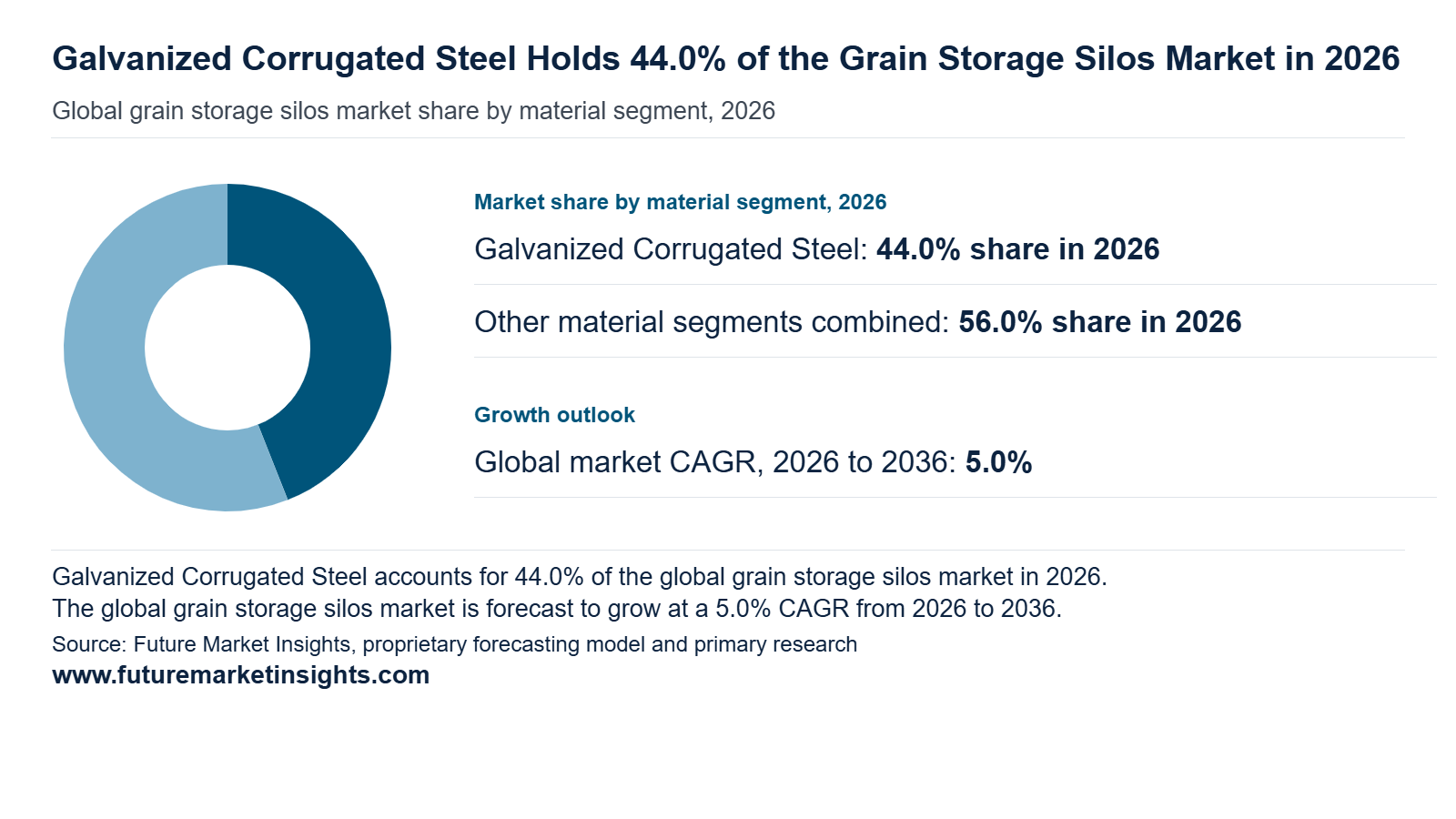
In 2026, galvanized corrugated steel captures 44.0% of material category share, owing to the cost and logistics advantage of shipping roll-formed zinc-aluminum coated panels on standard flatbeds for bolted field assembly. Slip-form concrete construction requires specialized continuous crews and heavy foundations, whereas corrugated steel rings let farms and commercial elevators add capacity in modular phases. FMI believes ongoing upgrades in structural steel yield strength will further widen this material preference, as demonstrated when Ag Growth International Inc. (June 2026) added 4-inch corrugated farm-bin roll-forming at its Clay Center, Kansas plant and Symaga S.A. (July 2026) adopted S450GD galvanized steel beside functional flours and sprouted flour milling complexes. Favorable installed cost per tonne is projected to sustain galvanized corrugated steel leadership through 2036.
What Makes Flat-Bottom Bins Lead the Type Category with 48.0% Share in 2026?
Direct slab support on reinforced concrete with sub-floor aeration trenches allows a single vessel to hold anywhere from 1,000 tonnes to over 25,000 tonnes without expensive elevated steel hopper cones. Because slab-supported geometry delivers the lowest structural cost per bushel for multi-month seasonal holding, flat-bottom bins secure 48.0% of silo type share in 2026. Project disclosures from Silos Cordoba (May 2026) commissioning a 3,100-tonne flat-bottom wheat silo in Germany and product updates from GSI (Grain & Protein Technologies) (April 2026) expanding its EVO 2X flat-bottom bin range confirm strong commercial and farm demand. FMI predicts that growing carryover stocks and bioethanol buffer complexes will keep flat-bottom bins as the leading silo type through 2036.
Why Does the 500 to 5,000 Tonnes Band Capture 36.0% of Capacity Sales in 2026?
Installation case records from Silos Cordoba (July 2025) supplying a 23-silo grain and feed facility for Dutch Trading in Romania and Silos Cordoba (May 2026) delivering a 3,100-tonne milling vessel in Germany show why mid-sized bins anchor repeat commercial orders. Vessels in the 500 to 5,000 tonnes capacity band account for 36.0% of capacity share in 2026 because this size envelope fits both multi-bin family farms and identity-preserved grain segregation lines at flour and feed mills. As per FMI, bins in this range can be erected on standard ring foundations and fed by existing bucket elevators without port-terminal pilings, supporting steady adoption in parallel with breakfast cereal and wheat bran and cereal sidestream texturizers processing lines through 2036.
How Do Farms Secure 38.0% of End User Silo Revenue in 2026?
Row-crop producers across North America, South America, and Europe are investing in on-farm bin batteries to decouple combine harvesting speed from country-elevator waiting lines and capture post-harvest carry premiums. Driven by this shift toward farmer-owned grain marketing and moisture blending, farms represent 38.0% of end user share in 2026, ahead of commercial elevators, port terminals, and government reserves. FMI analysts note that low-interest government equipment loans and smart aeration apps directly support farm-level adoption, evidenced by the Farm Service Agency, United States Department of Agriculture (January 2026) Farm Storage Facility Loan program and Sukup Manufacturing Co. (April 2025) expanding its Ames, Iowa bin-controls engineering center. Higher combine harvesting rates are expected to keep farms as the largest end user segment through 2036.
Regional & Country Outlook
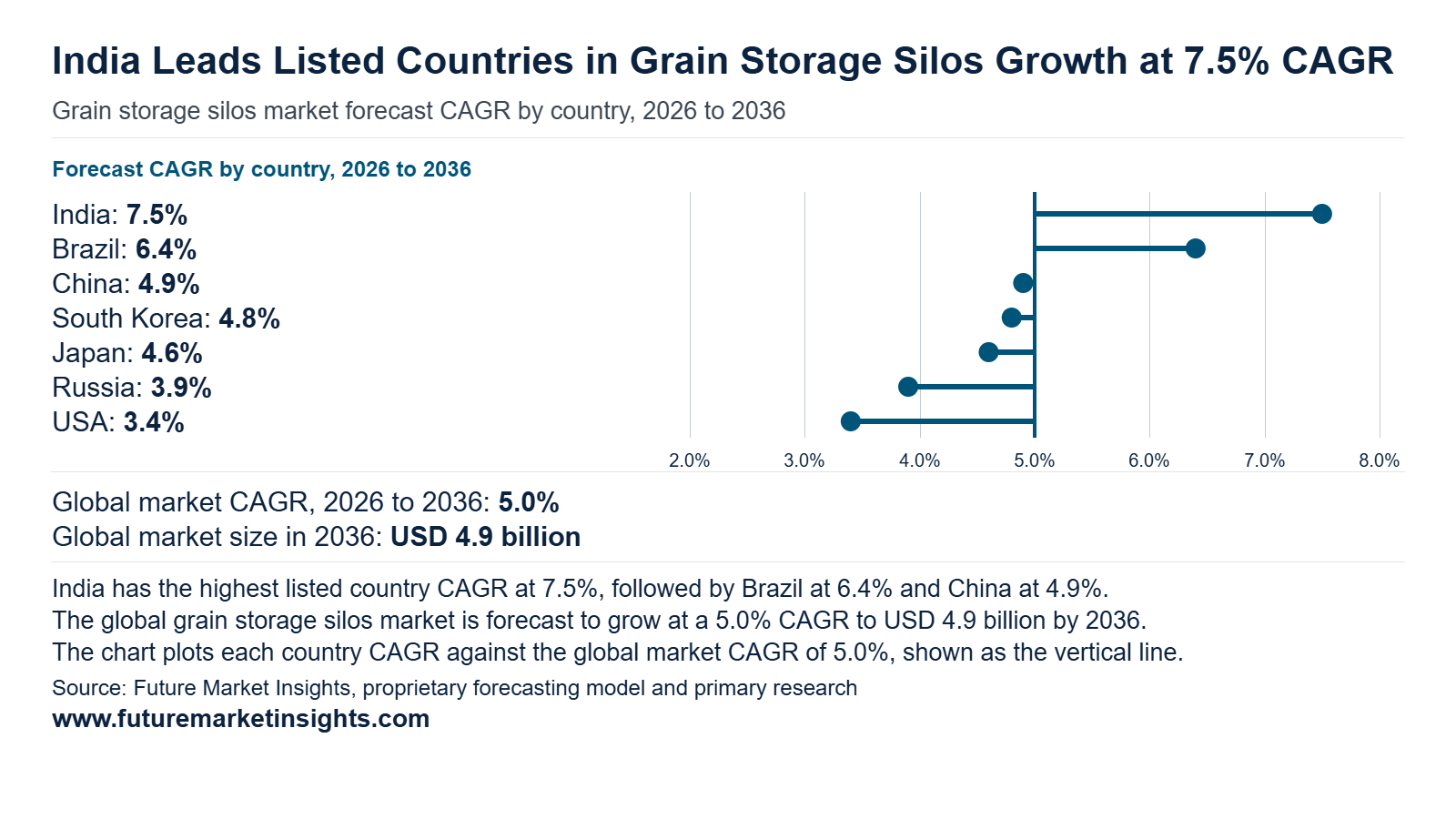
North America, East Asia, and Latin America represent the largest regional markets for grain storage silos, while South Asia and South America record the fastest percentage expansion as public food-security programs and industrial corn processors build bulk steel capacity. FMI projects India to lead country growth at a 7.5% CAGR from 2026 to 2036, followed by Brazil at 6.4% and China at 4.9%. South Korea advances at 4.8%, Japan at 4.6%, Russia at 3.9%, and the USA at 3.4%, reflecting a 4.1% growth spread across the seven profiled countries.
| Country | 2026 Revenue | 2036 Revenue | 10-Year Addition | 2026 to 2036 CAGR | Global Share (2026 -> 2036) |
|---|---|---|---|---|---|
| India | USD 0.3 billion | USD 0.6 billion | +USD 0.3 billion | 7.5% | 10.0% -> 12.2% |
| Brazil | USD 0.4 billion | USD 0.7 billion | +USD 0.3 billion | 6.4% | 13.3% -> 14.3% |
| China | USD 0.6 billion | USD 1.0 billion | +USD 0.4 billion | 4.9% | 20.0% -> 20.4% |
| South Korea | USD 0.2 billion | USD 0.3 billion | +USD 0.1 billion | 4.8% | 6.7% -> 6.1% |
| Japan | USD 0.2 billion | USD 0.3 billion | +USD 0.1 billion | 4.6% | 6.7% -> 6.1% |
| Russia | USD 0.2 billion | USD 0.3 billion | +USD 0.1 billion | 3.9% | 6.7% -> 6.1% |
| USA | USD 1.0 billion | USD 1.4 billion | +USD 0.4 billion | 3.4% | 33.3% -> 28.6% |
Source: Future Market Insights analysis of the grain storage silos market, 2026.
India
Demand for grain storage silos across India is projected to climb from USD 0.3 billion in 2026 to USD 0.6 billion by 2036, advancing at a 7.5% CAGR, contributing +USD 0.3 billion in incremental revenue. What makes India's grain storage silos market fundamentally different from Western farm-bin markets is that demand is led by institutional public-private partnership concessions building rail-linked hub-and-spoke steel terminals to replace conventional jute-bag warehouses. Official releases from the Press Information Bureau, Government of India (September 2026) reviewing a storage policy for 13.1 million metric tons (131 lakh tonnes) of additional food-grain capacity, combined with infrastructure updates from the Press Information Bureau, Government of India (September 2025), confirm a massive public tender pipeline. FMI believes turnkey contractors capable of integrating civil foundations and mechanized rail bulk loading will capture rapid Indian expansion through 2036.
Brazil
Demand for grain storage silos across Brazil is forecast to advance from USD 0.4 billion in 2026 to USD 0.7 billion by 2036, advancing at a 6.4% CAGR, contributing +USD 0.3 billion in incremental revenue. Brazilian demand differs from North American patterns because double-cropping of soybeans and second-crop corn in Mato Grosso and Goias overwhelms rural highways, prompting both mega-farms and corn-ethanol plants to build 200,000-tonne-plus flat-bottom complexes. National surveys from the Instituto Brasileiro de Geografia e Estatistica (June 2026) showing total agricultural storage reaching 233.8 million tonnes in the second half of 2025 with silos holding 124.7 million tonnes, paired with Kepler Weber S.A. (November 2025) signing a 240,000-tonne Goias storage contract for Sao Martinho, prove the scale of local machinery investment. FMI predicts agro-industrial ethanol and crush expansions will anchor Brazilian silo sales through 2036.
China
Demand for grain storage silos across China is estimated to rise from USD 0.6 billion in 2026 to USD 1.0 billion by 2036, advancing at a 4.9% CAGR, contributing +USD 0.4 billion in incremental revenue. Rather than building basic unmonitored farm bins, Chinese procurement focuses on replacing older state granaries with airtight, quasi-low-temperature vertical silos that cut post-harvest spoilage and chemical fumigation across national reserves. Policy briefings from the State Council Information Office of China (September 2026) confirming national standard grain warehousing capacity above 730.0 million tonnes in 2026 and directing 2026 to 2030 investments toward green climate-controlled storage explain why technical specifications are rising. According to FMI analysts, state reserve modernization and coastal oilseed crushing terminals will sustain Chinese silo demand through 2036.
South Korea
Demand for grain storage silos across South Korea is projected to expand from USD 0.2 billion in 2026 to USD 0.3 billion by 2036, advancing at a 4.8% CAGR, contributing +USD 0.1 billion in incremental revenue. South Korea differs from major grain-exporting countries because domestic demand centers on government rice-reserve rotation facilities and import-dependent coastal feed mills that require strict moisture conditioning and lot segregation. Reserve management plans approved by the Ministry of Agriculture, Food and Rural Affairs of the Republic of Korea (August 2026) for 400,000 tonnes of 2026 public rice purchases highlight the ongoing need for automated, low-loss bulk storage vessels. FMI suggests that sensor-monitored hopper retrofits at port feed terminals will support steady South Korean adoption through 2036.
Japan
Demand for grain storage silos across Japan is anticipated to grow from USD 0.2 billion in 2026 to USD 0.3 billion by 2036, advancing at a 4.6% CAGR, contributing +USD 0.1 billion in incremental revenue. Japanese market conditions are distinct from global volume hubs because tight coastal land availability and strict earthquake codes require compact, seismic-rated vertical silos equipped with precision temperature and insect-control telemetry for imported wheat, corn, and domestic rice. Distribution statistics from the Ministry of Agriculture, Forestry and Fisheries of Japan (January 2026) reporting 3.4 million tonnes of private rice inventory at collection and wholesale stages at the end of December 2025 demonstrate why wholesalers prioritize automated quality preservation. In FMI's view, terminal automation upgrades and food-security reserve standards will maintain consistent Japanese orders through 2036.
Russia
Demand for grain storage silos across Russia is projected to climb from USD 0.2 billion in 2026 to USD 0.3 billion by 2036, advancing at a 3.9% CAGR, contributing +USD 0.1 billion in incremental revenue. What separates Russia from faster-growing emerging markets is that high domestic commercial interest rates and export corridor bottlenecks push cash-constrained farms toward temporary plastic bags, leaving permanent galvanized steel silo orders concentrated among accredited railway elevators and export terminals. Regional grain briefings from the Food and Agriculture Organization of the United Nations (March 2026) in Altai Krai documenting 2025 Russian grain output at 138.8 million tonnes and Food and Agriculture Organization of the United Nations (June 2026) reports in the Volga region confirm the scale of inland handling needs. FMI finds that rail-terminal modernization and state intervention storage will drive selective Russian steel-silo investments through 2036.
USA
Demand for grain storage silos across USA is forecast to advance from USD 1.0 billion in 2026 to USD 1.4 billion by 2036, advancing at a 3.4% CAGR, contributing +USD 0.4 billion in incremental revenue. Unlike developing agricultural economies building first-time storage, the mature American market is driven by row-crop farms and commercial elevators replacing older small bins with wide-diameter, 4-inch corrugated flat-bottom vessels and high-speed intake legs that keep up with modern combines. Official inventory reports from the National Agricultural Statistics Service, United States Department of Agriculture (September 2026) recording 787.0 million bushels of on-farm corn and 1.3 billion bushels of off-farm corn in September 2026, paired with Ag Growth International Inc. (June 2026) localizing 4-inch corrugated farm-bin production in Clay Center, Kansas, confirm active replacement demand. FMI expects zero-entry safety retrofits and biofuel processor storage to anchor American revenue through 2036.
Competitive Environment and Notable Companies
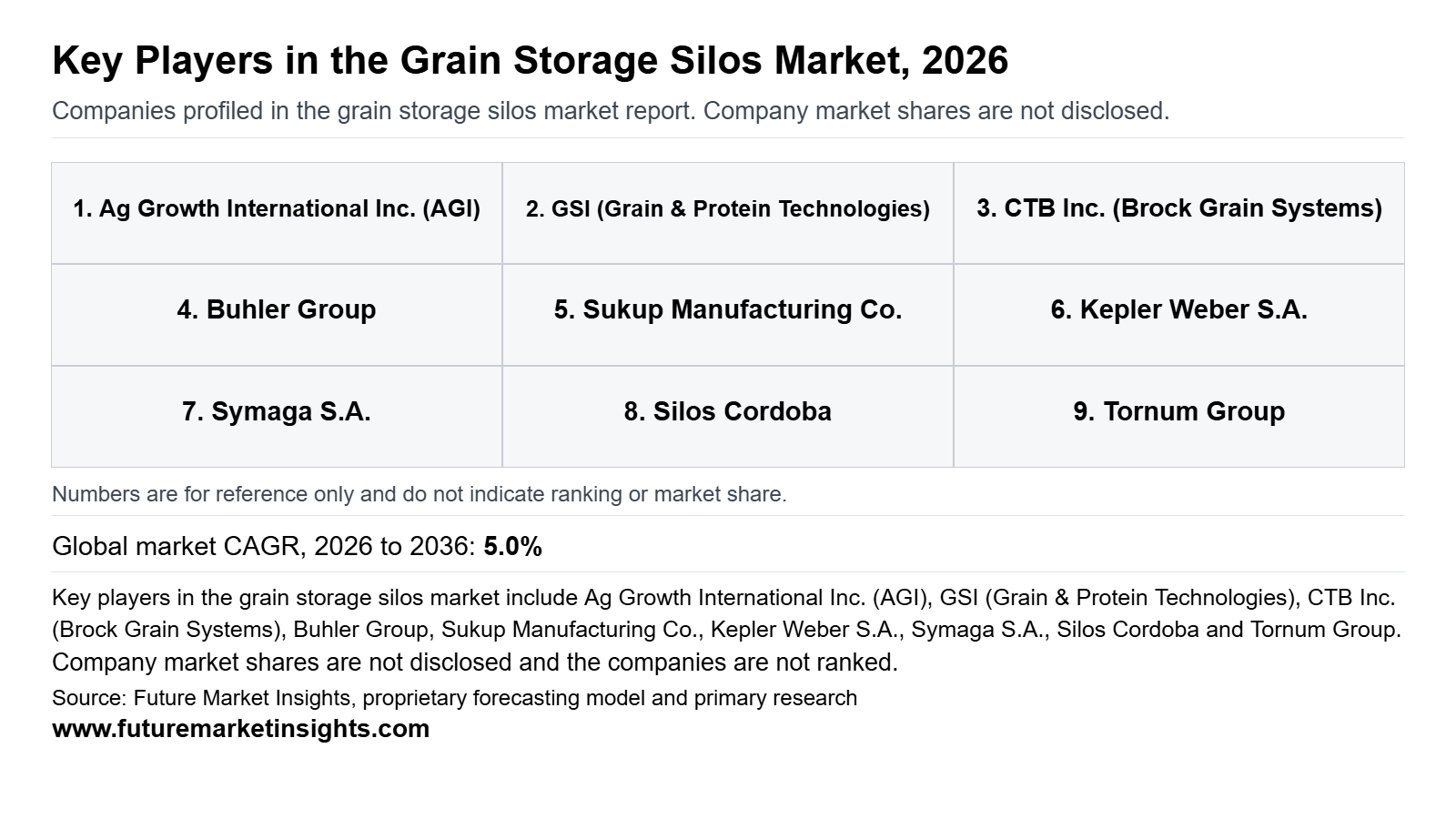
Notable companies operating in the global grain storage silos market include Ag Growth International Inc. (AGI), GSI (Grain & Protein Technologies), CTB Inc. (Brock Grain Systems), Buhler Group, Sukup Manufacturing Co., Kepler Weber S.A., Symaga S.A., Silos Cordoba, Tornum Group, and CST Industries Inc. Competition spans North American and Brazilian farm-and-commercial bin manufacturers, European export-focused industrial silo fabricators, and turnkey mill-and-terminal engineering contractors.
How Are Companies Positioned in the Grain Storage Silos Market?
North American manufacturers including Ag Growth International Inc. (June 2026), GSI (Grain & Protein Technologies) (April 2026), CTB Inc. through Brock Grain Systems (September 2026), and Sukup Manufacturing Co. (April 2025) anchor farm and commercial elevator positioning through dealer-erected corrugated steel bins and integrated drying-aeration packages. Kepler Weber S.A. (November 2025) leads Brazilian post-harvest and bioethanol storage projects, while European builders Symaga S.A. (July 2026), Silos Cordoba (May 2026), Tornum Group (2026), and Buhler Group (March 2026) supply engineered mill and port silos and CST Industries Inc. (2026) provides bolted epoxy-coated tanks.
What Matters When a Buyer Selects a Grain Storage Silo Supplier?
Farm operators and commercial elevator engineers evaluate vendors on galvanized coating mass (up to 600 g/m2), structural steel yield strength under wind and seismic codes, zero-entry sweep auger reliability, and local dealer erection availability prior to harvest. Industrial buyers contracting turnkey facilities with Kepler Weber S.A. (November 2025) or Silos Cordoba (May 2026) also require integrated SCADA control across intake pits, cleaners, dryers, and temperature cables.
Which Capabilities Distinguish Product Offers?
Product differentiation centers on corrugation profile geometry, high-tensile steel grades, and smart conditioning telemetry. Symaga S.A. (July 2026) differentiates by upgrading feed and grain silos to S450GD steel with 450 N/mm2 yield strength, whereas Sukup Manufacturing Co. (March 2025) integrates its SYNK cloud-based temperature and moisture monitoring platform and Silos Cordoba (April 2025) engineers SCADA-controlled hopper complexes for port and milling terminals.
How Does Geographic Reach Affect Competition?
High ocean and inland freight costs for heavy steel sheets favor manufacturers with roll-forming plants near major grain belts. Ag Growth International Inc. (June 2026) is realigning North American manufacturing by adding 4-inch corrugated farm-bin lines in Clay Center, Kansas, while Kepler Weber S.A. (January 2025) serves Latin America from Brazilian plants and Spanish manufacturers Symaga S.A. (October 2025) and Silos Cordoba (July 2025) export containerized flat-bottom and hopper kits across Europe, the Middle East, and Africa.
| Verified Company Evidence (2025 to 2026) | Commercial Effect | Buyer Action |
|---|---|---|
| July 2026: Symaga S.A. upgraded its silo manufacturing to S450GD structural steel (450 N/mm2 yield strength) and launched new 3.8 m diameter models (Symaga S.A., July 2026). | Increases structural load resistance and raw-material supply continuity for farm and industrial silos. | Compare steel yield-strength specifications (S450GD vs S350GD) and zinc coating weights during tender qualification. |
| June 2026: Ag Growth International Inc. announced a multi-million-dollar investment to add 4-inch corrugated farm-bin production at its Clay Center, Kansas plant (Ag Growth International Inc., June 2026). | Localizes corrugated farm-bin roll-forming inside the United States Midwest grain belt with production starting mid-2027. | Evaluate freight savings and dealer installation lead times when planning Midwest on-farm storage expansions. |
| November 2025: Kepler Weber S.A. signed a contract to supply a 240,000-tonne grain handling and storage unit in Goias, Brazil for Sao Martinho (Kepler Weber S.A., November 2025). | Demonstrates large-scale flat-bottom silo integration with industrial corn-to-ethanol processing plants. | Specify high-throughput intake pits and automated reclaim conveyors when sizing processor buffer silos. |
Source: Verified corporate disclosures and Future Market Insights analysis, 2026.
| Company | Core Positioning | Verified Activity & Source Attribution |
|---|---|---|
| Ag Growth International Inc. (AGI) | Corrugated farm bins, commercial flat-bottom silos, and bulk handling | Invested in 4-inch corrugated farm-bin manufacturing in Clay Center, Kansas in June 2026 (Ag Growth International Inc., June 2026). |
| GSI (Grain & Protein Technologies) | EVO 2X corrugated steel grain bins, conditioning, and GrainVue controls | Markets EVO 2X flat-bottom bins and GrainVue digital cable systems across North America and Asia-Pacific (GSI (Grain & Protein Technologies), April 2026). |
| CTB Inc. (Brock Grain Systems) | Everest flat-bottom bins, hopper silos, and zero-entry bin sweeps | Publishes farm and commercial bin unloading and harvest-capacity engineering solutions (Brock Grain Systems, September 2026). |
| Buhler Group | Turnkey industrial grain elevator, port terminal, and mill storage systems | Recorded continued grain storage project installations in Iraq and new West African silo contracts in 2025 Annual Report (Buhler Group, March 2026). |
| Sukup Manufacturing Co. | Farm and commercial grain bins, axial/centrifugal dryers, and SYNK controls | Expanded Ames, Iowa engineering footprint in April 2025 and launched SYNK smart bin monitoring in March 2025 (Sukup Manufacturing Co., April 2025). |
| Kepler Weber S.A. | Post-harvest flat-bottom silos, conveyors, and agro-industrial terminals | Contracted a 240,000-tonne storage complex for Sao Martinho in November 2025 after record simultaneous projects in January 2025 (Kepler Weber S.A., November 2025). |
| Symaga S.A. | Galvanized flat-bottom and hopper silos for global export projects | Adopted S450GD high-yield steel in July 2026 and installed two robotic manufacturing cells in October 2025 (Symaga S.A., July 2026). |
| Silos Cordoba | Engineered flat-bottom and hopper-bottom grain and feed facilities | Completed a 3,100-tonne German mill expansion in May 2026 and a 23-silo Romanian facility in July 2025 (Silos Cordoba, May 2026). |
| Tornum Group | Grain drying, conditioning, and galvanized silos including SIMEZA | Supplies Eurocode and ANSI-compliant flat-bottom and 45/60-degree hopper silos across Europe (Tornum Group, 2026). |
| CST Industries Inc. | TecTank bolted epoxy-coated and galvanized dry-bulk storage tanks | Manufactures factory-coated bolted steel silos for food, grain, and industrial dry-bulk terminals (CST Industries Inc., 2026). |
Source: Verified corporate disclosures and Future Market Insights analysis, 2026.
Key takeaways from the Grain Storage Silos Market Report
- Worldwide demand is valued at USD 3.0 billion in 2026, expected to reach USD 4.9 billion by 2036.
- A ten-year expansion is expected to contribute USD 1.9 billion at a 5.0% CAGR.
- Material preference is led by galvanized corrugated steel at 44.0% share in 2026.
- Flat-bottom bins capture 48.0% of silo type demand in 2026.
- India is anticipated to lead national growth at 7.5% CAGR, followed by Brazil at 6.4% and China at 4.9%.
Grain Storage Silos Market-Report Scope and Research Methodology
FMI analysts size the global grain storage silos market through primary interviews with steel-silo and farm-bin manufacturers, agricultural dealer erectors, commercial elevator superintendents, and public food-reserve procurement authorities, combined with desk research across agricultural ministry stock reports, national statistical capacity censuses, and corporate contract filings. Core 2025 and 2026 valuations reconcile new flat-bottom, hopper-bottom, concrete elevator, and portable farm bin revenues across all seven profiled countries. Segment shares across material, type, capacity, and end user axes are cross-checked against verified project awards, while excluding stored grain commodity value, temporary plastic silo bags, conventional flat warehouses, and standalone grain dryers to prevent double counting.
| Coverage Field | Report Scope |
|---|---|
| Market Definition | Revenue from new grain storage silo and bin structures supplied to farm, commercial elevator, processor, terminal, and government reserve users, including integral aeration and monitoring. |
| Material Segments | Galvanized Corrugated Steel, Concrete, Bolted Steel Tanks, and Welded Stainless Steel. |
| Type Segments | Flat-Bottom Bins, Hopper-Bottom Silos, Concrete Elevator Silos, and Portable and Small Farm Bins. |
| Capacity Segments | 500 to 5,000 Tonnes, Below 500 Tonnes, 5,000 to 20,000 Tonnes, and Above 20,000 Tonnes. |
| End User Segments | Farms, Commercial Elevators and Traders, Ports and Terminals, Food and Feed Processors, and Government Reserves. |
| Exclusions | Stored grain commodity value, temporary plastic silo bags, conventional flat warehouses, standalone grain dryers, and civil earthworks unrelated to silo supply. |
| Quantitative Units | USD Billion for global market sizing; CAGR % for 2026 to 2036 growth. |
| Historical & Base Years | 2025 (Historical) and 2026 (Estimated Base Year). |
| Forecast Period | 2026 to 2036 (10-Year Projection Window). |
| Regions Covered | North America, Latin America, Western Europe, Eastern Europe, East Asia, South Asia and Pacific, and Middle East and Africa. |
| Countries Profiled | USA, China, Brazil, India, Russia, Japan, and South Korea. |
| Companies Covered | Ag Growth International Inc. (AGI), GSI (Grain & Protein Technologies), CTB Inc. (Brock Grain Systems), Buhler Group, Sukup Manufacturing Co., Kepler Weber S.A., Symaga S.A., Silos Cordoba, Tornum Group, and CST Industries Inc. |
| Research Approach | Primary silo manufacturer and elevator operator interviews combined with secondary agricultural census, grain stock, and corporate contract triangulation. |
Source: Future Market Insights analysis of the grain storage silos market, 2026.
Research Sources and Bibliography
- Ag Growth International Inc. (2026, June 9). AGI Realigns Manufacturing to Deliver Storage Solutions Closer to United States Farmers. https://www.aggrowth.com/en-us/media/news-releases/2026/agi-realigns-manufacturing-to-deliver-storage-solutions-closer-to-usa-farmers
- Brock Grain Systems. (2025, November 25). The Dos and Don'ts of Grain Bin Unloading Part 1. https://www.brockgrain.com/blog/grain-bin-unloading-part-1/
- Brock Grain Systems. (2026, September 22). When Your Grain Storage System Cannot Keep Up with Your Farm. https://www.brockgrain.com/blog/when-your-grain-storage-system-cant-keep-up/
- Buhler Group. (2026, March 10). Grains and Food: Annual Report 2025. https://annualreport.buhlergroup.com/reports/en_25/home/economy/grains-and-food.html
- CST Industries Inc. (2026). Food Storage Tanks, Grain Silos, and Bolted Epoxy TecTank Systems. https://www.cstindustries.com/solution/dry-bulk-storage-solutions/food-grain/
- Farm Service Agency, United States Department of Agriculture. (2026, January 15). Farm Storage Facility Loan (FSFL) Program Fact Sheet. https://www.fsa.usda.gov/resources/loans/farm-storage-facility-loan-fsfl-program
- Food and Agriculture Organization of the United Nations. (2026, March 2). FAO Presents Key Trends in Global Grain Production and Trade in Altai Krai. https://www.fao.org/russian-federation/news/news-detail/fao-presents-key-trends-in-global-grain-production-and-trade-in-altai-krai-(russia-s-breadbasket/en
- Food and Agriculture Organization of the United Nations. (2026, June 26). FAO in the Vast Fields of Volga Region Grain Basket. https://www.fao.org/russian-federation/news/news-detail/fao-in-the-vast-fields-of-volga-region-(-grain-basket/en
- GSI (Grain & Protein Technologies). (2026, April 15). GSI EVO 2X Grain Storage Bins and GrainVue Conditioning Systems. https://www.grainsystems.com/na/en/products/storage/grain-bins/
- Instituto Brasileiro de Geografia e Estatistica. (2026, June 11). Agricultural Storage Capacity Grows 1.1% and Reaches 233.8 Million Tonnes in the Second Half of 2025. https://agenciadenoticias.ibge.gov.br/en/agencia-press-room/2185-news-agency/releases-en/47097-capacidade-de-armazenagem-agricola-cresce-1-1-e-chega-a-233-8-milhoes-de-toneladas-no-segundo-semestre-de-2026
- Kepler Weber S.A. (2025, January 8). New Products Drive Business and Kepler Weber Breaks Record for Simultaneous Projects. https://ri.kepler.com.br/en/noticia/new-products-drive-business-and-kepler-weber-breaks-record-for-simultaneous-projects/
- Kepler Weber S.A. (2025, November 26). Kepler Weber to Build 240,000-Tonne Storage Unit for Sao Martinho in Goias. https://ri.kepler.com.br/noticia/kepler-weber-vai-construir-unidade-de-armazenagem-de-240-mil-t-para-sao-martinho/
- Ministry of Agriculture, Food and Rural Affairs of the Republic of Korea. (2026, August 25). 2026 Public Grain Reserve Implementation Plan and 2027 Supply Management Plan. https://mafra.go.kr/home/5109/subview.do?enc=Zm5jdDF8QEB8JTJGYmJzJTJGaG9tZSUyRjc5MiUyRmFydGNsVmlldy5kbyUzRg%3D%3D
- Ministry of Agriculture, Forestry and Fisheries of Japan. (2026, January 30). Rice Distribution in December 2025: Collection, Sales and Private Inventory. https://www.maff.go.jp/j/press/nousan/kikaku/260130.html
- National Agricultural Statistics Service, United States Department of Agriculture. (2026, September 30). Grain Stocks Report: United States Corn Ending Stocks Up 35% from Last Year. https://data.nass.usda.gov/Newsroom/2026/09-30-2026.php
- Occupational Safety and Health Administration, United States Department of Labor. (2025, January 10). 29 CFR 1910.272: Grain Handling Facilities Safety Standard. https://www.osha.gov/laws-regs/regulations/standardnumber/1910/1910.272
- Press Information Bureau, Government of India. (2025, September 28). From Harvest to Home: Building Resilient Infrastructure for Storage of Food Grains. https://www.pib.gov.in/PressReleasePage.aspx?PRID=2172351&lang=2®=3
- Press Information Bureau, Government of India. (2026, September 1). States and UTs Food Secretaries Conference Reviews Food Grain Storage Policy. https://www.pib.gov.in/PressReleaseIframePage.aspx?PRID=2305725&lang=2®=48
- Silos Cordoba. (2025, April 16). Silos Cordoba Begins the Assembly of a New Silo Plant in Dubai. https://www.siloscordoba.com/2025/04/16/silos-cordoba-begins-the-assembly-of-a-new-silo-plant-in-dubai/
- Silos Cordoba. (2025, July 16). New Grain Storage Installation in Romania for Dutch Trading in Collaboration with MGN. https://www.siloscordoba.com/2025/07/16/new-grain-storage-installation-in-romania-for-dutch-trading-in-collaboration-with-mgn/
- Silos Cordoba. (2026, May 21). New Industrial Expansion in Germany: 3,100-Tonne Flat-Bottom Silo Capacity and Control. https://www.siloscordoba.com/2026/05/21/new-industrial-expansion-in-germany-more-capacity-greater-control-and-improved-operational-efficiency/
- State Council Information Office of China. (2026, September 22). China Moves to Strengthen Food Security Across Grain Supply Chain in 2026-2030. https://english.scio.gov.cn/m/pressroom/2026-09/22/content_118707566.html
- Sukup Manufacturing Co. (2025, March 6). SYNK: Smarter Grain Bin Monitoring with Sukup. https://blog.sukup.com/synk-smarter-grain-bin-monitoring-with-sukup
- Sukup Manufacturing Co. (2025, April 14). Sukup Manufacturing Co. Expands Ames Engineering and Testing Footprint. https://blog.sukup.com/growth-inevitable-sukup-manufacturing-co.-expands-ames-footprint
- Symaga S.A. (2025, October 13). Symaga Launches a New Fulfilment Department and Maintains Its EUR 3 Million Investment Plan. https://www.symaga.com/en/symaga-launches-a-new-fulfilment-department-and-maintains-its-investment-plan/
- Symaga S.A. (2026, July 13). The Feed and Grain Silo Is Evolving: S450GD Steel and New 3.8 Meter Models. https://www.symaga.com/en/the-feed-silo-is-evolving-s450gd-steel-and-new-o380-models/
- Tornum Group. (2026). Galvanized Grain Storage Silos and Hopper-Bottom Silo Systems. https://www.tornum.com/product/grain-storage-silos/
Table of Content
- Key Takeaways
- Market Size and CAGR
- Top Growth Driver
- Fastest Growing Segment
- Leading Region
- Key Companies
- Emerging Opportunities
- Executive Summary
- Global Market Outlook
- Demand-side Trends
- Supply-side Trends
- Technology Roadmap Analysis
- Analysis and Recommendations
- Analyst Perspective (What is happening? Why now? What should investors know?)
- Key Questions Answered
- How large is the market?
- What is the CAGR?
- What are key trends?
- Which region dominates?
- Who are the leaders?
Read More...
- Market Overview
- Market Coverage / Taxonomy
- Market Definition / Scope / Limitations
- Research Methodology
- Chapter Orientation
- Analytical Lens and Working Hypotheses
- Market Structure, Signals, and Trend Drivers
- Benchmarking and Cross-market Comparability
- Market Sizing, Forecasting, and Opportunity Mapping
- Research Design and Evidence Framework
- Desk Research Programme (Secondary Evidence)
- Expert Input and Fieldwork (Primary Evidence)
- Tooling, Models, and Reference Databases
- Data Engineering and Model Build
- Quality Assurance and Audit Trail
- Market Background
- Market Dynamics (Drivers, Restraints, Opportunity, Trends)
- Scenario Forecast (Optimistic, Likely, Conservative)
- Impact Analysis
- AI Impact
- Sustainability Impact
- Regulatory Impact
- Technology Impact
- Consumer / Buyer Analysis
- Purchase Drivers
- Adoption Barriers
- Buyer Journey
- Opportunity Map Analysis
- Product Life Cycle Analysis
- Supply Chain Analysis
- Investment Feasibility Matrix
- Value Chain Analysis
- PESTLE and Porter's Analysis
- Regulatory Landscape
- Regional Parent Market Outlook
- Production and Consumption Statistics
- Import and Export Statistics
- Global Market Analysis and Forecast, 2021 to 2036
- Historical Market Size Value (USD Billion) Analysis, 2021 to 2025
- Current and Future Market Size Value (USD Billion) Projections, 2026 to 2036
- Y-o-Y Growth Trend Analysis
- Absolute $ Opportunity Analysis
- Global Market Pricing Analysis, 2021 to 2036
- Global Market Analysis and Forecast, By Material, 2021 to 2036
- Introduction / Key Findings
- Historical Market Size Value (USD Billion) Analysis By Material, 2021 to 2025
- Current and Future Market Size Value (USD Billion) Analysis and Forecast By Material, 2026 to 2036
- Galvanized Corrugated Steel
- Concrete
- Bolted Steel Tanks
- Welded Stainless Steel
- Y-o-Y Growth Trend Analysis By Material, 2021 to 2025
- Absolute $ Opportunity Analysis By Material, 2026 to 2036
- Global Market Analysis and Forecast, By Type, 2021 to 2036
- Introduction / Key Findings
- Historical Market Size Value (USD Billion) Analysis By Type, 2021 to 2025
- Current and Future Market Size Value (USD Billion) Analysis and Forecast By Type, 2026 to 2036
- Flat-Bottom Bins
- Hopper-Bottom Silos
- Concrete Elevator Silos
- Portable and Small Farm Bins
- Y-o-Y Growth Trend Analysis By Type, 2021 to 2025
- Absolute $ Opportunity Analysis By Type, 2026 to 2036
- Global Market Analysis and Forecast, By Capacity, 2021 to 2036
- Introduction / Key Findings
- Historical Market Size Value (USD Billion) Analysis By Capacity, 2021 to 2025
- Current and Future Market Size Value (USD Billion) Analysis and Forecast By Capacity, 2026 to 2036
- 500 to 5
- 000 Tonnes
- Below 500 Tonnes
- 5
- 000 to 20
- 000 Tonnes
- Above 20
- 000 Tonnes
- Y-o-Y Growth Trend Analysis By Capacity, 2021 to 2025
- Absolute $ Opportunity Analysis By Capacity, 2026 to 2036
- Global Market Analysis and Forecast, By End User, 2021 to 2036
- Introduction / Key Findings
- Historical Market Size Value (USD Billion) Analysis By End User, 2021 to 2025
- Current and Future Market Size Value (USD Billion) Analysis and Forecast By End User, 2026 to 2036
- Farms
- Commercial Elevators and Traders
- Ports and Terminals
- Food and Feed Processors
- Government Reserves
- Y-o-Y Growth Trend Analysis By End User, 2021 to 2025
- Absolute $ Opportunity Analysis By End User, 2026 to 2036
- Global Market Analysis and Forecast, By Region, 2021 to 2036
- Introduction
- Historical Market Size Value (USD Billion) Analysis By Region, 2021 to 2025
- Current Market Size Value (USD Billion) Analysis and Forecast By Region, 2026 to 2036
- North America
- Western Europe
- East Asia
- South Asia and Pacific
- Market Attractiveness Analysis By Region
- North America Market Analysis and Forecast, By Country, 2021 to 2036
- Historical Market Size Value (USD Billion) Trend Analysis By Market Taxonomy, 2021 to 2025
- Market Size Value (USD Billion) Forecast By Market Taxonomy, 2026 to 2036
- By Country
- United States
- Canada
- By Material
- By Type
- By Capacity
- By End User
- By Country
- Market Attractiveness Analysis
- By Country
- By Material
- By Type
- By Capacity
- By End User
- Key Takeaways
- Western Europe Market Analysis and Forecast, By Country
- Historical Market Size Value (USD Billion) Trend Analysis By Market Taxonomy, 2021 to 2025
- Market Size Value (USD Billion) Forecast By Market Taxonomy, 2026 to 2036
- By Country
- United Kingdom
- Germany
- France
- By Material
- By Type
- By Capacity
- By End User
- By Country
- Market Attractiveness Analysis
- By Country
- By Material
- By Type
- By Capacity
- By End User
- Key Takeaways
- East Asia Market Analysis and Forecast, By Country
- Historical Market Size Value (USD Billion) Trend Analysis By Market Taxonomy, 2021 to 2025
- Market Size Value (USD Billion) Forecast By Market Taxonomy, 2026 to 2036
- By Country
- China
- Japan
- South Korea
- By Material
- By Type
- By Capacity
- By End User
- By Country
- Market Attractiveness Analysis
- By Country
- By Material
- By Type
- By Capacity
- By End User
- Key Takeaways
- South Asia and Pacific Market Analysis and Forecast, By Country
- Historical Market Size Value (USD Billion) Trend Analysis By Market Taxonomy, 2021 to 2025
- Market Size Value (USD Billion) Forecast By Market Taxonomy, 2026 to 2036
- By Country
- India
- Australia
- Rest of world aggregate
- By Material
- By Type
- By Capacity
- By End User
- By Country
- Market Attractiveness Analysis
- By Country
- By Material
- By Type
- By Capacity
- By End User
- Key Takeaways
- Key Countries Market Analysis
- United States
- Pricing Analysis
- Market Share Analysis, 2025
- By Material
- By Type
- By Capacity
- By End User
- Canada
- Pricing Analysis
- Market Share Analysis, 2025
- By Material
- By Type
- By Capacity
- By End User
- Germany
- Pricing Analysis
- Market Share Analysis, 2025
- By Material
- By Type
- By Capacity
- By End User
- United Kingdom
- Pricing Analysis
- Market Share Analysis, 2025
- By Material
- By Type
- By Capacity
- By End User
- France
- Pricing Analysis
- Market Share Analysis, 2025
- By Material
- By Type
- By Capacity
- By End User
- India
- Pricing Analysis
- Market Share Analysis, 2025
- By Material
- By Type
- By Capacity
- By End User
- China
- Pricing Analysis
- Market Share Analysis, 2025
- By Material
- By Type
- By Capacity
- By End User
- Japan
- Pricing Analysis
- Market Share Analysis, 2025
- By Material
- By Type
- By Capacity
- By End User
- South Korea
- Pricing Analysis
- Market Share Analysis, 2025
- By Material
- By Type
- By Capacity
- By End User
- Australia
- Pricing Analysis
- Market Share Analysis, 2025
- By Material
- By Type
- By Capacity
- By End User
- United States
- Market Structure Analysis
- Competition Dashboard
- Competition Benchmarking
- Market Share Analysis of Top Players
- By Regional
- By Material
- By Type
- By Capacity
- By End User
- Emerging Startups
- Innovation Benchmarking
- Competition Analysis
- Competition Deep Dive
- Ag Growth International Inc. (AGI)
- Overview
- Product Portfolio
- Profitability by Market Segments
- Sales Footprint
- Strategy Overview
- Marketing Strategy
- Product Strategy
- Channel Strategy
- GSI (Grain & Protein Technologies)
- CTB Inc. (Brock Grain Systems)
- Buhler Group
- Sukup Manufacturing Co.
- Kepler Weber S.A.
- Symaga S.A.
- Silos Cordoba
- Tornum Group
- CST Industries Inc.
- Ag Growth International Inc. (AGI)
- Case Studies
- Success Stories
- Recent Developments
- Competition Deep Dive
- Assumptions & Acronyms Used
List of Tables
- Table 1: Global Market Value (USD Billion) Forecast by Region, 2021 to 2036
- Table 2: Global Market Value (USD Billion) Forecast by Material, 2021 to 2036
- Table 3: Global Market Value (USD Billion) Forecast by Type, 2021 to 2036
- Table 4: Global Market Value (USD Billion) Forecast by Capacity, 2021 to 2036
- Table 5: Global Market Value (USD Billion) Forecast by End User, 2021 to 2036
- Table 6: North America Market Value (USD Billion) Forecast by Country, 2021 to 2036
- Table 7: North America Market Value (USD Billion) Forecast by Material, 2021 to 2036
- Table 8: North America Market Value (USD Billion) Forecast by Type, 2021 to 2036
- Table 9: North America Market Value (USD Billion) Forecast by Capacity, 2021 to 2036
- Table 10: North America Market Value (USD Billion) Forecast by End User, 2021 to 2036
- Table 11: Western Europe Market Value (USD Billion) Forecast by Country, 2021 to 2036
- Table 12: Western Europe Market Value (USD Billion) Forecast by Material, 2021 to 2036
- Table 13: Western Europe Market Value (USD Billion) Forecast by Type, 2021 to 2036
- Table 14: Western Europe Market Value (USD Billion) Forecast by Capacity, 2021 to 2036
- Table 15: Western Europe Market Value (USD Billion) Forecast by End User, 2021 to 2036
- Table 16: East Asia Market Value (USD Billion) Forecast by Country, 2021 to 2036
- Table 17: East Asia Market Value (USD Billion) Forecast by Material, 2021 to 2036
- Table 18: East Asia Market Value (USD Billion) Forecast by Type, 2021 to 2036
- Table 19: East Asia Market Value (USD Billion) Forecast by Capacity, 2021 to 2036
- Table 20: East Asia Market Value (USD Billion) Forecast by End User, 2021 to 2036
- Table 21: South Asia and Pacific Market Value (USD Billion) Forecast by Country, 2021 to 2036
- Table 22: South Asia and Pacific Market Value (USD Billion) Forecast by Material, 2021 to 2036
- Table 23: South Asia and Pacific Market Value (USD Billion) Forecast by Type, 2021 to 2036
- Table 24: South Asia and Pacific Market Value (USD Billion) Forecast by Capacity, 2021 to 2036
- Table 25: South Asia and Pacific Market Value (USD Billion) Forecast by End User, 2021 to 2036
List of Figures
- Figure 1: Global Market Pricing Analysis
- Figure 2: Global Market Value (USD Billion) Forecast 2021-2036
- Figure 3: Global Market Value Share and BPS Analysis by Material, 2026 and 2036
- Figure 4: Global Market Y-o-Y Growth Comparison by Material, 2026-2036
- Figure 5: Global Market Attractiveness Analysis by Material
- Figure 6: Global Market Value Share and BPS Analysis by Type, 2026 and 2036
- Figure 7: Global Market Y-o-Y Growth Comparison by Type, 2026-2036
- Figure 8: Global Market Attractiveness Analysis by Type
- Figure 9: Global Market Value Share and BPS Analysis by Capacity, 2026 and 2036
- Figure 10: Global Market Y-o-Y Growth Comparison by Capacity, 2026-2036
- Figure 11: Global Market Attractiveness Analysis by Capacity
- Figure 12: Global Market Value Share and BPS Analysis by End User, 2026 and 2036
- Figure 13: Global Market Y-o-Y Growth Comparison by End User, 2026-2036
- Figure 14: Global Market Attractiveness Analysis by End User
- Figure 15: Global Market Value (USD Billion) Share and BPS Analysis by Region, 2026 and 2036
- Figure 16: Global Market Y-o-Y Growth Comparison by Region, 2026-2036
- Figure 17: Global Market Attractiveness Analysis by Region
- Figure 18: North America Market Incremental Dollar Opportunity, 2026-2036
- Figure 19: Western Europe Market Incremental Dollar Opportunity, 2026-2036
- Figure 20: East Asia Market Incremental Dollar Opportunity, 2026-2036
- Figure 21: South Asia and Pacific Market Incremental Dollar Opportunity, 2026-2036
- Figure 22: North America Market Value Share and BPS Analysis by Country, 2026 and 2036
- Figure 23: North America Market Value Share and BPS Analysis by Material, 2026 and 2036
- Figure 24: North America Market Y-o-Y Growth Comparison by Material, 2026-2036
- Figure 25: North America Market Attractiveness Analysis by Material
- Figure 26: North America Market Value Share and BPS Analysis by Type, 2026 and 2036
- Figure 27: North America Market Y-o-Y Growth Comparison by Type, 2026-2036
- Figure 28: North America Market Attractiveness Analysis by Type
- Figure 29: North America Market Value Share and BPS Analysis by Capacity, 2026 and 2036
- Figure 30: North America Market Y-o-Y Growth Comparison by Capacity, 2026-2036
- Figure 31: North America Market Attractiveness Analysis by Capacity
- Figure 32: North America Market Value Share and BPS Analysis by End User, 2026 and 2036
- Figure 33: North America Market Y-o-Y Growth Comparison by End User, 2026-2036
- Figure 34: North America Market Attractiveness Analysis by End User
- Figure 35: Western Europe Market Value Share and BPS Analysis by Country, 2026 and 2036
- Figure 36: Western Europe Market Value Share and BPS Analysis by Material, 2026 and 2036
- Figure 37: Western Europe Market Y-o-Y Growth Comparison by Material, 2026-2036
- Figure 38: Western Europe Market Attractiveness Analysis by Material
- Figure 39: Western Europe Market Value Share and BPS Analysis by Type, 2026 and 2036
- Figure 40: Western Europe Market Y-o-Y Growth Comparison by Type, 2026-2036
- Figure 41: Western Europe Market Attractiveness Analysis by Type
- Figure 42: Western Europe Market Value Share and BPS Analysis by Capacity, 2026 and 2036
- Figure 43: Western Europe Market Y-o-Y Growth Comparison by Capacity, 2026-2036
- Figure 44: Western Europe Market Attractiveness Analysis by Capacity
- Figure 45: Western Europe Market Value Share and BPS Analysis by End User, 2026 and 2036
- Figure 46: Western Europe Market Y-o-Y Growth Comparison by End User, 2026-2036
- Figure 47: Western Europe Market Attractiveness Analysis by End User
- Figure 48: East Asia Market Value Share and BPS Analysis by Country, 2026 and 2036
- Figure 49: East Asia Market Value Share and BPS Analysis by Material, 2026 and 2036
- Figure 50: East Asia Market Y-o-Y Growth Comparison by Material, 2026-2036
- Figure 51: East Asia Market Attractiveness Analysis by Material
- Figure 52: East Asia Market Value Share and BPS Analysis by Type, 2026 and 2036
- Figure 53: East Asia Market Y-o-Y Growth Comparison by Type, 2026-2036
- Figure 54: East Asia Market Attractiveness Analysis by Type
- Figure 55: East Asia Market Value Share and BPS Analysis by Capacity, 2026 and 2036
- Figure 56: East Asia Market Y-o-Y Growth Comparison by Capacity, 2026-2036
- Figure 57: East Asia Market Attractiveness Analysis by Capacity
- Figure 58: East Asia Market Value Share and BPS Analysis by End User, 2026 and 2036
- Figure 59: East Asia Market Y-o-Y Growth Comparison by End User, 2026-2036
- Figure 60: East Asia Market Attractiveness Analysis by End User
- Figure 61: South Asia and Pacific Market Value Share and BPS Analysis by Country, 2026 and 2036
- Figure 62: South Asia and Pacific Market Value Share and BPS Analysis by Material, 2026 and 2036
- Figure 63: South Asia and Pacific Market Y-o-Y Growth Comparison by Material, 2026-2036
- Figure 64: South Asia and Pacific Market Attractiveness Analysis by Material
- Figure 65: South Asia and Pacific Market Value Share and BPS Analysis by Type, 2026 and 2036
- Figure 66: South Asia and Pacific Market Y-o-Y Growth Comparison by Type, 2026-2036
- Figure 67: South Asia and Pacific Market Attractiveness Analysis by Type
- Figure 68: South Asia and Pacific Market Value Share and BPS Analysis by Capacity, 2026 and 2036
- Figure 69: South Asia and Pacific Market Y-o-Y Growth Comparison by Capacity, 2026-2036
- Figure 70: South Asia and Pacific Market Attractiveness Analysis by Capacity
- Figure 71: South Asia and Pacific Market Value Share and BPS Analysis by End User, 2026 and 2036
- Figure 72: South Asia and Pacific Market Y-o-Y Growth Comparison by End User, 2026-2036
- Figure 73: South Asia and Pacific Market Attractiveness Analysis by End User
- Figure 74: Global Market - Tier Structure Analysis
- Figure 75: Global Market - Company Share Analysis
Frequently Asked Questions
How big is the grain storage silos market in 2026?
Future Market Insights estimates global grain storage silos market valuation at USD 3.0 billion in 2026, progressing from USD 2.9 billion in 2025 on farm and commercial installations.
What is the projected size and CAGR of the grain storage silos market through 2036?
Global grain storage silos revenue is projected to reach USD 4.9 billion by 2036, expanding at a 5.0% CAGR from 2026 to 2036 and generating USD 1.9 billion in new value.
Which Material segment leads the grain storage silos market in 2026?
Galvanized corrugated steel leads the material category with a 44.0% revenue share in 2026 due to modular container transport and rapid bolted field assembly.
Which Type of grain storage silo captures the largest market share?
Flat-bottom bins account for 48.0% of type revenue in 2026 because slab-supported vessels deliver the lowest structural cost per tonne for bulk seasonal holding.
How much share does the 500 to 5,000 Tonnes segment hold in Capacity?
Vessels in the 500 to 5,000 tonnes class hold 36.0% of 2026 capacity demand as they match phased farm expansions and commercial mill batch segregation.
Why do Farms lead the grain storage silos End User category?
Farms capture 38.0% of 2026 end user revenue because on-farm storage prevents harvest queuing delays and lets growers time grain sales.
Which countries are projected to grow fastest in the grain storage silos market?
India leads national growth at a 7.5% CAGR from 2026 to 2036, followed by Brazil at 6.4% and China at 4.9% on public reserve and processor builds.
Which companies are profiled as key players in the grain storage silos market?
Key profiled companies include Ag Growth International Inc. (AGI), GSI (Grain & Protein Technologies), CTB Inc. (Brock Grain Systems), Buhler Group, Sukup Manufacturing Co., Kepler Weber S.A., Symaga S.A., Silos Cordoba, Tornum Group, and CST Industries Inc.
Preview the report firsthand - request a free sample
Get SampleGet the brochure for pricing and purchase details.
Get PDF