

- Industry Size (2026)
- USD 109.82 Mn
- Forecast (2036)
- USD 164.22 Mn
- CAGR (2026 to 2036)
- 4.1%
Tire Storage Rack Outlook in the UK 2026 to 2036
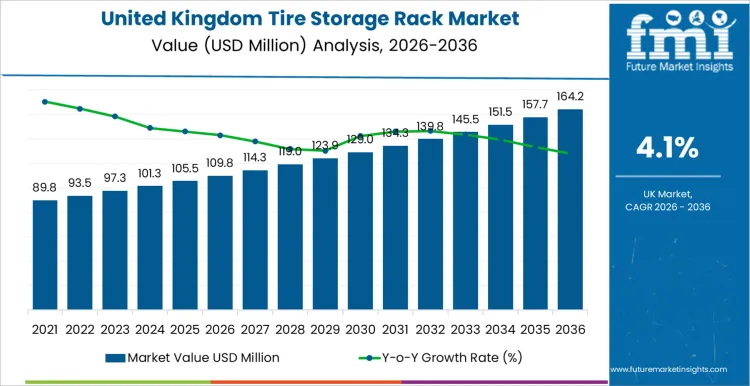
Sales of tire storage racks in the UK are projected to reach USD 109.82 million in 2026. Demand is expected to further rise to USD 164.22 million by 2036, expanding at a 4.1% CAGR. This growth is closely linked to how UK automotive service networks are reorganising storage to improve throughput, safety, and space utilisation. Tire inventory is no longer treated as a seasonal overflow problem alone.
It is becoming a managed asset across dealerships, independent garages, fleet depots, 3PL storage sites, and multi-location service chains. As tyre changes, inspections, and rotations increase in workflow intensity, storage racks are being selected as operational infrastructure, not just warehouse furniture.
Quick Stats for Tire Storage Rack Demand in the UK
- Tire Storage Rack Valuation in the UK (2026): USD 109.82 million
- Tire Storage Rack Forecast Valuation in the UK (2036): USD 164.22 million
- Tire Storage Rack Forecast CAGR (2026 to 2036): 4.1%
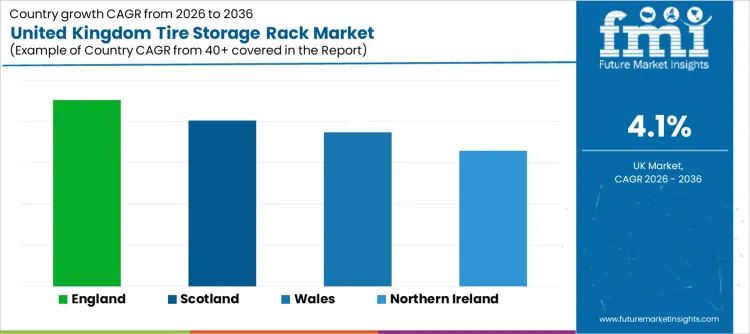
- Leading Regional Growth: England (4.5%)
- Leading Capacity Band: Up to 10 Tires (42% share)
- Leading Design: Stationary (57.0% share)
- Leading Tire Type: Passenger Car Tires (46% share)
- Leading Material: Steel (41.0% share)
- Key Companies Profiled: FEMCO Holdings, LLC; Steel King Industries, Inc.; Martins Industries; Meiser GmbH; Tier-Rack Corporation
For stakeholders such as service chain CEOs, logistics operators, and facility managers, rack decisions are shaped by five priorities: capacity per footprint, safe handling, visibility of stored stock, installation flexibility, and long-term durability. These priorities push demand toward solutions that reduce manual strain, improve picking speed, and support structured inspection routines.
Why is the UK a High-Activity Hub for Tire Storage Rack Adoption?
The UK has an extensive network of tire servicing points and vehicle maintenance operations, spanning national chains and independent workshops. These facilities handle high volumes of passenger car tyres, fleet tyres, and seasonal changeovers. That creates constant pressure on storage, especially in service bays that were designed for older workflows and lower inventory density.
Safety and compliance expectations also influence buying decisions. The UK Health and Safety Executive provides warehousing and storage guidance that emphasises risk prevention, safe handling, and structured control of hazards in storage environments. Warehouse racking safety discipline, including load management and condition monitoring, is reinforced through industry guidance and inspection services delivered by specialist bodies.
Two operational shifts strengthen long-term demand. First is warehouse modernisation across logistics and service supply chains, where storage density and access speed are treated as performance levers. This aligns naturally with warehouse racking systems that support better space use and structured inventory handling.
Second is the steady move toward mechanised handling in depots and parts operations, which supports material handling equipment adoption for safer and faster movement of heavy items. The outcome is a consistent preference for rack designs that are easy to inspect, simple to label, and scalable across multiple sites without disrupting daily servicing operations.
How is Tire Storage Rack Demand Segmented by Capacity, Orientation, Design, Tire Type, and Material?
Segment demand reflects how operators prioritise compact storage, safe handling, and predictable access during peak workloads.
Why do racks with a capacity of Up to 10 Tires dominate in space-constrained facilities?
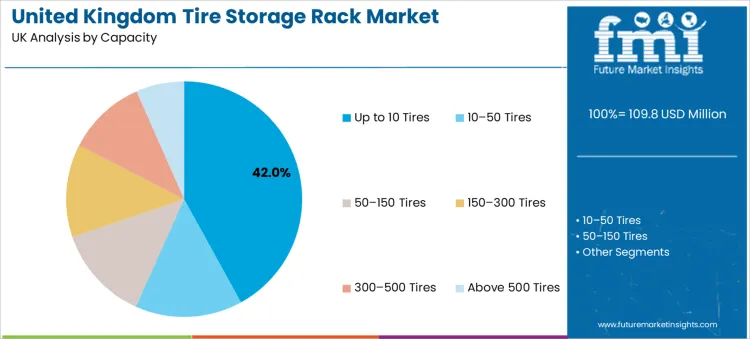
The up to 10 tires category holds a 42% share, showing that many UK buyers prioritise compact footprint storage for quick access. This segment is common in workshops, service bays, and smaller depots where tyres must be stored close to the point of use.
These racks also support tighter organisation, which reduces searching time during changeovers and avoids floor stacking that increases handling risk. For decision makers, this capacity band is an easy operational upgrade because it fits into existing layouts without major facility redesign.
How is horizontal orientation improving access speed during busy service cycles?
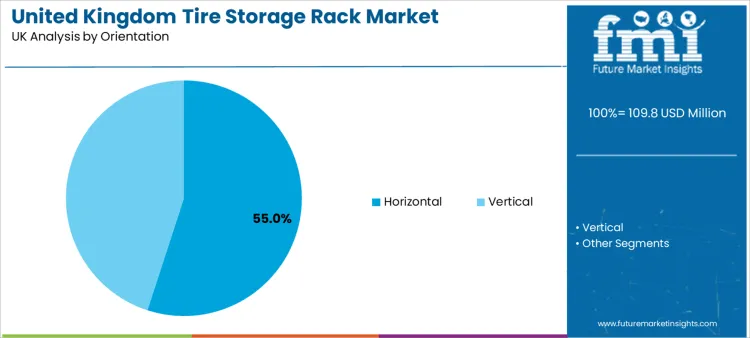
Horizontal orientation is widely selected when operators want consistent reach and fast pick cycles. Horizontal layouts make visual identification easier and can reduce the strain associated with lifting tyres from awkward angles. They also support systematic labelling and clear separation of customer-held tyres from in-house inventory. For multi-branch service providers, horizontal racks are often aligned to standard operating procedures so teams can follow the same storage logic across sites.
Why is stationary design preferred for predictable durability and stable storage planning?
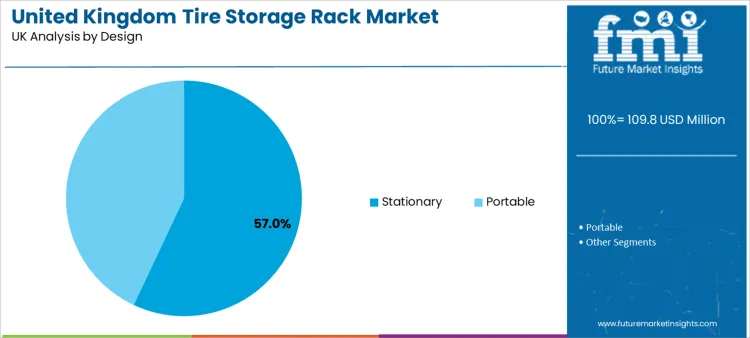
Stationary rack designs lead with a 57.0% share, driven by stability and long-term site planning. Facilities that manage steady tyre volumes prefer fixed structures that remain aligned even during repeated loading cycles.
Stationary setups also support stronger compliance controls through clear load signage, repeatable inspection routines, and consistent aisle discipline. In environments where forklift or trolley movement is present, stable rack positions help reduce collision risk and accidental damage.
When operators do need flexibility, portable racks support reconfiguration during seasonal spikes or temporary storage needs. That said, many facilities treat portability as a secondary requirement once safety, capacity, and access speed are secured.
Why do passenger car tires lead storage demand across service networks?
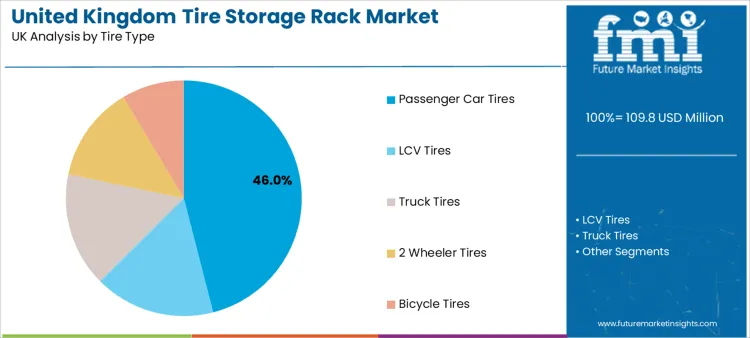
Passenger car tyres represent a 46% share, reflecting the dominance of passenger vehicles in routine servicing workflows. This segment drives daily demand across garages, fast-fit centres, dealership service departments, and regional warehouses that distribute replacement stock. Passenger car tyre storage benefits from modular racking because tyre sizes vary, and stock rotation is constant.
LCV and truck tyre storage brings additional planning needs such as heavier loads, wider spacing, and stronger access equipment. Two-wheeler and bicycle tyres add different SKU complexity, often needing smaller compartments or bundled storage approaches.
Why is steel the most used material for long-life rack infrastructure?
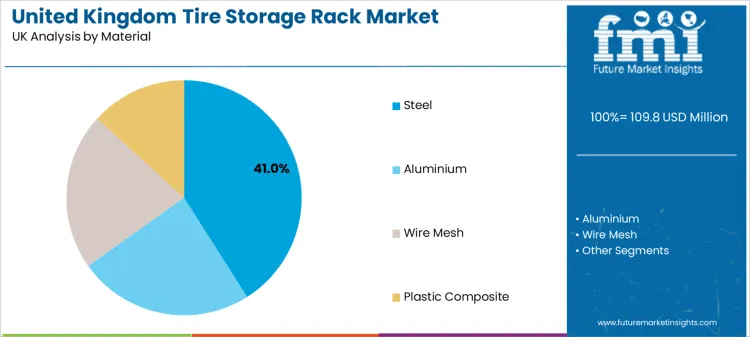
Steel holds a 41.0% share, supported by durability, load-bearing confidence, and long lifecycle performance. Steel racks are widely preferred where operators need reliable structural strength under repetitive loading. This material also supports fixed-site investment models where facilities want predictable performance and minimal deformation risk.
Alternative materials such as aluminium, wire mesh, and plastic composite can fit specialised needs such as corrosion resistance, lightweight handling, or ventilation. Steel remains the default for high-traffic use cases where stability and long-term resilience matter most.
For storage-heavy facilities planning denser layouts, the same space-efficiency logic behind tyre racks also supports broader pallet racking systems selection for structured industrial storage.
What are the Dynamics, Restraints, Opportunities, and Threats Shaping this Sector?
How are service throughput and floor-space economics driving consistent buying?
Racks directly support productivity by reducing time spent moving tyres, locating stock, and clearing service bays. Facility heads increasingly treat tyre storage as part of lean operations. When tyres are organised in structured racks instead of stacked on the floor, workflows become predictable and bays remain usable. This has a direct impact on daily capacity and customer experience, especially during seasonal rush periods.
Automation and high-efficiency storage approaches also influence procurement thinking. Distribution centres and large service depots often align storage design with automated material handling systems where movement, retrieval, and workflow discipline are tied together.
Do inspection discipline and safety requirements shape replacement cycles?
Safety is a strong replacement driver. Storage equipment needs structured oversight to prevent collapse risk, worker injury, and product damage. Industry guidance highlights the importance of routine inspections and condition monitoring.
SEMA notes that a professionally qualified inspector, reinforcing formal assessment practices for storage environments, should inspect racking at least annually. EN 15635 is also widely referenced as the key European standard for safe use and maintenance of static steel storage systems.
These practices push buyers toward higher-quality racks, stronger load signage, and designs that are easy to inspect and repair. Racks that show bending, impact damage, or poor anchoring are increasingly replaced rather than patched, especially in high-traffic depots.
Where do opportunities emerge in materials, modularity, and inventory visibility?
The largest opportunities sit in modular systems that scale without disrupting operations. Facilities want racks that can expand in sections, reconfigure row spacing, and support barcode location labelling.
Some operators also integrate tyre storage with wider inventory systems that drive better replenishment timing and fewer mis-picks. That creates adjacent demand for storage and handling equipment where high-density storage design becomes a measurable performance advantage.
Another opportunity is the growing focus on proper tyre preservation. Guidance on safe tyre storage conditions highlights the importance of avoiding harmful heat, sunlight, and chemical exposure. Racks that support ventilation, minimise deformation, and keep tyres off the floor can protect product integrity and reduce scrap loss.
What threats can disrupt adoption pace and buyer confidence?
Two threats stand out. The first is cost pressure in service operations, which can delay upgrades even when safety benefits are clear. The second is inconsistency in installation quality, especially where racks are added quickly during peak periods. Poor anchoring, incorrect loading, and damaged uprights create avoidable risk. Buyers respond by favouring suppliers with clear installation guidance, load rating clarity, and maintenance support.
Facilities that manage tyre flows connected to sustainability initiatives are also watching how end-of-life tyres are processed and handled upstream and downstream, with equipment demand extending into areas like tire retreading equipment and workshop-level handling upgrades.
How is Tire Storage Rack Demand Evolving across Key Regions in the UK?
Regional demand is influenced by service density, warehouse footprint availability, transport activity, and distribution infrastructure. CAGR trends from 2026 to 2036 show the following outlook:
| Region | CAGR (2026-2036) |
|---|---|
| England | 4.5% |
| Scotland | 4.0% |
| Wales | 3.7% |
| Northern Ireland | 3.3% |
Why is England leading adoption through dense service networks and high inventory turnover?
England shows the fastest expansion at a 4.5% CAGR, supported by the highest concentration of automotive service locations and high-volume tyre movement. Operators prioritise structured storage to reduce congestion in service bays and to handle seasonal peaks efficiently. Multi-site service chains also push for standard rack layouts to simplify training and ensure consistent safety routines.
England is also a key region for scaling modern logistics sites where tyre inventory is stored alongside broader vehicle component flows. In high-density depots, designs often align with space-efficiency practices used in drive-in pallet racking solutions for maximising storage per square metre.
How is Scotland building steady growth through durability-focused storage upgrades?
Scotland expands at 4.0% CAGR, driven by stable service demand and a strong preference for durable storage that withstands repeated loading. Facilities often evaluate steel strength, upright protection, and ease of inspection, especially where depots handle mixed tyre types. Buyers also weigh serviceability and replacement part availability, aiming for rack infrastructure that stays reliable across long operational cycles.
What is driving Wales toward practical improvements in workshop organisation and safety routines?
Wales grows at a 3.7% CAGR, supported by facilities that prioritise safe handling and tidy service environments. Compact racks that store tyres off the floor are favoured, particularly in smaller service centres where space is limited and workflow discipline prevents bottlenecks. Strong labelling and organised storage rows also reduce picking errors when multiple customer-held sets are stored on-site.
Why is Northern Ireland adopting with a measured focus on cost control and staged expansion?
Northern Ireland posts a 3.3% CAGR, reflecting steady demand shaped by staged facility upgrades. Operators often expand rack capacity in phases, matching investment to service volume increases and seasonal requirements. Rack choices are guided by stability, clear load visibility, and ease of repositioning within the facility layout.
What defines the Competitive Landscape for Tire Storage Racks in the UK?
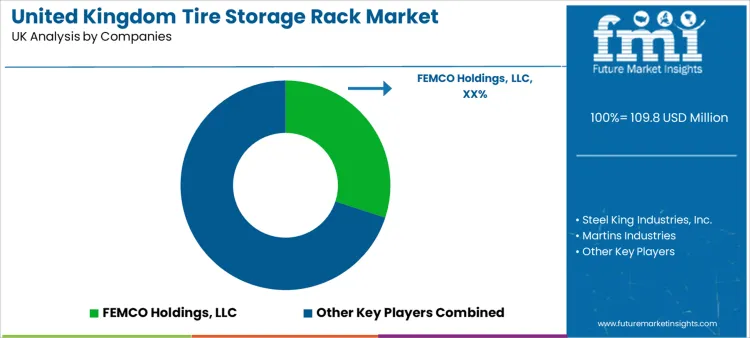
Competition is shaped by structural reliability, load clarity, installation quality, and long-term service support. Buyers compare rack systems based on how they handle daily loading cycles, whether they support fast tyre access, and how easily teams can maintain inspection discipline. Steel rack suppliers stand out when they provide strong corrosion protection, impact resilience, and repeatable modular designs that scale across multi-site footprints.
Facility leaders also expect transparent load rating communication and clear documentation that supports internal audits. Racking safety emphasis in UK warehousing guidance reinforces why operators value structured processes, staff training, and hazard prevention around storage systems.
Key providers compete through range depth, build quality, and the ability to support diverse tyre types across service and warehousing environments. For higher-load settings, buyers often compare rack robustness against criteria used in heavy-duty pallet rack designs, especially where tyre storage overlaps with industrial storage infrastructure.
Key Industry Participants
- FEMCO Holdings, LLC
- Steel King Industries, Inc.
- Martins Industries
- Meiser GmbH
- Tier-Rack Corporation
Scope of Report
| Items | Values |
|---|---|
| Quantitative Units | USD Million |
| Capacity | Up to 10 Tires; 10-50 Tires; 50-150 Tires; 150-300 Tires; 300-500 Tires; Above 500 Tires |
| Orientation | Horizontal; Vertical |
| Design | Stationary; Portable |
| Tire Type | Passenger Car Tires; LCV Tires; Truck Tires; 2 Wheeler Tires; Bicycle Tires |
| Material | Steel; Aluminium; Wire Mesh; Plastic Composite |
| Regions Covered | England; Scotland; Wales; Northern Ireland |
| Key Companies Profiled | FEMCO Holdings, LLC; Steel King Industries, Inc.; Martins Industries; Meiser GmbH; Tier-Rack Corporation |
Tire Storage Rack Demand in the UK by Segment
By Capacity
- Up to 10 Tires
- 10-50 Tires
- 50-150 Tires
- 150-300 Tires
- 300-500 Tires
- Above 500 Tires
By Orientation
- Horizontal
- Vertical
By Design
- Stationary
- Portable
By Tire Type
- Passenger Car Tires
- LCV Tires
- Truck Tires
- 2 Wheeler Tires
- Bicycle Tires
By Material
- Steel
- Aluminium
- Wire Mesh
- Plastic Composite
By Region
- England
- Scotland
- Wales
- Northern Ireland
Bibliography
- Health and Safety Executive. (2025). Warehousing and storage: A guide to health and safety (HSG76).
- Storage Equipment Manufacturers’ Association. (2025). Racking regulations and safety guidance.
- Storage Equipment Manufacturers’ Association. (2025). Warehouse racking inspection guidance.
- Stow Group. (2025). Warehouse safety standards: EN 15635 and safe use of static steel storage systems.
- Protyre. (2025). Correct tyre storage conditions and handling guidance.
Frequently Asked Questions
How big is the demand for tire storage rack in uk in 2026?
The demand for tire storage rack in uk is estimated to be valued at USD 109.8 million in 2026.
What will be the size of tire storage rack in uk in 2036?
The market size for the tire storage rack in uk is projected to reach USD 164.2 million by 2036.
How much will be the demand for tire storage rack in uk growth between 2026 and 2036?
The demand for tire storage rack in uk is expected to grow at a 4.1% CAGR between 2026 and 2036.
What are the key product types in the tire storage rack in uk?
The key product types in tire storage rack in uk are up to 10 tires, 10–50 tires, 50–150 tires, 150–300 tires, 300–500 tires and above 500 tires.
Which orientation segment is expected to contribute significant share in the tire storage rack in uk in 2026?
In terms of orientation, horizontal segment is expected to command 55.0% share in the tire storage rack in uk in 2026.
Preview the report firsthand - request a free sample
Get SampleGet the brochure for pricing and purchase details.
Get PDFTable of Content
- Executive Summary
- UK Market Outlook
- Demand-side Trends
- Supply-side Trends
- Technology Roadmap Analysis
- Analysis and Recommendations
- Market Overview
- Market Coverage / Taxonomy
- Market Definition / Scope / Limitations
- Market Background
- Market Dynamics
- Drivers
- Restraints
- Opportunity
- Trends
- Scenario Forecast
- Demand in Optimistic Scenario
- Demand in Likely Scenario
- Demand in Conservative Scenario
- Opportunity Map Analysis
- Product Life Cycle Analysis
- Supply Chain Analysis
- Investment Feasibility Matrix
- Value Chain Analysis
- PESTLE and Porter’s Analysis
- Regulatory Landscape
- Regional Parent Market Outlook
- Production and Consumption Statistics
- Import and Export Statistics
- Market Dynamics
- UK Market Analysis 2021 to 2025 and Forecast, 2026 to 2036
- Historical Market Size Value (USD Million) Analysis, 2021 to 2025
- Current and Future Market Size Value (USD Million) Projections, 2026 to 2036
- Y-o-Y Growth Trend Analysis
- Absolute $ Opportunity Analysis
- UK Market Pricing Analysis 2021 to 2025 and Forecast 2026 to 2036
- UK Market Analysis 2021 to 2025 and Forecast 2026 to 2036, By Capacity
- Introduction / Key Findings
- Historical Market Size Value (USD Million) Analysis By Capacity , 2021 to 2025
- Current and Future Market Size Value (USD Million) Analysis and Forecast By Capacity , 2026 to 2036
- Up to 10 Tires
- 10-50 Tires
- 50-150 Tires
- 150-300 Tires
- 300-500 Tires
- Above 500 Tires
- Up to 10 Tires
- Y-o-Y Growth Trend Analysis By Capacity , 2021 to 2025
- Absolute $ Opportunity Analysis By Capacity , 2026 to 2036
- UK Market Analysis 2021 to 2025 and Forecast 2026 to 2036, By Orientation
- Introduction / Key Findings
- Historical Market Size Value (USD Million) Analysis By Orientation, 2021 to 2025
- Current and Future Market Size Value (USD Million) Analysis and Forecast By Orientation, 2026 to 2036
- Horizontal
- Vertical
- Horizontal
- Y-o-Y Growth Trend Analysis By Orientation, 2021 to 2025
- Absolute $ Opportunity Analysis By Orientation, 2026 to 2036
- UK Market Analysis 2021 to 2025 and Forecast 2026 to 2036, By Design
- Introduction / Key Findings
- Historical Market Size Value (USD Million) Analysis By Design, 2021 to 2025
- Current and Future Market Size Value (USD Million) Analysis and Forecast By Design, 2026 to 2036
- Stationary
- Portable
- Stationary
- Y-o-Y Growth Trend Analysis By Design, 2021 to 2025
- Absolute $ Opportunity Analysis By Design, 2026 to 2036
- UK Market Analysis 2021 to 2025 and Forecast 2026 to 2036, By Tire Type
- Introduction / Key Findings
- Historical Market Size Value (USD Million) Analysis By Tire Type, 2021 to 2025
- Current and Future Market Size Value (USD Million) Analysis and Forecast By Tire Type, 2026 to 2036
- Passenger Car Tires
- LCV Tires
- Truck Tires
- 2 Wheeler Tires
- Bicycle Tires
- Passenger Car Tires
- Y-o-Y Growth Trend Analysis By Tire Type, 2021 to 2025
- Absolute $ Opportunity Analysis By Tire Type, 2026 to 2036
- UK Market Analysis 2021 to 2025 and Forecast 2026 to 2036, By Material
- Introduction / Key Findings
- Historical Market Size Value (USD Million) Analysis By Material, 2021 to 2025
- Current and Future Market Size Value (USD Million) Analysis and Forecast By Material, 2026 to 2036
- Steel
- Aluminium
- Wire Mesh
- Plastic Composite
- Steel
- Y-o-Y Growth Trend Analysis By Material, 2021 to 2025
- Absolute $ Opportunity Analysis By Material, 2026 to 2036
- Market Structure Analysis
- Competition Dashboard
- Competition Benchmarking
- Market Share Analysis of Top Players
- By Regional
- By Capacity
- By Orientation
- By Design
- By Tire Type
- By Material
- Competition Analysis
- Competition Deep Dive
- FEMCO Holdings, LLC
- Overview
- Product Portfolio
- Profitability by Market Segments (Product/Age /Sales Channel/Region)
- Sales Footprint
- Strategy Overview
- Marketing Strategy
- Product Strategy
- Channel Strategy
- Steel King Industries, Inc.
- Martins Industries
- Meiser GmbH
- Tier-Rack Corporation
- FEMCO Holdings, LLC
- Competition Deep Dive
- Assumptions & Acronyms Used
- Research Methodology


