

- Market Size (2026)
- USD 451.2 Mn
- Forecast (2036)
- USD 919.9 Mn
- CAGR (2026 to 2036)
- 7.4%
Hydrophilic Interior Glass Defogging Coatings Market Size, Forecast, and Outlook By FMI
Summary of the Hydrophilic Interior Glass Defogging Coatings Market
- Demand and Growth Drivers
- Larger windshield and display glass areas are increasing coating use in vehicles with higher cabin moisture exposure.
- Demand for hydrophilic polymer coatings is sustained by their role in reducing visible droplets.
- Higher EV penetration supports coating adoption as automakers pursue passive cabin moisture control.
- Driver visibility requirements support coated windshield use across passenger cars and premium vehicles.
- Product and Segment View
- Hydrophilic polymer coatings are projected to account for 46.0% of coating chemistry in 2026 due to broad mist-control use.
- In glass surface, windshield glass is expected to record 49.0% share in 2026 since driver visibility starts with front glass clarity.
- In 2026, passenger cars are projected to capture 62.0% of vehicle class segment supported by higher factory fitment.
- OEM glazing is expected to contribute 71.0% of channel segment in 2026, supported by factory-level coating control.
- Geography and Competitive Outlook
- China is projected to record 8.8% CAGR through 2036, backed by EV production and smart cockpit content.
- India is expected to advance at 8.5% CAGR by 2036 through passenger vehicle sales and humid driving conditions.
- AGC and Saint-Gobain Sekurit hold deeper positions through automotive glass depth and OEM glazing programs.
- NSG Group and PPG focus on coating expertise and high-precision glass production portfolios.
- Analyst Opinion
- Nikhil Kaitwade, Principal Consultant at FMI states: “The hydrophilic interior glass defogging coatings market is expanding because of application in vehicles using larger glass surfaces and more advanced cabin electronics. These coatings are preferred in windshield and display glass applications as they reduce fogging without disturbing visibility. Competitive edge can be obtained from proven wetting behavior and tested wipe durability instead of broad anti-fog claims.”
- Hydrophilic Interior Glass Defogging Coatings Market Value Analysis
- Hydrophilic polymer coatings now serve vehicle glass programs needing mist control across interior viewing areas.
- Windshield glass is in demand as driver visibility needs stable optical clarity during humidity changes.
- OEM glazing supports recurring supplier access as automakers approve coatings during vehicle platform development.
- Broader adoption requires coatings that reduce fogging while maintaining low haze across driver-facing glass.
- Price pressure is highest in mid-priced vehicles since added coating cost affects glazing program approval.
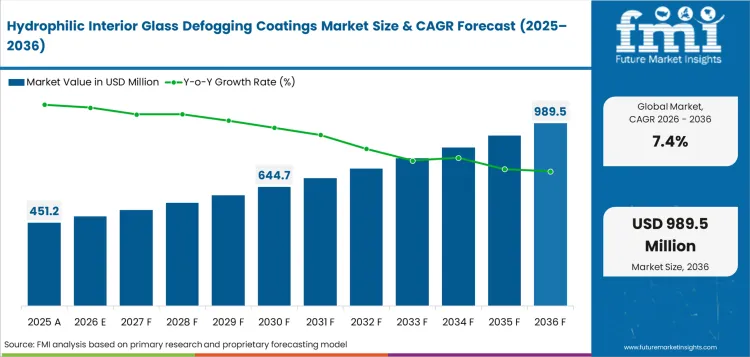
Key Takeaways, Market Size, and Forecast
- Hydrophilic interior glass defogging coatings market valuation was USD 418.6 million in 2025.
- Industry is expected to reach USD 919.9 million by 2036.
- Revenue is forecast at 7.4% CAGR across 2026 to 2036.
- Incremental opportunity across 2026 to 2036 is USD 468.7 million.
- Hydrophilic polymer coatings are expected to lead coating chemistry demand with 46.0% share in 2026.
- China is projected to record 8.8% CAGR in Hydrophilic Interior Glass Defogging Coatings through 2036.
- Windshield glass is projected to account for 49.0% share in 2026.
Hydrophilic Interior Glass Defogging Coatings Market Definition
Hydrophilic interior glass defogging coatings include transparent coating layers applied to cabin-facing automotive glass surfaces. Scope includes hydrophilic polymer coatings and silica hybrid coatings used for mist reduction and viewing-zone clarity. Surfactant blends and nanocomposite coatings are included if they support long-term fog reduction. Products serve passenger cars and electric vehicles with windshield or display glass visibility needs.
Hydrophilic Interior Glass Defogging Coatings Market Inclusions
Scope includes hydrophilic polymer coatings and silica hybrid coatings. Surfactant blends and nanocomposite coatings are included. Windshield glass and side glass are covered. Rear glass and display glass are within scope. Aftermarket retrofit supply is included only for durable interior glass coating systems.
Hydrophilic Interior Glass Defogging Coatings Market Exclusions
Scope excludes basic glass cleaners and temporary anti-fog sprays. Exterior rain-repellent films and mirror-only coatings are outside scope. Rear defogger grids and heated glass circuits are excluded. Generic automotive glass cleaner products without permanent coating function are outside market scope.
Hydrophilic Interior Glass Defogging Coatings Market Research Methodology
- Primary Research: FMI analysts reviewed automotive glass suppliers and coating formulators. OEM glazing teams and cabin material engineers were reviewed separately. The research focused on haze limits and interior glass approval cycles. It reviewed wetting durability and wipe-resistance needs.
- Desk Research: Desk research covered vehicle production statistics and electric vehicle sales data. Official safety rules and automotive glazing product data helped define where interior coatings are used. Company releases and technical product literature defined the coating scope. Interior glass and advanced glass systems were reviewed separately.
- Market Sizing and Forecasting: The sizing model combined vehicle production and glass surface area. Coating attachment rates and average applied coating value were considered after segment review. Forecasts were cross-checked with EV adoption and passenger vehicle output. Country production and glazing supplier presence were reviewed as separate checks.
- Data Validation: Validation compared company portfolios and public automotive production signals. End-use need and cabin glass technology patterns were checked separately. Forecasts were adjusted for EV penetration and regional vehicle platform shifts.
Why is Hydrophilic Interior Glass Defogging Coatings Market Growing?
- Windshield mist control requires hydrophilic coatings as droplets can reduce driver visibility during humidity shifts.
- Electric vehicle platforms use larger glass surfaces as cabins shift toward display-rich interiors.
- Passenger cars create early adoption because OEMs can apply the same coating across several trim levels.
- Safety visibility rules support coated glass consumption as defogging stays central to driver view.
- OEM glazing suppliers standardize coating validation to reduce program risk during glass approval.
Vehicle cabin design is a larger adoption source for hydrophilic interior glass coatings as driver visibility becomes part of comfort planning. Global electric car sales exceeded 17 million in 2024 and reached a share above 20.0% of new car sales. This wider EV base improves revenue potential from small attachment-rate increases in coated interior glass programs. Hydrophilic coatings enter these systems through windshield and display cover glass. Glazing teams need coatings able to spread moisture without raising haze across viewing zones. Suppliers must support optical testing for automakers to approve coatings during glass design. This pushes adoption toward coating systems with proven cabin-side performance.
Regulatory attention creates another defined demand base as windshield visibility stays part of vehicle approval. NHTSA proposed changes to FMVSS No. 103 and FMVSS No. 104 in March 2026. The proposal covers windshield defrosting and defogging systems for vehicles equipped with Automated Driving Systems. This confirms windshield visibility stays a formal safety topic as vehicle controls change. Coating suppliers benefit when they prove defogging performance without reducing glass clarity. The shift makes qualification centered on tested visibility and driver-view safety instead of general anti-fog claims.
Market Segmentation Analysis
- Hydrophilic polymer segment is estimated to account for 46.0% share in 2026 due to broad mist-control use.
- In 2026, windshield glass is expected to hold 49.0% share due to strong visibility compatibility.
- Passenger cars are anticipated to capture 62.0% of vehicle class segment in 2026, driven by broad OEM fitment.
- OEM glazing is expected to represent 71.0% of sales channel in 2026 through factory approval needs.
- In 2026, mist control is expected to contribute 44.0% because daily fogging affects driver visibility.
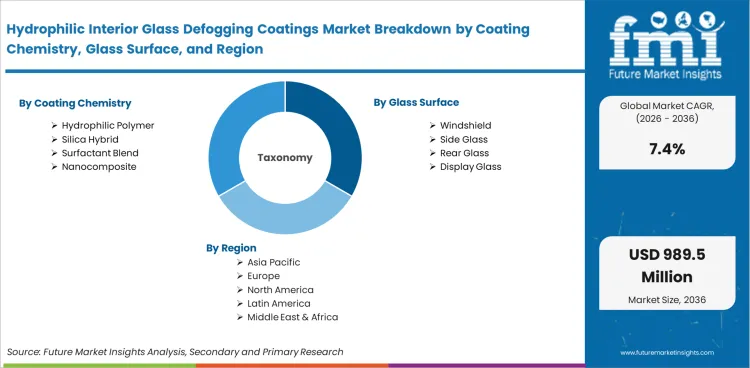
The market is divided into coating chemistry, glass surface, vehicle class, sales channel, application, and region.. Coating chemistry covers hydrophilic polymer and silica hybrid. Surfactant blend and nanocomposite systems are included as separate chemistry types. Glass surface covers windshield and side glass. Rear glass and display glass are covered. Vehicle class includes passenger cars and electric vehicles. Premium cars and light commercial vehicles are included. Sales channel includes OEM glazing and aftermarket retrofit. Application includes mist control and cabin visibility. Display clarity and moisture control are covered as separate application areas.
Insights into the Hydrophilic Polymer Coating Chemistry Segment
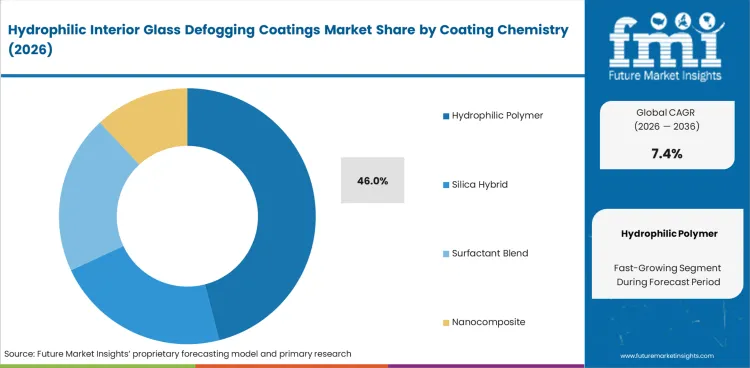
Hydrophilic Interior Glass Defogging Coatings Market Analysis By Coating Chemistry
- In 2026, hydrophilic polymer coatings are projected to account for 46.0% of coating chemistry as spread-film moisture control reduces visible droplets.
- Silica hybrid coatings serve premium cabin programs using harder surfaces. Hydrophilic polymer systems cover broader cabin humidity and mist events.
Insights into the Windshield Glass Surface Segment
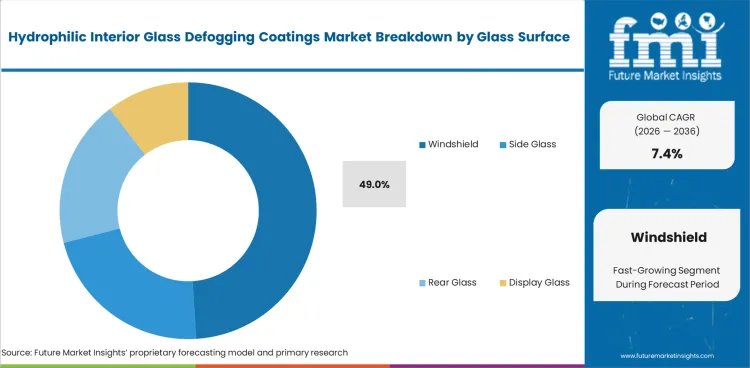
Hydrophilic Interior Glass Defogging Coatings Market Analysis By Glass Surface
- Windshield glass is expected to represent 49.0% of glass surface in 2026 due to validated driver visibility needs.
- Display glass follows windshield glass since touchscreens and cockpit displays need low-haze coating protection inside humid cabins.
Insights into the Passenger Cars Vehicle Class Segment
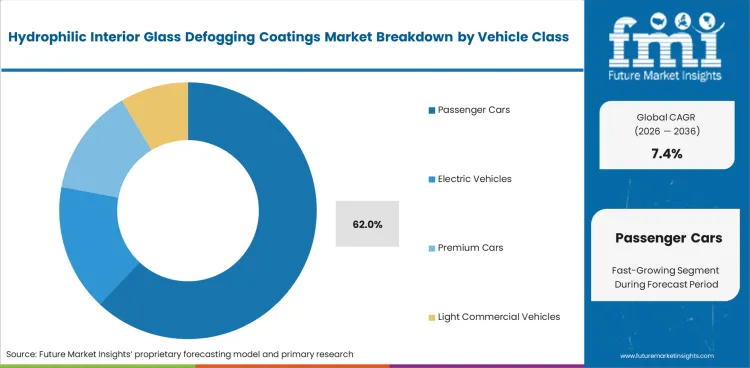
Hydrophilic Interior Glass Defogging Coatings Market Analysis By Vehicle Class
- Passenger cars are anticipated to represent 62.0% of vehicle class segment in 2026 since mass platforms create wider coating volume.
- Electric vehicle purchase is rising as glass-heavy cabin design increases need for hydrophilic coating performance.
Insights into the OEM Glazing Sales Channel Segment
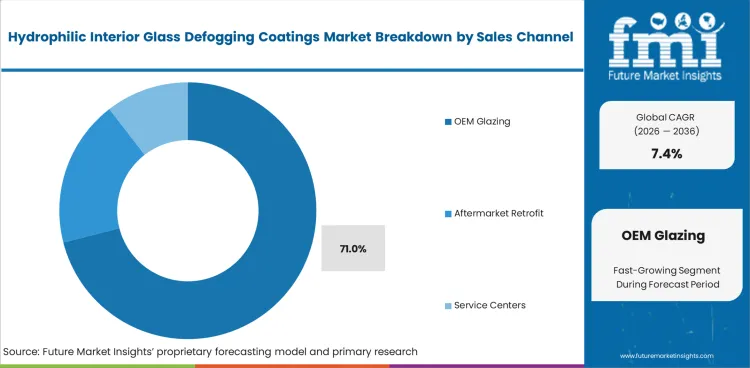
Hydrophilic Interior Glass Defogging Coatings Market Analysis By Sales Channel
- OEM glazing is expected to hold 71.0% share in 2026, supported by factory validation and platform approval.
- Aftermarket retrofit need is smaller since permanent interior glass coating needs surface control and careful application before use.
Insights into the Mist Control Application Segment
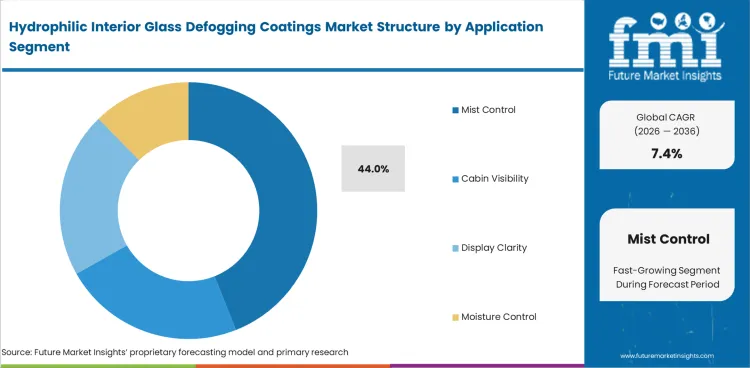
Hydrophilic Interior Glass Defogging Coatings Market Analysis By Application
- Mist control is projected to account for 44.0% of application in 2026 as cabin humidity affects daily windshield visibility.
- Demand for cabin visibility in premium EVs rises since glass clarity influences perceived interior quality and safety confidence.
Hydrophilic Interior Glass Defogging Coatings Market Drivers, Restraints, and Opportunities
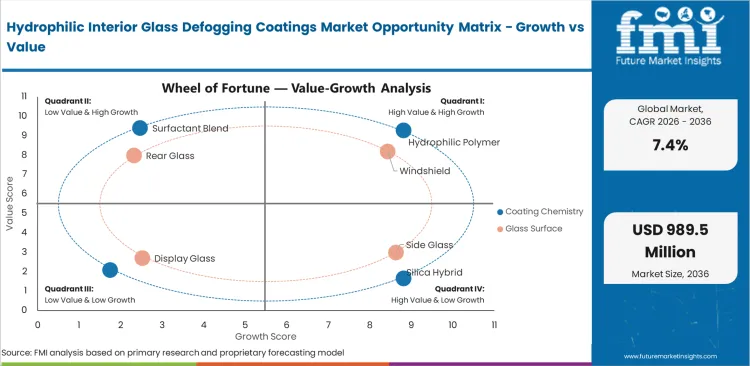
- Cabin mist control supports demand for coatings able to spread moisture without visual distortion.
- Larger EV glass surfaces support coating use as cabin interfaces shift toward display-rich designs.
- Wipe abrasion is a restraint since interior coating layers must survive cleaning and touch exposure.
- Display glass creates sales potential for suppliers offering fog control and low-haze screen surfaces.
- Safety visibility rules support coating validation as windshield defogging is part of regulated vehicle design.
Cabin Mist Control
Interior glass fogging generates demand for coating suppliers as moisture condenses on cold glass during short trips. Hydrophilic coatings reduce visible droplets by spreading water across the surface. Global EV sales topped 17 million units in 2024, creating more vehicles with energy-sensitive cabin systems. This supports coatings that reduce repeated blower use during fogging events. Automakers do not benefit from defogging alone. They need coatings preserving visibility and resisting wipe marks across the glass. Suppliers with proven mist-control performance can defend higher value inside OEM glazing programs.
Display Glass Creates Openings
Display glass programs are generating coating demand in vehicles with larger center screens. Passenger displays add cabin surfaces exposed to moisture and touch. Defogging coatings gain adoption when they work with display cover glass and automotive glass film structures. Coatings must avoid streaking and color shift across screen areas. These moves support closer links between smart interiors and moisture-control coating systems.
Hydrogen Safety Rules Are Resetting Entry Requirements
For hydrophilic interior glass defogging coatings, vehicle-level safety discussion is moving toward proven windshield visibility rather than broad anti-fog claims. NHTSA’s March 2026 proposal addresses FMVSS No. 103 on windshield defrosting and defogging systems. The proposal also covers FMVSS No. 104 on windshield wiping and washing systems for vehicles equipped with Automated Driving Systems. This matters for coating suppliers because cabin-side coatings must support visibility without adding haze, streaking, or driver-view distortion.
Metal Inputs Are Resetting Quote Risk
Quote risk in hydrophilic interior glass defogging coatings is tied to polymer, silica, surfactant, solvent, and application costs. Vehicle programs need optical clarity and wipe resistance before coatings receive approval. Suppliers quoting long OEM glazing programs need material adjustment terms and clear durability evidence. Coatings that fail haze, adhesion, or wiping tests can create rework costs for glass suppliers. Companies should expect shorter quote validity periods and closer cost review in coated interior glass sourcing.
Analysis of Hydrophilic Interior Glass Defogging Coatings Market By Key Countries
.webp "Top Country Growth Comparison Hydrophilic Interior Glass Defogging Coatings Market Cagr (2026 2036)")
| Country | CAGR |
|---|---|
| China | 8.8% |
| India | 8.5% |
| South Korea | 7.8% |
| United States | 7.2% |
| Germany | 6.9% |
| France | 6.7% |
| Japan | 6.6% |
Source: FMI analysis based on primary research and proprietary forecasting model.
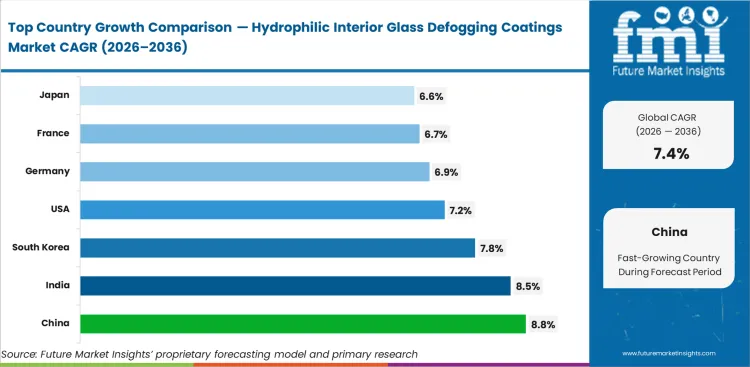
Hydrophilic Interior Glass Defogging Coatings CAGR Analysis By Country
- China is projected to progress at a CAGR of 8.8% by 2036, supported by EV output and smart cockpit adoption.
- India is projected to record a CAGR of 8.5% through 2036, with need connected to humid weather and passenger vehicle upgrades.
- South Korea is forecast to garner a CAGR of 7.8% during the assessment period, owing to EV and export vehicle programs.
- The United States is anticipated to expand at a CAGR of 7.2% over the forecast period, helped by safety visibility rules.
- Germany is projected to post a CAGR of 6.9% by 2036, with adoption due to premium OEM glass requirements.
- France is expected to advance at a CAGR of 6.7% through 2036, as EV platforms support selective fitment.
- Japan is expected to register a CAGR of 6.6% through 2036, with momentum coming from high-precision glazing.
Demand Outlook for Hydrophilic Interior Glass Defogging Coatings in China
Hydrophilic Interior Glass Defogging Coatings Market Country Value Analysis
China’s position is shaped by EV production depth and local automotive glass supply. These two factors allow faster approval for coated interior glass systems. China produced 34.531 million vehicles in 2025 through CAAM-reported industry data. This scale creates repeated opportunities for defogging coating trials across electric and premium models. Local EV platforms require higher-specification coatings for smart cockpit and driver visibility functions. China is projected at 8.8% CAGR by 2036 with EV and glazing supply supporting coated glass use. Local suppliers obtain orders when shorter validation cycles and lower service cost match automaker needs.
- Guangdong’s EV supplier base generates coated glass demand across smart cockpit and electronics supply chains.
- Shanghai premium vehicle activity creates interior glass need through design teams and high-end EV assembly.
- Chongqing and Hubei auto plants support repeat orders for qualified glass suppliers near vehicle production.
Sales Analysis of Hydrophilic Interior Glass Defogging Coatings in India
Hydrophilic Interior Glass Defogging Coatings Market Country Value Analysis
India is expected to expand at 8.5% CAGR through 2036 with passenger vehicle upgrades and humid driving conditions supporting coatings use. India’s sales base is shaped by monsoon visibility issues and local windshield supply. SIAM reported passenger vehicle sales of 4.3 million units in FY 2024 to 2025. This figure reflects direct opportunity for coated glass across higher trim vehicles. Electric cars and premium SUVs create early demand for hydrophilic coating systems. Companies often balance optical performance with price limits in India. Manufacturer opportunity improves when coating validation and local technical aid match automaker schedules.
- Haryana automotive manufacturers drives windshield program demand through Maruti Suzuki and supplier networks.
- Tamil Nadu EV and automotive plants aid coating use near Chennai and Hosur production belts.
- Maharashtra premium vehicle sales strengthen interior glass coating adoption across Mumbai and Pune dealer markets.
Opportunity Analysis of Hydrophilic Interior Glass Defogging Coatings in South Korea
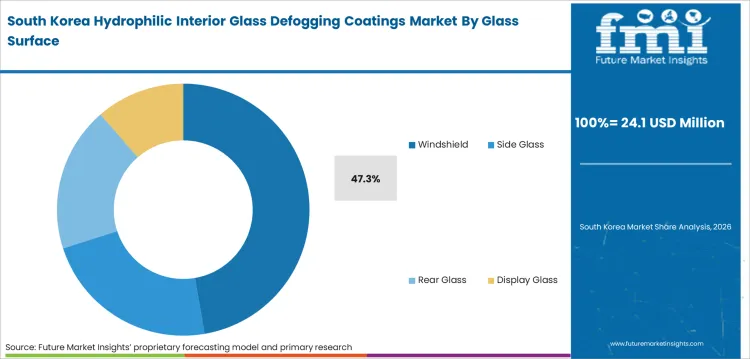
Hydrophilic Interior Glass Defogging Coatings Market Country Value Analysis
South Korea’s revenue is shaped by export-focused automakers and advanced cockpit electronics. Hyundai and Kia platforms generate demand for driver display functions across global vehicle lines. Korea’s vehicle production base supports coated glass qualification for Europe and North America. South Korea is forecast to expand at 7.8% CAGR through 2036 through export vehicle programs. Hydrophilic coatings serve these models through clarity and defogging performance. Suppliers need clean optical data and reliable coating durability to pass purchase checks.
- Ulsan supports Hyundai output and windshield supplier activity across global vehicle programs.
- Gyeonggi Province aids electronics and display suppliers serving cockpit technology development.
- Busan logistics access helps export vehicle supply chains needing stable glass delivery schedules.
Demand Analysis of Hydrophilic Interior Glass Defogging Coatings in the United States
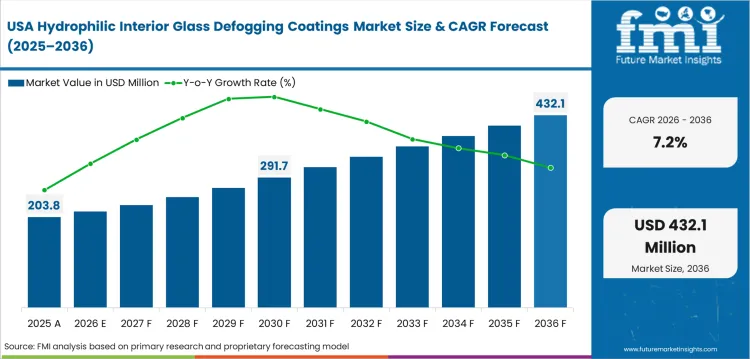
Hydrophilic Interior Glass Defogging Coatings Market Country Value Analysis
The United States has mature demand from premium SUVs and electric vehicle programs. Cold-weather states create product need through defogging and frost visibility needs. NHTSA’s March 2026 proposal kept windshield defrosting and defogging systems within the safety discussion for ADS vehicles. This raises attention on visibility systems across vehicle designs without manual controls. The United States is forecast to grow at 7.2% rate during the study period, supported by EV and SUV programs. Adoption rises because of cabin visibility expectations. Suppliers with abrasion-tested coatings can defend price premiums.
- Michigan engineering centers support coating validation for Detroit automaker windshield programs.
- Ohio automotive glass operations strengthen local glazing capacity for passenger vehicle programs.
- California EV programs aid interior glass coating use across premium electric models.
Future Outlook for Hydrophilic Interior Glass Defogging Coatings in Germany
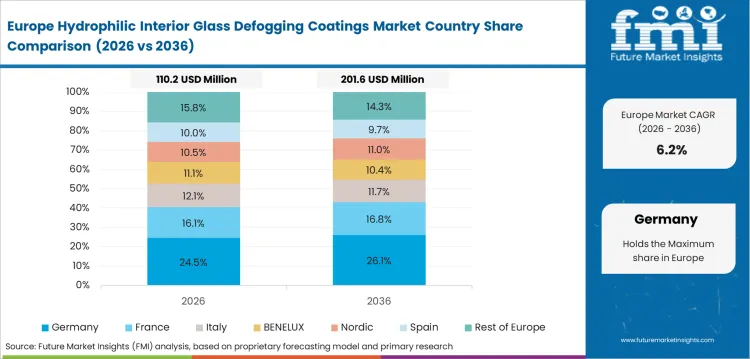
Hydrophilic Interior Glass Defogging Coatings Market Country Value Analysis
Germany is expected to advance at 6.9% CAGR through 2036 through premium OEM glass demand. Germany has higher relevance in premium vehicles using HUD windshields and advanced cabin glass systems. European BEV registration trends support ongoing qualification for interior glass coatings despite pressure on total vehicle output. Germany-based automakers focus on display quality and long-term coating reliability. Premium cockpit programs reinforce demand for low haze across windshield viewing zones. Suppliers able to meet strict durability testing is expected to obtain repeat orders from OEM platforms.
- Bavaria supports premium vehicle programs through BMW and related glazing supplier networks.
- Baden-Württemberg strengthens Mercedes-Benz and Porsche programs needing high optical performance.
- Lower Saxony reinforces Volkswagen platforms with scale across premium and mass-premium vehicles.
Demand Outlook for Hydrophilic Interior Glass Defogging Coatings in France
Hydrophilic Interior Glass Defogging Coatings Market Country Value Analysis
France creates selective demand through compact EV platforms and European safety expectations. ACEA reported EU battery-electric car share at 17.4% in 2025. This matters for France as regional EV platforms carry similar cabin comfort needs. France is forecast at 6.7% CAGR through 2036 as local automakers evaluate surface comfort features. Coating suppliers can compete by proving optical stability and application repeatability. Small wins on shared Europe-based platforms can create multi-country volume.
- Île-de-France fleet use generates demand for durable cabin visibility products across urban duty cycles.
- Hauts-de-France automotive plants support supplier access to glass and interior module programs.
- Winter humidity conditions increase windshield fog complaints during short commuter trips.
In-depth Analysis of Hydrophilic Interior Glass Defogging Coatings in Japan
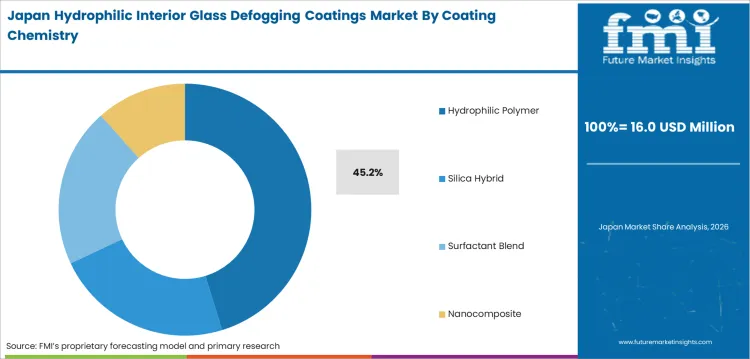
Hydrophilic Interior Glass Defogging Coatings Market Country Value Analysis
Japan’s market reflects high-precision glazing and careful vehicle qualification. JAMA reported 8.23 million motor vehicles produced in Japan during 2024. This production base supports coating demand even with slower output recovery. Japanese automakers often prefer proven materials and long backing records. Hydrophilic coatings are adopted in premium trims and advanced safety packages. Japan is projected to rise at 6.6% CAGR through 2036 as precision glazing and selective fitment aid stable sales. Suppliers must prove coating repeatability across humidity and abrasion testing cycles.
- Aichi automotive hubs support windshield coatings across Toyota-linked vehicle programs.
- Kanagawa allows Nissan engineering and supplier collaboration for cockpit display systems.
- Shiga and Chiba aid glass and materials production connected with advanced glazing supply.
Competitive Landscape and Strategic Positioning
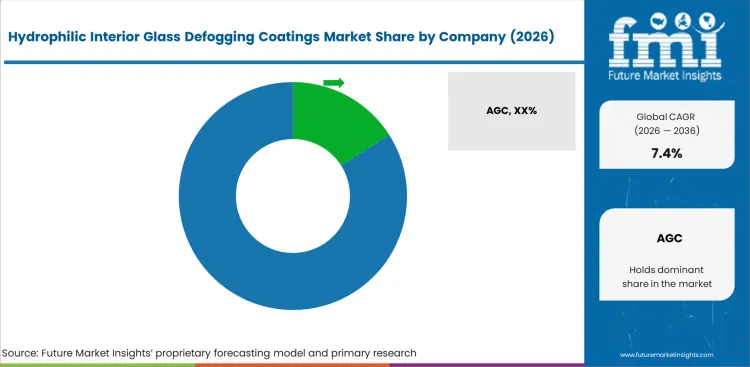
- The market is moderately concentrated with global glazing suppliers controlling large OEM glass programs.
- Smaller suppliers compete by coating chemistry and faster support for display-zone testing.
- Barriers to entry include optical validation and abrasion performance. OEM trust raises the entry threshold.
- Regional suppliers can win local vehicle programs if technical service and coating quality meet automaker needs.
Competitive strength begins with proof of coating performance across interior windshield and display glass systems. Automakers test haze and moisture behavior before approving suppliers. Abrasion durability and optical consistency decide final qualification. AGC supports advanced automotive glass through mobility glass and coating-related technologies. The company position indicates approved suppliers can secure repeat work after technical qualification. In passenger cars and electric vehicles, coating failure can create visibility issues and warranty exposure. Suppliers with validation depth and glass integration experience hold deeper positions in long-cycle accounts.
Established companies benefit from product breadth across automotive glazing and coating systems. Laminated windshield and interior display workflows create demand. Saint-Gobain Sekurit supports advanced glass programs through glass shaping and automotive glazing expertise. NSG Group competes through precision glass production and global automotive glass supply. PPG drives automotive coatings through chemistry depth and OEM relationships. That service range reduces switching risk for vehicle makers using automotive glass systems.
Specialist companies win orders through focused surface chemistry and functional film capabilities. Local support helps automakers reduce development delays. 3M has a defined position in films and specialty surface products. Nanofilm and FIC compete through anti-fog and surface treatment products. Specialist suppliers perform better in retrofit accounts needing quick sampling and installer-ready coating packs.
Entry is difficult because interior glass coatings must work inside existing vehicle approval systems. Compatibility with laminated glass and display surfaces creates a technical hurdle for new entrants. A supplier can make an anti-fog coating but fail purchase checks on haze control. Premium and EV customers need durability data across cleaning and humidity cycles. Automotive companies need support knowledge for glass design and optical validation. The strongest suppliers combine coating reliability with application support during specification. This creates competition based on trust and approved glass history.
Key Companies in the Hydrophilic Interior Glass Defogging Coatings Market
Hydrophilic coating competition includes global glazing suppliers, coating specialists, and regional application partners.
- Global Glazing Suppliers: AGC and Saint-Gobain Sekurit strengthen positioning through glass technology depth and OEM program access. AGC supports mobility glass performance through coating and glass integration. Saint-Gobain Sekurit serves advanced automotive glass users through glazing and cabin comfort know-how. NSG Group contributes automotive glass production through precision manufacturing capability.
- Coating Specialists: PPG and 3M maintain edge through coating chemistry and surface material expertise. PPG serves automotive coatings across vehicle programs and finish systems. 3M supports films and specialty materials used across vehicle surfaces. Their edge is highest in programs needing durability and compatibility with glass structures.
- Regional Application Partners: Nanofilm and Aculon compete through surface treatment knowledge and smaller program flexibility. These companies are better positioned if buyers need fast technical support and application-specific coating formats. Their opportunity improves in aftermarket retrofit and service-driven channels.
Competitive Benchmarking: Hydrophilic Interior Glass Defogging Coatings Market
| Company | Wetting Chemistry Depth | Coating Durability Support | OEM Glazing Access | Geographic Footprint |
|---|---|---|---|---|
| AGC | High | High | High | Global |
| Saint-Gobain Sekurit | High | High | High | Global |
| NSG Group | High | Medium | High | Global |
| PPG | High | High | High | Global |
| 3M | Medium | High | Medium | Global |
| Nanofilm | Medium | Medium | Low | North America |
| FIC | Medium | Medium | Low | Asia |
| Aculon | Medium | Medium | Moderate | North America and Europe |
Source: Future Market Insights competitive analysis, 2026. Ratings reflect relative positioning based on Wetting Chemistry Depth, Coating Durability Support, and OEM Glazing Access.
Key Developments in Hydrophilic Interior Glass Defogging Coatings Market
- In March 2025, PPG opened an automotive coatings color innovation studio in Tianjin, China. This supports closer coating development work near Chinese OEM programs.
- In October 2025, PPG received Stellantis 2025 Supplier of the Year recognition in Body and Interior. This reinforces buyer trust in automotive coating capability.
- In December 2023, AGC announced CES mobility glass solutions covering detection, connection, and comfort. This supports interior glass function development.
- In 2026, Saint-Gobain highlighted anti-fog solutions for transparencies with reduced heating energy consumption. This supports passive visibility control use cases.
Key Players in the Hydrophilic Interior Glass Defogging Coatings Market
Global Glazing Suppliers
- AGC
- Saint-Gobain Sekurit
- NSG Group
Coating Specialists
- PPG
- 3M
- Aculon
Regional Application Partners
- Nanofilm
- FIC
- Automotive glass service chains
Report Scope and Coverage
|
Parameter |
Details |
|
Quantitative Units |
USD 451.2 million in 2026 to USD 919.9 million by 2036, at 7.4% CAGR |
|
Market Definition |
Durable hydrophilic coating systems used on interior automotive glass surfaces for fog control |
|
Regions Covered |
North America, Latin America, Europe, East Asia, South Asia and Pacific, Middle East and Africa |
|
Countries Covered |
China, India, South Korea, United States, Germany, France, Japan, and 30+ countries |
|
Key Companies Profiled |
AGC, Saint-Gobain Sekurit, NSG Group, PPG, 3M, Nanofilm, FIC, Aculon |
|
Forecast Period |
2026 to 2036 |
|
Approach |
Hybrid bottom-up and top-down method using vehicle production, coating pricing, glass surface area, and country demand checks |
Hydrophilic Interior Glass Defogging Coatings Market Breakdown By Coating Chemistry, Glass Surface, Vehicle Class, Sales Channel, Application, and Region
Hydrophilic Interior Glass Defogging Coatings Market Segmented by Coating Chemistry:
- Hydrophilic Polymer
- Silica Hybrid
- Surfactant Blend
- Nanocomposite
Hydrophilic Interior Glass Defogging Coatings Market Segmented by Glass Surface:
- Windshield
- Side Glass
- Rear Glass
- Display Glass
Hydrophilic Interior Glass Defogging Coatings Market Segmented by Vehicle Class:
- Passenger Cars
- Electric Vehicles
- Premium Cars
- Light Commercial Vehicles
Hydrophilic Interior Glass Defogging Coatings Market Segmented by Sales Channel:
- OEM Glazing
- Aftermarket Retrofit
- Service Centers
Hydrophilic Interior Glass Defogging Coatings Market Segmented by Application:
- Mist Control
- Cabin Visibility
- Display Clarity
- Moisture Control
Hydrophilic Interior Glass Defogging Coatings Market by Region:
- North America
- United States
- Canada
- Mexico
- Latin America
- Brazil
- Chile
- Rest of Latin America
- Western Europe
- Germany
- UK
- Italy
- Spain
- France
- Nordic
- BENELUX
- Rest of Western Europe
- Eastern Europe
- Russia
- Poland
- Hungary
- Balkan and Baltic
- Rest of Eastern Europe
- East Asia
- China
- Japan
- South Korea
- South Asia and Pacific
- India
- ASEAN
- Australia and New Zealand
- Rest of South Asia and Pacific
- Middle East and Africa
- Kingdom of Saudi Arabia
- Other GCC Countries
- Turkiye
- South Africa
- Other African Union
- Rest of Middle East and Africa
Research Sources and Bibliography
- National Highway Traffic Safety Administration. (2026, March 16). Federal Motor Vehicle Safety Standards; Modernization of FMVSS No. 103 and FMVSS No. 104 to Accommodate ADS-Equipped Vehicles; Incorporation by Reference. Federal Register.
- International Energy Agency. (2025, May 14). Global EV Outlook 2025. IEA.
- National Highway Traffic Safety Administration. (2026, March 16). Federal Motor Vehicle Safety Standards; Modernization of FMVSS No. 103 and FMVSS No. 104 to accommodate vehicles equipped with automated driving systems. Federal Register.
- China Association of Automobile Manufacturers. (2026, January 14). China’s auto output, sales reach new highs in 2025. The State Council of the People’s Republic of China.
- Society of Indian Automobile Manufacturers. (2025, August 28). SIAM Annual Report 2024-25. SIAM.
- European Automobile Manufacturers’ Association. (2026, January 27). New car registrations: +1.8% in 2025; battery-electric 17.4% market share. ACEA.
- European Automobile Manufacturers’ Association. (2026, January 27). Press release: New car registrations, European Union. ACEA.
- Japan Automobile Manufacturers Association. (2025, September 26). The Motor Industry of Japan 2025. JAMA.
- Korea Automobile & Mobility Association. (2025, January 24). Domestic sales, exports and production: December 2024. KAMA.
- PPG. (2025, March 27). PPG opens automotive coatings color innovation studio in China. PPG Investor Relations.
- PPG. (2025, October 30). PPG recognized by Stellantis as a 2025 Supplier of the Year. PPG Newsroom.
- Saint-Gobain Aerospace. (2026). Antifog solution for transparencies. Saint-Gobain Aerospace.
- Stellantis. (2025, October 29). Stellantis recognizes 54 global suppliers at fifth annual Supplier of the Year ceremony in Paris. Stellantis.
The bibliography is provided for reader reference and uses trade body data, regulatory publications, and official company sources.
This Report Answers
- What is the projected size of Hydrophilic Interior Glass Defogging Coatings in 2026 and 2036?
- Which CAGR is forecast for Hydrophilic Interior Glass Defogging Coatings demand between 2026 and 2036?
- Which coating chemistry is projected to lead interior glass defogging coating demand in 2026?
- Which glass surface is expected to account for the highest share in 2026?
- Which countries are forecast to record faster hydrophilic coating expansion through 2036?
- Which companies hold deeper positions in automotive glass and anti-fog coating systems?
- Which coating types are included and excluded from this interior glass coating scope?
- Which vehicle classes shape coating validation and factory glazing demand?
- Which methodology supports FMI’s market size and country-level forecast view?
Frequently Asked Questions
What is the global demand for Hydrophilic Interior Glass Defogging Coatings in 2026?
In 2026, the global market is expected to be worth USD 451.2 million through wider OEM glass use.
What is the projected value of the market by 2036?
By 2036, valuation is projected to reach USD 919.9 million as interior glass coating use expands.
What CAGR is expected for the market between 2026 and 2036?
The market is forecast to expand at 7.4% CAGR between 2026 and 2036 across automotive applications.
Which coating chemistry is projected to lead in 2026?
Hydrophilic polymer coatings are projected to account for 46.0% share in 2026 through broad mist-control use.
Which glass surface is expected to lead in 2026?
Windshield glass is expected to represent 49.0% share in 2026 because of driver visibility needs.
Which country is forecast to expand fastest through 2036?
China is projected to record 8.8% CAGR through 2036 as EV output supports coated glass demand.
What is included in this market?
The scope includes durable hydrophilic coating systems used on interior automotive glass surfaces for fog control.
What method supports the forecast?
FMI used vehicle production and country demand checks to validate the forecast.
Preview the report firsthand - request a free sample
Get SampleGet the brochure for pricing and purchase details.
Get PDFTable of Content
- Executive Summary
- Global Market Outlook
- Demand-side Trends
- Supply-side Trends
- Technology Roadmap Analysis
- Analysis and Recommendations
- Market Overview
- Market Coverage / Taxonomy
- Market Definition / Scope / Limitations
- Research Methodology
- Chapter Orientation
- Analytical Lens and Working Hypotheses
- Market Structure, Signals, and Trend Drivers
- Benchmarking and Cross-market Comparability
- Market Sizing, Forecasting, and Opportunity Mapping
- Research Design and Evidence Framework
- Desk Research Programme (Secondary Evidence)
- Company Annual and Sustainability Reports
- Peer-reviewed Journals and Academic Literature
- Corporate Websites, Product Literature, and Technical Notes
- Earnings Decks and Investor Briefings
- Statutory Filings and Regulatory Disclosures
- Technical White Papers and Standards Notes
- Trade Journals, Industry Magazines, and Analyst Briefs
- Conference Proceedings, Webinars, and Seminar Materials
- Government Statistics Portals and Public Data Releases
- Press Releases and Reputable Media Coverage
- Specialist Newsletters and Curated Briefings
- Sector Databases and Reference Repositories
- FMI Internal Proprietary Databases and Historical Market Datasets
- Subscription Datasets and Paid Sources
- Social Channels, Communities, and Digital Listening Inputs
- Additional Desk Sources
- Expert Input and Fieldwork (Primary Evidence)
- Primary Modes
- Qualitative Interviews and Expert Elicitation
- Quantitative Surveys and Structured Data Capture
- Blended Approach
- Why Primary Evidence is Used
- Field Techniques
- Interviews
- Surveys
- Focus Groups
- Observational and In-context Research
- Social and Community Interactions
- Stakeholder Universe Engaged
- C-suite Leaders
- Board Members
- Presidents and Vice Presidents
- R&D and Innovation Heads
- Technical Specialists
- Domain Subject-matter Experts
- Scientists
- Physicians and Other Healthcare Professionals
- Governance, Ethics, and Data Stewardship
- Research Ethics
- Data Integrity and Handling
- Primary Modes
- Tooling, Models, and Reference Databases
- Desk Research Programme (Secondary Evidence)
- Data Engineering and Model Build
- Data Acquisition and Ingestion
- Cleaning, Normalisation, and Verification
- Synthesis, Triangulation, and Analysis
- Quality Assurance and Audit Trail
- Market Background
- Market Dynamics
- Drivers
- Restraints
- Opportunity
- Trends
- Scenario Forecast
- Demand in Optimistic Scenario
- Demand in Likely Scenario
- Demand in Conservative Scenario
- Opportunity Map Analysis
- Product Life Cycle Analysis
- Supply Chain Analysis
- Investment Feasibility Matrix
- Value Chain Analysis
- PESTLE and Porter’s Analysis
- Regulatory Landscape
- Regional Parent Market Outlook
- Production and Consumption Statistics
- Import and Export Statistics
- Market Dynamics
- Global Market Analysis 2021 to 2025 and Forecast, 2026 to 2036
- Historical Market Size Value (USD Million) Analysis, 2021 to 2025
- Current and Future Market Size Value (USD Million) Projections, 2026 to 2036
- Y-o-Y Growth Trend Analysis
- Absolute $ Opportunity Analysis
- Global Market Pricing Analysis 2021 to 2025 and Forecast 2026 to 2036
- Global Market Analysis 2021 to 2025 and Forecast 2026 to 2036, By Coating Chemistry
- Introduction / Key Findings
- Historical Market Size Value (USD Million) Analysis By Coating Chemistry , 2021 to 2025
- Current and Future Market Size Value (USD Million) Analysis and Forecast By Coating Chemistry , 2026 to 2036
- Hydrophilic Polymer
- Silica Hybrid
- Surfactant Blend
- Nanocomposite
- Hydrophilic Polymer
- Y-o-Y Growth Trend Analysis By Coating Chemistry , 2021 to 2025
- Absolute $ Opportunity Analysis By Coating Chemistry , 2026 to 2036
- Global Market Analysis 2021 to 2025 and Forecast 2026 to 2036, By Glass Surface
- Introduction / Key Findings
- Historical Market Size Value (USD Million) Analysis By Glass Surface, 2021 to 2025
- Current and Future Market Size Value (USD Million) Analysis and Forecast By Glass Surface, 2026 to 2036
- Windshield
- Side Glass
- Rear Glass
- Display Glass
- Windshield
- Y-o-Y Growth Trend Analysis By Glass Surface, 2021 to 2025
- Absolute $ Opportunity Analysis By Glass Surface, 2026 to 2036
- Global Market Analysis 2021 to 2025 and Forecast 2026 to 2036, By Vehicle Class
- Introduction / Key Findings
- Historical Market Size Value (USD Million) Analysis By Vehicle Class, 2021 to 2025
- Current and Future Market Size Value (USD Million) Analysis and Forecast By Vehicle Class, 2026 to 2036
- Passenger Cars
- Electric Vehicles
- Premium Cars
- Light Commercial Vehicles
- Passenger Cars
- Y-o-Y Growth Trend Analysis By Vehicle Class, 2021 to 2025
- Absolute $ Opportunity Analysis By Vehicle Class, 2026 to 2036
- Global Market Analysis 2021 to 2025 and Forecast 2026 to 2036, By Sales Channel
- Introduction / Key Findings
- Historical Market Size Value (USD Million) Analysis By Sales Channel, 2021 to 2025
- Current and Future Market Size Value (USD Million) Analysis and Forecast By Sales Channel, 2026 to 2036
- OEM Glazing
- Aftermarket Retrofit
- Service Centers
- OEM Glazing
- Y-o-Y Growth Trend Analysis By Sales Channel, 2021 to 2025
- Absolute $ Opportunity Analysis By Sales Channel, 2026 to 2036
- Global Market Analysis 2021 to 2025 and Forecast 2026 to 2036, By Application
- Introduction / Key Findings
- Historical Market Size Value (USD Million) Analysis By Application, 2021 to 2025
- Current and Future Market Size Value (USD Million) Analysis and Forecast By Application, 2026 to 2036
- Mist Control
- Cabin Visibility
- Display Clarity
- Moisture Control
- Mist Control
- Y-o-Y Growth Trend Analysis By Application, 2021 to 2025
- Absolute $ Opportunity Analysis By Application, 2026 to 2036
- Global Market Analysis 2021 to 2025 and Forecast 2026 to 2036, By Region
- Introduction
- Historical Market Size Value (USD Million) Analysis By Region, 2021 to 2025
- Current Market Size Value (USD Million) Analysis and Forecast By Region, 2026 to 2036
- North America
- Latin America
- Western Europe
- Eastern Europe
- East Asia
- South Asia and Pacific
- Middle East & Africa
- Market Attractiveness Analysis By Region
- North America Market Analysis 2021 to 2025 and Forecast 2026 to 2036, By Country
- Historical Market Size Value (USD Million) Trend Analysis By Market Taxonomy, 2021 to 2025
- Market Size Value (USD Million) Forecast By Market Taxonomy, 2026 to 2036
- By Country
- USA
- Canada
- Mexico
- By Coating Chemistry
- By Glass Surface
- By Vehicle Class
- By Sales Channel
- By Application
- By Country
- Market Attractiveness Analysis
- By Country
- By Coating Chemistry
- By Glass Surface
- By Vehicle Class
- By Sales Channel
- By Application
- Key Takeaways
- Latin America Market Analysis 2021 to 2025 and Forecast 2026 to 2036, By Country
- Historical Market Size Value (USD Million) Trend Analysis By Market Taxonomy, 2021 to 2025
- Market Size Value (USD Million) Forecast By Market Taxonomy, 2026 to 2036
- By Country
- Brazil
- Chile
- Rest of Latin America
- By Coating Chemistry
- By Glass Surface
- By Vehicle Class
- By Sales Channel
- By Application
- By Country
- Market Attractiveness Analysis
- By Country
- By Coating Chemistry
- By Glass Surface
- By Vehicle Class
- By Sales Channel
- By Application
- Key Takeaways
- Western Europe Market Analysis 2021 to 2025 and Forecast 2026 to 2036, By Country
- Historical Market Size Value (USD Million) Trend Analysis By Market Taxonomy, 2021 to 2025
- Market Size Value (USD Million) Forecast By Market Taxonomy, 2026 to 2036
- By Country
- Germany
- UK
- Italy
- Spain
- France
- Nordic
- BENELUX
- Rest of Western Europe
- By Coating Chemistry
- By Glass Surface
- By Vehicle Class
- By Sales Channel
- By Application
- By Country
- Market Attractiveness Analysis
- By Country
- By Coating Chemistry
- By Glass Surface
- By Vehicle Class
- By Sales Channel
- By Application
- Key Takeaways
- Eastern Europe Market Analysis 2021 to 2025 and Forecast 2026 to 2036, By Country
- Historical Market Size Value (USD Million) Trend Analysis By Market Taxonomy, 2021 to 2025
- Market Size Value (USD Million) Forecast By Market Taxonomy, 2026 to 2036
- By Country
- Russia
- Poland
- Hungary
- Balkan & Baltic
- Rest of Eastern Europe
- By Coating Chemistry
- By Glass Surface
- By Vehicle Class
- By Sales Channel
- By Application
- By Country
- Market Attractiveness Analysis
- By Country
- By Coating Chemistry
- By Glass Surface
- By Vehicle Class
- By Sales Channel
- By Application
- Key Takeaways
- East Asia Market Analysis 2021 to 2025 and Forecast 2026 to 2036, By Country
- Historical Market Size Value (USD Million) Trend Analysis By Market Taxonomy, 2021 to 2025
- Market Size Value (USD Million) Forecast By Market Taxonomy, 2026 to 2036
- By Country
- China
- Japan
- South Korea
- By Coating Chemistry
- By Glass Surface
- By Vehicle Class
- By Sales Channel
- By Application
- By Country
- Market Attractiveness Analysis
- By Country
- By Coating Chemistry
- By Glass Surface
- By Vehicle Class
- By Sales Channel
- By Application
- Key Takeaways
- South Asia and Pacific Market Analysis 2021 to 2025 and Forecast 2026 to 2036, By Country
- Historical Market Size Value (USD Million) Trend Analysis By Market Taxonomy, 2021 to 2025
- Market Size Value (USD Million) Forecast By Market Taxonomy, 2026 to 2036
- By Country
- India
- ASEAN
- Australia & New Zealand
- Rest of South Asia and Pacific
- By Coating Chemistry
- By Glass Surface
- By Vehicle Class
- By Sales Channel
- By Application
- By Country
- Market Attractiveness Analysis
- By Country
- By Coating Chemistry
- By Glass Surface
- By Vehicle Class
- By Sales Channel
- By Application
- Key Takeaways
- Middle East & Africa Market Analysis 2021 to 2025 and Forecast 2026 to 2036, By Country
- Historical Market Size Value (USD Million) Trend Analysis By Market Taxonomy, 2021 to 2025
- Market Size Value (USD Million) Forecast By Market Taxonomy, 2026 to 2036
- By Country
- Kingdom of Saudi Arabia
- Other GCC Countries
- Turkiye
- South Africa
- Other African Union
- Rest of Middle East & Africa
- By Coating Chemistry
- By Glass Surface
- By Vehicle Class
- By Sales Channel
- By Application
- By Country
- Market Attractiveness Analysis
- By Country
- By Coating Chemistry
- By Glass Surface
- By Vehicle Class
- By Sales Channel
- By Application
- Key Takeaways
- Key Countries Market Analysis
- USA
- Pricing Analysis
- Market Share Analysis, 2025
- By Coating Chemistry
- By Glass Surface
- By Vehicle Class
- By Sales Channel
- By Application
- Canada
- Pricing Analysis
- Market Share Analysis, 2025
- By Coating Chemistry
- By Glass Surface
- By Vehicle Class
- By Sales Channel
- By Application
- Mexico
- Pricing Analysis
- Market Share Analysis, 2025
- By Coating Chemistry
- By Glass Surface
- By Vehicle Class
- By Sales Channel
- By Application
- Brazil
- Pricing Analysis
- Market Share Analysis, 2025
- By Coating Chemistry
- By Glass Surface
- By Vehicle Class
- By Sales Channel
- By Application
- Chile
- Pricing Analysis
- Market Share Analysis, 2025
- By Coating Chemistry
- By Glass Surface
- By Vehicle Class
- By Sales Channel
- By Application
- Germany
- Pricing Analysis
- Market Share Analysis, 2025
- By Coating Chemistry
- By Glass Surface
- By Vehicle Class
- By Sales Channel
- By Application
- UK
- Pricing Analysis
- Market Share Analysis, 2025
- By Coating Chemistry
- By Glass Surface
- By Vehicle Class
- By Sales Channel
- By Application
- Italy
- Pricing Analysis
- Market Share Analysis, 2025
- By Coating Chemistry
- By Glass Surface
- By Vehicle Class
- By Sales Channel
- By Application
- Spain
- Pricing Analysis
- Market Share Analysis, 2025
- By Coating Chemistry
- By Glass Surface
- By Vehicle Class
- By Sales Channel
- By Application
- France
- Pricing Analysis
- Market Share Analysis, 2025
- By Coating Chemistry
- By Glass Surface
- By Vehicle Class
- By Sales Channel
- By Application
- India
- Pricing Analysis
- Market Share Analysis, 2025
- By Coating Chemistry
- By Glass Surface
- By Vehicle Class
- By Sales Channel
- By Application
- ASEAN
- Pricing Analysis
- Market Share Analysis, 2025
- By Coating Chemistry
- By Glass Surface
- By Vehicle Class
- By Sales Channel
- By Application
- Australia & New Zealand
- Pricing Analysis
- Market Share Analysis, 2025
- By Coating Chemistry
- By Glass Surface
- By Vehicle Class
- By Sales Channel
- By Application
- China
- Pricing Analysis
- Market Share Analysis, 2025
- By Coating Chemistry
- By Glass Surface
- By Vehicle Class
- By Sales Channel
- By Application
- Japan
- Pricing Analysis
- Market Share Analysis, 2025
- By Coating Chemistry
- By Glass Surface
- By Vehicle Class
- By Sales Channel
- By Application
- South Korea
- Pricing Analysis
- Market Share Analysis, 2025
- By Coating Chemistry
- By Glass Surface
- By Vehicle Class
- By Sales Channel
- By Application
- Russia
- Pricing Analysis
- Market Share Analysis, 2025
- By Coating Chemistry
- By Glass Surface
- By Vehicle Class
- By Sales Channel
- By Application
- Poland
- Pricing Analysis
- Market Share Analysis, 2025
- By Coating Chemistry
- By Glass Surface
- By Vehicle Class
- By Sales Channel
- By Application
- Hungary
- Pricing Analysis
- Market Share Analysis, 2025
- By Coating Chemistry
- By Glass Surface
- By Vehicle Class
- By Sales Channel
- By Application
- Kingdom of Saudi Arabia
- Pricing Analysis
- Market Share Analysis, 2025
- By Coating Chemistry
- By Glass Surface
- By Vehicle Class
- By Sales Channel
- By Application
- Turkiye
- Pricing Analysis
- Market Share Analysis, 2025
- By Coating Chemistry
- By Glass Surface
- By Vehicle Class
- By Sales Channel
- By Application
- South Africa
- Pricing Analysis
- Market Share Analysis, 2025
- By Coating Chemistry
- By Glass Surface
- By Vehicle Class
- By Sales Channel
- By Application
- USA
- Market Structure Analysis
- Competition Dashboard
- Competition Benchmarking
- Market Share Analysis of Top Players
- By Regional
- By Coating Chemistry
- By Glass Surface
- By Vehicle Class
- By Sales Channel
- By Application
- Competition Analysis
- Competition Deep Dive
- AGC
- Overview
- Product Portfolio
- Profitability by Market Segments (Product/Age /Sales Channel/Region)
- Sales Footprint
- Strategy Overview
- Marketing Strategy
- Product Strategy
- Channel Strategy
- Saint-Gobain Sekurit
- NSG Group
- PPG
- 3M
- Nanofilm
- FIC
- Aculon
- AGC
- Competition Deep Dive
- Assumptions & Acronyms Used


