

- Industry Size (2026)
- USD 2840.0 Mn
- Forecast (2036)
- USD 9640.6 Mn
- CAGR (2026 to 2036)
- 13.0%
Investment & Financing Models for PCR Innovation Market Forecast and Outlook 2026 to 2036
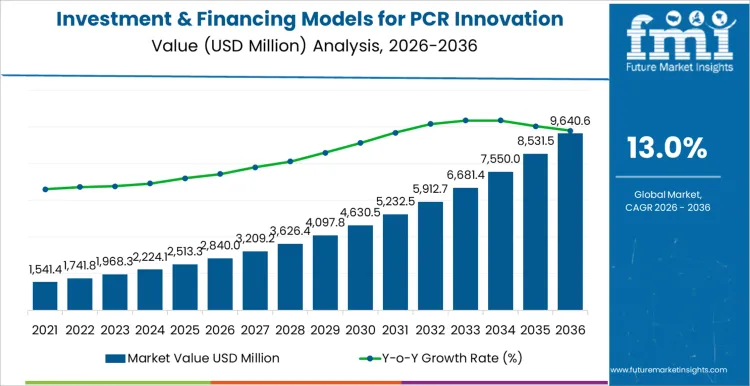
The investment & financing models for PCR innovation market is set to reach USD 2,840.0 million in 2026 and is forecasted to reach USD 9,640.6 million by 2036, at a CAGR of 13.0% over the assessment period. Capital deployment is increasing as advanced recycling technologies, high-purity PCR production, and circular material platforms require long gestation periods and high upfront investment. Financing demand is strongest where innovation risk, infrastructure intensity, and policy-driven recycled content targets intersect, particularly across packaging, automotive, and durable goods value chains. Venture and growth equity models dominate early and mid-stage funding, enabling technology validation, capacity expansion, and accelerated commercialization of novel PCR pathways.
Momentum is reinforced by evolving risk-sharing structures that align technology developers, brand owners, and financial institutions. Blended finance, state-backed loans, and sustainability-linked instruments reduce exposure to feedstock variability, regulatory uncertainty, and PCR price volatility. Long-term offtake agreements and brand-backed demand signals improve bankability, supporting transition from pilot facilities to industrial-scale operations. Financing decisions increasingly integrate technology readiness, regulatory alignment, and supply chain resilience rather than short-term return metrics alone. As recycled content mandates tighten and material performance expectations rise, structured financing becomes a critical enabler for scaling PCR innovation beyond experimental deployments into stable, commercially viable infrastructure.
Quick Stats for Investment & Financing Models for PCR Innovation Market
- Investment & Financing Models for PCR Innovation Market Value (2026): USD 2,840.0 million
- Investment & Financing Models for PCR Innovation Market Forecast Value (2036): USD 9,640.6 million
- Investment & Financing Models for PCR Innovation Market Forecast CAGR (2026 to 2036): 13.0%
- Leading Financing Model by Demand Share: Venture & growth equity
- Fastest-Growing Countries: India, China, USA, Brazil, Germany
- Top Players in Global Demand: Closed Loop Partners, Breakthrough Energy Ventures, European Investment Bank, KfW, China Development Bank
Investment & Financing Models for PCR Innovation Market Key Takeaways
| Metric | Value |
|---|---|
| Market Value (2026) | USD 2,840.0 million |
| Market Forecast Value (2036) | USD 9,640.6 million |
| Forecast CAGR (2026 to 2036) | 13.0% |
Why is the Demand for Investment & Financing Models for PCR Innovation Growing?
Investment and financing models for PCR innovation are attracting attention as companies and financiers confront barriers to scaling advanced recycling and high-quality post-consumer recycled (PCR) material production. Polymer reclamation facilities with solvent-based, depolymerization, and enhanced sorting technologies require significant capital outlay early in their lifecycle. Strategic investors, venture arms of large consumer goods brands, and project finance teams are structuring agreements that share risk across technology developers and end users needing consistent PCR output. Corporate sustainability departments incorporate dedicated funding streams to accelerate implementation of proprietary recycling systems that deliver engineered recyclate suitable for packaging, automotive, and durable goods applications with stringent performance specifications.
Public and private financing mechanisms are evolving in response to policy incentives and recycled content targets that influence capital deployment decisions. Regions with mandated recycled content thresholds or tax credits tied to PCR utilization motivate blended finance structures that combine grants, low interest loans, and performance-linked returns. Lenders assess feedstock availability, off-take agreements with converters, and material quality forecasts when determining credit terms for PCR innovation projects. Collaboration between design engineers, materials scientists, and investment analysts enhances due diligence, enabling financing that aligns technical maturity with commercial viability for next generation PCR solutions.
How Is the Investment and Financing Models for PCR Innovation Industry Segmented by Financing Model, Target Area, and End Use?
Investment activity in PCR innovation is shaped by capital intensity, technology maturity, and policy-driven sustainability objectives. Financiers evaluate risk profiles based on feedstock security, regulatory alignment, and scalability of recycling technologies. Funding structures vary depending on development stage, return horizon, and strategic control considerations. Segmentation by financing model, target area, and end use explains how capital allocation supports technology deployment, infrastructure build-out, and commercialization of PCR solutions across the circular economy value chain.
Which Financing Model Represents the Largest Share in PCR Innovation Funding?
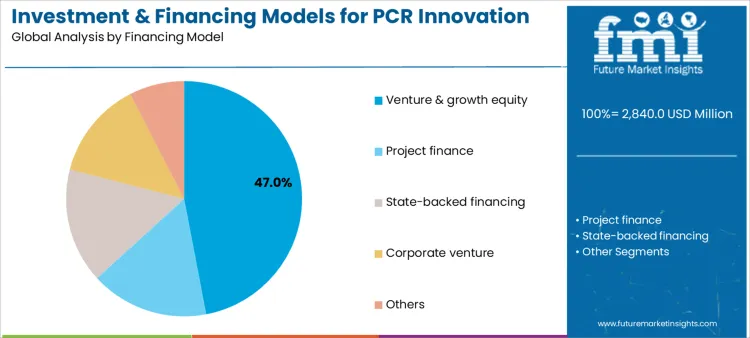
Venture and growth equity account for 47.0%, reflecting strong interest in scaling emerging PCR technologies and platforms. These investments support technology validation, capacity expansion, and market entry acceleration. Project finance, state-backed financing, corporate venture participation, and other models address differing risk appetites and ownership structures without disclosed share values. Financing-model segmentation highlights preference for equity-led funding where innovation speed, governance influence, and upside participation remain priorities for investors backing PCR advancement.
Key Points:
- Venture capital supports rapid PCR technology scaling.
- Equity models align with innovation-driven risk profiles.
- Alternative financing structures address infrastructure-heavy needs.
How Do Target Areas Influence Allocation of PCR Innovation Capital?
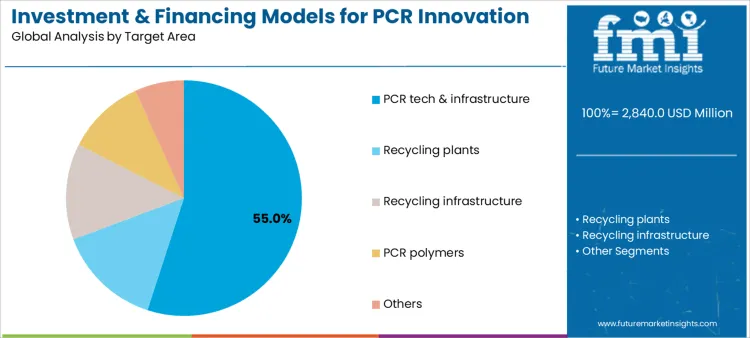
PCR technology and infrastructure represent 55.0%, driven by need to commercialize advanced sorting, recycling, and compounding systems. Capital deployment prioritizes assets that improve material purity, yield, and regulatory compliance. Recycling plants, broader recycling infrastructure, PCR polymer development, and other areas attract funding based on regional demand and policy incentives without quantified shares. Target-area segmentation reflects focus on foundational capabilities that enable downstream PCR adoption across packaging, automotive, and consumer goods industries.
Key Points:
- Technology and infrastructure attract majority of investment focus.
- Capital targets improvements in purity and scalability.
- Upstream capability development enables downstream adoption.
Which End Uses Drive Demand for PCR-Focused Investment and Financing?
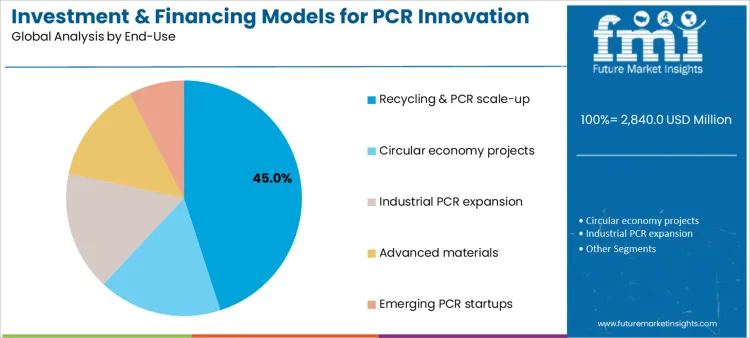
Recycling and PCR scale-up account for 45.0%, reflecting emphasis on moving from pilot to commercial operations. These investments support capacity expansion, operational optimization, and supply reliability. Circular economy projects, industrial PCR expansion, advanced materials development, and emerging PCR startups contribute to funding demand without disclosed share values. End-use segmentation shows concentration where scale, regulatory pressure, and material demand converge to justify sustained capital commitment.
Key Points:
- Scale-up initiatives anchor investment deployment.
- Circular economy projects broaden capital application.
- Emerging startups drive innovation-led funding demand.
What are the Key Dynamics in the Investment & Financing Models for PCR Innovation Market?
Investment and financing models for post-consumer recycled (PCR) innovation are shaped by the need to bridge early-stage research with commercial-scale deployment of advanced recycling technologies, material recovery infrastructure, and PCR supply chain platforms. Capital flows tilt toward initiatives that enhance sorting efficiency, contaminant removal, chemical recycling processes, and product applications that demand high-quality recycled feedstocks. Value assessment by investors centers on technology readiness, intellectual property strength, regulatory incentives, and projected market uptake of PCR materials within packaging, automotive, and durable goods sectors.
How do technology risk profiles and commercialization pathways influence funding decisions?
Funding decisions for PCR innovation reflect the technical and market risks inherent in early-stage recycling technologies. Investors evaluate technology readiness levels and proof-of-concept performance for solvent-based, enzymatic, and depolymerization systems intended to convert mixed waste streams into high-quality polymers. Projects backed by strong intellectual property portfolios and demonstrable pilot or semi-industrial data attract strategic venture capital and corporate venture arms of major polymer producers or consumer brands. Financing models vary from milestone-based venture rounds that tie disbursement to technical achievements, to joint development agreements where risk and reward are shared among recyclers, converters, and offtake partners. Public-private partnerships and blended finance structures are common in regions offering tax incentives or recycled content mandates, where government support reduces perceived commercial risk and unlocks co-investment from private capital.
How do supply chain engagement and revenue certainty shape scaling trajectories?
Scaling trajectories for PCR innovation are influenced by structured offtake agreements, revenue certainty mechanisms, and alignment with supply chain stakeholders that anchor demand. Long-term contracts with brand owners and packaging converters provide revenue visibility that underpins project financing and debt instruments, reducing reliance solely on equity-stage capital. Aggregators and processors that integrate feedstock collection with material refinement can access asset-backed lending when stable cash flows from contracted PCR supply paths are established. Green bonds and sustainability-linked loans tied to clear impact metrics such as recycled content adoption or waste diversion performance are increasingly attractive to institutional investors seeking environmental and financial returns. Market scaling is challenged where feedstock variability, regulatory uncertainty, or fluctuating PCR pricing undermine projected cash flows, prompting financiers to require risk mitigation tools such as insurance products or third-party certifications that validate operational assumptions. Structuring financing around measurable performance targets and active supply chain partnerships increases confidence among capital providers and accelerates deployment of PCR innovations beyond pilot stages.
How Is Demand for Investment and Financing Models for PCR Innovation Evolving Globally?
Global demand for investment and financing models supporting PCR innovation is rising as recycled content targets accelerate across packaging, automotive, and consumer goods. Growth reflects capital intensity of advanced recycling, compounding, and material qualification infrastructure. Financial structures increasingly align with long payback periods, technology risk, and regulatory dependency. Public funding, brand-backed offtake agreements, and blended finance structures gain relevance. India records 16.2% CAGR, China records 14.8% CAGR, USA records 12.4% CAGR, Brazil records 12.3% CAGR, and Germany records 12.0% CAGR. Market expansion is driven by financing complexity and risk-sharing needs rather than volume-led PCR capacity growth.
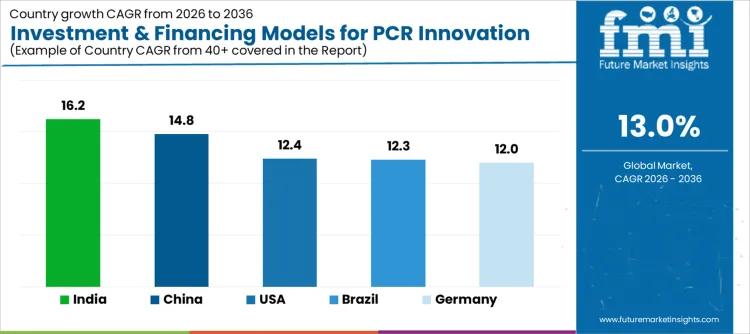
| Country | CAGR (%) |
|---|---|
| India | 16.2% |
| China | 14.8% |
| USA | 12.4% |
| Brazil | 12.3% |
| Germany | 12.0% |
What is driving growth of investment and financing models for PCR innovation demand in India?
Demand for investment and financing models for PCR innovation in India is expanding as recycling and compounding infrastructure scales rapidly. Growth at 16.2% CAGR reflects capital needs across collection, sorting, washing, and advanced compounding facilities. High feedstock variability increases technology risk, shaping financing toward phased investments and milestone-based funding. Government-linked incentives and sustainability-linked loans support early-stage projects. Brand commitments to recycled content improve bankability through long-term supply agreements. Domestic financial institutions develop sector-specific evaluation frameworks for PCR ventures. Demand remains concentrated in packaging, consumer goods, and automotive polymers supporting fast-growing domestic manufacturing clusters.
- Expansion of advanced recycling infrastructure
- Need for risk-mitigated financing structures
- Brand-backed offtake agreements
- Government-supported sustainability financing
Why is China seeing expansion in investment and financing model adoption for PCR innovation?
Investment and financing demand for PCR innovation in China is rising as large-scale recycling projects enter commercialization phases. Growth at 14.8% CAGR reflects funding requirements for chemical recycling, high-purity mechanical recycling, and compounding capacity. State-backed capital, industrial policy support, and infrastructure-linked financing dominate project structures. Export-oriented manufacturers seek financing aligned with global brand sustainability mandates. Technology validation and scale efficiency influence lender confidence. Domestic banks and funds integrate recycled content compliance into credit assessments. Demand remains centered on large integrated projects supplying packaging, electronics, and automotive supply chains.
- State-supported recycling investment frameworks
- Large-scale project financing requirements
- Export compliance driven capital allocation
- Integration of sustainability metrics in lending
What factors are shaping investment and financing models for PCR innovation in the USA?
Sales of investment and financing solutions for PCR innovation in the USA are increasing as private capital targets circular economy infrastructure. Growth at 12.4% CAGR reflects strong activity in venture funding, private equity, and project finance for recycling technologies. Brand sustainability commitments support revenue certainty through long-term contracts. Regulatory uncertainty shapes cautious capital deployment and staged financing. Institutional investors emphasize governance, traceability, and return visibility. Financing structures prioritize scalability and exit clarity. Demand is driven by portfolio diversification into climate-aligned assets rather than expansion of traditional recycling capacity.
- Growth of private equity and venture funding
- Brand-linked revenue assurance models
- Focus on scalable recycling technologies
- Governance and return visibility requirements
How is Brazil supporting growth of investment and financing models for PCR innovation?
Investment demand for PCR innovation financing in Brazil is advancing as packaging and consumer goods sectors increase recycled content adoption. Growth at 12.3% CAGR reflects funding needs for regional collection, upgrading, and compounding infrastructure. Development banks and sustainability-linked credit play central roles. Feedstock supply inconsistency increases project risk, shaping conservative financing structures. International brand presence supports co-investment and technical partnerships. Financing activity remains focused on mechanical recycling and packaging-grade PCR projects serving domestic consumption.
- Role of development bank financing
- Regional recycling infrastructure investment
- Brand-led co-investment structures
- Focus on packaging-grade PCR capacity
What is driving expansion of investment and financing models for PCR innovation in Germany?
Demand for investment and financing models for PCR innovation in Germany is rising as circular economy regulations intensify capital requirements. Growth at 12.0% CAGR reflects investment across high-purity recycling, traceability systems, and certified compounding facilities. EU-aligned funding, green bonds, and public-private partnerships dominate financing structures. Strict compliance standards increase upfront capital intensity. Investors prioritize long-term regulatory stability and technology reliability. Financing activity concentrates within automotive, industrial, and high-spec packaging polymers supporting regulated markets.
- EU-backed green financing mechanisms
- High capital intensity of compliant infrastructure
- Focus on certified high-purity PCR
- Long-term regulatory stability considerations
What is the competitive landscape of demand for the investment and financing models for PCR innovation market globally?
Capital deployment into PCR innovation is shaped by scaling risk, technology maturity gaps, and long payback cycles across advanced recycling projects. Investors and project developers assess feedstock security, technology readiness levels, policy support, and offtake visibility before committing capital. Buyer evaluation includes risk-sharing structures, blended finance availability, return profiles aligned with sustainability mandates, and geographic exposure. Procurement of capital favors long-term instruments, public–private co-investment, and financing linked to infrastructure buildout rather than short-term returns. Trend in the investment and financing models for PCR innovation market reflects growing use of patient capital, guarantees, and policy-backed loans supporting scale-up beyond pilot stages.
Closed Loop Partners leads positioning through catalytic capital models combining equity, debt, and guarantees focused on circular plastics infrastructure. Breakthrough Energy Ventures competes by backing high-risk, technology-driven PCR pathways with long-duration climate capital. European Investment Bank supports demand via low-cost financing tied to EU recycling targets and industrial decarbonization programs. KfW maintains relevance by funding PCR-related manufacturing and recycling assets aligned with German and European circular economy policies. China Development Bank participates by financing large-scale PCR capacity expansion integrated with national industrial strategy. Competitive differentiation centers on risk tolerance, policy alignment, scale of deployable capital, and ability to crowd in private investment.
Key Players in the Investment & Financing Models for PCR Innovation Market
- Closed Loop Partners
- Breakthrough Energy Ventures
- European Investment Bank
- KfW
- China Development Bank
- CITIC
- Mitsubishi UFJ Capital
- Others
Scope of the Report
| Items | Values |
|---|---|
| Quantitative Units | USD million |
| Financing Model | Venture & growth equity; Project finance; State-backed financing; Corporate venture; Others |
| Target Area | PCR tech & infrastructure; Recycling plants; Recycling infrastructure; PCR polymers; Others |
| End-Use | Recycling & PCR scale-up; Circular economy projects; Industrial PCR expansion; Advanced materials; Emerging PCR startups |
| Regions Covered | Asia Pacific, Europe, North America, Latin America, Middle East & Africa |
| Countries Covered | India, China, USA, Brazil, Germany, and 40+ countries |
| Key Companies Profiled | Closed Loop Partners; Breakthrough Energy Ventures; European Investment Bank; KfW; China Development Bank; CITIC; Mitsubishi UFJ Capital; Others |
| Additional Attributes | Investment flows by financing model, target area, and end-use segment; role of public-private capital in scaling PCR infrastructure; influence of state-backed financing on large recycling assets; corporate venture participation accelerating PCR polymer innovation; funding patterns supporting early-stage PCR startups and late-stage industrial expansion across global circular economy value chains. |
Investment & Financing Models for PCR Innovation Market by Segment
Financing Model:
- Venture & growth equity
- Project finance
- State-backed financing
- Corporate venture
- Others
Target Area:
- PCR tech & infrastructure
- Recycling plants
- Recycling infrastructure
- PCR polymers
- Others
End-Use:
- Recycling & PCR scale-up
- Circular economy projects
- Industrial PCR expansion
- Advanced materials
- Emerging PCR startups
Region:
- Asia Pacific
- China
- Japan
- South Korea
- India
- Australia & New Zealand
- ASEAN
- Rest of Asia Pacific
- Europe
- Germany
- United Kingdom
- France
- Italy
- Spain
- Nordic
- BENELUX
- Rest of Europe
- North America
- United States
- Canada
- Mexico
- Latin America
- Brazil
- Chile
- Rest of Latin America
- Middle East & Africa
- Kingdom of Saudi Arabia
- Other GCC Countries
- Turkey
- South Africa
- Other African Union
- Rest of Middle East & Africa
Bibliography
- European Investment Bank. (2023). Financing the circular economy. European Investment Bank.
- Organisation for Economic Co‑operation and Development. (2023). Blended finance for the circular economy. OECD Publishing.
- World Bank Group. (2024). Mobilizing private capital for circular economy infrastructure. World Bank.
Frequently Asked Questions
How big is the investment & financing models for pcr innovation market in 2026?
The global investment & financing models for pcr innovation market is estimated to be valued at USD 2,840.0 million in 2026.
What will be the size of investment & financing models for pcr innovation market in 2036?
The market size for the investment & financing models for pcr innovation market is projected to reach USD 9,640.6 million by 2036.
How much will be the investment & financing models for pcr innovation market growth between 2026 and 2036?
The investment & financing models for pcr innovation market is expected to grow at a 13.0% CAGR between 2026 and 2036.
What are the key product types in the investment & financing models for pcr innovation market?
The key product types in investment & financing models for pcr innovation market are venture & growth equity, project finance, state-backed financing, corporate venture and others.
Which target area segment to contribute significant share in the investment & financing models for pcr innovation market in 2026?
In terms of target area, pcr tech & infrastructure segment to command 55.0% share in the investment & financing models for pcr innovation market in 2026.
Preview the report firsthand - request a free sample
Get SampleGet the brochure for pricing and purchase details.
Get PDFTable of Content
- Executive Summary
- Global Market Outlook
- Demand-side Trends
- Supply-side Trends
- Technology Roadmap Analysis
- Analysis and Recommendations
- Market Overview
- Market Coverage / Taxonomy
- Market Definition / Scope / Limitations
- Market Background
- Market Dynamics
- Drivers
- Restraints
- Opportunity
- Trends
- Scenario Forecast
- Demand in Optimistic Scenario
- Demand in Likely Scenario
- Demand in Conservative Scenario
- Opportunity Map Analysis
- Product Life Cycle Analysis
- Supply Chain Analysis
- Investment Feasibility Matrix
- Value Chain Analysis
- PESTLE and Porter’s Analysis
- Regulatory Landscape
- Regional Parent Market Outlook
- Production and Consumption Statistics
- Import and Export Statistics
- Market Dynamics
- Global Market Analysis 2021 to 2025 and Forecast, 2026 to 2036
- Historical Market Size Value (USD Million) Analysis, 2021 to 2025
- Current and Future Market Size Value (USD Million) Projections, 2026 to 2036
- Y-o-Y Growth Trend Analysis
- Absolute $ Opportunity Analysis
- Global Market Pricing Analysis 2021 to 2025 and Forecast 2026 to 2036
- Global Market Analysis 2021 to 2025 and Forecast 2026 to 2036, By Financing Model
- Introduction / Key Findings
- Historical Market Size Value (USD Million) Analysis By Financing Model , 2021 to 2025
- Current and Future Market Size Value (USD Million) Analysis and Forecast By Financing Model , 2026 to 2036
- Venture & growth equity
- Project finance
- State-backed financing
- Corporate venture
- Others
- Venture & growth equity
- Y-o-Y Growth Trend Analysis By Financing Model , 2021 to 2025
- Absolute $ Opportunity Analysis By Financing Model , 2026 to 2036
- Global Market Analysis 2021 to 2025 and Forecast 2026 to 2036, By Target Area
- Introduction / Key Findings
- Historical Market Size Value (USD Million) Analysis By Target Area, 2021 to 2025
- Current and Future Market Size Value (USD Million) Analysis and Forecast By Target Area, 2026 to 2036
- PCR tech & infrastructure
- Recycling plants
- Recycling infrastructure
- PCR polymers
- Others
- PCR tech & infrastructure
- Y-o-Y Growth Trend Analysis By Target Area, 2021 to 2025
- Absolute $ Opportunity Analysis By Target Area, 2026 to 2036
- Global Market Analysis 2021 to 2025 and Forecast 2026 to 2036, By End-Use
- Introduction / Key Findings
- Historical Market Size Value (USD Million) Analysis By End-Use, 2021 to 2025
- Current and Future Market Size Value (USD Million) Analysis and Forecast By End-Use, 2026 to 2036
- Recycling & PCR scale-up
- Circular economy projects
- Industrial PCR expansion
- Advanced materials
- Emerging PCR startups
- Recycling & PCR scale-up
- Y-o-Y Growth Trend Analysis By End-Use, 2021 to 2025
- Absolute $ Opportunity Analysis By End-Use, 2026 to 2036
- Global Market Analysis 2021 to 2025 and Forecast 2026 to 2036, By Region
- Introduction
- Historical Market Size Value (USD Million) Analysis By Region, 2021 to 2025
- Current Market Size Value (USD Million) Analysis and Forecast By Region, 2026 to 2036
- North America
- Latin America
- Western Europe
- Eastern Europe
- East Asia
- South Asia and Pacific
- Middle East & Africa
- Market Attractiveness Analysis By Region
- North America Market Analysis 2021 to 2025 and Forecast 2026 to 2036, By Country
- Historical Market Size Value (USD Million) Trend Analysis By Market Taxonomy, 2021 to 2025
- Market Size Value (USD Million) Forecast By Market Taxonomy, 2026 to 2036
- By Country
- USA
- Canada
- Mexico
- By Financing Model
- By Target Area
- By End-Use
- By Country
- Market Attractiveness Analysis
- By Country
- By Financing Model
- By Target Area
- By End-Use
- Key Takeaways
- Latin America Market Analysis 2021 to 2025 and Forecast 2026 to 2036, By Country
- Historical Market Size Value (USD Million) Trend Analysis By Market Taxonomy, 2021 to 2025
- Market Size Value (USD Million) Forecast By Market Taxonomy, 2026 to 2036
- By Country
- Brazil
- Chile
- Rest of Latin America
- By Financing Model
- By Target Area
- By End-Use
- By Country
- Market Attractiveness Analysis
- By Country
- By Financing Model
- By Target Area
- By End-Use
- Key Takeaways
- Western Europe Market Analysis 2021 to 2025 and Forecast 2026 to 2036, By Country
- Historical Market Size Value (USD Million) Trend Analysis By Market Taxonomy, 2021 to 2025
- Market Size Value (USD Million) Forecast By Market Taxonomy, 2026 to 2036
- By Country
- Germany
- UK
- Italy
- Spain
- France
- Nordic
- BENELUX
- Rest of Western Europe
- By Financing Model
- By Target Area
- By End-Use
- By Country
- Market Attractiveness Analysis
- By Country
- By Financing Model
- By Target Area
- By End-Use
- Key Takeaways
- Eastern Europe Market Analysis 2021 to 2025 and Forecast 2026 to 2036, By Country
- Historical Market Size Value (USD Million) Trend Analysis By Market Taxonomy, 2021 to 2025
- Market Size Value (USD Million) Forecast By Market Taxonomy, 2026 to 2036
- By Country
- Russia
- Poland
- Hungary
- Balkan & Baltic
- Rest of Eastern Europe
- By Financing Model
- By Target Area
- By End-Use
- By Country
- Market Attractiveness Analysis
- By Country
- By Financing Model
- By Target Area
- By End-Use
- Key Takeaways
- East Asia Market Analysis 2021 to 2025 and Forecast 2026 to 2036, By Country
- Historical Market Size Value (USD Million) Trend Analysis By Market Taxonomy, 2021 to 2025
- Market Size Value (USD Million) Forecast By Market Taxonomy, 2026 to 2036
- By Country
- China
- Japan
- South Korea
- By Financing Model
- By Target Area
- By End-Use
- By Country
- Market Attractiveness Analysis
- By Country
- By Financing Model
- By Target Area
- By End-Use
- Key Takeaways
- South Asia and Pacific Market Analysis 2021 to 2025 and Forecast 2026 to 2036, By Country
- Historical Market Size Value (USD Million) Trend Analysis By Market Taxonomy, 2021 to 2025
- Market Size Value (USD Million) Forecast By Market Taxonomy, 2026 to 2036
- By Country
- India
- ASEAN
- Australia & New Zealand
- Rest of South Asia and Pacific
- By Financing Model
- By Target Area
- By End-Use
- By Country
- Market Attractiveness Analysis
- By Country
- By Financing Model
- By Target Area
- By End-Use
- Key Takeaways
- Middle East & Africa Market Analysis 2021 to 2025 and Forecast 2026 to 2036, By Country
- Historical Market Size Value (USD Million) Trend Analysis By Market Taxonomy, 2021 to 2025
- Market Size Value (USD Million) Forecast By Market Taxonomy, 2026 to 2036
- By Country
- Kingdom of Saudi Arabia
- Other GCC Countries
- Turkiye
- South Africa
- Other African Union
- Rest of Middle East & Africa
- By Financing Model
- By Target Area
- By End-Use
- By Country
- Market Attractiveness Analysis
- By Country
- By Financing Model
- By Target Area
- By End-Use
- Key Takeaways
- Key Countries Market Analysis
- USA
- Pricing Analysis
- Market Share Analysis, 2025
- By Financing Model
- By Target Area
- By End-Use
- Canada
- Pricing Analysis
- Market Share Analysis, 2025
- By Financing Model
- By Target Area
- By End-Use
- Mexico
- Pricing Analysis
- Market Share Analysis, 2025
- By Financing Model
- By Target Area
- By End-Use
- Brazil
- Pricing Analysis
- Market Share Analysis, 2025
- By Financing Model
- By Target Area
- By End-Use
- Chile
- Pricing Analysis
- Market Share Analysis, 2025
- By Financing Model
- By Target Area
- By End-Use
- Germany
- Pricing Analysis
- Market Share Analysis, 2025
- By Financing Model
- By Target Area
- By End-Use
- UK
- Pricing Analysis
- Market Share Analysis, 2025
- By Financing Model
- By Target Area
- By End-Use
- Italy
- Pricing Analysis
- Market Share Analysis, 2025
- By Financing Model
- By Target Area
- By End-Use
- Spain
- Pricing Analysis
- Market Share Analysis, 2025
- By Financing Model
- By Target Area
- By End-Use
- France
- Pricing Analysis
- Market Share Analysis, 2025
- By Financing Model
- By Target Area
- By End-Use
- India
- Pricing Analysis
- Market Share Analysis, 2025
- By Financing Model
- By Target Area
- By End-Use
- ASEAN
- Pricing Analysis
- Market Share Analysis, 2025
- By Financing Model
- By Target Area
- By End-Use
- Australia & New Zealand
- Pricing Analysis
- Market Share Analysis, 2025
- By Financing Model
- By Target Area
- By End-Use
- China
- Pricing Analysis
- Market Share Analysis, 2025
- By Financing Model
- By Target Area
- By End-Use
- Japan
- Pricing Analysis
- Market Share Analysis, 2025
- By Financing Model
- By Target Area
- By End-Use
- South Korea
- Pricing Analysis
- Market Share Analysis, 2025
- By Financing Model
- By Target Area
- By End-Use
- Russia
- Pricing Analysis
- Market Share Analysis, 2025
- By Financing Model
- By Target Area
- By End-Use
- Poland
- Pricing Analysis
- Market Share Analysis, 2025
- By Financing Model
- By Target Area
- By End-Use
- Hungary
- Pricing Analysis
- Market Share Analysis, 2025
- By Financing Model
- By Target Area
- By End-Use
- Kingdom of Saudi Arabia
- Pricing Analysis
- Market Share Analysis, 2025
- By Financing Model
- By Target Area
- By End-Use
- Turkiye
- Pricing Analysis
- Market Share Analysis, 2025
- By Financing Model
- By Target Area
- By End-Use
- South Africa
- Pricing Analysis
- Market Share Analysis, 2025
- By Financing Model
- By Target Area
- By End-Use
- USA
- Market Structure Analysis
- Competition Dashboard
- Competition Benchmarking
- Market Share Analysis of Top Players
- By Regional
- By Financing Model
- By Target Area
- By End-Use
- Competition Analysis
- Competition Deep Dive
- Closed Loop Partners
- Overview
- Product Portfolio
- Profitability by Market Segments (Product/Age /Sales Channel/Region)
- Sales Footprint
- Strategy Overview
- Marketing Strategy
- Product Strategy
- Channel Strategy
- Breakthrough Energy Ventures
- European Investment Bank
- KfW
- China Development Bank
- CITIC
- Mitsubishi UFJ Capital
- Others
- Closed Loop Partners
- Competition Deep Dive
- Assumptions & Acronyms Used
- Research Methodology


