

- Industry Size (2026)
- USD 1563.2 Mn
- Forecast (2036)
- USD 3121.2 Mn
- CAGR (2026 to 2036)
- 12.6%
Peptide-Rich Firming Creams Market Forecast and Outlook 2026 to 2036
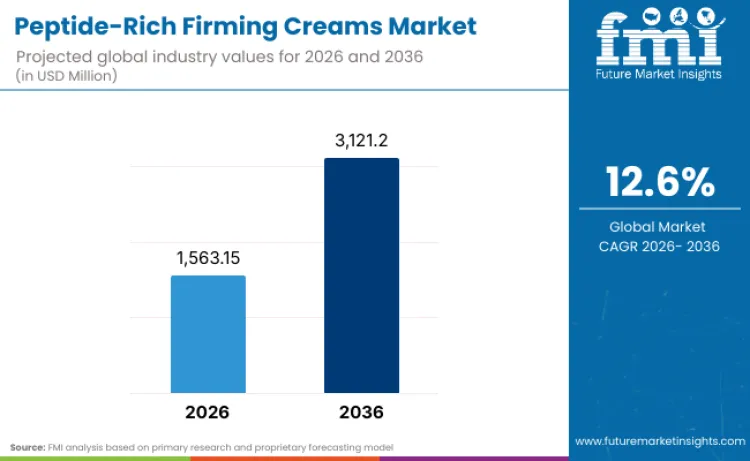
Peptide rich firming creams are projected to reach USD 1,563.15 million in 2026 and expand strongly through 2036 as anti aging demand shifts toward actives that can be positioned with clearer mechanism led narratives, better tolerability, and repeat purchase results in premium routines. Growth is being reinforced by consumers who expect firming and lifting benefits that show up in texture, elasticity, and visible smoothness, which is pushing brands to move beyond basic “anti wrinkle” messaging into peptide systems that are designed for collagen support, barrier compatibility, and sensorial performance. This is driving higher investment in peptide synthesis and screening, including biomimetic sequences and multi peptide complexes, plus delivery choices like encapsulation and controlled release that protect stability and improve performance on skin.
Regulatory oversight is also shaping how this segment scales. In the EU, products must comply with Regulation (EC) No 1223/2009, including safety substantiation and notification through the Cosmetic Products Notification Portal (CPNP) before placing products on the market. In the United States, MoCRA increases compliance expectations through facility registration and product listing frameworks and requires serious adverse event reporting, which is raising the bar for documentation, quality systems, and claims discipline for peptide led positioning. As a result, competitive advantage is increasingly tied to clinically defensible claims, consistent raw material specifications, and manufacturing controls aligned with cosmetics GMP expectations such as ISO 22716.
Quick Stats for Peptide-Rich Firming Creams Market
- Peptide-Rich Firming Creams Industry Value (2026): USD 1563.2 Million
- Peptide-Rich Firming Creams Industry Forecast Value (2036): USD 3121.2 Million
- Peptide-Rich Firming Creams Industry Forecast CAGR: 12.6%
- Peptide-Rich Firming Creams Industry Leading Function: Firming & Lifting (38.4%)
- Peptide-Rich Firming Creams Industry Key Growth Regions: North America, Europe, Asia-Pacific
- Peptide-Rich Firming Creams Industry Key Players: Estée Lauder, Olay, StriVectin, L'Oréal, Shiseido
Peptide-Rich Firming Creams Market Key Takeaways
| Metric | Value |
|---|---|
| Industry Size (2026) | USD 1563.2 Million |
| Industry Value (2036) | USD 3121.2 Million |
| CAGR (2026 to 2036) | 12.6% |
Source: Future Market Insights (FMI) analysis, based on proprietary forecasting model and primary research
Which Consumer Product KPIs Best Validate Accelerating Adoption of Firming and Lifting Peptide Functions?
Firming and lifting function adoption accelerates when brands can translate peptide credibility into measurable funnel performance, routine adherence, and repeat purchasing, because these benefits are experience-led and require consistent use to earn trust. In acquisition, CAC and conversion rate typically improve when education is mechanism-based, claims are supported with clear usage guidance, and product pages reduce ambiguity around who should use the formula and how quickly results are expected. In engagement, DAU/MAU, session duration, and feature adoption rise when routines, reminders, progress tracking, and skin-assessment tools help users stay consistent and reduce drop-off caused by impatience or misuse.
Retention is best captured through churn rate, retention rate, and stickiness, which strengthen when tolerability is high, texture is compatible with makeup and sunscreen layering, and the regimen is simple enough to repeat daily. In revenue, LTV, ARPU, and MRR/ARR expand when firming products anchor multi-step anti-aging bundles and subscription replenishment. NPS and CSAT reflect whether perceived tightening and comfort match expectations, while bounce rate and task completion rate show if shoppers understand the regimen and follow through rather than abandoning at checkout or after first use.
How Is the Peptide-Rich Firming Creams Market Segmented Across Key Categories?
Global landscape is intricately segmented to address diverse requirements of the advanced skincare industry, categorizing sector by functional benefit, product format, distribution method, and marketing claim positioning. Structural division allows stakeholders to identify specific dermatological targets, such as rising demand for serum concentrates in intensive treatment applications or preference for cream formulations in daily maintenance routines. By analyzing these segments, manufacturers can tailor production lines to meet distinct needs of clinical practitioners versus consumer retail markets. Segmentation also highlights shift from generic anti-aging approaches to peptide-specific interventions. As industry matures, granular segmentation becomes essential for understanding therapeutic pathways and regulatory compliance, ensuring product development aligns with evolving dermatological standards.
Why Do Firming & Lifting Functions Maintain Dominance?
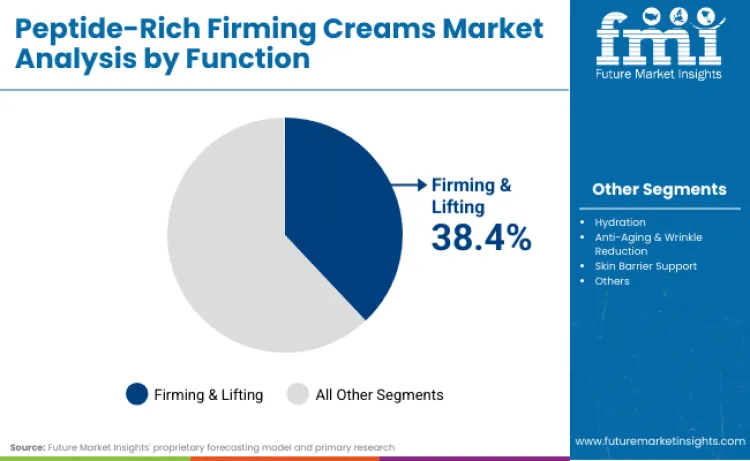
Firming & lifting applications account for 38.4% of functional share in 2026, driven by extensive clinical evidence supporting visible skin tightening benefits. Leadership position is underpinned by dermatological research from aesthetic medicine authorities recognizing peptide-induced collagen synthesis claims. Segment benefits from continuous peptide optimization improvements, such as encapsulation technology enhancing peptide stability and bioavailability. As per FMI's projection, research focused on mechanical skin properties is renewing interest among cosmeceutical manufacturers. Critical role in addressing gravitational skin aging further solidifies standing, as these formulations target structural protein degradation mechanisms. As aesthetic dermatology guidelines prioritize non-invasive firming solutions, demand for clinically proven peptide concentrates is expected to remain robust.
Why Are Serums the Preferred Product Type?
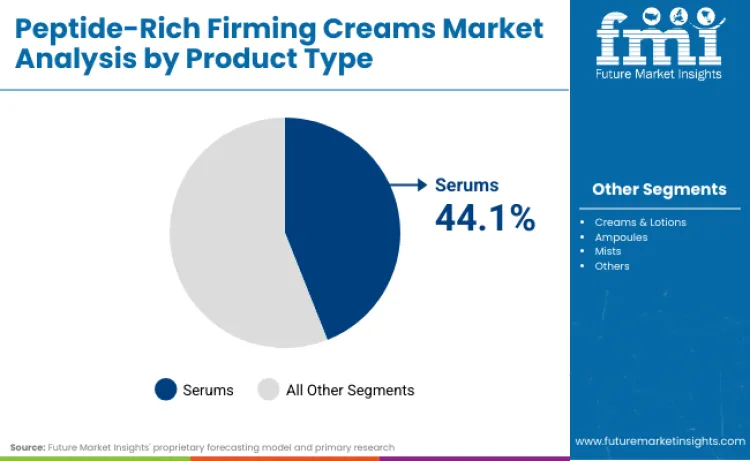
Serum format commands 44.1% share of sector in 2026, reflecting consumer preference for concentrated active ingredient delivery systems. Dominance is linked to superior penetration capabilities of lightweight formulations compared to traditional cream textures. Manufacturers rely on specialized serum technology to ensure optimal peptide concentration and minimal interference from heavy emollient bases. These formats are essential for delivering therapeutic peptide levels and maintaining formula stability, driving priority status among premium skincare brands. FMI is of the opinion that relentless pursuit of maximum bioavailability ensures products designed for intensive treatment remain primary choice. High efficacy expectations necessitate concentrated formulation expertise, bolstering sustained revenue streams for peptide specialty suppliers.
Why Do E-commerce Channels Lead Distribution?
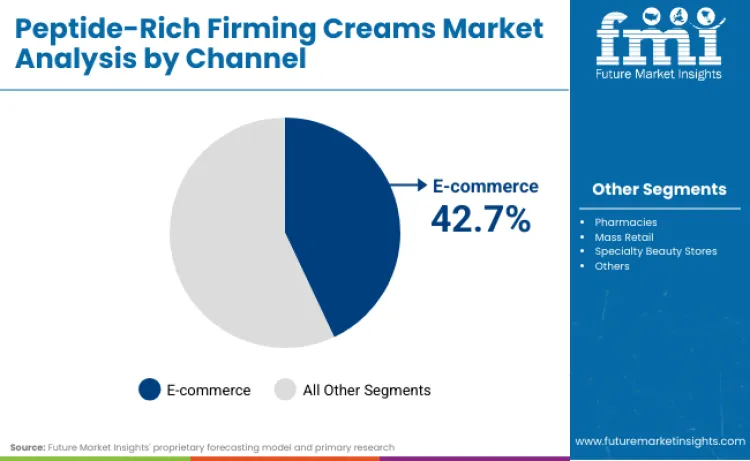
E-commerce platforms capture 42.7% of market share in 2026, owing to widespread digital shopping adoption requiring detailed product education and convenience. Dominance stems from consumer research patterns recommending online platforms alongside professional consultations for optimal product selection. Consumers prefer these channels for their comprehensive ingredient information and clinical study accessibility. Usage in researching peptide science and comparing formulation benefits drives continuous engagement among educated beauty consumers. As per FMI's estimates, compatibility with various subscription models allows for consistent treatment regimens across different usage patterns. Manufacturers focusing on digital education and influencer partnerships for these knowledge-seeking platforms secure significant loyalty among scientifically minded skincare enthusiasts.
How Will Aging Demographics Impact Sales?
Aging demographics are reshaping demand toward firming and lifting products that can credibly address mature-skin priorities such as laxity, texture change, and slower visible recovery. In the peptide-led segment, this pushes brands toward clearer benefit framing, stronger clinical support, and regimens designed for consistent long-term use rather than quick “instant lift” promises. Healthy-aging mindsets also expand the addressable base beyond corrective users, lifting demand for preventive routines positioned around maintaining skin structure and resilience. As older buyers tend to be more ingredient-literate and less tolerant of vague claims, products that do not communicate mechanism, tolerability strategy, and realistic outcome timelines risk losing share in premium channels.
How Will Scientific Research Integration Transform Distribution?
Scientific validation is changing distribution by shifting influence toward dermatologist-adjacent pathways where recommendation authority is higher and claims are scrutinized. Brands are increasingly activating medical aesthetics, clinic retail, and professional referral networks to convert peptide science into trust at the point of sale, especially for firming and lifting where results are gradual and require adherence. Clinical partnerships also support tighter education, enabling practices to recommend specific formulas based on assessed concerns and helping brands defend premium pricing through evidence rather than marketing language. Digital tools that deliver science-led education and regimen coaching further extend this professional influence into e-commerce and direct-to-consumer journeys.
How Will Regulatory Changes Affect Market Growth?
Regulatory pressure is raising the cost of participation in advanced peptide skincare while also creating a moat for brands that can substantiate performance and safety. As expectations tighten around efficacy wording, claims support, and ingredient safety documentation, product development is moving toward better-designed studies, clearer labeling discipline, and stronger post-market quality controls. This can slow launches and limit aggressive messaging, but it also increases consumer trust in peptide positioning and reduces the advantage of copycat formulas that rely on implied clinical benefits. Where standards align across regions, validated peptide portfolios gain easier scalability, improving international rollout efficiency for compliant premium brands.
How Will the Peptide-Rich Firming Creams Industry Evolve in Major Nations?
Global landscape for advanced peptide skincare is characterized by diverse regulatory frameworks, influenced by cosmetic science standards and clinical validation requirements. Established markets prioritize clinically proven formulations and pharmaceutical-grade manufacturing, whereas emerging economies focus on accessible pricing and basic peptide technology introduction. North America is emerging as rapid growth hub due to increasing aesthetic medicine awareness and expanding anti-aging consciousness. Conversely, European sectors pivot towards pharmaceutical-grade peptides and medical aesthetic integration protocols. Government initiatives in developed nations supporting cosmetic innovation research ensure sustained demand for scientifically advanced skincare products across all demographics.
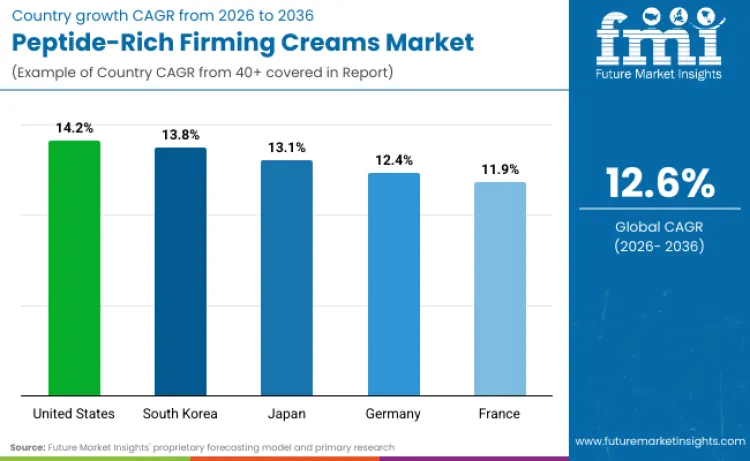
| Country | CAGR (2026 to 2036) |
|---|---|
| United States | 14.2% |
| South Korea | 13.8% |
| Japan | 13.1% |
| Germany | 12.4% |
| France | 11.9% |
Source: FMI analysis based on primary research and proprietary forecasting model
Why is the Peptide Rich Firming Creams Industry in United States Growing?
Sales of peptide rich firming creams in the United States are set to grow at 14.2% CAGR through 2036 because premium anti aging skincare is increasingly shaped by stricter federal compliance expectations and tighter claims discipline, which favors brands that can document safety and substantiation. Under MoCRA, cosmetic companies face new requirements such as facility registration and product listing with FDA, pushing the category toward better controlled ingredient documentation and more defensible product portfolios. In parallel, FDA guidance highlights that anti wrinkle and anti aging claims can cross into drug territory depending on intended use, which makes peptide positioning more successful when supported by strong evidence and careful claim wording, reinforcing demand for clinically framed firming creams.
Why is the Peptide Rich Firming Creams Sector in South Korea Expanding?
Demand in South Korea is projected to rise at 13.8% CAGR through 2036 because the country has a defined regulatory lane for performance positioned skincare, and that lane aligns directly with anti wrinkle outcomes that peptides are often used to support. MFDS defines functional cosmetics to include products intended for functions such as improving skin wrinkles, and it provides an evaluation flow for functional cosmetics, which supports structured product development and faster commercialization of substantiated anti wrinkle offerings. On top of that, the sector benefits from export led scaling, since Korea’s Ministry of Trade, Industry and Energy has highlighted strong cosmetics export performance, supporting continued launch velocity and global distribution reach for premium actives focused skincare lines.
Why is the Peptide Rich Firming Creams Industry in Japan Showing Potential?
Japan is poised to expand at 13.1% CAGR through 2036 because demand is reinforced by the country’s aging profile and by a structured approval pathway for higher function skincare positioning. Japan’s Cabinet Office documents a high share of population aged 65 and over, sustaining repeat purchase demand for firming and age defense routines. For products positioned with stronger efficacy narratives, Japan operates a formal system for quasi drugs, and PMDA publishes manufacturing and marketing procedures for quasi drugs, encouraging brands to invest in validated actives and disciplined claims, which supports premium peptide based formulations designed for measurable outcomes.
Why is the Peptide Rich Firming Creams Industry in Germany Growing?
Sales in Germany are set to grow at 12.4% CAGR through 2036 because the category is pulled by an evidence oriented skincare culture supported by strong safety assessment and claims justification expectations. The BfR assesses health risks of cosmetic ingredients, reinforcing ingredient scrutiny and preference for well supported actives that can fit sensitive skin and dermo cosmetic positioning. The BVL points to Regulation (EC) No 1223/2009 as the central legal basis for cosmetics placed on the German and EU market, supporting rigorous documentation and compliance practices. In addition, EU claims rules require justification criteria for cosmetic claims, which supports growth of peptide firming creams where brands can substantiate performance statements with acceptable evidence.
Why is the Peptide Rich Firming Creams Sector in France Expanding?
Revenue in France is set to grow at 11.9% CAGR through 2036 because premium skincare is reinforced by strong national oversight mechanisms for safety monitoring and harmonized EU compliance rules that reward substantiated innovation. France’s ANSES describes cosmetovigilance as governed by the EU cosmetics regulation and the French Public Health Code, supporting a safety monitoring culture that increases trust in sophisticated active ingredient products when they are responsibly positioned. France’s Directorate General for Enterprise also summarizes the harmonized EU regulatory framework for cosmetics and references the EU common criteria for claims justification, which supports expansion of science positioned firming creams that can meet documentation and claim standards.
What is the Competitive Outlook for the Peptide-Rich Firming Creams Market?
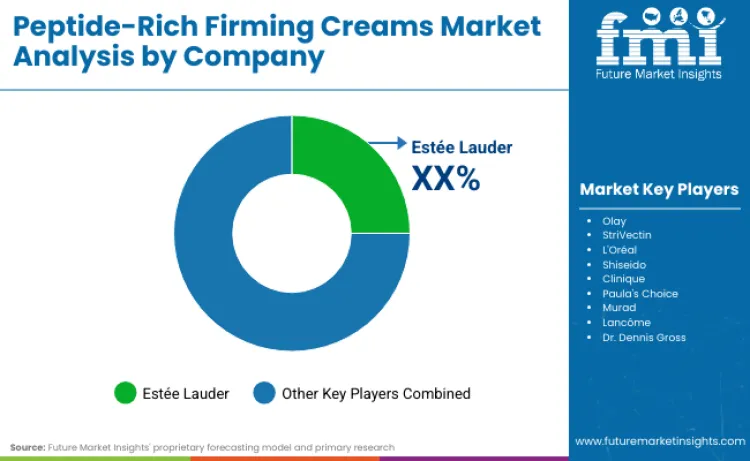
Competition in peptide-rich firming creams is being shaped less by “new anti-aging claims” and more by who can own credible actives platforms (peptides, delivery systems, and clinical-grade proof) and scale them across premium channels. Large beauty groups are increasingly using acquisitions to buy science-led skincare engines rather than build them slowly in-house. L’Oréal has reinforced its derm and clinical skincare push by acquiring Skinbetter Science and later signing to take a majority stake in Medik8, both brands positioned around results-driven routines that sit close to the same consumer demand set as peptide firming creams. Estée Lauder has also strengthened its actives-led portfolio by completing the acquisition of DECIEM (The Ordinary and related brands), expanding its reach in ingredient-forward skincare where peptides and clinically framed actives are central to repeat purchase.
At the innovation edge, the race is moving toward biotech-enabled ingredient pipelines and stronger mechanistic stories; for example, Estée Lauder’s partnership with Serpin Pharma signals continued investment in biotechnology collaborations to develop next-generation skin-care ingredients. Overall, these moves raise the bar for smaller peptide brands: without proprietary peptide IP, defensible delivery tech, or clinic-backed validation, it becomes harder to compete against groups that can scale science, distribution, and brand trust together.
Key Players in Peptide-Rich Firming Creams Market
- Estée Lauder
- Olay
- StriVectin
- L'Oréal
- Shiseido
- Clinique
- Paula's Choice
- Murad
- Lancôme
- Dr. Dennis Gross
Scope of Report
| Items | Values |
|---|---|
| Quantitative Units | USD Million |
| Function Segments | Firming & Lifting; Hydration; Anti-Aging & Wrinkle Reduction; Skin Barrier Support; Others |
| Product Type Categories | Serums; Creams & Lotions; Ampoules; Mists; Others |
| Channel Categories | E-commerce; Pharmacies; Mass Retail; Specialty Beauty Stores; Others |
| Claim Categories | Natural/Organic; Vegan; Fragrance-Free; Clean-Label; Others |
| Regions Covered | North America, Europe, East Asia, South Asia, Latin America, Middle East & Africa |
| Key Countries | United States, South Korea, Japan, Germany, France |
| Key Companies Profiled | Estée Lauder; Olay; StriVectin; L'Oréal; Shiseido; Clinique; Paula's Choice; Murad; Lancôme; Dr. Dennis Gross |
| Additional Attributes | Dollar sales measured for peptide-rich firming creams used in advanced anti-aging and skin firming applications, specified by peptide type (signal peptides, carrier peptides, neurotransmitter peptides), functional benefit (firming, hydration, wrinkle reduction), formulation format, marketing claim positioning (clean beauty, natural, clinical), retail model (professional vs. consumer), and compliance alignment with evolving cosmetic peptide regulations and clinical efficacy standards. |
Peptide-Rich Firming Creams Market by Segments
Function:
- Firming & Lifting
- Hydration
- Anti-Aging & Wrinkle Reduction
- Skin Barrier Support
- Others
Product Type:
- Serums
- Creams & Lotions
- Ampoules
- Mists
- Others
Channel:
- E-commerce
- Pharmacies
- Mass Retail
- Specialty Beauty Stores
- Others
Claim:
- Natural/Organic
- Vegan
- Fragrance-Free
- Clean-Label
- Others
Bibliography
- International Federation of Societies of Cosmetic Chemists. (2024). IFSCC Magazine: Advances in cosmetic peptide research. IFSCC.
- American Academy of Dermatology. (2024). Clinical practice guidelines: Topical therapies and cosmeceutical actives in aging skin. American Academy of Dermatology.
- Society for Investigative Dermatology. (2024). Scientific advances in skin peptide biology and clinical efficacy. Journal of Investigative Dermatology.
Frequently Asked Questions
How big is the global peptide-rich firming creams market?
The global peptide-rich firming creams market is valued at USD 1,563.2 million in 2026.
What is the growth outlook for the peptide-rich firming creams market over the next 10 years?
The market is projected to grow at a 12.6% CAGR from 2026 to 2036, reaching USD 3,121.2 million.
Which product segments or formats drive demand in this market?
Demand is driven primarily by serum formulations and firming-and-lifting focused products that deliver concentrated peptide actives with high bioavailability.
How does consumer behavior differ by region?
North America and Europe emphasize clinically validated, premium anti-aging solutions, while Asia-Pacific favors innovation-led, texture-focused, and routine-based peptide skincare adoption.
What are the main risks and constraints affecting this market?
Key constraints include stringent claims substantiation requirements, peptide stability challenges, higher formulation costs, and rising regulatory compliance burdens.
Preview the report firsthand - request a free sample
Get SampleGet the brochure for pricing and purchase details.
Get PDFTable of Content
- Executive Summary
- Global Market Outlook
- Demand Side Trends
- Supply Side Trends
- Technology Roadmap Analysis
- Analysis and Recommendations
- Market Overview
- Market Coverage / Taxonomy
- Market Definition / Scope / Limitations
- Research Methodology
- Chapter Orientation
- Analytical Lens and Working Hypotheses
- Market Structure, Signals, and Trend Drivers
- Benchmarking and Cross-market Comparability
- Market Sizing, Forecasting, and Opportunity Mapping
- Research Design and Evidence Framework
- Desk Research Programme (Secondary Evidence)
- Company Annual and Sustainability Reports
- Peer-reviewed Journals and Academic Literature
- Corporate Websites, Product Literature, and Technical Notes
- Earnings Decks and Investor Briefings
- Statutory Filings and Regulatory Disclosures
- Technical White Papers and Standards Notes
- Trade Journals, Industry Magazines, and Analyst Briefs
- Conference Proceedings, Webinars, and Seminar Materials
- Government Statistics Portals and Public Data Releases
- Press Releases and Reputable Media Coverage
- Specialist Newsletters and Curated Briefings
- Sector Databases and Reference Repositories
- FMI Internal Knowledge Base and Historical Datasets
- Subscription Datasets and Paid Sources
- Social Channels, Communities, and Digital Listening Inputs
- Additional Desk Sources
- Expert Input and Fieldwork (Primary Evidence)
- Primary Modes
- Qualitative Interviews and Expert Elicitation
- Quantitative Surveys and Structured Data Capture
- Blended Approach
- Why Primary Evidence is Used
- Field Techniques
- Interviews
- Surveys
- Focus Groups
- Observational and In-context Research
- Social and Community Interactions
- Stakeholder Universe Engaged
- C-suite Leaders
- Board Members
- Presidents and Vice Presidents
- R&D and Innovation Heads
- Technical Specialists
- Domain Subject-matter Experts
- Scientists
- Physicians and Other Healthcare Professionals
- Governance, Ethics, and Data Stewardship
- Research Ethics
- Data Integrity and Handling
- Primary Modes
- Tooling, Models, and Reference Databases
- Desk Research Programme (Secondary Evidence)
- Data Engineering and Model Build
- Data Acquisition and Ingestion
- Cleaning, Normalisation, and Verification
- Synthesis, Triangulation, and Analysis
- Quality Assurance and Audit Trail
- Market Background
- Market Dynamics
- Drivers
- Restraints
- Opportunity
- Trends
- Scenario Forecast
- Demand in Optimistic Scenario
- Demand in Likely Scenario
- Demand in Conservative Scenario
- Opportunity Map Analysis
- Product Life Cycle Analysis
- Supply Chain Analysis
- Investment Feasibility Matrix
- Value Chain Analysis
- PESTLE and Porter's Analysis
- Regulatory Landscape
- Regional Parent Market Outlook
- Production and Consumption Statistics
- Import and Export Statistics
- Market Dynamics
- Global Market Analysis 2021 to 2025 and Forecast, 2026 to 2036
- Historical Market Size Value (USD Million) Analysis, 2021 to 2025
- Current and Future Market Size Value (USD Million) Projections, 2026 to 2036
- Y-o-Y Growth Trend Analysis
- Absolute $ Opportunity Analysis
- Global Market Pricing Analysis 2021 to 2025 and Forecast 2026 to 2036
- Y-o-Y Growth Trend Analysis 2021 to 2025
- Absolute $ Opportunity Analysis 2026 to 2036
- Global Market Analysis 2021 to 2025 and Forecast 2026 to 2036, By Function
- Introduction / Key Findings
- Historical Market Size Value (USD Million) Analysis By Function, 2021 to 2025
- Current and Future Market Size Value (USD Million) Analysis and Forecast By Function, 2026 to 2036
- Firming & Lifting
- Hydration
- Anti-Aging & Wrinkle Reduction
- Skin Barrier Support
- Others
- Y-o-Y Growth Trend Analysis By Function, 2021 to 2025
- Absolute $ Opportunity Analysis By Function, 2026 to 2036
- Global Market Analysis 2021 to 2025 and Forecast 2026 to 2036, By Product Type
- Introduction / Key Findings
- Historical Market Size Value (USD Million) Analysis By Product Type, 2021 to 2025
- Current and Future Market Size Value (USD Million) Analysis and Forecast By Product Type, 2026 to 2036
- Serums
- Creams & Lotions
- Ampoules
- Mists
- Others
- Y-o-Y Growth Trend Analysis By Product Type, 2021 to 2025
- Absolute $ Opportunity Analysis By Product Type, 2026 to 2036
- Global Market Analysis 2021 to 2025 and Forecast 2026 to 2036, By Channel
- Introduction / Key Findings
- Historical Market Size Value (USD Million) Analysis By Channel, 2021 to 2025
- Current and Future Market Size Value (USD Million) Analysis and Forecast By Channel, 2026 to 2036
- E-commerce
- Pharmacies
- Mass Retail
- Specialty Beauty Stores
- Others
- Y-o-Y Growth Trend Analysis By Channel, 2021 to 2025
- Absolute $ Opportunity Analysis By Channel, 2026 to 2036
- Global Market Analysis 2021 to 2025 and Forecast 2026 to 2036, By Claim
- Introduction / Key Findings
- Historical Market Size Value (USD Million) Analysis By Claim, 2021 to 2025
- Current and Future Market Size Value (USD Million) Analysis and Forecast By Claim, 2026 to 2036
- Natural/Organic
- Vegan
- Fragrance-Free
- Clean-Label
- Others
- Y-o-Y Growth Trend Analysis By Claim, 2021 to 2025
- Absolute $ Opportunity Analysis By Claim, 2026 to 2036
- Global Market Analysis 2021 to 2025 and Forecast 2026 to 2036, By Region
- Introduction
- Historical Market Size Value (USD Million) Analysis By Region, 2021 to 2025
- Current Market Size Value (USD Million) Analysis and Forecast By Region, 2026 to 2036
- North America
- Latin America
- Western Europe
- Eastern Europe
- East Asia
- South Asia and Pacific
- Middle East & Africa
- Market Attractiveness Analysis By Region
- North America Market Analysis 2021 to 2025 and Forecast 2026 to 2036, By Country
- Historical Market Size Value (USD Million) Trend Analysis By Market Taxonomy, 2021 to 2025
- Market Size Value (USD Million) Forecast By Market Taxonomy, 2026 to 2036
- By Country
- USA
- Canada
- Mexico
- By Function
- By Product Type
- By Channel
- By Claim
- By Country
- Market Attractiveness Analysis
- By Country
- By Function
- By Product Type
- By Channel
- By Claim
- Key Takeaways
- Latin America Market Analysis 2021 to 2025 and Forecast 2026 to 2036, By Country
- Historical Market Size Value (USD Million) Trend Analysis By Market Taxonomy, 2021 to 2025
- Market Size Value (USD Million) Forecast By Market Taxonomy, 2026 to 2036
- By Country
- Brazil
- Chile
- Rest of Latin America
- By Function
- By Product Type
- By Channel
- By Claim
- By Country
- Market Attractiveness Analysis
- By Country
- By Function
- By Product Type
- By Channel
- By Claim
- Key Takeaways
- Western Europe Market Analysis 2021 to 2025 and Forecast 2026 to 2036, By Country
- Historical Market Size Value (USD Million) Trend Analysis By Market Taxonomy, 2021 to 2025
- Market Size Value (USD Million) Forecast By Market Taxonomy, 2026 to 2036
- By Country
- Germany
- UK
- Italy
- Spain
- France
- Nordic
- BENELUX
- Rest of Western Europe
- By Function
- By Product Type
- By Channel
- By Claim
- By Country
- Market Attractiveness Analysis
- By Country
- By Function
- By Product Type
- By Channel
- By Claim
- Key Takeaways
- Eastern Europe Market Analysis 2021 to 2025 and Forecast 2026 to 2036, By Country
- Historical Market Size Value (USD Million) Trend Analysis By Market Taxonomy, 2021 to 2025
- Market Size Value (USD Million) Forecast By Market Taxonomy, 2026 to 2036
- By Country
- Russia
- Poland
- Hungary
- Balkan & Baltic
- Rest of Eastern Europe
- By Function
- By Product Type
- By Channel
- By Claim
- By Country
- Market Attractiveness Analysis
- By Country
- By Function
- By Product Type
- By Channel
- By Claim
- Key Takeaways
- East Asia Market Analysis 2021 to 2025 and Forecast 2026 to 2036, By Country
- Historical Market Size Value (USD Million) Trend Analysis By Market Taxonomy, 2021 to 2025
- Market Size Value (USD Million) Forecast By Market Taxonomy, 2026 to 2036
- By Country
- China
- Japan
- South Korea
- By Function
- By Product Type
- By Channel
- By Claim
- By Country
- Market Attractiveness Analysis
- By Country
- By Function
- By Product Type
- By Channel
- By Claim
- Key Takeaways
- South Asia and Pacific Market Analysis 2021 to 2025 and Forecast 2026 to 2036, By Country
- Historical Market Size Value (USD Million) Trend Analysis By Market Taxonomy, 2021 to 2025
- Market Size Value (USD Million) Forecast By Market Taxonomy, 2026 to 2036
- By Country
- India
- ASEAN
- Australia & New Zealand
- Rest of South Asia and Pacific
- By Function
- By Product Type
- By Channel
- By Claim
- By Country
- Market Attractiveness Analysis
- By Country
- By Function
- By Product Type
- By Channel
- By Claim
- Key Takeaways
- Middle East & Africa Market Analysis 2021 to 2025 and Forecast 2026 to 2036, By Country
- Historical Market Size Value (USD Million) Trend Analysis By Market Taxonomy, 2021 to 2025
- Market Size Value (USD Million) Forecast By Market Taxonomy, 2026 to 2036
- By Country
- Kingdom of Saudi Arabia
- Other GCC Countries
- Turkiye
- South Africa
- Other African Union
- Rest of Middle East & Africa
- By Function
- By Product Type
- By Channel
- By Claim
- By Country
- Market Attractiveness Analysis
- By Country
- By Function
- By Product Type
- By Channel
- By Claim
- Key Takeaways
- Key Countries Market Analysis
- USA
- Pricing Analysis
- Market Share Analysis, 2025
- By Function
- By Product Type
- By Channel
- By Claim
- Canada
- Pricing Analysis
- Market Share Analysis, 2025
- By Function
- By Product Type
- By Channel
- By Claim
- Mexico
- Pricing Analysis
- Market Share Analysis, 2025
- By Function
- By Product Type
- By Channel
- By Claim
- Brazil
- Pricing Analysis
- Market Share Analysis, 2025
- By Function
- By Product Type
- By Channel
- By Claim
- Chile
- Pricing Analysis
- Market Share Analysis, 2025
- By Function
- By Product Type
- By Channel
- By Claim
- Germany
- Pricing Analysis
- Market Share Analysis, 2025
- By Function
- By Product Type
- By Channel
- By Claim
- UK
- Pricing Analysis
- Market Share Analysis, 2025
- By Function
- By Product Type
- By Channel
- By Claim
- Italy
- Pricing Analysis
- Market Share Analysis, 2025
- By Function
- By Product Type
- By Channel
- By Claim
- Spain
- Pricing Analysis
- Market Share Analysis, 2025
- By Function
- By Product Type
- By Channel
- By Claim
- France
- Pricing Analysis
- Market Share Analysis, 2025
- By Function
- By Product Type
- By Channel
- By Claim
- India
- Pricing Analysis
- Market Share Analysis, 2025
- By Function
- By Product Type
- By Channel
- By Claim
- ASEAN
- Pricing Analysis
- Market Share Analysis, 2025
- By Function
- By Product Type
- By Channel
- By Claim
- Australia & New Zealand
- Pricing Analysis
- Market Share Analysis, 2025
- By Function
- By Product Type
- By Channel
- By Claim
- China
- Pricing Analysis
- Market Share Analysis, 2025
- By Function
- By Product Type
- By Channel
- By Claim
- Japan
- Pricing Analysis
- Market Share Analysis, 2025
- By Function
- By Product Type
- By Channel
- By Claim
- South Korea
- Pricing Analysis
- Market Share Analysis, 2025
- By Function
- By Product Type
- By Channel
- By Claim
- Russia
- Pricing Analysis
- Market Share Analysis, 2025
- By Function
- By Product Type
- By Channel
- By Claim
- Poland
- Pricing Analysis
- Market Share Analysis, 2025
- By Function
- By Product Type
- By Channel
- By Claim
- Hungary
- Pricing Analysis
- Market Share Analysis, 2025
- By Function
- By Product Type
- By Channel
- By Claim
- Kingdom of Saudi Arabia
- Pricing Analysis
- Market Share Analysis, 2025
- By Function
- By Product Type
- By Channel
- By Claim
- Turkiye
- Pricing Analysis
- Market Share Analysis, 2025
- By Function
- By Product Type
- By Channel
- By Claim
- South Africa
- Pricing Analysis
- Market Share Analysis, 2025
- By Function
- By Product Type
- By Channel
- By Claim
- USA
- Market Structure Analysis
- Competition Dashboard
- Competition Benchmarking
- Market Share Analysis of Top Players
- By Regional
- By Function
- By Product Type
- By Channel
- By Claim
- Competition Analysis
- Competition Deep Dive
- Estée Lauder
- Olay
- StriVectin
- L'Oréal
- Shiseido
- Clinique
- Paula's Choice
- Murad
- Lancôme
- Dr. Dennis Gross
- Competition Deep Dive
- Assumptions & Acronyms Used


