

- Industry Size (2026)
- USD 379.3 Mn
- Forecast (2036)
- USD 1225.6 Mn
- CAGR (2026 to 2036)
- 12.4%
Demand for Identity Verification in South Korea Forecast and Outlook 2026 to 2036
Sales of identity verification in South Korea are projected to be valued at USD 379.3 million in 2026. The sector is likely to reach USD 1,225.6 million by 2036, advancing at a compound annual growth rate of 12.4%. South Korea is undergoing a fundamental shift from rigid, certificate-based authentication to flexible, biometric, and mobile-centric identity frameworks. This transition is accelerating as the government actively replaces the legacy accredited certificate system with diverse private sector solutions, creating a vibrant marketplace for next-generation verification technologies.
The industry's expansion is primarily influenced by the intensified regulatory focus on combating digital fraud and the deep integration of financial technology into daily life. The surge in super-apps like Kakao and Toss, which bundle banking, insurance, and retail, necessitates frictionless yet robust identity proofing to prevent account takeovers. Furthermore, the rising menace of AI-generated deepfakes has prompted regulators to mandate liveness detection and adaptive authentication for high-risk transactions. This environment compels enterprises to adopt advanced identity verification solutions that can distinguish between genuine users and synthetic bots in real-time.
Quick Stats for Demand for Identity Verification in South Korea
- Industry Value (2026): USD 379.3 million
- Industry Forecast Value (2036): USD 1,225.6 million
- Industry Forecast CAGR: 12.4%
- Leading Component: Solution (62%)
- Leading Industry: BFSI (34.4%)
- Leading Deployment: On-Premise (34.0%)
- Key Growth Regions: South Gyeongsang, North Jeolla, South Jeolla, Jeju
- Key Players: Entrust, Onfido, IDEMIA, Transmit Security, Secret Double Octopus
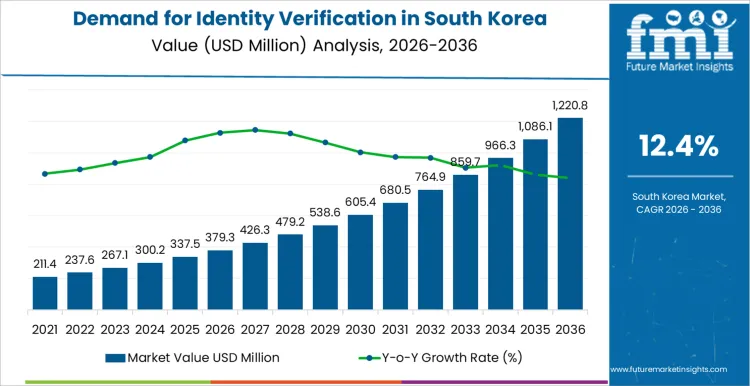
Technological adoption is pivoting toward decentralized identity and blockchain-based credentials, supported by vigorous government initiatives like the mobile driver's license rollout. Financial institutions and telecom operators are investing heavily in solution components, particularly biometrics services, to enhance user experience while meeting strict KYC and AML obligations. Simultaneously, the burgeoning e-commerce sector is driving the need for swift age verification systems to regulate the sale of restricted goods online, further broadening the scope of the landscape.
Major South Korean conglomerates are forming consortiums to establish interoperable identity networks, while international players like Entrust and Onfido are expanding their footprint by partnering with local banks to provide compliant, on-premise solutions. This strategic collaboration is fostering innovation in cloud-based verification services, making enterprise-grade security accessible to the country's vast ecosystem of startups and SMEs through 2036, reshaping the broader authentication solutions landscape.
Demand for Identity Verification in South Korea Key Takeaways
| Metric | Value |
|---|---|
| Industry Size (2026) | USD 379.3 million |
| Industry Value (2036) | USD 1,225.6 million |
| CAGR (2026 to 2036) | 12.4% |
What is Fueling the Rapid Acceleration of Digital Identity Protocols?
The primary catalyst for growth is the government's aggressive e-government identity management initiative, which aims to digitize all public services and IDs. The official launch and expansion of mobile driver's licenses and mobile resident registration cards have normalized digital IDs for the public, creating an expectation for similar convenience in the private sector. Additionally, the sheer density of smartphone usage in South Korea creates a fertile ground for mobile-first verification methods. The looming threat of sophisticated financial crimes, particularly voice phishing and deepfake-based fraud, is further compelling regulators to enforce stricter identity checks for opening bank accounts and activating mobile lines, thereby mandating the adoption of advanced liveness detection technologies.
How is the Sector Structured Across Key Segments?
The sector is segmented to address the specific security needs of South Korea's highly regulated industries. It is primarily categorized by industry, reflecting the varying levels of compliance required. The component segment distinguishes between the core technology platforms and the supporting services, while the deployment segment highlights the preference for data control versus agility. Each segment plays a vital role, where banking drives the demand for high-assurance security and retail drives the need for speed and convenience.
How is Financial Compliance Anchoring High-Assurance Security?
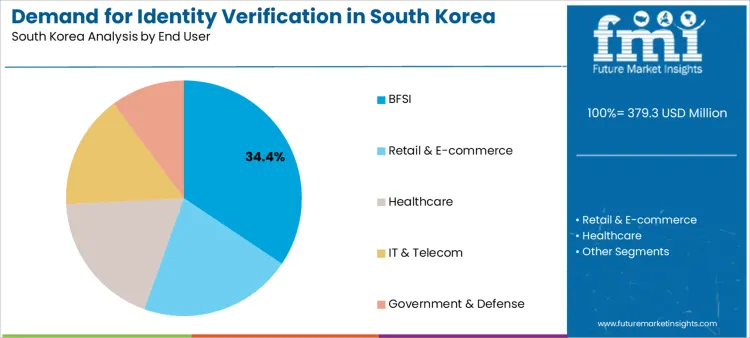
The BFSI sector commands a 34.4% share of the industry. This dominance is driven by the rigorous compliance landscape enforced by the Financial Services Commission, which requires stringent KYC and AML checks for all digital transactions. Banks and fintechs prioritize high-assurance regulatory technology components, such as biometric verification and document scanning, to prevent identity theft and money laundering. The shift toward open banking and the entry of internet-only banks have further intensified the competition to onboard customers remotely and securely, making robust identity verification a critical competitive differentiator.
Why are Automated Platforms Outpacing Managed Services?
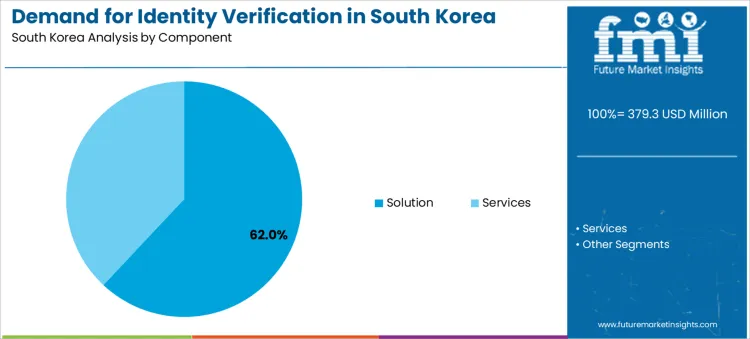
The solution segment holds the majority share of 62%. This is attributed to the widespread implementation of software platforms that can automate the verification process. South Korean enterprises prefer purchasing comprehensive software suites that integrate document verification, facial recognition, and risk scoring into a single API. This preference is driven by the need for scalability and the ability to handle high transaction volumes during peak retail periods or new product launches. While services are essential for integration and maintenance, the core value lies in the automated authentication solution technology that reduces manual review time and enhances user conversion rates.
Why Does On-Premise Infrastructure Retain Critical Relevance?
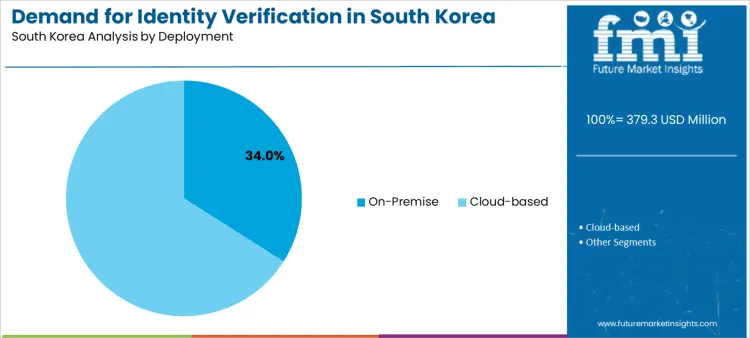
On-premise deployment accounts for 34.0% of the industry share. Despite the global trend toward the cloud, many South Korean financial institutions and government agencies retain a strong preference for on-premise infrastructure due to strict data sovereignty and privacy regulations. Organizations dealing with highly sensitive resident registration numbers often opt to host identity and access management engines within their own firewalls to maintain absolute control over the data and ensure compliance with local privacy laws. This segment is sustained by large enterprises that prioritize security and customization over the flexibility of cloud models, often integrating specialized identity governance and administration tools.
How is E-Commerce Accelerating Frictionless Verification?
The retail & e-commerce sector captures 21.9% of the demand. This segment is driven by the need to secure high-value transactions and enforce age restrictions for products like alcohol and tobacco sold online. Platforms are increasingly integrating lightweight identity verification steps that do not add friction to the checkout process. The rise of buy now, pay later services in South Korea also necessitates real-time credit risk assessment, which relies on accurate identity proofing. Solutions in this space focus on speed and user experience, ensuring that legitimate customers are verified instantly while fraudsters are blocked.
Will Decentralized Identity Redefine User Privacy?
A major trend reshaping the landscape is the adoption of decentralized identity blockchain standards. South Korea is a global pioneer in this space, with major consortiums like the DID Alliance pushing for self-sovereign identity models where users control their own data. This trend is driven by privacy concerns and the desire to eliminate centralized honeypots of personal data that are vulnerable to breaches. By enabling users to share only necessary credentials without revealing their full identity, DID systems are opening new opportunities for privacy-preserving verification in retail and online services, leveraging blockchain identity management frameworks.
Is the Deepfake Crisis Eroding Trust in Remote Onboarding?
The most significant restraint is the escalating sophistication of AI-generated deepfakes. As generative AI becomes more accessible, criminals are using synthetic faces and voices to bypass traditional biometric checks. This creates a cat-and-mouse dynamic where verification vendors must constantly upgrade their liveness detection algorithms to spot subtle artifacts of manipulation. This threat creates hesitation among some consumers and regulators regarding the reliability of remote onboarding, potentially slowing down the shift to fully digital processes for high-stakes transactions like mortgage approvals.
How Will the Metaverse Expand the Frontiers of Digital Identity?
The emerging field of the metaverse presents a frontier of opportunity. South Korea's heavy investment in virtual worlds and digital twins creates a need for persistent, verifiable digital avatars. Suppliers who can provide interoperable identity layers that function across different metaverse platforms stand to capture significant revenue. This transitional landscape serves as a testing ground for new forms of behavioral biometrics and NFT-based identity assets, allowing users to carry their reputation and credentials seamlessly between physical and virtual realities.
How is the Identity Verification Landscape Evolving Across South Korea's Regions?
The regional sphere shows a concentration of high-tech adoption in industrial and administrative hubs, while tourism-focused regions adapt verification for visitor management. High-growth areas are characterizing their modernization by integrating smart city infrastructure with secure access controls. As distinct provinces digitize their local industries, the utilization of identity solutions is becoming tailored to specific economic activities.
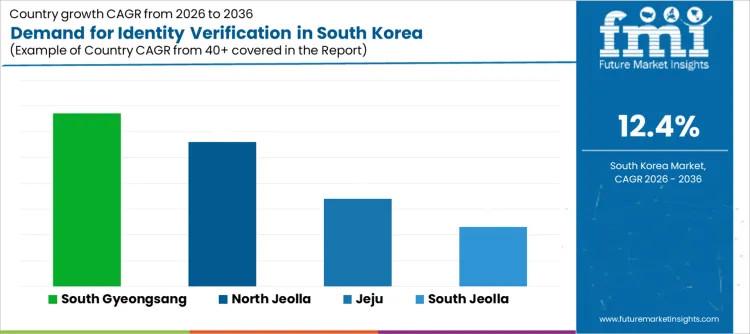
| Region | CAGR (2026 to 2036) |
|---|---|
| South Gyeongsang | 13.0% |
| North Jeolla | 9.9% |
| Jeju | 11.8% |
| South Jeolla | 14.9% |
How is Industrial Digitization Propelling Security Adoption in South Gyeongsang?
Sales of identity verification solutions in South Gyeongsang are projected to expand at a CAGR of 13.0% As a hub for heavy industry, including shipbuilding and aerospace, this region requires robust physical and logical access control systems. The digitization of manufacturing plants into smart factories necessitates secure identity management to control access to operational technology networks and sensitive machinery. Companies in this domain are investing in fingerprint biometrics and secure workforce credentialing to prevent industrial espionage and ensure safety compliance on the factory floor, driving the adoption of enterprise-grade verification solutions.
What Role Does Smart City Infrastructure Play in North Jeolla's Integration?
Adoption of identity verification protocols in North Jeolla is likely to reach a CAGR of 9.9%. The region's development is anchored by the massive Saemangeum reclamation project, which aims to build a smart waterfront city and renewable energy hub. This greenfield development creates opportunities for implementing smart city identity layers from the ground up, including secure access for energy grid management and digital citizen services. The focus here is on integrating identity verification with IoT infrastructure to enable seamless and secure interaction with public utilities and autonomous transport systems.
Why is Tourism Driving the Need for Seamless Visitor Verification in Jeju?
The identity verification sector in Jeju is anticipated to rise at a CAGR of 11.8%. As South Korea's premier tourism destination and a special self-governing province, Jeju faces unique challenges in managing visitor flows and duty-free commerce. The implementation of smart tourism initiatives requires verifying the identity of international tourists for tax-free shopping and rental car services without creating bottlenecks. Solutions that can accurately scan and verify diverse international passports and link them to digital travel credentials are in high demand to enhance the visitor experience while preventing customs fraud.
How is Rural Connectivity Enhancing Service Accessibility in South Jeolla?
Deployment of identity verification technologies in South Jeolla is expected to increase at a CAGR of 14.9%. While traditionally agricultural, the region is modernizing through energy valley projects and the digitization of rural services. The demand in this area is driven by the need to provide secure remote access to financial and government services for a dispersed population. Mobile-based identity verification allows residents to access banking and subsidies without visiting physical branches, bridging the digital divide. The focus is on user-friendly, low-friction solutions that can operate effectively on standard smartphones to ensure inclusivity.
How Are Companies Competing and Strengthening Their Positions in the South Korean Identity Verification Industry?
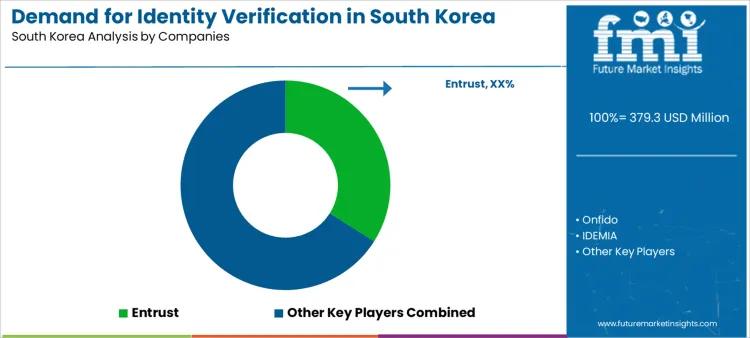
The competitive landscape is defined by the need for hyper-localization and seamless integration with the domestic app ecosystem, spurring demand for flexible digital identity services. Industry leaders like Entrust and IDEMIA are strengthening their positions by forming strategic partnerships with local system integrators and financial giants to ensure their solutions are compatible with Korea's specific regulatory requirements and legacy banking systems. There is also a marked trend toward mobile-first innovation, where vendors are optimizing their SDKs to be as lightweight as possible for integration into super-apps like KakaoTalk and Toss.
Mergers and acquisitions are targeted at niche AI startups, as global players seek to acquire advanced liveness detection and anti-deepfake capabilities. Leading companies are actively investing in FIDO authentication certification to offer passwordless authentication, which is highly favored in the Korean domain. Furthermore, competitive intensity is driving a shift toward offering identity-as-a-service models, allowing smaller fintechs and retailers to plug in enterprise-grade verification capabilities without heavy upfront infrastructure investments.
Key Companies
- Entrust
- Onfido
- IDEMIA
- Transmit Security
- Secret Double Octopus
- RaonSecure
- Dream Security
- Samsung SDS
- LG CNS
- SK Telecom
Scope of Report
| Items | Values |
|---|---|
| Quantitative Units | USD Million |
| Component | Solution, Services |
| Industry | BFSI, Retail & E-commerce, Healthcare, IT & Telecom, Government & Defense |
| Deployment | On-Premise, Cloud-based |
| Regions Covered | South Gyeongsang, North Jeolla, South Jeolla, Jeju |
| Key Companies Profiled | Entrust, Onfido, IDEMIA, Transmit Security, Secret Double Octopus, and others. |
Demand for Identity Verification in South Korea by Segments
By Component:
- Solution
- Services
By Industry:
- BFSI
- Retail & E-commerce
- Healthcare
- IT & Telecom
- Government & Defense
- Others
By Deployment:
- On-Premise
- Cloud-based
By Region:
- South Gyeongsang
- North Jeolla
- South Jeolla
- Jeju
Bibliography
- Statistics Korea (KOSTAT). (2025, February 3). Online Shopping Trends for December 2024 and Online International Direct Sales and Purchases Trends for the Fourth Quarter of 2024.
- Ministry of the Interior and Safety (MOIS). (2025, March 18). The Mobile Resident Registration Card Is Now Available Nationwide.
- Financial Services Commission (FSC). (2025, July 28). Authorities Propose Plans to Set Up Anti-vishing Platform Using Artificial Intelligence Analytics.
- Government of the Republic of Korea (Policy Briefing). (2024, November 5). Measures to Strengthen Responses to Deepfake Sexual Crimes.
- Ministry of Science and ICT (MSIT). (2024, December 31). Korea Plans to Adopt Blockchain in Seven Sectors with a Focus on Decentralized Identity.
Frequently Asked Questions
How big is the demand for identity verification in south korea in 2026?
The demand for identity verification in south korea is estimated to be valued at USD 379.3 million in 2026.
What will be the size of identity verification in south korea in 2036?
The market size for the identity verification in south korea is projected to reach USD 1,220.8 million by 2036.
How much will be the demand for identity verification in south korea growth between 2026 and 2036?
The demand for identity verification in south korea is expected to grow at a 12.4% CAGR between 2026 and 2036.
What are the key product types in the identity verification in south korea?
The key product types in identity verification in south korea are 0.38.
Which 0.344 segment is expected to contribute significant share in the identity verification in south korea in 2026?
In terms of 0.344, 0.219 segment is expected to command 0.0% share in the identity verification in south korea in 2026.
Preview the report firsthand - request a free sample
Get SampleGet the brochure for pricing and purchase details.
Get PDFTable of Content
- Executive Summary
- South Korea Market Outlook
- Demand-side Trends
- Supply-side Trends
- Technology Roadmap Analysis
- Analysis and Recommendations
- Market Overview
- Market Coverage / Taxonomy
- Market Definition / Scope / Limitations
- Market Background
- Market Dynamics
- Drivers
- Restraints
- Opportunity
- Trends
- Scenario Forecast
- Demand in Optimistic Scenario
- Demand in Likely Scenario
- Demand in Conservative Scenario
- Opportunity Map Analysis
- Product Life Cycle Analysis
- Supply Chain Analysis
- Investment Feasibility Matrix
- Value Chain Analysis
- PESTLE and Porter’s Analysis
- Regulatory Landscape
- Regional Parent Market Outlook
- Production and Consumption Statistics
- Import and Export Statistics
- Market Dynamics
- South Korea Market Analysis 2021 to 2025 and Forecast, 2026 to 2036
- Historical Market Size Value (USD Million) Analysis, 2021 to 2025
- Current and Future Market Size Value (USD Million) Projections, 2026 to 2036
- Y-o-Y Growth Trend Analysis
- Absolute $ Opportunity Analysis
- South Korea Market Pricing Analysis 2021 to 2025 and Forecast 2026 to 2036
- South Korea Market Analysis 2021 to 2025 and Forecast 2026 to 2036, By 0.62
- Introduction / Key Findings
- Historical Market Size Value (USD Million) Analysis By 0.62 , 2021 to 2025
- Current and Future Market Size Value (USD Million) Analysis and Forecast By 0.62 , 2026 to 2036
- 0.38
- 0.38
- Y-o-Y Growth Trend Analysis By 0.62 , 2021 to 2025
- Absolute $ Opportunity Analysis By 0.62 , 2026 to 2036
- South Korea Market Analysis 2021 to 2025 and Forecast 2026 to 2036, By 0.344
- Introduction / Key Findings
- Historical Market Size Value (USD Million) Analysis By 0.344, 2021 to 2025
- Current and Future Market Size Value (USD Million) Analysis and Forecast By 0.344, 2026 to 2036
- 0.219
- 0.185
- 0.159
- 0.145
- 0.219
- Y-o-Y Growth Trend Analysis By 0.344, 2021 to 2025
- Absolute $ Opportunity Analysis By 0.344, 2026 to 2036
- South Korea Market Analysis 2021 to 2025 and Forecast 2026 to 2036, By 0.34
- Introduction / Key Findings
- Historical Market Size Value (USD Million) Analysis By 0.34, 2021 to 2025
- Current and Future Market Size Value (USD Million) Analysis and Forecast By 0.34, 2026 to 2036
- 0.33
- 0.33
- 0.33
- Y-o-Y Growth Trend Analysis By 0.34, 2021 to 2025
- Absolute $ Opportunity Analysis By 0.34, 2026 to 2036
- Market Structure Analysis
- Competition Dashboard
- Competition Benchmarking
- Market Share Analysis of Top Players
- By Regional
- By 0.62
- By 0.344
- By 0.34
- Competition Analysis
- Competition Deep Dive
- Competition Deep Dive
- Assumptions & Acronyms Used
- Research Methodology


