

- Industry Size (2026)
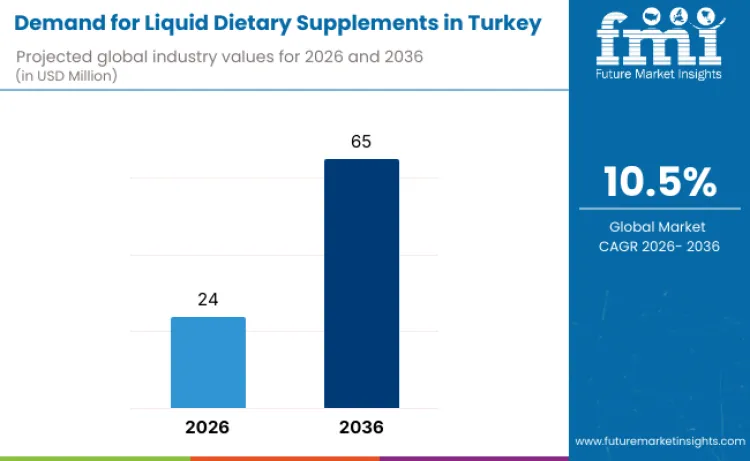
- USD 24.0 Mn
- Forecast (2036)
- USD 65.0 Mn
- CAGR (2026 to 2036)
- 10.5%
Liquid Dietary Supplements Outlook in Turkey 2026 to 2036
The liquid dietary supplements industry in Turkey is projected to be valued at USD 24.0 million in 2026, expected to reach USD 65.0 million by 2036. FMI expects the liquid dietary supplements landscape in Turkey to progress at a 10.5% CAGR. Expansion is shaped by how consumers shift from one-time trial purchases into sustained regimen-based usage, particularly for immunity, digestive wellness, energy and metabolism support, and healthy aging programs.
Liquid formats are increasingly chosen for convenience and routine fit, especially where multi-nutrient combinations and fast intake patterns improve compliance. Brands are also refining taste profiles, pack sizes, and dosing systems to improve repeatability and reduce friction in daily usage. Pharmacies remain a key trust channel for education and conversion, while online retail contributes strongly to discovery-led buying for herbal liquids, probiotics, omega oils, and beauty-linked specialty liquids.
Quick Stats for Liquid Dietary Supplements Demand in Turkey
- Liquid Dietary Supplements in Turkey Industry Value (2026): USD 24.0 million
- Liquid Dietary Supplements in Turkey Forecast Value (2036): USD 65.0 million
- Liquid Dietary Supplements in Turkey Forecast CAGR (2026-2036): 10.5%
- Leading Regional Growth: Marmara (11.3%)
- Leading Product: Vitamins & Minerals (41.0% share)
- Leading Health Function: Immunity (45.0% share)
- Leading Consumer Group: Adults (44.0% share)
Macro-Level Health and Wellness Trends Influencing Liquid Dietary Supplements Sales in Turkey
| Macro Trend | Anticipated Influence |
|---|---|
| Routine immunity programs becoming year-round | Improves repeat purchase cycles for multi-vitamin syrups, tonics, and daily immunity liquids |
| Expansion of herbal and botanical positioning | Strengthens demand for liquid herbal blends, especially through online discovery and pharmacy recommendations |
| Higher focus on digestive comfort and gut support | Lifts probiotics and digestive liquid formats designed for daily compliance |
| Rising fitness and energy-management routines | Supports growth of metabolism-focused liquids among sports and active nutrition users |
| Premiumization in wellness gifting and bundle formats | Increases demand for specialty liquids and omega oils in curated packs and seasonal promotions |
| Aging population priorities becoming more structured | Improves consumption of bone and joint, healthy aging, and women’s health liquids |
Source: Future Market Insights (FMI) analysis, based on proprietary forecasting model and primary research
Liquid Dietary Supplements Industry Key Takeaways in Turkey
| Metric | Value |
|---|---|
| Industry Value (2026) | USD 24.0 million |
| Industry Forecast Value (2036) | USD 65.0 million |
| Forecast CAGR (2026 to 2036) | 10.5% |
Source: FMI’s proprietary forecasting model and primary research
Long-range category planning in Turkey is often mapped in comparison with trends prevalent in the global dietary supplements landscape as companies refine liquid-first portfolios, channel sequencing, and pricing ladders across mainstream and premium tiers.
Why Turkey Building Stronger Consumption of Liquid Dietary Supplements?
According to FMI, Turkey is expanding liquid dietary supplements consumption at a faster pace because wellness purchasing is increasingly tied to routine-based use cases, not episodic seasonal buying. A steady rise in self-care adoption, wider pharmacy-led education, and stronger access through e-commerce channels are improving both trial rates and sustained replenishment.
Adults remain the primary volume anchor because daily use fits work-life routines and family purchasing patterns. Pediatric liquids continue to show relevance where parents prefer convenient intake formats, while seniors drive demand for bone and joint support, omega oils, and healthy aging regimens.
Turkey’s product momentum also reflects wider functional nutrition adoption patterns that strengthen demand across immunity and digestive programs, supported by how several operators track growth using functional foods when shaping broader wellness portfolios.
How is the Liquid Dietary Supplements Landscape in Turkey Segmented?
Turkey’s liquid dietary supplements landscape reflects a balance between high-volume vitamins and minerals and specialized liquids that compete on trust, repeat compliance, and clear outcome positioning.
Why Vitamins and Minerals Dominate Product Mix in Turkey?
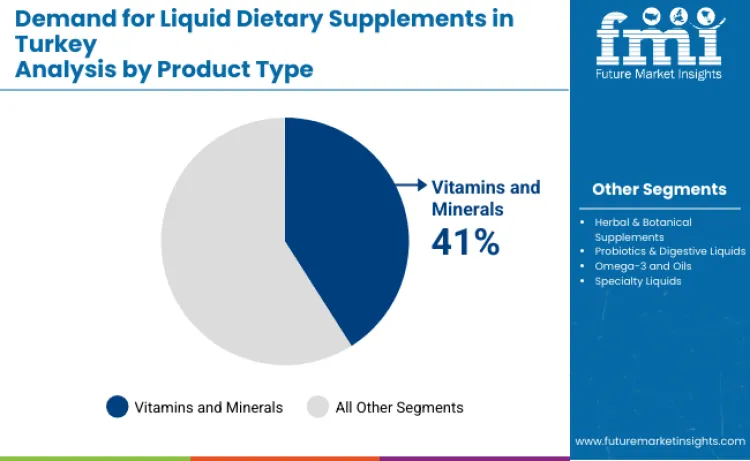
Vitamins and minerals hold a 41.0% share, supported by their broad applicability across daily wellness routines and their strong presence in pharmacy-driven purchasing. These products scale efficiently because they can address multiple needs through a single daily dose format, which supports higher adherence and consistent replenishment cycles. Brands are also expanding combinations that pair vitamins with supportive botanicals to improve differentiation while maintaining mass acceptability.
Which Health Function Category Leads in Turkey’s Liquid Dietary Supplements Industry?
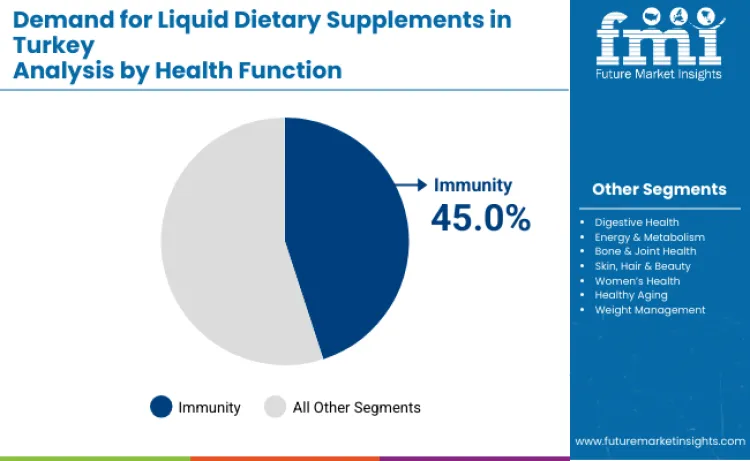
Immunity functions are estimated at 45.0%, reflecting a durable shift toward prevention-led routines. Immunity boosting liquid dietary supplements are positioned as everyday support rather than seasonal protection, which improves repeat buying stability. Digestive health is also strengthening as consumers adopt probiotics and gut-comfort liquids into daily regimens, particularly where taste and format convenience improve compliance.
How Consumer Group Preferences Shape Demand Patterns in Turkey?
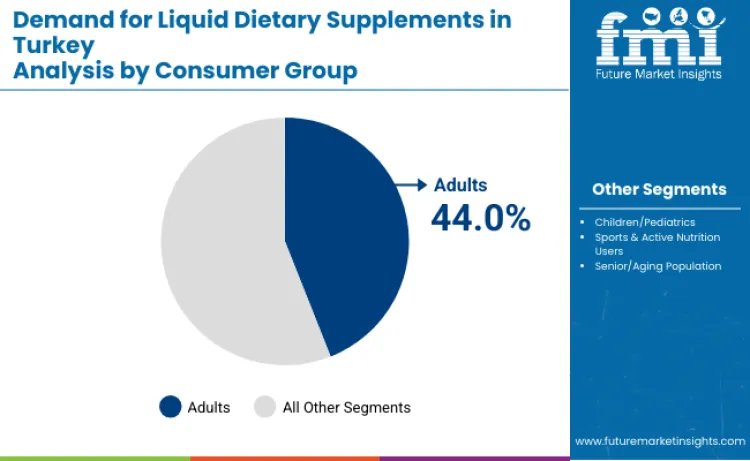
Adults account for 44.0% share, reflecting the highest routine-driven intake frequency and a strong tendency to maintain structured daily stacks. Children and pediatrics contribute through family basket purchases where taste and ease of intake influence product choice.
Senior and aging consumers support steady demand for omega oils, bone and joint liquids, women's health formats, and healthy aging solutions, especially where pharmacy credibility and clear dosing formats reduce usage friction. Sports and active nutrition users contribute through energy and metabolism liquids that fit training-linked routines.
What Dynamics, Restraints, Opportunities, Threats Shape Turkey’s Liquid Dietary Supplements Industry?
What Dynamics are Supporting Expansion of Liquid Dietary Supplements Sales?
The liquid dietary supplements industry in Turkey benefits from higher consumer preference for convenient intake, wider pharmacy-led education, and a growing online channel that improves product discovery. Product innovation is also supporting faster conversion, particularly where brands balance taste, functional claims, and repeatable dosing formats.
What Restraints Create Friction for Faster Scaling in Liquid Offerings?
Taste stability, formulation consistency, and packaging compatibility can limit rapid scale-up for liquids compared to solid formats. Distribution discipline is also essential because product performance issues in liquids can increase return risks and weaken repeat purchase confidence.
Regulatory and claim discipline can slow rollout speed, especially for products positioned around specialized outcomes such as women’s health, cognitive support, or weight management.
Where are the Most Lucrative Opportunities Emerging for Brand Owners?
Immunity liquids remain the largest repeat engine, while digestive health and probiotics show strong runway as routine gut-support adoption increases. Energy and metabolism liquids are also expanding among sports and active nutrition users where consumption is tied to performance routines.
Specialty liquids built around skin, hair, and beauty use cases are gaining attention where premium self-care purchases support higher margins, aligning with patterns prevalent in beauty supplements. Omega oils and bone and joint liquids also offer sustained growth potential as older consumers adopt longer-term prevention-led regimens.
What Threats Could Pressure Category Stability?
Pricing pressure may intensify in e-commerce channels where comparison is fast and promotions can erode premium positioning. Counterfeit risk and inconsistent quality perceptions can weaken consumer trust if channel governance is uneven. Companies respond by strengthening documentation readiness, packaging control, and product authentication practices to protect repeat purchase confidence.
How Regional Growth Prospects Evolve Across Turkey?
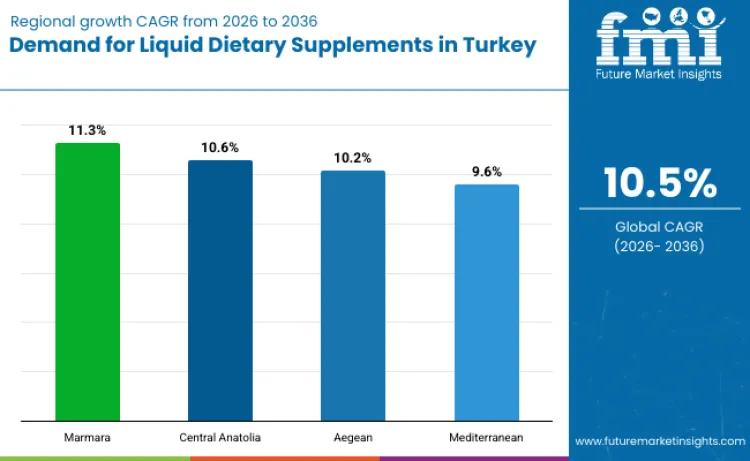
| Region | CAGR (2026 to 2036) |
| Marmara | 11.3% |
| Central Anatolia | 10.6% |
| Aegean | 10.2% |
| Mediterranean | 9.6% |
Source: Future Market Insights analysis, supported by a proprietary forecasting model and primary research
Why does Marmara Lead Expansion for Liquid Dietary Supplements in Turkey?
Marmara expands at an 11.3% CAGR, supported by dense retail access, stronger pharmacy network reach, and higher exposure to wellness-led purchasing habits. Consumers in this region show higher readiness to adopt routine stacks across immunity, digestive liquids, and multi-nutrient combinations.
Marmara also acts as a primary launchpad for new liquid formats, where brands test flavor innovation, pack sizes, and premium positioning before scaling distribution across other regions.
How does Central Anatolia build Steady Growth through Structured Wellness Adoption?
Central Anatolia progresses at a 10.6% CAGR, driven by consistent mainstream demand for vitamins and minerals and rising adoption of immunity liquids as routine purchases. Pharmacy guidance remains influential in shaping product selection, while online channels increasingly support discovery for herbal and botanical liquid supplements. Growth in this region rewards portfolios that maintain pricing discipline while offering dependable availability and consistent product performance.
What Supports Demand for Liquid Dietary Supplements in the Aegean Region amid Balanced Consumption Patterns?
The Aegean liquid dietary supplements landscape is slated to incline at a 10.2% CAGR, shaped by steady consumer uptake of digestive health and metabolism-linked liquids alongside immunity-focused tonics.
Demand here tends to favor familiar brands that maintain strong trust cues, clear usage formats, and stable quality consistency. Retail visibility and pharmacist recommendations remain important for repeat conversion across adult and family baskets.
Why does Mediterranean Turkey show Measured Growth with Wider Portfolio Mix?
Liquid dietary supplements demand in Mediterranean Turkey is expected to incle at a 9.6% CAGR, supported by gradual expansion in product accessibility and rising consumer comfort with daily wellness regimens. Liquid formats perform well where ease-of-intake supports repeat usage across adults, seniors, and lifestyle-driven buyers. Brands that maintain clear outcome positioning and dependable replenishment cycles are better placed to build stable demand in this region.
What Defines Competitive Landscape for Liquid Dietary Supplements in Turkey?
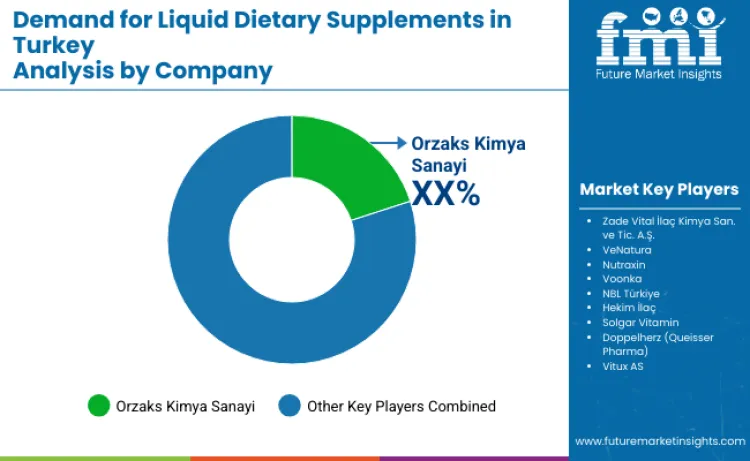
Competition is shaped by product credibility, portfolio breadth, channel control, and repeat purchase strength across pharmacy-led conversion and digital acquisition. Leaders differentiate through strong brand recognition, consistent taste and dosing performance and fast turnover of line extensions that remain aligned with everyday consumer needs.
Orzaks Kimya Sanayi maintains strong visibility through broad portfolio depth and pharmacy reach. Zade Vital İlaç Kimya San. ve Tic. A.Ş. competes through herbal and botanical credibility, while VeNatura, Nutraxin, and Voonka build demand through targeted regimens across immunity, digestive health, and lifestyle-linked wellness stacks.
NBL Türkiye and Hekim İlaç contribute through strong placement in mainstream channels, while international brands such as Solgar Vitamin and Doppelherz (Queisser Pharma) remain prominent due to trust, legacy positioning, and stable quality perception.
Key Industry Participants
- Orzaks Kimya Sanayi
- Zade Vital İlaç Kimya San. ve Tic. A.Ş.
- VeNatura
- Nutraxin
- Voonka
- NBL Türkiye
- Hekim İlaç
- Solgar Vitamin
- Doppelherz (Queisser Pharma)
- Vitux AS
Scope of Report
| Items | Values |
|---|---|
| Quantitative Units | USD Million |
| Product | Vitamins & Minerals; Herbal & Botanical Supplements; Probiotics & Digestive Liquids; Omega-3 and Oils; Specialty Liquids |
| Health Function | Immunity; Digestive Health; Energy & Metabolism; Bone & Joint Health; Skin, Hair & Beauty; Women’s Health; Healthy Aging; Weight Management |
| Consumer Group | Adults; Children / Pediatrics; Sports & Active Nutrition Users; Senior / Aging Population |
| Regions Covered | Marmara; Central Anatolia; Aegean; Mediterranean |
| Key Companies Profiled | Orzaks Kimya Sanayi; Zade Vital İlaç Kimya San. ve Tic. A.Ş.; VeNatura; Nutraxin; Voonka |
Source: Future Market Insights – analysis driven by proprietary forecasting models and primary research
Liquid Dietary Supplements Demand in Turkey by Segments
By Product
- Vitamins & Minerals
- Herbal & Botanical Supplements
- Probiotics & Digestive Liquids
- Omega-3 and Oils
- Specialty Liquids
By Health Function
- Immunity
- Digestive Health
- Energy & Metabolism
- Bone & Joint Health
- Skin, Hair & Beauty
- Women’s Health
- Healthy Aging
- Weight Management
By Consumer Group
- Adults
- Children/Pediatrics
- Sports & Active Nutrition Users
- Senior/Aging Population
By Region
- Marmara
- Central Anatolia
- Aegean
- Mediterranean
Bibliography
- Republic of Türkiye Ministry of Agriculture and Forestry. (2013). Turkish Food Codex Communiqué on Food Supplements (16 August 2013, No. 28737). Ministry of Agriculture and Forestry.
- Codex Alimentarius Commission. (2013). Guidelines for use of nutrition and health claims (CXG 23-1997). FAO/WHO Codex Alimentarius.
- Codex Alimentarius Commission. (2018). General standard for the labelling of prepackaged foods (CXS 1-1985, latest revision). FAO/WHO Codex Alimentarius.
- International Organization for Standardization. (2018). ISO 22000:2018: Food safety management systems Requirements for any organization in the food chain. ISO.
- Ministry of Health, Republic of Türkiye. (2023). Regulation on health claims for foods and food supplements (Official Gazette No. 32169; updated 23 August 2023). Ministry of Health.
- Food and Agriculture Organization of the United Nations. (2023). Food labelling guidance and principles supporting consumer information and compliant claims. FAO.
Frequently Asked Questions
What Value is the Liquid Dietary Supplements Industry in Turkey Expected to Reach in 2026?
Liquid dietary supplements demand in Turkey is likely to total USD 24.0 million in 2026.
What Value is the Liquid Dietary Supplements Landscape in Turkey Forecast to reach by 2036?
Liquid dietary supplements demand in Turkey is forecasted to reach USD 65.0 million by 2036.
What CAGR is Expected for Liquid Dietary Supplements in Turkey from 2026 to 2036?
Demand in Turkey is expected to expand at a 10.5% CAGR from 2026 to 2036.
Which Product leads Liquid Dietary Supplements Sales in Turkey?
Vitamins and minerals lead sales in Turkey, holding a 41.0% share.
Which Health Function leads Liquid Dietary Supplements Consumption in Turkey?
Immunity remains the leading health function in Turkey, accounting for a 45.0% share.
Which Consumer Group leads Liquid Dietary Supplements Consumption in Turkey?
Adults constitute the leading consumer group in Turkey, contributing 44.0% of total demand.
Preview the report firsthand - request a free sample
Get SampleGet the brochure for pricing and purchase details.
Get PDFTable of Content
- Executive Summary
- Industry Introduction, including Taxonomy and Market Definition
- Trends and Success Factors, including Macro-economic Factors, Market Dynamics, and Recent Industry Developments
- Turkey Demand Analysis 2021 to 2025 and Forecast 2026 to 2036, including Historical Analysis and Future Projections
- Pricing Analysis
- Turkey Analysis 2021 to 2025 and Forecast 2026 to 2036
- Product
- Health Function
- Consumer Group
- Region
- By Product
- Vitamins & Minerals
- Herbal & Botanical Supplements
- Probiotics & Digestive Liquids
- Omega-3 and Oils
- Specialty Liquids
- By Health Function
- Immunity
- Digestive Health
- Energy & Metabolism
- Bone & Joint Health
- Skin, Hair & Beauty
- Women’s Health
- Healthy Aging
- Weight Management
- 9. By Consumer Group
- Adults
- Children / Pediatrics
- Sports & Active Nutrition Users
- Senior / Aging Population
- By Region
- Marmara
- Central Anatolia
- Aegean
- Mediterranean
- Marmara Sales Analysis 2021 to 2025 and Forecast 2026 to 2036, by Key Segments
- Central Anatolia Sales Analysis 2021 to 2025 and Forecast 2026 to 2036, by Key Segments
- Aegean Sales Analysis 2021 to 2025 and Forecast 2026 to 2036, by Key Segments
- Mediterranean Sales Analysis 2021 to 2025 and Forecast 2026 to 2036, by Key Segments
- Sales Forecast to 2036 by Product, Health Function, Consumer Group, and Region
- Competitive Assessment, Company Share Analysis by Key Players, and Competition Dashboard
- Company Profile
- Orzaks Kimya Sanayi
- Zade Vital İlaç Kimya San. ve Tic. A.Ş.
- VeNatura
- Nutraxin
- Voonka
- NBL Türkiye
- Hekim İlaç
- Solgar Vitamin
- Doppelherz (Queisser Pharma)
- Vitux AS
- Other Players


