

- Industry Size (2026)
- USD 1180 Mn
- Forecast (2036)
- USD 4260 Mn
- CAGR (2026 to 2036)
- 13.7%
Wrap & Roll Boxes Market Forecast and Outlook By FMI
The global wrap & roll boxes market is forecasted to total USD 1,180 million in 2026, and is expected to increase further to USD 4,260 million by 2036. As per FMI’s projections, demand is slated to progress at a CAGR of 13.7% from 2026 to 2036. The market’s expansion reflects a structural realignment toward custom-length, void-eliminating packaging formats across poster and print fulfillment centers, industrial tube and parts distribution, e-commerce long-item logistics operators, and premium converters, as packaging economics move decisively from weight-based shipping logic to volumetric and dimensional compliance frameworks.
A primary macro catalyst is the introduction of density-based surcharges targeting shipments exceeding 15% void space ratios, which the document positions as fundamentally restructuring packaging cost logic for lightweight cylindrical and long-dimension goods. Under this pricing methodology, conventional standard cartons that require significant void fill become economically punitive, with dimensional weight charges frequently exceeding actual product weight by two to three times for posters, rolled prints, industrial tubes, and related items. In response, wrap and roll solutions are increasingly specified as default architectures because they form precisely around product length and eliminate void space entirely. The document frames this as producing measurable freight cost reductions that justify automation investments with payback periods typically under 24 months, due to combined savings from dimensional charges and void fill elimination.
The forecast outlook is also reinforced by regulatory void-space enforcement, particularly the EU Packaging and Packaging Waste Regulation (PPWR) with headspace reduction targets effective August 2026, and China’s GB 43352-2023 express delivery packaging standards mandating maximum 15% void space ratios with progressive penalties for non-compliance. This combination of carrier economics and regulatory enforcement is presented as pushing wrap & roll formats from a specialized poster-shipment solution into a broader dimensional compliance platform for long-item logistics across e-commerce and industrial distribution.
Summary of Wrap & Roll Boxes Market
- The wrap & roll boxes market comprises custom-length, roll-fed corrugated and paperboard packaging systems engineered to form tightly around cylindrical, tubular, and long-dimension products, enabling void elimination, dimensional weight optimization, and secure containment across poster and print shipments, industrial tube and parts distribution, e-commerce long-item fulfillment, and premium packaging applications.
- The defined scope in the document is structured under FMI taxonomy with segmentation across product application, closure style, material, and region, focusing exclusively on dedicated wrap-and-roll formats designed for precision length customization and automated, high-speed formation from continuous roll stock.
- FMI projects the market to expand at a 13.7% CAGR from 2026 to 2036, rising from USD 1,180 million in 2026 to USD 4,260 million by 2036. Growth is underpinned by the convergence of volumetric freight pricing enforcement, regulatory void-space mandates (notably PPWR and GB 43352-2023), and the rapid scaling of long-item e-commerce categories such as sporting goods, rolled textiles, window coverings, area rugs, and custom framing.
- Competitive positioning, as framed in the document, concentrates among global packaging and materials-science corporations and system integrators capable of delivering high-tensile roll-stock substrates, automated roll-fed equipment integration, AI-driven sizing optimization, and mono-material recyclability compliance documentation.
- China is positioned as the fastest-growing country market with 14.0% CAGR through 2036, followed by the United States (12.4%) and Germany (11.2%), reflecting regional differentiation based on regulatory strictness, carrier pricing regimes, e-commerce maturity, and labor-market automation needs.
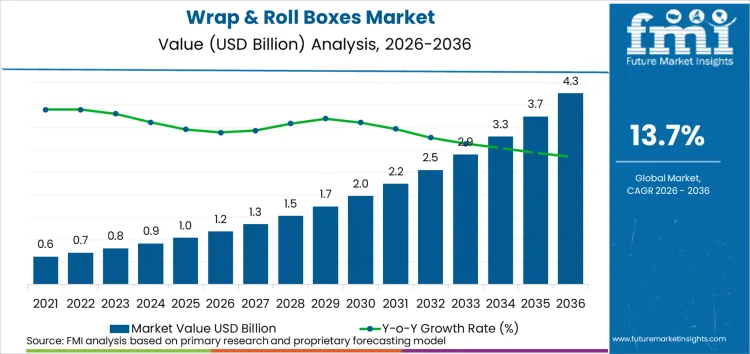
A distinctive feature of this market is the acceleration of roll-fed system specification over alternatives such as pre-erected telescoping cartons or rigid tubes. The document highlights corporate actions illustrating this transition, including Smurfit Westrock reporting a 40% surge in Pak On Demand deployments utilizing roll-stock technologies following carrier pricing changes, positioning packaging efficiency as a core competitive lever under the new freight regime. This strategic framing is reinforced by leadership commentary included in the document, signaling that on-demand roll-fed packaging is increasingly treated as a system-level efficiency platform rather than a packaging SKU purchase.
In East Asia, the document also emphasizes how massive parcel processing scale is enabling rapid rollout of AI-optimized wrap-and-roll systems. Industry disclosures cited include China’s e-commerce ecosystem processing 174.5 billion parcels annually, with Alibaba and JD.com deploying machine learning models to refine packaging specifications based on damage and freight outcomes, delivering material efficiency improvements exceeding 20% relative to rule-based sizing while sustaining zero-void compliance requirements. In parallel, European suppliers are described as pushing material innovation toward fully recyclable high-tensile corrugated roll formats, with fiber engineering (rather than plastic coatings) enabling moisture resistance aligned with circular requirements.
Wrap & Roll Boxes Market Key Takeaways
| Metric | Value |
|---|---|
| Expected Value (2026E) | USD 1,180 million |
| Projected Value (2036F) | USD 4,260 million |
| CAGR (2026-2036) | 13.7% |
Source: Future Market Insights (FMI), based on proprietary forecasting model and primary research
Why is the Wrap & Roll Boxes Market Growing?
Expansion of wrap & roll boxes demand is propelled by volumetric freight pricing enforcement, regulatory void-space mandates, long-item e-commerce fulfillment proliferation, art and print DTC channel expansion, and sustainable fiber engineering advancements. Institutional procurement specifications from parcel carriers, e-commerce platforms, and omnichannel retailers are increasingly forcing adoption of custom-length, void-eliminating roll-fed packaging systems for low-density shipments where packaging inefficiency now generates direct financial penalties.
Volumetric freight pricing is the primary demand driver in the document’s framing. Density surcharges applied to shipments exceeding 15% void space ratios penalize conventional standard carton approaches, especially for posters, rolled prints, and industrial tubes where dimensional weight can exceed actual weight by two to three times. Wrap and roll systems reduce or eliminate void fill and reduce dimensional-weight penalties, with the document citing freight cost reduction outcomes in the 30-50% range and automation payback periods typically under 24 months due to combined freight and material savings.
Regulatory void-space mandates create the second non-discretionary adoption driver. China’s GB 43352-2023 standards impose strict maximum void-space ratios and progressive penalties, while the EU PPWR (effective August 2026) is positioned as accelerating mono-material, recyclable wrap-and-roll adoption while tightening headspace requirements. These mandates do not simply encourage better design; they create compliance risk for void-heavy packaging, pushing shippers toward precision-sized formats that can be verified and standardized across fulfillment networks.
A third growth pillar is long-item e-commerce proliferation. The document notes that categories such as sporting goods, rolled textiles, window coverings, and rugs require length customization that roll-fed systems can provide more economically than maintaining inventories of pre-erected carton SKUs. In parallel, poster and print DTC expansion remains central because these products are highly sensitive to bending and abrasion, where wrap-and-roll tight formation reduces internal movement and lowers damage-driven returns. Finally, material and process innovation is expanding the market’s addressable range: fiber-engineered moisture resistance (Cobb₃₀ < 25 g/m² without polyethylene coating) and AI-driven sizing optimization (20%+ material efficiency improvements in cited platform deployments) strengthen the business case for conversion to roll-fed systems at scale.
How is the Wrap & Roll Boxes Market Segmented?
The wrap & roll boxes market is segmented by product application, closure style, and material, reflecting how dimensional compliance requirements vary by item length, surface sensitivity, handling frequency, and fulfillment speed. Unlike conventional cartons-where segmentation often follows end-use industry-the document frames segmentation here around void-elimination performance and length customization capability, because these factors directly determine freight penalties, regulatory compliance, and damage rates for long and cylindrical goods.
Segmentation is also influenced by the shift from SKU-based carton inventories to system-led roll-fed packaging, where converters and shippers specify a packaging process rather than a fixed box size. As a result, higher-value segments are those that require precision length cutting, tight wrap formation, and repeatable closure integrity at speed. This elevates applications and structures that can consistently deliver zero-void outcomes under automated operation, making segmentation less about volume alone and more about performance under dimensional-weight pricing and void-space audits.
Why do Poster & Print Shipments dominate the wrap & roll boxes market?
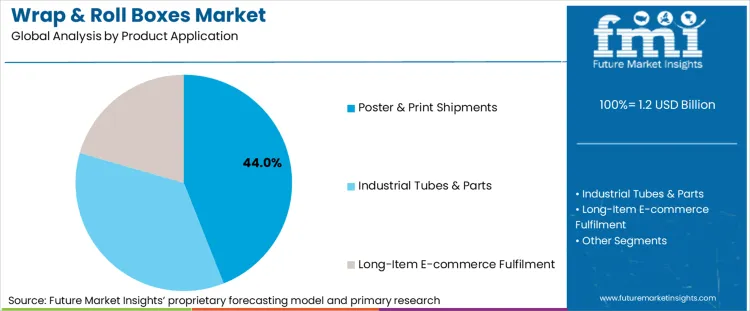
Poster and print shipments account for approximately 44% of total market demand, making them the largest product application segment. The document identifies this dominance as structural rather than cyclical. Posters, art prints, blueprints, and large-format graphics are lightweight yet highly dimension-sensitive; when shipped in standard cartons, they incur disproportionate dimensional-weight charges and require excessive void fill to prevent abrasion and bending. Wrap & roll boxes address both issues simultaneously by forming tightly around the rolled item, eliminating void space and stabilizing the product during transit.
The segment’s leadership is further reinforced by the expansion of direct-to-consumer (DTC) art and print commerce, where shipping cost often determines margin viability. The document highlights that wrap-and-roll formation reduces internal movement and edge wear, lowering damage-driven returns-an outcome that is especially valuable in premium print categories. Because these shipments demand both surface protection and dimensional efficiency, poster and print applications remain the anchor segment for wrap & roll box adoption across regions.
How is Roll-End Closure emerging as the preferred closure style?
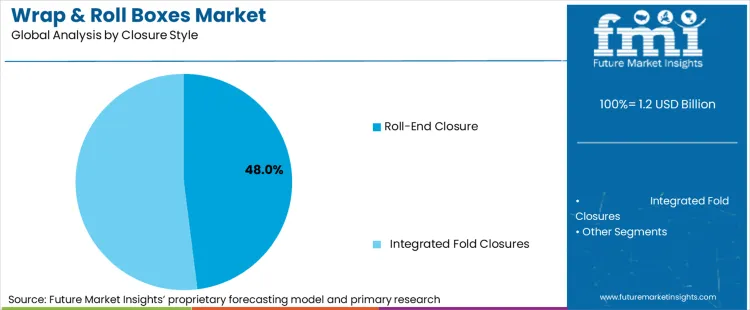
Roll-end closure formats hold a 48% share of the closure-style segment, reflecting their compatibility with high-speed automated formation and their ability to maintain structural integrity without auxiliary materials. The document positions roll-end closures as the most reliable solution for continuous roll-fed systems because they enable secure end sealing through folding geometry alone, reducing reliance on tapes, plastic caps, or additional inserts that would compromise recyclability and increase material cost.
From an operational perspective, roll-end closures also support consistent compression performance along the tube axis, which is critical for long-item shipments subject to stacking and vibration. Their dominance is reinforced by regulatory and sustainability considerations: roll-end closures maintain mono-material construction, aligning with PPWR recyclability expectations and simplifying waste handling for end users. As automation adoption scales, closure styles that integrate seamlessly into roll-fed forming lines-without introducing secondary operations-are increasingly specified as standard, sustaining roll-end formats as the leading choice.
Why does Kraft Board remain the dominant material platform?
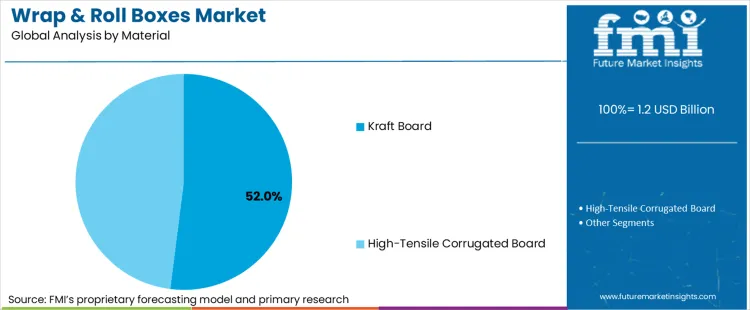
Kraft board represents approximately 52% of material usage, reflecting its balance of tensile strength, fold endurance, and recyclability. The document emphasizes that wrap & roll boxes must withstand longitudinal compression and repeated handling while maintaining tight wrap formation around the product. Kraft board delivers these properties without requiring plastic coatings or composite layers, making it well suited to the market’s performance and compliance requirements.
Material dominance is also linked to fiber engineering advancements cited in the document, including high-tensile kraft grades with improved moisture resistance achieved through fiber treatment rather than polyethylene lamination. This allows wrap & roll boxes to protect contents in humid or variable transit conditions while remaining compatible with paper recycling streams. As regulatory scrutiny of composite materials intensifies, kraft board’s ability to deliver performance within mono-material constraints sustains its leadership position.
What Drivers, Restraints, Opportunities, and Trends Shape the Wrap & Roll Boxes Market?
Volumetric freight pricing and void-space penalties are restructuring packaging economics. Density-based surcharges and void-space thresholds (notably penalties beyond 15% void space) is the primary demand driver. For long, lightweight items, dimensional weight frequently exceeds actual weight by two to three times when shipped in standard cartons. Wrap & roll systems eliminate this inefficiency by forming to exact product length, delivering freight cost reductions cited in the 30-50% range, which rapidly offset equipment and system investments.
Regulatory void-space mandates are institutionalizing precision-sized packaging. China’s GB 43352-2023 standards and the EU’s PPWR headspace requirements (effective August 2026) create direct compliance risk for void-heavy packaging. The document frames these mandates as enforcement mechanisms rather than guidance, compelling shippers to adopt packaging formats that can be audited and verified. Wrap & roll boxes, with their zero-void geometry and mono-material construction, align directly with these requirements.
Capital investment and integration complexity can delay adoption. While wrap & roll systems deliver strong operating savings, they often require roll-fed machinery, integration with fulfillment lines, and process redesign. The document implies that smaller operators or those with fragmented fulfillment infrastructure may face longer adoption timelines due to capital constraints and integration risk, particularly where volumes do not yet justify automation.
Material performance limits in extreme environments remain a challenge. Although fiber engineering has improved moisture resistance, kraft-based wrap & roll solutions can still face performance limits in prolonged exposure to high humidity or outdoor storage. The document notes that addressing these edge cases without introducing non-recyclable coatings remains an ongoing technical challenge, which can restrict adoption in certain industrial or export scenarios.
AI-driven sizing optimization can unlock incremental efficiency gains. Deployments in East Asia where machine learning models adjust wrap length and tension based on historical damage and freight data, delivering 20%+ material efficiency improvements beyond rule-based sizing. This presents an opportunity for system providers and converters to move up the value chain by offering data-driven optimization rather than static packaging formats.
Expansion into non-traditional long-item categories broadens the addressable market. Beyond posters and prints, categories such as rolled textiles, window coverings, rugs, and sporting goods are increasingly adopting wrap & roll formats. As material strength improves and automation costs decline, these adjacent segments represent a significant expansion opportunity, particularly in e-commerce and export-driven markets.
Transition from SKU-based cartons to system-based roll-fed packaging. There is a clear trend away from maintaining inventories of multiple carton sizes toward on-demand, roll-fed systems that cut and form packaging to exact length. This reduces inventory complexity, improves space utilization, and aligns with dynamic fulfillment environments handling variable order profiles.
Regulatory and brand pressure is driving innovation toward wrap & roll designs that achieve moisture resistance, compression strength, and durability without plastic laminates. Fiber-based solutions that meet these criteria are becoming the benchmark for compliance-ready packaging, shaping material development and supplier differentiation.
Analysis of Wrap & Roll Boxes Market by Key Countries
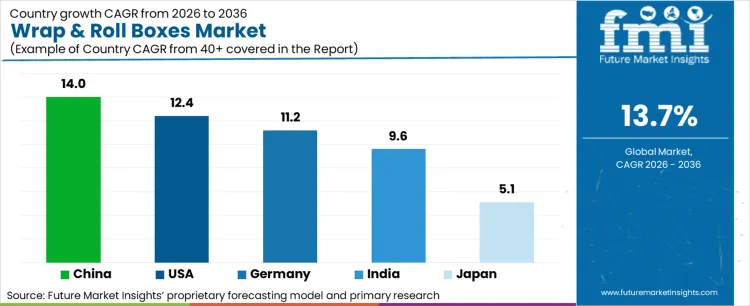
| Country | CAGR (2026-2036) |
|---|---|
| China | 14.0% |
| United States | 12.4% |
| Germany | 11.2% |
| India | 9.6% |
| Japan | 5.1% |
Source: Future Market Insights (FMI) analysis, based on proprietary forecasting model and primary research
How is national packaging legislation driving China’s wrap and roll market expansion at 14.0% CAGR?
China exhibits the highest market acceleration with a 14.0% CAGR from 2026 to 2036, anchored in enforcement of GB 43352-2023 national standards for express delivery packaging. The document positions this as the most forceful structural demand driver globally because it mandates a maximum 15% void space threshold while introducing progressive penalty fees and shipment rejection risks at sortation centers for non-compliant packages. The regulatory environment converts “packaging efficiency” from a best practice into an enforceable operating requirement, creating immediate incentive for zero-void wrap-and-roll systems.
Adoption is further accelerated by platform-scale execution. The document states that Alibaba and JD.com have implemented AI-driven sizing systems that refine cut-length specifications using historical damage and freight outcomes, achieving material efficiency improvements exceeding 20% while maintaining zero-void compliance. This mechanism matters because it makes wrap-and-roll packaging not only compliant, but continuously optimized-so large platforms reduce both regulatory risk and unit economics simultaneously. China’s domestic machinery ecosystem also reduces adoption barriers: roll-fed equipment manufactured locally is described as 30-40% lower-cost than imported alternatives, enabling rapid scaling across national hubs and regional logistics providers.
What is driving wrap and roll boxes demand in the United States market at 12.4% CAGR?
The United States market is projected to grow at a 12.4% CAGR, driven primarily by changes in carrier pricing rules that penalize inefficient packaging. The document highlights that major parcel carriers-including FedEx, UPS, and regional LTL carriers-have introduced density-based surcharges for shipments exceeding 15% void space, making traditional oversized cartons materially more expensive for long, lightweight goods. This directly shifts demand toward wrap-and-roll formats that eliminate unused space and reduce dimensional-weight penalties.
Operationally, the document explains that U.S. shippers of posters, textiles, sporting goods, and window coverings historically relied on void fill (air pillows, kraft paper, foam peanuts) to stabilize products inside oversized cartons-raising dimensional weight and adding consumable cost and labor time. Wrap-and-roll systems remove this inefficiency by producing custom-length boxes that eliminate void fill and reduce dimensional weight by 30-50%, generating combined savings across freight charges and consumables. The adoption curve is reinforced by supplier-side scaling: Smurfit Westrock reported a 40% increase in Pak On Demand deployments, and its February 11, 2026 NYSE presentation explicitly framed packaging efficiency as a competitive advantage under the new freight regime.
What regulatory framework is shaping wrap and roll packaging standards in Germany at 11.2% CAGR?
Germany’s market expands at an 11.2% CAGR, shaped by enforcement of the EU Packaging and Packaging Waste Regulation (PPWR) starting August 2026. The document positions PPWR as a structural accelerator because it mandates reduced headspace to cut transport emissions and packaging waste, establishing maximum allowable void-space ratios and associated compliance verification requirements. This shifts market preference toward wrap-and-roll designs that provide precise dimensional fit while remaining fully recyclable.
German producers are responding by transitioning away from multi-layer constructions incorporating plastic films or coatings and toward high-tensile corrugated roll systems. Companies in the Mondi Group network are cited as showcasing recyclable roll-fed designs at WorldStar 2026, including fiber-engineered moisture resistance achieving Cobb₃₀ values below 25 g/m² without polyethylene coating. Germany’s strong engineering ecosystem further supports adoption through advanced features such as multi-depth construction and integrated cushioning, while eco-modulated EPR fee schedules provide 15-30% license fee reductions for verified mono-material fiber packaging, reinforcing the economic case beyond compliance minimums.
How is e-commerce democratization shaping India’s wrap and roll adoption at 9.6% CAGR?
India advances at a 9.6% CAGR from 2026 to 2036, led by e-commerce democratization dynamics explicitly referenced through ONDC in the document’s country-growth framing. The market logic is centered on the broadening of seller participation and SKU diversity, which increases shipments of long and flexible items (rolled textiles, mats, posters, and home goods) where standard carton sizing is inefficient and void fill drives both cost and damage risk. Under these conditions, roll-fed wrap-and-roll systems provide an efficient pathway to reduce package volume and stabilize goods without maintaining inventories of multiple box sizes.
The document also connects India’s growth to equipment economics, citing Uflex Limited’s cost-efficient roll-fed machinery as an enabling factor. This is important structurally: when domestic machinery reduces capex thresholds, mid-sized fulfillment operators and converters can adopt roll-fed systems earlier, accelerating diffusion beyond top-tier national platforms. As India’s fulfillment networks expand into tier-2 and tier-3 cities, formats that reduce void fill and simplify pack-out are positioned as operational necessities rather than premium upgrades-supporting the country’s sustained growth rate over the decade.
Why does Japan’s labor-constrained environment support 5.1% growth in wrap and roll boxes?
Japan grows at a 5.1% CAGR through 2036, and the document frames this as a labor-economics-led market rather than a volume-led one. The Logistics 2024-2026 Crisis is cited as creating labor shortages that force packaging operations to minimize manual handling time. In this context, adoption centers on designs that deliver both dimensional fit and labor reduction-particularly one-touch self-erecting roll boxes that can be deployed at speed without multi-step assembly.
A specific innovation anchor is identified through Rengo Co.’s development of one-touch, self-erecting roll box systems that assemble in under two seconds, using spring-loaded configurations or mechanical assists to maintain throughput amid workforce attrition. The document notes that these labor-saving innovations are also migrating to other markets facing demographic constraints, but Japan remains the most advanced early adopter due to the severity of its labor shortage and the operational imperative to maintain fulfillment throughput with fewer workers.
What Is the Competition Outlook for the Wrap & Roll Boxes Market?
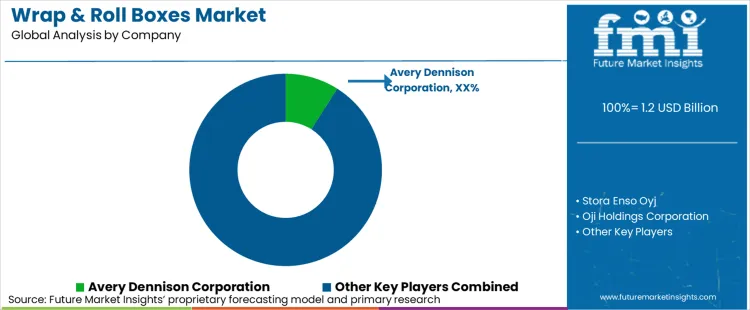
Competition in the wrap & roll boxes market is shifting from converter-led capacity competition to system-level performance competition. Buyers increasingly evaluate suppliers on their ability to deliver end-to-end dimensional compliance, combining roll-fed substrates, automated forming equipment, and data-driven sizing logic that eliminates void space at scale. As volumetric pricing penalties and regulatory void-space limits become enforceable constraints, packaging selection is moving upstream into logistics strategy, favoring suppliers that can quantify freight savings, material efficiency, and damage reduction.
A key differentiator is automation and integration capability. Market leaders are those that pair high-tensile roll stock with forming systems compatible with high-speed fulfillment lines, minimizing labor touchpoints and enabling continuous optimization. The document highlights that suppliers able to integrate AI-assisted cut-length optimization-learning from historical damage and freight outcomes-achieve superior material efficiency while maintaining zero-void compliance. This capability creates stickier, longer-term customer relationships compared to standalone box supply.
Another axis of competition is material science within mono-material constraints. As PPWR and GB 43352-2023 tighten scrutiny on composite structures, suppliers investing in fiber engineering (rather than plastic laminations) are gaining advantage. High-strength kraft grades with improved moisture tolerance and fold endurance allow wrap & roll formats to expand into industrial and export use cases without compromising recyclability. Over the forecast period, competitive intensity is expected to concentrate market share among global packaging groups and system integrators with scale, R&D depth, and automation partnerships.
Key Players Profiled in the Wrap & Roll Boxes Market
- Avery Dennison Corporation
- Stora Enso Oyj
- Oji Holdings Corporation
- Huhtamaki Oyj
- Smurfit Westrock
Market Definition
The wrap & roll boxes market comprises custom-length, roll-fed paperboard and corrugated packaging systems designed to form tightly around cylindrical, tubular, and long-dimension products. These systems eliminate void space, reduce dimensional-weight freight penalties, and stabilize contents during transit across poster and print shipments, industrial tubes and parts, long-item e-commerce fulfillment, and premium goods distribution.
Within FMI’s defined scope, the market includes wrap-and-roll boxes formed from continuous roll stock using automated or semi-automated equipment, incorporating roll-end or equivalent mono-material closures. The scope excludes pre-erected telescoping cartons, rigid tubes, plastic mailing tubes, non-paper cylindrical containers, flexible packaging, and downstream logistics services.
Scope of the Report
| Attribute | Details |
|---|---|
| Base Year | 2026 |
| Forecast Period | 2026-2036 |
| Market Size (2026E) | USD 1,180 million |
| Market Size (2036F) | USD 4,260 million |
| CAGR (2026-2036) | 13.7% |
| Product Applications | Poster & Print Shipments; Industrial Tubes & Parts; Long-Item E-commerce |
| Closure Styles | Roll-End Closure; Integrated Fold Closures |
| Materials | Kraft Board; High-Tensile Corrugated Board |
| Regions Covered | North America; Europe; East Asia; South Asia; Japan; Rest of the World |
| Key Countries | China; United States; Germany; India; Japan |
Source: Future Market Insights (FMI)
Wrap & Roll Boxes Market Key Segments
By Product Application
- Poster & Print Shipments
- Industrial Tubes & Parts
- Long-Item E-commerce Fulfilment
By Closure Style
- Roll-End Closure
- Integrated Fold Closures
By Material
- Kraft Board
- High-Tensile Corrugated Board
By Region
- North America
- Europe
- East Asia
- South Asia
- Japan
- Rest of the World
Bibliography
- State Post Bureau of the People’s Republic of China. (2023). GB 43352-2023: Express delivery packaging requirements and void-space limits. Government of China.
- European Commission. (2024). Packaging and Packaging Waste Regulation (PPWR): Headspace reduction and recyclability requirements. Official Journal of the European Union.
- Smurfit Westrock. (2026). Pak On Demand deployment growth and roll-fed packaging performance under density-based pricing. Investor presentation, February 11, 2026.
- Alibaba Group. (2025). AI-driven packaging optimization for long-item e-commerce logistics. Sustainability and logistics technology disclosure.
- JD.com, Inc. (2025). Machine-learning-based packaging specification systems for zero-void compliance. Corporate logistics white paper.
- Mondi Group. (2026). Fiber-engineered recyclable roll-fed packaging solutions showcased at WorldStar 2026. Corporate exhibition release.
- Rengo Co., Ltd. (2026). One-touch self-erecting roll box systems for labor-constrained logistics environments. Product technology briefing.
Frequently Asked Questions
What is the long-term growth outlook for the wrap & roll boxes market?
FMI projects the market to expand at a 13.7% CAGR from 2026 to 2036, driven by volumetric freight pricing enforcement, regulatory void-space mandates, and the scaling of long-item e-commerce.
How large is the market expected to be by 2036?
The market is expected to reach USD 4,260 million by 2036, up from USD 1,180 million in 2026.
Which application dominates demand?
Poster and print shipments dominate due to extreme dimensional sensitivity and the high cost penalties associated with void-heavy packaging.
Which country is growing the fastest?
China leads growth at 14.0% CAGR, supported by GB 43352-2023 enforcement and large-scale AI-driven packaging optimization across e-commerce platforms.
Why are wrap & roll boxes replacing standard cartons for long items?
Wrap & roll boxes eliminate void space, reduce dimensional-weight penalties by up to 30–50%, lower damage rates, and comply more easily with regulatory headspace limits.
Preview the report firsthand - request a free sample
Get SampleGet the brochure for pricing and purchase details.
Get PDFTable of Content
- Executive Summary
- Global Market Outlook
- Demand-side Trends
- Supply-side Trends
- Technology Roadmap Analysis
- Analysis and Recommendations
- Market Overview
- Market Coverage / Taxonomy
- Market Definition / Scope / Limitations
- Research Methodology
- Chapter Orientation
- Analytical Lens and Working Hypotheses
- Market Structure, Signals, and Trend Drivers
- Benchmarking and Cross-market Comparability
- Market Sizing, Forecasting, and Opportunity Mapping
- Research Design and Evidence Framework
- Desk Research Programme (Secondary Evidence)
- Company Annual and Sustainability Reports
- Peer-reviewed Journals and Academic Literature
- Corporate Websites, Product Literature, and Technical Notes
- Earnings Decks and Investor Briefings
- Statutory Filings and Regulatory Disclosures
- Technical White Papers and Standards Notes
- Trade Journals, Industry Magazines, and Analyst Briefs
- Conference Proceedings, Webinars, and Seminar Materials
- Government Statistics Portals and Public Data Releases
- Press Releases and Reputable Media Coverage
- Specialist Newsletters and Curated Briefings
- Sector Databases and Reference Repositories
- FMI Internal Proprietary Databases and Historical Market Datasets
- Subscription Datasets and Paid Sources
- Social Channels, Communities, and Digital Listening Inputs
- Additional Desk Sources
- Expert Input and Fieldwork (Primary Evidence)
- Primary Modes
- Qualitative Interviews and Expert Elicitation
- Quantitative Surveys and Structured Data Capture
- Blended Approach
- Why Primary Evidence is Used
- Field Techniques
- Interviews
- Surveys
- Focus Groups
- Observational and In-context Research
- Social and Community Interactions
- Stakeholder Universe Engaged
- C-suite Leaders
- Board Members
- Presidents and Vice Presidents
- R&D and Innovation Heads
- Technical Specialists
- Domain Subject-matter Experts
- Scientists
- Physicians and Other Healthcare Professionals
- Governance, Ethics, and Data Stewardship
- Research Ethics
- Data Integrity and Handling
- Primary Modes
- Tooling, Models, and Reference Databases
- Desk Research Programme (Secondary Evidence)
- Data Engineering and Model Build
- Data Acquisition and Ingestion
- Cleaning, Normalisation, and Verification
- Synthesis, Triangulation, and Analysis
- Quality Assurance and Audit Trail
- Market Background
- Market Dynamics
- Drivers
- Restraints
- Opportunity
- Trends
- Scenario Forecast
- Demand in Optimistic Scenario
- Demand in Likely Scenario
- Demand in Conservative Scenario
- Opportunity Map Analysis
- Product Life Cycle Analysis
- Supply Chain Analysis
- Investment Feasibility Matrix
- Value Chain Analysis
- PESTLE and Porter’s Analysis
- Regulatory Landscape
- Regional Parent Market Outlook
- Production and Consumption Statistics
- Import and Export Statistics
- Market Dynamics
- Global Market Analysis 2021 to 2025 and Forecast, 2026 to 2036
- Historical Market Size Value (USD Million) Analysis, 2021 to 2025
- Current and Future Market Size Value (USD Million) Projections, 2026 to 2036
- Y-o-Y Growth Trend Analysis
- Absolute $ Opportunity Analysis
- Global Market Pricing Analysis 2021 to 2025 and Forecast 2026 to 2036
- Global Market Analysis 2021 to 2025 and Forecast 2026 to 2036, By Product Application
- Introduction / Key Findings
- Historical Market Size Value (USD Million) Analysis By Product Application , 2021 to 2025
- Current and Future Market Size Value (USD Million) Analysis and Forecast By Product Application , 2026 to 2036
- Poster & Print Shipments
- Industrial Tubes & Parts
- Long-Item E-commerce Fulfilment
- Poster & Print Shipments
- Y-o-Y Growth Trend Analysis By Product Application , 2021 to 2025
- Absolute $ Opportunity Analysis By Product Application , 2026 to 2036
- Global Market Analysis 2021 to 2025 and Forecast 2026 to 2036, By Closure Style
- Introduction / Key Findings
- Historical Market Size Value (USD Million) Analysis By Closure Style, 2021 to 2025
- Current and Future Market Size Value (USD Million) Analysis and Forecast By Closure Style, 2026 to 2036
- Roll-End Closure
- Integrated Fold Closures
- Roll-End Closure
- Y-o-Y Growth Trend Analysis By Closure Style, 2021 to 2025
- Absolute $ Opportunity Analysis By Closure Style, 2026 to 2036
- Global Market Analysis 2021 to 2025 and Forecast 2026 to 2036, By Material
- Introduction / Key Findings
- Historical Market Size Value (USD Million) Analysis By Material, 2021 to 2025
- Current and Future Market Size Value (USD Million) Analysis and Forecast By Material, 2026 to 2036
- Kraft Board
- High-Tensile Corrugated Board
- Kraft Board
- Y-o-Y Growth Trend Analysis By Material, 2021 to 2025
- Absolute $ Opportunity Analysis By Material, 2026 to 2036
- Global Market Analysis 2021 to 2025 and Forecast 2026 to 2036, By Region
- Introduction
- Historical Market Size Value (USD Million) Analysis By Region, 2021 to 2025
- Current Market Size Value (USD Million) Analysis and Forecast By Region, 2026 to 2036
- North America
- Latin America
- Western Europe
- Eastern Europe
- East Asia
- South Asia and Pacific
- Middle East & Africa
- Market Attractiveness Analysis By Region
- North America Market Analysis 2021 to 2025 and Forecast 2026 to 2036, By Country
- Historical Market Size Value (USD Million) Trend Analysis By Market Taxonomy, 2021 to 2025
- Market Size Value (USD Million) Forecast By Market Taxonomy, 2026 to 2036
- By Country
- USA
- Canada
- Mexico
- By Product Application
- By Closure Style
- By Material
- By Country
- Market Attractiveness Analysis
- By Country
- By Product Application
- By Closure Style
- By Material
- Key Takeaways
- Latin America Market Analysis 2021 to 2025 and Forecast 2026 to 2036, By Country
- Historical Market Size Value (USD Million) Trend Analysis By Market Taxonomy, 2021 to 2025
- Market Size Value (USD Million) Forecast By Market Taxonomy, 2026 to 2036
- By Country
- Brazil
- Chile
- Rest of Latin America
- By Product Application
- By Closure Style
- By Material
- By Country
- Market Attractiveness Analysis
- By Country
- By Product Application
- By Closure Style
- By Material
- Key Takeaways
- Western Europe Market Analysis 2021 to 2025 and Forecast 2026 to 2036, By Country
- Historical Market Size Value (USD Million) Trend Analysis By Market Taxonomy, 2021 to 2025
- Market Size Value (USD Million) Forecast By Market Taxonomy, 2026 to 2036
- By Country
- Germany
- UK
- Italy
- Spain
- France
- Nordic
- BENELUX
- Rest of Western Europe
- By Product Application
- By Closure Style
- By Material
- By Country
- Market Attractiveness Analysis
- By Country
- By Product Application
- By Closure Style
- By Material
- Key Takeaways
- Eastern Europe Market Analysis 2021 to 2025 and Forecast 2026 to 2036, By Country
- Historical Market Size Value (USD Million) Trend Analysis By Market Taxonomy, 2021 to 2025
- Market Size Value (USD Million) Forecast By Market Taxonomy, 2026 to 2036
- By Country
- Russia
- Poland
- Hungary
- Balkan & Baltic
- Rest of Eastern Europe
- By Product Application
- By Closure Style
- By Material
- By Country
- Market Attractiveness Analysis
- By Country
- By Product Application
- By Closure Style
- By Material
- Key Takeaways
- East Asia Market Analysis 2021 to 2025 and Forecast 2026 to 2036, By Country
- Historical Market Size Value (USD Million) Trend Analysis By Market Taxonomy, 2021 to 2025
- Market Size Value (USD Million) Forecast By Market Taxonomy, 2026 to 2036
- By Country
- China
- Japan
- South Korea
- By Product Application
- By Closure Style
- By Material
- By Country
- Market Attractiveness Analysis
- By Country
- By Product Application
- By Closure Style
- By Material
- Key Takeaways
- South Asia and Pacific Market Analysis 2021 to 2025 and Forecast 2026 to 2036, By Country
- Historical Market Size Value (USD Million) Trend Analysis By Market Taxonomy, 2021 to 2025
- Market Size Value (USD Million) Forecast By Market Taxonomy, 2026 to 2036
- By Country
- India
- ASEAN
- Australia & New Zealand
- Rest of South Asia and Pacific
- By Product Application
- By Closure Style
- By Material
- By Country
- Market Attractiveness Analysis
- By Country
- By Product Application
- By Closure Style
- By Material
- Key Takeaways
- Middle East & Africa Market Analysis 2021 to 2025 and Forecast 2026 to 2036, By Country
- Historical Market Size Value (USD Million) Trend Analysis By Market Taxonomy, 2021 to 2025
- Market Size Value (USD Million) Forecast By Market Taxonomy, 2026 to 2036
- By Country
- Kingdom of Saudi Arabia
- Other GCC Countries
- Turkiye
- South Africa
- Other African Union
- Rest of Middle East & Africa
- By Product Application
- By Closure Style
- By Material
- By Country
- Market Attractiveness Analysis
- By Country
- By Product Application
- By Closure Style
- By Material
- Key Takeaways
- Key Countries Market Analysis
- USA
- Pricing Analysis
- Market Share Analysis, 2025
- By Product Application
- By Closure Style
- By Material
- Canada
- Pricing Analysis
- Market Share Analysis, 2025
- By Product Application
- By Closure Style
- By Material
- Mexico
- Pricing Analysis
- Market Share Analysis, 2025
- By Product Application
- By Closure Style
- By Material
- Brazil
- Pricing Analysis
- Market Share Analysis, 2025
- By Product Application
- By Closure Style
- By Material
- Chile
- Pricing Analysis
- Market Share Analysis, 2025
- By Product Application
- By Closure Style
- By Material
- Germany
- Pricing Analysis
- Market Share Analysis, 2025
- By Product Application
- By Closure Style
- By Material
- UK
- Pricing Analysis
- Market Share Analysis, 2025
- By Product Application
- By Closure Style
- By Material
- Italy
- Pricing Analysis
- Market Share Analysis, 2025
- By Product Application
- By Closure Style
- By Material
- Spain
- Pricing Analysis
- Market Share Analysis, 2025
- By Product Application
- By Closure Style
- By Material
- France
- Pricing Analysis
- Market Share Analysis, 2025
- By Product Application
- By Closure Style
- By Material
- India
- Pricing Analysis
- Market Share Analysis, 2025
- By Product Application
- By Closure Style
- By Material
- ASEAN
- Pricing Analysis
- Market Share Analysis, 2025
- By Product Application
- By Closure Style
- By Material
- Australia & New Zealand
- Pricing Analysis
- Market Share Analysis, 2025
- By Product Application
- By Closure Style
- By Material
- China
- Pricing Analysis
- Market Share Analysis, 2025
- By Product Application
- By Closure Style
- By Material
- Japan
- Pricing Analysis
- Market Share Analysis, 2025
- By Product Application
- By Closure Style
- By Material
- South Korea
- Pricing Analysis
- Market Share Analysis, 2025
- By Product Application
- By Closure Style
- By Material
- Russia
- Pricing Analysis
- Market Share Analysis, 2025
- By Product Application
- By Closure Style
- By Material
- Poland
- Pricing Analysis
- Market Share Analysis, 2025
- By Product Application
- By Closure Style
- By Material
- Hungary
- Pricing Analysis
- Market Share Analysis, 2025
- By Product Application
- By Closure Style
- By Material
- Kingdom of Saudi Arabia
- Pricing Analysis
- Market Share Analysis, 2025
- By Product Application
- By Closure Style
- By Material
- Turkiye
- Pricing Analysis
- Market Share Analysis, 2025
- By Product Application
- By Closure Style
- By Material
- South Africa
- Pricing Analysis
- Market Share Analysis, 2025
- By Product Application
- By Closure Style
- By Material
- USA
- Market Structure Analysis
- Competition Dashboard
- Competition Benchmarking
- Market Share Analysis of Top Players
- By Regional
- By Product Application
- By Closure Style
- By Material
- Competition Analysis
- Competition Deep Dive
- Avery Dennison Corporation
- Overview
- Product Portfolio
- Profitability by Market Segments (Product/Age /Sales Channel/Region)
- Sales Footprint
- Strategy Overview
- Marketing Strategy
- Product Strategy
- Channel Strategy
- Stora Enso Oyj
- Oji Holdings Corporation
- Huhtamaki Oyj
- Smurfit Westrock
- Avery Dennison Corporation
- Competition Deep Dive
- Assumptions & Acronyms Used


