

- Industry Size (2026)
- USD 85.1 Bn
- Forecast (2036)
- USD 175.5 Bn
- CAGR (2026 to 2036)
- 7.5%
North American Dietary Supplements Market Size, Market Forecast and Outlook By FMI
In 2025, the North American dietary supplements market was valued at USD 79.2 billion. Based on Future Market Insights’ analysis, demand for dietary supplements is estimated to grow to USD 85.1 billion in 2026 and USD 175.5 billion by 2036. FMI projects a CAGR of 7.5% during the forecast period.
As per FMI, absolute dollar growth of USD 90.4 billion over the decade reflects strong expansion driven by aging population health management, preventive wellness adoption, and clinical-grade supplement mainstreaming. Raw material costs for vitamins, minerals, and specialty bioactives remain the primary margin variables, with supply chain concentration in Chinese API manufacturing for vitamins C, D, and B-complex creating procurement volatility for North American brand owners and contract manufacturers.
As Stephan Gratziani, CEO of Herbalife, stated regarding the company’s strategic direction, 'The objective is to enter new segments with personalized offerings while also strengthening relationships with current customers.' [1] In February 2026, Herbalife announced the phased rollout of Pro2col, a digital health and wellness operating system designed to provide personalized nutritional supplement recommendations, with U.S. accessibility confirmed by end of H1 2026. [2]
Summary of North American Dietary Supplements Market
- North American Dietary Supplements Market Definition
- The industry covers vitamins, minerals, amino acids, proteins, probiotics, and botanical blends sold in multiple delivery forms across retail, e-commerce, and practitioner channels in the USA, Canada, and Mexico.
- Demand Drivers in the Market
- FMI analysts observe that aging population health management is expanding supplement adoption beyond traditional vitamin and mineral categories into condition-specific formulations targeting cognitive health, joint support, gut microbiome, and cardiovascular wellness.
- Personalized nutrition platforms using biomarker testing and digital health data are creating subscription-based supplement regimens that command 2 to 3x pricing premiums over mass-market equivalents while reducing retail dependency.
- GLP-1 receptor agonist adoption for weight management is creating adjacent supplement demand for protein, fiber, and micronutrient products designed to address nutritional gaps associated with reduced caloric intake.
- Key Segments Analyzed in the FMI Report
- Type: As per FMI, vitamins hold 27.2% of market value in 2026, driven by vitamin D, C, and B-complex demand across preventive wellness and immune support categories.
- Form: Tablets account for 25.3% of form demand, though gummies are the fastest-growing delivery format driven by consumer preference for palatability and convenience.
- Distribution Channel: Store-based distribution holds 59.4% share, with pharmacy chains (CVS, Walgreens, Shoppers Drug Mart) and mass retailers (Walmart, Costco) anchoring volume, while non-store channels grow faster through Amazon, DTC brands, and telehealth-linked platforms.
- Analyst Opinion at FMI
- Nandini Roy Choudhury, Principal Consultant for Food & Beverage Industry at Future Market Insights, opines, 'In the updated version of the North American Dietary Supplements Market Report for 2026 to 2036, CXOs will find that personalized nutrition platforms are compressing traditional retail distribution margins by converting consumers to subscription models that bypass pharmacy and mass retail intermediaries. My findings also indicate that the Kimberly-Clark acquisition of Kenvue is consolidating wellness and supplement portfolio ownership among fewer corporate parents, while Health Canada's NHP regulatory modernization is creating compliance cost uncertainty for smaller supplement brands operating across the US-Canada border.'
- Strategic Implications / Executive Takeaways
- Invest in digital personalization and biomarker-linked supplement recommendation platforms to capture subscription revenue that commands 2 to 3x premiums over mass-market shelf pricing.
- Build GLP-1 adjacent supplement product lines (protein, fiber, micronutrient gap formulations) to capture demand from the estimated 30+ million North Americans expected to use weight management medications by 2030.
- Diversify raw material sourcing for vitamins C, D, and B-complex beyond Chinese API manufacturers to mitigate trade policy and supply disruption risk on the three highest-volume supplement ingredients.
- Methodology
- Validated through first-hand interviews with supplement brand owners, contract manufacturers, and retail pharmacy buyers across the USA, Canada, and Mexico.
- Zero reliance on speculative third-party market research reports; all sizing is built from verifiable retail scanner data, e-commerce tracking, and company revenue disclosures.
- Based on FDA, Health Canada, and CRN industry data, supported by contract manufacturing throughput and raw material import volume verification.
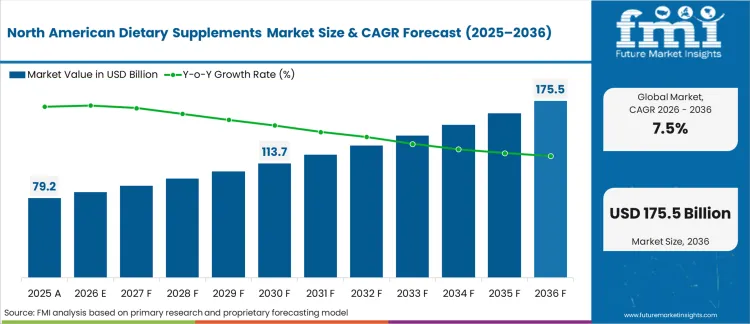
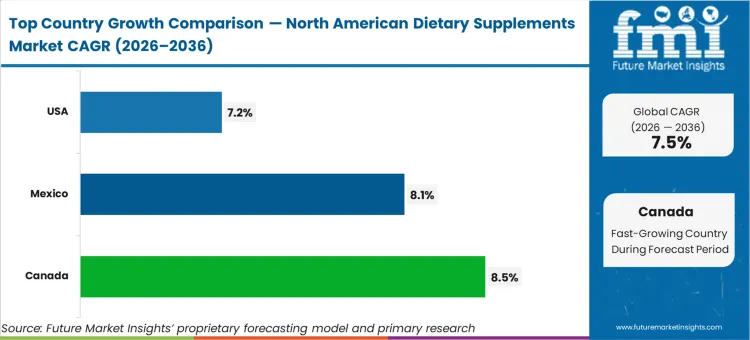
Canada (8.5% CAGR) leads growth through expanding natural health product (NHP) regulatory frameworks and aging population supplement adoption. Mexico (8.1% CAGR) benefits from rising middle-class health awareness and expanding pharmacy-channel supplement distribution. The USA (7.2% CAGR) generates the largest absolute demand, with growth driven by personalized nutrition platforms, clinical-grade supplement adoption, and GLP-1 adjacent supplement category expansion. Based on FMI’s report, vitamins hold 27.2% of market value in 2026, tablets account for 25.3% of form demand, and store-based distribution represents 59.4% of channel share.
North American Dietary Supplements Market Definition
The North American dietary supplements market covers the production, trade, and consumption of vitamins, minerals, amino acids, proteins, probiotics, and botanical blends sold in tablet, capsule, softgel, powder, and gummy forms across the United States, Canada, and Mexico. Products are regulated under the Dietary Supplement Health and Education Act (DSHEA) in the USA, the Natural Health Products Regulations in Canada, and COFEPRIS guidelines in Mexico. The market encompasses both mass-market and clinical-grade supplements distributed through retail pharmacies, specialty health stores, e-commerce platforms, and practitioner channels.
North American Dietary Supplements Market Inclusions
The report covers regional market sizes by volume and value with a 10-year forecast from 2026 to 2036. Segmental breakdowns include type (vitamins, minerals, amino acids, proteins, probiotics, blends), form (tablets, capsules, softgels, powders, gummies), distribution channel (store, non-store), and country-level analysis covering the United States, Canada, and Mexico.
North American Dietary Supplements Market Exclusions
The scope excludes prescription pharmaceuticals, over-the-counter drugs with therapeutic claims, medical foods requiring physician supervision, and infant formula. Sports nutrition products classified as foods rather than dietary supplements under FDA regulations are excluded unless marketed with supplement facts panels. Raw ingredient commodity trading without supplement manufacturing is not included.
North American Dietary Supplements Market Research Methodology
- Primary Research: Interviews were conducted with supplement brand owners, contract manufacturers, raw material suppliers, retail pharmacy buyers, e-commerce platform managers, and regulatory consultants across the USA, Canada, and Mexico.
- Desk Research: Production and trade data from FDA, Health Canada, COFEPRIS, NIH Office of Dietary Supplements, and the Council for Responsible Nutrition (CRN) supported volume benchmarking.
- Market-Sizing and Forecasting: A hybrid top-down and bottom-up model was developed. Demand was reconstructed from retail scanner data, e-commerce sales tracking, contract manufacturing throughput, and raw material import volumes, then validated against company-level revenue disclosures.
- Data Validation and Update Cycle: Outputs undergo anomaly screening, variance checks across retail and trade datasets, and structured peer review prior to release.
Why is the North American Dietary Supplements Market Growing?
The North American dietary supplements market is witnessing strong growth momentum, fueled by rising consumer awareness of preventive healthcare and the increasing prevalence of lifestyle-related health concerns. The growing focus on wellness, nutrition, and active lifestyles is shaping demand for supplements that support immunity, energy, and overall well-being. Expanding aging populations and higher disposable incomes are further driving adoption, with consumers seeking convenient solutions to bridge nutritional gaps.
Regulatory support for safe supplement formulations and increasing investments by manufacturers in product innovation and marketing strategies are strengthening market expansion. Online and offline distribution networks are contributing to broader accessibility, while advancements in personalized nutrition and digital health engagement are paving the way for tailored supplement offerings.
As consumer demand continues to evolve toward natural, plant-based, and clean-label ingredients, the market is expected to benefit from ongoing diversification of product portfolios With a strong presence of both established brands and new entrants, North America remains one of the most competitive and high-potential regions for dietary supplements.
Segmental Analysis
The north american dietary supplements market is segmented by type, form, distribution channel, and geographic regions. By type, north american dietary supplements market is divided into Vitamins, Minerals, Amino Acids, Proteins, Probiotics, and Blends. In terms of form, north american dietary supplements market is classified into Tablets, Capsules, Softgels, Powders, and Gummies. Based on distribution channel, north american dietary supplements market is segmented into Store and Non-store. Regionally, the north american dietary supplements industry is classified into North America, Latin America, Western Europe, Eastern Europe, Balkan & Baltic Countries, Russia & Belarus, Central Asia, East Asia, South Asia & Pacific, and the Middle East & Africa.
Insights into the Vitamins Type Segment
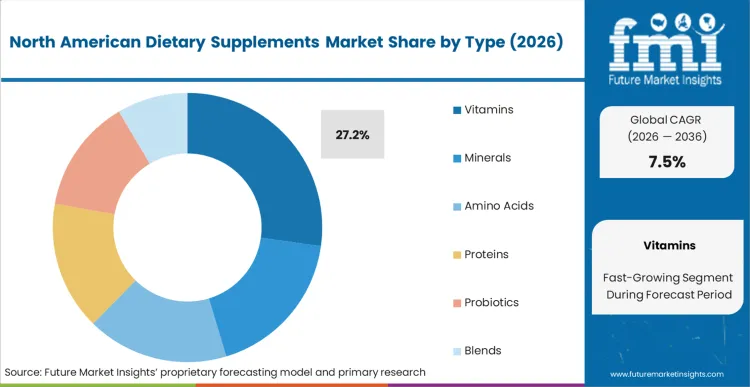
The vitamins segment is projected to account for 27.2% of the North American dietary supplements market revenue share in 2026, positioning it as the leading supplement type. This leadership is being supported by the essential role vitamins play in overall health maintenance, with consistent demand across a wide range of age groups and health conditions. Increasing consumer awareness about the importance of vitamins for immune system support, bone health, and metabolic functions has reinforced their strong adoption.
The prevalence of vitamin deficiencies, particularly in populations with dietary restrictions or specific lifestyle choices, is further driving supplement intake. Product innovations including higher bioavailability formulations and combination products are enhancing consumer interest.
The segment is also benefiting from growing recommendations by healthcare professionals and widespread inclusion of vitamins in preventive healthcare regimens With continued consumer focus on immunity, wellness, and long-term health management, vitamins are expected to maintain their dominant position in the North American market.
Insights into the Tablets Form Segment
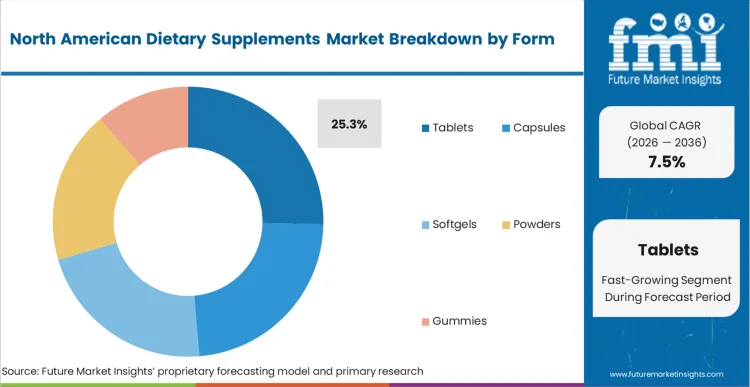
The tablets segment is anticipated to represent 25.3% of the North American dietary supplements market revenue share in 2026, making it the leading dosage form. This dominance is attributed to the convenience, stability, and cost-effectiveness offered by tablet formulations. Tablets are widely preferred due to their ease of consumption, accurate dosing, and longer shelf life compared to other forms.
Manufacturers favor tablets for their scalability in production and flexibility in incorporating multiple ingredients into a single formulation. Consumer trust in tablets is reinforced by their familiarity and established use within healthcare systems, making them a primary choice in both over-the-counter and prescription-based supplement categories.
Innovations such as coated tablets for improved swallowing and controlled-release technologies are further enhancing their appeal With widespread availability across retail and e-commerce platforms, tablets are expected to sustain their leadership as a practical and economical form of dietary supplements in the North American market.
Insights into the Store Distribution Channel Segment
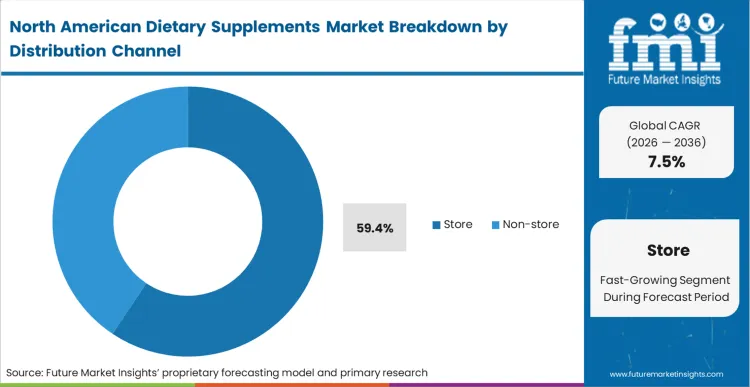
The store-based distribution channel is expected to hold 59.4% of the North American dietary supplements market revenue share in 2026, securing its position as the leading channel. Its dominance is being driven by the trust consumers place in physical retail outlets, including pharmacies, supermarkets, health food stores, and specialty nutrition shops. Store channels provide direct product access, personal interaction with staff, and immediate availability, which enhance consumer confidence in purchase decisions.
The segment is benefiting from strong merchandising strategies, promotional campaigns, and in-store education initiatives that influence consumer choices. Retail stores also offer a wide assortment of brands and formats, enabling comparison and informed decision-making.
While e-commerce is expanding rapidly, physical stores continue to capture the majority of supplement sales due to established consumer habits and the assurance of authenticity and safety associated with store purchases As consumer interest in supplements grows, store-based channels are expected to remain a central distribution pathway in the North American market.
Market Overview
North American Dietary Supplements Market Overview
Dietary supplements are products that contain dietary ingredient used to add nutritional value to the supplements. Several people use dietary supplements to adopt healthier lifestyle. Dietary supplements basically add missing nutrients to our diet and to get sufficient overall nutrients.
Dietary supplements are of various types that includes protein supplements, vitamins and minerals supplements, calorie supplements. Sufficient intake of dietary supplements promotes the growth and enhance the immunity. But excessive intake of dietary supplements results in the accumulation of extra body fat. Dietary supplements are present in different forms that includes capsules, tablets, liquids, powders.
Major drivers of dietary supplements market are growing economies where consumers have high disposable income, growing awareness about health and nutrition, stressful lifestyle, increasing population and growing number of people having chronic diseases.
Major driver for dietary supplements market in Canada is ageing population. There is increasing demand of supplements in Canada owing to the benefits associated with it such as strengthening the immunity and reducing cholesterol related diseases. More concern regarding the health and prevention of diseases drives the Mexican dietary supplement market.
Dietary supplements market is segmented on the basis of age as elderly person, pregnant women, adult and infants. By type dietary supplements market can be segmented into minerals, enzymes, amino acids, herbals. On the basis of forms dietary supplements market is segmented into capsules, tablets, powders, gel capsules, powders, and liquids. On the basis of geography North American Dietary Supplements market is segmented into Unites States of America, Mexico and Canada.
In United States, consumers are more conscious about the health of children and spend dollars to boost their health. Dietary supplements in United States experienced double digit growth owing to the increasing awareness among parents regarding children health.
However in Canada there is marginal growth in the dietary supplements market. Dietary supplement market is fragmented and there is immense consolidation in the market.
In Mexico there is drastic growth in the dietary supplements market as Mexican Government, public and private hospitals supported several advertising campaigns to prevent various diseases in order to create health awareness among people which results in increase in consumption of dietary supplements. In United States using protein as an ingredient is the major trend. Major drivers for protein are growing heath conscious consumers, increasing baby boomers, need for approaches to overcome obesity.
In United States DSM launched new nutrition innovation unit in Parsippany, New Jersey. It includes various laboratories and plants and analysis facilities in order to improve production process and enhance the quality of dietary supplements. Company such as 5- Hour Energy brand is continuously expanding its product portfolio. Some products included in its portfolio are original 5-hour energy which are further available in several flavours.
This company also extended its flavours for providing customers with enhanced taste such as berry extra strength, grapes extra strength, sour apple extra strength. In Mexico Company named DuPont designed new innovation centre in order to provide customers with solutions to face complicated problems.
This innovation centres help customers and strategic partners to work in partnership. In United States there is increasing demand for weight management supplements such as Yacón root is exclusively used in South America for maintaining healthy weight. Some popular dietary supplements are Green Coffee Bean extract.
In United States, 5-Hour Energy brand is the leading player in the dietary supplement market. In Mexico Herbalife Internacional de México is the leading player in the dietary supplements market.
Dietary supplement market is forecasted to be growing with constant CAGR owing to the increasing health awareness among consumers and growing older demographics.
The research report presents a comprehensive assessment of market and contains thoughtful insights, facts, historical data, and statistically supported and industry validated market data and projections with suitable set of assumptions and methodology. Research report provides analysis and information by categories such as market segments, geographies, types, technology and applications.
Report covers exhaustive analysis on
- Market Segments
- Market Dynamics
- Market Size
- Supply & Demand
- Current Trends/Issues/Challenges
- Competition & Companies involved
- Technology
- Value Chain
Regional analysis includes
- United States of America
- Canada
- Mexico
The report is a compilation of first-hand information, qualitative and quantitative assessment by industry analysts, inputs from industry experts and industry participants across value chain.
The report provides in-depth analysis of parent market trends, macro-economic indicators and governing factors along with market attractiveness as per segments. The report also maps qualitative impact of various market factors on market segments and various geographies.
Regional Analysis
Based on the regional analysis, the North American dietary supplements market covers the United States, Canada, and Mexico. The full report also offers market attractiveness analysis based on country-level trends.
.webp "Top Country Growth Comparison North American Dietary Supplements Market Cagr (2026 2036)")
| Country | CAGR (2026 to 2036) |
|---|---|
| Canada | 8.5% |
| Mexico | 8.1% |
| USA | 7.2% |
Source: Future Market Insights (FMI) analysis, based on proprietary forecasting model and primary research
USA: Personalized Nutrition and Clinical-Grade Supplement Expansion
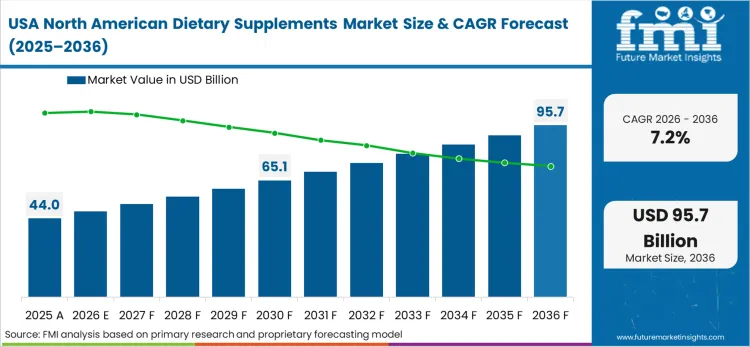
United States: Demand for dietary supplements in the USA is projected to rise at 7.2% CAGR through 2036. The USA accounts for over 80% of North American supplement consumption, with growth driven by three structural forces: personalized nutrition platform adoption, GLP-1 adjacent supplement demand, and clinical-grade supplement mainstreaming through practitioner channels. The FDA's DSHEA framework governs supplement marketing claims, with the agency increasing enforcement actions on products making unapproved disease treatment claims during 2024 and 2025. USANA Health Sciences holds approximately 16.3% of the branded supplement market by revenue, competing with Abbott (Ensure, Pedialyte), Bayer (One A Day), and Nature's Bounty across pharmacy and mass retail channels. Amazon captures an estimated 35% of online supplement sales, with private label supplements (Amazon Elements, Solimo) creating pricing pressure on branded products. In November 2025, Kimberly-Clark announced a USD 48.7 billion acquisition of Kenvue (former J&J consumer health), bringing Kenvue's vitamin and wellness portfolio under expanded distribution capability. [4]
Canada: NHP Regulatory Framework and Aging Population Adoption
Canada: Demand for dietary supplements in Canada is projected to rise at 8.5% CAGR through 2036, the fastest in the region. Health Canada's Natural Health Products Regulations require product licensing (NPN) before market entry, creating a regulatory compliance cost that serves as a barrier to entry but also supports consumer trust in licensed products. The Canadian Health Food Association (CHFA) reports that over 75% of Canadian adults use natural health products regularly. Jamieson Wellness, headquartered in Toronto, is the largest Canadian-owned supplement company, with distribution across Shoppers Drug Mart, Loblaws, and Costco Canada. On October 27, 2025, Nestle Health Science announced a strategic partnership with the University of California Davis Innovation Institute for Food and Health (IIFH), with research applications expected to influence both US and Canadian supplement formulation strategies. [3] Health Canada's ongoing NHP regulatory modernization is creating compliance cost uncertainty for smaller supplement brands operating cross-border.
Mexico: Rising Middle-Class Health Awareness and Pharmacy Channel Growth
Mexico: Demand for dietary supplements in Mexico is projected to rise at 8.1% CAGR through 2036. Mexico's growing middle class is expanding supplement adoption beyond traditional herbal remedies into vitamins, minerals, and protein supplements distributed through pharmacy chains (Farmacias del Ahorro, Farmacias Similares) and convenience retail. COFEPRIS (Federal Commission for the Protection against Sanitary Risks) regulates supplement registration and labelling, with enforcement tightening on imported products that lack proper health claims documentation. Herbalife maintains a strong direct-selling distribution network in Mexico that accounts for a material share of the company's Latin American revenue. Amway and GNC operate through both retail and direct-selling models, with GNC's franchise network covering major urban centers. Mexico's proximity to US supplement contract manufacturers enables cross-border supply chain optimization that reduces time-to-market for new product launches.
FMI’s analysis of the North American dietary supplements market consists of country-wise assessment across the USA, Canada, and Mexico. Readers can find regulatory trends, distribution channel dynamics, category growth rates, and competitive positioning across all three markets.
Competitive Aligners for Market Players
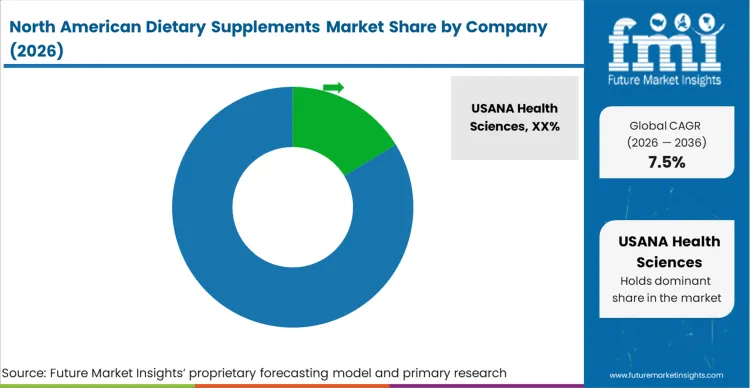
Market structure in North American dietary supplements is moderately fragmented at the brand level but increasingly consolidated at the corporate parent level. USANA Health Sciences holds approximately 16.3% market share, competing with Abbott Laboratories (nutritional brands), Bayer AG (One A Day, Flintstones), and Nature's Bounty across pharmacy and mass retail. The Kimberly-Clark acquisition of Kenvue (November 2025) signals accelerating M&A consolidation, bringing J&J's wellness and vitamin portfolio under a new corporate parent with global distribution infrastructure.
Contract manufacturers (Catalent, Thorne HealthTech, International Vitamin Corporation) serve as the production backbone for both branded and private-label supplements, with capacity utilization rates above 85% in major US facilities. Raw material sourcing concentration in Chinese API manufacturing for vitamins C, D, and B-complex creates procurement vulnerability that brand owners are mitigating through inventory buffer strategies and secondary sourcing from European and Indian suppliers.
Distribution channel competition is intensifying. Amazon's private label supplements and subscription models are compressing branded product margins in online channels, while personalized nutrition DTC brands (Care/of, Ritual, Persona) are building subscription revenue streams that bypass traditional retail entirely.
Recent Developments
The report includes full coverage of recent trends from competitive benchmarking. Some of the recent developments covered in the reports:
- In February 2026, Herbalife announced the phased rollout of Pro2col, a digital health and wellness operating system designed to provide personalized nutritional supplement recommendations, with U.S. accessibility confirmed by end of H1 2026. The company also launched Life I/O Baseline in late 2025, targeting the healthy lifespan and longevity category. [2]
- On October 27, 2025, Nestle Health Science announced a strategic partnership with the University of California Davis Innovation Institute for Food and Health (IIFH), designed to accelerate innovation in nutrition and health science by connecting Nestle's R&D capabilities with academic research for next-generation bioactive ingredients. [3]
- In November 2025, Kimberly-Clark announced a USD 48.7 billion acquisition of Kenvue (former J&J consumer health division), bringing Kenvue's wellness and vitamin portfolio under expanded global distribution to create a dominant health and wellness leader. [4]
Key Players in North American Dietary Supplements Market
- USANA Health Sciences
- NOW Foods
- Optimum Nutrition
- Amway
- Abbott Laboratories
- Bayer AG
- Nature's Way
- Pfizer Inc.
- New Chapter
- Jamieson Wellness
- Metagenics
- The Nature's Bounty Co.
- Herbalife
- Garden of Life
- GNC Holdings
Scope of the Report
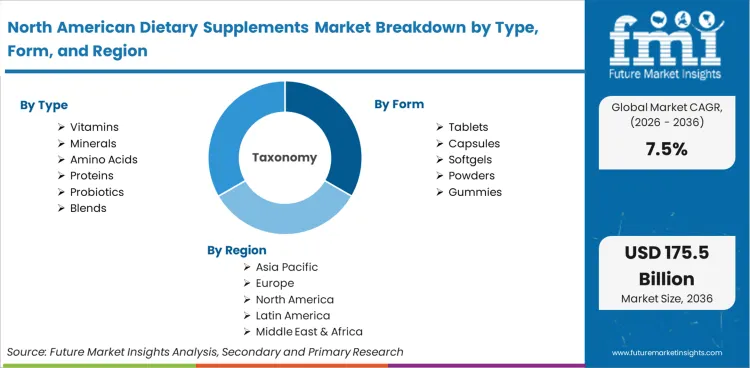
| Metric | Value |
|---|---|
| Quantitative Units | USD 85.1 billion (2026) to USD 175.5 billion (2036), at a CAGR of 7.5% |
| Market Definition | The North American dietary supplements market covers vitamins, minerals, amino acids, proteins, probiotics, and botanical blends sold across retail, e-commerce, and practitioner channels in the USA, Canada, and Mexico. |
| Type Segmentation | Vitamins, Minerals, Amino Acids, Proteins, Probiotics, Blends |
| Form Segmentation | Tablets, Capsules, Softgels, Powders, Gummies |
| Distribution Channel | Store, Non-store |
| Countries Covered | United States, Canada, Mexico |
| Key Companies Profiled | USANA Health Sciences, NOW Foods, Optimum Nutrition, Amway, Abbott Laboratories, Bayer AG, Nature's Way, Pfizer Inc., New Chapter, Jamieson Wellness, Metagenics, The Nature's Bounty Co., Herbalife, Garden of Life, GNC Holdings |
| Forecast Period | 2026 to 2036 |
| Approach | Hybrid top-down and bottom-up market modeling validated through primary interviews with supplement brand owners, contract manufacturers, and retail buyers, supported by retail scanner data and trade benchmarking |
North American Dietary Supplements Market Analysis by Segments
By Type:
Vitamins, Minerals, Amino Acids, Proteins, Probiotics, Blends
By Form:
Tablets, Capsules, Softgels, Powders, Gummies
By Distribution Channel:
Store, Non-store
By Country:
United States, Canada, Mexico
Bibliography
- [1] Herbalife. (2026). Herbalife outlines 2026 growth targets and personalized offerings strategy. Seeking Alpha / Corporate Investor Communication.
- [2] Herbalife. (2026). Pro2col digital health and wellness platform phased rollout and Life I/O Baseline launch. Corporate Product Announcement, February 2026.
- [3] Nestle Health Science. (2025). Nestle Health Science and University of California Davis Innovation Institute for Food and Health partnership. Corporate News Release, October 2025.
- [4] PwC / Kimberly-Clark. (2025). Kimberly-Clark announces acquisition of Kenvue for USD 48.7 billion. Consumer Markets Deal Trends, November 2025.
This Report Addresses
- Market intelligence to enable structured strategic decision making across the North American dietary supplements market
- Market size estimation and 10-year revenue forecasts from 2026 to 2036, supported by validated retail scanner data and trade benchmarks
- Growth opportunity mapping across vitamins, minerals, amino acids, proteins, probiotics, and blends with emphasis on personalized nutrition and GLP-1 adjacent categories
- Segment and country revenue forecasts covering type, form, distribution channel, and USA, Canada, Mexico breakdowns
- Competition strategy assessment including brand portfolio consolidation, DTC platform positioning, and contract manufacturing dependency analysis
- Regulatory tracking covering FDA DSHEA enforcement, Health Canada NHP modernization, and COFEPRIS supplement registration requirements
- Distribution channel disruption analysis covering Amazon private label impact, personalized nutrition subscription models, and pharmacy channel evolution
- Market report delivery in PDF, Excel, PPT, and interactive dashboard formats for executive and operational use
Frequently Asked Questions
How large is the demand for dietary supplements in North America in 2026?
Demand for dietary supplements in North America is estimated to be valued at USD 85.1 billion in 2026.
What will be the market size of North American dietary supplements by 2036?
Market size for North American dietary supplements is projected to reach USD 175.5 billion by 2036.
What is the expected CAGR for dietary supplements in North America between 2026 and 2036?
Demand is expected to grow at a CAGR of 7.5% between 2026 and 2036.
Which type segment leads the dietary supplements market in 2026?
Vitamins are expected to lead, capturing approximately 27.2% of market share in 2026, driven by vitamin D, C, and B-complex demand across preventive wellness and immune support.
Which form segment leads dietary supplements demand in 2026?
Tablets account for 25.3% of form demand in 2026, though gummies are the fastest-growing delivery format.
What distribution channel dominates dietary supplement sales in 2026?
Store-based distribution holds 59.4% share in 2026, with pharmacy chains and mass retailers anchoring volume.
What is the growth outlook for the USA dietary supplements market?
The USA is projected to grow at a CAGR of 7.2% during 2026 to 2036, driven by personalized nutrition, GLP-1 adjacent demand, and clinical-grade supplement mainstreaming.
What is the growth outlook for Canada?
Canada is projected to grow at a CAGR of 8.5% during 2026 to 2036, driven by NHP regulatory framework expansion and aging population supplement adoption.
What is driving dietary supplement growth in Mexico?
Rising middle-class health awareness and expanding pharmacy-channel distribution support Mexico's 8.1% CAGR through 2036.
What is the North American dietary supplements market in this report?
The market covers vitamins, minerals, amino acids, proteins, probiotics, and blends sold in multiple delivery forms across retail, e-commerce, and practitioner channels in the USA, Canada, and Mexico.
What is excluded from the scope?
Prescription pharmaceuticals, OTC drugs, medical foods requiring physician supervision, infant formula, and raw ingredient commodity trading are excluded.
How does FMI build and validate the forecast?
Forecast is developed using hybrid top-down and bottom-up modeling validated through retail scanner data, e-commerce tracking, contract manufacturing throughput, and structured industry review.
What does zero reliance on speculative third-party market research mean?
Primary interviews and verifiable public datasets are used instead of unverified syndicated market estimates.
Preview the report firsthand - request a free sample
Get SampleGet the brochure for pricing and purchase details.
Get PDFTable of Content
- Executive Summary
- Global Market Outlook
- Demand-side Trends
- Supply-side Trends
- Technology Roadmap Analysis
- Analysis and Recommendations
- Market Coverage / Taxonomy
- Market Definition / Scope / Limitations
- Research Methodology
- Chapter Orientation
- Analytical Lens and Working Hypotheses
- Market Structure, Signals, and Trend Drivers
- Benchmarking and Cross-market Comparability
- Market Sizing, Forecasting, and Opportunity Mapping
- Research Design and Evidence Framework
- Desk Research Programme (Secondary Evidence)
- Company Annual and Sustainability Reports
- Peer-reviewed Journals and Academic Literature
- Corporate Websites, Product Literature, and Technical Notes
- Earnings Decks and Investor Briefings
- Statutory Filings and Regulatory Disclosures
- Technical White Papers and Standards Notes
- Government Statistics Portals and Public Data Releases
- Press Releases and Reputable Media Coverage
- Specialist Newsletters and Curated Briefings
- Sector Databases and Reference Repositories
- FMI Internal Proprietary Databases and Historical Market Datasets
- Subscription Datasets and Paid Sources
- Social Channels, Communities, and Digital Listening Inputs
- Additional Desk Sources
- Expert Input and Fieldwork (Primary Evidence)
- Primary Modes
- Qualitative Interviews and Expert Elicitation
- Quantitative Surveys and Structured Data Capture
- Blended Approach
- Why Primary Evidence is Used
- Field Techniques
- Interviews
- Surveys
- Focus Groups
- Observational and In-context Research
- Social and Community Interactions
- Stakeholder Universe Engaged
- C-suite Leaders
- Board Members
- Presidents and Vice Presidents
- R&D and Innovation Heads
- Technical Specialists
- Domain Subject-matter Experts
- Scientists
- Physicians and Other Healthcare Professionals
- Governance, Ethics, and Data Stewardship
- Research Ethics
- Data Integrity and Handling
- Primary Modes
- Tooling, Models, and Reference Databases
- Desk Research Programme (Secondary Evidence)
- Data Engineering and Model Build
- Data Acquisition and Ingestion
- Cleaning, Normalisation, and Verification
- Synthesis, Triangulation, and Analysis
- Quality Assurance and Audit Trail
- Market Background
- Market Dynamics
- Drivers
- Restraints
- Opportunity
- Trends
- Scenario Forecast
- Demand in Optimistic Scenario
- Demand in Likely Scenario
- Demand in Conservative Scenario
- Opportunity Map Analysis
- Product Life Cycle Analysis
- Supply Chain Analysis
- Investment Feasibility Matrix
- Value Chain Analysis
- PESTLE and Porter’s Analysis
- Regulatory Landscape
- Regional Parent Market Outlook
- Production and Consumption Statistics
- Import and Export Statistics
- Market Dynamics
- Global Market Analysis 2021 to 2025 and Forecast, 2026 to 2036
- Historical Market Size Value (USD Million) Analysis, 2021 to 2025
- Current and Future Market Size Value (USD Million) Projections, 2026 to 2036
- Y-o-Y Growth Trend Analysis
- Absolute $ Opportunity Analysis
- Global Market Pricing Analysis 2021 to 2025 and Forecast 2026 to 2036
- Global Market Analysis 2021 to 2025 and Forecast 2026 to 2036, By Type
- Introduction / Key Findings
- Historical Market Size Value (USD Million) Analysis By Type , 2021 to 2025
- Current and Future Market Size Value (USD Million) Analysis and Forecast By Type , 2026 to 2036
- Vitamins
- Minerals
- Amino Acids
- Proteins
- Probiotics
- Blends
- Vitamins
- Y-o-Y Growth Trend Analysis By Type , 2021 to 2025
- Absolute $ Opportunity Analysis By Type , 2026 to 2036
- Global Market Analysis 2021 to 2025 and Forecast 2026 to 2036, By Form
- Introduction / Key Findings
- Historical Market Size Value (USD Million) Analysis By Form, 2021 to 2025
- Current and Future Market Size Value (USD Million) Analysis and Forecast By Form, 2026 to 2036
- Tablets
- Capsules
- Softgels
- Powders
- Gummies
- Tablets
- Y-o-Y Growth Trend Analysis By Form, 2021 to 2025
- Absolute $ Opportunity Analysis By Form, 2026 to 2036
- Global Market Analysis 2021 to 2025 and Forecast 2026 to 2036, By Distribution Channel
- Introduction / Key Findings
- Historical Market Size Value (USD Million) Analysis By Distribution Channel, 2021 to 2025
- Current and Future Market Size Value (USD Million) Analysis and Forecast By Distribution Channel, 2026 to 2036
- Store
- Non-store
- Store
- Y-o-Y Growth Trend Analysis By Distribution Channel, 2021 to 2025
- Absolute $ Opportunity Analysis By Distribution Channel, 2026 to 2036
- Global Market Analysis 2021 to 2025 and Forecast 2026 to 2036, By Region
- Introduction
- Historical Market Size Value (USD Million) Analysis By Region, 2021 to 2025
- Current Market Size Value (USD Million) Analysis and Forecast By Region, 2026 to 2036
- North America
- Latin America
- Western Europe
- Eastern Europe
- East Asia
- South Asia and Pacific
- Middle East & Africa
- Market Attractiveness Analysis By Region
- North America Market Analysis 2021 to 2025 and Forecast 2026 to 2036, By Country
- Historical Market Size Value (USD Million) Trend Analysis By Market Taxonomy, 2021 to 2025
- Market Size Value (USD Million) Forecast By Market Taxonomy, 2026 to 2036
- By Country
- USA
- Canada
- Mexico
- By Type
- By Form
- By Distribution Channel
- By Country
- Market Attractiveness Analysis
- By Country
- By Type
- By Form
- By Distribution Channel
- Key Takeaways
- Latin America Market Analysis 2021 to 2025 and Forecast 2026 to 2036, By Country
- Historical Market Size Value (USD Million) Trend Analysis By Market Taxonomy, 2021 to 2025
- Market Size Value (USD Million) Forecast By Market Taxonomy, 2026 to 2036
- By Country
- Brazil
- Chile
- Rest of Latin America
- By Type
- By Form
- By Distribution Channel
- By Country
- Market Attractiveness Analysis
- By Country
- By Type
- By Form
- By Distribution Channel
- Key Takeaways
- Western Europe Market Analysis 2021 to 2025 and Forecast 2026 to 2036, By Country
- Historical Market Size Value (USD Million) Trend Analysis By Market Taxonomy, 2021 to 2025
- Market Size Value (USD Million) Forecast By Market Taxonomy, 2026 to 2036
- By Country
- Germany
- UK
- Italy
- Spain
- France
- Nordic
- BENELUX
- Rest of Western Europe
- By Type
- By Form
- By Distribution Channel
- By Country
- Market Attractiveness Analysis
- By Country
- By Type
- By Form
- By Distribution Channel
- Key Takeaways
- Eastern Europe Market Analysis 2021 to 2025 and Forecast 2026 to 2036, By Country
- Historical Market Size Value (USD Million) Trend Analysis By Market Taxonomy, 2021 to 2025
- Market Size Value (USD Million) Forecast By Market Taxonomy, 2026 to 2036
- By Country
- Russia
- Poland
- Hungary
- Balkan & Baltic
- Rest of Eastern Europe
- By Type
- By Form
- By Distribution Channel
- By Country
- Market Attractiveness Analysis
- By Country
- By Type
- By Form
- By Distribution Channel
- Key Takeaways
- East Asia Market Analysis 2021 to 2025 and Forecast 2026 to 2036, By Country
- Historical Market Size Value (USD Million) Trend Analysis By Market Taxonomy, 2021 to 2025
- Market Size Value (USD Million) Forecast By Market Taxonomy, 2026 to 2036
- By Country
- China
- Japan
- South Korea
- By Type
- By Form
- By Distribution Channel
- By Country
- Market Attractiveness Analysis
- By Country
- By Type
- By Form
- By Distribution Channel
- Key Takeaways
- South Asia and Pacific Market Analysis 2021 to 2025 and Forecast 2026 to 2036, By Country
- Historical Market Size Value (USD Million) Trend Analysis By Market Taxonomy, 2021 to 2025
- Market Size Value (USD Million) Forecast By Market Taxonomy, 2026 to 2036
- By Country
- India
- ASEAN
- Australia & New Zealand
- Rest of South Asia and Pacific
- By Type
- By Form
- By Distribution Channel
- By Country
- Market Attractiveness Analysis
- By Country
- By Type
- By Form
- By Distribution Channel
- Key Takeaways
- Middle East & Africa Market Analysis 2021 to 2025 and Forecast 2026 to 2036, By Country
- Historical Market Size Value (USD Million) Trend Analysis By Market Taxonomy, 2021 to 2025
- Market Size Value (USD Million) Forecast By Market Taxonomy, 2026 to 2036
- By Country
- Kingdom of Saudi Arabia
- Other GCC Countries
- Turkiye
- South Africa
- Other African Union
- Rest of Middle East & Africa
- By Type
- By Form
- By Distribution Channel
- By Country
- Market Attractiveness Analysis
- By Country
- By Type
- By Form
- By Distribution Channel
- Key Takeaways
- Key Countries Market Analysis
- USA
- Pricing Analysis
- Market Share Analysis, 2025
- By Type
- By Form
- By Distribution Channel
- Canada
- Pricing Analysis
- Market Share Analysis, 2025
- By Type
- By Form
- By Distribution Channel
- Mexico
- Pricing Analysis
- Market Share Analysis, 2025
- By Type
- By Form
- By Distribution Channel
- Brazil
- Pricing Analysis
- Market Share Analysis, 2025
- By Type
- By Form
- By Distribution Channel
- Chile
- Pricing Analysis
- Market Share Analysis, 2025
- By Type
- By Form
- By Distribution Channel
- Germany
- Pricing Analysis
- Market Share Analysis, 2025
- By Type
- By Form
- By Distribution Channel
- UK
- Pricing Analysis
- Market Share Analysis, 2025
- By Type
- By Form
- By Distribution Channel
- Italy
- Pricing Analysis
- Market Share Analysis, 2025
- By Type
- By Form
- By Distribution Channel
- Spain
- Pricing Analysis
- Market Share Analysis, 2025
- By Type
- By Form
- By Distribution Channel
- France
- Pricing Analysis
- Market Share Analysis, 2025
- By Type
- By Form
- By Distribution Channel
- India
- Pricing Analysis
- Market Share Analysis, 2025
- By Type
- By Form
- By Distribution Channel
- ASEAN
- Pricing Analysis
- Market Share Analysis, 2025
- By Type
- By Form
- By Distribution Channel
- Australia & New Zealand
- Pricing Analysis
- Market Share Analysis, 2025
- By Type
- By Form
- By Distribution Channel
- China
- Pricing Analysis
- Market Share Analysis, 2025
- By Type
- By Form
- By Distribution Channel
- Japan
- Pricing Analysis
- Market Share Analysis, 2025
- By Type
- By Form
- By Distribution Channel
- South Korea
- Pricing Analysis
- Market Share Analysis, 2025
- By Type
- By Form
- By Distribution Channel
- Russia
- Pricing Analysis
- Market Share Analysis, 2025
- By Type
- By Form
- By Distribution Channel
- Poland
- Pricing Analysis
- Market Share Analysis, 2025
- By Type
- By Form
- By Distribution Channel
- Hungary
- Pricing Analysis
- Market Share Analysis, 2025
- By Type
- By Form
- By Distribution Channel
- Kingdom of Saudi Arabia
- Pricing Analysis
- Market Share Analysis, 2025
- By Type
- By Form
- By Distribution Channel
- Turkiye
- Pricing Analysis
- Market Share Analysis, 2025
- By Type
- By Form
- By Distribution Channel
- South Africa
- Pricing Analysis
- Market Share Analysis, 2025
- By Type
- By Form
- By Distribution Channel
- USA
- Market Structure Analysis
- Competition Dashboard
- Competition Benchmarking
- Market Share Analysis of Top Players
- By Regional
- By Type
- By Form
- By Distribution Channel
- Competition Analysis
- Competition Deep Dive
- USANA Health Sciences
- Overview
- Product Portfolio
- Profitability by Market Segments (Product/Age /Sales Channel/Region)
- Sales Footprint
- Strategy Overview
- Marketing Strategy
- Product Strategy
- Channel Strategy
- NOW Foods
- Optimum Nutrition
- Amway
- Abbott Laboratories
- Bayer AG
- Nature's Way
- Pfizer Inc.
- New Chapter
- Jamieson Wellness
- Metagenics
- The Nature's Bounty Co.
- Herbalife
- Garden of Life
- GNC Holdings
- USANA Health Sciences
- Competition Deep Dive
- Assumptions & Acronyms Used


