


About The Report
Magnesium Oxide Market Size, Market Forecast and Outlook By FMI
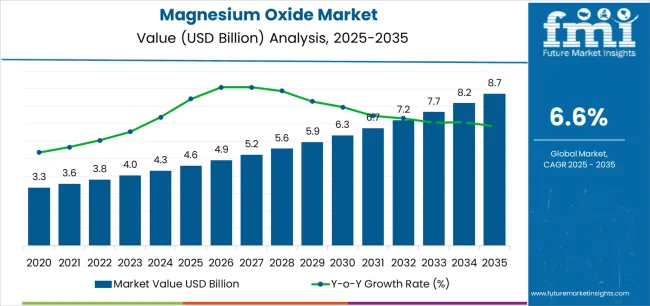
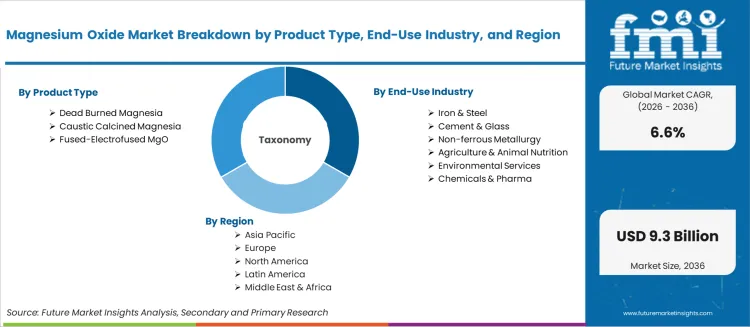
The Magnesium Oxide market was valued at USD 4.62 billion in 2025, projected to reach USD 4.90 billion in 2026, and is forecast to expand to USD 9.29 billion by 2036 at a 6.6% CAGR. The refractory-grade magnesia supply chain remains anchored by iron and steel sector procurement cycles, which represent the single largest demand concentration. Increasing blast furnace relining requirements across emerging Asian steel producers are accelerating consumption of dead burned and fused magnesia grades at a rate that outpaces incremental capacity additions from incumbent producers.
Summary of Magnesium Oxide Market
- Market Snapshot
- The Magnesium Oxide market is valued at USD 4.62 billion in 2025 and is projected to reach USD 9.29 billion by 2036.
- The industry is expected to grow at a 6.6% CAGR from 2026 to 2036, creating an incremental opportunity of USD 4.39 billion.
- The market is a refractory-grade commodity sector where procurement cycles are governed by steel and cement industry capital expenditure schedules and high-temperature process requirements.
- Demand and Growth Drivers
- Demand is rising as blast furnace and electric arc furnace relining programs across Asia expand, requiring large-volume dead burned and fused magnesia refractory consumption.
- Caustic calcined magnesia adoption is accelerating in wastewater neutralization, agricultural soil amendment, and pharmaceutical manufacturing applications that diversify end-use exposure beyond core steel sector demand.
- Infrastructure investment in developing economies is sustaining cement and glass sector consumption of mid-grade magnesia, particularly across South and Southeast Asian construction markets.
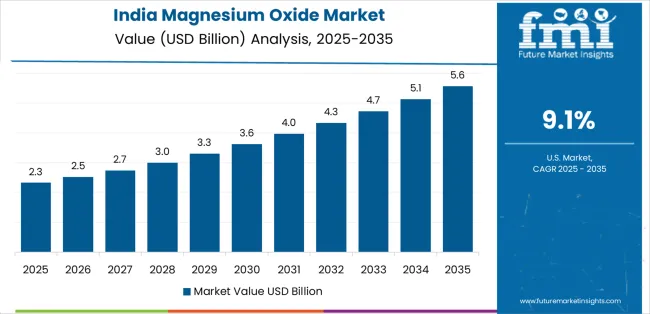
- India leads country-level growth at 9.1% CAGR, followed by China at 8.4%, South Korea at 6.6%, USA at 4.5%, Spain at 4.4%, Germany at 4.1%, and the UK at 4.0%.
- Product and Segment View
- Dead Burned Magnesia holds 53.5% share in 2026 as its ultra-high thermal stability makes it the mandatory grade for steel ladle and furnace lining applications across primary metallurgy operations.
- Iron & Steel commands 44.0% of end-use industry demand, reflecting the deep integration of magnesia-based refractories within steelmaking process architecture globally.
- Refractories constitute the primary application category, driven by mandatory relining schedules in steelmaking and non-ferrous metallurgy that create predictable replacement demand cycles.
- The scope includes Dead Burned Magnesia, Caustic Calcined Magnesia, and Fused/Electrofused MgO grades, while excluding downstream fabricated refractory shapes and finished lining products.
- Geography and Competitive Outlook
- India and China are the fastest-growing markets as greenfield and capacity-expansion steel investments drive magnesia procurement at volumes that exceed existing domestic supply capabilities.
- Europe registers stable mid-single-digit growth led by environmental services and specialty chemical applications offsetting slower core refractory replacement demand.
- Competition is concentrated among vertically integrated producers controlling primary magnesia ore reserves, with market leadership determined by proximity to steel belt customers and grade consistency.
- Key players include RHI Magnesita, Martin Marietta Materials, Magnezit Group, Grecian Magnesite, Ube Corporation, Nedmag, ICL Group, Premier Magnesia, Kumas Magnesite, Xinyang Mineral Group, Imerys, Haicheng Magnesite Group.
- Analyst Opinion at FMI
- 'Our analysis indicates that the Magnesium Oxide market is undergoing a structural reallocation where environmental and agricultural grade demand is absorbing incremental supply previously dependent on steel sector procurement alone. Producers lacking diversified grade portfolios face margin compression during steel cycle downturns, while those expanding into wastewater and agricultural applications will capture more consistent revenue streams.' - Nikhil Kaitwade, Inorganic Chemicals, Future Market Insights
Market Key Takeaways
| Metric | Details |
|---|---|
| Industry Size (2026) | USD 4.90 billion |
| Industry Value (2036) | USD 9.29 billion |
| CAGR (2026-2036) | 6.6% |
| Source | Future Market Insights, 2026 |
Source: FMI analysis based on primary research and proprietary forecasting model
The absolute dollar growth of USD 4.39 billion over the forecast window reflects the structural inelasticity of magnesia demand within high-temperature industrial applications. Caustic calcined magnesia grades are expanding their addressable end-use portfolio through environmental services adoption, where wastewater neutralization programs in municipal and industrial treatment facilities are converting from competing alkaline reagents. This diversification offsets the cyclical vulnerability tied to primary steel output fluctuations and provides a more stable secondary demand base through the forecast period.
India sets the pace among individual country markets with a 9.1% CAGR, driven by the accelerating construction of electric arc furnace capacity and government-backed infrastructure investment in steel-intensive sectors. China registers 8.4% CAGR as domestic magnesia reserve management policies constrain export volumes and divert premium grades toward domestic downstream processors. South Korea tracks at the 6.6% CAGR level alongside the global average, while the USA posts 4.5% anchored by mature steel and cement refractory replacement cycles. Spain at 4.4% and Germany at 4.1% reflect European refractory manufacturers operating under energy-efficiency upgrade mandates. The United Kingdom records 4.0% CAGR as legacy industrial refractory consumption undergoes gradual modernization.
Magnesium Oxide Market Definition
Magnesium Oxide refers to the inorganic compound derived from calcination and sintering of magnesite ore at varying temperature intensities to produce grades including caustic calcined magnesia, dead burned magnesia, and fused or electrofused magnesia. Each grade serves distinct industrial functions governed by its periclase crystal density, purity level, and thermal stability threshold. The compound functions as a critical refractory raw material in high-temperature metallurgical processes, an alkaline reagent in environmental treatment applications, and a nutritional supplement source in agricultural and pharmaceutical formulations.
Magnesium Oxide Market Inclusions
Market scope encompasses global and regional market sizing for caustic calcined magnesia, dead burned magnesia, and fused magnesia across their primary industrial applications. Forecast coverage spans the 2026 to 2036 period with segment breakdowns by product grade, end-use industry, and application category. Regional analysis includes market attractiveness assessments and country-level CAGR projections.
Magnesium Oxide Market Exclusions
The scope excludes downstream fabricated refractory shapes, pre-formed refractory bricks, and monolithic lining products made from magnesia feedstock. It also omits magnesium metal production processes and dolomite-based refractories unless specifically used in hybrid magnesia-dolomite formulations. Nutritional supplement retail products are excluded, with the scope limited to industrial bulk magnesia supply chains.
Magnesium Oxide Market Research Methodology
- Primary Research: Analysts conducted structured interviews with procurement managers at integrated steel producers, refractory lining contractors, environmental treatment plant operators, and magnesia ore mining companies to establish demand volume benchmarks and grade preference trends.
- Desk Research: Data aggregation utilized steel industry production statistics from national regulators, magnesia mine output data from geological surveys, international trade flow records from customs authorities, and environmental services procurement databases.
- Market-Sizing and Forecasting: A bottom-up volume methodology aggregated grade-specific consumption data across identified end-use categories and applied demand growth coefficients derived from correlated steel output, construction activity, and environmental regulation indices.
- Data Validation and Update Cycle: Projections are cross-validated against publicly disclosed capital expenditure guidance from major steel producers and refractory manufacturers, with model recalibration triggered by significant variance in steel output or magnesia export restriction announcements.
Why is the Magnesium Oxide Market Growing?
Market expansion is being supported by the increasing global demand for high-performance refractory materials in steel production and the corresponding need for magnesia-based refractories that can withstand extreme temperatures, resist corrosion from molten metals and slags, and ensure continuous operation across various basic oxygen furnaces, electric arc furnaces, and ladle refining applications. Modern steelmakers and refractory manufacturers are increasingly focused on implementing magnesia refractory solutions that can extend campaign life, reduce maintenance downtime, and provide predictable performance in aggressive steelmaking environments. Magnesium oxide's proven ability to deliver excellent thermal stability, superior slag resistance, and reliable structural integrity makes it an essential material for contemporary steel production and high-temperature industrial processes.
The growing emphasis on environmental compliance and pollution control is driving demand for magnesium oxide in flue gas desulfurization systems, wastewater treatment applications, and environmental remediation that can support effective acid neutralization, ensure regulatory compliance, and enable comprehensive pollution control across power generation, industrial processing, and municipal treatment facilities. Industrial operators' preference for cost-effective treatment solutions that combine neutralization efficiency with operational reliability is creating opportunities for innovative magnesium oxide implementations. The rising influence of circular economy principles and sustainable manufacturing is also contributing to increased adoption of energy-efficient magnesia production technologies that can reduce carbon emissions without compromising product quality or performance characteristics.
Segmental Analysis
The market is segmented by product type, application, end-use industry, and region. By product type, the market is divided into dead burned magnesia, caustic calcined magnesia, and fused/electrofused MgO. Based on application, the market is categorized into refractories, environmental (including FGD, wastewater, and flue gas), construction & boards, agriculture & feed, and chemicals & pharma. By end-use industry, the market covers iron & steel, cement & glass, non-ferrous metallurgy, agriculture & animal nutrition, environmental services, and chemicals & pharma. Regionally, the market is divided into Asia Pacific, North America, Europe, Latin America, and the Middle East & Africa.
By Product Type, the Dead Burned Magnesia Segment Leads the Market
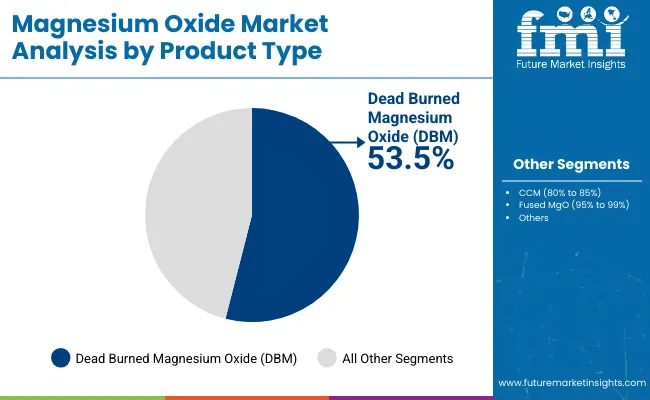
The dead burned magnesia segment is projected to maintain its leading position in the magnesium oxide market in 2026 with a commanding 53.5% market share, reaffirming its role as the preferred magnesia grade for high-performance refractory applications requiring maximum density, minimal reactivity, and superior corrosion resistance. Steel producers and refractory manufacturers increasingly utilize dead burned magnesia for its exceptional thermal stability, excellent slag resistance, and ability to withstand extreme temperatures exceeding 2000°C in basic oxygen furnaces, electric arc furnaces, and cement rotary kilns. Dead burned magnesia's proven effectiveness in delivering extended refractory service life directly addresses industrial requirements for reduced maintenance frequency and consistent performance in aggressive high-temperature environments.
This product segment forms the foundation of refractory-grade magnesium oxide consumption, as it represents the specification with the greatest thermal stability and corrosion resistance across multiple high-temperature industrial processes including steelmaking, cement production, and glass melting operations. Industrial investments in dead burned magnesia continue to strengthen adoption among steel mills and refractory engineers. With furnace operations requiring materials that can resist chemical attack from molten metal and slag while maintaining structural integrity, dead burned magnesia aligns with both performance objectives and operational reliability requirements, making it the central component of comprehensive refractory strategies supporting continuous high-temperature processing.
By End-Use Industry, the Iron & Steel Segment Holds the Largest Share
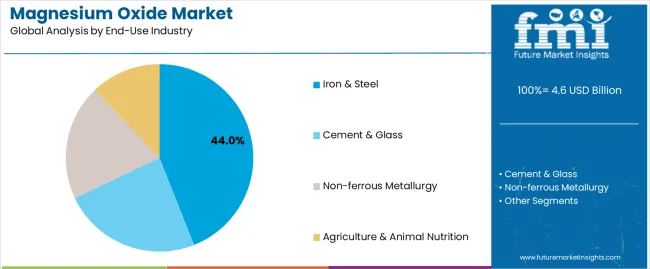
The iron & steel end-use industry segment commands the largest market share at 44.0% in 2026, reflecting its established position as the most demanding and volume-consuming sector for magnesium oxide requiring high-quality refractory materials for blast furnaces, basic oxygen furnaces, electric arc furnaces, and ladle refining operations. This segment benefits from magnesium oxide's unique combination of properties including superior resistance to basic slags rich in iron oxide and lime, excellent thermal conductivity supporting efficient heat management, and structural stability maintaining furnace integrity throughout extended production campaigns. The extensive use of magnesia-based refractories in steelmaking vessel linings, tundish working linings, and ladle permanent linings supports segment dominance.
Cement & glass follow with 23.0% share, utilizing magnesium oxide refractories for rotary kiln linings and glass furnace applications requiring corrosion resistance. Non-ferrous metallurgy accounts for 10.0%, serving copper, lead, and zinc smelting operations. Agriculture & animal nutrition hold 9.0% share, using feed-grade magnesium oxide for livestock supplementation. Environmental services represent 8.0%, encompassing pollution control and water treatment. Chemicals & pharma account for 6.0%, including pharmaceutical-grade and chemical intermediate applications. The iron & steel segment's leadership is reinforced by continuous steel capacity expansion, increasing electric arc furnace adoption driving magnesia refractory demand, and quality requirements supporting premium refractory-grade magnesia utilization across global steel production.
What are the Drivers, Restraints, and Key Trends of the Magnesium Oxide Market?
The magnesium oxide market is advancing robustly due to increasing steel production capacity expansion in emerging economies and growing adoption of electric arc furnace steelmaking technology that requires high-performance basic refractories across diverse metallurgical, cement production, and environmental treatment applications. Themarket faces challenges, including volatility in raw material costs affecting production economics, environmental regulations governing magnesite mining and calcination emissions, and competition from alternative refractory materials including alumina-magnesia and chrome-magnesia systems offering specialized performance characteristics. Innovation in energy-efficient calcination technologies and high-purity magnesia grades continues to influence product development and market expansion patterns.
Expansion of Electric Arc Furnace Steelmaking and Scrap Recycling
The growing adoption of electric arc furnace technology for steel production is enabling steelmakers to utilize scrap metal feedstocks, reduce carbon emissions compared to blast furnace routes, and achieve operational flexibility while requiring intensive magnesia refractory consumption due to aggressive operating conditions with high temperatures and corrosive basic slags. Electric arc furnace steelmaking provides shorter production cycles while demanding frequent refractory maintenance and high-quality magnesia-based linings that can withstand thermal cycling and chemical attack. Steel producers are increasingly recognizing the strategic importance of premium dead burned magnesia for electric arc furnace competitiveness, operational reliability, and production efficiency supporting circular economy principles through steel recycling.
Integration of Environmental Compliance and Pollution Control Technologies
Modern magnesium oxide producers and end-users are incorporating environmental applications including flue gas desulfurization systems, wastewater pH adjustment, and acid neutralization to enhance environmental performance, comply with stringent emission regulations, and support comprehensive pollution control through cost-effective neutralizing agents and reactive magnesia products. These technologies improve environmental compliance while enabling new applications including waste-to-energy plant flue gas treatment and industrial wastewater management. Advanced environmental magnesia applications also allow industrial facilities to support comprehensive sustainability objectives and regulatory compliance beyond traditional refractory applications, creating growth opportunities in environmental services and municipal treatment sectors.
Development of High-Purity and Specialty Magnesia Grades
The emergence of fused magnesia, electrofused magnesia, and ultra-high purity caustic calcined magnesia is creating specialized applications in electronics glass manufacturing, lithium-ion battery cathode materials, pharmaceutical excipients, and advanced ceramic production requiring exceptional purity levels, controlled particle size distributions, and minimal impurity content including silica, iron oxide, and heavy metals. These innovations enable manufacturers to serve demanding applications with stringent quality specifications including borosilicate glass for displays, battery-grade chemicals supporting electrification, and pharmaceutical intermediates requiring USP/EP compliance. Leading magnesia producers are investing in advanced purification processes, precision calcination control systems, and comprehensive analytical capabilities that deliver differentiated high-purity products, supporting premium pricing realization and strengthening technical partnerships with innovative industries developing next-generation materials and technologies.
Analysis of the Magnesium Oxide Market by Key Countries
.webp "Top Country Growth Comparison Magnesium Oxide Market Cagr (2026 2036)")
| Country | CAGR (2026-2036) |
|---|---|
| India | 9.1% |
| China | 8.4% |
| South Korea | 6.6% |
| United States | 4.5% |
| Spain | 4.4% |
| Germany | 4.1% |
| United Kingdom | 4.0% |
Source: FMI analysis based on primary research and proprietary forecasting model
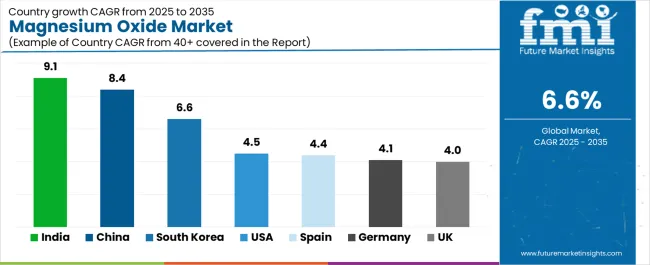
The magnesium oxide market is experiencing robust growth globally, with India leading at a 9.1% CAGR through 2036, driven by steel capacity additions supporting infrastructure development and industrial expansion, cement clinker quality upgrades requiring magnesia-based refractories, and feed-grade magnesium oxide adoption in expanding livestock and dairy sectors. China follows at 8.4%, supported by refractory intensity in electric arc furnace and basic oxygen furnace steelmaking operations, expansion of fused magnesia production capacity serving advanced refractory applications, and government infrastructure investment driving steel and cement demand. South Korea shows growth at 6.6%, emphasizing high-specification refractories for electronics glass manufacturing and battery production with advanced magnesia grades. The United States records 4.5%, focusing on electric arc furnace market share growth and environmental magnesium oxide applications in flue gas desulfurization and water treatment. Spain demonstrates 4.4% growth, supported by cement kiln refurbishment cycles and magnesia panel adoption in construction applications. Germany exhibits 4.1% growth, emphasizing specialty refractories in automotive steel production and container glass manufacturing. The United Kingdom shows 4.0% growth, supported by waste-to-energy flue gas treatment and magnesia board applications in construction.
The report covers an in-depth analysis of 40+ countries, Top-performing countries are highlighted below.
India Leads Global Market Growth with Steel Expansion and Industrial Development
The magnesium oxide market in India is projected to exhibit exceptional growth with a CAGR of 9.1% through 2036, driven by aggressive steel capacity additions supporting ambitious infrastructure development programs and manufacturing sector expansion, cement clinker quality upgrades requiring magnesia-based refractory linings and kiln operation optimization, and feed-grade magnesium oxide adoption across rapidly expanding livestock, dairy, and poultry sectors addressing animal nutrition requirements. The country's position as the world's second-largest steel producer and expanding cement manufacturing base are creating substantial demand for refractory-grade and industrial magnesia across diverse applications. Major international refractory companies and domestic magnesia suppliers are establishing comprehensive production and distribution capabilities to serve Indian steel and cement markets.
- Steel capacity additions and cement clinker upgrades are driving demand for dead burned magnesia throughout major steel-producing regions including Odisha, Jharkhand, and Chhattisgarh, supporting blast furnace campaigns, electric arc furnace operations, and cement rotary kiln maintenance programs.
- Feed-grade magnesium oxide adoption and expanding livestock sectors are supporting increased caustic calcined magnesia utilization across animal nutrition applications, with growing dairy and poultry industries requiring mineral supplementation for optimal animal health and productivity.
China Demonstrates Strong Market Potential with Steelmaking Intensity and Capacity Expansion
The magnesium oxide market in China is expanding at a CAGR of 8.4%, supported by the country's massive steel production scale with high refractory intensity in electric arc furnace and basic oxygen furnace operations requiring frequent refractory maintenance and replacement, expansion of fused and electrofused magnesia production capacity serving premium refractory applications, and continued infrastructure investment driving steel and cement consumption despite industry consolidation. The country's position as the world's largest steel producer and leading magnesia manufacturing hub are driving comprehensive magnesium oxide production and consumption. Chinese magnesia producers and refractory manufacturers are establishing extensive capabilities to serve both domestic and international markets.
- Refractory intensity in electric arc furnace and basic oxygen furnace steelmaking and expansion of fused magnesia capacity are creating opportunities for magnesium oxide producers throughout major production centers in Liaoning and other provinces, supporting domestic steel production and refractory exports to global steel industries.
- Infrastructure investment continuation and industrial processing requirements are driving sustained magnesium oxide demand among Chinese steel producers, cement manufacturers, and non-ferrous metal smelters requiring high-performance refractory materials and environmental treatment solutions.
United States Emphasizes Electric Arc Furnace Growth and Environmental Applications
The magnesium oxide market in the United States is expanding at a CAGR of 4.5%, supported by the country's increasing electric arc furnace market share in steel production driven by scrap availability and energy economics, environmental magnesium oxide applications in flue gas desulfurization systems at power plants and wastewater pH adjustment at industrial facilities, and steady demand for refractory maintenance in established steel and cement industries. The nation's transition toward electric steelmaking and stringent environmental regulations are driving demand for specialized magnesia products. Leading refractory suppliers and magnesia producers are investing in comprehensive supply chains to serve USA steel and environmental markets.
- Electric arc furnace share growth and scrap-based steelmaking expansion are creating sustained demand for refractory-grade magnesium oxide among USA steel producers, with electric arc furnace operating conditions requiring frequent basic refractory maintenance and high-quality magnesia materials.
- Environmental magnesium oxide applications in flue gas desulfurization and water treatment are supporting market expansion, while regulatory compliance requirements provide opportunities for caustic calcined magnesia in pollution control systems serving power generation and industrial processing sectors.
South Korea Focuses on High-Specification Applications and Advanced Materials
The magnesium oxide market in South Korea is growing at a CAGR of 6.6%, driven by the country's demand for high-specification refractories serving electronics glass manufacturing including display panels and specialty glass products, battery cathode material production requiring high-purity magnesium oxide for lithium-ion battery manufacturing, and advanced steel production supporting automotive and shipbuilding industries. The country's technology-focused industrial base and quality standards are driving specialized magnesia demand. Korean steel producers and electronics manufacturers are establishing comprehensive sourcing strategies for premium magnesia grades.
- High-specification refractories for electronics glass and battery production are creating demand for fused and ultra-high purity magnesium oxide throughout Korean manufacturing sectors, with stringent specifications supporting advanced material production and precision manufacturing processes.
- Advanced steel production and automotive industry requirements are driving adoption of premium refractory-grade magnesia among Korean steelmakers, with quality-focused production requiring superior refractory performance and consistent material properties supporting competitive manufacturing operations.
Germany Demonstrates Industrial Excellence with Specialty Refractories and Quality Focus
Demand for magnesium oxide in Germany is expanding at a CAGR of 4.1%, supported by the country's specialty refractory production for automotive steel manufacturing requiring high-quality steel grades and precision processing, container glass manufacturing demanding corrosion-resistant refractories for continuous melting operations, and comprehensive environmental standards driving adoption of magnesia-based treatment solutions. Germany's advanced manufacturing sectors and quality requirements are driving demand for premium magnesia products. German refractory manufacturers and industrial operators are investing in certified magnesia sourcing strategies.
- Specialty refractories in automotive steel and container glass manufacturing are creating opportunities for high-quality magnesium oxide throughout German industrial regions, with demanding applications requiring consistent refractory performance and comprehensive quality documentation supporting precision manufacturing.
- Environmental compliance requirements and industrial processing standards are driving adoption of magnesium oxide in flue gas treatment and wastewater management systems, with stringent regulations supporting specification of reliable neutralizing agents and reactive magnesia products.
Spain Emphasizes Cement Infrastructure and Construction Applications
Revenue from magnesium oxide in Spain is growing at a CAGR of 4.4%, driven by cement kiln refurbishment cycles requiring refractory replacement and maintenance, magnesia panel adoption in construction applications including fireproof boards and lightweight building panels, and industrial processing requirements across steel and non-ferrous metallurgy sectors. The country's construction activity recovery and cement production infrastructure are supporting magnesia demand. Spanish cement producers and construction material manufacturers are establishing magnesia sourcing capabilities.
- Cement kiln refurbishments and refractory maintenance programs are creating demand for dead burned magnesia throughout Spanish cement manufacturing regions, with kiln lining replacement cycles supporting consistent magnesia consumption patterns.
- Magnesia panels in construction and building material innovation are driving adoption of caustic calcined magnesia in lightweight boards, fire-resistant panels, and specialty construction products addressing building code requirements and sustainable construction trends.
United Kingdom Focuses on Environmental Treatment and Specialized Construction Applications
The magnesium oxide industry in the United Kingdom is expanding at a CAGR of 4.0%, supported by the country's waste-to-energy facility expansion requiring flue gas treatment systems and acid gas neutralization, magnesia board applications in construction including fire-rated partition systems and moisture-resistant panels, and industrial environmental compliance driving magnesium oxide utilization in pollution control. The UK's environmental focus and construction standards are supporting specialized magnesia applications. British environmental service providers and construction material manufacturers are establishing comprehensive magnesia utilization strategies.
- Waste-to-energy flue gas treatment and environmental compliance requirements are creating opportunities for caustic calcined magnesium oxide in pollution control systems, with municipal waste management and energy recovery facilities requiring effective acid gas neutralization solutions.
- Board applications and construction material innovation are driving adoption of magnesium oxide in fire-rated panels and moisture-resistant building products, with building regulations and green construction trends supporting specification of magnesia-based board systems.
Europe Market Split by Country
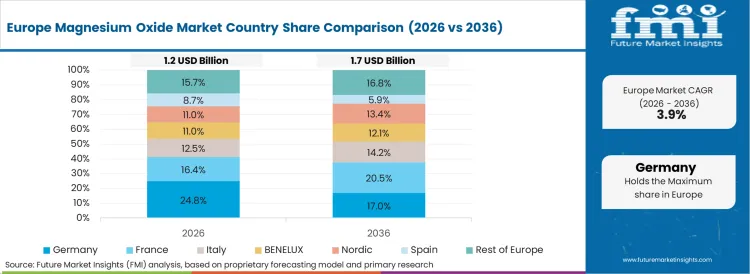
The magnesium oxide market in Europe is projected to grow from USD 1.1 billion in 2026 to USD 1.7 billion by 2036, registering a CAGR of 4.5% over the forecast period. Germany is expected to maintain its leadership position with a 20.0% market share in 2026, moderating slightly to 19.8% by 2036, supported by its specialty refractory production for automotive steel and container glass manufacturing, comprehensive environmental standards, and advanced industrial processing infrastructure serving European markets.
The United Kingdom follows with 12.0% in 2026, projected to reach 12.2% by 2036, driven by waste-to-energy flue gas treatment expansion and magnesia board applications in construction sectors. France holds 12.0% in 2026, rising to 12.1% by 2036, supported by steel and cement production requiring refractory maintenance and environmental applications. Italy commands 10.0% in 2026, projected to reach 10.2% by 2036, driven by specialty steel production and glass manufacturing. Spain accounts for 8.0% in 2026, expected to reach 8.4% by 2036, supported by cement kiln refurbishments and construction material applications. Nordics & Benelux maintain 18.0% in 2026, growing to 18.3% by 2036, driven by environmental treatment applications and specialty chemical production. Central & Eastern Europe holds 20.0% in 2026, moderating to 19.0% by 2036, attributed to steel production capacity, cement manufacturing expansion, and refractory replacement cycles supporting consistent magnesia consumption across emerging industrial markets implementing modern furnace technologies and environmental compliance standards.
Competitive Landscape of the Magnesium Oxide Market
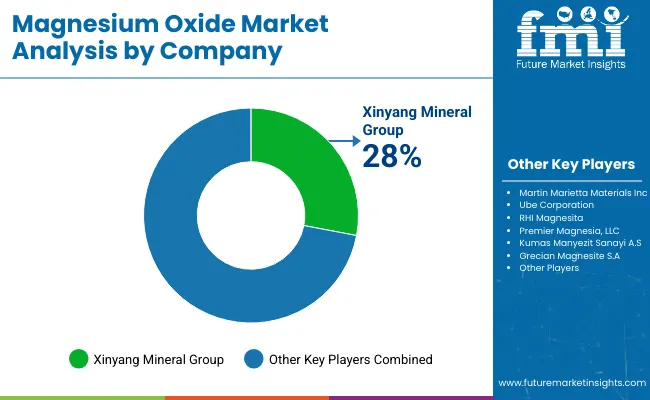
The magnesium oxide market features 12-18 players with moderate concentration, where the top three companies collectively hold around 44-50% of global market share, driven by strong mineral reserves, advanced calcination technologies, and long-term supply relationships with steel, refractory, agriculture, and chemical industries. The leading company, RHI Magnesita, commands 13% market share, supported by its vertically integrated magnesia operations, high-temperature refractory expertise, and global distribution capabilities. Competition centers on purity levels, controlled calcination grades (caustic, dead-burned, and fused), consistency, and compliance with industrial performance standards rather than price alone.
Market leaders such as RHI Magnesita, Martin Marietta Materials, and Magnezit Group maintain dominant positions by offering high-performance magnesium oxide grades tailored for refractory linings, steel and cement kilns, and advanced industrial applications. Their strengths lie in integrated mining assets, proprietary processing technologies, and strong customer partnerships across heavy industries.
Challenger companies including Grecian Magnesite, Ube Corporation, and Nedmag focus on specialty magnesium oxide grades for environmental remediation, food and feed additives, pharmaceuticals, and high-purity chemical applications.
Additional competitive pressure arises from ICL Group, Premier Magnesia, Kumas Magnesite, Xinyang Mineral Group, Imerys, Haicheng Magnesite Group, Russian Mining Chemical Company, SMZ Jelsava, and Dandong Jinyuan Group, which strengthen their positions through cost-effective production, diverse product portfolios, and strong supply capabilities across Asia, Europe, and North America.
Magnesium Oxide Market - Stakeholder Contribution Framework
Magnesium oxide represents a specialized high-temperature material segment within refractories and industrial minerals, projected to grow from USD 4.6 billion in 2026 to USD 8.7 billion by 2036 at a 6.6% CAGR. This versatile alkaline earth oxide, primarily dead burned magnesia for refractory applications, is produced through mining and calcination of magnesite ore or extraction from seawater to serve as an essential refractory material providing corrosion resistance in steelmaking furnaces, cement kiln linings, and glass melting tanks, while also serving environmental neutralization, construction materials, agricultural supplements, and pharmaceutical applications. Market expansion is driven by increasing steel production capacity, growing electric arc furnace adoption, expanding environmental compliance requirements, and rising demand for high-purity grades across metallurgy, cement, glass, and specialty chemical sectors.
How Industrial Regulators Could Strengthen Safety Standards and Environmental Compliance?
- Refractory Performance Standards: Establish comprehensive specifications for magnesia-based refractories, including thermal stability requirements, corrosion resistance criteria, and structural integrity testing protocols ensuring reliable furnace operation and worker safety in high-temperature industrial environments.
- Environmental Emission Controls: Develop regulatory frameworks for magnesium oxide production facilities addressing calcination emissions, particulate matter control, and energy efficiency standards that minimize environmental impact while supporting sustainable magnesia manufacturing.
- Mine Safety and Reclamation: Implement mandatory standards for magnesite mining operations including worker safety protocols, environmental monitoring requirements, and mine reclamation obligations ensuring responsible resource extraction and land restoration.
- Product Quality Specifications: Create standardized testing methods for magnesium oxide grades including chemical composition analysis, particle size distribution, reactivity assessment, and impurity profiling enabling comparative evaluation and informed material selection across industrial applications.
- Occupational Health Protection: Provide regulatory guidance for handling magnesium oxide products including dust exposure limits, respiratory protection requirements, and workplace monitoring protocols protecting worker health throughout production, processing, and application operations.
How Industry Associations Could Advance Technical Standards and Best Practices?
- Refractory Application Guidelines: Develop comprehensive technical resources for magnesia refractory selection, installation, and maintenance covering furnace design considerations, material compatibility, thermal management, and campaign life optimization supporting reliable high-temperature operations.
- Quality Assurance Protocols: Establish industry-wide testing standards for magnesium oxide characterization including chemical analysis methods, physical property measurement, and performance testing enabling consistent specifications and quality control throughout supply chains.
- Sustainable Production Practices: Create guidance for energy-efficient calcination technologies, waste minimization strategies, and circular economy implementation that reduce environmental footprint while maintaining product quality and cost competitiveness.
- Professional Training Programs: Develop specialized training curricula for refractory engineers, furnace operators, and quality control personnel covering magnesium oxide properties, refractory design principles, installation techniques, and troubleshooting supporting technical competence.
- Application Innovation Support: Facilitate knowledge sharing on emerging magnesium oxide applications including high-purity grades for electronics, battery materials, and pharmaceutical uses through technical conferences, research collaboration, and market development initiatives.
How Magnesium Oxide Manufacturers Could Drive Production Excellence and Market Expansion?
- Advanced Calcination Technologies: Invest in energy-efficient rotary kilns, shaft kilns, and electric arc furnace systems that optimize fuel consumption, reduce carbon emissions, and deliver consistent product quality through precise temperature control and residence time management.
- High-Purity Grade Development: Develop ultra-high purity magnesium oxide through advanced beneficiation, selective calcination, and purification processes serving demanding applications in electronics glass, battery cathodes, and pharmaceutical excipients requiring minimal impurities and controlled specifications.
- Sustainable Mining Practices: Implement responsible magnesite extraction including progressive reclamation, water management, biodiversity protection, and community engagement supporting long-term resource access and social license to operate.
- Quality Documentation Excellence: Provide comprehensive analytical certificates, material safety data sheets, technical data packages, and application guidance supporting customer compliance, process optimization, and successful material implementation across diverse industrial applications.
- Strategic Capacity Investment: Expand production facilities in proximity to key steel and cement manufacturing regions, optimize logistics networks, and develop strategic inventory positions ensuring reliable supply and competitive delivered costs supporting market share growth.
How Steel Producers and Refractory Users Could Optimize Operations and Cost Management?
- Strategic Refractory Selection: Conduct comprehensive evaluation of magnesia-based refractories considering operating conditions, campaign life expectations, maintenance strategies, and total cost of ownership to optimize furnace productivity and minimize unplanned downtime.
- Supplier Partnership Development: Establish long-term relationships with qualified magnesium oxide suppliers including quality agreements, technical support arrangements, and supply security provisions ensuring consistent material availability and application expertise.
- Refractory Management Optimization: Implement predictive maintenance programs, refractory monitoring systems, and post-campaign analysis protocols that extend campaign life, reduce maintenance costs, and optimize refractory consumption through data-driven decision making.
- Installation Excellence: Utilize best practices for refractory installation including proper drying procedures, joint design optimization, and quality control inspection ensuring maximum performance and avoiding premature failures from installation defects.
- Alternative Material Evaluation: Monitor emerging refractory technologies and material innovations that could provide performance advantages, cost reductions, or sustainability benefits while maintaining operational reliability and product quality standards.
How Environmental Service Providers Could Enhance Treatment Effectiveness?
- Application Optimization: Develop magnesium oxide dosing strategies for flue gas desulfurization, wastewater pH adjustment, and acid neutralization that maximize treatment efficiency while minimizing chemical consumption and residual waste generation.
- System Design Excellence: Engineer optimal contacting systems, mixing equipment, and residence time configurations enabling effective magnesium oxide utilization and consistent treatment performance across variable feed conditions and flow rates.
- Performance Monitoring: Implement real-time analysis, process control systems, and optimization algorithms that adjust magnesium oxide addition based on inlet conditions ensuring regulatory compliance and cost-effective operations.
- By-Product Management: Develop strategies for handling and valorizing magnesium-containing treatment residuals including gypsum from flue gas desulfurization and magnesium hydroxide sludges exploring beneficial use opportunities and minimizing disposal costs.
- Regulatory Compliance Excellence: Maintain comprehensive documentation of treatment performance, emission reductions, and water quality improvements demonstrating regulatory compliance and supporting permit renewals across environmental applications.
How Investors and Financial Enablers Could Support Market Growth and Innovation?
- Production Capacity Financing: Provide capital for new magnesium oxide production facilities, calcination technology upgrades, and mining infrastructure development that increase supply availability and support market growth across steel, cement, and emerging applications.
- Technology Development Investment: Finance research and development of energy-efficient production processes, high-purity grade innovations, and novel application development expanding addressable markets and supporting competitive differentiation.
- Sustainability Infrastructure: Support implementation of carbon reduction technologies, renewable energy integration, and circular economy systems in magnesium oxide production reducing environmental impact and addressing customer sustainability requirements.
- Emerging Market Development: Provide financing for capacity expansion in high-growth steel and cement markets including India, Southeast Asia, and Latin America capturing regional demand growth and reducing logistics costs through local production.
- Value Chain Integration: Fund vertical integration strategies including captive magnesite mining, integrated calcination and refractory manufacturing, and downstream application development creating value capture and competitive advantages through supply chain control.
Key Players in the Magnesium Oxide Market
- RHI Magnesita
- Martin Marietta Materials
- Magnezit Group
- Grecian Magnesite
- Ube Corporation
- Nedmag
- ICL Group
- Premier Magnesia
- Kumas Magnesite
- Xinyang Mineral Group
- Imerys
- Haicheng Magnesite Group
- Russian Mining Chemical Company
- SMZ Jelsava
- Dandong Jinyuan Group
Scope of the Report
| Metric | Value |
|---|---|
| Quantitative Units | USD 4.90 billion to USD 9.29 billion, at a CAGR of 6.6% |
| Market Definition | Magnesium Oxide encompasses caustic calcined, dead burned, and fused magnesia grades produced from magnesite calcination and used across refractory, environmental, agricultural, and specialty chemical applications. |
| Product Type Segmentation | Dead Burned Magnesia, Caustic Calcined Magnesia, Fused/Electrofused MgO |
| End-Use Industry Segmentation | Iron & Steel, Cement & Glass, Non-ferrous Metallurgy, Agriculture & Animal Nutrition, Environmental Services, Chemicals & Pharma |
| Application Segmentation | Refractories, Environmental, Construction & Boards, Agriculture & Feed, Chemicals & Pharma |
| Regions Covered | North America, Latin America, Europe, East Asia, South Asia, Oceania, Middle East & Africa |
| Countries Covered | India, China, South Korea, USA, Spain, Germany, UK, and 40 plus countries |
| Key Companies Profiled | RHI Magnesita, Martin Marietta Materials, Magnezit Group, Grecian Magnesite, Ube Corporation, Nedmag, ICL Group, Premier Magnesia, Kumas Magnesite, Xinyang Mineral Group, Imerys, Haicheng Magnesite Group |
| Forecast Period | 2026 to 2036 |
| Approach | Bottom-up volume aggregation by grade and end-use category, validated against steel production and trade flow statistics |
Magnesium Oxide Market by Segments
Product Type:
- Dead Burned Magnesia (DBM)
- Caustic Calcined Magnesia (CCM)
- Fused/Electrofused MgO
Application:
- Refractories
- Environmental (FGD, Wastewater, Flue Gas)
- Construction & Boards
- Agriculture & Feed
- Chemicals & Pharma
End-Use Industry:
- Iron & Steel
- Cement & Glass
- Non-ferrous Metallurgy
- Agriculture & Animal Nutrition
- Environmental Services
- Chemicals & Pharma
Region:
- North America
- United States
- Canada
- Mexico
- Europe
- Germany
- United Kingdom
- France
- Italy
- Spain
- Nordic
- BENELUX
- Rest of Europe
- Asia Pacific
- China
- Japan
- India
- South Korea
- ASEAN
- Australia & New Zealand
- Rest of Asia Pacific
- Latin America
- Brazil
- Argentina
- Chile
- Rest of Latin America
- Middle East & Africa
- Kingdom of Saudi Arabia
- UAE
- Other GCC Countries
- Turkey
- South Africa
- Rest of Middle East & Africa
Bibliography
- 1. World Steel Association. (2024). Steel Statistical Yearbook 2024. worldsteel.org.
- 2. United States Geological Survey. (2024). Mineral Commodity Summaries: Magnesium Compounds. USGS.
- 3. European Commission. (2024). Critical Raw Materials Act Implementation Report. European Commission.
- 4. International Refractory Industry Association. (2024). Global Refractory Market Statistics. IREFCON.
- 5. Government of India, Ministry of Mines. (2024). National Mineral Policy Review and Magnesite Reserve Assessment. Ministry of Mines.
- 6. International Energy Agency. (2024). Industrial Decarbonisation and Refractory Materials Sector Report. IEA.
This bibliography is provided for reader reference. The full Future Market Insights report contains the complete reference list with primary research documentation.
Frequently Asked Questions
How large is the demand for Magnesium Oxide in the global market in 2026?
Demand for Magnesium Oxide in the global market is estimated to be valued at USD 4.90 billion in 2026.
What will the market size of Magnesium Oxide be by 2036?
The Magnesium Oxide market is projected to reach USD 9.29 billion by 2036.
What is the expected CAGR for Magnesium Oxide between 2026 and 2036?
The Magnesium Oxide market is expected to grow at a CAGR of 6.6% between 2026 and 2036.
Which product type is poised to lead global sales in 2026?
Dead Burned Magnesia accounts for 53.5% share in 2026 as its ultra-high thermal density makes it the mandated grade for blast furnace and steelmaking ladle lining applications.
Which end-use industry commands the largest share in 2026?
Iron & Steel holds 44.0% of end-use demand in 2026 as steelmaking refractory relining programs generate the single largest volume consumption of magnesia grades globally.
Which country is projected to record the fastest growth?
India is projected to grow at 9.1% CAGR through 2036, driven by expanding electric arc furnace construction and government infrastructure programs supporting steel-intensive construction activity.
What does this report cover?
The report covers global market sizing, grade-level segmentation, end-use industry analysis, regional and country forecasts, competitive landscape assessment, and supply chain risk evaluation for the Magnesium Oxide market from 2026 to 2036.
Table of Content
- Executive Summary
- Global Market Outlook
- Demand to side Trends
- Supply to side Trends
- Technology Roadmap Analysis
- Analysis and Recommendations
- Market Overview
- Market Coverage / Taxonomy
- Market Definition / Scope / Limitations
- Research Methodology
- Chapter Orientation
- Analytical Lens and Working Hypotheses
- Market Structure, Signals, and Trend Drivers
- Benchmarking and Cross-market Comparability
- Market Sizing, Forecasting, and Opportunity Mapping
- Research Design and Evidence Framework
- Desk Research Programme (Secondary Evidence)
- Company Annual and Sustainability Reports
- Peer-reviewed Journals and Academic Literature
- Corporate Websites, Product Literature, and Technical Notes
- Earnings Decks and Investor Briefings
- Statutory Filings and Regulatory Disclosures
- Technical White Papers and Standards Notes
- Trade Journals, Industry Magazines, and Analyst Briefs
- Conference Proceedings, Webinars, and Seminar Materials
- Government Statistics Portals and Public Data Releases
- Press Releases and Reputable Media Coverage
- Specialist Newsletters and Curated Briefings
- Quantitative Surveys and Structured Data Capture
- Blended Approach
- Why Primary Evidence is Used
- Field Techniques
- Interviews
- Surveys
- Focus Groups
- Observational and In-context Research
- Social and Community Interactions
- Stakeholder Universe Engaged
- C-suite Leaders
- Board Members
- Presidents and Vice Presidents
- R&D and Innovation Heads
- Technical Specialists
- Domain Subject-matter Experts
- Scientists
- Physicians and Other Healthcare Professionals
- Governance, Ethics, and Data Stewardship
- Research Ethics
- Data Integrity and Handling
- Desk Research Programme (Secondary Evidence)
- Tooling, Models, and Reference Databases
- Data Engineering and Model Build
- Data Acquisition and Ingestion
- Cleaning, Normalisation, and Verification
- Synthesis, Triangulation, and Analysis
- Quality Assurance and Audit Trail
- Market Background
- Market Dynamics
- Drivers
- Restraints
- Opportunity
- Trends
- Scenario Forecast
- Demand in Optimistic Scenario
- Demand in Likely Scenario
- Demand in Conservative Scenario
- Opportunity Map Analysis
- Product Life Cycle Analysis
- Supply Chain Analysis
- Investment Feasibility Matrix
- Value Chain Analysis
- PESTLE and Porter’s Analysis
- Regulatory Landscape
- Regional Parent Market Outlook
- Production and Consumption Statistics
- Import and Export Statistics
- Market Dynamics
- Global Market Analysis 2021 to 2025 and Forecast, 2026 to 2036
- Historical Market Size Value (USD Million) Analysis, 2021 to 2025
- Current and Future Market Size Value (USD Million) Projections, 2026 to 2036
- Y to o to Y Growth Trend Analysis
- Absolute $ Opportunity Analysis
- Global Market Pricing Analysis 2021 to 2025 and Forecast 2026 to 2036
- Global Market Analysis 2021 to 2025 and Forecast 2026 to 2036, By Product Type
- Introduction / Key Findings
- Historical Market Size Value (USD Million) Analysis By Product Type , 2021 to 2025
- Current and Future Market Size Value (USD Million) Analysis and Forecast By Product Type , 2026 to 2036
- Dead Burned Magnesia
- Caustic Calcined Magnesia
- Fused/Electrofused MgO
- Dead Burned Magnesia
- Y to o to Y Growth Trend Analysis By Product Type , 2021 to 2025
- Absolute $ Opportunity Analysis By Product Type , 2026 to 2036
- Global Market Analysis 2021 to 2025 and Forecast 2026 to 2036, By End-Use Industry
- Introduction / Key Findings
- Historical Market Size Value (USD Million) Analysis By End-Use Industry, 2021 to 2025
- Current and Future Market Size Value (USD Million) Analysis and Forecast By End-Use Industry, 2026 to 2036
- Iron & Steel
- Cement & Glass
- Non-ferrous Metallurgy
- Agriculture & Animal Nutrition
- Environmental Services
- Chemicals & Pharma
- Iron & Steel
- Y to o to Y Growth Trend Analysis By End-Use Industry, 2021 to 2025
- Absolute $ Opportunity Analysis By End-Use Industry, 2026 to 2036
- Global Market Analysis 2021 to 2025 and Forecast 2026 to 2036, By Application
- Introduction / Key Findings
- Historical Market Size Value (USD Million) Analysis By Application, 2021 to 2025
- Current and Future Market Size Value (USD Million) Analysis and Forecast By Application, 2026 to 2036
- Refractories
- Environmental
- Construction & Boards
- Agriculture & Feed
- Chemicals & Pharma
- Refractories
- Y to o to Y Growth Trend Analysis By Application, 2021 to 2025
- Absolute $ Opportunity Analysis By Application, 2026 to 2036
- Global Market Analysis 2021 to 2025 and Forecast 2026 to 2036, By Region
- Introduction
- Historical Market Size Value (USD Million) Analysis By Region, 2021 to 2025
- Current Market Size Value (USD Million) Analysis and Forecast By Region, 2026 to 2036
- North America
- Latin America
- Western Europe
- Eastern Europe
- East Asia
- South Asia and Pacific
- Middle East & Africa
- Market Attractiveness Analysis By Region
- North America Market Analysis 2021 to 2025 and Forecast 2026 to 2036, By Country
- Historical Market Size Value (USD Million) Trend Analysis By Market Taxonomy, 2021 to 2025
- Market Size Value (USD Million) Forecast By Market Taxonomy, 2026 to 2036
- By Country
- USA
- Canada
- Mexico
- By Product Type
- By End-Use Industry
- By Application
- By Country
- Market Attractiveness Analysis
- By Country
- By Product Type
- By End-Use Industry
- By Application
- Key Takeaways
- Latin America Market Analysis 2021 to 2025 and Forecast 2026 to 2036, By Country
- Historical Market Size Value (USD Million) Trend Analysis By Market Taxonomy, 2021 to 2025
- Market Size Value (USD Million) Forecast By Market Taxonomy, 2026 to 2036
- By Country
- Brazil
- Chile
- Rest of Latin America
- By Product Type
- By End-Use Industry
- By Application
- By Country
- Market Attractiveness Analysis
- By Country
- By Product Type
- By End-Use Industry
- By Application
- Key Takeaways
- Western Europe Market Analysis 2021 to 2025 and Forecast 2026 to 2036, By Country
- Historical Market Size Value (USD Million) Trend Analysis By Market Taxonomy, 2021 to 2025
- Market Size Value (USD Million) Forecast By Market Taxonomy, 2026 to 2036
- By Country
- Germany
- UK
- Italy
- Spain
- France
- Nordic
- BENELUX
- Rest of Western Europe
- By Product Type
- By End-Use Industry
- By Application
- By Country
- Market Attractiveness Analysis
- By Country
- By Product Type
- By End-Use Industry
- By Application
- Key Takeaways
- Eastern Europe Market Analysis 2021 to 2025 and Forecast 2026 to 2036, By Country
- Historical Market Size Value (USD Million) Trend Analysis By Market Taxonomy, 2021 to 2025
- Market Size Value (USD Million) Forecast By Market Taxonomy, 2026 to 2036
- By Country
- Russia
- Poland
- Hungary
- Balkan & Baltic
- Rest of Eastern Europe
- By Product Type
- By End-Use Industry
- By Application
- By Country
- Market Attractiveness Analysis
- By Country
- By Product Type
- By End-Use Industry
- By Application
- Key Takeaways
- East Asia Market Analysis 2021 to 2025 and Forecast 2026 to 2036, By Country
- Historical Market Size Value (USD Million) Trend Analysis By Market Taxonomy, 2021 to 2025
- Market Size Value (USD Million) Forecast By Market Taxonomy, 2026 to 2036
- By Country
- China
- Japan
- South Korea
- By Product Type
- By End-Use Industry
- By Application
- By Country
- Market Attractiveness Analysis
- By Country
- By Product Type
- By End-Use Industry
- By Application
- Key Takeaways
- South Asia and Pacific Market Analysis 2021 to 2025 and Forecast 2026 to 2036, By Country
- Historical Market Size Value (USD Million) Trend Analysis By Market Taxonomy, 2021 to 2025
- Market Size Value (USD Million) Forecast By Market Taxonomy, 2026 to 2036
- By Country
- India
- ASEAN
- Australia & New Zealand
- Rest of South Asia and Pacific
- By Product Type
- By End-Use Industry
- By Application
- By Country
- Market Attractiveness Analysis
- By Country
- By Product Type
- By End-Use Industry
- By Application
- Key Takeaways
- Middle East & Africa Market Analysis 2021 to 2025 and Forecast 2026 to 2036, By Country
- Historical Market Size Value (USD Million) Trend Analysis By Market Taxonomy, 2021 to 2025
- Market Size Value (USD Million) Forecast By Market Taxonomy, 2026 to 2036
- By Country
- Kingdom of Saudi Arabia
- Other GCC Countries
- Turkiye
- South Africa
- Other African Union
- Rest of Middle East & Africa
- By Product Type
- By End-Use Industry
- By Application
- By Country
- Market Attractiveness Analysis
- By Country
- By Product Type
- By End-Use Industry
- By Application
- Key Takeaways
- Key Countries Market Analysis
- USA
- Pricing Analysis
- Market Share Analysis, 2025
- By Product Type
- By End-Use Industry
- By Application
- Canada
- Pricing Analysis
- Market Share Analysis, 2025
- By Product Type
- By End-Use Industry
- By Application
- Mexico
- Pricing Analysis
- Market Share Analysis, 2025
- By Product Type
- By End-Use Industry
- By Application
- Brazil
- Pricing Analysis
- Market Share Analysis, 2025
- By Product Type
- By End-Use Industry
- By Application
- Chile
- Pricing Analysis
- Market Share Analysis, 2025
- By Product Type
- By End-Use Industry
- By Application
- Germany
- Pricing Analysis
- Market Share Analysis, 2025
- By Product Type
- By End-Use Industry
- By Application
- UK
- Pricing Analysis
- Market Share Analysis, 2025
- By Product Type
- By End-Use Industry
- By Application
- Italy
- Pricing Analysis
- Market Share Analysis, 2025
- By Product Type
- By End-Use Industry
- By Application
- Spain
- Pricing Analysis
- Market Share Analysis, 2025
- By Product Type
- By End-Use Industry
- By Application
- France
- Pricing Analysis
- Market Share Analysis, 2025
- By Product Type
- By End-Use Industry
- By Application
- India
- Pricing Analysis
- Market Share Analysis, 2025
- By Product Type
- By End-Use Industry
- By Application
- ASEAN
- Pricing Analysis
- Market Share Analysis, 2025
- By Product Type
- By End-Use Industry
- By Application
- Australia & New Zealand
- Pricing Analysis
- Market Share Analysis, 2025
- By Product Type
- By End-Use Industry
- By Application
- China
- Pricing Analysis
- Market Share Analysis, 2025
- By Product Type
- By End-Use Industry
- By Application
- Japan
- Pricing Analysis
- Market Share Analysis, 2025
- By Product Type
- By End-Use Industry
- By Application
- South Korea
- Pricing Analysis
- Market Share Analysis, 2025
- By Product Type
- By End-Use Industry
- By Application
- Russia
- Pricing Analysis
- Market Share Analysis, 2025
- By Product Type
- By End-Use Industry
- By Application
- Poland
- Pricing Analysis
- Market Share Analysis, 2025
- By Product Type
- By End-Use Industry
- By Application
- Hungary
- Pricing Analysis
- Market Share Analysis, 2025
- By Product Type
- By End-Use Industry
- By Application
- Kingdom of Saudi Arabia
- Pricing Analysis
- Market Share Analysis, 2025
- By Product Type
- By End-Use Industry
- By Application
- Turkiye
- Pricing Analysis
- Market Share Analysis, 2025
- By Product Type
- By End-Use Industry
- By Application
- South Africa
- Pricing Analysis
- Market Share Analysis, 2025
- By Product Type
- By End-Use Industry
- By Application
- USA
- Market Structure Analysis
- Competition Dashboard
- Competition Benchmarking
- Market Share Analysis of Top Players
- By Regional
- By Product Type
- By End-Use Industry
- By Application
- Competition Analysis
- Competition Deep Dive
- RHI Magnesita
- Overview
- Product Portfolio
- Profitability by Market Segments (Product/Age /Sales Channel/Region)
- Sales Footprint
- Strategy Overview
- Marketing Strategy
- Product Strategy
- Channel Strategy
- Martin Marietta Materials
- Magnezit Group
- Grecian Magnesite
- Ube Corporation
- Nedmag
- ICL Group
- Premier Magnesia
- Kumas Magnesite
- Xinyang Mineral Group
- Imerys
- Haicheng Magnesite Group
- Russian Mining Chemical Company
- SMZ Jelsava
- Dandong Jinyuan Group
- RHI Magnesita
- Competition Deep Dive
- Assumptions & Acronyms Used
List of Tables
- Table 1: Global Market Value (USD Million) Forecast by Region, 2021 to 2036
- Table 2: Global Market Value (USD Million) Forecast by Product Type , 2021 to 2036
- Table 3: Global Market Value (USD Million) Forecast by End-Use Industry, 2021 to 2036
- Table 4: Global Market Value (USD Million) Forecast by Application, 2021 to 2036
- Table 5: North America Market Value (USD Million) Forecast by Country, 2021 to 2036
- Table 6: North America Market Value (USD Million) Forecast by Product Type , 2021 to 2036
- Table 7: North America Market Value (USD Million) Forecast by End-Use Industry, 2021 to 2036
- Table 8: North America Market Value (USD Million) Forecast by Application, 2021 to 2036
- Table 9: Latin America Market Value (USD Million) Forecast by Country, 2021 to 2036
- Table 10: Latin America Market Value (USD Million) Forecast by Product Type , 2021 to 2036
- Table 11: Latin America Market Value (USD Million) Forecast by End-Use Industry, 2021 to 2036
- Table 12: Latin America Market Value (USD Million) Forecast by Application, 2021 to 2036
- Table 13: Western Europe Market Value (USD Million) Forecast by Country, 2021 to 2036
- Table 14: Western Europe Market Value (USD Million) Forecast by Product Type , 2021 to 2036
- Table 15: Western Europe Market Value (USD Million) Forecast by End-Use Industry, 2021 to 2036
- Table 16: Western Europe Market Value (USD Million) Forecast by Application, 2021 to 2036
- Table 17: Eastern Europe Market Value (USD Million) Forecast by Country, 2021 to 2036
- Table 18: Eastern Europe Market Value (USD Million) Forecast by Product Type , 2021 to 2036
- Table 19: Eastern Europe Market Value (USD Million) Forecast by End-Use Industry, 2021 to 2036
- Table 20: Eastern Europe Market Value (USD Million) Forecast by Application, 2021 to 2036
- Table 21: East Asia Market Value (USD Million) Forecast by Country, 2021 to 2036
- Table 22: East Asia Market Value (USD Million) Forecast by Product Type , 2021 to 2036
- Table 23: East Asia Market Value (USD Million) Forecast by End-Use Industry, 2021 to 2036
- Table 24: East Asia Market Value (USD Million) Forecast by Application, 2021 to 2036
- Table 25: South Asia and Pacific Market Value (USD Million) Forecast by Country, 2021 to 2036
- Table 26: South Asia and Pacific Market Value (USD Million) Forecast by Product Type , 2021 to 2036
- Table 27: South Asia and Pacific Market Value (USD Million) Forecast by End-Use Industry, 2021 to 2036
- Table 28: South Asia and Pacific Market Value (USD Million) Forecast by Application, 2021 to 2036
- Table 29: Middle East & Africa Market Value (USD Million) Forecast by Country, 2021 to 2036
- Table 30: Middle East & Africa Market Value (USD Million) Forecast by Product Type , 2021 to 2036
- Table 31: Middle East & Africa Market Value (USD Million) Forecast by End-Use Industry, 2021 to 2036
- Table 32: Middle East & Africa Market Value (USD Million) Forecast by Application, 2021 to 2036
List of Figures
- Figure 1: Global Market Pricing Analysis
- Figure 2: Global Market Value (USD Million) Forecast 2021-2036
- Figure 3: Global Market Value Share and BPS Analysis by Product Type , 2026 and 2036
- Figure 4: Global Market Y-o-Y Growth Comparison by Product Type , 2026-2036
- Figure 5: Global Market Attractiveness Analysis by Product Type
- Figure 6: Global Market Value Share and BPS Analysis by End-Use Industry, 2026 and 2036
- Figure 7: Global Market Y-o-Y Growth Comparison by End-Use Industry, 2026-2036
- Figure 8: Global Market Attractiveness Analysis by End-Use Industry
- Figure 9: Global Market Value Share and BPS Analysis by Application, 2026 and 2036
- Figure 10: Global Market Y-o-Y Growth Comparison by Application, 2026-2036
- Figure 11: Global Market Attractiveness Analysis by Application
- Figure 12: Global Market Value (USD Million) Share and BPS Analysis by Region, 2026 and 2036
- Figure 13: Global Market Y-o-Y Growth Comparison by Region, 2026-2036
- Figure 14: Global Market Attractiveness Analysis by Region
- Figure 15: North America Market Incremental Dollar Opportunity, 2026-2036
- Figure 16: Latin America Market Incremental Dollar Opportunity, 2026-2036
- Figure 17: Western Europe Market Incremental Dollar Opportunity, 2026-2036
- Figure 18: Eastern Europe Market Incremental Dollar Opportunity, 2026-2036
- Figure 19: East Asia Market Incremental Dollar Opportunity, 2026-2036
- Figure 20: South Asia and Pacific Market Incremental Dollar Opportunity, 2026-2036
- Figure 21: Middle East & Africa Market Incremental Dollar Opportunity, 2026-2036
- Figure 22: North America Market Value Share and BPS Analysis by Country, 2026 and 2036
- Figure 23: North America Market Value Share and BPS Analysis by Product Type , 2026 and 2036
- Figure 24: North America Market Y-o-Y Growth Comparison by Product Type , 2026-2036
- Figure 25: North America Market Attractiveness Analysis by Product Type
- Figure 26: North America Market Value Share and BPS Analysis by End-Use Industry, 2026 and 2036
- Figure 27: North America Market Y-o-Y Growth Comparison by End-Use Industry, 2026-2036
- Figure 28: North America Market Attractiveness Analysis by End-Use Industry
- Figure 29: North America Market Value Share and BPS Analysis by Application, 2026 and 2036
- Figure 30: North America Market Y-o-Y Growth Comparison by Application, 2026-2036
- Figure 31: North America Market Attractiveness Analysis by Application
- Figure 32: Latin America Market Value Share and BPS Analysis by Country, 2026 and 2036
- Figure 33: Latin America Market Value Share and BPS Analysis by Product Type , 2026 and 2036
- Figure 34: Latin America Market Y-o-Y Growth Comparison by Product Type , 2026-2036
- Figure 35: Latin America Market Attractiveness Analysis by Product Type
- Figure 36: Latin America Market Value Share and BPS Analysis by End-Use Industry, 2026 and 2036
- Figure 37: Latin America Market Y-o-Y Growth Comparison by End-Use Industry, 2026-2036
- Figure 38: Latin America Market Attractiveness Analysis by End-Use Industry
- Figure 39: Latin America Market Value Share and BPS Analysis by Application, 2026 and 2036
- Figure 40: Latin America Market Y-o-Y Growth Comparison by Application, 2026-2036
- Figure 41: Latin America Market Attractiveness Analysis by Application
- Figure 42: Western Europe Market Value Share and BPS Analysis by Country, 2026 and 2036
- Figure 43: Western Europe Market Value Share and BPS Analysis by Product Type , 2026 and 2036
- Figure 44: Western Europe Market Y-o-Y Growth Comparison by Product Type , 2026-2036
- Figure 45: Western Europe Market Attractiveness Analysis by Product Type
- Figure 46: Western Europe Market Value Share and BPS Analysis by End-Use Industry, 2026 and 2036
- Figure 47: Western Europe Market Y-o-Y Growth Comparison by End-Use Industry, 2026-2036
- Figure 48: Western Europe Market Attractiveness Analysis by End-Use Industry
- Figure 49: Western Europe Market Value Share and BPS Analysis by Application, 2026 and 2036
- Figure 50: Western Europe Market Y-o-Y Growth Comparison by Application, 2026-2036
- Figure 51: Western Europe Market Attractiveness Analysis by Application
- Figure 52: Eastern Europe Market Value Share and BPS Analysis by Country, 2026 and 2036
- Figure 53: Eastern Europe Market Value Share and BPS Analysis by Product Type , 2026 and 2036
- Figure 54: Eastern Europe Market Y-o-Y Growth Comparison by Product Type , 2026-2036
- Figure 55: Eastern Europe Market Attractiveness Analysis by Product Type
- Figure 56: Eastern Europe Market Value Share and BPS Analysis by End-Use Industry, 2026 and 2036
- Figure 57: Eastern Europe Market Y-o-Y Growth Comparison by End-Use Industry, 2026-2036
- Figure 58: Eastern Europe Market Attractiveness Analysis by End-Use Industry
- Figure 59: Eastern Europe Market Value Share and BPS Analysis by Application, 2026 and 2036
- Figure 60: Eastern Europe Market Y-o-Y Growth Comparison by Application, 2026-2036
- Figure 61: Eastern Europe Market Attractiveness Analysis by Application
- Figure 62: East Asia Market Value Share and BPS Analysis by Country, 2026 and 2036
- Figure 63: East Asia Market Value Share and BPS Analysis by Product Type , 2026 and 2036
- Figure 64: East Asia Market Y-o-Y Growth Comparison by Product Type , 2026-2036
- Figure 65: East Asia Market Attractiveness Analysis by Product Type
- Figure 66: East Asia Market Value Share and BPS Analysis by End-Use Industry, 2026 and 2036
- Figure 67: East Asia Market Y-o-Y Growth Comparison by End-Use Industry, 2026-2036
- Figure 68: East Asia Market Attractiveness Analysis by End-Use Industry
- Figure 69: East Asia Market Value Share and BPS Analysis by Application, 2026 and 2036
- Figure 70: East Asia Market Y-o-Y Growth Comparison by Application, 2026-2036
- Figure 71: East Asia Market Attractiveness Analysis by Application
- Figure 72: South Asia and Pacific Market Value Share and BPS Analysis by Country, 2026 and 2036
- Figure 73: South Asia and Pacific Market Value Share and BPS Analysis by Product Type , 2026 and 2036
- Figure 74: South Asia and Pacific Market Y-o-Y Growth Comparison by Product Type , 2026-2036
- Figure 75: South Asia and Pacific Market Attractiveness Analysis by Product Type
- Figure 76: South Asia and Pacific Market Value Share and BPS Analysis by End-Use Industry, 2026 and 2036
- Figure 77: South Asia and Pacific Market Y-o-Y Growth Comparison by End-Use Industry, 2026-2036
- Figure 78: South Asia and Pacific Market Attractiveness Analysis by End-Use Industry
- Figure 79: South Asia and Pacific Market Value Share and BPS Analysis by Application, 2026 and 2036
- Figure 80: South Asia and Pacific Market Y-o-Y Growth Comparison by Application, 2026-2036
- Figure 81: South Asia and Pacific Market Attractiveness Analysis by Application
- Figure 82: Middle East & Africa Market Value Share and BPS Analysis by Country, 2026 and 2036
- Figure 83: Middle East & Africa Market Value Share and BPS Analysis by Product Type , 2026 and 2036
- Figure 84: Middle East & Africa Market Y-o-Y Growth Comparison by Product Type , 2026-2036
- Figure 85: Middle East & Africa Market Attractiveness Analysis by Product Type
- Figure 86: Middle East & Africa Market Value Share and BPS Analysis by End-Use Industry, 2026 and 2036
- Figure 87: Middle East & Africa Market Y-o-Y Growth Comparison by End-Use Industry, 2026-2036
- Figure 88: Middle East & Africa Market Attractiveness Analysis by End-Use Industry
- Figure 89: Middle East & Africa Market Value Share and BPS Analysis by Application, 2026 and 2036
- Figure 90: Middle East & Africa Market Y-o-Y Growth Comparison by Application, 2026-2036
- Figure 91: Middle East & Africa Market Attractiveness Analysis by Application
- Figure 92: Global Market - Tier Structure Analysis
- Figure 93: Global Market - Company Share Analysis

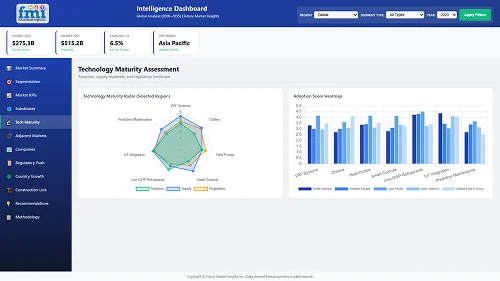
Our Research Products

The "Full Research Suite" delivers actionable market intel, deep dives on markets or technologies, so clients act faster, cut risk, and unlock growth.
The Leaderboard benchmarks and ranks top vendors, classifying them as Established Leaders, Leading Challengers, or Disruptors & Challengers.

Locates where complements amplify value and substitutes erode it, forecasting net impact by horizon

We deliver granular, decision-grade intel: market sizing, 5-year forecasts, pricing, adoption, usage, revenue, and operational KPIs—plus competitor tracking, regulation, and value chains—across 60 countries broadly.

Spot the shifts before they hit your P&L. We track inflection points, adoption curves, pricing moves, and ecosystem plays to show where demand is heading, why it is changing, and what to do next across high-growth markets and disruptive tech

Real-time reads of user behavior. We track shifting priorities, perceptions of today’s and next-gen services, and provider experience, then pace how fast tech moves from trial to adoption, blending buyer, consumer, and channel inputs with social signals (#WhySwitch, #UX).

Partner with our analyst team to build a custom report designed around your business priorities. From analysing market trends to assessing competitors or crafting bespoke datasets, we tailor insights to your needs.
Supplier Intelligence
Discovery & Profiling
Capacity & Footprint
Performance & Risk
Compliance & Governance
Commercial Readiness
Who Supplies Whom
Scorecards & Shortlists
Playbooks & Docs
Category Intelligence
Definition & Scope
Demand & Use Cases
Cost Drivers
Market Structure
Supply Chain Map
Trade & Policy
Operating Norms
Deliverables
Buyer Intelligence
Account Basics
Spend & Scope
Procurement Model
Vendor Requirements
Terms & Policies
Entry Strategy
Pain Points & Triggers
Outputs
Pricing Analysis
Benchmarks
Trends
Should-Cost
Indexation
Landed Cost
Commercial Terms
Deliverables
Brand Analysis
Positioning & Value Prop
Share & Presence
Customer Evidence
Go-to-Market
Digital & Reputation
Compliance & Trust
KPIs & Gaps
Outputs
Full Research Suite comprises of:

Market outlook & trends analysis
Interviews & case studies
Strategic recommendations
Vendor profiles & capabilities analysis
5-year forecasts
8 regions and 60+ country-level data splits
Market segment data splits
12 months of continuous data updates
DELIVERED AS:
PDF EXCEL ONLINE


