

- Industry Size (2026)
- USD 1383.5 Mn
- Forecast (2036)
- USD 2295.9 Mn
- CAGR (2026 to 2036)
- 5.2%
ASEAN Spout Pouch Market Forecast and Outlook By FMI
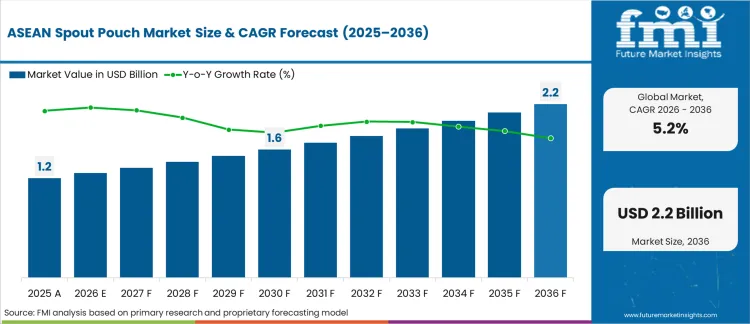
In 2025, the ASEAN spout pouch market was valued at USD 1,361.8 million. Based on Future Market Insights' analysis, demand for spout pouches in ASEAN is estimated to grow to USD 1,383.5 million in 2026 and USD 2,295.9 million by 2036. FMI projects a CAGR of 5.2% during the forecast period.
The market is expected to generate an absolute dollar growth of USD 912.4 million between 2026 and 2036. This reflects steady structural expansion driven by rising packaged food consumption, urbanization, and growing demand for convenient, lightweight packaging formats. Growth is supported by increasing adoption of stand-up spout pouches in juices, baby food, sauces, and liquid personal care products. However, recycling infrastructure limitations and resin price volatility remain structural constraints across several ASEAN economies.
Summary of the ASEAN Spout Pouch Market
- ASEAN Spout Pouch Market Definition
- The ASEAN spout pouch market includes flexible, reclosable packaging solutions designed for liquid and semi-liquid products across food, personal care, pharmaceutical, and industrial applications.
- Demand Drivers in the Market
- Rising consumption of convenient, single-serve beverage and baby food products is accelerating demand for lightweight stand-up spout pouches across Southeast Asia.
- Growth in modern retail and e-commerce channels is encouraging brands to adopt durable, leak-resistant pouch formats with improved shelf appeal.
- Increasing focus on cost efficiency and material reduction is supporting the shift from rigid packaging to flexible spouted alternatives.
- Key Segments Analyzed in the FMI Report
- By Material: Plastic dominates usage, particularly polyethylene and polypropylene, due to flexibility, sealing performance, and cost effectiveness.
- By Product: Stand-up spout pouches lead adoption as they offer superior shelf visibility, stability, and consumer convenience.
- By Geography: Indonesia, Thailand, and Vietnam represent high-growth markets driven by expanding packaged food and personal care sectors.
- Analyst Opinion at FMI
- Ismail Sutaria, Principal Consultant for Packaging Industry at Future Market Insights, opines, ‘CXOs will find in this report actionable insights on retail modernization and flexible packaging innovation are reshaping growth strategies in the ASEAN spout pouch market.’
- Strategic Implications / Executive Takeaways
- Expand localized production capabilities to reduce logistics costs and improve market responsiveness.
- Invest in recyclable and mono-material pouch structures to meet emerging sustainability regulations.
- Strengthen partnerships with regional food and personal care brands to secure long-term supply agreements.
- Methodology
- Market estimates were validated through interviews with regional converters and brand owners.
- Secondary research included trade data and packaged goods production statistics.
- Forecasts were developed using country-level consumption modeling and packaging substitution analysis.
Mr Ashok Chaturvedi, chairman and managing director of Uflex Limited said, “Given our end-to-end expertise in the field of flexible packaging we can bring out very many variants of these retortable spout pouches that are aesthetically unique; functionally more agile; counterfeiting proof (with the help of myriad holographic solutions) and have optimised barrier properties.”
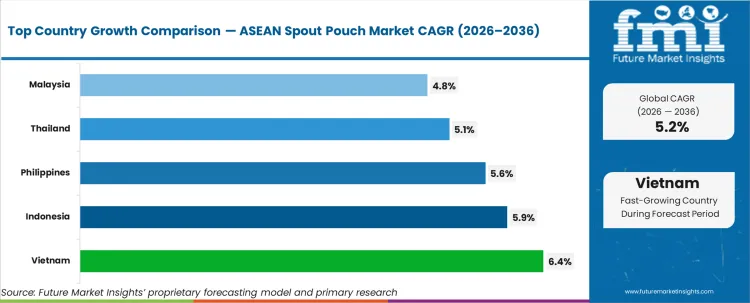
Vietnam (6.4%) is projected to record the fastest growth, supported by expanding food processing exports and rising domestic consumption. Indonesia (5.9%) follows, driven by a large consumer base and rapid retail modernization. The Philippines (5.6%) benefits from increasing packaged beverage demand and urban population growth. Thailand (5.1%) and Malaysia (4.8%) show steady expansion linked to food manufacturing and household product demand, while more mature ASEAN markets generate incremental, replacement-driven growth rather than rapid volume acceleration.
ASEAN Spout Pouch Market Definition
The ASEAN spout pouch market refers to the production and supply of flexible pouches fitted with dispensing spouts for packaging liquid and semi-liquid products across Southeast Asia. These pouches are typically made from multilayer plastic films, aluminum foil laminates, paper-based structures, or recycled materials. They are designed to provide controlled pouring, leak resistance, and product protection while reducing packaging weight compared to rigid containers. Spout pouches are widely used for beverages, baby food, sauces, detergents, personal care liquids, pharmaceuticals, and industrial fluids. Key end users include food and beverage manufacturers, personal care companies, household product producers, pharmaceutical firms, and industrial suppliers operating within ASEAN countries.
ASEAN Spout Pouch Market Inclusions
The report provides ASEAN regional market size estimates for 2025 and 2026, with forecasts through 2036 and CAGR analysis. It includes segmentation by material type, pouch capacity, product format, closure type, end use industry, and country. The study covers value-based sizing, country-level growth comparisons, sustainability trends, packaging substitution patterns, and regional trade flow analysis across ASEAN markets.
ASEAN Spout Pouch Market Exclusions
The scope excludes rigid packaging formats such as plastic bottles, metal cans, and glass containers that do not incorporate flexible pouch structures. Non-spouted flexible formats such as pillow pouches and sachets without dispensing closures are not included. Finished packaged goods such as beverages or detergents are excluded, as the analysis focuses strictly on spout pouch packaging materials, components, and manufacturing systems within ASEAN.
ASEAN Spout Pouch Market Research Methodology
- Primary Research: Interviews were conducted with flexible packaging converters, resin suppliers, spout and cap manufacturers, brand owners, and distributors across ASEAN countries. Resin suppliers clarified PE and PP pricing fluctuations, while converters validated rigid-to-flexible substitution trends across food and household segments.
- Desk Research: ASEAN trade statistics, customs data, packaging association publications, and company annual reports were reviewed to benchmark production volumes and intra-regional trade flows.
- Market-Sizing and Forecasting: A hybrid top-down and bottom-up approach was applied. Demand was reconstructed from liquid product consumption across ASEAN and validated against converter capacity and import-export data.
- Data Validation and Update Cycle: Data was cross-verified across trade datasets and stakeholder inputs, followed by structured expert review prior to publication.
Segmental analysis
ASEAN Spout Pouch Market Analysis by Product
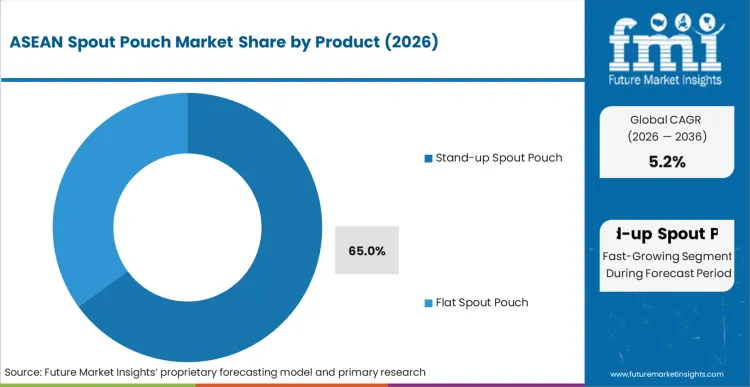
Based on FMI's ASEAN Spout Pouch market report, consumption of Stand-up Spout Pouch is estimated to hold 65.0% share in 2026. Stand-up formats dominate due to strong retail shelf visibility, structural stability, and resealability suited to high-humidity tropical climates across Southeast Asia. They address brand priorities including lightweighting, lower transport cost, and consumer convenience for liquid and semi-liquid products. The format is widely adopted for beverages, sauces, cooking oils, and refill packs, where portability and controlled dispensing are critical.
- Retail Shelf Optimization: Modern trade expansion across Indonesia, Thailand, and Vietnam favors upright packaging that maximizes shelf presence and branding surface.
- Refill Culture Growth: Rising adoption of refill packs in urban households strengthens demand for stand-up spout pouches as a cost-effective alternative to rigid bottles.
- Export Alignment: Regional manufacturers increasingly use stand-up spouted formats for cross-border FMCG exports due to their durability and cube efficiency during transport.
ASEAN Spout Pouch Market Analysis by End Use
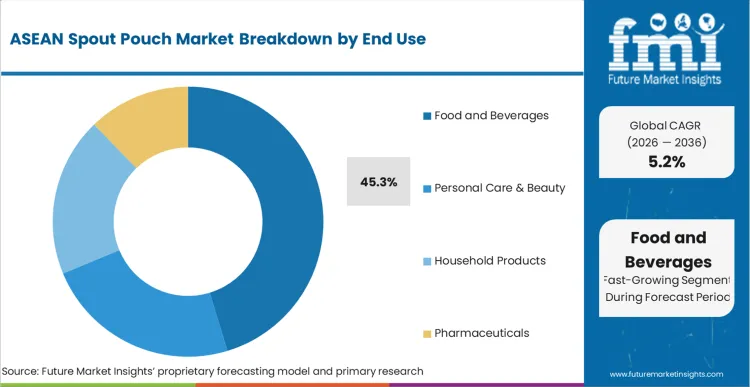
Based on FMI's ASEAN Spout Pouch market report, consumption of Food and Beverages is estimated to hold 45.3% share in 2026. The segment leads due to strong demand for packaged juices, dairy drinks, sauces, and edible oils across expanding urban populations. Spout pouches address buyer priorities including leak resistance, portion control, and extended shelf life in warm climatic conditions.
- Convenience Consumption: Rising demand for ready-to-drink beverages and portable food products supports continued adoption of resealable spout pouches.
- Food Safety Focus: Increasing regulatory attention to hygienic packaging standards is strengthening use of sealed spouted formats in baby food and dairy categories.
- Distribution Efficiency: Lightweight flexible packaging reduces logistics cost across fragmented regional supply chains, reinforcing spout pouch penetration in ASEAN markets.
ASEAN Spout Pouch Market: Drivers, Restraints, and Opportunities
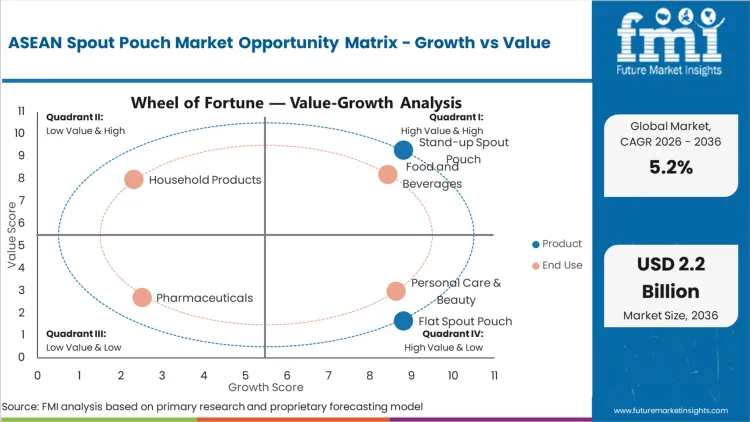
Future Market Insights analysis indicates that the ASEAN spout pouch market is structurally expanding in line with rapid urbanization, rising disposable incomes, and the formalization of packaged food and homecare retail across Southeast Asia. The market exists at its current scale because spout pouches provide a cost-efficient, lightweight alternative to rigid bottles while offering resealability and portion control suited to price-sensitive yet convenience-driven consumers. Growth has historically tracked the expansion of modern trade channels in Indonesia, Thailand, Vietnam, and the Philippines, where flexible packaging supports smaller pack sizes and affordable price points.
FMI analysts observe a transition from traditional sachets and rigid containers toward value-added spouted formats in beverages, condensed milk, sauces, and refill detergents. While sachets remain dominant in ultra-low-price segments, spout pouches are gaining traction in mid-tier and premium categories due to improved durability and reusability. These formats involve higher material and fitment costs compared to simple sachets, but improved shelf presence, reduced leakage, and enhanced consumer convenience justify the pricing differential. As a result, value growth is outpacing pure volume expansion in several FMCG categories.
- Small-Pack Urban Demand:High-density urban markets favor portable and resealable packaging for on-the-go consumption. Spout pouches meet this need while maintaining competitive unit pricing.
- Retail Modernization:Expansion of supermarkets and convenience chains across ASEAN is increasing demand for shelf-stable, visually differentiated packaging formats, supporting spout pouch penetration.
- Refill Economy Expansion:Growing use of refill detergents and personal care liquids in Indonesia and Thailand is structurally supporting spout pouch adoption as brands promote cost savings and reduced rigid plastic use.
Country- wise Analysis
The ASEAN spout pouch market is segmented across Vietnam, Indonesia, the Philippines, Thailand, and Malaysia. Growth differences reflect packaged beverage consumption, dairy expansion, flexible packaging manufacturing capacity, and regulatory frameworks governing food-contact materials. The full report provides detailed country-level market attractiveness analysis.
.webp "Top Country Growth Comparison Asean Spout Pouch Market Cagr (2026 2036)")
| Country | CAGR (%) |
|---|---|
| Vietnam | 6.4% |
| Indonesia | 5.9% |
| Philippines | 5.6% |
| Thailand | 5.1% |
| Malaysia | 4.8% |
Source: Future Market Insights (FMI) analysis, based on proprietary forecasting model and primary research
ASEAN - Rapidly Expanding Flexible Beverage Packaging Corridor
ASEAN functions as a rapidly expanding flexible beverage packaging corridor, supported by growing middle-class consumption and expanding dairy and liquid food production. Companies such as SCGP (Thai Containers Group), TOPPAN Inc., and Amcor Plc maintain strong flexible packaging operations across Southeast Asia. Competitive positioning is defined by lightweight packaging demand, export-oriented food processing, and regulatory alignment with international food safety standards.
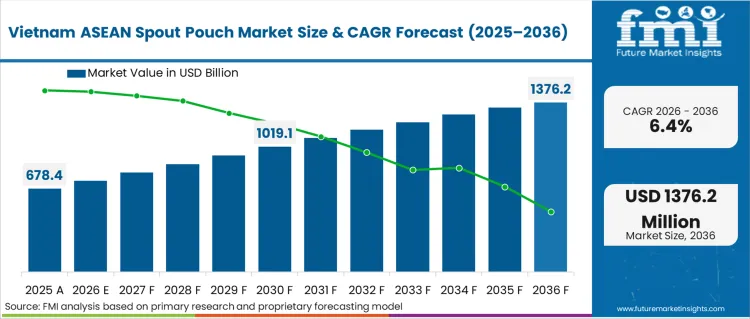
- Vietnam: Demand for spout pouches in Vietnam is projected to rise at 6.4% CAGR through 2036. Growth is supported by expansion in dairy beverages, fruit drinks, and baby food packaging. In 2024, Vietnam’s Ministry of Health continued enforcement of food safety regulations under updated national technical standards for food-contact materials, reinforcing compliance requirements for multilayer flexible packaging. Additionally, government-backed food processing development programs under Vietnam’s industrial strategy continue to promote value-added agricultural exports, increasing demand for lightweight and resealable pouch formats. In 2024, beverage manufacturers expanded ready-to-drink tea and juice production lines for domestic and export markets, driving higher usage of spouted pouches for convenience and shelf differentiation. Rising modern retail penetration further strengthens demand for flexible, transport-efficient packaging solutions.
- Indonesia: Demand for spout pouches in Indonesia is projected to rise at 5.9% CAGR through 2036. The market benefits from strong domestic beverage consumption and growing packaged coconut water and dairy segments. In 2024, Indonesia strengthened implementation of its National Action Plan on Plastic Waste Reduction, encouraging packaging producers to improve recyclability and material efficiency. This shift supports adoption of downgauged flexible pouches. The National Agency of Drug and Food Control continues oversight of food packaging compliance, reinforcing safety standards for liquid packaging. Expansion in halal-certified food and beverage exports also increases demand for secure and tamper-evident pouch formats. Urban population growth and convenience-driven consumption patterns further contribute to steady market expansion.
- Philippines: Demand for spout pouches in the Philippines is projected to rise at 5.6% CAGR through 2036. Growth is driven by increasing consumption of ready-to-drink beverages and condiments. In 2024, the Food and Drug Administration Philippines continued enforcement of food packaging safety and labeling compliance standards, strengthening requirements for safe food-contact materials. Government initiatives to strengthen local food processing and agricultural value chains are encouraging packaged fruit puree and beverage production. Retail modernization and expansion of convenience stores have increased demand for compact and resealable packaging formats. While price sensitivity remains in certain segments, convenience and portability continue to support adoption of spouted pouch packaging.
- Thailand: Demand for spout pouches in Thailand is projected to rise at 5.1% CAGR through 2036. Thailand’s well-established food processing sector drives steady packaging demand. In 2024, the Thai Food and Drug Administration continued enforcing packaging compliance standards for processed beverages and dairy products. Government support for food export competitiveness under national industrial development policies encourages manufacturers to adopt lightweight and visually differentiated packaging formats. Expansion in coconut milk and ready-to-drink beverage exports increases demand for flexible pouches with dispensing functionality. Strong domestic packaging manufacturing capacity, supported by SCGP operations, ensures consistent supply of multilayer flexible pouch solutions.
- Malaysia: Demand for spout pouches in Malaysia is projected to rise at 4.8% CAGR through 2036. The market benefits from stable growth in dairy beverages and food exports. In 2024, Malaysia’s Ministry of Health reinforced compliance requirements for food-contact packaging materials under national food regulations. Government sustainability initiatives aimed at reducing plastic waste are encouraging packaging producers to explore recyclable flexible pouch solutions. Expansion in ready-to-drink beverage manufacturing and export-oriented palm-based product packaging further supports demand. While growth is moderate compared to Vietnam and Indonesia, Malaysia’s established food processing base sustains steady spout pouch consumption.
FMI's analysis of ASEAN spout pouch market consists of country-wise assessment that includes Vietnam, Indonesia, the Philippines, Thailand, and Malaysia. Readers can find insights on regulatory compliance trends, beverage packaging demand, sustainability initiatives, and regional manufacturing expansion.
Competitive Aligners for Market Players
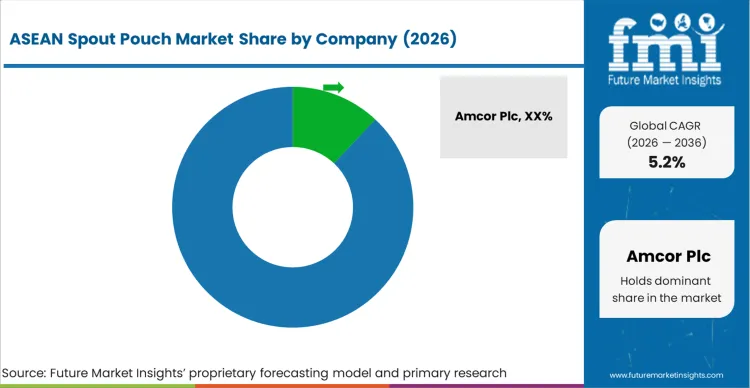
The ASEAN spout pouch market reflects a moderately competitive structure, shaped by the presence of global flexible packaging leaders and strong regional converters. Multinational firms such as Amcor Plc, Mondi, Huhtamaki Group, Sealed Air Corporation, Constantia Flexibles, SIG, and TOPPAN Inc. operate across Southeast Asia through manufacturing hubs and regional partnerships. At the same time, regional players such as SCGP (Thai Containers Group), Flexo Manufacturing Corporation, and ZACROS maintain localized production strength and supply agility. Competition in the ASEAN market is driven primarily by high-barrier laminate capability, retort compatibility, fitment integration, and cost competitiveness aligned with fast-moving consumer goods demand.
Structural advantages are concentrated among companies with vertically integrated film extrusion, lamination, and spout fitment manufacturing. Multinational groups benefit from global material science expertise and the ability to introduce recyclable mono-material pouch formats into ASEAN markets where sustainability regulations are gradually strengthening. SCGP leverages strong domestic supply networks and integrated packaging platforms in Thailand and neighboring countries, while Japanese players such as TOPPAN and ZACROS bring advanced multilayer film technologies. Companies with regional manufacturing footprints reduce lead times and mitigate import-related cost volatility, strengthening their competitive positioning.
Buyer leverage in the ASEAN spout pouch market varies across segments. Large multinational food and beverage brands operating in Southeast Asia typically implement dual-sourcing strategies and negotiate long-term supply agreements tied to resin pricing benchmarks. However, for retort-ready or high-barrier spout formats used in baby food and liquid condiments, supplier substitution can be limited due to performance validation requirements. As regional governments gradually introduce extended producer responsibility frameworks, buyers increasingly prioritize recyclable pouch solutions, strengthening the pricing position of technologically advanced suppliers.
Recent Developments
- In November 2025, Amcor announced the launch of its Amcor Lift-Off Winter 2025/26 Challenge, an open innovation initiative inviting start-ups globally to develop breakthrough solutions for sustainable packaging, including flexible and paper-based formats. This reflects Amcor’s commitment to advancing circularity and sustainability across its packaging portfolio.
- In March 2025, Constantia Flexibles acquired a majority stake in Aluflexpack AG, a European flexible packaging producer serving food and pharmaceutical sectors. This acquisition enhances Constantia’s footprint in flexible and barrier-film solutions used in high-performance applications relevant to spout pouch and similar packaging formats.
Key Players
- Amcor Plc
- Constantia Flexibles
- Flexo Manufacturing Corporation
- Huhtamaki Group
- Mondi
- Sealed Air Corporation
- SIG
- SCGP
- TOPPAN Inc
- ZACROS
Scope Of Report
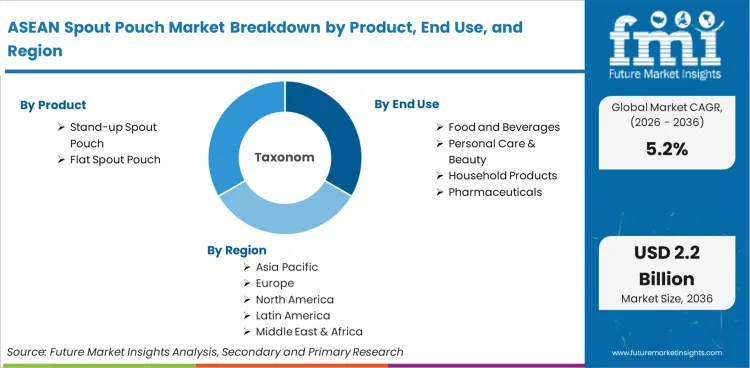
| Metric | Value |
|---|---|
| Quantitative Units | USD 1,361.8 million (2025); USD 1,383.5 million (2026) to USD 2,295.9 million (2036), at a CAGR of 5.2% |
| Market Definition | The ASEAN spout pouch market comprises the production, distribution, and consumption of flexible pouches integrated with dispensing spouts and reclosable closures across Southeast Asian countries, designed for convenient storage, controlled pouring, lightweight transport, and extended shelf life of liquid and semi-liquid products. |
| Form Segmentation | Stand-up Spout Pouch; Flat Spout Pouch |
| End Use Segmentation | Food & Beverages; Personal Care & Beauty; Household Products; Pharmaceuticals; Industrial & Chemical Products |
| Application Coverage | Juices & Smoothies; Baby Food; Sauces & Condiments; Dairy Products; Cooking Oils; Shampoos & Conditioners; Liquid Soaps; Lotions & Creams; Liquid Medications & Syrups; Nutritional Supplements; Lubricants & Oils; Liquid Fertilizers; Automotive Fluids |
| Regions Covered | ASEAN (Association of Southeast Asian Nations) |
| Countries Covered | Indonesia; Philippines; Thailand; Malaysia; Singapore; Vietnam; Brunei; Myanmar; Cambodia; Laos |
| Key Companies Profiled | Amcor Plc; Constantia Flexibles; Huhtamaki Group; Mondi; SCGP (Thai Containers Group); Others |
| Forecast Period | 2026 to 2036 |
| Approach | Hybrid top-down and bottom-up market modeling validated through primary interviews with ASEAN-based packaging converters, regional distributors, and brand owners, supported by trade flow benchmarking, country-level demand assessment, manufacturing capacity analysis, and regulatory compliance evaluation across food, personal care, and pharmaceutical packaging sectors. |
ASEAN Spout Pouch Market by Segment
By Material:
- Plastic
- Polyethylene (PE)
- Polypropylene (PP)
- Polyester (PET)
- Bioplastics
- PCR Plastics
- Aluminum foil
- Paper
By Pouch Capacity:
- Less than 200 Grams
- 200 to 500 Grams
- 501 to 1000 Grams
- Above 1000 Grams
By Product:
- Stand-up Spout Pouch
- Flat Spout Pouch
By Closure Type:
- Flip Top Caps
- Screw Caps
- Pull-out Caps
By End Use:
- Food and Beverages
- Juices & Smoothies
- Baby Food
- Sauces & Condiments
- Dairy Products
- Cooking Oils
- Personal Care & Beauty
- Shampoos and conditioners
- Liquid soaps (hand soaps, body washes, shower gels)
- Lotions and creams
- Hair care products (hair oils, serums)
- Household Products
- Laundry detergents
- Fabric softeners
- Dishwashing liquids
- Multipurpose cleaners
- Pharmaceuticals
- Liquid medications and syrups
- Oral solutions
- Nutritional supplements
- Industrial and Chemical Products
- Lubricants and oils
- Liquid fertilizers
- Automotive fluids
By Country:
- Indonesia
- Philippines
- Thailand
- Malaysia
- Singapore
- Vietnam
- Brunei
- Myanmar
- Cambodia
- Laos
Bibliography
- ASEAN Secretariat, ASEAN Statistical Yearbook 2024, November 2024.
- Singapore Food Agency (SFA), Food Packaging and Labelling Requirements Guidelines, Updated January 2024.
- Ministry of Health Malaysia (MOH), Food Regulations 1985 (As Amended 2023), December 2023 Consolidated Version.
- Thailand Food and Drug Administration, Notification of the Ministry of Public Health: Packaging Materials for Food (Updated 2024), March 2024.
- International Organization for Standardization (ISO), ISO 22000:2018 Food Safety Management Systems - Requirements for Any Organization in the Food Chain (Confirmed 2023 Review), September 2023.
- ASTM International, ASTM F88/F88M-23 - Standard Test Method for Seal Strength of Flexible Barrier Materials, April 2023.
- PlasticsEurope, Plastics - The Facts 2024: An Analysis of European Plastics Production, Demand and Waste Data, October 2024.
- European Parliament and Council, Regulation (EU) 2024/1781 on Packaging and Packaging Waste (PPWR), April 2024.
This bibliography is provided for reader reference and is not exhaustive. The full report contains the complete reference list and detailed citations.
This Report Addresses
- Strategic market intelligence supporting investment planning and competitive positioning across ASEAN flexible spout pouch manufacturing ecosystems.
- ASEAN market size estimation with revenue forecasts from 2026 to 2036, validated through country-level consumption and converter capacity analysis.
- Growth opportunity assessment across stand-up and flat spout pouch formats serving food, personal care, household, and pharmaceutical sectors.
- Country-level revenue projections covering Vietnam, Indonesia, Philippines, Thailand, Malaysia, and emerging ASEAN economies.
- Competitive benchmarking of regional and multinational converters based on laminate capability, fitment integration, and retort compatibility.
- Sustainability transition analysis including mono-material structures, downgauging strategies, and regulatory influence on recyclable pouch adoption.
- End-use demand mapping across beverages, baby food, detergents, liquid personal care, and refill packaging segments.
- Report delivery in PDF, Excel, PPT, and interactive dashboard formats for procurement, strategy, and operational planning.
Frequently Asked Questions
How large is the ASEAN Spout Pouch Market in 2026?
The ASEAN Spout Pouch Market is valued at 1,383.5 Million in 2026.
What was the market size of the ASEAN Spout Pouch Market in 2025?
The market was valued at 1,361.8 Million in 2025.
What will the market size be for the ASEAN Spout Pouch Market by 2036?
The market is projected to reach 2,295.9 Million by 2036.
What is the expected CAGR of the ASEAN Spout Pouch Market during the forecast period?
The ASEAN Spout Pouch Market is expected to grow at a CAGR of 5.2%.
Which product type is poised to lead the ASEAN Spout Pouch Market?
Stand-up spout pouches dominate the market with 65.0% share, while flat spout pouches account for 35.0%.
Which material segment holds the largest share in the ASEAN market?
Plastic leads with 53.0% share, followed by aluminum foil at 27.5% and paper at 19.5%.
How significant is the Food and Beverages segment in the ASEAN Spout Pouch Market?
Food and Beverages is the dominant end-use segment, accounting for 45.3% of the market share.
What share does the Personal Care & Beauty segment contribute?
Personal Care & Beauty represents 22.5% of the total market, driven by demand for shampoos, liquid soaps, and lotions.
Which country is projected to grow the fastest in ASEAN?
Vietnam is projected to grow at the highest CAGR of 6.4%, followed by Indonesia at 5.9% and the Philippines at 5.6%.
What is the growth outlook for Thailand and Malaysia?
Thailand is projected to grow at a CAGR of 5.1%, while Malaysia is expected to expand at 4.8% during the forecast period.
Preview the report firsthand - request a free sample
Get SampleGet the brochure for pricing and purchase details.
Get PDFTable of Content
- Executive Summary
- Global Market Outlook
- Demand-side Trends
- Supply-side Trends
- Technology Roadmap Analysis
- Analysis and Recommendations
- Market Overview
- Market Coverage / Taxonomy
- Market Definition / Scope / Limitations
- Research Methodology
- Chapter Orientation
- Analytical Lens and Working Hypotheses
- Market Structure, Signals, and Trend Drivers
- Benchmarking and Cross-market Comparability
- Market Sizing, Forecasting, and Opportunity Mapping
- Research Design and Evidence Framework
- Desk Research Programme (Secondary Evidence)
- Company Annual and Sustainability Reports
- Peer-reviewed Journals and Academic Literature
- Corporate Websites, Product Literature, and Technical Notes
- Earnings Decks and Investor Briefings
- Statutory Filings and Regulatory Disclosures
- Technical White Papers and Standards Notes
- Trade Journals, Industry Magazines, and Analyst Briefs
- Conference Proceedings, Webinars, and Seminar Materials
- Government Statistics Portals and Public Data Releases
- Press Releases and Reputable Media Coverage
- Specialist Newsletters and Curated Briefings
- Sector Databases and Reference Repositories
- FMI Internal Proprietary Databases and Historical Market Datasets
- Subscription Datasets and Paid Sources
- Social Channels, Communities, and Digital Listening Inputs
- Additional Desk Sources
- Expert Input and Fieldwork (Primary Evidence)
- Primary Modes
- Qualitative Interviews and Expert Elicitation
- Quantitative Surveys and Structured Data Capture
- Blended Approach
- Why Primary Evidence is Used
- Field Techniques
- Interviews
- Surveys
- Focus Groups
- Observational and In-context Research
- Social and Community Interactions
- Stakeholder Universe Engaged
- C-suite Leaders
- Board Members
- Presidents and Vice Presidents
- R&D and Innovation Heads
- Technical Specialists
- Domain Subject-matter Experts
- Scientists
- Physicians and Other Healthcare Professionals
- Governance, Ethics, and Data Stewardship
- Research Ethics
- Data Integrity and Handling
- Primary Modes
- Tooling, Models, and Reference Databases
- Desk Research Programme (Secondary Evidence)
- Data Engineering and Model Build
- Data Acquisition and Ingestion
- Cleaning, Normalisation, and Verification
- Synthesis, Triangulation, and Analysis
- Quality Assurance and Audit Trail
- Market Background
- Market Dynamics
- Drivers
- Restraints
- Opportunity
- Trends
- Scenario Forecast
- Demand in Optimistic Scenario
- Demand in Likely Scenario
- Demand in Conservative Scenario
- Opportunity Map Analysis
- Product Life Cycle Analysis
- Supply Chain Analysis
- Investment Feasibility Matrix
- Value Chain Analysis
- PESTLE and Porter’s Analysis
- Regulatory Landscape
- Regional Parent Market Outlook
- Production and Consumption Statistics
- Import and Export Statistics
- Market Dynamics
- Global Market Analysis 2021 to 2025 and Forecast, 2026 to 2036
- Historical Market Size Value (USD Million) Analysis, 2021 to 2025
- Current and Future Market Size Value (USD Million) Projections, 2026 to 2036
- Y-o-Y Growth Trend Analysis
- Absolute $ Opportunity Analysis
- Global Market Pricing Analysis 2021 to 2025 and Forecast 2026 to 2036
- Global Market Analysis 2021 to 2025 and Forecast 2026 to 2036, By Product
- Introduction / Key Findings
- Historical Market Size Value (USD Million) Analysis By Product , 2021 to 2025
- Current and Future Market Size Value (USD Million) Analysis and Forecast By Product , 2026 to 2036
- Stand-up Spout Pouch
- Flat Spout Pouch
- Stand-up Spout Pouch
- Y-o-Y Growth Trend Analysis By Product , 2021 to 2025
- Absolute $ Opportunity Analysis By Product , 2026 to 2036
- Global Market Analysis 2021 to 2025 and Forecast 2026 to 2036, By End Use
- Introduction / Key Findings
- Historical Market Size Value (USD Million) Analysis By End Use, 2021 to 2025
- Current and Future Market Size Value (USD Million) Analysis and Forecast By End Use, 2026 to 2036
- Food and Beverages
- Personal Care & Beauty
- Household Products
- Pharmaceuticals
- Food and Beverages
- Y-o-Y Growth Trend Analysis By End Use, 2021 to 2025
- Absolute $ Opportunity Analysis By End Use, 2026 to 2036
- Global Market Analysis 2021 to 2025 and Forecast 2026 to 2036, By Region
- Introduction
- Historical Market Size Value (USD Million) Analysis By Region, 2021 to 2025
- Current Market Size Value (USD Million) Analysis and Forecast By Region, 2026 to 2036
- North America
- Latin America
- Western Europe
- Eastern Europe
- East Asia
- South Asia and Pacific
- Middle East & Africa
- Market Attractiveness Analysis By Region
- North America Market Analysis 2021 to 2025 and Forecast 2026 to 2036, By Country
- Historical Market Size Value (USD Million) Trend Analysis By Market Taxonomy, 2021 to 2025
- Market Size Value (USD Million) Forecast By Market Taxonomy, 2026 to 2036
- By Country
- USA
- Canada
- Mexico
- By Product
- By End Use
- By Country
- Market Attractiveness Analysis
- By Country
- By Product
- By End Use
- Key Takeaways
- Latin America Market Analysis 2021 to 2025 and Forecast 2026 to 2036, By Country
- Historical Market Size Value (USD Million) Trend Analysis By Market Taxonomy, 2021 to 2025
- Market Size Value (USD Million) Forecast By Market Taxonomy, 2026 to 2036
- By Country
- Brazil
- Chile
- Rest of Latin America
- By Product
- By End Use
- By Country
- Market Attractiveness Analysis
- By Country
- By Product
- By End Use
- Key Takeaways
- Western Europe Market Analysis 2021 to 2025 and Forecast 2026 to 2036, By Country
- Historical Market Size Value (USD Million) Trend Analysis By Market Taxonomy, 2021 to 2025
- Market Size Value (USD Million) Forecast By Market Taxonomy, 2026 to 2036
- By Country
- Germany
- UK
- Italy
- Spain
- France
- Nordic
- BENELUX
- Rest of Western Europe
- By Product
- By End Use
- By Country
- Market Attractiveness Analysis
- By Country
- By Product
- By End Use
- Key Takeaways
- Eastern Europe Market Analysis 2021 to 2025 and Forecast 2026 to 2036, By Country
- Historical Market Size Value (USD Million) Trend Analysis By Market Taxonomy, 2021 to 2025
- Market Size Value (USD Million) Forecast By Market Taxonomy, 2026 to 2036
- By Country
- Russia
- Poland
- Hungary
- Balkan & Baltic
- Rest of Eastern Europe
- By Product
- By End Use
- By Country
- Market Attractiveness Analysis
- By Country
- By Product
- By End Use
- Key Takeaways
- East Asia Market Analysis 2021 to 2025 and Forecast 2026 to 2036, By Country
- Historical Market Size Value (USD Million) Trend Analysis By Market Taxonomy, 2021 to 2025
- Market Size Value (USD Million) Forecast By Market Taxonomy, 2026 to 2036
- By Country
- China
- Japan
- South Korea
- By Product
- By End Use
- By Country
- Market Attractiveness Analysis
- By Country
- By Product
- By End Use
- Key Takeaways
- South Asia and Pacific Market Analysis 2021 to 2025 and Forecast 2026 to 2036, By Country
- Historical Market Size Value (USD Million) Trend Analysis By Market Taxonomy, 2021 to 2025
- Market Size Value (USD Million) Forecast By Market Taxonomy, 2026 to 2036
- By Country
- India
- ASEAN
- Australia & New Zealand
- Rest of South Asia and Pacific
- By Product
- By End Use
- By Country
- Market Attractiveness Analysis
- By Country
- By Product
- By End Use
- Key Takeaways
- Middle East & Africa Market Analysis 2021 to 2025 and Forecast 2026 to 2036, By Country
- Historical Market Size Value (USD Million) Trend Analysis By Market Taxonomy, 2021 to 2025
- Market Size Value (USD Million) Forecast By Market Taxonomy, 2026 to 2036
- By Country
- Kingdom of Saudi Arabia
- Other GCC Countries
- Turkiye
- South Africa
- Other African Union
- Rest of Middle East & Africa
- By Product
- By End Use
- By Country
- Market Attractiveness Analysis
- By Country
- By Product
- By End Use
- Key Takeaways
- Key Countries Market Analysis
- USA
- Pricing Analysis
- Market Share Analysis, 2025
- By Product
- By End Use
- Canada
- Pricing Analysis
- Market Share Analysis, 2025
- By Product
- By End Use
- Mexico
- Pricing Analysis
- Market Share Analysis, 2025
- By Product
- By End Use
- Brazil
- Pricing Analysis
- Market Share Analysis, 2025
- By Product
- By End Use
- Chile
- Pricing Analysis
- Market Share Analysis, 2025
- By Product
- By End Use
- Germany
- Pricing Analysis
- Market Share Analysis, 2025
- By Product
- By End Use
- UK
- Pricing Analysis
- Market Share Analysis, 2025
- By Product
- By End Use
- Italy
- Pricing Analysis
- Market Share Analysis, 2025
- By Product
- By End Use
- Spain
- Pricing Analysis
- Market Share Analysis, 2025
- By Product
- By End Use
- France
- Pricing Analysis
- Market Share Analysis, 2025
- By Product
- By End Use
- India
- Pricing Analysis
- Market Share Analysis, 2025
- By Product
- By End Use
- ASEAN
- Pricing Analysis
- Market Share Analysis, 2025
- By Product
- By End Use
- Australia & New Zealand
- Pricing Analysis
- Market Share Analysis, 2025
- By Product
- By End Use
- China
- Pricing Analysis
- Market Share Analysis, 2025
- By Product
- By End Use
- Japan
- Pricing Analysis
- Market Share Analysis, 2025
- By Product
- By End Use
- South Korea
- Pricing Analysis
- Market Share Analysis, 2025
- By Product
- By End Use
- Russia
- Pricing Analysis
- Market Share Analysis, 2025
- By Product
- By End Use
- Poland
- Pricing Analysis
- Market Share Analysis, 2025
- By Product
- By End Use
- Hungary
- Pricing Analysis
- Market Share Analysis, 2025
- By Product
- By End Use
- Kingdom of Saudi Arabia
- Pricing Analysis
- Market Share Analysis, 2025
- By Product
- By End Use
- Turkiye
- Pricing Analysis
- Market Share Analysis, 2025
- By Product
- By End Use
- South Africa
- Pricing Analysis
- Market Share Analysis, 2025
- By Product
- By End Use
- USA
- Market Structure Analysis
- Competition Dashboard
- Competition Benchmarking
- Market Share Analysis of Top Players
- By Regional
- By Product
- By End Use
- Competition Analysis
- Competition Deep Dive
- Amcor Plc
- Overview
- Product Portfolio
- Profitability by Market Segments (Product/Age /Sales Channel/Region)
- Sales Footprint
- Strategy Overview
- Marketing Strategy
- Product Strategy
- Channel Strategy
- Constantia Flexibles
- Flexo Manufacturing Corporation
- Huhtamaki Group
- Mondi
- Sealed Air Corporation
- SIG
- SCGP
- TOPPAN Inc
- ZACROS
- Amcor Plc
- Competition Deep Dive
- Assumptions & Acronyms Used


