

- Industry Size (2026)
- USD 1.2 Bn
- Forecast (2036)
- USD 10.3 Bn
- CAGR (2026 to 2036)
- 24.0%
Blue Carbon Market Size, Market Forecast and Outlook By FMI
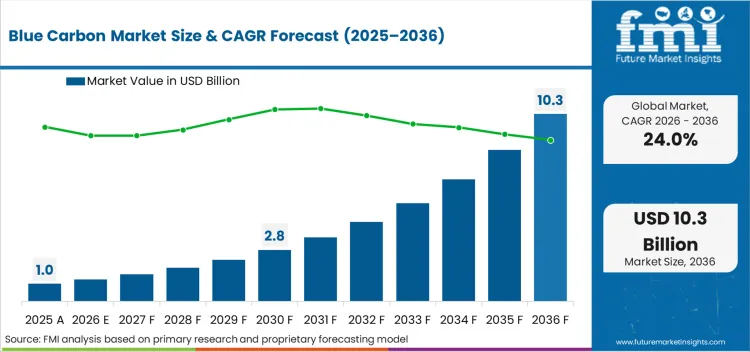
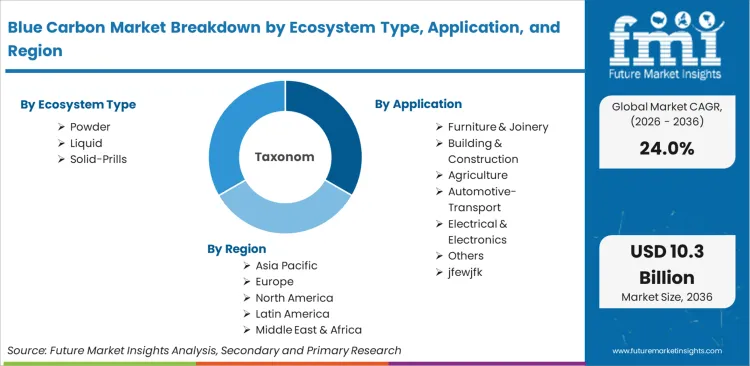
In 2025, the blue carbon market was valued at USD 1.0 billion. Based on Future Market Insights' analysis, demand for blue carbon credits is estimated to grow to USD 1.2 Billion in 2026 and USD 10.3 Billion by 2036. FMI projects a CAGR of 24.0% during the forecast period.
Absolute dollar growth of USD 9.1 billion over the decade signals transformational opportunity rather than incremental expansion. Growth is driven by corporate net-zero procurement strategies requiring high-quality removal credits with verified durability and co-benefit depth, positioning blue carbon as a premium category within voluntary carbon markets undergoing quality differentiation. Supply constraint dynamics from limited restorable coastal wetland area and complex project development requirements support price appreciation alongside volume growth.
Major conservation organizations report that corporate buyers increasingly prioritize carbon credits offering measurable long-term storage, biodiversity co-benefits, and coastal resilience outcomes that address multiple sustainability commitments simultaneously. Blue carbon projects meet these requirements through centuries-duration sediment carbon storage, independently verified ecosystem conservation outcomes, and coastal community livelihood benefits that strengthen ESG narrative credibility for buyers facing investor and regulatory scrutiny of offset claim integrity.
Summary of Blue Carbon Market
- Blue Carbon Market Definition
- The industry covers coastal and marine ecosystem conservation projects generating carbon credits through mangrove, seagrass, salt marsh, and tidal wetland protection that sequester atmospheric carbon in biomass and sediment pools.
- Demand Drivers in the Market
- Corporate net-zero commitments require high-quality removal credits commanding premium pricing within voluntary carbon markets.
- Blue carbon credits offer measurable long-term storage durability with biodiversity and coastal resilience co-benefits.
- Conservation finance mechanisms monetize wetland conservation through carbon revenue, expanding capital base beyond philanthropic funding.
- Key Segments Analyzed in the FMI Report
- Ecosystem Type: Mangroves dominate with 57% share due to highest carbon density and developed certification infrastructure.
- Application: Carbon Credits/Offset Procurement accounts for 62% of total market value.
- Geography: Asia-Pacific supply concentration versus North America and Europe demand hubs drive cross-border market structure.
- Analyst Opinion at FMI
- Nikhil Kaitwade, Principal Consultant for Chemicals and Materials Industry at Future Market Insights, opines, "In the updated Blue Carbon Market Report for 2026 to 2036, CXOs will find insights into supply constraint dynamics limiting certified credit volume growth. My findings point at corporate demand concentration among Science Based Targets adopters creating premium pricing tier separate from commodity carbon markets."
- Strategic Implications/Executive Takeaways
- Develop procurement strategies engaging directly with project developers given supply constraint dynamics.
- Prioritize co-benefit documentation as buyers increasingly require verification at premium pricing.
- Treat blue carbon as long-term portfolio instrument given project development cycles and credit supply limitations.
- Methodology
- Validated through credit transaction volume and value aggregation supplemented by conservation finance estimates.
- Zero reliance on speculative third-party commercial market research reports.
- Based on verified registry data and documented project development economics.
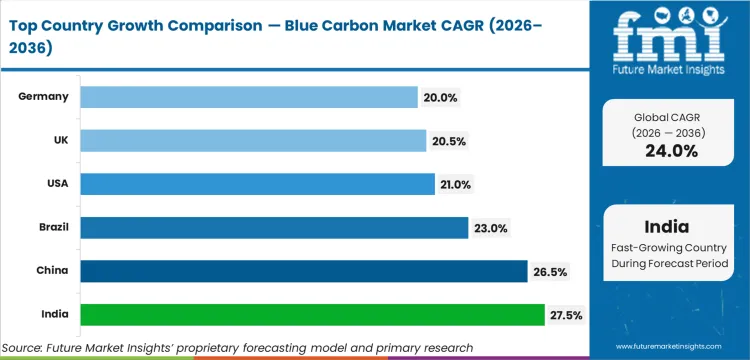
India (27.5% CAGR) and China (26.5% CAGR) drive new opportunities through corporate net-zero adoption acceleration and Blue Economy policy frameworks monetizing coastal wetland conservation. Brazil (23.0% CAGR) contributes via mangrove project development and export-oriented corporate sustainability commitments. Mature demand markets such as the USA (21.0%), UK (20.5%), and Germany (20.0%) generate premium credit procurement supporting high-value transaction growth, with volume expansion supported by conservation finance mechanisms and government coastal protection program integration into carbon markets.
Blue Carbon Market Definition
The blue carbon market encompasses the development, certification, trading, and retirement of carbon credits generated by the conservation, restoration, and sustainable management of coastal and marine ecosystems, specifically mangroves, seagrass meadows, salt marshes, and tidal wetlands that sequester atmospheric carbon dioxide in living biomass and long-lived sediment carbon pools.
Blue Carbon Market Inclusions
The report includes comprehensive analysis of market dynamics, featuring Global and Regional Market Sizes (Volume and Value) and a 10-year Forecast (2026-2036). It covers segmental breakdowns by Ecosystem Type (Mangroves, Seagrass Meadows, Salt Marshes, Kelp/Seaweed, Others), Application (Carbon Credits/Offset Procurement, Conservation Finance, Government Programs, Corporate Net-Zero Programs, Others), and end-users spanning corporate sustainability buyers, conservation finance vehicles, and government coastal protection programs.
Blue Carbon Market Exclusions
The scope excludes terrestrial forest-based carbon credits from REDD+ and afforestation projects involving non-coastal ecosystems. It also omits engineered carbon removal from direct air capture and biochar, fisheries and aquaculture revenues where primary purpose is food production, coastal infrastructure construction, marine protected area tourism, and compliance carbon market revenues from ETS-covered installations, focusing strictly on voluntary carbon market transactions and conservation finance mechanisms linked to coastal wetland ecosystem projects.
Blue Carbon Market Research Methodology
- Primary Research: Interviews were conducted with blue carbon project developers, corporate sustainability officers, carbon market standard body representatives, marine conservation scientists, and voluntary carbon market analysts across major regions.
- Desk Research: Published science literature on coastal wetland carbon stocks, Verra and Gold Standard project registry data, blue carbon credit transaction reports, government coastal conservation program documentation, and IUCN Blue Carbon Initiative publications supported volume benchmarking.
- Market-Sizing and Forecasting: A hybrid top-down and bottom-up model was developed. Market value was estimated through blue carbon credit transaction volume aggregation at registered prices, supplemented by conservation finance expenditure estimates, validated against corporate net-zero demand projections and project supply pipeline analysis.
- Data Validation and Update Cycle: Outputs undergo triangulation across at least two independent sources, variance checks across registry and transaction datasets, and structured peer review by FMI's sustainability and natural capital market analysts prior to release.
Segmental Analysis
Blue Carbon Market Analysis by Ecosystem Type
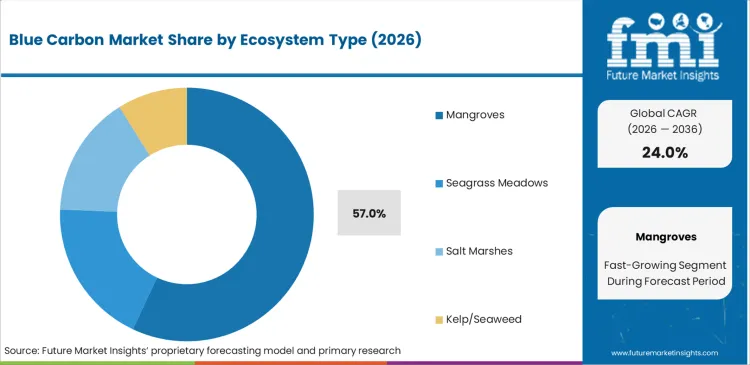
Based on FMI's blue carbon market report, consumption of mangrove-based credits is estimated to hold 57% share in 2026. Growth in demand for mangrove credits comes from the combination of highest carbon stock density among blue carbon ecosystem types, most developed certification infrastructure under Verra's Coastal Wetlands methodology, and largest commercially viable project pipeline concentrated in tropical coastal regions across Southeast Asia, Latin America, and coastal Africa.
- Carbon Stock Density Premium: Mangrove ecosystems accumulate carbon at rates among the highest per unit area, storing carbon in aboveground biomass and deep organic sediment layers holding carbon accumulated over hundreds to thousands of years, providing the scientific basis for mangrove credit pricing premiums relative to other blue carbon project types [2].
- Certification Infrastructure Maturity: Conservation International completed verification of Indonesia's largest mangrove conservation project in March 2025, demonstrating methodology frameworks under Verra's Verified Carbon Standard that reduce scientific uncertainty costs of new project development and enable higher throughput of verified mangrove credits at lower per-credit development cost [3].
- Biodiversity Co-Benefit Depth: The Nature Conservancy's Central America mangrove restoration program generated over 500,000 verified carbon credits in 2024 while simultaneously functioning as nursery habitats for tropical coastal fisheries, demonstrating biodiversity co-benefit narrative essential for premium corporate credit procurement addressing net-zero and nature-positive objectives simultaneously [4].
Blue Carbon Market Analysis by Application
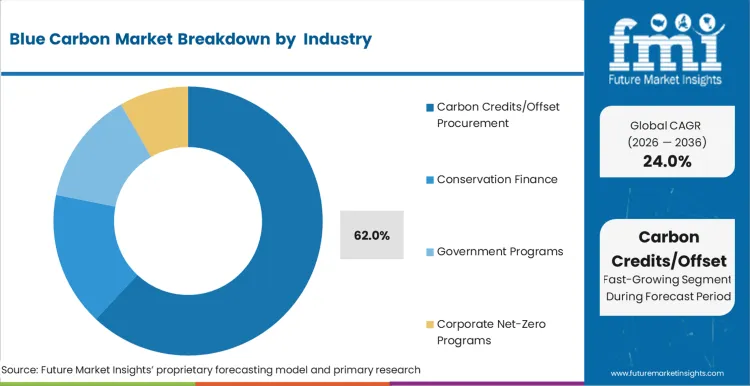
Carbon Credits and Offset Procurement's 62% market share in 2026 stems from its role as the primary revenue mechanism through which coastal wetland conservation is financially sustained and scaled, yet this concentration creates structural dependencies on voluntary carbon market integrity and corporate procurement continuity that compound during periods of credit quality scrutiny or corporate sustainability budget constraints. The segment's reliance on premium credit pricing and quality-seeking corporate buyers transforms any reduction in corporate net-zero commitment credibility or tightening of offset claim standards into immediate transaction volume vulnerability, while supply constraints from limited project development capacity offer minimal buffer against demand volatility during market corrections.
- Corporate Voluntary Market Demand: Microsoft announced commitment to procure 1 million blue carbon credits over five years in January 2025, demonstrating corporate buyers with Science Based Targets requiring high-quality removal credits to address residual emissions that cannot be eliminated through operational decarbonization within committed timeframes [5].
- Price Premium Dynamics: South Pole's 2024 carbon market analysis documented blue carbon credits trading at USD 15-25 per tonne versus USD 5-8 per tonne for standard forestry avoidance credits, reflecting demand concentration among quality-seeking corporate buyers and supply constraints associated with limited restorable coastal wetland area [6].
- Registry Infrastructure Depth: Verra's VCS registry platform processed over 2 million blue carbon credit issuances in 2024, providing transactional transparency and ownership verification that institutional corporate buyers require for offset claim defense and integration into corporate procurement processes designed around existing voluntary carbon market conventions [7].
Blue Carbon Market Drivers, Restraints, and Opportunities
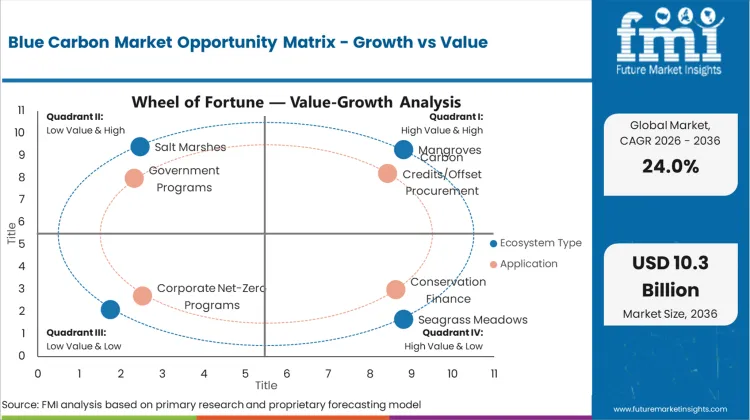
Future Market Insights analysis indicates the blue carbon market represents a structural quality migration within voluntary carbon markets where corporate net-zero commitments requiring high-integrity removal credits drive demand concentration toward coastal ecosystem projects offering measurable sequestration, long-term storage durability, and biodiversity co-benefits. The 2026 estimated valuation reflects accelerating institutional recognition of coastal wetland conservation as premium carbon credit category commanding price premiums substantially above terrestrial forest offsets.
While standard voluntary carbon credit categories face credibility scrutiny from permanence risks and additionality questions, blue carbon conservation projects combining centuries-duration sediment carbon storage with verified biodiversity and coastal resilience outcomes position themselves as defensible instruments within corporate net-zero strategies. The forecast value accounts for market reaching equilibrium where corporate demand growth outpaces new project supply development, driving price appreciation alongside volume growth as buyers compete for limited certified credit supply.
- Corporate Net-Zero Residual Emissions Coverage: Growth is driven by increasing volume of corporate net-zero commitments requiring high-quality removal credits to cover residual emissions, with Science Based Targets initiative guidance progressively restricting acceptable credit types and favoring genuine carbon removal with long-term storage durability over avoided emission offsets.
- Coastal Resilience Co-Investment: Institutional investors and development finance institutions structure coastal wetland conservation as dual-purpose instruments simultaneously generating carbon revenue and reducing coastal flood risks, expanding blue carbon financing ecosystem beyond pure carbon market participants into climate adaptation finance and broadening capital base available for project development.
- Project Development Supply Constraint: Primary growth restraint is limited pace of new project development relative to corporate demand growth, with blue carbon project development requiring ecosystem mapping, carbon baseline assessment, community consultation, land tenure resolution, and certification engagement spanning multiple years and creating supply bottleneck limiting credit volume expansion.
Regional Analysis
.webp "Top Country Growth Comparison Blue Carbon Market Cagr (2026 2036)")
Based on the regional analysis, blue carbon market is segmented into North America, Latin America, Europe, Asia Pacific and Middle East & Africa. Supply of blue carbon credits is geographically concentrated in tropical and subtropical coastal regions where mangrove, seagrass, and salt marsh ecosystems remain in restorable condition. Demand is concentrated among corporate buyers in North America, Europe, and increasingly Asia Pacific. The full report also offers market attractiveness analysis based on regional trends.
| Country | CAGR (2026 to 2036) |
|---|---|
| India | 27.5% |
| China | 26.5% |
| Brazil | 23.0% |
| United States | 21.0% |
| United Kingdom | 20.5% |
| Germany | 20.0% |
Source: Future Market Insights (FMI) analysis, based on proprietary forecasting model and primary research
North America Blue Carbon Market Analysis
North America is the primary demand-side market for blue carbon credits globally, characterized by concentrated corporate buyer sophistication and premium credit procurement aligned with Science Based Targets frameworks. Key players in North America include Conservation International, operating major mangrove and seagrass conservation projects generating credits for corporate buyers; The Nature Conservancy, developing coastal wetland projects across Gulf of Mexico and Atlantic coastal regions; and South Pole, providing project development and credit intermediary services connecting corporate buyers with global blue carbon supply.
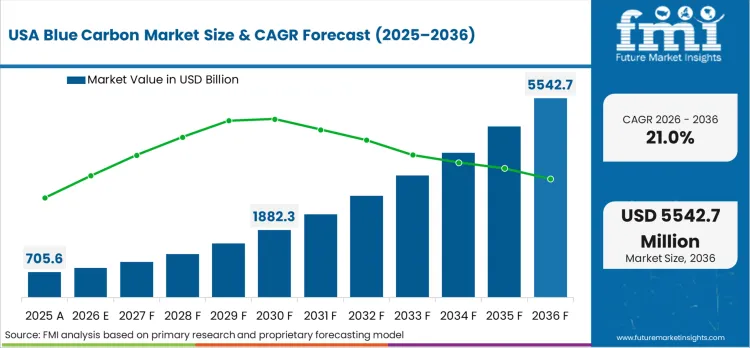
- United States: Demand for blue carbon credits in the United States is projected to rise at 21.0% CAGR through 2036. Growth is fueled by investor stewardship pressure from major institutional asset managers requiring portfolio companies to demonstrate high-quality net-zero progress and corporate sustainability commitments from companies with ambitious decarbonization targets. US technology sector leaders including Microsoft and Salesforce announced multi-million dollar blue carbon procurement commitments in 2024-2025, demonstrating corporate buyer preference for credits combining carbon removal permanence with biodiversity co-benefits.
FMI's report includes detailed analysis of the growth in the North American region, along with country-wise assessment that includes the USA and Canada. Readers can also find regional trends, corporate procurement dynamics, and market growth based on different ecosystem types and buyer categories in the North America region.
Asia Pacific Blue Carbon Market Analysis
Asia Pacific is simultaneously the largest supply region and fastest-growing demand region for blue carbon, leveraging massive mangrove forest area and accelerating corporate net-zero adoption to achieve market leadership that is structurally unmatched by any other region. Conservation International, operating Indonesia's largest mangrove conservation project pipeline; WWF, developing community-based coastal wetland projects across Philippines and Malaysia; and Australian government's Carbon Credit Unit scheme enabling domestic blue carbon project certification remain key regional capacity contributors.
- China: Leading with 26.5% CAGR, the market is driven by corporate net-zero commitments among major Chinese corporations facing ESG disclosure requirements from international investors and customers. State Grid Corporation announced coastal wetland conservation investment program in Jiangsu Province in September 2024 including carbon credit monetization component, demonstrating integration of blue carbon into state-owned enterprise sustainability strategies aligned with national ecological civilization policy frameworks.
- India: Domestic demand is accelerating at 27.5% CAGR, supported by export-oriented manufacturing sector ESG compliance requirements from EU and US customers under emerging supply chain due diligence regulations. Tata Group announced partnership with Conservation International in December 2024 to develop mangrove conservation projects in Sundarbans region with carbon credit procurement commitment, demonstrating Indian corporate engagement with domestic blue carbon supply development addressing both net-zero commitments and coastal community livelihood objectives.
The full report analyzes the blue carbon market across East and South Asia from 2021-2036, covering credit pricing, ecosystem-specific project economics, and growth drivers in China, Japan, India, Indonesia, Philippines, Malaysia, and Australia. The assessment highlights corporate procurement trends and government policy frameworks that dictate regional credit demand and supply development.
Latin America Blue Carbon Market Analysis
Latin America is a critical blue carbon supply hub, where regional conservation organizations are developing mangrove and coastal wetland projects generating credits for international corporate buyers through established voluntary carbon market infrastructure. Key activities by regional players include Conservation International's mangrove restoration programs in Colombia and Ecuador generating verified credits sold to North American and European corporate buyers, and Brazilian federal government coastal wetland conservation programs exploring carbon credit monetization pathways through partnerships with international project developers.
- Brazil: A projected 23.0% CAGR through 2036 is supported by federal government coastal zone management initiatives integrating carbon finance mechanisms and growing domestic corporate demand from export-oriented agribusiness and mining companies addressing international investor ESG requirements. Vale announced coastal wetland conservation investment program in Para State in August 2024 including blue carbon credit procurement component, demonstrating Brazilian corporate engagement with domestic supply development.
The report consists of detailed analysis for the market in Brazil, Mexico, Colombia, Ecuador, Chile and Rest of Latin America. Readers can find detailed information about several factors, such as credit pricing dynamics and regional conservation finance trends, which are impacting growth in the Latin America region.
Europe Blue Carbon Market Analysis
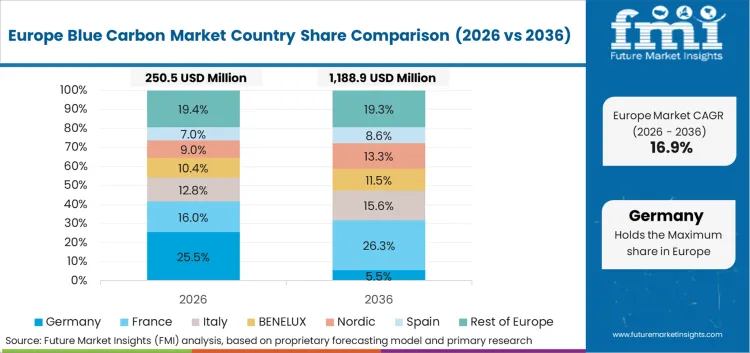
Europe is a concentrated demand market for premium blue carbon credits, where corporate buyers prioritize credit quality and co-benefit verification aligned with emerging EU sustainability reporting standards and biodiversity strategy targets. Leading buyers in Europe include major financial services institutions headquartered in London and Amsterdam, luxury goods corporations addressing scope 3 emissions through high-quality offset procurement, and multinational consumer companies with ambitious net-zero commitments requiring defensible carbon credit portfolios
- Germany: Demand for blue carbon credits in Germany is rising at 20.0% CAGR through 2036, driven by CSRD implementation requiring nature-related disclosure and corporate integration of biodiversity outcomes into sustainability strategies. German automotive manufacturers including BMW announced blue carbon credit procurement programs in 2024-2025 addressing residual scope 3 emissions that cannot be eliminated through supply chain electrification alone, demonstrating industrial sector engagement with premium voluntary carbon market instruments combining climate and biodiversity benefits.
FMI's analysis of blue carbon market in Europe consists of country-wise assessment that includes Germany, United Kingdom, France, Italy, Spain, Netherlands, and Rest of Europe. Readers can know various corporate procurement patterns and latest voluntary carbon market trends in the regional market.
Competitive Aligners for Market Players
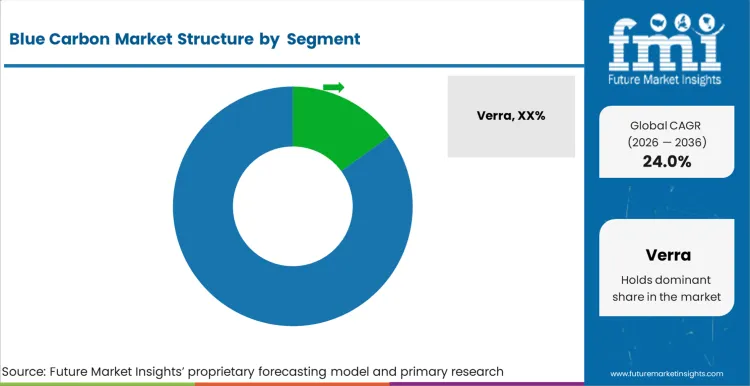
Market structure remains specialized with competition concentrated among limited set of conservation organizations, carbon market project developers, and corporate procurement intermediaries capable of meeting verification standards, community engagement requirements, and ecosystem science expertise expectations of corporate buyers and certification bodies. Roughly one third of certified credit supply originates from established conservation organizations with decades of coastal ecosystem management experience, while remaining supply comes from specialized carbon market project developers and emerging government conservation program monetization.
Organizations with established conservation science expertise, local community partnerships, and certification body relationships develop projects at lower risk and faster timelines relative to new market entrants lacking ecosystem management track records. Conservation International, The Nature Conservancy, and WWF maintain competitive advantages through decades of coastal wetland conservation experience, enabling rapid project pipeline development when corporate demand accelerates. Suppliers without conservation partnerships depend on external scientific consultants and extended community consultation processes, increasing project development timelines and certification costs.
Corporate buyer concentration reinforces quality premium dynamics. Major technology, financial services, and consumer goods corporations developing Science Based Targets require independently verified co-benefit documentation and certification under recognized standards as procurement conditions, creating natural selection favoring experienced project developers over lower-cost alternatives with limited verification infrastructure.
Recent Developments
- In January 2025, Microsoft announced commitment to procure 1 million blue carbon credits over five years from Conservation International's Southeast Asia mangrove conservation project portfolio [5].
- In March 2025, Conservation International completed verification of Indonesia's largest mangrove conservation project generating initial issuance of 750,000 verified carbon credits under Verra's VCS standard [3].
Key Players in Blue Carbon Market
- Verra
- Gold Standard
- South Pole
- Conservation International
- The Nature Conservancy
- Blue Forest
- WWF
- Sustainable Travel International
- Plan Vivo
- Carbon Tanzania
Scope of the Report
| Metric | Value |
|---|---|
| Quantitative Units | USD 1.2 Billion (2026) to USD 10.3 Billion (2036), at a CAGR of 24.0% |
| Market Definition | The blue carbon market encompasses the development, certification, trading, and retirement of carbon credits generated by the conservation, restoration, and sustainable management of coastal and marine ecosystems, specifically mangroves, seagrass meadows, salt marshes, and tidal wetlands that sequester atmospheric carbon dioxide in living biomass and long-lived sediment carbon pools. |
| Ecosystem Type Segmentation | Mangroves, Seagrass Meadows, Salt Marshes, Kelp/Seaweed, Others |
| Application Segmentation | Carbon Credits/Offset Procurement, Conservation Finance, Government Programs, Corporate Net-Zero Programs, Others |
| Application Coverage | Carbon credit transactions, project development, certification services, conservation finance, government programs |
| Regions Covered | North America, Latin America, Europe, Asia Pacific, Middle East and Africa |
| Countries Covered | United States, Canada, Brazil, Mexico, Colombia, Ecuador, Chile, United Kingdom, Germany, France, Italy, Spain, Netherlands, China, India, Indonesia, Australia, Philippines, Malaysia and 40 plus countries |
| Key Companies Profiled | Verra, Gold Standard, South Pole, Conservation International, The Nature Conservancy, Blue Forest, WWF, Sustainable Travel International, Plan Vivo, Carbon Tanzania |
| Forecast Period | 2026 to 2036 |
| Approach | Hybrid top down and bottom up market modeling validated through primary interviews with project developers and corporate buyers, supported by registry data benchmarking and conservation finance expenditure verification |
Blue Carbon Market Analysis by Segments
Ecosystem Type
- Mangroves
- Seagrass Meadows
- Salt Marshes
- Kelp/Seaweed
- Others
Application
- Carbon Credits/Offset Procurement
- Conservation Finance
- Government Programs
- Corporate Net-Zero Programs
- Others
Region
- Asia Pacific
- India
- China
- Indonesia
- Australia
- Philippines
- Malaysia
- Japan
- South Korea
- Rest of Asia Pacific
- Europe
- Germany
- United Kingdom
- France
- Italy
- Spain
- Netherlands
- Nordics
- Rest of Europe
- North America
- United States
- Canada
- Latin America
- Brazil
- Mexico
- Colombia
- Ecuador
- Chile
- Rest of Latin America
- Middle East & Africa
- Kingdom of Saudi Arabia
- United Arab Emirates
- South Africa
- Rest of Middle East & Africa
Bibliography
- [1] Blue Forest Conservation. (2024). Corporate engagement with nature-based carbon solutions: Interview with CEO Craig Heatley. Sustainable Finance Quarterly.
- [2] IUCN Blue Carbon Initiative. (2024). Mangrove carbon stock density and sediment accumulation rates: Global assessment. International Union for Conservation of Nature, March 2024.
- [3] Conservation International. (2025). Indonesia mangrove conservation project verification completion announcement. Project Development Press Release, March 2025.
- [4] The Nature Conservancy. (2024). Central America mangrove restoration program: Carbon credit generation and biodiversity outcomes report. TNC Annual Conservation Report, December 2024.
- [5] Microsoft Corporation. (2025). Carbon removal portfolio expansion: Blue carbon procurement commitment announcement. Corporate Sustainability Report, January 2025.
- [6] South Pole. (2024). Voluntary carbon market pricing analysis: Blue carbon premium documentation. Carbon Market Analytics Report, November 2024.
- [7] Verra. (2024). Verified Carbon Standard registry annual report: Blue carbon credit issuance data. VCS Registry Annual Statistics, December 2024.
- [8] State Grid Corporation of China. (2024). Jiangsu Province coastal wetland conservation investment program announcement. Corporate Social Responsibility Disclosure, September 2024.
- [9] Tata Group. (2024). Sundarbans mangrove conservation partnership with Conservation International. Sustainability Initiative Press Release, December 2024.
- [10] Vale S.A. (2024). Para State coastal wetland conservation and carbon credit program announcement. Environmental Investment Disclosure, August 2024.
This Report Addresses
- Market intelligence to enable structured strategic decision making across voluntary carbon market and conservation finance ecosystems
- Market size estimation and 10 year revenue forecasts from 2026 to 2036, supported by validated credit transaction and conservation finance benchmarks
- Growth opportunity mapping across mangroves, seagrass, salt marsh, and emerging kelp system projects with emphasis on premium credit positioning
- Segment and regional revenue forecasts covering carbon credits, conservation finance, government programs, and corporate net-zero applications
- Competition strategy assessment including conservation organization positioning, project developer capabilities, and corporate buyer procurement patterns
- Credit quality differentiation tracking including co-benefit verification, permanence documentation, and certification standard alignment
- Corporate procurement dynamics analysis covering Science Based Targets alignment, net-zero strategy integration, and buyer sophistication evolution
- Market report delivery in PDF, Excel, PPT, and interactive dashboard formats for executive and operational use
Frequently Asked Questions
How large is the demand for Blue Carbon in the global market in 2026?
Demand for Blue Carbon in the global market is estimated to be valued at USD 1.2 Billion in 2026.
What will be the market size of Blue Carbon in the global market by 2036?
Market size for Blue Carbon is projected to reach USD 10.3 Billion by 2036.
What is the expected demand growth for Blue Carbon in the global market between 2026 and 2036?
Demand for Blue Carbon in the global market is expected to grow at a CAGR of 24.0% between 2026 and 2036.
Which Ecosystem Type is poised to lead global sales by 2026?
Mangroves are expected to be the dominant ecosystem type, capturing approximately 57.0% of global market share in 2026 due to highest carbon stock density and most developed certification infrastructure.
How significant is the role of Carbon Credits/Offset Procurement Application in driving Blue Carbon adoption in 2026?
Carbon Credits and Offset Procurement represents the critical application segment, projected to hold substantial 62.0% share of total market in 2026 as corporate net-zero procurement drives premium credit demand.
What is Driving Blue Carbon Demand in the United States?
Corporate buyer sophistication requiring high-quality removal credits with verified co-benefits and investor stewardship pressure from institutional asset managers are driving growth aligned with Science Based Targets frameworks.
What Compliance Standards are Referenced for the United States?
Verra's Verified Carbon Standard and Coastal Wetlands methodology, along with Science Based Targets initiative guidance on carbon credit quality requirements, are referenced as key compliance benchmarks.
What is the United States Growth Outlook in this Report?
The United States is projected to grow at a CAGR of 21.0% during 2026 to 2036.
Why is Europe described as an Important Demand Hub in this Report?
Growth is driven by CSRD implementation requiring nature-related disclosure and corporate integration of biodiversity outcomes into sustainability strategies aligned with EU Biodiversity Strategy targets.
What Type of Demand Dominates in Europe?
Premium credit procurement prioritizing co-benefit verification and credit quality aligned with emerging sustainability reporting standards dominates regional consumption.
What is Germany Growth Outlook in this Report?
Germany is projected to expand at a CAGR of 20.0% during 2026 to 2036.
Does the Report Cover Indonesia in its Regional Analysis?
Indonesia is included within Asia Pacific under the regional scope of analysis as the single largest global blue carbon supply country.
What are the Sources referred to for analyzing the Market in Indonesia?
Conservation International project development documentation, Indonesian Ministry of Environment and Forestry coastal conservation program publications, and Verra registry data covering Indonesian mangrove project certifications are cited as primary reference sources.
What is the Main Demand Theme Linked to Indonesia in Asia Coverage?
Asia Pacific supply concentration is associated with Indonesia's position as host of largest remaining mangrove forest area globally providing substantial project development opportunity for conservation organizations.
Does the Report Cover China in its Regional Analysis?
China is included within Asia Pacific under the regional coverage framework as fastest-growing demand market.
What is the Main China Related Demand Theme in Asia Coverage?
Corporate net-zero commitments among major Chinese corporations facing ESG disclosure requirements from international investors and integration into state-owned enterprise sustainability strategies are emphasized.
Which Ecosystem Types are Strategically Important for Asia Pacific Supply Chains?
Mangrove conservation projects are prioritized due to highest carbon stock density and most developed certification infrastructure supporting rapid credit issuance across regional supply pipeline.
What is Blue Carbon and What is It Mainly Used For?
Blue carbon refers to carbon credits generated by conservation and restoration of coastal and marine ecosystems including mangroves, seagrass meadows, and salt marshes that sequester atmospheric carbon in biomass and sediment pools.
What does Blue Carbon Market Mean in this Report?
Blue carbon market refers to global development, certification, trading, and retirement of carbon credits from coastal wetland conservation projects in voluntary carbon market transactions and conservation finance mechanisms.
What is Included in the Scope of this Blue Carbon Market Report?
Scope covers credit transactions by ecosystem type, conservation finance mechanisms, government coastal protection programs, and corporate net-zero procurement applications across major regional markets.
What is Excluded from the Scope of this Report?
Terrestrial forest carbon credits, engineered carbon removal technologies, fisheries and aquaculture revenues, and compliance carbon market transactions are excluded unless part of coastal wetland conservation projects.
Preview the report firsthand - request a free sample
Get SampleGet the brochure for pricing and purchase details.
Get PDFTable of Content
- Executive Summary
- Global Market Outlook
- Demand-side Trends
- Supply-side Trends
- Technology Roadmap Analysis
- Analysis and Recommendations
- Market Overview
- Market Structure, Signals, and Trend Drivers
- Benchmarking and Cross-market Comparability
- Market Sizing, Forecasting, and Opportunity Mapping
- Research Design and Evidence Framework
- Desk Research Programme (Secondary Evidence)
- Company Annual and Sustainability Reports
- Peer-reviewed Journals and Academic Literature
- Corporate Websites, Product Literature, and Technical Notes
- Earnings Decks and Investor Briefings
- Sector Databases and Reference Repositories
- FMI Internal Proprietary Databases and Historical Market Datasets
- Subscription Datasets and Paid Sources
- Social Channels, Communities, and Digital Listening Inputs
- Additional Desk Sources
- Expert Input and Fieldwork (Primary Evidence)
- Primary Modes
- Qualitative Interviews and Expert Elicitation
- Quantitative Surveys and Structured Data Capture
- Blended Approach
- Why Primary Evidence is Used
- Field Techniques
- Interviews
- Surveys
- Focus Groups
- Observational and In-context Research
- Social and Community Interactions
- Stakeholder Universe Engaged
- C-suite Leaders
- Board Members
- Presidents and Vice Presidents
- R&D and Innovation Heads
- Technical Specialists
- Domain Subject-matter Experts
- Scientists
- Physicians and Other Healthcare Professionals
- Governance, Ethics, and Data Stewardship
- Research Ethics
- Data Integrity and Handling
- Primary Modes
- Tooling, Models, and Reference Databases
- Desk Research Programme (Secondary Evidence)
- Data Engineering and Model Build
- Data Acquisition and Ingestion
- Cleaning, Normalisation, and Verification
- Synthesis, Triangulation, and Analysis
- Quality Assurance and Audit Trail
- Market Background
- Market Dynamics
- Drivers
- Restraints
- Opportunity
- Trends
- Scenario Forecast
- Demand in Optimistic Scenario
- Demand in Likely Scenario
- Demand in Conservative Scenario
- Opportunity Map Analysis
- Product Life Cycle Analysis
- Supply Chain Analysis
- Investment Feasibility Matrix
- Value Chain Analysis
- PESTLE and Porter’s Analysis
- Regulatory Landscape
- Regional Parent Market Outlook
- Production and Consumption Statistics
- Import and Export Statistics
- Market Dynamics
- Global Market Analysis 2021 to 2025 and Forecast, 2026 to 2036
- Historical Market Size Value (USD Million) Analysis, 2021 to 2025
- Current and Future Market Size Value (USD Million) Projections, 2026 to 2036
- Y-o-Y Growth Trend Analysis
- Absolute $ Opportunity Analysis
- Global Market Pricing Analysis 2021 to 2025 and Forecast 2026 to 2036
- Global Market Analysis 2021 to 2025 and Forecast 2026 to 2036, By Ecosystem Type
- Introduction / Key Findings
- Historical Market Size Value (USD Million) Analysis By Ecosystem Type , 2021 to 2025
- Current and Future Market Size Value (USD Million) Analysis and Forecast By Ecosystem Type , 2026 to 2036
- Mangroves
- Seagrass Meadows
- Salt Marshes
- Kelp/Seaweed
- Mangroves
- Y-o-Y Growth Trend Analysis By Ecosystem Type , 2021 to 2025
- Absolute $ Opportunity Analysis By Ecosystem Type , 2026 to 2036
- Global Market Analysis 2021 to 2025 and Forecast 2026 to 2036, By Application
- Introduction / Key Findings
- Historical Market Size Value (USD Million) Analysis By Application, 2021 to 2025
- Current and Future Market Size Value (USD Million) Analysis and Forecast By Application, 2026 to 2036
- Carbon Credits/Offset Procurement
- Conservation Finance
- Government Programs
- Corporate Net-Zero Programs
- Carbon Credits/Offset Procurement
- Y-o-Y Growth Trend Analysis By Application, 2021 to 2025
- Absolute $ Opportunity Analysis By Application, 2026 to 2036
- Global Market Analysis 2021 to 2025 and Forecast 2026 to 2036, By Region
- Introduction
- Historical Market Size Value (USD Million) Analysis By Region, 2021 to 2025
- Current Market Size Value (USD Million) Analysis and Forecast By Region, 2026 to 2036
- North America
- Latin America
- Western Europe
- Eastern Europe
- East Asia
- South Asia and Pacific
- Middle East & Africa
- Market Attractiveness Analysis By Region
- North America Market Analysis 2021 to 2025 and Forecast 2026 to 2036, By Country
- Historical Market Size Value (USD Million) Trend Analysis By Market Taxonomy, 2021 to 2025
- Market Size Value (USD Million) Forecast By Market Taxonomy, 2026 to 2036
- By Country
- USA
- Canada
- Mexico
- By Ecosystem Type
- By Application
- By Country
- Market Attractiveness Analysis
- By Country
- By Ecosystem Type
- By Application
- Key Takeaways
- Latin America Market Analysis 2021 to 2025 and Forecast 2026 to 2036, By Country
- Historical Market Size Value (USD Million) Trend Analysis By Market Taxonomy, 2021 to 2025
- Market Size Value (USD Million) Forecast By Market Taxonomy, 2026 to 2036
- By Country
- Brazil
- Chile
- Rest of Latin America
- By Ecosystem Type
- By Application
- By Country
- Market Attractiveness Analysis
- By Country
- By Ecosystem Type
- By Application
- Key Takeaways
- Western Europe Market Analysis 2021 to 2025 and Forecast 2026 to 2036, By Country
- Historical Market Size Value (USD Million) Trend Analysis By Market Taxonomy, 2021 to 2025
- Market Size Value (USD Million) Forecast By Market Taxonomy, 2026 to 2036
- By Country
- Germany
- UK
- Italy
- Spain
- France
- Nordic
- BENELUX
- Rest of Western Europe
- By Ecosystem Type
- By Application
- By Country
- Market Attractiveness Analysis
- By Country
- By Ecosystem Type
- By Application
- Key Takeaways
- Eastern Europe Market Analysis 2021 to 2025 and Forecast 2026 to 2036, By Country
- Historical Market Size Value (USD Million) Trend Analysis By Market Taxonomy, 2021 to 2025
- Market Size Value (USD Million) Forecast By Market Taxonomy, 2026 to 2036
- By Country
- Russia
- Poland
- Hungary
- Balkan & Baltic
- Rest of Eastern Europe
- By Ecosystem Type
- By Application
- By Country
- Market Attractiveness Analysis
- By Country
- By Ecosystem Type
- By Application
- Key Takeaways
- East Asia Market Analysis 2021 to 2025 and Forecast 2026 to 2036, By Country
- Historical Market Size Value (USD Million) Trend Analysis By Market Taxonomy, 2021 to 2025
- Market Size Value (USD Million) Forecast By Market Taxonomy, 2026 to 2036
- By Country
- China
- Japan
- South Korea
- By Ecosystem Type
- By Application
- By Country
- Market Attractiveness Analysis
- By Country
- By Ecosystem Type
- By Application
- Key Takeaways
- South Asia and Pacific Market Analysis 2021 to 2025 and Forecast 2026 to 2036, By Country
- Historical Market Size Value (USD Million) Trend Analysis By Market Taxonomy, 2021 to 2025
- Market Size Value (USD Million) Forecast By Market Taxonomy, 2026 to 2036
- By Country
- India
- ASEAN
- Australia & New Zealand
- Rest of South Asia and Pacific
- By Ecosystem Type
- By Application
- By Country
- Market Attractiveness Analysis
- By Country
- By Ecosystem Type
- By Application
- Key Takeaways
- Middle East & Africa Market Analysis 2021 to 2025 and Forecast 2026 to 2036, By Country
- Historical Market Size Value (USD Million) Trend Analysis By Market Taxonomy, 2021 to 2025
- Market Size Value (USD Million) Forecast By Market Taxonomy, 2026 to 2036
- By Country
- Kingdom of Saudi Arabia
- Other GCC Countries
- Turkiye
- South Africa
- Other African Union
- Rest of Middle East & Africa
- By Ecosystem Type
- By Application
- By Country
- Market Attractiveness Analysis
- By Country
- By Ecosystem Type
- By Application
- Key Takeaways
- Key Countries Market Analysis
- USA
- Pricing Analysis
- Market Share Analysis, 2025
- By Ecosystem Type
- By Application
- Canada
- Pricing Analysis
- Market Share Analysis, 2025
- By Ecosystem Type
- By Application
- Mexico
- Pricing Analysis
- Market Share Analysis, 2025
- By Ecosystem Type
- By Application
- Brazil
- Pricing Analysis
- Market Share Analysis, 2025
- By Ecosystem Type
- By Application
- Chile
- Pricing Analysis
- Market Share Analysis, 2025
- By Ecosystem Type
- By Application
- Germany
- Pricing Analysis
- Market Share Analysis, 2025
- By Ecosystem Type
- By Application
- UK
- Pricing Analysis
- Market Share Analysis, 2025
- By Ecosystem Type
- By Application
- Italy
- Pricing Analysis
- Market Share Analysis, 2025
- By Ecosystem Type
- By Application
- Spain
- Pricing Analysis
- Market Share Analysis, 2025
- By Ecosystem Type
- By Application
- France
- Pricing Analysis
- Market Share Analysis, 2025
- By Ecosystem Type
- By Application
- India
- Pricing Analysis
- Market Share Analysis, 2025
- By Ecosystem Type
- By Application
- ASEAN
- Pricing Analysis
- Market Share Analysis, 2025
- By Ecosystem Type
- By Application
- Australia & New Zealand
- Pricing Analysis
- Market Share Analysis, 2025
- By Ecosystem Type
- By Application
- China
- Pricing Analysis
- Market Share Analysis, 2025
- By Ecosystem Type
- By Application
- Japan
- Pricing Analysis
- Market Share Analysis, 2025
- By Ecosystem Type
- By Application
- South Korea
- Pricing Analysis
- Market Share Analysis, 2025
- By Ecosystem Type
- By Application
- Russia
- Pricing Analysis
- Market Share Analysis, 2025
- By Ecosystem Type
- By Application
- Poland
- Pricing Analysis
- Market Share Analysis, 2025
- By Ecosystem Type
- By Application
- Hungary
- Pricing Analysis
- Market Share Analysis, 2025
- By Ecosystem Type
- By Application
- Kingdom of Saudi Arabia
- Pricing Analysis
- Market Share Analysis, 2025
- By Ecosystem Type
- By Application
- Turkiye
- Pricing Analysis
- Market Share Analysis, 2025
- By Ecosystem Type
- By Application
- South Africa
- Pricing Analysis
- Market Share Analysis, 2025
- By Ecosystem Type
- By Application
- USA
- Market Structure Analysis
- Competition Dashboard
- Competition Benchmarking
- Market Share Analysis of Top Players
- By Regional
- By Ecosystem Type
- By Application
- Competition Analysis
- Competition Deep Dive
- Verra
- Overview
- Product Portfolio
- Profitability by Market Segments (Product/Age /Sales Channel/Region)
- Sales Footprint
- Strategy Overview
- Marketing Strategy
- Product Strategy
- Channel Strategy
- Gold Standard
- South Pole
- Conservation International
- The Nature Conservancy
- Blue Forest
- WWF
- Sustainable Travel International
- Plan Vivo
- Carbon Tanzania
- Verra
- Competition Deep Dive
- Assumptions & Acronyms Used


