

- Market Size (2026)
- USD 260.4 Mn
- Forecast (2036)
- USD 420.1 Mn
- CAGR (2026 to 2036)
- 4.9%
Cashew Milk Market Size, Market Forecast and Outlook By FMI
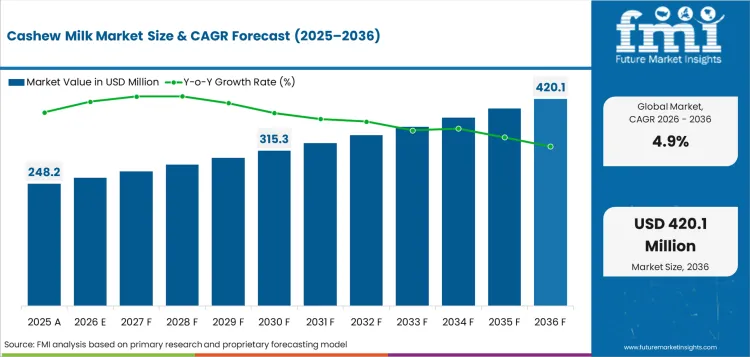
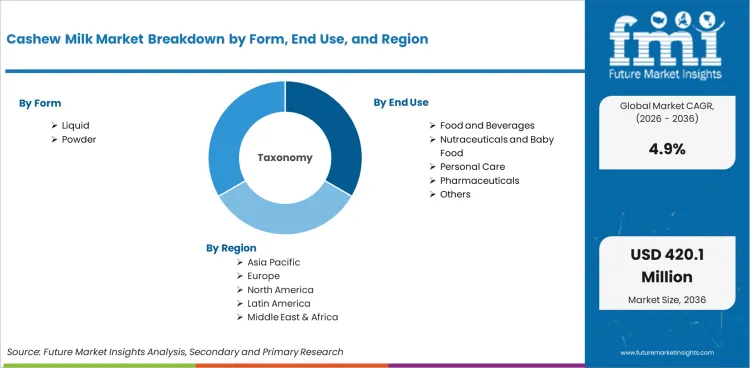
The cashew milk market was valued at USD 248.2 million in 2025. The market is set to reach USD 260.4 million by 2026-end and grow at a CAGR of 4.9% between 2026-2036 to reach USD 420.1 million by 2036. Liquid will dominate with a 62.8% share, while Food and Beverages will lead with a 55.4% share.
Summary of the Cashew Milk Market
- Demand and Growth Drivers
- Shifting consumer dietary preferences toward plant based and health conscious alternatives are expected to support demand across mainstream retail channels.
- Multi-channel distribution expansion, including online grocery and convenience store formats, is likely to improve product accessibility during the forecast period.
- Premiumization trends and functional ingredient positioning are expected to support margin expansion and product diversification.
- Product and Segment View
- Liquid is likely to account for 62.8% of the form in 2026, supported by shifting consumer preferences and retail distribution expansion.
- Food and Beverages is expected to hold 55.4% of the end use segment, reflecting shifting consumer preferences and retail distribution expansion.
- Supermarket and Hypermarket is expected to represent 46.9% of the sales channel segment, with demand shaped by wide distribution reach and impulse purchase exposure at retail.
- Geography and Competitive Outlook
- Japan is likely to remain a leading market with a projected CAGR of 6.7%, supported by established end use demand and favorable policy frameworks.
- India is expected to follow at 4.4%, reflecting growing adoption and expanding market infrastructure.
- Companies with integrated product portfolios and multi-regional distribution presence are likely to strengthen their competitive positions during the forecast period.
- Analyst Opinion
- Nandini Roy Choudhury, Principal Consultant at FMI says, 'Companies that balance cost competitiveness with credible product differentiation through functional ingredients and clean label positioning are likely to outperform during the forecast period.'
- The cashew milk market is evolving from a niche category toward mainstream retail positioning, supported by shifting consumer preferences and expanded distribution access.
- Rising health consciousness and premiumization trends, as well as multi-channel retail expansion in both developed and emerging markets, are accelerating the pace of adoption.
- Competitive positioning is increasingly based on supply chain efficiency, brand credibility and responsiveness to rapidly changing cycles in consumer preference.
- Rising interest in sustainable sourcing, clean label formulations and functional nutrition claims further buoy demand.
Key Takeaways, Market Size, and Forecast
- The cashew milk market was valued at USD 248.2 million in 2025.
- By 2036, the Cashew Milk Market is expected to be worth USD 420.1 million.
- From 2026 to 2036, the market is projected to expand at a CAGR of 4.9%.
- The market is projected to create an incremental opportunity of USD 159.7 million between 2026 and 2036.
- In 2026, Liquid is expected to account for 62.8% of the form, driven by shifting consumer preferences and retail distribution expansion.
- Japan (6.7%) and India (4.4%) are two of the fastest growing markets in the world.
Cashew Milk Market Definition
The cashew milk market encompasses commercially produced and distributed cashew milk products across all major retail and foodservice channels. The market covers branded and private label products in various formats, packaging types, and formulations distributed through supermarkets, convenience stores, online channels, and other retail outlets across all major geographic regions.
Cashew Milk Market Inclusions
Market scope encompasses all commercially traded cashew milk products categorized by Form (Liquid, Powder); End Use (Food and Beverages, Nutraceuticals and Baby Food, Personal Care, Pharmaceuticals, Others); Sales Channel (Supermarket and Hypermarket, Online Retail, Others); Packaging (Cartons, Bottles, Pouches, Jars, Cans, Others); Product Type (Plain Cashew Milk, Flavored Cashew Milk). The revenue forecast spans 2026 to 2036.
Cashew Milk Market Exclusions
The scope does not include unprocessed raw ingredients sold without branding, foodservice and institutional bulk supply not packaged for retail, or products marketed primarily as animal feed. Private label products are included where distributed through retail channels.
Cashew Milk Market Research Methodology
- Primary Research: FMI analysts conducted interviews with food manufacturers, retail buyers, distribution executives, and consumer insights professionals across key markets.
- Desk Research: Combined data from retail audit data, trade association reports, consumer survey databases, and manufacturer disclosures.
- Market Sizing and Forecasting: Bottom up aggregation across form, end use, sales channel, packaging, product type segments with regional adoption curves.
- Data Validation: Cross-checked quarterly against retail sales tracking data, trade production statistics, and manufacturer revenue disclosures.
Why is the Cashew Milk Market Growing?
- Shifting consumer dietary preferences and increasing health awareness are creating sustained demand for cashew milk products, with adoption expanding beyond niche segments into mainstream retail.
- Multi-channel distribution expansion and online grocery penetration are improving product accessibility, with retailers allocating increased shelf space to the category.
- Japan leads growth at 6.7%, supported by expanding retail infrastructure and increasing consumer demand for convenient, health-oriented products.
Consumer pricing sensitivity shapes product positioning and distribution strategy. Mainstream consumers prioritize value, creating pressure on manufacturers to control input costs while maintaining product quality. Private label expansion by major retailers compresses branded product margins. Premium positioning requires clear functional differentiation, such as organic certification, protein content claims, or allergen free formulations. Companies that control both cost structure and brand perception maintain healthier margins.
Distribution channel dynamics are shifting as online grocery penetration increases and convenience store formats expand. Supermarkets and hypermarkets remain the primary volume channel, but direct to consumer and online platforms offer higher margins and better consumer data access. Retailers increasingly demand category management support, promotional investment, and rapid product innovation cycles. Companies with multi-channel distribution capabilities and strong retailer relationships capture broader market access.
Raw material sourcing volatility affects production costs and margin stability. Agricultural input prices fluctuate with weather patterns, trade policies, and supply chain disruptions. Companies with long term supplier agreements, backward integration into ingredient sourcing, or diversified supplier networks manage cost volatility more effectively. Quality consistency across batches remains a competitive differentiator, particularly for products positioned in premium segments.
Market Segmentation Analysis
- The form contains 62.8% liquid, in accordance with demand patterns in key markets.
- The end use segment is Food and Beverages 55.4%, supported by changing consumer preferences and expansion in retail distribution.
- Supermarket and Hypermarket accounts for 46.9% of the sales channel segment. The adoption is increasing due to broad distribution reach and exposure to impulse purchase at retail.
The cashew milk market is segmented into form, end-use, sales channel, packaging, and product type. Procurement patterns and growth trajectories are influenced by different demand drivers, end use requirements and competitive dynamics for each segment.
Insights into the Liquid Form Segments
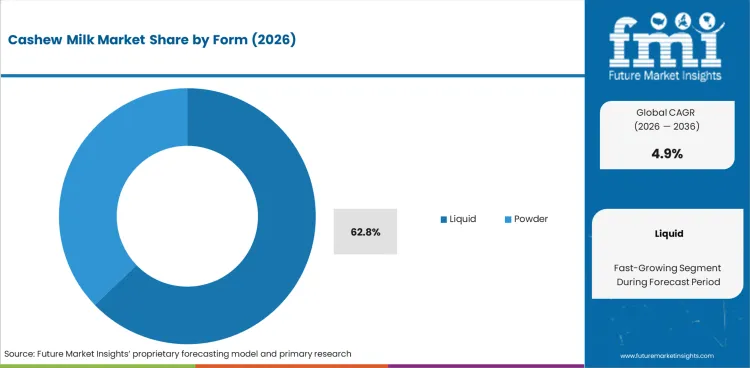
Liquid will have 62.8% of the form segment in 2026. Consumer tastes are changing and the retail distribution is growing to fuel demand. Other categories of form include Powder, each meeting different application demands.
In this segment, sub-categories like Ready-to-Drink Cashew Milk, Fresh Cashew Milk, Instant Cashew Milk Powder are niche application areas. The sub-segments illustrate the level of product differentiation and the extent of technical requirements across end use applications.
Insights into the Food and Beverages End Use Segment
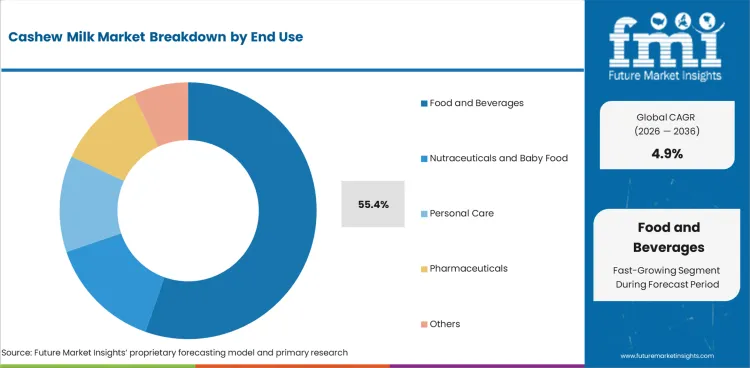
Food and Beverages is anticipated to hold 55.4% of the end use segment in 2026. Demand is driven by the changing tastes of consumers and the expansion of retail distribution. Other end use segments are Nutraceuticals and Baby Food, Personal Care, Pharmaceuticals, Others for different application needs.
This segment is further categorized into sub segments such as Dairy Alternatives, Bakery and Confectionery, Infant Nutrition representing specialized application areas. These sub-segments indicate the degree of product differentiation and the degree of technical requirements across end use applications.
Cashew Milk Market Drivers, Restraints, and Opportunities
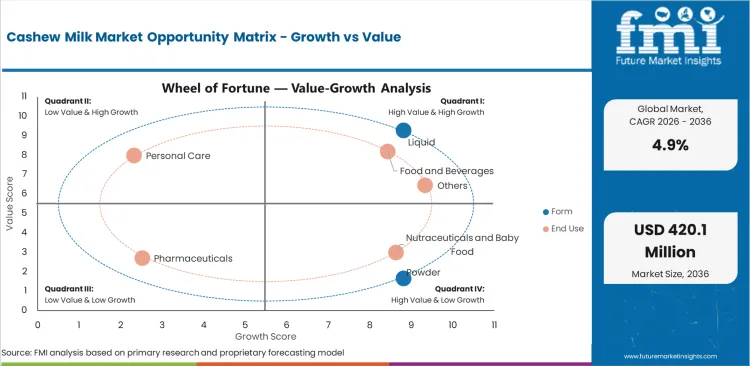
- Changing consumer dietary preferences are driving steady demand for cashew milk products in current markets.
- Raw Material Cost Volatility limits adoption in price sensitive segments. This limits near term growth in emerging markets.
- The forecast period is expected to witness incremental demand channels, generated by Functional Positioning and premiumization.
The growth trajectory of the cashew milk market is a function of the interplay between demand growth, cost pressures and structural market shifts. Adoption is determined by regulatory requirements, specifications of end use and competition in the value chain.
Shifting Consumer Dietary Preferences
The rising popularity of plant based and health conscious diets in developed and urban emerging markets is fueling demand. Consumers willingness to trial alternative products supports category growth and product diversification.
Retail Distribution and Channel Expansion
Growth is driven by retail shelf space allocation, online grocery penetration and convenience store format growth. Multi-channel distribution capabilities are critical to capturing volume in consumer segments.
Raw Material Cost Volatility
Input price volatility squeezes margins, especially for manufacturers reliant on agricultural commodities subject to seasonal supply variability. Companies having diversified sourcing and long term supplier contracts manage this risk better.
Premiumization and Functional Positioning
Premium product segments are growing as consumers are willing to pay for functional ingredients, clean label formulations and sustainability certifications. This trend is good for margin expansion for manufacturers of differentiated product portfolios.
Analysis of Cashew Milk Market By Key Countries
.webp "Top Country Growth Comparison Cashew Milk Market Cagr (2026 2036)")
| Country | CAGR |
|---|---|
| Japan | 6.7% |
| India | 4.4% |
| Germany | 4.1% |
| USA | 3.9% |
| China | 2.6% |
Source: FMI analysis based on primary research and proprietary forecasting model
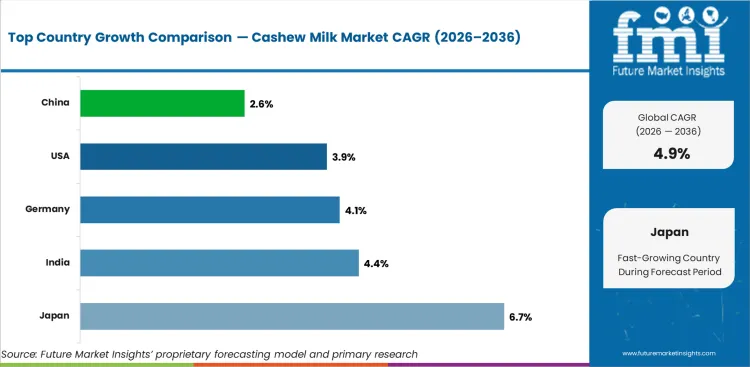
- Japan at 6.7% shows growing uptake and increasing market infrastructure.
- India 4.4% is indicative of the growing adoption and growth of market infrastructure.
- Germany’s 4.1% reflects increased acceptance and expanding market infrastructure.
- USA 3.9%. This highlights the availability of offtake infrastructure and supportive policy environments.
The global cashew milk market is expected to grow at a rate of 4.9% per year from 2026 to 2036. The study covers more than 30 countries, and the main markets are listed below.
Demand Outlook for Cashew Milk Market in Japan
Japan projected to grow 6.7% through 2036. Demand is driven by an aging health-conscious population, an established convenience food culture and strong retail distribution networks.
- Demand for healthy food formats is being driven by health-conscious aging demographics.
- The existing culture of convenience food makes it easy to adopt ready-to-eat products.
- Products are widely available through extensive retail distribution networks.
Future Outlook for Cashew Milk Market in India
India is expected to grow at 4.4% till 2036. Growth is driven by growing end use demand, infrastructure investment and policy-led adoption.
- Sustained demand growth driven by growing end use applications.
- Infrastructure investment builds capacity for market expansion.
- Policy frameworks enable adoption and compliance driven procurement.
Opportunity Analysis of Cashew Milk Market in Germany
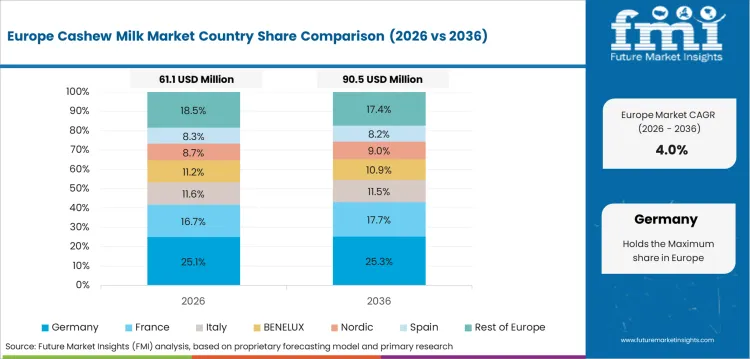
Germany is projected to grow at 4.1% until 2036. Demand has been supported by the country’s organic food culture, solid retail infrastructure and consumer preference for sustainable products.
- Plant based product positioning is in harmony with organic food culture.
- Distribution supported by strong discount and premium retail channels.
- Consumers who are conscious of sustainability are driving demand for plant-based alternatives.
In-depth Analysis of Cashew Milk Market in the United States
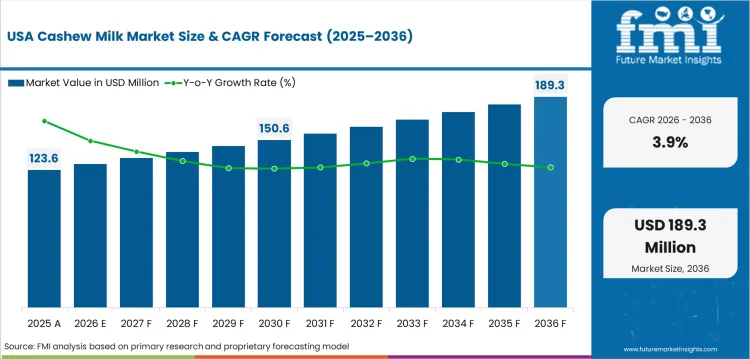
The USA is expected to grow 3.9% through 2036. Growth is driven by increasing plant based diet adoption, retail distribution expansion and consumer demand for convenient protein alternatives.
- There is increasing adoption of plant based diets in mainstream consumer segments.
- Volume supported by retail distribution reach through supermarkets and online channels.
- Health-conscious consumers are looking for products that are formulated to be nutrient dense.
Sales Analysis of Cashew Milk Market in China
China is expected to remain ahead at 2.6% until 2036. Market penetration is accelerated by urbanization, growing disposable income and increasing awareness of plant based nutrition.
- Demand for convenient food formats is supported by urbanization and lifestyle change.
- Higher disposable income leads to premiumization and product diversification.
- Increasing health awareness shifts consumer preferences towards plant based options.
Competitive Landscape and Strategic Positioning
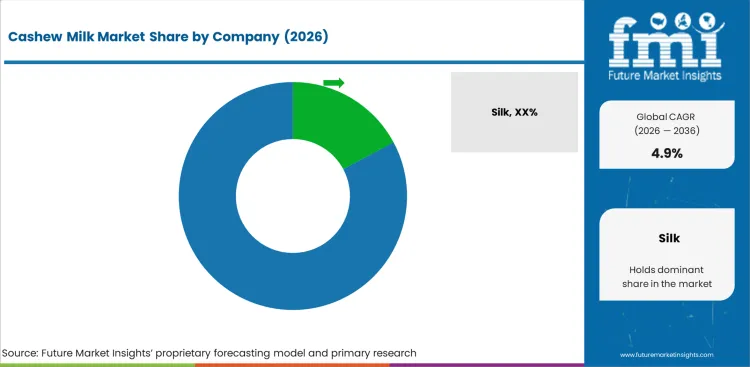
- Silk continues to be a leader with integrated product capabilities and established distribution relationships in major markets.
- Califia Farms and Blue Diamond Growers have product portfolios with a mix of mature and emerging product categories.
- Niche applications and differentiated product formulations are being used by new players to establish a market presence.
Silk has a leading position because of integrated manufacturing capabilities and established procurement relationships with major end users. The company’s product portfolio covers multiple segments with cross selling and customer retention opportunities.
Califia Farms competes on product breadth and geographical reach. Blue Diamond Growers focuses on differentiation through technology and specialized applications. Both companies have established distribution networks and customer relationships in key markets.
Entry barriers include the need for regulatory approval, manufacturing scale, established supply chain relationships and customer switching costs. Leading companies’ strategic priorities include cost optimization, geographic expansion, product portfolio diversification and strategic partnerships.
Key Companies in the Cashew Milk Market
Key global companies leading the cashew milk market include:
- Silk, Califia Farms, Blue Diamond Growers, The Hain Celestial Group maintain strong manufacturing infrastructure, established end user relationships, and broad product portfolios.
- SunOpta Inc, Forager Project, Vitasoy Australia Products Pty Ltd have established positions through specialized product capabilities and regional distribution networks.
- Daiya Foods Inc, Alpro, So Delicious Dairy Free, Other Companies combined are establishing market presence through differentiated product formulations and targeted application focus, demonstrating potential for future market leadership.
Competitive Benchmarking: Cashew Milk Market
| Company | Product Range | Distribution Network | Brand Strength | Geographic Footprint |
|---|---|---|---|---|
| Silk | High | High | Strong | Global |
| Califia Farms | High | Medium | Strong | Global |
| Blue Diamond Growers | Medium | High | Moderate | Regional |
| The Hain Celestial Group | High | Medium | Strong | Global |
| SunOpta Inc | Medium | High | Moderate | Regional |
| Forager Project | High | Medium | Moderate | Regional |
| Vitasoy Australia Products Pty Ltd | Medium | High | Low | Regional |
| Daiya Foods Inc | Low | High | Low | Regional |
| Alpro | Medium | Medium | Low | Regional |
| So Delicious Dairy Free | Low | Low | Low | Regional |
Source: Future Market Insights competitive analysis, 2026.
Key Developments in Cashew Milk Market
- In 2025, Silk maintained its existing cashew milk product portfolio in the US market with no announced new product launches, portfolio expansions, or international market entries — Silk Cashewmilk (sold under Danone/Deer Brands) continued to be available in the United States only, with no documented expansion into Japan or European markets.
- In 2025, Califia Farms launched Califia Farms Creamy Refreshers (a new juice line with four flavors: Strawberry Creme, Key Lime Colada, Piña Colada, Orange Creme) targeting North America (US) only, available nationwide at Albertsons, Target, and Kroger.
Key Players in the Cashew Milk Market
Major Global Players
- Silk
- Califia Farms
- Blue Diamond Growers
- The Hain Celestial Group
- SunOpta Inc
- Forager Project
- Vitasoy Australia Products Pty Ltd
Emerging Players/Startups
- Daiya Foods Inc
- Alpro
- So Delicious Dairy Free
- Other Companies combined
Report Scope and Coverage
| Parameter | Details |
|---|---|
| Quantitative Units | USD 260.4 million to USD 420.1 million, at a CAGR of 4.9% |
| Market Definition | The cashew milk market encompasses commercially produced and distributed products for cashew milk applications. |
| Regions Covered | North America, Latin America, Europe, East Asia, South Asia and Pacific, Middle East and Africa |
| Countries Covered | Japan, India, Germany, USA, China, 30 plus countries |
| Key Companies Profiled | Silk, Califia Farms, Blue Diamond Growers, The Hain Celestial Group, SunOpta Inc, Forager Project, Vitasoy Australia Products Pty Ltd, Daiya Foods Inc, Alpro, So Delicious Dairy Free, Other Companies combined |
| Forecast Period | 2026 to 2036 |
| Approach | Hybrid bottom-up and top-down methodology starting with verified transaction data, projecting adoption velocity across segments and regions. |
Market Segmentation Analysis
Cashew Milk Market Segmented by Form:
- Liquid
- Ready-to-Drink Cashew Milk
- Fresh Cashew Milk
- Powder
- Instant Cashew Milk Powder
- Blended Plant Milk Powder
Cashew Milk Market Segmented by End Use:
- Food and Beverages
- Dairy Alternatives
- Bakery and Confectionery
- Nutraceuticals and Baby Food
- Infant Nutrition
- Dietary Supplements
- Personal Care
- Cosmetic Formulations
- Pharmaceuticals
- Clinical Nutrition
- Others
- Foodservice Applications
Cashew Milk Market Segmented by Sales Channel:
- Supermarket and Hypermarket
- Retail Chains
- Wholesale Stores
- Online Retail
- E-commerce Platforms
- Direct Brand Websites
- Others
- Convenience Stores
Cashew Milk Market Segmented by Packaging:
- Cartons
- Tetra Pack Cartons
- Aseptic Cartons
- Bottles
- Plastic Bottles
- Glass Bottles
- Pouches
- Flexible Pouches
- Jars
- Plastic Jars
- Cans
- Metal Cans
- Others
- Bulk Packaging
Cashew Milk Market Segmented by Product Type:
- Plain Cashew Milk
- Unsweetened Variant
- Organic Plain Milk
- Flavored Cashew Milk
- Vanilla Flavor
- Chocolate Flavor
- Fruit-Based Flavors
- Spiced Variants
Cashew Milk Market by Region:
- North America
- USA
- Canada
- Mexico
- Latin America
- Brazil
- Chile
- Rest of Latin America
- Western Europe
- Germany
- UK
- Italy
- Spain
- France
- Nordic
- BENELUX
- Rest of Western Europe
- Eastern Europe
- Russia
- Poland
- Hungary
- Balkan & Baltic
- Rest of Eastern Europe
- East Asia
- China
- Japan
- South Korea
- South Asia and Pacific
- India
- ASEAN
- Australia & New Zealand
- Rest of South Asia and Pacific
- Middle East & Africa
- Kingdom of Saudi Arabia
- Other GCC Countries
- Turkiye
- South Africa
- Other African Union
- Rest of Middle East & Africa
Research Sources and Bibliography
- 1. Food and Agriculture Organization. (2025). FAO Global Food Market Report. FAO.
- 2. USA Department of Agriculture. (2025). USDA Food Production and Consumption Statistics. USDA.
- 3. European Commission. (2025). EU Food Safety and Labeling Regulation Updates. EC.
- 4. World Health Organization. (2025). WHO Nutrition and Food Safety Guidelines. WHO.
- 5. International Food Information Council. (2025). IFIC Consumer Food Insights Survey. IFIC.
This bibliography is provided for reader reference.
This Report Addresses
- Estimating the size of the market and revenue from 2026 to 2036.
- Segmentation by form, end use, sales channel, packaging, product type.
- Insights across more than 30 country markets.
- Analysis of competitive landscape and strategic positioning.
- Assessment of market drivers, restraints, and growth opportunities.
- Investment opportunity identification across segments and regions.
- Supply chain and procurement pattern analysis.
- Delivery of data in PDF and Excel formats.
Frequently Asked Questions
What is the global market demand for Cashew Milk Market in 2026?
In 2026, the global cashew milk market is expected to be worth USD 260.4 million.
How big will the Cashew Milk Market be in 2036?
By 2036, the cashew milk market is expected to be worth USD 420.1 million.
How much is demand for Cashew Milk Market expected to grow between 2026 and 2036?
Between 2026 and 2036, the demand for cashew milk market is expected to grow at a CAGR of 4.9%.
Which Form is likely to lead the Cashew Milk Market globally by 2026?
Liquid is expected to account for 62.8% of the form in 2026, reflecting shifting consumer preferences and retail distribution expansion.
What is causing demand to rise in Japan in the Cashew Milk Market?
Japan is projected to grow at 6.7% per year through 2036, supported by expanding market infrastructure and growing adoption.
What is causing demand to rise in India in the Cashew Milk Market?
India is projected to grow at 4.4% per year through 2036, supported by growing market demand and infrastructure investment.
What does this report mean by 'Cashew Milk Market definition'?
The cashew milk market includes commercially produced and distributed products for cashew milk applications across all major segments and regions.
How does FMI make the Cashew Milk Market forecast and validate it?
Forecasting models use a hybrid bottom-up and top-down approach, starting with verified transaction data and checking it against retail sales data and production statistics.
Preview the report firsthand - request a free sample
Get SampleGet the brochure for pricing and purchase details.
Get PDFTable of Content
- Executive Summary
- Global Market Outlook
- Demand-side Trends
- Supply-side Trends
- Technology Roadmap Analysis
- Analysis and Recommendations
- Market Overview
- Market Coverage / Taxonomy
- Market Definition / Scope / Limitations
- Research Methodology
- Chapter Orientation
- Analytical Lens and Working Hypotheses
- Market Structure, Signals, and Trend Drivers
- Benchmarking and Cross-market Comparability
- Market Sizing, Forecasting, and Opportunity Mapping
- Research Design and Evidence Framework
- Desk Research Programme (Secondary Evidence)
- Company Annual and Sustainability Reports
- Peer-reviewed Journals and Academic Literature
- Corporate Websites, Product Literature, and Technical Notes
- Earnings Decks and Investor Briefings
- Statutory Filings and Regulatory Disclosures
- Technical White Papers and Standards Notes
- Trade Journals, Industry Magazines, and Analyst Briefs
- Conference Proceedings, Webinars, and Seminar Materials
- Government Statistics Portals and Public Data Releases
- Press Releases and Reputable Media Coverage
- Specialist Newsletters and Curated Briefings
- Sector Databases and Reference Repositories
- FMI Internal Proprietary Databases and Historical Market Datasets
- Subscription Datasets and Paid Sources
- Social Channels, Communities, and Digital Listening Inputs
- Additional Desk Sources
- Expert Input and Fieldwork (Primary Evidence)
- Primary Modes
- Qualitative Interviews and Expert Elicitation
- Quantitative Surveys and Structured Data Capture
- Blended Approach
- Why Primary Evidence is Used
- Field Techniques
- Interviews
- Surveys
- Focus Groups
- Observational and In-context Research
- Social and Community Interactions
- Stakeholder Universe Engaged
- C-suite Leaders
- Board Members
- Presidents and Vice Presidents
- R&D and Innovation Heads
- Technical Specialists
- Domain Subject-matter Experts
- Scientists
- Physicians and Other Healthcare Professionals
- Governance, Ethics, and Data Stewardship
- Research Ethics
- Data Integrity and Handling
- Primary Modes
- Tooling, Models, and Reference Databases
- Desk Research Programme (Secondary Evidence)
- Data Engineering and Model Build
- Data Acquisition and Ingestion
- Cleaning, Normalisation, and Verification
- Synthesis, Triangulation, and Analysis
- Quality Assurance and Audit Trail
- Market Background
- Market Dynamics
- Drivers
- Restraints
- Opportunity
- Trends
- Scenario Forecast
- Demand in Optimistic Scenario
- Demand in Likely Scenario
- Demand in Conservative Scenario
- Opportunity Map Analysis
- Product Life Cycle Analysis
- Supply Chain Analysis
- Investment Feasibility Matrix
- Value Chain Analysis
- PESTLE and Porter’s Analysis
- Regulatory Landscape
- Regional Parent Market Outlook
- Production and Consumption Statistics
- Import and Export Statistics
- Historical Market Size Value (USD Million) Analysis, 2021 to 2025
- Current and Future Market Size Value (USD Million) Projections, 2026 to 2036
- Y-o-Y Growth Trend Analysis
- Absolute $ Opportunity Analysis
- Market Dynamics
- Global Market Pricing Analysis 2021 to 2025 and Forecast 2026 to 2036
- Global Market Analysis 2021 to 2025 and Forecast 2026 to 2036, By Form
- Introduction / Key Findings
- Historical Market Size Value (USD Million) Analysis By Form , 2021 to 2025
- Current and Future Market Size Value (USD Million) Analysis and Forecast By Form , 2026 to 2036
- Liquid
- Ready-to-Drink Cashew Milk
- Fresh Cashew Milk
- Powder
- Instant Cashew Milk Powder
- Blended Plant Milk Powder
- Liquid
- Y-o-Y Growth Trend Analysis By Form , 2021 to 2025
- Absolute $ Opportunity Analysis By Form , 2026 to 2036
- Global Market Analysis 2021 to 2025 and Forecast 2026 to 2036, By End Use
- Introduction / Key Findings
- Historical Market Size Value (USD Million) Analysis By End Use, 2021 to 2025
- Current and Future Market Size Value (USD Million) Analysis and Forecast By End Use, 2026 to 2036
- Food and Beverages
- Dairy Alternatives
- Bakery and Confectionery
- Nutraceuticals and Baby Food
- Infant Nutrition
- Dietary Supplements
- Personal Care
- Cosmetic Formulations
- Pharmaceuticals
- Clinical Nutrition
- Others
- Foodservice Applications
- Food and Beverages
- Y-o-Y Growth Trend Analysis By End Use, 2021 to 2025
- Absolute $ Opportunity Analysis By End Use, 2026 to 2036
- Global Market Analysis 2021 to 2025 and Forecast 2026 to 2036, By Sales Channel
- Introduction / Key Findings
- Historical Market Size Value (USD Million) Analysis By Sales Channel, 2021 to 2025
- Current and Future Market Size Value (USD Million) Analysis and Forecast By Sales Channel, 2026 to 2036
- Supermarket and Hypermarket
- Retail Chains
- Wholesale Stores
- Online Retail
- E-commerce Platforms
- Direct Brand Websites
- Others
- Convenience Stores
- Supermarket and Hypermarket
- Y-o-Y Growth Trend Analysis By Sales Channel, 2021 to 2025
- Absolute $ Opportunity Analysis By Sales Channel, 2026 to 2036
- Global Market Analysis 2021 to 2025 and Forecast 2026 to 2036, By Packaging
- Introduction / Key Findings
- Historical Market Size Value (USD Million) Analysis By Packaging, 2021 to 2025
- Current and Future Market Size Value (USD Million) Analysis and Forecast By Packaging, 2026 to 2036
- Cartons
- Tetra Pack Cartons
- Aseptic Cartons
- Bottles
- Plastic Bottles
- Glass Bottles
- Pouches
- Flexible Pouches
- Jars
- Plastic Jars
- Cans
- Metal Cans
- Others
- Bulk Packaging
- Cartons
- Y-o-Y Growth Trend Analysis By Packaging, 2021 to 2025
- Absolute $ Opportunity Analysis By Packaging, 2026 to 2036
- Global Market Analysis 2021 to 2025 and Forecast 2026 to 2036, By Product Type
- Introduction / Key Findings
- Historical Market Size Value (USD Million) Analysis By Product Type, 2021 to 2025
- Current and Future Market Size Value (USD Million) Analysis and Forecast By Product Type, 2026 to 2036
- Plain Cashew Milk
- Unsweetened Variant
- Organic Plain Milk
- Flavored Cashew Milk
- Vanilla Flavor
- Chocolate Flavor
- Fruit-Based Flavors
- Spiced Variants
- Plain Cashew Milk
- Y-o-Y Growth Trend Analysis By Product Type, 2021 to 2025
- Absolute $ Opportunity Analysis By Product Type, 2026 to 2036
- Global Market Analysis 2021 to 2025 and Forecast 2026 to 2036, By Region
- Introduction
- Historical Market Size Value (USD Million) Analysis By Region, 2021 to 2025
- Current Market Size Value (USD Million) Analysis and Forecast By Region, 2026 to 2036
- North America
- Latin America
- Western Europe
- Eastern Europe
- East Asia
- South Asia and Pacific
- Middle East & Africa
- Market Attractiveness Analysis By Region
- North America Market Analysis 2021 to 2025 and Forecast 2026 to 2036, By Country
- Historical Market Size Value (USD Million) Trend Analysis By Market Taxonomy, 2021 to 2025
- Market Size Value (USD Million) Forecast By Market Taxonomy, 2026 to 2036
- By Country
- USA
- Canada
- Mexico
- By Form
- By End Use
- By Sales Channel
- By Packaging
- By Product Type
- By Country
- Market Attractiveness Analysis
- By Country
- By Form
- By End Use
- By Sales Channel
- By Packaging
- By Product Type
- Key Takeaways
- Latin America Market Analysis 2021 to 2025 and Forecast 2026 to 2036, By Country
- Historical Market Size Value (USD Million) Trend Analysis By Market Taxonomy, 2021 to 2025
- Market Size Value (USD Million) Forecast By Market Taxonomy, 2026 to 2036
- By Country
- Brazil
- Chile
- Rest of Latin America
- By Form
- By End Use
- By Sales Channel
- By Packaging
- By Product Type
- By Country
- Market Attractiveness Analysis
- By Country
- By Form
- By End Use
- By Sales Channel
- By Packaging
- By Product Type
- Key Takeaways
- Western Europe Market Analysis 2021 to 2025 and Forecast 2026 to 2036, By Country
- Historical Market Size Value (USD Million) Trend Analysis By Market Taxonomy, 2021 to 2025
- Market Size Value (USD Million) Forecast By Market Taxonomy, 2026 to 2036
- By Country
- Germany
- UK
- Italy
- Spain
- France
- Nordic
- BENELUX
- Rest of Western Europe
- By Form
- By End Use
- By Sales Channel
- By Packaging
- By Product Type
- By Country
- Market Attractiveness Analysis
- By Country
- By Form
- By End Use
- By Sales Channel
- By Packaging
- By Product Type
- Key Takeaways
- Eastern Europe Market Analysis 2021 to 2025 and Forecast 2026 to 2036, By Country
- Historical Market Size Value (USD Million) Trend Analysis By Market Taxonomy, 2021 to 2025
- Market Size Value (USD Million) Forecast By Market Taxonomy, 2026 to 2036
- By Country
- Russia
- Poland
- Hungary
- Balkan & Baltic
- Rest of Eastern Europe
- By Form
- By End Use
- By Sales Channel
- By Packaging
- By Product Type
- By Country
- Market Attractiveness Analysis
- By Country
- By Form
- By End Use
- By Sales Channel
- By Packaging
- By Product Type
- Key Takeaways
- East Asia Market Analysis 2021 to 2025 and Forecast 2026 to 2036, By Country
- Historical Market Size Value (USD Million) Trend Analysis By Market Taxonomy, 2021 to 2025
- Market Size Value (USD Million) Forecast By Market Taxonomy, 2026 to 2036
- By Country
- China
- Japan
- South Korea
- By Form
- By End Use
- By Sales Channel
- By Packaging
- By Product Type
- By Country
- Market Attractiveness Analysis
- By Country
- By Form
- By End Use
- By Sales Channel
- By Packaging
- By Product Type
- Key Takeaways
- South Asia and Pacific Market Analysis 2021 to 2025 and Forecast 2026 to 2036, By Country
- Historical Market Size Value (USD Million) Trend Analysis By Market Taxonomy, 2021 to 2025
- Market Size Value (USD Million) Forecast By Market Taxonomy, 2026 to 2036
- By Country
- India
- ASEAN
- Australia & New Zealand
- Rest of South Asia and Pacific
- By Form
- By End Use
- By Sales Channel
- By Packaging
- By Product Type
- By Country
- Market Attractiveness Analysis
- By Country
- By Form
- By End Use
- By Sales Channel
- By Packaging
- By Product Type
- Key Takeaways
- Middle East & Africa Market Analysis 2021 to 2025 and Forecast 2026 to 2036, By Country
- Historical Market Size Value (USD Million) Trend Analysis By Market Taxonomy, 2021 to 2025
- Market Size Value (USD Million) Forecast By Market Taxonomy, 2026 to 2036
- By Country
- Kingdom of Saudi Arabia
- Other GCC Countries
- Turkiye
- South Africa
- Other African Union
- Rest of Middle East & Africa
- By Form
- By End Use
- By Sales Channel
- By Packaging
- By Product Type
- By Country
- Market Attractiveness Analysis
- By Country
- By Form
- By End Use
- By Sales Channel
- By Packaging
- By Product Type
- Key Takeaways
- Key Countries Market Analysis
- USA
- Pricing Analysis
- Market Share Analysis, 2025
- By Form
- By End Use
- By Sales Channel
- By Packaging
- By Product Type
- Canada
- Pricing Analysis
- Market Share Analysis, 2025
- By Form
- By End Use
- By Sales Channel
- By Packaging
- By Product Type
- Mexico
- Pricing Analysis
- Market Share Analysis, 2025
- By Form
- By End Use
- By Sales Channel
- By Packaging
- By Product Type
- Brazil
- Pricing Analysis
- Market Share Analysis, 2025
- By Form
- By End Use
- By Sales Channel
- By Packaging
- By Product Type
- Chile
- Pricing Analysis
- Market Share Analysis, 2025
- By Form
- By End Use
- By Sales Channel
- By Packaging
- By Product Type
- Germany
- Pricing Analysis
- Market Share Analysis, 2025
- By Form
- By End Use
- By Sales Channel
- By Packaging
- By Product Type
- UK
- Pricing Analysis
- Market Share Analysis, 2025
- By Form
- By End Use
- By Sales Channel
- By Packaging
- By Product Type
- Italy
- Pricing Analysis
- Market Share Analysis, 2025
- By Form
- By End Use
- By Sales Channel
- By Packaging
- By Product Type
- Spain
- Pricing Analysis
- Market Share Analysis, 2025
- By Form
- By End Use
- By Sales Channel
- By Packaging
- By Product Type
- France
- Pricing Analysis
- Market Share Analysis, 2025
- By Form
- By End Use
- By Sales Channel
- By Packaging
- By Product Type
- India
- Pricing Analysis
- Market Share Analysis, 2025
- By Form
- By End Use
- By Sales Channel
- By Packaging
- By Product Type
- ASEAN
- Pricing Analysis
- Market Share Analysis, 2025
- By Form
- By End Use
- By Sales Channel
- By Packaging
- By Product Type
- Australia & New Zealand
- Pricing Analysis
- Market Share Analysis, 2025
- By Form
- By End Use
- By Sales Channel
- By Packaging
- By Product Type
- China
- Pricing Analysis
- Market Share Analysis, 2025
- By Form
- By End Use
- By Sales Channel
- By Packaging
- By Product Type
- Japan
- Pricing Analysis
- Market Share Analysis, 2025
- By Form
- By End Use
- By Sales Channel
- By Packaging
- By Product Type
- South Korea
- Pricing Analysis
- Market Share Analysis, 2025
- By Form
- By End Use
- By Sales Channel
- By Packaging
- By Product Type
- Russia
- Pricing Analysis
- Market Share Analysis, 2025
- By Form
- By End Use
- By Sales Channel
- By Packaging
- By Product Type
- Poland
- Pricing Analysis
- Market Share Analysis, 2025
- By Form
- By End Use
- By Sales Channel
- By Packaging
- By Product Type
- Hungary
- Pricing Analysis
- Market Share Analysis, 2025
- By Form
- By End Use
- By Sales Channel
- By Packaging
- By Product Type
- Kingdom of Saudi Arabia
- Pricing Analysis
- Market Share Analysis, 2025
- By Form
- By End Use
- By Sales Channel
- By Packaging
- By Product Type
- Turkiye
- Pricing Analysis
- Market Share Analysis, 2025
- By Form
- By End Use
- By Sales Channel
- By Packaging
- By Product Type
- South Africa
- Pricing Analysis
- Market Share Analysis, 2025
- By Form
- By End Use
- By Sales Channel
- By Packaging
- By Product Type
- USA
- Market Structure Analysis
- Competition Dashboard
- Competition Benchmarking
- Market Share Analysis of Top Players
- By Regional
- By Form
- By End Use
- By Sales Channel
- By Packaging
- By Product Type
- Competition Analysis
- Competition Deep Dive
- Silk
- Overview
- Product Portfolio
- Profitability by Market Segments (Product/Age /Sales Channel/Region)
- Sales Footprint
- Strategy Overview
- Marketing Strategy
- Product Strategy
- Channel Strategy
- Califia Farms
- Blue Diamond Growers
- The Hain Celestial Group
- SunOpta Inc
- Forager Project
- Vitasoy Australia Products Pty Ltd
- Daiya Foods Inc
- Alpro
- So Delicious Dairy Free
- Other Companies combined
- Silk
- Competition Deep Dive
- Assumptions & Acronyms Used


