

- Market Size (2026)
- USD 3.1 Bn
- Forecast (2036)
- USD 15.4 Bn
- CAGR (2026 to 2036)
- 17.4%
GLP-1 Diet Food Market Size, Market Forecast and Outlook By FMI
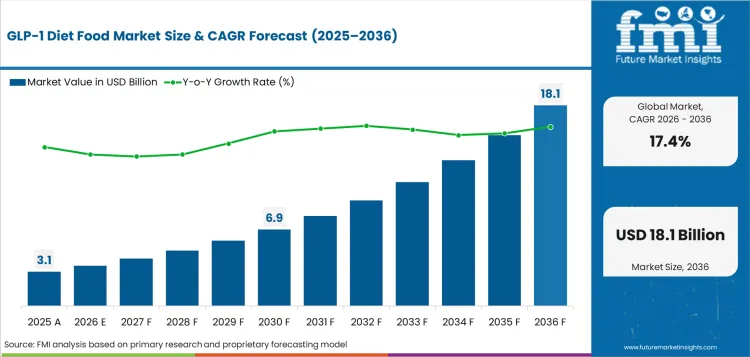
The GLP-1 diet food market is projected to grow from USD 3.1 billion in 2026 to USD 15.4 billion by 2036, at a CAGR of 17.4%. Ready meals are expected to lead product demand with a 28.0% share, while high-protein positioning remains the leading nutritional focus at 31.0% of market revenue. Source: FMI analysis, 2026.
Summary of the GLP-1 Diet Food Market
- Demand and Growth Drivers
- GLP-1 medication adoption is changing how consumers think about meal size and nutrient density.
- Food brands are starting to build products around smaller portions and higher protein, with more attention to digestive tolerance.
- Dietitian guidance and digital health content are pushing users toward more structured food choices while on treatment.
- Product and Segment View
- Ready meals remain the clearest commercial entry point as they combine convenience with controlled calorie load.
- Nutrition shakes and high-protein snacks continue to gain traction in between-meal and low-appetite use occasions.
- Fiber-forward and gut-support products are gaining relevance where users need gentler digestion support or more complete nutrition.
- Geography and Competitive Outlook
- North America leads early commercialization as major food companies launch GLP-1-oriented ranges and on-pack cues.
- Western Europe is moving through functional nutrition and premium meal solutions, with health-led direct-to-consumer brands helping category education.
- Competition is strongest among companies that can combine nutrition credibility with familiar taste and easy retail access.
- Analyst Opinion
- "GLP-1 diet food is not becoming a separate grocery aisle overnight. It is becoming a set of nutritional rules that food brands are beginning to design around: more protein, tighter portions, and foods that fit a smaller appetite without feeling clinical," says Nandini Roy Choudhury, Principal Consultant.
- The winners are likely to come from companies that already understand protein, portioning, and the logic of functional nutrition.
- Products that feel medical or punitive will struggle to scale beyond an early adopter audience.
- The category has room to grow fast, though it will still depend on taste and convenience, along with price discipline.
Key Takeaways
- The GLP-1 diet food market is expected to be valued at USD 3.1 billion in 2026.
- By 2036, the GLP-1 diet food market is forecast to reach USD 15.4 billion.
- From 2026 to 2036, the market is projected to expand at a CAGR of 17.4%.
- The market is expected to create an incremental opportunity of USD 12.3 billion over the forecast period.
- Ready meals remain the leading product type as they solve portion control and nutrient density in one purchase.
- High-protein products continue to anchor the category as users place more weight on satiety and lean-mass support.
- The United States remains the largest value market. The United Kingdom, Germany, Japan, and South Korea are likely to shape premium product development and adoption standards.
The sharper opportunity sits in eating-friction reduction, not in broad weight-management branding. First-hand commercial signals from Nestle's Vital Pursuit launch, Conagra's Healthy Choice On Track badge, and Smoothie King's GLP-1 Support Menu show that suppliers are responding to a distinct user need around smaller portions, higher protein density, and easier-to-finish meals. That shifts the market toward food manufacturers and foodservice operators that can prove formulation relevance rather than simply attach GLP-1 language to existing products. Brands that solve convenience, satiety support, and repeat-use practicality should hold the strongest position as the category matures.
GLP-1 Diet Food Market Definition
The GLP-1 diet food market includes food and beverage products formulated, positioned, or merchandised to support consumers using GLP-1 receptor agonist weight-management therapies or following similar eating patterns. It covers meals, snacks, beverages, and nutrition-support formats designed around smaller portions, higher protein, lower sugar load, digestive tolerance, and stronger nutrient density.
GLP-1 Diet Food Market Inclusions
Key stakeholder scope includes packaged-food manufacturers, protein and fiber ingredient suppliers, nutrition brands, co-manufacturers, retail and e-commerce buyers, pharmacy-adjacent channel partners, foodservice operators, dietitians, wellness platforms, and GLP-1 users. Food manufacturers benefit by adapting ready meals, shakes, snacks, and breakfast products to smaller appetite patterns; ingredient suppliers benefit by selling protein, fiber, digestive-support, and reduced-sugar systems; retailers and e-commerce channels benefit from clearer category navigation; and users benefit from portion control, satiety support, and easier meal planning.
Market scope covers commercially traded GLP-1-supportive foods sold across retail, e-commerce, direct-to-consumer, pharmacy-adjacent, and foodservice channels. The study includes segmentation by product type, nutritional focus, consumer stage, distribution channel, packaging format, end use, and region for the period 2026 to 2036.
GLP-1 Diet Food Market Exclusions
The scope does not include prescription medicines, standalone dietary supplements sold without a food format, bariatric meal plans outside mass-market commercialization, or general healthy foods with no meaningful relevance to GLP-1-linked eating behavior.
Market Research Methodology
- Primary Research: Review of demand behavior across packaged-food manufacturers, nutrition brands, retail buyers, dietitians, wellness operators, and foodservice innovators in major markets.
- Desk Research: Assessment of public information on GLP-1 user behavior, food launches, functional nutrition deals, direct-to-consumer strategies, and ingredient-platform development.
- Market sizing and forecasting: Revenue modeling based on product-type demand, user-stage adoption, nutrition-led pricing, channel expansion, and regional market readiness.
- Data validation: Cross-checking against visible company launches, consumer-behavior studies, health-focused food innovation, and the direction of obesity-management support categories.
Why is the GLP-1 Diet Food Market Growing?
- Consumers on GLP-1 therapy often want smaller meals that still deliver meaningful protein and micronutrients.
- Food companies now see a clear commercial gap between generic weight-management products and the specific eating patterns of GLP-1 users.
- Functional nutrition brands are helping normalize the category through direct-to-consumer education and product bundling.
The market is growing as GLP-1 use changes food behavior in practical ways. Many users eat less in one sitting and skip larger meals. They also pay closer attention to protein, fiber, hydration, and digestive comfort. That creates demand for products that are not just "healthy" in a broad sense, but better aligned with a smaller appetite and a more deliberate meal structure.
The category is also benefiting from fast brand validation. Nestlé introduced Vital Pursuit in 2024 as the first food brand in its U.S. portfolio built specifically for GLP-1 users. Conagra followed with GLP-1-friendly "On Track" badges on select Healthy Choice products. Smoothie King launched a dedicated GLP-1 Support Menu in late 2024. These moves do not yet define a mature category, but they do confirm that large and mid-scale operators see real commercial demand.
Nutrition platforms are widening the opportunity beyond frozen meals. ADM has already rolled out more than 25 market-ready GLP-1-supportive food and supplement concepts for brand customers. Danone's March 2026 agreement to acquire Huel, subject to regulatory approvals, also reinforces the pull toward portion-aware, nutritionally complete formats that can overlap with GLP-1-led eating needs.
The market still faces constraints. Regulatory caution around medical adjacency, uneven long-term persistence on GLP-1 therapies, and the risk of superficial marketing claims can slow adoption. The category also faces trust risk because GLP-1-friendly food claims are not yet regulated as a formal food-label category in the U.S. Even so, the demand signal is strong enough to support rapid expansion through 2036.
Market Segmentation Analysis
- Ready meals lead the market with a 28.0% share, supported by convenience and built-in portion control.
- High-protein positioning accounts for 31.0% of market revenue in 2026, making it the leading nutritional focus.
- Supermarkets and hypermarkets remain the largest distribution channel, though direct-to-consumer and pharmacy-adjacent channels are gaining importance.
The GLP-1 diet food market is segmented by product type, nutritional focus, consumer stage, distribution channel, packaging format, end use, and region. That structure reflects how value is emerging in the category: through nutritional design, easy consumption formats, and channel strategies that reduce friction for users who are already changing their routines.
Insights into the Ready Meals Segment
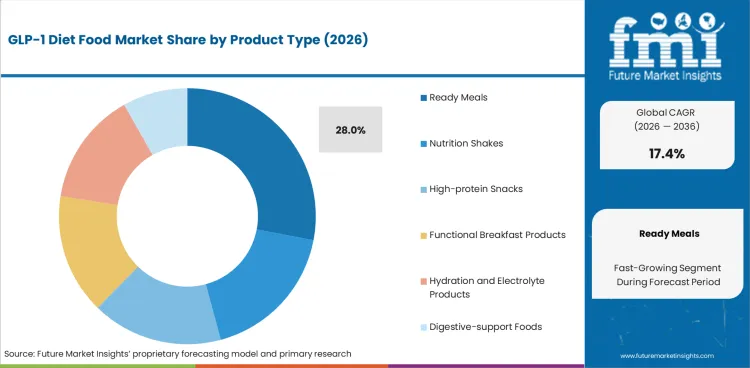
Ready meals remain the leading product segment in the GLP-1 diet food market. They fit the category well as brands can combine protein, fiber, and portion control in one product without asking the consumer to plan a full meal. That is commercially useful for users whose appetite is lower but whose nutrient needs remain important.
The segment also has strong retail logic. Frozen and chilled meals already have space in supermarkets, clear pack communication, and repeat purchase potential. That reduces the time needed to introduce a new nutrition-led subcategory.
Insights into the High-protein Segment
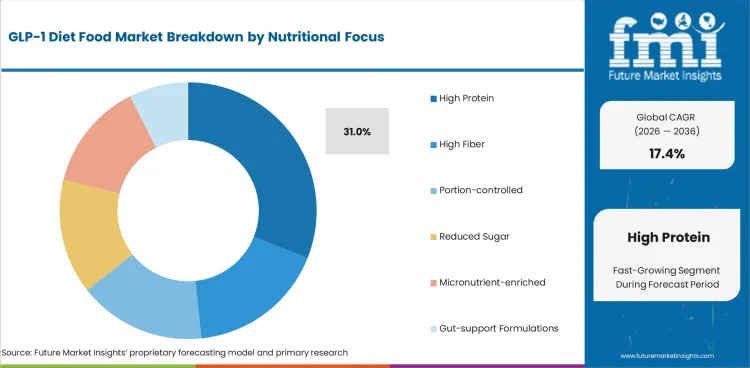
High-protein positioning remains the strongest nutritional anchor in the market. Users and clinicians alike are placing more weight on lean-mass support and satiety during weight-loss treatment. That gives protein a more direct functional role than generic wellness messaging.
This segment is spreading across meals, shakes, bars, and snacks. The broad reach matters. It allows brands to meet different eating occasions without depending on one format alone.
Insights into the Active GLP-1 Users Segment
Active GLP-1 users are expected to account for the largest consumer-stage segment in the market in 2026. These consumers are most likely to seek purpose-built foods, experiment with new formats, and follow nutrition guidance while adjusting to changes in appetite and portion size.
This segment matters most in the near term, though it will not be the only growth pool. Step-down users and broader weight-management consumers are likely to widen the addressable market over time as branded positioning becomes more familiar.
GLP-1 Diet Food Market Drivers, Restraints, and Opportunities
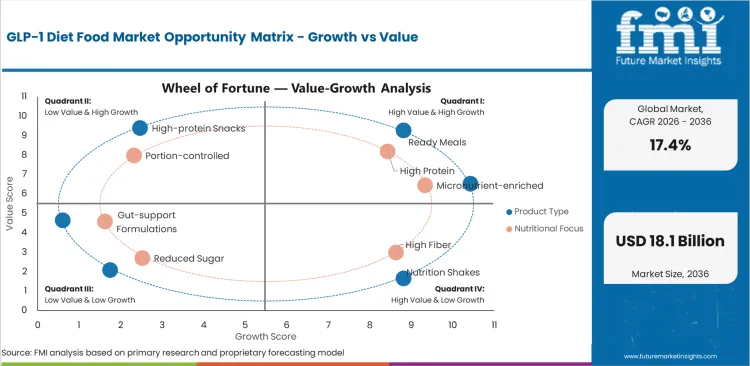
- Medication-led changes in appetite and meal structure remain the main demand driver.
- Consumer skepticism and the risk of shallow "GLP-1-friendly" positioning continue to restrain category trust.
- The strongest opportunities are opening in complete nutrition, frozen meals, and high-protein snacks, with dietitian-supported digital commerce adding another growth path.
The market is moving quickly, though it is still early. A brand cannot win here by only shrinking a serving size and adding a new badge. Users are paying closer attention to how foods make them feel and whether they can finish the portion comfortably. They also want products that help them stay consistent over time.
Appetite Change and Muscle-preservation Needs Support Demand
GLP-1 users often eat less, but they still need protein, fiber, and adequate micronutrient intake. That creates a strong opening for foods that are easier to finish and more nutritionally efficient.
Marketing Risk and Category Confusion Create Friction
The main restraint is credibility. If brands make the category look like a short-lived label trend, repeat purchase will weaken. Products that overpromise without clear nutritional logic are likely to face quick consumer rejection.
Upside in Guided Nutrition and Everyday Formats
The best opportunity sits in products that fit normal grocery behavior. Small frozen meals, balanced shakes, and high-protein breakfast items have a clearer path to scale than highly medicalized concepts. Snack products with stronger fiber support also look promising.
Regional Market Analysis
.webp "Top Country Growth Comparison Glp 1 Diet Food Market Cagr (2026 2036)")
- The United States is projected to grow at 18.2% CAGR from 2026 to 2036 and remain the largest market in value terms.
- The United Kingdom and Germany are expected to expand at 16.4% and 15.8%, supported by functional nutrition and premium meal solutions.
- Japan and South Korea are forecast to post 15.1% and 14.7% growth as convenience-led nutrition and portion-controlled formats gain more relevance.
The GLP-1 diet food market is likely to scale first in countries where obesity treatment, functional food adoption, and modern grocery infrastructure intersect. North America leads the first commercial wave, while parts of Europe and East Asia are likely to shape the next phase of premiumization and format innovation. Country growth rates are FMI estimates, 2026.
How Is the United States Shaping the GLP-1 Diet Food Market?
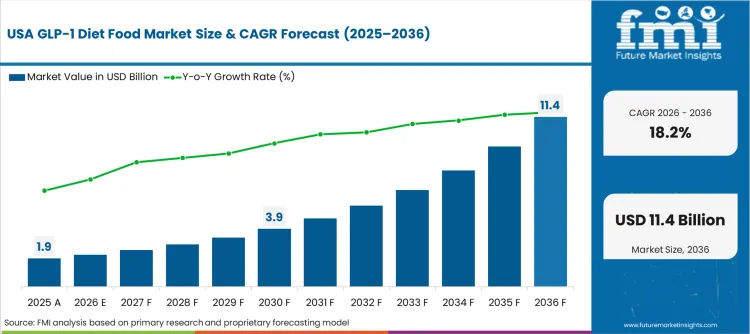
The United States remains the reference market for the category. It has the strongest mix of GLP-1 adoption, retail innovation, consumer willingness to try premium health-positioned foods, and visible large-brand investment.
- Nestlé's Vital Pursuit launch gave the category an early mainstream packaged-food benchmark.
- Conagra's Healthy Choice badge strategy showed how incumbents can adapt existing products for GLP-1 relevance.
- Smoothie King's national support menu pushed the category into foodservice and on-the-go consumption.
Why Does the United Kingdom Matter in This GLP-1 Diet Food Market?
The United Kingdom matters through direct-to-consumer nutrition brands, functional meal formats, and strong consumer comfort with structured food solutions. Huel's scale and Danone's 2026 move to acquire it strengthen the country's role in the market's development path.
- Functional nutrition is already established in the UK as a consumer habit rather than a niche.
- Direct-to-consumer distribution makes education and repeat purchase easier in early-stage categories.
- Portion-aware complete nutrition formats are likely to resonate with GLP-1-linked users.
What Is Driving Demand in Germany?
Germany remains important as a high-spec market for functional nutrition, pharmacy-adjacent wellness, and structured eating formats. Buyers tend to reward quality and clear product logic over trend-heavy positioning.
- Premium meal and nutrition products have stronger room to scale in Germany than in price-led mass markets.
- Consumer trust depends on product clarity and nutritional discipline.
- The market is likely to favor credible protein-and-fiber propositions with straightforward communication.
How Are Japan and South Korea Entering the Category?
Japan and South Korea are likely to approach the category through convenience, format discipline, and premium portion-controlled products rather than through loud GLP-1 branding alone. Small-format nutrition products already fit both markets well.
- Convenience-led eating patterns suit smaller, nutrient-dense product concepts.
- Functional beverage and snack innovation is already strong in both countries.
- Users are likely to respond better to restrained nutritional positioning than to overtly medical framing.
Competitive Landscape and Strategic Positioning
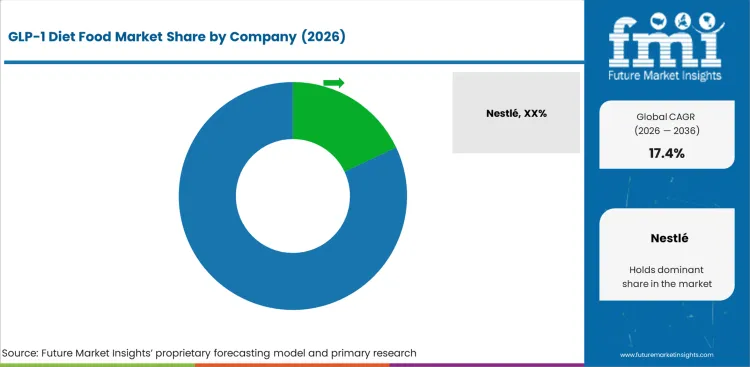
- The market is early-stage, though it is already attracting large food companies, ingredient platforms, and functional nutrition brands.
- Competitive advantage depends on protein credibility, portion logic, retail execution, and consumer trust.
- The strongest suppliers are building around familiar formats instead of trying to invent a completely new eating occasion.
Competition is forming across three different models. Large packaged-food groups are adapting existing meal and nutrition assets. Ingredient and solutions players are helping brands formulate GLP-1-supportive products. Functional nutrition brands are leaning into direct-to-consumer education and higher-margin complete nutrition formats.
That split matters. It means the market is unlikely to consolidate around one format or one channel in the near term. Frozen meals, shakes, protein snacks, and complete-meal concepts can all coexist if they solve a real user problem.
Credibility will remain the main commercial filter. Buyers and users want foods that feel useful rather than opportunistic. Companies that can show nutritional relevance without turning every message into medical marketing are better placed to hold long-term demand.
Key Companies in the GLP-1 Diet Food Market
Key companies active in the market include Nestlé, Conagra Brands, Danone, Huel, Smoothie King, and ADM.
Competitive Benchmarking: GLP-1 Diet Food Market
| Company | Core Strength | Primary GLP-1-adjacent Exposure | Strategic Positioning | Geographic Footprint |
|---|---|---|---|---|
| Nestlé | Scaled food and nutrition portfolio | Vital Pursuit meals and GLP-1 nutrition support | Mainstream packaged-food leadership | Global |
| Conagra Brands | Established frozen-meal and convenience strength | Healthy Choice GLP-1-friendly meal cues | Portfolio adaptation within mass retail | North America |
| Danone | Functional nutrition scale | Huel acquisition and health-led portfolio expansion | Complete nutrition and premium wellness | Global |
| Huel | Digitally native complete nutrition platform | Portion-aware powders, RTDs, and meal formats | Functional nutrition and DTC depth | UK, Europe, USA |
| Smoothie King | Foodservice and wellness positioning | GLP-1 Support Menu in national QSR format | On-the-go protein and hydration support | USA |
| ADM | Ingredient and concept platform | GLP-1-supportive food and supplement concepts | Formulation and B2B enablement | Global |
Key Developments in GLP-1 Diet Food Market
- Nestlé introduced Vital Pursuit in May 2024 as the first food brand in its USA portfolio designed for GLP-1 users, with frozen bowls, sandwiches, and pizzas built around protein, fiber, and portion alignment.
- Smoothie King launched a national GLP-1 Support Menu in October 2024 with high-protein, fiber-rich smoothies positioned for medication users and other weight-management consumers.
- ADM unveiled GLP-1-supportive solutions in October 2024, including more than 25 market-ready food and supplement concepts for brand customers developing products for GLP-1 users.
- Conagra Brands announced in December 2024 that select Healthy Choice items would carry an "On Track" badge from January 2025 to help shoppers identify GLP-1-friendly meal options.
- Danone announced in March 2026 that it had entered into an agreement to acquire Huel, subject to regulatory approvals, strengthening its exposure to complete-meal formats relevant to GLP-1-linked eating behavior.
Key Players in the GLP-1 Diet Food Market
Major Global Players
- Nestlé
- Conagra Brands
- Danone
- Huel
- Smoothie King
- ADM
Emerging and Adjacent Growth Brands
- Protein-led snack brands, digital nutrition platforms, and clinically aligned wellness-food companies are likely to widen the field over the next few years. Their role will be most important in niches where personalization, coaching, or direct subscription models improve retention.
Report Scope and Coverage
| Attribute | Details |
|---|---|
| Estimated market size (2026) | USD 3.1 billion |
| Projected market size (2036) | USD 15.4 billion |
| CAGR (2026 to 2036) | 17.4% |
| Forecast period | 2026 to 2036 |
| Quantitative units | USD billion |
| Key segment coverage | Product Type, Nutritional Focus, Consumer Stage, Distribution Channel, Packaging Format, End Use, Region |
| Regions covered | North America, Europe, Asia Pacific, Latin America, Middle East and Africa |
Segment Analysis by Product Type, Nutritional Focus, Consumer Stage, Distribution Channel, Packaging Format, End Use, and Region
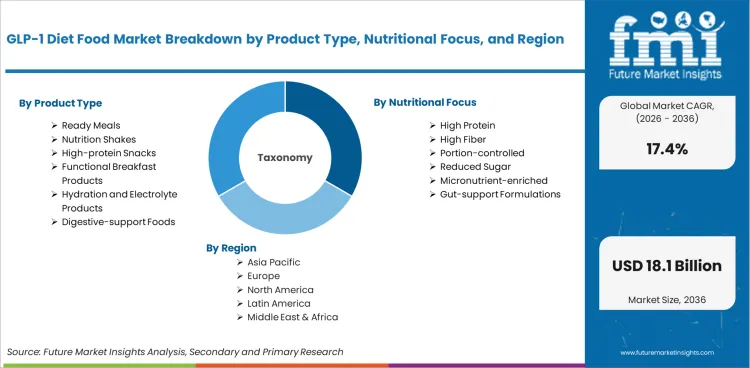
By Product Type:
- Ready Meals
- Nutrition Shakes
- High-protein Snacks
- Functional Breakfast Products
- Hydration and Electrolyte Products
- Digestive-support Foods
By Nutritional Focus:
- High Protein
- High Fiber
- Portion-controlled
- Reduced Sugar
- Micronutrient-enriched
- Gut-support Formulations
By Consumer Stage:
- Active GLP-1 Users
- Weight-maintenance Users
- GLP-1 Step-down Users
- General Weight-management Consumers
By Distribution Channel:
- Supermarkets and Hypermarkets
- Pharmacies and Health Stores
- Direct-to-Consumer
- E-commerce Marketplaces
- Foodservice and QSR
By Packaging Format:
- Single-serve Frozen
- Shelf-stable Packs
- Refrigerated Drinks
- Powdered Mixes
- Snack Bars and Bites
By End Use:
- Retail Household Consumption
- Clinical and Dietitian-led Programs
- Fitness and Wellness Use
- Foodservice and On-the-go Consumption
By Region:
- North America
- Europe
- Asia Pacific
- Latin America
- Middle East and Africa
Research Sources and Bibliography
- U.S. Food and Drug Administration. 2025. Wegovy (semaglutide) Injection: Prescribing Information.
- Eli Lilly and Company. 2026. Zepbound (tirzepatide) Injection: Prescribing Information.
- Novo Nordisk. 2026. Wegovy Prescribing Information and Patient Safety Information.
- Nestlé. 2024. Vital Pursuit Supports GLP-1 Users in the U.S.
- Nestlé Health Science. 2025. Nestlé Health Science Launches GLP-1 Nutrition Support Platform in U.S.
- Conagra Brands. 2024. Conagra Brands Introduces Badges on Select Healthy Choice Products, Leading Consumers to GLP-1 Friendly Options.
- Smoothie King. 2024. Smoothie King Launches GLP-1 Support Menu to Support Health and Fitness Journeys to Medication Users.
- ADM. 2024. ADM Unveils GLP-1 Supportive Solutions Backed by Proprietary Insights.
- ADM. 2026. GLP-1 User Support Products.
- Danone. 2026. Danone Announces Agreement to Acquire Huel.
- Huel. 2026. Huel Product and Nutrition Information.
This Report Answers
- What is the projected value of the GLP-1 Diet Food Market in 2026 and 2036?
- What is the expected CAGR from 2026 to 2036?
- Which segment currently contributes the largest share in the market structure?
- Which countries are expected to expand faster than the global average through 2036?
- Which companies hold the strongest visible positions in the current competitive landscape?
- What commercial factors are supporting current market adoption?
- Which product, application, or end-use areas are expected to create the strongest opportunity?
Frequently Asked Questions
What is the global market demand for GLP-1 Diet Food Market in 2026?
In 2026, the global market for GLP-1 Diet Food Market is estimated at USD 3.1 billion.
What is the forecast market value by 2036?
By 2036, the market is projected to reach USD 15.4 billion under the base-case forecast model.
What is the forecast CAGR from 2026 to 2036?
The market is expected to expand at a 17.4% CAGR during the forecast period.
Which segment leads the market?
The leading segment is identified in the market segmentation analysis based on FMI estimates for 2026.
Which countries are expected to expand faster than the global average?
The regional market analysis highlights the faster-growing country markets under the FMI forecast model.
Why is GLP-1 Diet Food Market gaining market traction?
Adoption is rising as suppliers and buyers respond to measurable operational, commercial, and performance needs in the category.
Preview the report firsthand - request a free sample
Get SampleGet the brochure for pricing and purchase details.
Get PDFTable of Content
- Executive Summary
- Global Market Outlook
- Demand-side Trends
- Supply-side Trends
- Technology Roadmap Analysis
- Analysis and Recommendations
- Market Overview
- Market Coverage / Taxonomy
- Market Definition / Scope / Limitations
- Research Methodology
- Chapter Orientation
- Analytical Lens and Working Hypotheses
- Market Structure, Signals, and Trend Drivers
- Benchmarking and Cross-market Comparability
- Market Sizing, Forecasting, and Opportunity Mapping
- Research Design and Evidence Framework
- Desk Research Programme (Secondary Evidence)
- Company Annual and Sustainability Reports
- Peer-reviewed Journals and Academic Literature
- Corporate Websites, Product Literature, and Technical Notes
- Earnings Decks and Investor Briefings
- Statutory Filings and Regulatory Disclosures
- Technical White Papers and Standards Notes
- Trade Journals, Industry Magazines, and Analyst Briefs
- Conference Proceedings, Webinars, and Seminar Materials
- Government Statistics Portals and Public Data Releases
- Press Releases and Reputable Media Coverage
- Specialist Newsletters and Curated Briefings
- Sector Databases and Reference Repositories
- FMI Internal Proprietary Databases and Historical Market Datasets
- Subscription Datasets and Paid Sources
- Social Channels, Communities, and Digital Listening Inputs
- Additional Desk Sources
- Expert Input and Fieldwork (Primary Evidence)
- Primary Modes
- Qualitative Interviews and Expert Elicitation
- Quantitative Surveys and Structured Data Capture
- Blended Approach
- Why Primary Evidence is Used
- Field Techniques
- Interviews
- Surveys
- Focus Groups
- Observational and In-context Research
- Social and Community Interactions
- Stakeholder Universe Engaged
- C-suite Leaders
- Board Members
- Presidents and Vice Presidents
- R&D and Innovation Heads
- Technical Specialists
- Domain Subject-matter Experts
- Scientists
- Physicians and Other Healthcare Professionals
- Governance, Ethics, and Data Stewardship
- Research Ethics
- Data Integrity and Handling
- Primary Modes
- Tooling, Models, and Reference Databases
- Desk Research Programme (Secondary Evidence)
- Data Engineering and Model Build
- Data Acquisition and Ingestion
- Cleaning, Normalisation, and Verification
- Synthesis, Triangulation, and Analysis
- Quality Assurance and Audit Trail
- Market Background
- Market Dynamics
- Drivers
- Restraints
- Opportunity
- Trends
- Scenario Forecast
- Demand in Optimistic Scenario
- Demand in Likely Scenario
- Demand in Conservative Scenario
- Opportunity Map Analysis
- Product Life Cycle Analysis
- Supply Chain Analysis
- Investment Feasibility Matrix
- Value Chain Analysis
- PESTLE and Porter’s Analysis
- Regulatory Landscape
- Regional Parent Market Outlook
- Production and Consumption Statistics
- Import and Export Statistics
- Market Dynamics
- Global Market Analysis 2021 to 2025 and Forecast, 2026 to 2036
- Historical Market Size Value (USD Million) Analysis, 2021 to 2025
- Current and Future Market Size Value (USD Million) Projections, 2026 to 2036
- Y-o-Y Growth Trend Analysis
- Absolute $ Opportunity Analysis
- Global Market Pricing Analysis 2021 to 2025 and Forecast 2026 to 2036
- Global Market Analysis 2021 to 2025 and Forecast 2026 to 2036, By Product Type
- Introduction / Key Findings
- Historical Market Size Value (USD Million) Analysis By Product Type , 2021 to 2025
- Current and Future Market Size Value (USD Million) Analysis and Forecast By Product Type , 2026 to 2036
- Ready Meals
- Nutrition Shakes
- High-protein Snacks
- Functional Breakfast Products
- Hydration and Electrolyte Products
- Digestive-support Foods
- Ready Meals
- Y-o-Y Growth Trend Analysis By Product Type , 2021 to 2025
- Absolute $ Opportunity Analysis By Product Type , 2026 to 2036
- Global Market Analysis 2021 to 2025 and Forecast 2026 to 2036, By Nutritional Focus
- Introduction / Key Findings
- Historical Market Size Value (USD Million) Analysis By Nutritional Focus, 2021 to 2025
- Current and Future Market Size Value (USD Million) Analysis and Forecast By Nutritional Focus, 2026 to 2036
- High Protein
- High Fiber
- Portion-controlled
- Reduced Sugar
- Micronutrient-enriched
- Gut-support Formulations
- High Protein
- Y-o-Y Growth Trend Analysis By Nutritional Focus, 2021 to 2025
- Absolute $ Opportunity Analysis By Nutritional Focus, 2026 to 2036
- Global Market Analysis 2021 to 2025 and Forecast 2026 to 2036, By Region
- Introduction
- Historical Market Size Value (USD Million) Analysis By Region, 2021 to 2025
- Current Market Size Value (USD Million) Analysis and Forecast By Region, 2026 to 2036
- North America
- Latin America
- Western Europe
- Eastern Europe
- East Asia
- South Asia and Pacific
- Middle East & Africa
- Market Attractiveness Analysis By Region
- North America Market Analysis 2021 to 2025 and Forecast 2026 to 2036, By Country
- Historical Market Size Value (USD Million) Trend Analysis By Market Taxonomy, 2021 to 2025
- Market Size Value (USD Million) Forecast By Market Taxonomy, 2026 to 2036
- By Country
- USA
- Canada
- Mexico
- By Product Type
- By Nutritional Focus
- By Country
- Market Attractiveness Analysis
- By Country
- By Product Type
- By Nutritional Focus
- Key Takeaways
- Latin America Market Analysis 2021 to 2025 and Forecast 2026 to 2036, By Country
- Historical Market Size Value (USD Million) Trend Analysis By Market Taxonomy, 2021 to 2025
- Market Size Value (USD Million) Forecast By Market Taxonomy, 2026 to 2036
- By Country
- Brazil
- Chile
- Rest of Latin America
- By Product Type
- By Nutritional Focus
- By Country
- Market Attractiveness Analysis
- By Country
- By Product Type
- By Nutritional Focus
- Key Takeaways
- Western Europe Market Analysis 2021 to 2025 and Forecast 2026 to 2036, By Country
- Historical Market Size Value (USD Million) Trend Analysis By Market Taxonomy, 2021 to 2025
- Market Size Value (USD Million) Forecast By Market Taxonomy, 2026 to 2036
- By Country
- Germany
- UK
- Italy
- Spain
- France
- Nordic
- BENELUX
- Rest of Western Europe
- By Product Type
- By Nutritional Focus
- By Country
- Market Attractiveness Analysis
- By Country
- By Product Type
- By Nutritional Focus
- Key Takeaways
- Eastern Europe Market Analysis 2021 to 2025 and Forecast 2026 to 2036, By Country
- Historical Market Size Value (USD Million) Trend Analysis By Market Taxonomy, 2021 to 2025
- Market Size Value (USD Million) Forecast By Market Taxonomy, 2026 to 2036
- By Country
- Russia
- Poland
- Hungary
- Balkan & Baltic
- Rest of Eastern Europe
- By Product Type
- By Nutritional Focus
- By Country
- Market Attractiveness Analysis
- By Country
- By Product Type
- By Nutritional Focus
- Key Takeaways
- East Asia Market Analysis 2021 to 2025 and Forecast 2026 to 2036, By Country
- Historical Market Size Value (USD Million) Trend Analysis By Market Taxonomy, 2021 to 2025
- Market Size Value (USD Million) Forecast By Market Taxonomy, 2026 to 2036
- By Country
- China
- Japan
- South Korea
- By Product Type
- By Nutritional Focus
- By Country
- Market Attractiveness Analysis
- By Country
- By Product Type
- By Nutritional Focus
- Key Takeaways
- South Asia and Pacific Market Analysis 2021 to 2025 and Forecast 2026 to 2036, By Country
- Historical Market Size Value (USD Million) Trend Analysis By Market Taxonomy, 2021 to 2025
- Market Size Value (USD Million) Forecast By Market Taxonomy, 2026 to 2036
- By Country
- India
- ASEAN
- Australia & New Zealand
- Rest of South Asia and Pacific
- By Product Type
- By Nutritional Focus
- By Country
- Market Attractiveness Analysis
- By Country
- By Product Type
- By Nutritional Focus
- Key Takeaways
- Middle East & Africa Market Analysis 2021 to 2025 and Forecast 2026 to 2036, By Country
- Historical Market Size Value (USD Million) Trend Analysis By Market Taxonomy, 2021 to 2025
- Market Size Value (USD Million) Forecast By Market Taxonomy, 2026 to 2036
- By Country
- Kingdom of Saudi Arabia
- Other GCC Countries
- Turkiye
- South Africa
- Other African Union
- Rest of Middle East & Africa
- By Product Type
- By Nutritional Focus
- By Country
- Market Attractiveness Analysis
- By Country
- By Product Type
- By Nutritional Focus
- Key Takeaways
- Key Countries Market Analysis
- USA
- Pricing Analysis
- Market Share Analysis, 2025
- By Product Type
- By Nutritional Focus
- Canada
- Pricing Analysis
- Market Share Analysis, 2025
- By Product Type
- By Nutritional Focus
- Mexico
- Pricing Analysis
- Market Share Analysis, 2025
- By Product Type
- By Nutritional Focus
- Brazil
- Pricing Analysis
- Market Share Analysis, 2025
- By Product Type
- By Nutritional Focus
- Chile
- Pricing Analysis
- Market Share Analysis, 2025
- By Product Type
- By Nutritional Focus
- Germany
- Pricing Analysis
- Market Share Analysis, 2025
- By Product Type
- By Nutritional Focus
- UK
- Pricing Analysis
- Market Share Analysis, 2025
- By Product Type
- By Nutritional Focus
- Italy
- Pricing Analysis
- Market Share Analysis, 2025
- By Product Type
- By Nutritional Focus
- Spain
- Pricing Analysis
- Market Share Analysis, 2025
- By Product Type
- By Nutritional Focus
- France
- Pricing Analysis
- Market Share Analysis, 2025
- By Product Type
- By Nutritional Focus
- India
- Pricing Analysis
- Market Share Analysis, 2025
- By Product Type
- By Nutritional Focus
- ASEAN
- Pricing Analysis
- Market Share Analysis, 2025
- By Product Type
- By Nutritional Focus
- Australia & New Zealand
- Pricing Analysis
- Market Share Analysis, 2025
- By Product Type
- By Nutritional Focus
- China
- Pricing Analysis
- Market Share Analysis, 2025
- By Product Type
- By Nutritional Focus
- Japan
- Pricing Analysis
- Market Share Analysis, 2025
- By Product Type
- By Nutritional Focus
- South Korea
- Pricing Analysis
- Market Share Analysis, 2025
- By Product Type
- By Nutritional Focus
- Russia
- Pricing Analysis
- Market Share Analysis, 2025
- By Product Type
- By Nutritional Focus
- Poland
- Pricing Analysis
- Market Share Analysis, 2025
- By Product Type
- By Nutritional Focus
- Hungary
- Pricing Analysis
- Market Share Analysis, 2025
- By Product Type
- By Nutritional Focus
- Kingdom of Saudi Arabia
- Pricing Analysis
- Market Share Analysis, 2025
- By Product Type
- By Nutritional Focus
- Turkiye
- Pricing Analysis
- Market Share Analysis, 2025
- By Product Type
- By Nutritional Focus
- South Africa
- Pricing Analysis
- Market Share Analysis, 2025
- By Product Type
- By Nutritional Focus
- USA
- Market Structure Analysis
- Competition Dashboard
- Competition Benchmarking
- Market Share Analysis of Top Players
- By Regional
- By Product Type
- By Nutritional Focus
- Competition Analysis
- Competition Deep Dive
- Nestlé
- Overview
- Product Portfolio
- Profitability by Market Segments (Product/Age /Sales Channel/Region)
- Sales Footprint
- Strategy Overview
- Marketing Strategy
- Product Strategy
- Channel Strategy
- Conagra Brands
- Danone
- Huel
- Smoothie King
- ADM
- Nestlé
- Competition Deep Dive
- Assumptions & Acronyms Used


