

- Industry Size (2026)
- USD 1.17 Bn
- Forecast (2036)
- USD 1.91 Bn
- CAGR (2026 to 2036)
- 5.00%
Hinged Dual Flap Caps Market Size, Market Forecast and Outlook By FMI

The hinged dual flap caps market was valued at USD 1.12 billion in 2025, projected to reach USD 1.17 billion in 2026, and is forecast to expand to USD 1.91 billion by 2036 at a 5.00% CAGR. As per FMI, the incremental opportunity across the forecast period amounts to USD 73.96 billion, reflecting a steady expansion trajectory shaped by evolving end-use requirements and shifting procurement patterns across global supply chains.
Summary of Hinged Dual Flap Caps Market
- Market Snapshot
- The hinged dual flap caps market is valued at USD 1.12 billion in 2025 and is projected to reach USD 1.91 billion by 2036.
- The industry is expected to grow at a 5.00% CAGR from 2026 to 2036, creating an incremental opportunity of USD 73.96 billion.
- The market is a functional closure component category, where hinge fatigue life, dispensing precision, tamper evidence capability, and material recyclability define specification and procurement decisions across food, beverage, and personal care applications.
- Demand and Growth Drivers
- Demand is driven by quick-service restaurant and retail food packaging requirements for dual-function dispensing closures that enable both controlled shaking and pouring from a single cap.
- Personal care product brand owners are specifying hinged dual flap caps for controlled dispensing of viscous products where precise dosage and reclosability are critical to consumer experience.
- Pharmaceutical packaging tamper evidence requirements and child-resistant closure mandates are creating procurement specifications for dual flap cap designs with integrated safety features.
- Among key countries, China at 6.8%, India at 6.3%, Germany at 5.8%, Brazil at 5.3%, USA at 4.8%, UK at 4.3%, Japan at 3.8%.
- Product and Segment View
- The market includes hinged dual flap caps across material types (plastic, polypropylene, polyethylene terephthalate, polyethylene, LDPE, HDPE) for food, beverage, home and personal care, chemical and pharmaceutical, and other end-use applications.
- Snacks and chemicals application commands the leading end-use share, driven by spice, condiment, and chemical dispenser packaging volumes.
- The scope includes hinged dual flap caps manufactured as closure components, while excluding continuous thread screw caps, snap-on lids, dispensing pumps, and trigger sprayers.
- Plastic leads by Material Type with 33.1% share in 2026.
- Snacks Chemicals leads by End Use with 40.8% share in 2026.
- Geography and Competitive Outlook
- China and India are the fastest-growing markets driven by packaged food and FMCG manufacturing expansion, while North America and Europe sustain value through quick-service restaurant packaging and pharmaceutical closure specification requirements.
- Competition is shaped by product specification depth, manufacturing precision, and supply chain reliability, with key players including Berry Global Inc., Silgan Holdings Inc., Amcor Limited, RPC Group Plc, Albéa Group, Guala Closures Group, Closure Systems International, Weener Plastics Group, Bericap GmbH & Co. KG, Reynolds Group Holdings Limited, Blackhawk Molding Co. Inc., Global Closure Systems.
- Analyst Opinion at FMI
- Ismail Sutaria, Principal Consultant, opines: 'In my analysis, I have observed that the hinged dual flap caps market is experiencing a material specification tightening cycle where brand owners are mandating mono-material polypropylene or polyethylene constructions to meet packaging recyclability targets under Extended Producer Responsibility frameworks. Closure manufacturers who continue offering multi-material or non-recyclable cap designs face growing disqualification from brand owner and retailer approved component lists as circular economy compliance deadlines approach.'
- Strategic Implications / Executive Takeaways
- Closure manufacturers must transition production toward mono-material polypropylene and polyethylene hinged dual flap cap designs to meet brand owner recyclability specification requirements under EPR frameworks.
- Food and beverage brand owners should specify hinge fatigue life testing protocols in closure procurement contracts to ensure dispensing function reliability across product shelf life.
- Pharmaceutical packaging teams must evaluate dual flap cap designs against child-resistant closure and tamper evidence regulatory requirements to ensure compliance across target market jurisdictions.
Hinged Dual Flap Caps Market Key Takeaways
| Metric | Details |
|---|---|
| Industry Size (2026) | USD 1.17 Billion |
| Industry Value (2036) | USD 1.91 Billion |
| CAGR (2026-2036) | 5.00% |
Source: Future Market Insights, 2026
Based on FMI's report, the hinged dual flap caps market is expected to create an incremental opportunity of USD 73.96 billion between 2026 and 2036. FMI analysts project that end-use procurement patterns and regional supply chain dynamics will shape the distribution of this opportunity across segments and geographies.
Expanding convenience packaging demand across food, beverage, personal care, and pharmaceutical sectors is driving procurement of hinged dual flap caps that offer controlled dispensing, reclosability, and tamper evidence in a single closure format. Quick-service restaurant condiment packaging, spice dispenser bottles, and personal care product containers are the primary demand drivers as brand owners specify dual flap configurations that enable both shaking and pouring functions from the same opening. FMI analysts note that polypropylene and polyethylene material formulations dominate production volumes due to their combination of hinge fatigue resistance, chemical compatibility, and injection molding processability.
Regional demand for hinged dual flap caps reflects the geographic distribution of packaged food production, beverage bottling, personal care product manufacturing, and pharmaceutical packaging activity. China at 6.8% CAGR, India at 6.3% CAGR, Germany at 5.8% CAGR, Brazil at 5.3% CAGR, USA at 4.8% CAGR, UK at 4.3% CAGR, Japan at 3.8% CAGR. China leads growth through expanding processed food and personal care product manufacturing at scale. India follows on the strength of growing packaged food consumption and FMCG product proliferation across urban and semi-urban retail channels. Germany sustains growth through precision closure manufacturing and pharmaceutical packaging requirements. France and the United Kingdom maintain growth through food and personal care packaging specification upgrades. The United States advances through quick-service restaurant packaging demand and spice and condiment container procurement volumes. Brazil registers steady growth as packaged food and beverage manufacturing scales.
Hinged Dual Flap Caps Market Definition
Hinged dual flap caps are injection-molded plastic closures featuring two independently openable dispensing flaps connected by a living hinge to the cap body. They provide dual-function dispensing capability, typically combining a shaker opening and a pour spout within a single reclosable closure. These caps are used across food packaging (spices, condiments, sweeteners), beverage containers, personal care products, and pharmaceutical and chemical dispensing applications.
Future Market Insights analysis captures the complete addressable consumption base across all major producing and consuming regions, covering the forecast period from 2026 to 2036.
Hinged Dual Flap Caps Market Inclusions
Market scope includes hinged dual flap caps across material types (plastic, polypropylene, PET, polyethylene, LDPE, HDPE), end-use applications, and end-use industries (food, beverage, home and personal care, chemicals and pharmaceuticals, others). The assessment covers global and regional market sizes, forecast period 2026 to 2036, and segment breakdowns by material type, end use, end-use industry, and region.
Hinged Dual Flap Caps Market Exclusions
The scope excludes continuous thread screw caps, snap-on lids, dispensing pumps, trigger sprayers, flip-top caps with single opening, and child-resistant closures that do not feature dual flap dispensing. Cap liners and induction seals sold separately are not included.
Hinged Dual Flap Caps Market Research Methodology
- Primary Research: Analysts engaged with procurement managers, production engineers, and distribution channel executives to map the decision gates and compliance thresholds shaping product adoption.
- Desk Research: Data collection aggregated regulatory filings, trade body publications, standards body documentation, and company financial disclosures across all major producing and consuming regions.
- Market-Sizing and Forecasting: Baseline values derive from a bottom-up aggregation of producer shipment volumes and trade flow data, applying region-specific demand growth curves to project adoption velocity through 2036.
- Data Validation and Update Cycle: Projections are tested against publicly reported industry statistics, trade data, and company guidance. The model is updated quarterly to reflect market structure changes.
Why is the Hinged Dual Flap Caps Market Growing?
The Hinged Dual Flap Caps market is witnessing steady growth, driven by increasing demand for convenient, resealable packaging solutions across food, beverage, and chemical industries. Growing consumer preference for on-the-go consumption and easy-to-use packaging has accelerated the adoption of hinged dual flap caps, which offer enhanced sealing, reusability, and product protection. Advances in cap design, manufacturing precision, and material optimization have improved durability and performance, further strengthening market acceptance.
Plastic materials, which offer lightweight, cost-effective, and versatile solutions, are increasingly being utilized in the production of these caps. Rising demand from snacks, chemicals, and packaged food sectors is fueling widespread adoption, while regulatory compliance regarding food safety and chemical containment reinforces the importance of high-quality materials.
Increasing focus on reducing packaging waste through recyclable and environmentally sustainable plastics is shaping market trends As manufacturers continue to innovate in design and material selection, and as consumer convenience remains a priority, the Hinged Dual Flap Caps market is expected to experience sustained growth, driven by functionality, efficiency, and safety.
Segmental Analysis
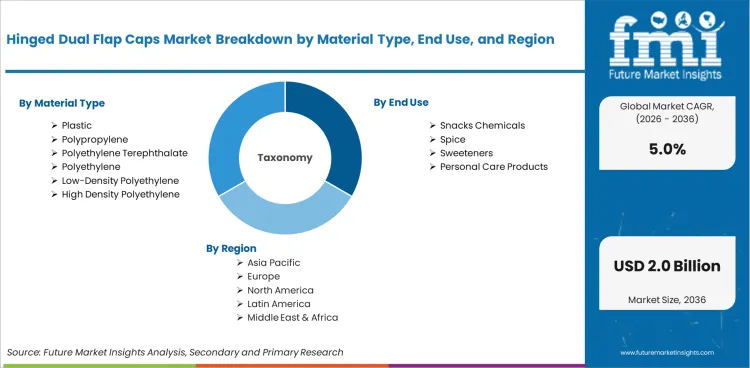
The hinged dual flap caps market is segmented by material type, end use, end use industry, and geographic regions. By material type, hinged dual flap caps market is divided into Plastic, Polypropylene (PP), Polyethylene Terephthalate (PET), Polyethylene (PE), Low-Density Polyethylene (LDPE), and High Density Polyethylene (HDPE). In terms of end use, hinged dual flap caps market is classified into Snacks Chemicals, Spice, Sweeteners, and Personal Care Products. Based on end use industry, hinged dual flap caps market is segmented into Food, Beverage, Home & Personal Care Products, Chemicals & Pharmaceuticals, and Others (Agro Products, Etc.). Regionally, the hinged dual flap caps industry is classified into North America, Latin America, Western Europe, Eastern Europe, Balkan & Baltic Countries, Russia & Belarus, Central Asia, East Asia, South Asia & Pacific, and the Middle East & Africa.
Insights into the Plastic Material Type Segment
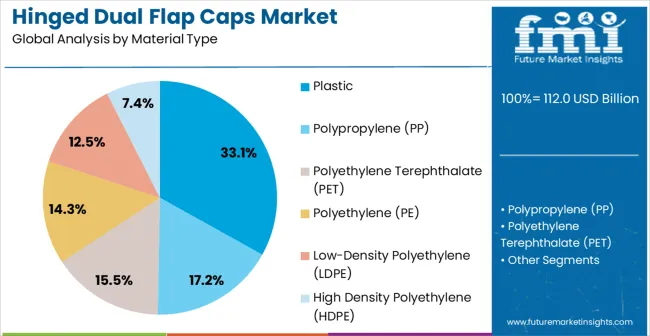
The plastic material type segment is projected to hold 33.1% of the market revenue in 2026, making it the leading material type. Growth in this segment is being driven by plastic’s versatility, lightweight nature, and cost-effectiveness, which make it ideal for large-scale production of hinged dual flap caps. Plastic allows for consistent molding precision, durability, and the ability to incorporate multiple functionalities, such as resealability and leak prevention.
The material also supports diverse color, texture, and branding requirements, which enhances consumer appeal. Its compatibility with food-grade and chemical-grade standards ensures safety and regulatory compliance across industries. Rising adoption in snacks, beverages, and chemicals is reinforcing plastic’s market leadership.
Additionally, ongoing innovations in recyclable and bio-based plastics are creating opportunities for sustainable product offerings The combination of performance, flexibility, and economic advantages is ensuring that plastic remains the preferred material for hinged dual flap caps, supporting continued dominance in the market.
Insights into the Snacks Chemicals End Use Segment
The snacks chemicals end use segment is anticipated to account for 40.8% of the market revenue in 2026, establishing it as the leading end-use category. Growth is being driven by the increasing demand for convenient, resealable packaging in snack and chemical products to maintain freshness, prevent contamination, and enhance user convenience. Hinged dual flap caps enable precise dispensing and resealing, which is critical for product safety and shelf life in snacks and chemical applications.
Manufacturers are leveraging these caps to improve brand perception, product functionality, and consumer satisfaction. Compliance with food safety and chemical handling standards further supports adoption in this segment.
As consumer demand for packaged snacks and specialty chemical products rises globally, the use of hinged dual flap caps in this end-use sector is expected to remain dominant Innovation in cap design, material durability, and multi-functional features continues to reinforce growth, positioning snacks chemicals as a key driver of the market.
Insights into the Food End Use Industry Segment

The food end-use industry segment is projected to hold 33.7% of the market revenue in 2026, making it the leading end-use industry. The growth of this segment is being driven by the increasing demand for convenient, resealable packaging that ensures product freshness, hygiene, and ease of consumption. Hinged dual flap caps allow for reliable sealing and repeated opening without compromising the quality or safety of food products.
Rising consumer preference for on-the-go snacks, beverages, and packaged foods is accelerating adoption. The ability to integrate branding, labeling, and tamper-evident features within these caps enhances product appeal and regulatory compliance.
Manufacturers are increasingly adopting durable, food-grade materials to meet safety standards and performance requirements As packaged food consumption continues to rise globally, the demand for hinged dual flap caps in the food industry is expected to sustain strong growth, reinforced by innovation in material selection, ergonomic design, and multi-functional sealing capabilities.
Market Overview
At the forefront, the key players invest huge amounts of money in Research and Development. Additionally, the manufacturers are using materials like Polypropylene and Polyethylene to develop robust flap caps.
Moreover, the manufacturers are developing customized dual flap caps to target a larger customer base and properly dispense the materials. The products are being developed by ensuring that they cater to the customers to dispense the required amount of liquid, thereby helping them in regularisation.
Moreover, the manufacturers in the hinged dual flap caps market are making the best use of the ease of availability of raw materials. A lot of costs are cut down owing to less investment in logistics and supply chain, and because of this, they can invest the same amount for other useful purposes.
Thus, the manufacturers can invest the same amount in upgrading their technology through cost cutting. On that note, they are making use of robots. Robots can perform certain monotonous tasks with ten times higher efficiency than humans.
Moreover, within the factory as well, all the heavy-duty work is being carried out by robots. Because of this, human resources are used in extremely crucial tasks that mainly involve decision-making and product development.
One more major development in the market is that the key players are expanding their portfolios through integration or diversification.
If we talk about integration, the key players mainly opt for forwarding integration as they come closer to the end customer. This will help them further enhance their products.
However, as far as diversification is concerned, the key players in the hinged dual flap caps market are getting into new fields. Thanks to the huge investment that they are making in headhunts. Moreover, getting into an unrelated field would mean a lot of risks.
To mitigate the risks, the key players are conducting pilot tests and launching the products on a district/state level. This sampling method would help the key players save a lot of money and take the necessary step only after careful consideration.
Analysis of Hinged Dual Flap Caps Market By Key Countries
.webp "Top Country Growth Comparison Hinged Dual Flap Caps Market Cagr (2026 2036)")
| Country | CAGR |
|---|---|
| China | 6.8% |
| India | 6.3% |
| Germany | 5.8% |
| Brazil | 5.3% |
| USA | 4.8% |
| UK | 4.3% |
| Japan | 3.8% |
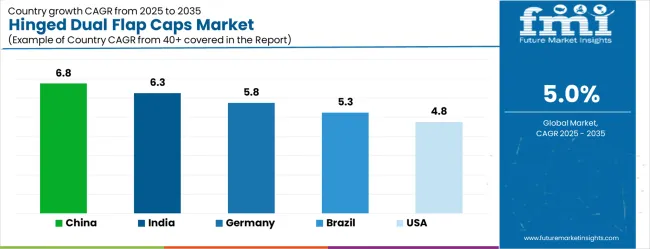
The Hinged Dual Flap Caps Market is expected to register a CAGR of 5.0% during the forecast period, exhibiting varied country level momentum. China leads with the highest CAGR of 6.8%, followed by India at 6.3%. Developed markets such as Germany, France, and the UK continue to expand steadily, while the USA is likely to grow at consistent rates. Japan posts the lowest CAGR at 3.8%, yet still underscores a broadly positive trajectory for the global Hinged Dual Flap Caps Market. In 2026, Germany held a dominant revenue in the Western Europe market and is expected to grow with a CAGR of 5.8%. The USA Hinged Dual Flap Caps Market is estimated to be valued at USD 38.7 billion in 2026 and is anticipated to reach a valuation of USD 38.7 billion by 2036. Sales are projected to rise at a CAGR of 4.8% over the forecast period between 2026 and 2036. While Japan and South Korea markets are estimated to be valued at USD 5.8 billion and USD 3.0 billion respectively in 2026.
Key Players in the Hinged Dual Flap Caps Market
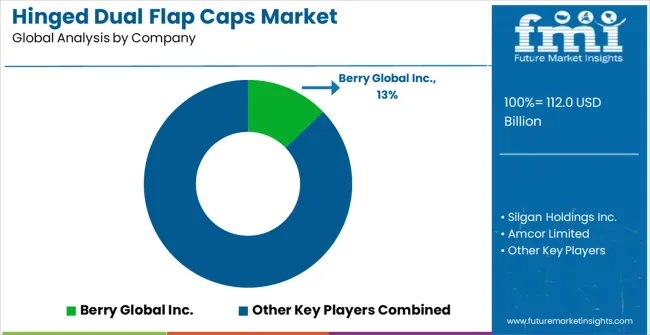
- Berry Global Inc.
- Silgan Holdings Inc.
- Amcor Limited
- RPC Group Plc
- Albéa Group
- Guala Closures Group
- Closure Systems International
- Weener Plastics Group
- Bericap GmbH & Co. KG
- Reynolds Group Holdings Limited
- Blackhawk Molding Co. Inc.
- Global Closure Systems
- Comar LLC
- O.Berk Company, LLC
- Plastic Closures Limited
Scope of the Report
| Metric | Value |
|---|---|
| Quantitative Units | USD 1.17 Billion to USD 1.91 Billion, at a CAGR of 5.00% |
| Market Definition | Hinged dual flap caps are injection-molded plastic closures featuring two independently openable dispensing flaps connected by a living hinge to the cap body. They provide dual-function dispensing capability, typically combining a shaker opening and a pour spout within a single reclosable closure. |
| Segmentation | Material Type: Plastic, Polypropylene, Polyethylene Terephthalate, Polyethylene, Low-Density Polyethylene, High Density Polyethylene; End Use: Snacks Chemicals, Spice, Sweeteners, Personal Care Products; End Use Industry: Food, Beverage, Home & Personal Care Products, Chemicals & Pharmaceuticals, Others |
| Regions Covered | North America, Latin America, Europe, East Asia, South Asia, Oceania, Middle East & Africa |
| Countries Covered | China, India, Germany, Brazil, USA, UK, Japan, and 40 plus countries |
| Key Companies Profiled | Berry Global Inc., Silgan Holdings Inc., Amcor Limited, RPC Group Plc, Albéa Group, Guala Closures Group, Closure Systems International, Weener Plastics Group, Bericap GmbH & Co. KG, Reynolds Group Holdings Limited, Blackhawk Molding Co. Inc., Global Closure Systems |
| Forecast Period | 2026 to 2036 |
| Approach | Forecasting models apply a bottom-up methodology starting with regional production and trade metrics and projecting adoption rates against demand drivers and regulatory compliance timelines. |
Hinged Dual Flap Caps Market by Segments
Material Type:
- Plastic
- Polypropylene (PP)
- Polyethylene Terephthalate (PET)
- Polyethylene (PE)
- Low-Density Polyethylene (LDPE)
- High Density Polyethylene (HDPE)
End Use:
- Snacks Chemicals
- Spice
- Sweeteners
- Personal Care Products
End Use Industry:
- Food
- Beverage
- Home & Personal Care Products
- Chemicals & Pharmaceuticals
- Others (Agro Products, Etc.)
Region:
- North America
- USA
- Canada
- Mexico
- Latin America
- Brazil
- Chile
- Rest of Latin America
- Western Europe
- Germany
- UK
- Italy
- Spain
- France
- Nordic
- BENELUX
- Rest of Western Europe
- Eastern Europe
- Russia
- Poland
- Hungary
- Balkan & Baltic
- Rest of Eastern Europe
- East Asia
- China
- Japan
- South Korea
- South Asia and Pacific
- India
- ASEAN
- Australia & New Zealand
- Rest of South Asia and Pacific
- Middle East & Africa
- Kingdom of Saudi Arabia
- Other GCC Countries
- Turkiye
- South Africa
- Other African Union
- Rest of Middle East & Africa
Bibliography
- European Commission. (2025). Packaging and Packaging Waste Regulation (PPWR): Attached Caps Mandate. European Commission.
- USA Consumer Product Safety Commission. (2025). Poison Prevention Packaging Act: Child-Resistant Closure Standards. CPSC.
- International Organization for Standardization. (2025). ISO 8317: Child-Resistant Packaging Requirements. ISO.
- Organisation for Economic Co-operation and Development. (2025). Extended Producer Responsibility Policy Guidance: Packaging. OECD.
- Berry Global Inc. (2025). Annual Report 2025: Consumer Packaging Division. Berry Global.
This bibliography is provided for reader reference. The full Future Market Insights report contains the complete reference list with primary research documentation.
Frequently Asked Questions
How large is the demand for Hinged Dual Flap Caps in the global market in 2026?
Demand for Hinged Dual Flap Caps in the global market is estimated to be valued at USD 1.17 billion in 2026.
What will be the market size of Hinged Dual Flap Caps in the global market by 2036?
Market size for Hinged Dual Flap Caps is projected to reach USD 1.91 billion by 2036.
What is the expected demand growth for Hinged Dual Flap Caps in the global market between 2026 and 2036?
Demand for Hinged Dual Flap Caps is expected to grow at a CAGR of 5.00% between 2026 and 2036.
Which Material Type is poised to lead global sales by 2026?
Plastic accounts for 33.1% share in 2026 based on structural demand factors and procurement concentration patterns.
What is driving demand in China?
China leads growth at 6.8% CAGR through 2036, driven by expanding domestic production capacity and end-use procurement volumes.
What is India's growth outlook in this report?
India is projected to grow at a CAGR of 6.3% during 2026 to 2036.
What is Hinged Dual Flap Caps and what is it mainly used for?
Hinged dual flap caps are injection-molded plastic closures featuring two independently openable dispensing flaps connected by a living hinge to the cap body. They provide dual-function dispensing capability, typically combining a shaker opening and a pour spout within a single reclosable closure.
How does FMI build and validate the forecast?
Forecasting models apply a bottom-up methodology starting with regional production and trade metrics and cross-validate projections against industry statistics and company guidance.
Preview the report firsthand - request a free sample
Get SampleGet the brochure for pricing and purchase details.
Get PDFTable of Content
- Executive Summary
- Global Market Outlook
- Demand-side Trends
- Supply-side Trends
- Technology Roadmap Analysis
- Analysis and Recommendations
- Market Overview
- Market Coverage / Taxonomy
- Market Definition / Scope / Limitations
- Research Methodology
- Chapter Orientation
- Analytical Lens and Working Hypotheses
- Market Structure, Signals, and Trend Drivers
- Benchmarking and Cross-market Comparability
- Market Sizing, Forecasting, and Opportunity Mapping
- Research Design and Evidence Framework
- Desk Research Programme (Secondary Evidence)
- Company Annual and Sustainability Reports
- Peer-reviewed Journals and Academic Literature
- Corporate Websites, Product Literature, and Technical Notes
- Earnings Decks and Investor Briefings
- Statutory Filings and Regulatory Disclosures
- Technical White Papers and Standards Notes
- Trade Journals, Industry Magazines, and Analyst Briefs
- Conference Proceedings, Webinars, and Seminar Materials
- Government Statistics Portals and Public Data Releases
- Press Releases and Reputable Media Coverage
- Specialist Newsletters and Curated Briefings
- Sector Databases and Reference Repositories
- FMI Internal Proprietary Databases and Historical Market Datasets
- Subscription Datasets and Paid Sources
- Social Channels, Communities, and Digital Listening Inputs
- Additional Desk Sources
- Expert Input and Fieldwork (Primary Evidence)
- Primary Modes
- Qualitative Interviews and Expert Elicitation
- Quantitative Surveys and Structured Data Capture
- Blended Approach
- Why Primary Evidence is Used
- Field Techniques
- Interviews
- Surveys
- Focus Groups
- Observational and In-context Research
- Social and Community Interactions
- Stakeholder Universe Engaged
- C-suite Leaders
- Board Members
- Presidents and Vice Presidents
- R&D and Innovation Heads
- Technical Specialists
- Domain Subject-matter Experts
- Scientists
- Physicians and Other Healthcare Professionals
- Governance, Ethics, and Data Stewardship
- Research Ethics
- Data Integrity and Handling
- Primary Modes
- Tooling, Models, and Reference Databases
- Desk Research Programme (Secondary Evidence)
- Data Engineering and Model Build
- Data Acquisition and Ingestion
- Cleaning, Normalisation, and Verification
- Synthesis, Triangulation, and Analysis
- Quality Assurance and Audit Trail
- Market Background
- Market Dynamics
- Drivers
- Restraints
- Opportunity
- Trends
- Scenario Forecast
- Demand in Optimistic Scenario
- Demand in Likely Scenario
- Demand in Conservative Scenario
- Opportunity Map Analysis
- Product Life Cycle Analysis
- Supply Chain Analysis
- Investment Feasibility Matrix
- Value Chain Analysis
- PESTLE and Porter’s Analysis
- Regulatory Landscape
- Regional Parent Market Outlook
- Production and Consumption Statistics
- Import and Export Statistics
- Market Dynamics
- Global Market Analysis 2021 to 2025 and Forecast, 2026 to 2036
- Historical Market Size Value (USD Million) Analysis, 2021 to 2025
- Current and Future Market Size Value (USD Million) Projections, 2026 to 2036
- Y-o-Y Growth Trend Analysis
- Absolute $ Opportunity Analysis
- Global Market Pricing Analysis 2021 to 2025 and Forecast 2026 to 2036
- Global Market Analysis 2021 to 2025 and Forecast 2026 to 2036, By Material Type
- Introduction / Key Findings
- Historical Market Size Value (USD Million) Analysis By Material Type , 2021 to 2025
- Current and Future Market Size Value (USD Million) Analysis and Forecast By Material Type , 2026 to 2036
- Plastic
- Polypropylene
- Polyethylene Terephthalate
- Polyethylene
- Low-Density Polyethylene
- High Density Polyethylene
- Plastic
- Y-o-Y Growth Trend Analysis By Material Type , 2021 to 2025
- Absolute $ Opportunity Analysis By Material Type , 2026 to 2036
- Global Market Analysis 2021 to 2025 and Forecast 2026 to 2036, By End Use
- Introduction / Key Findings
- Historical Market Size Value (USD Million) Analysis By End Use, 2021 to 2025
- Current and Future Market Size Value (USD Million) Analysis and Forecast By End Use, 2026 to 2036
- Snacks Chemicals
- Spice
- Sweeteners
- Personal Care Products
- Snacks Chemicals
- Y-o-Y Growth Trend Analysis By End Use, 2021 to 2025
- Absolute $ Opportunity Analysis By End Use, 2026 to 2036
- Global Market Analysis 2021 to 2025 and Forecast 2026 to 2036, By End Use Industry
- Introduction / Key Findings
- Historical Market Size Value (USD Million) Analysis By End Use Industry, 2021 to 2025
- Current and Future Market Size Value (USD Million) Analysis and Forecast By End Use Industry, 2026 to 2036
- Food
- Beverage
- Home & Personal Care Products
- Chemicals & Pharmaceuticals
- Others
- Food
- Y-o-Y Growth Trend Analysis By End Use Industry, 2021 to 2025
- Absolute $ Opportunity Analysis By End Use Industry, 2026 to 2036
- Global Market Analysis 2021 to 2025 and Forecast 2026 to 2036, By Region
- Introduction
- Historical Market Size Value (USD Million) Analysis By Region, 2021 to 2025
- Current Market Size Value (USD Million) Analysis and Forecast By Region, 2026 to 2036
- North America
- Latin America
- Western Europe
- Eastern Europe
- East Asia
- South Asia and Pacific
- Middle East & Africa
- Market Attractiveness Analysis By Region
- North America Market Analysis 2021 to 2025 and Forecast 2026 to 2036, By Country
- Historical Market Size Value (USD Million) Trend Analysis By Market Taxonomy, 2021 to 2025
- Market Size Value (USD Million) Forecast By Market Taxonomy, 2026 to 2036
- By Country
- USA
- Canada
- Mexico
- By Material Type
- By End Use
- By End Use Industry
- By Country
- Market Attractiveness Analysis
- By Country
- By Material Type
- By End Use
- By End Use Industry
- Key Takeaways
- Latin America Market Analysis 2021 to 2025 and Forecast 2026 to 2036, By Country
- Historical Market Size Value (USD Million) Trend Analysis By Market Taxonomy, 2021 to 2025
- Market Size Value (USD Million) Forecast By Market Taxonomy, 2026 to 2036
- By Country
- Brazil
- Chile
- Rest of Latin America
- By Material Type
- By End Use
- By End Use Industry
- By Country
- Market Attractiveness Analysis
- By Country
- By Material Type
- By End Use
- By End Use Industry
- Key Takeaways
- Western Europe Market Analysis 2021 to 2025 and Forecast 2026 to 2036, By Country
- Historical Market Size Value (USD Million) Trend Analysis By Market Taxonomy, 2021 to 2025
- Market Size Value (USD Million) Forecast By Market Taxonomy, 2026 to 2036
- By Country
- Germany
- UK
- Italy
- Spain
- France
- Nordic
- BENELUX
- Rest of Western Europe
- By Material Type
- By End Use
- By End Use Industry
- By Country
- Market Attractiveness Analysis
- By Country
- By Material Type
- By End Use
- By End Use Industry
- Key Takeaways
- Eastern Europe Market Analysis 2021 to 2025 and Forecast 2026 to 2036, By Country
- Historical Market Size Value (USD Million) Trend Analysis By Market Taxonomy, 2021 to 2025
- Market Size Value (USD Million) Forecast By Market Taxonomy, 2026 to 2036
- By Country
- Russia
- Poland
- Hungary
- Balkan & Baltic
- Rest of Eastern Europe
- By Material Type
- By End Use
- By End Use Industry
- By Country
- Market Attractiveness Analysis
- By Country
- By Material Type
- By End Use
- By End Use Industry
- Key Takeaways
- East Asia Market Analysis 2021 to 2025 and Forecast 2026 to 2036, By Country
- Historical Market Size Value (USD Million) Trend Analysis By Market Taxonomy, 2021 to 2025
- Market Size Value (USD Million) Forecast By Market Taxonomy, 2026 to 2036
- By Country
- China
- Japan
- South Korea
- By Material Type
- By End Use
- By End Use Industry
- By Country
- Market Attractiveness Analysis
- By Country
- By Material Type
- By End Use
- By End Use Industry
- Key Takeaways
- South Asia and Pacific Market Analysis 2021 to 2025 and Forecast 2026 to 2036, By Country
- Historical Market Size Value (USD Million) Trend Analysis By Market Taxonomy, 2021 to 2025
- Market Size Value (USD Million) Forecast By Market Taxonomy, 2026 to 2036
- By Country
- India
- ASEAN
- Australia & New Zealand
- Rest of South Asia and Pacific
- By Material Type
- By End Use
- By End Use Industry
- By Country
- Market Attractiveness Analysis
- By Country
- By Material Type
- By End Use
- By End Use Industry
- Key Takeaways
- Middle East & Africa Market Analysis 2021 to 2025 and Forecast 2026 to 2036, By Country
- Historical Market Size Value (USD Million) Trend Analysis By Market Taxonomy, 2021 to 2025
- Market Size Value (USD Million) Forecast By Market Taxonomy, 2026 to 2036
- By Country
- Kingdom of Saudi Arabia
- Other GCC Countries
- Turkiye
- South Africa
- Other African Union
- Rest of Middle East & Africa
- By Material Type
- By End Use
- By End Use Industry
- By Country
- Market Attractiveness Analysis
- By Country
- By Material Type
- By End Use
- By End Use Industry
- Key Takeaways
- Key Countries Market Analysis
- USA
- Pricing Analysis
- Market Share Analysis, 2025
- By Material Type
- By End Use
- By End Use Industry
- Canada
- Pricing Analysis
- Market Share Analysis, 2025
- By Material Type
- By End Use
- By End Use Industry
- Mexico
- Pricing Analysis
- Market Share Analysis, 2025
- By Material Type
- By End Use
- By End Use Industry
- Brazil
- Pricing Analysis
- Market Share Analysis, 2025
- By Material Type
- By End Use
- By End Use Industry
- Chile
- Pricing Analysis
- Market Share Analysis, 2025
- By Material Type
- By End Use
- By End Use Industry
- Germany
- Pricing Analysis
- Market Share Analysis, 2025
- By Material Type
- By End Use
- By End Use Industry
- UK
- Pricing Analysis
- Market Share Analysis, 2025
- By Material Type
- By End Use
- By End Use Industry
- Italy
- Pricing Analysis
- Market Share Analysis, 2025
- By Material Type
- By End Use
- By End Use Industry
- Spain
- Pricing Analysis
- Market Share Analysis, 2025
- By Material Type
- By End Use
- By End Use Industry
- France
- Pricing Analysis
- Market Share Analysis, 2025
- By Material Type
- By End Use
- By End Use Industry
- India
- Pricing Analysis
- Market Share Analysis, 2025
- By Material Type
- By End Use
- By End Use Industry
- ASEAN
- Pricing Analysis
- Market Share Analysis, 2025
- By Material Type
- By End Use
- By End Use Industry
- Australia & New Zealand
- Pricing Analysis
- Market Share Analysis, 2025
- By Material Type
- By End Use
- By End Use Industry
- China
- Pricing Analysis
- Market Share Analysis, 2025
- By Material Type
- By End Use
- By End Use Industry
- Japan
- Pricing Analysis
- Market Share Analysis, 2025
- By Material Type
- By End Use
- By End Use Industry
- South Korea
- Pricing Analysis
- Market Share Analysis, 2025
- By Material Type
- By End Use
- By End Use Industry
- Russia
- Pricing Analysis
- Market Share Analysis, 2025
- By Material Type
- By End Use
- By End Use Industry
- Poland
- Pricing Analysis
- Market Share Analysis, 2025
- By Material Type
- By End Use
- By End Use Industry
- Hungary
- Pricing Analysis
- Market Share Analysis, 2025
- By Material Type
- By End Use
- By End Use Industry
- Kingdom of Saudi Arabia
- Pricing Analysis
- Market Share Analysis, 2025
- By Material Type
- By End Use
- By End Use Industry
- Turkiye
- Pricing Analysis
- Market Share Analysis, 2025
- By Material Type
- By End Use
- By End Use Industry
- South Africa
- Pricing Analysis
- Market Share Analysis, 2025
- By Material Type
- By End Use
- By End Use Industry
- USA
- Market Structure Analysis
- Competition Dashboard
- Competition Benchmarking
- Market Share Analysis of Top Players
- By Regional
- By Material Type
- By End Use
- By End Use Industry
- Competition Analysis
- Competition Deep Dive
- Berry Global Inc.
- Overview
- Product Portfolio
- Profitability by Market Segments (Product/Age /Sales Channel/Region)
- Sales Footprint
- Strategy Overview
- Marketing Strategy
- Product Strategy
- Channel Strategy
- Silgan Holdings Inc.
- Amcor Limited
- RPC Group Plc
- Albéa Group
- Guala Closures Group
- Closure Systems International
- Weener Plastics Group
- Bericap GmbH & Co. KG
- Reynolds Group Holdings Limited
- Blackhawk Molding Co. Inc.
- Global Closure Systems
- Comar LLC
- O.Berk Company, LLC
- Plastic Closures Limited
- Berry Global Inc.
- Competition Deep Dive
- Assumptions & Acronyms Used


