

- Industry Size (2026)
- USD 2.9 Bn
- Forecast (2036)
- USD 6.6 Bn
- CAGR (2026 to 2036)
- 8.5%
Hydro Fiber Pads Market Forecast and Outlook 2026 to 2036
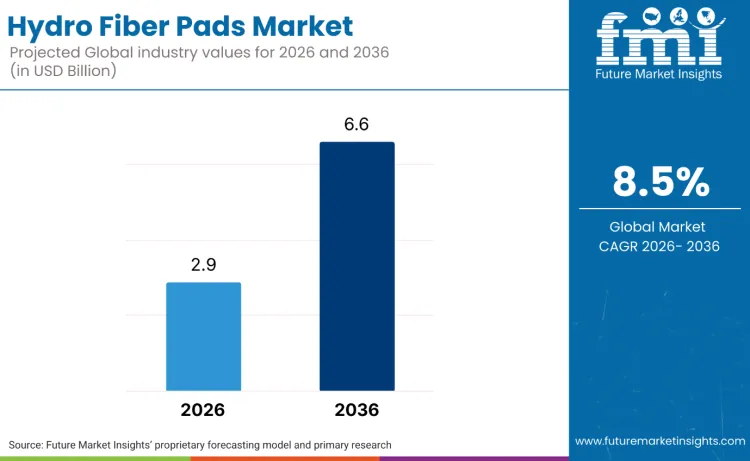
The Hydro Fiber Pads market is forecast to expand from USD 2.9 Billion in 2026 to USD 6.6 Billion by 2036, registering an 8.5% CAGR. Growth is being anchored in care delivery shifts that are changing how advanced wound dressings are selected and standardised. Mölnlycke’s integrated annual report for 2024 states that wound care is shifting from acute to post-acute and home care and that procurement continues to play a growing role in decision-making.
Competitive investment and portfolio management are reinforcing this shift. ConvaTec’s annual results for the year ended 31 December 2024 explicitly frame wound care and chronic care as execution priorities within a broader profitable growth agenda, with CEO Karim Bitar stating: ‘Our FY24 results demonstrate that Convatec has successfully pivoted to broad-based, sustainable and profitable growth.’
The category’s competitive perimeter has also been reshaped by 3M completing the spin-off of its Health Care business as Solventum on 1 April 2024, altering one major wound-care portfolio’s operating model and capital allocation priorities.
Summary of the Hydro Fiber Pads Market
What is Growth Outlook for Hydro Fiber Pads Market as per Future Market Insights Projection?
Future Market Insights projects the Hydro Fiber Pads market to expand from USD 2.9 Billion in 2026 to USD 6.6 Billion by 2036, reflecting an 8.5% CAGR.
FMI Research Approach: Forecast built by mapping advanced wound dressing demand to chronic wound case volumes, hospital procurement conversion rates, and channel-level replenishment patterns across regulated care settings.
How do FMI Analysts Perceive Hydro Fiber Pads Market to Evolve?
FMI expects purchasing to tighten around protocol-led standardisation, where suppliers win by proving pathway continuity from hospital to clinic to home care, with utilisation discipline and contract compliance becoming the primary gatekeepers.
FMI Research Approach: Competitive tracking of formulary wins, tendering behaviour, and care-transition consumption patterns across acute and post-acute settings.
Which Country is Expected to be the Fastest Growing in Hydro Fiber Pads Market?
China is expected to grow at an 11.7% CAGR from 2026 to 2036, as hospital cost governance strengthens and standardised wound care pathways scale across large provider networks.
FMI Research Approach: Country model weighted to payment reform adoption, public hospital purchasing centralisation, and protocol-driven consumption in chronic wound care.
Which Product Type Leads the Hydro Fiber Pads Market in 2026?
Silver impregnated hydro fiber pads lead with a 47.3% share in 2026, reflecting institutional preference for infection-management-aligned dressings in high-exudate wounds under procurement scrutiny.
FMI Research Approach: Segment share derived from hospital purchasing patterns, antimicrobial dressing utilisation in chronic wound protocols, and portfolio breadth of scaled suppliers.
Which Application Accounts for the Largest Share in 2026?
Chronic wounds lead with a 65.0% share in 2026, driven by long-duration dressing cycles and repeat utilisation in diabetic foot ulcers, pressure ulcers, and venous leg ulcers.
FMI Research Approach: Application sizing linked to chronic wound prevalence proxies, episode duration assumptions, and average dressing change frequency by care setting.
How is Demand Most Commonly Routed to Patients in 2026?
Hospitals lead the end user mix with a 51.5% share in 2026, while hospital pharmacies remain the largest distribution channel at 43.8%, reflecting formulary-controlled initiation and central inventory governance.
FMI Research Approach: Channel allocation model based on institutional procurement flows, discharge continuation dynamics, and relative replenishment intensity across hospital and retail pathways.
Hydro Fiber Pads Market Key Takeaways
| Metric | Value |
|---|---|
| Market Size (2026) | USD 2.9 Billion |
| Market Size (2036) | USD 6.6 Billion |
| CAGR (2026 to 2036) | 8.5% |
What is Driving Demand for Hydro Fiber Pads?
Demand is being driven by chronic wound caseload growth and tighter prevention economics for infections and amputations. Public health guidance from the USA CDC states that diabetes care can reduce blood flow and damage nerves, making wounds harder to heal and more likely to become infected, which sustains long-duration dressing cycles in diabetic foot care and related chronic wound pathways.
This clinical burden is being operationalised through procurement-led standardisation. ConvaTec’s FY2024 results commentary links performance to broad-based growth across chronic care markets, signalling sustained commercial and product platform investment behind advanced dressings.
How is the Hydro Fiber Pads Market Segmented?
The market for Hydro Fiber Pads is segmented into Product Type (silver impregnated hydro fiber pads, antimicrobial hydro fiber pads, high absorbency hydro fiber pads, and standard hydro fiber pads), Clinical Application Pathways (chronic wound management including diabetic foot ulcers and pressure ulcers, surgical wound care, burn treatment, traumatic wound management, and pressure injury prevention), and End User / Distribution Structure (hospitals, clinics, home healthcare settings, and ambulatory surgical centers, with distribution routed through hospital pharmacies, retail pharmacies, online medical stores, and medical supply distributors).
This segmentation reflects how hydro fiber pads are specified within infection-prevention and exudate-management protocols, how utilisation is driven by long-duration chronic wound episodes versus episodic surgical care, and how purchasing and replenishment are governed by formulary control and continuity-of-care requirements as patients transition from acute hospital settings to post-acute and home care environments.
Why do Silver Impregnated Hydro Fiber Pads Lead by Product Type?
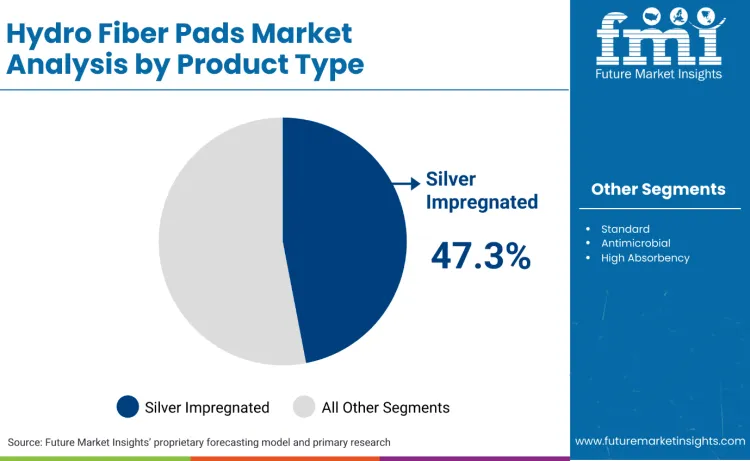
Silver impregnated hydro fiber pads lead with a 47.3% share in 2026 because hospital infection-management pathways increasingly require dressing options that align with antimicrobial stewardship policies while still supporting high-exudate control. This is not driven by broad preference claims.
It is driven by procurement behaviour. Mölnlycke states that procurement continues to play a growing role in wound care decision-making while care shifts toward post-acute and home settings. Silver variants sit inside this standardisation logic because they are easier to defend in formulary committees when infection-management is treated as a cost-avoidance lever. Platform players that repeatedly emphasise chronic care growth and innovation pipelines further reinforce supply continuity and contracting depth for these variants.
Why do Chronic Wounds Dominate by Application?
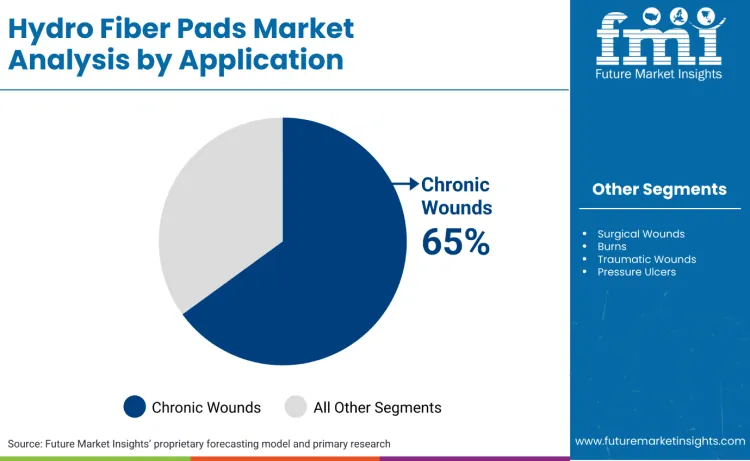
Chronic wounds lead with a 65.0% share in 2026 because they generate repeat, multi-week dressing utilisation governed by clinical pathways rather than episodic purchasing. Health systems are responding by tightening pathway consistency across care sites. In this setting, hydrofiber formats benefit from protocol fit because they can be standardised across outpatient and home-care continuation without forcing frequent switches that create variability, training load, and utilisation leakage. The dominance of chronic wounds therefore reflects system-level recurrence and length-of-episode dynamics, not marketing intensity.
What are the Key Trends and Restraints Shaping the Hydro Fiber Pads Market?
A core trend is pathway-driven expansion of advanced wound care beyond acute wards into post-acute and home settings, while procurement influence increases. Mölnlycke states that wound care is shifting from acute to post-acute and home care and that procurement continues to play a growing role in decision-making, which pushes suppliers to support standardised dressing selection across care transitions and to build continuity tools that reduce variation after discharge. This structurally benefits hydrofiber formats that are used across chronic and surgical wound pathways where exudate control and predictable utilisation are prioritised.
A central restraint is tightening payment and budget governance that raises the evidentiary bar for premium advanced dressings, especially antimicrobial variants. Peer-reviewed analysis indicates that China’s DRG and DIP payment reforms aim to standardise medical practices and reduce unnecessary spending; this has increased scrutiny on consumables, forcing hospitals to justify the use of advanced dressings based on strict, pathway-approved value. As cost accountability rises, substitution risk increases when suppliers cannot support standardisation, training, and utilisation controls demanded by procurement teams.
How Will Hydro Fiber Pads Market Expansion Unfold Across Key Global Regions?
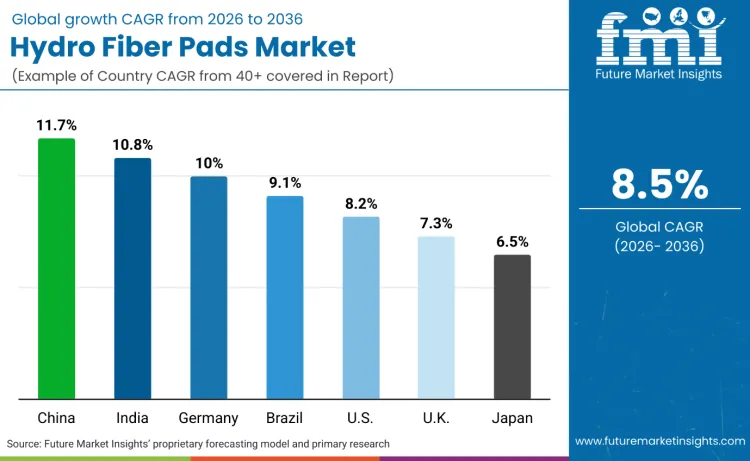
Future Market Insights identifies China (CAGR 11.7%), India (10.9%), Germany (10.0%), Brazil (9.1%), United States (8.3%), United Kingdom (7.4%), and Japan (6.5%) as the core regional growth drivers for the hydro fiber pads market through 2036. China leads expansion as DRG and DIP payment reforms intensify hospital cost governance and accelerate protocol-led standardisation of advanced wound dressings across large provider networks.
India’s growth is driven by expanded inpatient coverage under Ayushman Bharat PM-JAY, which increases protocolised wound care utilisation and supports continuity of advanced dressings after discharge. The United States benefits from sustained chronic disease burden, particularly diabetic foot ulcers, combined with continued investment by scaled wound care platforms that reinforce institutional contracting depth. Germany’s demand reflects ageing demographics and procurement-led consistency in chronic wound pathways across hospitals and clinics. Brazil’s momentum is supported by ANVISA’s regulatory framework, which favours compliant advanced dressings within institutional protocols.
The UK’s growth is anchored in NHS diabetic foot frameworks that reinforce multidisciplinary pathway standardisation. Japan shows slower but durable growth as population ageing expands long-term care wound routines, where predictable, protocol-aligned dressing utilisation governs adoption.
| Country | CAGR (2026 to 2036) |
|---|---|
| China | 11.7% |
| India | 10.9% |
| Germany | 10.0% |
| Brazil | 9.1% |
| USA | 8.3% |
| UK | 7.4% |
| Japan | 6.5% |
Source: Future Market Insights (FMI) analysis, based on proprietary forecasting model and primary research.
How is China’s DRG and DIP reform forcing tighter wound dressing standardisation in hospitals?
China will grow at an 11.7% CAGR from 2026 to 2036 because payment reform mechanisms are pushing hospitals toward tighter internal management of episode costs, accelerating standardised wound care purchasing. The strengthens procurement influence and favours hydro fiber dressing systems that can be standardised across hospital departments and carried into discharge plans without variability. The structural effect is higher protocol density for chronic wounds where infection risk and delayed healing expand resource use, making predictable exudate-management dressings easier to justify when tied to pathway compliance rather than discretionary clinician preference.
Why is Ayushman Bharat PM-JAY expanding India’s protocol-led advanced dressing utilisation?
India will expand at a 10.9% CAGR across 2026 to 2036 because national health assurance coverage is expanding access to secondary and tertiary care episodes that drive advanced dressing utilisation. The National Health Authority describes PM-JAY, launched in 2018 under Ayushman Bharat, as a major health assurance programme that increases the utilisation of inpatient and procedure-linked care; this creates an environment where wound dressings are increasingly protocolised within hospital supply systems.
As beneficiaries move through covered hospital episodes, providers standardise advanced dressings that can be continued after discharge, supporting hydro fiber adoption across chronic and post-surgical wounds. This mechanism is reinforced by chronic disease burden that increases diabetic foot and vascular wound caseloads, creating repeat dressing cycles that hospitals prefer to control through formulary discipline and hospital pharmacy distribution.
How is Germany’s ageing profile structurally increasing chronic wound episodes that favour hydro fiber pads?
Germany will grow at a 10.0% CAGR from 2026 to 2036 because ageing demographics expand chronic wound exposure while structured procurement strengthens standardised dressing utilisation. Destatis reports that by 2035, one in four people in Germany will be aged 67 or older; this demographic shift increases the risk of pressure ulcers and vascular disease, thereby driving demand for advanced exudate-managing dressings in long-term care settings.
In parallel, procurement-led standardisation in wound care is consistent with the purchasing environment in German hospitals and clinics, where formulary discipline and predictable supply performance shape vendor selection. This sustains adoption of hydro fiber pads across hospitals and clinics as chronic wound episodes increase in volume and duration.
Why does ANVISA’s device governance make compliant advanced dressings scale faster in Brazil?
Brazil will rise at a 9.1% CAGR through 2036 because medical device regulatory gatekeeping and institutional protocol formalisation strengthen demand for registered advanced dressings within hospital supply systems. ANVISA’s medical device regulatory framework governs classification and compliance pathways for medical devices and related products, which favours suppliers that can sustain documentation, registration, and institutional selling discipline for advanced dressings used in chronic wounds and burns. As hospitals and clinics tighten pressure injury prevention and diabetic wound management practices, hydro fiber pads benefit where they can be standardised in institutional protocols and distributed through controlled channels that support inventory governance.
How do USA diabetic foot pathways and advanced wound platform investment sustain hydro fiber demand?
The United States will grow at an 8.3% CAGR from 2026 to 2036 because chronic disease burden sustains long-duration wound episodes and reinforces protocol-driven advanced dressing utilisation across hospitals, ambulatory settings, and home care. The CDC states that diabetes can reduce blood flow and damage nerves, increasing infection risk and making wounds harder to heal, which sustains diabetic foot ulcer care pathways that require consistent exudate management over multi-week cycles. This demand is reinforced by scaled platform competition in advanced wound management.
Smith+Nephew reported 5.3% Group underlying revenue growth in 2024, with its Advanced Wound Management business seeing accelerating momentum in the second half (up 6.5% in Q3), driven by strong performance in Bioactives and a return to growth in Advanced Wound Care.
Why do NHS diabetic foot frameworks intensify standardisation of advanced dressings in the UK?
The United Kingdom will expand at a 7.4% CAGR across 2026 to 2036 because national diabetic foot disease frameworks reinforce multidisciplinary pathways that standardise wound care practice and dressing utilisation. NHS England published a framework aimed at improving care for diabetic foot disease and avoiding unnecessary amputations and deaths, pushing pathway consistency across where patients present. Procurement influence is also rising as post-acute and community care continuity becomes more central, supporting hydro fiber pads when suppliers can align with formulary rules and continuity-of-care requirements.
How is Japan’s 65-plus share reshaping long-term care wound routines that drive hydro fiber usage?
Japan will grow at a 6.5% CAGR from 2026 to 2036 because population ageing expands long-term care demand where pressure injury prevention and chronic wound management become repeat operational needs for facilities and home-care services. Japan’s Cabinet Office annual report states that as of October 1, 2024, the percentage of the population aged 65 and over reached 29.3%. As long-term care settings scale, dressing utilisation becomes more standardised in facility protocols, supporting hydro fiber demand where products can be integrated into care routines with predictable inventory control.
How is the Competitive Landscape Evolving in the Hydro Fiber Pads Market?
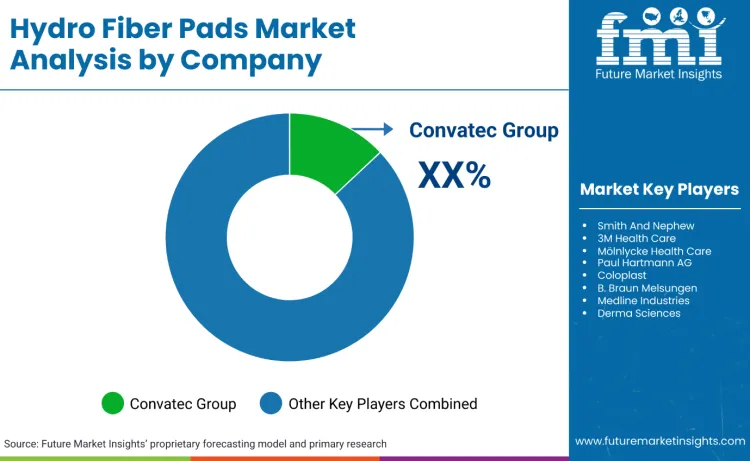
Competition is concentrated among advanced wound care platform companies that operate global hospital contracts and maintain broad dressing portfolios. This scope includes hydrofiber pads used for chronic wounds, surgical wounds, burns, traumatic wounds, and pressure ulcers. This scope excludes foam dressings, hydrocolloids, non-hydrofiber alginates, negative pressure wound therapy systems, biologic matrices, and wound closure devices. ConvaTec is positioned as a leading global reference player in hydrofiber dressings due to repeated executive emphasis on chronic care growth platforms and sustained innovation pipeline priorities in FY2024 results communications. Regional leadership differs.
In North America, Smith+Nephew’s Advanced Wound Management growth disclosure indicates competitive strength in hospital and outpatient channels alongside infection management categories. In Europe, Mölnlycke signals procurement-driven standardisation as a structural trend and continues to invest across wound care solutions, reinforcing strong institutional positioning in major European markets. In Asia, global leadership does not automatically translate into local dominance, particularly in Japan where ageing-driven care is delivered through long-term care routines and facility protocols that require channel and implementation depth.
Recent Developments
In April 2024, 3M completed the spin-off of its healthcare business, launching Solventum as an independent firm listed on the NYSE as SOLV, enabling distinct growth strategies and capital allocation plans.
In January 2024, Coloplast launched Biatain® Silicone Fit in the USA, expanding its wound care portfolio with a silicone foam dressing designed for pressure injury prevention and effective wound management in clinical and care settings.
Key Players
- ConvaTec Group
- Smith+Nephew
- Mölnlycke Health Care
- Paul Hartmann AG
- Coloplast
- B. Braun Melsungen
- Medline Industries
- Integra LifeSciences
- Derma Sciences
- Solventum (formerly 3M Health Care)
Market Definition
Hydro fiber pads are gelling fibre wound dressings designed to absorb exudate and support a moist wound environment across acute and chronic wound types. They are used in chronic wounds, surgical wounds, burns, traumatic wounds, and pressure ulcers across hospitals, clinics, and supervised home care. The market tracks hydrofiber-format pads as a distinct advanced dressing category within broader wound care portfolios where procurement, protocol fit, and continuity of care drive purchasing.
Market Inclusion
Included revenues cover standard hydro fiber pads, high absorbency hydro fiber pads, antimicrobial hydro fiber pads, and silver impregnated hydro fiber pads sold as regulated wound dressings through hospital pharmacies, retail pharmacies, online medical stores, and medical supply distributors. ConvaTec is treated as a leading global reference player because FY2024 results communications repeatedly emphasise chronic care markets and execution discipline as core growth engines, signalling sustained investment behind advanced dressing platforms.
Market Exclusion
Excluded are foam dressings, hydrocolloids, alginates that are not hydrofiber, gauze and basic bandages, topical drugs, biologic wound matrices, negative pressure wound therapy systems, and wound closure products. Service revenues from wound clinics and digital tools are excluded when not bundled as hydrofiber dressing revenue. Regional leadership is assessed separately because procurement structure and care delivery models differ, particularly in Japan where long-term care routines influence adoption mechanics.
Scope of Report
| Items | Values |
|---|---|
| Quantitative Units | USD Billion |
| Product Type Segments | Silver Impregnated Hydro Fiber Pads; Antimicrobial Hydro Fiber Pads; High Absorbency Hydro Fiber Pads; Standard Hydro Fiber Pads |
| Application Categories | Chronic Wounds; Surgical Wounds; Burns; Traumatic Wounds; Pressure Ulcers |
| End User Groups | Hospitals; Clinics; Home Healthcare Settings; Ambulatory Surgical Centers |
| Distribution Channels | Hospital Pharmacies; Retail Pharmacies; Online Medical Stores; Medical Supply Distributors |
| Regions Covered | North America, Latin America, Western Europe, Eastern Europe, South Asia & Pacific, East Asia, Middle East & Africa |
| Key Countries | China, India, Germany, United States, Brazil, United Kingdom, Japan |
| Key Companies Profiled | ConvaTec Group; Smith+Nephew; Mölnlycke Health Care; Paul Hartmann AG; Coloplast; B. Braun Melsungen; Medline Industries; Integra LifeSciences; Derma Sciences; Solventum (formerly 3M Health Care) |
| Additional Attributes | Dollar sales measured for hydro fiber wound dressings by product type, clinical application pathway, end-user setting and distribution flow; protocol-led procurement and formulary standardisation impact; infection-management and antimicrobial utilisation dynamics; continuity-of-care demand from hospital to post-acute and home settings; policy and payment reform influence across major healthcare systems; channel governance effects through hospital pharmacy control and institutional contracting; competitive positioning based on platform scale, tender wins and geographic execution depth |
Hydro Fiber Pads Market by Key Segments
Product Type
- Silver impregnated hydro fiber pads
- Standard hydro fiber pads
- Antimicrobial hydro fiber pads
- High absorbency hydro fiber pads
Application
- Chronic wounds
- Surgical wounds
- Burns
- Traumatic wounds
- Pressure ulcers
End User
- Hospitals
- Clinics
- Home healthcare
- Ambulatory surgical centers
Distribution Channel
- Hospital pharmacies
- Retail pharmacies
- Online medical stores
- Medical supply distributors
Bibliography (APA)
- Cabinet Office, Government of Japan. (2024). Annual report on the aging society: Summary FY2024.
- Centers for Disease Control and Prevention. (2024). Diabetes and your feet. U.S. Department of Health & Human Services.
- Federal Statistical Office of Germany (Destatis). (2025). 16th coordinated population projection: One person in four will be aged 67 or older in 2035
Frequently Asked Questions
What is the Hydro Fiber Pads Market size in 2026 and 2036, and what is the CAGR?
The hydro fiber pads market is valued at USD 2.9 billion in 2026 and is projected to reach USD 6.6 billion by 2036, growing at an 8.5% CAGR.
Which product type leads the Hydro Fiber Pads Market in 2026?
Silver impregnated hydro fiber pads dominate with a 47.3% share due to their alignment with infection-management protocols under hospital procurement systems.
Which application segment accounts for the largest share of hydro fiber pad demand in 2026?
Chronic wound management leads with a 65.0% share driven by long-duration treatment cycles in diabetic foot, pressure ulcers, and venous leg ulcers.
Which care setting represents the primary end-user base in 2026?
Hospitals hold the largest end-user share at 51.5% as formulary-controlled initiation of advanced dressings begins within acute care pathways.
Which distribution channel controls the highest volume of hydro fiber pad sales in 2026?
Hospital pharmacies dominate with a 43.8% share due to centralised inventory governance and contract-based replenishment systems.
Preview the report firsthand - request a free sample
Get SampleGet the brochure for pricing and purchase details.
Get PDFTable of Content
- Executive Summary
- Global Market Outlook
- Demand-side Trends
- Supply-side Trends
- Technology Roadmap Analysis
- Analysis and Recommendations
- Market Overview
- Market Coverage / Taxonomy
- Market Definition / Scope / Limitations
- Research Methodology
- Chapter Orientation
- Analytical Lens and Working Hypotheses
- Market Structure, Signals, and Trend Drivers
- Benchmarking and Cross-market Comparability
- Market Sizing, Forecasting, and Opportunity Mapping
- Research Design and Evidence Framework
- Desk Research Programme (Secondary Evidence)
- Company Annual Reports and Integrated Reports
- Peer-reviewed Medical and Clinical Journals
- Corporate Websites and Product Technical Literature
- Investor Presentations and Earnings Communications
- Regulatory Filings and Medical Device Standards
- Clinical Guidelines and Public Health Publications
- Trade Journals and Wound Care Industry Magazines
- Conference Proceedings and Clinical Congress Materials
- Government Health Statistics and Surveillance Data
- Press Releases and Verified Media Coverage
- Specialist Healthcare Newsletters
- Sector Databases and Medical Device Repositories
- FMI Internal Knowledge Base
- Subscription-based Healthcare Databases
- Hospital Procurement and Tendering Inputs
- Additional Desk Sources
- Expert Input and Fieldwork (Primary Evidence)
- Primary Modes
- Qualitative Interviews
- Quantitative Surveys
- Hybrid Validation Approach
- Why Primary Evidence is Used
- Field Techniques
- Hospital and Clinic Interviews
- Procurement and Formulary Surveys
- Wound Care Specialist Workshops
- Care Pathway Observations
- Policy and Payment Reform Consultations
- Stakeholder Universe Engaged
- C-suite Executives
- Hospital Procurement Heads
- Clinical Directors and Wound Care Specialists
- Quality and Infection Control Leads
- Regulatory and Compliance Officers
- Home Care and Post-acute Care Coordinators
- Governance, Ethics, and Data Stewardship
- Research Ethics
- Data Integrity and Handling
- Primary Modes
- Tooling, Models, and Reference Databases
- Desk Research Programme (Secondary Evidence)
- Data Engineering and Model Build
- Data Acquisition and Ingestion
- Cleaning, Normalisation, and Verification
- Synthesis, Triangulation, and Analysis
- Quality Assurance and Audit Trail
- Market Background
- Market Dynamics
- Drivers
- Restraints
- Opportunity
- Trends
- Scenario Forecast
- Demand in Optimistic Scenario
- Demand in Likely Scenario
- Demand in Conservative Scenario
- Opportunity Map Analysis
- Product Life Cycle Analysis
- Supply Chain Analysis
- Investment Feasibility Matrix
- Value Chain Analysis
- PESTLE and Porter’s Analysis
- Regulatory Landscape
- Regional Parent Market Outlook
- Healthcare Utilisation and Treatment Statistics
- Import and Export Statistics
- Market Dynamics
- Global Market Analysis 2021 to 2025 and Forecast, 2026 to 2036
- Historical Market Size Value (USD Billion) Analysis, 2021 to 2025
- Current and Future Market Size Value (USD Billion) Projections, 2026 to 2036
- Y-o-Y Growth Trend Analysis
- Absolute $ Opportunity Analysis
- Global Market Pricing Analysis 2021 to 2025 and Forecast 2026 to 2036
- Global Market Analysis 2021 to 2025 and Forecast 2026 to 2036, By Product Type
- Introduction / Key Findings
- Historical Market Size Value (USD Billion) Analysis By Product Type, 2021 to 2025
- Current and Future Market Size Value (USD Billion) Analysis and Forecast By Product Type, 2026 to 2036
- Y-o-Y Growth Trend Analysis By Product Type, 2021 to 2025
- Absolute $ Opportunity Analysis By Product Type, 2026 to 2036
- Global Market Analysis 2021 to 2025 and Forecast 2026 to 2036, By Application
- Y-o-Y Growth Trend Analysis By Application
- Absolute $ Opportunity Analysis By Application
- Global Market Analysis 2021 to 2025 and Forecast 2026 to 2036, By End User
- Y-o-Y Growth Trend Analysis By End User
- Absolute $ Opportunity Analysis By End User
- Global Market Analysis 2021 to 2025 and Forecast 2026 to 2036, By Distribution Channel
- Y-o-Y Growth Trend Analysis By Distribution Channel
- Absolute $ Opportunity Analysis By Distribution Channel
- Global Market Analysis 2021 to 2025 and Forecast 2026 to 2036, By Region
- Introduction
- Historical Market Size Value (USD Billion) Analysis By Region, 2021 to 2025
- Current Market Size Value (USD Billion) Analysis and Forecast By Region, 2026 to 2036
- North America
- Latin America
- Western Europe
- Eastern Europe
- East Asia
- South Asia and Pacific
- Middle East & Africa
- Market Attractiveness Analysis By Region
- Key Countries Market Analysis
- Market Structure Analysis
- Competition Dashboard
- Competition Benchmarking
- Market Share Analysis of Top Players
- By Regional
- By Product Type
- By Application
- By End User
- By Distribution Channel
- Competition Analysis
- Competition Deep Dive
- Assumptions & Acronyms Used


