

- Industry Size (2026)
- USD 780.7 Mn
- Forecast (2036)
- USD 1479.3 Mn
- CAGR (2026 to 2036)
- 6.6%
Lump Breaker Machines Market Size, Market Forecast and Outlook By FMI
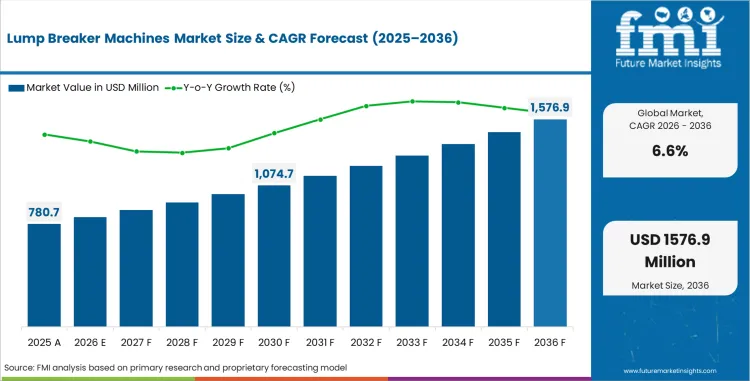
The lump breaker machines market was valued at USD 732.4 million in 2025. Sector is estimated to reach USD 780.7 million in 2026, reflecting steady demand for in-line material conditioning equipment. Demand is projected to grow at a CAGR of 6.6% from 2026 to 2036, with total revenue expected to reach USD 1,479.3 million by 2036.
Summary of Lump Breaker Machines Market
- The market is forecast to reach USD 1,479.3 million by 2036.
- The market is expected to grow at a CAGR of 6.6% from 2026 to 2036.
- The market was estimated at USD 732.4 million in 2025.
- The forecast period represents an incremental opportunity of USD 698.6 million.
- Lump breaker machines are used to break agglomerated materials before conveying, mixing, and processing operations.
- Demand is driven by the need for consistent material flow in food, chemical, pharmaceutical, and mineral processing industries.
- Single-shaft machines lead the segment with a 39.0% share due to simple design and broad application suitability.
- The chemicals sector dominates end use with a 26.0% share, supported by continuous powder handling requirements.
- The 1-5 tph capacity range holds 46.0% share, reflecting strong demand from mid-scale processing lines.
- Stainless steel construction leads with a 64.0% share due to hygiene, corrosion resistance, and ease of cleaning.
- India and China are the fastest-growing markets, while the United States remains a key installed-base market.
- Market growth is constrained by long equipment lifecycles and replacement-driven demand in mature regions.
- Leading companies include Munson Machinery, Palamatic Process, Kason, Franklin Miller, Hosokawa Micron, AZO, and Prater.
Bulk solid handling systems face frequent blockages due to lump formation in hygroscopic and moisture-sensitive materials. Facilities are prioritizing equipment that can prevent buildup in discharge points and conveying lines. Delays in installing appropriate conditioning systems increase the risk of extended downtime caused by material solidification inside process equipment. Raw material sourcing across longer supply chains introduces greater variability in moisture content and handling conditions. This increases the likelihood of clumping during transit and storage. Equipment selection now focuses on systems that can handle sudden load variations and torque spikes during operation.
Shear-cell flow testing is used to evaluate material behavior before designing conveying systems. High-velocity pneumatic conveying setups require consistent particle size to prevent pipe blockage. Lump breakers are installed upstream to ensure controlled material flow and reduce the risk of system interruption.
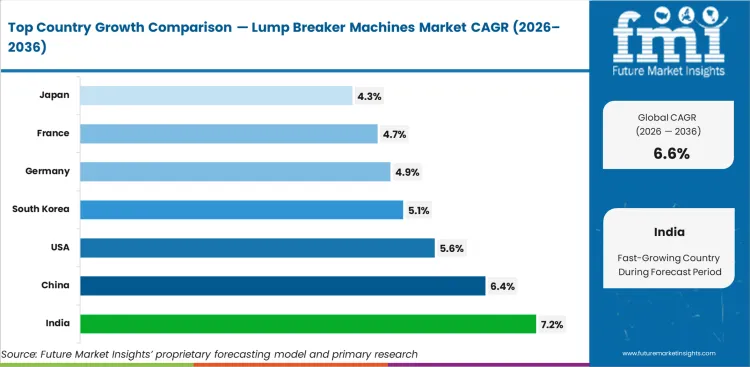
India is projected to grow at a CAGR of 7.2% in the lump breaker machines market from 2026 to 2036, supported by demand from fertilizer blending operations handling moisture-sensitive materials. China is expected to expand at a CAGR of 6.4% over the same period, driven by automation in chemical processing. The United States is anticipated to grow at a CAGR of 5.6% from 2026 to 2036, supported by safety requirements that limit manual intervention in blocked systems. South Korea is forecast to record a CAGR of 5.1% during the forecast period, driven by particle size control requirements in battery material processing. Germany is set to grow at a CAGR of 4.9% through 2036, with demand linked to handling higher-moisture inputs in industrial processes. France is expected to expand at a CAGR of 4.7% over the forecast period, supported by upgrades in agricultural chemical storage and handling. Japan is projected to grow at a CAGR of 4.3% from 2026 to 2036, with focus on compact systems suited for space-constrained industrial environments.
Segmental Analysis
Lump Breaker Machines Market Analysis by Machine Type
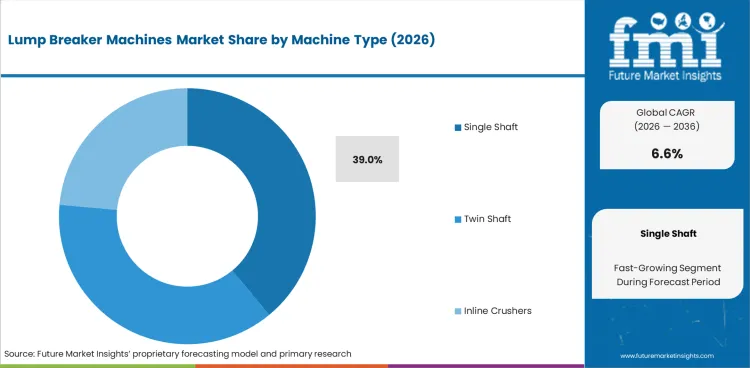
Simplified internal configurations are gaining preference where maintenance access and downtime reduction remain critical. Single shaft systems are expected to account for approximately 39.0% share of the lump breaker machines market in 2026, supported by their ease of servicing and reduced mechanical complexity. Fewer moving components improve reliability when handling abrasive or cohesive materials. Complex dual-rotor systems introduce additional maintenance challenges, particularly during jam events. Equipment selection depends on balancing operational durability with accessibility, ensuring consistent performance across continuous powder conditioning processes.
- Jam clearance velocity: Unidirectional comb structures allow rapid side-door extraction during severe blockage events. Maintenance supervisors prevent extensive multi-shift teardowns replacing jammed internal sizing screens.
- Drive isolation endurance: Direct-coupled motors suffer extreme shock loads during instantaneous solid block ingestion. Reliability engineers specify advanced shear-pin couplings preventing complete gearbox destruction during unplanned surge events.
- Comb wear replacement: Abrasive particulate flow degrades stationary sizing fingers faster than active rotor blades. Procurement directors must negotiate extended consumable contracts ensuring immediate availability regarding specialized hardened replacement combs.
Lump Breaker Machines Market Analysis by End Use
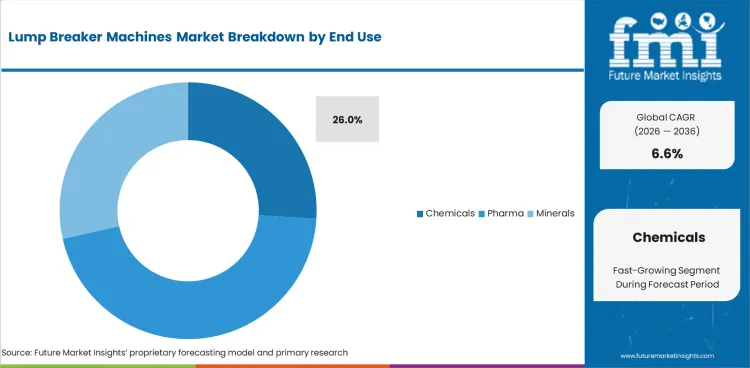
The deployment of lump breaker machines in chemicals industry applications are likely to reach 26.0% share in 2026, as modern continuous mixing lines cannot tolerate unconditioned precursor blocks entering sensitive reaction vessels. FMI notes that process engineering directors utilize chemical powder processing equipment to prevent massive exothermic runaway reactions triggered by unequal powder dispersion. Facilities avoid installing massive dedicated hammer mill systems required for extreme fine grinding; when evaluating a lump breaker vs hammer mill, it becomes clear that highly reactive chemical agglomerates require gentle shearing to prevent frictional heat ignition. Safety officers selecting the best lump breaker for chemicals prioritize thermal management over sheer throughput. Engineers deploying abrasive formulations alongside cone crusher circuits require robust explosion-proof certifications. Elsewhere, strict hygiene requirements define the specification of lump breaker machines for food processing and lump breaker machines for pharmaceutical powders.
- Exothermic reaction prevention: Pre-conditioning solid chunks guarantees uniform surface area during complex chemical dosing sequences. Process engineers achieve precise reaction timing without risking localized thermal runaway events.
- Corrosive dust containment: Aggressive chemical processing destroys standard elastomeric shaft seals within months. Maintenance directors demand specialized air-purged packing glands preventing toxic powder leakage into critical bearing assemblies.
- Explosion suppression integration: Combustible dust environments dictate specialized low-friction rotor materials eliminating mechanical sparking risks. Safety compliance officers mandate rigorous grounding protocols ensuring secure operations inside hazardous zones.
Lump Breaker Machines Market Analysis by Throughput
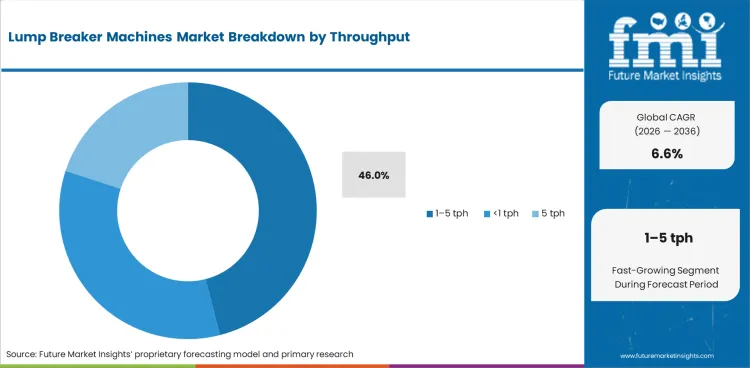
Modular unloading alignment dictates current intermediate capacity investments across major processing zones. When analyzing which throughput range leads the lump breaker machines market, the mid-tier 1-5 tph capacity is anticipated to capture 46.0% share over the forecast period as it precisely matches gravitational discharge rates typical for standard bulk bag unloading stations. Based on FMI's assessment, packaging line supervisors utilize a 1 to 5 tph lump breaker directly beneath super-sack frames to condition compacted powders before entering volumetric dosing screws. Purchasing departments optimize facility layouts avoiding massive portable crushers footprints wherever localized point-of-use conditioning suffices. Capacity precisely matches FIBC super-sack discharge rates, meaning units function more as unloading bottleneck limiters than bulk process crushers. Facility planners ignoring specific volumetric flow correlations face continuous upstream bridging during stone crushing equipment integration. Specifying undersized breakers guarantees permanent line starvation affecting downstream mixing efficiency.
- Bulk bag synchronization: Matching breaker capacity against standard super-sack emptying rates optimizes continuous dosing workflows. Packaging line supervisors prevent downstream volumetric feeders from experiencing material starvation.
- Surge load digestion: Sacks stored under high humidity frequently drop solidified multi-ton blocks instantaneously. Plant engineers require oversized drive motors absorbing massive instantaneous kinetic shocks without stalling continuous lines.
- Vertical stack optimization: Compact low-profile drive designs allow installation between existing bag frames and receiving hoppers. Facility planners avoid costly structural building modifications raising entire unloading mezzanine levels.
Lump Breaker Machines Market Analysis by Material Build
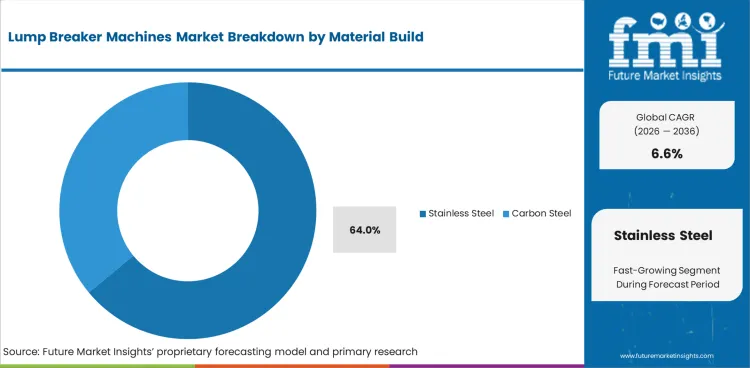
Material construction influences durability, hygiene compliance, and resistance to corrosion across processing environments. Stainless steel is expected to represent nearly 64.0% share of lump breaker machine demand in 2026 due to its suitability for washdown conditions. Surface finish plays a critical role in preventing contamination and improving cleanability. Alternative materials introduce risks in environments requiring strict hygiene control. Selection depends on balancing durability with compliance requirements across regulated processing sectors.
- Caustic sanitation survival: Frequent batch changeovers mandate aggressive wet-washing using highly corrosive cleaning agents. Quality assurance directors prevent localized rusting protecting sensitive product purity continuously.
- Surface finish validation: Electro-polished internal components eliminate microscopic crevices trapping residual powder between production runs. Sanitation managers achieve zero-contamination swab testing results faster without manual scrubbing.
- Galling resistance engineering: Stainless-on-stainless rotational contact creates severe galling risks without specialized tolerancing. Mechanical engineering leads specify distinct alloy hardness differentials preventing rotor lockups.
Lump Breaker Machines Market Drivers, Restraints, and Opportunities
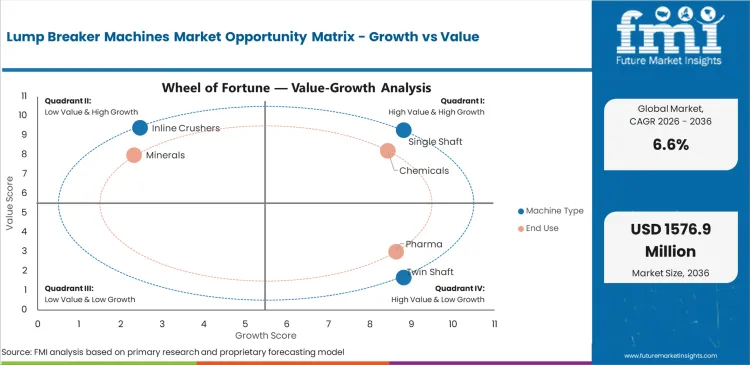
Moisture exposure during long-distance transport causes hygroscopic powders to absorb water and form solid agglomerates. Receiving operations must break these lumps before material enters reactors or downstream equipment. Mechanical de-agglomeration is required to maintain flow consistency and protect sensitive process stages. Facilities that delay installing proper conditioning systems risk production interruptions and loss of processing contracts.
Space constraints limit equipment integration in existing plants. Many facilities lack sufficient vertical clearance to install standard lump breaker units between slide gates and rotary valves. Retrofitting requires changes to discharge piping, structural supports, and layout design. These modifications increase installation time and cost. Low-profile and modular equipment designs are being developed to address space limitations. These configurations improve installation flexibility but may reduce internal screening or processing capacity. Facilities must balance compact design with throughput requirements when selecting equipment.
Opportunities in the Lump Breaker Machines Industry
- Predictive maintenance software integration: Equipment manufacturers can bundle AI-driven vibration monitoring models directly into control architectures. Plant directors capture premium uptime by anticipating fatigue failures early, supported by comprehensive lump breaker troubleshooting protocols.
- Automated continuous weighing capabilities: Integrating loss-in-weight load cells allows real-time material tracking without pausing powder induction and dispersion systems sequences. Process engineers achieve higher dosing resolution safely.
- Mobile modular transfer stations: Building self-contained extraction environments enables flexible routing across multiple process lines. Production planners validate diverse cohesive material changes efficiently using a standardized lump breaker installation guide.
Regional Analysis
Based on regional analysis, Lump Breaker Machines is segmented into North America, Europe, and Asia Pacific across 40 plus countries.
.webp "Top Country Growth Comparison Lump Breaker Machines Market Cagr (2026 2036)")
| Country | CAGR (2026 to 2036) |
|---|---|
| India | 7.2% |
| China | 6.4% |
| USA | 5.6% |
| South Korea | 5.1% |
| Germany | 4.9% |
| France | 4.7% |
| Japan | 4.3% |
Source: Future Market Insights (FMI) analysis, based on proprietary forecasting model and primary research
Asia Pacific Lump Breaker Machines Market Analysis
State-backed centralized infrastructure modernization targets force an immediate expansion regarding physical extraction capacity across regional manufacturing hubs. Regional chemical developers mandate localized flow validation for massive projects, refusing to accept cohesive material testing data generated in different climate zones. FMI analysts note that strict compliance pushes processing plants building entirely new high-capacity cement facilities dedicated exclusively toward alternative fuel consumption. Facilities race securing necessary structural reinforcement before local substations hit maximum capacity. Operating legacy intake lines alongside fully automated powder packing machine frameworks further strains regional engineering resources.
- India: India is set to record 7.2% CAGR in the lump breaker machines market during 2026 to 2036. High humidity conditions across several industrial zones lead to material agglomeration during storage and transport. Processing plants handling cement, chemicals, and food powders require equipment that restores uniform particle size before further handling. Operators prioritize machines capable of handling variable moisture content without excessive energy consumption. Rapid capacity expansion across manufacturing sectors increases equipment deployment. These factors support steady demand for reliable and adaptable lump breaking systems.
- China: Large-scale chemical and material processing facilities in China face operational challenges linked to material compaction during storage. Lump formation disrupts flow consistency and reduces efficiency across automated handling systems. The market in China is projected to expand at 6.4% CAGR through 2036, supported by upgrades in powder handling infrastructure across industrial facilities. Equipment selection focuses on maintaining throughput without generating excessive fines. Regulatory oversight on dust emissions also shapes system design. These conditions support ongoing replacement of legacy size reduction equipment.
- South Korea: Battery material production in South Korea requires strict control over particle size to maintain product quality. Lump breaker machines are used to prevent oversized particles from entering sensitive downstream processes. Demand is driven by the need for precise size reduction in cathode and anode material handling, with growth aligned at 5.1% CAGR over 2026 to 2036. Equipment must maintain narrow tolerance levels without damaging material structure. Operators prioritize machines that support consistent output under continuous operation. These requirements support adoption across high-precision manufacturing environments.
- Japan: Food and specialty chemical processing facilities in Japan require consistent particle sizing to maintain product quality and safety standards. Equipment selection focuses on systems that support hygienic operation and prevent contamination during processing. The market reflects a 4.3% CAGR through 2036, supported by demand for controlled size reduction in high-specification production environments. Machines with clean-in-place capability are preferred in facilities handling multiple product lines. Compact system design supports installation in space-limited plants. Reliability remains critical in maintaining consistent output quality.
North America Lump Breaker Machines Market Analysis
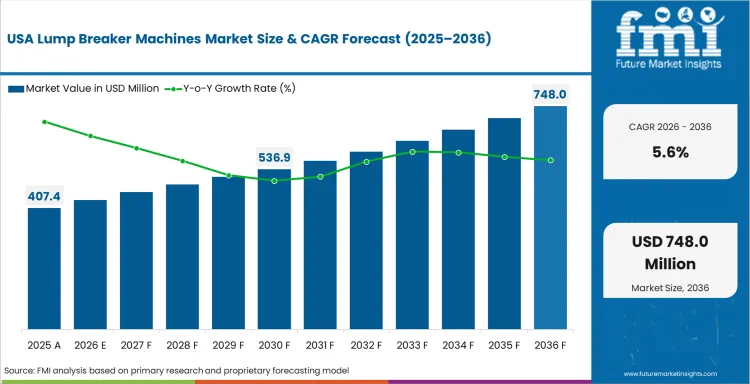
Federal occupational safety programs specifically targeting confined space entry mitigation create massive capital influxes for independent chemical processors. Safety compliance officers require facility managers utilizing automated flow promotion centers releasing operating permits safely. As per FMI's projection, strict regulatory enforcement guarantees high replacement rates replacing any plant operating legacy manual hoppers. Purchasing departments aggressively secure high-power vibratory rigs handling anticipated surges evaluating cohesive formulations integrating safe food powder packaging machine architectures.
- USA: The lump breaker machines market in the United States is anticipated to expand at 5.6% CAGR between 2026 and 2036, driven by regulatory pressure to reduce manual interaction with bulk materials. Facilities replace older systems that rely on manual breaking of compacted materials. Operators prioritize machines that integrate with automated conveying systems and maintain consistent output size. Retrofitting existing plants shapes procurement strategies across industries. Equipment must operate reliably under varying material conditions. These factors support steady demand across chemical, food, and industrial processing sectors.
Europe Lump Breaker Machines Market Analysis
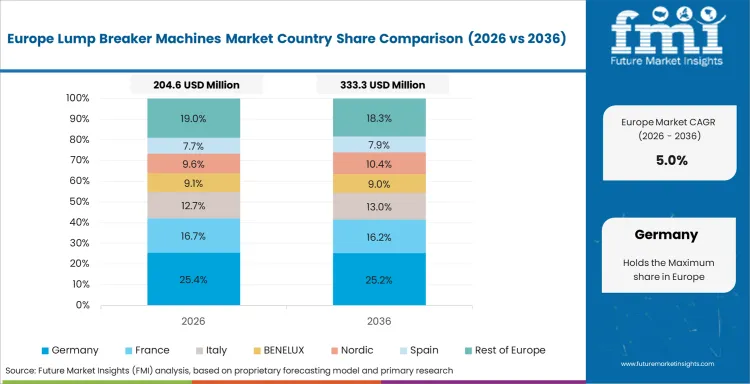
Stringent cross-border ATEX standardization mandates require equipment manufacturers mapping complex static discharge risks continuously over thousands of operational hours. Compliance managers rely upon certified activators proving long-term explosion prevention stability under simulated atmospheric variations. FMI observes that independent processors prioritize sophisticated grounding control suites over raw extraction capacity generating compliant certification dossiers. Operating high-precision static diagnostic alarms alongside traditional automatic powder forming machine frameworks becomes baseline operational requirement.
- Germany: Germany’s lump breaker machines market is likely to grow at 4.9% CAGR from 2026 to 2036, supported by demand from industrial facilities requiring precise and consistent particle size control. Equipment selection focuses on systems that operate reliably under continuous processing conditions. Operators prioritize machines with monitoring features that detect irregularities in material flow. Integration with automated systems remains a key requirement. These factors support adoption across chemical and manufacturing sectors with strict quality standards.
- France: Agricultural chemical processing and specialty material handling applications influence demand for lump breaker machines in France. Facilities require equipment that prevents material compaction from affecting downstream operations. Growth in France is estimated at 4.7% CAGR through 2036, supported by modernization of processing infrastructure. Operators prioritize machines that maintain consistent particle size without generating excessive fines. Equipment must also meet hygiene and safety requirements in regulated industries. These conditions support steady adoption across industrial and processing environments.
Competitive Aligners for Market Players
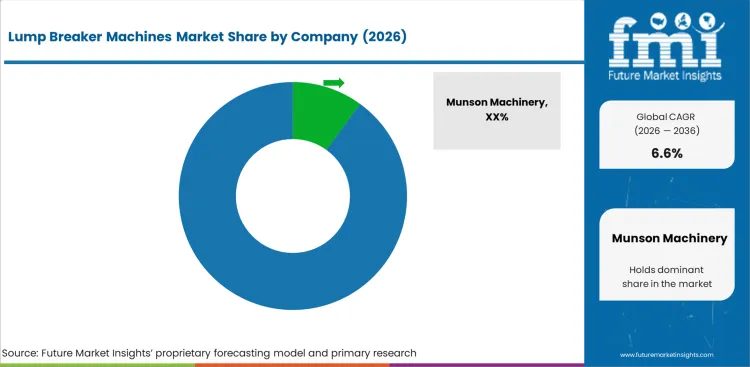
Engineering capability in force control and vibration management plays a central role in supplier selection, often outweighing basic fabrication strength. Buyers assess how well equipment manages dynamic loads while staying within plant structural limits. System design must support stable operation without transferring excessive vibration to surrounding structures.
Processing facilities evaluate machines based on how maintenance tasks are handled during operation. Operators must be able to access and service components without releasing dust into the environment. Equipment with modular assemblies improves maintenance efficiency and reduces exposure during routine work.
Established suppliers benefit from global service coverage and long-standing industrial relationships. Equipment reliability remains critical, as failure during operation can disrupt entire processing lines handling large material volumes. Procurement teams require proven performance data before approving new suppliers, even when lower-cost options are available.
Processing companies standardize connector and interface designs to avoid dependence on specific vendors. Equipment selection favors systems that support interchangeable components rather than proprietary locking mechanisms. Suppliers that restrict compatibility face resistance during evaluation. Competition is expected to shift toward monitoring and diagnostics. Manufacturers are likely to differentiate through systems that track equipment condition and predict maintenance needs, alongside improvements in mechanical performance and durability.
Key Players in Lump Breaker Machines Market
- Munson Machinery
- Palamatic Process
- Kason
- Franklin Miller
- Hosokawa Micron
- AZO
- Prater
Scope of the Report
| Metric | Value |
|---|---|
| Quantitative Units | USD 780.7 million to USD 1,479.3 million, at a CAGR of 6.6% |
| Market Definition | Specialized low-RPM kinetic devices attached to storage vessel outlets to reduce compacted dry bulk solids back to baseline particle sizes via applied mechanical shear. |
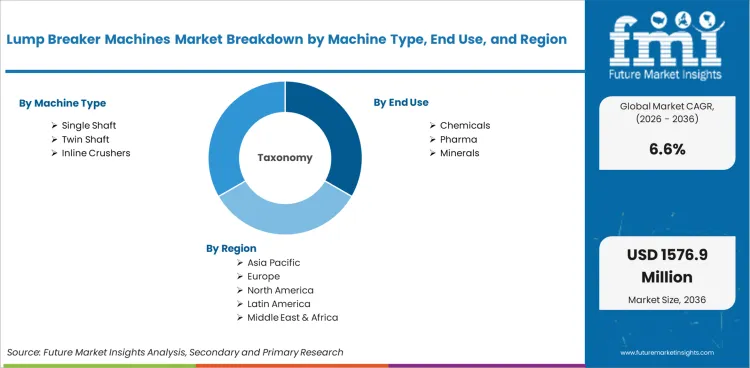
| Segmentation | Machine Type, End Use, Throughput, Material Build, and Region |
| Regions Covered | North America, Latin America, Europe, East Asia, South Asia & Pacific, Middle East & Africa |
| Countries Covered | USA, Germany, France, China, India, Japan, South Korea |
| Key Companies Profiled | Munson Machinery, Palamatic Process, Kason, Franklin Miller, Hosokawa Micron, AZO, Prater |
| Forecast Period | 2026 to 2036 |
| Approach | Independent material handling facility capital expenditure data cross-validated with federal occupational safety program equipment registries. |
Source: Future Market Insights (FMI) analysis, based on proprietary forecasting model and primary research
Lump Breaker Machines Market Analysis by Segments
Machine Type
- Single Shaft
- Twin Shaft
- Inline Crushers
End Use
- Food
- Chemicals
- Pharma
- Minerals
- Other
Throughput
- <1 tph
- 1-5 tph
- 5 tph
Material Build
- Carbon Steel
- Stainless Steel
Region
- North America
- United States
- Canada
- Europe
- Germany
- United Kingdom
- France
- Italy
- Spain
- Asia Pacific
- China
- Japan
- South Korea
- Taiwan
- Singapore
- Latin America
- Brazil
- Mexico
- Argentina
- Middle East & Africa
- GCC Countries
- South Africa
- Israel
Bibliography
- American Chemistry Council. (2025). Economic Sentiment Index Q3 2025.
- European Commission, Eurostat. (2025, December 16). Chemicals production and consumption statistics.
- USA Department of Agriculture, Foreign Agricultural Service. (2026, March). India: Food Processing Ingredients Annual.
- USA Food and Drug Administration. (2025, December 12). Report on the State of Pharmaceutical Quality.
- United Nations Industrial Development Organization. (2025). International Yearbook of Industrial Statistics.
This bibliography is provided for reader reference. The full FMI report contains the complete reference list with primary source documentation.
This Report Addresses
- Component specification criteria procurement managers utilize evaluating aerodynamic extraction bases.
- Capital expenditure impacts plant directors navigate building continuous multi-line discharging floors.
- Powder incompatibility constraints engineering teams solve maximizing individual intake platform utilization.
- Exposure barriers independent processors bypass integrating advanced predictive structural fatigue algorithms.
- Ventilation connectivity complications facility planners resolve operating fully integrated extraction frameworks safely.
- Wetted material requirements R&D directors implement handling extreme cohesive powder testing environments.
- Occupational validation mandates compelling massive near-term safety expansions across global manufacturing agencies.
- Ergonomic vulnerabilities processing operators face lacking adequate automated waste compaction channels.
Frequently Asked Questions
What is a lump breaker machine?
These represent specialized low-RPM rotational mechanisms engineered specifically to reduce compacted materials and transient agglomerates back to original particle sizes without degrading the fundamental product structure.
How does a lump breaker work?
A lump breaker for bulk solids handling applies mechanical shear utilizing rotating blades or combs to gently break down solid chunks that form during storage or transport, ensuring smooth downstream processing.
Why do powders and bulk solids form lumps?
Moisture ingress, extreme humidity during transit, static compaction, and thermal variations cause fine particles to fuse together into solid blocks, necessitating the use of mechanical de-agglomeration.
Which industries use lump breaker machines most?
Chemical manufacturing, food processing, pharmaceutical production, and mineral extraction represent the primary sectors requiring continuous bulk solids processing equipment.
Why does the chemicals segment lead this market?
The industrial lump breaker market sees high demand from chemical plants to prevent exothermic runaway reactions, as unconditioned precursor blocks entering sensitive reaction vessels can cause uneven powder dispersion.
Why does stainless steel lead the material-build segment?
Hygienic washdown mandates in food and pharmaceutical processing demand alloys that survive aggressive daily caustic sanitation cycles without rusting, making stainless steel the absolute standard.
Which throughput range is most common?
The 1-5 tph throughput range is the most prevalent, as it precisely matches the gravitational discharge rates typical for standard bulk bag unloading stations.
Who are the main manufacturers in lump breaker machines?
Leading suppliers include Munson Machinery, Palamatic Process, Kason, Franklin Miller, Hosokawa Micron, AZO, and Prater.
How do lump breakers differ from crushers and hammer mills?
When analyzing a lump breaker vs crusher or a lump breaker vs hammer mill, lump breakers utilize low-RPM shearing to merely break apart transient clumps, whereas crushers and hammer mills utilize high-speed impact to permanently alter and pulverize base material dimensions.
Which countries are growing fastest in this market?
India leads global growth at a 7.2% CAGR due to massive fertilizer blending expansion, closely followed by China as its chemical sector modernizes bulk material processing capabilities.
Preview the report firsthand - request a free sample
Get SampleGet the brochure for pricing and purchase details.
Get PDFTable of Content
- Executive Summary
- Global Market Outlook
- Demand-side Trends
- Supply-side Trends
- Technology Roadmap Analysis
- Analysis and Recommendations
- Market Overview
- Market Coverage / Taxonomy
- Market Definition / Scope / Limitations
- Research Methodology
- Chapter Orientation
- Analytical Lens and Working Hypotheses
- Market Structure, Signals, and Trend Drivers
- Benchmarking and Cross-market Comparability
- Market Sizing, Forecasting, and Opportunity Mapping
- Research Design and Evidence Framework
- Desk Research Programme (Secondary Evidence)
- Company Annual and Sustainability Reports
- Peer-reviewed Journals and Academic Literature
- Corporate Websites, Product Literature, and Technical Notes
- Earnings Decks and Investor Briefings
- Statutory Filings and Regulatory Disclosures
- Technical White Papers and Standards Notes
- Trade Journals, Industry Magazines, and Analyst Briefs
- Conference Proceedings, Webinars, and Seminar Materials
- Government Statistics Portals and Public Data Releases
- Press Releases and Reputable Media Coverage
- Specialist Newsletters and Curated Briefings
- Sector Databases and Reference Repositories
- FMI Internal Proprietary Databases and Historical Market Datasets
- Subscription Datasets and Paid Sources
- Social Channels, Communities, and Digital Listening Inputs
- Additional Desk Sources
- Expert Input and Fieldwork (Primary Evidence)
- Primary Modes
- Qualitative Interviews and Expert Elicitation
- Quantitative Surveys and Structured Data Capture
- Blended Approach
- Why Primary Evidence is Used
- Field Techniques
- Interviews
- Surveys
- Focus Groups
- Observational and In-context Research
- Social and Community Interactions
- Stakeholder Universe Engaged
- C-suite Leaders
- Board Members
- Presidents and Vice Presidents
- R&D and Innovation Heads
- Technical Specialists
- Domain Subject-matter Experts
- Scientists
- Physicians and Other Healthcare Professionals
- Governance, Ethics, and Data Stewardship
- Research Ethics
- Data Integrity and Handling
- Primary Modes
- Tooling, Models, and Reference Databases
- Desk Research Programme (Secondary Evidence)
- Data Engineering and Model Build
- Data Acquisition and Ingestion
- Cleaning, Normalisation, and Verification
- Synthesis, Triangulation, and Analysis
- Quality Assurance and Audit Trail
- Market Background
- Market Dynamics
- Drivers
- Restraints
- Opportunity
- Trends
- Scenario Forecast
- Demand in Optimistic Scenario
- Demand in Likely Scenario
- Demand in Conservative Scenario
- Opportunity Map Analysis
- Product Life Cycle Analysis
- Supply Chain Analysis
- Investment Feasibility Matrix
- Value Chain Analysis
- PESTLE and Porter’s Analysis
- Regulatory Landscape
- Regional Parent Market Outlook
- Production and Consumption Statistics
- Import and Export Statistics
- Market Dynamics
- Global Market Analysis 2021 to 2025 and Forecast, 2026 to 2036
- Historical Market Size Value (USD Million) Analysis, 2021 to 2025
- Current and Future Market Size Value (USD Million) Projections, 2026 to 2036
- Y-o-Y Growth Trend Analysis
- Absolute $ Opportunity Analysis
- Global Market Pricing Analysis 2021 to 2025 and Forecast 2026 to 2036
- Global Market Analysis 2021 to 2025 and Forecast 2026 to 2036, By Machine Type
- Introduction / Key Findings
- Historical Market Size Value (USD Million) Analysis By Machine Type , 2021 to 2025
- Current and Future Market Size Value (USD Million) Analysis and Forecast By Machine Type , 2026 to 2036
- Single Shaft
- Twin Shaft
- Inline Crushers
- Single Shaft
- Y-o-Y Growth Trend Analysis By Machine Type , 2021 to 2025
- Absolute $ Opportunity Analysis By Machine Type , 2026 to 2036
- Global Market Analysis 2021 to 2025 and Forecast 2026 to 2036, By End Use
- Introduction / Key Findings
- Historical Market Size Value (USD Million) Analysis By End Use, 2021 to 2025
- Current and Future Market Size Value (USD Million) Analysis and Forecast By End Use, 2026 to 2036
- Chemicals
- Pharma
- Minerals
- Chemicals
- Y-o-Y Growth Trend Analysis By End Use, 2021 to 2025
- Absolute $ Opportunity Analysis By End Use, 2026 to 2036
- Global Market Analysis 2021 to 2025 and Forecast 2026 to 2036, By Throughput
- Introduction / Key Findings
- Historical Market Size Value (USD Million) Analysis By Throughput, 2021 to 2025
- Current and Future Market Size Value (USD Million) Analysis and Forecast By Throughput, 2026 to 2036
- 1–5 tph
- <1 tph
- 5 tph
- 1–5 tph
- Y-o-Y Growth Trend Analysis By Throughput, 2021 to 2025
- Absolute $ Opportunity Analysis By Throughput, 2026 to 2036
- Global Market Analysis 2021 to 2025 and Forecast 2026 to 2036, By Material Build
- Introduction / Key Findings
- Historical Market Size Value (USD Million) Analysis By Material Build, 2021 to 2025
- Current and Future Market Size Value (USD Million) Analysis and Forecast By Material Build, 2026 to 2036
- Stainless Steel
- Carbon Steel
- Stainless Steel
- Y-o-Y Growth Trend Analysis By Material Build, 2021 to 2025
- Absolute $ Opportunity Analysis By Material Build, 2026 to 2036
- Global Market Analysis 2021 to 2025 and Forecast 2026 to 2036, By Region
- Introduction
- Historical Market Size Value (USD Million) Analysis By Region, 2021 to 2025
- Current Market Size Value (USD Million) Analysis and Forecast By Region, 2026 to 2036
- North America
- Latin America
- Western Europe
- Eastern Europe
- East Asia
- South Asia and Pacific
- Middle East & Africa
- Market Attractiveness Analysis By Region
- North America Market Analysis 2021 to 2025 and Forecast 2026 to 2036, By Country
- Historical Market Size Value (USD Million) Trend Analysis By Market Taxonomy, 2021 to 2025
- Market Size Value (USD Million) Forecast By Market Taxonomy, 2026 to 2036
- By Country
- USA
- Canada
- Mexico
- By Machine Type
- By End Use
- By Throughput
- By Material Build
- By Country
- Market Attractiveness Analysis
- By Country
- By Machine Type
- By End Use
- By Throughput
- By Material Build
- Key Takeaways
- Latin America Market Analysis 2021 to 2025 and Forecast 2026 to 2036, By Country
- Historical Market Size Value (USD Million) Trend Analysis By Market Taxonomy, 2021 to 2025
- Market Size Value (USD Million) Forecast By Market Taxonomy, 2026 to 2036
- By Country
- Brazil
- Chile
- Rest of Latin America
- By Machine Type
- By End Use
- By Throughput
- By Material Build
- By Country
- Market Attractiveness Analysis
- By Country
- By Machine Type
- By End Use
- By Throughput
- By Material Build
- Key Takeaways
- Western Europe Market Analysis 2021 to 2025 and Forecast 2026 to 2036, By Country
- Historical Market Size Value (USD Million) Trend Analysis By Market Taxonomy, 2021 to 2025
- Market Size Value (USD Million) Forecast By Market Taxonomy, 2026 to 2036
- By Country
- Germany
- UK
- Italy
- Spain
- France
- Nordic
- BENELUX
- Rest of Western Europe
- By Machine Type
- By End Use
- By Throughput
- By Material Build
- By Country
- Market Attractiveness Analysis
- By Country
- By Machine Type
- By End Use
- By Throughput
- By Material Build
- Key Takeaways
- Eastern Europe Market Analysis 2021 to 2025 and Forecast 2026 to 2036, By Country
- Historical Market Size Value (USD Million) Trend Analysis By Market Taxonomy, 2021 to 2025
- Market Size Value (USD Million) Forecast By Market Taxonomy, 2026 to 2036
- By Country
- Russia
- Poland
- Hungary
- Balkan & Baltic
- Rest of Eastern Europe
- By Machine Type
- By End Use
- By Throughput
- By Material Build
- By Country
- Market Attractiveness Analysis
- By Country
- By Machine Type
- By End Use
- By Throughput
- By Material Build
- Key Takeaways
- East Asia Market Analysis 2021 to 2025 and Forecast 2026 to 2036, By Country
- Historical Market Size Value (USD Million) Trend Analysis By Market Taxonomy, 2021 to 2025
- Market Size Value (USD Million) Forecast By Market Taxonomy, 2026 to 2036
- By Country
- China
- Japan
- South Korea
- By Machine Type
- By End Use
- By Throughput
- By Material Build
- By Country
- Market Attractiveness Analysis
- By Country
- By Machine Type
- By End Use
- By Throughput
- By Material Build
- Key Takeaways
- South Asia and Pacific Market Analysis 2021 to 2025 and Forecast 2026 to 2036, By Country
- Historical Market Size Value (USD Million) Trend Analysis By Market Taxonomy, 2021 to 2025
- Market Size Value (USD Million) Forecast By Market Taxonomy, 2026 to 2036
- By Country
- India
- ASEAN
- Australia & New Zealand
- Rest of South Asia and Pacific
- By Machine Type
- By End Use
- By Throughput
- By Material Build
- By Country
- Market Attractiveness Analysis
- By Country
- By Machine Type
- By End Use
- By Throughput
- By Material Build
- Key Takeaways
- Middle East & Africa Market Analysis 2021 to 2025 and Forecast 2026 to 2036, By Country
- Historical Market Size Value (USD Million) Trend Analysis By Market Taxonomy, 2021 to 2025
- Market Size Value (USD Million) Forecast By Market Taxonomy, 2026 to 2036
- By Country
- Kingdom of Saudi Arabia
- Other GCC Countries
- Turkiye
- South Africa
- Other African Union
- Rest of Middle East & Africa
- By Machine Type
- By End Use
- By Throughput
- By Material Build
- By Country
- Market Attractiveness Analysis
- By Country
- By Machine Type
- By End Use
- By Throughput
- By Material Build
- Key Takeaways
- Key Countries Market Analysis
- USA
- Pricing Analysis
- Market Share Analysis, 2025
- By Machine Type
- By End Use
- By Throughput
- By Material Build
- Canada
- Pricing Analysis
- Market Share Analysis, 2025
- By Machine Type
- By End Use
- By Throughput
- By Material Build
- Mexico
- Pricing Analysis
- Market Share Analysis, 2025
- By Machine Type
- By End Use
- By Throughput
- By Material Build
- Brazil
- Pricing Analysis
- Market Share Analysis, 2025
- By Machine Type
- By End Use
- By Throughput
- By Material Build
- Chile
- Pricing Analysis
- Market Share Analysis, 2025
- By Machine Type
- By End Use
- By Throughput
- By Material Build
- Germany
- Pricing Analysis
- Market Share Analysis, 2025
- By Machine Type
- By End Use
- By Throughput
- By Material Build
- UK
- Pricing Analysis
- Market Share Analysis, 2025
- By Machine Type
- By End Use
- By Throughput
- By Material Build
- Italy
- Pricing Analysis
- Market Share Analysis, 2025
- By Machine Type
- By End Use
- By Throughput
- By Material Build
- Spain
- Pricing Analysis
- Market Share Analysis, 2025
- By Machine Type
- By End Use
- By Throughput
- By Material Build
- France
- Pricing Analysis
- Market Share Analysis, 2025
- By Machine Type
- By End Use
- By Throughput
- By Material Build
- India
- Pricing Analysis
- Market Share Analysis, 2025
- By Machine Type
- By End Use
- By Throughput
- By Material Build
- ASEAN
- Pricing Analysis
- Market Share Analysis, 2025
- By Machine Type
- By End Use
- By Throughput
- By Material Build
- Australia & New Zealand
- Pricing Analysis
- Market Share Analysis, 2025
- By Machine Type
- By End Use
- By Throughput
- By Material Build
- China
- Pricing Analysis
- Market Share Analysis, 2025
- By Machine Type
- By End Use
- By Throughput
- By Material Build
- Japan
- Pricing Analysis
- Market Share Analysis, 2025
- By Machine Type
- By End Use
- By Throughput
- By Material Build
- South Korea
- Pricing Analysis
- Market Share Analysis, 2025
- By Machine Type
- By End Use
- By Throughput
- By Material Build
- Russia
- Pricing Analysis
- Market Share Analysis, 2025
- By Machine Type
- By End Use
- By Throughput
- By Material Build
- Poland
- Pricing Analysis
- Market Share Analysis, 2025
- By Machine Type
- By End Use
- By Throughput
- By Material Build
- Hungary
- Pricing Analysis
- Market Share Analysis, 2025
- By Machine Type
- By End Use
- By Throughput
- By Material Build
- Kingdom of Saudi Arabia
- Pricing Analysis
- Market Share Analysis, 2025
- By Machine Type
- By End Use
- By Throughput
- By Material Build
- Turkiye
- Pricing Analysis
- Market Share Analysis, 2025
- By Machine Type
- By End Use
- By Throughput
- By Material Build
- South Africa
- Pricing Analysis
- Market Share Analysis, 2025
- By Machine Type
- By End Use
- By Throughput
- By Material Build
- USA
- Market Structure Analysis
- Competition Dashboard
- Competition Benchmarking
- Market Share Analysis of Top Players
- By Regional
- By Machine Type
- By End Use
- By Throughput
- By Material Build
- Competition Analysis
- Competition Deep Dive
- Munson Machinery
- Overview
- Product Portfolio
- Profitability by Market Segments (Product/Age /Sales Channel/Region)
- Sales Footprint
- Strategy Overview
- Marketing Strategy
- Product Strategy
- Channel Strategy
- Palamatic Process
- Kason
- Franklin Miller
- Hosokawa Micron
- AZO
- Prater
- Munson Machinery
- Competition Deep Dive
- Assumptions & Acronyms Used


