

- Industry Size (2026)
- USD 2.5 Bn
- Forecast (2036)
- USD 5.7 Bn
- CAGR (2026 to 2036)
- 8.5%
Mono-Material FFS Machinery Retrofits Market Size, Market Forecast and Outlook By FMI
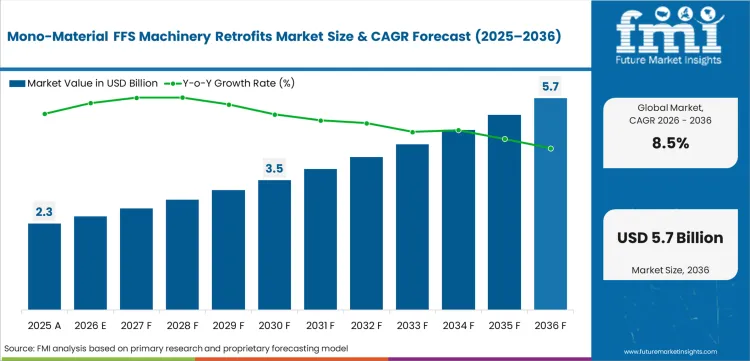
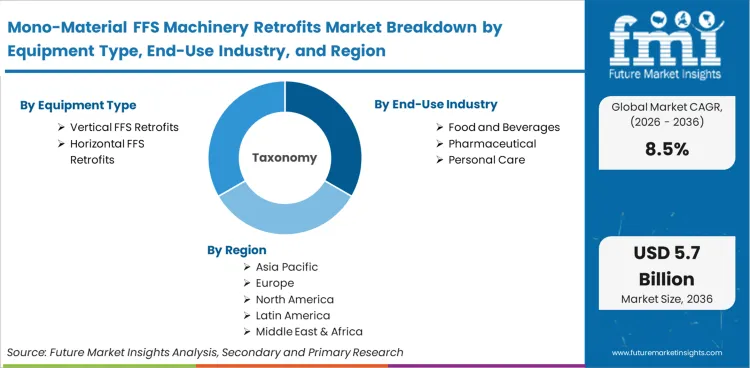
In 2025, the mono‑material FFS machinery retrofits market achieved USD 2.3 billion. It is projected to hit USD 2.5 billion in 2026, advancing at a steady 8.5% CAGR during the forecast period. Demand acceleration takes the market beyond USD 5.7 billion by 2036, supported by increasing retrofit necessity as mid‑market food producers optimize sealing accuracy for sustainable mono‑material packaging.
Converting existing high-speed lines to handle narrower sealing windows compresses the qualification timeline for sustainable packaging architectures. Line engineering directors executing factory floor modernization plans reject complete machine replacements in favor of modular thermal and tension modifications. According to FMI's estimates, this targeted capital allocation strategy accelerates the deployment of mono material packaging formats without incurring full-line replacement costs.
FMI analysts observe that the underlying momentum sustaining this compound expansion relies entirely on the thermodynamic limitations of installed packaging infrastructure. Converting multi-layer laminated lines to handle temperature-sensitive mono-materials dictates a complete overhaul of sealing profiles. Line engineering directors cannot achieve required barrier properties without specialized heat jaws and advanced cooling modules. This hardware bottleneck establishes a non-negotiable capital threshold that dictates regional modernization timelines across the packaging landscape.
Summary of Mono-Material FFS Machinery Retrofits Market
- Mono-Material FFS Machinery Retrofits Market Definition
- Mono-Material FFS Machinery Retrofits represent specialized hardware modifications applied to existing form-fill-seal equipment to enable the processing of highly recyclable, single-polymer packaging films.
- Demand Drivers in the Market
- Strict recycling tax frameworks penalize multi-layer laminate usage, compelling brand sustainability procurement leads to specify single-polymer packaging architectures.
- Narrower thermodynamic sealing windows inherent to polyethylene films force line engineering directors to install precision temperature control modules.
- Extensible physical properties of mono-material webs demand advanced tension control systems to prevent graphic distortion during high-speed forming cycles.
- Key Segments Analyzed in the FMI Report
- Vertical FFS Retrofits: 64.5% share in 2026, reflecting the massive installed base of vertical baggers requiring immediate thermal jaw modifications to process temperature-sensitive recyclable pouches.
- Food and Beverages: 55% share in 2026, as fast-moving consumer goods brands convert high-volume snack and dairy lines to meet corporate sustainability pledges.
- India: 10.5% compound expansion anchored by strict national plastic waste management regulations forcing rapid equipment upgrades.
- Analyst Opinion at FMI
- Ismail Sutaria, Principal Consultant for Packaging, opines, “I believe, the true bottleneck in sustainable packaging migration is not polymer science, but the thermodynamic limitations of installed form-fill-seal infrastructure. Facilities attempting to run temperature-sensitive polyethylene films on legacy crimp jaws face unavoidable melt-through events that trigger automated line rejections. Contract packaging line managers who delay thermal module upgrades will find themselves unable to meet the high-speed throughput requirements required for next-generation recyclable flexible packaging contracts.”
- Strategic Implications / Executive Takeaways
- Original equipment manufacturers must develop drop-in thermal sealing kits to capture revenue from the massive installed base of older packaging lines.
- Capital equipment budget owners should phase out incompatible multi-layer laminate tooling and prioritize advanced web handling modifications.
- Systems integrators must establish precise thermodynamic calibration protocols to validate seal integrity during line commissioning phases.
- Methodology
- Primary Research: Analysts engaged with packaging operations leads, thermal sealing architects, and contract packaging line managers to map specific upgrade triggers.
- Desk Research: The data collection phase aggregated compliance roadmaps from global packaging associations and corporate sustainability reports.
- Market-Sizing and Forecasting: The baseline value derives from a bottom-up aggregation of retrofit kit shipments, applying region-specific modernization curves.
- Data Validation and Update Cycle: Projections are rigorously tested against publicly reported capital expenditure guidance from major packaging equipment conglomerates.
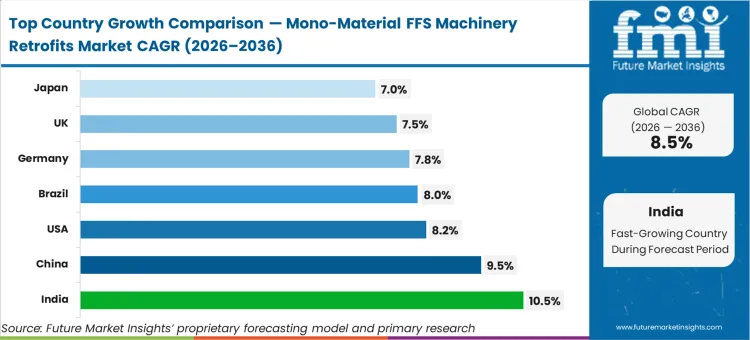
North American and European packaging hubs lead the initial retrofit wave driven by stringent environmental compliance frameworks. The USA advances at an 8.2% trajectory, while Germany posts a 7.8% rate and the UK registers 7.5%. Across the Asia Pacific region, India sets a rapid 10.5% pace, followed by China at 9.5% and Japan at 7.0%. Brazil anchors Latin American demand with an 8.0% expansion track.
Mono-Material FFS Machinery Retrofits Market Definition
Mono-Material FFS Machinery Retrofits comprise specific hardware and control system upgrades installed on existing form-fill-seal machinery to process fully recyclable, single-polymer flexible films. Typical packages include advanced continuous-heat sealing jaws, precise web tension controllers, and integrated cooling bars. Upgrading standard crimp sealers with specialized ultrasonic or dynamic thermal modules represents a primary example. Global extended producer responsibility directives dictate the operational parameters defining these essential hardware modifications.
Mono-Material FFS Machinery Retrofits Market Inclusions
The market scope includes replacement heat sealing jaws, advanced cooling modules, precision tension control systems, and specialized web handlers engineered specifically for single-polymer films. Control software upgrades required to orchestrate narrower thermal sealing windows fall within the boundaries. Modifying an existing form fill seal machine with specialized Teflon-coated sealing bars is fully incorporated.
Mono-Material FFS Machinery Retrofits Market Exclusions
Complete new form-fill-seal machine installations are excluded. Standard maintenance parts lacking specific engineering adaptations for mono-material processing fall outside defined parameters. Upgrades explicitly designed to enhance paperboard packaging or rigid plastic thermoforming lines are strictly omitted from the valuation.
Mono-Material FFS Machinery Retrofits Market Research Methodology
- Primary Research: Analysts conducted technical interviews with line engineering directors and contract packaging managers across global markets to validate thermodynamic upgrade timelines.
- Desk Research: Data aggregation encompassed published sustainability roadmaps from global consumer packaged goods brands and extended producer responsibility legislative texts.
- Market-Sizing and Forecasting: The model applies a bottom-up methodology starting with global installed base metrics for flexible packaging machines and projecting the conversion rate to mono-material capability.
- Data Validation and Update Cycle: Segment forecasts undergo cross-validation against quarterly component shipment volumes for advanced thermal sealing technologies.
Segmental Analysis
Mono-Material FFS Machinery Retrofits Market Analysis by Equipment Type
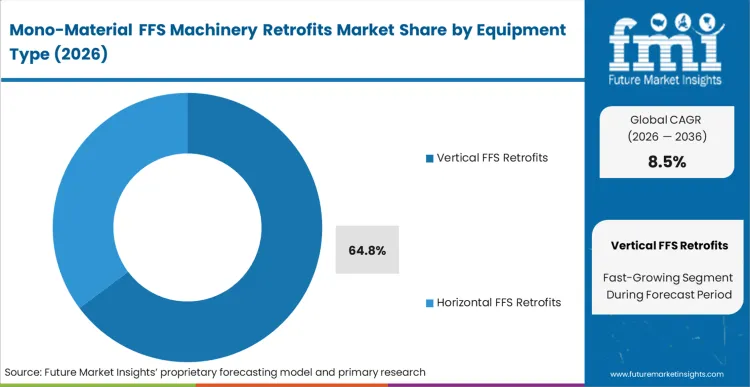
Narrowing the thermodynamic tolerance window requires physical upgrades to sealing systems before sustainable films can run at production speeds. Contract packagers deploying specialized thermal modules onto an existing vertical form fill seal (VFFS) machine establish the foundation for zero-waste operational environments. Replacing standard resistance heaters with dynamic temperature control units eliminates the risk of film distortion during the drop-and-seal phase. With strict recyclability targets approaching, capital equipment budget owners execute large-scale hardware modifications across their flexible packaging fleets. Vertical FFS Retrofits command a dominant 64.5% share in 2026. As per FMI's projection, facilities transitioning to native mono-material processing realize measurable reductions in film waste. Equipment vendors unable to supply precision thermal upgrades lose shortlist position before the 2027 retail compliance deadline.
- Thermal Physics Constraints: Narrower melting points of polyethylene require continuous heat profiles rather than impulse sealing bursts.
- Web Tension Dynamics: Stretch-prone single-polymer films demand ultra-low friction film routing pathways during vertical material draw-down.
- Cooling Synchronization: Active cooling bars must immediately stabilize the hot seal to prevent weight-induced ruptures before bag discharge.
Mono-Material FFS Machinery Retrofits Market Analysis by Retrofit Component
FMI analysts opine that integrating these precise thermal components directly determines a facility's ability to maintain historic throughput speeds while running sustainable structures. Suppliers failing to demonstrate seamless integration of advanced thermal systems forfeit margin to packaging tax penalties under new EPR frameworks. Every line engineering director bidding on sustainable packaging contracts now faces strict adherence criteria for seal integrity. Heat Sealing Jaws capture an estimated 45% segment share in 2026. Polyethylene-based mono-materials exhibit a notoriously narrow window between melting and sealing, requiring highly specialized jaw geometries to prevent burn-through. Upgrading standard crimp profiles with continuously heated, Teflon-coated sealing bars guarantees that delicate film structures fuse correctly.
- Thermodynamic Precision: Specialized cartridge heaters combined with high-density sensors maintain exact sealing temperatures across the entire jaw surface.
- Surface Coating Technology: Advanced non-stick jaw treatments prevent melted polymer accumulation during high-cycle production runs.
- Pressure Distribution: Engineered jaw profiles ensure uniform mechanical pressure application, eliminating microscopic channel leaks in the final seal.
Mono-Material FFS Machinery Retrofits Market Analysis by End-Use Industry
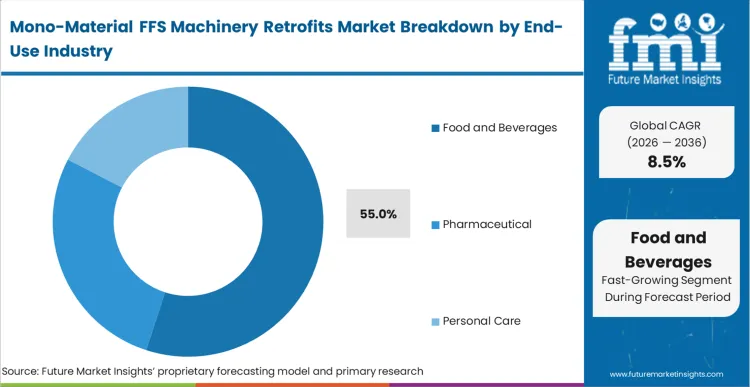
Snack and dairy producers replacing complex film structures with recyclable alternatives discover their existing equipment systematically destroys the new materials. Prior reliance on multi-layer laminates guaranteed high-barrier protection for perishable products but created impossible recycling streams. Extended producer responsibility taxes dismantle this operational paradigm. Food and Beverages accounts for a leading 55% segment share in 2026. Modifying lines with precision web handlers and continuous heating elements provides the microsecond accuracy necessary to form flawless monomaterial PE dry food pouches. Maintaining strict atmosphere control inside the package requires absolute seal integrity. Facilities operating without these specialized retrofit modules face systemic production errors as barrier properties fail post-packaging.
- Barrier Protection: Perfect thermal seals prevent oxygen ingress, maintaining mandatory shelf-life requirements for sensitive nutritional products.
- Throughput Optimization: Advanced web handling retrofits allow sustainable films to navigate the forming collar without stretching or tearing at full operational speeds.
- Contamination Resistance: Specialized jaw designs push product residue out of the sealing zone, ensuring perfect hermetic closure for liquid and powder formats.
Mono-Material FFS Machinery Retrofits Market Drivers, Restraints, and Opportunities
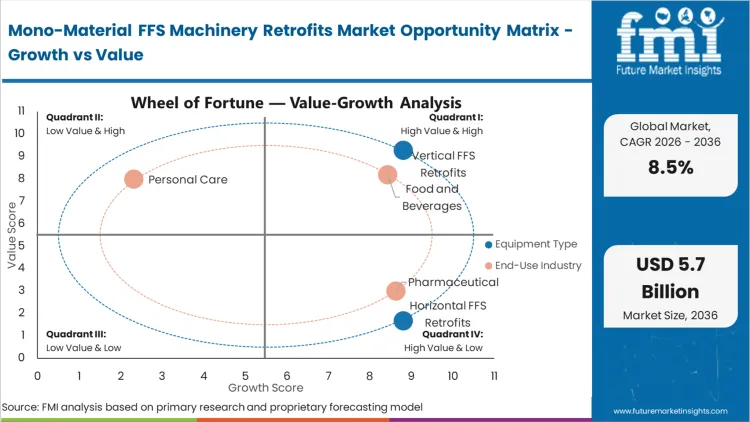
Transitioning massive consumer goods portfolios to recyclable packaging forces contract packaging line managers to overhaul fundamental machine physics. This architectural requirement renders standard impulse sealing technology obsolete. Modifying installed fleets with precision thermal controllers enables facilities to run highly engineered polyethylene films without slowing down production metrics. According to FMI's estimates, brand sustainability procurement leads who specify design for recycling packaging formats require their co-manufacturing partners to demonstrate validated sealing capabilities. Facilities failing to modernize their core forming layers risk severe production bottlenecks and reduced overall equipment effectiveness.
The intricate thermodynamic calibration parameters required to optimize continuous heating profiles create steep learning curves for maintenance teams. Designing conflict-free thermal cycles across older mechanical machines demands specialized engineering expertise that most localized packaging facilities lack internally. Line engineering directors mitigate this skill gap by sourcing comprehensive retrofit packages that include advanced diagnostic software, automating the temperature validation process before physical production begins.
- Ultrasonic Sealing Integration: Next-generation retrofit modules enable automation architects to run ultrasonic welding technology directly on existing horizontal flow wrappers. This cold-sealing approach eliminates thermal distortion risks entirely for temperature-sensitive chocolate and confectionery lines.
- Automated Tension Feedback: Upgraded tension control bandwidth permits quality assurance teams to deploy real-time strain gauges along the film path. This capability prevents film elongation from progressing into the final seal zone.
- Active Cooling Architecture: Packaging network planners integrating specialized active cooling bars accelerate the seal-setting process. Precision cooling provides the microsecond stabilization necessary to drop heavier liquid products into newly formed pouches without catastrophic bottom-seal failure.
Regional Analysis
.webp "Top Country Growth Comparison Mono Material Ffs Machinery Retrofits Market Cagr (2026 2036)")
Segmenting the Mono-Material FFS Machinery Retrofits market across 40+ countries, regional analysis covers North America, Latin America, Europe, East Asia, South Asia, Oceania, and Middle East & Africa. Evaluating regional trends provides a comprehensive market attractiveness framework within the full report.
| Country | CAGR (2026 to 2036) |
|---|---|
| India | 10.5% |
| China | 9.5% |
| USA | 8.2% |
| Brazil | 8.0% |
| Germany | 7.8% |
| UK | 7.5% |
| Japan | 7.0% |
Source: Future Market Insights (FMI) analysis, based on proprietary forecasting model and primary research
Asia Pacific Mono-Material FFS Machinery Retrofits Market Analysis
Specific regulatory requirements of individual nations dictate precise implementation parameters for mechanical transformations across the Asia Pacific region. Capital equipment budget owners overseeing massive contract manufacturing hubs specify comprehensive thermal upgrades to maintain preferred supplier status with global consumer brands. Accelerating the elimination of multi-layer packaging formats, stringent new plastic waste management directives force compliance. Analysts opine that preserving capital while achieving sustainability targets relies on this massive retrofit push, which entirely bypasses the need for full-line equipment replacement. Deploying highly extensible local polyethylene films demands upgrading existing web tensioning systems as a critical prerequisite. Consequently, specialized heat sealing components capable of micro-degree temperature adjustments see surging demand fueled by this region-wide adaptation strategy.
- India: Expanding at a CAGR value of 10.5% through 2036, India's mono-material retrofit demand responds directly to mandatory plastic waste management rules that penalize multi-layer flexible packaging volumes. Strict extended producer responsibility targets establish immediate hardware bottlenecks for the domestic contract packaging sector, which operates massive fleets of older vertical form-fill-seal equipment tuned exclusively for temperature-resistant laminates. Transitioning to polyethylene structures imposes a thermodynamic constraint. High-speed snack producers must implement immediate sealing jaw modifications to maintain line efficiency. Line engineering directors managing these facilities must secure precise thermal module upgrades before the next major enforcement phase, avoiding unplanned downtime costs during peak volume transitions.
- China: Aggressive national carbon peaking initiatives in China compel major food processing conglomerates to redesign their entire flexible packaging portfolios around single-polymer architectures. Upgrading massive multi-lane sachet machines to handle these sensitive films drives a 9.5% CAGR for mono-material retrofits in China through 2036, reflecting massive capital shifts toward sustainable compliance. Extreme throughput rates across the eastern industrial corridor's high-speed dairy and liquid packaging lines require highly specialized cooling modules to ensure seal integrity. Converting these lines demands precise synchronization between continuous heating elements and active cooling bars. Vendors unable to demonstrate verified high-bandwidth thermal control capabilities lose access to the most lucrative factory modernization projects in the region.
- Japan: Advanced recycling infrastructure in Japan enforces strict material purity standards through the Container and Packaging Recycling Law. Every new snack and confectionery packaging line must validate thermal sealing compliance for mono-material films before receiving authorization for commercial production. Maintaining global competitive advantage requires the domestic packaging machinery sector to embed precision temperature control silicon directly into replacement sealing jaws. Component suppliers lacking verified interoperable testing records forfeit access to the next generation of full-line sustainable packaging contracts. Sustaining specialized network retrofits in Japan's advanced food corridors, this continuous qualification constraint drives a 7.0% of CAGR value.
FMI's report includes extensive coverage of the Asia Pacific packaging machinery landscape. It incorporates detailed analysis of Taiwan, Indonesia, Australia, and the broader ASEAN region. A primary trend shaping these nations is the rapid localization of sustainable film extrusion, forcing contract manufacturers to deploy specialized web handling retrofits to process locally sourced, highly extensible polyethylene structures.
North America Mono-Material FFS Machinery Retrofits Market Analysis
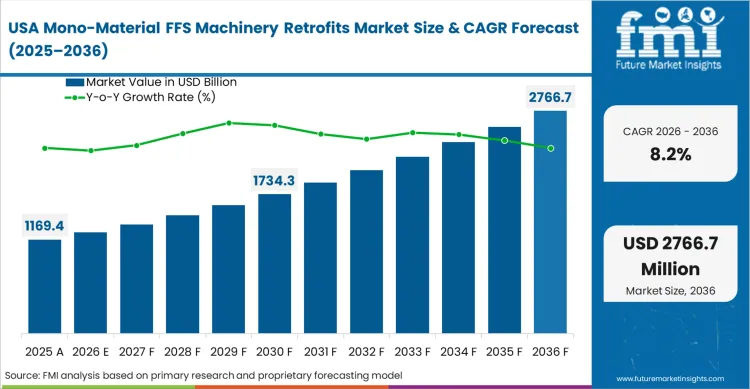
Regional food safety standards govern the exact specifications required for critical mechanical upgrades across North American production hubs. Line engineering directors leading massive food production overhauls face strict directives to unify disparate packaging materials under a single recyclable polymer family. Converting enormous installed bases of high-speed snack bagging equipment requires significant capital allocation toward robust continuous-heat sealing hardware capable of isolating thermal energy from the product zone. Minimizing production downtime during installation depends entirely on the availability of drop-in retrofit modules. Processing thinner down-gauged mono-materials without compromising structural integrity requires facilities to implement advanced tension controllers. Corporate sustainability pledges driven by major retail chains systematically eradicate the use of non-recyclable multi-layer flexible films.
- USA: Strict sustainability mandates enforced across the United States consumer packaged goods sector disrupt its entire multi-tier co-manufacturing ecosystem. Replacing standard crimp jaws with highly specialized Teflon-coated variants becomes mandatory as post-consumer recycled content directives proliferate at the state level. Discrete manufacturers modifying their sealing profiles propel the USA along a CAGR at 8.2% across the forecast decade. Network specification leads replacing aging impulse sealing systems must deploy continuous-heat architectures capable of supporting both rapid thermal recovery and precise temperature control. Hardware vendors lacking documented capability to run complex retortable mono material pouches for wet foods face immediate exclusion from major brand co-manufacturing contracts.
FMI's report details dynamic industrial shifts in Comprehensive evaluation of the North American packaging machinery sector. Integrating the cross-border fresh produce supply chains requires advanced modified atmosphere packaging retrofits to coordinate gas-flushing operations perfectly with the narrower sealing windows of recyclable films in Canada and Mexico.
Europe Mono-Material FFS Machinery Retrofits Market Analysis
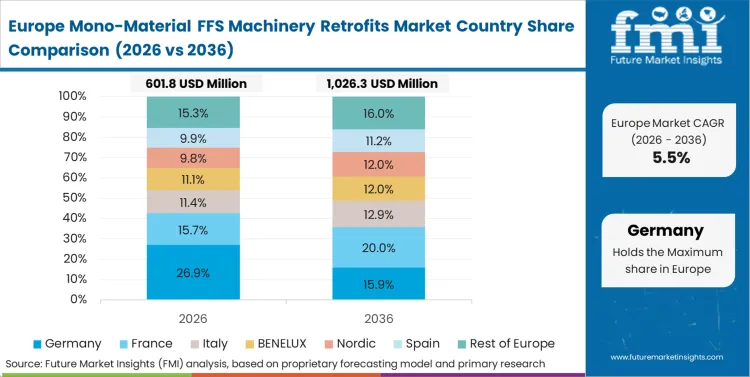
Maintaining outdated thermal sealing standards severely limits the ability of facility directors to compete in highly regulated European retail channels. Automation architects redesigning legacy production environments must integrate advanced flexible packaging machinery upgrades alongside rigorous quality inspection protocols. Guaranteeing closure stability while utilizing fully recyclable mono-polyethylene structures forces the rapid adoption of ultrasonic sealing technology. Shifting from high-friction standard steel to specialized low-friction composite surfaces requires a complete overhaul of existing mechanical forming collars. Running highly extensible films without graphic distortion demands upgrading the core web handling infrastructure. Actively penalizing the continued operation of lines producing non-recyclable flexible formats, the European Union's Packaging and Packaging Waste Regulation drives this transformation.
- Germany: Accelerating at a VAGR value of 7.8% for certified thermal retrofits, Germany responds to rigorous dual-system recycling infrastructure mandates that dictate stringent validation criteria for seal integrity. Advanced mono-material packaging formats force control systems engineers to demonstrate flawless execution of continuous heating profiles before receiving authorization to connect modified bagging cells to main factory discharge lines. Recurring compliance cycles govern the national machine engineering sector, requiring unified diagnostic layers under rigorous safety certifications. Replacing sealing components becomes a continuous operational necessity. Engineering firms targeting domestic dairy packaging plant retooling projects must guarantee microsecond-level temperature recovery performance prior to the finalization of capital procurement budgets.
- UK: Precise material composition tracking to balance complex tax liabilities across vast retail product portfolios stems directly from the United Kingdom's Plastic Packaging Tax. Contract packaging planners deploying advanced horizontal flow wrappers mandate sealing architectures capable of sub-degree temperature accuracy to process tax-exempt highly recyclable film variants. Abandoning legacy impulse sealers in favor of highly resilient continuously heated jaws becomes mandatory as operators shift toward sustainable shelf-ready packaging. Systems integrators unable to demonstrate absolute thermodynamic determinism under severe production speeds forfeit qualification for national retail supplier networks. Food producers systematically upgrading their operational backbones anchor the UK's CAGR at 7.5% being trajected towards 2036.
FMI's report includes thorough investigation of the European industrial packaging framework. The analysis encompasses Italy, France, Spain, the Nordics, and the Benelux region. A prevailing structural condition across these nations is the mandatory compliance with strict food contact material directives, forcing asset owners to specify specialized cooling modules that can rapidly set thick polyethylene seals without degrading the polymer's protective barrier properties.
Latin America Mono-Material FFS Machinery Retrofits Market Analysis
Validating seal integrity under varying ambient plant temperatures forms the critical challenge for local engineering teams across Latin American production networks. Line engineering directors face immediate pressure to upgrade existing vertical bagging fleets to handle imported mono-material rollstock, driven by multinational consumer goods conglomerates enforcing global sustainability standardization. Converting older mechanical equipment to process extensible films requires immediate investment in advanced servo-driven web handlers. Catastrophic film jams inside the forming tube are prevented by strictly managing the tension of stretch-prone materials. Specifying complete retrofit kits allows capital project leaders to avoid sourcing disparate components from multiple regional vendors.
- Brazil: Surviving complex maritime logistics chains demands highly durable flexible packaging from Brazil's massive agricultural and food processing export sector. Replacing multi-layer laminates with recyclable alternatives forces process engineers to deploy heavy-duty continuous sealing jaws capable of fusing thick mono-polyethylene structures. The domestic requirement for export-grade seal integrity anchors Brazil's 8.0% CAGR value demands thermal retrofit through 2036 as upgrade volume scales. Maximizing yield rates within massive coffee and protein export facilities necessitates continuous investment in ultra-low-friction forming collars. Equipment suppliers failing to provide advanced active cooling modules to stabilize these heavy-gauge seals surrender primary supplier status for major agribusiness packaging contracts.
FMI's report includes detailed assessment of the Latin American packaging machinery conversion landscape. The analysis covers Argentina, Chile, Colombia, and the broader Andean region. A primary structural driver across these markets involves the modernization of basic mechanical form-fill-seal machines with digital temperature controllers, elevating local contract packaging capabilities to meet the strict quality assurance demands of international retail brands.
Competitive Aligners for Market Players
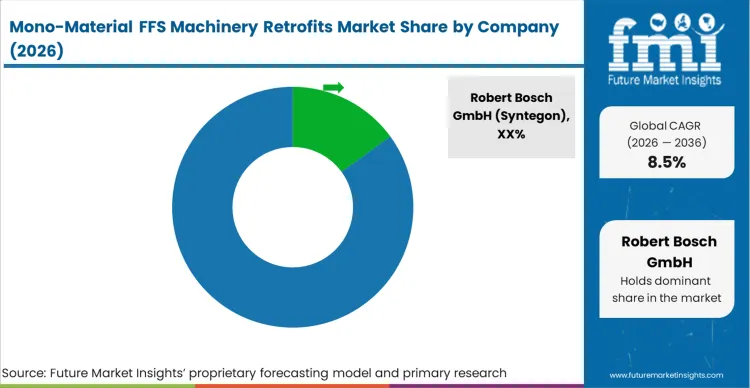
The introduction of strict design-for-recycling guidelines by global retail consortiums fundamentally alters how fast-moving consumer goods brands evaluate form-fill-seal machinery performance. Procurement teams now demand validated, high-speed mono-material processing capabilities in all new co-manufacturing tenders. This specification shift establishes a rigid performance baseline, meaning contract packagers who continue to rely on obsolete impulse-sealing mechanical equipment face exclusion from major brand portfolios. Industry frontrunners Robert Bosch GmbH (Syntegon) and I.M.A. INDUSTRIA MACCHINE AUTOMATICHE S.P.A. actively capitalize on this capability gap by engineering drop-in continuous-heat sealing modules that allow capital equipment budget owners to rapidly bridge thermodynamic performance shortfalls. Contract packagers unable to prove continuous-heat sealing reliability using these advanced kits lose their approved supplier status before formal bidding processes even commence.
Integrating advanced ultrasonic and precision cooling architectures directly into existing horizontal flow wrappers changes the cost fundamentals of sustainable food packaging. Converting heat-sensitive product lines to mono-materials previously caused unacceptable melt-damage and product loss when using standard thermal jaws. Deploying localized cold-weld ultrasonic modules or advanced active cooling bars entirely eliminates this thermodynamic risk while achieving perfect hermetic seals. ProMach and GEA Group AG drive this architectural pivot by offering specialized sonic retrofits and digital web handling modules that significantly reduce scrap rates and compress product changeover times. Simultaneously, JBT Corporation expands its retrofit portfolio to support high-throughput liquid and viscous product filling, ensuring rapid temperature stabilization during the critical drop-and-seal phase. Equipment vendors lacking mature thermal integration packages forfeit margin to specialized engineering firms capable of solving specific heat bottlenecks.
Cross-vendor interoperability frameworks disrupt long-established machinery strongholds across the contract packaging sector. With mechanical upgrade modules becoming standardized, line engineering directors designing sustainable packaging lines select web-handling and thermal components from multiple specialized suppliers without worrying about control system integration failures. Open-architecture temperature controllers communicate perfectly with existing programmable logic controllers. KHS GmbH and Krones AG accelerate this interoperability trend by supplying modular software and hardware packages that synchronize perfectly with third-party form-fill-seal base frames, empowering facility owners to optimize their retrofits for precise film types rather than being constrained by original equipment manufacturer lock-in. Component manufacturers slow to adopt open communication standards risk losing position during early-stage vendor shortlisting for major factory overhauls.
Key Players in Mono-Material FFS Machinery Retrofits Market
- Robert Bosch GmbH (Syntegon)
- I.M.A. INDUSTRIA MACCHINE AUTOMATICHE S.P.A.
- ProMach
- GEA Group AG
- JBT Corporation
- KHS GmbH
- Krones AG
Scope of the Report
| Metric | Value |
|---|---|
| Quantitative Units | USD 2.5 billion to USD 5.7 billion, at a CAGR of 8.5% |
| Market Definition | Mono-Material FFS Machinery Retrofits represent specialized hardware modifications applied to existing form-fill-seal equipment to enable the processing of highly recyclable, single-polymer packaging films. |
| Equipment Type Segmentation | Vertical FFS Retrofits, Horizontal FFS Retrofits |
| Retrofit Component Segmentation | Heat Sealing Jaws, Tension Control Systems, Cooling Modules, Web Handlers |
| End-Use Industry Segmentation | Food and Beverages, Pharmaceutical, Personal Care |
| Regions Covered | North America, Latin America, Europe, East Asia, South Asia, Oceania, Middle East & Africa |
| Countries Covered | USA, China, Germany, Japan, India, UK, Brazil, and 40 plus countries |
| Key Companies Profiled | Robert Bosch GmbH (Syntegon), I.M.A. INDUSTRIA MACCHINE AUTOMATICHE S.P.A., ProMach, GEA Group AG, JBT Corporation, KHS GmbH, Krones AG |
| Forecast Period | 2026 to 2036 |
| Approach | The baseline value derives from a bottom-up aggregation of retrofit kit shipments, applying region-specific modernization curves to project the future adoption velocity. |
Source: Future Market Insights (FMI) analysis, based on proprietary forecasting model and primary research
Segments Analysis
Equipment Type:
- Vertical FFS Retrofits
- Horizontal FFS Retrofits
Retrofit Component:
- Heat Sealing Jaws
- Tension Control Systems
- Cooling Modules
- Web Handlers
End-Use Industry:
- Food and Beverages
- Pharmaceutical
- Personal Care
Region:
- Asia Pacific
- India
- China
- Japan
- South Korea
- Indonesia
- Australia & New Zealand
- ASEAN
- Rest of Asia Pacific
- Europe
- Germany
- Italy
- France
- United Kingdom
- Spain
- Benelux
- Nordics
- Central & Eastern Europe
- Rest of Europe
- North America
- United States
- Canada
- Mexico
- Latin America
- Brazil
- Argentina
- Chile
- Rest of Latin America
- Middle East & Africa
- Kingdom of Saudi Arabia
- United Arab Emirates
- South Africa
- Turkey
- Rest of Middle East & Africa
Bibliography
- Department for Environment, Food & Rural Affairs. (2024). Unlocking resource efficiency: Phase 2 main report.
- Flexible Plastic Fund. (2024). FlexCollect project interim report.
- Association of Plastic Recyclers. (2024, March 11). How to scale the recycling of flexible film packaging.
- ASTM International. (2025). ASTM F1886/F1886M-25: Standard test method for determining integrity of primary packaging by visual inspection.
- Food Standards Agency. (2026). Alternatives to single-use plastics: Results.
- International Trade Administration. (2026, January 5). Brazil plastics regulatory framework.
- PMMI Media Group. (2024). Packaging Compass Report 2024: Adapting legacy machines for sustainable packaging.
- Plastics Recyclers Europe. (2024). Years of making plastics circular.
This bibliography is provided for reader reference. The full FMI report contains the complete reference list with primary research documentation.
This Report Addresses
- Market sizing and quantitative forecast metrics detailing the precise capital expenditure dedicated to mono-material thermal retrofit modules across major packaging sectors through 2036.
- Segmentation analysis mapping the adoption velocity of specific web handling upgrades and evaluating the thermodynamic limitations driving sealing component replacements.
- Regional deployment intelligence comparing the strict extended producer responsibility compliance strategies in Europe against the rapid mechanical modernization requirements prevalent in Asian co-manufacturing hubs.
- Regulatory compliance assessment analyzing how stringent plastic waste management directives and material purity standards force the adoption of specialized continuous-heat architectures.
- Competitive posture evaluation tracking the mandatory shift toward ultrasonic sealing integration and the resulting demand for high-precision cooling modules.
- Capital project strategic guidance defining the exact procurement specifications and temperature tolerances required to support high-speed single-polymer flexible packaging lines.
- Supply chain vulnerability analysis identifying the specific thermodynamic integration bottlenecks that extend facility conversion timelines during sustainability transitions.
- Custom data delivery formats encompassing interactive dashboards, raw Excel datasets, and comprehensive PDF narrative reports.
Frequently Asked Questions
How large is the demand for Mono-Material FFS Machinery Retrofits in the global market in 2026?
Demand for Mono-Material FFS Machinery Retrofits in the global market is estimated to be valued at USD 2.5 billion in 2026.
What will be the market size of Mono-Material FFS Machinery Retrofits in the global market by 2036?
Market size for Mono-Material FFS Machinery Retrofits is projected to reach USD 5.7 billion by 2036.
What is the expected demand growth for Mono-Material FFS Machinery Retrofits in the global market between 2026 and 2036?
Demand for Mono-Material FFS Machinery Retrofits is expected to grow at a CAGR of 8.5% between 2026 and 2036.
Which Equipment Type is poised to lead global sales by 2026?
Vertical FFS Retrofits commands 64.5% share in 2026 as contract packagers deploy specialized thermal modules to establish the foundation for zero-waste operational environments.
How significant is the role of Food and Beverages in driving Mono-Material FFS Machinery Retrofits adoption in 2026?
Food and Beverages represents 55% of segment share as fast-moving consumer goods brands convert high-volume snack lines to meet corporate sustainability pledges.
What is driving demand in India?
Strict mandatory plastic waste management rules establish extended producer responsibility targets that penalize multi-layer flexible packaging volumes.
What compliance standards or regulations are referenced for Japan?
The Japanese packaging sector operates under the highly advanced Container and Packaging Recycling Law enforcing strict material purity standards.
What is the India growth outlook in this report?
India is projected to grow at a CAGR of 10.5% during 2026 to 2036.
Why is Europe described as a priority region in this report?
The European Union's Packaging and Packaging Waste Regulation actively penalizes the continued operation of lines producing non-recyclable flexible formats.
What type of demand dominates in Europe?
Demand heavily focuses on replacing standard mechanical forming collars and crimp jaws with highly resilient continuous-heat jaws and ultrasonic sealing modules.
What is China's growth outlook in this report?
China is projected to expand at a CAGR of 9.5% during 2026 to 2036.
Does the report cover USA in its regional analysis?
Yes, USA is included within North America under the regional scope of analysis.
What are the sources referred to for analyzing USA?
Published sustainability roadmaps from global consumer packaged goods brands and state-level post-consumer recycled content mandates form the analytical basis.
What is the main demand theme linked to USA in its region coverage?
Strict sustainability mandates across multi-tier co-manufacturing ecosystems force the deployment of continuous-heat architectures capable of supporting precise temperature control.
Does the report cover Germany in its regional analysis?
Yes, Germany is included within Europe under the regional coverage framework.
What is the main Germany related demand theme in its region coverage?
Stringent validation criteria for seal integrity on advanced mono-material packaging formats compel the adoption of flawless continuous heating profiles.
Which product formats or configurations are strategically important for Asia Pacific supply chains?
Specialized heat sealing components capable of micro-degree temperature adjustments are critical for processing locally sourced polyethylene structures.
What is Mono-Material FFS Machinery Retrofits and what is it mainly used for?
These retrofits represent hardware modifications applied to existing form-fill-seal equipment. They are primarily used to enable the processing of highly recyclable, temperature-sensitive single-polymer packaging films.
What does Mono-Material FFS Machinery Retrofits mean in this report?
The scope encompasses replacement heat sealing jaws, precise tension controllers, and cooling modules engineered specifically for mono-material processing.
What is included in the scope of this Mono-Material FFS Machinery Retrofits report?
The market covers advanced continuous-heat sealing bars, ultrasonic modules, specialized web handlers, and related control software upgrades.
What is excluded from the scope of this report?
Complete new form-fill-seal machine installations, standard replacement parts, and upgrades designed for rigid plastic thermoforming are explicitly excluded.
What does market forecast mean on this page?
The market forecast represents a model-based projection built on defined industrial and technology adoption assumptions for strategic planning purposes.
How does FMI build and validate the Mono-Material FFS Machinery Retrofits forecast?
The model applies a bottom-up methodology starting with global installed base metrics and cross-validates projections against component shipment volumes for advanced thermal sealing technologies.
What does zero reliance on speculative third-party market research mean here?
Primary interviews, verified sustainability roadmaps, and official extended producer responsibility legislative texts are used exclusively instead of unverified syndicated estimates.
Preview the report firsthand - request a free sample
Get SampleGet the brochure for pricing and purchase details.
Get PDFTable of Content
- Executive Summary
- Global Market Outlook
- Demand-side Trends
- Supply-side Trends
- Technology Roadmap Analysis
- Analysis and Recommendations
- Market Overview
- Market Coverage / Taxonomy
- Market Definition / Scope / Limitations
- Research Methodology
- Chapter Orientation
- Analytical Lens and Working Hypotheses
- Market Structure, Signals, and Trend Drivers
- Desk Research Programme (Secondary Evidence)
- Company Annual and Sustainability Reports
- Peer-reviewed Journals and Academic Literature
- Corporate Websites, Product Literature, and Technical Notes
- Earnings Decks and Investor Briefings
- Statutory Filings and Regulatory Disclosures
- Technical White Papers and Standards Notes
- Trade Journals, Industry Magazines, and Analyst Briefs
- Conference Proceedings, Webinars, and Seminar Materials
- Government Statistics Portals and Public Data Releases
- Press Releases and Reputable Media Coverage
- Specialist Newsletters and Curated Briefings
- Sector Databases and Reference Repositories
- FMI Internal Proprietary Databases and Historical Market Datasets
- Subscription Datasets and Paid Sources
- Social Channels, Communities, and Digital Listening Inputs
- Additional Desk Sources
- Expert Input and Fieldwork (Primary Evidence)
- Primary Modes
- Qualitative Interviews and Expert Elicitation
- Quantitative Surveys and Structured Data Capture
- Blended Approach
- Why Primary Evidence is Used
- Field Techniques
- Interviews
- Surveys
- Focus Groups
- Observational and In-context Research
- Social and Community Interactions
- Stakeholder Universe Engaged
- C-suite Leaders
- Board Members
- Presidents and Vice Presidents
- R&D and Innovation Heads
- Technical Specialists
- Domain Subject-matter Experts
- Scientists
- Physicians and Other Healthcare Professionals
- Governance, Ethics, and Data Stewardship
- Research Ethics
- Data Integrity and Handling
- Primary Modes
- Tooling, Models, and Reference Databases
- Data Engineering and Model Build
- Data Acquisition and Ingestion
- Cleaning, Normalisation, and Verification
- Synthesis, Triangulation, and Analysis
- Quality Assurance and Audit Trail
- Market Background
- Market Dynamics
- Drivers
- Restraints
- Opportunity
- Trends
- Scenario Forecast
- Demand in Optimistic Scenario
- Demand in Likely Scenario
- Demand in Conservative Scenario
- Opportunity Map Analysis
- Product Life Cycle Analysis
- Supply Chain Analysis
- Investment Feasibility Matrix
- Value Chain Analysis
- PESTLE and Porter’s Analysis
- Regulatory Landscape
- Regional Parent Market Outlook
- Production and Consumption Statistics
- Import and Export Statistics
- Market Dynamics
- Global Market Analysis 2021 to 2025 and Forecast, 2026 to 2036
- Historical Market Size Value (USD Million) Analysis, 2021 to 2025
- Current and Future Market Size Value (USD Million) Projections, 2026 to 2036
- Y-o-Y Growth Trend Analysis
- Absolute $ Opportunity Analysis
- Global Market Pricing Analysis 2021 to 2025 and Forecast 2026 to 2036
- Global Market Analysis 2021 to 2025 and Forecast 2026 to 2036, By Equipment Type
- Introduction / Key Findings
- Historical Market Size Value (USD Million) Analysis By Equipment Type , 2021 to 2025
- Current and Future Market Size Value (USD Million) Analysis and Forecast By Equipment Type , 2026 to 2036
- Vertical FFS Retrofits
- Horizontal FFS Retrofits
- Vertical FFS Retrofits
- Y-o-Y Growth Trend Analysis By Equipment Type , 2021 to 2025
- Absolute $ Opportunity Analysis By Equipment Type , 2026 to 2036
- Global Market Analysis 2021 to 2025 and Forecast 2026 to 2036, By End-Use Industry
- Introduction / Key Findings
- Historical Market Size Value (USD Million) Analysis By End-Use Industry, 2021 to 2025
- Current and Future Market Size Value (USD Million) Analysis and Forecast By End-Use Industry, 2026 to 2036
- Food and Beverages
- Pharmaceutical
- Personal Care
- Food and Beverages
- Y-o-Y Growth Trend Analysis By End-Use Industry, 2021 to 2025
- Absolute $ Opportunity Analysis By End-Use Industry, 2026 to 2036
- Global Market Analysis 2021 to 2025 and Forecast 2026 to 2036, By Region
- Introduction
- Historical Market Size Value (USD Million) Analysis By Region, 2021 to 2025
- Current Market Size Value (USD Million) Analysis and Forecast By Region, 2026 to 2036
- North America
- Latin America
- Western Europe
- Eastern Europe
- East Asia
- South Asia and Pacific
- Middle East & Africa
- Market Attractiveness Analysis By Region
- North America Market Analysis 2021 to 2025 and Forecast 2026 to 2036, By Country
- Historical Market Size Value (USD Million) Trend Analysis By Market Taxonomy, 2021 to 2025
- Market Size Value (USD Million) Forecast By Market Taxonomy, 2026 to 2036
- By Country
- USA
- Canada
- Mexico
- By Equipment Type
- By End-Use Industry
- By Country
- Market Attractiveness Analysis
- By Country
- By Equipment Type
- By End-Use Industry
- Key Takeaways
- Latin America Market Analysis 2021 to 2025 and Forecast 2026 to 2036, By Country
- Historical Market Size Value (USD Million) Trend Analysis By Market Taxonomy, 2021 to 2025
- Market Size Value (USD Million) Forecast By Market Taxonomy, 2026 to 2036
- By Country
- Brazil
- Chile
- Rest of Latin America
- By Equipment Type
- By End-Use Industry
- By Country
- Market Attractiveness Analysis
- By Country
- By Equipment Type
- By End-Use Industry
- Key Takeaways
- Western Europe Market Analysis 2021 to 2025 and Forecast 2026 to 2036, By Country
- Historical Market Size Value (USD Million) Trend Analysis By Market Taxonomy, 2021 to 2025
- Market Size Value (USD Million) Forecast By Market Taxonomy, 2026 to 2036
- By Country
- Germany
- UK
- Italy
- Spain
- France
- Nordic
- BENELUX
- Rest of Western Europe
- By Equipment Type
- By End-Use Industry
- By Country
- Market Attractiveness Analysis
- By Country
- By Equipment Type
- By End-Use Industry
- Key Takeaways
- Eastern Europe Market Analysis 2021 to 2025 and Forecast 2026 to 2036, By Country
- Historical Market Size Value (USD Million) Trend Analysis By Market Taxonomy, 2021 to 2025
- Market Size Value (USD Million) Forecast By Market Taxonomy, 2026 to 2036
- By Country
- Russia
- Poland
- Hungary
- Balkan & Baltic
- Rest of Eastern Europe
- By Equipment Type
- By End-Use Industry
- By Country
- Market Attractiveness Analysis
- By Country
- By Equipment Type
- By End-Use Industry
- Key Takeaways
- East Asia Market Analysis 2021 to 2025 and Forecast 2026 to 2036, By Country
- Historical Market Size Value (USD Million) Trend Analysis By Market Taxonomy, 2021 to 2025
- Market Size Value (USD Million) Forecast By Market Taxonomy, 2026 to 2036
- By Country
- China
- Japan
- South Korea
- By Equipment Type
- By End-Use Industry
- By Country
- Market Attractiveness Analysis
- By Country
- By Equipment Type
- By End-Use Industry
- Key Takeaways
- South Asia and Pacific Market Analysis 2021 to 2025 and Forecast 2026 to 2036, By Country
- Historical Market Size Value (USD Million) Trend Analysis By Market Taxonomy, 2021 to 2025
- Market Size Value (USD Million) Forecast By Market Taxonomy, 2026 to 2036
- By Country
- India
- ASEAN
- Australia & New Zealand
- Rest of South Asia and Pacific
- By Equipment Type
- By End-Use Industry
- By Country
- Market Attractiveness Analysis
- By Country
- By Equipment Type
- By End-Use Industry
- Key Takeaways
- Middle East & Africa Market Analysis 2021 to 2025 and Forecast 2026 to 2036, By Country
- Historical Market Size Value (USD Million) Trend Analysis By Market Taxonomy, 2021 to 2025
- Market Size Value (USD Million) Forecast By Market Taxonomy, 2026 to 2036
- By Country
- Kingdom of Saudi Arabia
- Other GCC Countries
- Turkiye
- South Africa
- Other African Union
- Rest of Middle East & Africa
- By Equipment Type
- By End-Use Industry
- By Country
- Market Attractiveness Analysis
- By Country
- By Equipment Type
- By End-Use Industry
- Key Takeaways
- Key Countries Market Analysis
- USA
- Pricing Analysis
- Market Share Analysis, 2025
- By Equipment Type
- By End-Use Industry
- Canada
- Pricing Analysis
- Market Share Analysis, 2025
- By Equipment Type
- By End-Use Industry
- Mexico
- Pricing Analysis
- Market Share Analysis, 2025
- By Equipment Type
- By End-Use Industry
- Brazil
- Pricing Analysis
- Market Share Analysis, 2025
- By Equipment Type
- By End-Use Industry
- Chile
- Pricing Analysis
- Market Share Analysis, 2025
- By Equipment Type
- By End-Use Industry
- Germany
- Pricing Analysis
- Market Share Analysis, 2025
- By Equipment Type
- By End-Use Industry
- UK
- Pricing Analysis
- Market Share Analysis, 2025
- By Equipment Type
- By End-Use Industry
- Italy
- Pricing Analysis
- Market Share Analysis, 2025
- By Equipment Type
- By End-Use Industry
- Spain
- Pricing Analysis
- Market Share Analysis, 2025
- By Equipment Type
- By End-Use Industry
- France
- Pricing Analysis
- Market Share Analysis, 2025
- By Equipment Type
- By End-Use Industry
- India
- Pricing Analysis
- Market Share Analysis, 2025
- By Equipment Type
- By End-Use Industry
- ASEAN
- Pricing Analysis
- Market Share Analysis, 2025
- By Equipment Type
- By End-Use Industry
- Australia & New Zealand
- Pricing Analysis
- Market Share Analysis, 2025
- By Equipment Type
- By End-Use Industry
- China
- Pricing Analysis
- Market Share Analysis, 2025
- By Equipment Type
- By End-Use Industry
- Japan
- Pricing Analysis
- Market Share Analysis, 2025
- By Equipment Type
- By End-Use Industry
- South Korea
- Pricing Analysis
- Market Share Analysis, 2025
- By Equipment Type
- By End-Use Industry
- Russia
- Pricing Analysis
- Market Share Analysis, 2025
- By Equipment Type
- By End-Use Industry
- Poland
- Pricing Analysis
- Market Share Analysis, 2025
- By Equipment Type
- By End-Use Industry
- Hungary
- Pricing Analysis
- Market Share Analysis, 2025
- By Equipment Type
- By End-Use Industry
- Kingdom of Saudi Arabia
- Pricing Analysis
- Market Share Analysis, 2025
- By Equipment Type
- By End-Use Industry
- Turkiye
- Pricing Analysis
- Market Share Analysis, 2025
- By Equipment Type
- By End-Use Industry
- South Africa
- Pricing Analysis
- Market Share Analysis, 2025
- By Equipment Type
- By End-Use Industry
- USA
- Market Structure Analysis
- Competition Dashboard
- Competition Benchmarking
- Market Share Analysis of Top Players
- By Regional
- By Equipment Type
- By End-Use Industry
- Competition Analysis
- Competition Deep Dive
- Robert Bosch GmbH (Syntegon)
- Overview
- Product Portfolio
- Profitability by Market Segments (Product/Age /Sales Channel/Region)
- Sales Footprint
- Strategy Overview
- Marketing Strategy
- Product Strategy
- Channel Strategy
- I.M.A. INDUSTRIA MACCHINE AUTOMATICHE S.P.A.
- ProMach
- GEA Group AG
- JBT Corporation
- KHS GmbH
- Robert Bosch GmbH (Syntegon)
- Competition Deep Dive
- Assumptions & Acronyms Used


