

- Industry Size (2026)
- USD 1.3 Bn
- Forecast (2036)
- USD 4.1 Bn
- CAGR (2026 to 2036)
- 12.06%
Payer Policy Intelligence Platforms Market Size, Market Forecast and Outlook By FMI
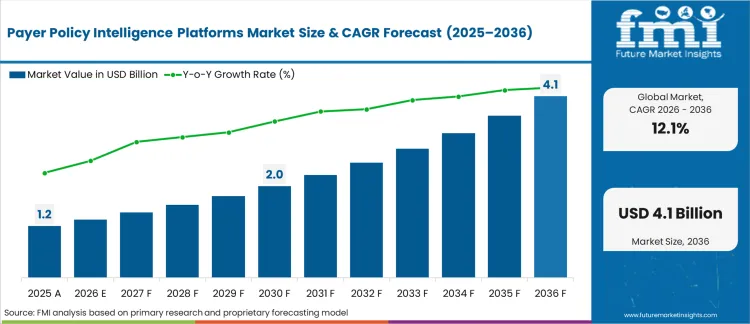
The payer policy intelligence platforms market was valued at USD 1.2 billion in 2025 and is projected to reach USD 1.3 billion in 2026, reflecting a CAGR of 12.06%. Industry is expected to grow to USD 4.1 billion by 2036, driven by the adoption of NLP‑enabled systems that streamline the interpretation of complex commercial and Medicare policies and reduce delays in market access processes.
Transitioning from manual PDF scraping to algorithmic policy tracking forces Pharmaceutical Market Access Directors to upgrade their commercialization infrastructure. Relying on static policy reviews creates massive blind spots when daily medical policy updates exceed manual review capacity. Market access teams failing to track these changes lose peak product revenue as favorable coverage criteria revert or tighten without their knowledge. The critical failure point is mapping ambiguous clinical criteria rather than just extracting raw policy text. Commercial leaders integrating these engines with healthcare data integration architectures bypass traditional operational silos.
Algorithmic tracking achieves self-sustaining adoption once market access teams must map concurrent real-time criteria changes across 500+ commercial plans simultaneously to maintain Tier 2 formulary status. Pharma launch coordinators must link their patient assistance programs to dynamic policy feeds before post-launch commercialization windows close. This forces an immediate migration away from ad-hoc consultant reports toward continuous API-fed intelligence platforms.
Summary of Payer Policy Intelligence Platforms Market
- Payer Policy Intelligence Platforms Market Definition
- This market comprises algorithmic systems that ingest and structure fragmented medical policies and reimbursement criteria from health insurers. It provides pharmaceutical, medtech, and provider organizations with real-time visibility into coverage shifts, enabling precise market access and revenue cycle execution.
- Demand Drivers in the Market
- The CMS Interoperability and Prior Authorization Final Rule forces healthcare system revenue cycle teams to adopt API-driven policy transparency tools to manage denials.
- Erratic Medicare Local Coverage Determinations compel medtech commercialization leads to deploy dynamic tracking to prevent widespread reimbursement eligibility loss.
- Compressed product launch windows drive pharma market access directors to automate formulary monitoring to secure peak sales velocity.
- Key Segments Analyzed in the FMI Report
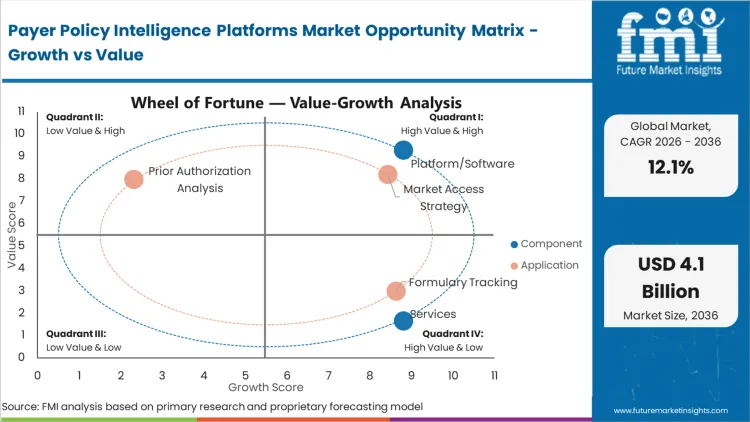
- Platform/Software: 68.5% share in 2026, anchored by life sciences firms shifting from outsourced consultants to continuous API-fed intelligence subscriptions.
- Market Access Strategy: 41.2% share in 2026, dictated by the urgent need to model projected revenue impacts before new clinical criteria edits take effect.
- Pharmaceutical & Biotech Companies: 48.7% share in 2026, driven by high-margin specialty drug portfolios requiring continuous Tier 2 formulary status defense.
- India: 15.2% compound growth, accelerated by Ayushman Bharat Digital Mission requirements for standardized national coverage mapping.
- Analyst Opinion at FMI
- Sabyasachi Ghosh, Principal Analyst, Healthcare Market Intelligence, opines, "The core operational constraint is not policy extraction, but the ability to interpret and contextualize ambiguous medical‑necessity criteria. Vendors that cannot translate raw policy language into cohort‑specific, decision‑ready insights will face escalating churn as market access teams prioritize solutions that directly support workflow execution. I observe that platforms limiting their capability to alert generation without providing the corresponding TAM impact will rapidly lose ground to predictive modeling engines."
- Strategic Implications / Executive Takeaways
- MedTech commercialization leads must implement automated LCD monitoring to preemptively adjust billing codes before unannounced policy shifts freeze their revenue streams.
- Pharma launch coordinators should integrate policy intelligence directly into patient assistance programs to accurately project script fulfillment rates.
- Health system revenue cycle VPs must adopt NLP-driven authorization analysis or face unsustainable write-offs from increasingly complex commercial payer criteria.
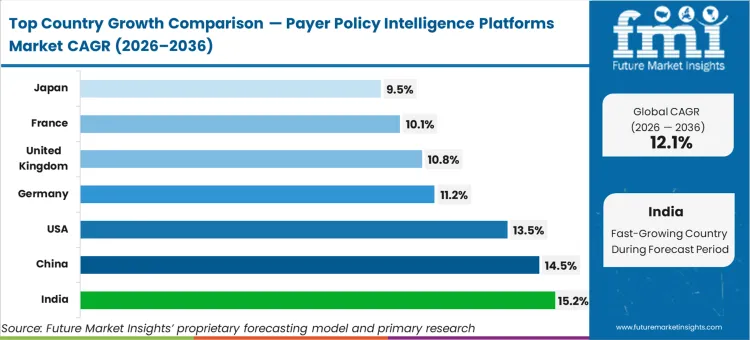
India tracks 15.2% compound growth, driven by Ayushman Bharat Digital Mission mandates requiring unstructured coverage data mapping for national registries. China advances at 14.5% as provincial reimbursement criteria consolidate under centralised negotiation frameworks. The United States follows at 13.5% through 2036. Germany records an 11.2% rate, while the United Kingdom expands at 10.8%. France and Japan post growth of 10.1% and 9.5% respectively. This structural spread exists because single-payer systems require localized policy linkage, whereas multi-payer commercial markets force exponentially higher ingestion volume to maintain baseline revenue cycle visibility.
Payer Policy Intelligence Platforms Market Key Takeaways
| Metric | Details |
|---|---|
| Industry Size (2026) | USD 1.3 billion |
| Industry Value (2036) | USD 4.1 billion |
| CAGR (2026-2036) | 12.06% |
Payer Policy Intelligence Platforms Market Definition
The Payer Policy Intelligence Platforms Market encompasses software systems and managed services that autonomously ingest, interpret, and track medical policies, formulary updates, and reimbursement criteria from public and commercial health insurers. These platforms convert unstructured payer documents into structured, queryable databases. The market is strictly separated from general clinical trial management tools by its exclusive focus on post-approval coverage rules, billing codes, and health technology assessment tracking.
Payer Policy Intelligence Platforms Market Inclusions
Scope includes AI-driven policy document extraction tools, real-time formulary status dashboards, prior authorization criteria monitors, and Medicare Local Coverage Determination (LCD) tracking modules. Natural language processing engines built specifically for medical necessity interpretation fall within this boundary. Systems that map payer requirements directly to specialized medical billing software frameworks are included, alongside subscription-based policy alert services designed for medical device commercialization teams.
Payer Policy Intelligence Platforms Market Exclusions
General electronic health record (EHR) systems and patient-facing claim dispute portals are explicitly excluded. Contract lifecycle management systems that handle payer-provider rate negotiations but do not interpret clinical coverage policies are outside scope. Clinical decision support systems used purely for diagnostic assistance, without integrating insurer-specific reimbursement rules, do not qualify for this market analysis.
Payer Policy Intelligence Platforms Market Research Methodology
- Primary Research: FMI analysts engaged with Pharma Market Access Directors, MedTech Commercialization Leads, and Health System Revenue Cycle VPs to map specific policy tracking bottlenecks.
- Desk Research: Aggregation of policy change volume metrics derived from the Centers for Medicare & Medicaid Services (CMS) registries and major commercial payer bulletin archives.
- Market-Sizing and Forecasting: Baseline valuations derived from enterprise software licensing contracts for top-tier life sciences firms, adjusted by institutional adoption curves for automated policy tracking.
- Data Validation and Update Cycle: Projections cross-validated against public health information exchange (HIE) API transaction volumes and real-world evidence vendor deployment timelines.
Segmental Analysis
Payer Policy Intelligence Platforms Market Analysis by Component
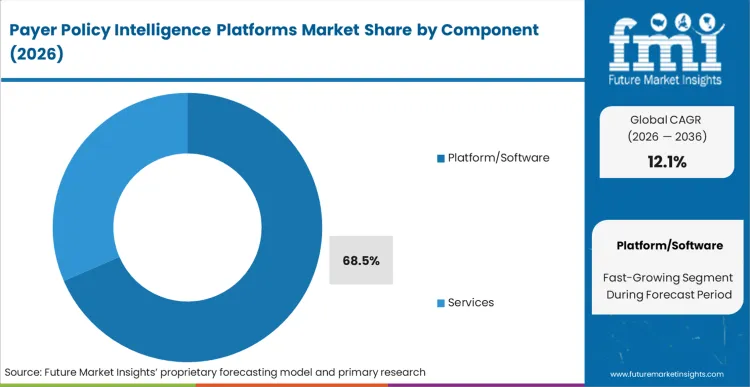
The replacement of slow, manual consultant-led policy audits with persistent NLP tracking systems accelerates adoption across the life sciences sector. Platform/Software holds 68.5% share in 2026 due to the sheer volume of daily policy bulletins, which far exceeds human processing capacity. According to FMI's estimates, vendors embedding clinical natural language processing directly into market access dashboards create an indispensable technical advantage. Market access directors must transition from project-based service contracts to continuous software subscriptions to avoid fatal launch delays caused by outdated coverage assumptions.
- Latency reduction: Continuous API scraping eliminates the multi-day lag inherent in manual policy reviews. Product launch directors capturing this real-time data prevent sales teams from targeting restricted physician networks.
- Historical linkage: Preserving archived policy versions allows analysts to identify payer criteria tightening trends over time. Commercial strategy leads deploying this feature accurately model future coverage erosion for specialty therapies.
- Criteria extraction: Algorithmic identification of step-therapy requirements isolates specific barriers to script fulfilment. Patient support program managers utilizing this extraction customize copay assistance to offset precise payer restrictions.
Payer Policy Intelligence Platforms Market Analysis by Application
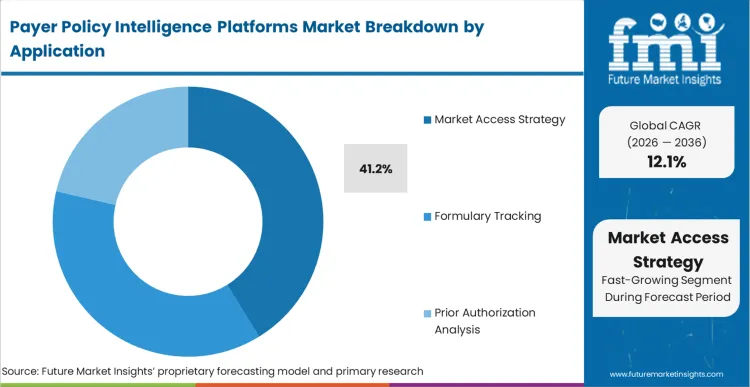
The operational gap between securing regulatory approval and actually navigating complex reimbursement pathways drives demand for specialised modelling. Market Access Strategy leads with 41.2% share in 2026, as drug manufacturers rely on these tools to secure and defend Tier 2 or Tier 3 formulary placements.
As per FMI's projection, the ability to simulate the financial impact of a competitor's favorable policy change forces companies to invest heavily in strategic modelling platforms. Incorporating these insights into broader revenue cycle management strategies allows organizations to anticipate cash flow disruptions. Commercial launch leaders must validate payer criteria constraints prior to deploying expensive field sales forces or face devastating budget overruns.
- Simulated impact: Predictive engines calculate potential revenue loss from impending prior authorization rollouts. Financial analysts leveraging these simulations adjust quarterly revenue guidance before the policy officially takes effect.
- Competitor tracking: Automated alerts trigger when a rival therapeutic secures preferred formulary status. Brand managers receiving these notifications immediately deploy counter-contracting strategies to defend their market share.
- Code validation: Continuous tracking of billing code modifications prevents systemic claim rejection. Hospital billing directors implementing this validation secure steady cash flows against erratic Medicare edits.
Payer Policy Intelligence Platforms Market Analysis by End User
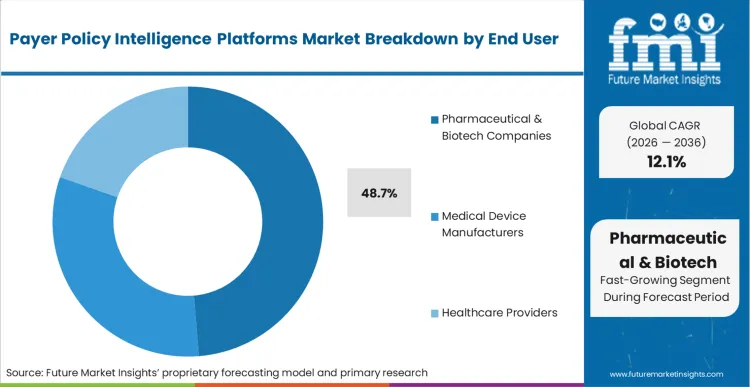
The rigid compliance threshold surrounding specialty drug reimbursement dictates technology procurement for major drug developers. Pharmaceutical & Biotech Companies capture 48.7% share in 2026 because their high-margin portfolios are disproportionately targeted by aggressive payer cost-containment measures. FMI analysts opine that integrating these intelligence feeds with emerging digital therapeutics commercialization efforts will become a standard industry requirement. Pharma launch executives must deploy comprehensive policy surveillance to protect peak product revenues from sudden, unannounced criteria restrictions.
- Launch defense: Pre-populated coverage maps allow field reps to target accessible patient populations immediately upon approval. Sales operations directors using these maps avoid wasting resources on territories with hostile payer environments.
- Indication expansion: Tracking off-label coverage nuances highlights opportunities for formal supplemental new drug applications. Clinical development leads analyzing this data prioritize trial investments based on proven payer willingness to reimburse.
- Device eligibility: Translating erratic LCD changes into actionable device eligibility rules prevents delayed hospital purchasing. Medtech commercialization managers relying on these rules secure long-term procurement contracts by guaranteeing reimbursement viability.
Payer Policy Intelligence Platforms Market Drivers, Restraints, and Opportunities
The CMS Interoperability and Prior Authorization Final Rule (CMS-0057-F) forces hospital revenue cycle teams to implement automated policy tracking architectures. This regulatory mandate creates an urgent operational deadline, as manual denial management becomes mathematically unsustainable under the new data-sharing requirements. Health systems that adopt NLP-driven intelligence platforms drastically reduce their write-off ratios by aligning physician orders with precise, real-time payer criteria. Operations vice presidents who ignore this technical shift face catastrophic claim denial rates and subsequent cash flow paralyzation.
Heavy fragmentation in regional payer terminology creates severe algorithmic friction. Small health plans frequently use non-standardized language for medical necessity, which confuses baseline NLP models trained strictly on Medicare standards. To circumvent this, vendors deploy human-in-the-loop validation teams, significantly increasing the cost of goods sold and limiting the scalability of pure-play software models in highly localized markets.
Opportunities in the Payer Policy Intelligence Platforms Market
- Predictive Criteria Modeling: Advanced algorithms allow platform providers to forecast future policy changes based on historical payer behavior and demographic cost pressures. Market access directors licensing this healthcare predictive analytics capability secure a first-mover advantage in rebate negotiations.
- EHR Workflow Integration: Embedding policy alerts directly into the physician's electronic prescribing interface stops unapproved scripts before they reach the pharmacy. Healthcare IT integrators deploying this feature capture massive hospital contracts by proving immediate reduction in administrative burden.
- Genomic Testing Policy Tracking: Specialized modules designed to track the rapidly evolving reimbursement rules for companion diagnostics fill a critical industry void. Bioinformatics commercial leads utilizing these specific trackers accelerate the adoption of precision medicine protocols across cautious payer networks.
Regional Analysis
Based on the regional analysis, the Payer Policy Intelligence Platforms market is segmented into North America, Latin America, Europe, East Asia, South Asia & Pacific, and Middle East & Africa across 40 plus countries.
.webp "Top Country Growth Comparison Payer Policy Intelligence Platforms Market Cagr (2026 2036)")
| Country | CAGR (2026 to 2036) |
|---|---|
| India | 15.2% |
| China | 14.5% |
| United States | 13.5% |
| Germany | 11.2% |
| United Kingdom | 10.8% |
| France | 10.1% |
| Japan | 9.5% |
South Asia & Pacific Payer Policy Intelligence Platforms Market Analysis
Specific policy mandates driven by national digital health infrastructure overhauls dictate this region's aggressive platform adoption. Integrating fragmented private insurer data with emerging centralized registries forces local technology vendors to build sophisticated data ingestion engines. Based on FMI's assessment, the push for standardized health records requires deep linkage between policy text and population health management frameworks to ensure broad clinical accessibility.
- India: India's rollout of the Ayushman Bharat Digital Mission (ABDM) forces fragmented private and public payers to map unstructured coverage data into standardized national registries for network inclusion. This specific integration requirement mandates the immediate procurement of automated policy translation layers. High-volume hospital networks confirm this shift by aggressively replacing manual billing teams with API-driven solutions. Tracking 15.2% annual growth to 2036. Healthcare IT directors who delay ABDM compliance face total exclusion from the nation's largest emerging patient pools.
FMI's report includes comprehensive evaluation of Australia, Indonesia, and Malaysia. The rapid proliferation of private micro-insurance models across these nations accelerates the need for hyper-localized policy tracking algorithms.
East Asia Payer Policy Intelligence Platforms Market Analysis
Centralized procurement practices and aggressive state-negotiated reimbursement criteria characterize the East Asian market structure. The sheer volume of population-level formulary adjustments requires life sciences companies to utilize real-time surveillance to protect their contracted margins. In FMI's view, pharmaceutical manufacturers operating here cannot rely on legacy consulting models due to the rapid execution timelines mandated by provincial health authorities.
- China: Industry in China is set to advance at 14.5% compound between 2026 and 2036. The centralised National Reimbursement Drug List (NRDL) negotiations in China compel domestic and foreign pharmaceutical firms to simulate precise pricing and coverage trade-offs prior to bidding. This rigid procurement practice necessitates algorithmic modelling to avoid ruinous margin compression during contract finalisation. Procurement records indicate a massive surge in local enterprise software licensing for market access analytics. Pharma commercialization leads ignoring these policy modelling platforms risk catastrophic exclusion from provincial hospital networks.
- Japan: The adoption curve is anchored to a 9.5% annual expansion through the decade. Stringent biennial drug pricing revisions define Japan's position in the global market access landscape. This specific cost-containment strategy forces drug manufacturers to track Health Ministry policy nuances continuously to defend premium pricing tiers. Regulatory affairs directors must deploy automated intelligence tools or suffer compounding revenue erosion during mandatory price cuts.
FMI's report includes detailed analysis of South Korea and Taiwan. Both countries utilize strict health technology assessment (HTA) gateways, requiring advanced policy tracking for successful market entry.
North America Payer Policy Intelligence Platforms Market Analysis
Complex multi-payer economics and erratic commercial coverage variations create the highest baseline demand for policy tracking globally. The structural necessity to monitor thousands of disparate health plan bulletins simultaneously makes manual oversight impossible for organizations operating at scale. As per FMI's projection, the volume of data generated by the American healthcare billing apparatus drives unmatched investment in natural language processing architectures.
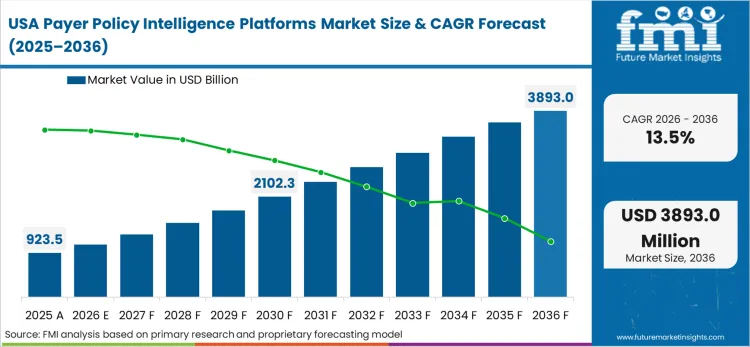
- United States: Tier-1 pharmaceutical distributors in the United States face continuous policy volatility from hundreds of independent commercial payers altering step-therapy and prior authorization rules daily. This fragmented payer environment forces market access teams to purchase persistent software monitoring to maintain script fulfillment visibility. Software vendor deployment logs confirm near-universal adoption among leading life sciences firms. Projected at 13.5% compound growth over the forecast period. MedTech reimbursement strategists must secure these intelligence feeds to prevent erratic Medicare Administrative Contractor (MAC) decisions from freezing product adoption.
FMI's report includes coverage of Canada. The transition toward harmonized provincial drug review systems drives parallel demand for specialized policy mapping software north of the border.
Europe Payer Policy Intelligence Platforms Market Analysis
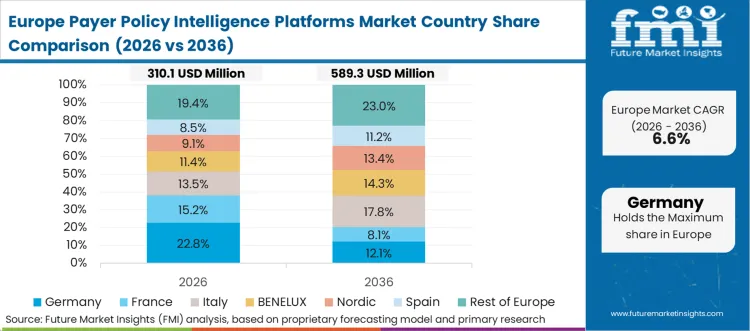
Strict health technology assessment protocols and unified data privacy directives heavily influence platform design in this region. The need to prove clinical and economic value against established standard-of-care policies forces drug developers to maintain massive repositories of historical payer decisions. FMI analysts opine that navigating these unified yet complex national health systems requires platforms built explicitly for European value-based pricing models.
- Germany: The AMNOG pricing regulation framework requires pharmaceutical companies to continuously track comparator drug policies and reference pricing shifts. This policy environment forces market access teams to deploy platforms capable of mapping complex clinical trial outcomes against evolving Federal Joint Committee (G-BA) criteria. Expanding at 11.2% between 2026 and 2036. Market access directors who fail to align their policy intelligence with AMNOG mandates face immediate, irreversible price degradation upon launch.
- United Kingdom: The National Institute for Health and Care Excellence (NICE) guidelines compel life sciences firms to maintain rigorous surveillance of cost-effectiveness thresholds and evolving appraisal methodologies. Sustaining a 10.8% CAGR to 2036.
- France: France's early access program (accès compassionnel) forces specialized biotech firms to track rapid, interim policy changes that dictate preliminary hospital reimbursement. The sector advances at a 10.1% compound annual rate through 2036.
FMI's report includes comprehensive evaluation of Italy, Spain, and the Nordics. The expansion of regional value-based procurement contracts requires deep integration with local hospital formulary data.
Competitive Aligners for Market Players
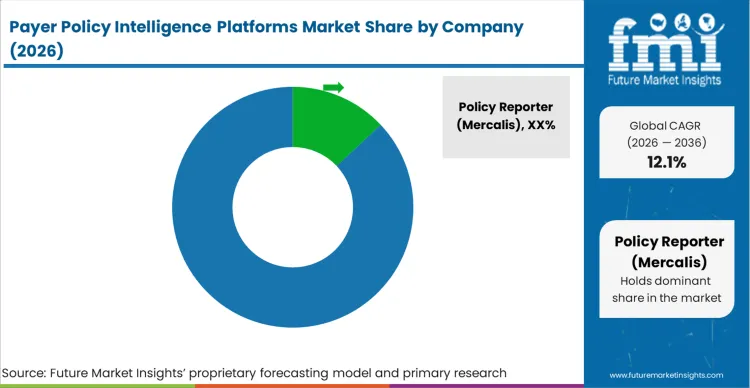
The payer policy intelligence market exhibits a moderately consolidated structure, anchored by high barriers to entry related to historical data accumulation and payer network integration. Challengers struggle to replicate the extensive archives of commercial medical policies maintained by dominant firms like Clarivate (MMIT) and Policy Reporter. Buyers distinguish qualified vendors primarily through the latency of their data ingestion—specifically, whether a platform alerts them to a policy change within 24 hours versus a week. This behavior shift forces incumbent platforms to abandon batch-processing methods in favor of real-time API connectivity.
Firms like Panalgo and Komodo Health hold specific structural advantages by linking raw policy text directly to massive real-world patient data repositories. A challenger entering this space must build proprietary cross-referencing capabilities that match specific billing codes to exact diagnostic criteria, rather than simply presenting unstructured PDFs. Vendors embedding these capabilities into comprehensive healthcare cloud computing infrastructures capture the most lucrative life sciences contracts. Challengers providing only surface-level scraping tools face rapid displacement.
Large pharmaceutical buyers actively prevent vendor lock-in by utilizing multi-vendor strategies, often pairing a dominant formulary tracking platform with a specialized predictive analytics tool. This structural tension prevents dominant intelligence providers from exerting absolute pricing power over enterprise contracts, as sophisticated market access teams can insource basic data aggregation if software licensing fees become punitive. The competitive trajectory to 2036 indicates further consolidation as leading platforms acquire specialized NLP startups to enhance their ability to parse highly ambiguous oncology and rare disease criteria.
Key Players in Payer Policy Intelligence Platforms Market
- Policy Reporter (Mercalis)
- Clarivate (MMIT)
- Panalgo
- Model N
- Komodo Health
- Definitive Healthcare
- Veeva Systems
- Zitter Insights
Scope of the Report
| Metric | Value |
|---|---|
| Quantitative Units | USD 1.3 billion to USD 4.1 billion, at a CAGR of 12.06% |
| Market Definition | Software and services that autonomously ingest, interpret, and track medical policies, formulary updates, and reimbursement criteria from public and commercial health insurers. |
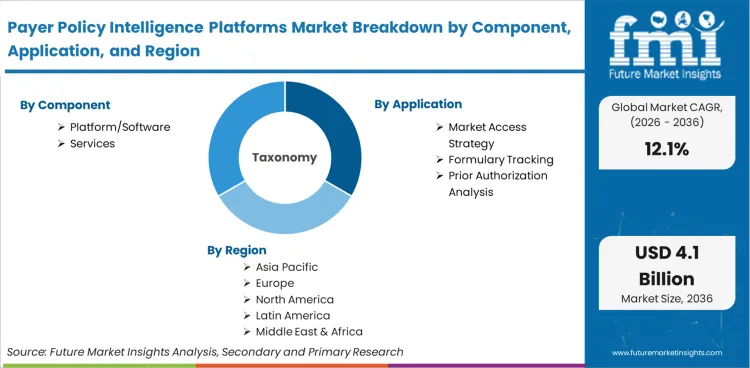
| Component Segmentation | Platform/Software, Services |
| Application Segmentation | Market Access Strategy, Formulary Tracking, Prior Authorization Analysis, Coding & Billing Compliance |
| End User Segmentation | Pharmaceutical & Biotech Companies, Medical Device Manufacturers, Healthcare Providers |
| Regions Covered | North America, Latin America, Europe, East Asia, South Asia & Pacific, Middle East & Africa |
| Countries Covered | India, China, United States, Germany, United Kingdom, France, Japan, and 40 plus countries |
| Key Companies Profiled | Policy Reporter (Mercalis), Clarivate (MMIT), Panalgo, Model N, Komodo Health, Definitive Healthcare, Veeva Systems, Zitter Insights |
| Forecast Period | 2026 to 2036 |
| Approach | Primary interviews with Pharma Market Access Directors and Health System Revenue Cycle VPs. Market sizing validated against enterprise software licensing contracts and API transaction volumes. |
Payer Policy Intelligence Platforms Market Analysis by Segments
Component:
- Platform/Software
- Services
Application:
- Market Access Strategy
- Formulary Tracking
- Prior Authorization Analysis
- Coding & Billing Compliance
End User:
- Pharmaceutical & Biotech Companies
- Medical Device Manufacturers
- Healthcare Providers
Region:
- North America
- United States
- Canada
- Latin America
- Brazil
- Mexico
- Europe
- Germany
- United Kingdom
- France
- Italy
- Spain
- East Asia
- China
- Japan
- South Korea
- South Asia & Pacific
- India
- Australia
- Middle East & Africa
- GCC Countries
- South Africa
Bibliography
- Amann, S. T., Shah, E. D., & Wilson, L. J. (2024). An overview of the challenging process of prior authorization: Medical necessity for a better way. Clinical Gastroenterology and Hepatology, 22(12), 2362–2366.
- American Medical Association. (2025). 2024 AMA prior authorization physician survey.
- Centers for Medicare & Medicaid Services. (2024, January 17). CMS finalizes rule to expand access to health information and improve the prior authorization process.
- Freed, M., Fuglesten Biniek, J., Damico, A., & Neuman, T. (2024, August 8). Medicare Advantage in 2024: Premiums, out-of-pocket limits, supplemental benefits, and prior authorization. KFF.
- Gemeinsamer Bundesausschuss. (2024, December 5). AMNOG-Nutzenbewertung: Ab Januar 2025 Nachweispflicht zur Anzahl der Studienteilnehmenden in Deutschland – G-BA beschließt Anpassung an gesetzliche Änderungen im Medizinforschungsgesetz [AMNOG benefit assessment: From January 2025, proof of the number of study participants in Germany required – G-BA adopts adaptation to legal changes in the Medical Research Act].
- Joyce, G., Blaylock, B., Chen, J., & Van Nuys, K. (2024). Medicare Part D plans greatly increased utilization restrictions on prescription drugs, 2011–20. Health Affairs, 43(3), 391–397.
- Ministry of Health and Family Welfare, Government of India. (2025, February 13). Update on the implementation of Ayushman Bharat Digital Mission (ABDM).
- Ministry of Health, Labour and Welfare. (2024, December). Fiscal year 2024 guidebook on insurance coverage for medical devices and in vitro diagnostics.
- National Healthcare Security Administration of the People’s Republic of China, & Ministry of Human Resources and Social Security of the People’s Republic of China. (2024, November 28). Notice on issuing the National basic medical insurance, work-related injury insurance, and maternity insurance drug catalog (2024).
- National Institute for Health and Care Excellence. (2025). NICE technology appraisal and highly specialised technologies guidance: The manual (PMG36).
This bibliography is provided for reader reference. The full FMI report contains the complete reference list with primary source documentation.
This Report Addresses
- Market intelligence to support strategic decision making across NLP-driven policy extraction algorithms and dynamic formulary tracking modules unique to this market
- Market size estimation and 10-year revenue forecasts from 2026 to 2036, supported by enterprise software licensing contracts and API transaction volumes
- Growth opportunity mapping across Platform/Software and Services categories with emphasis on the specific need to map concurrent real-time criteria changes across 500+ commercial plans
- Segment and regional revenue forecasts covering Prior Authorization Analysis and Coding & Billing Compliance across the Ayushman Bharat Digital Mission regulatory context
- Competition strategy assessment including historical data accumulation barriers, API ingestion latency, and proprietary real-world evidence linkages
- Platform capability development tracking including CMS-0057-F compliance frameworks, predictive criteria modelling, and automated step-therapy extraction techniques discussed in this article
- Market access analysis covering Tier 2 formulary defense programs, Medicare LCD continuous monitoring channels, and hospital revenue cycle procurement pathways
- Market report delivery in PDF, Excel, PPT, and interactive dashboard formats for executive strategy, pharmaceutical commercialization planning, and operational benchmarking use
Frequently Asked Questions
How large is the Payer Policy Intelligence Platforms Market in 2026?
The market is projected to reach USD 1.3 billion in 2026, driven by life sciences firms migrating away from manual PDF reviews to continuous API-fed intelligence subscriptions.
What will it be valued at by 2036?
The valuation reaches USD 4.1 billion through 2036 as NLP-driven coverage ingestion automates the interpretation of scattered commercial and Medicare policies, eliminating fatal delays in market access.
What CAGR is projected?
A 12.06% compound annual growth rate is structurally supported by the operational necessity to map ambiguous clinical criteria to specific patient cohorts continuously.
Which Component segment leads?
Platform/Software holds 68.5% share in 2026 because the sheer daily volume of policy bulletins far exceeds human consultant processing capacity.
Which Application segment leads?
Market Access Strategy commands 41.2% share, dictated by the urgent commercial need to simulate projected revenue impacts before new clinical criteria edits take effect.
Which End User segment leads?
Pharmaceutical & Biotech Companies capture 48.7% share, as their high-margin specialty drug portfolios are disproportionately targeted by aggressive payer cost-containment measures.
What drives rapid growth?
The CMS Interoperability and Prior Authorization Final Rule forces health systems to adopt automated transparency tools, while compressed product launch windows compel pharma directors to secure peak sales velocity.
What is the primary restraint?
Heavy fragmentation in regional payer terminology creates severe algorithmic friction, requiring expensive human-in-the-loop validation teams to interpret non-standardized medical necessity language.
Which country grows fastest?
India advances at 15.2% annually, accelerated by the Ayushman Bharat Digital Mission requiring unstructured coverage data mapping for national registry inclusion.
How does CMS-0057-F impact this sector?
This mandate forces healthcare system revenue cycle teams to adopt API-driven policy transparency tools to manage skyrocketing denial rates.
What limits manual policy extraction?
Static policy scraping causes massive operational blind spots when daily medical policy updates exceed a market access team's manual review threshold of approximately 50 changes per week.
How do vendors compete on latency?
Buyers distinguish qualified vendors primarily by whether their platform alerts them to a localized policy change within 24 hours versus a multi-day processing lag.
Why is China's market expanding rapidly?
The centralized National Reimbursement Drug List negotiations compel domestic and foreign pharmaceutical firms to simulate precise pricing and coverage trade-offs prior to bidding.
What accelerates adoption in the United States?
Tier-1 pharmaceutical distributors face continuous policy volatility from hundreds of independent commercial payers altering step-therapy and prior authorization rules daily.
How does Germany's AMNOG framework drive procurement?
The regulation requires pharmaceutical companies to continuously track comparator drug policies and reference pricing shifts against evolving Federal Joint Committee criteria.
Why is MedTech adoption accelerating?
Erratic Medicare Local Coverage Determinations compel medtech commercialization leads to deploy dynamic tracking to prevent widespread reimbursement eligibility loss.
What happens if market access teams delay adoption?
Pharma teams failing to track these changes lose peak product revenue as favorable coverage criteria revert or tighten without their immediate knowledge.
Why are predictive algorithms becoming necessary?
Predictive engines calculate potential revenue loss from impending prior authorization rollouts, allowing financial analysts to adjust quarterly revenue guidance before the policy officially activates.
How do buyers avoid vendor lock-in?
Large pharmaceutical buyers utilize multi-vendor strategies, often pairing a dominant formulary tracking platform with a specialized predictive analytics tool.
What defines the crossover point for technology adoption?
The tipping point occurs when market access teams must map concurrent real-time criteria changes across 500+ commercial plans simultaneously to defend Tier 2 formulary status.
How does historical linkage provide an advantage?
Preserving archived policy versions allows analysts to identify payer criteria tightening trends over time, enabling accurate modeling of future coverage erosion for specialty therapies.
Why is genomic testing policy tracking an opportunity?
Specialized modules track the rapidly evolving reimbursement rules for companion diagnostics, accelerating precision medicine protocols across cautious payer networks.
How does API connectivity change the workflow?
Embedding policy alerts directly into the physician's electronic prescribing interface stops unapproved scripts before they reach the pharmacy, drastically reducing administrative burden.
Preview the report firsthand - request a free sample
Get SampleGet the brochure for pricing and purchase details.
Get PDFTable of Content
- Executive Summary
- Global Market Outlook
- Demand-side Trends
- Supply-side Trends
- Technology Roadmap Analysis
- Analysis and Recommendations
- Market Overview
- Market Coverage / Taxonomy
- Market Definition / Scope / Limitations
- Research Methodology
- Chapter Orientation
- Analytical Lens and Working Hypotheses
- Market Structure, Signals, and Trend Drivers
- Benchmarking and Cross-market Comparability
- Market Sizing, Forecasting, and Opportunity Mapping
- Research Design and Evidence Framework
- Desk Research Programme (Secondary Evidence)
- Company Annual and Sustainability Reports
- Peer-reviewed Journals and Academic Literature
- Corporate Websites, Product Literature, and Technical Notes
- Earnings Decks and Investor Briefings
- Statutory Filings and Regulatory Disclosures
- Technical White Papers and Standards Notes
- Trade Journals, Industry Magazines, and Analyst Briefs
- Conference Proceedings, Webinars, and Seminar Materials
- Government Statistics Portals and Public Data Releases
- Press Releases and Reputable Media Coverage
- Specialist Newsletters and Curated Briefings
- Sector Databases and Reference Repositories
- FMI Internal Proprietary Databases and Historical Market Datasets
- Subscription Datasets and Paid Sources
- Social Channels, Communities, and Digital Listening Inputs
- Additional Desk Sources
- Expert Input and Fieldwork (Primary Evidence)
- Primary Modes
- Qualitative Interviews and Expert Elicitation
- Quantitative Surveys and Structured Data Capture
- Blended Approach
- Why Primary Evidence is Used
- Field Techniques
- Interviews
- Surveys
- Focus Groups
- Observational and In-context Research
- Social and Community Interactions
- Stakeholder Universe Engaged
- C-suite Leaders
- Board Members
- Presidents and Vice Presidents
- R&D and Innovation Heads
- Technical Specialists
- Domain Subject-matter Experts
- Scientists
- Physicians and Other Healthcare Professionals
- Governance, Ethics, and Data Stewardship
- Research Ethics
- Data Integrity and Handling
- Primary Modes
- Tooling, Models, and Reference Databases
- Desk Research Programme (Secondary Evidence)
- Data Engineering and Model Build
- Data Acquisition and Ingestion
- Cleaning, Normalisation, and Verification
- Synthesis, Triangulation, and Analysis
- Quality Assurance and Audit Trail
- Market Background
- Market Dynamics
- Drivers
- Restraints
- Opportunity
- Trends
- Scenario Forecast
- Demand in Optimistic Scenario
- Demand in Likely Scenario
- Demand in Conservative Scenario
- Opportunity Map Analysis
- Product Life Cycle Analysis
- Supply Chain Analysis
- Investment Feasibility Matrix
- Value Chain Analysis
- PESTLE and Porter’s Analysis
- Regulatory Landscape
- Regional Parent Market Outlook
- Production and Consumption Statistics
- Import and Export Statistics
- Market Dynamics
- Global Market Analysis 2021 to 2025 and Forecast, 2026 to 2036
- Historical Market Size Value (USD Million) Analysis, 2021 to 2025
- Current and Future Market Size Value (USD Million) Projections, 2026 to 2036
- Y-o-Y Growth Trend Analysis
- Absolute $ Opportunity Analysis
- Global Market Pricing Analysis 2021 to 2025 and Forecast 2026 to 2036
- Global Market Analysis 2021 to 2025 and Forecast 2026 to 2036, By Component
- Introduction / Key Findings
- Historical Market Size Value (USD Million) Analysis By Component , 2021 to 2025
- Current and Future Market Size Value (USD Million) Analysis and Forecast By Component , 2026 to 2036
- Platform/Software
- Services
- Platform/Software
- Y-o-Y Growth Trend Analysis By Component , 2021 to 2025
- Absolute $ Opportunity Analysis By Component , 2026 to 2036
- Global Market Analysis 2021 to 2025 and Forecast 2026 to 2036, By Application
- Introduction / Key Findings
- Historical Market Size Value (USD Million) Analysis By Application, 2021 to 2025
- Current and Future Market Size Value (USD Million) Analysis and Forecast By Application, 2026 to 2036
- Market Access Strategy
- Formulary Tracking
- Prior Authorization Analysis
- Market Access Strategy
- Y-o-Y Growth Trend Analysis By Application, 2021 to 2025
- Absolute $ Opportunity Analysis By Application, 2026 to 2036
- Global Market Analysis 2021 to 2025 and Forecast 2026 to 2036, By End User
- Introduction / Key Findings
- Historical Market Size Value (USD Million) Analysis By End User, 2021 to 2025
- Current and Future Market Size Value (USD Million) Analysis and Forecast By End User, 2026 to 2036
- Pharmaceutical & Biotech Companies
- Medical Device Manufacturers
- Healthcare Providers
- Pharmaceutical & Biotech Companies
- Y-o-Y Growth Trend Analysis By End User, 2021 to 2025
- Absolute $ Opportunity Analysis By End User, 2026 to 2036
- Global Market Analysis 2021 to 2025 and Forecast 2026 to 2036, By Region
- Introduction
- Historical Market Size Value (USD Million) Analysis By Region, 2021 to 2025
- Current Market Size Value (USD Million) Analysis and Forecast By Region, 2026 to 2036
- North America
- Latin America
- Western Europe
- Eastern Europe
- East Asia
- South Asia and Pacific
- Middle East & Africa
- Market Attractiveness Analysis By Region
- North America Market Analysis 2021 to 2025 and Forecast 2026 to 2036, By Country
- Historical Market Size Value (USD Million) Trend Analysis By Market Taxonomy, 2021 to 2025
- Market Size Value (USD Million) Forecast By Market Taxonomy, 2026 to 2036
- By Country
- USA
- Canada
- Mexico
- By Component
- By Application
- By End User
- By Country
- Market Attractiveness Analysis
- By Country
- By Component
- By Application
- By End User
- Key Takeaways
- Latin America Market Analysis 2021 to 2025 and Forecast 2026 to 2036, By Country
- Historical Market Size Value (USD Million) Trend Analysis By Market Taxonomy, 2021 to 2025
- Market Size Value (USD Million) Forecast By Market Taxonomy, 2026 to 2036
- By Country
- Brazil
- Chile
- Rest of Latin America
- By Component
- By Application
- By End User
- By Country
- Market Attractiveness Analysis
- By Country
- By Component
- By Application
- By End User
- Key Takeaways
- Western Europe Market Analysis 2021 to 2025 and Forecast 2026 to 2036, By Country
- Historical Market Size Value (USD Million) Trend Analysis By Market Taxonomy, 2021 to 2025
- Market Size Value (USD Million) Forecast By Market Taxonomy, 2026 to 2036
- By Country
- Germany
- UK
- Italy
- Spain
- France
- Nordic
- BENELUX
- Rest of Western Europe
- By Component
- By Application
- By End User
- By Country
- Market Attractiveness Analysis
- By Country
- By Component
- By Application
- By End User
- Key Takeaways
- Eastern Europe Market Analysis 2021 to 2025 and Forecast 2026 to 2036, By Country
- Historical Market Size Value (USD Million) Trend Analysis By Market Taxonomy, 2021 to 2025
- Market Size Value (USD Million) Forecast By Market Taxonomy, 2026 to 2036
- By Country
- Russia
- Poland
- Hungary
- Balkan & Baltic
- Rest of Eastern Europe
- By Component
- By Application
- By End User
- By Country
- Market Attractiveness Analysis
- By Country
- By Component
- By Application
- By End User
- Key Takeaways
- East Asia Market Analysis 2021 to 2025 and Forecast 2026 to 2036, By Country
- Historical Market Size Value (USD Million) Trend Analysis By Market Taxonomy, 2021 to 2025
- Market Size Value (USD Million) Forecast By Market Taxonomy, 2026 to 2036
- By Country
- China
- Japan
- South Korea
- By Component
- By Application
- By End User
- By Country
- Market Attractiveness Analysis
- By Country
- By Component
- By Application
- By End User
- Key Takeaways
- South Asia and Pacific Market Analysis 2021 to 2025 and Forecast 2026 to 2036, By Country
- Historical Market Size Value (USD Million) Trend Analysis By Market Taxonomy, 2021 to 2025
- Market Size Value (USD Million) Forecast By Market Taxonomy, 2026 to 2036
- By Country
- India
- ASEAN
- Australia & New Zealand
- Rest of South Asia and Pacific
- By Component
- By Application
- By End User
- By Country
- Market Attractiveness Analysis
- By Country
- By Component
- By Application
- By End User
- Key Takeaways
- Middle East & Africa Market Analysis 2021 to 2025 and Forecast 2026 to 2036, By Country
- Historical Market Size Value (USD Million) Trend Analysis By Market Taxonomy, 2021 to 2025
- Market Size Value (USD Million) Forecast By Market Taxonomy, 2026 to 2036
- By Country
- Kingdom of Saudi Arabia
- Other GCC Countries
- Turkiye
- South Africa
- Other African Union
- Rest of Middle East & Africa
- By Component
- By Application
- By End User
- By Country
- Market Attractiveness Analysis
- By Country
- By Component
- By Application
- By End User
- Key Takeaways
- Key Countries Market Analysis
- USA
- Pricing Analysis
- Market Share Analysis, 2025
- By Component
- By Application
- By End User
- Canada
- Pricing Analysis
- Market Share Analysis, 2025
- By Component
- By Application
- By End User
- Mexico
- Pricing Analysis
- Market Share Analysis, 2025
- By Component
- By Application
- By End User
- Brazil
- Pricing Analysis
- Market Share Analysis, 2025
- By Component
- By Application
- By End User
- Chile
- Pricing Analysis
- Market Share Analysis, 2025
- By Component
- By Application
- By End User
- Germany
- Pricing Analysis
- Market Share Analysis, 2025
- By Component
- By Application
- By End User
- UK
- Pricing Analysis
- Market Share Analysis, 2025
- By Component
- By Application
- By End User
- Italy
- Pricing Analysis
- Market Share Analysis, 2025
- By Component
- By Application
- By End User
- Spain
- Pricing Analysis
- Market Share Analysis, 2025
- By Component
- By Application
- By End User
- France
- Pricing Analysis
- Market Share Analysis, 2025
- By Component
- By Application
- By End User
- India
- Pricing Analysis
- Market Share Analysis, 2025
- By Component
- By Application
- By End User
- ASEAN
- Pricing Analysis
- Market Share Analysis, 2025
- By Component
- By Application
- By End User
- Australia & New Zealand
- Pricing Analysis
- Market Share Analysis, 2025
- By Component
- By Application
- By End User
- China
- Pricing Analysis
- Market Share Analysis, 2025
- By Component
- By Application
- By End User
- Japan
- Pricing Analysis
- Market Share Analysis, 2025
- By Component
- By Application
- By End User
- South Korea
- Pricing Analysis
- Market Share Analysis, 2025
- By Component
- By Application
- By End User
- Russia
- Pricing Analysis
- Market Share Analysis, 2025
- By Component
- By Application
- By End User
- Poland
- Pricing Analysis
- Market Share Analysis, 2025
- By Component
- By Application
- By End User
- Hungary
- Pricing Analysis
- Market Share Analysis, 2025
- By Component
- By Application
- By End User
- Kingdom of Saudi Arabia
- Pricing Analysis
- Market Share Analysis, 2025
- By Component
- By Application
- By End User
- Turkiye
- Pricing Analysis
- Market Share Analysis, 2025
- By Component
- By Application
- By End User
- South Africa
- Pricing Analysis
- Market Share Analysis, 2025
- By Component
- By Application
- By End User
- USA
- Market Structure Analysis
- Competition Dashboard
- Competition Benchmarking
- Market Share Analysis of Top Players
- By Regional
- By Component
- By Application
- By End User
- Competition Analysis
- Competition Deep Dive
- Policy Reporter (Mercalis)
- Overview
- Product Portfolio
- Profitability by Market Segments (Product/Age /Sales Channel/Region)
- Sales Footprint
- Strategy Overview
- Marketing Strategy
- Product Strategy
- Channel Strategy
- Clarivate (MMIT)
- Panalgo
- Model N
- Komodo Health
- Definitive Healthcare
- Veeva Systems
- Zitter Insights
- Policy Reporter (Mercalis)
- Competition Deep Dive
- Assumptions & Acronyms Used


