

- Industry Size (2026)
- USD 680.0 Mn
- Forecast (2036)
- USD 1950.0 Mn
- CAGR (2026 to 2036)
- 10.4%
Psyllium Husk Powder Market Size, Market Forecast and Outlook By FMI
In 2025, the Psyllium Husk Powder market surpassed a value of USD 630.0 million and is projected to reach USD 680.0 million in 2026 and USD 1,950.0 million by 2036, reflecting a CAGR of 10.4% as preventative cardiology protocols reposition natural soluble fibers over synthetic laxatives. According to FMI's estimates, clinical guidelines establishing baseline intake targets force commercial food processors to fortify existing product matrices. Buyers shift procurement toward bulk milling operations to secure verified hydrocolloid supplies.
Raised compliance thresholds reset minimum capability and bring forward preventative clinical interventions. Revenue scales from USD 630.0 Million to USD 1,950.0 Million at 10.4% CAGR. In 2025, systemic studies confirmed psyllium decreased LDL-C by 8.55 mg/dL across 2,049 participants [1]. Procurement concentrates around medical nutrition providers prioritizing verifiable cardiovascular benefits.
Summary of Psyllium Husk Powder
- Psyllium Husk Powder Market Definition
- Milled soluble fiber derived from Plantago ovata utilized for functional food binding and clinical dietary supplementation.
- Demand Drivers in the Market
- Clinical guidelines formally recognizing cholesterol-lowering properties of high-viscosity soluble fibers.
- Chronic dietary fiber deficits in Western populations prompting aggressive public health recommendations.
- Integration of natural hydrocolloids into clean-label functional beverage manufacturing.
- Key Segments Analyzed in the FMI Report
- Product Form: Raw powder (57%) versus capsules, tablets, and ready-to-mix blends.
- Application: Dietary supplements (46% of total volume) versus functional foods, pharmaceuticals, and animal nutrition.
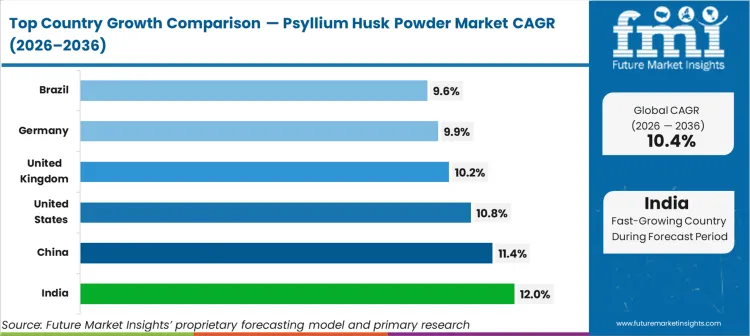
- Geography: High-growth Asia-Pacific (India 12.0%, China 11.4%) versus mature North America and Europe (United States 10.8%, Germany 9.9%, United Kingdom 10.2%).
- Analyst Opinion at FMI
- Nandini Roy Choudhury, Principal Consultant for Food & Beverage at Future Market Insights, opines, “In our latest Psyllium Husk Powder Market analysis, my team and I have identified satiety-driven product innovation as a key commercial accelerator. As weight management and metabolic health gain prominence, formulators are leveraging psyllium’s high soluble fiber content to support appetite-control positioning. However, hydration kinetics and viscosity management remain technical constraints in ready-to-drink formats. Suppliers that optimize instant solubility and minimize lumping during dispersion will unlock stronger integration across beverages, meal replacements, and functional nutrition platforms.”
- Strategic Implications/Executive Takeaways
- Secure long-term processing contracts to mitigate regional agricultural yield volatility.
- Prioritize ultra-fine milling capabilities to meet stringent functional beverage texture specifications.
- Align marketing claims strictly with established clinical cardiometabolic benchmarks.
- Methodology
- Validated through first-hand corporate production and capacity data.
- Zero reliance on speculative third-party market research reports.
- Based on verifiable industrial benchmarks and verified sources.
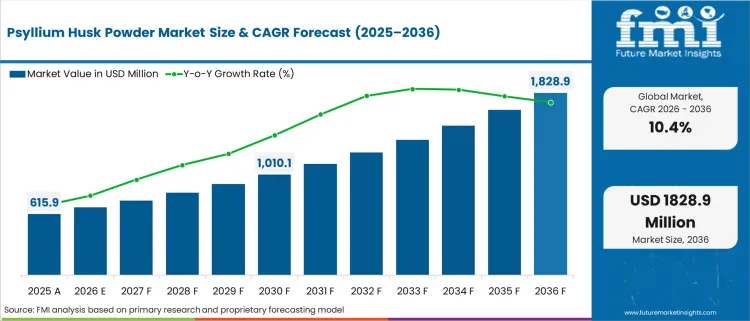
Psyllium Husk Powder Market Key Takeaways
| Metric | Details |
|---|---|
| Industry Size (2026) | USD 680.0 Million |
| Industry Value (2036) | USD 1,950.0 Million |
| CAGR (2026-2036) | 10.4% |
Geographic expansion metrics redefine supply chain prioritization for raw material processors. As noted by Ashwin Nayak, President of Isabgol Processors' Association, "Earlier, demand for isabgol was largely driven by the US, UK, Germany, and Italy. But in the past two years, new markets have opened across the Gulf, the Far East, and even neighbouring Pakistan and Bangladesh, propelling further demand" [2]. Expanding export corridors shift purchasing models from localized sourcing to global forward contracts.
Across India, China, United States, United Kingdom, Germany, and Brazil, growth concentrates where preventative healthcare alignment meets high processing capacity. Procurement clusters around medical networks prioritizing digestive health supplements to mitigate systemic nutrient deficits. Processors prioritize specialized milling infrastructure to capture premium institutional contracts.
Psyllium Husk Powder Definition
Psyllium husk powder refers to milled botanical derivatives derived from the seeds of Plantago ovata, primarily used as a high-viscosity soluble fiber. The primary industrial applications of psyllium husk powder focus on its mucilaginous properties, which aid in hydrocolloid binding for functional formulations and support therapeutic regularity in clinical settings. Buyers assess batches based on swell volume and particle size reduction. Processing facilities convert raw agricultural inputs into standardized nutraceutical ingredients, ready for blending in commercial products.
Psyllium Husk Powder Inclusions
This includes raw pulverized husk grades intended for human dietary consumption and clinical nutrition products. Encapsulated formulations and ready-to-mix hydration blends targeting digestive wellness are part of the scope, along with pet and animal nutrition grades used for veterinary intestinal support. Bioactive compound mixtures, which combine psyllium with probiotics or hemp-derived fibers, are also included.
Psyllium Husk Powder Exclusions
Exclusions cover whole unmilled psyllium seeds sold for agricultural purposes or unprocessed bulk trade. Synthetic laxative compounds and non-botanical stool softeners that do not contain Plantago ovata are excluded, as are finished baked goods containing trace amounts of husk where fiber acts as a secondary additive. Additionally, speculative laboratory extraction processes lacking commercial scalability or regulatory approval are not included.
Psyllium Husk Powder Market Research Methodology
- Primary Research: Direct consultations occurred with milling plant managers, global nutraceutical buyers, and botanical trade association directors.
- Desk Research: Analysts extracted capacity figures from regional agricultural ministries and clinical efficacy metrics from verified health organizations.
- Market-Sizing and Forecasting: Models triangulated baseline production capacity against documented clinical demand thresholds and historical export volumes.
- Data Validation and Update Cycle: Findings undergo structural variance checks against recognized clinical studies and verified corporate expansion announcements before publication.
Segmental Analysis
Psyllium Husk Powder Market Analysis by Product Form
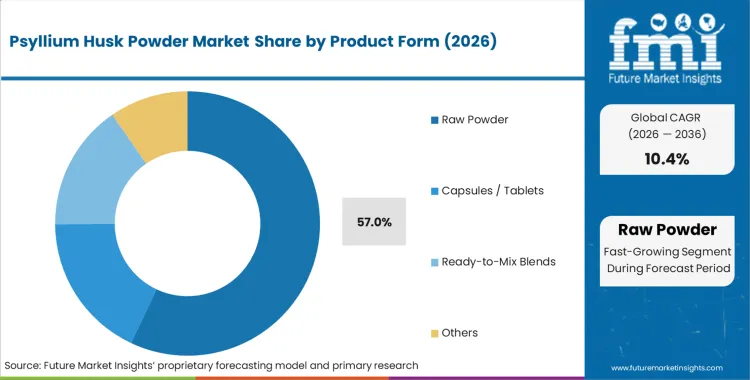
Manufacturers are prioritizing formats that offer blending flexibility and support higher dosage delivery, prompting processors to produce ultra-fine grades that disperse smoothly into liquid systems without affecting texture. Formulators often prefer loose powder over capsules to deliver effective fiber levels more economically and maintain tighter cost control. As formulation stability increasingly shapes procurement decisions, raw powder formats are positioned to command 57% of volume in 2026.
- Formulation requirements: Nutraceutical brands pivot away from synthetic binders toward pure husk matrices for functional beverage lines. Clinical thresholds require high active dosing, driving manufacturers to favor powder formats to reach effective clinical benchmarks economically.
- Active consumer alignment: Younger demographics integrate functional botanical blends into performance recovery and microbiome optimization routines.
- Bulk cost advantages: Raw powder procurement lowers per-serving packaging expenditures for massive consumer packaged goods operations. Buyers secure unflavored milling outputs to blend custom food dietary fibers privately, minimizing intermediate processing steps before final packaging.
Psyllium Husk Powder Market Analysis by Application
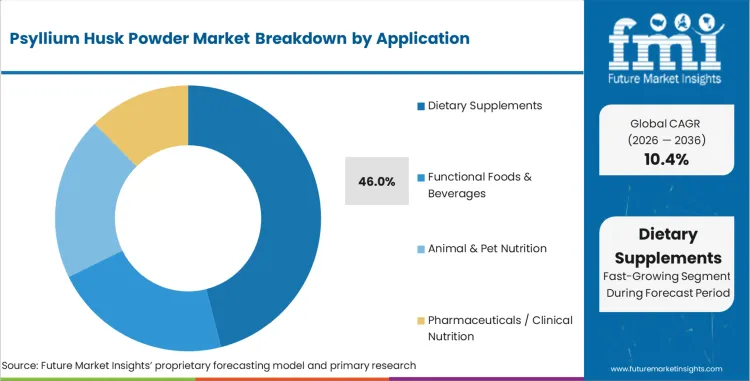
Dietary supplements secure 46% of segment share in 2026, driven by aggressive preventative health campaigns and chronic systemic nutrient deficits. Encapsulation facilities and blending plants expand output to meet escalating consumer reliance on concentrated botanical solutions. FMI analysts opine that preventative screening protocols amplify physician-led recommendations, directly accelerating supplement consumption. Processors dedicate specialized production runs to meet precise medical-grade purity requirements for specialized therapeutic applications.
- Medical protocol adoption: Professionals increasingly endorse targeted botanical interventions over pharmaceutical laxatives for long-term digestive maintenance. Gastroenterology research in 2025 validated 25 gram daily doses for normalizing bowel habits in critical patient populations [4].
- Baking substitutions: Commercial bakeries utilize ultra-fine milled husk to replicate gluten network elasticity in allergen-free product portfolios. Development teams test varying viscosity grades to perfect texture parameters within complex gluten free prepared food lines.
- Metabolic targeting: Brands formulate functional compounds to address complex metabolic conditions including glycemic instability. Reviews in 2025 demonstrated 10 grams of daily psyllium improves glycemic control in diabetes patients, validating condition-focused product pipelines [5].
Psyllium Husk Powder Market Drivers, Restraints, and Opportunities
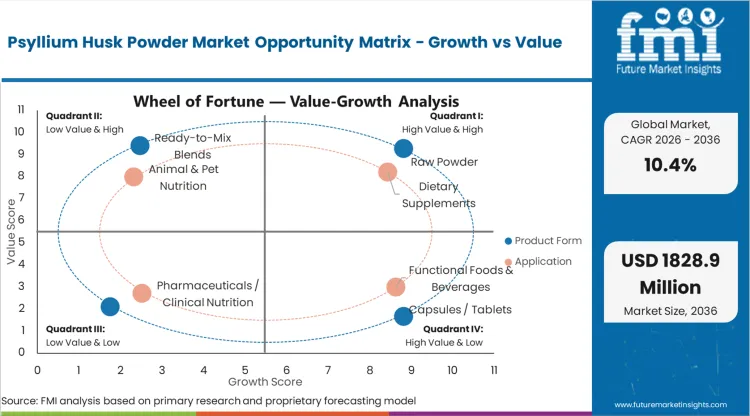
Clinical evidence thresholds definitively shift procurement logic from optional wellness spending toward mandated dietary intervention protocols. Medical organizations consistently publish updated dietary guidelines exposing massive population-level nutrient deficits, forcing structural changes in consumer purchasing. Recommendations directly correlate specific botanical intake volumes with measurable cardiovascular and metabolic improvements, providing brands with unassailable marketing claims. Public health economics heavily favor preventative supplementation over acute medical treatments. Annual Reviews of Food Science analysis in 2025 demonstrated psyllium utilization holds an economic savings potential of USD 870 million annually for LDL patients [6].
Agricultural supply chain volatility restricts seamless global expansion and creates chronic wholesale pricing instability. Milling operations remain heavily dependent on localized crop yields within specific geographic zones, exposing global supply networks to extreme weather events and erratic harvest volumes. Buyers mitigate localized disruptions by securing massive forward contracts and mandating multi-region sourcing redundancy from primary processors.
- Formulation Upgrade: Advanced milling techniques enable integration into high-margin liquid nutrition formats without compromising sensory attributes.
- Veterinary Expansion: Companion animal nutrition networks aggressively adopt functional botanical ingredients to address rising canine intestinal disorders. Feed processors integrate plant based fiber mixtures into specialized pet lines to secure high-margin veterinary contracts.
- Clean Label Substitution: Wholesale bakeries replace synthetic dough conditioners with natural botanical hydrocolloids to achieve clean-label certification. Partnerships established across 2025 by Bob's Red Mill accelerated husk integration into specialized egg-substitute applications [8].
Regional Analysis
Based on regional analysis, Psyllium Husk Powder market is segmented into North America, Latin America, Europe, East Asia, South Asia, Oceania and Middle East and Africa across 40 plus countries. Full report also offers market attractiveness analysis based on regional trends.
.webp "Top Country Growth Comparison Psyllium Husk Powder Market Cagr (2026 2036)")
| Country | CAGR (2026 to 2036) |
|---|---|
| India | 12.0% |
| China | 11.4% |
| United States | 10.8% |
| United Kingdom | 10.2% |
| Germany | 9.9% |
| Brazil | 9.6% |
Source: Future Market Insights (FMI) analysis, based on proprietary forecasting model and primary research
Asia Pacific Psyllium Husk Powder Analysis
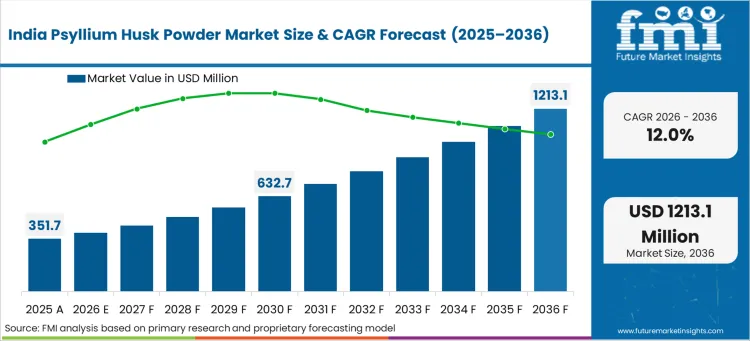
Asia Pacific commands absolute dominance in raw agricultural cultivation and primary milling operations, establishing baseline global pricing metrics. Regional processors execute massive capacity expansions to transition from raw commodity exporters to premium value-added ingredient suppliers. Domestic consumption simultaneously accelerates as expanding middle classes encounter rising rates of lifestyle-related metabolic disorders. According to FMI's estimates, export-driven quality upgrades force local facilities to adopt stringent international compliance standards.
- India: Demand for raw processing capacity in India is set to grow at 12.0% CAGR through 2036, supported by massive multinational investments before procurement cycles translate into global supply. Foreign capital accelerates modernization of traditional agricultural processing centers, capturing immense export value.
- China: Product sales in China are projected to rise at 11.4% CAGR from 2026 to 2036 as rising preventative health awareness shapes dietary habits, creating a clearer pathway from policy intent to purchase orders. Processors focus on securing bulk raw material contracts to feed rapidly expanding domestic nutraceutical actives manufacturing facilities.
FMI's report includes extensive coverage of Southeast Asian processing developments, tracking capacity additions across Vietnam and Indonesia. Escalating processing technology investments define competitive positioning as local entities compete for lucrative Western supply contracts. Facility managers evaluate international certification frameworks to penetrate tightly regulated medical nutrition pipelines.
North America Psyllium Husk Powder Analysis
North American market dynamics revolve around chronic population-level dietary fiber deficits and aggressive commercial supplementation strategies. Clinical entities and mainstream retail channels push high-viscosity hydrocolloids as primary interventions for preventative cardiovascular health. Marketing architectures heavily depend on established health claims separating functional botanical fibers from generic dietary bulk. As per FMI's projection, clinical dietetics adopt standardized dosing protocols to ensure measurable patient outcomes.
- United States: In the United States, demand for psyllium is strengthening as widespread dietary fiber gaps increase reliance on supplementation and functional food fortification. Clinical guidance continues to highlight insufficient fiber intake, with 94% of adults reported to fall short of recommended levels in 2025 [9]. This persistent shortfall is encouraging broader commercial rollouts and product innovation, supporting expansion at a 10.8% CAGR from 2026 to 2036.
FMI's report includes comprehensive tracking of North American market indicators, featuring in-depth analysis of Canadian health retail environments. Preventative care legislation alters hospital procurement logic, forcing institutions to source validated bulk fibers in unprecedented volumes. American Botanical Council data indicated herbal supplement sales rose to USD 13.231 billion in 2024, anchoring massive regional distribution networks [10].
Europe Psyllium Husk Powder Analysis
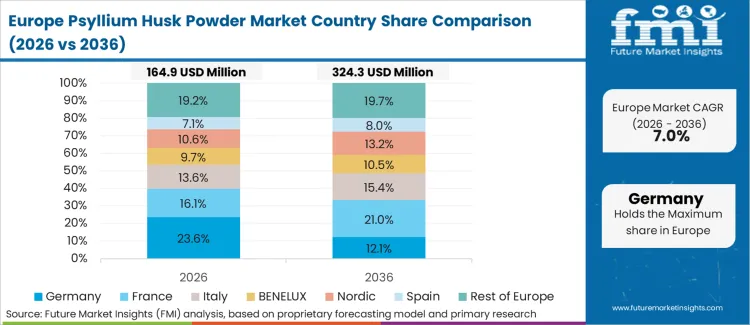
European demand frameworks rely heavily on rigorous clinical validation and clean-label manufacturing compliance. Mature regulatory agencies scrutinize health claims, forcing brands to utilize high-purity botanical inputs supported by unquestionable scientific efficacy data. Consumers reject synthetic pharmaceutical interventions in favor of natural organically certified functional dietary additions. FMI analysts opine that formulation complexity dictates ingredient sourcing as bakeries substitute synthetic binders with ultra-fine milled husk.
- United Kingdom: United Kingdom is expected to record 10.2% CAGR in supplement demand over 2026 to 2036 as clean-label food trends displace synthetic additives, tightening operational constraints and adoption-led investment. Functional brands pursue specialized milling suppliers to ensure compliance with strict domestic ingredient standards.
- Germany: In Germany, the botanical sector is gaining steady traction as geriatric clinical care guidelines translate into structured healthcare spending and formal procurement frameworks. Preventive care protocols increasingly emphasize standardized daily supplementation, encouraging long-term institutional purchasing across expanding clinical networks, supporting growth at a 9.9% CAGR through 2036.
FMI's report includes granular exploration of European consumption patterns, evaluating emerging commercial avenues in France, Italy, and Spain. Aging demographics compel national health services to rethink chronic care management, shifting expenditures toward preventative prebiotic fiber regimens. Procurement specialists navigate fragmented organic certification requirements to ensure unimpeded cross-border distribution.
Latin America Psyllium Husk Powder Analysis
Latin American supply chains rapidly integrate international botanical supplements to counter surging regional metabolic disorder rates. Expanding retail pharmacy networks dedicate extensive shelf space to preventative wellness products, mimicking successful North American merchandising strategies. Domestic distributors execute strategic import agreements to secure reliable access to premium milled grades originating in South Asia. According to FMI's estimates, rising disposable incomes directly finance specialized clinical nutrition purchases.
- Brazil: Supplement uptake in Brazil is anticipated to climb at 9.6% CAGR over forecast period as modernization of health retail infrastructure exposes populations to functional fibers, helping suppliers align positioning with local buying triggers. Multinational brands target major metropolitan pharmacy chains to establish early market dominance.
FMI's report includes focused assessments of Latin American economic developments, capturing vital distribution shifts across Mexico, Argentina, and Chile. Evolving import regulations dictate supply chain velocity, compelling foreign processors to establish localized warehousing infrastructure. Buyers monitor foreign exchange volatility to time massive bulk ingredient purchases efficiently.
Competitive Aligners for Market Players
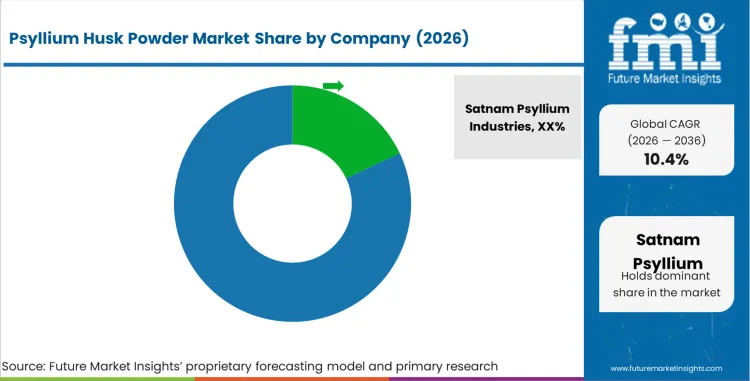
Corporate integration models rapidly reshape fundamental processing landscapes as multinational conglomerates acquire localized milling specialists to secure uninterrupted raw material pipelines. Consolidation forces independent mid-tier operators to specialize in ultra-niche formulations or face severe raw material pricing disadvantages. Vertical integration provides massive pricing leverage during periods of acute agricultural shortages. FMI analysts opine that integrated players execute aggressive capacity upgrades to dominate long-term global supply contracts.
Advanced product differentiation relies heavily on combining traditional botanical fibers with secondary bioactive compounds to create proprietary patentable blends. Formulation innovation allows brands to escape commoditized wholesale pricing traps and establish dominant positions within specialized clinical performance sectors. Research and development teams prioritize fiber supplements incorporating distinct probiotic strains to multiply functional health claims. Buyers favor suppliers offering pre-blended functional matrices over single-ingredient commodities.
Aggressive retail expansion strategies target specialized digital consumer demographics demanding immediate performance recovery solutions. Brands bypass traditional sluggish pharmacy chains to capture high-margin recurring revenue through optimized direct-to-consumer digital subscription architectures. According to FMI's estimates, digital distribution eliminates expensive retail slotting fees and provides direct access to granular consumer purchasing data. Marketing teams utilize automated subscription platforms to ensure continuous patient adherence to specific dosing protocols.
Recent Developments
The report includes full coverage of key trends from competitive benchmarking. Some of the recent developments covered in the reports:
- In February 2026, Momentous launched new performance-focused Fiber+ supplement designed to deliver 6 grams of fiber per serving for metabolic recovery [3].
- In February 2024, Manitoba Harvest announced strategic partnership with Brightseed to launch advanced bioactive fiber blends, achieving full commercialization by 2025 [7].
Key Players in Psyllium Husk Powder Market
- Satnam Psyllium Industries
- Akash Agro Industries
- JYOT Overseas Pvt. Ltd.
- Farmvale Psyllium
- Gayatri Psyllium Industries
- Laxmi Sat Isabgol
- Organic India
Scope of the Report
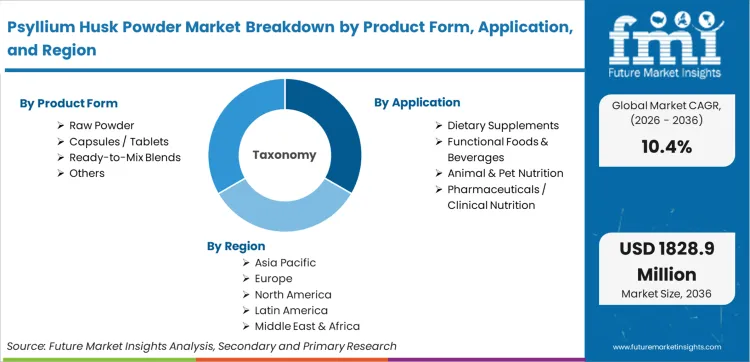
| Metric | Value |
|---|---|
| Quantitative Units | USD 680.0 Million to USD 1,950.0 Million, CAGR 10.4% |
| Market Definition | Psyllium husk powder represents milled botanical derivative extracted from Plantago ovata seeds, primarily utilized as high-viscosity soluble fiber for dietary supplementation and functional food matrices. |
| Product Form Segmentation | Raw Powder, Capsules / Tablets, Ready-to-Mix Blends, Others |
| Application Segmentation | Dietary Supplements, Functional Foods & Beverages, Animal & Pet Nutrition, Pharmaceuticals / Clinical Nutrition, Other Uses |
| Application Coverage | Dietary Supplements, Functional Foods & Beverages, Animal & Pet Nutrition, Pharmaceuticals / Clinical Nutrition, Other Uses |
| Regions Covered | North America, Latin America, Europe, East Asia, South Asia, Oceania, Middle East and Africa |
| Countries Covered | United States, Canada, Mexico, Brazil, Argentina, Germany, France, United Kingdom, Italy, Spain, China, India, Japan, South Korea, Indonesia, Australia and 40 plus countries |
| Key Companies Profiled | Satnam Psyllium Industries, Akash Agro Industries, JYOT Overseas Pvt. Ltd., Farmvale Psyllium, Gayatri Psyllium Industries, Laxmi Sat Isabgol, Organic India |
| Forecast Period | 2026 to 2036 |
| Approach | Hybrid top-down and bottom-up market modeling, validated through primary interviews with psyllium producers and nutraceutical companies, supported by trade data benchmarking and production capacity analysis for psyllium husk powder applications |
Psyllium Husk Powder Market Analysis by Segments
Product Form
- Raw Powder
- Capsules / Tablets
- Ready-to-Mix Blends
- Others
Application
- Dietary Supplements
- Functional Foods & Beverages
- Animal & Pet Nutrition
- Pharmaceuticals / Clinical Nutrition
- Other Uses
Region
- Asia Pacific
- India
- China
- Japan
- South Korea
- Indonesia
- Australia & New Zealand
- ASEAN
- Rest of Asia Pacific
- Europe
- Germany
- Italy
- France
- United Kingdom
- Spain
- Benelux
- Nordics
- Central & Eastern Europe
- Rest of Europe
- North America
- United States
- Canada
- Mexico
- Latin America
- Brazil
- Argentina
- Chile
- Rest of Latin America
- Middle East & Africa
- Kingdom of Saudi Arabia
- United Arab Emirates
- South Africa
- Turkey
- Rest of Middle East & Africa
Bibliography
- [1] Lipid profiles systematic review & dose-response meta-analysis. (2025). Psyllium decreased LDL-C WMD -8.55 mg/dL; total cholesterol WMD -9.05 mg/dL.
- [2] Times of India. (2025). Statement by Ashwin Nayak, President of Isabgol Processors' Association.
- [3] Businesswire. (2026). Momentous launches Fiber+ supplement with psyllium husk.
- [4] Gastroenterology Journal. (2025). Psyllium husk positively alters gut microbiota, normalizes bowel habits for IBS management.
- [5] Nutrition Today. (2025). Soluble fiber from psyllium (10 g/day) improves glycemic control in type 2 diabetes patients.
- [6] Annual Reviews of Food Science & Technology. (2025). Psyllium provides 5 FDA-recognized benefits; economic savings potential $870 million annually.
- [7] NutraIngredients-USA. (2024). Manitoba Harvest partners with Brightseed to launch Bioactive Fiber.
- [8] Bob’s Red Mill. (2025). Expansion of psyllium-based fiber lines in gluten-free applications.
- [9] NCBI StatPearls. (2025). Average US fiber intake 17 g/day; 94% of adults fail to meet recommendations.
- [10] American Botanical Council. (2025). US herbal supplement sales rose 5.4% to $13.231 billion in 2024.
This bibliography is provided for reader reference and is not exhaustive. Full report contains complete reference list and detailed citations.
This Report Addresses
- Market intelligence to enable structured strategic decision making across mature and emerging botanical ingredient economies.
- Market size estimation and 10 year revenue forecasts from 2026 to 2036, supported by validated milling capacity and clinical data benchmarks.
- Growth opportunity mapping across powder, capsules, and ready-to-mix blends with emphasis on ultra-fine milling transitions.
- Segment and regional revenue forecasts covering dietary supplements, functional foods, clinical nutrition, and animal feed applications.
- Competition strategy assessment including corporate integration models, supply chain stabilization positioning, and regulatory compliance benchmarking.
- Product reformulation tracking including FDA-recognized claims, therapeutic dosing protocols, and clean-label ingredient upgrades.
- Regulatory impact analysis covering preventative health mandates, recommended daily intake thresholds, and export-driven certification upgrades.
- Market report delivery in PDF, Excel, PPT, and interactive dashboard formats for executive and operational use.
Frequently Asked Questions
How large is demand for Psyllium Husk Powder in global market in 2026?
Demand for Psyllium Husk Powder in global market is estimated to be valued at USD 680.0 Million in 2026.
What will be market size of Psyllium Husk Powder in global market by 2036?
Market size for Psyllium Husk Powder is projected to reach USD 1,950.0 Million by 2036.
What is expected demand growth for Psyllium Husk Powder in global market between 2026 and 2036?
Demand for Psyllium Husk Powder in global market is expected to grow at a CAGR of 10.4% between 2026 and 2036.
Which Product Form is poised to lead global sales by 2026?
Raw Powder is expected to be dominant form, capturing approximately 57% of global market share in 2026 due to dosing flexibility and formulation stability.
How significant is role of Dietary Supplements in driving Psyllium Husk Powder adoption in 2026?
Dietary Supplements represent critical segment, projected to hold substantial 46% share of total market in 2026 as preventative healthcare prioritizes natural botanical solutions.
What is driving demand in India?
Massive multinational capital expenditures targeting raw processing infrastructure and strict export compliance standards drive production volume growth.
What compliance standards or regulations are referenced for India?
International certification frameworks and export-grade clinical standards define baseline operational compliance for regional processors.
What is India growth outlook in this report?
India is projected to grow at a CAGR of 12.0% during 2026 to 2036.
Why is North America described as priority region in this report?
Growth reflects chronic systemic dietary fiber deficits combined with aggressive mainstream retail commercialization of preventative wellness products.
What type of demand dominates in North America?
Clinical substitution demand for validated botanical fibers over synthetic alternatives dominates regional consumption.
What is China growth outlook in this report?
China is projected to expand at a CAGR of 11.4% during 2026 to 2036.
Does report cover United States in its regional analysis?
Yes, United States is included within North America under regional scope of analysis.
What are sources referred to for analyzing United States?
Official statistics published by health organizations tracking dietary fiber intakes and herbal supplement retail performance are cited as primary reference sources.
What is main demand theme linked to United States in its region coverage?
High dependency on clinical preventative protocols to mitigate systemic nutritional deficits shapes primary adoption models.
Does report cover United Kingdom in its regional analysis?
Yes, United Kingdom is included within Europe under regional coverage framework.
What is main United Kingdom related demand theme in its region coverage?
Stringent clean-label ingredient preferences dictate procurement logic across functional food processing facilities.
Which product formats or configurations are strategically important for Asia Pacific supply chains?
Raw milled powder grades are prioritized to supply massive downstream encapsulation and functional beverage manufacturing lines globally.
What is Psyllium Husk Powder and what is it mainly used for?
Milled botanical fiber extract utilized primarily to provide therapeutic digestive regularity and functional hydrocolloid binding.
What does Psyllium Husk Powder mean in this report?
Market refers to global production, trade, and consumption of processed botanical husk in dietary supplements and clinical applications.
What is included in scope of this Psyllium Husk Powder report?
Scope covers raw powder, capsules, and blends utilized across supplements, functional foods, and animal nutrition.
What is excluded from scope of this report?
Whole agricultural seeds, synthetic laxatives, and trace inclusions in baked goods are excluded from core valuation.
What does market forecast mean on this page?
Market forecast represents model-based projection built on defined assumptions for strategic planning purposes.
How does FMI build and validate Psyllium Husk Powder forecast?
Forecast is developed using hybrid top-down and bottom-up modeling validated through capacity checks, trade data, and clinical benchmarking.
What does zero reliance on speculative third party market research mean here?
Primary interviews and verifiable public clinical and corporate datasets are used instead of unverified syndicated market estimates.
Preview the report firsthand - request a free sample
Get SampleGet the brochure for pricing and purchase details.
Get PDFTable of Content
- Executive Summary
- Global Market Outlook
- Demand-side Trends
- Supply-side Trends
- Technology Roadmap Analysis
- Analysis and Recommendations
- Market Overview
- Market Coverage / Taxonomy
- Market Definition / Scope / Limitations
- Research Methodology
- Chapter Orientation
- Analytical Lens and Working Hypotheses
- Market Structure, Signals, and Trend Drivers
- Benchmarking and Cross-market Comparability
- Market Sizing, Forecasting, and Opportunity Mapping
- Research Design and Evidence Framework
- Desk Research Programme (Secondary Evidence)
- Company Annual and Sustainability Reports
- Peer-reviewed Journals and Academic Literature
- Corporate Websites, Product Literature, and Technical Notes
- Earnings Decks and Investor Briefings
- Statutory Filings and Regulatory Disclosures
- Technical White Papers and Standards Notes
- Trade Journals, Industry Magazines, and Analyst Briefs
- Conference Proceedings, Webinars, and Seminar Materials
- Government Statistics Portals and Public Data Releases
- Press Releases and Reputable Media Coverage
- Specialist Newsletters and Curated Briefings
- Sector Databases and Reference Repositories
- FMI Internal Proprietary Databases and Historical Market Datasets
- Subscription Datasets and Paid Sources
- Social Channels, Communities, and Digital Listening Inputs
- Additional Desk Sources
- Expert Input and Fieldwork (Primary Evidence)
- Primary Modes
- Qualitative Interviews and Expert Elicitation
- Quantitative Surveys and Structured Data Capture
- Blended Approach
- Why Primary Evidence is Used
- Field Techniques
- Interviews
- Surveys
- Focus Groups
- Observational and In-context Research
- Social and Community Interactions
- Stakeholder Universe Engaged
- C-suite Leaders
- Board Members
- Presidents and Vice Presidents
- R&D and Innovation Heads
- Technical Specialists
- Domain Subject-matter Experts
- Scientists
- Physicians and Other Healthcare Professionals
- Governance, Ethics, and Data Stewardship
- Research Ethics
- Data Integrity and Handling
- Primary Modes
- Tooling, Models, and Reference Databases
- Desk Research Programme (Secondary Evidence)
- Data Engineering and Model Build
- Data Acquisition and Ingestion
- Cleaning, Normalisation, and Verification
- Synthesis, Triangulation, and Analysis
- Quality Assurance and Audit Trail
- Market Background
- Market Dynamics
- Drivers
- Restraints
- Opportunity
- Trends
- Scenario Forecast
- Demand in Optimistic Scenario
- Demand in Likely Scenario
- Demand in Conservative Scenario
- Opportunity Map Analysis
- Product Life Cycle Analysis
- Supply Chain Analysis
- Investment Feasibility Matrix
- Value Chain Analysis
- PESTLE and Porter’s Analysis
- Regulatory Landscape
- Regional Parent Market Outlook
- Production and Consumption Statistics
- Import and Export Statistics
- Market Dynamics
- Global Market Analysis 2021 to 2025 and Forecast, 2026 to 2036
- Historical Market Size Value (USD Million) Analysis, 2021 to 2025
- Current and Future Market Size Value (USD Million) Projections, 2026 to 2036
- Y-o-Y Growth Trend Analysis
- Absolute $ Opportunity Analysis
- Global Market Pricing Analysis 2021 to 2025 and Forecast 2026 to 2036
- Global Market Analysis 2021 to 2025 and Forecast 2026 to 2036, By Product Form
- Introduction / Key Findings
- Historical Market Size Value (USD Million) Analysis By Product Form , 2021 to 2025
- Current and Future Market Size Value (USD Million) Analysis and Forecast By Product Form , 2026 to 2036
- Raw Powder
- Capsules / Tablets
- Ready-to-Mix Blends
- Others
- Raw Powder
- Y-o-Y Growth Trend Analysis By Product Form , 2021 to 2025
- Absolute $ Opportunity Analysis By Product Form , 2026 to 2036
- Global Market Analysis 2021 to 2025 and Forecast 2026 to 2036, By Application
- Introduction / Key Findings
- Historical Market Size Value (USD Million) Analysis By Application, 2021 to 2025
- Current and Future Market Size Value (USD Million) Analysis and Forecast By Application, 2026 to 2036
- Dietary Supplements
- Functional Foods & Beverages
- Animal & Pet Nutrition
- Pharmaceuticals / Clinical Nutrition
- Dietary Supplements
- Y-o-Y Growth Trend Analysis By Application, 2021 to 2025
- Absolute $ Opportunity Analysis By Application, 2026 to 2036
- Global Market Analysis 2021 to 2025 and Forecast 2026 to 2036, By Region
- Introduction
- Historical Market Size Value (USD Million) Analysis By Region, 2021 to 2025
- Current Market Size Value (USD Million) Analysis and Forecast By Region, 2026 to 2036
- North America
- Latin America
- Western Europe
- Eastern Europe
- East Asia
- South Asia and Pacific
- Middle East & Africa
- Market Attractiveness Analysis By Region
- North America Market Analysis 2021 to 2025 and Forecast 2026 to 2036, By Country
- Historical Market Size Value (USD Million) Trend Analysis By Market Taxonomy, 2021 to 2025
- Market Size Value (USD Million) Forecast By Market Taxonomy, 2026 to 2036
- By Country
- USA
- Canada
- Mexico
- By Product Form
- By Application
- By Country
- Market Attractiveness Analysis
- By Country
- By Product Form
- By Application
- Key Takeaways
- Latin America Market Analysis 2021 to 2025 and Forecast 2026 to 2036, By Country
- Historical Market Size Value (USD Million) Trend Analysis By Market Taxonomy, 2021 to 2025
- Market Size Value (USD Million) Forecast By Market Taxonomy, 2026 to 2036
- By Country
- Brazil
- Chile
- Rest of Latin America
- By Product Form
- By Application
- By Country
- Market Attractiveness Analysis
- By Country
- By Product Form
- By Application
- Key Takeaways
- Western Europe Market Analysis 2021 to 2025 and Forecast 2026 to 2036, By Country
- Historical Market Size Value (USD Million) Trend Analysis By Market Taxonomy, 2021 to 2025
- Market Size Value (USD Million) Forecast By Market Taxonomy, 2026 to 2036
- By Country
- Germany
- UK
- Italy
- Spain
- France
- Nordic
- BENELUX
- Rest of Western Europe
- By Product Form
- By Application
- By Country
- Market Attractiveness Analysis
- By Country
- By Product Form
- By Application
- Key Takeaways
- Eastern Europe Market Analysis 2021 to 2025 and Forecast 2026 to 2036, By Country
- Historical Market Size Value (USD Million) Trend Analysis By Market Taxonomy, 2021 to 2025
- Market Size Value (USD Million) Forecast By Market Taxonomy, 2026 to 2036
- By Country
- Russia
- Poland
- Hungary
- Balkan & Baltic
- Rest of Eastern Europe
- By Product Form
- By Application
- By Country
- Market Attractiveness Analysis
- By Country
- By Product Form
- By Application
- Key Takeaways
- East Asia Market Analysis 2021 to 2025 and Forecast 2026 to 2036, By Country
- Historical Market Size Value (USD Million) Trend Analysis By Market Taxonomy, 2021 to 2025
- Market Size Value (USD Million) Forecast By Market Taxonomy, 2026 to 2036
- By Country
- China
- Japan
- South Korea
- By Product Form
- By Application
- By Country
- Market Attractiveness Analysis
- By Country
- By Product Form
- By Application
- Key Takeaways
- South Asia and Pacific Market Analysis 2021 to 2025 and Forecast 2026 to 2036, By Country
- Historical Market Size Value (USD Million) Trend Analysis By Market Taxonomy, 2021 to 2025
- Market Size Value (USD Million) Forecast By Market Taxonomy, 2026 to 2036
- By Country
- India
- ASEAN
- Australia & New Zealand
- Rest of South Asia and Pacific
- By Product Form
- By Application
- By Country
- Market Attractiveness Analysis
- By Country
- By Product Form
- By Application
- Key Takeaways
- Middle East & Africa Market Analysis 2021 to 2025 and Forecast 2026 to 2036, By Country
- Historical Market Size Value (USD Million) Trend Analysis By Market Taxonomy, 2021 to 2025
- Market Size Value (USD Million) Forecast By Market Taxonomy, 2026 to 2036
- By Country
- Kingdom of Saudi Arabia
- Other GCC Countries
- Turkiye
- South Africa
- Other African Union
- Rest of Middle East & Africa
- By Product Form
- By Application
- By Country
- Market Attractiveness Analysis
- By Country
- By Product Form
- By Application
- Key Takeaways
- Key Countries Market Analysis
- USA
- Pricing Analysis
- Market Share Analysis, 2025
- By Product Form
- By Application
- Canada
- Pricing Analysis
- Market Share Analysis, 2025
- By Product Form
- By Application
- Mexico
- Pricing Analysis
- Market Share Analysis, 2025
- By Product Form
- By Application
- Brazil
- Pricing Analysis
- Market Share Analysis, 2025
- By Product Form
- By Application
- Chile
- Pricing Analysis
- Market Share Analysis, 2025
- By Product Form
- By Application
- Germany
- Pricing Analysis
- Market Share Analysis, 2025
- By Product Form
- By Application
- UK
- Pricing Analysis
- Market Share Analysis, 2025
- By Product Form
- By Application
- Italy
- Pricing Analysis
- Market Share Analysis, 2025
- By Product Form
- By Application
- Spain
- Pricing Analysis
- Market Share Analysis, 2025
- By Product Form
- By Application
- France
- Pricing Analysis
- Market Share Analysis, 2025
- By Product Form
- By Application
- India
- Pricing Analysis
- Market Share Analysis, 2025
- By Product Form
- By Application
- ASEAN
- Pricing Analysis
- Market Share Analysis, 2025
- By Product Form
- By Application
- Australia & New Zealand
- Pricing Analysis
- Market Share Analysis, 2025
- By Product Form
- By Application
- China
- Pricing Analysis
- Market Share Analysis, 2025
- By Product Form
- By Application
- Japan
- Pricing Analysis
- Market Share Analysis, 2025
- By Product Form
- By Application
- South Korea
- Pricing Analysis
- Market Share Analysis, 2025
- By Product Form
- By Application
- Russia
- Pricing Analysis
- Market Share Analysis, 2025
- By Product Form
- By Application
- Poland
- Pricing Analysis
- Market Share Analysis, 2025
- By Product Form
- By Application
- Hungary
- Pricing Analysis
- Market Share Analysis, 2025
- By Product Form
- By Application
- Kingdom of Saudi Arabia
- Pricing Analysis
- Market Share Analysis, 2025
- By Product Form
- By Application
- Turkiye
- Pricing Analysis
- Market Share Analysis, 2025
- By Product Form
- By Application
- South Africa
- Pricing Analysis
- Market Share Analysis, 2025
- By Product Form
- By Application
- USA
- Market Structure Analysis
- Competition Dashboard
- Competition Benchmarking
- Market Share Analysis of Top Players
- By Regional
- By Product Form
- By Application
- Competition Analysis
- Competition Deep Dive
- Satnam Psyllium Industries
- Overview
- Product Portfolio
- Profitability by Market Segments (Product/Age /Sales Channel/Region)
- Sales Footprint
- Strategy Overview
- Marketing Strategy
- Product Strategy
- Channel Strategy
- Akash Agro Industries
- JYOT Overseas Pvt. Ltd.
- Farmvale Psyllium
- Gayatri Psyllium Industries
- Laxmi Sat Isabgol
- Satnam Psyllium Industries
- Competition Deep Dive
- Assumptions & Acronyms Used


