

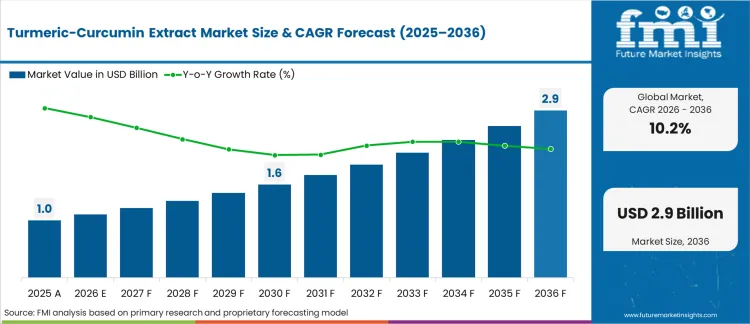
- Industry Size (2026)
- USD 1135.0 Mn
- Forecast (2036)
- USD 2945.0 Mn
- CAGR (2026 to 2036)
- 10.2%
Turmeric/Curcumin Extract Market Size, Market Forecast and Outlook By FMI
In 2025, the turmeric/curcumin extract market surpassed a value of USD 1,058.0 million, is projected at USD 1,135.0 million in 2026 and USD 2,945.0 million by 2036, implying a 10.2% CAGR, with momentum tied to clinical substantiation requirements replacing generic botanical claims. Buyers move where suppliers provide verified contaminant controls and bioavailable delivery systems, prompting formulation upgrades across curcumin portfolios.
Emerging categories present untapped potential as clinical substantiation secures specialized medical food applications. Manufacturers navigate changing demands by combining botanicals with biotics to create novel therapeutic platforms, shifting turmeric from traditional herbalism into preventative care protocols.
Summary of Turmeric/Curcumin Extract
- Turmeric/Curcumin Extract Market Definition
- Extract commercialization encompasses the extraction, standardization, and distribution of curcuminoid compounds for clinical, nutritional, and industrial applications.
- Demand Drivers in the Market
- Heightened regulatory scrutiny forces a flight to quality, favoring extractors with pristine adulteration controls.
- Formulation innovations solving poor bioavailability unlock higher absorption rates, justifying premium retail pricing.
- Expanding clinical substantiation for joint and cognitive health broadens the addressable demographic beyond traditional herbalists.
- Key Segments Analyzed in the FMI Report
- Product Form: Standardized Curcumin Extracts command 45% share due to precise dosing capabilities.
- Application: Dietary Supplements represent the primary volume sink at 51% share.
- Geography: North America dominates retail consumption, and India retains a monopoly on raw material processing.
- Analyst Opinion at FMI
- Nandini Roy Choudhury, Principal Consultant for Food & Beverage at Future Market Insights, opines, “Through our recent evaluation, we observed turmeric extracts moving decisively into mainstream functional food matrices, including dairy alternatives, immunity beverages, and fortified snacks. However, stability under heat processing and color retention remain formulation challenges. Suppliers investing in encapsulation and dispersion technologies will strengthen integration across large-scale food manufacturing systems.”
- Strategic Implications/Executive Takeaways
- Shift portfolio emphasis toward clinically backed, high-absorption phytosome complexes to defend margins against commodity extractors.
- Secure multi-year agricultural contracts in high-curcumin zones to insulate processing units from raw material spot price volatility.
- Institute pharmaceutical-grade contaminant testing, utilizing rigorous compliance as a primary competitive differentiator.
- Methodology
- Validated through first-hand corporate production and capacity data.
- Zero reliance on speculative third-party market research reports.
- Based on verifiable industrial benchmarks and verified sources.
Across India, China, the United States, the United Kingdom, Germany, and Brazil, adoption correlates strictly with local regulatory enforcement frameworks. According to FMI's estimates, country dispersion skews toward regions where suppliers integrate advanced botanical extracts technologies to bypass adulteration risks.
Turmeric/Curcumin Extract Market Key Takeaways
| Metric | Details |
|---|---|
| Industry Size (2026) | USD 1,135.0 million |
| Industry Value (2036) | USD 2,945.0 million |
| CAGR (2026-2036) | 10.2% |
Turmeric/Curcumin Extract Market Definition
Turmeric/curcumin extract represents the commercial procurement of isolated, standardized bioactive compounds derived from the Curcuma longa rhizome. Suppliers provide concentrated phytochemicals to nutraceutical, pharmaceutical, and functional food manufacturers requiring precise dosing and verified purity. Formulations apply to anti-inflammatory dietary supplements, natural colorants, and therapeutic topical formulations.
Turmeric/Curcumin Extract Market Inclusions
The Turmeric/Curcumin Extract category includes standardized curcuminoid extracts delivering 95% concentration for clinical-grade supplement manufacturing. It covers enhanced bioavailability formulations incorporating phytosome and liposomal delivery systems, solvent-extracted turmeric oleoresins used in industrial food coloring and flavoring, and tetrahydro curcumin derivatives positioned for high-value dermo cosmetic applications at the ingredient supply level.
Turmeric/Curcumin Extract Market Exclusions
The scope excludes raw whole turmeric roots traded as agricultural commodities and conventional culinary turmeric powder without defined curcuminoid standardization. Synthetic yellow color substitutes that replicate turmeric’s hue are not included. Multi-herb curry powders containing only minor turmeric fractions are also excluded from valuation.
Turmeric/Curcumin Extract Market Research Methodology
- Primary Research: Analysts conduct interviews with extraction facility managers, supplement formulators, and botanical supply chain directors to validate yield rates and procurement contracts.
- Desk Research: Statutory export filings from government ministries and warning letters from global regulatory bodies inform baseline production and compliance constraints.
- Market-Sizing and Forecasting: Trade volume data combines with retail sales velocity metrics to project long-term category valuation.
- Data Validation and Update Cycle: Export pricing anomalies undergo cross verification against localized raw material spot prices in major trading hubs before finalizing models.
Segmental Analysis
Turmeric/Curcumin Extract Market Analysis by Product Form
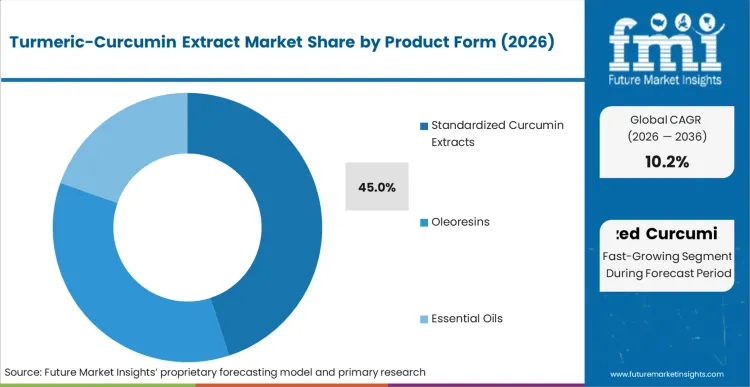
Standardized Curcumin Extracts account for 45% of total volume in 2026, functioning as the baseline requirement for therapeutic-grade supplement manufacturing. Brands abandon generic powders in favor of meticulously assayed extracts to avoid enforcement actions. Processors invest heavily in advanced solvent extraction and chromatography to guarantee batch-to-batch uniformity across curcumin food color and therapeutic portfolios.
- Procurement shift: Regulatory enforcement compels supplement brands to source from verified extractors maintaining flawless documentation. BAPP published a comprehensive review on turmeric powder and extract adulteration in early 2026, prompting buyers to overhaul vendor qualification protocols entirely [4].
- Supply-side defense: Manufacturers secure patents for advanced absorption technologies to escape commodity pricing pressures. Gencor and Pharmako Biotechnologies announced a United States patent for HydroCurc in April 2025, validating their unique delivery system to institutional buyers [5].
- Clinical adoption: Formulators demand verified bioavailability metrics to justify premium retail placement and reduce pill burden. A January 2025 study revealed efficacy for TurmiPure Gold at a low 300 mg dose, establishing a new commercial standard for high-absorption extracts [6].
Turmeric/Curcumin Extract Market Analysis by Application
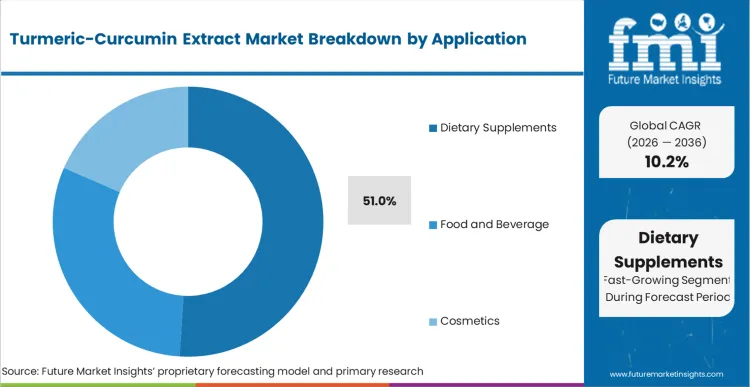
Dietary Supplements dictate consumption, holding a 51% share in 2026. Retail velocity thrives on expanding consumer awareness regarding natural anti-inflammatory properties, shifting botanical supplements from niche channels into mass-market prominence. FMI analysts opine that brands continuously segment formulations by pairing curcumin with complementary bioactives to target distinct physiological systems. Pain and inflammation accounted for 55.1% of turmeric sales in 2024, cementing curcumin's role in adult wellness routines [7]. Joint health remains the primary volume sink, and emerging formulations target cognitive function and metabolic support.
- Category expansion: Saturated joint-health shelves force brands to identify adjacent health categories to maintain revenue expansion. Turmeric liver support sales grew 291.2% in the United States natural channel during 2024, demonstrating rapid consumer acceptance of specialized therapeutic applications [8].
- Retail dominance: Established natural channels remain the primary launchpad for premium botanical formulations. Turmeric supplement sales in the United States Natural Expanded Channel hit USD 37.1 million in 2024, dictating commercialization strategies for global extractors [9].
- Digital displacement: Direct-to-consumer platforms outpace traditional physical retail by offering high information density to specialized shopper cohorts. United States direct-to-consumer herbal supplement sales totaled USD 7.503 billion in 2024, lowering barriers to entry for agile startups utilizing contract manufacturers [10].
Turmeric/Curcumin Extract Market Drivers, Restraints, and Opportunities
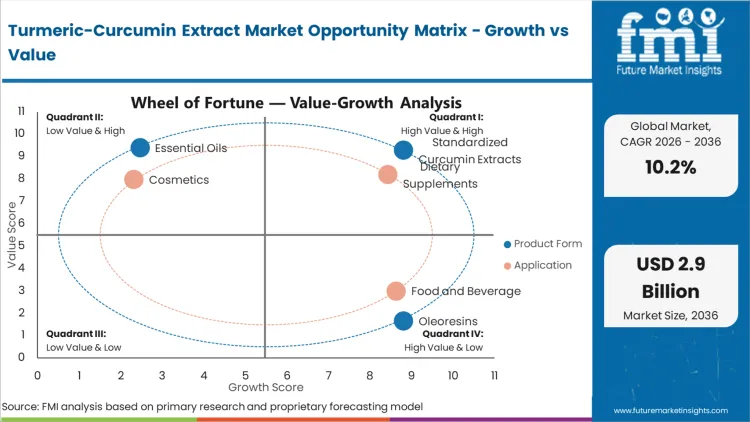
The professionalization of the botanical supply chain acts as the primary demand catalyst, fundamentally altering brand procurement protocols. Regulatory agencies and consumer watchdogs target misbranded and adulterated supplements, forcing manufacturers to upgrade sourcing mandates. Brands actively abandon opaque spot markets, choosing to form strategic alliances with vertically integrated extractors. Processors guarantee isotopic purity and exact curcuminoid concentrations, transforming compliance from a cost center into a core marketing asset.
Raw material price volatility severely disrupts long-term margin predictability for extraction facilities. Spot prices for agricultural commodities fluctuate based on monsoon patterns and speculative trading within regional markets. The Erode market turmeric price increased by 62.9% year-over-year from April to December of FY 2024–25, destroying margins for processors bound by fixed annual pricing contracts [12]. Extractors face extreme difficulty passing sudden cost inflations onto retail brands. Sophisticated processors utilize contract farming, locking in acreage and prices directly with growers to stabilize input costs and ensure continuous factory utilization.
- Supply integration: Ingredient manufacturers are increasingly setting up localized production hubs to reduce intermediary costs and maintain tighter control over raw material quality. By situating processing facilities closer to cultivation areas, companies improve feedstock freshness, enhance traceability, and streamline operational efficiency while strengthening long-term supply chain reliability.
- Delivery formulation: Novel formulation technologies unlock new product formats beyond traditional capsules. The debut of pioneering biotic and botanical combination concepts at Vitafoods Europe in May 2024 allows brands to penetrate mainstream food channels rapidly [14].
- Corporate acquisition: Ingredient manufacturers are increasingly acquiring consumer-facing brands to move closer to end markets and secure stable offtake channels. This vertical integration strategy helps capture higher retail margins, strengthen brand positioning, and create more predictable demand across internal supply networks.
Regional Analysis
.webp "Top Country Growth Comparison Turmeric Curcumin Extract Market Cagr (2026 2036)")
Based on the regional analysis, the Turmeric/Curcumin Extract market is segmented into North America, Latin America, Europe, East Asia, South Asia, Oceania and Middle East & Africa across 40+ countries. The full report also offers market attractiveness analysis based on regional trends.
| Country | CAGR (2026 to 2036) |
|---|---|
| India | 11.8% |
| China | 11.3% |
| United States | 10.7% |
| United Kingdom | 10.1% |
| Germany | 9.8% |
| Brazil | 9.4% |
Source: Future Market Insights (FMI) analysis, based on proprietary forecasting model and primary research
South Asia Turmeric/Curcumin Extract Analysis
South Asia commands absolute supremacy in the cultivation and primary extraction of curcuminoid compounds. As per FMI's projection, operations focus on vertically integrating supply chains, linking rural farmers directly to high-tech solvent extraction facilities to ensure global compliance. Extractors continuously expand capacity to meet escalating Western demand for pure, traceable ingredients. Operations benefit from dedicated government intervention aimed at maximizing export value and standardizing crop quality across all processing hubs.
- India: India continues to strengthen its position in the global turmeric trade, with export volumes reaching 176,325 tons in FY 2024–25, reinforcing its dominant supply role [16]. This scale compels international buyers to maintain close sourcing relationships within the region. As strong export performance supports structured procurement and downstream budgeting commitments, demand for turmeric extracts in India is projected to grow at an 11.8% CAGR through 2036.
FMI’s report includes an extensive evaluation of South Asia dynamics. Sri Lanka and Bangladesh represent vital auxiliary agricultural zones supporting regional output. Procurement teams must navigate fluctuating monsoon yields while securing reliable bulk shipments to maintain processing utilization rates across tetrahydrocurcumin production lines.
East Asia Turmeric/Curcumin Extract Analysis
East Asia exhibits strong consumption spurred by the integration of traditional medicine frameworks with modern nutraceutical formats. The region imports high-volume quantities of standardized extracts to supply vast domestic functional food and beverage manufacturing sectors. Regulatory authorities align with global safety standards, scrutinizing imported botanicals for heavy metals and synthetic adulterants. Leading regional pharmaceutical companies incorporate bioavailable curcumin into premium joint health formulations, targeting an aging demographic.
- China: Turmeric/curcumin extract sales in China are projected to rise at 11.3% CAGR from 2026 to 2036 as functional food integration expands, creating a clearer pathway from policy or spending intent to purchase orders. Procurement teams in China secure raw materials from dominant global suppliers, acknowledging India's estimated 65% share of global turmeric exports to maintain domestic manufacturing output [17].
FMI’s report includes comprehensive metrics for East Asia dynamics. Japan and South Korea represent advanced consumer bases demanding sophisticated, high-absorption delivery mechanisms. Suppliers monitor the regulatory landscape as food processors seek natural alternatives to synthetic yellow dyes.
North America Turmeric/Curcumin Extract Analysis
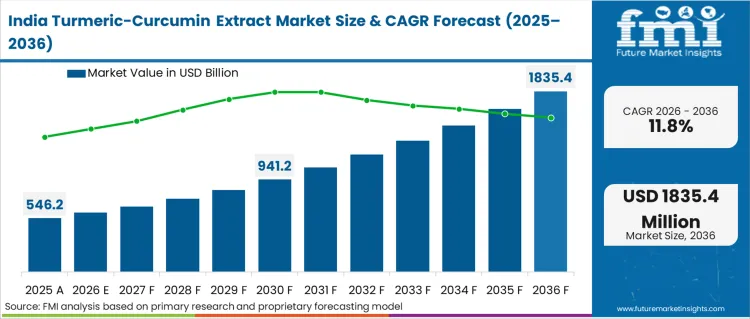
North America represents the most lucrative retail destination for finished curcumin formulations. High consumer awareness regarding systemic inflammation fuels continuous expansion within the dietary supplement sector. Mass-market channels stock premium botanical products, blurring lines between specialized health food stores and traditional grocery. Regulatory enforcement shapes the competitive landscape, as authorities actively penalize brands failing to meet label claims.
- United States: In the United States, stronger regulatory oversight is influencing how companies source and position turmeric and curcumin extracts, encouraging more structured procurement practices. The sector is expected to grow at a 10.7% CAGR from 2026 to 2036, as improved compliance standards support higher utilization and ongoing technology upgrades. Meanwhile, digital retail channels continue to introduce new formats, with the NIH Dietary Supplement Label Database noting fresh turmeric chew entries in July 2025, highlighting steady product innovation and online shelf refresh cycles [18].
FMI’s report includes a deep dive into North American consumption patterns. Canada and Mexico present distinct regulatory environments for natural health products. Distributors must secure prominent shelf placement near complementary joint-health items to maximize impulse cross-purchasing volumes for herbal nutraceuticals.
Europe Turmeric/Curcumin Extract Analysis
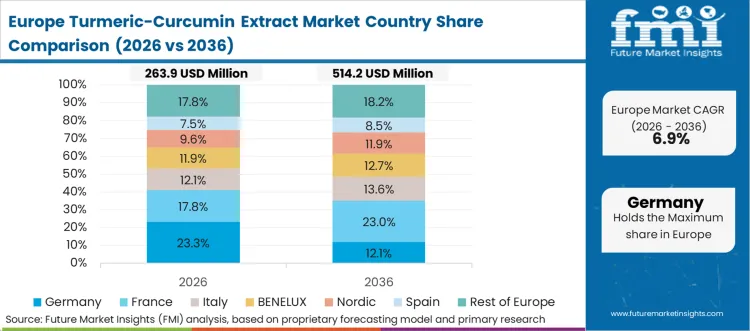
Europe enforces stringent quality and safety standards for botanical imports. Formulators require extensive documentation, including pesticide residue analyses and clinical efficacy data, before introducing new ingredients. The market heavily favors scientifically validated phytosome and liposomal complexes over generic powders. Leading ingredient conglomerates partner with specialized botanical extractors to develop bespoke, highly bioavailable combinations tailored for targeted therapeutic applications.
- United Kingdom: United Kingdom is expected to record 10.1% CAGR in turmeric/curcumin extract demand over 2026 to 2036 as evidence-backed joint positioning mainstreams, tightening the link between operational constraints and adoption-led investment. European formulators lock long-term contracts to avoid severe agricultural inflation, such as the 37.2% year-over-year price spike recorded at the Nizamabad market [19].
- Germany: In Germany, the turmeric/curcumin extract market is forecast to advance at 9.8% CAGR through 2036, with growth anchored in pharmaceutical-grade compliance that converts into measurable budget allocation. High-purity extracts displace cheaper, opaque alternatives as brands align with German preferences for scientifically backed nutraceuticals.
FMI’s report includes detailed tracking of European market shifts. France and Italy dictate trends in phytosome delivery technologies and advanced botanical formulation. Formulators navigate complex European Food Safety Authority directives regarding novel foods to ensure compliant retail distribution.
Latin America Turmeric/Curcumin Extract Analysis
Latin America exhibits emerging demand driven by digital marketplaces and an expanding middle class prioritizing proactive health management. Regulatory frameworks gradually modernize, placing greater emphasis on claim substantiation and ingredient purity. Local supplement brands rely heavily on imported standardized extracts from South Asia to formulate anti-inflammatory and beauty-from-within products.
- Brazil: In Brazil, growing direct-to-consumer supplement models are reshaping purchasing patterns and helping suppliers better align with local demand triggers. Regional processors continue to depend on imported standardized extracts, reinforcing strong trade ties with major producing nations. India’s turmeric exports reaching Rs 2,885.39 crore in FY 2024–25 highlight the scale of this supply relationship [20]. As distribution channels mature and consumer awareness expands, turmeric and curcumin extract uptake in Brazil is projected to rise at a 9.4% CAGR over the forecast period.
FMI’s report includes a robust analysis of Latin American developments. Argentina and Chile represent critical nodes for digital health supplement expansion. Foreign brands establish local joint ventures or utilize efficient contract manufacturers to bypass import tariffs and achieve competitive pricing.
Competitive Aligners for Market Players
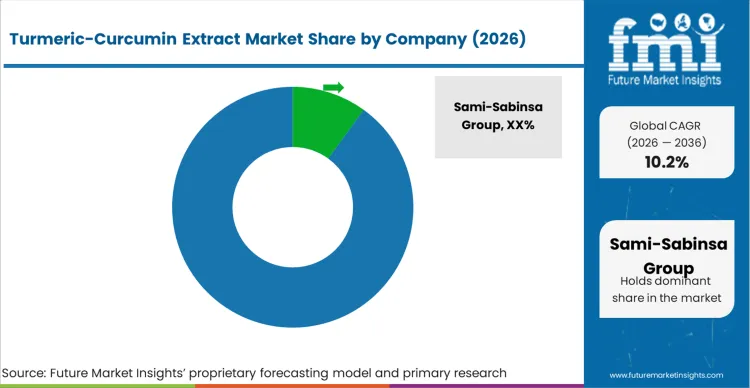
Vertical integration dictates the survival and profitability of primary extractors facing extreme agricultural price volatility. Facilities possessing captive cultivation agreements insulate themselves from severe spot market inflations. FMI analysts opine that extractors lacking direct farm linkages suffer margin compression, unable to fulfill long-term fixed-price contracts with global supplement brands. Leading players execute extensive capital expenditures to construct localized processing units directly adjacent to primary harvest zones, securing immediate access to fresh, high-yield rhizomes for organic spices and extracts.
Clinical substantiation acts as the primary barrier to entry within the premium formulation tier. Global ingredient conglomerates collaborate with specialized botanical research firms to engineer highly bioavailable, low-dose delivery systems. Joint ventures yielding innovations like combined Curcumin Phytosome and Boswellia Phytosome complexes allow companies to command exceptional price premiums in saturated retail channels. According to FMI's estimates, suppliers without dedicated clinical trial data are relegated to commoditized sectors, unable to meet the documentation requirements of top-tier nutraceutical brands.
Strategic acquisitions enable raw material processors to capture lucrative downstream consumer margins. Purchasing established consumer-facing brands secures guaranteed off-take volumes for standardized ingredients. This structural shift allows primary processors to dictate finished product pricing strategies, fundamentally altering the competitive dynamics against independent supplement formulators launching new functional extracts.
Key Players in Turmeric/Curcumin Extract
- Sami-Sabinsa Group
- dsm-firmenich
- Indena
- OmniActive Health Technologies
- Givaudan
- Gencor
- Pharmako Biotechnologies
- Arjuna Natural
- Synthite Industries
- Plant Lipids
Scope of the Report
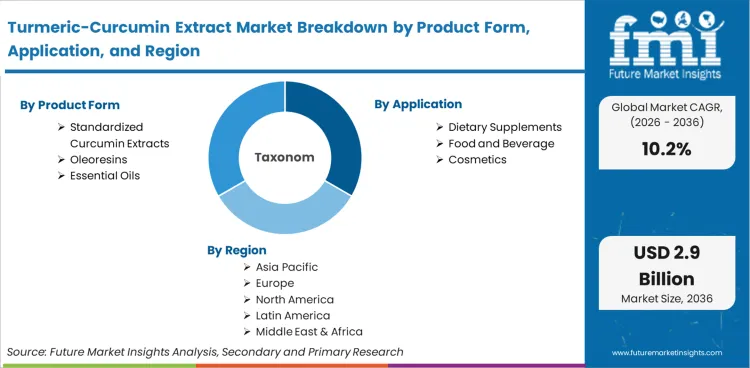
| Metric | Value |
|---|---|
| Quantitative Units | USD 1,135.0 million (2026) to USD 2,945.0 million (2036), at a CAGR of 10.2% |
| Market Definition | Turmeric/curcumin extract represents the commercial procurement of isolated, standardized bioactive compounds derived from the Curcuma longa rhizome. |
| Product Form Segmentation | Standardized Curcumin Extracts, Oleoresins, Essential Oils |
| Application Segmentation | Dietary Supplements, Food and Beverage, Cosmetics |
| Distribution Channel Segmentation | Online Retail, Pharmacies, Supermarkets |
| End-User Group Segmentation | Adults, Seniors, Pediatrics |
| Regions Covered | North America, Latin America, Europe, East Asia, South Asia, Oceania, Middle East and Africa |
| Countries Covered | United States, Canada, Mexico, Brazil, Argentina, Germany, France, United Kingdom, Italy, Spain, China, India, Japan, South Korea, Indonesia, Australia and 40 plus countries |
| Key Companies Profiled | Sami-Sabinsa Group, dsm-firmenich, Indena, OmniActive Health Technologies, Givaudan, Gencor, Pharmako Biotechnologies, Arjuna Natural, Synthite Industries, Plant Lipids |
| Forecast Period | 2026 to 2036 |
| Approach | Trade volume data combines with retail sales velocity metrics to project long-term category valuation |
Turmeric/Curcumin Extract Market Analysis by Segments
Product Form
- Standardized Curcumin Extracts
- Oleoresins
- Essential Oils
Application
- Dietary Supplements
- Food and Beverage
- Cosmetics
Distribution Channel
- Online Retail
- Pharmacies
- Supermarkets
End-User Group
- Adults
- Seniors
- Pediatrics
Region
- Asia Pacific
- India
- China
- Japan
- South Korea
- Indonesia
- Australia & New Zealand
- ASEAN
- Rest of Asia Pacific
- Europe
- Germany
- Italy
- France
- United Kingdom
- Spain
- Benelux
- Nordics
- Central & Eastern Europe
- Rest of Europe
- North America
- United States
- Canada
- Mexico
- Latin America
- Brazil
- Argentina
- Chile
- Rest of Latin America
- Middle East & Africa
- Kingdom of Saudi Arabia
- United Arab Emirates
- South Africa
- Turkey
- Rest of Middle East & Africa
Bibliography
- 1] American Botanical Council. (2024). Turmeric and herbal supplement sales insights for the United States (multiple stats referenced from 2024 ABC reporting).
- [2] U.S. Food and Drug Administration. (2024). Warning letter issued to AnuMed International citing 775 mg discrepancy.
- [3] Nutraceuticals World. (2026). BAPP published a comprehensive review on turmeric powder and extract adulteration.
- [4] Nutritional Outlook. (2025). Gencor and Pharmako Biotechnologies announced a U.S. patent for HydroCurc.
- [5] Nutraceutical Business Review. (2025). Givaudan study revealed efficacy for TurmiPure Gold at a 300 mg dose.
- [6] Ministry of Commerce and Industry. (2025). India turmeric policy, market price movements, and export performance updates (multiple 2025 items referenced).
- [7] Sami-Sabinsa Group. (2026). New Hassan Unit-2 facility began producing herbal ingredients with a USD 15M investment.
- [8] dsm-firmenich. (2024). Debut of pioneering biotic and botanical combination concepts at Vitafoods Europe.
- [9] Hanbury FZE. (2025). Sabinsa acquired Ayurvedic brand Nature’s Formulary to expand consumer goods division.
- [10] NIH DSLD. (2025). Dietary Supplement Label Database entry update for turmeric chews (label date entered in July).
This bibliography is provided for reader reference and is not exhaustive. The full report contains the complete reference list and detailed citations.
This Report Addresses
- Market intelligence to enable structured strategic decision making across mature and emerging botanical extract sectors
- Market size estimation and 10 year revenue forecasts from 2026 to 2036, supported by validated export data and agricultural yield metrics
- Growth opportunity mapping across standardized extracts and bioavailable phytosome formats
- Segment and regional revenue forecasts covering dietary supplements, clinical nutrition, and functional food applications
- Competition strategy assessment including vertical integration models, extraction capacity positioning, and clinical substantiation benchmarking
- Regulatory impact analysis covering FDA warning letters, botanical adulteration standards, and dietary supplement labeling mandates
- Supply chain stability analysis covering agricultural spot market pricing and dedicated contract farming operations
- Market report delivery in PDF, Excel, PPT, and interactive dashboard formats for executive and operational use
Frequently Asked Questions
How large is the demand for Turmeric/Curcumin Extract in the global market in 2026?
Demand for Turmeric/Curcumin Extract in the global market is estimated to be valued at USD 1,135.0 million in 2026.
What will be the market size of Turmeric/Curcumin Extract in the global market by 2036?
Market size for Turmeric/Curcumin Extract is projected to reach USD 2,945.0 million by 2036.
What is the expected demand growth for Turmeric/Curcumin Extract in the global market between 2026 and 2036?
Demand for Turmeric/Curcumin Extract in the global market is expected to grow at a CAGR of 10.2% between 2026 and 2036.
Which Product Form is poised to lead global sales by 2026?
Standardized Curcumin Extracts command 45% of volume in 2026 due to precise dosing capabilities required for therapeutic compliance.
How significant is the role of Dietary Supplements in driving Turmeric/Curcumin Extract adoption in 2026?
Dietary Supplements represent a critical segment, projected to hold a substantial 51% share in 2026 as consumer awareness of natural anti-inflammatory properties expands.
What is driving demand in India?
Demand scales through absolute export dominance and vertical integration securing high-curcumin rhizome cultivation zones.
What compliance standards or regulations are referenced for India?
The National Turmeric Board enforces product development and export infrastructure quality compliance frameworks.
What is the India growth outlook in this report?
India is projected to grow at a CAGR of 11.8% during 2026 to 2036.
Why is East Asia described as a priority region in this report?
East Asia functions as a major nutraceutical processing hub integrating traditional medicine frameworks with modern botanical delivery formats.
What type of demand dominates in East Asia?
Functional food integration utilizing clean-label, contaminant-free extracts dominates regional volume consumption.
What is China growth outlook in this report?
China is projected to expand at a CAGR of 11.3% during 2026 to 2036.
Does the report cover United States in its regional analysis?
Yes, United States is included within North America under the regional scope of analysis.
What are the sources referred to for analyzing United States?
American Botanical Council retail sales metrics and FDA compliance warning letters are cited as primary reference sources.
What is the main demand theme linked to United States in its region coverage?
Demand is associated with strict clinical substantiation enforcing procurement shifts away from opaque spot markets.
Does the report cover United Kingdom in its regional analysis?
Yes, United Kingdom is included within Europe under the regional coverage framework.
What is the main United Kingdom related demand theme in its region coverage?
Evidence-backed joint positioning mainstreams, demanding highly documented phytosome complexes for retail authorization.
Which product formats or configurations are strategically important for North America supply chains?
Bioavailable extract complexes utilizing liposomal or phytosome delivery systems are prioritized to capture premium therapeutic margins.
What is Turmeric/Curcumin Extract and what is it mainly used for?
Turmeric/curcumin extract represents standardized bioactive compounds utilized primarily for therapeutic anti-inflammatory dietary supplements.
What does Turmeric/Curcumin Extract mean in this report?
Turmeric/curcumin extract refers to global production, trade, and commercialization of isolated curcuminoid compounds and oleoresins.
What is included in the scope of this Turmeric/Curcumin Extract report?
Scope covers standardized 95% extracts, bioavailable phytosome formulations, and solvent-extracted turmeric oleoresin used in supplements and cosmetics.
What is excluded from the scope of this report?
Raw whole turmeric root, standard culinary curry powders, and synthetic yellow food dyes are excluded from scope.
What does market forecast mean on this page?
Market forecast represents a model based projection built on defined botanical extraction and healthcare expenditure assumptions for strategic planning.
How does FMI build and validate the Turmeric/Curcumin Extract forecast?
Forecast is developed using trade volume data combined with retail sales velocity metrics validated through localized spot price checks.
What does zero reliance on speculative third party market research mean here?
Primary interviews and verifiable statutory export filings are used instead of unverified syndicated market estimates.
Preview the report firsthand - request a free sample
Get SampleGet the brochure for pricing and purchase details.
Get PDFTable of Content
- Executive Summary
- Global Market Outlook
- Demand-side Trends
- Supply-side Trends
- Technology Roadmap Analysis
- Analysis and Recommendations
- Market Overview
- Market Coverage / Taxonomy
- Market Definition / Scope / Limitations
- Research Methodology
- Chapter Orientation
- Analytical Lens and Working Hypotheses
- Market Structure, Signals, and Trend Drivers
- Benchmarking and Cross-market Comparability
- Market Sizing, Forecasting, and Opportunity Mapping
- Research Design and Evidence Framework
- Desk Research Programme (Secondary Evidence)
- Company Annual and Sustainability Reports
- Peer-reviewed Journals and Academic Literature
- Corporate Websites, Product Literature, and Technical Notes
- Earnings Decks and Investor Briefings
- Government Statistics Portals and Public Data Releases
- Press Releases and Reputable Media Coverage
- Specialist Newsletters and Curated Briefings
- Sector Databases and Reference Repositories
- FMI Internal Proprietary Databases and Historical Market Datasets
- Subscription Datasets and Paid Sources
- Social Channels, Communities, and Digital Listening Inputs
- Additional Desk Sources
- Expert Input and Fieldwork (Primary Evidence)
- Primary Modes
- Qualitative Interviews and Expert Elicitation
- Quantitative Surveys and Structured Data Capture
- Blended Approach
- Why Primary Evidence is Used
- Field Techniques
- Interviews
- Surveys
- Focus Groups
- Observational and In-context Research
- Social and Community Interactions
- Stakeholder Universe Engaged
- C-suite Leaders
- Board Members
- Presidents and Vice Presidents
- R&D and Innovation Heads
- Technical Specialists
- Domain Subject-matter Experts
- Scientists
- Physicians and Other Healthcare Professionals
- Governance, Ethics, and Data Stewardship
- Research Ethics
- Data Integrity and Handling
- Primary Modes
- Tooling, Models, and Reference Databases
- Desk Research Programme (Secondary Evidence)
- Data Engineering and Model Build
- Data Acquisition and Ingestion
- Cleaning, Normalisation, and Verification
- Synthesis, Triangulation, and Analysis
- Quality Assurance and Audit Trail
- Market Background
- Market Dynamics
- Drivers
- Restraints
- Opportunity
- Trends
- Scenario Forecast
- Demand in Optimistic Scenario
- Demand in Likely Scenario
- Demand in Conservative Scenario
- Opportunity Map Analysis
- Product Life Cycle Analysis
- Supply Chain Analysis
- Investment Feasibility Matrix
- Value Chain Analysis
- PESTLE and Porter’s Analysis
- Regulatory Landscape
- Regional Parent Market Outlook
- Production and Consumption Statistics
- Import and Export Statistics
- Market Dynamics
- Global Market Analysis 2021 to 2025 and Forecast, 2026 to 2036
- Historical Market Size Value (USD Million) Analysis, 2021 to 2025
- Current and Future Market Size Value (USD Million) Projections, 2026 to 2036
- Y-o-Y Growth Trend Analysis
- Absolute $ Opportunity Analysis
- Global Market Pricing Analysis 2021 to 2025 and Forecast 2026 to 2036
- Global Market Analysis 2021 to 2025 and Forecast 2026 to 2036, By Product Form
- Introduction / Key Findings
- Historical Market Size Value (USD Million) Analysis By Product Form , 2021 to 2025
- Current and Future Market Size Value (USD Million) Analysis and Forecast By Product Form , 2026 to 2036
- Standardized Curcumin Extracts
- Oleoresins
- Essential Oils
- Standardized Curcumin Extracts
- Y-o-Y Growth Trend Analysis By Product Form , 2021 to 2025
- Absolute $ Opportunity Analysis By Product Form , 2026 to 2036
- Global Market Analysis 2021 to 2025 and Forecast 2026 to 2036, By Application
- Introduction / Key Findings
- Historical Market Size Value (USD Million) Analysis By Application, 2021 to 2025
- Current and Future Market Size Value (USD Million) Analysis and Forecast By Application, 2026 to 2036
- Dietary Supplements
- Food and Beverage
- Cosmetics
- Dietary Supplements
- Y-o-Y Growth Trend Analysis By Application, 2021 to 2025
- Absolute $ Opportunity Analysis By Application, 2026 to 2036
- Global Market Analysis 2021 to 2025 and Forecast 2026 to 2036, By Region
- Introduction
- Historical Market Size Value (USD Million) Analysis By Region, 2021 to 2025
- Current Market Size Value (USD Million) Analysis and Forecast By Region, 2026 to 2036
- North America
- Latin America
- Western Europe
- Eastern Europe
- East Asia
- South Asia and Pacific
- Middle East & Africa
- Market Attractiveness Analysis By Region
- North America Market Analysis 2021 to 2025 and Forecast 2026 to 2036, By Country
- Historical Market Size Value (USD Million) Trend Analysis By Market Taxonomy, 2021 to 2025
- Market Size Value (USD Million) Forecast By Market Taxonomy, 2026 to 2036
- By Country
- USA
- Canada
- Mexico
- By Product Form
- By Application
- By Country
- Market Attractiveness Analysis
- By Country
- By Product Form
- By Application
- Key Takeaways
- Latin America Market Analysis 2021 to 2025 and Forecast 2026 to 2036, By Country
- Historical Market Size Value (USD Million) Trend Analysis By Market Taxonomy, 2021 to 2025
- Market Size Value (USD Million) Forecast By Market Taxonomy, 2026 to 2036
- By Country
- Brazil
- Chile
- Rest of Latin America
- By Product Form
- By Application
- By Country
- Market Attractiveness Analysis
- By Country
- By Product Form
- By Application
- Key Takeaways
- Western Europe Market Analysis 2021 to 2025 and Forecast 2026 to 2036, By Country
- Historical Market Size Value (USD Million) Trend Analysis By Market Taxonomy, 2021 to 2025
- Market Size Value (USD Million) Forecast By Market Taxonomy, 2026 to 2036
- By Country
- Germany
- UK
- Italy
- Spain
- France
- Nordic
- BENELUX
- Rest of Western Europe
- By Product Form
- By Application
- By Country
- Market Attractiveness Analysis
- By Country
- By Product Form
- By Application
- Key Takeaways
- Eastern Europe Market Analysis 2021 to 2025 and Forecast 2026 to 2036, By Country
- Historical Market Size Value (USD Million) Trend Analysis By Market Taxonomy, 2021 to 2025
- Market Size Value (USD Million) Forecast By Market Taxonomy, 2026 to 2036
- By Country
- Russia
- Poland
- Hungary
- Balkan & Baltic
- Rest of Eastern Europe
- By Product Form
- By Application
- By Country
- Market Attractiveness Analysis
- By Country
- By Product Form
- By Application
- Key Takeaways
- East Asia Market Analysis 2021 to 2025 and Forecast 2026 to 2036, By Country
- Historical Market Size Value (USD Million) Trend Analysis By Market Taxonomy, 2021 to 2025
- Market Size Value (USD Million) Forecast By Market Taxonomy, 2026 to 2036
- By Country
- China
- Japan
- South Korea
- By Product Form
- By Application
- By Country
- Market Attractiveness Analysis
- By Country
- By Product Form
- By Application
- Key Takeaways
- South Asia and Pacific Market Analysis 2021 to 2025 and Forecast 2026 to 2036, By Country
- Historical Market Size Value (USD Million) Trend Analysis By Market Taxonomy, 2021 to 2025
- Market Size Value (USD Million) Forecast By Market Taxonomy, 2026 to 2036
- By Country
- India
- ASEAN
- Australia & New Zealand
- Rest of South Asia and Pacific
- By Product Form
- By Application
- By Country
- Market Attractiveness Analysis
- By Country
- By Product Form
- By Application
- Key Takeaways
- Middle East & Africa Market Analysis 2021 to 2025 and Forecast 2026 to 2036, By Country
- Historical Market Size Value (USD Million) Trend Analysis By Market Taxonomy, 2021 to 2025
- Market Size Value (USD Million) Forecast By Market Taxonomy, 2026 to 2036
- By Country
- Kingdom of Saudi Arabia
- Other GCC Countries
- Turkiye
- South Africa
- Other African Union
- Rest of Middle East & Africa
- By Product Form
- By Application
- By Country
- Market Attractiveness Analysis
- By Country
- By Product Form
- By Application
- Key Takeaways
- Key Countries Market Analysis
- USA
- Pricing Analysis
- Market Share Analysis, 2025
- By Product Form
- By Application
- Canada
- Pricing Analysis
- Market Share Analysis, 2025
- By Product Form
- By Application
- Mexico
- Pricing Analysis
- Market Share Analysis, 2025
- By Product Form
- By Application
- Brazil
- Pricing Analysis
- Market Share Analysis, 2025
- By Product Form
- By Application
- Chile
- Pricing Analysis
- Market Share Analysis, 2025
- By Product Form
- By Application
- Germany
- Pricing Analysis
- Market Share Analysis, 2025
- By Product Form
- By Application
- UK
- Pricing Analysis
- Market Share Analysis, 2025
- By Product Form
- By Application
- Italy
- Pricing Analysis
- Market Share Analysis, 2025
- By Product Form
- By Application
- Spain
- Pricing Analysis
- Market Share Analysis, 2025
- By Product Form
- By Application
- France
- Pricing Analysis
- Market Share Analysis, 2025
- By Product Form
- By Application
- India
- Pricing Analysis
- Market Share Analysis, 2025
- By Product Form
- By Application
- ASEAN
- Pricing Analysis
- Market Share Analysis, 2025
- By Product Form
- By Application
- Australia & New Zealand
- Pricing Analysis
- Market Share Analysis, 2025
- By Product Form
- By Application
- China
- Pricing Analysis
- Market Share Analysis, 2025
- By Product Form
- By Application
- Japan
- Pricing Analysis
- Market Share Analysis, 2025
- By Product Form
- By Application
- South Korea
- Pricing Analysis
- Market Share Analysis, 2025
- By Product Form
- By Application
- Russia
- Pricing Analysis
- Market Share Analysis, 2025
- By Product Form
- By Application
- Poland
- Pricing Analysis
- Market Share Analysis, 2025
- By Product Form
- By Application
- Hungary
- Pricing Analysis
- Market Share Analysis, 2025
- By Product Form
- By Application
- Kingdom of Saudi Arabia
- Pricing Analysis
- Market Share Analysis, 2025
- By Product Form
- By Application
- Turkiye
- Pricing Analysis
- Market Share Analysis, 2025
- By Product Form
- By Application
- South Africa
- Pricing Analysis
- Market Share Analysis, 2025
- By Product Form
- By Application
- USA
- Market Structure Analysis
- Competition Dashboard
- Competition Benchmarking
- Market Share Analysis of Top Players
- By Regional
- By Product Form
- By Application
- Competition Analysis
- Competition Deep Dive
- Sami-Sabinsa Group
- Overview
- Product Portfolio
- Profitability by Market Segments (Product/Age /Sales Channel/Region)
- Sales Footprint
- Strategy Overview
- Marketing Strategy
- Product Strategy
- Channel Strategy
- dsm-firmenich
- Indena
- OmniActive Health Technologies
- Givaudan
- Gencor
- Pharmako Biotechnologies
- Arjuna Natural
- Sami-Sabinsa Group
- Competition Deep Dive
- Assumptions & Acronyms Used


