

- Industry Size (2026)
- USD 19.6 Bn
- Forecast (2036)
- USD 51.3 Bn
- CAGR (2026 to 2036)
- 11.3%
Automotive Active Safety System Market Size, Market Forecast and Outlook By FMI
In 2025, the automotive active safety system market was valued at USD 17.6 billion. Based on Future Market Insights' analysis, demand for automotive active safety systems is estimated to grow to USD 19.6 billion in 2026 and USD 51.3 billion by 2036. FMI projects a CAGR of 11.3% during the forecast period. Pace of expansion is transformational rather than incremental, reflecting structural integration of advanced driver assistance systems into mainstream passenger vehicles, though pricing pressure from OEM procurement cycles and semiconductor supply constraints can moderate year-to-year acceleration.
The expansion of the automotive active safety system market is dependent on the development and deployment of systems such as the EyeQ6 High (EyeQ6H) system-on-chip. Amnon Shashua, President and CEO of Mobileye, observes: “We see tremendous opportunities ahead as we execute toward on-time launches of advanced EyeQ6 High-based products, deepen engagement with strategic customers across our portfolio, and prepare for the commercialization of driverless robotaxi beginning in 2026 [1].”
Summary of Automotive Active Safety System Market
- Market Definition
- Automotive active safety systems are in-vehicle sensor and control technologies that detect collision risks and automatically intervene through braking, steering, or speed adjustment to reduce accident probability.
- Demand Drivers
- Regulatory Mandates: Government safety frameworks in China, India, and the European Union are compelling OEMs to integrate ADAS features such as automatic emergency braking and lane departure warning as standard fitment.
- Premium Vehicle Penetration: Passenger car buyers, particularly in mid to high-end segments, are opting for vehicles equipped with adaptive cruise control and blind spot detection as default safety packages.
- Insurance and Fleet Economics: Commercial fleet operators are specifying forward collision warning and driver monitoring systems to lower accident-related costs and meet insurer risk assessment benchmarks.
- Key Segments Analyzed
- Product Type: Adaptive cruise control is projected to hold about 24% share in 2026, reflecting its early adoption across passenger car platforms.
- Vehicle Type: Passenger cars are expected to account for nearly 85% of total demand in 2026 due to higher ADAS penetration rates compared to commercial vehicles.
- Offering: Hardware components such as radar modules and camera units continue to command the larger revenue share relative to embedded software.
- Geography: China and India represent the fastest expansion corridors, while the United States, Germany, and Japan remain high-value but replacement-driven markets.
- Analyst Opinion at FMI
- Nikhil Kaitwade, principal consultant for Automotive at Future Market Insights, opines, “For CXOs, the next decade of competitive advantage in active safety will be defined not by incremental feature additions, but by mastering platform‑level integration and building scalable, software‑centric sensor architectures that future‑proof OEM roadmaps and unlock sustainable value creation across vehicle lineups.”
- Strategic Implications/Executive Takeaways
- Prioritize modular ADAS platforms that can be deployed across multiple vehicle models to improve scale economics.
- Strengthen semiconductor and sensor supply agreements to mitigate component shortages that can delay OEM production cycles.
- Align product roadmaps with evolving safety regulations to secure early-mover advantage in compliance-driven markets.
- Methodology
- Market sizing combines OEM fitment rate analysis with vehicle production statistics to ensure consistency with the USD 19.6 billion valuation in 2026.
- Revenue triangulation was performed using Tier-1 supplier disclosures and regional shipment data.
- Forecasts through 2036 were validated against regulatory timelines and planned ADAS rollouts disclosed by major automotive manufacturers, as per FMI.
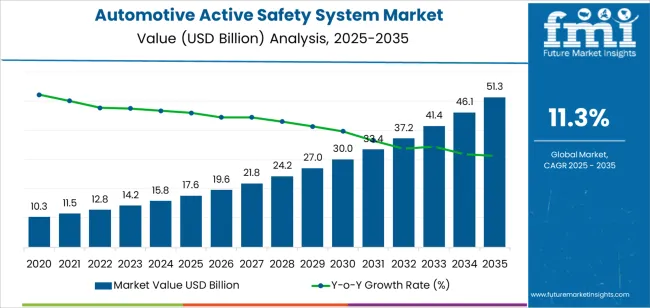
| Metric | Value |
|---|---|
| Estimated Value (2026E) | USD 19.6 billion |
| Forecast Value (2036F) | USD 51.3 billion |
| CAGR (2026 to 2036) | 11.3% |
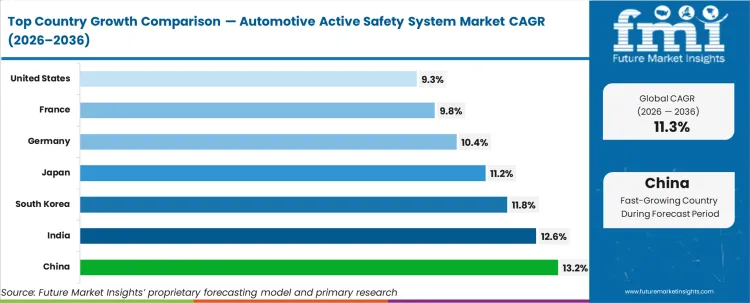
China is projected to expand at a CAGR of 13.2%, driven by rapid ADAS integration across domestic EV platforms and regulatory tightening around vehicle safety standards. India is expected to grow at 12.6% CAGR, supported by rising premium vehicle penetration and phased implementation of advanced safety mandates. South Korea is forecast to register a CAGR of 11.8%, owing to strong OEM-led technology adoption and export-oriented passenger vehicle production. Germany is estimated to record a CAGR of 10.4%, reflecting steady upgrades in premium vehicle segments and regulatory compliance requirements across the EU. USA and Japan are projected to grow at comparatively moderate CAGRs of 9.3% and 8.9%, respectively. As these mature markets generate replacement-driven demand rather than first-time system adoption; high platform standardization and pricing pressure from large OEM procurement contracts act as structural constraints in these regions.
Automotive Active Safety System Market Definition
The automotive active safety system market covers electronic and sensor-based technologies installed in vehicles to prevent or mitigate accidents before they occur. These systems monitor the vehicle’s surroundings and driver behavior using radar, cameras, ultrasonic sensors, and control software. Their primary function is to detect potential hazards such as obstacles, lane deviations, or sudden braking events and automatically intervene through steering, braking, or throttle control. Key end uses include passenger cars, light commercial vehicles, and heavy commercial vehicles, where features such as adaptive cruise control, lane departure warning, and blind spot detection are integrated into vehicle platforms.
Market Inclusions
The report covers global and regional market size estimates and forecasts from 2026 to 2036, along with historical valuation for 2025. It provides segment breakdowns by product type, vehicle type, and offering, including hardware and software components. The study also includes pricing trends, OEM procurement structures, regulatory influence assessment, and high-level trade flow analysis across major automotive manufacturing hubs.
Market Exclusions
The scope excludes passive safety components such as airbags, seatbelts, and crash structures unless integrated directly within active electronic control systems. It also omits fully autonomous driving platforms beyond Level 2 and Level 3 ADAS, aftermarket infotainment systems, and unrelated vehicle electronics such as engine control units. The focus remains strictly on active, pre-collision safety technologies and their immediate hardware and software architecture.
Research Methodology
- Primary research: Interviews were conducted with OEM procurement managers, Tier-1 suppliers, system integrators, and regulatory consultants across North America, Europe, and Asia Pacific.
- Desk research: Public sources reviewed include automotive production statistics, regulatory notifications, company annual reports, investor presentations, and safety compliance documentation.
- Market-sizing and forecasting: A hybrid approach combining bottom-up aggregation of OEM fitment rates and top-down validation against vehicle production volumes was applied.
- Data validation and update cycle: Findings were cross-verified through triangulation with supplier revenue disclosures and periodic updates aligned with quarterly production and regulatory announcements.
Segmental Analysis
Automotive Active Safety System Market Analysis by product type
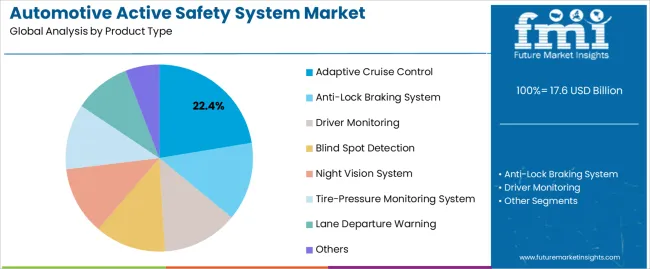
Based on FMI’s automotive active safety system market report, adaptive cruise control is estimated to hold a 24% share in 2026. Its lead position comes from being a bundleable ADAS feature that OEMs can scale across trims using common radar/camera hardware, while improving highway comfort and maintaining safer following distances in dense traffic.
- ADAS M&A move: HARMAN’s proposed acquisition of ZF’s ADAS business (including compute solutions, smart cameras, radar technology, and ADAS software) signals continued consolidation around centralized ADAS stacks that support features such as adaptive cruise control. [2]
- OEM feature upgrade: Toyota’s 2024 Land Cruiser launch highlighted enhancements to Dynamic Radar Cruise Control, including full-speed range capability and expanded following-distance functionality, showing how OEM refresh cycles keep ACC-class functions moving into higher-volume nameplates. [3]
- Radar scaling signal: Continental reported producing its 200 millionth radar sensor and disclosed ~€1.5 billion in radar orders in Q1 2025, with series production planned to start in 2026–2027, reinforcing the supply-side scaling that underpins ACC deployment. [4]
Automotive Active Safety System Market Analysis by vehicle type
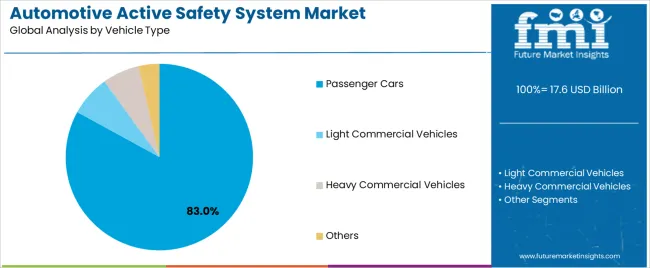
Passenger cars are expected to account for about 85% in 2026, reflecting higher ADAS fitment rates versus commercial vehicles and faster feature trickle-down from premium trims into mid-range models through platform standardization.
- OEM R&D investment: JLR announced a USD 180 million investment in its North American technology hub to develop connected-car and driver-aid technologies, supporting passenger car roadmaps where active safety features are increasingly platform-defined. [5]
- Program adoption: Mobileye stated that Mahindra selected its SuperVision™ and Surround ADAS solutions for next-generation vehicles, pointing to faster passenger-car ADAS penetration in India as OEMs expand feature availability beyond top-end trims. [6]
- Fleetwide integration trend: MITRE’s PARTS initiative noted the ongoing expansion and broader integration of ADAS features in new vehicles, consistent with passenger cars being the primary volume channel for active safety system rollouts. [7]
Automotive Active Safety System Market Drivers, Restraints, and Opportunities
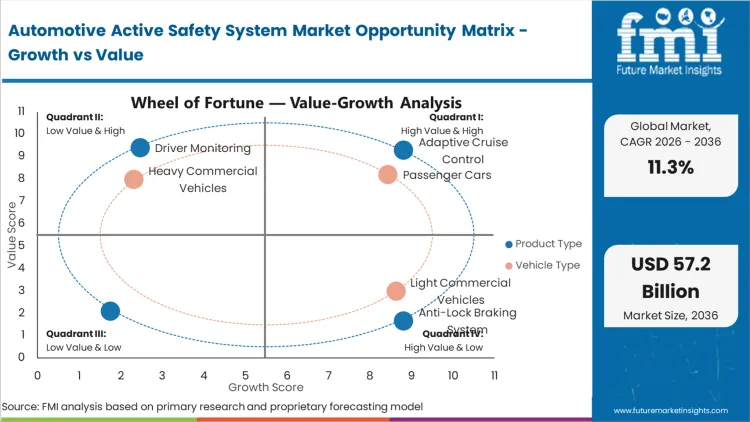
The automotive active safety system market has evolved from a premium vehicle differentiator into a regulatory-linked mainstream requirement. Its valuation of USD 19.6 billion in 2026 reflects structural embedding of ADAS functions into passenger vehicle platforms rather than optional add-ons. The market exists at this scale because regulators in major automotive regions have shifted focus from passive crash protection toward accident prevention, compelling OEMs to integrate forward collision warning, automatic emergency braking, and lane-keeping technologies as baseline safety architecture.
Analysts observe a transition from standalone electronic control units toward centralized domain controllers and software-defined vehicle architectures. Demand for basic, single-function driver aids is stabilizing in mature markets, while multi-sensor fusion systems and driver monitoring modules are gaining traction in Asia and premium European landscapes. Although next-generation sensor suites carry higher per-vehicle costs, OEMs are offsetting this through platform consolidation and shared hardware across trims, resulting in revenue expansion even when unit-level margins face procurement pressure.
- Regulatory escalation: The European Union General Safety Regulation (EU 2019/2144) mandates features such as intelligent speed assistance and advanced emergency braking in new vehicle types, accelerating OEM integration cycles and increasing baseline fitment rates across the region. This policy-driven compliance requirement sustains demand independent of discretionary consumer upgrades.
- Asia production surge: China’s electric vehicle manufacturing scale and domestic ADAS supplier ecosystem are reshaping global sourcing patterns. High-volume EV production allows local OEMs to integrate camera and radar-based safety systems at competitive cost points, creating geographic concentration of growth in Asia Pacific.
- Semiconductor constraint: Active safety systems rely heavily on automotive-grade semiconductors and imaging chips, exposing the market to supply chain volatility. Component shortages and longer validation cycles can delay OEM launches, moderating short-term revenue realization despite strong long-term structural demand.
Regional Analysis
The automotive active safety system market is assessed across North America, Europe, Asia Pacific, Latin America, and the Middle East and Africa, with geographic performance benchmarked by vehicle production scale, safety-rule enforcement, and OEM fitment strategies. Regional sizing reflects differences in ADAS regulation timing, consumer safety adoption, and the localization of sensors and control software across major manufacturing corridors.
.webp "Top Country Growth Comparison Automotive Active Safety System Market Cagr (2026 2036)")
| Country | CAGR (2026-2036) |
|---|---|
| China | 13.2% |
| India | 12.6% |
| South Korea | 11.8% |
| Japan | 11.2% |
| Germany | 10.4% |
| France | 9.8% |
| United States | 9.3% |
Source: Future Market Insights (FMI) analysis, based on proprietary forecasting model and primary research
Asia Pacific Automotive Active Safety System Market Analysis
Asia Pacific is the production epicenter for high-volume ADAS fitment, where rapid platform rollouts and local supply chains compress the cost of radar, camera, and controller hardware. Denso retains a strong position in sensor and ECU supply into Japanese OEM programs, while Hyundai Mobis is scaling software-defined architectures and ADAS modules across Korean and export platforms [9]. Meanwhile, global Tier-1 suppliers are actively partnering with local tech firms to localize sensor fusion algorithms and domain controllers, ensuring compliance with diverse regional driving conditions and domestic safety mandates.
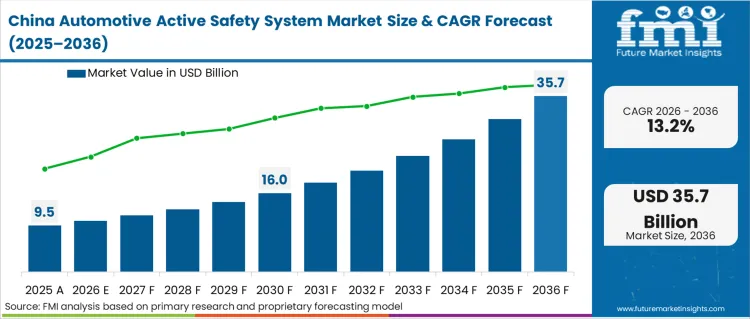
- China: The automotive active safety system landscape in China is set to achieve a CAGR of 13.2% through 2036. Growth is being pulled forward by rule-setting that is shifting ADAS from optional packages to baseline safety equipment, including national standard moves that require automatic emergency braking as the standard fitment for light vehicles effective January 2028. [8] On the supply side, China’s scale advantage is reinforced by high local penetration of forward sensors in new vehicles, which accelerates OEM learning cycles and pushes ADAS costs down across mass-market trims. [11]
- India: India is expected to see its automotive active safety system sector grow at a compound annual rate of 12.6% through 2036. The market is being shaped by the government’s rollout of Bharat NCAP, which formalized the star-rating process under AIS-197 and operationalized manufacturer applications for assessment from October 2023, creating a structured pathway for Safety Assist Technologies to become a visible purchase criterion. [12] Supplier localization is building execution capacity, illustrated by Hyundai Mobis expanding software R&D scope at its India technical center to support vehicle software and integrated solutions for OEM programs. [14]
- South Korea: Over the forecast period, automotive active safety systems in South Korea are set for a CAGR of 11.8% through 2036. Growth is supported by Korea’s fast transition toward software-defined vehicle architectures, which raises the attach rate of ADAS functions by moving compute and controls into centralized platforms showcased in January 2024 SDV initiatives. [15] Supplier roadmaps are tightening around high-performance compute and ADAS stack integration, reflected in January 2026 collaboration announcements linking SoC platforms with ADAS sensor and software integration pathways. [16]
- Japan: Sales of automotive active safety systems in Japan are on track to record a CAGR of 11.2% through 2036. Japan represents a highly mature, technology-driven market where an aging demographic has accelerated the regulatory push for advanced collision avoidance and pedal misapplication prevention systems.
The comprehensive FMI report provides an in-depth analysis of the broader Asia Pacific ecosystem, extending beyond these core manufacturing bases to identify highly lucrative opportunities in Thailand and Indonesia. Thailand's status as the automotive export hub of Southeast Asia drives significant demand for active safety components, as assembly plants continuously upgrade vehicle platforms to meet the stringent NCAP standards of their European and Australasian destination markets.
Analysis of Automotive Active Safety System Market in Europe
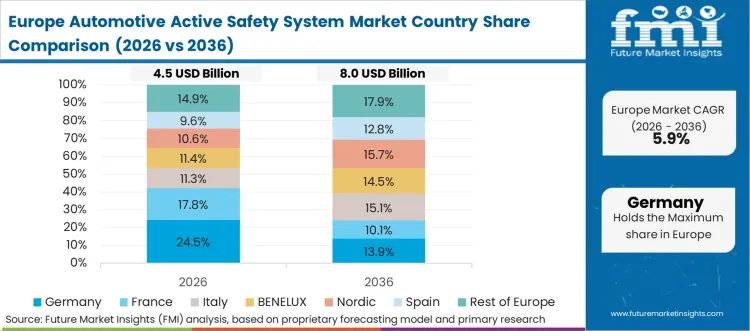
Europe operates as the global regulatory laboratory for vehicle safety, heavily influenced by Euro NCAP's aggressive assessment roadmap and the European Union's stringent General Safety Regulation (GSR), which fundamentally shifts active safety from a luxury add-on to a legal prerequisite.
- Germany: Demand for automotive active safety systems in Germany is estimated to expand at a CAGR of 10.4% through 2036. Uptake is anchored in compliance-driven fitment under the EU safety timetable, where Germany’s transport ministry outlines staged introduction dates for mandatory vehicle safety systems, including broad application to new vehicle types by July 2024 under the EU framework. [17] Industrial capacity and export-linked programs also support ADAS hardware scaling, with Continental reporting major radar shipment milestones and new radar orders in May 2025, reinforcing Germany’s role in sensor supply into European platforms. [10]
- France: France's automotive active safety system industry is projected to witness growth at a CAGR of 9.8% through 2036. Driven by domestic giants like Renault and Stellantis, the French market is rapidly integrating Level 2+ active safety features across high-volume compact and subcompact vehicle segments. Strong government incentives for modernizing the national fleet, coupled with heightened consumer awareness around Euro NCAP safety ratings, are accelerating the deep penetration of intelligent speed assistance and advanced lane-keeping systems.
FMI rigorous report provides an in-depth look at the wider European market, analyzing lucrative hubs outside of Germany and France. The United Kingdom represents a critical focus area, where the government's CAM (Connected and Automated Mobility) initiatives heavily promote the deployment of advanced active safety technologies to reduce traffic fatalities. Additionally, Italy is recognized as a high-potential hub experiencing a rise in specialized demand for luxury and high-performance vehicle ADAS integrations.
North America Automotive Active Safety System Market Analysis
North America acts as a primary innovation and compliance hub, characterized by high consumer willingness to pay for premium safety packages and rapidly tightening federal performance standards that dictate the baseline functionality of new vehicles.
- United States: The market for automotive active safety systems in the United States is forecast to register a CAGR of 9.3% through 2036. The key driver is enforceable performance standardization, as NHTSA finalized FMVSS No. 127 for light-vehicle AEB in May 2024, extending requirements to include pedestrian AEB and forward collision warning as regulated capabilities rather than voluntary features. [19] A subsequent Federal Register action in November 2024 addressed petitions for reconsideration, signaling that compliance details will continue to shape OEM system specifications, validation workloads, and rollout pacing. [20]
FMI report gets in-depth on the North American landscape by analyzing additional high-potential markets like Canada and Mexico. Canada represents a highly lucrative hub uniquely specialized in active safety systems calibrated for extreme weather and low-visibility conditions. Concurrently, Mexico is expanding as an essential nearshoring hub, drawing significant investments in ADAS component manufacturing and sensor assembly to supply the broader North American automotive footprint.
Competitive Aligners for Market Players
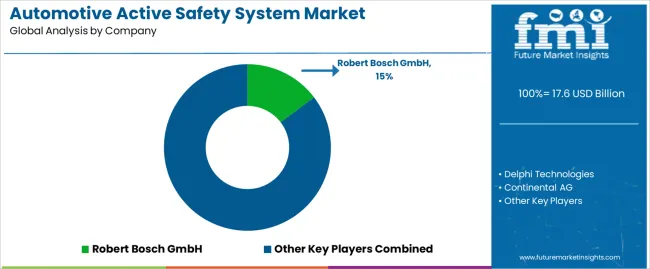
Competitive structure is led by a relatively concentrated set of global Tier-1 suppliers and specialized ADAS software-stack providers, with OEMs typically awarding multi-year platform programs rather than buying features as standalone parts. The primary competitive variable is the ability to deliver a validated, safety-compliant ADAS stack, sensors plus compute plus embedded software, at an OEM cost target while meeting launch timing and functional safety requirements.
Structural advantages sit with suppliers that control both the sensing layer and the compute-and-software integration layer, because they can standardize architectures across multiple OEM platforms and amortize validation costs. Scale in radar and camera manufacturing, access to automotive-grade silicon roadmaps, and established vehicle integration toolchains reduce per-program engineering load and shorten SOP readiness, which is why consolidation around full-stack ADAS portfolios keeps recurring.
Consumer behavior in this market favors large OEM purchasing leverage. Vehicle manufacturers manage supplier dependency through dual-sourcing of sensors, competitive RFQs for compute platforms, and contractual price-down clauses tied to volume ramps and component cost curves. This dynamic limits pricing power for commodity-like hardware modules, while preserving margin headroom for suppliers that can demonstrate measurable system performance, lower integration burden, and faster homologation across regions.
Recent developments
- ZF and HARMAN acquisition (December 2025): ZF announced the sale of its ADAS business to HARMAN, transferring assets across compute solutions, smart cameras, radar technology, and ADAS software as part of the transaction.
- Hyundai Mobis and Qualcomm agreement (January 2026): Hyundai Mobis and Qualcomm disclosed a comprehensive agreement to collaborate on SDV architecture for ADAS, aligning supplier roadmaps around centralized compute and software integration.
- Mobileye program win (January 2026): Mobileye announced that a top-10 US-based automaker selected EyeQ6H to power future Surround ADAS with hands-free driving on select highways, signaling continued OEM movement toward consolidated, scalable ADAS stacks.
Key Players in Automotive Active Safety System Market
- Robert Bosch GmbH
- Continental AG
- ZF Friedrichshafen AG
- Autoliv Inc.
- Hyundai Mobis
- Valeo SA
- DENSO Corporation
- Magna International Inc.
- Infineon Technologies AG
- Aptiv PLC
- Veoneer Inc.
- Hitachi Astemo, Ltd.
- Nidec Corporation
- Texas Instruments Incorporated
- NXP Semiconductors N.V.
- onsemi
- STMicroelectronics N.V.
- Rohm Semiconductor
- Analog Devices Inc.
- Mobileye Global Inc.
Scope of the Report
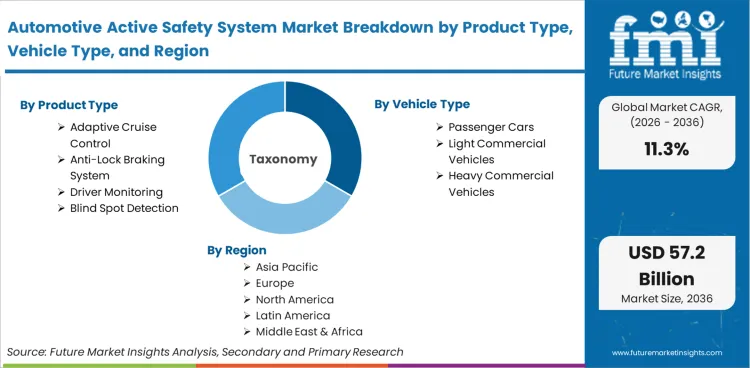
| Metric | Value |
|---|---|
| Quantitative Units | USD 19.6 billion (2026) to USD 51.3 billion (2036), at a CAGR of 11.3% |
| Market Definition | The automotive active safety system market comprises the global production, integration, and servicing of technologies that actively prevent accidents through hazard detection and automated intervention, including adaptive cruise control, automatic emergency braking, lane departure warning, and driver monitoring systems. |
| Product Type Segmentation | Adaptive Cruise Control (24%), Anti-Lock Braking System, Driver Monitoring, Blind Spot Detection, Night Vision System, Tire-Pressure Monitoring System, Lane Departure Warning, Others |
| Vehicle Type Segmentation | Passenger Cars (85%), Light Commercial Vehicles, Heavy Commercial Vehicles |
| Offering Segmentation | Hardware (76%), Software |
| Regions Covered | North America, Latin America, Western Europe, Eastern Europe, South Asia and Pacific, East Asia, Middle East and Africa |
| Countries Covered | United States, Canada, Mexico, Brazil, Germany, France, United Kingdom, Italy, Spain, China, India, Japan, South Korea, Indonesia, Australia, and 40 plus countries |
| Key Companies Profiled | Robert Bosch GmbH, Continental AG, ZF Friedrichshafen AG, Autoliv Inc., Hyundai Mobis, Valeo SA, DENSO Corporation, Magna International Inc., Infineon Technologies AG, Aptiv PLC, Veoneer Inc., Hitachi Astemo, Ltd., Nidec Corporation, Texas Instruments Incorporated, NXP Semiconductors N.V., onsemi, STMicroelectronics N.V., Rohm Semiconductor, Analog Devices Inc., Mobileye Global Inc. |
| Forecast Period | 2026 to 2036 |
| Approach | Hybrid top-down and bottom-up market modeling validated through primary interviews with active safety system manufacturers, OEM safety engineers, and sensor suppliers, supported by vehicle production data and component supplier capacity verification |
Automotive Active Safety System Market Analysis by Segments
Product Type:
- Adaptive Cruise Control
- Anti-Lock Braking System
- Driver Monitoring
- Blind Spot Detection
- Night Vision System
- Tire-Pressure Monitoring System
- Lane Departure Warning
- Others
Vehicle Type:
- Passenger Cars
- Light Commercial Vehicles
- Heavy Commercial Vehicles
Offering:
- Hardware
- Software
Region:
- North America
- Latin America
- Western Europe
- Eastern Europe
- South Asia and Pacific
- East Asia
- Middle East and Africa
Bibliography
- [1] Mobileye Global Inc. (2025, October 30). Mobileye releases third quarter 2025 results and provides business overview.
- [2] ZF Friedrichshafen AG. HARMAN to Acquire ZF’s ADAS Business Unit. January 2025.
- [3] Toyota Motor North America. The Evolution of a Legend: The All-New 2024 Land Cruiser. June 2023.
- [4] Continental AG. Continental Produces 200 Million Radar Sensors and Secures Major Orders. May 2025. Ava
- [5] Jaguar Land Rover. JLR Investing $180m in its North American Tech Hub Developing Connected Car and Driver Aid Technologies. February 2025.
- [6] Mobileye Global Inc. Mahindra Selects Mobileye’s SuperVision™ and Surround ADAS for Next-Generation Vehicles. January 2025. Available at:
- [7] MITRE. Advanced Driver Assistance Systems Continue to Expand, New Report Shows. October 2024.
- [8] CNEVPost. China issues 1st mandatory standard for driver assist systems, AEB to be standard. January 2026.
- [9] Hyundai Motor Group. CES 2024: Introducing SDV exhibits and unveiling core SDV technologies. January 2024.
- [10] Continental AG. Continental produces 200 million radar sensors and secures major orders. May 2025. [11] CarNewsChina. China mandates automatic emergency braking system on light commercial vehicles, effective 2028. January 2026.
- [12] Press Information Bureau, Government of India. Bharat new car assessment programme introduced for enhancing road safety. December 2023.
- [13] Ministry of Road Transport and Highways (MoRTH), Government of India. Draft G.S.R. 464(E) dated 28 June 2023 regarding Bharat NCAP (AIS-197). July 2023.
- [14] Hyundai Mobis. Newsroom release on expanding software R&D scope at the India technical center. (Accessed via Hyundai Mobis newsroom page).
- [15] Hyundai Motor Group. CES 2024 SDV and E/E architecture overview (Brand Journal). January 2024.
- [16] Qualcomm. Hyundai Mobis and Qualcomm sign comprehensive agreement to collaborate on SDV architecture for ADAS. January 2026.
- [17] German Federal Ministry for Digital and Transport (BMDV). New vehicle safety systems (timetable for mandatory technologies). (Accessed 2026).
- [18] EUR-Lex. Regulation (EU) 2019/2144 context and implementing measures (type-approval and advanced vehicle systems). 2024.
- [19] National Highway Traffic Safety Administration (NHTSA). NHTSA finalizes rule on automatic emergency braking (FMVSS No. 127). May 2024.
- [20] Federal Register. Federal Motor Vehicle Safety Standards; Automatic Emergency Braking Systems for Light Vehicles (FMVSS No. 127) - reconsideration action. November 2024.
This bibliography is provided for reader reference and is not exhaustive. The full report contains the complete reference list and detailed citations.
This Report Addresses
- Market intelligence to enable structured strategic decision-making across mature and emerging automotive active safety system markets.
- Market size estimation and 10-year revenue forecasts from 2026 to 2036, supported by validated vehicle production data and component procurement benchmarks.
- Growth opportunity mapping across product types, vehicle types, and offerings, with emphasis on sensor fusion platform transitions.
- Segment and regional revenue forecasts covering adaptive cruise control, driver monitoring, blind spot detection, and other active safety technologies.
- Competition strategy assessment including technology positioning, systems integration capability, and regulatory compliance benchmarking.
- Technology roadmap tracking including sensor evolution (radar, camera, LiDAR), processing platform development, and software algorithm advancement.
- Regulatory impact analysis covering NHTSA mandates, Euro NCAP protocols, C-NCAP requirements, and regional safety standards.
- Market report delivery in PDF, Excel, PPT, and interactive dashboard formats for executive and operational use.
Frequently Asked Questions
How large was the automotive active safety system market in 2025?
In 2025, the automotive active safety system market was valued at USD 17.6 billion.
What will the market size be in 2026?
Demand for automotive active safety systems is estimated to grow to USD 19.6 billion in 2026.
What is the projected market size by 2036?
The market is expected to reach USD 51.3 billion by 2036.
What is the expected CAGR during the forecast period?
FMI projects a CAGR of 11.3% during the forecast period from 2026 to 2036.
How much absolute dollar growth is anticipated between 2025 and 2036?
The market is set to expand by USD 33.7 billion over the period, rising from USD 17.6 billion in 2025 to USD 51.3 billion in 2036.
Is this growth incremental or transformational?
The USD 33.7 billion expansion represents transformational growth driven by regulatory-driven ADAS integration and platform-level deployment.
Which product type is poised to lead the market?
Adaptive cruise control is projected to hold about 24% share in 2026, making it the leading product segment.
How significant is the passenger car segment in overall demand?
Passenger cars are expected to account for nearly 85% of total demand in 2026.
How fast is China expected to grow in this market?
China is projected to expand at a CAGR of 13.2% through 2036.
What growth rate is expected in India?
India is forecast to register a CAGR of 12.6% through 2036.
How does South Korea compare in terms of growth?
South Korea is estimated to grow at a CAGR of 11.8% through 2036.
What is the expected CAGR for Germany?
Germany is projected to record a CAGR of 10.4% through 2036.
What is the outlook for the United States market?
The United States is anticipated to grow at a CAGR of 9.3% through 2036.
How does Japan perform relative to other mature markets?
Japan is projected to grow at a CAGR of 8.9% through 2036, reflecting replacement-driven demand dynamics.
What underpins the long-term revenue outlook of USD 51.3 billion by 2036?
The projected USD 51.3 billion valuation by 2036 is supported by regulatory mandates, rising ADAS penetration in passenger vehicles, and scaling sensor integration across global OEM platforms.
Preview the report firsthand - request a free sample
Get SampleGet the brochure for pricing and purchase details.
Get PDFTable of Content
- Executive Summary
- Global Market Outlook
- Demand-side Trends
- Supply-side Trends
- Technology Roadmap Analysis
- Analysis and Recommendations
- Market Overview
- Market Coverage / Taxonomy
- Market Definition / Scope / Limitations
- Research Methodology
- Chapter Orientation
- Analytical Lens and Working Hypotheses
- Market Structure, Signals, and Trend Drivers
- Benchmarking and Cross-market Comparability
- Market Sizing, Forecasting, and Opportunity Mapping
- Research Design and Evidence Framework
- Desk Research Programme (Secondary Evidence)
- Company Annual and Sustainability Reports
- Peer-reviewed Journals and Academic Literature
- Corporate Websites, Product Literature, and Technical Notes
- Earnings Decks and Investor Briefings
- Statutory Filings and Regulatory Disclosures
- Technical White Papers and Standards Notes
- Trade Journals, Industry Magazines, and Analyst Briefs
- Conference Proceedings, Webinars, and Seminar Materials
- Government Statistics Portals and Public Data Releases
- Press Releases and Reputable Media Coverage
- Specialist Newsletters and Curated Briefings
- Sector Databases and Reference Repositories
- FMI Internal Proprietary Databases and Historical Market Datasets
- Subscription Datasets and Paid Sources
- Social Channels, Communities, and Digital Listening Inputs
- Additional Desk Sources
- Expert Input and Fieldwork (Primary Evidence)
- Primary Modes
- Qualitative Interviews and Expert Elicitation
- Quantitative Surveys and Structured Data Capture
- Blended Approach
- Why Primary Evidence is Used
- Field Techniques
- Interviews
- Surveys
- Focus Groups
- Observational and In-context Research
- Social and Community Interactions
- Stakeholder Universe Engaged
- C-suite Leaders
- Board Members
- Presidents and Vice Presidents
- R&D and Innovation Heads
- Technical Specialists
- Domain Subject-matter Experts
- Scientists
- Physicians and Other Healthcare Professionals
- Governance, Ethics, and Data Stewardship
- Research Ethics
- Data Integrity and Handling
- Primary Modes
- Tooling, Models, and Reference Databases
- Desk Research Programme (Secondary Evidence)
- Data Engineering and Model Build
- Data Acquisition and Ingestion
- Cleaning, Normalisation, and Verification
- Synthesis, Triangulation, and Analysis
- Quality Assurance and Audit Trail
- Market Background
- Market Dynamics
- Drivers
- Restraints
- Opportunity
- Trends
- Scenario Forecast
- Demand in Optimistic Scenario
- Demand in Likely Scenario
- Demand in Conservative Scenario
- Opportunity Map Analysis
- Product Life Cycle Analysis
- Supply Chain Analysis
- Investment Feasibility Matrix
- Value Chain Analysis
- PESTLE and Porter’s Analysis
- Regulatory Landscape
- Regional Parent Market Outlook
- Production and Consumption Statistics
- Import and Export Statistics
- Market Dynamics
- Global Market Analysis 2021 to 2025 and Forecast, 2026 to 2036
- Historical Market Size Value (USD Million) Analysis, 2021 to 2025
- Current and Future Market Size Value (USD Million) Projections, 2026 to 2036
- Y-o-Y Growth Trend Analysis
- Absolute $ Opportunity Analysis
- Global Market Pricing Analysis 2021 to 2025 and Forecast 2026 to 2036
- Global Market Analysis 2021 to 2025 and Forecast 2026 to 2036, By Product Type
- Introduction / Key Findings
- Historical Market Size Value (USD Million) Analysis By Product Type , 2021 to 2025
- Current and Future Market Size Value (USD Million) Analysis and Forecast By Product Type , 2026 to 2036
- Adaptive Cruise Control
- Anti-Lock Braking System
- Driver Monitoring
- Blind Spot Detection
- Adaptive Cruise Control
- Y-o-Y Growth Trend Analysis By Product Type , 2021 to 2025
- Absolute $ Opportunity Analysis By Product Type , 2026 to 2036
- Global Market Analysis 2021 to 2025 and Forecast 2026 to 2036, By Vehicle Type
- Introduction / Key Findings
- Historical Market Size Value (USD Million) Analysis By Vehicle Type, 2021 to 2025
- Current and Future Market Size Value (USD Million) Analysis and Forecast By Vehicle Type, 2026 to 2036
- Passenger Cars
- Light Commercial Vehicles
- Heavy Commercial Vehicles
- Passenger Cars
- Y-o-Y Growth Trend Analysis By Vehicle Type, 2021 to 2025
- Absolute $ Opportunity Analysis By Vehicle Type, 2026 to 2036
- Global Market Analysis 2021 to 2025 and Forecast 2026 to 2036, By Region
- Introduction
- Historical Market Size Value (USD Million) Analysis By Region, 2021 to 2025
- Current Market Size Value (USD Million) Analysis and Forecast By Region, 2026 to 2036
- North America
- Latin America
- Western Europe
- Eastern Europe
- East Asia
- South Asia and Pacific
- Middle East & Africa
- Market Attractiveness Analysis By Region
- North America Market Analysis 2021 to 2025 and Forecast 2026 to 2036, By Country
- Historical Market Size Value (USD Million) Trend Analysis By Market Taxonomy, 2021 to 2025
- Market Size Value (USD Million) Forecast By Market Taxonomy, 2026 to 2036
- By Country
- USA
- Canada
- Mexico
- By Product Type
- By Vehicle Type
- By Country
- Market Attractiveness Analysis
- By Country
- By Product Type
- By Vehicle Type
- Key Takeaways
- Latin America Market Analysis 2021 to 2025 and Forecast 2026 to 2036, By Country
- Historical Market Size Value (USD Million) Trend Analysis By Market Taxonomy, 2021 to 2025
- Market Size Value (USD Million) Forecast By Market Taxonomy, 2026 to 2036
- By Country
- Brazil
- Chile
- Rest of Latin America
- By Product Type
- By Vehicle Type
- By Country
- Market Attractiveness Analysis
- By Country
- By Product Type
- By Vehicle Type
- Key Takeaways
- Western Europe Market Analysis 2021 to 2025 and Forecast 2026 to 2036, By Country
- Historical Market Size Value (USD Million) Trend Analysis By Market Taxonomy, 2021 to 2025
- Market Size Value (USD Million) Forecast By Market Taxonomy, 2026 to 2036
- By Country
- Germany
- UK
- Italy
- Spain
- France
- Nordic
- BENELUX
- Rest of Western Europe
- By Product Type
- By Vehicle Type
- By Country
- Market Attractiveness Analysis
- By Country
- By Product Type
- By Vehicle Type
- Key Takeaways
- Eastern Europe Market Analysis 2021 to 2025 and Forecast 2026 to 2036, By Country
- Historical Market Size Value (USD Million) Trend Analysis By Market Taxonomy, 2021 to 2025
- Market Size Value (USD Million) Forecast By Market Taxonomy, 2026 to 2036
- By Country
- Russia
- Poland
- Hungary
- Balkan & Baltic
- Rest of Eastern Europe
- By Product Type
- By Vehicle Type
- By Country
- Market Attractiveness Analysis
- By Country
- By Product Type
- By Vehicle Type
- Key Takeaways
- East Asia Market Analysis 2021 to 2025 and Forecast 2026 to 2036, By Country
- Historical Market Size Value (USD Million) Trend Analysis By Market Taxonomy, 2021 to 2025
- Market Size Value (USD Million) Forecast By Market Taxonomy, 2026 to 2036
- By Country
- China
- Japan
- South Korea
- By Product Type
- By Vehicle Type
- By Country
- Market Attractiveness Analysis
- By Country
- By Product Type
- By Vehicle Type
- Key Takeaways
- South Asia and Pacific Market Analysis 2021 to 2025 and Forecast 2026 to 2036, By Country
- Historical Market Size Value (USD Million) Trend Analysis By Market Taxonomy, 2021 to 2025
- Market Size Value (USD Million) Forecast By Market Taxonomy, 2026 to 2036
- By Country
- India
- ASEAN
- Australia & New Zealand
- Rest of South Asia and Pacific
- By Product Type
- By Vehicle Type
- By Country
- Market Attractiveness Analysis
- By Country
- By Product Type
- By Vehicle Type
- Key Takeaways
- Middle East & Africa Market Analysis 2021 to 2025 and Forecast 2026 to 2036, By Country
- Historical Market Size Value (USD Million) Trend Analysis By Market Taxonomy, 2021 to 2025
- Market Size Value (USD Million) Forecast By Market Taxonomy, 2026 to 2036
- By Country
- Kingdom of Saudi Arabia
- Other GCC Countries
- Turkiye
- South Africa
- Other African Union
- Rest of Middle East & Africa
- By Product Type
- By Vehicle Type
- By Country
- Market Attractiveness Analysis
- By Country
- By Product Type
- By Vehicle Type
- Key Takeaways
- Key Countries Market Analysis
- USA
- Pricing Analysis
- Market Share Analysis, 2025
- By Product Type
- By Vehicle Type
- Canada
- Pricing Analysis
- Market Share Analysis, 2025
- By Product Type
- By Vehicle Type
- Mexico
- Pricing Analysis
- Market Share Analysis, 2025
- By Product Type
- By Vehicle Type
- Brazil
- Pricing Analysis
- Market Share Analysis, 2025
- By Product Type
- By Vehicle Type
- Chile
- Pricing Analysis
- Market Share Analysis, 2025
- By Product Type
- By Vehicle Type
- Germany
- Pricing Analysis
- Market Share Analysis, 2025
- By Product Type
- By Vehicle Type
- UK
- Pricing Analysis
- Market Share Analysis, 2025
- By Product Type
- By Vehicle Type
- Italy
- Pricing Analysis
- Market Share Analysis, 2025
- By Product Type
- By Vehicle Type
- Spain
- Pricing Analysis
- Market Share Analysis, 2025
- By Product Type
- By Vehicle Type
- France
- Pricing Analysis
- Market Share Analysis, 2025
- By Product Type
- By Vehicle Type
- India
- Pricing Analysis
- Market Share Analysis, 2025
- By Product Type
- By Vehicle Type
- ASEAN
- Pricing Analysis
- Market Share Analysis, 2025
- By Product Type
- By Vehicle Type
- Australia & New Zealand
- Pricing Analysis
- Market Share Analysis, 2025
- By Product Type
- By Vehicle Type
- China
- Pricing Analysis
- Market Share Analysis, 2025
- By Product Type
- By Vehicle Type
- Japan
- Pricing Analysis
- Market Share Analysis, 2025
- By Product Type
- By Vehicle Type
- South Korea
- Pricing Analysis
- Market Share Analysis, 2025
- By Product Type
- By Vehicle Type
- Russia
- Pricing Analysis
- Market Share Analysis, 2025
- By Product Type
- By Vehicle Type
- Poland
- Pricing Analysis
- Market Share Analysis, 2025
- By Product Type
- By Vehicle Type
- Hungary
- Pricing Analysis
- Market Share Analysis, 2025
- By Product Type
- By Vehicle Type
- Kingdom of Saudi Arabia
- Pricing Analysis
- Market Share Analysis, 2025
- By Product Type
- By Vehicle Type
- Turkiye
- Pricing Analysis
- Market Share Analysis, 2025
- By Product Type
- By Vehicle Type
- South Africa
- Pricing Analysis
- Market Share Analysis, 2025
- By Product Type
- By Vehicle Type
- USA
- Market Structure Analysis
- Competition Dashboard
- Competition Benchmarking
- Market Share Analysis of Top Players
- By Regional
- By Product Type
- By Vehicle Type
- Competition Analysis
- Competition Deep Dive
- Robert Bosch GmbH
- Overview
- Product Portfolio
- Profitability by Market Segments (Product/Age /Sales Channel/Region)
- Sales Footprint
- Strategy Overview
- Marketing Strategy
- Product Strategy
- Channel Strategy
- Continental AG
- ZF Friedrichshafen AG
- Autoliv Inc.
- Hyundai Mobis
- Valeo SA
- DENSO Corporation
- Magna International Inc.
- Robert Bosch GmbH
- Competition Deep Dive
- Assumptions & Acronyms Used


