

- Industry Size (2026)
- USD 7.2 Bn
- Forecast (2036)
- USD 16.3 Bn
- CAGR (2026 to 2036)
- 8.5%
Electronics Adhesives Market Size, Market Forecast and Outlook By FMI
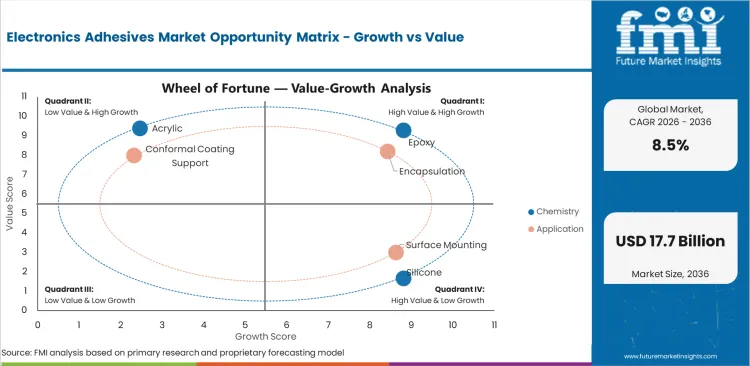
The electronics adhesives market is expected to expand from USD 7.2 billion in 2026 to USD 16.3 billion by 2036. The market is anticipated to register an 8.5% CAGR during the forecast period. Epoxy is likely to lead with 36.0% share due to bonding strength and thermal stability. Encapsulation applications are projected to account for 41.2% share because components need protection from moisture and stress.
Summary of the Electronics Adhesives Market
- Demand and Expansion Drivers
- Device miniaturization increases adhesive demand as assemblies need precise bonding and protection.
- Electric vehicle electronics support adoption through sensors and battery management systems.
- Semiconductor packaging growth raises need for thermal and protective adhesive materials.
- Automated dispensing systems improve adhesive use across high-volume electronics assembly lines.
- Product and Segment View
- Epoxy adhesives are expected to lead because they offer strong bonding and chemical resistance.
- Silicone adhesives gain use where electronics need flexibility and thermal cycling resistance.
- Encapsulation remains the leading application as components require protection from moisture and vibration.
- Automotive electronics creates growth as vehicles include more sensors and control modules.
- Geography and Competitive Outlook
- India is expected to expand as electronics manufacturing and EV component assembly increase.
- China remains important because large electronics production supports adhesive demand.
- Germany is likely to grow steadily as automotive electronics and industrial systems require advanced bonding.
- Companies with thermal management and automated dispensing support are expected to gain advantage.
- Analyst Opinion
- Nikhil Kaitwade, Principal Consultant at FMI states: “Electronics adhesives demand is being shaped by miniaturization and semiconductor packaging needs. Epoxy remains central because it offers bonding strength and thermal stability. Encapsulation applications lead as component protection becomes more important. Manufacturers need adhesive systems that fit automated production lines. Suppliers with application support and thermal management capability will hold stronger positions.”
- Electronics Adhesives Market Value Analysis
- Epoxy adhesives create value because they meet bonding and stability needs in electronic assemblies.
- Encapsulation supports higher-value demand because components need protection across harsh use conditions.
- Automotive electronics expands revenue as vehicles use more control modules and sensor systems.
- Automated dispensing compatibility improves adoption in high-volume electronics production.
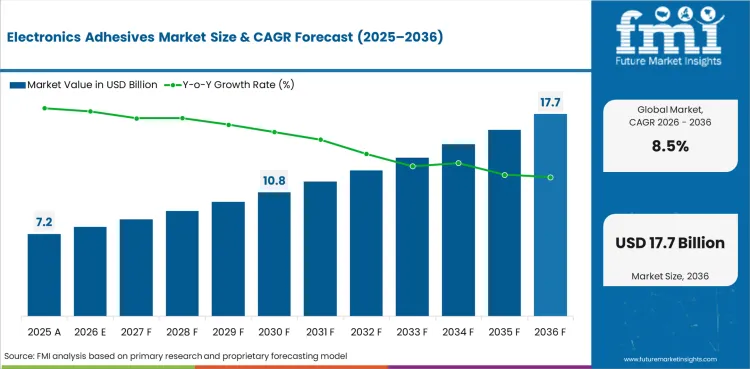
Key Takeaways, Market Size, and Forecast
| Metric | Value |
|---|---|
| Market Size (2026) | USD 7.2 Billion |
| Market Size (2036) | USD 16.3 Billion |
| CAGR (2026–2036) | 8.5% |
| Leading Chemistry (2026) | Epoxy |
| Epoxy Share (2026) | 36.0% |
| Leading Application (2026) | Encapsulation Applications |
| Encapsulation Applications Share (2026) | 41.2% |
| Highlight | Electronics adhesive adoption in India is likely to advance strongly through 2036 |
Electronics Adhesives Market Definition
The electronics adhesives market includes formulated adhesive systems used in the assembly, bonding and protection, along with thermal management of electronic components and devices. It covers conductive, non-conductive and thermally conductive, along with specialty adhesive materials used across semiconductor packaging, printed circuit boards, displays, sensors and automotive electronics, along with related electronics manufacturing applications.
Electronics Adhesives Market Inclusions
Market scope covers commercially traded electronics adhesives segmented by chemistry, application, formulation type, end-use industry, curing method and sales channel, along with region for the period 2026 to 2036. The study includes materials supplied to OEMs, EMS providers and semiconductor-packaging operations, along with industrial electronics manufacturers.
Electronics Adhesives Market Exclusions
The scope does not include bulk industrial adhesives with no defined electronics application, unrelated sealants sold outside electronics assembly contexts, or standalone thermal interface hardware that is not adhesive-based.
Market Research Methodology
- Primary Research: Review of demand behavior across electronics OEMs, semiconductor packaging suppliers, EMS providers and adhesive formulators, along with material distributors in major markets.
- Desk Research: Assessment of public information on semiconductor capacity expansion, electronics assembly trends and EV electronics growth, along with supplier product developments.
- Market sizing and forecasting: Revenue modeling based on chemistry mix, application demand, formulation complexity and regional electronics output, along with advanced-packaging trends.
- Data validation: Cross-checking against supplier positioning, visibleelectronics manufacturing expansion and semiconductor materials activity, along with application-specific demand patterns.
Why is the Electronics Adhesives Market Growing?
- Device miniaturization continues to increase the need for reliable bonding and protective materials in tighter assemblies.
- Semiconductor packaging and automotive electronics are creating more demand for thermally and electrically specialized formulations.
- Adhesives are gaining a larger role in automated electronicsmanufacturing where precision and repeatability, along with throughput matter.
The market is growing as electronics adhesives are becoming more integrated into device performance rather than serving only a joining function. Modern assemblies require materials that can support heat dissipation, environmental protection and package integrity, along with increasingly fine manufacturing tolerances. That expands the role of advanced adhesive systems across multiple electronics categories.
Semiconductors and advanced packaging remain a major support point. Encapsulation, die attach and underfill, along with thermally managed bonding solutions are critical as chip architectures become more compact and performance-intensive. Automotive electronics adds further momentum through sensors, power modules and control units, along with battery-adjacent electronics.
Consumer devices and industrial electronics also contribute meaningful demand. Displays, wearables, smartphones and telecom equipment, along with connected industrial systems all require adhesives that combine process reliability with application-specific electrical and thermal properties. As automated dispensing and curing systems improve, adhesives become easier to integrate at scale.
The market still faces constraints. Qualification cycles and material compatibility requirements, along with pressure on manufacturing costs can slow conversion to newer formulations. Even so, electronics adhesives retain enoughstructural demand from semiconductor and automotive, along with consumer electronics production to support strong growth through 2036.
Market Segmentation Analysis
- Epoxy remains the leading chemistry segment due to its strong balance of bonding, thermal stability, and chemical resistance.
- Encapsulation remains the largest application in 2026, supported by protective material demand in semiconductor and electronics assemblies.
- Thermally conductive and specialty formulations continue to gain visibility as thermal control becomes more commercially important.
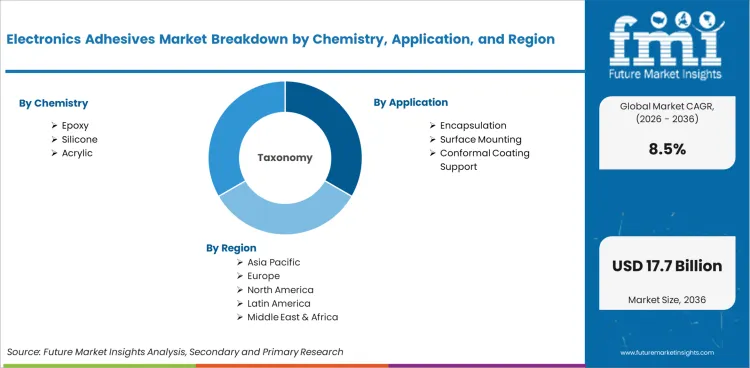
The electronics adhesives market is segmented by chemistry, application, formulation type, end-use industry, curing method and sales channel, along with region. This structure reflects how value is created in practice, from materials design and assembly integration to long-term reliability in end devices.
Insights into the Epoxy Segment
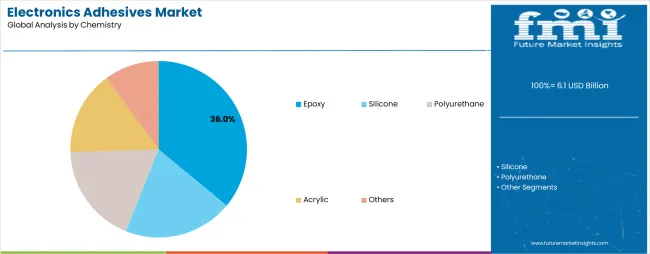
Epoxy remains the leading chemistry in the electronics adhesives market. Its strength comes from reliable bonding performance, chemical resistance and thermal stability, along with broad acceptance across multiple electronics manufacturing processes.
This segment also benefits from process familiarity. Manufacturers already understand how epoxy systems behave within dispensing, curing and encapsulation, along with package-protection workflows, which keeps the chemistry central to high-volume production.
Insights into the Encapsulation Segment
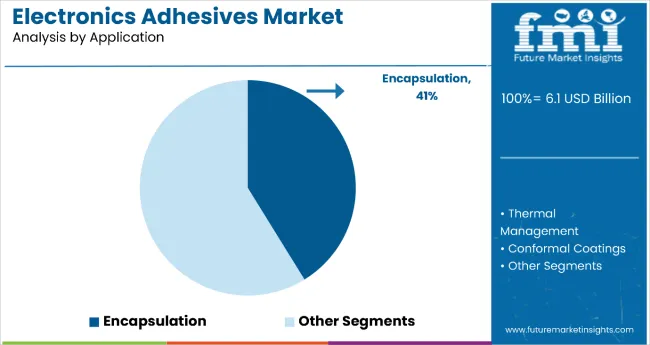
Encapsulation remains the leading application segment in the market. The category benefits from recurring demand for protective materials that shield sensitive components from moisture, contamination and mechanical stress, along with environmental variability.
The segment remains strategically important as electronics producers continue to prioritize package reliability and performance stability. Once a material system is qualified for assembly, it often enters repeat use across long production runs.
Insights into the Thermally Conductive Adhesives Segment
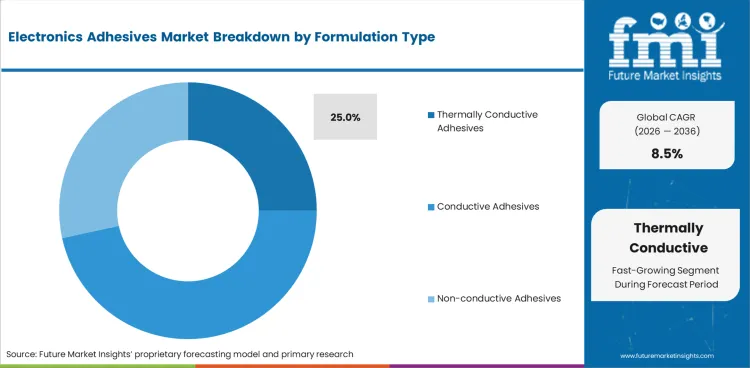
Thermally conductive adhesives remain one of the most strategically important formulation categories in the market. Their relevance is growing as electronicsassemblies face higher power densities and more compact layouts, along with tighter temperature-management requirements.
This segment is becoming more commercially significant in EV electronics, power modules and telecom hardware, along with higher-performance consumer devices where thermal control directly affects reliability and device life.
Electronics Adhesives Market Drivers and Restraints, along with Opportunities
- Semiconductor growth and EV electronics, along with device miniaturization remain the main demand drivers.
- Qualification complexity and cost sensitivity continue to restrain faster product adoption in some applications.
- The strongest opportunitiesare opening in advanced packaging and thermal-interface solutions, along with electronics manufacturing in Asia.
The market continues to evolve as electronics manufacturing shifts toward higher complexity and tighter thermal management. Adhesive suppliers are no longer competing only on general performance metrics. They are competing on how welltheir materials fit automated assembly and advanced packaging, along with reliability-critical environments.
Electronics Miniaturization Supports Growth
Smaller and denser, along with more functional electronic systems continue to increase the importance of precision adhesive materials across multiple device architectures.
Qualification and Cost Constraints Create Friction
The largest restraintscome from lengthy validation cycles and compatibility testing, along with the pressure to control total assembly cost in high-volume electronics manufacturing.
Upside in Advanced Packaging and Thermal Solutions
The strongest upside lies in adhesives tailored for semiconductor packaging, thermal management and die attach, along with high-reliability electronics systems where material performance carries strategic value.
Regional Market Analysis
.webp "Top Country Growth Comparison Electronics Adhesives Market Cagr (2026 2036)")
- India is projected to grow at 9.4% CAGR from 2026 to 2036, making it the fastest-growing major country market in the study.
- China is expected to expand at 9.1% CAGR, while the United States and Germany are forecast to grow at 8.0% and 7.8%, respectively.
The electronics adhesives market remains global in reach but regionally concentrated around electronics manufacturing and semiconductor investment. Asia Pacific continues to drive the strongest growth, while North America and Europe remain important for advanced materials and higher-value applications.
How Is India Strengthening Demand for Electronics Adhesives?
India remains one of the fastest-growing markets in the study. Demand is supportedby expanding electronics manufacturing and semiconductor policy focus, along with rising assembly activity across consumer and industrial categories.
- Electronics manufacturing expansion is widening the local customer base for adhesives.
- Government-backed semiconductor and electronics initiatives are improving market depth.
- Assembly growth is creating more recurring demand for process materials.
How Is China’s Electronics Adhesives Market Expanding?
China remains one of the largest and most influential markets due to its scale in electronics production, component assembly, and broader manufacturing integration.
- Manufacturing depth supports large-volume adhesive consumption across multiple electronics segments.
- Semiconductor and device production keep demand broad and technically diverse.
- Scale manufacturing strengthens adoption of automated dispensing and curing materials.
What Is Driving Electronics Adhesive Demand in the USA?
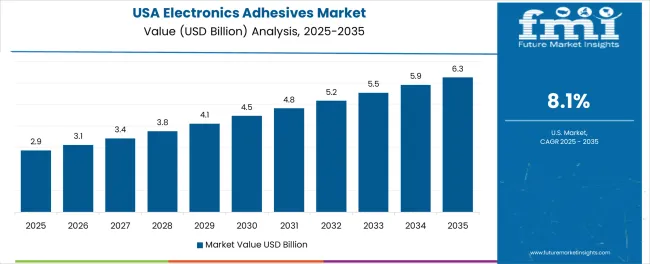
The United States remains a major value market through semiconductor packaging, high-reliability electronics and aerospace-adjacent assemblies, along with advanced materials development.
- Advanced packaging and semiconductor work support higher-value adhesive demand.
- Reliability-intensive electronics keep specialty formulations commercially relevant.
- Materials innovation remains a competitive differentiator in the market.
Why Does Germany Remain Important in Electronics Adhesives?
Germany remains influentialdue to automotive electronics and industrial automation, along with precision manufacturing. Buyers place more weight on quality consistency, thermal performance, and process compatibility.
- Automotive electronics remain a strong demand pillar.
- Industrial electronics add further depth to the application base.
- Technical performance and process discipline support premium formulations.
Competitive Landscape and Strategic Positioning
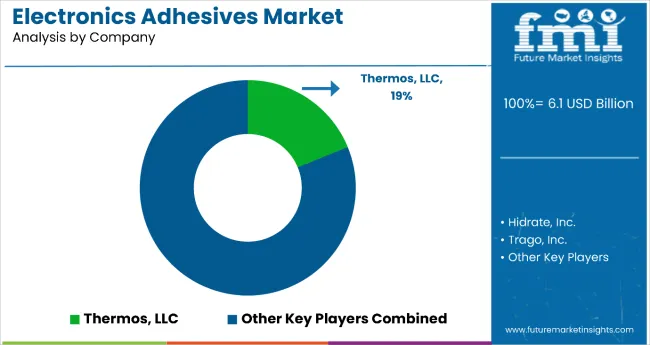
- The market is led by global adhesive and specialty-material suppliers with strong electronics formulation capability.
- Competitive advantage depends on formulation performance, semiconductor and electronics customer access, and process-integration support.
- Leading companiesare investing in advanced packaging and thermal management, along with regional manufacturing expansion.
The competitive landscape remains technically driven. Large materials companies hold an advantagewhere customers need global supply and formulation depth, along with process engineering support. Electronics manufacturers do not switch adhesive systems lightly, so qualification history and application support remain significant barriers to entry.
Another important theme is regional footprint expansion. Suppliers that add manufacturing and application support in Asia and electronics growth corridors are better positioned to capture demand as supply chains diversify.
Claims discipline matters more than before. Buyerswant evidence on thermal performance and process stability, along with semiconductor compatibility rather than broad innovation language. Companies with visible electronics customer wins and application-center investments remain better placed to win long-term business.
Key Companies in the Electronics Adhesives Market
Key companies active in the market include Henkel AG, 3M, H.B. Fuller and Sika AG, along with Dow.
Competitive Benchmarking: Electronics Adhesives Market
| Company | Core Strength | Primary Electronics Exposure | Strategic Positioning | Geographic Footprint |
|---|---|---|---|---|
| Henkel AG | Broad electronics materials platform | Semiconductor packaging, die attach, electronics assembly | Advanced packaging and electronics depth | Global |
| 3M | Materials science breadth | Semiconductor processing, electronics assembly, advanced packaging | Process integration and platform breadth | Global |
| H.B. Fuller | Formulation and application support | Electronics and industrial assembly | Regional capability expansion | Global |
| Sika AG | Specialty adhesive engineering | Industrial and electronic bonding applications | Performance-led materials positioning | Global |
| Dow | Silicone and thermal materials capability | Thermal management, electronics assembly, advanced materials | Thermal-interface and specialty-material focus | Global |
Key Developments in Electronics Adhesives Market
- Henkel announced in February 2025 that it was strengthening its electronics footprint in India with a new electronics application center in Chennai and an adhesive materials manufacturing plant for the electronics sector.
- Henkel also received ASE’s 2024 Best Supplier Award in May 2025 for semiconductor packaging materials and sustainability collaboration, reinforcing its position in advanced electronics materials.
- 3M joined the US-JOINT Consortium in February 2025 to support next-generation semiconductor advanced packaging and back-end processing technologies.
- Dow highlighted its 2024 partnership with Carbice on advanced thermal interface materials for electronics, supporting thermal management across semiconductors and industrial electronics, along with consumer devices.
Key Players in the Electronics Adhesives Market
Major Global Players
- Henkel AG
- 3M
- H.B. Fuller
- Sika AG
- Dow
Emerging and Regional Specialists
- Specialtyconductive-adhesive formulators and semiconductor-material suppliers, along with regional electronics-chemicals companies continue to widen the competitive field, especially in applications where local technical support and niche performance matter more than general-purpose adhesive scale.
Report Scope and Coverage
| Attribute | Details |
|---|---|
| Estimated market size (2026) | USD 7.2 billion |
| Projected market size (2036) | USD 16.3 billion |
| CAGR (2026 to 2036) | 8.5% |
| Historical period | 2021 to 2025 |
| Forecast period | 2026 to 2036 |
| Quantitative units | USD billion |
| Key segment coverage | Chemistry, Application, Formulation Type, End-use Industry, Curing Method, Sales Channel, Region |
| Regions covered | Asia Pacific, North America, Europe, Latin America, Middle East and Africa |
Segment Analysis by Chemistry, Application, Formulation Type, End-use Industry, Curing Method and Sales Channel, along with Region
By Chemistry:
- Epoxy
- Silicone
- Acrylic
- Polyurethane
- UV-curable and Specialty Adhesives
By Application:
- Encapsulation
- Surface Mounting
- Conformal Coating Support
- Thermal Management Bonding
- Wire Tacking and Component Assembly
- Display and Sensor Bonding
By Formulation Type:
- Conductive Adhesives
- Non-conductive Adhesives
- Thermally Conductive Adhesives
- Optically Clear Adhesives
By End-use Industry:
- Consumer Electronics
- Semiconductors and Packaging
- Automotive Electronics
- Telecommunications
- Industrial Electronics
- Medical Electronics
By Curing Method:
- Heat Cure
- UV Cure
- Moisture Cure
- Dual Cure
By Sales Channel:
- Direct OEM Supply
- Electronics Manufacturing Service Providers
- Industrial Distributors
- Contract Formulators
By Region:
- Asia Pacific
- North America
- Europe
- Latin America
- Middle East and Africa
This Report Answers
- What is the current and future size of the electronics adhesives market?
- How fast is the electronics adhesives market expected to grow between 2026 and 2036?
- Which segment is likely to lead the electronics adhesives market by 2026?
- Which end-use and application patterns are shaping demand in the electronics adhesives market?
- What factors are driving demand for the electronics adhesives market globally?
- Which countries are emerging as key growth markets in the electronics adhesives market?
- Which companies are active in the electronics adhesives market?
- How does FMI estimate and validate the electronics adhesives market forecast?
Frequently Asked Questions
How big is the electronics adhesives market in 2026?
The global electronics adhesives market is estimated at USD 7.2 billion in 2026.
What will be the size of the electronics adhesives market in 2036?
The electronics adhesives market is projected to reach USD 16.3 billion by 2036.
How much will the electronics adhesives market grow between 2026 and 2036?
The electronics adhesives market is expected to grow at a 8.5% CAGR between 2026 and 2036.
Which segment is expected to contribute the largest share in the electronics adhesives market in 2026?
The report evaluates leading segment performance across the core market taxonomy used in the study.
What is driving demand in the electronics adhesives market?
Electronics Adhesives Market is gaining momentum as buyers place more weight on application fit, supply reliability, and performance consistency across end-use demand.
Preview the report firsthand - request a free sample
Get SampleGet the brochure for pricing and purchase details.
Get PDFTable of Content
- Executive Summary
- Global Market Outlook
- Demand-side Trends
- Supply-side Trends
- Technology Roadmap Analysis
- Analysis and Recommendations
- Market Overview
- Market Coverage / Taxonomy
- Market Definition / Scope / Limitations
- Research Methodology
- Chapter Orientation
- Analytical Lens and Working Hypotheses
- Market Structure, Signals, and Trend Drivers
- Benchmarking and Cross-market Comparability
- Market Sizing, Forecasting, and Opportunity Mapping
- Research Design and Evidence Framework
- Desk Research Programme (Secondary Evidence)
- Company Annual and Sustainability Reports
- Peer-reviewed Journals and Academic Literature
- Corporate Websites, Product Literature, and Technical Notes
- Earnings Decks and Investor Briefings
- Statutory Filings and Regulatory Disclosures
- Technical White Papers and Standards Notes
- Trade Journals, Industry Magazines, and Analyst Briefs
- Conference Proceedings, Webinars, and Seminar Materials
- Government Statistics Portals and Public Data Releases
- Press Releases and Reputable Media Coverage
- Specialist Newsletters and Curated Briefings
- Sector Databases and Reference Repositories
- FMI Internal Proprietary Databases and Historical Market Datasets
- Subscription Datasets and Paid Sources
- Social Channels, Communities, and Digital Listening Inputs
- Additional Desk Sources
- Expert Input and Fieldwork (Primary Evidence)
- Primary Modes
- Qualitative Interviews and Expert Elicitation
- Quantitative Surveys and Structured Data Capture
- Blended Approach
- Why Primary Evidence is Used
- Field Techniques
- Interviews
- Surveys
- Focus Groups
- Observational and In-context Research
- Social and Community Interactions
- Stakeholder Universe Engaged
- C-suite Leaders
- Board Members
- Presidents and Vice Presidents
- R&D and Innovation Heads
- Technical Specialists
- Domain Subject-matter Experts
- Scientists
- Physicians and Other Healthcare Professionals
- Governance, Ethics, and Data Stewardship
- Research Ethics
- Data Integrity and Handling
- Primary Modes
- Tooling, Models, and Reference Databases
- Desk Research Programme (Secondary Evidence)
- Data Engineering and Model Build
- Data Acquisition and Ingestion
- Cleaning, Normalisation, and Verification
- Synthesis, Triangulation, and Analysis
- Quality Assurance and Audit Trail
- Market Background
- Market Dynamics
- Drivers
- Restraints
- Opportunity
- Trends
- Scenario Forecast
- Demand in Optimistic Scenario
- Demand in Likely Scenario
- Demand in Conservative Scenario
- Opportunity Map Analysis
- Product Life Cycle Analysis
- Supply Chain Analysis
- Investment Feasibility Matrix
- Value Chain Analysis
- PESTLE and Porter’s Analysis
- Regulatory Landscape
- Regional Parent Market Outlook
- Production and Consumption Statistics
- Import and Export Statistics
- Market Dynamics
- Global Market Analysis 2021 to 2025 and Forecast, 2026 to 2036
- Historical Market Size Value (USD Million) Analysis, 2021 to 2025
- Current and Future Market Size Value (USD Million) Projections, 2026 to 2036
- Y-o-Y Growth Trend Analysis
- Absolute $ Opportunity Analysis
- Global Market Pricing Analysis 2021 to 2025 and Forecast 2026 to 2036
- Global Market Analysis 2021 to 2025 and Forecast 2026 to 2036, By Chemistry
- Introduction / Key Findings
- Historical Market Size Value (USD Million) Analysis By Chemistry , 2021 to 2025
- Current and Future Market Size Value (USD Million) Analysis and Forecast By Chemistry , 2026 to 2036
- Epoxy
- Silicone
- Acrylic
- Epoxy
- Y-o-Y Growth Trend Analysis By Chemistry , 2021 to 2025
- Absolute $ Opportunity Analysis By Chemistry , 2026 to 2036
- Global Market Analysis 2021 to 2025 and Forecast 2026 to 2036, By Application
- Introduction / Key Findings
- Historical Market Size Value (USD Million) Analysis By Application, 2021 to 2025
- Current and Future Market Size Value (USD Million) Analysis and Forecast By Application, 2026 to 2036
- Encapsulation
- Surface Mounting
- Conformal Coating Support
- Encapsulation
- Y-o-Y Growth Trend Analysis By Application, 2021 to 2025
- Absolute $ Opportunity Analysis By Application, 2026 to 2036
- Global Market Analysis 2021 to 2025 and Forecast 2026 to 2036, By Formulation Type
- Introduction / Key Findings
- Historical Market Size Value (USD Million) Analysis By Formulation Type, 2021 to 2025
- Current and Future Market Size Value (USD Million) Analysis and Forecast By Formulation Type, 2026 to 2036
- Thermally Conductive Adhesives
- Conductive Adhesives
- Non-conductive Adhesives
- Thermally Conductive Adhesives
- Y-o-Y Growth Trend Analysis By Formulation Type, 2021 to 2025
- Absolute $ Opportunity Analysis By Formulation Type, 2026 to 2036
- Global Market Analysis 2021 to 2025 and Forecast 2026 to 2036, By Region
- Introduction
- Historical Market Size Value (USD Million) Analysis By Region, 2021 to 2025
- Current Market Size Value (USD Million) Analysis and Forecast By Region, 2026 to 2036
- North America
- Latin America
- Western Europe
- Eastern Europe
- East Asia
- South Asia and Pacific
- Middle East & Africa
- Market Attractiveness Analysis By Region
- North America Market Analysis 2021 to 2025 and Forecast 2026 to 2036, By Country
- Historical Market Size Value (USD Million) Trend Analysis By Market Taxonomy, 2021 to 2025
- Market Size Value (USD Million) Forecast By Market Taxonomy, 2026 to 2036
- By Country
- USA
- Canada
- Mexico
- By Chemistry
- By Application
- By Formulation Type
- By Country
- Market Attractiveness Analysis
- By Country
- By Chemistry
- By Application
- By Formulation Type
- Key Takeaways
- Latin America Market Analysis 2021 to 2025 and Forecast 2026 to 2036, By Country
- Historical Market Size Value (USD Million) Trend Analysis By Market Taxonomy, 2021 to 2025
- Market Size Value (USD Million) Forecast By Market Taxonomy, 2026 to 2036
- By Country
- Brazil
- Chile
- Rest of Latin America
- By Chemistry
- By Application
- By Formulation Type
- By Country
- Market Attractiveness Analysis
- By Country
- By Chemistry
- By Application
- By Formulation Type
- Key Takeaways
- Western Europe Market Analysis 2021 to 2025 and Forecast 2026 to 2036, By Country
- Historical Market Size Value (USD Million) Trend Analysis By Market Taxonomy, 2021 to 2025
- Market Size Value (USD Million) Forecast By Market Taxonomy, 2026 to 2036
- By Country
- Germany
- UK
- Italy
- Spain
- France
- Nordic
- BENELUX
- Rest of Western Europe
- By Chemistry
- By Application
- By Formulation Type
- By Country
- Market Attractiveness Analysis
- By Country
- By Chemistry
- By Application
- By Formulation Type
- Key Takeaways
- Eastern Europe Market Analysis 2021 to 2025 and Forecast 2026 to 2036, By Country
- Historical Market Size Value (USD Million) Trend Analysis By Market Taxonomy, 2021 to 2025
- Market Size Value (USD Million) Forecast By Market Taxonomy, 2026 to 2036
- By Country
- Russia
- Poland
- Hungary
- Balkan & Baltic
- Rest of Eastern Europe
- By Chemistry
- By Application
- By Formulation Type
- By Country
- Market Attractiveness Analysis
- By Country
- By Chemistry
- By Application
- By Formulation Type
- Key Takeaways
- East Asia Market Analysis 2021 to 2025 and Forecast 2026 to 2036, By Country
- Historical Market Size Value (USD Million) Trend Analysis By Market Taxonomy, 2021 to 2025
- Market Size Value (USD Million) Forecast By Market Taxonomy, 2026 to 2036
- By Country
- China
- Japan
- South Korea
- By Chemistry
- By Application
- By Formulation Type
- By Country
- Market Attractiveness Analysis
- By Country
- By Chemistry
- By Application
- By Formulation Type
- Key Takeaways
- South Asia and Pacific Market Analysis 2021 to 2025 and Forecast 2026 to 2036, By Country
- Historical Market Size Value (USD Million) Trend Analysis By Market Taxonomy, 2021 to 2025
- Market Size Value (USD Million) Forecast By Market Taxonomy, 2026 to 2036
- By Country
- India
- ASEAN
- Australia & New Zealand
- Rest of South Asia and Pacific
- By Chemistry
- By Application
- By Formulation Type
- By Country
- Market Attractiveness Analysis
- By Country
- By Chemistry
- By Application
- By Formulation Type
- Key Takeaways
- Middle East & Africa Market Analysis 2021 to 2025 and Forecast 2026 to 2036, By Country
- Historical Market Size Value (USD Million) Trend Analysis By Market Taxonomy, 2021 to 2025
- Market Size Value (USD Million) Forecast By Market Taxonomy, 2026 to 2036
- By Country
- Kingdom of Saudi Arabia
- Other GCC Countries
- Turkiye
- South Africa
- Other African Union
- Rest of Middle East & Africa
- By Chemistry
- By Application
- By Formulation Type
- By Country
- Market Attractiveness Analysis
- By Country
- By Chemistry
- By Application
- By Formulation Type
- Key Takeaways
- Key Countries Market Analysis
- USA
- Pricing Analysis
- Market Share Analysis, 2025
- By Chemistry
- By Application
- By Formulation Type
- Canada
- Pricing Analysis
- Market Share Analysis, 2025
- By Chemistry
- By Application
- By Formulation Type
- Mexico
- Pricing Analysis
- Market Share Analysis, 2025
- By Chemistry
- By Application
- By Formulation Type
- Brazil
- Pricing Analysis
- Market Share Analysis, 2025
- By Chemistry
- By Application
- By Formulation Type
- Chile
- Pricing Analysis
- Market Share Analysis, 2025
- By Chemistry
- By Application
- By Formulation Type
- Germany
- Pricing Analysis
- Market Share Analysis, 2025
- By Chemistry
- By Application
- By Formulation Type
- UK
- Pricing Analysis
- Market Share Analysis, 2025
- By Chemistry
- By Application
- By Formulation Type
- Italy
- Pricing Analysis
- Market Share Analysis, 2025
- By Chemistry
- By Application
- By Formulation Type
- Spain
- Pricing Analysis
- Market Share Analysis, 2025
- By Chemistry
- By Application
- By Formulation Type
- France
- Pricing Analysis
- Market Share Analysis, 2025
- By Chemistry
- By Application
- By Formulation Type
- India
- Pricing Analysis
- Market Share Analysis, 2025
- By Chemistry
- By Application
- By Formulation Type
- ASEAN
- Pricing Analysis
- Market Share Analysis, 2025
- By Chemistry
- By Application
- By Formulation Type
- Australia & New Zealand
- Pricing Analysis
- Market Share Analysis, 2025
- By Chemistry
- By Application
- By Formulation Type
- China
- Pricing Analysis
- Market Share Analysis, 2025
- By Chemistry
- By Application
- By Formulation Type
- Japan
- Pricing Analysis
- Market Share Analysis, 2025
- By Chemistry
- By Application
- By Formulation Type
- South Korea
- Pricing Analysis
- Market Share Analysis, 2025
- By Chemistry
- By Application
- By Formulation Type
- Russia
- Pricing Analysis
- Market Share Analysis, 2025
- By Chemistry
- By Application
- By Formulation Type
- Poland
- Pricing Analysis
- Market Share Analysis, 2025
- By Chemistry
- By Application
- By Formulation Type
- Hungary
- Pricing Analysis
- Market Share Analysis, 2025
- By Chemistry
- By Application
- By Formulation Type
- Kingdom of Saudi Arabia
- Pricing Analysis
- Market Share Analysis, 2025
- By Chemistry
- By Application
- By Formulation Type
- Turkiye
- Pricing Analysis
- Market Share Analysis, 2025
- By Chemistry
- By Application
- By Formulation Type
- South Africa
- Pricing Analysis
- Market Share Analysis, 2025
- By Chemistry
- By Application
- By Formulation Type
- USA
- Market Structure Analysis
- Competition Dashboard
- Competition Benchmarking
- Market Share Analysis of Top Players
- By Regional
- By Chemistry
- By Application
- By Formulation Type
- Competition Analysis
- Competition Deep Dive
- Henkel AG
- Overview
- Product Portfolio
- Profitability by Market Segments (Product/Age /Sales Channel/Region)
- Sales Footprint
- Strategy Overview
- Marketing Strategy
- Product Strategy
- Channel Strategy
- 3M
- H.B. Fuller
- Sika AG
- Dow
- Henkel AG
- Competition Deep Dive
- Assumptions & Acronyms Used


