

- Industry Size (2026)
- USD 48.7 Bn
- Forecast (2036)
- USD 74.8 Bn
- CAGR (2026 to 2036)
- 4.4%
Fish Meal Market Size, Market Forecast and Outlook By FMI
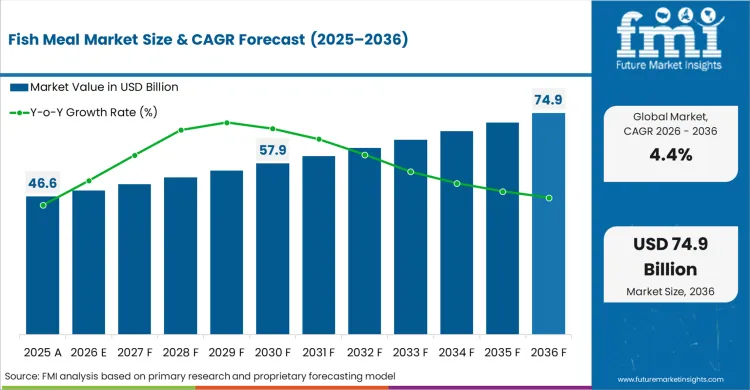
The fish meal market is expected to expand from USD 48.7 billion in 2026 to USD 74.8 billion by 2036. The market is anticipated to register a 4.4% CAGR during the forecast period. Wild-caught fish meal is likely to lead source demand with a 40.0% share, while aquaculture is projected to account for 50.0% of application share in 2026.
Fish meal demand is projected to increase from USD 46.6 billion in 2025 to USD 48.7 billion in 2026. The sharp fall in global fishmeal production during the first quarter of 2026 tightens a market that is already sensitive to quota cycles and anchovy availability. Peru’s role in marine ingredient supply makes any reduction in anchovy catch commercially important for aquafeed and pet nutrition buyers. A 28% decline in first-quarter fishmeal output can lift procurement risk because feed producers need predictable protein quality and amino acid density.
The immediate effect is likely to be stronger price pressure on high-grade meals and more selective use in formulations. Aquafeed producers may reserve fish meal for growth stages where digestibility and survival rates matter most. Lower-value feed segments may turn to soy protein concentrate or poultry by-product meal where performance allows. This substitution will not remove fish meal’s strategic role because many premium aquaculture diets still depend on marine protein for palatability and feed efficiency. The second-order impact is supplier qualification.
Buyers will place more value on producers with quota access, certified sourcing, and steady logistics. Inventory strategy may also change as mills hold more safety stock or diversify origins. For the fish meal market, this development reinforces a clear pattern. Value growth will be shaped by scarcity management, not simple tonnage expansion. Producers that can prove traceability and grade consistency should be better positioned in contract negotiations.
Summary of the Fish Meal Market
- Demand and Growth Drivers
- Aquaculture growth is increasing the need for digestible marine protein.
- Limited wild-catch supply is keeping value growth stronger than volume growth.
- Premium feed producers prefer certified sources for export-linked aquaculture.
- Pet food manufacturers are using marine ingredients for high-value nutrition claims.
- Product and Segment View
- Wild-caught fish meal remains important due to strong amino acid quality.
- Othres meal is gaining attention as processors improve trimming recovery.
- Aquaculture leads demand as shrimp and finfish farming expand.
- Feed formulators use fish meal more selectively due to price pressure.
- Geography and Competitive Outlook
- Asia Pacific leads consumption through large-scale aquaculture production.
- Latin America remains central to exports through Peru and Chile.
- Europe favors certified inputs for salmon feed and premium formulations.
- Leading suppliers are securing quota access and processing capacity.
- Analyst Opinion
- Nandini Roy Choudhury at Future Market Insights opines, “Fish meal demand is entering a more disciplined supply phase. Aquaculture producers still need marine protein, but buyers now judge suppliers on traceability, quota security, and grade consistency. Producers with certified sourcing and by-product recovery systems will be better placed to protect margins.”
- Fish Meal Market Value Analysis
- The fish meal market is moving from bulk protein supply toward value-based marine nutrition.
- Demand is likely to rise as aquaculture producers prioritize survival rates and feed efficiency.
- Adoption may gain strength from certified sourcing and stronger traceability systems.
- Spending outlook remains linked to catch limits, export demand, and premium feed formulation.
Key Takeaways, Market Size, and Forecast
- The fish meal market was valued at USD 46.6 billion in 2025.
- The market is anticipated to be valued at USD 48.7 billion in 2026.
- By 2036, the fish meal market is forecast to reach USD 74.8 billion.
- Demand is likely to expand at a 4.4% CAGR during 2026 to 2036.
- Wild-caught fish meal is set to lead source demand with 40.0% share in 2026.
- Aquaculture is projected to account for 50.0% of application demand in 2026.
- China records the strongest country-level growth at 6.3% CAGR through 2036.
Fish Meal Market Definition
Fish meal is a commercial product made from fish and fish bones/offal that are processed by cooking, pressing, drying, and grinding the raw material into a solid or powder form. It serves as a high-protein, nutrient-rich feed ingredient primarily used in aquaculture and animal husbandry due to its digestible amino acid profile. The industry distinguishes between meals derived from whole wild-caught pelagic fish and those produced from trimmings or others of seafood processing.
Fish Meal Market Inclusions
The report includes fish meal derived from various species such as anchovy, menhaden, herring, and sardines, as well as meals produced from crustaceans or mixed marine raw materials. It covers all major grades, including standard, prime, and super-prime, utilized across aquaculture, swine, poultry, and pet food sectors. Analysis extends to the trade of both brown fish meal and white fish meal, tracking volumes destined for direct consumption or blending in fish feed mills.
Fish Meal Market Exclusions
The scope excludes raw fish oil sold separately from the meal production process, although both are often co-products. Direct human consumption of fish, fresh or frozen seafood trade, and plant-based fish feed concentrates used as substitutes are not part of the market sizing. Synthetic amino acid supplements and non-marine protein meals are also omitted unless they are part of a specific comparative analysis.
Fish Meal Market Research Methodology
- Primary Research: Interviews with feed formulators, marine ingredient associations, processing plant managers, and trade distributors to verify pricing and utilization trends.
- Desk Research: Analysis of catch quotas, export-import ledgers from bodies like FAO GLOBEFISH, and corporate filings from major integrators like Cooke and BioMar.
- Market-Sizing and Forecasting: A bottom-up approach aggregating feed production volumes by species and region, cross-referenced with biological feed conversion ratios.
- Data Validation and Update Cycle: Peer review of supply-demand balances against IFFO production benchmarks and OECD aquaculture outlooks.
Segmental Analysis
Fish Meal Market Analysis by Source
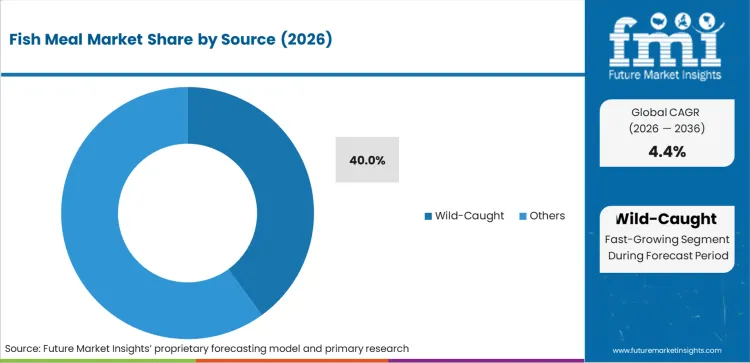
According to FMI's estimates, the wild-caught segment commands 40% of the market share as of 2026, driven by the superior nutritional profile of whole pelagic fish like anchoveta. Demand for this premium source is inelastic in early-stage aquaculture, where juvenile survival rates depend on high digestibility. However, ecological quotas and climate variability are forcing a gradual structural pivot toward marine by-products utilization.
- Sustainability trigger: Regulatory caps on wild capture encourage processors to monetize trimmings, which now contribute significantly to global volume without expanding fishing effort [3].
- Procurement shift: Feed mills are increasingly blending wild-caught and others meals to balance amino acid profiles while managing raw material costs during low-catch seasons [10].
- Traceability implication: Buyers prioritize sources with certifications like MarinTrust, compelling suppliers to implement rigorous tracking from vessel to plant to retain access to Western markets [10].
Fish Meal Market Analysis by Application
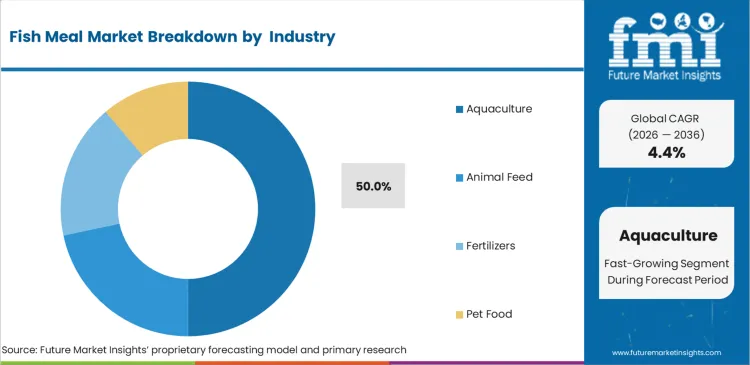
Aquaculture stands as the dominant application, accounting for 50% of consumption in 2026, a figure poised to climb as farming intensity increases globally. The sector's reliance on fish meal is evolving from a bulk protein source to a strategic inclusion for palatability and health. FMI analysts opine that this transition supports value-over-volume growth strategies for feed producers, even as the fish meal alternative landscape expands.
- Nutritional dependence: Use of fish meal in carnivorous finfish diets ensures optimal growth rates, with OECD projecting 84% of fish meal going to aquaculture by 2034 [3].
- Formulation adjustment: High prices drive nutritionists to reserve fish meal for critical growth stages, utilizing it as a strategic additive rather than a primary bulk ingredient [3].
- Feed conversion impact: Improvements in feed technology allow for lower inclusion rates without compromising harvest weights, sustaining demand even as alternative proteins enter the mix [3].
Fish Meal Market Drivers, Restraints, and Opportunities
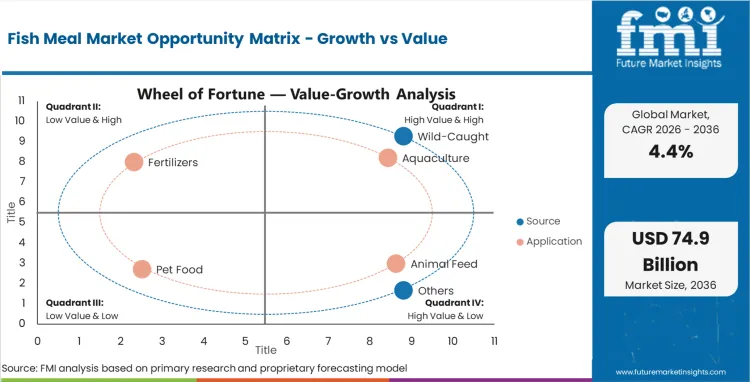
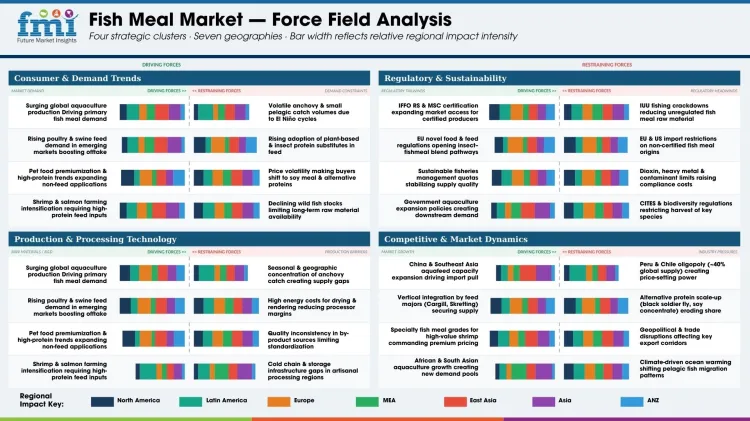
The primary driver for market expansion is the relentless growth of the global aquaculture sector, particularly in Asia. As wild fish stocks plateau, the farming of shrimp and carnivorous fish has become the only viable method to meet global seafood demand. This reliance creates a direct correlation between aquaculture output and fish meal consumption. For instance, China's imports of fish meal from Peru surged to 771,000 tonnes in the first nine months of 2024, reflecting the massive appetite of its farming industry [1]. Feed producers are responding by locking in supply, as seen with Exalmar's acquisition of Pesquera Centinela to secure processing capacity and vessel quotas in the key Peruvian fishing grounds [9].
However, the market is restrained by the inherent volatility of climatic events like El Niño, which can decimate anchovy biomass and trigger sharp price spikes. Such unpredictability forces feed manufacturers to seek alternative proteins, creating a ceiling on fish meal pricing during shortage years. The industry also faces scrutiny regarding overfishing, leading to stricter quotas that limit raw material availability. In the United States, industrial fishery production of fish meal was recorded at 501.5 million pounds in 2022, a figure heavily regulated to maintain stock sustainability [8]. These supply-side constraints compel the industry to innovate with zero fishmeal feed concepts or risk losing share to plant-based competitors.
- Functional Feed Development: Companies can capture premium margins by developing specialized feeds for juvenile stages, as evidenced by BioMar's capacity expansion in Ecuador to serve the high-value shrimp hatchery segment [5].
- Circular Economy Integration: There is significant potential in upgrading processing facilities to handle diverse by-products, aligning with trends where integrated players like Mowi optimize internal feed supply chains [6].
- Asian Market Penetration: Expanding distribution networks in India offers growth, as demonstrated by IFB Agro’s acquisition of Cargill’s local aquafeed business to tap into the country’s modernizing shrimp sector [7].
Regional Analysis
Based on the regional analysis, the Fish Meal market is segmented into North America, Latin America, Europe, East Asia, South Asia, Oceania and Middle East & Africa across 40+ countries. The full report also offers market attractiveness analysis based on regional trends.
.webp "Top Country Growth Comparison Fish Meal Market Cagr (2026 2036)")
| Country | CAGR (2026 to 2036) |
|---|---|
| China | 6.3% |
| Chile | 4.9% |
| India | 4.1% |
| Norway | 3.8% |
| United States | 3.2% |
| Japan | 2.5% |
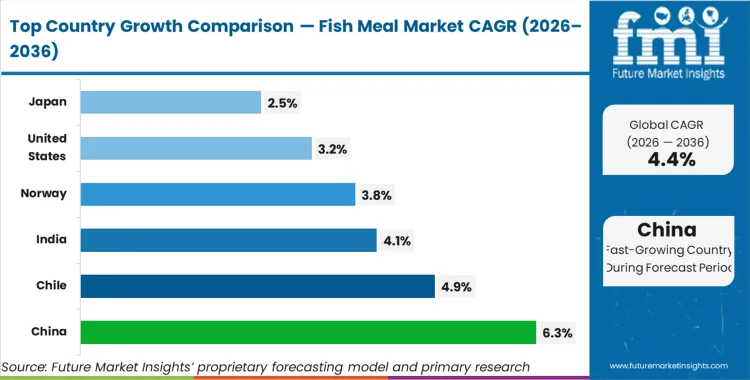
Source: Future Market Insights (FMI) analysis, based on proprietary forecasting model and primary research
Asia Pacific Fish Meal Market Analysis
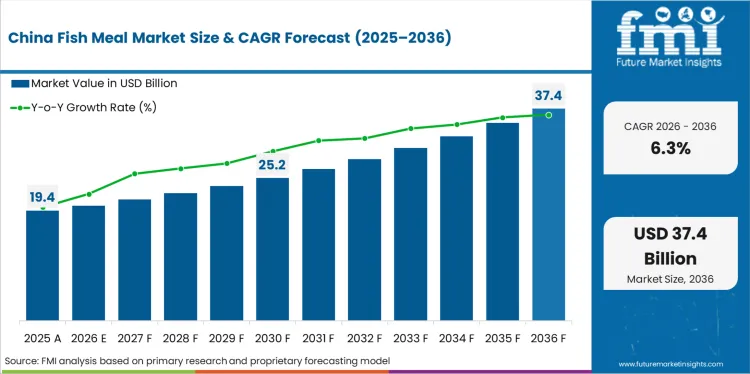
Asia Pacific remains the global engine of consumption, absorbing the vast majority of export volumes to fuel its expansive aquaculture industry. FMI analysts opine that the region's demand is shifting from quantity to quality as farming practices modernize and export standards tighten. In the first nine months of 2024, China alone accounted for 40% of global fish meal imports, underscoring its pivotal role in the trade balance [1]. Corporate activity mirrors this growth, with BioMar announcing a 50,000-tonne capacity expansion in Wuxi to serve the local market's increasing sophistication [5].
- China: Demand for fish meal in China is set to grow at 6.3% CAGR through 2036, supported by the massive scale of its fed aquaculture sector before procurement and budgeting cycles translate into higher deployment volumes. This hunger for resources is evident in the 771,000 tonnes imported from Peru in early 2024, a sharp rise from the previous year [1].
- India: Growth in fish meal across India is estimated at 4.1% CAGR through 2036, driven by the industrialization of shrimp farming that increases the value of reliability and compliance in buyer criteria. Strategic consolidation, such as IFB Agro acquiring Cargill India’s feed business, highlights the push to secure domestic supply lines [7].
- Japan: The outlook for fish meal in Japan indicates a 2.5% CAGR from 2026 to 2036 as mature farming practices prioritize efficiency, strengthening demand from both public programs and private operators. Buyers are focusing on high-specification feeds, aligning with global trends where aquaculture consumes the lion's share of marine ingredients [3].
FMI’s report includes a comprehensive assessment of the Asia Pacific region, detailing trends in Vietnam and Thailand. Vietnam and Indonesia are emerging as critical growth nodes, where expanding shrimp production is driving demand for high-protein starter feeds. These markets are increasingly adopting marine feed innovations to improve disease resistance and growth rates [3].
Latin America Fish Meal Market Analysis
Latin America serves as the world's primary production and export hub, with Peru and Chile dictating global pricing dynamics through their anchovy seasons. The region is characterizing a "compliance push," where producers upgrade facilities to meet international sustainability standards for export. Cooke Inc.'s recent acquisition of Copeinca consolidates this influence, merging significant vessel quotas with processing capabilities to ensure supply continuity [4].
- Chile: Chile is expected to record 4.9% CAGR in fish meal demand over 2026 to 2036 as the salmon industry expands, tightening the link between operational constraints and adoption-led investment. Exports remain robust, with 204,000 tonnes shipped in the first three quarters of 2024, primarily consisting of high-quality grades [1].
FMI’s report includes detailed analysis of Peru and Ecuador alongside Chile. Peru remains the undisputed volume leader, contributing nearly 20% of global output, while Ecuador is rapidly expanding its own feed capacities to support its shrimp export leadership [2]. Strategic investments in these countries focus on upgrading fleet efficiency and plant yields to maximize output from fixed quotas using advanced marine extract technologies [5].
North America Fish Meal Market Analysis
North America's market is defined by a balance of domestic production and specialized consumption in pet food and niche aquaculture. Regulatory oversight by bodies like NOAA ensures that production adheres to strict biological benchmarks. In 2022, USA production of fish meal reached 501.5 million pounds, catering to high-end nutritional applications where traceability is paramount [8].
- United States: The United States is poised to expand at 3.2% CAGR during 2026 to 2036 because the pet food and specialty aquaculture sectors require consistent high-protein inputs, which lifts utilization rates and justifies technology refresh decisions. This steady demand is supported by a stable domestic fishery and increasing imports of certified sustainable ingredients [8].
FMI’s report includes insights into Canada and Mexico as key trading partners within the region. Canada's growing aquaculture presence, particularly on the Atlantic coast, offers opportunities for premium feed suppliers. The focus in these opportunistic markets is shifting toward fish feed ingredients that offer lower carbon footprints and higher traceability [4].
Europe Fish Meal Market Analysis
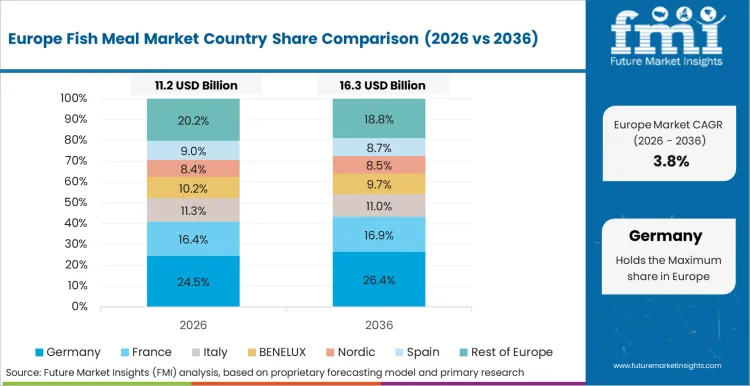
Europe operates as a high-value market where sustainability certifications are a prerequisite for market entry. The region's salmon farming giants drive innovation in feed formulations, reducing dependency on marine ingredients while maintaining nutritional quality. Mowi's strategic partnership with Skretting exemplifies this approach, integrating feed production with farming operations to optimize costs and sustainability metrics [6].
- Norway: Norway's fish meal landscape is forecast to expand at 3.8% CAGR through 2036, as the salmon sector demands premium, certified ingredients and market participants respond with scaled deployment plans. This growth is underpinned by a shift where certified marine ingredient use in feeds rose from 77% to 85% between 2023 and 2024 [10].
FMI’s report includes coverage of the United Kingdom and Iceland, which are vital players in the North Atlantic fishery. Denmark and Iceland continue to be significant producers of high-quality fish meal from herring and blue whiting. The trend in these markets is increasingly focused on fish hydrolysate and other advanced derivatives to extract maximum value from the catch [10].
Competitive Aligners for Market Players
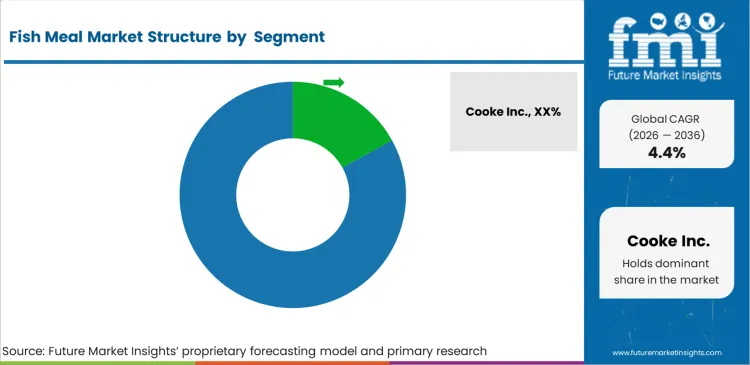
The competitive landscape is undergoing a wave of consolidation as major players seek to insulate themselves from raw material volatility through vertical integration. Cooke Inc.'s acquisition of Copeinca is a definitive move in this direction, combining one of the world's largest fishing fleets with extensive processing infrastructure to secure a stable internal supply of marine active ingredients [4]. This integration model allows companies to absorb price shocks and guarantee traceability, a key differentiator for premium buyers.
Feed manufacturers are increasingly aligning with sustainability mandates to protect their market share in Western economies. Skretting's reported increase in certified marine ingredient usage to 85% signals a competitive shift where provenance is as critical as protein content [10]. Suppliers who cannot provide verified chain-of-custody data risk exclusion from the supply chains of major retailers and aquaculture groups.
Innovation in by-product recovery is becoming a central competitive variable, enabling firms to expand volumes without relying on limited wild-catch quotas. Exalmar’s purchase of Pesquera Centinela not only expands its fleet but also its processing capacity, allowing for greater efficiency and yield maximization [9]. Companies that invest in advanced processing to create specialized, functional ingredients from trimmings are better positioned to capture higher margins than those selling generic commodities.
Recent Developments:
The report includes full coverage of key trends from competitive benchmarking. Some of the recent developments covered in the reports:
- In November 2024, Cooke Inc. entered a binding share purchase agreement to acquire Copeinca, significantly expanding its access to Peruvian anchovy quotas and processing assets.[4]
- In February 2026, BioMar acquired the remaining 30% of BioMar Ecuador and announced plans to expand capacity from 300,000 to 410,000 tonnes to serve the shrimp sector.[5]
Key Players in Fish Meal
- Cooke Inc.
- BioMar Group
- Mowi ASA
- Pesquera Exalmar S.A.A.
- Skretting (Nutreco)
- Cargill, Inc.
- IFB Agro Industries Ltd.
- Aker BioMarine
- Copeinca
- Pesquera Centinela
Scope of the Report
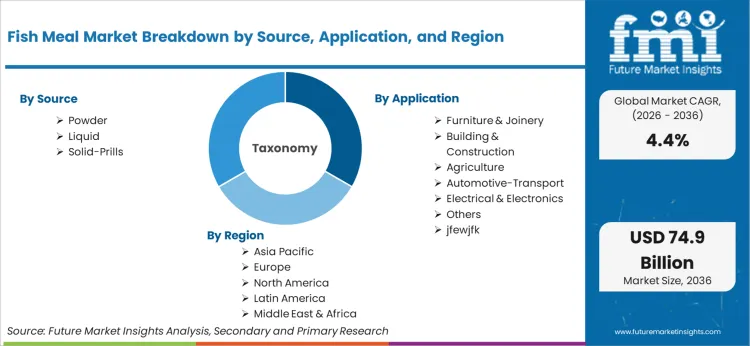
| Metric | Value |
|---|---|
| Quantitative Units | USD 48.7 billion (2026) to USD 74.8 billion (2036), at a CAGR of 4.4% |
| Market Definition | Fish meal is a high-protein feed ingredient obtained by cooking, pressing, drying, and milling raw fish or fish trimmings, used primarily in aquaculture and animal feed. |
| Source Segmentation | Wild-caught, Others |
| Application Segmentation | Aquaculture, Animal Feed, Fertilizers, Pet Food |
| Livestock Segmentation | Aquatic Animals, Swine, Poultry, Pets, Others |
| Regions Covered | North America, Latin America, Europe, East Asia, South Asia, Oceania, Middle East and Africa |
| Countries Covered | United States, Canada, Mexico, Brazil, Chile, Peru, Ecuador, Germany, Norway, United Kingdom, France, China, India, Japan, South Korea, Indonesia, Australia and 40 plus countries |
| Key Companies Profiled | Cooke Inc., BioMar, Mowi, Exalmar, Skretting, Cargill, IFB Agro, Aker BioMarine, Copeinca, Centinela |
| Forecast Period | 2026 to 2036 |
| Approach | Hybrid top down and bottom up market modeling validated through primary interviews with resin producers and panel manufacturers, supported by trade data benchmarking and plant level capacity verification |
Fish Meal Market Analysis by Segments
Source:
- Wild-caught
- Others
Application:
- Aquaculture
- Animal Feed
- Fertilizers
- Pet Food
Livestock:
- Aquatic Animals
- Swine
- Poultry
- Pets
- Others
Region:
- Asia Pacific
- India
- China
- Japan
- South Korea
- Indonesia
- Australia & New Zealand
- ASEAN
- Rest of Asia Pacific
- Europe
- Germany
- Italy
- France
- United Kingdom
- Spain
- Benelux
- Nordics
- Central & Eastern Europe
- Rest of Europe
- North America
- United States
- Canada
- Mexico
- Latin America
- Brazil
- Argentina
- Chile
- Rest of Latin America
- Middle East & Africa
- Kingdom of Saudi Arabia
- United Arab Emirates
- South Africa
- Turkey
- Rest of Middle East & Africa
Bibliography
- [1] FAO GLOBEFISH. (2025). Fishmeal exports and China imports trade data (first 9 months 2024). FAO GLOBEFISH.
- [2] IFFO. (2025). Global fishmeal and fish oil production estimates and quote by Dr Enrico Bachis. IFFO.
- [3] OECD/FAO. (2025). OECD-FAO Agricultural Outlook 2025-2034 (Fishmeal and Fish Oil Projections). OECD.
- [4] Cooke Inc. (2024). Cooke enters binding share purchase agreement to acquire Copeinca. Company Press Release.
- [5] BioMar. (2026). BioMar acquires full ownership of BioMar Ecuador and expands capacity. Company Press Release.
- [6] Mowi. (2025). Mowi enters strategic partnership with Skretting for feed production. Company Announcement.
- [7] IFB Agro. (2025). IFB executes Business Transfer Agreement to acquire Cargill India’s aquafeed business. Company Filing.
- [8] NOAA Fisheries. (2025). Fisheries of the United States 2022 (Industrial Fishery Products). NOAA.
- [9] SeafoodSource. (2025). Exalmar agrees to purchase Pesquera Centinela assets. SeafoodSource.
- [10] Skretting. (2025). Sustainability Report: Certified marine ingredient use increases to 85%. Skretting.
This Report Addresses
- Market intelligence to enable structured strategic decision making across mature and emerging aquaculture and animal nutrition economies
- Market size estimation and 10-year revenue forecasts from 2026 to 2036, supported by validated production volumes, catch data, and trade benchmarks
- Growth opportunity mapping across standard, LT (low-temperature), and specialty grades with emphasis on high-protein and pharmaceutical-grade transitions
- Segment and regional revenue forecasts covering aquafeed, poultry, swine, pet food, and specialty livestock applications
- Competition strategy assessment including vertical integration models, raw material security positioning, and export competitiveness benchmarking
- Product quality differentiation tracking including protein concentration, digestibility indices, contaminant thresholds, and certification standards
- Regulatory impact analysis covering fishing quotas, marine resource management policies, feed safety norms, and cross-border trade regulations
- Market report delivery in PDF, Excel, PPT, and interactive dashboard formats for executive and operational use
Frequently Asked Questions
How large is the demand for Fish Meal in the global market in 2026?
Demand for Fish Meal in the global market is estimated to be valued at USD 48.7 billion in 2026.
What will be the market size of Fish Meal in the global market by 2036?
Market size for Fish Meal is projected to reach USD 74.8 billion by 2036.
What is the expected demand growth for Fish Meal in the global market between 2026 and 2036?
Demand for Fish Meal in the global market is expected to grow at a CAGR of 4.4% between 2026 and 2036.
Which Source segment is poised to lead global sales by 2026?
Wild-caught fish meal is expected to be the dominant form, capturing approximately 40% of global market share in 2026 due to its established supply chains and nutrient density.
How significant is the role of Aquaculture Application in driving Fish Meal adoption in 2026?
Aquaculture represents a critical segment, projected to hold a substantial 50% share of the total market in 2026 as farming intensity scales to meet seafood demand.
What is driving demand in China?
Demand in China is driven by the massive scale of its aquaculture industry, necessitating huge volumes of imported protein to sustain production outputs.
What compliance standards or regulations are referenced for China?
Import regulations and trade protocols with major suppliers like Peru are key benchmarks referenced for the Chinese market.
What is the China growth outlook in this report?
China is projected to grow at a CAGR of 6.3% during 2026 to 2036.
Why is Latin America described as a priority region in this report?
Latin America is central as the primary production and export hub, with Peru and Chile controlling the majority of global anchovy quotas.
What type of demand dominates in Latin America?
Export-driven production dominates, with local industries focused on processing wild catch for shipment to Asian and European markets.
What is Chile growth outlook in this report?
Chile is projected to expand at a CAGR of 4.9% during 2026 to 2036.
Does the report cover India in its regional analysis?
Yes, India is included within Asia Pacific under the regional scope of analysis.
What are the sources referred to for analyzing India?
Company filings regarding acquisitions, such as IFB Agro's purchase of Cargill India's feed business, are cited as primary reference sources.
What is the main demand theme linked to India in its region coverage?
Asia Pacific demand in India is associated with the industrialization of shrimp farming and the consolidation of feed supply chains.
Does the report cover Norway in its regional analysis?
Yes, Norway is included within Europe under the regional coverage framework.
What is the main Norway related demand theme in its region coverage?
The theme emphasizes high-value, certified sustainable ingredients for the advanced salmon farming sector.
Which product formats or configurations are strategically important for Asia Pacific supply chains?
Bulk shipments of standard and prime grade fish meal are prioritized to feed the region's expansive aquaculture operations.
What is Fish Meal and what is it mainly used for?
Fish meal is a commercial product made from fish and fish bones, primarily used as a high-protein ingredient in aquaculture and animal feeds.
What does Fish Meal mean in this report?
Fish Meal market refers to the global production, trade, and consumption of meal derived from wild-caught fish and by-products.
What is included in the scope of this Fish Meal report?
Scope covers fish meal from various species and sources, applied in aquaculture, animal feed, and pet food sectors.
What is excluded from the scope of this report?
Raw fish oil sold separately, direct human consumption seafood, and plant-based protein concentrates are excluded.
What does market forecast mean on this page?
Market forecast represents a model based projection built on defined assumptions for strategic planning purposes.
How does FMI build and validate the Fish Meal forecast?
Forecast is developed using hybrid top down and bottom up modeling validated through trade data, production checks, and industry review.
What does zero reliance on speculative third party market research mean here?
Primary interviews and verifiable public datasets are used instead of unverified syndicated market estimates.
Preview the report firsthand - request a free sample
Get SampleGet the brochure for pricing and purchase details.
Get PDFTable of Content
- Executive Summary
- Global Market Outlook
- Demand-side Trends
- Supply-side Trends
- Technology Roadmap Analysis
- Analysis and Recommendations
- Market Overview
- Market Coverage / Taxonomy
- Market Definition / Scope / Limitations
- Research Methodology
- Chapter Orientation
- Analytical Lens and Working Hypotheses
- Market Structure, Signals, and Trend Drivers
- Benchmarking and Cross-market Comparability
- Market Sizing, Forecasting, and Opportunity Mapping
- Research Design and Evidence Framework
- Desk Research Programme (Secondary Evidence)
- Company Annual and Sustainability Reports
- Peer-reviewed Journals and Academic Literature
- Corporate Websites, Product Literature, and Technical Notes
- Earnings Decks and Investor Briefings
- Statutory Filings and Regulatory Disclosures
- Technical White Papers and Standards Notes
- Trade Journals, Industry Magazines, and Analyst Briefs
- Conference Proceedings, Webinars, and Seminar Materials
- Government Statistics Portals and Public Data Releases
- Press Releases and Reputable Media Coverage
- Specialist Newsletters and Curated Briefings
- Sector Databases and Reference Repositories
- FMI Internal Proprietary Databases and Historical Market Datasets
- Subscription Datasets and Paid Sources
- Social Channels, Communities, and Digital Listening Inputs
- Additional Desk Sources
- Expert Input and Fieldwork (Primary Evidence)
- Primary Modes
- Qualitative Interviews and Expert Elicitation
- Quantitative Surveys and Structured Data Capture
- Blended Approach
- Why Primary Evidence is Used
- Field Techniques
- Interviews
- Surveys
- Focus Groups
- Observational and In-context Research
- Social and Community Interactions
- Stakeholder Universe Engaged
- C-suite Leaders
- Board Members
- Presidents and Vice Presidents
- R&D and Innovation Heads
- Technical Specialists
- Domain Subject-matter Experts
- Scientists
- Physicians and Other Healthcare Professionals
- Governance, Ethics, and Data Stewardship
- Research Ethics
- Data Integrity and Handling
- Primary Modes
- Tooling, Models, and Reference Databases
- Desk Research Programme (Secondary Evidence)
- Data Engineering and Model Build
- Data Acquisition and Ingestion
- Cleaning, Normalisation, and Verification
- Synthesis, Triangulation, and Analysis
- Quality Assurance and Audit Trail
- Market Background
- Market Dynamics
- Drivers
- Restraints
- Opportunity
- Trends
- Scenario Forecast
- Demand in Optimistic Scenario
- Demand in Likely Scenario
- Demand in Conservative Scenario
- Opportunity Map Analysis
- Product Life Cycle Analysis
- Supply Chain Analysis
- Investment Feasibility Matrix
- Value Chain Analysis
- PESTLE and Porter’s Analysis
- Regulatory Landscape
- Regional Parent Market Outlook
- Production and Consumption Statistics
- Import and Export Statistics
- Market Dynamics
- Global Market Analysis 2021 to 2025 and Forecast, 2026 to 2036
- Historical Market Size Value (USD Billion) Analysis, 2021 to 2025
- Current and Future Market Size Value (USD Billion) Projections, 2026 to 2036
- Y-o-Y Growth Trend Analysis
- Absolute $ Opportunity Analysis
- Global Market Pricing Analysis 2021 to 2025 and Forecast 2026 to 2036
- Global Market Analysis 2021 to 2025 and Forecast 2026 to 2036, By Source
- Introduction / Key Findings
- Historical Market Size Value (USD Billion) Analysis By Source , 2021 to 2025
- Current and Future Market Size Value (USD Billion) Analysis and Forecast By Source , 2026 to 2036
- Wild-Caught
- Others
- Wild-Caught
- Y-o-Y Growth Trend Analysis By Source , 2021 to 2025
- Absolute $ Opportunity Analysis By Source , 2026 to 2036
- Global Market Analysis 2021 to 2025 and Forecast 2026 to 2036, By Application
- Introduction / Key Findings
- Historical Market Size Value (USD Billion) Analysis By Application, 2021 to 2025
- Current and Future Market Size Value (USD Billion) Analysis and Forecast By Application, 2026 to 2036
- Aquaculture
- Animal Feed
- Fertilizers
- Pet Food
- Aquaculture
- Y-o-Y Growth Trend Analysis By Application, 2021 to 2025
- Absolute $ Opportunity Analysis By Application, 2026 to 2036
- Global Market Analysis 2021 to 2025 and Forecast 2026 to 2036, By Region
- Introduction
- Historical Market Size Value (USD Billion) Analysis By Region, 2021 to 2025
- Current Market Size Value (USD Billion) Analysis and Forecast By Region, 2026 to 2036
- North America
- Latin America
- Western Europe
- Eastern Europe
- East Asia
- South Asia and Pacific
- Middle East & Africa
- Market Attractiveness Analysis By Region
- North America Market Analysis 2021 to 2025 and Forecast 2026 to 2036, By Country
- Historical Market Size Value (USD Billion) Trend Analysis By Market Taxonomy, 2021 to 2025
- Market Size Value (USD Billion) Forecast By Market Taxonomy, 2026 to 2036
- By Country
- USA
- Canada
- Mexico
- By Source
- By Application
- By Country
- Market Attractiveness Analysis
- By Country
- By Source
- By Application
- Key Takeaways
- Latin America Market Analysis 2021 to 2025 and Forecast 2026 to 2036, By Country
- Historical Market Size Value (USD Billion) Trend Analysis By Market Taxonomy, 2021 to 2025
- Market Size Value (USD Billion) Forecast By Market Taxonomy, 2026 to 2036
- By Country
- Brazil
- Chile
- Rest of Latin America
- By Source
- By Application
- By Country
- Market Attractiveness Analysis
- By Country
- By Source
- By Application
- Key Takeaways
- Western Europe Market Analysis 2021 to 2025 and Forecast 2026 to 2036, By Country
- Historical Market Size Value (USD Billion) Trend Analysis By Market Taxonomy, 2021 to 2025
- Market Size Value (USD Billion) Forecast By Market Taxonomy, 2026 to 2036
- By Country
- Germany
- UK
- Italy
- Spain
- France
- Nordic
- BENELUX
- Rest of Western Europe
- By Source
- By Application
- By Country
- Market Attractiveness Analysis
- By Country
- By Source
- By Application
- Key Takeaways
- Eastern Europe Market Analysis 2021 to 2025 and Forecast 2026 to 2036, By Country
- Historical Market Size Value (USD Billion) Trend Analysis By Market Taxonomy, 2021 to 2025
- Market Size Value (USD Billion) Forecast By Market Taxonomy, 2026 to 2036
- By Country
- Russia
- Poland
- Hungary
- Balkan & Baltic
- Rest of Eastern Europe
- By Source
- By Application
- By Country
- Market Attractiveness Analysis
- By Country
- By Source
- By Application
- Key Takeaways
- East Asia Market Analysis 2021 to 2025 and Forecast 2026 to 2036, By Country
- Historical Market Size Value (USD Billion) Trend Analysis By Market Taxonomy, 2021 to 2025
- Market Size Value (USD Billion) Forecast By Market Taxonomy, 2026 to 2036
- By Country
- China
- Japan
- South Korea
- By Source
- By Application
- By Country
- Market Attractiveness Analysis
- By Country
- By Source
- By Application
- Key Takeaways
- South Asia and Pacific Market Analysis 2021 to 2025 and Forecast 2026 to 2036, By Country
- Historical Market Size Value (USD Billion) Trend Analysis By Market Taxonomy, 2021 to 2025
- Market Size Value (USD Billion) Forecast By Market Taxonomy, 2026 to 2036
- By Country
- India
- ASEAN
- Australia & New Zealand
- Rest of South Asia and Pacific
- By Source
- By Application
- By Country
- Market Attractiveness Analysis
- By Country
- By Source
- By Application
- Key Takeaways
- Middle East & Africa Market Analysis 2021 to 2025 and Forecast 2026 to 2036, By Country
- Historical Market Size Value (USD Billion) Trend Analysis By Market Taxonomy, 2021 to 2025
- Market Size Value (USD Billion) Forecast By Market Taxonomy, 2026 to 2036
- By Country
- Kingdom of Saudi Arabia
- Other GCC Countries
- Turkiye
- South Africa
- Other African Union
- Rest of Middle East & Africa
- By Source
- By Application
- By Country
- Market Attractiveness Analysis
- By Country
- By Source
- By Application
- Key Takeaways
- Key Countries Market Analysis
- USA
- Pricing Analysis
- Market Share Analysis, 2025
- By Source
- By Application
- Canada
- Pricing Analysis
- Market Share Analysis, 2025
- By Source
- By Application
- Mexico
- Pricing Analysis
- Market Share Analysis, 2025
- By Source
- By Application
- Brazil
- Pricing Analysis
- Market Share Analysis, 2025
- By Source
- By Application
- Chile
- Pricing Analysis
- Market Share Analysis, 2025
- By Source
- By Application
- Germany
- Pricing Analysis
- Market Share Analysis, 2025
- By Source
- By Application
- UK
- Pricing Analysis
- Market Share Analysis, 2025
- By Source
- By Application
- Italy
- Pricing Analysis
- Market Share Analysis, 2025
- By Source
- By Application
- Spain
- Pricing Analysis
- Market Share Analysis, 2025
- By Source
- By Application
- France
- Pricing Analysis
- Market Share Analysis, 2025
- By Source
- By Application
- India
- Pricing Analysis
- Market Share Analysis, 2025
- By Source
- By Application
- ASEAN
- Pricing Analysis
- Market Share Analysis, 2025
- By Source
- By Application
- Australia & New Zealand
- Pricing Analysis
- Market Share Analysis, 2025
- By Source
- By Application
- China
- Pricing Analysis
- Market Share Analysis, 2025
- By Source
- By Application
- Japan
- Pricing Analysis
- Market Share Analysis, 2025
- By Source
- By Application
- South Korea
- Pricing Analysis
- Market Share Analysis, 2025
- By Source
- By Application
- Russia
- Pricing Analysis
- Market Share Analysis, 2025
- By Source
- By Application
- Poland
- Pricing Analysis
- Market Share Analysis, 2025
- By Source
- By Application
- Hungary
- Pricing Analysis
- Market Share Analysis, 2025
- By Source
- By Application
- Kingdom of Saudi Arabia
- Pricing Analysis
- Market Share Analysis, 2025
- By Source
- By Application
- Turkiye
- Pricing Analysis
- Market Share Analysis, 2025
- By Source
- By Application
- South Africa
- Pricing Analysis
- Market Share Analysis, 2025
- By Source
- By Application
- USA
- Market Structure Analysis
- Competition Dashboard
- Competition Benchmarking
- Market Share Analysis of Top Players
- By Regional
- By Source
- By Application
- Competition Analysis
- Competition Deep Dive
- Cooke Inc.
- Overview
- Product Portfolio
- Profitability by Market Segments (Product/Age /Sales Channel/Region)
- Sales Footprint
- Strategy Overview
- Marketing Strategy
- Product Strategy
- Channel Strategy
- BioMar Group
- Mowi ASA
- Pesquera Exalmar S.A.A.
- Skretting (Nutreco)
- Cargill, Inc.
- Cooke Inc.
- Competition Deep Dive
- Assumptions & Acronyms Used


