

- Industry Size (2026)
- USD 3.1 Bn
- Forecast (2036)
- USD 5.96 Bn
- CAGR (2026 to 2036)
- 6.8%
Specialty Nitriles Market Size, Market Forecast and Outlook By FMI
In 2025, the specialty nitriles market was valued at USD 2.90 billion. Based on Future Market Insights' analysis, demand for specialty nitriles is estimated to grow to USD 3.10 billion in 2026 and USD 5.96 billion by 2036. FMI projects a CAGR of 6.8% during the forecast period. Growth is steady due to sustained demand from automotive and chemical intermediates, while feedstock price volatility and substitution pressures in certain applications act as moderating factors.
The introduction of new product formulations, particularly bio-based and low-emission variants, is opening fresh avenues for expansion in the specialty nitriles market by aligning performance requirements with decarbonization targets across automotive, electronics, and chemical processing sectors. In March 2024, INEOS Nitriles announced the launch of Invireo, a bio-based acrylonitrile produced using renewable feedstock that enables a certified reduction in greenhouse gas emissions of up to 90% compared to conventional fossil-based acrylonitrile, based on mass balance principles and third-party certification. As Hans Casier, CEO INEOS Nitriles, stated: “Put simply, InvireoTM is a green feedstock that reduces the carbon footprint of the end product by more than 90%!” [1]
Summary of Specialty Nitriles Market
- Market Definition
- Specialty nitriles refer to high-performance nitrile-based chemical intermediates tailored for specific industrial applications such as ABS resins, nitrile rubber, coatings, and specialty solvents where heat, chemical resistance, and mechanical strength are required.
- Demand Drivers
- Automotive manufacturers are increasing the use of ABS plastics and nitrile rubber in lightweight components to meet fuel efficiency and durability standards.
- Electronics and appliance producers rely on acrylonitrile-based polymers for impact resistance and dimensional stability in housings and structural parts.
- Chemical processors are expanding specialty solvent and intermediate production to serve adhesives, coatings, and engineered plastics markets.
- Key Segments Analyzed
- Product Type: Acrylonitrile leads with an estimated 47.2% share in 2026 due to its central role in ABS and nitrile rubber production.
- Application: Automotive applications account for the dominant share in 2026, reflecting high consumption in structural plastics and elastomers.
- End User: Polymer and plastics manufacturers represent the largest end-user group, driven by consistent feedstock requirements.
- Geography: Asia Pacific remains the leading regional market, supported by integrated petrochemical capacity and export-oriented polymer production.
- Analyst Opinion at FMI
- Nikhil Kaitwade, principal consultant for Chemicals & Materials at Future Market Insights, opines, 'Producers that align specialty nitrile output with low-carbon feedstock strategies and downstream integration will secure stronger margin stability over the forecast period.'
- Strategic Implications / Executive Takeaways
- Secure long-term propylene supply contracts to reduce exposure to feedstock price swings.
- Invest in bio-based or mass-balance certified nitrile variants to meet Scope 3 emission targets of key customers.
- Strengthen regional distribution partnerships in Asia Pacific to capture automotive and electronics demand clusters.
- Methodology
- Market size estimates were derived using a hybrid top-down and bottom-up modeling framework.
- Primary interviews with manufacturers and distributors were used to validate shipment volumes and pricing bands.
- Data triangulation was conducted using trade statistics, company disclosures, and capacity utilization benchmarks.
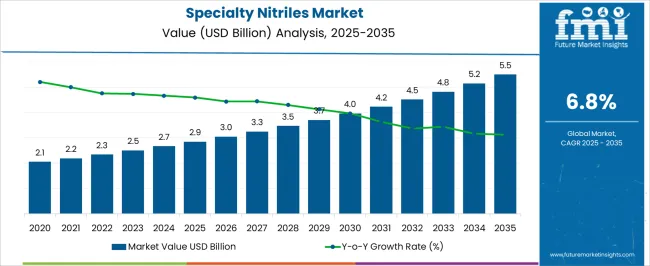
| Metric | Value |
|---|---|
| Estimated Value (2026E) | USD 3.1 billion |
| Forecast Value (2036F) | USD 5.96 billion |
| CAGR (2026 to 2036) | 6.8% |
Source: FMI analysis based on primary research and proprietary forecasting model
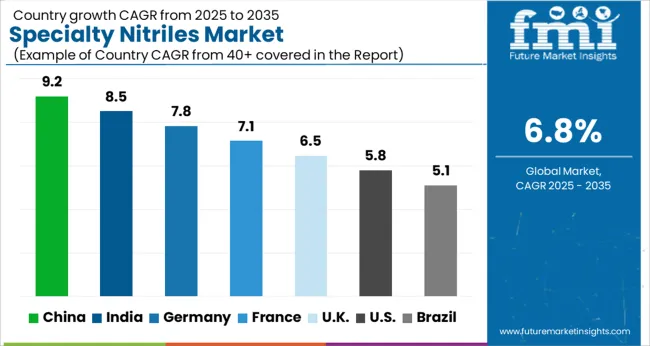
India is projected to expand at a CAGR of 7.6%, driven by rising domestic acrylonitrile consumption across automotive components and synthetic rubber production. China is expected to register a CAGR of 7.2%, supported by integrated petrochemical capacity expansions and downstream ABS and nitrile rubber manufacturing growth. South Korea is forecasted to grow at 6.5%, reflecting steady demand from electronics and high-performance polymer exports. The United States and Germany, grouped as mature markets, are anticipated to grow at 5.4% and 5.1% respectively, where demand is largely replacement-led and efficiency-driven rather than volume expansion, constrained by environmental compliance costs and limited new petrochemical capacity additions.
Specialty Nitriles Market Definition
The specialty nitriles market covers the production and sale of nitrile-based chemical compounds that are engineered for specific performance requirements beyond standard commodity grades. Nitriles are organic chemicals containing a carbon-nitrogen functional group, commonly derived from petrochemical feedstocks such as propylene. Their function is to act as intermediates in the manufacture of high-performance plastics, synthetic rubbers, coatings, adhesives, and specialty solvents. One of the largest end uses is in the automotive sector, where acrylonitrile and related nitriles are used to produce ABS plastics and nitrile rubber for components that require heat resistance, strength, and chemical stability.
Specialty Nitriles Market Inclusions
This report covers global and regional market sizes for specialty nitriles, with forecasts from 2026 to 2036. It provides detailed segment breakdowns by product type, application, end user, distribution channel, form, and region. The analysis includes year-on-year growth trends, market share estimates, and country-level CAGRs. It also evaluates pricing trends, feedstock cost linkages, supply-demand balances, and trade flow patterns shaping procurement and capacity strategies across major markets.
Specialty Nitriles Market Exclusions
The scope excludes commodity-grade acrylonitrile used purely for bulk polymer production unless classified under specialty specifications. It also omits finished downstream goods such as ABS appliances, automotive dashboards, nitrile gloves, and finished rubber products, focusing strictly on specialty nitrile compounds and their immediate industrial intermediates. Bio-based feedstocks unrelated to nitrile chemistry and non-nitrile nitrogen derivatives are not included in this assessment.
Specialty Nitriles Market Research Methodology
- Primary Research: FMI analysts conducted interviews with specialty nitrile manufacturers, raw material suppliers, distributors, and procurement heads in automotive and polymer processing companies to validate demand trends and pricing movements.
- Desk Research: The study draws on company annual reports, investor presentations, trade data, petrochemical capacity announcements, and regulatory publications to establish supply-demand benchmarks and competitive positioning.
- Market-Sizing and Forecasting: A hybrid model combining bottom-up capacity assessment and top-down demand estimation was used to calculate market size, with scenario-based forecasting applied to account for feedstock volatility and end-use shifts.
- Data Validation and Update Cycle: All estimates were cross-verified through triangulation with primary interviews and historical shipment data, with periodic updates aligned to quarterly financial disclosures and major capacity announcements.
Segment Analysis
Specialty Nitriles Market Analysis by Product Type
Acrylonitrile is estimated to hold a 47.2% share in 2026. It dominates because it is the primary precursor for ABS resins and nitrile rubber, giving polymer producers a reliable intermediate with well-established processing parameters and global qualification across automotive and industrial supply chains.
- Capacity restructuring: Asahi Kasei announced in May 2024 that it would withdraw from acrylonitrile production at its Mizushima Works, reflecting strategic realignment within commodity and specialty nitrile portfolios and tightening regional supply structures [2].
- Renewable pathway development: Trillium Renewable Chemicals selected a USA Gulf Coast site in 2024 to advance its plant-based acrylonitrile demonstration project, indicating commercial interest in alternative feedstocks to lower lifecycle emissions [3].
- Trade flow shift: Mitsubishi Chemical Group disclosed plans in February 2024 to discontinue certain acrylonitrile-related operations in Japan, a move that signals ongoing consolidation and cross-border sourcing adjustments in Asia [4].
Specialty Nitriles Market Analysis by Application
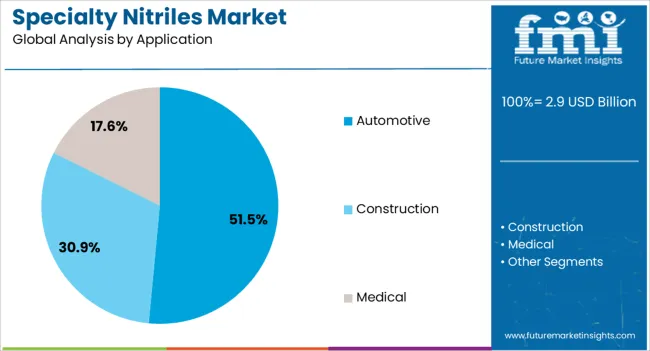
Based on FMI's specialty nitriles market report, automotive applications are likely to hold a 34% share in 2026. Automotive leads because ABS and nitrile elastomers address impact resistance, thermal stability, and fuel or oil contact requirements in structural plastics and sealing systems.
- Low-carbon resin launch: Trinseo introduced sustainably advantaged ABS and SAN grades in June 2024 positioned as drop-in materials for automotive and industrial applications seeking reduced carbon intensity [5].
- Technical center expansion: LG Chem opened a North American customer solution center in August 2024 to strengthen technical support for automotive and appliance manufacturers, reinforcing application-specific resin validation [6].
- Regional pricing action: Trinseo announced ABS price increases in Europe in December 2024, reflecting cost pass-through dynamics that influence procurement strategies for vehicle component suppliers [7].
Specialty Nitriles Market Analysis by End User
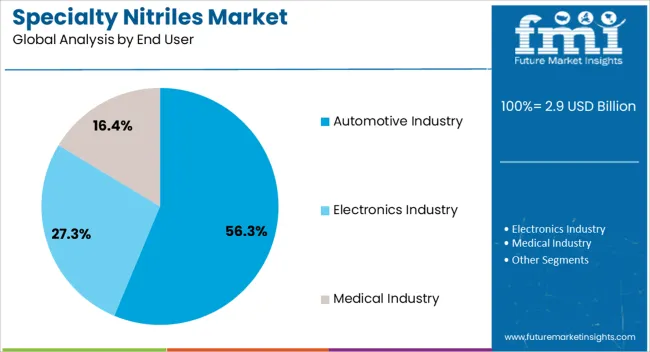
Polymer and elastomer manufacturers will likely account for 41% of specialty nitriles consumers in 2026. This group leads because it converts nitriles into standardized resins and rubbers that downstream industries specify by grade, performance, and compliance requirements.
- Elastomer capacity addition: ZEON decided to increase hydrogenated nitrile rubber production capacity at its USA facility, expanding output of higher-value nitrile elastomers for industrial and mobility uses.
- Chemically recycled feedstock use: Trinseo announced availability of ABS and SAN produced with chemically recycled monomer through depolymerization in October 2025, providing end users with certified circular material options [8].
- Certification adoption: Toray Industries reported ISCC PLUS certification at two domestic plants in February 2026, reflecting how chain-of-custody standards are influencing procurement across specialty material value chains [9].
Specialty Nitriles Market Drivers, Restraints, and Opportunities
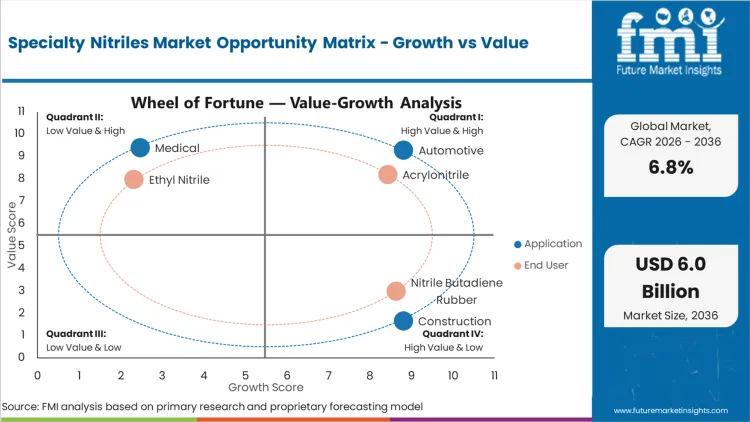
Specialty nitrile applications have moved beyond being purely volume-driven petrochemical-based into a performance-linked intermediate applications. These are closely to automotive, electronics, and engineered plastics production cycles. The current valuation reflects stable demand for acrylonitrile as a core feedstock for ABS resins and nitrile rubber, both of which are embedded in regulated industries requiring durability, heat resistance, and chemical stability. Environmental compliance costs and feedstock integration structures have historically shaped margins and capacity allocation.
Commodity-grade applications in certain mature markets are stabilizing or contracting due to efficiency gains and lightweighting in vehicles, while demand is expanding in higher-specification, lower-carbon variants. Bio-attributed or mass-balance-certified nitriles often carry price premiums and initially lower volumes, yet these grades improve margin profiles and align with OEM Scope 3 emission targets. The result is a shift from purely tonnage growth to value-driven expansion.
- Automotive lightweighting push: Stricter fleet emission norms under regulations such as the EU CO2 standards for passenger cars are prompting OEMs to adopt lightweight ABS and nitrile-based components, sustaining demand for high-performance intermediates used in structural and under-hood applications.
- Asia capacity concentration: China and South Korea continue to anchor regional acrylonitrile production through integrated petrochemical complexes, creating export-oriented supply chains that influence global pricing benchmarks and contract structures.
- Carbon compliance pressure: Policies linked to the EU Emissions Trading System and corporate Scope 3 disclosure frameworks are increasing scrutiny on feedstock carbon intensity, encouraging producers to develop mass-balance or renewable pathways despite higher production costs.
Regional Analysis
The specialty nitriles market is analyzed across North America, Latin America, Europe, Asia Pacific, and the Middle East & Africa. Geographic segmentation evaluates regional production hubs, consumption centers, and country-level growth trends shaping global supply-demand balances. The full report provides comparative market attractiveness analysis across these countries and regions.
.webp "Top Country Growth Comparison Specialty Nitriles Market Cagr (2026 2036)")
| Country | CAGR (2026-2036) |
|---|---|
| India | 7.6% |
| China | 7.2% |
| South Korea | 6.5% |
| Brazil | 6.1% |
| United States | 5.4% |
| Germany | 5.1% |
| Japan | 4.8% |
Source: Future Market Insights analysis, supported by a proprietary forecasting model and primary research
Asia Pacific Market Analysis
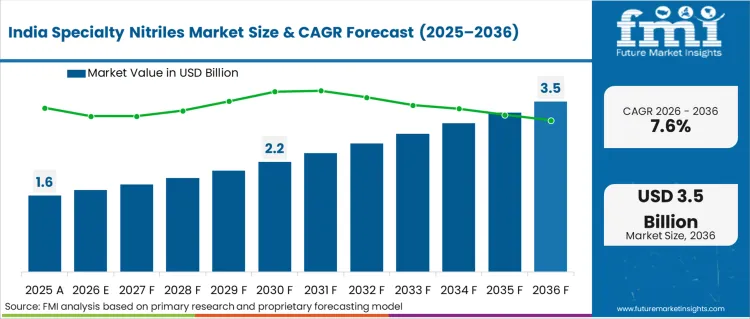
Asia Pacific functions as the global production backbone and a fast-growing consumption corridor for specialty nitriles, supported by integrated petrochemical complexes, domestic refinery expansions, and export-oriented polymer chains. Leading regional participants such as Asahi Kasei Corporation, Mitsubishi Chemical Group Corporation, and LG Chem Ltd. compete through upstream integration, downstream ABS positioning, and close alignment with automotive and electronics OEM supply networks.
- India: Demand for specialty nitriles in India is set to grow at a CAGR of 7.6% through 2036. In August 2023, the Ministry of Heavy Industries extended the Production Linked Incentive scheme for automobiles and auto components, strengthening domestic manufacturing of engineering plastics and elastomers [15]. India’s demand is import-substitution oriented, though inland logistics infrastructure and distribution costs moderate scale efficiency.
- China: Specialty nitriles sales in China are projected to rise at a compound annual rate of 7.2% through 2036. In September 2023, the National Development and Reform Commission released the 2023 edition of the Industrial Structure Adjustment Catalogue, promoting advanced petrochemical materials and higher-value derivatives [11]. China’s model is capacity-led and export-oriented, though provincial energy-intensity controls and environmental inspections limit unrestricted incremental output.
- South Korea: The South Korea specialty nitriles sector is poised to expand at a CAGR of 6.5% through 2036. In July 2023, the Ministry of Trade, Industry and Energy advanced updates to the K-Semiconductor Strategy, reinforcing advanced material supply chains [13]. In April 2024, LG Chem announced specialty material investment at its Yeosu complex to strengthen high-value polymer exports [14]. South Korea’s growth is export-linked and specification-driven, with exposure to electronics cycles influencing procurement volumes.
- Japan: FMI estimates the specialty nitriles market in Japan to expand at an annual growth rate of 4.8% through 2036. Japan represents a mature, high-value technology anchor for the region, where demand is fiercely concentrated in ultra-high-purity nitriles for advanced electronics, battery binders, and specialized automotive elastomers. Domestic chemical giants continue to optimize their portfolios toward premium, customized formulations, steering away from commodity-grade production to serve highly technical downstream requirements in the robotics and semiconductor equipment sectors.
The comprehensive FMI report provides an in-depth analysis of the broader Asia Pacific ecosystem, extending beyond these core manufacturing bases to identify highly lucrative opportunities in Taiwan and Southeast Asia. Taiwan's massive semiconductor foundries drive intense, specialized demand for electronic-grade nitriles. Meanwhile, Vietnam and Thailand are rapidly emerging as high-potential hubs, capturing significant chemical and automotive manufacturing investments as global supply chains continue to diversify across the region.
Latin America Market Analysis
Latin America represents an emerging frontier for specialty nitriles, heavily influenced by its robust agricultural sector and expanding automotive assembly footprint. The region relies on a mix of localized compounding operations and strategic imports, with multinational chemical suppliers actively supporting domestic automotive and agrochemical supply chains.
- Brazil: The specialty nitriles landscape in Brazil is set to achieve a CAGR of 6.1% through 2036. Growth is structurally supported by Brazil's massive agribusiness sector, which relies on nitrile derivatives for the formulation of advanced agrochemicals and crop protection products. Furthermore, the recovery and expansion of domestic automotive manufacturing, driven by government incentives for hybrid and flex-fuel vehicles, are accelerating the demand for nitrile-butadiene rubber (NBR) and specialized elastomers capable of withstanding harsh engine environments and biofuel blends.
The FMI report goes in-depth to evaluate the wider Latin American ecosystem, highlighting that while Brazil is the volume driver, Argentina and Colombia remain highly lucrative hubs. Argentina’s specialized agricultural exports generate steady demand for nitrile-based intermediates, while Colombia is experiencing a rise in industrial manufacturing investments that require durable, chemically resistant polymer compounds.
North America Market Analysis
North America operates as a technology-driven consumption hub focused on elastomer specialization and advanced manufacturing. Players including Zeon Corporation, Ascend Performance Materials, and Exxon Mobil Corporation rely on Gulf Coast petrochemical integration and long-term industrial contracts to maintain stability.
- United States: The market for specialty nitriles in the United States is forecast to register a CAGR of 5.4% through 2036. The USA market is largely replacement-driven, with EPA oversight and higher compliance costs limiting commodity-scale expansion. In October 2023, Zeon Corporation confirmed expansion of hydrogenated nitrile rubber production capacity at its Texas site, targeting mobility and industrial applications [17]. During 2023-2024, implementation funding under the CHIPS and Science Act accelerated domestic semiconductor and advanced materials production, supporting engineering plastics demand [18].
FMI’s extensive report gets in-depth on the North American landscape by analyzing additional high-potential markets like Canada and Mexico. Mexico is rapidly expanding as an essential nearshoring hub, drawing significant investments in automotive parts manufacturing and consumer electronics assembly, which directly pulls specialty nitrile demand into the region. Canada’s advanced healthcare and industrial safety sectors create a steady, highly regulated pipeline for specialty nitrile elastomers used in medical-grade gloves and protective equipment.
Europe Market Analysis
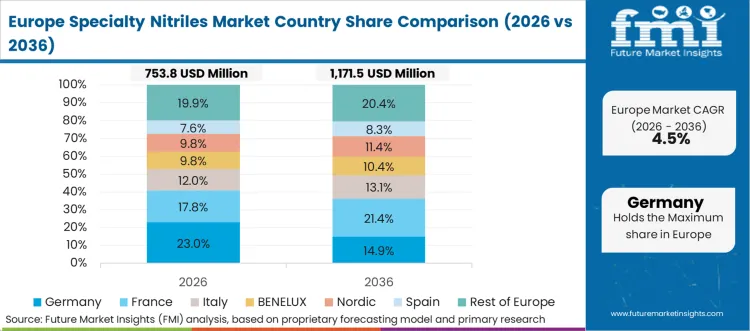
Europe functions as a compliance-led specialty nitriles market shaped by automotive engineering and carbon policy alignment. Companies such as BASF SE, INEOS Group Holdings S.A., and Trinseo PLC compete through advanced formulation, integration, and sustainability positioning within EU frameworks.
- Germany: Specialty nitriles revenue in Germany is anticipated to increase by a CAGR of 5.1% through 2036. In July 2023, Regulation (EU) 2023/851 amended CO₂ standards for passenger cars, reinforcing lightweight material adoption in automotive production [19]. Germany’s growth is innovation-oriented, though elevated energy prices and EU Emissions Trading System obligations constrain cost competitiveness.
FMI’s rigorous report provides an in-depth look at the wider European market, analyzing lucrative hubs outside of Germany. The United Kingdom stands out as a critical focus area, where the aerospace and high-performance engineering sectors necessitate ultra-durable, heat-resistant nitrile composites. Italy is recognized as a high-potential hub experiencing a rise in specialized demand, heavily supported by its premium automotive and industrial machinery sectors that require advanced, chemically resistant elastomers.
Competitive Aligners for Market Players
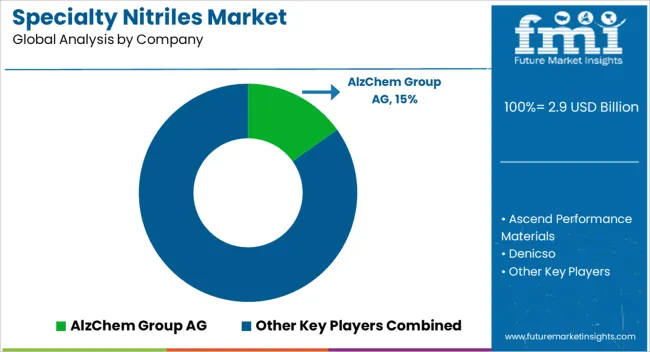
The specialty nitriles market is moderately concentrated, with a relatively small set of globally integrated producers shaping supply, qualification access, and contracting norms, while a longer tail of regional suppliers competes in narrower grades and local delivery lanes. The primary competitive variable is assured quality at scale, since automotive and engineered polymer buyers require consistent specifications, traceability, and stable supply across multi-plant programs.
Structural advantages sit with companies that combine captive feedstocks, integrated purification, and downstream alignment with ABS, elastomers, and specialty intermediates. Investments tend to prioritize purification, debottlenecking, and portfolio rationalization rather than greenfield commodity capacity, because sellers are protecting margins and compliance performance while meeting tighter product specifications.
Buyer leverage is highest among large polymer converters and automotive supply chains that dual-source qualified grades, lock in volume via term contracts, and negotiate index-linked pricing with energy and feedstock pass-through clauses. This procurement behavior limits spot-market pricing power during oversupply cycles, but it also enables suppliers with certified, high-purity, or application-qualified grades to maintain premiums when switching costs and requalification timelines are high.
Recent Developments
- Ascend Performance Materials (May 2025): Ascend began production of high-purity acrylonitrile after installing and commissioning new purification equipment at its Chocolate Bayou plant in Texas, strengthening supply of higher-spec material for downstream users [21].
- Asahi Kasei (November 2024): Asahi Kasei announced a decision to discontinue operations and deconstruct plant facilities at its equity-method affiliate PTT Asahi Chemical in Thailand, reflecting ongoing restructuring around acrylonitrile-linked assets [22].
- Trinseo (October 2025): Trinseo announced availability of PS, ABS, and SAN produced with chemically recycled monomer through depolymerization, supporting customer demand for certified circular feedstocks in engineering resins that sit downstream of nitrile value chains [23].
Key Players Profiled
- AlzChem Group AG
- Ascend Performance Materials
- Denicso
- Duraco
- Emerald Performance Materials
- INEOS
- Marco Rubber & Plastics, LLC.
- Parchem fine & specialty chemicals
- Speciality Tapes
- TIDI Products, LLC.
- Zeon Chemicals L.P.
Scope of the Report
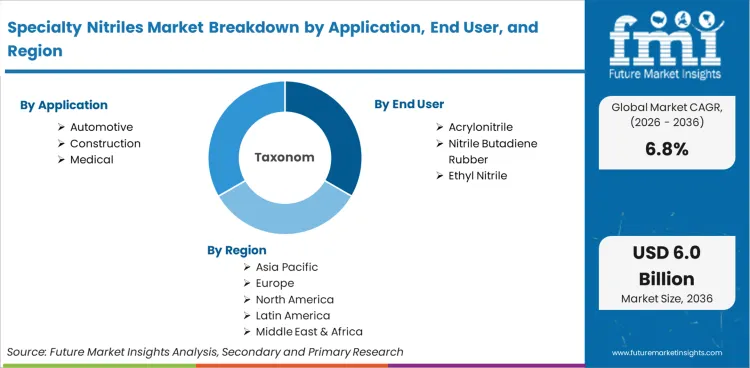
| Metric | Value |
|---|---|
| Quantitative Units | USD 3.10 billion (2026) to USD 5.96 billion (2036), at a CAGR of 6.8%, with 2025 historic value of USD 2.90 billion |
| Market Definition | The specialty nitriles market comprises the global production, formulation, and distribution of acrylonitrile monomer and its derivative polymers, primarily nitrile butadiene rubber (NBR) and hydrogenated nitrile butadiene rubber (HNBR), for high-performance elastomer applications. |
| Product Type Segmentation | Acrylonitrile, Nitrile Butadiene Rubber, Ethyl Nitrile |
| Application Segmentation | Automotive, Construction, Medical |
| End-User Segmentation | Automotive Industry, Electronics Industry, Medical Industry |
| Distribution Channel Segmentation | Direct Sales, Online Sales, Retail Sales |
| Form Segmentation | Liquid, Solid, Gas |
| Regions Covered | North America, Latin America, Europe, East Asia, South Asia & Pacific, Middle East & Africa |
| Countries Covered | United States, Canada, Mexico, Brazil, Germany, France, United Kingdom, Italy, Spain, China, India, Japan, South Korea, Australia, and 40 plus countries |
| Key Companies Profiled | AlzChem Group, Ascend Performance Materials, Denicso, Duraco, Emerald Performance Materials, INEOS, Marco Rubber & Plastics, Parchem, Speciality Tapes, TIDI Products, Zeon Chemicals |
| Forecast Period | 2026 to 2036 |
| Approach | Hybrid top-down and bottom-up market modeling validated through primary interviews with polymer manufacturers, compounders, and end-use specifiers, supported by trade data benchmarking and end-use industry production analysis |
Specialty Nitriles Market Analysis by Segments
Product Type
- Acrylonitrile
- Nitrile Butadiene Rubber
- Ethyl Nitrile
Application
- Automotive
- Construction
- Medical
End User
- Automotive Industry
- Electronics Industry
- Medical Industry
Distribution Channel
- Direct Sales
- Online Sales
- Retail Sales
Form
- Liquid
- Solid
- Gas
Region
- North America
- Latin America
- Europe
- East Asia
- South Asia & Pacific
- Middle East & Africa
Bibliography
- [1] INEOS. (March 2024). INEOS Nitriles launches InvireoTM bio-based acrylonitrile to deliver 90% reduction of greenhouse gas emissions.
- [2] Asahi Kasei Corporation. (May 2024). Notice regarding withdrawal from acrylonitrile production at Mizushima Works. Asahi Kasei.
- [3] Trillium Renewable Chemicals. (2024). Selection of USA Gulf Coast site for plant-based acrylonitrile demonstration project. Trillium Renewable Chemicals.
- [4] Mitsubishi Chemical Group. (February 2024). Announcement on the discontinuance of MMA production by the ACH process and related businesses. Mitsubishi Chemical Group.
- [5] Trinseo. (June 2024). New sustainably advantaged ABS and SAN resins work as drop-in solutions for automotive and industrial applications. Trinseo.
- [6] LG Chem. (August 2024). LG Chem opens customer solution center to cover North American region. LG Chem.
- [7] Trinseo. (December 2024). Trinseo announces price increase for ABS in Europe. Trinseo.
- [8] Zeon Corporation. (2024). ZEON decides to increase hydrogenated nitrile rubber production capacity in the United States. Zeon Corporation.
- [9] Trinseo. (October 2025). Trinseo announces availability of ABS and SAN produced with chemically recycled monomer. Trinseo.
- [10] Toray Industries, Inc. (February 2026). Two Toray domestic plants obtain ISCC PLUS certification. Toray Industries.
- [11] National Development and Reform Commission of China. (September 2023). Industrial Structure Adjustment Catalogue (2023 edition).
- [12] China Petroleum & Chemical Corporation (Sinopec). (March 2024). Zhenhai Refining & Chemical expansion update.
- [13] Ministry of Trade, Industry and Energy, Republic of Korea. (July 2023). K-Semiconductor Strategy update.
- [14] LG Chem Ltd. (April 2024). Investment announcement for specialty materials expansion at Yeosu complex.
- [15] Government of India, Ministry of Heavy Industries. (August 2023). Production Linked Incentive Scheme for Automobile and Auto Components update.
- [16] Indian Oil Corporation Limited. (February 2024). Panipat Refinery and Petrochemical Complex expansion announcement.
- [17] Zeon Corporation. (October 2023). Expansion of hydrogenated nitrile rubber production capacity in the United States.
- [18] United States Government. (2023-2024). CHIPS and Science Act implementation funding updates.
- [19] European Parliament and Council. (July 2023). Regulation (EU) 2023/851 amending CO₂ emission standards for passenger cars and light commercial vehicles.
- [20] BASF SE. (November 2023). Ludwigshafen site operational optimization and investment update.
- [21] Ascend Performance Materials. (2025, May 12). Ascend begins production of high-purity acrylonitrile. Ascend Performance Materials.
- [22] Asahi Kasei Corporation. (2024, November 15). Notice of decision to discontinue acrylonitrile and other operations of equity-method affiliate PTT Asahi Chemical Co., Ltd. Asahi Kasei.
- [23] Trinseo. (2025, October 9). Trinseo announces availability of polystyrene, ABS, and SAN for sale produced with Indavers’ chemically recycled monomer through depolymerization. Trinseo Investor Relations.
This Report Addresses
- Market intelligence to enable structured strategic decision-making across mature and emerging specialty nitriles markets.
- Market size estimation and 10-year revenue forecasts from 2026 to 2036, supported by validated automotive production and medical glove consumption benchmarks.
- Growth opportunity mapping across product types and application segments with emphasis on HNBR adoption in electrification and XNBR expansion in industrial applications.
- Segment and regional revenue forecasts covering automotive, medical, and industrial applications.
- Competition strategy assessment including polymer technology capability, regulatory compliance benchmarking, and supply chain position.
- Regulatory impact analysis covering medical device standards, automotive material specifications, and chemical registration requirements.
- Market report delivery in PDF, Excel, PPT, and interactive dashboard formats for executive and operational use.
Frequently Asked Questions
How large is the specialty nitriles market today?
In 2025, the specialty nitriles market was valued at USD 2.90 billion.
What will the market size be in the first forecast year?
Based on Future Market Insights' analysis, demand for specialty nitriles is estimated to grow to USD 3.10 billion in 2026.
What is the projected market value by 2036?
The market is expected to reach USD 5.96 billion by 2036.
What is the expected CAGR during the forecast period?
FMI projects a CAGR of 6.8% during the forecast period from 2026 to 2036.
How much absolute dollar growth will the market add over the decade?
The market is projected to expand from USD 2.90 billion in 2025 to USD 5.96 billion by 2036, adding USD 3.06 billion in absolute value.
Which product type is poised to lead the market?
Acrylonitrile is expected to lead the product type segment with a 47.2% share in 2026.
Which application segment will dominate demand?
Automotive applications are estimated to account for the largest share in 2026 due to strong consumption of ABS and nitrile rubber.
How significant is the Asia Pacific region in overall growth?
Asia Pacific remains the dominant regional market, supported by integrated petrochemical capacity and export-oriented polymer production.
Is the market expansion incremental or transformational?
With growth from USD 2.90 billion in 2025 to USD 5.96 billion by 2036 at a 6.8% CAGR, expansion reflects a near doubling in value over the forecast period.
What will the market be worth at the end of the forecast window compared to the base year?
The specialty nitriles market is projected to increase from USD 2.90 billion in 2025 to USD 5.96 billion by 2036.
Preview the report firsthand - request a free sample
Get SampleGet the brochure for pricing and purchase details.
Get PDFTable of Content
- Executive Summary
- Global Market Outlook
- Demand-side Trends
- Supply-side Trends
- Technology Roadmap Analysis
- Analysis and Recommendations
- Market Overview
- Market Coverage / Taxonomy
- Market Definition / Scope / Limitations
- Research Methodology
- Chapter Orientation
- Analytical Lens and Working Hypotheses
- Market Structure, Signals, and Trend Drivers
- Benchmarking and Cross-market Comparability
- Market Sizing, Forecasting, and Opportunity Mapping
- Research Design and Evidence Framework
- Desk Research Programme (Secondary Evidence)
- Company Annual and Sustainability Reports
- Peer-reviewed Journals and Academic Literature
- Corporate Websites, Product Literature, and Technical Notes
- Earnings Decks and Investor Briefings
- Statutory Filings and Regulatory Disclosures
- Technical White Papers and Standards Notes
- Trade Journals, Industry Magazines, and Analyst Briefs
- Conference Proceedings, Webinars, and Seminar Materials
- Government Statistics Portals and Public Data Releases
- Press Releases and Reputable Media Coverage
- Specialist Newsletters and Curated Briefings
- Sector Databases and Reference Repositories
- FMI Internal Proprietary Databases and Historical Market Datasets
- Subscription Datasets and Paid Sources
- Social Channels, Communities, and Digital Listening Inputs
- Additional Desk Sources
- Expert Input and Fieldwork (Primary Evidence)
- Primary Modes
- Qualitative Interviews and Expert Elicitation
- Quantitative Surveys and Structured Data Capture
- Blended Approach
- Why Primary Evidence is Used
- Field Techniques
- Interviews
- Surveys
- Focus Groups
- Observational and In-context Research
- Social and Community Interactions
- Stakeholder Universe Engaged
- C-suite Leaders
- Board Members
- Presidents and Vice Presidents
- R&D and Innovation Heads
- Technical Specialists
- Domain Subject-matter Experts
- Scientists
- Physicians and Other Healthcare Professionals
- Governance, Ethics, and Data Stewardship
- Research Ethics
- Data Integrity and Handling
- Primary Modes
- Tooling, Models, and Reference Databases
- Desk Research Programme (Secondary Evidence)
- Data Engineering and Model Build
- Data Acquisition and Ingestion
- Cleaning, Normalisation, and Verification
- Synthesis, Triangulation, and Analysis
- Quality Assurance and Audit Trail
- Market Background
- Market Dynamics
- Drivers
- Restraints
- Opportunity
- Trends
- Scenario Forecast
- Demand in Optimistic Scenario
- Demand in Likely Scenario
- Demand in Conservative Scenario
- Opportunity Map Analysis
- Product Life Cycle Analysis
- Supply Chain Analysis
- Investment Feasibility Matrix
- Value Chain Analysis
- PESTLE and Porter’s Analysis
- Regulatory Landscape
- Regional Parent Market Outlook
- Production and Consumption Statistics
- Import and Export Statistics
- Market Dynamics
- Global Market Analysis 2021 to 2025 and Forecast, 2026 to 2036
- Historical Market Size Value (USD Million) Analysis, 2021 to 2025
- Current and Future Market Size Value (USD Million) Projections, 2026 to 2036
- Y-o-Y Growth Trend Analysis
- Absolute $ Opportunity Analysis
- Global Market Pricing Analysis 2021 to 2025 and Forecast 2026 to 2036
- Global Market Analysis 2021 to 2025 and Forecast 2026 to 2036, By Application
- Introduction / Key Findings
- Historical Market Size Value (USD Million) Analysis By Application , 2021 to 2025
- Current and Future Market Size Value (USD Million) Analysis and Forecast By Application , 2026 to 2036
- Automotive
- Construction
- Medical
- Automotive
- Y-o-Y Growth Trend Analysis By Application , 2021 to 2025
- Absolute $ Opportunity Analysis By Application , 2026 to 2036
- Global Market Analysis 2021 to 2025 and Forecast 2026 to 2036, By End User
- Introduction / Key Findings
- Historical Market Size Value (USD Million) Analysis By End User, 2021 to 2025
- Current and Future Market Size Value (USD Million) Analysis and Forecast By End User, 2026 to 2036
- Acrylonitrile
- Nitrile Butadiene Rubber
- Ethyl Nitrile
- Acrylonitrile
- Y-o-Y Growth Trend Analysis By End User, 2021 to 2025
- Absolute $ Opportunity Analysis By End User, 2026 to 2036
- Global Market Analysis 2021 to 2025 and Forecast 2026 to 2036, By Region
- Introduction
- Historical Market Size Value (USD Million) Analysis By Region, 2021 to 2025
- Current Market Size Value (USD Million) Analysis and Forecast By Region, 2026 to 2036
- North America
- Latin America
- Western Europe
- Eastern Europe
- East Asia
- South Asia and Pacific
- Middle East & Africa
- Market Attractiveness Analysis By Region
- North America Market Analysis 2021 to 2025 and Forecast 2026 to 2036, By Country
- Historical Market Size Value (USD Million) Trend Analysis By Market Taxonomy, 2021 to 2025
- Market Size Value (USD Million) Forecast By Market Taxonomy, 2026 to 2036
- By Country
- USA
- Canada
- Mexico
- By Application
- By End User
- By Country
- Market Attractiveness Analysis
- By Country
- By Application
- By End User
- Key Takeaways
- Latin America Market Analysis 2021 to 2025 and Forecast 2026 to 2036, By Country
- Historical Market Size Value (USD Million) Trend Analysis By Market Taxonomy, 2021 to 2025
- Market Size Value (USD Million) Forecast By Market Taxonomy, 2026 to 2036
- By Country
- Brazil
- Chile
- Rest of Latin America
- By Application
- By End User
- By Country
- Market Attractiveness Analysis
- By Country
- By Application
- By End User
- Key Takeaways
- Western Europe Market Analysis 2021 to 2025 and Forecast 2026 to 2036, By Country
- Historical Market Size Value (USD Million) Trend Analysis By Market Taxonomy, 2021 to 2025
- Market Size Value (USD Million) Forecast By Market Taxonomy, 2026 to 2036
- By Country
- Germany
- UK
- Italy
- Spain
- France
- Nordic
- BENELUX
- Rest of Western Europe
- By Application
- By End User
- By Country
- Market Attractiveness Analysis
- By Country
- By Application
- By End User
- Key Takeaways
- Eastern Europe Market Analysis 2021 to 2025 and Forecast 2026 to 2036, By Country
- Historical Market Size Value (USD Million) Trend Analysis By Market Taxonomy, 2021 to 2025
- Market Size Value (USD Million) Forecast By Market Taxonomy, 2026 to 2036
- By Country
- Russia
- Poland
- Hungary
- Balkan & Baltic
- Rest of Eastern Europe
- By Application
- By End User
- By Country
- Market Attractiveness Analysis
- By Country
- By Application
- By End User
- Key Takeaways
- East Asia Market Analysis 2021 to 2025 and Forecast 2026 to 2036, By Country
- Historical Market Size Value (USD Million) Trend Analysis By Market Taxonomy, 2021 to 2025
- Market Size Value (USD Million) Forecast By Market Taxonomy, 2026 to 2036
- By Country
- China
- Japan
- South Korea
- By Application
- By End User
- By Country
- Market Attractiveness Analysis
- By Country
- By Application
- By End User
- Key Takeaways
- South Asia and Pacific Market Analysis 2021 to 2025 and Forecast 2026 to 2036, By Country
- Historical Market Size Value (USD Million) Trend Analysis By Market Taxonomy, 2021 to 2025
- Market Size Value (USD Million) Forecast By Market Taxonomy, 2026 to 2036
- By Country
- India
- ASEAN
- Australia & New Zealand
- Rest of South Asia and Pacific
- By Application
- By End User
- By Country
- Market Attractiveness Analysis
- By Country
- By Application
- By End User
- Key Takeaways
- Middle East & Africa Market Analysis 2021 to 2025 and Forecast 2026 to 2036, By Country
- Historical Market Size Value (USD Million) Trend Analysis By Market Taxonomy, 2021 to 2025
- Market Size Value (USD Million) Forecast By Market Taxonomy, 2026 to 2036
- By Country
- Kingdom of Saudi Arabia
- Other GCC Countries
- Turkiye
- South Africa
- Other African Union
- Rest of Middle East & Africa
- By Application
- By End User
- By Country
- Market Attractiveness Analysis
- By Country
- By Application
- By End User
- Key Takeaways
- Key Countries Market Analysis
- USA
- Pricing Analysis
- Market Share Analysis, 2025
- By Application
- By End User
- Canada
- Pricing Analysis
- Market Share Analysis, 2025
- By Application
- By End User
- Mexico
- Pricing Analysis
- Market Share Analysis, 2025
- By Application
- By End User
- Brazil
- Pricing Analysis
- Market Share Analysis, 2025
- By Application
- By End User
- Chile
- Pricing Analysis
- Market Share Analysis, 2025
- By Application
- By End User
- Germany
- Pricing Analysis
- Market Share Analysis, 2025
- By Application
- By End User
- UK
- Pricing Analysis
- Market Share Analysis, 2025
- By Application
- By End User
- Italy
- Pricing Analysis
- Market Share Analysis, 2025
- By Application
- By End User
- Spain
- Pricing Analysis
- Market Share Analysis, 2025
- By Application
- By End User
- France
- Pricing Analysis
- Market Share Analysis, 2025
- By Application
- By End User
- India
- Pricing Analysis
- Market Share Analysis, 2025
- By Application
- By End User
- ASEAN
- Pricing Analysis
- Market Share Analysis, 2025
- By Application
- By End User
- Australia & New Zealand
- Pricing Analysis
- Market Share Analysis, 2025
- By Application
- By End User
- China
- Pricing Analysis
- Market Share Analysis, 2025
- By Application
- By End User
- Japan
- Pricing Analysis
- Market Share Analysis, 2025
- By Application
- By End User
- South Korea
- Pricing Analysis
- Market Share Analysis, 2025
- By Application
- By End User
- Russia
- Pricing Analysis
- Market Share Analysis, 2025
- By Application
- By End User
- Poland
- Pricing Analysis
- Market Share Analysis, 2025
- By Application
- By End User
- Hungary
- Pricing Analysis
- Market Share Analysis, 2025
- By Application
- By End User
- Kingdom of Saudi Arabia
- Pricing Analysis
- Market Share Analysis, 2025
- By Application
- By End User
- Turkiye
- Pricing Analysis
- Market Share Analysis, 2025
- By Application
- By End User
- South Africa
- Pricing Analysis
- Market Share Analysis, 2025
- By Application
- By End User
- USA
- Market Structure Analysis
- Competition Dashboard
- Competition Benchmarking
- Market Share Analysis of Top Players
- By Regional
- By Application
- By End User
- Competition Analysis
- Competition Deep Dive
- AlzChem Group AG
- Overview
- Product Portfolio
- Profitability by Market Segments (Product/Age /Sales Channel/Region)
- Sales Footprint
- Strategy Overview
- Marketing Strategy
- Product Strategy
- Channel Strategy
- Ascend Performance Materials
- Denicso
- Duraco
- Emerald Performance Materials
- INEOS
- Marco Rubber & Plastics, LLC.
- AlzChem Group AG
- Competition Deep Dive
- Assumptions & Acronyms Used


