

- Industry Size (2026)
- USD 1.28 Bn
- Forecast (2036)
- USD 2.53 Bn
- CAGR (2026 to 2036)
- 7.0%
AC Voltage Transducer Market Size, Market Forecast and Outlook By FMI
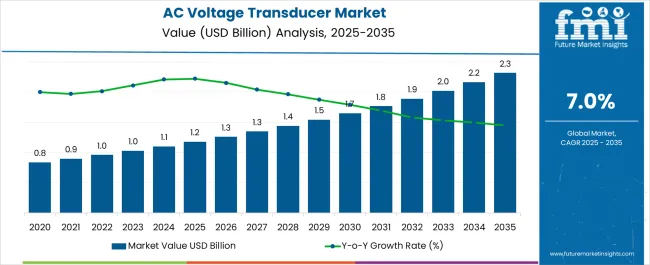
The AC Voltage Transducer market was valued at USD 1.2 billion in 2025, projected to reach USD 1.28 billion in 2026, and is forecast to expand to USD 2.53 billion by 2036 at a 7.0% CAGR. Accelerating industrial automation deployments, grid monitoring infrastructure upgrades, and the proliferation of building energy management systems are generating sustained demand for precision AC voltage measurement devices across manufacturing, commercial facility, and utility distribution network applications.
FMI is of the opinion that the transition from conventional analogue transducer modules to digital output and communication-enabled smart transducers is elevating both demand volumes and average unit values, as industrial operators and building managers seek integration-ready measurement nodes compatible with programmable logic controllers, SCADA systems, and cloud-based energy management platforms. The voltage transducer market is increasingly interlinked with the industrial IoT sensor market and the power quality monitoring market, as condition monitoring and predictive maintenance architectures require real-time voltage measurement at distributed network points.
Summary of AC Voltage Transducer Market
- Market Snapshot
- The AC Voltage Transducer market is valued at USD 1.2 billion in 2025 and is projected to reach USD 2.53 billion by 2036.
- The industry is expected to grow at a 7.0% CAGR from 2026 to 2036, creating an incremental opportunity of USD 1.242 billion.
- The market is a precision sensing component category where industrial automation penetration, smart grid instrumentation programmes, and building energy management compliance mandates define demand trajectories.
- Demand and Growth Drivers
- Industrial automation deployments and motor drive protection requirements are generating sustained demand for high-accuracy AC voltage transducers in manufacturing and process control applications.
- Smart grid instrumentation and distribution network monitoring programmes are driving utility segment adoption of communication-enabled voltage measurement nodes.
- Commercial building energy management certification requirements and sub-metering mandates are expanding addressable transducer demand across multi-tenant and large commercial premises.
- China leads at 9.5% CAGR, followed by India at 8.8%, Germany at 8.1%, France at 7.4%, UK at 6.7%, USA at 6.0%, and Brazil at 5.3%.
- Product and Segment View
- The market covers analogue and digital output AC voltage transducers, hall-effect and transformer-isolated measurement modules, and smart communication-enabled voltage sensing devices for industrial, commercial, and utility network applications.
- Industrial application leads with 39.0% share in 2026, driven by manufacturing automation, motor drive protection, and process control voltage monitoring requirements.
- Digital output and fieldbus-compatible transducers are gaining share against conventional analogue output devices, driven by industrial IoT integration and SCADA system connectivity requirements.
- Scope includes AC voltage measurement transducers and transmitters for panel, DIN rail, and distribution board mounting; excludes current transducers, power quality analysers, and energy meters as standalone devices.
- Geography and Competitive Outlook
- China and India are the fastest-growing markets driven by industrial automation investments and smart grid programmes, while Germany and France represent high-value demand from precision manufacturing and energy management compliance.
- The USA generates steady demand from industrial facility automation and grid modernisation programmes, with commercial building energy monitoring adding incremental volume.
- Competition is served by global measurement and automation specialists alongside dedicated transducer manufacturers, with key players including ABB, Analog Devices, Carlo Gavazzi, CR Magnetics, LEM International, NK Technologies, Phoenix Contact, Schneider Electric, Siemens, Socomec.
AC Voltage Transducer Market Key Takeaways
| Metric | Details |
|---|---|
| Industry Size (2026) | USD 1.28 billion |
| Industry Value (2036) | USD 2.53 billion |
| CAGR (2026 to 2036) | 7.0% |
| Source | Future Market Insights, 2026 |
Source: FMI analysis based on primary research and proprietary forecasting model
The absolute dollar increment between 2026 and 2036 stands at USD 1.242 billion, reflecting a precision measurement component category undergoing technology-driven average selling price escalation alongside volume growth. FMI analysts observe that industrial segment demand is being shaped by the adoption of motor drive protection systems, variable frequency drive installations, and automated process control loops requiring high-accuracy voltage sensing at machine-level distribution points.
Commercial application growth is driven by green building certification requirements mandating sub-metered energy monitoring across multi-tenant and large commercial premises. Utility demand is anchored by smart grid instrumentation programmes deploying distributed voltage sensors across medium and low-voltage distribution networks to support outage detection, power quality management, and demand response programme execution.
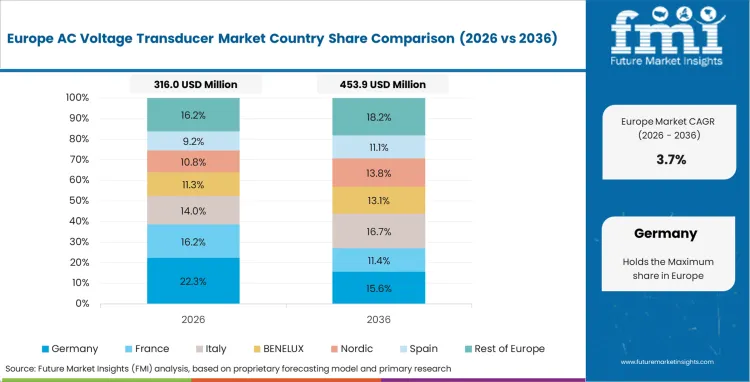
China leads at a 9.5% CAGR through 2036, driven by industrial automation investment under national manufacturing upgrading programmes and smart grid infrastructure expansion by state-owned utilities. India follows at 8.8% as national smart metering rollout programmes and industrial capacity expansion in manufacturing sectors generate parallel demand for measurement and monitoring components. Germany advances at 8.1% supported by Industry 4.0 adoption in manufacturing and commercial building energy management requirements under building energy efficiency regulations.
France progresses at 7.4% anchored by commercial building energy monitoring mandates and utility distribution network modernisation. The United Kingdom tracks at 6.7%, driven by commercial energy management compliance requirements and industrial site monitoring upgrades. The United States records 6.0% growth, supported by industrial facility automation investments and grid modernisation programmes. Brazil generates 5.3% growth from industrial sector expansion and utility grid instrumentation upgrades.
AC Voltage Transducer Market Definition
The AC Voltage Transducer market encompasses electronic measurement devices that convert alternating current voltage signals into standardised analogue or digital output signals proportional to the measured AC voltage, enabling safe and accurate voltage monitoring in industrial automation systems, commercial energy management installations, and utility distribution network instrumentation. Devices include transformer-isolated voltage transducers, hall-effect based measurement modules, and smart transducers with fieldbus or wireless communication interfaces, operating across standard industrial and utility voltage ranges in compliance with international measurement and safety standards.
AC Voltage Transducer Market Inclusions
Market scope includes DIN rail, panel-mount, and PCB-mount AC voltage transducers with analogue output (4-20mA, 0-10V), digital output (Modbus, PROFIBUS, CANopen), and wireless communication variants. Isolated voltage measurement modules for motor drives, variable frequency drives, and process control panels, as well as smart transducers compatible with industrial IoT and building management system architectures, are fully incorporated across industrial, commercial, and utility application segments.
AC Voltage Transducer Market Exclusions
Standalone current transducers, multi-parameter power quality analysers, revenue-grade energy meters, and voltage sensors integrated as sub-components within larger switchgear or motor drive assemblies are excluded. High-voltage instrument transformers for substation applications and oscilloscope voltage probes fall outside defined analytical boundaries. Resistive voltage dividers and passive measurement components without active signal conditioning are explicitly omitted from market valuation.
AC Voltage Transducer Market Research Methodology
- Primary Research: FMI analysts engaged with industrial automation engineers, building energy management system integrators, utility grid instrumentation procurement leads, and transducer component product managers to map application adoption triggers and technology selection criteria.
- Desk Research: Data aggregation incorporated industrial capital expenditure statistics from national statistical agencies, smart grid instrumentation programme documentation from utility regulators, building energy efficiency standards from regulatory bodies, and company primary disclosures from annual reports and investor presentations.
- Market-Sizing and Forecasting: Baseline values were derived from bottom-up aggregation of industrial automation equipment shipments, commercial building energy management system installations, and utility smart grid sensor deployment programmes, applying voltage transducer content ratios per system type.
- Data Validation and Update Cycle: Projections are cross-referenced against publicly reported sales data from leading measurement and automation component manufacturers and validated against industrial construction output and smart grid investment statistics from government and regulatory sources.
Why is the AC Voltage Transducer Market Growing?
The AC voltage transducer market is witnessing steady expansion driven by rising demand for efficient power monitoring, grid stability, and industrial automation across sectors. As industries adopt smart grid technologies and energy-efficient systems, voltage transducers have become integral to monitoring voltage levels, preventing overloads, and ensuring accurate energy billing.
The growing emphasis on predictive maintenance and process optimization has further increased the deployment of AC voltage transducers in manufacturing and utility infrastructures. Regulatory mandates for power quality and safety standards are also pushing utilities and industrial operators to integrate reliable voltage sensing components in their systems.
Technological improvements in signal conditioning, miniaturization, and digital communication interfaces are expected to enhance device performance, opening opportunities across legacy grid upgrades and emerging IoT-based energy management systems.
Segmental Analysis
The AC voltage transducer market is segmented by application and geographic regions. By application, the AC voltage transducer market is divided into Industrial, Railway, Renewables, Automotive, and others. Regionally, the AC voltage transducer industry is classified into North America, Latin America, Western Europe, Eastern Europe, Balkan & Baltic Countries, Russia & Belarus, Central Asia, East Asia, South Asia & Pacific, and the Middle East & Africa.
Insights into the Industrial Application Segment
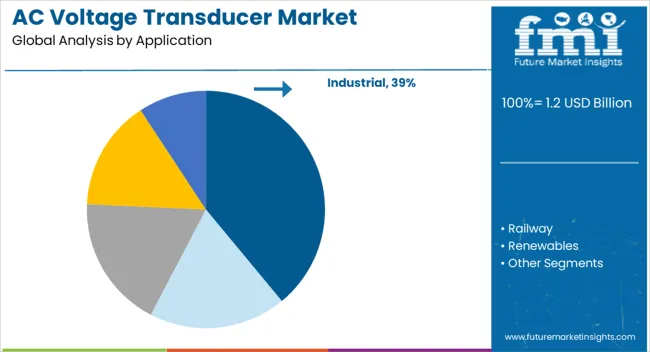
The industrial segment is projected to lead the AC voltage transducer market with a 39.00% revenue share in 2026. This dominance is being driven by widespread adoption of transducers for real-time monitoring, load balancing, and equipment protection across manufacturing plants, process industries, and heavy-duty applications.
Voltage transducers are essential in automated systems for ensuring operational safety, energy efficiency, and compliance with electrical standards. The growing trend of Industry 4.0 and integration of SCADA and PLC systems has further accelerated demand for accurate, noise-immune voltage measurement devices.
Industrial settings often operate under variable loads and fluctuating conditions, making transducer-based feedback systems critical for operational reliability. As infrastructure modernization continues, especially in developing markets, industrial deployments of AC voltage transducers are expected to remain dominant due to their scale, safety needs, and cost-saving potential.
What are the Drivers, Restraints, and Key Trends of the AC Voltage Transducer Market?
The AC voltage transducer market is growing due to the increasing demand for accurate and reliable measurement of alternating voltage in industrial, commercial, and residential applications. These devices play a key role in ensuring the proper functioning of electrical systems by converting AC voltage into a proportional DC signal for monitoring and control purposes. Technological advancements in transducer design and an increasing focus on energy efficiency are driving market growth. Despite challenges related to cost and integration with existing systems, opportunities for market expansion are found in automation, renewable energy, and smart grid systems.
Growing Demand for Energy Monitoring and Automation
The AC voltage transducer market is being driven by the growing need for precise energy monitoring and control across various industries. As industrial automation becomes more prevalent, there is an increasing demand for reliable transducers to monitor electrical systems in real-time, ensuring efficiency and minimizing downtime. In sectors such as energy, manufacturing, and utilities, these devices are critical for maintaining stable voltage levels and preventing equipment failure. The global shift toward smart grids and energy-efficient systems further supports the demand for advanced voltage transducers, enabling better integration with automation systems and real-time data monitoring. Additionally, regulatory standards for energy efficiency and safety are promoting the adoption of AC voltage transducers in energy management systems.
High Integration Costs and Compatibility Issues
A major challenge in the AC voltage transducer market is the high cost of integration, especially when upgrading existing electrical systems. The installation of new transducers in legacy systems requires significant investment in hardware and software, making the adoption of these devices expensive for many companies. Furthermore, compatibility issues between transducers and various system architectures, particularly in older setups, can lead to delays and additional costs. These integration complexities can discourage smaller businesses or organizations with limited budgets from investing in new voltage monitoring technology. The need for highly skilled technicians to calibrate and maintain these systems adds to the operational costs, further limiting adoption in some markets.
Advancements in Smart Grid and Energy Management Systems
The AC voltage transducer market presents substantial opportunities due to the growing adoption of smart grid and energy management systems. These systems require precise voltage measurements to optimize energy distribution and consumption. As utilities and industries worldwide invest in smart infrastructure, the demand for advanced transducers capable of real-time data transmission and integration with cloud-based platforms is increasing. The transition toward renewable energy sources such as solar and wind also creates a need for efficient voltage regulation, providing further opportunities for transducer manufacturers. Moreover, the rise in energy storage systems and electric vehicles presents new avenues for the deployment of AC voltage transducers, helping to manage and monitor power flow efficiently.
Integration with IoT and Advancements in Digital Technology
A key trend in the AC voltage transducer market is the integration of Internet of Things (IoT) technology, enabling real-time monitoring and data analytics. By incorporating IoT capabilities, voltage transducers can send data to centralized control systems, providing insights into energy consumption patterns, voltage fluctuations, and system health. This integration is particularly beneficial in industries focused on energy optimization and predictive maintenance. Another trend is the advancement of digital transducers that offer higher accuracy, faster response times, and enhanced reliability compared to traditional analog models. As industries push for more energy-efficient and automated systems, the demand for smart, digital AC voltage transducers that integrate seamlessly into modern electrical grids continues to rise.
Analysis of AC Voltage Transducer Market By Key Countries
.webp "Top Country Growth Comparison Ac Voltage Transducer Market Cagr (2026 2036)")
| Country | CAGR |
|---|---|
| China | 9.5% |
| India | 8.8% |
| Germany | 8.1% |
| France | 7.4% |
| UK | 6.7% |
| USA | 6.0% |
| Brazil | 5.3% |
Source: FMI analysis based on primary research and proprietary forecasting model
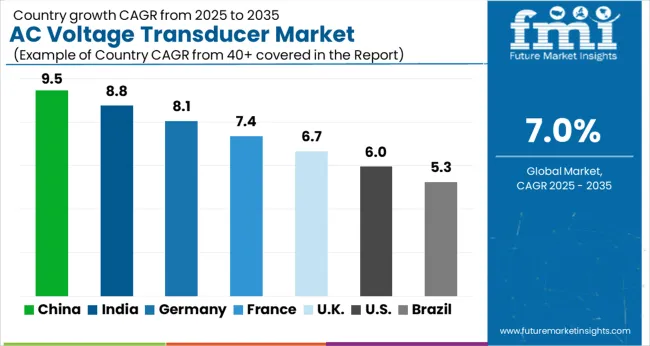
The AC voltage transducer market is projected to grow at a CAGR of 7.0% from 2026 to 2036. China leads at 9.5%, followed by India at 8.8%, France at 7.4%, the United Kingdom records 6.7%, and the United States stands at 6.0%. These growth rates reflect the significant demand for AC voltage transducers in BRICS countries like China and India, driven by rapid industrialization, the need for improved electrical infrastructure, and energy management. Developed markets such as France, the UK, and the USA demonstrate steady growth, supported by advancements in electrical systems and a focus on energy efficiency. The analysis spans over 40+ countries, with the top countries shown below.
Sales Dynamics of AC Voltage Transducer Market in China
China is projected to grow at a CAGR of 9.5% through 2036, driven by its vast industrial landscape and the rapid expansion of smart grid systems. China’s focus on upgrading its electrical infrastructure, improving energy efficiency, and increasing reliance on renewable energy has heightened the demand for AC voltage transducers. The rising demand for automation and control systems in manufacturing plants and the increasing adoption of electric vehicles further support the market. The government’s emphasis on clean energy and electrical system reliability accelerates the adoption of voltage transducers in various applications, including industrial automation, power distribution, and renewable energy sectors.
- Rapid industrialization and infrastructure expansion drive demand for voltage transducers.
- Smart grid and renewable energy adoption accelerates market growth.
- Electric vehicle and automation demand fuels voltage monitoring needs.
Growth Prospects of AC Voltage Transducer Market in India
India is expected to grow at a CAGR of 8.8% through 2036, driven by a rapidly expanding industrial base and increased demand for energy-efficient solutions. With a growing population and expanding manufacturing and infrastructure sectors, the need for accurate and efficient voltage measurement and monitoring solutions has risen sharply. The Indian government’s push to enhance electrical grids, alongside investments in smart grid technologies, is boosting demand for AC voltage transducers in power management systems. The increasing adoption of renewable energy and the subsequent need for voltage monitoring in solar and wind energy systems further accelerates market growth.
- Demand from growing industrial sectors drives market adoption.
- Government initiatives to modernize electrical grids boost transducer usage.
- Renewable energy sector growth contributes to increased demand for voltage monitoring.
Market Expansion for AC Voltage Transducers in France
France is projected to grow at a CAGR of 7.4% through 2036, driven by increasing demand for energy-efficient solutions across industrial and residential sectors. As part of its strategy to reduce energy consumption and promote sustainable energy, France is investing heavily in smart grid technologies, which require efficient voltage monitoring solutions. The French market is also experiencing growth due to the expansion of renewable energy sources such as solar and wind, which necessitate precise voltage control and monitoring systems. The demand for AC voltage transducers is being driven by advancements in electrical infrastructure and the need for reliable power distribution systems.
- Government focus on energy efficiency supports voltage transducer demand.
- Growth in renewable energy applications drives voltage monitoring needs.
- Smart grid investments increase adoption of advanced voltage solutions.
Future Outlook for AC Voltage Transducer Market in the United States
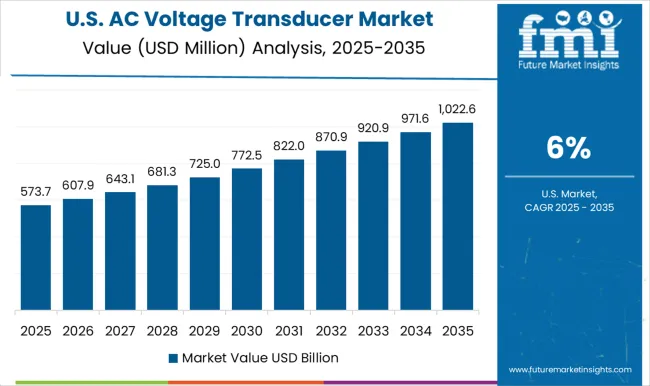
The United States is projected to grow at a CAGR of 6.0% through 2036, with demand primarily driven by the growing need for energy-efficient electrical systems and advancements in smart grid technologies. As the USA transitions towards more sustainable energy solutions, the demand for AC voltage transducers to ensure efficient energy management is rising. The USA industrial sector, particularly in manufacturing, automation, and renewable energy, continues to adopt more precise and reliable voltage monitoring systems. This trend is further supported by the country's regulatory requirements for energy efficiency and grid modernization.
- Adoption of smart grid technologies boosts demand for voltage transducers.
- Energy efficiency goals drive investment in advanced voltage monitoring systems.
- Renewable energy and automation sectors contribute to market growth.
Demand and Adoption of AC Voltage Transducers in the United Kingdom
TThe United Kingdom is projected to grow at a CAGR of 6.7% through 2036, driven by continued advancements in electrical infrastructure and energy management solutions. The UK is focusing on increasing energy efficiency in both the industrial and residential sectors, contributing to the growth of the AC voltage transducer market. The rise of renewable energy technologies and the need for precise voltage control in these systems are expected to drive demand. The UK government’s initiatives to improve electrical grid infrastructure and modernize energy systems further support the market. The need for more reliable and efficient voltage monitoring solutions across various sectors, including automotive and manufacturing, continues to grow.
- Energy efficiency goals drive adoption of voltage transducers.
- Growth in renewable energy and grid modernization increases market demand.
- Technological advancements in voltage monitoring systems propel market growth.
Competitive Landscape of AC Voltage Transducer Market
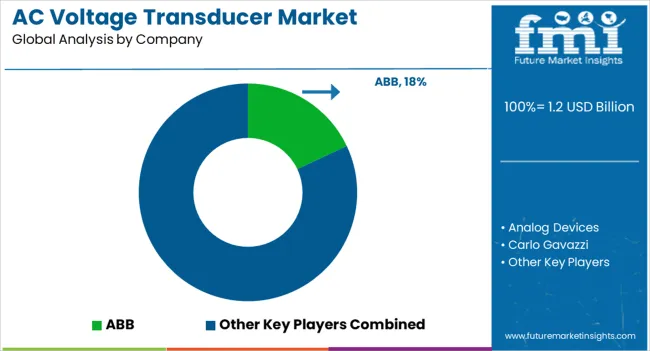
The AC voltage transducer market is driven by major players in the industrial and electronics sectors, providing precise measurement solutions for monitoring voltage fluctuations, energy consumption, and electrical systems in various applications. ABB, Siemens, and Schneider Electric are key global players, offering advanced AC voltage transducers integrated into their energy management systems, industrial automation, and building management solutions.
These companies leverage their extensive expertise in electrical infrastructure and automation to provide reliable, accurate voltage measurement devices for critical applications. Analog Devices and Carlo Gavazzi focus on offering cutting-edge voltage transducers for monitoring power quality, with an emphasis on high precision, low power consumption, and integration with IoT-based systems for smart grids.
LEM International and Phoenix Contact specialize in transducers with integrated protection features, aimed at industrial environments, including manufacturing and renewable energy systems. NK Technologies and CR Magnetics provide innovative solutions for power monitoring, offering both standalone and integrated voltage transducers to enhance system reliability in commercial and industrial applications.
Competitive differentiation in this market revolves around measurement accuracy, scalability for different voltage levels, signal conversion technology, and integration with digital control systems. Barriers to entry include technical complexity, certification requirements, and established relationships with large industrial customers. Strategic priorities involve improving signal processing capabilities, expanding wireless and IoT-enabled transducer solutions, and enhancing compatibility with renewable energy systems and energy storage applications.
Scope of the Report
| Metric | Value |
|---|---|
| Quantitative Units | USD 1.28 billion to USD 2.53 billion, at a CAGR of 7.0% |
| Market Definition | AC Voltage Transducers encompass active electronic measurement devices converting AC voltage signals to standardised output for industrial automation, commercial energy management, and utility grid instrumentation applications. |
| Application Segmentation | Industrial, Commercial, Utility |
| Regions Covered | North America, Latin America, Europe, East Asia, South Asia, Oceania, Middle East & Africa |
| Countries Covered | India, China, USA, Germany, France, UK, Brazil, and 40 plus countries |
| Key Companies Profiled | ABB, Analog Devices, Carlo Gavazzi, CR Magnetics, LEM International, NK Technologies, Phoenix Contact, Schneider Electric, Siemens, Socomec |
| Forecast Period | 2026 to 2036 |
| Approach | Bottom-up methodology aggregating industrial automation equipment deployment volumes, commercial building management system installations, and utility smart grid sensor programmes with technology adoption overlay for digital and smart transducer penetration rates. |
AC Voltage Transducer Market by Segments
Application:
- Industrial
- Railway
- Renewables
- Automotive
- Others
Region:
- North America
- USA
- Canada
- Mexico
- Latin America
- Brazil
- Chile
- Rest of Latin America
- Western Europe
- Germany
- UK
- Italy
- Spain
- France
- Nordic
- BENELUX
- Rest of Western Europe
- Eastern Europe
- Russia
- Poland
- Hungary
- Balkan & Baltic
- Rest of Eastern Europe
- East Asia
- China
- Japan
- South Korea
- South Asia and Pacific
- India
- ASEAN
- Australia & New Zealand
- Rest of South Asia and Pacific
- Middle East & Africa
- Kingdom of Saudi Arabia
- Other GCC Countries
- Turkiye
- South Africa
- Other African Union
- Rest of Middle East & Africa
Bibliography
- 1. International Electrotechnical Commission. (2023). IEC 61869: Instrument transformers and transducers. IEC. https://www.iec.ch
- 2. International Energy Agency. (2025). Smart grids: Tracking clean energy progress. IEA. https://www.iea.org
- 3. European Commission, Directorate-General for Energy. (2025). Energy efficiency directive: Implementation status. European Commission. https://energy.ec.europa.eu
- 4. International Society of Automation. (2023). ISA-50: Signal compatibility of electrical instruments. ISA. https://www.isa.org
- 5. National Institute of Standards and Technology. (2025). Smart grid standards and measurement. NIST. https://www.nist.gov
- 6. Central Electricity Authority, Government of India. (2025). Advanced metering infrastructure rollout progress report. CEA. https://cea.nic.in
- 7. Organisation for Economic Co-operation and Development. (2023). Digitalisation of the electricity system. OECD. https://www.oecd.org
This bibliography is provided for reader reference. The full Future Market Insights report contains the complete reference list with primary research documentation.
Frequently Asked Questions
How large is the AC Voltage Transducer market in 2026?
The AC Voltage Transducer market is estimated at USD 1.284 billion in 2026.
What will the AC Voltage Transducer market size reach by 2036?
The market is projected to reach USD 2.526 billion by 2036.
What is the CAGR for the AC Voltage Transducer market from 2026 to 2036?
The AC Voltage Transducer market is expected to grow at a CAGR of 7.0% between 2026 and 2036.
Which Application segment leads AC Voltage Transducer demand in 2026?
Industrial applications hold 39.0% share in 2026, driven by motor drive protection systems, variable frequency drive installations, and automated process control voltage monitoring requirements in manufacturing facilities.
Which country registers the fastest growth for AC Voltage Transducers?
China leads with a 9.5% CAGR through 2036, supported by national manufacturing upgrading programmes driving industrial automation investments and smart grid expansion programmes by state utility operators.
What is driving adoption in Germany and France?
Germany advances at 8.1% CAGR driven by Industry 4.0 precision manufacturing requirements and building energy efficiency directive compliance, while France progresses at 7.4% anchored by commercial building energy monitoring mandates and utility distribution instrumentation upgrades.
What technology trend is reshaping the AC Voltage Transducer market?
The transition from conventional analogue output devices to digital fieldbus-compatible and IoT-enabled smart transducers is the primary structural technology shift, raising average unit values and expanding addressable integration use cases across industrial SCADA systems and building management platforms.
Preview the report firsthand - request a free sample
Get SampleGet the brochure for pricing and purchase details.
Get PDFTable of Content
- Executive Summary
- Global Market Outlook
- Demand-side Trends
- Supply-side Trends
- Technology Roadmap Analysis
- Analysis and Recommendations
- Market Overview
- Market Coverage / Taxonomy
- Market Definition / Scope / Limitations
- Research Methodology
- Company Annual and Sustainability Reports
- Peer-reviewed Journals and Academic Literature
- Corporate Websites, Product Literature, and Technical Notes
- Earnings Decks and Investor Briefings
- Statutory Filings and Regulatory Disclosures
- Technical White Papers and Standards Notes
- Trade Journals, Industry Magazines, and Analyst Briefs
- Conference Proceedings, Webinars, and Seminar Materials
- Government Statistics Portals and Public Data Releases
- Press Releases and Reputable Media Coverage
- Specialist Newsletters and Curated Briefings
- Sector Databases and Reference Repositories
- FMI Internal Proprietary Databases and Historical Market Datasets
- Subscription Datasets and Paid Sources
- Social Channels, Communities, and Digital Listening Inputs
- Additional Desk Sources
- Expert Input and Fieldwork (Primary Evidence)
- Primary Modes
- Qualitative Interviews and Expert Elicitation
- Quantitative Surveys and Structured Data Capture
- Blended Approach
- Why Primary Evidence is Used
- Field Techniques
- Interviews
- Surveys
- Focus Groups
- Observational and In-context Research
- Social and Community Interactions
- Stakeholder Universe Engaged
- C-suite Leaders
- Board Members
- Presidents and Vice Presidents
- R&D and Innovation Heads
- Technical Specialists
- Domain Subject-matter Experts
- Scientists
- Physicians and Other Healthcare Professionals
- Governance, Ethics, and Data Stewardship
- Research Ethics
- Data Integrity and Handling
- Primary Modes
- Tooling, Models, and Reference Databases
- Data Engineering and Model Build
- Data Acquisition and Ingestion
- Cleaning, Normalisation, and Verification
- Synthesis, Triangulation, and Analysis
- Quality Assurance and Audit Trail
- Market Background
- Market Dynamics
- Drivers
- Restraints
- Opportunity
- Trends
- Scenario Forecast
- Demand in Optimistic Scenario
- Demand in Likely Scenario
- Demand in Conservative Scenario
- Opportunity Map Analysis
- Product Life Cycle Analysis
- Supply Chain Analysis
- Investment Feasibility Matrix
- Value Chain Analysis
- PESTLE and Porter’s Analysis
- Regulatory Landscape
- Regional Parent Market Outlook
- Production and Consumption Statistics
- Import and Export Statistics
- Market Dynamics
- Global Market Analysis 2021 to 2025 and Forecast, 2026 to 2036
- Historical Market Size Value (USD Million) Analysis, 2021 to 2025
- Current and Future Market Size Value (USD Million) Projections, 2026 to 2036
- Y-o-Y Growth Trend Analysis
- Absolute $ Opportunity Analysis
- Global Market Pricing Analysis 2021 to 2025 and Forecast 2026 to 2036
- Global Market Analysis 2021 to 2025 and Forecast 2026 to 2036, By Application
- Introduction / Key Findings
- Historical Market Size Value (USD Million) Analysis By Application , 2021 to 2025
- Current and Future Market Size Value (USD Million) Analysis and Forecast By Application , 2026 to 2036
- Industrial
- Railway
- Renewables
- Automotive
- Others
- Industrial
- Y-o-Y Growth Trend Analysis By Application , 2021 to 2025
- Absolute $ Opportunity Analysis By Application , 2026 to 2036
- Global Market Analysis 2021 to 2025 and Forecast 2026 to 2036, By Region
- Introduction
- Historical Market Size Value (USD Million) Analysis By Region, 2021 to 2025
- Current Market Size Value (USD Million) Analysis and Forecast By Region, 2026 to 2036
- North America
- Latin America
- Western Europe
- Eastern Europe
- East Asia
- South Asia and Pacific
- Middle East & Africa
- Market Attractiveness Analysis By Region
- North America Market Analysis 2021 to 2025 and Forecast 2026 to 2036, By Country
- Historical Market Size Value (USD Million) Trend Analysis By Market Taxonomy, 2021 to 2025
- Market Size Value (USD Million) Forecast By Market Taxonomy, 2026 to 2036
- By Country
- USA
- Canada
- Mexico
- By Application
- By Country
- Market Attractiveness Analysis
- By Country
- By Application
- Key Takeaways
- Latin America Market Analysis 2021 to 2025 and Forecast 2026 to 2036, By Country
- Historical Market Size Value (USD Million) Trend Analysis By Market Taxonomy, 2021 to 2025
- Market Size Value (USD Million) Forecast By Market Taxonomy, 2026 to 2036
- By Country
- Brazil
- Chile
- Rest of Latin America
- By Application
- By Country
- Market Attractiveness Analysis
- By Country
- By Application
- Key Takeaways
- Western Europe Market Analysis 2021 to 2025 and Forecast 2026 to 2036, By Country
- Historical Market Size Value (USD Million) Trend Analysis By Market Taxonomy, 2021 to 2025
- Market Size Value (USD Million) Forecast By Market Taxonomy, 2026 to 2036
- By Country
- Germany
- UK
- Italy
- Spain
- France
- Nordic
- BENELUX
- Rest of Western Europe
- By Application
- By Country
- Market Attractiveness Analysis
- By Country
- By Application
- Key Takeaways
- Eastern Europe Market Analysis 2021 to 2025 and Forecast 2026 to 2036, By Country
- Historical Market Size Value (USD Million) Trend Analysis By Market Taxonomy, 2021 to 2025
- Market Size Value (USD Million) Forecast By Market Taxonomy, 2026 to 2036
- By Country
- Russia
- Poland
- Hungary
- Balkan & Baltic
- Rest of Eastern Europe
- By Application
- By Country
- Market Attractiveness Analysis
- By Country
- By Application
- Key Takeaways
- East Asia Market Analysis 2021 to 2025 and Forecast 2026 to 2036, By Country
- Historical Market Size Value (USD Million) Trend Analysis By Market Taxonomy, 2021 to 2025
- Market Size Value (USD Million) Forecast By Market Taxonomy, 2026 to 2036
- By Country
- China
- Japan
- South Korea
- By Application
- By Country
- Market Attractiveness Analysis
- By Country
- By Application
- Key Takeaways
- South Asia and Pacific Market Analysis 2021 to 2025 and Forecast 2026 to 2036, By Country
- Historical Market Size Value (USD Million) Trend Analysis By Market Taxonomy, 2021 to 2025
- Market Size Value (USD Million) Forecast By Market Taxonomy, 2026 to 2036
- By Country
- India
- ASEAN
- Australia & New Zealand
- Rest of South Asia and Pacific
- By Application
- By Country
- Market Attractiveness Analysis
- By Country
- By Application
- Key Takeaways
- Middle East & Africa Market Analysis 2021 to 2025 and Forecast 2026 to 2036, By Country
- Historical Market Size Value (USD Million) Trend Analysis By Market Taxonomy, 2021 to 2025
- Market Size Value (USD Million) Forecast By Market Taxonomy, 2026 to 2036
- By Country
- Kingdom of Saudi Arabia
- Other GCC Countries
- Turkiye
- South Africa
- Other African Union
- Rest of Middle East & Africa
- By Application
- By Country
- Market Attractiveness Analysis
- By Country
- By Application
- Key Takeaways
- Key Countries Market Analysis
- USA
- Pricing Analysis
- Market Share Analysis, 2025
- By Application
- Canada
- Pricing Analysis
- Market Share Analysis, 2025
- By Application
- Mexico
- Pricing Analysis
- Market Share Analysis, 2025
- By Application
- Brazil
- Pricing Analysis
- Market Share Analysis, 2025
- By Application
- Chile
- Pricing Analysis
- Market Share Analysis, 2025
- By Application
- Germany
- Pricing Analysis
- Market Share Analysis, 2025
- By Application
- UK
- Pricing Analysis
- Market Share Analysis, 2025
- By Application
- Italy
- Pricing Analysis
- Market Share Analysis, 2025
- By Application
- Spain
- Pricing Analysis
- Market Share Analysis, 2025
- By Application
- France
- Pricing Analysis
- Market Share Analysis, 2025
- By Application
- India
- Pricing Analysis
- Market Share Analysis, 2025
- By Application
- ASEAN
- Pricing Analysis
- Market Share Analysis, 2025
- By Application
- Australia & New Zealand
- Pricing Analysis
- Market Share Analysis, 2025
- By Application
- China
- Pricing Analysis
- Market Share Analysis, 2025
- By Application
- Japan
- Pricing Analysis
- Market Share Analysis, 2025
- By Application
- South Korea
- Pricing Analysis
- Market Share Analysis, 2025
- By Application
- Russia
- Pricing Analysis
- Market Share Analysis, 2025
- By Application
- Poland
- Pricing Analysis
- Market Share Analysis, 2025
- By Application
- Hungary
- Pricing Analysis
- Market Share Analysis, 2025
- By Application
- Kingdom of Saudi Arabia
- Pricing Analysis
- Market Share Analysis, 2025
- By Application
- Turkiye
- Pricing Analysis
- Market Share Analysis, 2025
- By Application
- South Africa
- Pricing Analysis
- Market Share Analysis, 2025
- By Application
- USA
- Market Structure Analysis
- Competition Dashboard
- Competition Benchmarking
- Market Share Analysis of Top Players
- By Region
- By Application
- Competition Analysis
- Competition Deep Dive
- ABB
- Overview
- Product Portfolio
- Profitability by Market Segments (Product/Age /Sales Channel/Region)
- Sales Footprint
- Strategy Overview
- Marketing Strategy
- Product Strategy
- Channel Strategy
- Analog Devices
- Carlo Gavazzi
- CR Magnetics
- LEM International
- NK Technologies
- Phoenix Contact
- Schneider Electric
- Siemens
- Socomec
- ABB
- Competition Deep Dive
- Assumptions & Acronyms Used


