

- Industry Size (2026)
- USD 290.0 Mn
- Forecast (2036)
- USD 575.9 Mn
- CAGR (2026 to 2036)
- 7.10%
Charcoal Teeth Whitening Powder Market Size, Market Forecast, and Outlook By FMI
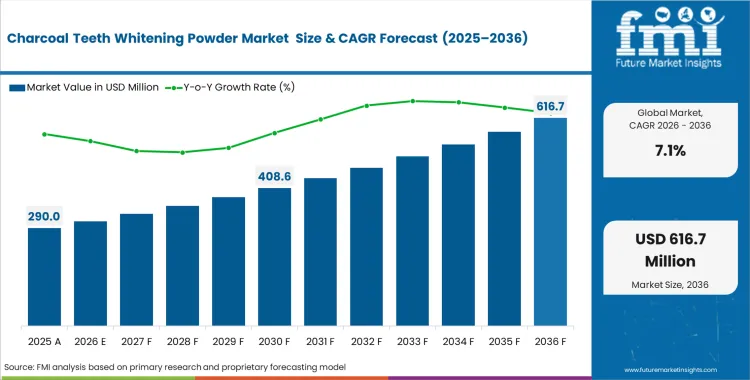
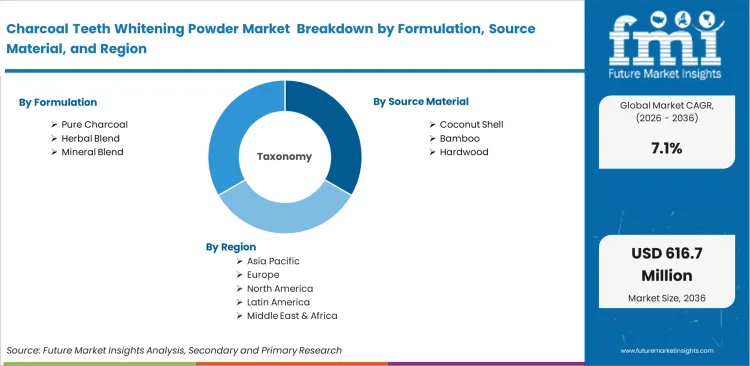
The charcoal teeth whitening powder market was valued at USD 270.8 million in 2025. Demand is estimated to hit USD 290.0 million in 2026 at a charcoal teeth whitening powder CAGR of 7.10% during this forecast period. Market value is projected at a total valuation of USD 575.9 million through 2036 as consumer goods formulators prioritize abrasive stain removal formats that bypass professional clinical channels.
Summary of Charcoal Teeth Whitening Powder Market
- Market Snapshot
- The charcoal teeth whitening powder market was valued at USD 270.8 million in 2025 and is projected to reach USD 575.9 million by 2036.
- Sector is expected to expand at a 7.1% CAGR from 2026 to 2036, creating an incremental opportunity of USD 285.8 million.
- This category operates as a small OTC whitening niche within oral care, concentrated around powder-based surface-stain removal rather than peroxide-led deep bleaching.
- Growth is commercially viable, but the category remains structurally capped by weak clinical differentiation versus conventional whitening products and dentist-supervised options.
- Demand and Growth Drivers
- Consumer interest in natural, peroxide-free, stain-lifting oral care products is driving demand, particularly for discoloration caused by tea, coffee, wine, and tobacco.
- E-commerce remains a major growth engine because specialist powder brands can scale globally without needing mainstream shelf space, which supports the 49.0% online retail share estimate.
- Category expansion is also tied to premiumization across broader oral care, where whitening continues to attract consumer spending inside a larger market forecast to reach USD 95.7 billion by 2036.
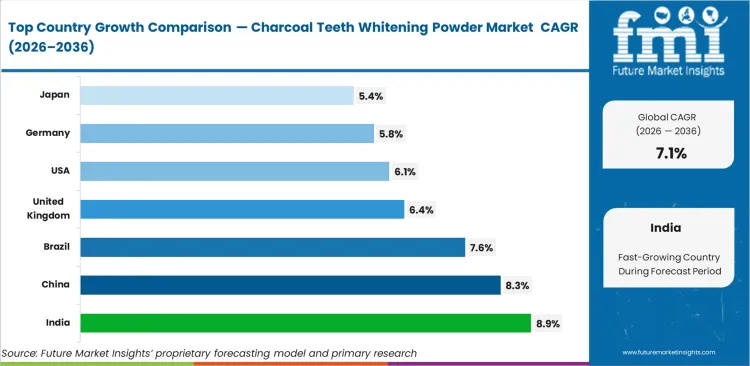
- India is estimated to lead at 8.9% CAGR, followed by China at 8.3%, Brazil at 7.6%, the United Kingdom at 6.4%, the United States at 6.1%, Germany at 5.8%, and Japan at 5.4%.
- Growth is moderated by clinical evidence showing charcoal formulations often deliver surface cleaning more than true whitening, alongside roughness and abrasion concerns.
- Product and Segment View
- The market covers powder-based OTC whitening dentifrices built mainly from activated charcoal, commonly positioned as stain removers, detoxifying powders, or peroxide-free oral-brightening products.
- These products are used mainly for surface stains, daily brightening routines, and natural-oral-care regimens rather than professional bleaching outcomes.
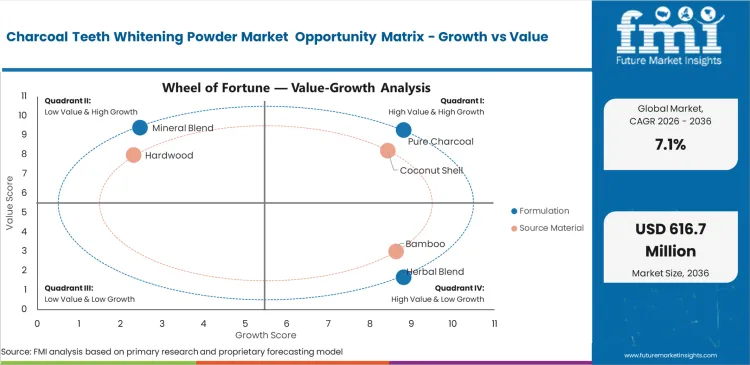
- Clean-label positioning and simple stain-removal appeal are expected to support Pure Charcoal's 46.0% share of the formulation segment in 2026.
- Coconut Shell is anticipated to capture 54.0% share of the source material segment in 2026, reflecting the commercial preference for coconut-derived activated charcoal across branded oral-care powders.
- Online Retail is estimated to hold 49.0% share of the distribution channel segment in 2026, as direct-to-consumer websites and digital marketplaces remain the most efficient route for category expansion.
- Mid-Priced is poised to garner 47.0% share of the price tier segment in 2026, as consumer uptake remains strongest where affordability supports repeat trial and routine use.
- Scope includes standalone charcoal whitening powders and tooth-polish powders sold for home use, but excludes strips, pens, lamp systems, dentist-applied bleaching agents, and general charcoal toothpastes.
- Geography and Competitive Outlook
- India, China, and Brazil are expected to remain the fastest-growing markets, while the United States remains a stable high-value base because whitening awareness is already established.
- Competition is fragmented, led more by specialist oral-beauty and natural-care brands than by the biggest global toothpaste companies.
- Key active brands include Carbon Coco, Procoal, Georganics, HealthVit, Deyga, Habbits, and Apollo Noni, with Carbon Coco estimated to hold the leading individual share at 8.6%.
- Market structure remains shelf-light and digitally native, which helps small brands enter quickly but also keeps concentration low and product claims under scrutiny.
Formulators face growing pressure to validate stain-removal claims without crossing into restricted bleaching-agent classifications. Regulatory bodies limit hydrogen peroxide concentrations in over-the-counter products, forcing product developers toward mechanical abrasives like activated charcoal teeth whitening powder. Product performance depends partly on access to high-porosity charcoal grades that can support stain-removal efficacy in powder formulations. Delayed qualification of standardized cosmetic-grade carbon exposes brands to significant clinical pushback regarding enamel degradation. Teeth whitening platforms built entirely on mechanical abrasion face shorter product lifecycles than chemically active alternatives.
Clearer abrasivity guidance for charcoal tooth powder would improve retail confidence and could support broader mass-market adoption. Clear clinical thresholds would make pharmacy distribution more feasible alongside traditional dentifrices. Pre-standardization shelving decisions currently rely entirely on brand liability absorption rather than verified enamel safety.
India is expected to record an 8.9% CAGR through 2036, supported by digital-first oral-care brands scaling online distribution among younger consumers. China is anticipated to post 8.3% CAGR, aided by strong domestic production capacity and broader availability of coconut charcoal whitening powder across mass and specialty channels. Brazil is expected to register 7.6% CAGR as discretionary spending on cosmetic personal care continues to widen the buyer base. The United Kingdom is projected to expand at 6.4% CAGR, while the United States is estimated to rise at 6.1% CAGR over the 2026 to 2036 period. Germany is likely to record 5.8% CAGR, and Japan is expected to pose at a 5.4% CAGR. This spread reflects a clear divide between faster-moving emerging markets benefiting from digital toothbrushes and mature markets where evidence standards and clinical scrutiny keep adoption more measured.
Segmental Analysis
Charcoal Teeth Whitening Powder Market Analysis by Formulation
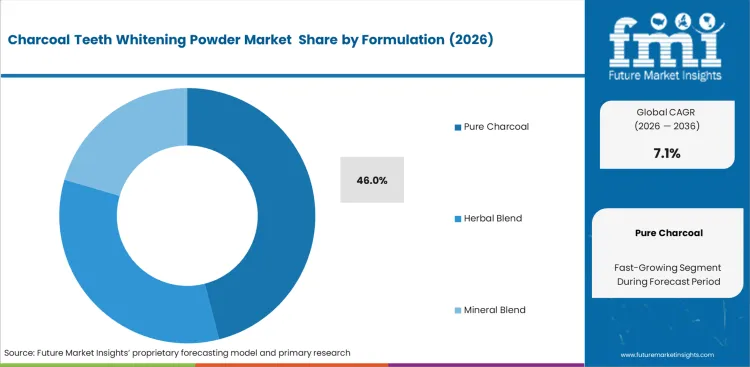
Minimalist composition keeps pure charcoal commercially relevant, where clean-label positioning and low formulation complexity influence purchase decisions. Removing binders, sweeteners, and secondary actives gives brands a simpler product story and lowers blending, compatibility, and ingredient-control requirements during production. Pure charcoal is expected to hold 46.0% share of the formulation segment in 2026, as manufacturers continue to benefit from straightforward sourcing, faster batch standardization, and easier label communication in natural oral-care channels. Positioning also remains favorable among consumers looking for peroxide-free whitening products, especially in routines built around surface-stain removal rather than chemically active treatment.
- Batch qualification streamlining: Single-ingredient formulas reduce blending complexity and shorten validation requirements across incoming materials and finished batches. Lower formulation burden helps smaller brands move faster with fewer processing variables.
- Moisture degradation risk: Unblended powders absorb ambient humidity more easily during storage and use. Higher clumping risk can weaken texture consistency, reduce user satisfaction, and raise return exposure.
- Clinical vulnerability: Pure abrasive systems fit demand for peroxide-free whitening products, but whitening depth remains narrower than formats built around a dental bleaching agent.
Charcoal Teeth Whitening Powder Market Analysis by Source Material
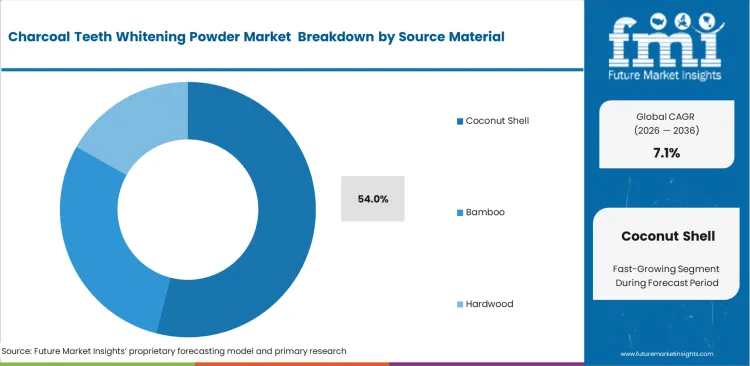
Coconut shell leads this segment because its activated carbon profile is better suited to surface-stain adsorption in oral-care powders than most wood-based alternatives. More reliable cleaning performance, cleaner ingredient positioning, and easier brand communication keep it commercially ahead in natural whitening formats. Coconut Shell is anticipated to capture 54.0% share of the source material segment in 2026, as manufacturers continue to prefer grades that balance efficacy, formulation consistency, and label appeal. Comparison with teeth whitening pens also supports its position, since powder buyers often place more value on familiar ingredients and non-peroxide positioning than on fast chemical whitening.
- Pore geometry alignment: Coconut-derived carbon adsorbs common dietary stains efficiently, which supports stain-removal performance without requiring heavier use levels.
- Yield volatility exposure: Feedstock supply can fluctuate with harvest conditions and kiln output, creating input-cost pressure when sourcing is not secured.
- Activation baseline requirements: Controlled activation remains critical because underprocessed batches reduce absorption efficiency and weaken product consistency.
Charcoal Teeth Whitening Powder Market Analysis by Distribution Channel
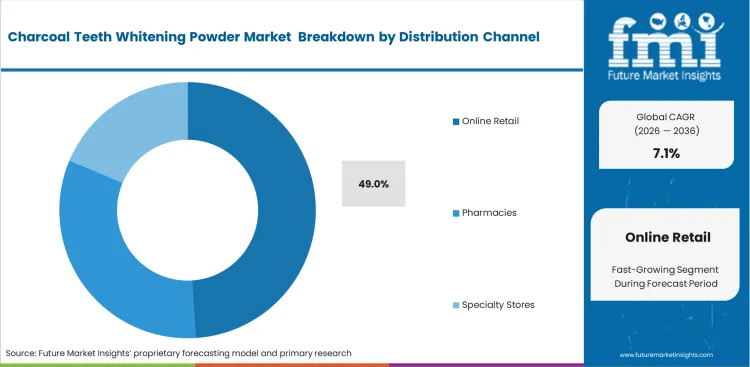
Online retail remains the leading distribution route because this category scales more easily through direct digital visibility than through pharmacy placement. Online Retail charcoal tooth powder is estimated to hold 49.0% share in 2026, as advantages continue to outweigh the weaker clinical validation and rising advertising costs associated with online-only expansion. Visual product demonstrations give emerging brands a practical way to communicate stain-removal results without depending on in-store education or dentist-linked channels. Faster listing cycles also make it easier to adjust packaging, claims framing, and bundle formats in response to consumer feedback. Lower entry barriers add to that advantage, especially for smaller brands that would otherwise struggle to absorb physical retail slotting costs or secure broad offline placement. Category visibility also benefits from adjacent digital oral-care traffic, where consumers browsing products such as toothpaste tablets are already comfortable evaluating newer non-traditional formats online.
- Gatekeeper bypass: Digital storefronts remove dependence on pharmacy shelf approvals and allow brands to update packaging, claims framing, and product bundles with greater speed. Faster iteration improves launch flexibility in a niche category where retail acceptance is still uneven.
- Visual demonstration scaling: Brushing demonstrations and stain-removal visuals translate well across digital commerce channels. Stronger visual communication helps brands convert trial purchases without relying on in-store education.
- Acquisition cost inflation: Platform advertising becomes more expensive as more oral-care brands compete for the same users. Margin pressure rises when repeat purchase and retention do not improve fast enough to offset higher customer acquisition costs.
Charcoal Teeth Whitening Powder Market Analysis by Price Tier
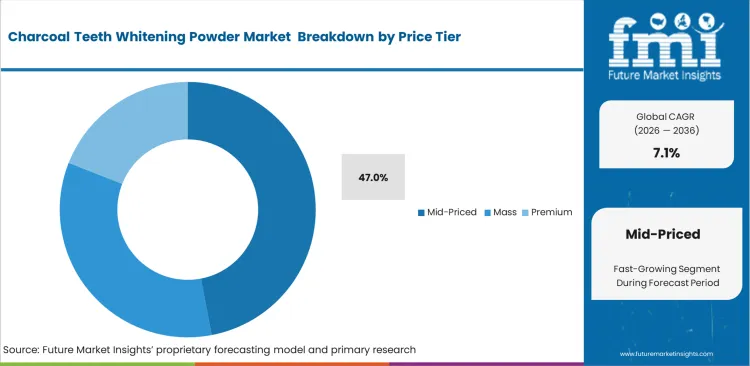
Mid-priced products lead this segment because oral-care buyers usually avoid the lowest-priced options when product safety and enamel exposure are part of the purchase decision. This tier gives brands enough room to maintain cosmetic-grade purification, acceptable packaging quality, and retail credibility without moving beyond routine trial range. Mid-Priced is poised to garner 47.0% share, as conversion remains strongest where perceived safety, affordability, and repeat-purchase viability stay in balance. Packaging costs can quickly distort pricing in this category, especially when jars, closures, and presentation upgrades add more cost than the formulation itself.
- Perception threshold balancing: Consumers often associate extremely low prices with weaker product safety in oral care. Stronger conversion usually comes from pricing that stays accessible without appearing compromised.
- Packaging margin leverage: Container, closure, and presentation choices can shape the final shelf price more than the charcoal formulation itself. Margin control improves when brands standardize packaging formats and avoid unnecessary packaging cost escalation.
- Cross-tier component sharing: Mid-priced and premium products may source carbon from similar processing bases, which narrows raw-material differentiation across tiers. Competitive separation often depends more on branding, packaging discipline, and channel execution than on major input differences.
Charcoal Teeth Whitening Powder Market Drivers, Restraints, and Opportunities
Regulatory restrictions on hydrogen peroxide concentrations in over-the-counter retail environments force product developers toward mechanical abrasion formats. Dental clinic channels cannot legally source high-percentage bleaching gels, compelling them to build portfolios around natural whitening powder alternatives. Delayed entry into carbon powder segments exposes oral hygiene brands to significant share erosion as digital-native competitors capture younger demographics seeking immediate aesthetic results. Formulators facing consumer pushback regarding chemical sensitivity drive this urgency. Formulation teams must deploy oral care chemicals substitutions before retail buyers reallocate shelf space entirely.
Clinical pushback regarding irreversible enamel degradation creates primary structural friction slowing broader adoption. Dental professionals actively advise patients against utilizing unregulated abrasive powders daily. This medical resistance makes pharmacy category managers hesitant to expand shelf space for pure carbon formats. While some brands attempt to integrate remineralizing agents, core mechanical conflicts remain unsolved. Until industry-standard Relative Dentin Abrasivity testing becomes mandatory for cosmetic powders, mainstream retail expansion faces persistent institutional friction.
Opportunities in the Charcoal Teeth Whitening Powder Market
- Post-abrasion remineralization pairing: R&D directors formulate two-step kits combining enamel-safe charcoal whitening powder with hydroxyapatite serums. This protocol addresses clinical criticism directly while doubling average order values.
- Precision dosage delivery formats: Packaging engineers replace loose jars with pre-measured pods. This eliminates sink mess and standardizes abrasive loads per brushing session.
- Dental clinic co-branding: Strategy directors partner with progressive cosmetic dentists to launch maintenance oral antiseptics powders. Professional endorsement overrides traditional clinical resistance pathways.
Regional Analysis
Based on regional analysis, charcoal teeth whitening powder market is segmented into North America, Latin America, Western Europe, Eastern Europe, East Asia, South Asia and Pacific, and Middle East and Africa across 40 plus countries.
.webp "Top Country Growth Comparison Charcoal Teeth Whitening Powder Market Cagr (2026 2036)")
| Country | CAGR (2026 to 2036) |
|---|---|
| India | 8.9% |
| China | 8.3% |
| Brazil | 7.6% |
| United Kingdom | 6.4% |
| United States | 6.1% |
| Germany | 5.8% |
| Japan | 5.4% |
Source: Future Market Insights (FMI) analysis, based on proprietary forecasting model and primary research
South Asia and Pacific Charcoal Teeth Whitening Powder Market Analysis
Digital commerce defines this region more than legacy oral-care shelf infrastructure. Category expansion is being supported by rising smartphone-led product discovery, lower barriers to direct brand launches, and stronger consumer receptivity to cosmetic oral-care formats sold through social and marketplace channels. Demand remains more trial-driven than clinically anchored, which favors visually demonstrable products such as charcoal whitening powders but also keeps repeat use dependent on price discipline, texture consistency, and acceptable in-use experience. Regional relevance also benefits from access to coconut-derived carbon feedstock, which strengthens sourcing logic for natural-positioned powders and supports faster product turnover in value-conscious channels.
- India: Stronger digital reach into non-metro demand centers keeps India at the front of regional expansion. Visual stain-removal positioning fits well in a market where cosmetic self-care purchases are increasingly shaped by online discovery and affordable trial formats. Demand for charcoal teeth whitening powder in India is expected to rise at a 8.9% CAGR. Its trajectory also reflects broader consumer willingness to trial adjunct dental care products outside conventional toothpaste formats. Local access to coconut-shell inputs improves cost control, which helps manufacturers defend mid-market pricing while expanding reach across digitally active consumer groups.
FMI's report includes supply chain mapping of ASEAN, Oceania, and the Rest of South Asia and the Pacific. Indonesia adds relevance through its coconut-processing base and expanding digital personal-care retail, both of which strengthen the region’s role in feedstock availability and low-cost product circulation.
East Asia Charcoal Teeth Whitening Powder Market Analysis
Manufacturing depth gives East Asia a structurally important position in this market. Access to activated carbon processing capacity, lower-cost conversion, and fast packaging turnaround allows regional brands to refresh formulas and formats more quickly than many import-reliant markets. Price competition is correspondingly sharper in digital channels, where low switching costs and frequent listing updates compress margins. Demand still does not move uniformly across the region because each market places a different weight on affordability, safety assurance, and retail acceptance.
- China: Charcoal teeth whitening powder manufacturers scale the main volume driver within the region. Broad access to adjacent carbon-processing capacity, rapid packaging changes, and dense online assortment keep entry barriers relatively low for domestic suppliers. Category competition also sits alongside adjacent oral-care formats such as disposable electric tooth brushes, which raises pressure on powder brands to defend value through pricing and visible stain-removal positioning. Sales of charcoal teeth whitening powder in China are anticipated to increase at a CAGR of 8.3% from 2026 to 2036. Expansion is likely to remain price dependant, which supports volume growth but leaves less room for imported brands that depend mainly on premium positioning.
- Japan: Clinical caution shapes market behavior more strongly in Japan than in most neighboring countries. Wider adoption depends on stronger product tolerance signaling, especially for abrasive formats intended for repeated oral use, which slows expansion for lesser-known brands and narrower-claim products. Retail acceptance also remains more selective, where safety credibility matters as much as cosmetic appeal. Charcoal teeth whitening powder industry in Japan is projected to rise at a 5.4% CAGR from 2026 to 2036. Commercial success remains more tied to credibility and controlled product positioning than to rapid promotional scaling.
FMI’s report also provides granular tracking of South Korea. This market represents a distinct transitional case where strong consumer interest in visible cosmetic improvement meets a retail environment that remains highly selective around product safety, formulation credibility, and daily-use acceptability.
Latin America Charcoal Teeth Whitening Powder Market Analysis
Beauty-led oral-care spending gives Latin America a favorable base for this category, especially where consumers are moving beyond standard toothpaste into visibly differentiated whitening formats. Mid-priced positioning works well across the region because it keeps products accessible while still signaling better cosmetic quality than entry-level mass oral care. Distribution through beauty-oriented pharmacies, digital retail, and personal-care channels also supports trial, particularly for formats marketed around appearance improvement rather than clinically intensive whitening outcomes. Repeated demand will continue to depend on price discipline, texture quality, and product credibility in everyday use.
- Brazil: Strong consumer attention to dental appearance keeps Brazil central to regional demand formation. Trial rates are supported by a willingness to explore whitening formats outside professional treatment settings, especially when products are presented as part of broader grooming and self-care routines. Sales outlook of charcoal teeth whitening powder in Brazil are expected to increase at a CAGR of 7.6%. Localized flavor adaptation and price-aware premium positioning can improve shelf movement here, but long-term traction will still favor brands that balance cosmetic appeal with acceptable daily-use confidence.
FMI’s report also includes a structural evaluation of Mexico and the Rest of Latin America. Mexico remains commercially relevant through expanding beauty and personal-care retail networks, while the wider regional cluster adds opportunity where affordable specialization and broader pharmacy access continue to support category expansion.
Western Europe Charcoal Teeth Whitening Powder Market Analysis
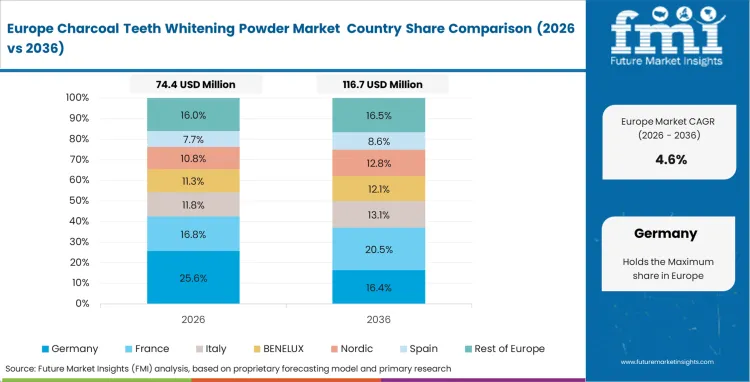
Cosmetic oral-care products in this region face tighter expectations around ingredient safety, abrasivity tolerance, labeling discipline, and retail acceptability, which raises the cost of market entry and limits the spread of loosely positioned low-cost powders. Demand remains present, but it is filtered through a more evidence-conscious buying environment where whitening claims must stay measured, and daily-use credibility matters more than visual hype. Regional growth is steadier than in less regulated markets, with adoption favoring brands that can combine acceptable stain-removal performance with a cleaner safety profile.
- United Kingdom: Clinical caution shapes demand in the United Kingdom, where charcoal teeth whitening powder industry is expected to rise at a CAGR of 6.4% from 2026 to 2036. Abrasive whitening formats face closer consumer and retail scrutiny here than more familiar oral-care products. Messaging works better when positioned around gradual daily brightening and manageable cosmetic upkeep rather than aggressive whitening transformation.
- Germany: Science-driven purchase behavior keeps Germany more selective, especially in oral-care categories where routine use and enamel tolerance influence acceptance. Powder formats gain better traction when the formulation profile appears more balanced and less abrasive in consumer perception, which narrows the market for purely trend-led offerings. Sales of charcoal teeth whitening powder in Germany are projected to increase at a CAGR of 5.8%. Slower expansion here still carries value because brands that meet this standard can build stronger long-term trust in a market that rewards product discipline over rapid cosmetic positioning.
FMI’s report also includes adoption mapping across France, Italy, Spain, and the Rest of Western Europe. France and Italy remain relevant where premium personal-care spending and pharmacy-led oral-care distribution support niche whitening formats, while Spain adds value through broader consumer uptake of affordable cosmetic care in mass and specialty retail.
North America Charcoal Teeth Whitening Powder Market Analysis
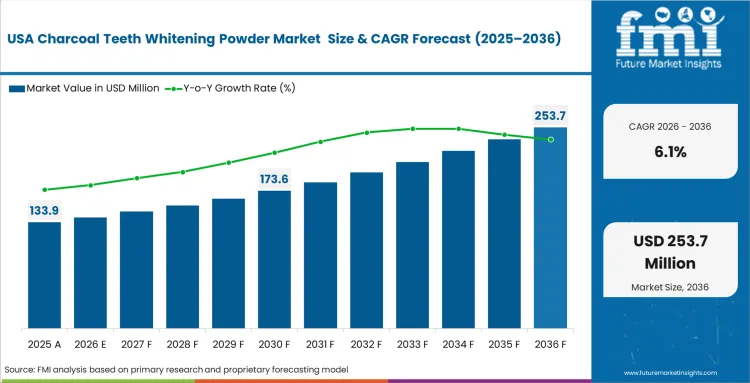
Established peroxide-led whitening formats shape buyer expectations across North America, which leaves charcoal powders positioned more as a natural alternative than as a mainstream efficacy substitute. Demand is concentrated among consumers seeking simpler ingredient profiles, peroxide-free routines, and cosmetic stain management outside professionally oriented whitening pathways. Market expansion remains possible, but conversion is narrower here because performance comparison against strips, gels, and other chemically active formats is more direct than in less mature whitening markets. Commercial success depends less on broad whitening claims and more on clear positioning around ingredient familiarity, routine use, and acceptable daily-care fit.
- United States: Natural-positioned oral care remains the clearest opening in the United States, where charcoal powders appeal most to consumers deliberately avoiding synthetic or peroxide-based whitening products. Product acceptance improves when these formats are sold within broader wellness and clean-label oral-care ecosystems rather than against conventional dentifrice performance benchmarks alone, especially in retail environments that already carry adjacent formats such as mouthwash tablets. Charcoal teeth whitening powder in the United States is expected to rise at a 6.1% CAGR by 2036. Staying power in this market will depend on whether brands can maintain distinct positioning, defend repeat-purchase economics, and remain relevant within a wider set of alternative oral-care options.
FMI’s report also includes a cross-category assessment of Canada. Canada remains relevant where natural-positioned oral-care demand, pharmacy-led distribution, and preference for cleaner ingredient profiles support steady niche adoption across alternative whitening formats.
Competitive Aligners for Market Players
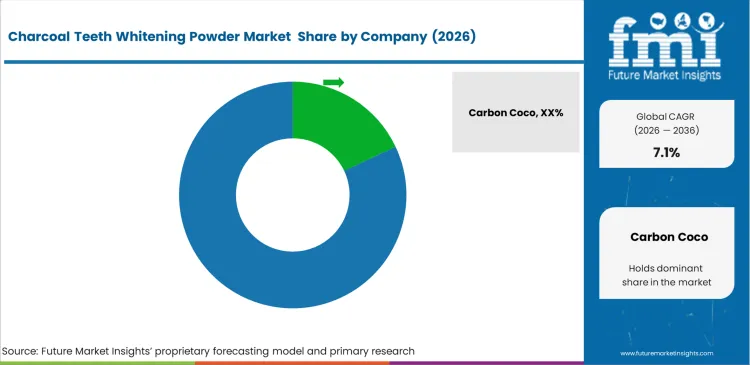
Competition in this market centers more on digital customer acquisition efficiency than on proprietary clinical technology. Direct-to-consumer brands such as Carbon Coco and Georganics operate with limited protection from patent-based differentiation because activated carbon itself is not a defendable active in the same way as a specialized whitening compound. Brand visibility shifts toward whichever company manages social conversion most efficiently through packaging, positioning, and aesthetic appeal. This keeps newer names such as Habbits and Deyga in a constant cycle of campaign renewal, while larger legacy players often find it harder to adapt established brand language to fast-moving visual platforms.
Larger oral-care companies still retain advantages in testing capability and supplier discipline, but those strengths do not always translate cleanly into a category driven heavily by impulse-led cosmetic buying. Longstanding relationships across dental and oral-care supply networks, including specialized dental supplies share vendors, can support tighter control over abrasivity standards and formulation consistency, which smaller competitors may struggle to match. Independent brands such as Procoal and Apollo Noni offset that disadvantage by leaning more heavily on simple ingredient stories that resonate with consumers who remain wary of chemically dense formulations. Commercial separation depends less on technical exclusivity and more on whether brands can maintain profitable acquisition across crowded digital channels.
Retail distribution adds a different layer of pressure because pharmacy and store buyers tend to favor formulations that reduce liability concerns. Higher-abrasion pure powders face greater resistance than blended products that incorporate remineralizing or moderating components. This keeps many smaller operators concentrated in online channels unless they invest further in formulation development and safety support. Product strategy continues to balance visible stain-removal performance against longer-term enamel tolerance. Brands built around immediate cosmetic payoff may win faster digital trial, while safer and more balanced formulas are better placed to secure lasting retail acceptance.
Key Players in Charcoal Teeth Whitening Powder Market
- Carbon Coco
- Procoal
- Georganics
- HealthVit
- Deyga
- Habbits
- Apollo Noni
Scope of the Report
| Metric | Value |
|---|---|
| Quantitative Units | USD 290.0 Million to USD 575.9 Million, at a CAGR of 7.10% |
| Market Definition | Charcoal teeth whitening powder functions as a dry abrasive oral care compound utilizing activated carbon's porous structure to physically lift extrinsic stains from enamel surfaces, avoiding chemical bleaching agents. |
| Segmentation | Formulation, Source Material, Distribution Channel, Price Tier, Application, and Region |
| Regions Covered | North America, Latin America, Western Europe, Eastern Europe, East Asia, South Asia and Pacific, Middle East and Africa |
| Countries Covered | United States, United Kingdom, Germany, Japan, China, India, Brazil |
| Key Companies Profiled | Carbon Coco, Procoal, Georganics, HealthVit, Deyga, Habbits, Apollo Noni |
| Forecast Period | 2026 to 2036 |
| Approach | Direct-to-consumer shipment volumes for loose powder oral formats anchor baseline calculations. |
Source: Future Market Insights (FMI) analysis, based on proprietary forecasting model and primary research
Charcoal Teeth Whitening Powder Market Analysis by Segments
Formulation
- Pure Charcoal
- Herbal Blend
- Mineral Blend
Source Material
- Coconut Shell
- Bamboo
- Hardwood
Distribution Channel
- Online Retail
- Pharmacies
- Specialty Stores
- Dental Clinics
Price Tier
- Mid-Priced
- Mass
- Premium
Application
- Surface Stain Removal
- Daily Brightening
- Tobacco Stain Care
Region
- North America
- United States
- Canada
- Latin America
- Brazil
- Mexico
- Rest of Latin America
- Western Europe
- Germany
- United Kingdom
- France
- Italy
- Spain
- Rest of Western Europe
- Eastern Europe
- Russia
- Poland
- Rest of Eastern Europe
- East Asia
- China
- Japan
- South Korea
- South Asia and Pacific
- India
- ASEAN
- Oceania
- Rest of South Asia and Pacific
- Middle East and Africa
- GCC Countries
- South Africa
- Rest of Middle East and Africa
Bibliography
- American Dental Association. (2025, January). Whitening. American Dental Association.
- Bardellini, E., et al. (2025, February). Effectiveness of activated charcoal toothpaste vs. 6% hydrogen peroxide whitening pen in tooth whitening. PubMed Central.
- Dabur India Limited. (2025, March). Dabur India Limited annual report 2024-25. Dabur India.
- DailyMed. (2024, June). TEETH WHITENING POWDER powder. USA National Library of Medicine.
- Hindustan Unilever Limited. (2025, March). Integrated annual report 2024-25. Hindustan Unilever.
- Polan, M. N., et al. (2025, March). Effects of different charcoal-containing whitening toothpastes on coffee-induced discoloration and surface roughness. PubMed Central.
- Ribeiro, E. P., et al. (2024, August). Whitening efficacy of activated charcoal-based products. PubMed.
- Santos, G. C., et al. (2024, September). Does the whitening dentifrice containing activated charcoal affect the enamel surface roughness, microhardness, and color change?. PubMed Central.
- Wiktorski, C. A., et al. (2024, November). The effect of charcoal-based dentifrice and conventional whitening toothpastes on color stability and surface roughness of composite resin. Dentistry Journal.
This bibliography is provided for reader reference. The full FMI report contains the complete reference list with primary source documentation.
This Report Addresses
- Strategy directors evaluating direct-to-consumer acquisition costs against traditional pharmacy placement fees.
- Procurement teams sourcing private label charcoal teeth whitening powder to scale new retail product lines.
- R&D managers reformulating abrasive dry carbon powders to meet emergent clinical safety standards.
- Retail buyers sourcing wholesale activated charcoal teeth whitening powder for regional pharmacy expansion.
- Marketing executives building visual demonstration campaigns bypassing legacy dentifrice distribution channels.
- Formulators balancing pure ingredient claims with required anti-caking synthetic additives.
- Supply chain planners locking in high-porosity cosmetic-grade carbon contracts ahead of peak demand cycles.
- Category managers navigating tensions between consumer aesthetic demands and dental association warnings.
Frequently Asked Questions
What is the current size of the charcoal teeth whitening powder market?
Direct-to-consumer shipment volumes for cosmetic powders establish our USD 290.0 million valuation for 2026. Social commerce impulse buys drive immediate trial, pulling revenue forward despite high long-term churn rates.
How fast is the charcoal teeth whitening powder market growing?
Regulatory restrictions on peroxide concentrations force brands toward mechanical alternatives, sustaining a 7.10% compound growth rate. Consumers seeking aesthetic upgrades without clinical dental costs maintain steady replacement cycles for these accessible formats.
Is charcoal teeth whitening powder safer than peroxide whitening?
Dental professionals warn that mechanical abrasion physically removes enamel over time, creating irreversible sensitivity. Peroxide chemically alters intrinsic tooth color without physical scratching, making pure carbon powders clinically vulnerable despite their natural positioning.
Does charcoal teeth whitening powder really work for deep stains?
Particle sizes are engineered to shear away soft pellicle layers where coffee pigments accumulate on the surface. Mechanical abrasion cannot alter intrinsic dentin color underneath, meaning efficacy plateaus completely once extrinsic stain layers vanish.
Which countries should suppliers target for charcoal whitening powder?
Indian startups leverage unregulated digital distribution to capture first-time cosmetic buyers rapidly. Sourcing directors expanding into East Asia must navigate intense pricing competition driven by massive internal coconut processing infrastructure in China.
How should buyers compare charcoal powder vs whitening toothpaste?
Category managers recognize shoppers remain hesitant to apply ultra-cheap raw abrasives. Toothpaste suspends carbon within liquid binders, significantly reducing actual abrasion while adding protective fluoride, making pastes safer for daily routines than dry powders.
What are the main restraints on category expansion?
Pharmacy buyers fear liability regarding enamel degradation. Without standardized remineralizing agents, aggressive abrasives fail to secure shelf space next to clinically validated daily pastes.
Why do dentists discourage charcoal whitening powder?
Professional practitioners prioritize intrinsic dentin shade changes requiring peroxide chemistry. Mechanical powders offer only temporary extrinsic improvement while risking severe structural enamel damage during prolonged usage cycles.
Who are the top companies in charcoal teeth whitening powder?
Nimble direct-to-consumer operators like Carbon Coco, Procoal, and Georganics bypass traditional patent moats by focusing purely on branding. Legacy dentifrice conglomerates generally avoid pure powders entirely due to medical liability concerns.
Why does online retail dominate this category?
Algorithmic social media targeting allows digital marketers to leverage high-contrast visual demonstrations. Direct fulfillment bypasses traditional pharmacy gatekeepers, letting startup brands test multiple packaging variants without committing to massive retail slotting fees.
How do premium brands differentiate identical active ingredients?
Operations managers invest heavily in proprietary delivery systems. Standardizing abrasive doses through single-use pods eliminates associated sink mess factors driving consumer complaints.
What limits pure charcoal adoption across mass retail?
Risk-averse pharmacy chains demand extensive enamel micro-hardness documentation. Unblended formats failing to provide independent safety verification lose shelf allocations to scientifically validated oral care routines.
Why do coconut shell derivatives dominate supply chains?
Specific microporosity geometry matches common dietary stain molecules perfectly. Procurement teams favor this base because it requires less per-use volume to achieve visible shear on pellicle layers.
How do mid-priced formulations defend their share?
Brands optimize aesthetic jar packaging while utilizing standard bulk carbon processing. This balances perceived consumer risk with impulse-purchase affordability without sacrificing product margins.
What stops hardwood carbon from taking volume share?
Inconsistent pore structures require longer brushing durations for equivalent efficacy. Formulation chemists reject hardwood because it generates higher consumer complaints regarding lack of results.
How do brands manage post-brushing sensitivity complaints?
Customer success teams aggressively push alternating days brushing schedules. This operational workaround attempts to mitigate enamel wear without reformulating underlying abrasive products.
What role do specialty stores play in channel mixes?
Independent beauty retailers act as validation nodes for digital brands. Placing product in these curated environments provides prestige required to justify premium pricing online.
What shifts when standard abrasivity testing becomes mandatory?
Mass-market retail adoption accelerates immediately. Clear clinical thresholds allow risk-averse pharmacy chains to stock products alongside traditional toothpastes without liability concerns.
Why is tobacco stain care isolated as a distinct application?
Heavy tar accumulation requires larger particle sizing. Product engineers formulate specifically for this demographic, accepting higher enamel wear risk for necessary visual results.
Where does actual margin exist in this supply chain?
Raw material costs remain negligible. Profitability depends entirely on lowering digital customer acquisition costs below lifetime values generated by two-jar subscription cycles.
How do supply chain directors mitigate harvest volatility?
Inventory planners secure multi-year contracts with specialized high-temperature kilns in Southeast Asia. This shields margins from sudden raw coconut shell price spikes during poor agricultural yields.
What forces formulators away from 100% pure claims?
Unblended powders absorb ambient bathroom humidity rapidly. R&D directors must eventually introduce synthetic anti-caking agents preventing complete product failure during customer storage.
Preview the report firsthand - request a free sample
Get SampleGet the brochure for pricing and purchase details.
Get PDFTable of Content
- Executive Summary
- Global Market Outlook
- Demand-side Trends
- Supply-side Trends
- Technology Roadmap Analysis
- Analysis and Recommendations
- Market Overview
- Market Coverage / Taxonomy
- Market Definition / Scope / Limitations
- Research Methodology
- Chapter Orientation
- Analytical Lens and Working Hypotheses
- Market Structure, Signals, and Trend Drivers
- Benchmarking and Cross-market Comparability
- Market Sizing, Forecasting, and Opportunity Mapping
- Research Design and Evidence Framework
- Desk Research Programme (Secondary Evidence)
- Company Annual and Sustainability Reports
- Peer-reviewed Journals and Academic Literature
- Corporate Websites, Product Literature, and Technical Notes
- Earnings Decks and Investor Briefings
- Statutory Filings and Regulatory Disclosures
- Technical White Papers and Standards Notes
- Trade Journals, Industry Magazines, and Analyst Briefs
- Conference Proceedings, Webinars, and Seminar Materials
- Government Statistics Portals and Public Data Releases
- Press Releases and Reputable Media Coverage
- Specialist Newsletters and Curated Briefings
- Sector Databases and Reference Repositories
- FMI Internal Proprietary Databases and Historical Market Datasets
- Subscription Datasets and Paid Sources
- Social Channels, Communities, and Digital Listening Inputs
- Additional Desk Sources
- Expert Input and Fieldwork (Primary Evidence)
- Primary Modes
- Qualitative Interviews and Expert Elicitation
- Quantitative Surveys and Structured Data Capture
- Blended Approach
- Why Primary Evidence is Used
- Field Techniques
- Interviews
- Surveys
- Focus Groups
- Observational and In-context Research
- Social and Community Interactions
- Stakeholder Universe Engaged
- C-suite Leaders
- Board Members
- Presidents and Vice Presidents
- R&D and Innovation Heads
- Technical Specialists
- Domain Subject-matter Experts
- Scientists
- Physicians and Other Healthcare Professionals
- Governance, Ethics, and Data Stewardship
- Research Ethics
- Data Integrity and Handling
- Primary Modes
- Tooling, Models, and Reference Databases
- Desk Research Programme (Secondary Evidence)
- Data Engineering and Model Build
- Data Acquisition and Ingestion
- Cleaning, Normalisation, and Verification
- Synthesis, Triangulation, and Analysis
- Quality Assurance and Audit Trail
- Market Background
- Market Dynamics
- Drivers
- Restraints
- Opportunity
- Trends
- Scenario Forecast
- Demand in Optimistic Scenario
- Demand in Likely Scenario
- Demand in Conservative Scenario
- Opportunity Map Analysis
- Product Life Cycle Analysis
- Supply Chain Analysis
- Investment Feasibility Matrix
- Value Chain Analysis
- PESTLE and Porter’s Analysis
- Regulatory Landscape
- Regional Parent Market Outlook
- Production and Consumption Statistics
- Import and Export Statistics
- Market Dynamics
- Global Market Analysis 2021 to 2025 and Forecast, 2026 to 2036
- Historical Market Size Value (USD Million) Analysis, 2021 to 2025
- Current and Future Market Size Value (USD Million) Projections, 2026 to 2036
- Y-o-Y Growth Trend Analysis
- Absolute $ Opportunity Analysis
- Global Market Pricing Analysis 2021 to 2025 and Forecast 2026 to 2036
- Global Market Analysis 2021 to 2025 and Forecast 2026 to 2036, By Formulation
- Introduction / Key Findings
- Historical Market Size Value (USD Million) Analysis By Formulation , 2021 to 2025
- Current and Future Market Size Value (USD Million) Analysis and Forecast By Formulation , 2026 to 2036
- Pure Charcoal
- Herbal Blend
- Mineral Blend
- Pure Charcoal
- Y-o-Y Growth Trend Analysis By Formulation , 2021 to 2025
- Absolute $ Opportunity Analysis By Formulation , 2026 to 2036
- Global Market Analysis 2021 to 2025 and Forecast 2026 to 2036, By Source Material
- Introduction / Key Findings
- Historical Market Size Value (USD Million) Analysis By Source Material, 2021 to 2025
- Current and Future Market Size Value (USD Million) Analysis and Forecast By Source Material, 2026 to 2036
- Coconut Shell
- Bamboo
- Hardwood
- Coconut Shell
- Y-o-Y Growth Trend Analysis By Source Material, 2021 to 2025
- Absolute $ Opportunity Analysis By Source Material, 2026 to 2036
- Global Market Analysis 2021 to 2025 and Forecast 2026 to 2036, By Distribution Channel
- Introduction / Key Findings
- Historical Market Size Value (USD Million) Analysis By Distribution Channel, 2021 to 2025
- Current and Future Market Size Value (USD Million) Analysis and Forecast By Distribution Channel, 2026 to 2036
- Online Retail
- Pharmacies
- Specialty Stores
- Online Retail
- Y-o-Y Growth Trend Analysis By Distribution Channel, 2021 to 2025
- Absolute $ Opportunity Analysis By Distribution Channel, 2026 to 2036
- Global Market Analysis 2021 to 2025 and Forecast 2026 to 2036, By Price Tier
- Introduction / Key Findings
- Historical Market Size Value (USD Million) Analysis By Price Tier, 2021 to 2025
- Current and Future Market Size Value (USD Million) Analysis and Forecast By Price Tier, 2026 to 2036
- Mid-Priced
- Mass
- Premium
- Mid-Priced
- Y-o-Y Growth Trend Analysis By Price Tier, 2021 to 2025
- Absolute $ Opportunity Analysis By Price Tier, 2026 to 2036
- Global Market Analysis 2021 to 2025 and Forecast 2026 to 2036, By Region
- Introduction
- Historical Market Size Value (USD Million) Analysis By Region, 2021 to 2025
- Current Market Size Value (USD Million) Analysis and Forecast By Region, 2026 to 2036
- North America
- Latin America
- Western Europe
- Eastern Europe
- East Asia
- South Asia and Pacific
- Middle East & Africa
- Market Attractiveness Analysis By Region
- North America Market Analysis 2021 to 2025 and Forecast 2026 to 2036, By Country
- Historical Market Size Value (USD Million) Trend Analysis By Market Taxonomy, 2021 to 2025
- Market Size Value (USD Million) Forecast By Market Taxonomy, 2026 to 2036
- By Country
- USA
- Canada
- Mexico
- By Formulation
- By Source Material
- By Distribution Channel
- By Price Tier
- By Country
- Market Attractiveness Analysis
- By Country
- By Formulation
- By Source Material
- By Distribution Channel
- By Price Tier
- Key Takeaways
- Latin America Market Analysis 2021 to 2025 and Forecast 2026 to 2036, By Country
- Historical Market Size Value (USD Million) Trend Analysis By Market Taxonomy, 2021 to 2025
- Market Size Value (USD Million) Forecast By Market Taxonomy, 2026 to 2036
- By Country
- Brazil
- Chile
- Rest of Latin America
- By Formulation
- By Source Material
- By Distribution Channel
- By Price Tier
- By Country
- Market Attractiveness Analysis
- By Country
- By Formulation
- By Source Material
- By Distribution Channel
- By Price Tier
- Key Takeaways
- Western Europe Market Analysis 2021 to 2025 and Forecast 2026 to 2036, By Country
- Historical Market Size Value (USD Million) Trend Analysis By Market Taxonomy, 2021 to 2025
- Market Size Value (USD Million) Forecast By Market Taxonomy, 2026 to 2036
- By Country
- Germany
- UK
- Italy
- Spain
- France
- Nordic
- BENELUX
- Rest of Western Europe
- By Formulation
- By Source Material
- By Distribution Channel
- By Price Tier
- By Country
- Market Attractiveness Analysis
- By Country
- By Formulation
- By Source Material
- By Distribution Channel
- By Price Tier
- Key Takeaways
- Eastern Europe Market Analysis 2021 to 2025 and Forecast 2026 to 2036, By Country
- Historical Market Size Value (USD Million) Trend Analysis By Market Taxonomy, 2021 to 2025
- Market Size Value (USD Million) Forecast By Market Taxonomy, 2026 to 2036
- By Country
- Russia
- Poland
- Hungary
- Balkan & Baltic
- Rest of Eastern Europe
- By Formulation
- By Source Material
- By Distribution Channel
- By Price Tier
- By Country
- Market Attractiveness Analysis
- By Country
- By Formulation
- By Source Material
- By Distribution Channel
- By Price Tier
- Key Takeaways
- East Asia Market Analysis 2021 to 2025 and Forecast 2026 to 2036, By Country
- Historical Market Size Value (USD Million) Trend Analysis By Market Taxonomy, 2021 to 2025
- Market Size Value (USD Million) Forecast By Market Taxonomy, 2026 to 2036
- By Country
- China
- Japan
- South Korea
- By Formulation
- By Source Material
- By Distribution Channel
- By Price Tier
- By Country
- Market Attractiveness Analysis
- By Country
- By Formulation
- By Source Material
- By Distribution Channel
- By Price Tier
- Key Takeaways
- South Asia and Pacific Market Analysis 2021 to 2025 and Forecast 2026 to 2036, By Country
- Historical Market Size Value (USD Million) Trend Analysis By Market Taxonomy, 2021 to 2025
- Market Size Value (USD Million) Forecast By Market Taxonomy, 2026 to 2036
- By Country
- India
- ASEAN
- Australia & New Zealand
- Rest of South Asia and Pacific
- By Formulation
- By Source Material
- By Distribution Channel
- By Price Tier
- By Country
- Market Attractiveness Analysis
- By Country
- By Formulation
- By Source Material
- By Distribution Channel
- By Price Tier
- Key Takeaways
- Middle East & Africa Market Analysis 2021 to 2025 and Forecast 2026 to 2036, By Country
- Historical Market Size Value (USD Million) Trend Analysis By Market Taxonomy, 2021 to 2025
- Market Size Value (USD Million) Forecast By Market Taxonomy, 2026 to 2036
- By Country
- Kingdom of Saudi Arabia
- Other GCC Countries
- Turkiye
- South Africa
- Other African Union
- Rest of Middle East & Africa
- By Formulation
- By Source Material
- By Distribution Channel
- By Price Tier
- By Country
- Market Attractiveness Analysis
- By Country
- By Formulation
- By Source Material
- By Distribution Channel
- By Price Tier
- Key Takeaways
- Key Countries Market Analysis
- USA
- Pricing Analysis
- Market Share Analysis, 2025
- By Formulation
- By Source Material
- By Distribution Channel
- By Price Tier
- Canada
- Pricing Analysis
- Market Share Analysis, 2025
- By Formulation
- By Source Material
- By Distribution Channel
- By Price Tier
- Mexico
- Pricing Analysis
- Market Share Analysis, 2025
- By Formulation
- By Source Material
- By Distribution Channel
- By Price Tier
- Brazil
- Pricing Analysis
- Market Share Analysis, 2025
- By Formulation
- By Source Material
- By Distribution Channel
- By Price Tier
- Chile
- Pricing Analysis
- Market Share Analysis, 2025
- By Formulation
- By Source Material
- By Distribution Channel
- By Price Tier
- Germany
- Pricing Analysis
- Market Share Analysis, 2025
- By Formulation
- By Source Material
- By Distribution Channel
- By Price Tier
- UK
- Pricing Analysis
- Market Share Analysis, 2025
- By Formulation
- By Source Material
- By Distribution Channel
- By Price Tier
- Italy
- Pricing Analysis
- Market Share Analysis, 2025
- By Formulation
- By Source Material
- By Distribution Channel
- By Price Tier
- Spain
- Pricing Analysis
- Market Share Analysis, 2025
- By Formulation
- By Source Material
- By Distribution Channel
- By Price Tier
- France
- Pricing Analysis
- Market Share Analysis, 2025
- By Formulation
- By Source Material
- By Distribution Channel
- By Price Tier
- India
- Pricing Analysis
- Market Share Analysis, 2025
- By Formulation
- By Source Material
- By Distribution Channel
- By Price Tier
- ASEAN
- Pricing Analysis
- Market Share Analysis, 2025
- By Formulation
- By Source Material
- By Distribution Channel
- By Price Tier
- Australia & New Zealand
- Pricing Analysis
- Market Share Analysis, 2025
- By Formulation
- By Source Material
- By Distribution Channel
- By Price Tier
- China
- Pricing Analysis
- Market Share Analysis, 2025
- By Formulation
- By Source Material
- By Distribution Channel
- By Price Tier
- Japan
- Pricing Analysis
- Market Share Analysis, 2025
- By Formulation
- By Source Material
- By Distribution Channel
- By Price Tier
- South Korea
- Pricing Analysis
- Market Share Analysis, 2025
- By Formulation
- By Source Material
- By Distribution Channel
- By Price Tier
- Russia
- Pricing Analysis
- Market Share Analysis, 2025
- By Formulation
- By Source Material
- By Distribution Channel
- By Price Tier
- Poland
- Pricing Analysis
- Market Share Analysis, 2025
- By Formulation
- By Source Material
- By Distribution Channel
- By Price Tier
- Hungary
- Pricing Analysis
- Market Share Analysis, 2025
- By Formulation
- By Source Material
- By Distribution Channel
- By Price Tier
- Kingdom of Saudi Arabia
- Pricing Analysis
- Market Share Analysis, 2025
- By Formulation
- By Source Material
- By Distribution Channel
- By Price Tier
- Turkiye
- Pricing Analysis
- Market Share Analysis, 2025
- By Formulation
- By Source Material
- By Distribution Channel
- By Price Tier
- South Africa
- Pricing Analysis
- Market Share Analysis, 2025
- By Formulation
- By Source Material
- By Distribution Channel
- By Price Tier
- USA
- Market Structure Analysis
- Competition Dashboard
- Competition Benchmarking
- Market Share Analysis of Top Players
- By Region
- By Formulation
- By Source Material
- By Distribution Channel
- By Price Tier
- Competition Analysis
- Competition Deep Dive
- Carbon Coco
- Overview
- Product Portfolio
- Profitability by Market Segments (Product/Age /Sales Channel/Region)
- Sales Footprint
- Strategy Overview
- Marketing Strategy
- Product Strategy
- Channel Strategy
- Procoal
- Georganics
- HealthVit
- Deyga
- Habbits
- Carbon Coco
- Competition Deep Dive
- Assumptions & Acronyms Used


